1 Negligence 1 Negligence
1.1 Introduction 1.1 Introduction
1.1.1 The Size of the Torts System 1.1.1 The Size of the Torts System
One way to glimpse the tort system in the aggregate is to look at the total amount of money passing through the American tort system each year. It is here that little cases like Vosburg connect up to the heated political controversies over tort law in the past several decades.
Insurers estimate that the money transferred in the tort system amounts to more than $260 billion per year. This is a huge amount of money, comparable to the amount the United States spends annually on old age pensions in the Social Security system. Moreover, if we look at the amount of money flowing through the tort system, we can see that it has increased sharply over the past sixty years, though that growth has slowed (and by some measures has been reversed) since the middle of the 1990s.
UNITED STATES TORT COSTS
| Year | U.S. Population (millions) | Adjusted Tort Costs (billions) (2010) | Tort Costs as a Percentage of GDP |
| 1950 | 152 | 16 | 0.62% |
| 1960 | 181 | 40 | 1.03% |
| 1970 | 205 | 78 | 1.34% |
| 1980 | 228 | 113 | 1.53% |
| 1990 | 249 | 217 | 2.24% |
| 2000 | 281 | 227 | 1.80% |
| 2010 | 309 | 265 | 1.82% |
Source: Towers-Watson, 2011 Update on U.S. Tort Cost Trends, https://perma.cc/4EGK-VXBY.
Even with the slower growth of recent years, the figures for transfers and administrative costs in tort law are far higher in the United States than in any comparable legal system or economy.
COMPARATIVE TORT COSTS AS A PERCENTAGE OF GDP IN 2000
| Country | Tort Costs as a Percentage of National GDP (2000) |
| United States | 2.2% |
| Italy | 1.7% |
| Germany | 1.1% |
| Spain | 1.0% |
| Belgium | 1.0% |
| Japan | 0.8% |
| Switzerland | 0.8% |
| United Kingdom | 0.7% |
| France | 0.7% |
| Denmark | 0.6% |
| Poland | 0.6% |
Source: Tillinghast-Towers Perrin, U.S. Tort Costs and Cross-Border Perspectives: 2005
Update.
There is at least one country where tort costs as a percentage of GDP are near zero: New Zealand simply abolished tort law for virtually all injuries forty years ago, replacing it with a system of social insurance.
One of the things we will want to be able to make sense of by the end of this book is why the tort system is so much bigger in the United States than it is in other countries. The answer, it turns out, is not about the substantive doctrines of American tort law, which more or less resemble the substantive tort doctrines of other developed legal systems. The real difference in American tort law lies in its institutions and procedures: jury trials, discovery, a plaintiffs’ bar whose fees are contingent percentages of the plaintiff’s ultimate recovery, and relatively restrictive programs of social provision. One recent study of 24 countries, for example, finds a strong negative relationship between the generosity of government social programs, on the one hand, and tort liability, on the other, after controlling for income, accident rates, and other factors. See Dana A. Kerr, Yu-Luen Ma, & Joan T. Schmit, A Cross-National Study of Government Social Insurance as an Alternative to Tort Liability Compensation, 76 J. RISK & INSURANCE 367 (2009).
It is worth noting that the data cited above, regarding torts costs in the U.S., is hotly controversial: it comes from a consultant to the insurance industry now named Towers-Watson, formerly Tillinghast or Towers-Perrin. Critics contend that the Towers-Watson data is misleading and tendentious and that the insurance industry aims to use it to promote legislation that would reduce tort costs and thus serve the interests of insurers and the tort defendants they insure. See, e.g., Lawrence Chimerine & Ross Eisenbrey, The Frivolous Case for Tort Law Change, ECON. POL’Y INST. (May 16, 2005), https://perma.cc/6BRJ-UYP5. The critics complain both that certain elements of the cost calculation, such as insurance executive compensation, ought to be excluded, and that Towers-Watson and its predecessors misstate the concept of costs in the tort system. Both critiques have some force. The latter critique in particular has obvious merit. Why, after all, call the monetary transfers in the tort system the “costs” of tort law? The costs might much better be described as the underlying injuries plus avoidance costs plus the costs of administering claims when injuries happen. Is it a “cost” when tort law transfers money from wrongdoer to victim? Or is it a “cost” when a wrongdoer injured the victim in the first place? For a general theory of the sum of accident costs, see GUIDO CALABRESI, THE COSTS OF ACCIDENTS (1970).
Despite the criticisms, however, there is also a good reason to use the insurers’ data as a basic measure of the tort system. For the startling thing about tort law in the United States is that insurers’ private information is the only way we can even possibly begin to grasp the full size and scope of the tort system. This is worth emphasizing again: the biggest insurers and only the biggest insurers are in a position to see the macro trends in the field. The reason is that the pervasiveness of private settlement ensures that there is no public repository of information about the fate of most tort claims, sometimes virtually all tort claims. Nothing in the law of torts or in the law of settlement contracts even requires that a claim be filed with a court before it is contractually extinguished in a settlement agreement. To the contrary, the parties can save money on the cost of drafting and filing a complaint and share those savings between them if they settle before filing the claim in a courthouse. There is thus often not even a single trace in the public record of a tort claim, even one that produces a substantial settlement. Indeed, many plaintiffs receive higher settlement awards precisely in return for their promise to keep the terms of the settlement and even the fact of their claim confidential—promises that are enforceable under current law, despite the protests of many well-positioned observers.
In short, the only institutions that could possibly know the overall size of the American tort system are the insurers. And that tells us a lot about the system we are studying. It is party-driven, highly opaque, radically decentralized, and vast. Taken together, these features present the tort lawyer with an important challenge: What goals or moral projects could possibly be so important as to make U.S. tort law worth its stunningly high costs?
___
Reprinted from John Fabian Witt & Karen M. Tani, Torts: Cases, Principles, and Institutions, Fifth Edition, Published by CALI eLangdell Press. Available under a Creative Commons BY-NC-SA 4.0 License
1.1.2 Accident Rates and the Deterrence Goal 1.1.2 Accident Rates and the Deterrence Goal
One goal tort jurists often advance is the deterrence of unreasonably dangerous conduct. The logic here is simple and intuitively attractive. Tort law raises the price of injurious behavior. As a result, the logic goes, the prospect of tort liability should decrease the amount of injurious behavior in the world. Deterrence theory has further implications and wrinkles. We will return to these at a number of junctures later in the book. But the important point for now is that the risk of tort damages ought to lead rational parties to take into account the costs of their behavior in a way they might not, absent tort liability.
Of course, tort law is one of many regulatory mechanisms that aim to accomplish the goal of improving safety standards. Consider, for example, state inspection regimes for everything from housing code compliance to factory employment standards. The federal Food and Drug Administration seeks to guarantee the safety of pharmaceuticals and food products. The Federal Highway Administration’s Office of Safety issues regulations and guidelines with an eye toward automobile accidents. The Consumer Product Safety Commission does the same for consumer goods. Even aside from regulators, the market itself creates many incentives for safety on the part of market actors seeking to attract buyers, passengers, or clients.
Does tort law add to the deterrence function played by these other regulatory institutions? Formal evidence is considerably more difficult to come by, in no small part because of the difficulties described above in obtaining good information about the size and significance of tort costs. Nonetheless, anecdotal evidence suggests that in the United States tort law does shape behavior around risk and safety. We routinely read news stories about firms that claim to have made some decision—often an unpopular one—on the basis of the risk of litigation.
Consider the big picture trends in accidental and violent injuries over time. For the past half-century and more—precisely the time during which tort costs have soared—rates of accidental death have declined substantially. This is not to say that tort law has caused that decline. It might be the case that causation runs in the other direction: improvements in safety may have generated higher expectations of safety and thus led to heightened standards in tort law. Either way, the trend is striking. Since 1960, accidental deaths in the United States have fallen by nearly half.
| Year | Heart disease |
Cancer | Cerebro- vascular diseases |
Chronic lower respiratory diseases |
Diabetes mellitus |
Influenza and pneumonia |
Chronic liver disease and cirrhosis |
Accidents | Suicide | Homicide |
|---|---|---|---|---|---|---|---|---|---|---|
| 1960 | 559.0 | 193.9 | 177.9 | 12.5 | 22.5 | 53.7 | 13.3 | 63.1 | 12.5 | 5.2 |
| 1961 | 545.3 | 193.4 | 173.1 | 12.6 | 22.1 | 43.4 | 13.3 | 60.6 | 12.2 | 5.2 |
| 1962 | 556.9 | 193.3 | 174.0 | 14.2 | 22.6 | 47.1 | 13.8 | 62.9 | 12.8 | 5.4 |
| 1963 | 563.4 | 194.7 | 173.9 | 16.5 | 23.1 | 55.6 | 14.0 | 64.0 | 13.0 | 5.4 |
| 1964 | 543.3 | 193.6 | 167.0 | 16.3 | 22.5 | 45.4 | 14.2 | 64.1 | 12.7 | 5.7 |
| 1965 | 542.5 | 195.6 | 166.4 | 18.3 | 22.9 | 46.8 | 14.9 | 65.8 | 13.0 | 6.1 |
| 1966 | 541.2 | 196.5 | 165.8 | 19.2 | 23.6 | 47.9 | 15.9 | 67.6 | 12.7 | 6.5 |
| 1967 | 524.7 | 197.3 | 159.3 | 19.2 | 23.4 | 42.2 | 16.3 | 66.2 | 12.5 | 7.5 |
| 1968 | 531.0 | 198.8 | 162.5 | 20.7 | 25.3 | 52.8 | 16.9 | 65.6 | 12.4 | 8.1 |
| 1969 | 516.8 | 198.5 | 155.4 | 20.9 | 25.1 | 47.9 | 17.1 | 64.9 | 12.7 | 8.3 |
| 1970 | 492.7 | 198.6 | 147.7 | 21.3 | 24.3 | 41.7 | 17.8 | 62.2 | 13.1 | 9.0 |
| 1971 | 492.9 | 199.3 | 147.6 | 21.8 | 23.9 | 38.4 | 17.8 | 60.3 | 13.1 | 9.8 |
| 1972 | 490.2 | 200.3 | 147.3 | 22.8 | 23.7 | 41.3 | 18.0 | 60.2 | 13.3 | 10.0 |
| 1973 | 482.0 | 200.0 | 145.2 | 23.6 | 23.0 | 41.2 | 18.1 | 59.3 | 13.1 | 10.2 |
| 1974 | 458.8 | 201.5 | 136.8 | 23.2 | 22.1 | 35.5 | 17.9 | 52.7 | 13.2 | 10.5 |
| 1975 | 431.2 | 200.1 | 123.5 | 23.7 | 20.3 | 34.9 | 16.7 | 50.8 | 13.6 | 10.2 |
| 1976 | 426.9 | 202.5 | 117.4 | 24.9 | 19.5 | 36.8 | 16.4 | 48.7 | 13.2 | 9.2 |
| 1977 | 413.7 | 203.5 | 110.4 | 24.7 | 18.2 | 31.0 | 15.8 | 48.8 | 13.7 | 9.2 |
| 1978 | 409.9 | 204.9 | 103.7 | 26.3 | 18.3 | 34.5 | 15.2 | 48.9 | 12.9 | 9.2 |
| 1979 | 401.6 | 204.0 | 97.1 | 25.5 | 17.5 | 26.1 | 14.8 | 46.5 | 12.6 | 9.9 |
| 1980 | 412.1 | 207.9 | 96.4 | 28.3 | 18.1 | 31.4 | 15.1 | 46.4 | 12.2 | 10.5 |
| 1981 | 397.0 | 206.4 | 89.5 | 29.0 | 17.6 | 30.0 | 14.2 | 43.4 | 12.3 | 10.1 |
| 1982 | 389.0 | 208.3 | 84.2 | 2.1 | 17.2 | 26.5 | 13.2 | 40.1 | 12.5 | 9.4 |
| 1983 | 388.9 | 209.1 | 81.2 | 31.6 | 17.6 | 29.8 | 12.8 | 39.1 | 12.4 | 8.4 |
| 1984 | 378.8 | 210.8 | 78.7 | 32.4 | 17.2 | 30.6 | 12.7 | 39.8 | 12.6 | 8.1 |
| 1985 | 375.0 | 211.3 | 76.6 | 34.5 | 17.4 | 34.5 | 12.3 | 38.5 | 12.5 | 8.0 |
| 1986 | 365.1 | 211.5 | 73.1 | 34.8 | 17.2 | 34.8 | 11.8 | 38.6 | 13.0 | 8.6 |
| 1987 | 355.9 | 211.7 | 71.6 | 35.0 | 17.4 | 33.8 | 11.7 | 38.2 | 12.8 | 8.3 |
| 1988 | 352.5 | 212.5 | 70.6 | 36.5 | 18.0 | 37.3 | 11.6 | 38.9 | 12.5 | 8.5 |
| 1989 | 332.0 | 214.2 | 66.9 | 36.6 | 20.5 | 35.9 | 11.6 | 37.7 | 12.3 | 8.8 |
| 1990 | 321.8 | 216.0 | 65.5 | 37.2 | 20.7 | 36.8 | 11.1 | 36.3 | 12.5 | 9.5 |
| 1991 | 313.8 | 215.8 | 63.2 | 38.0 | 20.7 | 34.9 | 10.7 | 34.9 | 12.3 | 10.1 |
| 1992 | 306.1 | 214.3 | 62.0 | 37.9 | 20.8 | 33.1 | 10.5 | 33.4 | 12.1 | 9.6 |
| 1993 | 309.9 | 214.6 | 63.1 | 40.9 | 22.0 | 35.2 | 10.3 | 34.5 | 12.2 | 9.8 |
| 1994 | 299.7 | 213.1 | 63.1 | 40.6 | 22.7 | 33.9 | 10.2 | 34.6 | 12.1 | 9.4 |
| 1995 | 296.3 | 211.7 | 63.9 | 40.5 | 23.4 | 33.8 | 10.0 | 34.9 | 12.0 | 8.6 |
| 1996 | 288.3 | 208.7 | 63.2 | 41.0 | 24.0 | 33.2 | 9.8 | 34.9 | 11.7 | 7.8 |
| 1997 | 280.4 | 205.7 | 61.8 | 41.5 | 24.0 | 33.6 | 9.6 | 34.8 | 11.4 | 7.3 |
| 1998 | 272.4 | 202.4 | 59.6 | 42.0 | 24.2 | 34.6 | 9.5 | 35.0 | 11.3 | 6.7 |
| 1999 | 267.8 | 202.7 | 61.8 | 45.8 | 25.2 | 23.6 | 9.7 | 35.9 | 10.7 | 6.2 |
| 2000 | 257.6 | 199.6 | 60.9 | 44.2 | 25.0 | 23.7 | 9.5 | 34.9 | 10.4 | 5.9 |
| 2001 | 247.8 | 196.0 | 57.9 | 43.7 | 25.3 | 22.0 | 9.5 | 35.7 | 10.7 | 7.1 |
| 2002 | 240.4 | 194.0 | 56.3 | 43.7 | 25.4 | 22.7 | 9.3 | 35.3 | 10.6 | 5.9 |
| 2003 | 232.3 | 190.1 | 53.5 | 43.3 | 25.3 | 22.0 | 9.3 | 37.3 | 10.8 | 6.0 |
| 2004 | 217.5 | 184.6 | 50.0 | 41.8 | 24.4 | 20.4 | 8.8 | 36.6 | 10.7 | 5.6 |
| 2005 | 220.0 | 188.7 | 48.4 | 37.8 | 25.3 | 21.3 | 9.3 | 39.7 | 11.0 | 5.6 |
| 2006 | 261.2 | 180.7 | 43.6 | 40.5 | 23.3 | 17.8 | 8.8 | 39.8 | 10.9 | 6.2 |
| 2007 | 190.7 | 177.5 | 41.6 | 41.2 | 22.4 | 16.3 | 8.9 | 37.8 | 10.8 | 5.8 |
| 2009 | 179.8 | 173.6 | 38.9 | 42.2 | 20.9 | 16.2 | 9.2 | 37.0 | 11.7 | 5.5 |
| 2011 | 173.7 | 168.6 | 37.9 | 42.7 | 21.5 | 15.7 | 9.7 | 38.0 | 12.0 | 5.2 |
Source: Statistical Abstracts of the U.S. (2014).
Much of this change continues a trend that began long before 1960. Excluding motor vehicle accidents, accidental deaths fell from around a hundred per 100,000 people in the population annually to less than thirty by 1975.
Even motor vehicle accidental death rates have dropped during the past sixty years.
| 1950 | 1960 | 1970 | 1980 | 1990 | 2000 | 2010 | 2018 | |
| Total Unintentional Injuries (per 100,000) |
78.0 | 62.3 | 60.1 | 46.4 | 36.3 | 34.9 | 38.0 | 48.0 |
| Motor Vehicle Related Injuries | 24.6 | 23.1 | 27.6 | 22.3 | 18.5 | 15.4 | 11.3 | 11.7 |
| Percetage of Total Unintentional Injuries | 31.5% | 37.1% | 45.9% | 48.1% | 50.1% | 44.1% | 29.7% | 24.4% |
Source: Center for Disease Control and Prevention, https://perma.cc/V87X-9W64.
If we adjust motor vehicle accidental death rates by miles traveled, the drop in motor vehicle traffic fatalities has been even more pronounced.
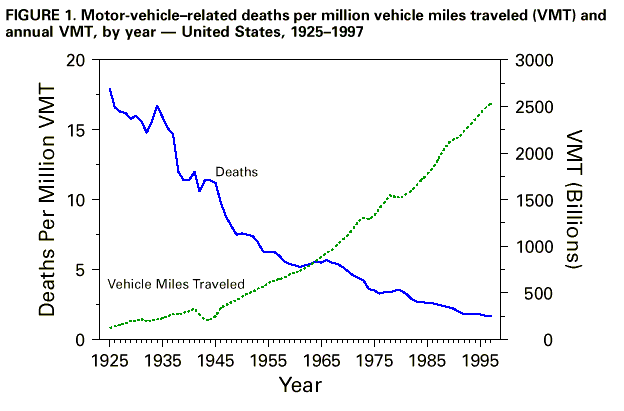
Source: Center for Disease Control and Prevention (link)
Yet if our goal in tort law is to deter unreasonably dangerous actions, as many observers argue it is or at least ought to be, the connections between deterrence and a case like Vosburg are not at all clear. Is it reasonable to think that the prospect of tort damages payments—or even the prospect of interminable tort litigation—will alter the behavior of children in a classroom? In this domain, at least, using tort law to induce appropriately safe behavior by children seems a fool’s errand, at least so long as we are trying to alter the behavior of children with monetary sanctions aimed at the children themselves. (Monetary awards against the school or the teachers might be far more effective, even if controversial for other reasons.)
Many scholars believe that the notion of tort damages shaping behavior is unlikely even in other domains where it might seem more plausible than in the middle-school classroom. We will return to this problem repeatedly in this book. For now, it is sufficient to observe that the critics point to a myriad of factors that they say get in the way of translating prospective tort damages into a safer behavior. Some parties are not susceptible to being incentivized in the relevant respect by cash. Others act irrationally. Still others act rationally and are responsive to monetary incentives, but are protected from tort damages by third parties who will pay the damages, such as liability insurers or employers. Some may be sheltered from the threat of paying tort damages because they have time horizons shorter than the 4-plus years that it took Vosburg to conclude.
This is not to say that deterrence is an impossible goal, or that deterrence ought not be thought of as an important function of tort law. We will see considerable support for the idea that tort damages do shape behavior in many contexts. Nonetheless, the effort to shape behavior and induce safety offers at best a partial justification for tort law.
___
Reprinted from John Fabian Witt & Karen M. Tani, Torts: Cases, Principles, and Institutions, Fifth Edition, Published by CALI eLangdell Press. Available under a Creative Commons BY-NC-SA 4.0 License.
1.1.3 Hammontree v. Jenner 1.1.3 Hammontree v. Jenner
[Civ. No. 38197.
Second Dist., Div, One.
Oct. 14, 1971.]
MAXINE HAMMONTREE et al., Plaintiffs and Appellants, v. THOMAS H. JENNER, Defendant and Respondent.
*529 Counsel
Hurley & Hurley and Joseph G. Hurley for Plaintiffs and Appellants.
LaFollette, Johnson, Horgan & Robinson, Patrick J. Hast, Horvitz & Minikes, Ellis J. Horvitz and Morton Minikes for Defendant and Respondent.
Opinion
LILLIE, J.
Plaintiffs Maxine Hammontree and her husband sued defendant for personal injuries and property damage arising out of an automobile *530 accident. The cause was tried to a jury. Plaintiffs appeal from judgment entered on a jury verdict returned against them and in favor of defendant.
The evidence shows that on the afternoon of April 25, 1967, defendant was driving his 1959 Chevrolet home from work; at the same time plaintiff Maxine Hammontree was working in a bicycle shop owned and operated by her and her husband; without warning defendant’s car crashed through the wall of the shop, struck Maxine and caused personal injuries and damage to the shop.
Defendant claimed he became unconscious during an epileptic seizure losing control of his car. He did not recall the accident but his last recollection before it, was leaving a stop light after his last stop, and his first recollection after the accident was being taken out of his car in plaintiffs’ shop. Defendant testified he has a medical history of epilepsy and knows of no other reason for his loss of consciousness except an epileptic seizure; prior to 1952 he had been examined by several neurologists whose conclusion was that the condition could be controlled and who placed him on medication; in 1952 he suffered a seizure while fishing; several days later he went to Dr. Benson Hyatt who diagnosed his condition as petit mal seizure and kept him on the same medication; thereafter he saw Dr. Hyatt every six months and then on a yearly basis several years prior to 1967; in 1953 he had another seizure, was told he was an epileptic and continued his medication; in 1954 Dr. Kershner prescribed dilantin and in 1955 Dr. Hyatt prescribed phelantin; from 1955 until the accident occurred (1967) defendant had used phelantin on a regular basis which controlled his condition; defendant has continued to take medication as prescribed by his physician and has done everything his doctors told him to do to avoid a seizure; he had no inkling or warning that he was about to have a seizure prior to the occurrence of the accident.
In 1955 or 1956 the Department of Motor Vehicles was advised that defendant was an epileptic and placed him on probation under which every six months he had to report to the doctor who was required to advise it in writing of defendant’s condition. In 1960 his probation was changed to a once-a-year report.
Dr. Hyatt testified that during the times he saw defendant, and according to his history, defendant “was doing normally” and that he continued to take phelantin; that “[t]he purpose of the [phelantin] would be to react on the nervous system in such a way that where, without the medication, I would say to raise the threshold so that he would not be as subject to these episodes without the medication, so as not to have the seizures. He would not be having the seizures with the medication as he would without *531 the medication compared to taking medication”; in a seizure it would be impossible for a person to drive and control an automobile; he believed it was safe for defendant to drive.
Appellants’ contentions that the trial court erred in refusing to grant their motion for summary judgment on the issue of liability and their motion for directed verdict on the pleadings and counsel’s opening argument are answered by the disposition of their third claim that the trial court committed prejudicial error in refusing to give their jury instruction on absolute liability. 1
Under the present state of the law found in appellate authorities beginning with Waters v. Pacific Coast Dairy, Inc., 55 Cal.App.2d 789, 791-793 [131 P.2d 588] (driver rendered unconscious from sharp pain in left arm and shoulder) through Ford v. Carew & English, 89 Cal.App.2d 199, 203-204 [200 P.2d 828] (fainting spells from strained heart muscles), Zabunoff v. Walker, 192 Cal.App.2d 8, 11 [13 Cal.Rptr. 463] (sudden sneeze), and Tannyhill v. Pacific Motor Trans. Co., 227 Cal.App.2d 512, 520 [38 Cal.Rptr. 774] (heart attack), the trial judge properly refused the instruction. The foregoing cases generally hold that liability of a driver, suddenly stricken by an illness rendering him unconscious, for injury resulting from an accident occurring during that time rests on principles of negligence. However, herein during the trial plaintiffs withdrew their claim of negligence and, after both parties rested and before jury argument, objected to the giving of any instructions on negligence electing to stand solely on the theory of absolute liability. The objection was overruled and the court refused plaintiffs’ requested instruction after which plaintiffs waived both opening and closing jury arguments. Defendant argued the cause to the jury after which the judge read a series of negligence instructions and, on his own motion, BAJI 4.02 (res ipsa loquitur).
Appellants seek to have this court override the established law of this state which is dispositive of the issue before us as outmoded in today’s social and economic structure, particularly in the light of the now recognized principles imposing liability upon the manufacturer, retailer and all distributive and vending elements and activities which bring a product to the consumer to his injury, on the basis of strict liability in tort expressed first in Justice Traynor’s concurring opinion in Escola v. Coca Cola Bot *532 tling Co., 24 Cal.2d 453, 461-468 [150 P.2d 436]; and then in Greenman v. Yuba Power Products, Inc., 59 Cal.2d 57 [27 Cal.Rptr. 697, 377 P.2d 897, 13 A.L.R.3d 1049]; Vandermark v. Ford Motor Co., 61 Cal.2d 256 [37 Cal.Rptr. 896, 391 P.2d 168]; and Elmore v. American Motors Corp., 70 Cal.2d 578 [75 Cal.Rptr. 652, 451 P.2d 84]. These authorities hold that “A manufacturer [or retailer] is strictly liable in tort when an article he places on the market, knowing that it is to be used without inspection for defects, proves to have a defect that causes injury to a human being.” (Greenman v. Yuba Power Products, Inc., supra, 59 Cal.2d 57, 62; Vandermark v. Ford Motor Co., supra, 61 Cal.2d 256, 260-261.) Drawing a parallel with these products liability cases, appellants argue, with some degree of logic, that only the driver affected by a physical condition which could suddenly render him unconscious and who is aware of that condition can anticipate the hazards and foresee the dangers involved in his operation of a motor vehicle, and that the liability of those who by reason of seizure or heart failure or’ some other physical condition lose the ability to safely operate and control a motor vehicle resulting in injury to an innocent person should be predicated on strict liability.
We decline to superimpose the absolute liability of products liability cases upon drivers under the circumstances here. The theory on which those cases are predicated is that manufacturers, retailers and distributors of products are engaged in the business of distributing goods to the public and are an. integral part of the over-all producing and marketing enterprise that should bear the cost of injuries from defective parts. (Vandermark v. Ford Motor Co., 61 Cal.2d 256, 262 [37 Cal.Rptr. 896, 391 P.2d 168]; Greenman v. Yuba Power Products, Inc., 59 Cal.2d 57, 63 [27 Cal. Rptr. 697, 377 P.2d 897, 13 A.L.R.3d 1049].) This policy hardly applies here and it is not enough to simply say, as do appellants, that the insurance carriers should be the ones to bear the cost of injuries to innocent victims on a strict liability basis. In Maloney v. Rath, 69 Cal.2d 442 [71 Cal.Rptr. 897, 445 P.2d 513], followed by Clark v. Dziabas, 69 Cal.2d 449 [71 Cal.Rptr. 901, 445 P.2d 517], appellant urged that defendant’s violation of a safety provision (defective brakes) of the Vehicle Code makes the violator strictly liable for damages caused by the violation. While reversing the judgment for defendant upon another ground, the California Supreme Court refused to apply the doctrine of strict liability to automobile drivers. The situation involved two users of the highway but the problems of fixing responsibility under, a system of strict liability are as complicated in the instant case as those in Maloney v. Rath (p. 447), and could only create uncertainty in the area of its concern. As stated in Maloney, at page 446; “To invoke a rule of strict liability on users of the streets and highways, however, without also establishing in substantial detail how the *533 new rule should operate would only contribute confusion to the automobile accident problem. Settlement and claims adjustment procedures would become chaotic until the new rules were worked out on a case-by-case basis, and the hardships of delayed compensation would be seriously intensified. Only the Legislature, if it deems it wise to do so, can avoid such difficulties by enacting a comprehensive plan for the compensation of automobile accident victims in place of or in addition to the law of negligence.”
The instruction tendered by appellants was properly refused for still another reason. Even assuming the merit of appellants’ position under the facts of this case in which defendant knew he had a history of epilepsy, previously had suffered seizures and at the time of the accident was attempting to control the condition by medication, the instruction does not except from its ambit the driver who suddenly is stricken by an illness or physical condition which he had no reason whatever to anticipate and of which he had no prior knowledge.
The judgment is affirmed.
Wood, P. J., and Thompson, J., concurred.
Appellants’ petition for a hearing by the Supreme Court was denied December 16,1971.
“When the evidence shows that a driver of a motor vehicle on a public street or highway loses his ability to safely operate and control such vehicle because of some seizure or health failure, that driver is nevertheless legally liable for all injuries and property damage which an innocent person may suffer as a proximate result of the defendant’s inability to so control or operate his motor vehicle. “This is true even if you find the defendant driver had no warning of any such impending seizure or health failure.”
1.2 Breach 1.2 Breach
1.2.1 The Standard of Care 1.2.1 The Standard of Care
1.2.1.1 Adams v. . Bullock 1.2.1.1 Adams v. . Bullock
Leo Adams, an Infant, by Marcy E. Adams, His Guardian ad Litem, Respondent, v. George Bullock, as Receiver of the Buffalo and Lake Erie Traction Company, Appellant.
(Argued October 23, 1919;
decided November 18, 1919.)
Thomas R. Wheeler for appellant.
Murle L. Rowe and Nelson J. Palmer for respondent.
Cardozo, J.
The defendant runs a trolley line in the city of Dunkirk, employing the overhead wire system. At one point, the road is crossed by a bridge or culvert which carries the tracks of the Nickle Plate and Pennsylvania railroads. Pedestrians often use the bridge as a short cut between .streets, and children play on it. On April 21, 1916, the plaintiff, a boy of twelve years, came across the bridge, swinging a wire about eight feet long. In swinging it, he brought it in contact with the defendant’s trolley wire, which ran beneath the structure. The side of the bridge was protected by a parapet eighteen inches wide. Four feet seven and' three-fourths inches below the top of the parapet, the trolley wire was strung. The plaintiff was shocked and burned when the wires came together. He had a verdict at Trial Term, which has been affirmed at the Appellate Division by a divided court.
We think the verdict cannot stand. The defendant in using an overhead trolley was in the lawful exercise of its *210 franchise. Negligence, therefore, cannot be imputed to it because it used that system and not another (Dumphy v. Montreal L., H. & P. Co., 1907 A. C. 454). There was, of course, a duty to adopt all reasonable precautions to minimize the resulting perils. We think there is no evidence that this duty was ignored. The trolley wire was so placed that no one standing on the bridge or even bending over the parapet could reach it. Only some extraordinary casualty, not fairly within the area of ordinary prevision, could make it a thing of danger. Reasonable care in the use of a destructive agency imports a high degree of vigilance (Nelson v. Branford L. & W. Co., 75 Conn. 548, 551; Braun v. Buffalo Gen. El. Co., 200 N. Y. .484). But no vigilance, however alert, unless fortified by the gift of prophecy, could have predicted the point upon the route where such an accident would occur. It might with equal reason have been expected anywhere else. At any point upon the route, a mischievous or thoughtless boy might touch the wire with a metal pole, or fling another wire across it (Green v. W. P. Rys. Co., 246 Penn. St. 340). If unable to reach it from the walk, he might stand upon a wagon or climb upon a tree. No special danger at this bridge warned the defendant that there was need of special measures of precaution. No like accident had occurred before. No custom had been disregarded. We think that ordinary caution did not involve forethought of this extraordinary peril. It has been so ruled in like circumstances by courts in other jurisdictions (Green v. W. P. Rys. Co., supra; Vannatta v. Lancaster L. & P. Co., 164 Wis. 344; Parker v. Charlotte Elec. Ry. Co., 169 N. C. 68; Kempf v. S. &I. E. R. R. Co., 82 Wash. 263; Sheffield Co. v. Morton, 161 Ala. 153). Nothing to the contrary was held in Braun v. Buffalo Gen. El. Co. (200 N. Y. 484) or Wittleder v. Citizens Electric Ill. Co. (47 App. Div. 410). In those cases, the accidents were well within the range of prudent foresight (Braun v. Buffalo Gen. El. Co., supra, at p. *211 494). That was also the basis of the ruling in Nelson v. Branford Lighting & Water Co. (75 Conn. 548, 551). There is, we may add, a distinction, not to ignored, between electric light and trolley wires. The distinction is that the former may be insulated. Chance of harm, though remote, may betoken negligence, if needless. Facility of protection may impose a duty to protect. With trolley wires, the case is different. Insulation is impossible. Guards here and there are of little value. To avert the possibility of this accident and others like it at one point or another on the route, the defendant must have abandoned the overhead system, and put the wires underground. Neither its power nor its duty to make the change is shown. To hold it liable upon the facts exhibited in this record would be to charge it as an insurer.
The judgment should be reversed and a new trial granted, with costs to abide the event.
Hiscock, Ch. J„, Chase, Collin, Hogan, Crane and Andrews, JJ., concur.
Judgments reversed, etc.
1.2.1.2 Braun v. . Buffalo General Electric Co. 1.2.1.2 Braun v. . Buffalo General Electric Co.
Charles Braun, as Administrator of the Estate of Nicholas Braun, Deceased, Appellant, v. Buffalo General Electric Company, Respondent.
(Argued December 16, 1910;
decided January 27, 1911.)
Charles Newton for appellant.
Alfred L. Becker for respondent.
Hiscock, J.
While plaintiff’s intestate was engaged as a carpenter in the erection of a building on private premises in the city of Buffalo, he took hold of two wires strung and maintained by the respondent across said premises and carrying an electric current of a high voltage. Inasmuch as the insulation on these wires had become ragged and defective there followed the quite inevitable result — death of the man. The learned courts below have unanimously decided that the intestate was killed without legal responsibility on the part of the respondent for the part which it took in bringing about this result, and in determining whether this conclusion was justified we are called on to consider the rule of care and responsibility which governs a company carrying wires charged with dangerous currents of electricity over private premises in the midst of a large and thickly populated city.
The controlling facts which present this question in this ease as they might have been found by the jury are as follows:
The premises where the intestate was at work were part of a lot situate at the corner of Northampton street and East Parade avenue in the city of Buffalo. The entire lot was thirty feet front on Northampton street and had a frontage on East Parade avenue of one hundred and fifty feet. Some years before the accident a one-story house had been erected facing on Northampton street and with a yard occupying about sixty feet in depth along East Parade avenue. In the rear of this lot and fronting on the latter avenue the owner had commenced the erection of what was intended to be a two-family apartment house. This building had been in process of construction for some time and had reached the point where joists were being laid between the second and third floors at a distance of something over twenty feet from the ground. As *488 far back as 1888 or 1889 the respondent, under a written permission, and so far as appears without compensation, had strung two electric wires for the purpose of furnishing electric light to a summer park nearby. These wires from 'their terminus in the park were carried to a pole in East Parade avenue, and thence diagonally across the premises in question, so that they were situated directly over the building in process of erection. They had not been in service from November until the date of the accident in March, but nevertheless they were carrying a current of between 2,000 and 8,000 volts. They were from twenty to twenty-four inches apart and ran about four and a half feet above the joists on which the deceased was working, making a total distance from the ground of twenty-five or twenty-six feet. There was nothing to indicate who maintained them. It was discovered after the accident that the insulation at and around the point of contact by deceased had become defective and entirely ineffective to protect a person from the electric current, and so far as appears nothing had been done in the way of inspecting or repairing this insulation during the entire time of the service of the wires as above stated, although it appeared that such insulation as was used would not remain effective for more than three years.
The diameter of an ordinary telephone wire which does not carry a current of sufficient voltage to be dangerous is about one-sixteenth of an inch without insulation and the wires in question had a diameter of about five-sixteenths of an inch. The ownership of the premises had changed since the installation of the wires and except for the difference in size there was nothing to indicate even to an experienced person that the wires were not telephone wires or that they were “ alive ” and dangerous. In fact the contractor for whom the deceased was at work stated that betook them to be telephone wires. The entire neighboorhood, except this one lot, was built up presumably with dwelling buildings. The deceased was called by one of his co-workmen to come and assist in straightening out the joists which naturally required him to *489 move around on the joists below the wires. He was not seen at the instant when he took hold of the latter, but being attracted by a noise one of the witnesses discovered him with one hand on each wire and hanging down therefrom. Owing to the relative situation of the wires and the joists it would be natural for one desiring to go fronrone side of the building to the other to raise the wires so that he could pass under or bear down on them so that he could step over.
The question now presented to us is one of those which as a general class are constantly becoming of greater importance. In earlier times the proposition that a man owned all of the space above his land commonly became, after a short distance, one of mere theoretical interest, but with the constantly increasing uses for upper space this is changing, and the subject is continually becoming more and more one of new and 'practical importance. Recently this court has held in opposition to earlier authorities that an action of ejectment may be maintained for the removal of a telephone wire stretched at considerable height over a man’s premises. (Butler v. Frontier Telephone Co., 186 N. Y. 486.)
While the measure of liability of one stringing or maintaining overhead wires conducting a dangerous current of electricity has been frequently under consideration, it may be admitted that it has not been determined under circumstances entirely analogous to those now presenting it, and we are, therefore, called on to determine largely by .the application of general principles the rule which should be applied.
As a preliminary general consideration counsel for the respondent, in view of the evidence that the insulation such as was originally placed on the wires would be effective for only three years, argues that it would be a great hardship to require a company like the respondent to renew this insulation so frequently, and that as a matter of general policy we should not impose any such burden. It is probable that the weight of the burden is somewhat exaggerated, but however that may be this argument does not impress us as being very decisive of the rule which should be applied in this or similar *490 cases. It is a matter of common knowledge that a company like the respondent for its own profit ordinary installs and maintains its wires across private premises without compensation. In a large city overhead wires are apt to be numerous, and there are no such marked characteristics of the different ones as would enable an ordinary layman to distinguish between those which are comparatively harmless, like a telephone wire, and those which are charged with a deadly current like those here. While the convenience of electric and telephone wires is obvious and their maintenance should not be burdened with excessive liabilities, still it seems clear that a company maintaining dangerous wires should not be relieved on the ground of expense from the affirmative duty of exercising a reasonable degree of care to maintain proper insulation and thereby prevent accidents reasonably to be apprehended to those lawfully coming in the neighborhood of such wires.
When we apply general principles of diligence and care to the respondent in this case its conduct seems to be such that a jury should have been allowed to decide whether or not it was guilty of negligence rather than that the court should have held as a matter of law that it was not guilty thereof.
Little need or can be said about the condition of the wires, for if the respondent owed any obligation whatever of making them safe it would scarcely have been more negligent if, instead of allowing them to remain uninspected and unrepaired as it did, it had strung and maintained absolutely naked wires. The only question which is at all close is whether the respondent in the exercise of reasonable care and foresight should have apprehended that the premises over which the wires were strung might be so used as to bring people in contact with them, and whether, therefore, it should have guarded against such a contingency. As indicated, I think this was fairly a question for the jury. Here was a vacant lot in the midst of a thickly built-up section of a large city. It was no remote or country lot where no buildings could be expected. The neighboring land was covered with buildings. *491 It was the only vacant lot in the vicinity. It fronted on a street and there was plenty of space for a building. Now, what was reasonably to be anticipated — that this lot ivould be allowed indefinitely to lie unimproved and unproductive, or that it, like other surrounding lots, would be improved by additions to the old building or by the erection of new and independent ones? Was it to be anticipated that its use would be an exception to the rule prevailing in the entire neighborhood or that it would be in conformity therewith ? It seems to me that the answer to these questions should have been made by the jury, and that the latter would be justified in saying that the respondent was bound to anticipate what was usual rather than that which was exceptional and act accordingly. It does not appear how much this neighborhood may have changed since the wires were first strung, but assuming that it had materially changed in respect of the use of lots for buildings, such a change in a neighborhood for aught that appears in this case requires some time, and as a basis for responsibility it is not too much to charge a company stringing such wires with notice of gradual changes in the locality through which the wires pass.
Of course it is not necessary to say that the respondent might be required in the exercise of reasonable prudence to anticipate that just this particular fashion of building would be erected at just the particular spot where intestate was working. If it could be required to foresee that the lot would probably be built upon, the situation of the wires was such with reference to the ground and the shape of the lot that a jury might fairly say that such building operations were quite apt to bring persons in proximity to the wires and that they should be safeguarded. It is not a satisfactory answer to appellant’s claim that the company should have exercised care respecting its wires to say that the intestate or his employer should have noticed them and given notice to remove or make them safe, for, as has been pointed out, there was nothing to indicate to whom the wires belonged or, as matter of law, that they were dangerous.
*492 As has been said, apparently there are no authorities directly in point. Some may be cited, however, which tend to support the conclusions here adopted. The fundamental and general principle that a company like respondent, if reasonably chargeable with knowledge, or in the exercise of reasonable prudence bound to anticipate, that people may lawfully come in close proximity to its wires either for purposes of business or pleasure, is under obligation to exercise care to keep the latter in a safe condition is abundantly established. (Connell v. Keokuk El. Ry. & P. Co., 131 Iowa, 622; Rowe v. Taylorville El. Co., 213 Ill. 318, 322; Fitzgerald v. Edison El. Ill. Co., 200 Penn. St. 540; Wabash, St. L. & P. Ry. Co. v. Locke, 112 Ind. 404; McLaughlin v. Louisville El. L. Co., 100 Ky. 173.)
It is only the application of this general principle which can provoke discussion, and the cases next cited are illustrative of the varying circumstances to which it has been applied, with the result of holding that the defendant might be held negligent for not anticipating and guarding against the accidental contact by an outsider in each case with its wires.
In Fitzgerald v. Edison El. Ill. Co. (200 Penn. St. 540) it appeared that the intestate, who was a painter, for his convenience went on a roof and, in order to do his work, propped up some of defendant’s wires. Subsequently one of these slipped from the prop and killed him because of defect in insulation, and it was held that a nonsuit was improper.
In McLaughlin v. Louisville El. L. Co. (100 Ky. 173) the defendant was held liable to a painter on a house who came in contact with a nearby wire of defendant which was imperfectly insulated.
In Griffin v. United El. L. Co. (164 Mass. 492) it appeared that plaintiff was a tinsmith engaged in placing a conductor on a building and was injured through the latter pipe accidentally coming in contact with a defective wire several feet away. It was held that the defendant, owing the duty to use reasonable diligence to keep its wires in repair for every person who for purposes of business might bo rightfully on the *493 premises, was liable although the injuries were the result of an accidental and somewhat novel contact.
Geissman v. Missouri-Edison El. Co. (173 Mo. 654) is a somewhat analogous case. There the defendant was held liable in a case where deceased, who was engaged in removing a sign, was killed through a wire connected with the sign coming in contact with a defectively insulated wire of defendant several feet away.
In Daltry v. Media Electric L., H. & P. Co. (208 Penn. St. 403) the defendant was held liable for injuries from a defectively insulated wire which was strung across a private lawn and which 'came in contact with plaintiff, a boy ten years old, who had passed from the street on to the lawn to play. The court said: “ Having constructed the line across the lawn to the house in proximity to the carriageway, it knew that children as well as adults might frequent the way and, hence, the necessity of keeping its wires in a proper condition and repair to avoid danger. It must be presumed that the company also knew what the evidence disclosed as a fact that children used the lawn of the premises near the gateway and in the vicinity of the wire as well as the street in front of the premises as a playground. * * * It was, therefore, the duty of the company * * * to take reasonable precautions to prevent injury to persons who might be at this point.”
In Byerly v. Con. Light, P. & I. Co. (130 Mo. App. 593), although plaintiff was defeated on other grounds, it appeared that the intestate was engaged in working around a pile of refuse produced from a mine growing larger as fresh deposits were made. By reason of this growth, one of the defendant’s wires which originally was far enough away not to be dangerous, was finally brought near to the pile so that intestate, as assumed, came in contact therewith. It was held on that branch of the case that it was the duty of defendant, in view of the changes in the pile, either to have insulated its wires or else to have elevated them beyond the line of danger.
In Temple v. McComb City El. Light & Power Company (Supreme Court of Mississippi, 42 South. Rep. 874) a demurrer *494 was overruled to a complaint in which it was in substance stated that the plaintiff, a boy ten years old, had been injured by coming in contact with a live wire strung by defendant through a tree with branches reaching nearly t,o the ground in a thickly populated neighborhood and in which plaintiff and other children played. In holding that the bill stated a cause of action, the court did so not on the ground that the defendant actually knew of the habit of the plaintiff and other children, but on the ground that “it did know the tree, the kind of tree, and, knowing that, knew what any person of practical common sense would know — that it was just the kind of a tree that children might climb into to play in the branches.”
In Horning v. Hudson River Tel. Co. (111 App. Div. 122; affirmed, 186 N. Y. 552) plaintiff recovered for injuries which were primarily caused by a disused telephone wire dropping upon an electric light wire, neither being properly insulated, and whereby a powerful current was conducted to his body while handling the telephone wire. The contact of the two wires was caused by the burning of a building to which the telephone wire was attached by brackets. On appeal the charge of the trial court was approved, which, amongst other things, instructed the jury in effect that one of the questions in the case was whether the electric light company in the exercise of reasonable prudence should have observed the insulation of the wires and that the telephone wire was supported by a wooden building which was liable to burn causing the wires to come in contact as they did.
The true scope of these decisions as indicating the range of probabilities which an electric company may be required to anticipate is made all the clearer by reference to a single case cited by the respondent, in which it was held that the occurrences leading to the accident were so irregular and unusual that such a company could not reasonably be expected to foresee them.
In Sheffield Co. v. Morton (49 South. Rep. 772) the attempt was made to recover for the injuries to a boy who had come *495 in contact with one of the defendant’s wires. But it appearing that the wire in question was maintained on a bluff out of reach of persons resorting to the neighboring level places in an ordinary and rational way, and that the plaintiff came in contact with it only after climbing into a position of difficulty on the bluff and of obvious danger independent of the wire, it was held that defendant, could not be held liable for not anticipating such a situation.
While it may be going a step further than these authorities went to decide that respondent may, if a jury sees proper, be held to the obligation of anticipating the use of the land under its wires for building purposes which would bring people in close proximity to the latter, I think this step is a logical and proper one, and, therefore, should be taken.
If, as has been reasoned, the respondent could be held to anticipate such use of the lot as was made and safeguard its wires for the protection of persons liable to come in contact with them, this obligation would be broad enough to include as amongst those entitled to its protection one like intestate, who was upon the premises by express request or permission for a lawful purpose. (Griffin v. United Electric L. Co., 164 Mass. 492; Ennis v. Gray, 87 Hun, 355, 359, 360; Wagner v. Brooklyn Heights R. R. Co., 69 App. Div. 349; Wabash, St. L. & P. Ry. Co. v. Locke, 112 Ind. 404.)
In addition to the argument that respondent was not negligent, it is urged that there is no sufficient evidence to show that the intestate was free from contributory negligence. I have already referred to the facts bearing on that subject, and think the jury would have been allowed by the evidence to reach the conclusion that the intestate in moving about in the course of his work took hold of the wires for the purpose of passing under or over them, and that he was not guilty of negligence as a matter of law for not knowing the nature of the wires (Giraudi v. Electric Imp. Co., 107 Cal. 120), or for not noticing the lack of proper insulation, which was not discovered by any of the men at work on the building until the day after the accident. (Illingsworth v. Boston El. L. Co., *496 161 Mass. 583.) It has often been said that where the injured person is dead wider latitude should be allowed to the jury in passing on this question of contributory negligence, and this case seems to come well within those where it has been decided on meagre evidence that the care of the deceased person was a question for the jury. (Schafer v. Mayor, etc., of N. Y., 154 N. Y. 466; Jones v. N. Y. C. & H. R. R. R. Co., 28 Hun, 364; affirmed, 92 N. Y. 628; Noble v. N. Y. C. & H. R. R. R. Co., 20 App. Div. 40; affirmed, 161 N. Y. 620; Hart v. Hudson River Bridge Co., 80 N. Y. 622.)
For these reasons I recommend that the judgment of both courts be reversed and a new trial granted, with costs to abide event.
Judgment reversed, etc.
1.2.1.3 United States v. Carroll Towing Co., Inc. 1.2.1.3 United States v. Carroll Towing Co., Inc.
UNITED STATES et al. v. CARROLL TOWING CO., Inc., et al.
Nos. 98 and 97, Dockets 20371 and 20372.
Circuit Court of Appeals, Second Circuit.
Jan. 9, 1947.
*170Robert S. Erskine and Kirlin, Campbell, Hickox & Keating, all of New York City (John H. Hanrahan, of New York City, of counsel), for Grace Line, Inc.
Edmund F. Lamb and Purdy & Lamb, all of New York City, for Conners Marine Co., Inc.,
Christopher E. Heckman and Foley & Martin, all of New York City, for Carroll Towing Co., Inc.
Frederic Conger and Burlingham, Veeder, Clark & Hupper, all of New York City (Chauncey I. Clark, of New York City, of counsel), for Pennsylvania Railroad Company.
Before L. HAND, CHASE and FRANK, Circuit Judges.
These appeals concern the sinking of the barge, “Anna C,” on January 4, 1944, off Pier 51, North River. The Conners Marine Co., Inc., was the owner of the barge, which the Pennsylvania Railroad Company had chartered; the Grace Line, Inc., was the charterer of the tug, “Carroll,” of which the Carroll Towing Co., Inc., was the owner. The decree in the limitation proceeding held the Carroll Company liable to the United States for the loss of the barge’s cargo of flour, and to the Pennsylvania Railroad Company, for expenses in salving the cargo and barge; and it held the Carroll Company also liable to the Conners Company for one half the damage to the barge; these liabilities being all subject to limitation. The decree in the libel suit held the Grace Line primarily liable for the other half of the damage to the barge, and for any part of the first half, not recovered against the Carroll Company because of limitation of liability; it also held the Pennsylvania Railroad secondarily liable for the same amount that the Grace Line was liable. The Carroll Company and the Pennsylvania Railroad Company have filed assignments of error.
The facts, as the judge found them, were as follows. On June 20, 1943, the Conners Company chartered the barge, “Anna C,” to the Pennsylvania Railroad Company at a stated hire per diem, by a charter of the kind usual in the Harbor, which included the services of a bargee, apparently limited to the hours 8 A.M. to 4 P.M. On January 2, 1944, the barge, which had lifted the cargo of flour, was made fast off the end of Pier 58 on the Manhattan side of the North River, whence she was later shifted to Pier 52. At some time not disclosed, five other barges were moored outside her, extending into the river; her lines to the pier were not then strengthened. At the end of the next pier north (called the Public Pier), lay four barges; and a line had been made fast from the outermost of these to the fourth barge of the tier hanging to Pier 52. The purpose of this line is not entirely apparent, and in any event it obstructed entrance into the slip between the two tiers of barges. The Grace Line, which had chartered the tug, “Carroll,” sent her down to the locus in quo to “drill” out one of the barges which lay at the end of the Public Pier; and in order to do so it was necessary to throw off the line between the two tiers. On board the “Carroll” at the time were not only her master, but a “harbormaster” employed by the Grace Line. Before throwing off the line between the two tiers, the “Carroll” nosed up against the outer barge of the tier lying off Pier 52, ran a line from her own stem to the middle bit of that barge, and kept working her engines “slow ahead” against the ebb tide which was making at that time. The captain of the “Carroll” put a deckhand and the “harbormaster” on the barges, told them to throw off the line which barred the entrance to the slip; *171but, before doing so, to make sure that the tier on Pier 52 was safely moored, as there was a strong northerly wind blowing down the river. The “harbormaster" and the deckhand went aboard the barges and readjusted all the fasts to their satisfaction, including those from the “Anna C,” to the pier.
After doing so, they threw off the line between the two tiers and again boarded the “Carroll,” which backed away from the outside barge, preparatory to “drilling” out the barge she was after in the tier off the Public Pier. She had only got about seventy-five feet away when the tier off Pier 52 broke adrift because the fasts from the “Anna C,” either rendered, or carried away. The tide and wind carried down the six barges, still holding together, until the “Anna C” fetched up against a tanker, lying on the north side of the pier below — Pier 51 — whose propeller broke a hole in her at or near her bottom. Shortly thereafter: i. e., at about 2:15 P.M., she careened, dumped her cargo of flour and sank. The tug, “Grace,” owned by the Grace Line, and the “Carroll,” came to the help of the flotilla after it broke loose; and, as both had syphon pumps on board, they could have kept the “Anna C” afloat, had they learned of her condition; but the bargee had left her on the evening before, and nobody was on board to observe that she was leaking. The Grace Line wishes to exonerate itself from all liability because the “harbormaster” was not authorized to pass on the sufficiency of the fasts of the “Anna C” which held the tier to Pier 52; the Carroll Company wishes to charge the Grace Line with the entire liability because the “harbormaster” was given an over-all authority. Both wish to charge the “Anna C” with a share of all her damages, or at least with so much as resulted from her sinking. The Pennsylvania Railroad Company also wishes to hold the barge liable. The Conners Company wishes the decrees to be affirmed.
The first question is whether the Grace Line should be held liable at all for any part of the damages. The answer depends first upon how far the “harbormaster’s” authority went, for concededly he was an employee of some sort. Although the judge made no other finding of fact than that he was an “employee,” in his second conclusion of law he held that the Grace Line was “responsible for his negligence.” Since the facts on which he based this liability do not appear, we cannot give that weight to the conclusion which we should to a finding of fact; but it so happens that on cross-examination the “harbormaster” showed that he was authorized to pass on the sufficiency of the fasts of the “Anna C.” He said that it was part of his job to tie up barges;- that when he came “to tie up a barge” he had “to go in and look at the barges that are inside the barge” he was “handling”; that in such cases “most of the time” he went in “to see that the lines to the inside barges are strong enough to hold these barges”; and that “if they are not” he “put out sufficient other lines as are necessary.” That does not, however, determine the other question: i. e., whether, when the master of the “Carroll” told him and the deckhand to go aboard the tier and look at the fasts, preparatory to casting off the line between the tiers, the tug master meant the “harbormaster” to exercise a joint authority with the deckhand. As to this the judge in his tenth finding said: “The captain of the Carroll then put the deckhand of the tug and the harbor master aboard the boats at the end of Pier 52 to throw off the line between the two tiers of boats after first ascertaining if it would be safe to do so.” Whatever doubts the testimony of the “harbormaster” might raise, this finding settles it for us that the master of the “Carroll” deputed the deckhand and the “harbormaster,” jointly to pass upon the sufficiency of the “Anna C’s” fasts to the pier. The case is stronger against the Grace Line than Rice v. The Marion A. C. Meseck,1 was against the tug there held liable, because the tug had only acted under the express orders of the “harbormaster.” Here, although the relations were reversed, that makes no difference in principle; and the “harbormaster” was not instructed what he should do about the fasts, but was allowed *172to use his own judgment. The fact that the deckhand shared in this decision, did not exonerate him, and there is no reason why both should not be held equally liable, as the judge held them.
We cannot, however, excuse the Conners Company for the bargee’s failure to care for the barge, and we think that this prevents full recovery. First as to the facts. As we have said, the deckhand and the “harbormaster” jointly undertook to pass upon the “Anna C’s” fasts to the pier; and even though we assume that the bargee was responsible for his fasts after the other barges were added outside, there is not the slightest ground for saying that the deckhand and the “harbormaster” would have paid any attention to any protest which he might have made, had he been there. We do' not therefore attribute it as in any degree a fault of the “Anna C” that the flotilla broke adrift. Hence she may recover in full against the Carroll Company and the Grace Line for any injury she suffered from the contact with the tanker’s propeller, which we shall speak of as the “collision damages.” On the other hand, if the bargee had been on board, and had done his duty to his employer, he would have gone below at once, examined the injury, and called for help from the “Carroll” and the Grace Line tug. Moreover, it is clear that these tugs could have kept the barge afloat, until they had safely beached her, and saved her cargo. This would have avoided what we shall call the “sinking damages.” Thus, if it was a failure in the Conner Company’s proper care of its own barge, for the bargee to be absent, the company can recover only one third of the “sinking” damages from the Carroll Company and one third from the Grace Line. For this reason the question arises whether a barge owner is slack in the care of his barge if the bargee is absent.
As,to the consequences of a bargee’s absence from his barge there have been a number of decisions; and we cannot agree that it is never ground for liability even to other vessels who may be injured. As early as 1843, Judge Sprague in Clapp v. Young,2 held a schooner liable which broke adrift from her moorings in a gale in Provincetown Harbor, and ran down another ship. The ground was that the owners of the offending ship had left no one on board, even though it was the custom in that harbor not to do so. Judge Tenney in Fenno v. The Mary E. Cuff,3 treated it as one of several faults against another vessel which was run down, to leave the offending vessel unattended in a storm in Port Jefferson Harbor. Judge Thomas in The On-the-Level,4 held liable for damage to a stake-boat, a barge moored to the stake-boat “south of Liberty Light, off the Jersey shore,” because she had been left without a bargee; indeed he declared that the bargee’s absence was “gross negligence.” In the Kathryn B. Guinan,5 Ward, J., did indeed say that, when a barge was made fast to a pier in the harbor, as distinct from being in open waters, the bargee’s absence would not be the basis for the owner’s negligence. However, the facts in that case made no such holding necessary; the offending barge in fact had a bargee aboard though he was asleep. In the Beeko,6 Judge Campbell exonerated a power boat which had no watchman on board, which boys had maliciously cast loose from her moorings at the Marine Basin in Brooklyn and which collided with another vessel. Obviously that decision has no bearing on the facts at bar. In United States Trucking Corporation v. City of New York,7 the same judge refused to reduce the recovery of a coal hoister, injured at a foul berth, because the engineer was not on board; he had gone home for the night as was apparently his custom. We reversed the decree,8 but for another reason. In The Sadie,9 we affirmed Judge Coleman’s holding10 that it was actionable negligence to leave without a bargee on board a barge made fast outside another barge, in the face of storm warnings. The damage was done to the *173inside barge. In The P. R. R. No. 216,11 we charged with liability a lighter which broke loóse from, or was cast off, by a tanker to which she was moored, on the ground that her bargee should not have left her over Sunday. He could not know when the tanker might have to cast her off. We carried this so far in The East Indian,12 as to hold a lighter whose bargee went ashore for breakfast, during which the stevedores cast off some of the lighter’s lines. True, the bargee came back after she was free and was then ineffectual in taking control of her before she damaged another vessel; but we held his absence itself a fault, knowing as he must have, that the stevedores were apt to cast off the lighter. The Conway No. 2313 went on the theory that the absence of the bargee had no connection with the damage done to the vessel itself; it assumed liability, if the contrary had been proved. In The Trenton,14 we refused to hold a moored vessel because another outside of her had overcharged her fasts. The bar-gee had gone away for the night when a storm arose; and our exoneration of the offending vessel did depend upon the theory that it was not negligent for the bargee to be away for the night; but no danger was apparently then to be apprehended. In Bouker Contracting Co. v. Williams-burgh Power Plant Corporation15, we charged a scow with half damages because her bargee left her without adequate precautions. In O’Donnell Transportation Co. v. M. & J. Tracy,16 we refused to charge a barge whose bargee had been absent from 9 A.M. to 1:30 P.M., having “left the vessel to go ashore for a time on his own business.”
It appears from the foregoing review that there is no general rule to determine when the absence of a bargee or other attendant will make the owner of the barge liable for injuries to other vessels if she breaks away from her moorings. However, in any cases where he would be so liable for injuries to others, obviously he must reduce his damages proportionately, if the injury is to his own barge. It becomes apparent why there can be no such general rule, when we consider the grounds for such a liability. Since there are occasions when every vessel will break from her moorings, and since, if she does, she becomes a menace to those about her; the owner’s duty, as in other similar situations, to provide against resulting injuries is a function of three variables: (1) The probability that she will break away; (2) the gravity of the resulting injury, if she does; (3) the burden of adequate precautions. Possibly it serves to bring this notion into relief to state it in algebraic terms: if the probability be called P; the injury, L; and the burden, B; liability depends upon whether B is less than L multiplied by P: i. e., whether B PL. Applied to the situation at bar, the likelihood that a barge will break from her fasts and the damage she will do, vary with the place and time; for example, if a storm threatens, the danger is greater; so it is, if she is in a crowded harbor where moored barges are constantly being shifted about. On the other hand, the barge must not be the bargee’s prison, even though he lives aboard; he must go ashore at times. We need not say whether, even in such crowded waters as New York Harbor a bargee must be aboard at night at all; it may be that the custom is otherwise, as Ward, J., supposed in “The Kathryn B. Guinan,” supra;17 and that, if so, the situation is one where custom should control. We leave that question open; but we hold that it is not in all cases a sufficient answer to a bargee’s absence without excuse, during working hours, that he has properly made fast his barge to a pier, when he leaves her. In the case at bar the bargee left at five o’clock in the afternoon of January 3rd, and the flotilla broke away at about two o’clock in the afternoon of the following day, twenty-one hours afterwards. The bargee had been away all the time, and we hold that his fabricated story was affirmative evidence *174that he had no excuse for his absence. At the locus in quo — especially during the short January days and in the full tide of war activity — barges were being constantly “drilled” in and out. Certainly it was not beyond reasonable expectation that, with the inevitable haste and bustle, the work might not be done with adequate care. In such circumstances we hold— and it is all that we do hold — that it was a fair requirement that the Conners Company should have a bargee aboard (unless he had some excuse for his absence), during the working hours of daylight.
The decrees will be modified as follows. In the libel of the Conners Company against the Pennsylvania Railroad Company in which the Grace Line was im-pleaded, since the Grace Line is liable in solido, and the Carroll Company was not impleaded, the decree must be for full “collision damages”, and half “sinking damages,” and the Pennsylvania Railroad Company will be secondarily liable. In the limitation proceeding of the Carroll Company (the privilege of limitation being conceded), the claim of the United States and of the Pennsylvania Railroad Company will be allowed in full. Since the claim of the Conners Company for “collision damages” will be collected in full in the libel against the Grace Line, the claim will be disallowed pro tanto. The claim of the Conners Company for “sinking damages” being allowed for one half in the libel, will be allowed for only one sixth in the limitation proceeding. The Grace Line has claimed for only so much as the Conners Company may recover in the libel. That means that its claim will be for one half the “collision damages” and for one sixth the “sinking damages.” If the fund be large enough, the result will be to throw one half the “collision damages” upon the Grace Line and one half on the Carroll Company; and one third of the “sinking damages” on the Conners Company, the Grace Line and the Carroll Company, each. If the fund is not large enough, the Grace Line will not be able altogether to recoup itself in the limitation proceeding for its proper contribution from the Carroll' Company.
Decrees reversed and cause remanded for further proceedings in accordance with the foregoing.
1.2.1.4 Second Restatement on Risk-Utility Balancing 1.2.1.4 Second Restatement on Risk-Utility Balancing
Tort law is, for the most part, state law. Consequently, tort doctrines vary from state to state. In this course, we will read judicial decisions that illustrate core concepts in the law of torts, with the understanding that the rules stated in the cases may not apply in all jurisdictions. The Restatement of Torts is a multi-volume work that seeks to distill general principles of tort law and formulate them into model doctrines. The restatement rules are not themselves law, but judges do generally consider them persuasive authority. Sometimes courts will adopt the restatement rule into state law.
The Restatement is sponsored by the American Law Insitute (ALI), a membership organization of distinguished legal scholars, attorneys, and judges founded in 1923. The ALI sponsors restatements for many areas of law. It appoints members to serve as "reporters" for a restatement, and all ALI members are afforded an opportunity to provide input on preliminary drafts, which are eventually adopted by a vote of the members and approval by the ALI governing council. Here is how the ALI describes these influential works:
Restatements are primarily addressed to courts and aim at clear formulations of common law and its statutory elements, and reflect the law as it presently stands or might appropriately be stated by a court. Although Restatements aspire toward the precision of statutory language, they are also intended to reflect the flexibility and capacity for development and growth of the common law. That is why they are phrased in the descriptive terms of a judge announcing the law to be applied in a given case rather than in the mandatory terms of a statute.
The Restatement of Torts has been updated twice. Although the Restatement (Third) of Torts, which is still in the process of being completed, is the most current edition, the Restatement (Second) of Torts remains authoritative. Throughout the course, we will consult both of these restatements.
You can find all of the restatements of torts on Westlaw here. (You must be logged into Westlaw for this link to work.)
You can find more information about the ALI restatment drafting process here.
§ 291 Unreasonableness; How Determined; Magnitude of Risk and Utility of Conduct
§ 292 Factors Considered in Determining Utility of Actor's Conduct
§ 293 Factors Considered in Determining Magnitude of Risk
1.2.1.5 The Economic Theory of Negligence 1.2.1.5 The Economic Theory of Negligence
Economic concepts such as cost, utility and risk pervade contemporary tort doctrine. For this reason, you need to have at least an elementary familiarity with them. Please make sure that you understand what these concepts mean and how to employ them in determining the economic meaning of "reasonable" care.
1. Costs associated with accidents fall into at least three categories:
(1) costs of injury to victims
(2) costs of precautions
(3) administrative costs of deciding who pays for injury costs
For the purposes of the analysis presented here, we will focus on accident costs of types (1) and (2).
Tort liability can influence behavior in ways that affect the type and amount of accident costs in society.
(a) In the absence of tort liability, precaution costs would be low and injury costs would be high.
(b) When tort liability is imposed, precaution costs will go up and injury costs will go down.
2. The economic theory of negligence seeks to minimize the costs of accidents.
One way to accomplish this is by encouraging actors to take reasonable, or cost effective, safety measures by holding them liable whenever they fail to take any additional precaution that costs less (in prevention costs) than the amount of injury costs that it would have prevented.
As Learned Hand put it:
An actor is negligent in failing to provide a particular safety precaution if the cost of the precaution (B) is less than the cost of the injury (L) discounted by the probability of its occurrence (P). In other words, an actor is negligent whenever she fails to pay for a precaution that would cost less than the amount of expected accident costs that it would prevent.
Another way to accomplish this goal of minimizing accident costs is to discourage any activity that is not worth the injury costs that it imposes.
As the Restatement puts it:
An actor is negligent when the value of her activity is less than the risk that it imposes on others. (The value of the activity is its general utility and the risk that it imposes is the gravity of the injury that it causes discounted by the probability of the injury's occurrence).
The basic idea here is that it is unreasonable not to invest in cost effective precautions (those where B < LP) or to conduct activities that create more costs to society than they are worth (risk outweighs utility).
3. The reasoning behind the Carroll Towing test for negligence (B < LP) is a desire to minimize the cost of accidents by finding the "optimal" or "efficient" level of precaution.
That level is the amount of precaution at which the cost of precaution is not more than the cost of the accidents that it prevents. That is, we will take all precautions that save more (in accident prevention) than they cost.
If we demand precautions that cost more than the accidents that they will prevent, then the sum of injury costs and precaution costs is higher than it would be if we did not use these extra precautions and simply let the accidents happen
e.g.: assume, for the sake of simplicity, that the owner of cargo on a barge sues the barge owner in circumstances similar to those in Carrol Towing. (See figure 1 below.)
if posting a bargee on the barge between midnight and 6 a.m. costs $100, and the expected injury cost is $50 ($1000 damage x 5% chance), then it would not be efficient to post the bargee.
but if posting a bargee on the barge at that time only costs $40, then it would be efficient to do so.
if the barge owner is never liable then he will not hire a bargee. If the bargee costs $100, then there is an efficient outcome. But if the bargee only costs $40, then the outcome will be inefficient. à The barge owner's interests and the interests of efficiency are not the same.
if the barge owner is liable under the Carroll Towing negligence rule, then the owner will not hire the bargee if the bargee costs $100 (since he will not be liable) (an efficient outcome) and will hire the bargee if the bargee costs $40 (since he faces an expected liability cost of $50) (an efficient outcome). So the Carroll Towing negligence rule ensures an efficient outcome. à The barge owner's interests and the interests of efficiency are the same.

An economic definition of negligence will create incentives for private parties to do what is socially optimal.
note: the question here is not whether to have a bargee at all during the day, but whether to have the additional precaution of one for the six hours between midnight and 6 a.m. that is, is the additional precaution worth it? we are concerned with the efficiency of marginal precaution.
- For a more detailed treatment of the economic theory of negligence see chapter 6 of Economic Analysis of Law (3rd ed.) (1986) by Richard Posner.
1.2.2 The Reasonable Person 1.2.2 The Reasonable Person
1.2.2.1 Third Restatement § 3 1.2.2.1 Third Restatement § 3
Negligence
Only read comments a - c. You should come back to this section as we progress through the course.
-
A person acts negligently if the person does not exercise reasonable care under all the circumstances. Primary factors to consider in ascertaining whether the person's conduct lacks reasonable care are the foreseeable likelihood that the person's conduct will result in harm, the foreseeable severity of any harm that may ensue, and the burden of precautions to eliminate or reduce the risk of harm.
-
Illustrations:
-
1. Some time ago the Local Power Company strung electric power lines that travel for a short distance along the bank of the Rogers River. The uninsulated wires are 23 feet above the water level. Over the years, many sailboats have begun using the River for recreational purposes. The metal masts on many of these sailboats exceed 23 feet above water level, though almost always by no more than a foot. Peter is a guest on the sailboat of a friend who is unfamiliar with this segment of the River. The mast of the sailboat reaches 24 feet above water line. As the boat approaches shore, Peter (who did not see the power line) is holding the mast when it came into contact with the line. On account of that contact, Peter suffers severe electric burns. In his suit against Local, he alleges Local's negligence in not having raised the height of the power lines to at least 25 feet once boating on the River had become common. In his suit, the evidence shows that the likelihood of contact between sailboat masts and the power lines at 23 feet is, over time, considerable; the severity of injuries when such contacts occur will probably be extremely serious; the cost to Local of raising the height of the power lines to 25 feet would be moderate. Local can be found negligent for having failed to raise the height of its power lines. Whether judgment as a matter of law against Local on the negligence issue is appropriate is determined in accordance with § 8(b).
-
2. Betty is driving on a street during a windstorm when a tree on City property adjacent to the street falls on her car; Betty's car is damaged, and she suffers a personal injury. The tree had been planted by the City 15 years ago, and appeared to be flourishing. It turns out that at the time of the storm there was an internal defect in the tree, which caused it to fall in the pressure of the storm. The City had no actual knowledge of that defect. Within the City's 90 square miles are almost 60,000 trees along city streets. The City inspects each tree annually, by trained staff on a drive-by basis; also, as employees of City departments perform their regular duties, they are under instructions to keep their eyes open for trees in a hazardous condition. Even when a tree goes bad, the chances of it suddenly falling in circumstances likely to produce serious property damage or personal injury are small. Only a much more ambitious inspection program—including an annual 20-minute inspection of each tree—would have succeeded in detecting the defect in the tree that fell on Betty. The City's failure to adopt such a program can be found not negligent. Whether judgment as a matter of law in favor of the City on the negligence issue is appropriate is determined in accordance with § 8(b).
-
1.2.2.2 Bethel v. New York City Transit Authority 1.2.2.2 Bethel v. New York City Transit Authority
Mark Bethel, Respondent, v New York City Transit Authority, Doing Business as Manhattan and Bronx Surface Transit Operating Authority, Appellant.
Argued September 10, 1998;
decided October 15, 1998
POINTS OF COUNSEL
Lawrence Heisler, Brooklyn, Wallace D. Gossett, Lawrence A. Silver and Dawn Reid-Green for appellant.
*349 Carol R. Finocchio, New York City, and Michael A. Cervini for respondent.
*350 OPINION OF THE COURT
Levine, J.
Over a century ago this Court adopted its version of the rule which came to prevail at the time in almost all State jurisdictions, imposing the duty upon common carriers of “the exercise of the utmost care, so far as human skill and foresight can go,” for the safety of their passengers in transit (Kelly v Manhattan Ry. Co., 112 NY 443, 450 [emphasis supplied]). New York, however, limited application of the rule of the carrier’s duty of extraordinary care to possible defects “in the road-bed, or machinery or in the construction of the cars, or * * * appliances such as would be likely to occasion great danger and loss of life” (id., at 450). The duty of highest care was not extended to risks of injuries resulting from the conduct of operational employees of carriers (see, Stierle v Union Ry. Co., 156 NY 70, 73, rearg denied 156 NY 684), or to the carriers’ stations, platforms or other facilities of ingress or egress (see, Lewis v Metropolitan Transp. Auth., 99 AD2d 246, 248, affd 64 NY2d 670). For those situations, the customary standard of reasonable care applied.
*351 Nearly 50 years ago, this Court suggested that the rule of a common carrier’s duty of extraordinary care should be reexamined (see, McLean v Triboro Coach Corp., 302 NY 49, 51). Since McLean, two Second Circuit panels have anticipated our eventual abandonment of the rule, in favor of the more universal standard of reasonable care under all of the circumstances of the particular case (see, Stagl v Delta Airlines, 52 F3d 463, 471, n 5; Plagianos v American Airlines, 912 F2d 57, 59). And two terms ago, in overruling another latter 19th century special doctrine of common carrier liability for injuries to passengers (for the torts of employees, irrespective of whether they were acting within the scope of their employment), we again questioned whether exacting a carrier’s duty of exceptional care was still appropriate (see, Adams v New York City Tr. Auth., 88 NY2d 116, 121).
We granted leave to appeal in this case to confront directly whether a duty of highest care should continue to be applied, as a matter of law, to common carriers and conclude that it should not. We thus realign the standard of care required of common carriers with the traditional, basic negligence standard of reasonable care under the circumstances. Under that standard, there is no stratification of degrees of care as a matter of law (see, Prosser and Keeton, Torts § 34, at 210 [5th ed]). Rather, “there are only different amounts of care, as a matter of fact” (id., at 211).
In this case, plaintiff boarded New York City Transit Authority M5 Bus No. 2209, in midtown Manhattan on June 19, 1989, and proceeded to a seat directly opposite the rear door of the bus referred to at the trial as the “wheelchair accessible seat.” The seat was wheelchair accessible only in the sense that if a wheelchair-bound passenger entered the bus at the rear door by means of the disabled person’s platform lift, the seat could be folded up and against the sidewall of the bus by means of a lever under it, thereby creating a space for the wheelchair and passenger to be strapped in against the wall. At any other time, the seat would be in its normal horizontal position, available for ordinary seating by ambulatory passengers. According to plaintiff, this seat collapsed immediately upon his sitting down and he fell to the floor of the bus, severely injuring his back. After the accident, a Transit Authority inspection revealed that the position of the seat was at a slightly elevated angle and that the seat could not be restored to its normal, completely horizontal position. In the inspector’s attempt to adjust the seat, a hinge broke and the seat collapsed.
*352 Plaintiff was unable to produce any evidence that the Transit Authority actually knew that the seat was subject to collapse. Instead, plaintiff relied upon a theory of constructive notice, evidenced by a computer printout repair record of Bus No. 2209, containing two notations that, 11 days before the accident, repairs (adjustment and alignment) were made to a “Lift Wheelchair.” Plaintiff contended that the repairs to the “Lift Wheelchair” were to the seat in question, and that a proper inspection during those repairs would have revealed the defect causing the seat to collapse 11 days later.
The court charged the jury that, as a common carrier, “[t]he bus company here * * * had a duty to use the highest degree of care that human prudence and foresight can suggest in the maintenance of its vehicles and equipment for the safety of its passengers” (see, PJI3d 2:164). On the issue of constructive notice, arising out of the earlier inspection and repair, the trial court submitted to the jury the question of whether “considering the duty of care that is imposed on common carriers with respect to this equipment, a reasonable inspection would have led to the discovery of the condition and its repair” before the accident (emphasis supplied).
The jury found in favor of plaintiff solely on the basis of constructive notice. The Appellate Division affirmed (242 AD2d 223), holding that the evidence of constructive notice was legally sufficient to present a jury question, and that the verdict was not against the weight of the evidence. The Court found all of the Transit Authority’s remaining arguments to be merit-less, without addressing the Authority’s objection to the court’s instruction on the elevated duty of care owed by common carriers.
We agree with the Appellate Division that the Transit Authority was not entitled to a dismissal of the complaint for legal insufficiency. Thus, the dispositive issue on this appeal is the propriety of the trial court’s instruction which embodied the rule of a carrier’s duty of exceptional care.
The duty of common carriers to exercise the highest degree of care, like the special rule of vicarious liability overturned in Adams v New York City Tr. Auth. (supra), was widely adopted at the advent of the age of steam railroads in 19th century America. Their primitive safety features resulted in a phenomenal growth in railroad accident injuries and with them, an explosion in personal injury litigation, significantly affecting the American tort system (see, Friedman, A History of Ameri *353 can Law, at 482-484, 485, n 47 [2d ed 1985]). In this century, however, through technological advances and intense govern- . mental regulation, “public conveyances *. * * have become at least as safe as private modes of travel” (Adams v New York City Tr. Auth., supra, 88 NY2d, at 121).
Time has also disclosed the inconsistency of the carrier’s duty of extraordinary care with the fundamental concept of negligence in tort doctrine.
“The whole theory of negligence presupposes some uniform standard of behavior. Yet the infinite variety of situations which may arise makes it impossible to fix definite rules in advance for all conceivable human conduct * * * The standard of conduct which the community demands must be an external and objective one, rather than the individual judgment, good or bad, of the particular actor * * * The courts have dealt with this very difficult problem by creating a fictional person * * * the ‘reasonable [person] of ordinary prudence’ ” (Prosser and Keeton, Torts § 32, at 173-174 [5th ed]).
(See also, Restatement [Second] of Torts § 283, comment c [“(t)he chief advantage of this standard of the reasonable (person) is that it enables the triers of fact * * * to look to a community standard rather than an individual one, and at the same time to express their judgment of what that standard is in terms of the conduct of a human being”].)
The objective, reasonable person standard in basic traditional negligence theory, however, necessarily takes into account the circumstances with which the actor was actually confronted when the accident occurred, including the reasonably perceivable risk and gravity of harm to others and any special relationship of dependency between the victim and the actor.
“The [reasonable person] standard provides sufficient flexibility, and leeway, to permit due allowance to be made * * * for all of the particular circumstances of the case which may reasonably affect the conduct required” (Restatement [Second] of Torts § 283, comment c; see also, Prosser and Keeton, op. cit., at 174).
Recognition that the rule of a common carrier’s duty of extraordinary care conflicted with the underlying negligence theory embodied in the reasonable person standard occurred early in this century. Thus, in Union Traction Co. v Berry (121 *354 NE 655, 188 Ind 514 [1919]), the Indiana Supreme Court reversed a judgment in which the jury was charged on the defendant carrier’s duty of the highest care. The court noted that application of the reasonable person standard will result in a sliding scale of due care factually “commensurate to the danger involved under the circumstances of the particular case” (id., 121 NE, at 657, 188 Ind, at 522). Therefore, the court reasoned “[i]t is not practicable for a court to fix and declare as a matter of law the quantum of care or the degree of care that should be exercised under the conditions and circumstances peculiar to any special case; that duty rests with the jury to be performed under proper instructions from the court” (id., 121 NE, at 658, 188 Ind, at 522-523). Hence, instructing the jury on a quantum of highest degree of care is “misleading” and when so used, “constitute[s] an invasion of the province of the jury” (id., 121 NE, at 658, 188 Ind, at 523).
Similar criticisms were leveled at the rule in a 1928 law review article (see, Green, High Care and Gross Negligence, 23 111 L Rev 4). Imposition upon carriers of a duty of highest care was said to have come from a misreading of English cases (id., at 5-7) and its adoption was attributed to the “sentimental and rhetorical value of an appeal for the utmost exercise of human care * * * as applied to the novel institution of transportation by steam” (id., at 8). The article charged the rule with creating a confused but analytically meaningless different standard from the common negligence standard of a reasonable person under the particular circumstances, serving no function except “that in an action by a passenger against a carrier the jury is invited to scrutinize the carrier’s conduct in an endeavor to find it defective” (id., at 10-11).
Then, in McLean v Triboro Coach Corp. (supra), this Court also noted that the Kelly v Manhattan Ry. Co. rule cannot be squared with the customary negligence standard of care of the reasonably prudent person under the circumstances of the particular case.
“ [I] t may well be asked whether it is ever practicable for one to use more care than one reasonably can; whether it is ever reasonable for one to use less; or whether, in sum, there can ever be more than one degree of care” (McLean v Triboro Coach Corp., supra, 302 NY, at 51).
In addition to its inherent inconsistency with the underlying concept of negligence in common-law tort doctrine previously *355 discussed, our contemporary negligence jurisprudence has essentially undermined both of the main policy justifications for exacting of common carriers a duty of extraordinary care. The two most often expressed rationales for duty of highest care were (1) the perceived ultrahazardous nature of the instrumentalities of public rapid transit, and (2) the status of passengers and their relationship to the carrier, notably their total dependency upon the latter for safety precautions (see, Adams v New York City Tr. Auth., supra, 88 NY2d, at 121-122; Green, op. cit., at 8; 3 Harper, James and Gray, Torts § 16.14, at 508, n 6 [2d ed]).
We, however, have since held that the single, reasonable person standard is sufficiently flexible by itself to permit courts and juries fully to take into account the ultrahazardous nature of a tortfeasor’s activity. Thus, we ruled in Miner v Long Is. Light. Co. (40 NY2d 372) that applying the “common-law standard of due care” (id., at 380) was sufficient to hold a utility liable for failing to exercise an elevated level of precaution commensurate with the foreseeable extreme danger of placing high voltage lines in a residential neighborhood. There is no empirical or policy basis why, in the case of common carriers, the reasonable care standard is not similarly sufficient to permit triers of fact to take into account all of the hazardous aspects of public transportation in deciding whether due care was exercised in a particular case.
Our decision in Basso v Miller (40 NY2d 233) undermines the need for the Kelly rule based upon the injured party’s status as a passenger and that person’s dependent relationship with the carrier. In Basso, we rejected an even more entrenched and venerable stratification of degrees of care (owed by owners or occupiers of land), hinging upon the status or relationship of the injured party to the defendant. We recognized in Basso that reliance upon status distinctions to fix the appropriate degree of care as a matter of law results in anomalies and semantic confusion and conflicts (id., at 240). Thus, in Basso we abandoned the long-established three-tiered standard of care, based upon the injured party’s relationship to the landowner, in favor of the single reasonable person standard. The injured party’s status on the land, however, could be taken into account in determining “what would be reasonable care under the circumstances” (id., at 241).
As with the doctrine overturned in Basso, the imposition upon common carriers of a legal duty of extraordinary care can produce anomalous results, as when a passenger is injured by *356 the negligent operation of a bus or train, rather than a defect in the “road-bed, or machinery or * * * appliances” (Kelly v Manhattan Ry. Co., supra, 112 NY, at 450), or a ticketed passenger suffers an injury as a result of the defective condition of the carrier’s station platform rather than in transit. In both instances, the carrier would only be held to a duty of ordinary care (see, Stierle v Union Ry. Co., supra; Lewis v Metropolitan Transp. Auth., supra). Moreover, as we noted in McLean v Triboro Coach Corp. (supra), the Kelly highest care standard also presents uncertainties in its application by the courts (of which the instant case may well be illustrative). Among such uncertainties for trial courts is whether the defective equipment at issue should be considered an “appliance [] such as would be likely to occasion great danger and loss of life” to passengers (Kelly v Manhattan Ry. Co., supra, at 450), thus triggering a jury instruction on the defendant’s duty of the highest care.
Moreover, when charged to the jury, the rule may well skew its deliberations, so that, in effect, “the jury is invited to scrutinize the carrier’s conduct in an endeavor to find it defective” (Green, op. cit, at 11).
For all of the foregoing reasons, we conclude that the rule of a common carrier’s duty of extraordinary care is no longer viable. Rather, a common carrier is subject to the same duty of care as any other potential tortfeasor — reasonable care under all of the circumstances of the particular case. Here, because the jury was specifically charged that the defendant carrier was required to exercise “the highest degree of care that human prudence and foresight can suggest” in connection with the issue of its constructive notice of the defective seat, the error cannot be deemed merely harmless.
Accordingly, the order of the Appellate Division should be reversed, with costs, and the case remitted to Supreme Court for a new trial.
Chief Judge Kaye and Judges Bellacosa, Smith, Ciparick and Wesley concur.
Order reversed, etc.
1.2.2.3 Vaughan v. Menlove 1.2.2.3 Vaughan v. Menlove
Vaughan v. Menlove
Court of Common Pleas, 1837
3 Bingham’s New Cases 468
The declaration alleged, in substance, that plaintiff was the owner of two cottages; that defendant owned land near to the said cottages; that defendant had a rick or stack of hay near the boundary of his land which was liable and likely to ignite, and thereby was dangerous to the plaintiff’s cottages; that the defendant, well knowing the premises, wrongfully and negligently kept and continued the rick in the aforesaid dangerous condition; that the rick did ignite, and that plaintiff’s cottages were burned by fire communicated from the rick . . . .
At the trial it appeared that the rick in question had been made by the defendant near the boundary of his own premises; that the hay was in such a state when put together, as to give rise to discussions on the probability of fire; that though there were conflicting opinions on the subject, yet during a period of five weeks the defendant was repeatedly warned of his peril; that his stock was insured; and that upon one occasion, being advised to take the rick down to avoid all danger, he said “he would chance it.” He made an aperture or chimney through the rick; but in spite, or perhaps in consequence of this precaution, the rick at length burst into flames from the spontaneous heating of its materials; the flames communicated to the defendant’s barn and stables, and thence to the plaintiff’s cottages, which were entirely destroyed.
PATTESON, J., before whom the cause was tried, told the jury that the question for them to consider was, whether the fire had been occasioned by gross negligence on the part of the defendant; adding, that he was bound to proceed with such reasonable caution as a prudent man would have exercised under such circumstances.
A verdict having been found for the plaintiff, a rule nisi for a new trial was obtained,* on the ground that the jury should have been directed to consider, not whether the defendant had been guilty of a gross negligence with reference to the standard of ordinary prudence, a standard too uncertain to afford any criterion, but whether he had acted bond fide to the best of his judgment; if he had, he ought not to be responsible for the misfortune of not possessing the highest order of intelligence. The action under such circumstances was of the first impression.
Talfourd, Serjt., and Whately, showed cause [for the plaintiff]. . . . [T]here were no means of estimating the defendant’s negligence, except by taking as a standard the conduct of a man of ordinary prudence: that has been the rule always laid down, and there is no other that would not be open to much greater uncertainties.
R. V. RICHARDS, in support of the rule [for the defendant]. First, there was no duty imposed on the defendant, as there is on carriers or other bailees, under an implied contract, to be responsible for the exercise of any given degree of prudence: the defendant had a right to place his stack as near to the extremity of his own land as he pleased . . . . [U]nder that right, and subject to no contract, he can only be called on to act bona fide to the best of his judgment; if he has done that, it is a contradiction in terms, to inquire whether or not he has been guilty of gross negligence. At all events what would have been gross negligence ought to be estimated by the faculties of the individual, and not by those of other men. The measure of prudence varies so with the varying faculties of men, that it is impossible to say what is gross negligence with reference to the standard of what is called ordinary prudence.
TINDAL, C. J. I agree that this is a case prime impressionis; but I feel no difficulty in applying to it the principles of law as laid down in other cases of a similar kind. Undoubtedly this is not a case of contract, such as a bailment or the like, where the bailee is responsible in consequence of the remuneration he is to receive: but there is a rule of law which says you must so enjoy your own property as not to injure that of another; and according to that rule the defendant is liable for the consequence of his own neglect: and though the defendant did not himself light the fire, yet mediately he is as much the cause of it as if he had himself put a candle to the rick; for it is well known that hay will ferment and take fire if it be not carefully stacked. . .
It is contended, however, that . . . the question of negligence was so mixed up with reference to what would be the conduct of a man of ordinary prudence that the jury might have thought the latter the rule by which they were to decide; that such a rule would be too uncertain to act upon; and that the question ought to have been whether the defendant had acted honestly and bona fide to the best of his own judgment. That, however, would leave so vague a line as to afford no rule at all, the degree of judgment belonging to each individual being infinitely various: and though it has been urged that the care which a prudent man would take, is not an intelligible proposition as a rule of law, yet such has always been the rule adopted in cases of bailment . . . .
The care taken by a prudent man has always been the rule laid down; and as to the supposed difficulty of applying it, a jury has always been able to say, whether, taking that rule as their guide, there has been negligence on the occasion in question.
Instead, therefore, of saying that the liability for negligence should be coextensive with the judgment of each individual, which would be as variable as the length of the foot of each individual, we ought rather to adhere to the rule, which requires in all cases a regard to caution such as a man of ordinary prudence would observe. . . .
Rule discharged.
___
Reprinted from John Fabian Witt & Karen M. Tani, Torts: Cases, Principles, and Institutions, Fifth Edition, Published by CALI eLangdell Press. Available under a Creative Commons BY-NC-SA 4.0 License.
1.2.2.4. Dobbs on Physical Characteristics and the Fault Standard
1.2.2.5. Dobbs on Mental and Psychological Capacity and the Fault Standard
1.2.2.6 Third Restatement § 10 1.2.2.6 Third Restatement § 10
Children
-
(a) A child's conduct is negligent if it does not conform to that of a reasonably careful person of the same age, intelligence, and experience, except as provided in Subsection (b) or (c).
-
(b) A child less than five years of age is incapable of negligence.
-
(c) The special rule in Subsection (a) does not apply when the child is engaging in a dangerous activity that is characteristically undertaken by adults.
1.2.2.7 Third Restatement § 12 1.2.2.7 Third Restatement § 12
Knowledge and Skills
1.2.2.8 Second Restatement § 299A 1.2.2.8 Second Restatement § 299A
Undertaking in Profession or Trade
1.2.3 Proving (Un)Reasonability 1.2.3 Proving (Un)Reasonability
1.2.3.1 Indiana Consolidated Insurance v. Mathew 1.2.3.1 Indiana Consolidated Insurance v. Mathew
INDIANA CONSOLIDATED INSURANCE CO., Appellant, v. Robert D. MATHEW, Appellee.
No. 3-578A135.
Court of Appeals of Indiana, Third District.
April 2, 1980.
*1001 Paul C. Raver, Sr., and Solomon L. Low-enstein, Jr., Fort Wayne, for appellant.
Samuel S. Thompson and Jerry T. Gor-man, Thornburg, McGill, Deahl, Harman, Carey & Murray, Elkhart, for appellee.
HOFFMAN, Judge.
Appellant Indiana Consolidated Insurance Company seeks review of the finding that Robert D. Mathew (Mathew) did not act in a negligent manner so as to be liable for damages done to his brother’s garage when a Toro riding lawnmower that Mathew was starting caught fire. Appellant insured the garage and premises under a homeowner’s insurance policy and is pursuing this claim against Mathew by virtue of its subrogation rights.
Appellant presents two allegations of error, whether the court erred as a matter of law in finding that Mathew’s actions did not constitute negligence and whether the trial court erred in overruling its motion to reconsider.
Appellant correctly recognizes that it is appealing a negative judgment. As such the decision below can only be reversed if the evidence is uncontradicted and will support no reasonable inference in favor of the finding. Taxpayers Lobby v. Orr (1974), 262 Ind. 92, 311 N.E.2d 814. Upon such review the evidence is not to be reweighed or issues of credibility resolved, and the evidence is to be scrutinized from a standpoint most favorable to the judgment below. Link v. Sun Oil Co. et al. (1974), 160 Ind.App. 310, 312 N.E.2d 126.
With this standard in mind, the facts favorable to Mathew disclose that on May 1, 1976 Mathew’s brother was out of town for the weekend. The two brothers lived across the street from each other and took turns mowing both lawns. In the late afternoon Mathew decided to mow both lawns and went to his brother’s garage where a twelve horsepower Toro riding lawnmower *1002 was stored. The mower was approximately eight years old, was kept in good mechanical condition, and had required only minor tune-ups and belt replacements for the rotary mower assembly. Mathew pulled the mower away from the side wall of the garage and after checking the gas gauge filled the lawnmower approximately three-fourths full with gasoline using a funnel. He then went back across the street to his home for approximately twenty minutes. Upon returning to the garage Mathew started the lawnmower. However, he noticed a flame in the engine area under the hood and immediately shut the engine off. He opened the hood and saw a flame four to five inches tall under the gas tank. Using some clean towels Mathew tried to snuff out the flame but was unsuccessful. He could find no other means to extinguish the fire. The flames continued to grow and the machine began spewing gasoline, so he ran to his home to call the fire department. He returned to find the garage totally engulfed in flames.
At trial Mathew testified that he was afraid to try to push the flaming machine outside the garage for fear that the tank would explode in his face.
Indiana Consolidated brought this action against Mathew alleging that he breached a duty owed to his brother to exercise due care in starting the lawnmower and therefore stands liable for the damages resulting from his negligence. After a bench trial the Court below entered the following finding, to-wit:
“The Court having heretofore taken this matter under advisement and having considered the evidence introduced in the trial of this cause and being sufficiently advised, now enters Findings as follows: The Court now finds from the evidence concerning the past activities concerning the defendant in this cause and his involvement with the mower in question and the practices which he followed and from all of the circumstances present in this case that the defendant, Robert D. Mathew, did not act in any manner other than a reasonable prudent person would act under the same or similar circumstances; the Court further finds that there is no evidence of negligence on the part of the defendant, Robert D. Mathew, and that the plaintiff should take nothing by its complaint.
“IT IS THEREFORE ORDERED, ADJUDGED AND DECREED BY THE COURT that the plaintiff, Indiana Consolidated Insurance Company, take nothing by its complaint; and Judgment is entered for and on behalf of the defendant, Robert D. Mathew. Costs of this action are taxed to the plaintiff.”
On appeal appellant contends that the judgment is contrary to law because Mathew was negligent in filling the gas tank, in starting the mower in an enclosed area, and in failing to push the flaming mower out of the garage. The standard by which Mathew’s conduct is to be measured is whether he exercised the duty to use due care in operating the mower that an ordinary prudent man would exercise under the same or similar circumstances.
See: New York Central R.R. Co. v. Casey (1938), 214 Ind. 464, 14 N.E.2d 714; Orth v. Smedley (1978), Ind.App., 378 N.E.2d 20; Pierce v. Horvath et al. (1968), 142 Ind.App. 278, 233 N.E.2d 811.
The record amply supports the finding that Mathew did not act in a negligent manner in filling the gas tank. He testified that he did so carefully, with the use of a funnel. He did not fill the tank full, and he was adamant in his belief that he did not spill any gasoline. He hypothesized, that even had any gas been spilled it would have evaporated in the cool air during the twenty-minute period before he started the mower. Appellant is merely asking this Court to reweigh the evidence in regard to any gasoline spillage due to Mathew’s admission on cross-examination that he could have spilled some fuel. The trier of fact resolved this issue in favor of Mathew, finding that he exercised due care in fueling the mower, and it must remain undisturbed upon appeal. Appellant is again reminded that any conflicts in testimony when appeal from a negative judgment is taken must be resolved in favor of the appellee. Conard v. Mitchell Industries et al. (1973), 155 Ind.App. 110, 291 N.E.2d 577.
*1003 Appellant’s contention that Mathew should be held liable for the act of negligently starting the mower inside the garage is also without merit. It cannot seriously be contended that the evidence shows that Mathew acted other than a reasonably prudent man in pulling the mower out into an open area of the garage and starting it. The mower was a riding type that was of considerable weight and size. Garages are designed to permit the starting of motorized vehicles such as automobiles and are commonly used for such purpose. That this particular mower would catch fire at this particular time was not reasonably foreseeable. As one is not required to anticipate that which is unlikely to happen, the trial court did not err in determining that Mathew was not negligent in starting the mower inside the garage.
See : Geyer v. City of Logansport et al. (1977), 267 Ind. 334, 370 N.E.2d 333; Stayton v. Funkhouser (1970), 148 Ind.App. 75, 263 N.E.2d 764.
Appellant’s further allegation that Mathew negligently failed to push the flaming mower out of the garage area is refuted by the evidence that the machine was spewing gasoline and that he was afraid for his safety should the tank explode. Mathew therefore chose to leave and summon help from the local fire department. One who is confronted with a sudden emergency not of his own making is not chargeable with negligence if he acts according to his best judgment. Lovely v. Keele (1975), 166 Ind.App. 106, 333 N.E.2d 866. The sudden emergency doctrine requires the person so confronted to do that which an ordinary prudent man would do under like circumstances. Mathew’s course of action can be deemed an exercise of ordinary prudence. The law values human life above property. Greater risk of one’s person is justified to save life than is reasonable in protecting property. If Mathew had tried to push the riding mower ten feet into an open area the machine might have exploded and caused much graver damage to his person than was suffered by the destruction of the garage. Contrary to appellant’s position several jurisdictions have ruled that one may be deemed negligent in voluntarily risking life or serious injury for the purpose of saving mere property.
See: Flowers v. Slash Pine Electric Membership Corp. (1970), 122 Ga.App. 254, 176 S.E.2d 542; Holle v. Lake (1965), 194 Kan. 200, 398 P.2d 300; Ellmaker v. Goodyear Tire & Rubber Co. (Mo.App.1963), 372 S.W.2d 650; Morgan v. Treadwell (1938), 23 Tenn.App. 100, 126 S.W.2d 888.
Appellant also appeals the denial of its motion to reconsider, which spoke to the issue of causation. The trial court did not find that Mathew was negligent and thus did not consider the issue of proximate cause, and it is not a proper issue before this Court.
The judgment is not contrary to law and is therefore affirmed.
Affirmed.
1.2.3.2 Upchurch Ex Rel. Upchurch v. Rotenberry 1.2.3.2 Upchurch Ex Rel. Upchurch v. Rotenberry
Beverly Ann UPCHURCH, as Parent and Personal Representative of the Statutory Beneficiaries of Timothy Adam UPCHURCH, Deceased
v.
Teresa ROTENBERRY.
Supreme Court of Mississippi.
*201 Charles Yoste, Starkville, B.J. Wade, Memphis, TN, Attorneys for Appellant.
Robert L. Moore, James E. Conley, Memphis, TN, Attorneys for Appellee.
EN BANC.
ON MOTION FOR REHEARING
PITTMAN, Presiding Justice, for the Court:
¶ 1. The motion for rehearing is denied. The original opinions are withdrawn, and these opinions are substituted therefor.
STATEMENT OF THE CASE
¶ 2. This case arises out of a one-car accident that occurred in Oktibbeha County on October 5, 1992. The plaintiff, Beverly Ann Upchurch (Upchurch), filed a Complaint against the defendant, Teresa Rotenberry (Rotenberry) and her father, Walter Rotenberry (Walter) on October 3, 1993. The suit was filed as a result of the alleged negligence of Rotenberry. The Complaint alleges that Rotenberry negligently lost control of her vehicle while driving on Highway 182 in Oktibbeha County, Mississippi, which resulted in the death of Upchurch's son, Timothy Adam Upchurch (Adam). The Complaint further alleged that the Rotenberry's father was guilty of negligent entrustment of the vehicle. More specifically, the Complaint alleges that Rotenberry is guilty of violating Mississippi Code Annotated § 63-3-501 regarding speeding, § 63-3-1201 with regard to reckless driving and § 63-11-30 in that she operated her vehicle while under the influence of an intoxicating liquor.
¶ 3. Walter and Rotenberry both filed an Answer to the Complaint joining issue on all material allegations. An Order of Nonsuit Without Prejudice was entered in favor of Walter on May 20, 1994, and he ceased to be a party in this action.
¶ 4. This case was tried in Oktibbeha County Circuit Court on the 22nd, 23rd, and 29th days of April, 1996. Rotenberry moved for a directed verdict at the close of Upchurch's proof which was denied. The jury returned a verdict in favor of the Rotenberry.
¶ 5. Upchurch filed a Motion for Judgment Notwithstanding The Verdict Or In The Alternative For New Trial on May 15, 1996. Upchurch filed a Response to plaintiff's Motion on May 22, 1996. On September 23, 1996, Judge Lee J. Howard entered an Order Overruling Plaintiff's Motion For Judgment Notwithstanding The Verdict Or In The Alternative For A New Trial.
¶ 6. Upchurch timely filed Notice Of Appeal to this Court on October 11, 1996. The appeal from the verdict of the Oktibbeha County Circuit Court jury and from the denial of the Motion for Judgment Notwithstanding The Verdict Or In The Alternative For A New Trial raises the following issues:
I. THE TRIAL COURT ERRED IN DENYING THE PLAINTIFF'S MOTION NOTWITHSTANDING THE VERDICT OR IN THE ALTERNATIVE FOR A NEW TRIAL.
II. THE JURY'S VERDICT WAS CONTRARY TO THE OVERWHELMING WEIGHT OF THE EVIDENCE.
III. THE COURT ERRED IN NOT ALLOWING EXPERT TESTIMONY *202 ON THE ISSUE OF LOSS OF ENJOYMENT OF LIFE DAMAGES.
STATEMENT OF THE FACTS
¶ 7. While the facts of this case are not necessarily disputed, this case is certainly not without evidentiary difficulties. The case at bar is a perfect example of "he said, she said," with regard to the investigations and testimonies of the Upchurch's and Rotenberry's experts.
¶ 8. On the night of October 5, 1992, the decedent, Timothy Adam Upchurch, was riding in the passenger seat of Teresa Rotenberry's car while Rotenberry was driving. Adam was the only passenger in the car. The car was traveling west on Highway 182 in Oktibbeha County, Mississippi when Rotenberry lost control of her vehicle. Upchurch claims Teresa left the road suddenly without warning, causing injuries and damages to the decedent that resulted in his death. Rotenberry, however, maintains that she saw a small animal and swerving to avoid hitting it, left the road and lost control of her car. The vehicle struck a tree on the side of the road, and Adam was killed. There were no eyewitnesses to the collision.
¶ 9. Upchurch presented three witnesses on the issue of liability: Kirk Rosenhan, Larry Guyton and Teresa Rotenberry, who was called as an adverse witness.
¶ 10. Kirk Rosenhan is a part-time instructor in engineering mechanics at Mississippi State University. He is also a fire services coordinator for Oktibbeha County. Rosenhan came to the accident scene in his capacity as fire services coordinator. He surveyed the scene, including the roadway and the area between the point where the vehicle left the road and where it struck the tree. Rosenhan testified at trial as both an accident reconstructionist and a fact witness to the accident investigation. He testified that according to the absence of markings he observed, Rotenberry's vehicle traveled in a straight line from the point it left the road to the point it hit the tree. Rosenhan testified that on the night of the accident he walked the area with lights and could find no scuff marks or skid marks on the road. Rosenhan further testified that he estimated the speed of Rotenberry's vehicle to be 60 mph when it struck the tree. Finally, Rosenhan testified that the vehicle traveled 160 feet after leaving the road and before making impact with the tree. Rosenhan opined that Rotenberry had sufficient time to react once the vehicle left the roadway before it hit the tree.
¶ 11. The speed the vehicle was traveling when it struck the tree, as well as, whether the vehicle left any marks either on the roadway or the area between leaving the road and striking the tree is also disputed in this case. Rotenberry's expert, Thomas Shaeffer, testified that there were tire marks which began on the road and proceeded off the road, through the grass, and down toward the tree. Shaeffer identified these marks as yaw marks. Shaeffer defines yaw marks as a mark a tire makes when it is still rotating but not traveling in the direction that it is oriented. In other words,
if you're driving down the road and youyou steer to one direction, the tires are going to go where the steering wheel tells them to go, but the car may not be able to maneuver as quickly as you, uhas your steering angle that you've just input it, so the tires are still turning, but they're sliding sideways a little bit and what happens then is it typically leaves aa narrow black mark called a yaw mark on the road surface if it's paved or some sort of concrete surface or something like that.
On direct examination, Shaeffer testified that the car was traveling approximately 25 to 35 mph when it hit the tree. However, on cross examination, Shaeffer testified that the car was going 42 to 50 mph when it made impact with the tree.
¶ 12. Rotenberry introduced into evidence photographs to corroborate the conclusions *203 of Shaeffer. This Court notes, however, that while Upchurch introduced photos of the vehicle during direct examination of Rosenhan, there were no photos depicting the accident scene either marked for identification or introduced into evidence. When Rotenberry's counsel asked Rosenhan whether he had seen any photographs of the accident scene, he replied, "[I] took them." Rosenhan further testified that he had not seen the photographs of the accident scene, which showed the tire marks, taken by Shaeffer.
¶ 13. Shaeffer also testified that he observed small pebbles wedged between the rim and tire on both the front left and rear left wheels of the vehicle. This is additional evidence that the vehicle made an extreme right hand turn. All of the evidence presented at trial by Shaeffer was consistent with the vehicle making an evasive maneuver to the right in order to avoid an object on the roadway. Shaeffer's final determination was that the car struck the tree and flipped over on its top, which undoubtedly caused additional damage to the vehicle.
¶ 14. Rotenberry testified as an adverse witness. Throughout the discovery proceedings and at the trial itself, Rotenberry testified that she could not remember the events leading up to the accident including a two-day period just prior to the accident. However, on November 13, 1992 (about 5 weeks after the accident), Rotenberry did sign a written statement detailing the accident. In this statement, Rotenberry testified that a large animal, either a deer or a dog, ran across the road and into her lane ultimately causing her to leave the road. At the trial, Rotenberry was not able to elaborate at all on her November 13th statement.
¶ 15. In her brief, Upchurch raises the issue that Kirk Rosenhan, plaintiff's expert, testified that he smelled alcohol on the defendant at the accident scene. However, on direct examination of Rosenhan the following exchange occurred.
Q. Did you get close to Teresa Rotenberry?
A. Not really.
Q. Did you get close enough to smell her?
A. No, I didn't.
Q. Did you smell any odor of intoxicant on her?
A. Uh, not on her....
On redirect examination after an overnight recess, Rosenhan changed his testimony to say that he had not been specific as to the driver of the vehicle the day before and that he did smell alcohol on the driver the night of the accident. The above exchange, however, makes it clear that Rosenhan was perfectly specific on direct examination in denying that he smelled alcohol on Rotenberry at the scene of the accident. It is noteworthy that Rosenhan did testify on direct examination that he smelled alcohol in the area. Also, the presence of beer in the car is not disputed in the facts of this case.
¶ 16. Larry Guyton, a trooper with the Mississippi Highway Patrol, also testified for the plaintiff. Officer Guyton testified that he arrived on the scene after Rotenberry had been taken away by ambulance. Officer Guyton spoke to Rotenberry by telephone in her hospital room two days after the accident, October 7th, and again on October 8th. Rotenberry was able to remember the accident at this point. She appeared alert during the conversation. Officer Guyton testified that Rotenberry told him that she was traveling westbound on Highway 182 near Starkville when she saw an animal coming into her lane from the opposite side of the road. She swerved to the right to avoid hitting the animal. In Officer Guyton's opinion, Rotenberry appeared to be telling him the truth.
¶ 17. Further, Officer Guyton testified on direct examination that Rotenberry told him that she had two beers earlier in the evening at a place called "The Landing" on Highway 182 near Starkville. On cross *204 examination, however, Officer Guyton testified that Rotenberry did not tell him about drinking beer or about being at The Landing. He just asked her how the accident occurred, and she told him. Further, he stated that he did not put anything in his accident report concerning drinking or about being at The Landing. He continued by testifying that Rotenberry had not told him anything different than what was in his report.
DISCUSSION
I. THE TRIAL COURT ERRED IN DENYING THE PLAINTIFF'S MOTION NOTWITHSTANDING THE VERDICT OR IN THE ALTERNATIVE FOR A NEW TRIAL.
II. THE JURY'S VERDICT WAS CONTRARY TO THE OVERWHELMING WEIGHT OF THE EVIDENCE.
Judgment Notwithstanding the Verdict
¶ 18. This Court's review must be considered from the last point raised at trialin the instant case judgment notwithstanding the verdict. When reviewing the trial court's denial of JNOV, this Court's scope of review is limited as follows:
Consideration of the issue implicates our limited scope of review of jury verdicts. Where, as here, the trial judge has refused to grant a motion for JNOV, we examine all of the evidencenot just evidence which supports the non-movant's casein the light most favorable to the party opposed to the motion. All credible evidence tending to support the non-movant's case and all favorable inferences reasonably drawn therefrom are accepted as true and redound to the benefit of the non-mover. If the facts and inferences so considered point so overwhelmingly in favor of the movant that reasonable men could not have arrived at a contrary verdict, the motion should be granted. On the other hand, if there is substantial evidence opposed to the motion, that is, evidence of such quality and weight that reasonable and fairminded men in the exercise of impartial judgment might reach different conclusions, the jury verdict should be allowed to stand and the motion denied, and, if it has been so denied, we have no authority to reverse.
C & C Trucking Co. v. Smith, 612 So.2d 1092, 1098 (Miss.1992).
¶ 19. Examining all of the evidence in the light most favorable to Rotenberry and accepting all favorable credible evidence tending to support Rotenberry's case and all favorable inferences drawn therefrom as true, this Court concludes that reasonable and fairminded jury members could reach different conclusions. Consequently, the jury verdict stands, and the motion for JNOV is denied.
¶ 20. This Court will not intrude into the realm of the jury by determining the credibility of a witness and making findings of fact. The jury is the judge of the weight of the evidence and the credibility of the witnesses. Jackson v. Griffin, 390 So.2d 287, 289 (Miss.1980). Through her statement and the testimony of other witnesses, Rotenberry offered evidence explaining the events of that tragic night. The jury considered this evidence, weighed it, and found in favor of Rotenberry.
¶ 21. The burden of proof rests on the plaintiff. Under Mississippi law, the jury must determine "whether the actor being charged with negligence in any circumstance acted as a reasonable and prudent person would have acted under the same or similar circumstances." Knapp v. Stanford, 392 So.2d 196, 199 (Miss.1981). "All questions of negligence and contributory negligence shall be for the jury to determine." Miss.Code Ann. § 11-7-17 (Supp.1999). Generally, proximate causation is a matter reserved for the jury. Donald v. Amoco Prod. Co., 735 So.2d 161, 174 (Miss.1999).
*205 ¶ 22. This Court will not ignore the clear dictates of precedent and the authority granted to the jury by the Legislature by questioning the credibility of Rotenberry as a witness and making independent findings of fact. The jury is the judge of the weight of the evidence and the credibility of the witnesses. Jackson, 390 So.2d at 289. This Court has been even more specific regarding the realm of the jury concerning the credibility of witnesses in stating:
The demeanor or bearing, the tone of voice, the attitude and appearance of the witnesses, all are primarily for inspection and review by the jury. The jury not only has the right and duty to determine the truth or falsity of the witnesses, but also has the right to evaluate and determine what portions of the testimony of any witness it will accept or reject; therefore, unless it is clear to this Court that the verdict is contrary to the overwhelming weight of the credible testimony, this court will not set aside the verdict of a jury.
Wells Fargo Armored Serv. Corp. v. Turner, 543 So.2d 154, 156 (Miss.1989) (quoting Travelers Indem. Co. v. Rawson, 222 So.2d 131, 134 (Miss.1969)).
¶ 23. The jury heard the testimony of all the witnesses and considered all the evidence. The jury found for Rotenberry, giving weight to her prior statement and considering her a credible witness. Such is the duty and right of the jury, but not of this Court. Considering all the evidence, the jury determined that Rotenberry indeed "acted as a reasonable and prudent person would have acted under the same or similar circumstances." Knapp, 392 So.2d at 199. According to its duty, the jury concluded that Rotenberry acted reasonably in swerving to the right to avoid an animal and that she did not have time to avoid a tree which lay only 160 feet (or slightly over 53 yards) from where Rotenberry left the road.[1] The jury makes such fact determinations, not this Court.
¶ 24. Furthermore, the jury was properly instructed when given jury instruction P-10A which states:
You are instructed that an operator of a motor vehicle has a duty to keep the vehicle under proper control and to drive at a speed which is reasonable and prudent under existing conditions.
Therefore, if you find from a preponderance of the evidence in this case that:
1. The defendant, Teresa Rotenberry, was not driving at a reasonable and prudent rate of speed in view of the existing conditions of darkness on a two-lane highway and/or did not maintain proper control of the motor vehicle by leaving the roadway on October 5, 1992, and (emphasis added)
2. Such failure was the sole proximate cause or proximate contributing cause of Adam Upchurch's injuries, and subsequent death, then your verdict shall be for the plaintiff.
However, if you believe that the plaintiff has failed to prove any one of these elements by a preponderance of evidence in this case, then your verdict shall be for the defendant as to this theory of liability.
Adhering to this instruction, the jury found that Rotenberry acted as a reasonable and prudent person would have acted when suddenly confronted by an animal darting in the path of her vehicle. The jury found it reasonable that Rotenberry swerved to avoid this animal and consequently lost control of her vehicle, striking a tree a mere 160 feet from where she left the road. The sudden appearance of the darting animal was deemed the sole proximate cause of the incident. To reiterate:
*206 The resolution of disputed facts such as this is a duty that devolves upon the jury sitting as finders of fact. (citation omitted) They are charged with listening to the witnesses, observing their demeanor, and coming to their own conclusions of which evidence they find more credible. (citation omitted) Our system of jurisprudence has determined that citizen jurors, employing their native intelligence and collective life experiences, are best qualified to make those judgments. Absent some clear indication that the jurors in a particular case somehow ignored that duty, neither the trial court, nor this Court reviewing the record on appeal, are permitted to interfere in the conclusions reached by these jurors.
Hughes v. State, 750 So.2d 1265, 1267 (Miss.Ct.App.1999).
¶ 25. The instant case turned on questions of fact that most appropriately were answered by a jury. Under our limited scope of review concerning motions for JNOV, this Court examines all of the evidence in the light most favorable to Rotenberry and accepts all favorable credible evidence tending to support Rotenberry's case and all favorable inferences drawn therefrom as true. Taking all evidence as true in favor of the defendant, an animal of some type darted in front of Rotenberry's car, prompting an unexpected quick reaction. Given our standard when considering JNOV, it is apparent that reasonable and fairminded jury members could reach different conclusions. In such a case, the jury verdict must be allowed to stand and the motion for JNOV denied. Deferring to the jury and this Court's standard of review, the decision of the trial court must be upheld.
New Trial
¶ 26. The standard of review to be followed when reviewing a motion for a new trial has been recited by this Court many times over:
This Court applies the abuse of discretion standard of review when determining whether a trial court erred in refusing an additur or a new trial. It is primarily the province of the jury to determine the amount of damages to be awarded and the award will normally not "be set aside unless so unreasonable in amount as to strike mankind at first blush as being beyond all measure, unreasonable in amount and outrageous." The party seeking the additur must prove his injuries, damages, and loss of income. In deciding if the burden has been met, we must look at the evidence in the light most favorable to the party in whose favor the jury decided, granting that party any favorable inferences that may reasonably be drawn therefrom.
Harvey v. Wall, 649 So.2d 184, 187 (Miss. 1995) (citations omitted). In determining whether a jury verdict is against the overwhelming weight of the evidence, this Court must accept as true the evidence which supports the verdict and will reverse only when convinced that the trial court has abused its discretion in failing to grant a new trial. Nicolaou v. State, 612 So.2d 1080, 1083 (Miss.1992).
¶ 27. Accepting as true all of the evidence which supports the jury verdict in this case, we conclude that the trial court did not abuse its discretion in failing to grant Upchurch a new trial. The jury finding in this case is not contrary to the overwhelming weight of the evidence. Therefore, this issue is without merit.
III. THE COURT ERRED IN NOT ALLOWING EXPERT TESTIMONY ON THE ISSUE OF LOSS OF ENJOYMENT OF LIFE DAMAGES.
¶ 28. Because we decide herein to affirm a defense verdict, there is no need to reach the damages issue.
CONCLUSION
¶ 29. The trial court correctly denied Upchurch's Motion for Judgment Notwithstanding the Verdict. There was sufficient *207 evidence contained within the record to support the jury's finding and as such the trial judge was correct in denying plaintiffs Motion for New Trial. We further find that Upchurch failed to make an argument worthy of a finding that the jury's finding was against the overwhelming weight of the evidence. Therefore, the judgment of the trial court is affirmed.
¶ 30. AFFIRMED.
PRATHER, C.J., SMITH, MILLS, WALLER, COBB AND DIAZ, JJ., CONCUR. McRAE, J., DISSENTS WITH SEPARATE WRITTEN OPINION JOINED BY BANKS, P.J.
McRAE, Justice, dissenting:
¶ 31. Today's case does not revolve around the question of how much alcohol Teresa Rotenberry had in her system when she took the wheel of her Acura on October 5, 1992, or what speed she was traveling when she skidded some 240 feet (81 yards)[2] into the only tree in the field killing her passenger. The question is not what type of animal she may have turned to avoid hitting or how far from the animal her car was. The question is, was there any negligence on her part in the one-car crash? Since there was absolutely no negligence on the part of the passenger, a finding of 1% negligence or more by Rotenberry would warrant recovery. The evidence presented at trial clearly established Rotenberry's negligence in this one-car accident and showed that Adam Upchurch was not negligent at all. Even the evidence presented by Rotenberry's attorney claimed that her car was still traveling at a speed of at least 35 mph on impact some 240 feet after turning the wheel. A directed verdict should have been granted as to liability and the jury should have only determined damages. Accordingly, I dissent.
¶ 32. To establish liability for a claim sounding in negligence, the plaintiff must show a duty owed by the defendant to the plaintiff, that there was a breach of that duty by the defendant, and that the breach proximately caused an injury to the plaintiff. Lyle v. Mladinich, 584 So.2d 397, 398-99 (Miss.1991). When the trial court has concluded that the plaintiff has proven an injury with such certainty that no reasonable jury could find otherwise, it should direct a verdict for the plaintiff on liability.
¶ 33. Such a finding was appropriate in this case as even the majority concedes that Rotenberry was speeding at the time of the accident: "Both the expert for the defendant as well as the expert for the plaintiff testified that Teresa was traveling approximately sixty miles per hour when she left the road." (majority opinion, page 14). Highway patrolman Guyton also testified that when surveying the scene the damage was not consistent with the vehicle traveling below fifty-five (55) miles per hour as Rotenberry claimed.
¶ 34. Rotenberry was traveling, as the majority states, 60 mph on Highway 182 at Clayton Village which experts testified had a posted speed of fifty-five (55) miles per hour. Thus, Miss.Code Ann. § 63-3-501 is inapplicable. It is apparent from these facts that Rotenberry was in fact in violation of the speed laws of the State of Mississippi and a negligence per se instruction should have been given to the jury and a directed verdict entered. Jackson v. Daley, 739 So.2d 1031, 1038 (Miss. 1999); Detroit Marine Engineering v. McRee, 510 So.2d 462, 465 (Miss.1987). At that point, the trial court should have the limited question to the jury of the proper amount of damages to compensate the plaintiff for that injury. Harbin v. Jennings, 734 So.2d 269, 273 (Miss.Ct.App. 1999).
¶ 35. The deciding questions in this case were answered by Rotenberry's own testimony. *208 At trial, she stated that she left the road and lost control of her car. Rotenberry even admits to drinking (at least two glasses of wine) prior to the fatal collision. Thomas Schaeffer, Rotenberry's expert, could offer no explanation as to why Rotenberry lost control of her vehicle. It is undisputed that there were no problems with the conditions of the road or of the car. Therefore, there is no justification for Rotenberry's actions in losing control of her vehicle, traveling some 240 feet while failing to use her brakes and slamming into a tree at a speed somewhere between forty-two and sixty miles per hour (at least 35 mph by her expert). Rather, there was overwhelming proof that Adam Upchurch died as a result of Rotenberry's failure to maintain control of her vehicle.
¶ 36. In Mississippi, a driver is charged with maintaining proper control of his vehicle. See, e.g. Miss.Code Ann. §§ 63-3-501 (requiring drivers to follow speed limits); 63-3-601 (requiring vehicles to be driven on the right half of the roadway); 63-3-619 (requiring drivers to follow vehicles no more closely than is reasonably prudent); and 63-3-1201 (prohibiting reckless driving). Further,
[t]he driver of a car is charged with the duty of keeping a proper lookout and being on alert for vehicles, objects and persons ahead in the highway. The driver is charged with the absolute duty of seeing what he should have seen. He is also required to have his car under proper control, to be on the alert on the highway, and avoid striking plain objects.
Dennis v. Bolden, 606 So.2d 111, 113-14 (Miss.1992) (citations omitted). See also Layton v. Cook, 248 Miss. 690, 696, 160 So.2d 685, 687 (1964). "Moreover, it is the duty of the driver of an automobile to take reasonably proper steps to avoid an accident or injury to persons or property after having knowledge of the danger." Barkley v. Miller Transporters, Inc., 450 So.2d 416, 420 (Miss.1984)(quoting Shideler v. Taylor, 292 So.2d 155, 156-157 (Miss. 1974)).
¶ 37. At trial Rotenberry claimed she had amnesia and relied on her prior statement to investigators that she had swerved to avoid an animal in her path.
Q: (Wade) So you must have developed amnesia sometime after five weeks after the wreck, is that correct?
A: (Rotenberry) Yes.
Rotenberry was less than sure what type of animal entered the road, the size of the animal, or how far away the animal was when she saw it. In fact, the closer to trial the larger the animal became. She once thought that she might have veered to the right, but at trial, could not say. Even if Rotenberry swerved to avoid an animal she still was charged with exercising the care "a reasonably prudent and capable driver would use under the unusual circumstances." Moore v. Taggart, 233 Miss. 389, 402, 102 So.2d 333, 338 (1958). By failing to properly apply her brakes, allowing her car to crash into a tree some 240 feet away, Rotenberry obviously failed to exercise the care required under law. Even Rotenberry's own expert witness testified that there was no sign that Rotenberry applied her brakes. Shaeffer, a mechanical engineer who primarily does accident reconstruction, testified:
Q: (Wade) All right, sir. During that eighty-one yards did you find any evidence that the driver of that vehicle applied her brakes?
A: (Shaeffer) No.
¶ 38. The evidence clearly showed that Rotenberry was negligent, and she could not offer any justification for her actions. Moreover, whether her vehicle was traveling at sixty miles per hour or forty-two to fifty miles per hour at the time of impact is not of major importance; the fact remains that the 240 feet traveled between the time Rotenberry first turned the wheel and when her car hit the tree. This should have allowed a reasonably prudent and capable driver to turn the steering wheel *209 to avoid the tree, or at least hit the brakes in order to slow down or stop the car. At the very least, she had sufficient time and space to avoid a tree which was 240 feet away from her when she made that fatal turn. As a result, the trial court should have granted a directed verdict (peremptory instruction) as to the issue of liability. Instead, the issue of liability was improperly submitted to the jury.
¶ 39. Accordingly, I dissent.
BANKS, P.J., JOINS THIS OPINION.
NOTES
[1] A car traveling at sixty miles per hour traverses a distance of 160 feet in approximately 1.82 seconds.
[2] Apparently, 240 feet (81 yards) is the distance measured from where Rotenberry first swerved to avoid an animal to the tree her car struck. The previous measurement of 160 feet was the distance from the side of the road to the tree.
1.2.3.3 John Renner v. Retzer Resources, Inc. 1.2.3.3 John Renner v. Retzer Resources, Inc.
John RENNER
v.
RETZER RESOURCES, INC. and Velencia Hubbard, Individually and in Her Capacity as Manager of McDonald's
NO. 2016-CA-01255-SCT
Supreme Court of Mississippi.
December 7, 2017
Rehearing Denied February 15, 2018
Certiorari Denied March 15, 2018
ATTORNEYS FOR APPELLANT: DAVID NEIL McCARTY, ROBERT ALLEN SMITH, JR.
ATTORNEY FOR APPELLEE: ROBERT F. STACY, JR.
RANDOLPH, PRESIDING JUSTICE, FOR THE COURT:
¶ 1. The instant case arises from a trip-and-fall at a McDonald's restaurant in Winona, Mississippi. The circuit court granted summary judgment in favor of defendants. The plaintiff appeals, arguing that summary judgment was not proper because (1) he established each element of a premises-liability claim, and (2) the defendants lost or destroyed key video evidence, which he argues forecloses the grant of summary judgment. The plaintiff has established several triable issues of fact. Accordingly, summary judgment was inappropriate, and the Court reverses and remands.
FACTS AND PROCEDURAL HISTORY
¶ 2. According to the plaintiff, on August 13, 2012, seventy-six-year-old John Renner ("Renner") was traveling from Jackson, Mississippi, to his home in St. Louis, Missouri. He, his wife, and two other family members stopped at a McDonald's in Winona around 9:30 a.m. After he received his order, Renner set his food down at a table and walked to the condiment station. Renner picked up some condiments. Before returning to his table, he thought one of the McDonald's employees spoke to him. Renner turned and faced the counter before realizing the employee was speaking to another customer. As Renner turned back around to return to his table, his left foot struck a protruding leg of a highchair, causing him to fall and suffer injury to his face and left shoulder. After the fall, Renner heard one of the McDonald's employees ask another what the highchair was doing there, and to move it.
¶ 3. Two and a half years later, Renner filed suit against McDonald's; Retzer Resources, Inc., the owner and operator of the Winona McDonald's; and Velencia Hubbard, the manager of the Winona McDonald's. During discovery, the defendants claimed that video footage of the fall no longer existed.
¶ 4. The defendants, Hubbard and Retzer, moved for summary judgment, arguing that Renner could not demonstrate the existence of any genuine issue of material fact that: (1) the highchair was a dangerous condition; (2) any alleged danger was hidden; or (3) defendants had actual or constructive knowledge of the alleged dangerous condition. Attached to the defendants' motion and the plaintiff's response were the depositions of Greta Siegel, John Renner, Renner's wife Sherlyn, Velencia Hubbard, and Hugh Ballard, an Information Technology (IT) employee of Retzer Resources.
¶ 5. Greta Siegel was an eyewitness to the fall. Siegel, originally from Winona and a former Dean of Students at a college in California, was a frequent patron of the Winona McDonald's. Siegel visited McDonald's often in order to use its Wi-Fi connection. On the morning of the fall, Siegel was seated in a booth catty-corner to the location of the accident. Siegel's attention was directed that way when she heard a loud noise. She saw Renner fall and land on the floor. She also saw Renner's left foot tangled in the leg of a highchair. Siegel then heard a McDonald's employee immediately instruct other McDonald's employees to move the highchairs away from that area.
¶ 6. Siegel testified that she was not surprised that Renner had tripped at the condiment station, because the highchairs are obscured from view behind a "half wall," and because the legs of the highchairs protrude out farther than the tops of the highchairs. When questioned about the visibility of the highchairs, Siegel testified that, "[w]hat is hidden is the way that bottom juts out, because as you walk up to the chairs, obviously, they are there, but what you wouldn't expect is for a ... piece of it to be sticking out." When asked about the particular morning of Renner's fall and whether the highchairs were sticking out into the aisle, Siegel confirmed that they were and described the placement of the chairs as a "big hazard."
¶ 7. Siegel previously had seen other McDonald's customers bump into the highchairs at the same location where Renner fell. Siegel testified that she had seen approximately three customers stumble against the chairs and had seen other customers accidently kick the chairs. She described the customers' reactions to the chairs as being confused about what they had kicked, "because the top seems to be what you would hit first ... [b]ut with that bottom sticking out, it is something that people hit and they don't realize what they are kicking."
¶ 8. Siegel had complained several times about the location of the highchairs to a manager and to other McDonald's employees prior to this accident. Siegel testified that after complaining about the chairs, the employees would move them away from the corner, but still leave them on the same wall. However, Siegel also testified that, since the accident, the chairs remain in the same location.
¶ 9. Velencia Hubbard, the shift manager of McDonald's at the time of the accident, did not dispute any of Siegel's testimony. She opined that she thought the chairs were properly stored and did not believe they were out of place. Throughout her deposition testimony, Hubbard testified the she did not know or did not remember key facts. For example, Hubbard testified that she was not sure whether the legs of the highchairs protruded into the aisle at the time of the accident. Hubbard testified that she saw Renner fall and saw that his feet were caught in the highchair. She remembered speaking with the Renners, completing an incident report, and calling the insurance company, which was standard procedure after a slip and fall. Valencia testified that the placement of the chairs did not change after Renner's fall, and that they always remained in the same location. Valencia also testified that there was a video recording of Renner's fall, though she could not remember if she had ever seen it.
¶ 10. Sherlyn and Renner both provided affidavits relating events after the accident. Sherlyn and Renner testified that, two days after the fall, a risk management company for McDonald's called to check on Renner's condition. Sherlyn spoke with a woman from the company, who told Sherlyn that McDonald's had provided them with videotapes of the incident and that they would review the tapes to see what happened. Renner testified that about four to five weeks later, he called an "800 number" on a McDonald's incident form that he was provided. Renner spoke with a representative who told him that security tapes would have to be reviewed before they could speak about the accident with Renner. Another four to five weeks later, Renner called again. He was told the tapes had still not been reviewed. No video footage was produced per requests in discovery.
¶ 11. Hugh Ballard, the IT employee in charge of video surveillance at the Winona McDonald's, testified that a video camera faces the location where Renner fell. The video camera is motion-activated and does not record constantly. Ballard testified that the recordings are kept temporarily on a computer hard drive for approximately sixty-three to sixty-four days, depending on how quickly the hard drive fills up. The recordings are then recorded over. Ballard testified that he received a request from another Retzer Resources employee on October 17, 2013-sixty-five days after the accident-to preserve the video footage of Renner's fall. Ballard testified that he "imagined" that he tried to retrieve the footage, though he could not remember. Ballard testified that the video was gone. He had no way of knowing whether the footage was recorded over or whether it ever existed, although there was no indication that the camera was not operational on the day of Renner's fall.
¶ 12. Renner responded to the defendant's motion for summary judgment, arguing that the testimony of each of the five witnesses established that McDonald's was either directly negligent in causing his fall, or McDonald's had actual or constructive knowledge of the alleged dangerous condition. Further, Renner argued that, because of the unfavorable presumption that attaches to evidence spoliation, summary judgment would be inappropriate.
¶ 13. On August 2, 2016, the trial court issued its opinion and final judgment granting summary judgment in favor of the defendants, Hubbard and Retzer. The trial court found that Renner was an invitee of McDonald's, and therefore, McDonald's owed a duty to keep the premises reasonably safe and to warn only when there was hidden danger, not in plain and open view. The trial court found that "[t]he presence of a high chair in a restaurant like McDonald's is clearly a 'normal' and 'usual' condition that an invitee could 'expect to encounter.' Therefore, McDonald's cannot be held liable for Mr. Renner's injuries in this case." The trial court found that Renner had failed to produce any evidence that any McDonald's employee had placed the high chair in Renner's path or had any actual or constructive knowledge that the highchair posed a danger to Renner. The trial court's opinion made no reference to the missing video evidence. Renner timely appealed and raises two issues: (1) whether summary judgment was granted erroneously because Renner had proved each element of his premises-liability claim, and (2) whether the defendants' loss or destruction of key video evidence prohibited the grant of summary judgment.
DISCUSSION
¶ 14. "Summary judgment shall be rendered if the 'pleadings, depositions, answers to interrogatories and admissions on file, together with the affidavits, if any, show that there is no genuine issue as to any material fact and that the moving party is entitled to judgment as a matter of law.' " Miss. R. Civ. P. 56(c). "Summary judgment 'is appropriate when the non-moving party has failed to "make a showing sufficient to establish the existence of an element essential to the party's case, and on which that party will bear the burden of proof at trial." ' " Karpinsky v. American Nat'l Ins. Co. , 109 So.3d 84 , 88 (Miss. 2013) (citing Buckel v. Chaney , 47 So.3d 148 , 153 (Miss. 2010). We review the grant of summary judgment de novo and will view evidence "in the light most favorable to the party against whom the motion has been made." Id. (citing Pratt v. Gulfport-Biloxi Reg'l Airport Auth. , 97 So.3d 68 , 71 (Miss. 2012) ).
I. Premises-Liability Claim
¶ 15. Renner argues that the trial court erred in granting summary judgment because he proved each element of his premises-liability claim. The parties do not dispute that Renner was an invitee of McDonald's. "A landowner owes an invitee the duty 'to keep the premises reasonably safe and when not reasonably safe to warn only where there is hidden danger or peril that is not in plain and open view." Mayfield v. The Hairbender , 903 So.2d 733 , 737 (Miss. 2005) (citations omitted). To recover in a trip-and-fall case, a plaintiff must "(1) show that some negligent act of the defendant caused his injury; or (2) show that the defendant had actual knowledge of a dangerous condition and failed to warn the plaintiff; or (3) show that the dangerous condition existed for a sufficient amount of time to impute constructive knowledge to the defendant, in that the defendant should have known of the dangerous condition." Anderson v. B.H. Acquisition, Inc. , 771 So.2d 914 , 918 (Miss. 2000) (citing Downs v. Choo , 656 So.2d 84 , 86 (Miss. 1995) ).
¶ 16. Renner established sufficient facts, which, if believed, would defeat a motion for summary judgment. It would be a question for the finder of fact whether the defendants had actual knowledge of the alleged dangerous condition and failed to warn Renner, or whether the defendants had constructive knowledge of the alleged dangerous condition (another issue for a jury). Renner offered the deposition testimony of Siegel, who testified that the legs of the highchairs protrude into the aisle and are obscured from view behind a "half wall." Siegel claimed personally to have witnessed at least three customers bump into or kick the highchairs. Siegel testified that she repeatedly had alerted several McDonald's employees about her concerns regarding the alleged hidden nature and dangerous condition of the highchairs. This testimony regarding McDonald's knowledge was undisputed by Valencia Hubbard or any other witness.
¶ 17. The defendants take issue with Siegel's testimony and affidavit, arguing that she offered inadmissible opinions. Mississippi Rule of Evidence 701 sets forth the rules regarding lay witness opinion: "If a witness is not testifying as an expert, testimony in the form of an opinion is limited to one that is: (a) rationally based on the witness's perception; (b) helpful to clearly understanding the witness's testimony or to determining a fact in issue; and (c) not based on scientific, technical, or other specialized knowledge within the scope of Rule 702," which sets forth the rules for expert testimony. The Advisory Committee Note to the rule states that Rule 701 favors the admission of lay opinion when the opinion is based on first-hand knowledge or observation, and when the opinion is helpful in resolving the issues. The defendants' argument is without merit. Siegel's testimony and affidavit are based wholly on her own observations, and they certainly are helpful in deciding the issues of Renner's premises-liability claim.
¶ 18. The defendants also argue that Siegel offered inadmissable expert testimony because she opined that the highchair's design constituted a hazard. This argument is without merit. Siegel simply testified that the she physically saw that the legs of the highchairs protruded into the aisle and that several customers had bumped into or kicked the highchairs. She stated that, in her opinion, the highchairs were a "big hazard" because they were obscured behind a "half wall," and the legs jutted out farther than the tops of the highchairs. Siegel did not offer a scientific or technical opinion as to the highchair's design, but rather testified about her observations of the highchairs based on the many hours she has spent patronizing the Winona McDonald's.
¶ 19. The trial court's opinion fails to account for the testimony of Siegel and concluded that, because highchairs normally are present in restaurants, an invitee could expect to encounter them. The trial judge's opinion erroneously supplanted the facts in the record with his own opinion regarding the location of the highchairs. This is a role for jurors. See Prescott v. Leaf River Forest Prods., Inc ., 740 So.2d 301 , 309 (Miss. 1999) ("The trial court's function on a Rule 56 motion for summary judgment is not to resolve disputed factual issues, but rather to determine whether issues of fact exist to be tried.")
¶ 20. At the very least, genuine issues of material fact remain for trial. Siegel testified that she did not know of any person moving the highchairs at any time before the fall. Hubbard testified that she could not remember whether the highchairs had been moved. Further, Hubbard testified that Renner was walking from the counter with a tray in his hands, while the Renners and Siegel all testified that Renner did not have a tray, and that he was walking from the condiment station to the dining area. The number of highchairs stored behind the "half wall" also is in dispute, as Hubbard testified that there were only two, while Siegel testified that there were five or six.
¶ 21. "The moving party has the burden of demonstrating that [no] genuine issue of material fact[s] exists, and the non-moving party must be given the benefit of the doubt concerning the existence of a material fact." Duckworth v. Warren , 10 So.3d 433 , 437 (Miss. 2009) (quoting One South, Inc. v. Hollowell , 963 So.2d 1156 , 1160 (Miss. 2007) ) (citation omitted). Renner produced sufficient testimonial evidence establishing that genuine issues of material fact exist, and Renner should be given the benefit of every reasonable doubt . Ladnier v. Hester , 98 So.3d 1025 , 1028 (Miss. 2012) (citation omitted) (emphasis added). In any case "[w]here doubt exists as to whether there is a genuine issue of material fact, the trial judge should err on the side of denying the motion and permitting a full trial on the merits." Prescott , 740 So.2d at 309 . It was error for the trial court to grant summary judgment in favor of the defendants because triable issues of fact remain.
II. Spoliation of Video Evidence
¶ 22. Renner argues that the defendants' loss or destruction of video evidence forbids summary judgment. An examination of the record reveals that this issue has not been fully developed in discovery. The facts, as they are available now, indicate only that the IT employee claims no video of the fall exists. Whether the risk management company has or had the video is in dispute. If further discovery indicates that spoliation occurred, the trial court should approve a spoliation jury instruction, if appropriate. See Copeland v. City of Jackson , 548 So.2d 970 , 973 (Miss. 1989) ("[J]ury instructions should only be granted where there is evidence presented to support the giving of those instructions.")
¶ 23. This Court has held that where there is proof of spoliation, the nonoffending party is entitled to a "spoliation inference." Dowdle Butane Gas Co., Inc. v. Moore , 831 So.2d 1124 , 1127 (Miss. 2002) (citing Bott v. Wood , 56 Miss. 136 (1878) ). "The inference entitles the non-offending party to an instruction that the jury may infer that spoliated evidence is unfavorable to the offending party." Id. (citing DeLaughter v. Lawrence County Hosp. , 601 So.2d 818 , 822 (Miss. 1992) ). In other words, the jury is not required to draw an adverse inference that the evidence would have been unfavorable, but the innocent party is entitled to an instruction permitting the jury to draw a negative inference from spoliated evidence. See Kronisch v. U.S. , 150 F.3d 112 , 126 (2d Cir. 1998). To prove that spoliation occurred, the innocent litigant is not required to show fraudulent intent on the part of the spoliator. Thomas v. Isle of Capri Casino , 781 So.2d 125 , 133 (Miss. 2001). Even where evidence is unavailable due to negligence, an inference arises that the evidence would have been unfavorable, and the jury should be so instructed. Id. (citation omitted). Accordingly, if the evidence reveals that the video was lost intentionally or negligently, Renner is entitled to a spoliation jury instruction.
CONCLUSION
¶ 24. The trial court erroneously granted summary judgment because triable issues of fact remain. The Court reverses the judgment of the Washington County Circuit Court and remands for proceedings consistent with this opinion.
¶ 25. REVERSED AND REMANDED .
WALLER, C.J., KITCHENS, P.J., KING, COLEMAN, MAXWELL, BEAM, CHAMBERLIN AND ISHEE, JJ., CONCUR.
1.2.3.4 Negri v. Stop & Shop, Inc. 1.2.3.4 Negri v. Stop & Shop, Inc.
OPINION OF THE COURT
Memorandum.
The order of the Appellate Division should be reversed, with costs, and remitted to that court for consideration of the facts and of other issues not previously addressed.
The record contains some evidence tending to show that defendant had constructive notice of a dangerous condition which allegedly caused injuries to its customer. There was testimony that the injured plaintiff, while shopping in defendant’s store, fell backward, did not come into contact with the shelves, but hit her head directly on the floor where “a lot of broken jars” of baby food lay; that the baby food was “dirty and messy”; that a witness in the immediate vicinity of the accident did not hear any jars falling from the shelves or otherwise breaking during the 15 or 20 minutes prior to the accident; and that the aisle had not been cleaned or inspected for at least 50 minutes prior to the accident — indeed, some evidence was adduced that it was at least two hours.
Viewing the evidence in a light most favorable to the plaintiffs and according plaintiffs the benefit of every reasonable inference (see, Sagorsky v Malyon, 307 NY 584), it cannot be said, as a matter of law, that the circumstantial evidence was insufficient to permit the jury to draw the necessary inference that a slippery condition was created by jars of baby food which had fallen and broken a sufficient length of time prior to the accident to permit defendant’s employees to discover and remedy the condition. (Cf. Cameron v Bohack Co., 27 AD2d 362, 365; Torregrossa v Bohack Corp., 81 AD2d 884; Wheeler v Deutch, 242 App Div 641.) Plaintiffs having made out a prima facie case, .it was error to dismiss the complaint. If the jury verdict be deemed by the Appellate Division to be against the weight of the evidence, that court’s power is limited to ordering a new trial. (Sagorsky v Malyon, supra; see also, Imbrey v Prudential Ins. Co., 286 NY 434, 440-441.)
Chief Judge Wachtler and Judges Jasen, Meyer, Simons, Kaye and Alexander concur.
On review of submissions pursuant to section 500.4 of the Rules of the Court of Appeals (22 NYCRR 500.4), order reversed, with costs, and case remitted to the Appellate Division, Second *627Department, for further proceedings in accordance with the memorandum herein.
1.2.3.5 Gordon v. American Museum of Natural History 1.2.3.5 Gordon v. American Museum of Natural History
OPINION OF THE COURT
Memorandum.
The order of the Appellate Division should be reversed, with costs, the complaint dismissed and the certified question answered in the negative.
Plaintiff was injured when he fell on defendant’s front entrance steps. He testified that as he descended the upper level of steps he slipped on the third step and that while he was in midair he observed a piece of white, waxy paper next to his left foot. He alleges that this paper came from the concession stand that defendant had contracted to have present and which was located on the plaza separating the two tiers of steps and that defendant was negligent insofar as its employees failed to discover and remove the paper before he fell on it. The case was submitted to the jury on the theory that defendant had either actual or constructive notice of the dangerous condition presented by the paper on the steps. The jury found against defendant on the issue of liability.* A divided Appellate Division affirmed and granted defendant leave to appeal on a certified question.
There is no evidence in the record that defendant had actual notice of the paper and the case should not have gone to the jury on that theory. To constitute constructive notice, a defect must be visible and apparent and it must exist for a sufficient length of time prior to the accident to permit defendant’s employees to discover and remedy it (Negri v Stop & Shop, 65 NY2d 625, 626; Lewis v Metropolitan Transp. Auth., *83864 NY2d 670, affg on opn at 99 AD2d 246, 249). The record contains no evidence that anyone, including plaintiff, observed the piece of white paper prior to the accident. Nor did he describe the paper as being dirty or worn, which would have provided some indication that it had been present for some period of time (cf. Negri v Stop & Shop, supra, at p 626 [broken baby food jars were dirty]). Thus, on the evidence presented, the piece of paper that caused plaintiff’s fall could have been deposited there only minutes or seconds before the accident and any other conclusion would be pure speculation.
Contrary to plaintiff’s contentions, neither a general awareness that litter or some other dangerous condition may be present (see, Bogart v Woolworth Co., 24 NY2d 936, revg 31 AD2d 685) nor the fact that plaintiff observed other papers on another portion of the steps approximately 10 minutes before his fall is legally sufficient to charge defendant with constructive notice of the paper he fell on. Gramm v State of New York (28 AD2d 787, affd on majority opn below 21 NY2d 1025) and Kelsey v Port Auth. (52 AD2d 801) are not to the contrary. In both cases constructive notice was established by other evidence and the issue was whether plaintiffs had presented sufficient evidence on the issue of causation insofar as both plaintiffs failed to specify which step they had fallen on and what condition — wear, wetness or litter — had caused them to slip. In each case, the court concluded that plaintiff had presented a prima facie case because a fall was a natural and probable consequence of the conditions present on the stairs. The defect in plaintiff’s case here, however, is not an inability to prove the causation element of his fall but the lack of evidence establishing constructive notice of the particular condition that caused his fall.
Chief Judge Wachtler and Judges Meyer, Simons, Kaye, Alexander, Titone and Hancock, Jr., concur in memorandum.
On review of submissions pursuant to section 500.4 of the Rules of the Court of Appeals (22 NYCRR 500.4), order reversed, etc.
Plaintiff suggests, and the majority at the Appellate Division apparently agreed, that defendant could be found liable on the theory that it had created the dangerous condition (see, Lewis v Metropolitan Transp. Auth., 64 NY2d 670, affg on opn at 99 AD2d 246, 249-250). This theory was not submitted to the jury for its consideration, however, and therefore it is not now available to plaintiff as a grounds for affirmance.
1.2.4 Reasonability and Custom 1.2.4 Reasonability and Custom
1.2.4.1 Stewart v. Motts 1.2.4.1 Stewart v. Motts
Jonathon STEWART, Appellant, v. Martin MOTTS, II, t/d/b/a Mott’s Radiator, Appellee.
Supreme Court of Pennsylvania.
Argued Dec. 8, 1994.
Decided Feb. 15, 1995.
*599 Ronald K. Mishkin, for J. Stewart.
William G. Ross, G. Christopher Parrish, Marvin O. Schwartz, for M. Motts.
OPINION
MONTEMURO, Justice.
Appellant, Jonathon Stewart, appeals from an order and memorandum opinion of the Superior Court affirming a judgement of the Court of Common Pleas of Monroe County following a verdict in favor of appellee, Martin Motts, in this action for personal injuries, 434 Pa.Super. 709, 641 A.2d 1238.
The sole issue presented before us is whether there exists a higher standard of “extraordinary care” for the use of dangerous instrumentalities over and above the standard of “reasonable care” such that the trial court erred for failing to give an instruction to the jury that the Appellee should have used a “high degree of care” in handling gasoline. Because we believe that there is but one standard of care, the standard of “reasonable care”, we affirm.
The pertinent facts of this case are simple and were ably stated by the trial court:
On July 15, 1987, Plaintiff, Jonathon Stewart, stopped at Defendant, Martin Motts’ auto repair shop and offered *600 assistance to the Defendant in repairing an automobile fuel tank. In an effort to start and move the car with the gasoline tank unattached, the Plaintiff suggested and then proceeded to pour gasoline into the carburetor. The Defendant was to turn the ignition key at a given moment. While the exact sequence of events was contested, the tragic result was that the car backfired, caused an explosion and resulted in Plaintiff suffering severe burns to his upper body. On October 8, 1992, following a two day trial, a jury returned a verdict for the defendant thus denying the Plaintiffs claim for damages.
Stewart v. Motts, No. 52 Civil of 1988, slip op. at 1 (Court of Common Pleas of Monroe County, Dec. 18, 1992).
The only issue raised before this Court is the refusal of the trial court to read Stewart’s requested point for charge No. 4. This point for charge reads:
We are instructing you that gasoline due to its inflammability, is a very dangerous substance if not properly handled. Therefore, it is incumbent on Mr. Stewart to use care in pouring the gasoline into the motor vehicle. It is also the duty of Mr. Motts to use care in starting the machine to see that the vehicle started without any risk of harm to anyone, particularly Mr. Stewart. The backfiring of engines without the air filter on them does occur. Both Motts, and Stewart, realized, or should have realized the dangerous nature of this substance, and knew, or should have known that the engine may backfire, and/or that the gas may ignite, and burn. With an appreciation of such danger, and under conditions where its existence reasonably should have been known, there follows a high degree of care which circumscribes the conduct of everyone about the danger, and whether the parties, Motts, t/a Motts Radiator, and Stewart, acted as reasonable men under the circumstances is for you the jury to decide. See Konchar v. Cebular, 333 Pa. 499, 3 A.2d 913 (1939).
The trial court denied this point of charge finding that it was “cumulative with respect to the standard charge given by the Court....” Stewart, slip op. at 3. In this appeal, Stewart *601 argues that the trial court erred in failing to read point of charge No. 4 to the jury because Pennsylvania law applies an “extraordinary” or “heightened duty of care” to those employing a dangerous agency.
We begin our discussion by reaffirming the principle that there is but one standard of care to be applied to negligence actions involving dangerous instrumentalities in this Commonwealth. This standard of care is “reasonable care” as well stated in the Restatement (Second) of Torts:
The care required is always reasonable care. The standard never varies, but the care which it is reasonable to require of the actor varies with the danger involved in his act and is proportionate to it. The greater the danger, the greater the care which must be exercised....
Restatement (Second) of Torts § 298 comment b (1965).
This comment goes on to say that where the reasonable character of an actor’s conduct is in question “its utility is to be weighed against the magnitude of the risk which it involves.” Id. Thus, if an act involves risk of death or bodily injury, “the highest attention and caution are required.... ” Therefore, the comment concludes, “those who deal with firearms, explosives, poisonous drugs or high tension electricity are required to exercise the closest attention and the most careful precautions ...” Id.
Properly read, our cases involving dangerous agencies reaffirm these well accepted principles found in the Restatement. In Konchar v. Cebular, 333 Pa. 499, 3 A.2d 913 (1939), a case relied upon heavily by appellant in the case at bar, the plaintiff drove into a gas station and ordered a gallon of gasoline. The defendant began pumping gas into the motorcycle, but when three quarters of a gallon was placed in the tank, the gasoline overflowed and ran into the hot cylinders of the engine. The plaintiff, sitting on the motorcycle, was burned when the gasoline exploded. In the subsequent lawsuit for personal injuries, the jury returned a verdict to the defendant. The plaintiff claimed that the trial court erred in sending the question of his contributory negligence to the jury. In decid *602 ing the case, this Court noted that gasoline was a dangerous substance requiring a “high duty of care.” Konchar, 333 Pa. at 501, 3 A.2d at 914. We affirmed, holding that, “[i]t was for the jury to decide whether, under all of the circumstances, [the plaintiff] had acted as a reasonably prudent man.” Id. Thus, we recognized that the question of the plaintiffs contributory negligence was to be determined using the reasonable care standard in light of the particular circumstances of the case. One such circumstance, we acknowledged, was that gasoline, a dangerous substance, was involved requiring that the reasonably prudent person exercise a higher degree of care under these circumstances. Taken in context, our statement that the plaintiff was under a “high duty of care” did nothing more than reaffirm the general principle that the care employed by a reasonable man must be proportionate to the danger of the activity.
Similarly, in Fredericks v. Atlantic Refining Co., 282 Pa. 8, 127 A. 615 (1925), the plaintiff pulled into the station and requested gasoline. He was handed the hose and inserted it in the opening. When the valve failed to stop the flow, he called for the attendant to shut off the pump. Instead, the attendant yanked the hose out of the plaintiffs hands causing gasoline to be thrown all over. The gasoline caught fire, severely burning the plaintiff. We affirmed the trial court finding that the plaintiff had sustained his claim of negligence. In affirming, our Court stated the general principle that “[njegligence is absence or want of care under the circumstances.” Fredericks, 282 Pa. at 13, 127 A. at 616. We found that “a higher degree of care is required in dealing with a dangerous agency than in the ordinary affairs of life or business which involve little or no risk.” Id. Ultimately we held that “[n]o absolute standard can be fixed by law, but every reasonable precaution suggested by experience and the known danger ought to be taken.” Id. We closely followed the reasoning of Fredericks in MacDougall v. Pennsylvania Power & Light, 311 Pa. 387, 166 A. 589 (1933) (electricity as a dangerous agency); Pryor v. Chambersburg Oil & Gas Co., 376 Pa. 521, 103 A.2d 425 (1954) (gasoline as a dangerous *603 agency). We do not believe that these cases created a heightened or extraordinary standard of care above and beyond the standard of reasonable care for handling dangerous agencies. When we referred to a “higher degree of care” in these cases, we were not creating a second tier of “extraordinary care” over and above ordinary or reasonable care. Instead, we were simply recognizing the general principle that under the reasonable care standard, the level of care must be proportionate to the danger involved. Our use of the language “higher degree of care” merely stated the common sense conclusion that the use of a dangerous agency would require the reasonably prudent person to exercise more care. In fact these cases rejected any formalistic higher standard of care in holding that “no absolute standard of care [could] be fixed by law.”
Admittedly, this notion of a heightened level of “extraordinary care” for the handling of dangerous agencies has crept into our jurisprudence. In Kuhns v. Brugger, 390 Pa. 331, 135 A.2d 395 (1957), this Court considered the proper standard of care for negligence involving a handgun. The defendant in this case was a grandfather who had left a loaded handgun in an unlocked dresser drawer. While alone in the house, his grandchild found the gun and inadvertently shot another child. We affirmed the trial court’s finding that the grandfather was negligent for permitting a highly dangerous instrumentality to be in the place where a child could come into contact with it. In so affirming, we found that the possession of a loaded handgun placed upon the defendant the duty of, “exercising not simply ordinary, but extraordinary care so that no harm might be visited upon others.” Kuhns, 390 Pa. at 344, 135 A.2d at 403. This language in Kuhns on its face unfortunately suggests that this Commonwealth recognizes a separate standard of care, “extraordinary care”, for dangerous instrumentalities above and beyond “ordinary care.” We reject this suggestion. We note that the Kuhns Court adopted the above-quoted language without citation to or consideration of this Court’s previous cases involving dangerous agencies or the Restatement (Second) of Torts. Since the Kuhns Court *604 did not specifically overrule any of these previous cases, we choose to interpret Kuhns consistent with Fredericks, Ronchar, MacDougall, and Pryor. We note that the Kuhns Court explained:
We are not called upon to determine whether the possession of other instrumentalities or objects____would impose the same degree of care under similar circumstances; we are simply to determine the degree of care imposed upon the possessor of a loaded pistol, a weapon possessing lethal qualities, under the circumstances.
Kuhns, 390 Pa. at 344, 135 A.2d at 403.
This language strongly suggests that the Kuhns Court did not create a standard of “extraordinary care” for all dangerous instrumentalities as advocated by the appellant. Instead, we believe that the Kuhns Court considered the danger of an unattended hand gun under the circumstances of this case and fashioned a standard of care proportionate to that danger. This was the conclusion of Judge Spaeth in the Opinion in Support of Affirmance in Everette v. City of New Kensington, 262 Pa.Super. 28, 396 A.2d 467 (1978). Judge Spaeth considered our opinion in Kuhns and explicitly rejected the argument that it created a standard of “extraordinary care” over and above the standard of reasonable care. In Everette, the Dissent argued that Kuhns imposed a higher standard of “extraordinary care” in situations in which a civilian possesses a firearm. Everette, 262 Pa.Super. at 41, 396 A.2d at 474 (Price J., dissenting). Judge Spaeth rejected this argument, stating:
It depends upon, and echoes, the mistaken supposition that there is a ‘higher standard’ of ‘extraordinary care’, in contrast to a lesser standard of ‘reasonable care.’ As Kuhns and the cases it cites hold, there is no such hierarchy of standards; to repeat: for a person who possesses a loaded firearm, ‘extraordinary care’ is ‘reasonable care.’
Id. at 33, 396 A.2d at 469-70.
We agree with Judge Spaeth’s well-reasoned interpretation *605 of Kuhns. 1
In summation, this Commonwealth recognizes only one standard of care in negligence actions involving dangerous instrumentalities — the standard of reasonable care under the circumstances. It is well established by our case law that the reasonable man must exercise care in proportion to the danger involved in his act. See MacDougall, 311 Pa. at 396, 166 A. at 592 (“Vigilance must always be commensurate with danger. A high degree of danger always calls for a high degree of care.”); Lineaweaver v. John Wanamaker Philadelphia, 299 Pa. 45, 49, 149 A. 91, 92 (1930) (“The care required increases with the danger.”). Thus, when a reasonable man is presented with circumstances involving the use of dangerous instrumentalities, he must necessarily exercise a “higher” degree of care proportionate to the danger. Our case law has long recognized this common sense proposition that a reasonable man under the circumstances will exert a “higher” degree of care when handling dangerous agencies. See Pryor, 376 Pa. at 526, 103 A.2d at 427 (a “higher degree of care” imposed on persons dealing with gasoline); Konchar, 333 Pa. at 501, 3 A.2d at 914 (a “high duty of care” required for the handling of gasoline); MacDougall, 311 Pa. at 393, 166 A. at 591 (a “higher degree of care and vigilance” required for the handling of electricity); *606 and Fredericks, 282 Pa. at 13, 127 A. at 616 (a “higher degree of care” required for the handling of gasoline).
With these principles in mind we must next examine the jury instructions in this case. In examining these instructions, our scope of review is to determine whether the trial court committed clear abuse of discretion or error of law controlling the outcome of the case. Williams v. Philadelphia Transportation Company, 415 Pa. 370, 374, 203 A.2d 665, 668 (1964). Error in a charge is sufficient ground for a new trial, if the charge as a whole is inadequate or not clear or has a tendency to mislead or confuse rather than clarify a material issue. Glider v. Com. Dept. of Hwys., 435 Pa. 140, 151-52, 255 A.2d 542, 547 (1969). A charge will be found adequate unless “the issues are not made clear to the jury or the jury was palpably misled by what the trial judge said or unless there is an omission in the charge which amounts .to fundamental error.” Voitasefski v. Pittsburgh Rys. Co., 363 Pa. 220, 226, 69 A.2d 370, 373 (1949); A reviewing court will not grant a new trial on the ground of inadequacy of the charge unless there is a prejudicial omission of something basic or fundamental. Sweeny v. Bonafiglia, 403 Pa. 217, 221, 169 A.2d 292, 293 (1961); Giorgianni v. DiSanzo, 392 Pa. 350, 356, 140 A.2d 802, 805 (1958). In reviewing a trial court’s charge to the jury, we must not take the challenged words or passage out of context of the whole of the charge, but must look to the charge in its entirety. McCay v. Philadelphia Electric Company, 447 Pa. 490, 499, 291 A.2d 759, 763 (1972).
Reviewing the charge as a whole, we cannot conclude that it was inadequate. The trial judge explained to the jury that negligence is “the absence of ordinary care which a reasonably prudent person would exercise in the circumstances here presented.” Transcript of Testimony 10/7/92 at 158. The trial judge further explained:
It is for you to determine how a reasonably prudent person would act in those circumstances. Ordinary care is the care a reasonably prudent person would use under the circumstances presented in this case. It is the duty of every *607 person to use ordinary care not only for his own safety and the protection of his property, but also to avoid serious injury to others. What constitutes ordinary care varies according to the particular circumstances and conditions existing then and there. The amount of care required by law must be in keeping with the degree of danger involved.
Id. at 158-59.
The trial judge essentially repeated these instructions in affirming appellee’s point of charge number 8. This point of charge explained that “[wjhat is required of a reasonably prudent man is that he exercise care for his safety according to the circumstances.” Id. at 173. This point of charge further explained that “[w]hen he knows that he is undertaking any activity of danger, his care must be commensurate with that danger.” Id.
We find that this charge, when read as a whole, adequately instructed the jury. The charge informed the jury that the proper standard of care was “reasonable” or “ordinary” care under the circumstances in accordance with the law of this Commonwealth. The charge properly instructed the jury that the level of care required changed with the circumstances. The charge also informed the jury that the level of care required increased proportionately with the level of danger in the activity. We find nothing in this charge that is confusing, misleading, or unclear. From these instructions, the jury had the tools to examine the circumstances of the case and determine that the defendant was required to exercise a “higher degree of care” in using the dangerous agency of gasoline.
Nor do we believe that the failure of the trial judge to include the plaintiffs requested jury point for charge No. 4 was an omission constituting “fundamental error.” Plaintiffs requested point for charge stated that the defendant was required to use a “high degree of care” in employing the dangerous agency of gasoline. As discussed supra, there is no standard of heightened or “extraordinary care” in this Commonwealth that would entitle the plaintiff to this instruction as a matter of law. We do not believe that the phrase “high *608 degree of care” found frequently in our case law has any talismanic properties requiring that it always be used in instructing the jury on the standard of care in cases involving dangerous agencies or instrumentalities. We believe it more important that the jury be instructed on the proper standard of care, reasonable or ordinary care under the circumstances, and the requirement that reasonable care is care proportionate to the danger of the activity. This was clearly done in the instant case.
Appellant argues that the language in his point for charge was nearly identical to Pennsylvania Suggested Standard Civil Jury Instruction 3.16 which sets forth the standard of care to be employed on inherently dangerous instrumentalities. PSSCJI 3.16 provides that anyone using a dangerous instrumentality is “required by law to use the highest degree of care practicable.” 2 Assuming the applicability of this instruction to the case at bar, we find nothing in it inconsistent with our holding today. The “highest degree of care practicable” is simply another way of phrasing reasonable or ordinary care under the circumstances. We note that this standard jury instruction and point of charge No. 4 are completely consistent with our law. In fact, the use of such an instruction may very well have made the issue clearer to the jury. However, our standard of review is not to determine whether the jury had the best or clearest instructions, but whether they had adequate instructions. We find the jury instructions given in this case to be adequate. The trial judge rejected the plaintiffs point for charge No. 4 as “cumulative” of other jury instructions. We find no abuse of discretion or error of law on the part of the trial court in making this determination.
For the reasons set forth above, we affirm the order of the Superior Court.
. We also note that language suggesting a standard of "extraordinary care" can be found in Matulevich v. Matulevich, 345 Pa.Super. 507, 498 A.2d 939 (1985). In Matulevich, the Superior Court held, "[w]e agree with the lower court that the handling of firearms ... is an activity ■ requiring extraordinary care." Id. at 511, 498 A.2d at 941. However, the issue before the court in Matulevich was whether the trial court erred in not instructing the jury that a possessor of a gun was strictly liable for any injury he caused. The Superior Court rejected the argument that the law of strict liability applied and affirmed the trial court's instruction that the standard was one of “extraordinary care." Thus, the issue of whether the proper standard was reasonable care or extraordinary care was not argued before the court nor questioned by any of the parties. Therefore, this case properly stands for the proposition that accidents involving firearms are to be governed not by strict liability principles, but by negligence principles. This case did not establish "extraordinary care” as the proper standard. Rather, it merely accepted arguendo the standard applied by the trial court and unquestioned by the parties as the correct standard.
. PSSCJI 3.16 states in full:
Anyone who supplies or uses an inherently dangerous instrumentality, such as the high voltage current (acids, corrosives, explosives) provided (supplied) (used) by the defendant in this case is required by law to use the highest degree of care practicable to avoid injury to everyone who may be lawfully in the area of such activity.
1.2.4.2 Trimarco v. Klein 1.2.4.2 Trimarco v. Klein
*102OPINION OF THE COURT
Fuchsberg, J.
After trial by jury in a negligence suit for personal injuries, the plaintiff, Vincent N. Trimarco, recovered a judgment of $240,000. A sharply divided Appellate Division having reversed on the law and dismissed the complaint, our primary concern on this appeal is with the role of the proof plaintiff produced on custom and usage. The ultimate issue is whether he made out a case.
The controversy has its genesis in the shattering of a bathtub’s glass enclosure door in a multiple dwelling in July, 1976. Taking the testimony most favorably to the plaintiff, as we must in passing on the presence of a prima facie case, we note that, according to the trial testimony, at the time of the incident plaintiff, the tenant of the apartment in which it happened, was in the process of sliding the door open so that he could exit the tub. It is undisputed that the occurrence was sudden and unexpected and the injuries he received from the lacerating glass most severe.
The door, which turned out to have been made of ordinary glass variously estimated as one sixteenth to one quarter of an inch in thickness, concededly would have presented no different appearance to the plaintiff and his wife than did tempered safety glass, which their uncontradicted testimony shows they assumed it to be. Nor was there any suggestion that defendants ever brought its true nature to their attention.
Undeveloped in the trial record is the source of a hospital record entry which ascribed the plaintiff’s injuries to a “fall through his bathroom glass door”. Obviously, this may have been taken into account by the jury, since its verdict called for a reduction of its $400,000 gross assessment of damages by 40% to account for contributory negligence.1
As part of his case, plaintiff, with the aid of expert testimony, developed that, since at least the early 1950’s, a *103practice of using shatterproof glazing materials for bathroom enclosures had come into common use, so that by 1976 the glass door here no longer conformed to accepted safety standards. This proof was reinforced by a showing that over this period bulletins of nationally recognized safety and consumer organizations along with official Federal publications had joined in warning of the dangers that lurked when plain glass was utilized in “hazardous locations”, including “bathtub enclosures”.2 Over objection, the trial court also allowed in sections 389-m and 389-0 of New York’s General Business Law, which, enacted in 1972 though effective only as of July 1, 1973, required, on pain of criminal sanctions, that only “safety glazing material” be used in all bathroom enclosures after the effective date;3 however, the court carefully cautioned the jury that, because the statute did not apply to existing installations, of which the glass in question was one, it only was to be considered “along with all the other proof in this case, as a standard by which you may measure the conduct of the defendants”. And, on examination of the defendants’ managing agent, who long had enjoyed extensive familiarity with the management of multiple dwelling units in the New York City area, plaintiff’s counsel elicited agreement that, since at least 1965, it was customary for landlords *104who had occasion to install glass for shower enclosures, whether to replace broken glass or to comply with the request of a tenant or otherwise, to do so with “some material such as plastic or safety glass”.
In face of this record, in essence, the rationale of the majority at the Appellate Division was that, “assuming that there existed a custom and usage at the time to substitute shatterproof glass” and that this was a “better way or a safer method of enclosing showers” (82 AD2d, p 23), unless prior notice of the danger came to the defendants either from the plaintiff or by reason of a similar accident in the building, no duty devolved on the defendants to replace the glass either under the common law or under section 78 of the Multiple Dwelling Law.4 To this the court added that, were it not dismissing, it would have ordered a new trial because, in its view, the admission of the afore-mentioned sections of the General Business Law, even with the reservations attached by the Trial Judge, constituted reversible error.
In a dissenting opinion, Justice Leonard Sandler disagreed on both counts; on the underlying liability issue, he found that the plaintiff had presented a clear question of fact for the jury and, on the evidentiary one stemming from the submission of the General Business Law, after noting that a careful marshaling of authorities had persuaded him that it was a “close question” (82 AD2d, p 28), he opined that whether the statute should have gone to the jury was properly within the Trial Judge’s discretion. Concurring in part and dissenting in part, Justice Arnold Fein, writing separately, took the position that, while there indeed was “ample” evidence of custom and usage to support the plaintiff’s verdict, a new trial was required since the advice to the jury of the contents of the statute, no matter how cushioned by qualifications, “could only be misleading” (82 AD2d, p 30).
For the reasons which follow, we agree with Justice Sandler and Justice Fein that plaintiff established a *105prima facie case. However, we would not disturb the conclusion of Justice Fein and the majority that the General Business Law did not belong in the case.
Our analysis may well begin by rejecting defendants’ contention that the shower door was not within the compass of section 78 of the Multiple Dwelling Law. From early on, it was understood that this statute was enacted in recognition of the reality that occupants of tenements in apartment houses, notwithstanding their control of the rented premises, as a practical matter looked to their landlords for the safe maintenance of the tenanted quarters as well. The result was that, if responsibility for keeping “every part thereof * * * in good repair” was not placed on the landlords, defects would remain unremedied (Multiple Dwelling Law, § 78; see Altz v Leiberson, 233 NY 16, 19). Therefore, though early cases may have chosen to give the statutory phrase “every part” a restrictive connotation (e.g., Kitchen v Landy, 215 App Div 586 [defective coal stove]; and Boylan v 1986 Grand Ave. Realty Corp., 169 Misc 881 [defective clothes drier]), later cases made clear that the remedial reach of the legislation mandated a more expansive interpretation under which fixtures or appliances furnished by the landlord were found to be within the statutory intendment (Herring v Slattery & Bros., 266 App Div 719, affd 291 NY 794 [defective gas range]; Rosen v 2070 Davidson Ave. Corp., 246 App Div 588, mot for lv to app den 270 NY 676 [defective clothes drier]).
Which brings us to the well-recognized and pragmatic proposition that when “certain dangers have been removed by a customary way of doing things safely, this custom may be proved to show that [the one charged with the dereliction] has fallen below the required standard” (Garthe v Ruppert, 264 NY 290, 296). Such proof, of course, is not admitted in the abstract. It must bear on what is reasonable conduct under all the circumstances, the quintessential test of negligence.
It follows that, when proof of an accepted practice is accompanied by evidence that the defendant conformed to *106it, this may establish due care (Bennett v Long Is. R. R. Co., 163 NY 1, 4 [custom not to lock switch on temporary railroad siding during construction]), and, contrariwise, when proof of a customary practice is coupled with a showing that it was ignored and that this departure was a proximate cause of the accident, it may serve to establish liability (Levine v Blaine Co., 273 NY 386, 389 [custom to equip dumbwaiter with rope which does not splinter]). Put more conceptually, proof of a common practice aids in “formulating] the general expectation of society as to how individuals will act in the course of their undertakings, and thus to guide the common sense or expert intuition of a jury or commission when called on to judge of particular conduct under particular circumstances” (Pound, Administrative Application of Legal Standards, 44 ABA Rep, 445, 456-457).
The source of the probative power of proof of custom and usage is described differently by various authorities, but all agree on its potency. Chief among the rationales offered is, of course, the fact that it reflects the judgment and experience and conduct of many (2 Wigmore, Evidence [3d ed], § 461; Prosser, Torts [4th ed], § 33). Support for its relevancy and reliability comes too from the direct bearing it has on feasibility, for its focusing is on the practicality of a precaution in actual operation and the readiness with which it can be employed (Morris, Custom and Negligence, 42 Col L Rev 1147, 1148). Following in the train of both of these boons is the custom’s exemplification of the opportunities it provides to others to learn of the safe way, if that the customary one be. (See Restatement, Torts 2d, § 295A, Comments a, b.)
From all this it is not to be assumed customary practice and usage need be universal. It suffices that it be fairly well defined and in the same calling or business so that “the actor may be charged with knowledge of it or negligent ignorance” (Prosser, Torts [4th ed], § 33, p 168; Restatement, Torts 2d, § 295A, p 62, Comment a).
However, once its existence is credited, a common practice or usage is still not necessarily a conclusive or even a compelling test of negligence (1 Shearman & Redfield, Negligence [rev ed], § 10). Before it can be, the jury must *107be satisfied with its reasonableness, just as the jury must be satisfied with the reasonableness of the behavior which adhered to the custom or the unreasonableness of that which did not (see Shannahan v Empire Eng. Corp., 204 NY 543, 550). After all, customs and usages run the gamut of merit like everything else. That is why the question in each instance is whether it meets the test of reasonableness. As Holmes’ now classic statement on this subject expresses it, “[w]hat usually is done may be evidence of what ought to be done, but what ought to be done is fixed by a standard of reasonable prudence, whether it usually is complied with or not” (Texas & Pacific Ry. Co. v Behymer, 189 US 468, 470).
So measured, the case the plaintiff presented, even without the insertion of sections 389-m and 389-o of the General Business Law, was enough to send it to the jury and to sustain the verdict reached. The expert testimony, the admissions of the defendant’s manager, the data on which the professional and governmental bulletins were based, the evidence of how replacements were handled by at least the local building industry for the better part of two decades, these in the aggregate easily filled that bill. Moreover, it was also for the jury to decide whether, at the point in time when the accident occurred, the modest cost and ready availability of safety glass and the dynamics of the growing custom to use it for shower enclosures had transformed what once may have been considered a reasonably safe part of the apartment into one which, in the light of later developments, no longer could be so regarded.
Furthermore, the charge on this subject was correct. The Trial Judge placed the evidence of custom and usage “by others engaged in the same business” in proper perspective, when, among other things, he told the jury that the issue on which it was received was “the reasonableness of the defendant’s conduct' under all the circumstances”. He also emphasized that the testimony on this score was not conclusive, not only by saying so but by explaining that “the mere fact that another person or landlord may have used a better or safer practice does not establish a standard” and that it was for the jurors “to determine whether *108or not the evidence in this case does establish a general custom or practice”.
Nevertheless, we reverse and order a new trial because the General Business Law sections should have been excluded. True, if a statutory scheme intended for the protection of a particular class, as is the one here, does not expressly provide for civil liability, there is responsible authority for the proposition that a court may, in furtherance of the statutory purpose, read in such an intent (see Martin v Herzog, 228 NY 164, 168; Restatement, Torts 2d, § 286; see, generally, James, Statutory Standards and Negligence in Accident Cases, 11 La L Rev 95). Be that as it may, the fact is that the statutes here protected only those tenants for whom shower glazing was installed after the statutory effective date. Plaintiff was not in that class. Thus, while new installations made during the three-year interval between July 1,1973, the effective date of the new General Business Law provisions, and July, 1976, when plaintiff was injured, could have counted numerically in the totality of any statistics to support the existence of a developing custom to use safety glass, defendants’ objection to the statutes themselves should have been sustained. Without belaboring the point, it cannot be said that the statutes, once injected into the adversarial conflict, did not prejudice the defendants. Nor is it any answer to suggest that balancing the risk of prejudice against the asserted relevancy of the statutes here was a supportable discretionary judicial act. Unlike hearsay, which at times may be rendered admissible by necessity, the other proof of custom here eliminates the possibility of this justification.
For all these reasons, the order should be reversed and a new trial granted. In so ruling, we see no reason for a retrial of the damages issue. Instead, the new trial will be confined initially to the issue of liability and, if plaintiff once again should succeed in proving that defendants were negligent, to the issue of apportionment of fault between the parties (cf. Ferrer v Harris, 55 NY2d 285).
Accordingly, the case should be remitted to Supreme Court, Bronx County, for further proceedings in accordance with this opinion.
*109Chief Judge Cooke and Judges Jasen, Gabrielli, Jones, Wachtler and Meyer concur.
Order reversed, with costs, and case remitted to Supreme Court, Bronx County, for a new trial in accordance with the opinion herein.
. The chart had been put in evidence in unredacted form as part of the plaintiff’s medical proof.
. The organizations included the National Safety Council, the American National Standards Institute and the Consumer Safety Commission. One of the governmental publications, issued by the United States Health Department, was entitled Glass Door Injuries and Their Control and another, emanating from the United States Product Safety Commission, was entitled Hazard Analysis — Injuries Involving Architectural Glass.
. Section 389-0 provides “It shall be unlawful within the state of New York to knowingly sell, fabricate, assemble, glaze, install, consent or cause to be installed glazing materials other than safety glazing materials in or for use in, any ‘hazardous locations’.”
“Safety glazing materials” as pertinent here, are defined as “[a]ny glazing material, such as tempered glass, laminated glass, wire glass or rigid plastic, which meets the test requirements of the American National Standards Institute Standard (ANSI Z-97.1 — 1972), and which are so constructed, treated or combined with other materials as to minimize the likelihood of cutting and piercing injuries resulting from human contact with the glazing material”. (§ 398-m, subd [1].)
“Hazardous locations”, as pertinent here, are defined as “those structural elements, glazed or to be glazed in residential buildings and other structures used as dwellings, * * * known as sliding glass doors *** shower doors, bathtub enclosures * * * whether or not the glazing in such doors *** and enclosures is transparent” (§398-m, subd [21).
. Subdivision 1 of section 78 of the Multiple Dwelling Law provides: “Every multiple dwelling * * * and every part thereof * * * shall be kept in good repair. The owner shall be responsible for compliance with the provisions of this section”.
1.2.4.3 The Tj Hooper 1.2.4.3 The Tj Hooper
THE T. J. HOOPER.
THE NORTHERN NO. 30 AND NO. 17.
THE MONTROSE.
In re EASTERN TRANSP. CO.
NEW ENGLAND COAL & COKE CO.
v.
NORTHERN BARGE CORPORATION.
H. N. HARTWELL & SON, Inc.,
v.
SAME.
Circuit Court of Appeals, Second Circuit.
Foley & Martin, of New York City (James A. Martin and John R. Stewart, both of New York City, of counsel), for Eastern Transp. Co.
Burnham, Bingham, Gould & Murphy, of Boston, Mass., and Kirlin, Campbell, Hickox, Keating & McGrann, of New York City (Charles S. Bolster and Miles Wambaugh, both of Boston, Mass., of counsel), for New England Coal & Coke Co. and another.
John W. Oast, Jr., of Norfolk, Va. and Crowell & Rouse, of New York City, for Northern Barge Corporation.
Before L. HAND, SWAN, and AUGUSTUS N. HAND, Circuit Judges.
L. HAND, Circuit Judge.
The barges No. 17 and No. 30, belonging to the Northern Barge Company, had lifted cargoes of coal at Norfolk, Virginia, for New York in March, 1928. They were towed by two tugs of the petitioner, the "Montrose" and the "Hooper," and were lost off the Jersey Coast on March tenth, in an easterly gale. The cargo owners sued the barges under the contracts of carriage; the owner of the barges sued the tugs under the towing contract, both for its own loss and as bailee of the cargoes; the owner of the tug filed a petition to limit its liability. All the suits were joined and heard together, and the judge found that all the vessels were unseaworthy; the tugs, because they did not carry radio receiving sets by which they could have seasonably got warnings of a change in the weather which should have caused them to seek shelter in the Delaware Breakwater en route. He therefore entered an interlocutory decree holding each tug and barge jointly liable to each cargo owner, and each tug for half damages for the loss of its barge. The petitioner appealed, and the barge owner appealed and filed assignments of error.
Each tug had three ocean going coal barges in tow, the lost barge being at the end. The "Montrose," which had the No. 17, took an outside course; the "Hooper" with the No. 30, inside. The weather was fair without ominous symptoms, as the tows passed the Delaware Breakwater about midnight of March eighth, and the barges did not get into serious trouble until they were about opposite Atlantic City some sixty or seventy miles to the north. The wind began to freshen in the morning of the ninth and rose to a gale before noon; by afternoon the second barge of the Hooper's tow *738 was out of hand and signalled the tug, which found that not only this barge needed help, but that the No. 30 was aleak. Both barges anchored and the crew of the No. 30 rode out the storm until the afternoon of the tenth, when she sank, her crew having been meanwhile taken off. The No. 17 sprang a leak about the same time; she too anchored at the Montrose's command and sank on the next morning after her crew also had been rescued. The cargoes and the tugs maintain that the barges were not fit for their service; the cargoes and the barges that the tugs should have gone into the Delaware Breakwater, and besides, did not handle their tows properly.
The evidence of the condition of the barges was very extensive, the greater part being taken out of court. As to each, the fact remains that she foundered in weather that she was bound to withstand. A March gale is not unusual north of Hatteras; barges along the coast must be ready to meet one, and there is in the case at bar no adequate explanation for the result except that these were not well-found. The test of seaworthiness, being ability for the service undertaken, the case might perhaps be left with no more than this. As to the cargoes, the charters excused the barges if "reasonable means" were taken to make them seaworthy; and the barge owners amended their answers during the trial to allege that they had used due diligence in that regard. As will appear, the barges were certainly not seaworthy in fact, and we do not think that the record shows affirmatively the exercise of due diligence to examine them. The examinations at least of the pumps were perfunctory; had they been sufficient the loss would not have occurred.
To take up the evidence more in detail, the bargee of the No. 30 swore that she was making daily about a foot to eighteen inches of water when she left Norfolk, and Hutson, her owner's agent in charge of her upkeep, testified that a barge which made five inches was unseaworthy. Some doubt is thrown upon the bargee's testimony because he had served only upon moulded barges and the No. 30 was flat-bottomed; from which it is argued that he could not have known just how much she really leaked. Nevertheless, he was a man of experience, who swore to a fact of his own observation. We cannot discredit him merely upon the hypothesis that he did not know how to sound his boat. It is not however necessary to depend upon the proof of her leaking when she left Norfolk; she began to leak badly under stress of weather before which she should have been staunch, at least so far that her pumps could keep her alive, and her pumps failed. She had two kinds, hand and steam, but the first could not be manned. While the leaks had been gaining a little before the breakdown, it is probable, or at least possible, that had the tubes not burst, she would have lived, for the gale moderated on Friday night. The tubes were apparently sound when put in about a year before, and it does not appear why they burst; Hutson was very ambiguous as to how long they should last. The barge answers that it was the cold water which burst them, but the bargee gave no such explanation. Moreover, if she leaked so badly that the water gained until it reached the tubes, this was itself evidence of unseaworthiness. If a vessel is to be excused for leaking, she must at least be able to keep the leak down so as not to flood the pumps.
The unseaworthiness of the No. 17 is even clearer. Not only did she begin to leak under no greater stress of weather than the No. 30, but her pumps also failed, though for quite another reason. Part of her cargo was held back from the chain locker by a temporary bulkhead, which carried away because of the barge's pounding. She had begun to leak early in the morning of the ninth, but her bargee believed that he could have kept down the water if he could have used his pumps. When the bulkhead gave, the coal fell into the chain locker and clogged the suction, letting the bow fill without relief, putting the barge by the head and making her helpless. In addition a ventilator carried away, the water finding entrance through the hole; and the judge charged her for the absence of a proper cover, on which however we do not rely; the failure of the bulkhead was quite enough. As already intimated, we need not hold that a barge is necessarily unseaworthy because she leaks in a gale; the heaving and straining of the seams will often probe weak spots which no diligence can discover. It is, however, just against that possibility that the pumps are necessary; whatever impedes their action, or might reasonably be anticipated to do so, is a defect which makes her unfit for her service. As to both barges, therefore, we do not resort to the admissions put in the mouths of both bargees, some of them too extravagant for credence. We do not believe for instance that the No. 30 had six feet of water in her when she broke *739 ground at Norfolk, or that she leaked as well when light as when loaded. We doubt also whether the No. 17 was leaking two inches an hour at Norfolk, or that her bargee complained of an overload. Admissions, especially in cases of this kind, are notoriously unreliable; and watermen are not given to understatement.
A more difficult issue is as to the tugs. We agree with the judge that once conceding the propriety of passing the Breakwater on the night of the eighth, the navigation was good enough. It might have been worse to go back when the storm broke than to keep on. The seas were from the east and southeast, breaking on the starboard quarter of the barges, which if tight and well found should have lived. True they were at the tail and this is the most trying position, but to face the seas in an attempt to return was a doubtful choice; the masters' decision is final unless they made a plain error. The evidence does not justify that conclusion; and so, the case as to them turns upon whether they should have put in at the Breakwater.
The weather bureau at Arlington broadcasts two predictions daily, at ten in the morning and ten in the evening. Apparently there are other reports floating about, which come at uncertain hours but which can also be picked up. The Arlington report of the morning read as follows: "Moderate north, shifting to east and southeast winds, increasing Friday, fair weather to-night." The substance of this, apparently from another source, reached a tow bound north to New York about noon, and, coupled with a falling glass, decided the master to put in to the Delaware Breakwater in the afternoon. The glass had not indeed fallen much and perhaps the tug was over cautious; nevertheless, although the appearances were all fair, he thought discretion the better part of valor. Three other tows followed him, the masters of two of which testified. Their decision was in part determined by example; but they too had received the Arlington report or its equivalent, and though it is doubtful whether alone it would have turned the scale, it is plain that it left them in an indecision which needed little to be resolved on the side of prudence; they preferred to take no chances, and chances they believed there were. Courts have not often such evidence of the opinion of impartial experts, formed in the very circumstances and confirmed by their own conduct at the time.
Moreover, the "Montrose" and the "Hooper" would have had the benefit of the evening report from Arlington had they had proper receiving sets. This predicted worse weather; it read: "Increasing east and southeast winds, becoming fresh to strong, Friday night and increasing cloudiness followed by rain Friday." The bare "increase" of the morning had become "fresh to strong." To be sure this scarcely foretold a gale of from forty to fifty miles for five hours or more, rising at one time to fifty-six; but if the four tows thought the first report enough, the second ought to have laid any doubts. The master of the "Montrose" himself, when asked what he would have done had he received a substantially similar report, said that he would certainly have put in. The master of the "Hooper" was also asked for his opinion, and said that he would have turned back also, but this admission is somewhat vitiated by the incorporation in the question of the statement that it was a "storm warning," which the witness seized upon in his answer. All this seems to us to support the conclusion of the judge that prudent masters, who had received the second warning, would have found the risk more than the exigency warranted; they would have been amply vindicated by what followed. To be sure the barges would, as we have said, probably have withstood the gale, had they been well found; but a master is not justified in putting his tow to every test which she will survive, if she be fit. There is a zone in which proper caution will avoid putting her capacity to the proof; a coefficient of prudence that he should not disregard. Taking the situation as a whole, it seems to us that these masters would have taken undue chances, had they got the broadcasts.
They did not, because their private radio receiving sets, which were on board, were not in working order. These belonged to them personally, and were partly a toy, partly a part of the equipment, but neither furnished by the owner, nor supervised by it. It is not fair to say that there was a general custom among coastwise carriers so to equip their tugs. One line alone did it; as for the rest, they relied upon their crews, so far as they can be said to have relied at all. An adequate receiving set suitable for a coastwise tug can now be got at small cost and is reasonably reliable if kept up; obviously it is a source of great protection to their tows. Twice every day they can receive these predictions, *740 based upon the widest possible information, available to every vessel within two or three hundred miles and more. Such a set is the ears of the tug to catch the spoken word, just as the master's binoculars are her eyes to see a storm signal ashore. Whatever may be said as to other vessels, tugs towing heavy coal laden barges, strung out for half a mile, have little power to manuvre, and do not, as this case proves, expose themselves to weather which would not turn back stauncher craft. They can have at hand protection against dangers of which they can learn in no other way.
Is it then a final answer that the business had not yet generally adopted receiving sets? There are, no doubt, cases where courts seem to make the general practice of the calling the standard of proper diligence; we have indeed given some currency to the notion ourselves. Ketterer v. Armour & Co. (C. C. A.) 247 F. 921, 931, L. R. A. 1918D, 798; Spang Chalfant & Co. v. Dimon, etc., Corp. (C. C. A.) 57 F.(2d) 965, 967. Indeed in most cases reasonable prudence is in fact common prudence; but strictly it is never its measure; a whole calling may have unduly lagged in the adoption of new and available devices. It never may set its own tests, however persuasive be its usages. Courts must in the end say what is required; there are precautions so imperative that even their universal disregard will not excuse their omission. Wabash R. Co. v. McDaniels, 107 U. S. 454, 459-461, 2 S. Ct. 932, 27 L. Ed. 605; Texas & P. R. Co. v. Behymer, 189 U. S. 468, 470, 23 S. Ct. 622, 47 L. Ed. 905; Shandrew v. Chicago, etc., R. Co., 142 F. 320, 324, 325 (C. C. A. 8); Maynard v. Buck, 100 Mass. 40. But here there was no custom at all as to receiving sets; some had them, some did not; the most that can be urged is that they had not yet become general. Certainly in such a case we need not pause; when some have thought a device necessary, at least we may say that they were right, and the others too slack. The statute (section 484, title 46, U. S. Code [46 USCA § 484]) does not bear on this situation at all. It prescribes not a receiving, but a transmitting set, and for a very different purpose; to call for help, not to get news. We hold the tugs therefore because had they been properly equipped, they would have got the Arlington reports. The injury was a direct consequence of this unseaworthiness.
Decree affirmed.
1.2.5 Custom Dispositive: Medical Malpractice 1.2.5 Custom Dispositive: Medical Malpractice
1.2.5.1 Sheeley v. Memorial Hospital 1.2.5.1 Sheeley v. Memorial Hospital
Joanne SHEELEY et al. v. MEMORIAL HOSPITAL et al.
No. 95-602-Appeal.
Supreme Court of Rhode Island.
April 8, 1998.
*162 James T. McCormick, for Plaintiff.
Colleen J. Pelletier, William F. White, Mark C. Hadden, Providence, for Defendant.
OPINION
GOLDBERG, Justice.
This case is before the court on the appeal of Joanne Sheeley (Sheeley) from the directed verdict entered against her in the underlying medical malpractice action. Specifically Sheeley asserts that the trial justice erred in excluding the testimony of her expert witness, which exclusion resulted in the entry of the directed verdict. 1 For the reasons set *163 forth below, we hold that the trial justice erred in excluding the testimony and reverse the judgment from which the appeal was taken. Furthermore, we take this opportunity to reexamine the proper standard of care to be applied in medical malpractice cases and, in so doing, abandon the “similar locality” rule, which previously governed the admissibility of expert testimony in such actions. The facts insofar as are pertinent to this appeal are as follows.
On May 19, 1987, Sheeley delivered a healthy child at Memorial Hospital (hospital) in Pawtucket, Rhode Island. At the time of the birth Sheeley was under the care of Mary Ryder, M.D. (Dr. Ryder), then a second-year family practice resident. Brian Jack, M.D. (Dr. Jack), was the faculty member responsible for the supervision of Dr. Ryder.
In conjunction with the delivery process Dr. Ryder performed an episiotomy on Shee-ley. This procedure entails a cut into the perineum of the mother, the purpose being to prevent tearing during the delivery. After the baby had been delivered, Dr. Ryder performed a repair of the episiotomy, stitching the incision previously made into the perineum.
After her discharge from the hospital Sheeley developed complications in the area in which the episiotomy had been performed and ultimately developed a rectovaginal fistula. This condition, which consists of an opening between the vagina and the rectum, required corrective surgery. Notwithstanding the surgery, however, Sheeley continued to experience pain and discomfort at the site of the episiotomy. Sheeley, together with her husband Mark Sheeley, then filed suit against the hospital, Dr. Ryder, and Dr. Jack (collectively defendants), alleging that defendants were negligent in performing the epi-siotomy incision and repairing the same properly. 2
At the trial on the malpractice action, Sheeley sought to introduce the expert medical testimony of Stanley D. Leslie, M.D. (Dr. Leslie), a board certified obstetrician/gynecologist (OB/GYN). Doctor Leslie planned to testify about Dr. Ryder’s alleged malpractice and the applicable standard of care as it relates to the performance of an episiotomy. The defendants objected and filed a motion in limine to exclude the testimony, arguing that Dr. Leslie, as an OB/GYN, was not qualified under G.L.1956 § 9-19-41 3 to testify against a family practice resident who was performing obstetric and gynecological care. A hearing on the motion was conducted, at which time it was disclosed that Dr. Leslie had been board certified in obstetrics and gynecology since 1961 and recertified in 1979. Doctor Leslie testified that board certification represents a level of achievement of skill and knowledge as established by a national standard in which the standard of care is uniform throughout the medical specialty. Doctor Leslie is currently a clinical professor of obstetrics and gynecology at the Hill-Science Center, State University, College of Medicine in Syracuse. He is a member of the New York Statewide Professional Standards Review Council, which reviews disputes between doctors and hospitals regarding diagnosis and management, and the Credentials and Certification Committee at the Crouse-Irving Hospital, where his responsibilities include drafting standards for family practice physicians. It was further revealed that Dr. Leslie has in the course of his career delivered approximately 4,000 babies and that even though he has been retired from the practice of obstetrics since 1975, he has maintained his familiarity with *164 the standards and practices in the field of obstetrics through weekly conferences, active obstetric work, professorial responsibilities, and continuing education.
Nevertheless, relying on Soares v. Vestal, 632 A.2d 647 (R.I.1993), defendants maintained that § 9-19-41 requires .a testifying expert to be in the same medical field as the defendant physician. In Soares this court upheld the trial justice’s decision to exclude the testimony of the plaintiffs expert witness in a situation in which the expert was board certified in neurology and internal medicine, and the underlying malpractice action involved a family practitioner performing emergency medicine. 632 A.2d at 648. Agreeing that Soares was determinative, the trial justice here granted defendants’ motion, stating: “I fail to see where this case is distinguishable from Soares. I don’t quarrel with the doctor’s background and qualifications. I think he’s the inappropriate expert to testify in this ease.” ■ Sheeley did not have any other experts prepared to testify, nor was she able to procure one within the two-day period allowed by the trial justice. Consequently defendants’ motion for a directed verdict was granted. This appeal ensued.
On appeal Sheeley argues that the trial justice’s ruling constitutes an abuse of discretion and is clearly wrong because Dr. Leslie was amply qualified to testify concerning the alleged malpractice. The defendants respond by arguing that Sheeley’s appeal should be summarily dismissed for her failure to make an adequate offer of proof. Furthermore defendants assert that Shee-ley’s expert is not competent to offer expert testimony on the appropriate standard of care because he has more specialized training than Dr. Ryder and because he lacks any recent experience in providing obstetric care.
At the outset we note that there is no merit to defendants’ contention that Shee-ley’s failure to make an offer of proof precludes this court from reviewing the trial justice’s decision. Rule 103(a)(2) of the Rhode Island Rules of Evidence clearly states that in cases in which the ruling appealed from is one excluding evidence, “the substance of the evidence [had to be] made known to the court by offer or was apparent from the context within which questions were asked” before its exclusion can serve as a basis of error. (Emphasis added.) If, however, the nature of the evidence offered clearly describes the relevance and competence of the offered evidence, no such offer of proof is necessary. See Hudson v. Napolitano, 576 A.2d 187, 188-89 (R.I.1990). In a medical malpractice case expert testimony is an essential requirement in proving the standard of care applicable to the defendant, “unless the lack of care is so obvious as to be within the layman’s common knowledge.” Richardson v. Fuchs, 523 A.2d 445, 448 (R.I. 1987). Accordingly we are of the opinion that in this instance, the nature of the evidence offered clearly evinces its relevance and competence such that an offer of proof was not necessary. That said, we turn to the specific issue on appeal.
“The determination of the competency of an expert witness to testify is within the discretion of the trial justice.” Id. This court will not disturb that decision in the absence of clear error or abuse. Id. In fairness to the trial justice, we note that in making her determination with respect to the admissibility of the expert’s testimony, she was without the benefit of our decisions in Marshall v. Medical Associates of Rhode Island, Inc., 677 A.2d 425 (R.I.1996), and more importantly Buja v. Morningstar, 688 A.2d 817 (R.I.1997), which have distinguished Soares and limited its holding to situations in which the physician-expert lacks knowledge, skill, experience, or education in the same medical field as the alleged malpractice. Nevertheless, after a review of these eases, we find it clear that the trial justice did in fact abuse her discretion and commit reversible error in excluding the testimony of Dr. Leslie.
In Buja the plaintiffs brought a medical malpractice action against their family practitioners when their child suffered severe medical complications, including cerebral palsy and mental retardation, after having been deprived of oxygen just prior to birth. Buja, 688 A.2d at 818. At trial, the plaintiffs sought to introduce testimony of a board certified obstetrician. The trial justice, however, excluded the testimony and stated that *165 testimony concerning the standard of care required of a family practitioner practicing obstetrics had to be introduced by an expert in family medicine, not an expert in OB/GYN. Id. Relying on our previous holding in Marshall, this court reversed the trial justice and stated that even though the proposed expert did not practice in the same specialty as the defendants, he clearly had the prerequisite “knowledge, skill, experience, training or education * * * in the field of the alleged malpractice.” Id. at 819 (quoting § 9-19-41 and citing Marshall, 677 A.2d at 427). The Buja court held that nothing in the language of § 9-19-41 requires the expert to practice in the same specialty as the defendant. 688 A.2d at 819. “Such an additional requirement is unnecessary and is in contravention to the General Assembly’s clear intentions, as expressed in § 9-19-41.” 688 A.2d at 819. In view of this holding and the striking factual similarities of the instant matter to Buja, there can be little doubt that we must reverse the decision of the trial justice and remand the case for a new trial.
Yet in spite of our holdings in Buja and Marshall, defendants continue to insist that Dr. Leslie is not qualified to testify. In essence defendants argue that Dr. Leslie is overqualified, stating that a board certified OB/GYN does not possess the same knowledge, skill, experience, training, or education as a second-year family practice resident performing obstetrics in Rhode Island. Furthermore defendants argue that because Dr. Leslie has not actually practiced obstetrics since 1976, his experience in providing obstetrical care is “clearly outdated” and he is therefore not competent to testify concerning the appropriate standard of care as it applied to the performance .of an episiotomy, and the repair of the same—even while they acknowledge that the standard of care relative to the procedures involved in the alleged malpractice have changed little over the last thirty years. Finally defendants assert that pursuant to the limitations of the “similar locality” rule, Dr. Leslie must be disqualified because he lacks any direct knowledge about the applicable standard of care for a family practice resident providing obstetric care in Rhode Island. The defendants suggest that Dr. Leslie, although he has attended national conferences and studied medical journals and treatises in addition to his national certification, is not qualified to testify about the applicable local standard of care. In light of these arguments and with a view toward preventing any further confusion regarding the necessary qualifications of an expert testifying about the proper standard of care in medical malpractice actions, we take this opportunity to revisit our position on the appropriate standard of care.
For over three-quarters of a century this court has subscribed to the principle “that when a physician undertakes to treat or diagnose a patient, he or she is under a duty to exercise ‘the same degree of diligence and skill which is commonly possessed by other members of the profession who are engaged in the same type of practice in similar localities having due regard for the state of scientific knowledge at the time of treatment.’” DiFranco v. Klein, 657 A.2d 145, 148 (R.I.1995); see also Schenck v. Roger Williams General Hospital, 119 R.I. 510, 515, 382 A.2d 514, 517 (1977); Marshall v. Tomaselli, 118 R.I. 190, 196, 372 A.2d 1280, 1284 (1977); Wilkinson v, Vesey, 110 R.I. 606, 613, 295 A.2d 676, 682 (1972); Bigney v. Fisher, 26 R.I. 402, 403, 59 A. 72, 72 (1904). This “same or similar locality” rule is a somewhat expanded version of the “strict locality” rule, which requires that the expert testifying be from the same community as the defendant. See Shilkret v. Annapolis Emergency Hospital Association, 276 Md. 187, 349 A.2d 245, 248 (1975); see, e.g., Moon v. United States, 512 F.Supp. 140, 144 (D.Nev.1981); Hoagland v. Kamp, 155 A.D.2d 148, 552 N.Y.S.2d 978, 979 (1990). The rationale underlying the development of the “strict locality” rule was a recognition that opportunities, experience,, and conditions may differ between densely and sparsely populated communities. See Shilkret, 349 A.2d at 248-49; 61 Am. Jur.2d, Physicians, Surgeons and Other Healers, § 218 (1981).
This restrictive rule, however, soon came under attack in that it legitimized a low standard of care in certain smaller communities and that it also failed to address or to compensate -for the potential so-called conspiracy of silence in a plaintiff’s locality that *166 would preclude any possibility of obtaining expert testimony. See Shilkret, 349 A.2d at 249. Furthermore, as this court noted in Wilkinson, the locality rule is somewhat of an anachronism in view of “[m]odern systems of transportation and communication.” Wilkinson, 110 R.I. at 613 n. 5, 295 A.2d at 682 n. 5. Thus many jurisdictions, including our own, adopted the “same or similar locality” rule, which allows for experts from similarly situated communities to testify concerning the appropriate standard of care. Id.; see, e.g., Portillo v. United States, 816 F.Supp. 444, 446 (W.D.Tex.1993); Priest v. Lindig, 583 P.2d 173, 176 (Alaska 1978); Tucker v. Meis, 127 N.C.App. 197, 487 S.E.2d 827, 829 (1997). Nevertheless, even with this somewhat expanded view, the medical malpractice bar has continually urged a narrow application of the rule, arguing the need for similar, if not identical, education, training, and experience. See Buja, 688 A.2d at 818 (defense counsel argued obstetrician not qualified to testify concerning standard of care required of family practitioner performing obstetrical procedures); Marshall, 677 A.2d at 426-27 (defense counsel argued physician skilled in pediatries and family medicine not qualified to testify against physician certified in emergency and internal medicine when the alleged malpractice concerned treatment of animal bite). The obvious result of such an application, however, is to reduce the pool of qualified experts to its lowest common denominator. This is a consequence that we have never intended.
The appropriate standard of care to be utilized in any given procedure should not be compartmentalized by a physician’s area of professional specialization or certification. On the contrary, we believe the focus in any medical malpractice case should be the procedure performed and the question of whether it was executed in conformity with the recognized standard of care, the primary concern being whether the treatment was administered in a reasonable manner. Any doctor with knowledge of or familiarity with the procedure, acquired through experience, observation, association, or education, is competent to testify concerning the requisite standard of care and whether the care in any given case deviated from that standard. The resources available to a physician, his or her specific area of practice, or the length of time he or she has been practicing are all issues that should be considered by the trial justice in making his or her decision regarding the qualification of an expert. No one issue, however, should be determinative. Furthermore, except in extreme cases, a witness who has obtained board certification in a particular specialty related to the procedure in question, especially when that board certification reflects a national standard of training and qualification, should be presumptively qualified to render an opinion. See Shilkret, 349 A.2d at 253; see also Cheek v. Domingo, 628 F.Supp. 149, 152 (D.Virgin Islands 1986) (holding specialist may testify regarding standard of care of general practitioner provided proposed witness possesses requisite knowledge).
This court is of the opinion that whatever geographical impediments may previously have justified the need for a “similar locality” analysis are no longer applicable in view of the present-day realities of the medical profession. As the Shilkret court observed:
“The modern physician bears little resemblance to his predecessors. As we have indicated at length, the medical schools of yesterday could not possibly compare with the accredited institutions of today, many of which are associated with teaching hospitals. But the contrast merely begins at that point in the medical career: vastly superior postgraduate training, the dynamic impact of modem communications and transportation, the proliferation of medical literature, frequent seminars and conferences on a variety of professional subjects, and the growing availability of modem clinical facilities are but some of the developments in the medical profession which combine to produce contemporary standards that are not only much higher than they were just a few short years ago, but are also national in scope.
“In sum, the traditional locality rules no longer fit the present-day medical malpractice case.” Shilkret, 349 A.2d at 252.
We agree. Furthermore, we note that in enacting § 9-19-41, the Legislature failed to *167 employ any reference to the “similar locality” rule. We conclude that this omission was deliberate and constitutes a recognition of the national approach to the delivery of medical services, especially in the urban centers of this country, of which Rhode Island is certainly one.
Accordingly we join the growing number of jurisdictions that have repudiated the “same or similar” communities test in favor of a national standard and hold that a physician is under a duty to use the degree of care and skill that is expected of a reasonably competent practitioner in the same class to which he or she belongs, acting in the same or similar circumstances. 4 In this case the alleged malpractice occurred in the field of obstetrics and involved a procedure and attendant standard of care that has remained constant for over thirty years. Doctor Leslie, as a board certified OB/GYN with over thirty years of experience, a clinical professor of obstetrics and gynecology at a major New York hospital, and a member of the New York Statewide Professional Standards Review Council, is undoubtedly qualified to testify regarding the appropriate standard of care.
For the foregoing reasons the plaintiffs appeal is sustained, and the judgment appealed from is reversed. The papers in the case are remanded to the Superior Court with our decision endorsed thereon for a new trial in accordance with this opinion.
. Pursuant to Rule 50 of the Superior Court Rules of Civil Procedure, as amended in 1995, *163 motions for directed verdict are now designated as motions for judgment as a matter of law.
. Mark Sheeley, who has since been divorced from Joanne, is no longer a party to the lawsuit. The complaint against Dr. Jack has been dismissed.
. General Laws 1956 § 9-19-41 states:
"In any legal action based upon a cause of action arising on or after January 1, 1987, for personal injury or wrongful death filed against a licensed physician, hospital, clinic, health maintenance organization, professional service corporation providing health care services, dentists or dental hygienist based on professional negligence, only those persons who by knowledge, skill, experience, training or education qualify as experts in the field of the alleged malpractice shall be permitted to give expert testimony as to the alleged malpractice.”
. See Shilkret v. Annapolis Emergency Hospital Association, 276 Md. 187, 349 A.2d 245, 253 (1975); see also Parker v. Collins, 605 So.2d 824, 826 (Ala.1992); Capitol Hill Hospital v. Jones, 532 A.2d 89, 94 (D.C.App.1987); Williams v. Ricks, 152 Ga.App. 555, 263 S.E.2d 457, 458 (1979); Advincula v. United Blood Services, 176 Ill.2d 1, 223 Ill.Dec. 1, 12, 678 N.E.2d 1009, 1020 (1996); Vergara v. Doan, 593 N.E.2d 185, 187 (Ind.1992); Speed v. State, 240 N.W.2d 901, 908 (Iowa 1976); Blair v. Eblen, 461 S.W.2d 370, 373 (Ky.Ct.App.1970); Josselyn v. Dearborn, 143 Me. 328, 62 A.2d 174, 179 (1948); Stepakoff v. Kantar, 393 Mass. 836, 473 N.E.2d 1131, 1135 (1985); Hall v. Hilbun, 466 So.2d 856, 873 (Miss.1985); Ladish v. Gordon, 879 S.W.2d 623, 628 (Mo.Ct.App.1994); Wilburn v. Cleveland Psychiatric Institute, 1998 WL 53936 at 2 (Ohio Ct.App.1998); Spencer v. Seikel, 742 P.2d 1126, 1128 (Okla.1987); King v. Williams, 276 S.C. 478, 279 S.E.2d 618, 620 (1981); Shamburger v. Behrens, 418 N.W.2d 299, 306 (S.D.1988); Pederson v. Dumouchel, 72 Wash.2d 73, 431 P.2d 973, 978 (1967); Paintiff v. Parkersburg, 176 W.Va. 469, 345 S.E.2d 564, 565 (1986); Shier v. Freedman, 58 Wis.2d 269, 206 N.W.2d 166, 174 (1973); Roybal v. Bell, 778 P.2d 108, 112 (Wyo.1989).
1.2.5.2 Donna Faye Shipley v. Robin Williams 1.2.5.2 Donna Faye Shipley v. Robin Williams
Donna Faye SHIPLEY et al. v. Robin WILLIAMS.
Supreme Court of Tennessee, at Nashville.
Oct. 6, 2010 Session.
Aug. 11, 2011.
*531 Wendy Lynne Longmire and Julie Bhat-tacharya Peak, Nashville, Tennessee, for the appellant, Robin Williams, M.D.
Joe Bednarz, Sr., Nashville, Tennessee, and Steven R. Walker, Memphis, Tennessee, for the appellee, Donna Faye Shipley, individually and as next friend and surviving wife of Frank Shipley, deceased.
OPINION
SHARON G. LEE, J.,
delivered the opinion of the Court,
*532In medical malpractice actions, Tennessee adheres to a locality rule for expert medical witnesses. Claimants are required by statute to prove by expert testimony the recognized standard of acceptable professional practice in the community where the defendant medical provider practices or a similar community. Tenn.Code Ann. § 29-26-115 (2000 & Supp.2010). Since the locality rule was enacted in 1975, Tennessee courts have reached different conclusions in interpreting it. The rule does not define “similar community,” nor does it provide guidance as to how a community is determined to be “similar” to the defendant’s community. In this case, we address and clarify the applicable standards that courts should use in determining whether a medical expert is qualified to testify as an expert witness in a medical malpractice case. Applying these standards, we hold that the trial court’s exclusion of the claimant’s two proffered medical experts under the locality rule was error. The trial court’s grant of summary judgment is affirmed in part and vacated in part.
Factual and Procedural History
Dr. Robin Williams, a general surgeon, performed abdominal surgery on Donna Faye Shipley in January of 2001. Dr. Williams removed Mrs. Shipley’s colon and a portion of her small intestine.1 On Saturday, November 17, 2001, Mrs. Shipley called Dr. Williams complaining of abdominal pain and a sore throat. Dr. Williams told her to call and make an appointment for the following Tuesday and to call her back sooner if the pain worsened or Mrs. Shipley developed a fever. Mrs. Shipley called the next day, November 18, 2001, complaining of continued abdominal pain and a fever of 102 degrees. Dr. Williamsi told her to go to the emergency room, called the hospital to inform the emergency room staff that Mrs. Shipley was coming in, and requested that she be seen by an emergency room physician.
Dr. Leonard Walker saw Mrs. Shipley in the emergency room of Summit Medical Center in Nashville on Sunday, November 18, 2001. Dr. Walker took Mrs. Shipley’s medical history, examined her, and ordered tests including a complete blood count, urinalysis, chest x-ray, serum amylase, blood alcohol test, and computed tomography (“CT”) scan to check for intra-abdominal abscess or gallstones. The tests revealed an elevated white blood cell count of approximately 21,000, low blood pressure, and a high pulse rate. Dr. Walker believed Mrs. Shipley was dehydrated and ordered an intravenous (“I.V.”) bag of fluid. Dr. Walker diagnosed her with abdominal pain of unclear origin and dehydration.
While Mrs. Shipley was still being treated at the emergency room, Dr. Walker called Dr. Williams and provided her with information about Mrs. Shipley’s medical condition and test results. In his deposition, Dr. Walker testified as follows about that conversation:
I told her [Dr. Williams] I had a patient of hers here that I thought needed to be reexamined because she had abdominal pain that I couldn’t explain. And I gave her all the patient’s lab results, most importantly, her CT results, asked if she could be rechecked the next day. Based on her lab results and elevated white count, Dr. Williams thought she might have been significantly dehydrated and *533asked for [a] second bag of I.V. fluid and said she’d, be glad to see her in the office.
Dr. Walker also stated that Mrs. Shipley “needed at least to be reexamined” and that it was his “understanding that she [Mrs. Shipley] would be seen by Dr. Williams the next day.” Dr. Walker reaffirmed in his affidavit that “it was agreed that Ms. Shipley would not be admitted to the hospital, but would seek follow-up care from Dr. Williams” and that “[i]t is my understanding that Ms. Shipley was going to see Dr. Williams the next day.”
Dr. Williams agreed in her deposition that “it was decided to hydrate her up and she would follow up in my office.” Dr. Williams noted that the discharge instructions given to Mrs. Shipley told her to “call Dr. Williams in the AM to arrange recheck and further care.” Dr. Williams said that it was her understanding that she would see Mrs. Shipley in her office on Tuesday, November 20, because Dr. Williams was not ordinarily in her office on Mondays. Later in her deposition, however, Dr. Williams testified that she understood that her medical assistant had arranged for Mrs. Shipley to be seen by her primary care physician, Dr. Lisa Long, on Wednesday, November 21.2 Dr. Williams admitted that a white blood cell count of 21,000 in a patient with Mrs. Shipley’s medical history was “a major concern to the physician caring for her.”
Mrs. Shipley alleges in her complaint that she called Dr. Williams’ office several times to try to get follow-up care, but she was informed that Dr. Williams would not see her because it was a non-surgieal matter. On the evening of November 21, 2001, Mrs. Shipley returned to the emergency room and was admitted in critical condition with a diagnosis of acute sepsis, pneumonia, hypotension, acute renal failure, and abdominal pain. In the course of her subsequent treatment, Mrs. Shipley suffered a debilitating stroke and other alleged permanent damage.
Mrs. Shipley filed this action against Drs. Walker and Williams and the hospital, alleging medical negligence in failure to admit her to the hospital on November 18, failure to properly assess and diagnose her condition, and failure to provide necessary medical treatment, including adequate follow-up care. The hospital and Dr. Walker filed motions for summary judgment that were unopposed by Mrs. Shipley. The trial court granted the hospital and Dr. Walker summary judgment and those rulings have not been appealed.
The remaining defendant, Dr. Williams, moved for partial summary judgment on the claim of negligent failure to admit to the hospital. In support of her motion, Dr. Williams relied upon the testimony of Mrs. Shipley’s two medical experts — Dr. Stephen K. Rerych, a board-certified general surgeon who practices in Asheville, North Carolina, and Dr. Ronald A. Shaw, a physician board-certified in emergency medicine who practices in the Montgomery, Alabama, area. Drs. Rerych and Shaw testified to the effect that the treatment provided by Dr. Walker at the emergency room did not necessarily fall below the standard of care and that the appropriate standard of care, given Mrs. Shipley’s medical condition, required either admission to the hospital on November 18 or a follow-up appointment and recheck the *534next day after her release on November 18. The trial court granted partial summary judgment to Dr. Williams on the failure to admit claim based on the testimony of Drs. Rerych and Shaw that the failure to admit did not necessarily result in a breach of the standard of care under the circumstances presented.
Dr. Shaw further testified that it is the responsibility of the consulting physician, in this case Dr. Williams, to make the decision whether to admit a patient and how to provide follow-up rechecking and medical care after consulting with the emergency room physician. Dr. Shaw stated that emergency room physicians generally suggest and assume that patients with abdominal pain are rechecked within 24 hours of discharge because of the possibility of the patient’s condition rapidly worsening. Dr. Shaw testified that under Mrs. Shipley’s circumstances, “it was incumbent on Dr. Williams to either examine the patient or — in her office or make some arrangements to be seen somewhere.”
Dr. Rerych testified that under the circumstances presented here, “the general surgeon’s follow-up is absolutely imperative, and the follow-up in this case should have been done within 24 hours, no question about that.” Dr. Rerych stated that regarding the “general surgeon, who is now consulted and who has recommended that this patient come to the emergency room, then it’s the general surgeon’s responsibility to either admit the patient that day or see the patient the following day.” Dr. Rerych testified that given Mrs. Ship-ley’s history of inflammatory bowel disease and surgery, “we must make sure that it isn’t a problem with the bowel” and that there was a “need to have extreme vigilance, and you need to follow up on a patient like this.” Dr. Rerych concluded that “the bottom line was this patient should have been seen 24 hours after the discharge from the emergency room,” and that “clearly, in this case, there is a deviation from the standard of care.”
On December 1, 2006, Dr. Williams moved for disqualification of Drs. Rerych and Shaw and for full summary judgment. These motions were filed just over a month before trial and after the expiration of the expert disclosure deadline.3 The trial court held that Drs. Rerych and Shaw “do not meet the requirements of Tenn. Code Ann. § 29-26-115 and will not substantially assist the trier of fact pursuant to Tenn. R. Evid. 702 and 703.” Specifically, the trial court ruled that Dr. Rerych “did not demonstrate familiarity with the standard of care for general surgeons in Nashville ... Nor did he demonstrate that Asheville, North Carolina is a similar community to Nashville, Tennessee.” As to Dr. Shaw, the trial court held that he “does not practice in a specialty that is relevant to the standard of care issues in this case.” The trial court excluded their testimony, granted Dr. Williams summary judgment, and dismissed Mrs. Shipley’s case.
The Court of Appeals upheld the trial court’s decision to disqualify Mrs. Shipley’s medical experts, but, noting that “Dr. Williams ... offered no proof to negate Mrs. Shipley’s remaining negligence claims whatsoever, but moved for summary judgment based solely on the inadmissibility of Mrs. Shipley’s experts,” reversed summary judgment upon its finding that Dr. Williams failed to affirmatively negate an essential element of Mrs. Shipley’s claims or show that she could not prove an essen*535tial element of the claim at trial. Shipley v. Williams, No. M2007-01217-COA-R3-CV, 2009 WL 2486199, at *6-7 (Tenn.Ct. App. Aug. 14, 2009) (emphasis in original). Regarding Mrs. Shipley’s negligence claim based on Dr. Williams’ failure to admit her to the hospital, the intermediate court noted that the sole means by which Dr. Williams had negated an element of her claim (breach of the applicable standard of care) was through the testimony of Drs. Rerych and Shaw. Because the trial court later disqualified Drs. Rerych and Shaw as expert witnesses and excluded their testimony, there was no proof in the record to affirmatively negate an element of the failure to admit claim. In so ruling, the Court of Appeals observed that “there are dangers in relying upon plaintiffs experts at one stage in the proceeding when their testimony is beneficial and then later disqualifying [them] when their testimony is not helpful.” Id. at *6 n. 3.
We granted permission to appeal in order to address and clarify the standards a Tennessee court should use in determining whether a medical expert is qualified to testify as an expert witness in a medical negligence case.
Analysis
Summary Judgment Standard
Summary judgment is appropriate only when the moving party can demonstrate that there is no genuine issue of material fact and that it is entitled to judgment as a matter of law. Tenn. R. Civ. P. 56.04; Hannan v. Alltel Publ’g Co., 270 S.W.3d 1, 5 (Tenn.2008); Byrd v. Hall, 847 S.W.2d 208, 214 (Tenn.1993).4 In Hannan, this Court reaffirmed the basic principles guiding Tennessee courts in determining whether a motion for summary judgment should be granted, stating:
The moving party has the ultimate burden of persuading the court that “there are no disputed, material facts creating a genuine issue for trial ... and that he is entitled to judgment as a matter of law.” Byrd, 847 S.W.2d at 215. If the moving party makes a properly supported motion, the burden of production then shifts to the nonmoving party to show that a genuine issue of material fact exists. Id.
... [I]n Tennessee, a moving party who seeks to shift the burden of production to the nonmoving party who bears the burden of proof at trial must either: (1) affirmatively negate an essential element of the nonmoving party’s claim; or (2) show that the nonmoving party cannot prove an essential element of the claim at trial.
Hannan, 270 S.W.3d at 5, 8-9. It is insufficient for the moving party to “merely point to omissions in the nonmoving party’s proof and allege that the nonmoving party cannot prove the element at trial.” Id. at 10. “Similarly, the presentation of evidence that raises doubts about the non-moving party’s ability to prove his or her claim is also insufficient.” Martin v. Norfolk S. Ry. Co., 271 S.W.3d 76, 84 (Tenn.2008). If the party moving for summary judgment fails to satisfy its initial burden of production, the burden does not shift to the nonmovant, and the court must dismiss the motion for summary judgment. Hannan, 270 S.W.3d at 5; Blanchard v. Kellum, 975 S.W.2d 522, 525 (Tenn.1998).
*536The standard by which our courts must assess the evidence presented in support of, and in opposition to, a motion for summary judgment is also well established:
Courts must view the evidence and all reasonable inferences therefrom in the light most favorable to the non-moving party. Robinson v. Omer, 952 S.W.2d 423, 426 (Tenn.1997). A grant of summary judgment is appropriate only when the facts and the reasonable inferences from those facts would permit a reasonable person to reach only one conclusion. Staples v. CBL & Assocs., Inc., 15 S.W.3d 83, 89 (Tenn.2000). In making that assessment, this Court must discard all countervailing evidence. Byrd, 847 S.W.2d at 210-11.
Giggers v. Memphis Hous. Auth., 277 S.W.3d 359, 364 (Tenn.2009). This Court stated the applicable summary judgment standard in Martin as follows: “the non-moving party’s evidence m,ust be accepted as true, and any doubts concerning the existence of a genuine issue of material fact shall be resolved in favor of the non-moving party.” Martin, 271 S.W.3d at 84 (citing McCarley v. W. Quality Food Serv., 960 S.W.2d 585, 588 (Tenn.1998)) (emphasis added). “Because the resolution of a motion for summary judgment is a matter of law, we review the trial court’s judgment de novo with no presumption of correctness.” Martin, 271 S.W.3d at 84.
These summary judgment principles are applicable in the same way and with equal force in a medical malpractice case as in any other civil action. See Cox v. M.A. Primary & Urgent Care Clinic, 313 S.W.3d 240, 248 (Tenn.2010); Kelley v. Middle Tenn. Emergency Physicians, P.C., 133 S.W.3d 587, 591, 596 (Tenn.2004); Moon v. St. Thomas Hosp., 983 S.W.2d 225, 229 (Tenn.1998); Bowman v. Henard, 547 S.W.2d 527, 529-30 (Tenn.1977).
The Court of Appeals correctly observed in this case that Dr. Williams presented no proof to negate an element of Mrs. Ship-ley’s claims except in her failure to admit to the hospital claim. As the intermediate court noted, “Dr. Williams filed excerpts from her deposition that do not address the applicable standard of care and whether she met it. Unlike Dr. Walker, Dr. Williams has filed no affidavit about the applicable standard of care and whether she met it.” Shipley, 2009 WL 2486199, at *1. Dr. Williams admits in her appellate brief that she did not meet Hannan’s first prong requiring her to affirmatively negate an essential element of the nonmov-ing party’s claim. She argues, however, that she has successfully met Hannan’s second prong by showing that Mrs. Ship-ley cannot prove an essential element of her claim at trial because the trial court disqualified Mrs. Shipley’s expert medical witnesses and the trial court’s scheduling order deadlines for disclosure of expert witnesses had passed long before Dr. Williams moved for disqualification and summary judgment. Our resolution of this issue hinges on the correctness of the trial court’s ruling excluding Drs. Rerych and Shaw as expert witnesses based on Tennessee Code Annotated section 29-26-115.
Expert Testimony in Medical Malpractice Cases — The Locality Rule
Tennessee Code Annotated section 29-26-115 sets forth the required elements of proof in subsection (a), and the requirements for competency of a proffered medical expert in subsection (b), in a medical malpractice case:
(a) In a malpractice action, the claimant shall have the burden of proving by evidence as provided by subsection (b):
*537(1) The recognized standard of acceptable professional practice in the profession and the specialty thereof, if any, that the defendant practices in the community in which the defendant practices or in a similar community at the time the alleged injury or wrongful action occurred;
(2) That the defendant acted with less than or failed to act with ordinary and reasonable care in accordance with such standard; and
(3) As a proximate result of the defendant’s negligent act or omission, the plaintiff suffered injuries which would not otherwise have occurred.
(b) No person in a health care profession requiring licensure under the laws of this state shall be competent to testify in any court of law to establish the facts required to be established by subsection (a), unless the person was licensed to practice in the state or a contiguous bordering state a profession or specialty which would make the person’s expert testimony relevant to the issues in the case and had practiced this profession or specialty in one (1) of these states during the year preceding the date that the alleged injury or wrongful act occurred.
Tenn. Code Ann. § 29-26-115 (2000 & Supp.2010). Thus, expert testimony must be provided by a plaintiff to establish the elements of his or her medical negligence case, Williams v. Baptist Mem’l Hosp., 193 S.W.3d 545, 553 (Tenn.2006); Stovall v. Clarke, 113 S.W.3d 715, 723 (Tenn.2003); Robinson v. LeCorps, 83 S.W.3d 718, 724 (Tenn.2002), subject to the “common knowledge” exception that is not applicable here.5
An essential element of a claimant’s proof is the “recognized standard of acceptable professional practice ... in the community in which the defendant practices or in a similar community.” Tenn. Code Ann. § 29-26-115(a)(l). This requirement is known as the “locality rule.”
Before the Legislature enacted the locality rule in 1975, Tennessee courts applied a common law “strict locality” rule, requiring proof of the standard of care in the same locality as the defendant. Thompson v. Methodist Hosp., 211 Tenn. 650, 367 S.W.2d 134, 136 (1962) (“standards prevailing in any hospital in Memphis”); Gresham v. Ford, 192 Tenn. 310, 241 S.W.2d 408, 410 (1951) (“in that vicinity”); Floyd v. Walls, 26 TenmApp. 151, 168 S.W.2d 602, 607 (1941) (“the locality where he practiced”); Haskins v. Howard, 159 Tenn. 86, 16 S.W.2d 20, 23 (1929) (“same locality”). The justification for the rule in Tennessee and elsewhere was the assumption that doctors in an urban community had more access to medical resources and opportunities than doctors in rural areas. Sutphin v. Platt, 720 S.W.2d 455, 457 (Tenn.1986); Joseph H. King, Jr., The Standard of Care and Informed Consent Under the Tennessee Medical Malpractice Act, 44 Tenn. L.Rev. 225, 256-57 (1977); see, e.g., Small v. Howard, 128 Mass. 131, 136 (1880) (overruled by Brune v. Belinkoff, 354 Mass. 102, 235 N.E.2d 793, 798 (1968)).6
*538As our society became more interconnected with improved transportation and communications, the strict locality rule gave way to a more relaxed modified locality rule in many states, including Tennessee. See McCay v. Mitchell, 62 Tenn.App. 424, 463 S.W.2d 710, 718 (1970) (“Admittedly the ‘locality’ rule has been relaxed, and the knowledge possessed by a physician which renders him competent to testify as an expert can be from sources and experience other than in the locality in which the cause of action arose”). The adoption of a “same or similar” locality rule in 1975, reflected a “somewhat broadened definition of the geographic component to the medical standard of care,” a loosening of the traditional common law “strict” locality rule that required a plaintiff “to introduce evidence concerning the standard of care in the strict locality where the defendant worked.” Sutphin, 720 S.W.2d at 457 (Tenn.1986). Under this rule, a medical expert in a Tennessee court must demonstrate that he or she is familiar with either the standard in the community where the defendant practices or a “similar community.” Tenn.Code Ann. § 29-26-115.7
At the outset, we make an observation that is both basic and of fundamental importance to our analysis: the statute does not define “similar community,” nor does it provide any guidance as to how a community is determined to be “similar” to that where the defendant practices. Thus, it has fallen to the courts to determine the standards for when a medical expert has sufficiently established his or her familiarity with the defendant’s community or a “similar community.”
A trial court’s determination of whether an expert is qualified to provide testimony is of critical importance to a claimant’s malpractice action. See Bowman, 547 S.W.2d at 530 (Stating that although summary judgment is disfavored in a medical malpractice case as a general rule, finding exception “if the only issue is one of the kind on which expert testimony must be presented, and nothing is presented to challenge the affidavit of the expert, summary judgment may be proper”); Kenyon v. Handal, 122 S.W.3d 743, 758-59 (Tenn.Ct.App.2003) (Noting that “[i]t is now commonplace for medical practitioners to challenge the qualifications of the patient’s expert” and observing that “[p]atients who are unable to produce an expert affidavit of their own face almost certain dismissal of their complaint”); Coyle v. Prieto, 822 S.W.2d 596, 598 (Tenn.Ct.App.1991) (Observing that “plaintiffs case ... stands or falls on the correctness of the trial court’s *539ruling” that his expert was qualified to testify). Trial courts called upon to decide whether a claimant’s expert should be allowed to testify are therefore often deciding much more than a pretrial evidentiary skirmish, but rather whether the claimant’s action should be summarily dismissed, or allowed to be evaluated by a jury of his or her peers.
A review of the Tennessee cases interpreting and applying the locality rule in evaluating the qualifications of a proffered medical expert reveals that its application has been difficult and not entirely consistent. We agree with the Court of Appeals’ observation in Totty v. Thompson, 121 S.W.3d 676, 679 (Tenn.Ct.App.2003), that “[f]ew areas of American Jurisprudence have been more challenging through the years than the development of the standard of care applicable in medical malpractice cases.”
This Court first considered a challenge to the qualifications of a claimant’s expert under the locality rule in Searle v. Bryant, 713 S.W.2d 62 (Tenn.1986). The proffered medical expert was an infectious disease specialist and microbiologist who served as the director of the Vanderbilt University Medical Center clinical microbiology laboratory. The expert testified that he had performed infectious disease consultations and visited many of the smaller hospitals in the Middle Tennessee area, and that he was familiar with the standard of acceptable medical practice in the Middle Tennessee area. Id. at 64. The Searle Court stated the following regarding the expert’s familiarity with the Middle Tennessee area:
Although [plaintiff’s expert] Dr. Stratton did not know the location of several cities in Middle Tennessee, he was familiar with Smithville and other cities. He indicated his familiarity with the recognized standard of acceptable medical practice in the smaller communities in Middle Tennessee by testifying that he knew that such hospitals have infectious disease control committees which set up standards for precautions to be taken once an infection is discovered, and that they have the capability to culture for anaerobic bacteria, a procedure, he stated which the recognized standard of care required in this case.
... Dr. Stratton’s testimony that he was familiar with the standard of acceptable medical practice in the Middle Tennessee area with regard to the prevention and treatment of surgical wound infections implies that the same such standard exists throughout the Middle Tennessee area. As a result, under the circumstances of this case we are of the opinion that the testimony was admissible.
Id. at 64-65. The Court reversed the trial court’s decision to disqualify the expert and its directed verdict in the defendant’s favor. Id. at 65.
In Sutphin, this Court upheld the locality rule’s “contiguous state” geographic limitation on the qualification of a medical expert, Tennessee Code Annotated section 29-26-115(b), against a constitutional due process/equal protection challenge. In so doing, the Court noted that “in light of a modern trend towards the national standardization of medical practices, especially in specialties, courts and legislatures have gradually expanded the relevant geographic area for proving the medical standard of care.” Sutphin, 720 S.W.2d at 457.
In 2002, the claimant requested this Court in Robinson to “enlarge the scope of the ‘locality rule’ ... by adopting a national standard of care that would reflect the modern changes and improvements in the practice of medicine, medical technology, and communication.” 83 S.W.3d at 722 (emphasis added). The Court declined to *540adopt a national standard, noting that its “adoption” of a broad national standard in malpractice cases would be inconsistent with the locality rule. Id. at 723-24. The Robinson Court adhered to the statutory requirement that a proffered medical expert “must have knowledge of the standard of professional care in the defendant’s applicable community or knowledge of the standard of professional care in a community that is shown to be similar to the defendant’s community.” Id. at 724 (emphasis in original). But we further stated that “[t]his Court is mindful, however, that in many instances the national standard would indeed be representative of the local standard, especially for board certified specialists” and observed that “an expert’s discussion of the applicability of a national standard does not require exclusion of the testimony.” Id. In Robinson, we held that the proffered expert “did not establish the standard of professional care in Nashville, Tennessee, or in a similar community” where the expert “testified only that the applicable standard of care in this case ‘would be expected’ to be the same as the national standard of care and that ‘[tjhere is no differentiation recognized in ... one locality as opposed to the other, certain localities comparable with Nashville.’ ” Id.
A year later, in Stovall v. Clarke, this Court considered the propriety of the trial court’s summary judgment in favor of two medical malpractice defendants and provided further guidance regarding the application of the locality rule. 113 S.W.3d 715, 722-23 (Tenn.2003). The Stovall Court distinguished the case before it from Robinson and held the proof to be sufficient to qualify the proffered medical expert to testify in a Williamson County, Tennessee, medical negligence action. The proffered expert testified that he did not rely upon a national standard of care, nor did he equate the local standard with a national standard. Although he had never practiced medicine in Tennessee, he testified that he had reviewed over twenty medical charts from Tennessee, had testified in three other malpractice cases in middle Tennessee, and “had reviewed statistical information about the medical community in Williamson County, Tennessee, which included information about the medical specialists and resources available at the Williamson County Medical Center.” Id. at 723 (citation omitted). We observed that the defendant doctor’s arguments for the exclusion of the plaintiffs proffered expert essentially contested the weight of the doctor’s statements and thus misapprehended “the procedural context of this case: the proper analysis with respect to summary judgment is whether the evidence, when viewed in a light most favorable to the plaintiff, raises a genuine issue as to a material fact.” Id. We concluded that the trial court erred in granting summary judgment to the defendant doctors. Id. at 725.
In Hunter v. Ura, 163 S.W.3d 686 (Tenn.2005), the defendants argued that the trial court erred in allowing the testimony of the plaintiffs expert witness “because he did not know the recognized standard of professional care in the community in which the defendant Ura practiced or in a similar community.” Id. at 706-07. We held the following proof submitted by the proffered medical expert, Dr. Witt, sufficient to qualify him to testify:
Dr. Witt was a board-certified anesthesiologist who had practiced in Lexington, Kentucky since 1980. Dr. Witt testified that he was involved with the Academic Association of Anesthesia Program Directors, which was an organization “with people from Vanderbilt, from Lexington, and the surrounding area.” Dr. Witt had attended a meeting of the Southern University Department of Anesthesia *541Chairs at Vanderbilt in Nashville, Tennessee. Dr. Witt stated that he had been to Nashville six or seven times, that he knew the Chair at Vanderbilt’s anesthesia department very well, and that he was “familiar, in a regional setting, [with] the general kinds of care offered [ ] in Lexington as well as in Nashville.” Dr. Witt discussed several hospitals in Nashville and stated that the standard of professional care in this case “would be approximately the same as what we would see at some of the hospitals where I have been in Nashville.”
Id. at 708 (brackets in original). After reviewing our holdings in Robinson and Stovall, we reiterated that a medical expert may not “rely solely on a national standard of care” but instead must “ ‘show[ ] some underlying basis for his testimony.’ ” Id. (emphasis added).
In Williams, we observed that “[e]xpert witnesses may not simply assert their familiarity with the standard of professional care in the defendant’s community without indicating the basis for their familiarity.” 193 S.W.3d at 553. We summarized the proof contained in the proffered expert’s affidavit as follows and found it to be insufficient to qualify him to testify:
Dr. Gordon, a board-certified anesthesiologist who practiced in Winchester, Tennessee, stated that he was “familiar with the recognized standard of acceptable professional medical care in the metropolitan areas of Tennessee and specifically in Memphis, Tennessee and similar communities.... ” The affidavit contains no information regarding the basis for Dr. Gordon’s familiarity with the standard of care in Memphis, Tennessee, nor does it contain a basis for finding that the standard of care in Memphis is similar to that in the community in which Dr. Gordon practices. In short, Dr. Gordon’s affidavit simply asserts that he is familiar with the applicable standard of care. As we have explained in prior cases, a bare assertion of familiarity is insufficient under Tennessee Code Annotated section 29-26-115(a)(1). Accordingly, we conclude that the affidavit was legally insufficient.
Id. at 554.
The Court of Appeals has likewise struggled in addressing the question of the applicable standards to determine whether a medical expert has been qualified to testify by showing familiarity with the defendant’s medical community or a similar community. In Ayers v. Rutherford Hosp., Inc., 689 S.W.2d 155 (Tenn.Ct.App.1984), the court affirmed the disqualification of a medical expert because it was not shown that he had practiced medicine in a contiguous state during the year prior to the injury and because he had not sufficiently demonstrated that he was familiar with the defendant’s medical community or a similar community. The proffered expert stated in an affidavit that he was “familiar with the standard of care required of physicians in delivery and perinatal care of newborns as it would pertain to a community such as Murfreesboro, Tennessee.” Id. at 159. But the expert also testified by deposition
that he had never been to Murfreesboro, that he did not know where in Tennessee Murfreesboro was located, that he knew nothing about the size of the community, that he did not know how large the hospital was, that he knew no one from Murfreesboro, and that he knew no one who had ever practiced medicine in the city.
Id. When he was asked if he was familiar with the skills of the practitioners in Mur-freesboro, the proffered expert answered:
“Insofar as they are trained and examined and have developed the same sets *542of skills, read the same literature, update their skills, go to the same conferences for continuous education that I do, come to my conferences when I give them in Tennessee.” He testified that the standard of care “does not vary throughout the country,” that it is a national standard, and “doesn’t change with the locality.”
Id.
In Ledford v. Moskowitz, 742 S.W.2d 645 (Tenn.Ct.App.1987), the defendant doctor practiced in Bradley, Polk, and McMinn counties, and the proffered expert practiced in Atlanta, with “one-third of this practice coming from referrals from small towns outside the Atlanta area.” Id. at 648. The court, noting that the statute did not require “[p]recise knowledge” of a community’s “specific medical statistics,” id., held that the trial court erred in disqualifying the proffered expert witness and reversed summary judgment, stating:
Stuart [plaintiffs expert] testified that he was familiar with the standard of care in small towns all over Georgia. He said that he was familiar with the standard of care in Ducktown and Cleveland in a broad sense, and that he saw what doctors were doing and the standard of practice from examining the patients’ treatment records on referrals from outlying areas, and that recommendations for treatment were sent back to the referring physicians in the patient’s home area. Stuart did testify that he had not been to Cleveland, Tennessee, and did not know the number of hospitals, doctors, or physicians located there. Precise knowledge of the specific medical statistics of a particular community, however, is not a requirement of the statute.
Id. The Ledford court concluded:
We think that, taken as a whole, Stuart’s proof creates a material issue of fact on the standard of acceptable psychiatric practice in similar communities to those found in the Polk, McMinn, and Bradley county area. Although medical malpractice actions impose more rigorous procedural requirements on the plaintiff, once the threshold of proof has been crossed!,] as it has been here by Plaintiffs’ expert Stuart, then the case should proceed to trial on the merits.
Applying the scope of review as set out above, together with this Court’s view that summary judgments are generally inappropriate in tort actions, Bowman v. Henard, 547 S.W.2d 527 (Tenn.1977), the summary judgment of the trial court is reversed and this cause is remanded for trial on the merits.
Id. at 649.
In Coyle v. Prieto, the defendant doctor was a pathologist practicing in Memphis, and the plaintiffs expert was a doctor who practiced internal medicine and emergency room practice in Missouri. 822 S.W.2d at 598 (Tenn.Ct.App.1991). The court held the following proof offered by the plaintiffs expert sufficient to qualify him as a testifying expert:
During the voir dire of Dr. Wettach, he testified that he had participated in the work-up of perhaps two hundred patients with lung cancer, that he was familiar with the standard of care for arriving at a diagnosis of adenocarci-noma in lungs; that he was familiar with the standard of care in Memphis; that the standard of care in Memphis in the medical community was similar to that in St. Louis; that he was familiar with the way the medical profession goes about arriving at a diagnosis; that he was competent to testify about the standard of care for a pathologist in arriving at a diagnosis; that because of the network of medical information existing at the time of trial, the standard of care *543was pretty much uniform throughout the country; and finally, because of his training, education, and experience, he was competent to render an expert opinion about the manner and method in which the defendant arrived at his diagnosis. He stated that he arrived at his position by reviewing the x-rays in the patient’s medical file, the patient’s history, and the physical; and in addition, by reading some of the depositions taken in the case.
Id. The Coyle court did not indicate that the Missouri doctor provided any further testimony elaborating on or supporting his statement “that the standard of care in Memphis in the medical community was similar to that in St. Louis.” But the court concluded that the proffered expert “was competent to testify with regard to the recognized standard of acceptable medical practice. The objection raised by defendant goes more to the weight of the evidence rather than to its admissibility.” Id. at 600.
In Mahon v. Jackson-Madison Cnty. Gen’l Hosp., 968 S.W.2d 826 (Tenn.Ct.App.1997), the defendant doctor was a surgeon practicing in Jackson, Tennessee, and the plaintiffs expert was a surgeon practicing in Missouri. The Mahon court summarized the plaintiffs expert’s testimony, which the court held to be insufficient, as follows:
Dr. Shane states in his affidavit that he was familiar with the recognized standard of acceptable medical practice in an area such as Jackson, Tennessee and at a facility the size of Hospital. He further states that the standard of care in Jackson and at Hospital would be comparable to the cities and facilities at which he has practiced medicine and is the same for New York city and other large cities and, in effect, is a national standard. Dr. Shane also states that Dr. Thomas failed to meet the standard of care that “should have been available ” in a city the size of Jackson, Tennessee. (Emphasis supplied). Dr. Shane’s statement concerning the standard of care that “should have been available” is significant in that it illustrates that his statement in his affidavit regarding the standard of care is premised on the national standard of care and not on the standard of care for Jackson or similar communities. Admittedly, in his discovery deposition, he quite readily admits his complete lack of knowledge of Jackson’s medical community!)]
Id. at 880. The court observed that “a complete lack of knowledge concerning a community’s medical resources would be contrary to knowledge of the required standard of care” and stated that “we cannot accept Dr. Shane’s bare assertion that the standard of care in Jackson is the same nationwide and that the level of care with which Dr. Shane is familiar should have been available in Jackson.” Id. at 831 (emphasis in original).
In Roberts v. Bicknell, 78 S.W.3d 106 (Tenn.Ct.App.2001), the court was presented with a set of facts similar to those in Mabon, in that the defendant practiced in Jackson and the proffered expert “quite candidly admitted to knowing nothing about the practice of medicine in Jackson, Tennessee and the applicable standard of care for that locality.” Id. at 113. The court, affirming summary judgment and the trial court’s disqualification of plaintiffs expert, reiterated that “[t]he law on expert witnesses, as it exists in Tennessee, requires the expert to have some knowledge of the practice of medicine in the community at issue or a similar community,” and stated that “[w]e believe that it is reasonable to base such knowledge, among other things, upon information such as the size of the community, the existence or *544non-existence of teaching hospitals in the community and the location of the community.” Id. at 114 (emphasis in original).
In Wilson v. Patterson, 73 S.W.3d 95 (Tenn.Ct.App.2001), the defendant doctor practiced in Memphis, and the plaintiffs expert practiced in Lexington, Kentucky. The plaintiffs expert provided the following testimony:
Dr. Swan, in his deposition, indicates that there is a national standard of care for physicians in this particular specialty and that therefore he is familiar with the standard of care in Memphis, Tennessee. In his second affidavit, which was stricken by the trial court, he establishes that he is familiar with the recognized standard of care in the field of obstetrics and gynecology in Lexington, Kentucky, by virtue of his experience set out in his affidavit. He also opines that Lexington, Kentucky and Memphis, Tennessee are similar areas with regard to the standard of care of acceptable professional medical services, stating: “Both Lexington, Kentucky and Memphis, Tennessee are regional medical centers and are the locations of their state medical schools.” The affidavit goes somewhat further stating that because of Dr. Swan’s involvement in medical malpractice cases in Memphis, Tennessee,8 he has the opinion that the recognized standard of care of acceptable professional medical services of obstetrics and gynecology in Memphis is the same as that in Lexington.
Id. at 103. The Wilson court, reversing the trial court’s disqualification of the expert and summary judgment in defendant’s favor, concluded that “[ajlthough Dr. Swan’s testimony concerning the similarity of Lexington and Memphis is somewhat meager, we believe this testimony in conjunction with Dr. Swan’s testimony concerning his knowledge of the standard of care of Memphis is barely sufficient to withstand attack at the summary judgment stage of the proceeding.” Id. at 105.
In Kenyon v. Handal, 122 S.W.3d 743 (Tenn.Ct.App.2003), the court affirmed the trial court’s disqualification of plaintiffs expert, who practiced in Douglasville, Georgia, on the grounds that the expert’s affidavit did not contain sufficient facts to demonstrate that his opinion “is based either on his familiarity with the applicable standard of professional practice in Galla-tin or Sumner County or on his knowledge of the applicable standard of professional practice in a community similar to Gallatin or Sumner County” where the defendant practiced. Id. at 762. The court observed:
Nothing in Dr. Kumar’s affidavit indicates that he has any personal knowledge of the practice of obstetrics and gynecology in Gallatin or Sumner County. Accordingly, he can comply with Tenn.Code Ann. § 29 — 26—115(a)(1) only by demonstrating that he knows the applicable standard of professional practice in a community that is similar to Galla-tin or Sumner County.
*545Dr. Kumar does not assert that Doug-lasville, Georgia where he practices is similar to Gallatin or Sumner County. He bases his familiarity with the applicable standard of care of an obstetrician in January 1998 at the Sumner Regional Medical Center in Gallatin on his conclusion that the standards of professional practice in the State of Georgia are the same as those in the State of Tennessee. Generalizations regarding the similarity of the standards of professional care in two contiguous states are not specific enough information to demonstrate that a medical practitioner is qualified under the locality rule to render an opinion in a medical malpractice case.
Id.
In Bravo v. Sumner Reg’l Health Sys., Inc., 148 S.W.3d 357 (Tenn.Ct.App.2003), the defendant, a doctor practicing in Galla-tin, argued that the affidavit of the plaintiffs’ expert, who practiced in Georgia, did not satisfy the requirements of the locality rule. Id. at 368. The court disagreed, finding as follows:
Dr. Engel’s affidavit, however, sets out sufficient evidence to show that he was familiar with the standard of care either in Gallatin or in a similar community. In his affidavit, Dr. Engel states that, through his service on the TennCare review board, he has “become familiar with the medical resources available to obstetricians in communities similar in size to Gallatin,” and he is “familiar with the treatment, care and skill of practitioners in communities similar to Galla-tin.” Further, he states that he has reviewed literature and data regarding Gallatin, and he compares it with communities he claims are similar in size, namely Rome, Floyd County, Georgia, and Columbus, Muscogee County, Georgia. He asserts that, “[b]eeause of the referrals I receive from Muscogee County and Floyd County, I am familiar with the standard procedures and practices of obstetricians in Georgia communities similar to Gallatin.” He also states that he is “familiar with the standard of care for obstetrics and gynecology in 2000 in Rome, Floyd County, Georgia,” and that he is “familiar with the standard of care for obstetrics and gynecology in 2000 in Columbus, Muscogee County, Georgia.” Finally, Dr. Engel states that he has visited hospitals in communities similar to Gallatin, and he has attended seminars where he further became familiar with the standard of care for obstetricians in communities similar to Gallatin.
Id. Reversing the trial court’s disqualification of plaintiffs’ expert, the court concluded that “Dr. Engel’s affidavit, viewed in a light most favorable to the Plaintiffs, satisfies the ‘locality rule’ requirements of the statute.” Id. at 369 (emphasis added).
In Carpenter v. Klepper, 205 S.W.3d 474 (Tenn.Ct.App.2006), the court held that two expert medical witnesses called to testify by the defendants were not qualified under the locality rule. The defendants proffered the testimony of a doctor who practiced in Kentucky, whose testimony the court summarized as follows:
Dr. Aaron testified as to the number of beds at the Clarksville hospital, the medical technology available, and the proximity of the city to a larger metropolitan area. Clearly, Dr. Aaron’s testimony established that he had some knowledge as to the medical community in Clarksville.
... Dr. Aaron was admittedly unfamiliar with the standard of care in Clarksville, having practiced solely in Louisville, Kentucky. He asserted that he was, however, “intimately” familiar with the standard of professional practice in communities similar to Clarksville, having served on a federally mandated medical *546care quality assurance committee for the state of Kentucky which collected statistical information from participating hospitals and medical regions throughout the state, some of which had communities similar to Clarksville.
Although Dr. Aaron testified that he had treated patients from communities similar to Clarksville, he further stated that his care of those patients was no different than the care he provided to his regular patients in Louisville.
Id. at 478-80. Although Dr. Aaron further testified that “I do know what the standard of care for closure of trocar sites would be in any accredited institution in Kentucky because I am a surgeon. I’m familiar with those standards and I know how they are applied,” and asserted that he had seen “many [patients] from areas similar to Clarksville,” Id. at 479, 480, the Carpenter court held that he failed to establish the necessary showing of familiarity with a community similar to Clarksville. Id. at 480.
The defendants in Carpenter also proffered the expert testimony of a Dr. DeMa-ria, the chief of general surgery and professor of surgery at the University Medical College of Virginia located in Richmond, Virginia, who was also a fellow of the American College of Surgeons. Id. at 481. Dr. DeMaria testified as follows regarding his knowledge of the Clarksville medical community:
Q. How are you familiar with the standard of care [in Clarksville]?
A. Well, during my tenure in Richmond, I’ve practiced in community hospitals outside of the city. I actually live in a county outside of Richmond that’s about the same size as Montgomery County here. I have worked in several 200-bed — approximate size — hospitals in the Virginia area and have done laparoscopic surgery in those hospitals on a number of occasions.
I’ve also traveled in my role as a teacher to numerous communities that are very similar to this in other states.
I think Dr. Black had provided a supplement that I looked at that says that Montgomery County has about 135,-000 people. I think I mentioned before that I know about the hospital, the size of the hospital, its capabilities, and so forth.
[The defendants’ hospital has] about 200 or so beds. They have an emergency room. They have cancer treatment. They have most of the standard specialties represented. I think they have about 150 staff physicians with privileges there.
... I have, you know, encountered other situations that are very similar in both my own local environment in Virginia, knowing physicians who worked in smaller hospitals working with them on a regular basis, as well as traveling to numerous smaller hospitals, having a chance to develop relationships with surgeons, physicians. I offer courses at our institution. We have many surgeons travel to Richmond where we have several days of interaction, and so forth.
Id. at 480-82. The Carpenter court held that Dr. DeMaria had failed to sufficiently establish his familiarity with a community similar to Clarksville, reversed the trial court’s entry of the defense jury verdict, and remanded for a new trial. In reaching this conclusion, the court stated:
There is no basis in logic or reason why the testimony of both Dr. Aaron and Dr. *547DeMaria is not admissible into evidence in this case. We are, however, powerless to do anything other than to engage in the tedious exercise of hair-splitting manifested both in this case and in the recent case of Travis v. Ferraraccio, et al., 2005 WL 2277589, No. M2003-00916-COA-R3-CV (Tenn.Ct.App. Sept. 19, 2005). We can only once again follow the lead of the Supreme Court of Tennessee in Robinson, 83 S.W.3d at 723-24, and implore the Legislature to relegate the “similar locality rule” to the “ash heap” of history.
Carpenter, 205 S.W.3d at 484.
In Taylor ex rel. Gneiwek v. Jackson-Madison Cnty. Gen’l Hosp. Dist., 231 S.W.3d 361 (Tenn.Ct.App.2006), the defendant practiced in Jackson, and the plaintiffs expert practiced in Northeast Georgia. The court found the following summarized proof to be sufficient to qualify the plaintiffs expert, Dr. Harkrider:
Dr. Harkrider testified that he had conducted research concerning the community of Jackson, Tennessee, including referencing information concerning physicians and medical specialties in Jackson from a 1997 edition of the “Yellow Pages” directory for Jackson[,] Tennessee; reviewing information from the Madison County Chamber of Commerce regarding the community of Jackson, Tennessee; and reviewing information about the Defendant Jackson-Madison County General Hospital.
... Furthermore, Dr. Harkrider also compared the Defendant Hospital with Northeast Georgia Medical Center, based in Gainesville, Georgia, where Dr. Harkrider practiced, and testified as follows:
Q. ... Doctor, what — you’ve mentioned previously that you worked at Northeast Georgia Medical?
A. Yes, sir.
Q. What type of hospital is Northeast Georgia Medical?
A. It’s a full service hospital based in Gainesville, Georgia, which is approximately 40 miles north east of Georgia — of Atlanta. It’s a tertiary facility. Has all subspecialties, areas of medicine. It has a 20-county catchment area of patients that are referred to it.
Q. Okay. And have you made any comparisons with the work or practice that you have at the Northeast Georgia Medical facility to Jackson-Madison County General Hospital?
A. I have.
Q. And what were the comparisons . that you made?
A. The hospitals look fairly similar. They both are referral hospitals. They both have large catchment areas. They both have very busy emergency departments. I think Jackson-Madison County has somewhere around a hundred thousand, a hundred and five thousand. Northeast Georgia is between 75 and 80,000. I see all types of patients, and that would be the similarity.
Id. at 368, 370. The Taylor court, affirming the trial court’s qualification of Dr. Harkrider as an expert medical witness, stated that “[although Dr. Harkrider testified to a national standard of care, it appears ... that he did in fact rely upon a local standard of care in testifying regarding the duty of care owed to Mr. Taylor in this case, and whether such standard of care was breached.” Id. at 372.
In Eckler v. Allen, 231 S.W.3d 379 (Tenn.Ct.App.2006), the Court of Appeals added a novel and significant layer of analysis to the issue of qualification of medical *548experts under the locality rule. In Eckler, the trial court disqualified the plaintiffs expert on the grounds that he did not demonstrate sufficient familiarity with the Memphis medical community and the appropriate standard of care in Memphis and granted the defendant summary judgment. The Eckler court analyzed the plaintiffs expert testimony as follows:
In his affidavit, Dr. Huang clearly stated that he was familiar with the standard of care in the Memphis community. Dr. Huang’s affidavit and attached spreadsheet also demonstrate that Dr. Huang obtained knowledge of the applicable standard of care by surveying physicians in Tennessee who practice within the specialized field of Mohs micrographic surgery, including the one Mohs micro-graphics surgeon in Memphis who is not a partner of [defendant] Dr. Allen.
.... Our inquiry becomes, therefore, whether knowledge obtained by surveying physicians who practice in the specialized field in the defendant’s community is sufficient under the statute, or whether the statute demands personal, firsthand knowledge.
In the case at bar, although Dr. Huang’s affidavit and supporting attached documents demonstrated that he has personal knowledge of the standard of care applicable to the specialized field in Birmingham and, arguably, on a national level, there is nothing to indicate personal knowledge of the standard of care applicable in Memphis. Personal is “done in person without the intervention of another.” Personal knowledge is “first-hand” knowledge. Dr. Huang’s familiarity with the standard of care in Memphis was garnered only through interviewing other physicians in the community; it was not based on any firsthand experience.
Defendants assert that knowledge gained by surveying other physicians and not by personal or firsthand experience is not sufficient under § 29-26-115(a)(1). They submit that a non-expert could survey physicians in a community if the mere collection of data could constitute knowledge. Defendants assert the statute requires personal, firsthand, or direct knowledge of the applicable standard by an expert who practices in the community or in a similar community. We agree.
Id. at 386 (internal citations omitted). Thus, in Eckler, the court for the first time imposed a “personal, firsthand, or direct knowledge” requirement upon an expert, in effect holding that an expert’s attempts to educate himself or herself on the standard of care in a community where the expert has not practiced will always fall short, because the expert has not obtained “personal, firsthand, direct” knowledge of the medical community. The court reached this conclusion despite its recognition that, as we observed in Robinson, “in many cases and particularly in cases that involve a board-certified specialty, such as the case now before us, the national standard is representative of the local standard.” Eckler, 281 S.W.3d at 387.
Less than a year later, the Western Section of the Court of Appeals again applied the newly-minted “personal, firsthand, direct knowledge” standard to disqualify a medical expert proffered by the defendant hospital. Allen v. Methodist Healthcare Memphis Hosps., 237 S.W.3d 293 (Tenn.Ct.App.2007). The Allen court stated:
It is undisputed that Dr. VanHooydonk [defendant’s expert] practices in Nashville and not in Memphis. Dr. Van-Hooydonk ... is a member of the faculty at Vanderbilt, and all the hospitals at which he holds privileges are located in *549Nashville. However, the Hospital offered no evidence that Nashville is a community similar to Memphis.
We accordingly turn to whether Dr. VanHooydonk demonstrated knowledge of the standard of care applicable to nurses in Memphis hospital practice for the purposes of § 29-26-115(a)(l). The Hospital asserts Dr. VanHooydonk demonstrated familiarity with the applicable standard of care where he testified that he has interacted with Memphis physicians and nurses at a number of medical lectures and where he taught a continuing medical education in Memphis on timely intervention in obstetrics. The Hospital asserts that Dr. VanHooy-donk’s teaching experience regarding intervention in obstetrics makes him particularly qualified to testify in this matter. Although the Hospital arguably has shown that Dr. VanHooydonk’s credentials demonstrate knowledge of an optimum or national standard of care, we agree with Ms. Allen that the Hospital has failed to demonstrate knowledge of the standard of care in Memphis, or in a similar community, for the purposes of the statute.
We likewise hold here that Dr. Van-Hooydonk’s discussions with Memphis physicians and nurses at medical lectures does not constitute personal knowledge of the standard of care applicable in Memphis under the section. We also hold that, although Dr. Van-Hooydonk’s teaching of continuing education classes in obstetric intervention implies knowledge of a national standard of care, it does not demonstrate knowledge of the standard of care in the Memphis community.
Allen, 287 S.W.3d at 296-97. The court vacated the trial court’s judgment entered pursuant to a defense jury verdict and remanded for a new trial. Id.
Two years after Allen, a panel of the Eastern Section of the Court of Appeals in Farley v. Oak Ridge Med. Imaging, P.C., No. E2008-01731-CQA-R3-CV, 2009 WL 2474742, at *10 (Tenn.Ct.App. Aug. 13, 2009), declined to follow the “personal, firsthand, direct knowledge” standard set forth in Eckler and Allen, stating:
We do not believe Eckler went so far as to hold that the bridge of similarity from the community where the expert practices to the community where the defendant doctor practices, must all be built on personal, firsthand knowledge. There is just too much authority to the contrary that was not even discussed in Eckler.
The Farley court then surveyed and reviewed earlier Tennessee cases where a medical expert had, by various means, educated himself or herself on the characteristics of a defendant’s medical community and was allowed to testify in a malpractice case, and concluded:
Based on the above review, we conclude that the holding in Eckler cannot be extrapolated to require that an expert’s comparison of a standard of care in a community in a contiguous state to a standard of care in the community of the alleged malpractice be made solely on the basis of personal knowledge. If the expert is otherwise qualified, it is enough if he or she is actually practicing in some community in a contiguous state, and “connects the dots” between the standard in that community and the community where the alleged malpractice occurred.... Referrals from and interaction with medical providers in neighboring communities, combined with “a comparison of information such as the size, location, and presence [or absence] *550of teaching hospitals in the two should suffice.
Id. at *11.
Our review of Tennessee Code Annotated section 29-26-115 and pertinent Tennessee case law since 1986 leads us to several conclusions. First, subsection (b) of Tennessee Code Annotated section 29-26-115 sets forth the three requirements for an expert witness to be competent to testify in a medical negligence case. The witness must be (1) “licensed to practice in the state or a contiguous bordering state,” (2) “a profession or specialty which would make the person’s expert testimony relevant to the issues in the case,” and (3) must have “had practiced this profession or specialty in one ... of these states during the year preceding the date that the alleged injury or wrongful act occurred.” Therefore, the only grounds for disqualifying a medical expert as incompetent to testify are (1) that the witness was not licensed to practice in Tennessee, Georgia, Alabama, Mississippi, Arkansas, Missouri, Kentucky, North Carolina, or Virginia; (2) that the witness was not licensed to practice a profession or specialty that would make the person’s expert testimony relevant to the issues in the case; or (3) that the witness did not practice this profession in one of these states during the year preceding the date of the alleged injury or wrongful act. Tenn.Code Ann. § 29-26-115(b).
Subsection (a) of Tennessee Code Annotated section 29-26-115 sets forth the three elements a plaintiff must establish to recover in a medical negligence action:
(1)The recognized standard of acceptable professional practice in the profession and the specialty thereof, if any, that the defendant practices in the community in which the defendant practices or in a similar community at the time the alleged injury or wrongful action occurred;
(2) That the defendant acted with less than or failed to act with ordinary and reasonable care in accordance with such standard; and
(3) As a proximate result of the defendant’s negligent act or omission, the plaintiff suffered injuries which would not otherwise have occurred.
The claimant in most medical negligence cases9 must provide expert testimony to establish the required elements of subsection (a). Id.; Williams, 193 S.W.3d at 553; Stovall, 113 S.W.3d at 723; Robinson, 83 S.W.3d at 724.
Subsections (a) and (b) serve two distinct purposes. Subsection (a) provides the elements that must be proven in a medical negligence action and subsection (b) prescribes who is competent to testify to satisfy the requirements of subsection (a). Therefore, when determining whether a witness is competent to testify, the trial court should look to subsection (b), not subsection (a).
Any challenge to the admissibility of testimony from a medical expert who is competent to testify under section 29 — 26—115(b) can be made based on the Tennessee Rules of Evidence. In particular, Tennessee Rules of Evidence 702 and 703 are called into play. Rule 702 provides that “[i]f scientific, technical, or other specialized knowledge will substantially assist the trier of fact to understand the evidence or to determine a fact in issue, a witness qualified as an expert by knowledge, skill, experience, training, or education may testify in the form of an opinion or otherwise,” and Rule 703 provides:
*551The facts or data in the particular case upon which an expert bases an opinion or inference may be those perceived by or made known to the expert at or before the hearing. If of a type reasonably relied upon by experts in the particular field in forming opinions or inferences upon the subject, the facts or data need not be admissible in evidence. Facts or data that are otherwise inadmissible shall not be disclosed to the jury by the proponent of the opinion or inference unless the court determines that their probative value in assisting the jury to evaluate the expert’s opinion substantially outweighs their prejudicial effect. The court shall disallow testimony in the form of an opinion or inference if the underlying facts or data indicate lack of trustworthiness.
In describing the function of Rules 702 and 703, we have stated
that the preliminary question under Tenn. R. Evid. 104 is one of admissibility of the evidence. Once the evidence is admitted, it will thereafter be tested with the crucible of vigorous cross-examination and countervailing proof. After that occurs, a defendant may, of course, challenge the sufficiency of the evidence by moving for a directed verdict at the appropriate times. See Tenn. R. Civ. P. 50. Yet it is important to emphasize that the weight to be given to stated scientific theories, and the resolution of legitimate but competing scientific views, are matters appropriately entrusted to the trier of fact.
McDaniel v. CSX Transp., Inc., 955 S.W.2d 257, 265 (Tenn.1997) (citation omitted). A trial court should admit the testimony of a competent expert unless the party opposing the expert’s testimony shows that it will not substantially assist the trier of fact or if the facts or data on which the opinion is based are not trustworthy pursuant to Rules 702 and 703.
In its role as a gatekeeper, the trial court is to determine (1) whether the witness meets the competency requirements of Tennessee Code Annotated section 29 — 16—115(b) and, (2) whether the witness’ testimony meets the admissibility requirements of Rules 702 and 703. The trial court is not to decide how much weight is to be given to the witness’ testimony. Once the minimum requirements are met, any questions the trial court may have about the extent of the witness’s knowledge, skill, experience, training, or education pertain only to the weight of the testimony, not to its admissibility. See Stovall, 113 S.W.3d at 725 (noting that arguments concerning a medical expert’s qualifications and competency to testify “take issue primarily with [the expert’s] qualifications and the weight that should be given his opinions .... [t]hese are issues for trial and not for summary judgment”) (emphasis in original); Coyle, 822 S.W.2d at 600 (“The objection raised by the defendant [regarding the expert’s qualifications and competency] goes more to the weight of the evidence rather than to its admissibility”).
In deciding a motion for summary judgment, the trial court does not weigh the evidence, Martin, 271 S.W.3d at 87, but must accept the nonmoving party’s evidence as true, id. at 84, and view both the evidence and all reasonable inferences that can be drawn therefrom in the light most favorable to the nonmoving party. Giggers, 277 S.W.3d at 364; Kelley, 133 S.W.3d at 596. A trial court’s failure to properly determine the expert’s competency, the admissibility of the expert’s testimony, or its failure to view the expert’s testimony in the light most favorable to the nonmovant is reversible error. Cf. Stovall, 113 S.W.3d at 721; Searle, 713 *552S.W.2d at 65 (reversing directed verdict); Bravo, 148 S.W.3d at 863, 369; Wilson, 73 S.W.3d at 104; Church v. Perales, 39 S.W.3d 149, 166-67 (Tenn.Ct.App.2000); Ledford, 742 S.W.2d at 648-49.10 A trial court’s decision to accept or disqualify an expert medical witness is reviewed under the abuse of discretion standard. A trial court abuses its discretion when it disqualifies a witness who meets the competency requirements of section 29 — 16—115(b) and excludes testimony that meets the requirements of Rule 702 and 703. Contrary to statements made in the dissent, Tennessee continues to follow the majority rule and apply the abuse of discretion standard to decisions regarding the admissibility of evidence. This standard remains unchanged by this opinion.
Second, the locality rule requires that the claimant demonstrate “[t]he recognized standard of acceptable professional practice ... in the community in which the defendant practices or in a similar community.” Tenn.Code Ann. § 29 — 26—115(a)(1). The statute does not require a particular means or manner of proving what constitutes a “similar community,” nor does it define that term. Principles of stare decisis compel us to adhere to the requirement that a medical expert must demonstrate a modicum of familiarity with the medical community in which the defendant practices or a similar community. Generally, an expert’s testimony that he or she has reviewed and is familiar with pertinent statistical information such as community size, hospital size, the number and type of medical facilities in the community, and medical services or specialized practices available in the area; has discussed with other medical providers in the pertinent community or a neighboring one regarding the applicable standard of care relevant to the issues presented; or has visited the community or hospital where the defendant practices, will be sufficient to establish the expert’s testimony as relevant and probative to “substantially assist the trier of fact to understand the evidence or to determine a fact in issue” under Tennessee Rule of Evidence 702 in a medical malpractice case and to demonstrate that the facts on which the proffered expert relies are trustworthy pursuant to Tennessee Rule of Evidence 703.
Third, the “personal, firsthand, direct knowledge” standard set forth in Eckler and Allen is too restrictive. There is substantial Tennessee precedent allowing experts to become qualified by educating themselves by various means on the characteristics of a Tennessee medical community. See Stovall, 113 S.W.3d at 723; Searle, 713 S.W.2d at 64-65; Taylor, 231 S.W.3d at 368-71; Pullum v. Robinette, 174 S.W.3d 124, 132-33 (Tenn.Ct.App.2004); Bravo, 148 S.W.3d at 360-61; Ledford, 742 S.W.2d at 648. A proffered medical expert is not required to demonstrate “firsthand” and “direct” knowledge11 of a medical community and the appropriate standard of medical care there in order to qualify as competent to testify in a medical malpractice case. A proffered *553expert may educate himself or herself on the characteristics of a medical community in order to provide competent testimony in a variety of ways, including but not limited to reading reference materials on pertinent statistical information such as community and/or hospital size and the number and type of medical facilities in the area, conversing with other medical providers in the pertinent community or a neighboring or similar one, visiting the community or hospital where the defendant practices, or other means. We expressly reject the “personal, firsthand, direct knowledge” standard formulated by the Court of Appeals in Eckler and Allen.
Fourth, in this case we do not adopt a national standard of care in medical malpractice cases. Any change in the locality rule must come from the legislature, not the judiciary. However, we recognize that in many instances the national standard is representative of the local standard. Robinson, 83 S.W.3d at 724; see also Pullum, 174 S.W.3d at 129-30. A number of medical experts have testified in Tennessee cases that there is either a uniform national standard of care or a standard pertinent to a broad geographic area applicable to medical care providers. Examples of such testimony are found in Stovall, 113 S.W.3d at 719; Robinson, 83 S.W.3d at 721; Taylor, 231 S.W.3d at 371-72; Carpenter, 205 S.W.3d at 479-80; Pullum, 174 S.W.3d at 131-32; Kenyon, 122 S.W.3d at 762; Tatty, 121 S.W.3d at 678; Wilson, 73 S.W.3d at 99; Mahon, 968 S.W.2d at 828; Coyle, 822 S.W.2d at 598; and Ayers, 689 S.W.2d at 159.12
Therefore, expert medical testimony regarding a broader regional standard or a national standard should not be barred, but should be considered as an element of the expert witness’ knowledge of the standard of care in the same or similar community. Contrary to statements made in the dissent, this recognition is neither a dilution nor a relaxation nor an invitation of reliance on a national or regional standard of care. It is simply a common sense recognition of the current modern state of medical training, certification, communication, and information sharing technology, as demonstrated in the numerous instances of sworn testimony offered by medical experts in the above-reviewed cases, as well as the thoughtful analysis and discussion by courts in several other jurisdictions, that the consideration of such testimony is justified. See, e.g., Shilkret v. Annapolis Emer. Hosp. Ass’n, 276 Md. 187, 349 A.2d 245 (1975); Brune v. Belinkoff, 354 Mass. 102, 235 N.E.2d 793 (1968); Hall v. Hilbun, 466 So.2d 856 (Miss.1985).
Only after a medical expert witness has sufficiently established his or her familiarity with the standard of care in the same or similar community as the defendant, may the witness testify that there is a national standard of medical care to which members of his or her profession and/or specialty must adhere. This testimony, coupled with the expert’s explanation of why the national standard applies under the circumstances, is permissible and pertinent to support the expert’s opinion on the standard of care. The mere mention of a national standard of care should not disqualify an expert from testifying. However, an expert may not rely solely on a bare assertion of the existence of an applicable national standard of care in order for his or her proffered testimony *554to be admissible under Rules of Evidence 702 and 703.
In summary, (1) at the summary judgment stage of the proceedings, trial courts should not weigh the evidence but must view the testimony of a qualified expert proffered by the nonmoving party in the light most favorable to the nonmoving party. (2) A claimant is required to prove the “[t]he recognized standard of acceptable professional practice ... in the community in which the defendant practices or in a similar community.” Tenn.Code Ann. § 29 — 26—115(a)(1). The medical expert or experts used by the claimant to satisfy this requirement must demonstrate some familiarity with the medical community in which the defendant practices, or a similar community, in order for the expert’s testimony to be admissible under Rules 702 and 703. Generally, a competent expert’s testimony that he or she has reviewed and is familiar with pertinent statistical information such as community size, hospital size, the number and type of medical facilities in the community, and medical services or specialized practices available in the area; has had discussions with other medical providers in the pertinent community or a neighboring one regarding the applicable standard of care relevant to the issues presented; or has visited the community or hospital where the defendant practices, will be sufficient to establish the expert’s testimony as admissible. (3) A medical expert is not required to demonstrate “firsthand” and “direct” knowledge of a medical community and the appropriate standard of medical care there in order to qualify as competent to testify in a medical malpractice case. A proffered expert may educate himself or herself on the characteristics of a medical community in a variety of ways, as we have already noted. (4) In addition to testimony indicating a familiarity with the local standard of care, a medical expert may testify that there is a broad regional standard or a national standard of medical care to which members of his or her profession and/or specialty must adhere, coupled with the expert’s explanation of why the regional or national standard applies under the circumstances.
Qualification of Expert Witnesses Dr. Rerych and Dr. Shaw
We now turn to an application of the above-discussed principles to the testimony of the two proffered medical experts in the present case, Dr. Rerych and Dr. Shaw. Dr. Rerych’s curriculum vitae was included in the record. Dr. Rerych has been licensed to practice medicine in North Carolina since 1986 and has practiced in Asheville as a general, vascular and noncardiac thoracic surgeon since 1988. He is board-certified in general surgery. Dr. Rerych testified that he had traveled to Nashville to testify as a medical expert once or twice before, and had testified in the Tennessee Tri-Cities area on one previous occasion. According to Dr. Rerych’s testimony, he had been previously qualified to provide medical expert testimony in Tennessee and did so testify on two or three earlier occasions. Dr. Rerych testified that he had traveled to Nashville on several occasions and once toured one of the community hospitals there. He also testified that he reviewed demographic information about Nashville, Davidson County, the hospitals and medical facilities in Nashville, and Summit Medical Center where Dr. Williams practices, which he considered in forming his opinion that Asheville is a similar community to Nashville “as it applies to the facts and circumstances of this case,” although he also admitted he did not do any research on and was not familiar with the characteristics of Summit Hospital.
During his deposition, Dr. Rerych and defense counsel engaged in a semantical *555battle typical in a medical malpractice case where defense counsel tries to elicit testimony that will support an argument that the expert relied on a national standard of care, and where the expert may genuinely believe in an applicable national standard under the circumstances but is concerned that saying so will result in his disqualification:
Q: Do you know if [Summit Hospital is] at all similar to the hospital in your community?
A: It most likely is.
Q: How do you know that?
A: How do I know that? Because I’ve been to that area before, and in addition we have the same I wouldn’t say overall systems, but the hospitals are the same. We have acute beds. We have general surgeons and so on who take care of these patients who come through.
Q: Do you have an opinion as to whether or not the standard of care in Asheville, North Carolina, is the same or similar to the standard of care in Nashville or Hermitage, Tennessee?
A: It is.
Q: How do you know that? What’s the basis for that opinion?
A: I’ve been there before in terms of the Nashville vicinity, and I’ve testified in Nashville.
Q: I know you’ve testified there, but what’s the basis for your opinion that you see the same number of patients?
A: Not the same number. It might be different numbers. But they’re similar communities.
Q: How are they similar?
A: We see the same types of patients.
Q: How do you know that?
A: Because Crohn’s disease I see here. Ulcerative colitis I see here. That’s how I know. I mean that was not the case of an exotic problem.
Q: Would you say the standard of care is the same all over the United States for surgery?
A: Not necessarily, no. But the bottom line is we’re looking at similar communities.
Q: Well, how are the communities of Nashville and Asheville the same?
A: We see the same patients. The medical doctors are similar in terms of their training and experience.
Q: You don’t have any firsthand knowledge of practicing medicine in Hermitage or Nashville, do you?
A: I don’t have any firsthand knowledge, but on the other hand, medicine is medicine; diseases are diseases; training is similar.
Q: Medicine is medicine. So you’re saying the standard of care is the same in Columbus, Ohio, as it is in Asheville, North Carolina?
A: I’m saying that there [are] standards of care which are similar, governed by similar training, similar experience, similar education in similar communities.
Q: Regardless of where you are?
A: That’s correct. But not a national standard of care. I’m not going to get off into that stuff.
Q: Well, would you agree that the standard of care in Sacramento, California, is the same as Asheville, North Carolina?
A: Given the similar circumstances, perhaps.
*556Q: Okay. And the question is do you believe that the standard of care in Sacramento, California, is the same as that in Asheville, North Carolina?
A: I don’t understand your question.
Q: What is the basis for you having knowledge as to the standard of care in Sacramento, California?
A: Sacramento, California, has nothing to do with this case. I don’t want to answer that question.
Q: Well, I’m going to ask for sanctions.
We have carefully reviewed Dr. Rerych’s testimony and credentials and conclude that Dr. Rerych sufficiently established his familiarity with the recognized standard of acceptable professional practice in the community in which the defendant practices or in a similar community. Consequently, the trial court erred in holding him disqualified to render an expert medical opinion in this case.
Regarding Dr. Shaw’s testimony and qualifications, the Court of Appeals stated only the following:
The trial court first found that Dr. Shaw, an emergency room physician, failed to meet the requirements of Tenn. Code Ann. § 29-26-115 since he did not practice the appropriate speciality, i.e., surgery. Based upon the abuse of discretion standard, we cannot disagree that an emergency room physician’s opinion is not helpful in determining whether a surgeon committed malpractice.
Shipley, 2009 WL 2486199, at *5. This statement appears to comport with reason and common sense on its face, and we would be inclined to agree if the issues in this case pertained to surgery. But Tennessee Code Annotated section 29-26-115(b) provides that “[n]o person in a health care profession requiring licensure ... shall be competent to testify ... unless the person was licensed to practice in the state or a contiguous bordering state a profession or specialty which would make the person’s expert testimony relevant to the issues in the case ...” (Emphasis added).
Our courts have recognized on a number of occasions that section 29-26-115 “contains no requirement that the witness practice the same specialty as the defendant.” Searle, 713 S.W.2d at 65 (holding that the witness was competent to testify regarding “the applicable standards of surgeons in the prevention and treatment of surgical wound infections ... even though he was not himself a surgeon”); Cardwell v. Bechtol, 724 S.W.2d 739, 751 (Tenn.1987) (statute does not require witness to practice same specialty as defendant, but “the witness must demonstrate sufficient familiarity with the standard of care and the testimony must be probative of the issue involved”); Pullum, 174 S.W.3d at 142; Church, 39 S.W.3d at 166 n. 17; Ledford, 742 S.W.2d at 647. Consequently, courts must look carefully at the particular issues presented in the case to determine if an expert practices a profession or specialty that would make the expert’s testimony relevant to those issues. In this case, Dr. Shaw, a physician board-certified in emergency medicine who had practiced medicine for 33 years, testified that he was familiar with the standard of care applicable to a surgeon for the limited area of the standard of communication between a referring doctor and an emergency room doctor, and the apportionment of responsibility for deciding whether the patient should be admitted, and how, when, and by whom a patient should receive follow-up care. As noted, the issues in this case regarding allegations of Dr. Williams’ *557negligence do not pertain to surgery performed by Dr. Williams or related surgical care, but rather whether Dr. Williams provided appropriate and timely follow-up care under the circumstances presented, including Mrs. Shipley’s medical condition at the time she presented to the emergency room the first time. Dr. Shaw was thus qualified to testify as an expert because his testimony was probative and relevant to the issues and allegations presented in Mrs. Shipley’s lawsuit.13
Conclusion
We reverse the trial court’s judgment that Dr. Rerych and Dr. Shaw were not qualified to render expert medical opinions pursuant to Tennessee Code Annotated section 29-26-115. Regarding Mrs. Shipley’s claim based on failure to admit to the hospital on November 18, 2001, Dr. Williams successfully affirmatively negated an element of that claim— breach of the applicable standard of care— by pointing to the testimony of Drs. Rer-ych and Shaw that the failure to admit was not a breach of the appropriate standard of care. We reverse the judgment of the Court of Appeals in part and reinstate summary judgment in Dr. Williams’ favor on the failure to admit claim. Because Dr. Williams failed to either affirmatively negate an essential element of Mrs. Shipley’s remaining claims, or show that Mrs. Ship-ley cannot prove an essential element of her claims at trial, the burden did not shift to Mrs. Shipley to demonstrate a genuine issue of material fact, and summary judgment in Dr. Williams’ favor was improperly granted. We therefore vacate the court’s order granting summary judgment and remand the case for trial. Costs on appeal are assessed to the appellant, Dr. Robin Williams.
WILLIAM C. KOCH, JR., J., filed a separate opinion concurring in part and dissenting in part.
JANICE M. HOLDER, J„ filed a separate concurring opinion.
. Mrs. Shipley makes no claims of negligence regarding Dr. Williams’ performance of her abdominal surgery nor Dr. Williams' post-surgical follow-up care of Mrs. Shipley before November 17, 2001.
. Because Dr. Long was hospitalized with meningitis at that time, it was impossible for her to have seen Mrs. Shipley. It is unclear at what point Dr. Williams' office became aware of Dr. Long’s condition. Dr. Williams stated, "I don’t know if Dr. Long's office gave Grace [Dr. Williams’ medical assistant] an appointed time or if Dr. Long's office was going to contact Ms. Shipley for an actual time. All I know is that the patient was given an appointment or was going to be given an appointment to be seen on that Wednesday.”
. Dr. Williams’ counsel deposed Dr. Rerych on January 17, 2006 and Dr. Shaw on February 27, 2006, but did not file the motion to exclude their testimony and the motion for summary judgment until December 1, 2006.
. Motions for summary judgment are screening devices to identify cases that are not "trial-worthy.” Judy M. Cornett, Trick or Treat? Summary Judgment in Tennessee After Han-nan v. Alltel Publishing Co., 77 Tenn. L.Rev. 305, 337 (2010) (observing that "Tennessee has traditionally favored merits-based determinations over efficiency”).
. See Seavers v. Methodist Med. Ctr. of Oak Ridge, 9 S.W.3d 86, 92 (Tenn.1999); Bowman, 547 S.W.2d at 530-31.
. The locality rule has its origins in Massachusetts in 1880. See Small, 128 Mass, at 136. This was only four years after Alexander Graham Bell was issued a patent for the telephone. Since that time, significant and substantial improvements in technology and communications have made medical resources and information widely available to doctors in urban and rural settings. See Bruñe, 235 N.E.2d at 796-98.
. The locality rule has been subjected to much criticism from learned commentators, see Joseph H. King, Jr., The Standard of Care and Informed Consent Under the Tennessee Medical Malpractice Act, 44 Tenn. L.Rev. 225, 262-63 (1977) ("Inflexible geographic limitations on the standard of care are inconsistent with an increasingly uniform practice of medicine as suggested by modern medical education, instantaneous communications, and ubiquitous medical literature and access to information”); Scott A. Behrens, Note, Call in Houdini: The Time has Come to be Released from the Geographic Straitjacket Known as the Locality Rule, 56 Drake L.Rev. 753 (2008); see generally Steven E. Pegalis, Community v. National Standard of Care, 1 Am. Law Med. Malp.3d § 3.5 (updated 2010), and from courts, see, e.g., Robinson, 83 S.W.3d at 724 ("[W]e encourage the General Assembly to reconsider the current statutory framework of the locality rule.”); Carpenter v. Klepper, 205 S.W.3d 474, 484 (Tenn.Ct.App.2006) ("The legislatively mandated ‘similar locality rule’ has long since outlived its usefulness,” and "We ... implore the Legislature to relegate the ‘similar locality rule’ to the 'ash heap’ of history.”); see also Shilkret v. Annapolis Emergency Hosp. Ass’n, 276 Md. 187, 349 A.2d 245, 252 (1975) (reviewing rationales for locality rules and a national standard of medical care, and concluding that "justification for the locality rules no longer exists”).
. The plaintiffs expert, Dr. Swan, further stated:
I have testified in at least ten medical malpractice cases in Memphis, Tennessee. As a consequence, I have had the opportunity to review the depositions of and hear the testimony of numerous Memphis, Tennessee physicians on the recognized standard of care of acceptable professional medical practice in the field of gynecology and obstetrics. This has confirmed my opinion that the recognized standard of care of acceptable professional medical practice in the field of obstetrics and gynecology in Memphis, Tennessee is the same as that of Lexington, Kentucky in regard to the way that patients are evaluated for diagnostic laparoscopys and the manner in which the laparoscopic procedure is executed.
Wilson, 73 S.W.3d at 100.
. The exception to this general rule, as already noted, is the "common knowledge” exception. See Seavers, 9 S.W.3d at 92; Bowman, 547 S.W.2d at 530-31.
. See also Plunkett v. Bradley-Polk, No. E2008-00774-COA-R3-CV, 2009 WL 3126265, at *6, *8 (Tenn.Ct.App. Sept. 30, 2009); Waterman v. Damp, No. M2005-01265-COA-R3-CV, 2006 WL 2872432, at *7, * 18 (Tenn.Ct.App. Oct. 9, 2006); Travis v. Ferraraccio, No. M2003-00916-COA — R3-CV, 2005 WL 2277589, at *5-6 (Tenn.Ct.App. Sept. 19, 2005).
. We note that, although there is nothing wrong with requiring an expert’s knowledge to be "personal,” as a semantical matter such a requirement adds nothing to the analysis. Although philosophers may debate the point, for legal and practical purposes all knowledge possessed by a person, however obtained, is "personal” knowledge.
. See also Johnson v. Richardson, 337 S.W.3d 816 (Tenn.Ct.App.2010); Farley, 2009 WL 2474742, at *12; Travis, 2005 WL 2277589, at *9; Sandlin v. Univ. Med. Ctr., No. M2001-00679-COA-R3-CV, 2002 WL 1677716, at *6 (Tenn.Ct.App. July 25, 2002).
. Although there is no indication in the record or the trial court’s order that it found Dr. Shaw to be disqualified because of the locality rule, we note that Dr. Shaw’s testimony was sufficient to establish his familiarity with the recognized standard of acceptable professional practice in Nashville or a similar community under the principles and standards discussed herein.
JANICE M. HOLDER, J.,
concurring.
I concur in the majority opinion but write separately to address the dissenting opinion’s assertion that the “sky is falling.” The majority opinion has not substantially altered “the standard of review of summary judgments based on the inadmissibility of evidence relating to an essential element of the nonmoving party’s case.” Despite Justice Koch’s statements to the contrary, after the release of this opinion, appellate courts will continue to review evidentiary determinations using an abuse of discretion standard. Stating otherwise does not advance this discussion.
Medical malpractice cases, like Ms. Shipley’s claim against Dr. Williams, are governed in part by a statute that sets forth the elements a plaintiff must prove to recover damages. Tenn.Code Ann. § 29-26-115(a) (Supp.2010). The statute also governs the competency of testifying experts. Tenn.Code Ann. § 29-26-115(b). Added to this interplay are the Tennessee Rules of.Evidence.
When we construe a statute and its application to the facts of a case, our review is de novo. Larsen-Ball v. Ball, 301 S.W.3d 228, 232 (Tenn.2010). An expert must be “competent to testify” concerning the three elements the plaintiff must prove *558to recover. The expert’s competency is governed by the two requirements of subsection (b). The proffered expert must be “licensed to practice in the state or a contiguous bordering state a profession or specialty which would make the person’s expert testimony relevant to the issues in the case.” TenmCode Ann. § 29-26-115(b). The proffered expert also must have “practiced this profession or specialty in one ... of these states during the year preceding the date that the alleged injury or wrongful act occurred.” Tenn.Code Ann. § 29 — 26—115(b).1 Section 29-26-115 is clear that a witness who satisfies subsection (b) is competent to testify as to the elements in subsection (a), including the standard of care the plaintiff must prove.
Once the expert’s competency is established, the plaintiff must provide evidence through its expert of the three elements set forth in subsection 29-26-115(a): (1) the recognized standard of care in the defendant’s community or in a similar community; (2) that the defendant failed to comply with the standard of care; and (3) that the plaintiff suffered injuries as a proximate result of the defendant’s failure to comply with the standard of care. Tenn.Code Ann. § 29-26-115(a).
Dr. Williams moved for summary judgment in part on the basis that one of Ms. Shipley’s proffered experts, Dr. Rerych, was unfamiliar with the standard of care set forth in subsection (a)(1).2 This subsection states that the plaintiff must prove “[t]he recognized standard of acceptable professional practice in the profession and the specialty thereof, if any, that the defendant practices in the community in which the defendant practices or in a similar community at the time the alleged injury or wrongful action occurred.” Tenn. Code Ann. § 29-26-115(a)(l) (“the locality rule”). Ms. Shipley has the burden of proving this element “by a preponderance of the evidence.” TenmCode Ann. § 29-26 — 115(d). A jury is instructed concerning its role in this determination.3 TenmCode Ann. § 29-26-115(d). The trial court may *559not substitute its judgment for that of the trier of fact.
The trial court ruled that Dr. Williams was entitled to summary judgment because the testimony of Dr. Rerych was inadmissible pursuant to the locality rule. To be admissible, Dr. Rerych’s expert testimony must comply with Tennessee Rules of Evidence 702 and 703. Brown v. Crown Equip. Corp., 181 S.W.3d 268, 273 (Tenn.2005).
Tennessee Rule of Evidence 702 provides that an expert witness may testify in the form of an opinion if the witness’s specialized knowledge “will substantially assist the trier of fact.” Tennessee Rule of Evidence 703 permits an expert witness to base his opinion on facts or data “perceived by or made known to the expert at or before the hearing.” Furthermore, Rule 703 allows an expert witness to develop an opinion based on facts or data that are inadmissible, but the rule instructs courts to disallow an expert’s opinion based on facts or data that “indicate a lack of trustworthiness.” Tenn. R. Evid. 703.
We will reverse a trial court’s determination as to the admissibility of expert testimony only if the trial court abused its discretion, for example, by applying an incorrect legal standard and thereby prejudicing the complaining party. Brown, 181 S.W.3d at 273. In this ease, the trial court found that Dr. Rerych “does not satisfy the requirements of Tenn.Code Ann. § 29-26-115.” The trial court elaborated, “Dr. Rerych did not demonstrate familiarity with the standard of care for general surgeons in Nashville, Davidson County, Tennessee,” where Dr. Williams practiced at the time of Ms. Shipley’s injury. “Nor did he demonstrate that Ashe-ville, North Carolina,” the community in which Dr. Rerych practiced at the time of Ms. Shipley’s injury, “is a similar community to Nashville, Tennessee.”
Dr. Rerych’s competency to testify pursuant to Tennessee Code Annotated section 29-26-115(b) was undisputed. The pertinent issue therefore is whether Dr. Rerych’s opinion of the standard of care in Nashville or a similar community was based on sufficiently trustworthy facts or data so that it would substantially assist the trier of fact in determining the applicable standard of care. Tenn.Code Ann. § 29 — 26—115(a)(1); Tenn. R. Evid. 702, 703. As stated in the majority opinion, Dr. Rerych testified in his deposition as to specific facts supporting his assertion that he is familiar with the applicable standard of care. See Tenn. R. Civ. P. 56.06. It is not necessary that the trial court agree with Dr. Rerych. It is only necessary that the trial court find that Dr. Rerych has the appropriate qualifications pursuant to Tennessee Code Annotated section 29-26-115(b) and Tennessee Rule of Evidence 702 and that he bases his opinion on trustworthy facts or data as required by Tennessee Rule of Evidence 703. The trial court must bear in mind that Dr. Rerych’s testimony would be subject to “vigorous cross-examination and countervailing proof.” Brovm, 181 S.W.3d at 275. The trier of fact, not the trial court, bears the responsibility of weighing expert testimony and resolving “legitimate but competing expert opinions.” Id.
Applying Tennessee Rules of Evidence 702 and 703 and Brown, Dr. Rerych’s testimony will substantially assist the trier of fact in determining the element set forth in section 29-26-115(a)(l), the standard of care in Nashville or a similar community. The trial court failed to recognize the interplay of the Rules of Evidence and section 29-26-115(a)(l). In applying an incorrect legal analysis, the trial court precluded Ms. Shipley from presenting competent evidence of her medical malpractice claim to a trier of *560fact. The trial court therefore abused its discretion.
The sky has not fallen. The majority opinion has not charted new territory. Instead, it has applied an abuse of discretion standard in reviewing the trial court’s exclusion of Dr. Rerych’s opinion and has determined, correctly, that the trial court erred.
. The subsection also provides, "The court may waive this subsection (b) when it determines that the appropriate witnesses otherwise would not be available." Tenn.Code Ann. § 29-26-115(b).
. The trial court also excluded the testimony of Dr. Shaw, an emergency room physician who was one of Ms. Shipley's proffered experts, finding that Dr. Shaw was not competent to testify pursuant to section 29-26-115(b). As the majority opinion observes, a physician can satisfy subsection (b) if the physician practices in a specialty that is relevant to the medical malpractice claim. See Cardwell v. Bechtol, 724 S.W.2d 739, 751 (Tenn.1987); Searle v. Bryant, 713 S.W.2d 62, 65 (Tenn.1986). Dr. Shaw is a physician who is board-certified in emergency medicine and who has practiced medicine for thirty-three years. He testified that he was familiar with both the standard of care applicable to a surgeon who communicates with an emergency room physician concerning a patient and the standard of care applicable to physicians who are responsible for the patient's care following the emergency room visit. Because Ms. Shipley’s medical malpractice claim concerns Dr. Williams's actions following Ms. Shipley's emergency room visit, the majority correctly reversed the decision of the lower courts excluding Dr. Shaw’s testimony.
.The Tennessee Pattern Jury Instructions for "Standard of Medical Care Determined by Expert Testimony” state,
It is your obligation to determine the recognized standard of acceptable professional practice in a defendant’s profession for this or a similar community. In making this determination, you may consider only the opinions of the physicians, including the defendant, who have testified concerning this standard. Consider each opinion and the reasons given for this opinion, as well as the qualifications of the witnesses, giving each opinion the weight you believe it deserves.
8 Tenn. Prac. Pattern Jury Instr. T.P.I.-Civil § 6.18, p. 225 (9th ed.2008).
WILLIAM C. KOCH, JR., J.,
concurring in part and dissenting in part.
We originally granted the application for permission to appeal in this case to address a question regarding summary judgments in medical malpractice cases that was left unanswered in Hannan v. Alltel Publishing Co., 270 S.W.3d 1 (Tenn.2008). That question is whether a defendant in a medical malpractice case who does not present evidence that his or her conduct complied with the applicable standard of care is entitled to a summary judgment when he or she demonstrates that the expert witness or witnesses the plaintiff plans to present at trial do not satisfy the requirements of Tenn.Code Ann. § 29-26-115 (Supp.2010).1
In this case, both the trial court and the Court of Appeals, using rules and principles that have traditionally been employed in cases of this sort, determined that the plaintiffs two “standard of care” experts did not satisfy the requirements of Tenn. Code Ann. § 29-26-115. The Court now reverses those decisions, but not on the ground that the defendant did not present evidence that her conduct was consistent with the standard of care. The Court’s decision rests on (1) a substantial alteration of the standard of review of summary judgments based on the inadmissibility of evidence relating to an essential element of the nonmoving party’s case and (2) a significant relaxation of the “locality rule” in Tenn.Code Ann. § 29-26-115.
I find no legal or logical basis for changing the standard of review or for relaxing the requirements of Tenn.Code Ann. § 29-26-115. The motion for summary judgment at issue in this case was filed four years after the complaint was filed. By that time, the plaintiff had been given over two years to identify qualified “standard of care” experts, the discovery of the parties and the experts had been completed, and the case had been set for trial. Reviewing this record based on the standards traditionally used to review cases of this sort, I would find that both of the plaintiffs experts failed to satisfy the requirements of the locality rule and thus that the defendant demonstrated that she was entitled to a judgment as a matter of law. By establishing that the plaintiffs standard of care experts were not competent to testify, she affirmatively negated an essential element of the plaintiffs case.
I.
In mid-January 2001, Donna Faye Ship-ley underwent emergency surgery at Summit Medical Center in Nashville for a ruptured colon. The surgery was performed by Dr. Robin Williams, a general surgeon practicing in Nashville. Part of the procedure included the construction of a temporary ileostomy.2 During the months fol*561lowing her surgery, Ms. Shipley returned to the hospital several times because of infections associated with the ileostomy. Ms. Shipley remained under the care of Dr. Williams.
On Saturday, November 17, 2001, Ms. Shipley telephoned Dr. Williams complaining of abdominal pain and a sore throat. Dr. Williams instructed Ms. Shipley to make an office appointment for Tuesday, November 20, 2001, and to contact her before Tuesday if the pain worsened or if she developed a fever. Ms. Shipley telephoned Dr. Williams on Sunday, November 18, 2001, complaining of increased pain and a 102° fever. Dr. Williams instructed Ms. Shipley to go to the emergency room at Summit Medical Center and then alerted the emergency room staff that Ms. Shipley was en route.
Dr. Leonard A. Walker, III examined Ms. Shipley in the emergency room. During Ms. Shipley’s lengthy stay in the emergency room, Dr. Walker ordered a number of tests, including a CT scan and a chest X-ray. Dr. Walker ruled out strep throat and pneumonia and saw no signs of sepsis. However, because Ms. Shipley appeared to be dehydrated, Dr. Walker ordered IV fluids. Even though he was unable to formulate a specific diagnosis, Dr. Walker was concerned that Ms. Shipley “was developing some type of intra-abdominal problem” because of her abdominal pain and elevated white blood cell count.
Dr. Walker talked with Dr. Williams by telephone while Ms. Shipley was in the emergency room. Dr. Walker passed along the results of the laboratory tests, the CT scan, and the X-ray and also gave Dr. Williams his impression of Ms. Ship-ley’s condition based on his examination. When Dr. Walker stated that Ms. Shipley should be re-examined, Dr. Williams told him that she would be happy to see Ms. Shipley in her office. Because Ms. Shipley was dehydrated, Dr. Williams asked Dr. Walker to order a second bag of IV fluids before releasing her. Dr. Walker released Ms. Shipley from the emergency room after she received the additional IV fluids. He instructed her to rest, drink fluids vigorously, stay on a clear liquid diet for ten to twelve hours, and to contact Dr. Williams on Monday morning to arrange for an appointment.
Dr. Williams did not customarily see patients in her office on Monday. Accordingly, she understood that she would see Ms. Shipley in her office on Tuesday, November 20, 2001. However, for some reason not clearly explained in this record, Dr. Williams’s office made arrangements for Ms. Shipley to see her primary care physician on Wednesday, November 21, 2001. Unbeknownst to Dr. Williams, Ms. Shipley’s primary care physician contracted meningitis and could not see Ms. Ship-ley as planned. On the evening of November 21, 2001, Ms. Shipley returned to the Summit Medical Center emergency room. She was admitted to the hospital with sepsis and pneumonia.
On November 7, 2002, Ms. Shipley and her husband filed a medical malpractice suit in the Circuit Court for Davidson County against Drs. Williams and Walker and Summit Medical Center. They alleged that the physicians were negligent because they failed to admit Ms. Shipley to the hospital on November 18, 2001, and because Ms. Shipley “[got] the run around for several days” before she returned to the hospital on November 21, 2001. Ms. Shipley sought $3,000,000 in damages, and *562Mr. Shipley sought $500,000 in damages “for the loss of services and consortium of his wife.”
The Shipleys’ claims against Dr. Walker and Summit Medical Center fell by the wayside in relatively short order,3 and the case continued against Dr. Williams alone. The Shipleys deposed Dr. Williams on October 22, 2003. Less than one month later, on November 17, 2003, the trial court entered a case management and scheduling order directing the Shipleys to disclose their expert witnesses by February 2, 2004.4 On February 23, 2004, three weeks past the deadline, the Shipleys filed Tenn. R. Civ. P. 26.02(4) disclosures identifying Dr. Ronald A. Shaw, an emergency room physician practicing in Montgomery, Alabama, and Dr. Stephen K. Rerych, a general surgeon practicing in Asheville, North Carolina, as their “standard of care” experts. They also disclosed Dr. Gerald R. Donowitz, an internist with a sub-speciality in infectious diseases practicing in Char-lottesville, Virginia, as their “causation” expert.5
The trial court later extended the Ship-leys’ deadline to disclose experts to January 15, 2005 and Dr. Williams’s disclosure deadline to March 1, 2005. In an effort to meet the deposition deadline, Dr. Donowitz was deposed on July 20, 2005. Dr. Rer-ych’s deposition was taken on January 17, 2006, and Dr. Shaw’s deposition was taken on February 27, 2006.
On April 10, 2006, the trial court entered an agreed order setting the case for trial on October 30, 2006.6 On June 22, 2006, Dr. Williams filed a motion for partial summary judgment seeking dismissal of the claim that she had been negligent for failing to admit Ms. Shipley to the hospital on November 18, 2001. The trial court entered an order on September 1, 2006, granting the motion and dismissing this claim.
On September 11, 2006, the trial court entered a case management and scheduling order requiring all dispositive motions to be docketed to be heard on or before January 26, 2007. Accordingly, on December 1, 2006, Dr. Williams filed a “motion for summary judgment to exclude Stephen Rerych, M.D[J and Ronald Shaw, M.D.” (capitalization omitted). This motion was accompanied by a statement of undisputed facts and a memorandum of law and was set to be heard on January 12, 2007. In their response to the motion, the Shipleys admitted the facts in Dr. Williams’s statement of undisputed facts for the purpose of the motion.
The trial court heard Dr. Williams’s motion for summary judgment on January 17, 2007. On February 6, 2007, the court *563entered an order granting summary judgment. The order stated that Dr. Williams’s statement of undisputed acts would be deemed admitted because it was unopposed and that the “Plaintiffs testifying experts ... do not meet the requirements of Tenn.Code Ann. § 29-26-115 and will not substantially assist the trier of fact pursuant to Tenn. R. Evid. 702 and 703.”7
Ms. Shipley filed a Tenn. R. Civ. P. 59.04 motion to alter or amend on March 8, 2007. Attached to this motion were the affidavits of two new “standard of care” experts.8 She also complained that the trial court had not explained its reasons for granting the summary judgment and requested the trial court to set a new trial date.
On May 10, 2007, the trial court filed “findings of fact and conclusions of law.” (capitalization omitted). The court explained the basis for its February 6, 2007 order by pointing out that “Dr. Stephen Rerych[] does not satisfy the requirements of Tenn.Code Ann. § 29-26-115. Dr. Rerych did not demonstrate familiarity with the standard of care for general surgeons in Nashville, Davidson County, Tennessee. Nor did he demonstrate that Ash[e]ville, North Carolina is a similar community to Nashville, Tennessee.” With regard to Dr. Ronald Shaw, the trial court explained that “Dr. Ronald Shaw[] does not satisfy the requirements of Tenn. Code Ann. § 29-26-115. Dr. Ronald Shaw does not practice in a specialty that is relevant to the standard of care issues in this ease.” The trial court also denied Ms. Shipley’s motion to alter or amend.
Ms. Shipley filed a timely notice of appeal. The Court of Appeals filed its opinion on August 14, 2009. Shipley v. Williams, No. M2007-01217-COA-R3-CV, 2009 WL 2486199 (Tenn.Ct.App. Aug. 14, 2009). The court affirmed the trial court’s decision that Dr. Shaw was not qualified to give an opinion regarding Dr. Williams’s standard of care. Shipley v. Williams, 2009 WL 2486199, at *5. It also affirmed the trial court’s decision that Dr. Rerych could not render a standard of care opinion because he had failed to prove that the medical communities of Asheville, North Carolina and Nashville, Tennessee are similar. Shipley v. Williams, 2009 WL 2486199, at *5.
Notwithstanding these conclusions, the Court of Appeals reversed the trial court’s summary judgment. The court decided that the claim based on Dr. Williams’s failure to admit Ms. Shipley to the hospital on November 18, 2001 should not have been dismissed because Dr. Williams had relied solely on Dr. Rerych’s testimony that the trial court later found to be inadmissible. The court reasoned that without Dr. Rerych’s testimony, Dr. Williams had failed to present proof negating an essential element of Ms. Shipley’s “failure to admit” claim. Shipley v. Williams, 2009 WL 2486199, at *6.
The intermediate appellate court then turned its attention to Ms. Shipley’s remaining negligence claims.9 The court de*564termined that Dr. Williams was not entitled to a summary judgment on these claims because she had failed to negate an essential element of Ms. Shipley’s case and, therefore, that the burden never shifted back to Ms. Shipley to demonstrate the existence of a dispute of material fact warranting a trial. The court based its decision on its conclusions that (1) the excerpts of Dr. Williams’s deposition filed in support of her summary judgment did not address her own familiarity with the applicable standard of care and whether she complied with it and (2) the affidavit and deposition excerpts of Dr. Walker likewise did not address Dr. Williams’s standard of care and whether she complied with it. Shipley v. Williams, 2009 WL 2486199, at *7.
In her Tenn. R.App. P. 11 application for permission to appeal, Dr. Williams asserted (1) that the Court of Appeals had erred by concluding that she had relied on the opinions of Drs. Rerych and Shaw to support her motion for summary judgment and (2) that the court had also erred by failing to find that, by disqualifying Ms. Shipley’s two “standard of care experts after the deadline for disclosing experts had passed,” she had successfully shown that Ms. Shipley could not prove an essential element of her claim at trial. In her answer to Dr. Williams’s Tenn. R.App. P. 11 application, Ms. Shipley insisted that the Court of Appeals had erred by failing to consider the testimony of Drs. Rerych and Shaw in a light most favorable to her.
II.
The principles governing summary judgment practice in Tennessee have been under renewed scrutiny of late. As a result, the Court has significantly refocused the burden of persuasion standards, as well as the requirements that must be met before a summary judgment can be granted. These judicially wrought changes have marginalized the utility of summary judgment proceedings as “screening device[s] ... to identify those cases that are not trial-worthy.”10
The Court’s recent decisions have not, however, displaced the requirement in Tenn. R. Civ. P. 56.0611 that the evidence used to support or to oppose a motion for summary judgment must be admissible. Cox v. M.A. Primary & Urgent Care Clinic, 313 S.W.3d 240, 247 n. 5 (Tenn.2010); Green v. Green, 293 S.W.3d 493, 513 (Tenn.2009); Byrd v. Hall, 847 S.W.2d at 215-16. At the summary judgment stage, admissibility determinations focus principally on the content or substance of the *565evidence, not necessarily its form.12 Byrd v. Hall, 847 S.W.2d at 215-16; Roy v. City of Harriman, 279 S.W.3d 296, 299 (Tenn.Ct.App.2008); Messer Griesheim Indus., Inc. v. Cryotech of Kingsport, Inc., 45 S.W.3d 588, 598 (Tenn.Ct.App.2001). To be admissible, evidence at the summary judgment stage must satisfy the requirements of the Tennessee Rules of Evidence, as well as any other requirements controlling the admissibility of particular types of evidence. Thus, evidence that would be substantively inadmissible at trial would likewise be inadmissible at the summary judgment stage.
Despite its protestations to the contrary, the Court’s opinion in this case, subtly but significantly, changes the standard used to review decisions regarding the admissibility of evidence used to support or to oppose summary judgment motions. Because decisions regarding the admissibility of evidence have customarily been viewed as discretionary, the appellate courts have reviewed them — no matter the context — using the deferential “abuse-of-discretion” standard. See generally Sanford v. Waugh & Co., 328 S.W.3d 836, 847 (Tenn.2010); Mercer v. Vanderbilt Univ., Inc., 134 S.W.3d 121, 131 (Tenn.2004). Even though we have used this standard to review decisions involving the admissibility of evidence in summary judgment proceedings, Martin v. Norfolk S. Ry., 271 S.W.3d 76, 87 (Tenn.2008), the Court has now diluted this standard by requiring courts to view the evidence in the light most favorable to the nonmoving party when deciding whether the nonmoving party’s evidence is admissible. The liberal construction of the evidence principle favoring nonmoving parties was never intended to apply to threshold decisions regarding the admissibility of the evidence.
In summary judgment proceedings, it is necessary to distinguish between questions involving the admissibility of evidence and questions involving the weight of the evidence. A summary judgment proceeding is not a substitute for a trial of disputed factual issues. CAO Holdings, Inc. v. Trost, 333 S.W.3d 73, 82 (Tenn.2010); Fruge v. Doe, 952 S.W.2d 408, 410 (Tenn.1997). Because resolving factual disputes and weighing the evidence are the fact-finder’s prerogative, the courts may not weigh the evidence or resolve factual disputes in a summary judgment proceeding. Downs ex rel. Downs v. Bush, 263 S.W.3d 812, 815 (Tenn.2008); Teter v. Republic Parking Sys., Inc., 181 S.W.3d 330, 337 (Tenn.2005); Rollins v. Winn Dixie, 780 S.W.2d 765, 767 (Tenn.Ct.App.1989).
On the other hand, issues involving the admissibility of evidence are not questions addressed to the jury or the fact-finder. These questions are addressed to the court. State v. Housler, 193 S.W.3d 476, 489 (Tenn.2006); Currier v. Bank of Louisville, 45 Tenn. (5 Cold.) 460, 462 (1868); Godbee v. Dimick, 213 S.W.3d 865, 882 (Tenn.Ct.App.2006); see also Tenn. R. Evid. 104(a). In this regard, the courts protect the integrity of the fact-finding process by acting as gatekeepers to assure that the fact-finder’s decision is based only on admissible evidence. State v. Scott, 275 S.W.3d 395, 401 (Tenn.2009); Johnson v. John Hancock Funds, 217 S.W.3d 414, 425 (Tenn.Ct.App.2006).
An overwhelming majority of federal and state courts recognize that in summary judgment proceedings, issues involving the admissibility of evidence are sepa*566rate and distinct from issues involving the existence of genuine issues of fact sufficient to preclude a summary judgment. Gen. Electric Co. v. Joiner, 522 U.S. 136, 142-43, 118 S.Ct. 512, 139 L.Ed.2d 508 (1997); Suhadolnik v. Pressman, 151 Idaho 110, 254 P.3d 11, 15 (2011) (quoting Dulaney v. St. Alphonsus Reg’l Med. Ctr., 137 Idaho 160, 45 P.3d 816, 819 (2002)). Accordingly, they use the “abuse-of-discretion” standard when reviewing decisions involving the admissibility of evidence in the context of a summary judgment proceeding.13 At least until today, Tennessee’s courts have followed the majority rule.14
Because only admissible evidence can be used to support or to oppose a summary judgment motion, a trial court’s first order of business is to resolve all challenges to the admissibility of evidence. See Cox v. M.A. Primary & Urgent Care Clinic, 313 S.W.3d at 261 (holding that summary judgment for the defendants in a medical malpractice case was appropriate where the plaintiffs sole expert was not competent to testify about the standard of care). Evidence found to be inadmissible cannot be considered. However, the evidence found to be admissible may be considered in the light most favorable to the nonmoving party 15 when the trial court is deciding whether genuine issues of material fact exist or whether the party seeking the summary judgment is entitled to a judgment as a matter of law. The principle requiring liberal construction of the evidence in favor of the nonmoving party applies only to evidence that has been found to be admissible. Bozzi v. Nordstrom, Inc., 186 Cal.App.4th 755, 111 Cal.Rptr.3d 910, 915 (2010); Gem State Ins. Co. v. Hutchison, 145 Idaho 10, 175 P.3d 172, 175 (2007).
Most appellate courts use a combined standard of review in cases where the *567grant of a summary judgment is premised on an evidentiary ruling. First, they determine whether the trial court’s exclusion of the evidence was correct using the “abuse-of-discretion” standard commonly associated with evidentiary rulings. Second, they consider the trial court’s decision to grant the summary judgment de novo considering all of the admissible evidence in the light most favorable to the nonmov-ing party.16 At least until today, Tennessee’s courts have employed the same combined standard of review used by most of our federal and state counterparts. Jacobs v. Nashville Ear, Nose & Throat Clinic, 338 S.W.3d at 476; Dubois v. Haykal, 165 S.W.3d at 636-37; Wilson v. Patterson, 73 S.W.3d at 101; Ayers ex rel. Ayers v. Rutherford Hosp., Inc., 689 S.W.2d at 160; see also McDaniel v. Rustom, 2009 WL 1211335, at *6-7; Travis v. Ferraraccio, 2005 WL 2277589, at *5-6.
The combined standard of review traditionally used by Tennessee’s courts preserves the distinction between admissibility issues and issues regarding whether the party seeking a summary judgment is entitled to a judgment as a matter of law. It utilizes objective criteria that does not favor either party. Using the liberal review standard advocated by the Court today to decide admissibility questions relaxes the rules of evidence to favor the nonmoving party. The Court has not offered, and I cannot envision, cogent reasons for departing from existing practice or for tipping the scales in favor of the nonmoving party with regard to issues involving the admissibility of evidence.
III.
Tenn. R. Civ. P. 56 permits a party to seek a summary judgment on the ground that the nonmoving party cannot prove an essential element of a claim or defense at trial. Martin v. Norfolk S. Ry., 271 S.W.3d at 83-84; Hannan v. Alltel Publ’g Co., 270 S.W.3d at 6. A jury trial on a particular claim or defense is unnecessary whenever there is a complete failure of proof with regard to an essential element of a claim or defense. Alexander v. Memphis Individual Practice Ass’n, 870 S.W.2d 278, 280 (Tenn.1993) (citing Celotex Corp. v. Catrett, 477 U.S. 317, 106 S.Ct. 2548, 91 L.Ed.2d 265 (1986)); Byrd v. Hall, 847 S.W.2d at 213 (citing Celotex Corp. v. Catrett, 477 U.S. at 321-25, 106 S.Ct. 2548). As Judge Susano recently noted, “in seeking summary judgment, it is enough for a party to negate one element of a claim; it is not necessary that every element be negated. If any one element is negated, factual disputes as to [the] other elements are immaterial to the issue of summary judgment.” Jacobs v. Nashville Ear, Nose & Throat Clinic, 338 S.W.3d at 477.
Summary judgment motions have been employed in medical malpractice cases for decades.17 In cases where the testifying experts have been disclosed and discovery has been completed, it is now commonplace for parties to file a motion for sum*568mary judgment challenging the qualifications of an opposing party’s expert. In such a motion, the moving party asserts that the testimony of the challenged expert is inadmissible because the expert does not satisfy the applicable requirements of the Tennessee Rules of Evidence18 or of Tenn. Code Ann. § 29-26-115. Using the challenged expert’s affidavits, depositions, or other evidentiary materials in the record,19 the party seeking the summary judgment has the burden of demonstrating that the expert is not qualified to render an opinion.
Even though these motions raise eviden-tiary issues, they can be outcome-determinative if the trial court determines that the nonmoving party’s expert evidence regarding an essential element of a claim or defense is inadmissible. In cases in which the party seeking the summary judgment has also presented evidence regarding causation or the standard of care, successfully challenging the nonmoving party’s expert entitles the moving party to a judgment as a matter of law because it has “ ‘affirmatively negate[d] an essential element of the nonmoving party’s claim’ ”20 and because the remaining, and now uncontradicted, evidence supports the moving party’s claim or defense. In cases where the nonmoving party has not presented its own evidence and the deadlines for disclosing experts and taking discovery have passed — as they had in this case — successfully challenging the nonmoving party’s experts entitles the moving party to a judgment as a matter of law because it has successfully demonstrated that the “nonmoving party cannot establish an essential element of the claim at trial.”21
Some have insisted, as Ms. Shipley does in this case, that a party who seeks a summary judgment in a medical malpractice case cannot succeed without filing evi-dentiary materials of its own establishing that it is entitled to a judgment as a matter of law. They argue that merely casting doubt on the nonmoving party’s ability to prove an essential element of its case does not warrant a summary judgment.22 This assertion is overstated because it fails to take the procedural posture of the case into consideration.
The existence of a general scheduling order, or an order of similar import, plays a pivotal role in the fate of a nonmoving party’s claim or defense when challenged by a summary judgment motion. See Dykes v. City of Oneida, No. E2009-00717-COA-R3-CV, 2010 WL 681375, at *7 (Tenn.Ct.App. Feb. 26, 2010) (No Tenn. R.App. P. 11 application filed); see also McDaniel v. Rustom, 2009 WL 1211335, at *15 n. 6. If no scheduling order exists or if the deadlines for disclosure and discovery have not passed, a summary judgment motion asserting that the plaintiff cannot establish an essential element of its claim at trial would be premature. See Johnsey v. Northbrooke Manor, Inc., No. W2008-01118-COA-R3-CV, 2009 WL 1349202, at *569*9 n. 5 (Tenn.Ct.App. May 14, 2009) (No Tenn. R.App. P. 11 application filed). However, a similar motion, filed after the deadlines imposed in a scheduling order have passed, will succeed if the moving party is able to convince the trial court that the evidence upon which the plaintiff relies to prove an essential element of its claim or defense is inadmissible. McDaniel v. Rustom, 2009 WL 1211335, at *15 n. 6.
The trial court entered numerous scheduling orders in this case. Dr. Williams did not file her summary judgment motion challenging the qualifications of Drs. Rer-ych and Shaw until nine months after the taking of the last expert deposition. By that time, the deadline for taking depositions had been expired for more than one year, and the deadline for the disclosure of testifying experts had expired for almost two years. Under these circumstances, there can be no reasonable doubt that Dr. Williams would have been entitled to a summary judgment if she successfully demonstrated that the testimony of Drs. Rerych and Shaw was inadmissible. By the time Dr. Williams filed her summary judgment motion, the deadlines in the scheduling orders had long since passed.
IV.
Along with employing an admissibility analysis that tilts in favor of the nonmov-ing party, the Court also dilutes the locality rule in Tenn.Code Ann. § 29-26-115(a)(1) by placing more emphasis on national or regional standards of care than has heretofore been permitted in medical malpractice cases. Rather than requiring that attention be focused on the medical community in which the defendant physician practices or a similar community, the Court now invites reliance on a national or regional standard of care as a basis for establishing familiarity with the standard of care in the community in which the defendant physician practices or in a similar community. Neither the plain language of Tenn.Code Ann. § 29 — 26—115(a)(1) nor this Court’s prior interpretations of Tenn. Code Ann. § 29-26-115(a)(l) support this change in direction.
A.
Geographic considerations have always played a significant role in the analysis of standard of care and causation issues and expert witness qualification issues in medical malpractice cases. Well before the General Assembly addressed the subject in 1975, the courts had recognized that the conduct of physicians should be measured against the conduct of other physicians in the same or a similar location. Quinley v. Cocke, 183 Tenn. 428, 436, 192 S.W.2d 992, 995 (1946) (consideration limited to a “given locality”); Blankenship v. Baptist Mem’l Hosp., 26 Tenn.App. 131, 142-43, 168 S.W.2d 491, 495 (1942) (consideration limited to the “same neighborhood”).
A review of the decisions handed down prior to 1975 reflect a lack of uniformity regarding the weight that geographical considerations should be given in medical malpractice cases. Some decisions imposed strict “ ‘same’ locality” requirements; others employed “ ‘same or similar’ ” locality requirements; and still others appeared to impose no locality requirement at all. Joseph H. King, Jr., The Standard of Care and Informed Consent Under the Tennessee Medical Malpractice Act, 44 Tenn. L.Rev. 225, 258-59 (1977) (“King”). A review of these decisions also reflects that the courts were gradually de-emphasizing the importance of geographical considerations in medical malpractice cases. Ayers ex rel. Ayers v. Rutherford Hosp., Inc., 689 S.W.2d at 162 (quoting Scarborough v. Knoxville Orthopedic Clinic, *570No. 608 (Tenn.Ct.App. July 19, 1977) perm. app. denied (Tenn. Dec. 12, 1977)); McCay v. Mitchell, 62 Tenn.App. 424, 439, 468 S.W.2d 710, 718 (1970).
In 1975, the Tennessee General Assembly codified what we now refer to as the “locality rule” when it enacted the Medical Malpractice Review Board and Claims Act of 1975.23 As a result, the locality rule became a “creature of statute,” Chapman v. Bearfield, 207 S.W.3d 736, 740 (Tenn.2006), and the “hallmark of medical malpractice cases.” Andrew T. Wampler, Fly in the Buttermilk: Tennessee’s Desire to Dispense with Layperson Common Sense and the Medical Malpractice Locality Rule, 69 Tenn. L.Rev. 385, 422 (2002) (“Wampler”). Because the locality rule is now statutory, our task and obligation is to construe and apply it in a way that fully effectuates the General Assembly’s purpose without limiting or expanding the statute beyond its intended scope. Cf. Tuetken v. Tuetken, 320 S.W.3d 262, 268 (Tenn.2010); Nichols v. Jack Cooper Transp. Co., 318 S.W.3d 354, 359-60 (Tenn.2010); U.S. Bank, N.A. v. Tenn. Farmers Mut. Ins. Co., 277 S.W.3d 381, 386 (Tenn.2009).
Tenn.Code Ann. § 29-26-115(a)(l) embodies the “same or similar” community requirement adopted by some Tennessee courts prior to 1975. It plainly, clearly, and unequivocally requires experts offering opinions in medical malpractice cases to be licensed in Tennessee or in one of the eight states contiguous to Tennessee and to have practiced in one of those nine states during the year preceding the date of the alleged injury or wrongful act occurred. Similarly, it requires that these experts base their testimony on “[t]he recognized standard of accepted professional practice in the profession and the specialty thereof, if any, that the defendant practices in the community in which the claimant practices or in a similar community at the time the alleged injury or wrongful action occurred.” Tenn.Code Ann. § 29-26-115(a)(l).
The locality rule evolved from a belief that medical customs and practices vary depending on the particular area in which a physician practices. Sutphin v. Platt, 720 S.W.2d 455, 457 (Tenn.1986) (citing King, 44 Tenn. L.Rev. at 256). Numerous justifications have been offered for the rule over the years.24 Accordingly, this Court has held that “[tjhere is an undeniable legitimate state interest in assuring that doctors charged with negligence in this State receive a fair assessment of their conduct in relation to community standards similar to the one[s] in which they practice.” Sutphin v. Platt, 720 S.W.2d at 458.
*571To satisfy the requirements of Tenn. Code Ann. § 29-26-115(a)(l), an expert witness must “have knowledge of the standard of professional care in the defendant’s applicable community or knowledge of the standard of professional care in a community that is shozm to be similar to the defendant’s community.” Robinson v. LeCorps, 83 S.W.3d 718, 724 (Tenn.2002). While complete lack of knowledge of the applicable community’s medical resources would preclude an expert from testifying, Mabon v. Jackson-Madison Cnty. Gen. Hosp., 968 S.W.2d 826, 831 (Tenn.Ct.App.1997), an expert need not be familiar with all the medical statistics of the applicable community. Ledford v. Moskowitz, 742 S.W.2d 645, 648 (Tenn.Ct.App.1987).
The focus of the inquiry should be on the expert’s knowledge of the standards of practice in the community in which the defendant physician practices or a similar community, not on national standards, regional standards, or even statewide standards. Kenzjon v. Handal, 122 S.W.3d at 762. Testimony involving national standards [and presumably regional or statewide standards] is no substitute for the evidence required by Tenn.Code Ann. § 29-26-115(a)(l). Robinson v. LeCorps, 83 S.W.3d at 724.
Expert witnesses cannot satisfy the requirements of TenmCode Ann. § 29-26-115(a)(1) simply by asserting that they are familiar with the standard of care in the defendant physician’s community or in a similar community. They must explain the basis for their familiarity with the defendant physician’s medical community. Williams v. Baptist Mem’l Hosp., 193 S.W.3d at 553; Stovall v. Clarke, 113 S.W.3d 715, 722-23 (Tenn.2003); Robinson v. LeCorps, 83 S.W.3d at 724-25; Kenyon v. Handal, 122 S.W.3d at 762. If they base their opinion on their familiarity with a medical community similar to the one in which the defendant physician practices, they must explain the basis not only for their understanding of the standard of care in the similar community but also for their belief that this community is similar to the community in which the defendant physician practices. See Robinson v. LeCorps, 83 S.W.3d at 725.
Just as it was over forty years ago, TenmCode Ann. § 29-26-115(a)(l) permits an expert to gain knowledge of the applicable standard of care “from sources and experience other than in the locality in which the cause of action arose.” McCay v. Mitchell, 62 Tenn.App. at 439, 463 S.W.2d at 718. Accordingly, I agree with the Court’s conclusion that the “personal, firsthand, or direct knowledge” requirement fashioned by the Court of Appeals in Allen v. Methodist Healthcare Memphis Hospitals, 237 S.W.3d 293, 296 (Tenn.Ct.App.2007) and Eckler v. Allen, 231 S.W.3d 379, 386 (Tenn.Ct.App.2006) goes too far. As the Court holds today, an expert in a medical malpractice case may educate himself or herself on the characteristics of the medical community in which the defendant physician practices or regarding the factual basis for concluding that the community with which the expert is personally familiar is similar to the medical community in which the defendant physician practices.
Demonstrating familiarity with the medical community in which the defendant physician practices is not insurmountably difficult. Chamber of Commerce demographic information about the community, social or recreational visits to the community, or simply extrapolating community standards from national or regional standards will not suffice. However, the required familiarity can be derived from, among other things, (1) attending medical school in Tennessee; (2) having internship, residency, or advanced specialty training in Tennessee; (3) formerly practicing in *572Tennessee; (4) teaching or presenting at seminars attended by Tennessee physicians; (5) attending continuing medical education or other practice-related seminars in Tennessee; (6) collaborating with physicians practicing in Tennessee on papers on relevant subjects that are published in professional journals; (7) participating in credentialing or licensing of Tennessee physicians or medical facilities; or (8) consulting on cases with Tennessee physicians.
In addition to the activities described in the preceding paragraph an expert retained to give an opinion in a medical malpractice case in Tennessee may (1) obtain information regarding the medical facilities and professionals practicing in the relevant area, (2) consult with physicians practicing in Tennessee regarding the relevant standard of care, (3) review the relevant articles and literature prepared by physicians practicing in Tennessee, or (4) tour the relevant facilities in the area.
B.
Applying the standards traditionally employed in cases of this sort, there is little question that the affidavit and deposition testimony of both Drs. Rerych and Shaw fails to demonstrate that they are sufficiently familiar with the standards of practice of general surgeons in Nashville or in a community similar to Nashville to be permitted to testify against Dr. Williams. Dr. Rerych conceded that most of his visits to the Nashville area were recreational. He could not remember the name of the community hospital he “toured” or anything specific about the hospital. While he testified that he had previously testified in one or two cases in Nashville and one case in the tri-city area, he provided little information regarding the nature of the cases, whether his qualifications to testify were challenged in any of these cases, or whether his testimony in these cases related to the standard of care for general surgeons.
Dr. Shaw’s knowledge of the standard of care of general surgeons in Nashville and the basis for his belief that the medical community in Montgomery, Alabama is similar to the medical community in Nashville is even weaker than Dr. Rerych’s. Dr. Shaw displayed no direct familiarity with the medical community in Nashville. He stated that he had never consulted on a case with a Nashville physician, and that while he had “interacted with a physician from Nashville,” he had “not done so on a frequent or permanent basis.” The basis for Dr. Shaw’s conclusion that the medical community in Montgomery, Alabama was similar to the medical community in Nashville was based on his belief (1) that “the medical diseases and conditions that we treat are similar,” (2) that “we’re in a similar part of the country,” (3) that “the case mix is similar,” and (4) that Montgomery and Nashville have “similar geography, similar natural history of disease, [and] similar patient populations.”
In addition, Dr. Shaw failed to explain how his emergency room practice enabled him to testify regarding the standard of care of a general surgeon with regard to scheduling appointments for patients recovering from thoracic surgery. In fact, Dr. Shaw stated in his deposition on several occasions that he was not giving an opinion regarding a general surgeon’s standard of care.
Based on my review of the testimony of Drs. Rerych and Shaw, I find no basis to conclude that either the trial court or the Court of Appeals abused their discretion by determining that these witnesses had failed to demonstrate that they satisfy requirements of Tenn.Code Ann. § 29-26-115(a)(1). I would also find that the Court of Appeals erred by reversing the trial court solely because Dr. Williams did not *573present evidence establishing that her treatment of Ms. Shipley was consistent with the standard of care of general surgeons practicing in the Nashville area. Accordingly, I would affirm the trial court’s decision to grant Dr. Williams’s motion for summary judgment.
. Professor Judy M. Cornett addressed this very circumstance in her recent article defending this Court’s decision in Hannan v. Alltel Publishing Co., 270 S.W.3d 1 (Tenn.2008). Judy M. Cornett, Trick or Treat? Summary Judgment in Tennessee After Hannan v. Alltel Publishing Co., 77 Tenn. L.Rev. 305, 342-43 (2010).
. An ileostomy is a surgically created opening that connects the small intestine to the outside wall of the abdomen. It provides an exit from the small intestine to the surface of the *561patient’s skin that permits the collection and elimination of waste in an individually fitted drainable pouch that is worn at all times. The pouch is generally emptied five to eight times a day.
. On April 30, 2003, the trial court dismissed Summit Medical Center without opposition. Dr. Walker was dismissed as a party on January 8, 2004.
. The order also directed Dr. Williams to disclose her expert witnesses by April 5, 2004, and directed that all discovery depositions be taken by September 17, 2004. The deadline for taking discovery depositions was later extended to September 15, 2005.
. The Shipleys' Tenn. R. Civ. P. 26.02(4) disclosure regarding Dr. Donowitz is in the record. It states that “Dr. Donowitz will not be testifying as to the specific standard of care violations that apply in this case, i.e., as to the respective duties of the ER physician and the general surgeon.” During Dr. Donowitz’s deposition on July 20, 2005, the Shipleys’ lead counsel stated "I certainly do not intend to ask him whether or not [Dr.] Williams violated the standard of care.” When asked "are you saying you're not offering him [Dr. Do-nowitz] for any standard of care issues whatsoever?,” counsel responded “Exactly.”
.Three months later, on July 14, 2006, the trial date was moved from October 30, 2006 to February 26, 2007 "due to a conflict in Plaintiff’s counsel's calendar.”
. The Shipleys’ counsel prepared a competing order which the trial court signed and filed on February 21, 2007. However, in an order filed on March 6, 2007, the trial stated that the entry of the February 21, 2007 order was erroneous.
. The first affidavit was signed by Dr. Carl R. Doerhoff, a general surgeon practicing in Jefferson City, Missouri. The second affidavit was signed by Dr. Donowitz who had earlier been disclosed as the Shipleys’ “causation” expert. Despite the express limitations that they had placed on Dr. Donowitz's testimony, Ms. Shipley now desired to present him as a "standard of care” expert.
.The court characterized these claims as (1) negligent failure to properly assess her condition, (2) negligent failure to provide necessary medical treatment, (3) negligent failure to have her properly referred to another doctor, *564and (4) negligent failure to follow up on her progress. Shipley v. Williams, 2009 WL 2486199, at *6.
. See generally Cornett, 77 Tenn. L.Rev. at 337 (discussing the challenges of properly balancing summary judgment). This Court has likewise noted that summary judgment proceedings “enable the courts to pierce the pleadings to determine whether the case justifies the time and expense of a trial.’’ Byrd v. Hall, 847 S.W.2d 208, 210 (Tenn.1993). In its official comment to Tenn. R. Civ. P. 56, this Court’s Advisory Commission on the Rules of Practice and Procedure emphasizes that the rule was intended to accelerate litigation, remove insubstantial issues, and confine trials to only genuine issues. Tenn. R. Civ. P. 56, advisory comm’n cmt. Similarly, the authors of a definitive treatise on civil procedure have stated that summary judgments provide the parties with expeditious justice by winnowing out unfounded claims, specious denials, and sham defenses. 10A Charles Alan Wright et al., Federal Practice and Procedure § 2712, at 198 (3ded.l998).
. Tenn. R. Civ. P. 56.06 requires that "[s]up-porting and opposing affidavits shall be made on personal knowledge, shall set forth such facts as would be admissible in evidence, and shall show affirmatively that the affiant is competent to testify to the matters stated therein.”
. For example, parties commonly use affidavits and depositions to support or to oppose summary judgment motions. The fact that the evidence is in this form does not render the evidence inadmissible for summary judgment purposes. However, regardless of its form, the evidence could be excluded if it is found to be substantively inadmissible.
.See, e.g., Gen. Electric Co. v. Joiner, 522 U.S. at 142-43, 118 S.Ct. 512; Carnes v. Superior Court, 126 Cal.App.4th 688, 23 Cal.Rptr.3d 915, 919 (2005); Barlow v. Palmer, 96 Conn.App. 88, 898 A.2d 835, 837 (2008); Hagan v. Goody's Family Clothing, Inc., 227 Ga.App. 585, 490 S.E.2d 107, 109 (1997); J-U-B Eng'rs, Inc. v. Sec. Ins. Co. of Hartford, 146 Idaho 311, 193 P.3d 858, 861-62 (2008); Starks Mech., Inc. v. New Albany-Floyd Cnty. Consol. Sch. Corp., 854 N.E.2d 936, 939 (Ind.Ct.App.2006); Carrier v. City of Amite, 6 So.3d 893, 897 (La.Ct.App.2009); Injured Workers' Ins. Fund v. Orient Express Delivery Serv., Inc., 190 Md.App. 438, 988 A.2d 1120, 1127-29 (Md.Spec.Ct.App.2010); Glenn v. Overhead Door Corp., 2004-CA-01248-COA (¶ 12), 935 So.2d 1074, 1079 (Miss.Ct.App.2006); Richards v. Missoula Cnty., 2009 MT 453, ¶ 39, 354 Mont. 334, 223 P.3d 878, 883; HSI North Carolina, LLC v. Diversified Fire Prot. of Wilmington, Inc., 169 N.C.App. 767, 611 S.E.2d 224, 228 (2005); Andrushchenko v. Silchuk, 2008 SD 8, ¶¶ 8-20, 744 N.W.2d 850, 854-57; United Blood Servs. v. Longoria, 938 S.W.2d 29, 30 (Tex.1997); Allen v. Asbestos Corp., 138 Wash.App. 564, 157 P.3d 406, 408-09 (2007); San Francisco v. Wendy’s Int'l, Inc., 221 W.Va. 734, 656 S.E.2d 485, 491 (2007); Palisades Collection LLC v. Kalal, 2010 WI App. 38, If 10, 324 Wis.2d 180, 781 N.W.2d 503, 507; see generally White v. Woods, 2009 WY 29A, ¶ 18, 208 P.3d 597, 602-03.
. See, e.g., Martin v. Norfolk S. Ry., 271 S.W.3d at 87, Jacobs v. Nashville Ear, Nose & Throat Clinic, 338 S.W.3d 466, 476 (Tenn.Ct.App.2010); Johnson v. John Hancock Funds, 217 S.W.3d at 425-26; Dubois v. Haykal, 165 S.W.3d 634, 636-37 (Tenn.Ct.App.2004); Wilson v. Patterson, 73 S.W.3d 95, 101 (Tenn.Ct.App.2001); Ayers ex rel. Ayers v. Rutherford Hosp., Inc., 689 S.W.2d 155, 160 (Tenn.Ct.App.1984); see also McDaniel v. Rustom, No. W2008-00674-COA-R3-CV, 2009 WL 1211335, at *6 (Tenn.Ct.App. May 5, 2009) (No Tenn. R.App. P. 11 application filed); Travis v. Ferraraccio, No. M2003-00916-COA-R3-CV, 2005 WL 2277589, at *5-6 (Tenn.Ct.App. Sept. 19, 2005) (No Tenn. R.App. P. 11 application filed).
. See generally Martin v. Norfolk S. Ry., 271 S.W.3d at 84; Wait v. Travelers Indem. Co. of Ill., 240 S.W.3d 220, 224 (Tenn.2007).
. See generally Presbyterian Church of Sudan v. Talisman Energy, Inc., 582 F.3d 244, 264 (2d Cir.2009); Gunville v. Walker, 583 F.3d 979, 985 (7th Cir.2009); Monks v. Gen. Electric Co., 919 F.2d 1189, 1192-93 (6th Cir.1990); Montgomery v. Montgomery, 147 Idaho 1, 205 P.3d 650, 655-56 (2009); In re Belanger’s Estate, 433 N.E.2d 39, 42-43 (Ind.Ct. App.1982); Estate of Hanges v. Metro. Prop. & Cas. Ins. Co.. 202 N.J. 369. 997 A.2d 954. 964 (2010); Chase Bank, USA v. Curren, 2010-Ohio-6596, ¶ 16, 191 Ohio App.3d 507, 946 N.E.2d 810, 816; Ellison v. Utah Cnty., No. 20080145-CA, 2009 WL 707647, at *1 (Utah Ct.App. Mar. 19, 2009).
. See Bowman v. Henard, 547 S.W.2d 527, 530-31 (Tenn.1977); Teeters v. Currey, 518 S.W.2d 512, 513-14 (Tenn.1974).
. All experts must satisfy the relevancy requirements in Tenn. R. Evid. 401 and 402 and the requirements for expert witnesses in Tenn. R. Evid. 702 and 703. Johnson v. John Hancock Funds, 217 S.W.3d at 425; Kenyon v. Handal, 122 S.W.3d 743, 759 (Tenn.Ct.App.2003); Church v. Perales, 39 S.W.3d 149, 166 (Tenn.Ct.App.2000).
. Williams v. Baptist Mem’l Hosp., 193 S.W.3d 545, 553 (Tenn.2006).
. Hannan v. Alltel Publ'g Co., 270 S.W.3d at 6 (quoting Byrd v. Hall, 847 S.W.2d at 215 n. 5).
. Hannan v. Alltel Publ'g Co., 270 S.W.3d at 7.
. See Cornett, 77 Tenn. L.Rev. at 342-43 (discussing the mechanics of summary judgment when a plaintiff’s expert's qualifications are at issue).
. Act of May 21, 1975, ch. 299, § 14, 1975 Tenn. Pub. Acts 662, 669-70 (codified as amended at Tenn.Code Ann. § 29-26-115).
. Lawyers and academicians analyzing Tennessee's locality rule have identified at least seven justifications for the rule. They include: (1) physicians in smaller communities "do[ ] not have access to the same opportunities and medical resources as do physicians in [urban areas]”; (2) "the quality of medical information and resources continues to vary geographically”; (3) some diseases have regional concentrations which suggest "concomitant regional variations in medical practices and resource allocations”; (4) holding rural physicians to a national standard might discourage physicians from practicing in rural areas; (5) because of the important role that physicians play, “society should not allow just anyone to second-guess” a physician’s decision; (6) because "medicine is not an exact science,” a physician’s discretionary decisions should not easily be condemned in hindsight; and (7) because the practice of medicine is "complex and experimental ... experts should be forced to base their opinions on practices that are actually used in the field.” Wampler, 69 Tenn. L.Rev. at 423-24; BCing, 44 Tenn. L.Rev. at 257.
1.2.5.3 Dishmon v. Fucci 1.2.5.3 Dishmon v. Fucci
STEELE, Chief Justice.
On December 28, 2006, Michael Dish-mon filed suit against nursing home staff members, Pasquale Fucci, M.D. and Bernie Schneider, PA-C alleging that both defendants had committed medical negligence that resulted in his father’s death. *341Before trial, a Superior Court judge dismissed the suit, stating that the plaintiffs Affidavit of Merit failed to comply with 18 Del. C. § 6853. The submitted affidavit sufficiently stated the expert’s qualification to proffer an opinion, as well as his opinion that the defendants breached their respective standards of care and that the breaches caused the injury. However, the plaintiff failed to adhere to the procedural step of enclosing a copy of the testifying expert’s curriculum vitae. Since this error was procedural, a proper exercise of the trial judge’s discretion would have permitted the later submission of the curriculum vitae. The Superior Court judge erroneously dismissed the complaint. Accordingly, we REVERSE.
I. FACTS AND PROCEDURAL HISTORY
The decedent, James L. Dishmon, was admitted to the Hockessin Hills nursing home on December 27, 2004. He suffered from various medical conditions, including heart problems, renal failure, diabetes, and a urinary tract infection. The following Friday, December 31, 2004, James Dish-mon died of acute coronary ischemia and coronary artery disease. At that time, Dr. Fucci served as James’ primary care physician and Schneider served as Dr. Fucci’s physician’s assistant.
Later, Michael Dishmon (“Dishmon”), brought an action under 10 Del. C. § 3701 et seq.1 seeking compensation for his father’s death on the theory that Dr. Fucci and Schneider committed medical negligence. Dishmon claimed that, despite his instructions, Fucci and Schneider put a “Do Not Resuscitate” order in place, and as consequence, the staff at Hockessin Hills made no effort to resuscitate James before his death.
On December 28, 2006, Dishmon filed his complaint in the Superior Court. At the same time, he also filed a Motion for Extension of Time to File an Affidavit of Merit, which a judge granted. Thereafter, Dishmon’s attorney timely filed an Affidavit of Merit, executed by Herbert Lee Muncie, Jr., M.D. Defendants Fucci and Schneider then filed a Motion to Review the affidavit in camera. On April 25, 2007, a Superior Court judge determined that Dr. Muncie’s Affidavit of Merit failed to comply with the requirements of 18 Del. C. § 6853, because: (1) the filing did not include a copy of Dr. Muncie’s curriculum vitae; (2) the affidavit failed to demonstrate that Dr. Muncie was sufficiently acquainted with the standard of care applicable to a physician’s assistant; and, (3) Dr. Muncie failed to articulate with adequate detail, his opinion that both defendants breached their respective standards of care, and that those breaches proximately caused the decedent’s death. The Superi- or Court judge, therefore, dismissed the case.
In response, Dishmon filed a Motion for Relief from Judgment on May 5, 2007, attaching the missing curriculum vitae. For reasons not apparent to this Court, the Superior Court failed to rule on the Motion until September 16, 2010, at which point the Court denied the motion for relief without providing reasons. Dishmon now appeals.
II. STANDARD OF REVIEW
The focus of our inquiry is whether the Superior Court judge erred by granting a motion to dismiss for failure to comply with the Delaware medical negligence statute. Questions of statutory interpreta*342tion are questions of law that this Court reviews de novo.2 We must, thus, determine whether the Superior Court erred as a matter of law in formulating or applying the legal principles of 18 Del. C. § 6853.
III. DISCUSSION
Dishmon challenges all grounds on which the Superior Court judge based its dismissal of the case. First, Dishmon contends that he satisfied all statutory requirements under 18 Del. C. § 6853. He argues that the affidavit sufficiently established Dr. Muncie’s familiarity with the standards of medical care applicable to each defendant. Dishmon additionally asserts that the affidavit adequately articulated Dr. Muncie’s expert opinion that both defendants breached their respective standards of care, and that in having done so, proximately caused Jones’ death. Secondly, Dishmon contends that the Superior Court judge erred by refusing to allow him time in which to submit Dr. Muncie’s curriculum vitae after the judge determined that the document did not accompany the Affidavit of Merit.
A. The Delaware medical negligence statute sets forth minimal procedural requirements.
The purpose of 18 Del. C. § 68533 is to “require that expert medical testimony be presented to allege a deviation from the applicable standard of care.”4 The General Assembly enacted this provision to reduce the filing of merit-less medical negligence claims.5 The statute operates as a prophylactic measure to ensure the efficient administration of judicial resources. By requiring an Affidavit of Merit in addition to the typical filing requirements, Section 6853 simply obliges a plaintiff to make a prima facie showing that there are reasonable grounds to believe that negligence occurred and caused an injury.6 Accordingly, while the requirements of Section 6853 play an important role in preventing frivolous claims, they are purposefully minimal.7
In order to satisfy the prima facie burden, an Affidavit of Merit must only contain an expert’s sworn statement that medical negligence occurred, along with confirmation that he or she is qualified to proffer a medical opinion. By signing an affidavit, an affiant is under the penalty of perjury for any false assertion.8 Owing to the risk involved, courts in the initial review should assume that statements in affidavits of merit are reliable without additional evidentiary support. Thus, an expert may comply with Section 6853 by providing an affidavit of merit that *343tracks the statutory language. The General Assembly did not intend a minitrial at this stage of the litigation. Dr. Muncie, therefore, did not need to supplement his affidavit testimony regarding his qualifications as an expert and his medical opinion with additional evidentiary support.
On the issue of Dr. Muncie’s qualifications, the defendants argue that his Affidavit of Merit failed to comply with 18 Del. C. § 6853 because it did not demonstrate that the expert was sufficiently acquainted with the standard of care applicable to a physician’s assistant.9 We disagree.
It is well established in Delaware that a physician may offer an opinion on the standard of care of a non-physician, such as a physician’s assistant, nurse-midwife, or nurse.10 A physician need only establish his or her familiarity with the degree of skill ordinarily employed by a practitioner of the type about which he or she will be offering an opinion, in order for the opinion to be judicially acceptable.11 Section 6854 reiterates this standard.12 Qualifying as an expert for the purposes of the statute does not require meticulous validation of the proffered expert’s proficiency in a specific medical field. In this case, the expert needed only to establish his familiarity with the standard of care applicable to the area of medicine practiced by both defendants in order to present a valid opinion capable of passing Affidavit of Merit review.
In his Affidavit of Merit, Dr. Muncie affirmed that he is board certified in family practice and that “in the 29 years immediately preceding the alleged negligent act, [he] was engaged in the treatment of patients and/or in the teaching/academic side of medicine or similar field of medicine as the defendants.” Although his statement deviated slightly from the wording of Section 6853, it is the functional equivalent of the statutory language. In accordance with the minimal requirements of Section 6853, Dr. Muncie did not need to supplement his statement with evidentiary support. Thus, we agree with Dishmon that the Affidavit of Merit sufficiently establishes that Dishmon’s expert was qualified to testify as an expert on the standard of care applicable to both defendants.
Regarding the substance of Dr. Muncie’s opinion, the defendants contend that his Affidavit fails to comply with the requirements of Section 6853 because it does not distinguish between the standards of care applicable to the defendants, and further, because it does not demonstrate how those applicable standards were breached. We agree with Dishmon that the plain language of the statute requires neither.
*344Section 6853 requires the Affidavit of Merit to “set forth the expert’s opinion that there are reasonable grounds to believe that the applicable standard of care was breached by the named defendants) and that the breach was a proximate cause of injury(ies) claimed in the complaint.” 13 This Section requires that a qualified medical professional review a plaintiffs claim, to determine and then to state that there are reasonable grounds to believe that the health care provider breached the applicable standard of care that caused the injuries claimed in the complaint.14 Medical experts need not couch their opinions in legal terms, state the facts that underly their determination, or to articulate the standard of care with a high degree of legal precision or “magic words.” 15
After reviewing Dr. Muncie’s Affidavit, we find that the requirements of Section 6853 have been met. His Affidavit reads:
[T]here are reasonable grounds to believe that medical negligence was committed by Pasquale Fucci, M.D. and Bernie Schneider, PA-C in the treatment and care of James Dishmon and that breach was the proximate cause of the injuries sustained and Mr. Dish-mon’s death.
It is clear that upon his review of the facts, Dr. Muncie concluded there was a causal connection between the defendants’ breach and the decedent’s death. Again, we acknowledge that although the expert’s statement does not mirror Section 6853 exactly, his statement is the functional equivalent of the statutory language, and thus, satisfies the requisite proximate cause standard. No additional evidentiary support is needed to supplement Dr. Mun-cie’s opinion at this stage of the litigation.
Upon review of these issues, we find that the Superior Court judge erred by holding that Dr. Muncie’s opinion did not comport with the prima facie evidentiary requirements of Section 6853.
B. The Superior Court has discretion to excuse procedural deficiencies in appropriate circumstances where Delaware public policy outweighs dismissal.
Dishmon’s final claim is that the Superior Court judge erred by dismissing the suit because Dishmon failed to include his expert’s cumculum vitae with the Affidavit of Merit. We agree that Section 6853 requires a plaintiff to supplement his or her expert’s affidavit of merit with a cumculum vitae, and that failure to do so constitutes non-compliance. We are unconvinced, however, that the trial judge would have ordered dismissal had he initially recognized the sufficiency of the Affidavit on its merits. In light of our holding that the Affidavit was sufficient on its merits, we conclude, as a matter of law, that trial courts must give weight to Delaware’s well known public policy that favors permitting a litigant to have his day in court. In these circumstances, the absent curriculum vitae should have been viewed as a procedural deficiency, but not an independent basis for dismissal.
In applicable part, Section 6853 requires a plaintiff to supplement an affidavit of merit with the purported expert’s cumcu-lum vitas.16 From the plain language of Section 6853 it is clear that where a party fails to file an Affidavit of Merit with the Superior Court, the Court will not enter*345tain the case.17 The statute does not, however, contemplate that affidavits that are initially incomplete are automatically subject to outright dismissal. No language in Section 6853 or in any court rule so provides or even addresses the situation in which a party files an affidavit without the expert’s curriculum vitae.
In the absence of a contrary statute or court rule, the Superior Court judge has discretion to choose the appropriate sanction for noncompliance with Section 6853. In Drejka, we recently cautioned that judges should be reluctant to dismiss cases for procedural mistakes by counsel except as a last resort.18 A motion to dismiss should be granted if no other sanction would be more appropriate under the circumstances.19 The following factors bear importantly on whether or not a trial judge’s dismissal of a complaint constitutes an abuse of discretion:
(1) the extent of the party’s personal responsibility;
(2) the prejudice to the adversary caused by the failure to meet scheduling orders and respond to discovery;
(3) a history of dilatoriness;
(4) whether the conduct of the party or the attorney was willful or in bad faith;
(5) the effectiveness of sanctions other than dismissal, which entails an analysis of alternative sanctions; and
(6)the meritoriousness of the claim or defense.20
Those factors, applied here, lead us to conclude that a failure to enclose the curriculum vitae in a sealed envelope does not, by itself, justify dismissal. No facts suggest that Dishmon was personally responsible for his attorney’s failure to include Dr. Muncie’s curriculum vitae with the Affidavit of Merit. An Affidavit of Merit is not discoverable under the statute; therefore, the defense would not be prejudiced by a tardy filing.21 Although Dishmon did request a 60-day extension in which to file an affidavit, there is no evidence of any history of dilatoriness. No evidence suggests that Dishmon’s attorney acted in bad faith. The trial judge never previously imposed any other or lesser sanctions during the course of the proceedings, so there is no reasonable indication that a lesser sanction would have been ineffective. Lastly, on the merits, Dr. Muncie’s Affidavit of Merit established the necessary prima facie showing of medical negligence. Therefore the claim, at the very least, is not meritless, and is suitable for litigation. Accordingly, we find that the Superior Court judge should have exercised discretion to allow the plaintiff a reasonable time to file his expert’s curriculum vitae to avoid a dismissal of the complaint.22
*346To reiterate, Delaware has a strong public policy that favors permitting a litigant a right to a day in court.23 Courts should apply rules with “liberal construction because of the underlying public policy that favors a trial on the merits, as distinguished from a judgment based on a default.”24
Even if this appeal were focused on the Superior Court’s denial of Dishmon’s Super. Ct. Civ. R. 60(b) motion, rather than on the initial dismissal of the case, we would arrive at the same conclusion. Rulings on Rule 60(b) motions are reviewed under a three-pronged test, although only the first prong — whether the moving party’s conduct, which resulted in dismissal, was the product of excusable neglect25 — is relevant here.26 Under Rule 60(b) “excusable neglect exists if the moving party has valid reasons for the neglect — reasons showing that the neglect may have been the act of a reasonably prudent person under the circumstances.”27 “In determining whether the moving party’s neglect was ‘excusable,’ all suirounding circumstances may be considered.” 28 However, we also recognize that a “mere showing of negligence or carelessness without a valid reason may be deemed insufficient.”29
Dishmon’s attorney argues that under the circumstances, his failure to timely file Dr. Muncie’s cumculum vitae falls within the purview of excusable neglect. Therefore, the Superior Court judge should have granted him an extension in which to become fully compliant with the requirements of the statute. We agree.
Under 18 Del. C. § 6853(a)(1), an expert’s affidavit and an attached curriculum vitae must be filed with the court in a sealed envelope labeled “CONFIDENTIAL” and is subject to review only by a Superior Court judge.30 The logical inference is that once the envelope is sealed, a prudent person would refrain from breaking the seal to review the envelope’s contents where he or she believes all the necessary documents are enclosed. It is reasonable to infer that Dishmon’s attorney did not open the sealed envelope containing Dr. Muncie’s Affidavit of Merit because the attorney reasonably believed that the expert’s cumculum vitae was also enclosed. In drawing that inference, we cannot ignore the reality of how work *347is often delegated in a law office. Ministerial tasks, such as gathering and preparing materials to be filed in anticipation of litigation, are not uncommonly reserved for administrative staff. In that environment, an attorney who fails to file all required documents is not necessarily careless, but rather may have mistakenly relied on someone else to properly prepare and seal within the envelope all materials required by Section 6853. Therefore, in this case counsel’s error should have been construed as excusable neglect.
In summary, considerations of sound Delaware public policy lead us to conclude that the missing curriculum vitae, standing alone, was an insufficient basis to dismiss the plaintiffs complaint.
C. An additional matter.
At the periphery of this case is the highly regrettable fact that we are now being asked, in 2011, to rule on a judgment dismissing a complaint that was filed in 2006. Clearly, judicial processes are what delayed the Superior Court’s final judgment. Inexplicably, however, the unconscionably delayed final judgment contained no reasoning. It is well settled that the legal requirement of supplying reasons for a judicial decision is a matter of judicial ethics and of law.31 Thus, we urge trial judges to supply a full explanation supporting their denials of litigants’ motions for relief.
IV. CONCLUSION
The Superior Court erred by dismissing Dishmon’s complaint. The Delaware medical negligence statute sets forth minimal requirements that do not oblige experts to bolster their sworn statements with supplemental evidence. Furthermore, although submission of an expert’s curriculum vitae is mandatory under 18 Del. C. § 6853(c), a trial judge may, in the exercise of sound discretion grant relief allowing compliance "with this requirement. In light of Delaware public policy and the surrounding circumstances, we find that the dismissal of the initial complaint was too harsh a sanction. The judgment of Superior Court is reversed and remanded for proceedings consistent with this Opinion. Jurisdiction is not retained.
. See 10 Del. C. § 3701 ("All causes of action, with exceptions, shall survive to and against the executors or administrators of the person to, or against whom, the cause of action accrued”).
. Dambro v. Meyer, 974 A.2d 121, 129 (Del.2009) (citing Delaware Bay Surgical Serv. v. Swier, 900 A.2d 646, 652 (Del.2006)).
. 18 Del. C. § 6853 ("(a) No healthcare negligence lawsuit shall be filed in this State unless the complaint is accompanied by: (1) An affidavit of merit as to each defendant signed by an expert witness, as defined in § 6854 of this title, and accompanied by a current curriculum vitae of the witness, stating that there are reasonable grounds to believe that there has been healthcare medical negligence committed by each defendant”).
. Beckett v. Beebe Medical Center, 897 A.2d 753, 757 (Del.2006) (quoting Adams v. Luciani, 2003 WL 22873038, at *2 (Del. Dec. 2, 2003)).
. Id.
. Dambro, 974 A.2d at 134.
. Green v. Weiner, 766 A.2d 492, 495-96 (Del.2001).
. See 11 Del. C. § 1223 ("A person is guilty of perjury in the first degree when the person swears falsely and when the false statement consists of testimony and is material to the action, proceeding or matter in which it is made”).
. 18 Del. C. § 6853 ("An expert signing an affidavit of merit shall be licensed to practice medicine as of the date of the affidavit; and in the 3 years immediately preceding the alleged negligent act has been engaged in the treatment of patients and/or in the teaching/academic side of medicine in the same or similar field of medicine as the defendant or defendants, and the expert shall be Board certified in the same or similar field of medicine if the defendant or defendants is Board certified”).
. Divita v. Sweeney, 2010 WL 5313492 at *2 (Del.Super. Nov. 29, 2010); see also Sturgis v. Bayside Health Association Chartered, 942 A.2d 579 (Del.2007); Simmons v. Bayhealth Medical Center, Inc., 950 A.2d 659 (Del.2008).
. Id.
. 18 Del. C. § 6854 ("No person shall be competent to give expert medical testimony as to applicable standards of skill and care unless such person is familiar with the degree of skill ordinarily employed in the field of medicine on which he or she will testify”).
. 18 Del. C. § 6853(a).
. Id.
. Green, 766 A.2d at 495.
. Id.
. 18 Del. C. § 6853(a)(1) ("If the required affidavit does not accompany the complaint or if a motion to extend the time to file said affidavit as permitted by paragraph (2) of this subsection has not been filed with the court, then the Prothonotary or clerk of the court shall refuse to file the complaint and it shall not be docketed with the court”).
. Drejka v. Hitchens Tire Serv. Inc., 15 A.3d 1221, 1224 (Del.2010) (quoting Hoag v. Amex Assurance Co., 953 A.2d 713, 717 (Del.2008)).
. Hoag, 953 A.2d at 717 (citations omitted).
. Id. (citing, Minna v. Energy Coal S.p.A., 984 A.2d 1210, 1215 (Del.2009)) (citations omitted).
. 18 Del. C. § 6853(d) ("The affidavit of merit shall not be discoverable in any medical negligence action.”)
. Compare McBride v. Shipley Manor Health Care, 2005 WL 2090695 (Del.Super. Apr. 28, 2005) (The Superior Court allowed plaintiff 21 days to file an affidavit of merit to avoid dismissal of the complaint); Meloney v. Nanticoke Gastroenterology, P.A. and Mackler, 2006 *346WL 2329377 (Del.Super. June 18, 2006) (Superior Court allowed the plaintiff 18 days in which to file a second Affidavit of Merit that contained the expert’s cumculum vitae because one was missing from the first filing).
. Beckett, 897 A.2d at 757-58 (citing Dolan v. Williams, 707 A.2d 34, 36 (Del.1998)).
. Id. (citing Old Guard Ins. Co. v. Jimmy’s Grille, Inc. 2004 WL 2154286, at *13 (Del. Sept. 21, 2004) (Order) (citations omitted)).
. Power-Booth v. Power-Booth, 962 A.2d 257 (Del.2008). See Donohue v. Donohue, 2005 WL 1421023 at *1 (Del.2005).
. Id.
. Id. (quoting DiSabatino v. DiSabatino, 2007 WL 812766 at *3 (Del. Mar. 16, 2007)) (TABLE).
. Id. See DiSabatino, 2007 WL 812766 at *3 (citing McDonald v. S & J Hotel. Enters., 2002 WL 1978933 at *2 (Del.Super., August 27, 2002)).
. DiSabatino, 2007 WL 812766 at *3 (quoting McDonald, 2002 WL 1978933 at *2).
. 18 Del. C. § 6853(a)(1) (“The affidavit of merit and curriculum vitae shall be filed with the court in a sealed envelope which envelope shall state on its face: 'CONFIDENTIAL SUBJECT TO 18 DEL. C., SECTION 6853. THE CONTENTS OF THIS ENVELOPE MAY ONLY BE VIEWED BY A JUDGE OF THE SUPERIOR COURT’ ”).
. Baylis v. State, 2010 WL 376908 at *1 (Del. Jan. 14, 2010) (ORDER) (citing Cannon v. Miller, 412 A.2d 946, 947 (Del.1980)).
1.2.5.4 Medical Malpractice I 1.2.5.4 Medical Malpractice I
Expert testimony is not required in res ipsa malpractice cases.
In Sides v. St. Anthony’s Medical Center, 258 S.W.3d 811 (Mo. 2008), the Supreme Court of Missouri addressed whether expert testimony is always required in medical malpractice cases, specifically when a plaintiff proceeds under a theory of res ipsa loquitur. The court held that Missouri’s statutory requirement for an affidavit of merit from a qualified health care provider does not apply in res ipsa cases where common knowledge allows a jury to infer negligence without specialized testimony. The court emphasized that “§ 538.225 does not change Missouri's common law regarding res ipsa loquitur and does not require an expert's affidavit when res ipsa loquitur applies” (258 S.W.3d at 815). In Sides, the plaintiff alleged that an E. coli infection following lumbar surgery arose from negligence of a kind that ordinary jurors could assess without expert assistance.
An expert need not practice in the defendant’s exact specialty to testify.
In Robbins v. Footer, 553 F.2d 123 (D.C. Cir. 1977), the D.C. Circuit considered the qualifications required of an expert witness in a medical malpractice case. The plaintiff had sued a podiatrist for negligence, but the trial court disqualified the plaintiff’s expert on the ground that he was not a podiatrist. The appellate court reversed, holding that requiring an expert to practice in the exact same specialty as the defendant was too rigid a rule. The court explained: “The test of the admissibility of expert testimony is whether the witness offered as an expert has sufficient knowledge, education, training, and experience to make him competent to express an opinion on the subject matter in issue” (553 F.2d at 128).
Resident physicians are held to the same standard of care as fully licensed physicians.
In Arpin v. United States, 521 F.3d 769 (7th Cir. 2008), the Seventh Circuit considered a malpractice claim under the Federal Tort Claims Act arising from the alleged misdiagnosis of a hip condition by a physician’s assistant and resident physician, which allegedly contributed to the patient’s death. The key holding addressed the standard of care applicable to resident physicians. The court rejected the argument that residents are held to a more lenient standard than fully licensed physicians. It explained that the standard of care is uniform: residents must meet the standard expected of fully licensed practitioners in the same field and locality. The court observed that “the applicable standard of care is not reduced for residents. Rather, residents are held to the standard of care of fully licensed physicians in the same specialty” (521 F.3d at 776).
Physicians are not negligent for choosing among accepted schools of thought.
In Gala v. Hamilton, 715 A.2d 1108 (Pa. 1998), the Pennsylvania Supreme Court reaffirmed that physicians are not negligent merely because they choose one recognized course of treatment over another. In that case, the plaintiff claimed that the defendant physicians selected an improper method of delivering her child, resulting in injury. The court held that when competent medical authority supports multiple approaches, a physician is not negligent for choosing any one of them. The court wrote:
“Where competent medical authority is divided, a physician will not be held responsible if, in the exercise of his judgment, he follows a course of treatment advocated by a considerable number of recognized and respected professionals in his given area of expertise. It would be incongruous indeed to hold a physician responsible for an honest error in judgment if he chooses one of two or more methods of treatment recognized as proper by a considerable number, if not a majority, of reputable medical experts” (715 A.2d at 1111).
Physician discipline for testimony reinforces the “conspiracy of silence.”
Finally, Barrash v. American Association of Neurological Surgeons, Inc., 812 F.3d 416 (5th Cir. 2016), arose from disciplinary action against a neurosurgeon who provided expert testimony in a medical malpractice case. Dr. Barrash had testified that the defendant neurosurgeon failed to review intraoperative X-rays and that this failure constituted negligence. The AANS disciplined Dr. Barrash for providing misleading testimony, finding that he had himself not reviewed those X-rays before testifying. The Fifth Circuit upheld the discipline, noting that Dr. Barrash received notice and an opportunity to defend himself. The case illustrates how the so-called “conspiracy of silence” among physicians can impede malpractice litigation. Physicians may be reluctant to testify against their colleagues, fearing professional repercussions like those Dr. Barrash experienced. This reluctance can make it difficult for plaintiffs to secure expert testimony, which is critical in most malpractice actions under U.S. law. As a result, even meritorious claims may fail for lack of supporting expert evidence, reinforcing the systemic barriers plaintiffs face in pursuing accountability in medical negligence cases.
1.2.6 Malpractice and Other Claims 1.2.6 Malpractice and Other Claims
1.2.6.1 Matthies v. Mastromonaco 1.2.6.1 Matthies v. Mastromonaco
JEAN MATTHIES, PLAINTIFF-RESPONDENT, v. EDWARD D. MASTROMONACO, D.O., DEFENDANT-APPELLANT.
Argued February 16, 1999
Decided July 8, 1999.
*28 Melvin Greenberg argued the cause for appellant (Greenberg Dauber & Epstein, attorneys; Mr. Greenberg and Michael H. Freeman, on the briefs).
Arthur J. Messineo, Jr., argued the cause for respondent (Messineo & Messineo, attorneys; Nancy C. Ferro, on the brief).
The opinion of the Court was delivered by
POLLOCK, J.
This appeal presents the question whether the doctrine of informed consent requires a physician to obtain the patient’s consent before implementing a nonsurgical course of treatment. It questions also whether a physician, in addition to discussing with the patient treatment alternatives that the physician recommends, should discuss medically reasonable alternative courses of *29 treatment that the physician does not recommend. We hold that to obtain a patient’s informed consent to one of several alternative courses of treatment, the physician should explain medically reasonable invasive and noninvasive alternatives, including the risks and likely outcomes of those alternatives, even when the chosen course is noninvasive.
The Law Division concluded that plaintiff, Jean Matthies, could not assert a cause of action for breach of the duty of informed consent against defendant, Dr. Edward D. Mastromonaco. According to the court, a physician must secure a patient’s informed consent only to invasive procedures, not to those that are noninvasive. Consequently, the court prevented Matthies from presenting evidence that Dr. Mastromonaco had not obtained her informed consent to use bed-rest treatment, which is noninvasive, instead of surgery. On the issue whether Dr. Mastromonaco had committed malpractice by failing to perform surgery on Matthies, the jury returned a verdict of no cause for action. The Appellate Division reversed, holding that the doctrine of informed consent applies even when the course of treatment implemented by the physician is noninvasive. 310 N.J.Super. 572, 709 A.2d 238 (App.Div.1998) We granted Dr. Mastromonaco’s petition for certification, 156 N.J. 406, 719 A.2d 638 (1998), and now affirm.
I.
In 1990, Matthies was eighty-one years old and living alone in the Bella Vista Apartments, a twenty-three-story senior citizen residence in Union City. On August 26, 1990, she fell in her apartment and fractured her right hip. For two days, she remained undiscovered. When found, she was suffering the consequences of a lack of prompt medical attention, including dehydration, distended bowels, and confusion. An emergency service transported her to Christ Hospital in Jersey City. She was treated in the emergency room and admitted to the intensive care unit.
*30 One day after Matthies’s admission, her initial treating physician called Dr. Mastromonaco, an osteopath and board-certified orthopedic surgeon, as a consultant. Dr. Mastromonaco reviewed Matthies’s medical history, condition, and x-rays. He decided against pinning her hip, a procedure that would have involved the insertion of four steel screws, each approximately one-quarter inch thick and four inches long.
Dr. Mastromonaco reached that decision for several reasons. First, Matthies was elderly, frail, and in a weakened condition. Surgery involving the installation of screws would be risky. Second, Matthies suffered from osteoporosis, which led Dr. Mastro-monaco to conclude that her bones were too porous to hold the screws. He anticipated that the screws probably would loosen, causing severe pain and necessitating a partial or total hip replacement. Third, forty years earlier, Matthies had suffered a stroke from a mismatched blood transfusion during surgery. The stroke had left her partially paralyzed on her right side. Consequently she had worn a brace and essentially used her right leg as a post while propelling herself forward with her left leg. After considering these factors, Dr. Mastromonaco decided that with bed rest, a course of treatment that he recognized as “controversial,” Mat-thies’s fracture could heal sufficiently to restore her right leg to its limited function. He prescribed a “bed-rest treatment,” which consisted of complete restriction to bed for several days, followed by increasingly extended periods spent sitting in a chair and walking about the room.
Before her fall, Matthies had maintained an independent lifestyle. She had done her own grocery shopping, cooking, housework, and laundry. Her dentist of many years, Dr. Arthur Massarsky, testified that he often had observed Matthies climbing unassisted the two flights of stairs to his office. Matthies is now confined to a nursing home.
Matthies’s expert, Dr. Hervey Sicherman, a board-certified orthopedic surgeon, testified that under the circumstances, bed rest was an inappropriate treatment. He maintained that bed rest *31 alone is not advisable for a hip fracture unless the patient does not expect to regain the ability to walk. Essentially, he rejected bed rest except when the patient is terminally ill or in a vegetative state. Dr. Sicherman explained that unless accompanied by traction, the danger of treating a hip fracture with bed rest is that the fracture could dislocate. In fact, shortly after Matthies began her bed-rest treatment, the head of her right femur displaced. Her right leg shortened, and she has never regained the ability to walk. According to Dr. Sicherman, the weakness and porosity of Matthies’s bones increased the likelihood of this bad outcome. Even defendant’s expert, Dr. Ira Rochelle, another board-certified orthopedic surgeon, admitted that pinning Matthies’s hip would have decreased the risk of displacement. He nonetheless agreed with Dr. Mastromonaco that Matthies’s bones were probably too brittle to withstand the insertion of pins.
Dr. Mastromonaco’s goal in conservatively treating Matthies was to help her “get through this with the least complication as possible and to maintain a lifestyle conducive to her disability.” He believed that rather than continue living on her own, Matthies should live in a long-term care facility. He explained, “I’m not going to give her that leg she wanted. She wanted to live alone, but she couldn’t live alone---- I wanted her to be at peace with herself in the confines of professional care, somebody to care for her. She could not live alone.”
Matthies asserts that she would not have consented to bed rest if Dr. Mastromonaco had told her of the probable effect of the treatment on the quality of her life. She claims that Dr. Mastro-monaco knew that without surgery, she never would walk again. He did not provide her, however, with the opportunity to choose between bed rest and the riskier, but potentially more successful, alternative of surgery. Dr. Mastromonaco maintained that bed rest did not foreclose surgery at a later date.
A jury question existed whether Dr. Mastromonaco consulted either with plaintiff or her family about the possibility of surgery. The trial court permitted Dr. Mastromonaco to testify that he had *32 discussed surgical alternatives with Matthies, but that she had refused them because of her concern about the risks of a blood transfusion. Matthies’s daughter, Jean Kurzrok, who also spoke with Dr. Mastromonaco, testified that he had said that her mother did not need or want surgery. Kurzrok said that she told Dr. Mastromonaco, “Well, if she doesn’t need it, she doesn’t want it.” According to Ms. Kurzrok, Dr. Mastromonaco never discussed the treatment alternatives or their probable outcomes. Instead, he minimized the fracture, describing it as “just a little crack” that was “going to heal itself.”
Matthies remained at Christ Hospital until October 1990. She was then discharged to the Andover Intermediate Care Center, a residential nursing home in which she received physical therapy. While at Andover, Matthies was attended by several physicians, including orthopedic surgeons. Those doctors continued the conservative treatment begun by Dr. Mastromonaco. Matthies also saw psychiatrists and was treated at Andover for depression because she grew increasingly despondent over her continued inability to walk.
In January 1993, Matthies was transferred to the Castle Hill Health Care Center, another residential care facility. Except for hospital stays, she has remained at Castle Hill.
In June 1995, Matthies was admitted to Orange Hospital for knee surgery. She spent September to October 1995 at St. Francis Hospital following a hip replacement. Her hip replacement, five years after her fall, resulted in life-threatening complications, including serious blood clots and infections. Although she recovered, the bone density in her right femur could not support the hip implant. Consequently, her right femur broke below the implant, and she underwent a second hip replacement. Even after that procedure, however, the unequal lengths of Matthies’s legs have prevented her from walking. She is confined to a bed or chair and is completely dependent on others.
Matthies sued Dr. Mastromonaco on two theories. First, she claimed that he had deviated from standard medical care by failing *33 to pin her hip at the time of her injury. Second, she asserted that he negligently had failed to obtain her informed consent to bed rest as a treatment alternative. Specifically, Matthies contended that Mastromonaco had failed to disclose the alternative of surgery.
Dr. Mastromonaeo’s counsel argued that informed consent was irrelevant in a case in which the treatment administered was noninvasive. Accepting that argument, the trial court refused to charge the jury on the issue of lack of informed consent. It reasoned that the malpractice claim subsumed the claim for lack of informed consent. The court nevertheless permitted Dr. Mastro-monaco to testify that he had explained the surgical alternative to Matthies. As Dr. Mastromonaco explained, Matthies had said that she “did not want” surgery, because she was afraid of a blood transfusion. The trial court, however, prevented Matthies’s counsel from cross-examining Dr. Mastromonaco on that point.
The jury concluded that Dr. Mastromonaco, in deciding not to perform immediate surgery, had not deviated from the accepted standard of medical care. Accordingly, it returned a verdict of no cause for action on Matthies’s medical malpractice claim.
The Appellate Division reversed. 310 N.J.Super. at 572, 709 A.2d 238. Observing that New Jersey’s doctrine of informed consent is based not on battery, but on negligence, the court concluded that the doctrine applies to noninvasive, as well as invasive, procedures. Id. at 589-94, 709 A.2d 238. A physician has a duty to disclose information that will enable a patient “to consider and weigh knowledgeably the options available and the risk attendant to each.” Id. at 593, 709 A.2d 238 (citation omitted). At a minimum, Dr. Mastromonaco should have explained to Matthies the risks of bed rest and his reasons for recommending it as a course of treatment. Id. at 596, 709 A.2d 238. The court observed: “Defendant’s own testimony suggests that he made the decision to treat plaintiff conservatively after assessing her physical condition and determining that plaintiff would be better off in the care of others, i.e. that she could not live alone. As we have *34 held, this was not defendant’s decision to make.” Id. at 595, 709 A.2d 238.
In sum, the Appellate Division concluded that the trial court’s restriction on the presentation of evidence on Matthies’s informed consent claim also affected her medical malpractice claim. Id. at 599, 709 A.2d 238. Consequently, the court remanded for a new trial on both issues.
II.
Choosing among medically reasonable treatment alternatives is a shared responsibility of physicians and patients. To discharge their responsibilities, patients should provide their physicians with the information necessary for them to make diagnoses and determine courses of treatment. Physicians, in turn, have a duty to evaluate the relevant information and disclose all courses of treatment that are medically reasonable under the circumstances. Generally, a physician will recommend a course of treatment. As a practical matter, a patient often decides to adopt the physician’s recommendation. Still, the ultimate decision is for the patient.
We reject defendant’s contention that informed consent applies only to invasive procedures. Historically, the failure to obtain a patient’s informed consent to an invasive procedure, such as surgery, was treated as a battery. The physician’s need to obtain the consent of the patient to surgery derived from the patient’s right to reject a nonconsensual touching. Eventually, courts recognized that the need for the patient’s consent is better understood as deriving from the right of self-determination. Canesi v. Wilson, 158 N.J. 490, 503-04, 730 A.2d 805 (1999); Schloendorff v. Society of N.Y. Hosp., 211 N.Y. 125, 105 N.E. 92, 93 (1914). A shrinking minority of jurisdictions persist in limiting informed consent actions to invasive procedures. In those jurisdictions, battery survives as the appropriate cause of action. See, e.g., Karlsons v. Guerinot, 57 A.D.2d 73, 394 N.Y.S.2d 933, 939 (1977) (limiting application of informed consent to “those situations *35 where the harm suffered arose from some affirmative violation of the patient’s physical integrity such as surgical procedures, injections or invasive diagnostic tests”); Morgan v. MacPhail, 550 Pa. 202, 704 A.2d 617, 619 (1997) (stating that informed consent in Pennsylvania “has not been required in cases involving nonsurgical procedures”). Most jurisdictions view the failure to obtain a patient’s informed consent as an act of negligence or malpractice, not battery. See, e.g., Joan P. Dailey, The Two Schools of Thought and Informed Consent Doctrines in Pennsylvania: A Model For Integration, 98 Dick. L.Rev. 713, 727-28 & n. 101 (stating battery basis recognized in only minority of jurisdictions, for example, Georgia, Pennsylvania, and Virginia); Paula Walter, The Doctrine of Informed Consent: To Inform or Not To Inform?, 71 St. John’s L.Rev. 543, 543, 558-59 (1997) (noting that two 1980 cases moved informed consent doctrine of New York, one of few remaining battery jurisdictions, toward theory of negligence).
The rationale for basing an informed consent action on negligence rather than battery principles is that the physician’s failure is better viewed as a breach of professional responsibility than as a nonconsensual touching. Baird v. American Med. Optics, 155 N.J. 54, 70-71, 713 A.2d 1019 (1998); Largey v. Rothman, 110 N.J. 204, 207-08, 540 A.2d 504 (1988). As we have stated, “Informed consent is a negligence concept predicated on the duty of a physician to disclose to a patient information that will enable him to ‘evaluate knowledgeably the options available and the risks attendant upon each’ before subjecting that patient to a course of treatment.” Perna v. Pirozzi, 92 N.J. 446, 459, 457 A.2d 431 (1983); see also Kaplan v. Haines, 96 N.J.Super. 242, 257, 232 A.2d 840 (App.Div.1967), aff'd o.b., 51 N.J. 404, 241 A.2d 235 (1968) (sanctioning negligence-view, lack-of-informed-consent tort twenty years prior to Largey). Analysis based on the principle of battery is generally restricted to cases in which a physician has not obtained any consent or has exceeded the scope of consent. 3 David W. Louisell & Harold Williams, Medical Malpractice §§ 22.02, 22.03 (1999). The essential difference in analyzing in *36 formed consent claims under negligence, rather than battery-principles, is that the analysis focuses not on an unauthorized touching or invasion of the patient’s body, but on the physician’s deviation from a standard of care.
In informed consent analysis, the decisive factor is not whether a treatment alternative is invasive or noninvasive, but whether the physician adequately presents the material facts so that the patient can make an informed decision. That conclusion does not imply that a physician must explain in detail all treatment options in every case. For example, a physician need not recite all the risks and benefits of each potential appropriate antibiotic when writing a prescription for treatment of an upper respiratory infection. Conversely, a physician could be obligated, depending on the circumstances, to discuss a variety of treatment alternatives, such as chemotherapy, radiation, or surgery, with a patient diagnosed with cancer. Distinguishing the two situations are the limitations of the reasonable patient standard, which need not unduly burden the physician-patient relationship. The standard obligates the physician to disclose only that information material to a reasonable patient’s informed decision, Largey, supra, 110 N.J. at 211-12; , 540 A.2d 504 3 Louisell & Williams, supra, § 22.03(2). Physicians thus remain obligated to inform patients of medically reasonable treatment alternatives and their attendant probable risks and outcomes. Otherwise, the patient, in selecting one alternative rather than another, cannot make a decision that is informed.
To the extent that Parris v. Sands, 21 Cal.App.4th 187, 25 Cal.Rptr.2d 800 (Ct.App.1993), on which Dr. Mastromonaco relies, would not require a physician to inform a patient of alternative treatments, we disagree with that decision. Parris, however, is distinguishable. It involved not the failure of a physician to inform a patient of a nonrecommended treatment alternative, but the alleged negligence of the physician in diagnosing the patient’s pneumonia as viral rather than bacterial. See 3 Louisell & Williams, supra, § 22.04(3)(c) & n. 18. The extent to which the *37 reasonable patient standard obligates physicians to disclose the details of alternative diagnoses, as distinguished from treatment alternatives, is not before us. In sum, physicians do not adequately discharge their responsibility by disclosing only treatment alternatives that they recommend.
To assure that the patient’s consent is informed, the physician should describe, among other things, the material risks inherent in a procedure or course of treatment. Largey, supra, 110 N.J. at 210-13, 540 A.2d 504. The test for measuring the materiality of a risk is whether a reasonable patient in the patient’s position would have considered the risk material. Id. at 211-12, 540 A.2d 504. Although the test of materiality is objective, a “patient obviously has no complaint if he would have submitted to the therapy notwithstanding awareness that the risk was one of its perils.” Canterbury v. Spence, 464 F.2d 772, 790 (D.C.Cir.), cert. denied, 409 U.S. 1064, 93 S.Ct. 560, 34 L.Ed.2d 518 (1972) (citation omitted). As the court stated in Canterbury:
We think a technique which ties the factual conclusion on causation simply to the assessment of the patient’s credibility is unsatisfactory____ [W]hen causality is explored at a postinjury trial with a professedly uninformed patient, the question whether he actually would have turned the treatment down if he had known the risks is purely hypothetical____ And the answer which the patient supplies hardly represents more than a guess, perhaps tinged by the circumstance that the uncommunicated hazard has in fact materialized. In our view, this method of dealing with the issue on causation comes in second-best____ Better it is, we believe, to resolve the causality issue on an objective basis: in terms of what a prudent person in the patient’s position would have decided if suitably informed of all perils bearing significance. If adequate disclosure could reasonably be expected to have caused that person to decline the treatment because of the revelation of the kind of risk or danger that resulted in harm, causation is shown, but otherwise not. The patient’s testimony is relevant on that score of course but it would not threaten to dominate the findings. And since that testimony would probably be appraised congruently with the factfinder’s belief in its reasonableness, the case for a wholly objective standard for passing on causation is strengthened.
[ 7d at 790-91; see also Largey, supra, 110 N.J. at 215-16, 540 A.2d 504 (approving Canterbury’s adoption of objective test); Model Jury Charge 5.36G (1989) (“Although plaintiffs testimony may be considered on the question as to whether he/she would have consented, the issue to be resolved is not what this plaintiff would have done____”).]
*38 For consent to be informed, the patient must know not only of alternatives that the physician recommends, but of medically reasonable alternatives that the physician does not recommend. Otherwise, the physician, by not discussing these alternatives, effectively makes the choice for the patient. Accordingly, the physician should discuss the medically reasonable courses of treatment, including nontreatment. Largey, supra, 110 N.J. at 213, 540 A.2d 504. As we recently wrote: “The negligence lies in the physician’s failure to disclose sufficient information for the patient to make an informed decision about the comparative risks of various treatment options.” Baird, supra, 155 N.J. at 71, 713 A.2d 1019; In re Conroy, 98 N.J. 321, 347, 486 A.2d 1209 (1985) (“[T]he patient must have a clear understanding of the risks and benefits of the proposed treatment alternatives or nontreatment. ...”); Battenfeld v. Gregory, 247 N.J.Super. 538, 550, 589 A.2d 1059 (App.Div.1991) (“We are convinced ... that a physician may be held liable for withholding information concerning the potential harm likely to result if the patient remains untreated.”). To the same effect, the Department of Health has declared:
Similar concerns animate our Administrative Code’s “patient rights,” which include a patient’s right “[t]o receive from the patient’s physieian[s] — in terms that the patient understands — an explanation of his or her complete medical condition, recommended treatment, riskfs] of the treatment, expected results and reasonable medical alternatives.”
[ N.J.A.C. 8:43G—4.1(a)(6).]
The medical profession likewise recognizes the physician’s obligation to explain all medically reasonable alternatives to the patient. The American Medical Association’s Code of Medical Ethics states:
The patient’s right of self-decision can be effectively exercised only if the patient possesses enough information to enable an intelligent choice. The patient should make his or her own determination on treatment. The physician’s obligation is to present the medical facts accurately to the patient or to the individual responsible for the patient’s care and to make recommendations for management in accordance with good medical practice____ Social policy does not accept the paternalistic view that the physician may remain silent because divulgence might prompt the patient to forego needed therapy. Rational, informed patients should not be expected to act uniformly, even under similar circumstances, in agreeing to or refusing treatment.
*39 [American Medical Association, Code of Medical Ethics: Current Opinions with Annotations, Opinion 8.08 (1981).]
Because the patient has a right to be fully informed about medically reasonable courses of treatment, we are unpersuaded that a cause of action predicated on the physician’s breach of a standard of care adequately protects the patient’s right to be informed of treatment alternatives. A physician may select a method of treatment that is medically reasonable, but not the one that the patient would have selected if informed of alternative methods. Like the deviation from a standard of care, the physician’s failure to obtain informed consent is a form of medical negligence. See Baird, supra, 155 N.J. at 70, 713 A.2d 1019; Teilhaber v. Greene, 320 N.J.Super. 453, 457, 727 A.2d 518 (App.Div.1999). Recognition of a separate duty emphasizes the physician’s obligation to inform, as well as treat, the patient. The physician’s selection of one of several medically reasonable alternatives may not violate a standard of care, but it may represent a choice that the patient would not make. Physicians may neither impose their values on their patients nor substitute their level of risk aversion for that of their patients. One patient may prefer to undergo a potentially risky procedure, such as surgery, to enjoy a better quality of life. Another patient may choose a more conservative course of treatment to secure reduced risk at the cost of a diminished lifestyle. The choice is not for the physician, but the patient in consultation with the physician. By not telling the patient of all medically reasonable alternatives, the physician breaches the patient’s right to make an informed choice.
The physician’s duty to inform the patient of alternatives is especially important when the alternatives are mutually exclusive. If, as a practical matter, the choice of one alternative precludes the choice of others, or even if it increases appreciably the risks attendant on the other alternatives, the patient’s need for relevant information is critical. That need intensifies when the choice turns not so much on purely medical considerations as on the choice of one lifestyle or set of values over another.
*40 It is not dispositive that the alternative that the physician recommends is more or less invasive than other alternatives. See Caputa v. Antiles, 296 N.J.Super. 123, 686 A.2d 356 (App.Div.1996) (holding doctor had duty to disclose alternative of “observation” as well as recommended alternative of surgery). The critical consideration is not the invasiveness of the procedure, but the patient’s need for information to make a reasonable decision about the appropriate course of medical treatment, whether invasive or noninvasive.
According to Dr. Mastromonaco’s testimony, he recognized that need. He testified that he discussed the alternative of surgery with Matthies. Whether that discussion ever took place and, if so, what the parties said, should have been an issue at trial.
The trial court, believing informed consent applied to invasive procedures only, precluded Matthies’s attorney from cross-examining Dr. Mastromonaco on that issue. Several times during the trial, Matthies’s counsel attempted to introduce testimony to refute Dr. Mastromonaco’s assertion that he had discussed surgery as an option. Each time, the trial court barred the testimony. At the conclusion of the case, therefore, Dr. Mastromonaco had presented his side of the story on the issue of informed consent, but Matthies had been prevented from presenting her side. The trial court, moreover, refused to charge the jury on the issue of informed consent. Hence, the only issue submitted to the jury was whether Dr. Mastromonaco had breached a standard of care in selecting bed rest as a treatment alternative. Consequently, the jury did not have the opportunity to consider the issue that forms the basis of this appeal, whether Dr. Mastromonaco had obtained Matthies’s informed consent to the treatment he recommended.
The issue of informed consent often intertwines with that of medical malpractice. Baird, supra, 155 N.J. at 70-71, 713 A.2d 1019. Because of the interrelationship between the malpractice *41 and informed consent issues in the present case, the jury should consider both issues at the retrial.
The judgment of the Appellate Division is affirmed.
For affirmance — Chief Justice PORITZ and Justices HANDLER, POLLOCK, O’HERN, GARIBALDI, STEIN and COLEMAN — 7.
Opposed — None.
1.2.6.2 Burchell v. Faculty Physicians & Surgeons etc. 1.2.6.2 Burchell v. Faculty Physicians & Surgeons etc.
Filed 9/10/20
                           CERTIFIED FOR PUBLICATION

          IN THE COURT OF APPEAL OF THE STATE OF CALIFORNIA

                           FOURTH APPELLATE DISTRICT

                                      DIVISION TWO


 KEITH BURCHELL,

          Plaintiff and Respondent,                 E071146

 v.                                                 (Super.Ct.No. CIVDS1503214)

 FACULTY PHYSICIANS &                               OPINION
 SURGEONS OF THE LOMA LINDA
 UNIVERSITY SCHOOL OF
 MEDICINE,

          Defendant and Appellant.


        APPEAL from the Superior Court of San Bernardino County. Donald R. Alvarez,

Judge. Affirmed in part, reversed in part, and remanded with directions.

        Horvitz & Levy, S. Thomas Todd, David M. Axelrad, Yen-Shyang Tseng; Winet

Patrick Gayer Creighton & Hanes, William J. Rohr, Catherine A. Gayer, and Sarah Y.

Sorensen for Defendant and Appellant.

        Cole Pedroza, Curtis A. Cole, and Scott M. Klausner for the American Medical

Association, California Medical Association, California Dental Association and

California Hospital Association as Amici Curiae on behalf of Defendant and Appellant.

        David H. Ricks & Associates and David H. Ricks for Plaintiff and Respondent.


                                            1
       In 2014, plaintiff and respondent Keith Burchell underwent what was supposed to

be a simple, outpatient procedure to remove a small mass in his scrotum for testing. The

surgeon, Dr. Gary Barker, discovered that the mass was more extensive than expected,

involving not only the scrotum but also the penis. Barker believed that the mass was

malignant. Without consulting either Burchell (who was under anesthesia) or the person

Burchell had designated as his medical proxy, Barker removed the mass from both the

scrotum and the penis, a different and substantially more invasive procedure than had

been contemplated. Burchell suffered serious side effects, some of which are permanent

and irreversible. The mass turned out to be benign.

       Burchell brought suit, alleging professional negligence and medical battery. A

jury returned a verdict for Burchell on both causes of action, awarding him $4 million in

past noneconomic damages and $5.25 million in future noneconomic damages. The jury

was not asked to consider any economic damages, as the parties stipulated before trial

that Burchell’s economic damages were $22,346.11. The trial court entered judgment of

$9,272,246.11 for Burchell and against defendant and appellant Faculty Physicians &

Surgeons of the Loma Linda University School of Medicine (FPS). Pursuant to Code of

Civil Procedure section 998 and Civil Code section 3291, Burchell sought an award of

costs that included expert witness fees totaling $27,868.42 and prejudgment interest of

$1,000,093.92. The trial court denied FPS’s motion to tax those costs, as well as its

motions for judgment notwithstanding the verdict and for a new trial.


                                            2
      FPS argues here that the award of noneconomic damages should be reduced to the

$250,000 limit on such damages in “any action for injury against a health care provider

based on professional negligence” provided by Civil Code section 3333.2, subdivision

(a), part of the Medical Injury Compensation Reform Act of 1975 (MICRA). In the

alternative, FPS argues the award of noneconomic damages was excessive and the

product of improper argument by Burchell’s counsel, so we should reverse and remand

for new trial unless Burchell accepts a reduction of the award to an amount we deem

reasonable. Finally, FPS argues that Burchell’s offer to compromise pursuant to Code of

Civil Procedure section 998 (section 998 offer) was invalid, so the award of expert

witness fees and prejudgment interest must be reversed.

      We reject FPS’s arguments that the award of noneconomic damages should be

reduced. The limitation on such damages provided by Civil Code section 3333.2 does

not apply to Burchell’s medical battery claim, and we do not find the award excessive.

We find, however, that Burchell’s section 998 offer was invalid, and therefore reverse the

award of expert witness fees and prejudgment interest.

                                   I. BACKGROUND

A. Facts

      In 2014, Burchell sought medical care after discovering a small lump in his

scrotum. At the time, he was 41 years old. He was experiencing some scrotum pain but

had no complaints about pain, deformity, or disfunction of his penis, and he reported that

he was sexually active.


                                            3
      After some initial examinations and tests, Burchell agreed to undergo surgery to

remove the mass and send it for testing. The consent forms described the procedure as a

“local excision of a scrotal mass,” which Burchell was informed was simple, consisting

of the surgeon, Barker, making a small incision, removing the mass, and then closing the

incision. The common risks and side effects were bleeding, infection, and possible injury

to surrounding tissue. The surgery was to be performed under general anesthesia, but as

an outpatient; Burchell was expected to go home the same day and be “back on [his] feet”

the next day. Burchell designated a proxy, his ex-wife, to make medical decisions on his

behalf while he was unable to do so.

      During the surgery, which was performed on August 12, 2014, Barker discovered

that the mass was larger than expected. Presurgical examinations had detected what

Barker believed to be about a one-centimeter mass in the scrotum. In surgery, Barker

discovered that the mass was much larger, and it appeared to be vascularized and

invading the nerves, blood vessels, and erectile chambers of Burchell’s penis. From what

he could observe, Barker believed that the mass was malignant, and he understood that

even a benign tumor could be harmful.

      Barker considered removing only a portion of the mass for biopsy. He decided,

however, to instead remove the entire mass, excising tissue not only from Burchell’s

scrotum but also the penis—a “resection of the proximal corpora.” In all, Barker

removed a specimen measuring eight by five by two and a half-centimeters. The mass

would later be identified as a benign cystic lymphangioma.


                                            4
       Barker knew that this more extensive surgery would render Burchell impotent,

causing the “immediate loss of the erectile chambers,” and damaging the nerves and

blood supply to the penis. Barker made the decision to perform this procedure without

further consulting either Burchell or his designated proxy, Burchell’s ex-wife. Burchell

was under general anesthesia, so he could not be consulted without stopping the surgery.

Although Burchell’s ex-wife was present at the facility during the surgery, Barker did not

realize she had been designated to act as Burchell’s proxy; he never looked at that portion

of the consent form. After the surgery, Burchell could not be sent home as an outpatient,

but instead he was hospitalized for several days for “observation and pain control.”

       Some of the more minor side effects of the surgery resolved in time. A week or

two after the surgery, Burchell had to seek emergency treatment for an infection. He had

“four huge boils” drained and described his pain as “excruciating,” but the infection was

ultimately cured. Also, initially, Burchell had pain and numbness in his arms, apparently

from not being repositioned during a surgery that took much longer than expected. That

issue, however, resolved over time.

       Other effects of the surgery have been longer lasting. Since the surgery,

Burchell’s penis substantially “deviates to the right side,” a result of a large section of the

right proximal corpora having been removed. He continues to have “spraying of his

urinary stream and difficulty voiding in the standing position.” He has had constant pain

internal to the base of his penis and no feeling at all in his penis. Two reconstructive

surgeries, one in 2015 and another in 2016, have reduced his pain somewhat, but not


                                               5
entirely; Burchell testified that he remains “uncomfortable” at best, and when his penis is

touched or moved, his pain level “goes up.”

       After the mass was removed and before reconstructive surgery, Burchell could not

get an erection. The two reconstructive surgeries have only partially and unsatisfactorily

resolved that issue. The doctor who performed the reconstructive surgeries testified that

the “usual landmarks of anatomy and the structure and the surgical planes we usually

find” had been “completely obliterated.” In the first reconstructive surgery, only a single,

short implant, extending about three quarters of the way to the tip of the penis, could be

inserted because of extensive scar tissue. This first implant was to act as a tissue

expander, making room for a larger, longer implant in a second surgery. The second

reconstructive surgery inserted a larger implant, but that implant failed; the muscles that

would normally anchor its base had been removed by Barker, and the implant did not

remain secure. The implant has slipped backwards, so that when inflated “the end of

[the] penis droops over the cylinder.” Also, the base of the implant has come loose and

pushes back towards Burchell’s anus during intercourse, causing pain. Burchell testified

that he has achieved orgasm through penetrative sex with the help of the implant, but not

often, and generally sex is painful, not pleasurable.

       The doctor who performed the reconstructive surgery testified that additional

surgery could potentially improve Burchell’s condition by creating a better anchor to

secure the base of a new implant, and perhaps create a space for a second implant

cylinder. Any additional surgery, however, would carry with it substantial risks,


                                              6
including the possibility of an infection that would require complete removal of the

implant. Burchell has not, to this point, been willing to accept those risks. He explained:

“It’s bad enough as it is, but to lose it altogether . . . I would completely lose my

manhood.” Moreover, no surgery can restore the loss of feeling caused by the severing

of nerves.

       Burchell presented evidence that, in addition to the physical consequences of the

surgery, he has also suffered mentally. He testified that his “world had been turned

upside down.” He became depressed and withdrawn, not only from his girlfriend but also

from his children. Although, at the time of trial, Burchell remained in a relationship with

his girlfriend, he testified that their previously “strong bond” had been “destroyed.” Both

Burchell’s ex-wife and his best friend testified that Burchell’s mental condition seemed to

have improved from his lowest point, but he did not seem entirely recovered.

B. Procedure

       Burchell initially brought suit against Barker and Loma Linda University Health

Care (LLUHC) on March 18, 2015. The complaint asserted causes of action for

professional medical negligence and medical battery, alleging that LLUHC was

responsible for Barker’s actions in its capacity as Barker’s employer.

       In May 2017, Burchell served Barker and LLUHC with a section 998 offer of $1.5

million. The offer was not accepted, and by statute it was deemed withdrawn 30 days

later. (See Code Civ. Proc., § 998, subd. (b)(2).)


                                               7
       On April 18, 2018, Burchell submitted a form amendment to the complaint, stating

as follows: “Plaintiff(s) having designated a defendant in the complaint by the incorrect

name of: Loma Linda University Health Care[,] and having discovered the true name of

the said defendant to be Faculty Physicians & Surgeons of the Loma Linda University

School of Medicine[,] hereby amends the complaint by inserting such true name in place

and stead of such fictitious name wherever it appears in said complaint.” It is undisputed

that, although Barker was associated with LLUHC, his employer was a different entity,

namely, FPS. The trial court signed and filed this amendment on May 1, 2018. On May

2, 2018, the first day of trial, plaintiff’s counsel stated on record the following stipulation:

“[W]e have a stipulation in place that any verdict that becomes final with respect to Mr.

Burchell will be paid by [FPS] and in exchange for that Dr. Barker will be dismissed as a

defendant. [. . . .] [T]he jurors will not know any of that information and [Barker] will be

tried as if he was remaining as a named party.” Barker was dismissed from the lawsuit

on May 9, 2018.

       In closing argument, Burchell’s counsel suggested that the jury should award

Burchell past damages of “no less than 4 million dollars,” and future damages of “around

$365,000 a year,” which amounts to $12,775,000, based on a jury instruction with an

actuarial estimate that a man of Burchell’s age would be expected, on average, to live

another 35 years. The jury found in favor of Burchell on both his causes of action and

awarded him $4 million in damages for past noneconomic losses, plus $5,250,000 for

future noneconomic losses. Pursuant to a stipulation between the parties, an additional


                                               8
$22,346.11, representing economic damages, was added to those sums, and the trial court
                                                                1
entered judgment against FPS in the amount of $9,272,346.11.

       After trial, Burchell requested costs that included expert witness fees totaling

$27,868.42 and prejudgment interest of $1,000,093.92. The trial court denied FPS’s

motion to tax those costs. The trial court also denied FPS’s motions for judgment

notwithstanding the verdict and for new trial.

                                     II. DISCUSSION

A. MICRA Limit on Noneconomic Damages

       FPS contends that the limit on noneconomic damages set by MICRA applies here,

so the jury’s award of $9,250,000 in noneconomic damages must be reduced to $250,000.

We find that the limitation does not apply.

       The relevant portion of MICRA, in Civil Code section 3333.2, provides: “(a) In

any action for injury against a health care provider based on professional negligence, the

injured plaintiff shall be entitled to recover noneconomic losses to compensate for pain,

suffering, inconvenience, physical impairment, disfigurement and other nonpecuniary

damage. [¶] (b) In no action shall the amount of damages for noneconomic losses exceed

two hundred fifty thousand dollars ($250,000).”

       Although MICRA expressly applies to actions based on professional negligence,

our Supreme Court has “not limited application of MICRA provisions to causes of action


       1
         Even before this surgery, Burchell was unable to work in his profession due to
an unrelated medical issue. This circumstance may have some bearing on why his
economic damages here were so limited here.

                                              9
that are based solely on a ‘negligent act or omission’ . . . .” (Central Pathology Service

Medical Clinic, Inc. v. Superior Court (1992)
3 Cal.4th 181, 192.) “[A]dditional causes of action frequently arise out of the same facts as a medical malpractice cause of action,” including battery. (Smith v. Ben Bennett, Inc. (2005)133 Cal.App.4th 1507
, 1514.)

“Indeed, a plaintiff hoping to evade the restrictions of MICRA may choose to assert only

seemingly non-MICRA causes of action.” (Ibid.) When a plaintiff does so, the court

must determine whether a cause of action framed as something other than medical

malpractice is nevertheless based on a health care provider’s professional negligence and

therefore subject to MICRA’s damages cap; the answer is “sometimes yes and sometimes

no.” (Ibid.) The focus of the court’s analysis must be on “the nature or gravamen of the

claim, not the label or form of action the plaintiff selects.” (Larson v. UHS of Rancho

Springs, Inc. (2014)
230 Cal.App.4th 336
, 347 (Larson).)

       We exercise independent judgment when required to interpret and apply a statute

where the underlying facts are not in dispute. (Shapiro v. San Diego City Council (2002)
96 Cal.App.4th 904, 912.) To the extent applying the statute required resolution of
disputed factual issues, we review those factual findings under the substantial evidence
standard. (Ibid.)
Our Supreme Court has distinguished between “two qualitatively different types”
of medical battery. (Larson, supra, 230 Cal.App.4th at p. 349 [discussing Cobbs v. Grant
(1972) 8 Cal.3d 229 (Cobbs)].) The first, an intentional tort, “occurs when a physician
obtains the patient’s consent to perform one type of treatment, but performs a
10
substantially different treatment for which the plaintiff gave no consent.”
(Larson, at p. 349.) MICRA’s limitation on noneconomic damages does not apply to
such claims. (E.g., Perry v. Shaw (2001) 88 Cal.App.4th 658, 663-664, 668 & fn.4.)
The second type “occurs when a physician performs the treatment for which
consent was obtained and an infrequent complication occurs that the physician failed to
disclose when obtaining the patient’s consent.” (Larson, supra, 230 Cal.App.4th
at p. 349.) “In that circumstance, the claim is based on professional negligence, not
intentional misconduct, because the physician did not deliberately deviate from the
consent, but merely failed to disclose all known potential complications.” (Ibid.)
MICRA’s limitation on noneconomic damages applies to this sort of battery, which
amounts to a claim that the doctor “failed to meet the applicable standard of care in
rendering his services.” (Id. at p. 352.)
Where a plaintiff brings a hybrid action, proceeding on some theories that would
constitute an intentional tort and others that are based on professional negligence, and the
plaintiff obtains a recovery that may be based on the “non-MICRA theory,” MICRA’s
limitation on noneconomic damages does not apply. (Perry v. Shaw, supra, 88
Cal.App.4th at pp. 669-670; see Waters v. Bourhis (1985) 40 Cal.3d 424, 437-438
[finding a different MICRA statutory limitation does not apply to “hybrid” action
involving both non-MICRA and MICRA causes of action, where the recovery may be
based on a non-MICRA theory].)
11
Here, Burchell’s medical battery claim falls squarely into the first category of
medical battery, not subject to MICRA’s limitations on noneconomic damages. Burchell
consented to have a small mass removed from his scrotum. He did not consent to Barker
performing any surgery involving his penis, nor did his designated proxy consent for him.
Although, like a “local excision of a scrotal mass,” the surgery Barker performed
involved the removal of a concerning bit of tissue, it was nevertheless a substantially
different treatment than the one to which Burchell consented. Indeed, we find this case
analogous to one that our Supreme Court has cited as a paradigmatic example of a
situation “[w]here a doctor obtains consent of the patient to perform one type of treatment
and subsequently performs a substantially different treatment for which consent was not
obtained.” (Cobbs, supra, 8 Cal.3d at p. 239.) In Corn v. French (1955) 71 Nev. 280,
the patient had consented to exploratory surgery of her breast to determine whether a
lump was cancerous, but the doctor instead performed a mastectomy. (Id. at pp. 281, 289
[cited in Cobbs, at p. 239].) Here, too, the patient consented only to removal of a small
mass for diagnosis, but the surgeon performed a much more extensive resection.
As FPS notes, and as the jury here was instructed, a doctor may act beyond the
patient’s express authorization in “life- or health-threatening situations.” (Conte v.
Girard Orthopaedic Surgeons Medical Group, Inc. (2003) 107 Cal.App.4th 1260, 1268; see also Cobbs, supra,8 Cal.3d 229
, 243 [“in an emergency consent is implied”].) Here,

however, there was substantial evidence to support a finding that there was no such

emergency. Barker testified that his immediate concern, from his observation of the mass


                                             12
during surgery, was that Burchell’s urethra would be damaged if the mass was not

removed and continued to grow. He also testified, however, that this was a concern over

the following “months . . . [¶] or a year or two,” and only a “low risk” in the short term.

Barker further testified that waiting a week for pathology results ran an increased risk of

“invasion from the tumor or scarring in the post-operative period,” that might have made

it more difficult or impossible to preserve the urethra in a later removal, but he

characterized any quantification of that risk as “speculation.” Moreover, Barker offered

no justification for his failure to consult with Burchell’s ex-wife during the surgery other

than his admittedly negligent failure to look at the form designating her as medical proxy.

Even if a proxy had not been immediately available, it would be a stretch to characterize

a “low risk” associated with taking a more conservative approach, or “speculation” about

possible risks, as evidence of an emergency, requiring the surgeon to act despite a lack of

express consent. On this record, the jury was well within the bounds of reason to

conclude (as we may infer it did because it returned a verdict in Burchell’s favor on his

medical battery claim) that there was no life- or health-threatening situation that justified

Barker’s decision to perform an operation substantially beyond the scope of Burchell’s

express consent.

       As FPS has emphasized in briefing and at oral argument, there was competing

expert testimony regarding whether Barker’s performance of the surgery fell below the

applicable standard of care. That disputed issue, however, was not an element of

Burchell’s medical battery claim, but rather his alternative cause of action alleging the


                                             13
surgery was performed negligently. The elements of a medical battery claim do not

involve a jury determination as to whether the standard of care was violated. (See Cobbs,

supra, 8 Cal.3d at p. 240 [“[E]xpert opinion as to community standard is not required in a

battery count, in which the patient must merely prove failure to give informed consent

and a mere touching absent consent”].) As discussed above, this is not a case where the

alleged medical battery arose from failure to disclose an infrequent complication of a

consented-to procedure, which is the type of battery that the case law has held to be based

on professional negligence. (See Larson, supra, 230 Cal.App.4th at p. 349.) In such a

case, the physician does not “deliberately deviate from the consent” (ibid.); rather the

issues are whether a complication is known, and whether it is sufficiently common and/or

serious enough to require a warning. Such issues can be decided only with reference to a

community standard of care.

       In this case, in contrast, Burchell alleged and proved to the jury’s satisfaction that

he consented to one treatment, and Barker performed a substantially different treatment

for which Burchell gave no consent, in the absence of any emergency that would justify

doing so. (See Larson, supra, 230 Cal.App.4th at p. 349.) This was not a failure to

disclose an infrequent complication, but the performance of an unexpected and

unconsented-to procedure. We do not view the case law as supporting FPS’s contention

that, by injecting into the trial the defense that Barker acted out of a view that this was an

emergency, FPS somehow transformed the medical battery verdict into one that turned on

the standard of care, even though the jury rejected that defense. Rather, as explained in


                                              14
Cobbs and Larson, on medical battery claims like Burchell’s, the jury’s determination has
                                                     2
nothing to do with a community standard of care.

        We conclude that MICRA’s limitation on noneconomic damages does not apply

here.

B. Excessive Noneconomic Damages

        FPS argues that the $9.25 million in noneconomic damages awarded by the jury is

excessive as a matter of law, and that the judgment should be reversed and the matter

remanded for new trial unless Burchell acquiesces to a reduced award. We are not

persuaded.

        “Noneconomic damages compensate an injured plaintiff for nonpecuniary

injuries . . . .” (Corenbaum v. Lampkin (2013)
215 Cal.App.4th 1308, 1332.) Such injuries include pain and suffering, emotional distress, as well as “such items as invasion of a person’s bodily integrity (i.e., the fact of the injury itself), disfigurement, disability, impaired enjoyment of life, susceptibility to future harm or injury, and a shortened life expectancy.” (Buell-Wilson v. Ford Motor Co. (2006)141 Cal.App.4th 525
, 549 (Buell-


        2
         One plaintiff’s expert, a medical doctor responding to the question of whether it
was within the standard of care to proceed with the more extensive surgery without
performing any kind of biopsy first, testified: “I don’t think it’s within the standard of
care to do this very large procedure that removes so many structures in the penis in the
surgery center without permission from the patient.” This sort of testimony, however,
though perhaps confusing because it muddles together issues relating to two separate
claims, has no bearing on the elements Burchell was required to prove, and is not a basis
to conclude that Burchell’s medical battery claim somehow “came down to whether Dr.
Barker fell below the standard of care,” as FPS would have it.

                                               15
Wilson), judg. vacated on other grounds sub nom. Ford Motor Co. v. Buell-Wilson (2007)
550 U.S. 931.)
“The amount of [noneconomic] damages is a fact question, first committed to the
discretion of the jury and next to the discretion of the trial judge on a motion for new
trial.” (Seffert v. Los Angeles Transit Lines (1961) 56 Cal.2d 498, 506 (Seffert); see also Lane v. Hughes Aircraft Co. (2000)22 Cal.4th 405
, 412 [on a motion for new trial the

trial court acts as an ‘“independent trier of fact’”].) Determining the amount of money a

plaintiff is to be awarded as compensation for noneconomic injuries is “[o]ne of the most

difficult tasks imposed on a factfinder.” (Pearl v. City of Los Angeles (2019)
36 Cal.App.5th 475
, 491.) “The inquiry is inherently subjective and not easily amenable to

concrete measurement.” (Ibid.) Naturally, therefore, the appropriate amount of

noneconomic damages is “‘a matter on which there legitimately may be a wide difference

of opinion.’” (Seffert, supra, at p. 508.)

       Our role is different from that of the jury and the trial court. “The duty of an

appellate court is to uphold the jury and trial judge whenever possible.” (Buell-Wilson,

supra, 141 Cal.App.4th at p. 547.) “An appellate court can interfere on the ground that

the judgment is excessive only on the ground that the verdict is so large that, at first

blush, it shocks the conscience and suggests passion, prejudice or corruption on the part

of the jury.” (Seffert, supra, 56 Cal.2d at p. 507.) Accordingly, “[w]e review the jury’s

damages award for substantial evidence, giving due deference to the jury’s verdict and

the trial court’s denial of the new trial motion.” (Bigler-Engler v. Breg, Inc. (2017) 7
16
Cal.App.5th 276, 300 (Bigler-Engler).) We “must determine every conflict in the
evidence in respondent’s favor, and must give him the benefit of every inference
reasonably to be drawn from the record.” (Ibid.) We may consider not only the amount
of the award, but also other “‘indications in the record that the fact finder was influenced
by improper considerations,’” such as “inflammatory evidence, misleading jury
instructions, improper argument by counsel, or other misconduct.” (Id. at p. 299.)
Additionally, it is appropriate to consider amounts awarded in prior cases, either to
compare amounts awarded for similar injuries, or to compare injuries found to justify
awards of similar magnitude. (See id. at pp. 303-304.) Nevertheless, “obviously, each
case must be decided on its own facts and circumstances.” (Seffert, at p. 508.)
Having reviewed the entire record, and viewing the evidence in the deferential
light required, the jury’s award of noneconomic losses does not, “at first blush,” shock
our collective conscience or suggest passion, prejudice or corruption. (Seffert, supra, 56
Cal.2d at p. 507.) It is, no doubt, a sizeable award, but Burchell’s injuries were
devastating. Although the lump sum award of future damages is larger than the award of
past damages, it represents compensation for injuries for a longer period and thus
appropriately reflects that, although Burchell’s condition has improved, he will continue
to suffer some of the effects of Barker’s tortious actions for the remainder of his life. The
amount awarded is also substantially less than the amount suggested by Burchell’s
counsel during closing argument. (Cf. Buell-Wilson, supra, 141 Cal.App.4th at p. 553
[finding award excessive in part because, even after reduction by the trial court, it “far
17
exceeded, and had no relation to,” the range suggested by Burchell’s counsel].) It
follows that we should uphold the determination of both the jury and the trial court that
$9.25 million represents not a windfall, but rather reasonable compensation for
Burchell’s noneconomic damages.
In support of a contrary conclusion, FPS offers arguments falling into three basic
categories: (1) that the award is excessive in comparison to analogous prior cases, either
in terms of the type of injuries at issue or the magnitude of the award; (2) that there is no
“reasonable relationship” between the amount of economic and noneconomic damages;
and (3) that misconduct by Burchell’s counsel during closing argument shows that the
jury relied on improper considerations. We reject each of these arguments.
First, while it is appropriate to look at awards in similar cases, or to contrast this
case on its facts with cases involving awards of a similar magnitude, “ultimately we must
determine the propriety of the award based upon the facts of this case.” (Buell-Wilson,
supra, 141 Cal.App.4th at p. 550.) Evidence of other verdicts is “relevant as a point of
reference,” but “a verdict may not be held to be excessive as a matter of law simply
because it exceeds the amount awarded in other cases.” (Id. at p. 551.)
Moreover, that point of reference may, as here, have only limited persuasive value
depending on the quality of the comparison. Here, for example, FPS cites to statistics for
average awards nationwide in cases “involving loss of male genitalia.” The cited
statistics, however, describe verdicts in “cases involving severe injury to the male sex
organs resulting in impotence or any type of temporary or permanent sexual impairment,”
18
including “cases involving the removal or loss of a testicle(s).” (Personal Injury
Valuation Handbook (Thomson Reuters 2020), 2011 WL 5528540.) This description
covers a vast range of injuries, and it seems plausible that this case would be most similar
to those at the more serious end of the spectrum, the 6 percent of cases that involve
awards of $5 million or greater. (Ibid.) Similarly, it may be that the award of
noneconomic damages here “rivals and often greatly exceeds many of the [noneconomic
damages awards] recovered by male paraplegic plaintiffs,” as FPS argues. This is hardly
surprising, however, given the wide range within which reasonable people may differ
regarding an appropriate monetary measure of compensation for physical injuries.
(Seffert, supra, 56 Cal.2d at p. 508.)
For present purposes, we need not discuss each of FPS’s arguments comparing
this case to verdicts in other cases, either through use of statistics or anecdotal
comparison, in any further detail. It is enough to note that we would not find them
persuasive, without more, even if we were to accept FPS’s assertion that the award here
is a statistical outlier. (See Rodriguez v. McDonnell Douglas Corp. (1978) 87
Cal.App.3d 626, 654-655, overruled on other grounds in Coito v. Superior Court (2012)54 Cal.4th 480
 [“[t]he fact that an award may set a precedent by its size does not in and

of itself render it suspect”].) Given the differences in factual circumstances, and the

substantial discretion afforded to the jury, statistical comparisons do not provide much of

a compass. The focus of our analysis must be on the facts of this case. And here, as

noted, the award of noneconomic damages reached by the jury, in which the trial court


                                              19
judge concurred, strikes us as well within the bounds of reason given the evidence

presented at trial.

       The second of FPS’s arguments—that the noneconomic damages award has no

“reasonable relationship” to the amount of economic damages—runs contrary to

established law. It has long been the rule that “[t]he ratio between special and general

damages is not controlling” due to differences in how those types of damages are

calculated. (Wood v. Davenport (1954)
127 Cal.App.2d 247, 252; accord Westphal v. Wal-Mart Stores, Inc. (1998)68 Cal.App.4th 1071
, 1078-1079 [“[D]efendant cites to no

authority establishing limits upon a general damage award based upon a small amount of

special damages. In fact, there is no specific requirement that any special damages be

awarded before general damages may be awarded”].)

       In support of the notion that there must be some “reasonable relationship” between

economic and noneconomic damages, FPS relies primarily on Major v. Western Home

Ins. Co. (2009)
169 Cal.App.4th 1197, 1216 (Major). The holding of that case, however, is limited to the context of bad faith actions against an insurance company. (Ibid. [“[I]n the insurance bad faith setting, emotional distress is not recoverable as a separate cause of action, but only as “‘an aggravation of the financial damages’”” (italics added)].) Insurance bad faith actions are “brought primarily to recover economic loss caused by the tortious interference with a property right, and any damages recovered for actual personal injury, including emotional distress, are incidental to the award of economic damages.” (Gourley v. State Farm Mut. Auto. Ins. Co., (1991),53 Cal.3d 121
, 123.) Such reasoning


                                            20
does not apply in the personal injury context, where a plaintiff properly may recover

noneconomic damages as simply an “item of damage” flowing directly from the

defendant’s conduct, and not dependent on or flowing from any economic injuries. (See

Perry v. Shaw, supra, 88 Cal.App.4th at p. 670.)

      Occasionally, even outside the insurance bad faith context, courts have

commented on whether an award of noneconomic damages is proportionate to the award

of economic damages. (E.g., Buell-Wilson, supra, 141 Cal.App.4th at p. 555; Bihun v.

AT&T Information Systems, Inc. (1993)
13 Cal.App.4th 976, 999; see also Corenbaum v.
Lampkin, supra, 215 Cal.App.4th at p. 1333 [noting that “[l]awyers have used the amount
of economic damages as a point of reference in their argument to a jury, or in settlement
discussions, as a means to help determine the amount of noneconomic damages”].) We
find such reasoning inconsistent with established law. (Wood v. Davenport, supra, 127
Cal.App.2d at p. 252; accord Westphal v. Wal-Mart Stores, Inc., supra, 68 Cal.App.4th at
pp. 1078-1079.) Of course, in any case where both economic and noneconomic damages
are awarded, the ratio between them may be calculated. The relevant question, however,
is not whether the ratio between the award of economic and noneconomic damages is
appropriate, but rather whether the amounts selected by the jury for each of the two
separate categories of damages are reasonable and supported by substantial evidence.
In short, we disagree that we should consider whether there was a “reasonable
relationship” between the award of economic and noneconomic damages here. Without
more, the ratio between economic and noneconomic damages that one could calculate
21
from a judgment does not tend to demonstrate that the award of noneconomic damages
was unreasonable. The relevant question is whether the values that make up the ratio are,
separately, supported by the evidence. Here, they are.
Finally, we turn to FPS’s contention that the award of noneconomic damages was
the product of improper argument by Burchell’s counsel. More specifically, FPS argues
that Burchell’s counsel improperly asked the jury to use its verdict not just to reasonably
compensate for Burchell’s injuries, but also to punish Barker, his employer, and the
medical industry, in the hopes of changing their behavior. FPS contends it was also
improper for Burchell’s counsel to appeal to the jury’s self-interest by asking them to use
their verdict to protect the community generally and patients like themselves. We find
that Burchell’s counsel’s comments, although improper, do not warrant reversal.
First, we note that FPS forfeited any argument that Burchell’s counsel’s comments
constituted misconduct by failing to object to those comments during trial and either
move for a mistrial or seek a curative admonition. (Regalado v. Callaghan (2016) 3
Cal.App.5th 582, 598 (Regalado).) Nevertheless, some courts have considered whether
improper attorney argument tended to show that a damages award was the product of
passion or prejudice, even where an attorney misconduct claim had not been preserved
for appeal. (E.g., Bigler-Engler, supra, 7 Cal.App.5th at pp. 295-296, 304-305.) We will
do the same.
Although FPS failed to raise any objection to Burchell’s counsel’s comments
during trial, it did raise the issue in its motion for a new trial. We review the trial court’s
22
decision to deny that motion deferentially: “[B]ecause of the trial court’s unique ability to
determine whether a verdict resulted in whole or in part from the alleged misconduct, its
decision to deny a motion for new trial should not be disturbed unless plainly wrong.”
(Nishihama v. City and County of San Francisco (2001) 93 Cal.App.4th 298, 305
(Nishihama).)
We agree with FPS that it was improper for Burchell’s counsel to ask the jury to
use its verdict to send a “message” to Barker, his employer, and to the medical industry at
large, and to invoke famous punitive damages cases in which jury verdicts had “changed
the conduct” of the defendant companies. (See Nishihama, supra, 93 Cal.App.4th at p.
305 [“Any suggestion that the jury should ‘send a message’ by inflating its award of
damages . . . would be improper where, as here, punitive damages may not be
awarded”].) It was also improper for Burchell’s counsel to ask the jury to cast itself in
the role of “protectors of the consumer, the patient, the person on whom a doctor is
working” and suggest that the jury use its verdict to “direct the future of care for
patients.” (See Regalado, supra, 3 Cal.App.5th at p. 599 [counsel’s remarks “telling the
jury that its verdict had an impact on the community and that it was acting to keep the
community safe were improper”].) Such arguments are inappropriate because they tend
to “deflect [jurors] from their task, which was to render a verdict based solely on the
evidence admitted at trial.” (Nishihama, at p. 305.)
23
Nevertheless, the jury was instructed in no uncertain terms that punitive damages
were not to be awarded: “You must not include in your award any damages to punish or
make an example of [Barker] and [FPS]. Such damages would be punitive damages, and
they cannot be a part of your verdict. You must award only the damages that fairly
compensate [Burchell] for his loss.” The jury was also instructed to follow the law as
given by the court, and that “[i]f the attorneys say anything different about what the law
means,” they were to follow the court’s instructions. “Absent some contrary indication in
the record, we presume the jury follows its instructions [citations] ‘and that its verdict
reflects the legal limitations those instructions imposed.’” (Cassim v. Allstate Ins. Co.
(2004) 33 Cal.4th 780, 803-804.) FPS, of course, points to the size of the verdict in
Burchell’s favor as such a contrary indication. The trial court, however, sitting as an
independent trier of fact, found that the jury’s award was “more than reasonable,” and, as
discussed above, we concur in that assessment. The trial court concluded that any
improper argument by Burchell’s counsel did not contribute to the verdict. We do not
find this conclusion to be plainly wrong, and therefore we will not disturb it.
In sum, FPS has not demonstrated that the jury’s award of noneconomic damages
was excessive.
24
C. Section 998 Offer
FPS argues that Burchell’s section 998 offer was invalid on two alternative bases.
First, it is undisputed that the offer was never served on FPS; it was made and expired
before FPS ever became a party to the litigation. The trial court concluded that FPS had
“agreed to step into the shoes of [LLUHC]” for all purposes, including the consequences
of LLUHC’s decision not to accept Burchell’s section 998 offer. FPS contests this
interpretation of the amendment to the complaint that made it a party and the stipulation
that FPS would pay “any verdict that becomes final with respect to Mr. Burchell” in
exchange for Barker’s dismissal. Second, FPS contends that Burchell’s section 998 offer
was invalid even as to Barker and LLUHC because it was improperly conditioned on
acceptance by both parties. Without deciding FPS’s first argument, we find that its
second argument has merit, and therefore reverse the trial court’s award of expert witness
fees and prejudgment interest based on the invalid section 998 offer.
Code of Civil Procedure Section 998 establishes a procedure for shifting costs
upon a party’s refusal to settle by “expand[ing] the number and type of recoverable costs
and fees” beyond those otherwise available to a prevailing party under Code of Civil
Procedure section 1032, subdivision (b). (Murillo v. Fleetwood Enterprises, Inc. (1998)
17 Cal.4th 985, 1000.) In addition to expert witness fees, a prevailing plaintiff in a
personal injury case may obtain postoffer interest on the judgment. (Civ. Code, § 3291.)
The purpose of Code of Civil Procedure section 998 is “to encourage settlement by
providing a strong financial disincentive to a party—whether it be a plaintiff or a
25
defendant—who fails to achieve a better result than that party could have achieved by
accepting his or her opponent’s settlement offer. (This is the stick. The carrot is that by
awarding costs to the putative settler the statute provides a financial incentive to make
reasonable settlement offers.)” (Bank of San Pedro v. Superior Court (1992) 3 Cal.4th
797, 804.) “To qualify for these augmented costs, the plaintiff’s offer must be in writing and conform to statutory content requirements.” (Martinez v. Brownco Construction Co. (2013)56 Cal.4th 1014
, 1019.)

       On undisputed facts, we review de novo whether a section 998 offer complies with

those statutory requirements. (Gonzalez v. Lew (2018)
20 Cal.App.5th 155, 160.) Burchell, as offeror, has the burden of demonstrating that his section 998 offer complied with the statutory content requirements, and we are required to construe the offer strictly in favor of the offeree, FPS. (Weinberg v. Safeco Ins. Co. of America (2004)114 Cal.App.4th 1075
, 1086.)

       It has “long been held” that, with exceptions not relevant here, a section 998 offer

must be “made in a manner allowing individual offerees to accept or reject it.” (Menees

v. Andrews (2004)
122 Cal.App.4th 1540, 1544 (Menees); Wickware v. Tanner (1997)53 Cal.App.4th 570
, 576) (Wickware) [“Even if a [section 998 offer] is allocated among

individual defendants, it may not be conditioned on acceptance by all defendants”].)

“This rule has been applied to both plaintiff and defendant offerors, and both where the

offer is explicitly and impliedly conditioned on joint acceptance by the offerees.”

(Menees, at p. 1544.)


                                             26
       In Menees, the Court of Appeal concluded that the offer at issue was conditioned

on the acceptance of all offerees—in that case, multiple plaintiffs—and therefore invalid,

because it “was made in a single document, which referred to [the offerees] in the

conjunctive.” (Menees, supra, 122 Cal.App.4th. at p. 1546.) It was accompanied by a

notice of acceptance that “again referred to [the offerees] in the conjunctive and, quite

tellingly, provided only one signature line—for the attorney who represented both of

them.” (Ibid.) In Wickware, the Court of Appeal reached the same conclusion about a

similar offer, “a single document addressed to all defendants” that “offers to take

judgment only against all defendants and not against one or more of them” and “requires

that defendants in the plural, and not any one defendant in the singular, accept the offer.”

(Wickware, supra, 53 Cal.App.4th at p. 577.)

       Burchell’s section 998 offer to Barker and LLUHC is also a single document

addressed to both parties, which referred to them in the conjunctive as “Defendants.” It

offered to take judgment against both Barker and LLUHC together, not against one or the

other. The accompanying notice of acceptance, too, referred to both Barker and LLUHC

in the conjunctive as “Defendants,” and there is only one signature line, for the attorney

who represented both of them. There is no meaningful distinction between Burchell’s

section 998 offer here and those at issue in Menees and Wickware. It is therefore invalid.

       Indeed, the facts here demonstrate why it is generally appropriate to require

separate offers, even though Burchell’s offer was to hold the Barker and LLUHC jointly

liable for the entire settlement amount. LLUHC had plausible defenses to liability not


                                             27
available to Barker, namely, that it was not in fact Barker’s employer and therefore

should not be held liable for his actions. By framing the offer to settle in the conjunctive,

Burchell made it effectively impossible for either party to accept the offer, even if so

inclined, because the offer required an entity that was not responsible for Barker’s actions

to accept liability.

       Burchell has argued that Steinfeld v. Foote-Goldman Proctologic Medical Group,

Inc. (1996)
50 Cal.App.4th 1542(Steinfeld) and Bihun v. AT&T Information Systems (1993)13 Cal.App.4th 976
 (Bihun) require a different conclusion. He is mistaken. Both

of those cases involve an unapportioned offer to hold multiple defendants joint and

severally liable, but both can be read to indicate that the offer was served separately on

each defendant. (See Steinfeld, supra, 50 Cal.App.4th at p. 1545 [offer to compromise

“served . . . on both defendants”]; Bihun, supra, 13 Cal.App.4th at p. 998 [offer made to

“defendant AT&T and several of its defendant employees”].) Neither case addresses the

issues related to the form of the offer that are the focus of Menees and Wickware.

       Because Burchell’s section 998 offer was invalid even as to Barker and LLUHC, it

is also invalid as to FPS. The trial court’s award of expert witness fees and prejudgment

interest on the basis of that offer therefore must be reversed.

                                    III. DISPOSITION

       The judgment is reversed with respect to the award of expert witness fees and

prejudgment interest; it is affirmed in all other respects. The matter is remanded for the


                                             28
trial court to enter a new judgment accordingly. The parties shall each bear their own

costs on appeal.

      CERTIFIED FOR PUBLICATION


                                                              RAPHAEL
                                                                                         J.

We concur:

MCKINSTER
                   Acting P. J.


FIELDS
                             J.


                                           29
1.2.6.3 Gragg v. Calandra 1.2.6.3 Gragg v. Calandra
GERALDINE GRAGG, Indiv. and as Special Adm’r of the Estate of Ann Guintola, Deceased, Plaintiff-Appellant, v. DAVID CALANDRA et al., Defendants-Appellees (J. Houck, Defendant).
Second District
No. 3—97—0719
Opinion filed July 6, 1998. —
Rehearing denied August 4, 1998.
*641Barbara J. Clinite, of Chicago, for appellant.
Todd M. Porter, of Ruff, Weidenaar & Reidy, Ltd., of Chicago, for appellee David Calandra.
Timothy J. Ashe and Jennifer A. Keller, both of Cassiday, Schade & Gloor, of Chicago, for appellee Rabindra Malhotra.
William H. Reinking, of Hinshaw & Culbertson, of Lisle, and D. Kendall Griffith, Stephen R. Swofford, Alice K. Kush, and Christine L. Olson, all of Hinshaw & Culbertson, of Chicago, for appellee Hinsdale Hospital.
delivered the opinion of the court:
Plaintiff, Geraldine Gragg, individually, and as special administrator of the estate of Ann Guintola, deceased, appeals the order of the trial court of Du Page County that dismissed the first count of her third amended complaint in favor of defendant Hinsdale Hospital (Hinsdale) and counts II through IV in favor of defendants Hinsdale and physicians David Calandra and Rabindra Malhotra (collectively defendants). Plaintiff alleged that defendants administered unwanted *642medical procedures to her father, Florian Quintóla, including open heart surgery and the continuation of life support. We affirm in part, reverse in part, and remand for further proceedings consistent with this opinion.
Plaintiff alleged the following. Hinsdale owned and operated a hospital emergency room and medical care facility, including the Rooney Heart Institute. Hinsdale employed various physicians and other health care providers to see and treat patients. Hinsdale held itself out to the public as a medical facility providing emergency, specialized cardiac care, and inpatient care by qualified and competent physicians. Hinsdale represented to the public that it provided equipment and staff, including a cardiac catheterization laboratory, “to make the most of the golden hour after a heart attack.”
On December 28, 1992, plaintiff and her mother went with Florian to the emergency room at Hinsdale where he was seen and examined by defendant doctors, who were apparent agents of Hinsdale and who led plaintiff and her mother to believe that they were agents of the hospital. Florian was examined by a physician who asked Ann to sign a consent for certain cardiac tests, including an angiogram. Plaintiff and her mother relied upon Hinsdale to provide heart catheterization equipment and staff, including reasonably qualified and competent heart specialists and physicians who would exercise due care and skill in the treatment of Florian. Plaintiff and her mother consented to catheterization by defendants as a result of such reliance. During the catheterization, performed by defendant Malhotra, Florian suffered a cardiac arrest and became unconscious and nonresponsive.
Following this, there was no reasonable likelihood that Florian would survive. Defendant Calandra and defendant J. Houck (who is not a party to this appeal) nevertheless proceeded to perform open heart bypass surgery on Florian.
Plaintiff alleged that defendants performed open heart surgery on Florian without first obtaining consent. Plaintiff also alleged that Hinsdale had a duty to Florian to permit only authorized treatment and surgical procedures with informed consent and was under a duty to obtain consent to surgery.
Florian sustained irreversible brain damage, remained nonresponsive, and could not survive without life support. Florian had a living will that stated that in the absence of his ability to give directions regarding extraordinary measures to sustain life, his family should honor his wishes to withhold such measures. Plaintiff and Ann repeatedly asked defendants to remove Florian from life support to honor his wishes. After requests were made by Florian’s regular physician to *643discontinue life support, a meeting was held with plaintiff, Ann, and others, including a nurse for defendant Calandra and an attorney for Hinsdale, to discuss Florian’s living will. Following the meeting, Dr. Glassford, the medical staff director of Hinsdale, informed plaintiff and her mother that the hospital and doctors would not honor the living will. Florian never regained consciousness and died on January 5, 1993.
Plaintiff, in her capacity as administrator of Ann’s estate and individually, brought count I of the third amended complaint against defendants under section 15 of the Rights of Married Persons Act (herein called the Family Expense Act) (750 ILCS 65/15 (West 1996)). Count II, brought by the estate, alleges that defendants violated the Consumer Fraud and Deceptive Business Practices Act (Consumer Fraud Act) (815 ILCS 505/1 et seq. (West 1996)). Counts III, brought by plaintiff individually, and IX brought by the estate, are based on intentional infliction of emotional distress. Defendants filed separate motions to dismiss. The trial court dismissed counts I through IV of the complaint against Hinsdale with prejudice. The trial court also dismissed counts II through IV against the other defendants with prejudice, finding that there was no just cause for delay of enforcement or appeal under Supreme Court Rule 304(a) (155 Ill. 2d R. 304(a)). Count I against defendant physicians remains pending in the trial court. Plaintiff timely appeals.
We note that defendants’ motions to dismiss were made pursuant to sections 2 — 615 and 2 — 619 of the Code of Civil Procedure (Code) (735 ILCS 5/2 — 615, 2 — 619 (West 1996)). The legal theories for proceeding on a motion to dismiss under sections 2 — 615 and 2 — 619 differ. A section 2 — 615 attacks the legal sufficiency of the complaint by asserting that it fails to state a cause of action upon which relief can be granted. T&S Signs, Inc. v. Village of Wadsworth, 261 Ill. App. 3d 1080, 1083 (1994). Under section 2 — 619, a party admits the legal sufficiency of the complaint but asserts an affirmative defense or other matter which avoids or defeats the claim. T&S Signs, Inc., 261 Ill. App. 3d at 1083. Similar to a motion brought under section 2 — 615, a motion to dismiss under section 2 — 619 admits all well-pleaded facts. Geick v. Kay, 236 Ill. App. 3d 868, 874 (1992). A reviewing court is not required to defer to the trial court’s judgment on a motion to dismiss, and we will review the matter de novo. T&S Signs, Inc., 261 Ill. App 3d at 1084.
Plaintiff first contends that the trial court improperly dismissed count I against Hinsdale. In count I, plaintiff seeks recovery individually and as special administrator of Ann’s estate for hospital expenses incurred by Florian under the Family Expense Act.
*644Initially, we note that plaintiff individually lacks standing to bring a claim under the Family Expense Act. Expenses of the family are those for which the husband and wife are liable. 750 ILCS 65/15 (West 1996). Thus, only a spouse may maintain an action against a tortfeasor under the statute for family expenses incurred due to injuries the victim’s spouse sustained. See Brown v. Metzger, 118 Ill. App. 3d 855, 860 (1983). Just as parents cannot maintain an action for expenses incurred by their adult children, adult children may not maintain an action for their parents’ medical bills. See Rodgers v. Consolidated R.R. Corp., 136 Ill. App. 3d 191, 196 (1985). Here, plaintiff does not plead that she is obligated individually to pay Florian’s medical expenses and therefore cannot bring an individual claim under the Family Expense Act. The trial court properly dismissed count I as to plaintiff individually.
Plaintiff as special administrator of Ann’s estate alleged two separate injuries under count I. The first injury is based on the open heart bypass surgery performed without consent. The second injury arose from placing Florian on life support without consent. Plaintiff alleged that had she or Ann been informed of the proposed open heart surgery and Florian’s condition, they would have withheld their consent for the surgery and life support measures. Plaintiff alleges that, as a direct and proximate result of defendants’ actions of performing surgery without consent and refusing to discontinue life support, Ann became obligated for medical expenses. Hinsdale counters that the cause of action under the Family Expense Act does not survive the death of Ann. Hinsdale contends that, if a cause of action is created by statute and neither that statute nor any other provides for its survival, the action abates upon the death of the party, citing Shapiro v. Chernoff, 3 Ill. App. 3d 396 (1972). Hinsdale argues that, because neither the Family Expense Act nor the Survival Act (755 ILCS 5/27 — 6 (West 1996)) provides a remedy for survival, the action abated on the death of Ann. We disagree.
The law determining the abatement or survival of actions is governed by common-law rules and statutory provisions changing the common law. Shapiro, 3 Ill. App. 3d at 401. Application of the correct rule depends upon the nature of the action to which it is applied. Therefore, we must characterize the theory of recovery that plaintiff alleges in count I.
Here, plaintiff alleges that Hinsdale wrongfully caused medical expenses to be incurred. Plaintiff is not seeking recovery for Florian’s injuries but, rather, plaintiff seeks a property right to recover expenses based on the hospital’s liability. The Family Expense Act did not create the liability; it merely provides a mechanism for recovery. Where *645recovery does not rest on the statute but upon a property right, it survives. See, e.g., McDaniel v. Bullard, 34 Ill. 2d 487, 491-92 (1966). Thus, we find that the action is not dependent upon Ann’s survival. We now proceed with our review of the trial court’s dismissal of count I against Hinsdale.
Hinsdale argues that the trial court correctly found that count I was grounded on healing art malpractice, for which a section 2 — 622 health professional report (735 ILCS 5/2 — 622 (West 1996)) must be attached. Hinsdale contends that the physician’s report submitted by plaintiff insufficiently complied with the proper standards. Plaintiff argues that the underlying action sounds in battery because the open heart surgery and life support were given without consent and, therefore, a section 2 — 622 report is unnecessary. We agree.
Liability for battery emphasizes the plaintiffs lack of consent to a touching. Cohen v. Smith, 269 Ill. App. 3d 1087, 1090 (1995). A defendant may be liable not only for contacts that do actual physical harm, but also for those relatively trivial ones that are merely offensive and insulting. Cohen, 269 Ill. App. 3d at 1091. “[A] plaintiff is entitled to demand that the defendant refrain from the offensive touching, although the contact results in no visible injury.” W. Keeton, Prosser & Keeton on Torts § 9, at 41 (5th ed. 1984).
We held in Kus v. Sherman Hospital, 268 Ill. App. 3d 771, 779 (1995), that the plaintiffs medical battery claim was viable under Illinois law. We recognized that in Illinois two causes of action exist for lack of consent to medical procedures. One action is based on negligence and the other is based on battery. Kus, 268 Ill. App. 3d at 779. In Guebard v. Jabaay, 117 Ill. App. 3d 1, 7 (1983), the court held that where an unauthorized surgeon operates, he commits a technical trespass to the patient resulting in the intentional tort of battery. It is not the hostile intent of the defendant but rather the absence of consent by the plaintiff that is at the core of an action for battery. Gaskin v. Goldwasser, 166 Ill. App. 3d 996, 1012 (1988).
Plaintiffs complaint alleges that Hinsdale operated on Florian without consent and maintained Florian on life support against the wishes expressed in his living will and his family’s wishes. Here, the violation of a plaintiffs right to bodily and personal integrity by an unconsented-to touching is the essence of the claim for battery. By stating that surgery and treatment were performed without consent, plaintiff has stated a claim for medical battery. See Grant v. Petroff, 291 Ill. App. 3d 795, 804-05 (1997); Cohen, 269 Ill. App. 3d at 1090-93; Kus, 268 Ill. App. 3d at 779.
Moreover, it is clear that plaintiff does not allege any deviation from the appropriate medical standards. Plaintiffs claim under count *646I against the hospital is not based upon medical malpractice. Consequently, it is unnecessary to provide a section 2 — 622 report.
Hinsdale contends that it did not have the duty to obtain consent to perform the surgery and therefore cannot be liable. Under ordinary negligence principles, it generally is the duty of the physician, not the hospital, to obtain consent. Pickle v. Curns, 106 Ill. App. 3d 734, 738 (1982). In this instance, the alleged liability arises from an unconsented-to touching.
Furthermore, under the doctrine of apparent authority, a hospital can be held vicariously liable for the negligent acts of a physician providing care at a hospital, regardless of whether the physician is an independent contractor, unless the patient knows, or should have known, that the physician is an independent contractor. Gilbert v. Sycamore Municipal Hospital, 156 Ill. 2d 511, 524 (1993). In Gilbert, the decedent’s estate brought a medical malpractice and wrongful death action against the doctor who treated the decedent and the hospital. The hospital contended that it was not vicariously liable for the doctor’s alleged negligence because he was not the hospital’s agent or employee. In so holding, the supreme court, concerned with the realities of modern hospital care, held:
“ ‘[Hjospitals increasingly hold themselves out to the public in expensive advertising campaigns as offering and rendering quality health services ***. Modern hospitals have spent billions of dollars marketing themselves, nurturing the image with the consuming public that they are full-care modern health facilities. All of these expenditures have but one purpose: to persuade those in need of medical services to obtain those services at a specific hospital.’ ” Gilbert, 156 Ill. 2d at 520, quoting Kashishian v. Port, 167 Wis. 2d 24, 38, 481 N.W.2d 277, 282 (1992).
The court further observed that modern hospital care involves the reasonable expectations of the public:
“ ‘[Generally people who seek medical help through the emergency room facilities of modern-day hospitals are unaware of the status of the various professionals working there. Absent a situation where the patient is directed by his own physician or where the patient makes an independent selection as to which physicians he will use while there, it is the reputation of the hospital itself upon which he would rely. Also, unless the patient is in some manner put on notice of the independent status of the professionals with whom it might be expected to come into contact, it would be natural for him to assume that these people are employees of the hospital.’ ” Gilbert, 156 Ill. 2d at 521, quoting Arthur v. St. Peters Hospital, 169 N.J. Super. 575, 583, 405 A.2d 443, 447 (1979).
Under the doctrine of apparent authority, a hospital can be held *647vicariously liable for the negligent acts of a physician providing care at the hospital. We see no reason why this reasoning should not apply to an intentional tort, as in this case, where, under the guise of apparent authority, an agent commits an intentional tort while furthering the business of the principal. See Bonnem v. Harrison, 17 Ill. App. 2d 292, 298-99 (1958).
Hinsdale next argues that it cannot be liable for the acts of the defendant physicians because plaintiff failed to properly plead a principal-agent relationship. Hinsdale argues that, other than alleging that the hospital represented to the public that it provided equipment, staff, and emergency care by the physicians, plaintiff made no specific allegations about how the hospital held out the physicians as its agents.
The supreme court in Gilbert also rejected a similar argument. There, the plaintiff simply alleged that the physician was an agent or employee of the hospital. Gilbert, 156 Ill. 2d at 527. Here, plaintiff alleges that the physician defendants were apparent agents of Hinsdale, did not advise plaintiff otherwise, and led plaintiff to believe that they were agents of Hinsdale. We find plaintiff adequately pleaded apparent agency. Accordingly, we reverse the trial court’s dismissal of count I against Hinsdale brought by plaintiff in her capacity as administrator of Ann’s estate. We reiterate that the trial court properly dismissed count I as to plaintiff individually. In all other respects, count I against defendant physicians remains.
Plaintiff next argues that the trial court improperly dismissed count II against all defendants for a violation of section 2 of the Consumer Fraud Act (815 ILCS 505/2 (West 1996)). Defendants counter that any action under the Consumer Fraud Act abated at Florian’s death; that, even if the claim survives, the condüct arising out of the practice of medicine is not a “trade or commerce” within the meaning of the Act; and that the allegations fail to state a claim for such relief because they allege medical malpractice and only tangentially relate to the business aspects of the medical profession.
•10 In order to state a cause of action under the Consumer Fraud Act, a complaint must set forth specific facts that show a deceptive act or misrepresentation of a material fact by the defendant, the defendant’s intention that the plaintiff rely on the deception or misrepresentation, and that the deception or misrepresentation occur in the course of business. Connick v. Suzuki Motor Co., 174 111. 2d 482, 501 (1996); People ex rel. Hartigan v. E&E Hauling, Inc., 153 111. 2d 473, 492 (1992). The complaint must set forth specific facts that establish each element of the claim. E&E Hauling, 153 111. 2d at 492. The representations can only be material if some connection is shown be*648tween those representations and the injury. E&E Hauling, 153 Ill. 2d at 492. The deceptive statements must proximately cause the alleged injury. Connick v. Suzuki Motor Co., 275 Ill. App. 3d 705, 722 (1995).
We find that plaintiff fails to state a claim for relief under the Consumer Fraud Act. Plaintiff alleges that Hinsdale and defendants represented to the public that patients for cardiology services would promptly receive care for cardiac patients who would be in surgery within an hour. Plaintiff further alleges that defendants had a complete cardiovascular center with a catheterization lab and would help patients choose the right doctor. However, plaintiff does not specify how the advertisements were false or deceptive or how the advertisements caused any damages. Plaintiff fails to show a connection between those representations and the injury that surgery was performed without consent and that Florian was placed on life support against his permission. In short, plaintiff simply does not allege a deceptive act or misrepresentation by defendants that was made with the intent that plaintiff rely upon them. Accordingly, we find that the trial court properly dismissed count II, as there are no allegations supporting the conclusion that the misrepresentations made by defendants were fraudulent or that the injury resulted from them.
Plaintiff next contends that the trial court improperly dismissed the intentional infliction of emotional distress claims set forth in counts III and IV of her complaint. Count III was brought in plaintiffs individual capacity, and count IV was brought in plaintiffs capacity as special administrator of her mother’s estate.
To state a claim for intentional infliction of emotional distress, the plaintiff must allege that the defendant engaged in extreme and outrageous conduct; that the defendant acted with the intent or knowledge that there was at least a high probability that his or her conduct would inflict severe emotional distress and with the reckless disregard of that probability; and that the plaintiff experienced severe emotional distress. Public Finance Corp. v. Davis, 66 Ill. 2d 85, 89-90 (1976). These factors must be applied on a case-by-case basis, and the determination of whether the conduct is actionable is to be made pursuant to an objective standard. Miller v. Linden, 172 Ill. App. 3d 594, 596-97 (1988). The distress inflicted must be so severe that no reasonable man could be expected to endure it. McGrath v. Fahey, 126 Ill. 2d 78, 86 (1988).
Plaintiff alleged that defendants “verbally abused” and “repeatedly insult[ed] and injure[d]” and “wilfully and wantonly inflict[edj” severe emotional distress on her and her mother by repeatedly accusing them in a public area in the presence of others of trying to kill Florian; by continuing life support without good cause, knowing *649that plaintiff and her mother were under emotional distress; by refusing to honor Florian’s living will and family requests, knowing that their refusals were themselves causing plaintiff and her mother great emotional distress; and by refusing to perform an EEG test or to report the results of such a test, knowing that the test would likely confirm that there was no brain activity.
Plaintiff relies on Wall v. Pecaro, 204 Ill. App. 3d 362 (1990). In that case, the plaintiff sought medical treatment from the defendant regarding a tumorous growth in the roof of her mouth. The defendant knew that the plaintiff did not have cancer but recommended that the plaintiff submit to unnecessary surgery that would have resulted in the removal of half of the plaintiffs face and the loss of her fetus. The defendant repeatedly told her that if she failed to undergo the procedures, her cancer would spread rapidly. After the plaintiff told the defendant that he was discharged, the defendant continued to insist that she allow him to perform the procedures, and he even called her at home. The court found the defendant’s conduct outrageous because the defendant knew or had reason to know that the plaintiff was peculiarly susceptible to emotional distress due to her pregnancy, especially in light of the fact that the procedures he recommended would have resulted not only in the loss of her viable fetus but also the loss of half her face. Wall, 204 Ill. App. 3d at 368-69.
Plaintiff also relies on Kolegas v. Heftel Broadcasting Corp., 154 Ill. 2d 1 (1992), and Cohen, 269 Ill. App. 3d 1087. The defendant in Kolegas knew that the plaintiffs wife and child were afflicted with “Elephant Man’s” disease and that the plaintiffs were promoting a festival to promote public awareness of the disease, yet he made statements during a radio program implying, among other things, that the plaintiffs wife was so hideous no one would marry her except under duress. Similarly, the defendant in Cohen knew that, because of the restrictions placed on the plaintiff by her religion, the plaintiff would be particularly susceptible to emotional distress if the defendant did not abide by those restrictions, yet the defendant allowed a male nurse to view and touch the plaintiff. Cohen, 269 Ill. App. 3d at 1095-96.
Plaintiff alleges that she and her mother were in such an emotional state because of Florian’s condition that they were more susceptible to emotional distress and that defendants’ conduct adversely affected their emotional state. Like the defendants in Wall, Kolegas, and Cohen, defendants in this case knew or had reason to know that plaintiff and Ann were extremely distraught because of Florian’s condition, yet defendants repeatedly accused plaintiff and her mother of trying to kill Florian. Under the circumstances, there was a high probability that severe emotional distress would follow, but *650defendants consciously disregarded it. We agree with plaintiff that this conduct could be deemed outrageous by a jury.
Defendants argue that they had a legitimate objective in sustaining Florian’s life. Although a defendant may reasonably believe that his objective is legitimate, it does not provide him with carte blanche to pursue that objective by outrageous means. McGrath, 126 Ill. 2d at 88. In the present context, considering the emotional state of plaintiff and her mother and that defendants knew or should have known of their emotional state, defendants’ actions of accusing plaintiff and her mother of trying to kill Florian could be considered so mortifying and callous as to amount to outrageous conduct. We find that plaintiff adequately alleged an extreme and outrageous course of action. Accordingly, the trial court erred in dismissing counts III and IV against defendants for intentional infliction of emotional distress.
In closing, we note that, because counts III and IV are based on an intentional tort, the doctrine of transferred negligence is inapplicable and there is no need to file a section 2 — 622 report. However, punitive damages may not be assessed as an additional recovery where the conduct arises from intentional infliction of emotional distress. Knierim v. Izzo, 22 Ill. 2d 73, 87-88 (1961); Morrison v. Sandell, 112 Ill. App. 3d 1057, 1060 (1983).
For the foregoing reasons, that part of the judgment of the circuit court of Du Page County that dismissed count I brought by plaintiff as administrator of Ann’s estate against Hinsdale is reversed, and the cause is remanded for further proceedings consistent with this order. That part of the judgment of the circuit court of Du Page County that dismissed count II against defendants is affirmed. That part of the judgment of the circuit court of Du Page County that dismissed counts III and IV is reversed, and the cause is remanded with directions to strike those portions of counts III and IV asking for punitive damages.
Affirmed in part and reversed in part; cause remanded with directions.
COLWELL and HUTCHINSON, JJ., concur.
1.2.7 Res Ipsa Loquitur 1.2.7 Res Ipsa Loquitur
1.2.7.1 Byrne v. Boadle 1.2.7.1 Byrne v. Boadle
159 Eng. Rep. 299
BYRNE
v.
BOADLE.
Nov. 25, 1863
The plaintiff was walking in a public street past the defendant's shop when a barrel of flour fell upon him from a window above the shop, and seriously injured him. Held sufficient prima facie evidence of negligence for the jury, to cast on the defendant the onus of proving that the accident was not caused by his negligence.
[S.C. 33 L.J. Ex. 13; 12 W.R. 279; 9 L.T. 450. Followed, Briggs v. Oliver, 1866, 4 H. & C. 407. Adopted, Smith v. Great Eastern Railway, 1866, L. R. 2 C.P. 11.]
Declaration. For that the defendant, by his servants, so negligently and unskillfully managed and lowered certain barrels of flour by means of a certain jigger-hoist and machinery attached to the shop of the defendant, situated in a certain highway, along which the plaintiff was then passing, that by and through t he negligence of the defendant, by his said servants, one of the said barrels of flour fell upon and struck against t he plaintiff, whereby the plaintiff was thrown down, wounded, lamed, and permanently injured, and was prevented from attending to his business for a long time, to wit, thence hitherto, and incurred great expense for medical attendance, and suffered great pain and anguish, and was otherwise damnified.
Plea. Not guilty.
At the trial before the learned Assessor of the Court of Passage at Liverpool, the evidence adduced on the part of the plaintiff was as follows:—A witness named Critchley said: "On the 18th July, I was in Scotland Road, on the right side going north, defendant's shop is on that side. When I was opposite to his shop, a barrel of flour fell from a window above in defendant's house and shop, and knocked [2 Hurlst. & Colt. 723] the plaintiff down. He was carried into an adjoining shop. A horse and cart came opposite the defendant's door. Barrels of flour were in the cart. I do not think the barrel was being lowered by a rope. I cannot say: I did not see the barrel until it struck the plaintiff. It was not swinging when it struck the plaintiff. It struck him on the shoulder and knocked him towards the shop. No one called out until after the accident." The plaintiff said: "On approaching Scotland Place and defendant’s shop, I lost all recollection. I felt no blow. I saw nothing to warn me of danger. I was taken home in a cab. I was helpless for a fortnight." (He then described his sufferings.) "I saw the path clear. I did not see any cart opposite defendant's shop." Another witness said: "I saw a barrel falling. I don't know how, but from defendant's." The only other witness was a surgeon, who described the injury which the plaintiff had received. It was admitted that the defendant was a dealer in flour.
It was submitted, on the part of the defendant, that there was no evidence of negligence for the jury. The learned Assessor was of that opinion, and nonsuited t he plaintiff, reserving leave to him to move the Court of Exchequer to enter the verdict for him with 501. damages, the amount assessed by the jury.
Littler, in the present term, obtained a rule nisi to enter the verdict for the plaintiff, on the ground of misdirection of the learned Assessor in ruling that there was no evidence of negligence on the part of the defendant; against which
Charles Russell nowshewed cause. First, there was noevidence to connect the defendant or his servants with the occurrence. It is not suggested that the defendant himself was present, and it will be argued that upon these pleadings it is not open to the defendant to contend that his servants were not engaged in lowering the barrel of flour. But the [2 Hurlst. & Colt. 724]declaration alleges that the defendant, by his servants, so negligently lowered the barrel of flour, that by and through the negligence of the defendant, by his said servants, it fell upon the plain tiff. That is tantamount to an allegation that the injury was caused by t he defendant's negligence, and it is competent to him, under t he plea of not guilty, to contend that his servants were not concerned in the act alleged. The plaintiff could not properly plead to this declaration that his servants were not guilty of negligence, or that the servants were not his servants. If it [159 Eng. Rep. 300] had been stated by way of inducement that at the time of the grievance the defendant’s servants were engaged in lowering the barrel of flour, that would have been a traversable allegation, not in issue under the plea of not guilty. Mitchell v. Crassweller (13 C. B. 237) and Hart v. Crowley (12 A. & E. 378) are authorities in favour of the defendant. Then, assuming the point is open upon these pleadings, there was no evidence that the defendant, or any person for whose acts he would be responsible, was engaged in lowering the barrel of flour. It is consistent with the evidence that the purchaser of the flour was superintending the lowering of it by his servant, or it may be that a stranger was engaged to do it without the knowledge or authority of the defendant. [Pollock, C. B. The presumption is that the defendant's servants were engaged in removing the defendant's flour; if they were not it was competent to the defendant to prove it. J Surmise ought not to be substituted for strict proof when it is sought to fix a defendant with serious liability. The plaintiff should establish his case by affirmative evidence.
Secondly, assuming the facts to be brought home to the defendant or his servants, these facts do not disclose any evidence for the jury of negligence. The plaintiff was bound to give affirmative proof of negligence. But there [2 Hurlst. & Colt. 725]was not a scintilla of evidence, unless the occurrence is of itself evidence of negligence. There was not even evidence that the barrel was being lowered by a jigger-hoist as alleged in the declaration. [Pollock, C. B. There are certain cases of which it may be said res ipsa loquitur, and this seems one of them. In some cases the Courts have held that the mere fact of the accident having occurred is evidence of negligence, as, for instance, in the case of railway collisions.] On examination of the authorities, that doctrine would seem to be confined to the case of a collision between two trains upon the same line, and both being the property and under the management of the same Company. Such was the case of Skinner v. The London, Brighton and South Coast Railway Company (5 Exch. 787), where the train in which the plaintiff was ran into another train which had stopped a short distance from a station, in consequence of a luggage train before it having broken down. In that case there must have been negligence, or the accident could not have happened. Other cases cited in the text-books, in support of the doctrine of presumptive negligence, when examined, will be found not to do so. Amongst them is Carpue v. The London and Brighton Railway Company (5 Q.B. 747), but there, in addition to proof of the occurrence, the plaintiff gave affirmative evidence of negligence, by shewing that the rails were somewhat deranged at the spot where the accident took place, and that the train was proceeding at a speed which, considering the state of the rails, was hazardous. Another case is Christie v. Griggs (2 Campb. 79), where a stage-coach on which the plaintiff was travelling broke down in consequence of the axle-tree having snapped asunder. But that was an action on the contract to carry safely, and one of the counts imputed the accident to the insufficiency of the [2 Hurlst. & Colt. 726]coach, of which its breaking down would be evidence for the jury. [Pollock, C. B. What difference would it have made, if instead of a passenger a bystander had been injured?) In the one case the coach proprietor was bound by his contract to provide a safe vehicle, in the other he would only be liable in case of negligence. The fact of the accident might be evidence of negligence in the one case, though not in the other. It would seem, from the case of Bird v. The Great Northern Railway Company (28 L.J. Exch. 3), that the fact of a train running off the line is not prima facie proof where the occurrence is consistent with the absence of negligence on the part of the defendants. Later cases have qualified the doctrine of presumptive negligence. In Cotton v. Wood (11 C.B. N.S. 568) it was held that a Judge is not justified in leaving the case to the jury where the plaintiff's evidence is equally consistent with the absence as with the existence of negligence in the defendant. In Hammack v. White (11 C.B. N.S. 588, 594), Erie, J., said that he was of opinion “that the plaintiff in a case of this sort was not entitled to have the case left to the jury unless he gives some affirmative evidence that there has been negligence on the part of the defendant.” [Pollock, C.B. If he meant that to apply to all cases, I must say, with great respect, that I entirely differ from him. He must refer to the mere nature of the accident in that particular case. Bramwell, B. No doubt, the presumption of negligence is not raised in every case of injury from accident, but in some it is. We must judge of the facts in a reasonable way; and regarding them in that light we know that these accidents do not take place without a cause, and in general that cause is negligence.] The law will not presume that a man is guilty of a wrong. It is consistent with the [159 Eng. Rep. 301] facts proved that the defendant's servants were using [2 Hurlst. & Colt. 727] the utmost care and the best appliances to lower the barrel with safety. Then why should the fact that accidents of this nature are sometimes caused by negligence raise any presumption against the defendant? There are many accidents from which no presumption of negligence can arise. [Bramwell, B. Looking at the matter in a reasonable way it comes to this—an injury is done to the plaintiff, who has no means of knowing whether it was the result of negligence; the defendant, who knows how it was caused, does not think fit to tell the jury.] Unless a plaintiff gives some evidence which ought to be submitted to the jury, the defendant is not bound to offer any defence. The plaintiff cannot, by a defective proof of his case, compel the defendant to give evidence in explanation. [Pollock, C.B. I have frequently observed that a defendant has a right to remain silent unless a prima facie ease is established against him. But here the question is whether the plaintiff has not shewn such a case.] In a case of this nature, in which the sympathies of a jury are with the plaintiff, it would be dangerous to allow presumption to be substituted for affirmative proof of negligence. Littler appeared to support the rule, but was not called upon to argue.
POLLOCK, C.B. We are all of opinion that the rule must be absolute to enter the verdict for the plaintiff. The learned counsel was quite right in saying that there are many accidents from which no presumption of negligence can arise, but I think it would be wrong tolay down asa rule that in no case can presumption of negligence arise from the fact of an accident. Suppose in this case the barrel bad rolled out of the warehouse and fallen on the plaintiff, how could he possibly ascertain from what cause it occurred?It is [2 Hurlst. & Colt. 728] the duty of persons who keep barrels in a warehouse to take care that they do not roll out, and I think that such a case would, beyond all doubt, afford prima facie evidence of negligence. A barrel could not roll out of a warehouse without some negligence, and to say that a plaintiff who is injured by it must call witnesses from the warehouse to prove negligence seems to me preposterous. So in the building or repairing a house, or putting pots on the chimneys, if a person passing along the road is injured by something falling upon him, I think the accident alone would be prima facie evidence of negligence. Or if an article calculated to cause damage is put in a wrong place and does mischief, I think that those whose duty it was to put it in the right place are prima facie responsible, and if there is any state of facts to rebut the presumption of negligence, they must prove them. The present case upon the evidence comes to this, a man is passing in front of the premises of a dealer in flour, and there falls down upon him a barrel of flour. I think it apparent that the barrel was in the custody of the defendant who occupied the premises, and who is responsible for the acts of his servants who had the controul of it; and in my opinion the fact of its falling is prima facie evidence of negligence, and the plaintiff who was injured by it is not bound to shew that it could not fall without negligence, but if there are any facts inconsistent with negligence it is for the defendant to prove them.
BRAMWELL, B. I am of the same opinion.
CHANNELL, B. I am of the same opinion. The first part of the rules assumes the existence of negligence, but takes this shape, that there was no evidence to connect the defendant with the negligence. The barrel of flour fell from a warehouse over a shop which the defendant occupied, and [2 Hurlst. & Colt. 729] therefore prima facie he is responsible. Then the question is whether there was any evidence of negligence, not a mere scintilla, but such as in the absence of any evidence in answer would entitle the plaintiff to a verdict. I am of opinion that there was. I think that a person who has a warehouse by the side of a public highway, and assumes to himself the right to lower from it a barrel of flour into a cart, has a duty cast upon him to take care that persons passing along the highway are not injured by it. I agree that it is not every accident which will warrant the inference of negligence. On the other hand, I dissent from the doctrine that there is no accident which will in itself raise a presumption of negligence. In this case I think that there was evidence for the jury, and that the rule ought to be absolute to enter the verdict for the plaintiff.
PIGOTT, B. I am of the same opinion.
Rule absolute.
1.2.7.2 McDougald v. Perry 1.2.7.2 McDougald v. Perry
Inevitably, in some negligence cases, evidence is lost or destroyed. Res ipsa loquitur, a rule that creates a presumption of negligence under certain circumstances, may help plaintiffs when other evidence is lacking. The next two cases consider the power and application of res ipsa.
Page 783
v.
Henry D. PERRY and C & S Chemicals, Inc., Respondents.
Page 784
Hank B. Campbell and Christine C. Daly of Lane, Trohn, Bertrand & Vreeland, P.A., Lakeland, and Raymond Ehrlich and Scott D. Makar of Holland & Knight, Jacksonville, for Petitioner.
Douglas M. Fraley and Margie I. Fraley of Fraley and Fraley, P.A., Tampa, for Respondent.
WELLS, Justice.
We have for review Perry v. McDougald, 698 So.2d 1256 (Fla. 2d DCA 1997), which conflicts with Cheung v. Ryder Truck Rental, Inc., 595 So.2d 82 (Fla. 5th DCA 1992). We have jurisdiction. Art. V, § 3(b)(3), Fla. Const.
Lawrence McDougald sued Henry Perry and Perry's employer, C & S Chemical, Inc., (collectively referred to as respondents), for personal injuries sustained in an accident which occurred on July 26, 1990, on U.S. Highway 60 West, in Bartow, Florida. On July 26, McDougald was driving behind a tractor-trailer which was driven by Perry. The trailer was leased by C & S from Ryder Truck Rentals, Inc. As Perry drove over some railroad tracks, the 130-pound spare tire came out of its cradle underneath the trailer and fell to the ground. The trailer's rear tires then ran over the spare, causing the spare to bounce into the air and collide the windshield of McDougald's Jeep Wagoneer.
The spare tire was housed in an angled cradle underneath the trailer and was held in place by its own weight. Additionally, the tire was secured by a four to six-foot long chain with one-inch links, which was wrapped around the tire. Perry testified that he believed the chain to be the original chain that came with the trailer in 1969. Perry also stated that, as originally designed, the chain was secured to the body of the trailer by a latch device. At the time of the accident, however, the chain was attached to the body of the trailer with a nut and bolt.
Perry testified that he performed a pretrip inspection of the trailer on the day of the accident. This included an inspection of the chain, although Perry admitted that he did not check every link in the chain. After the accident, Perry noticed that the chain was dragging under the trailer. Perry opined that one of the links had stretched and slipped from the nut which secured it to the trailer. 1 The judge instructed the jury on the doctrine of res ipsa loquitur. The jury subsequently returned a verdict in McDougald's favor.
On appeal, the district court reversed with instructions that the trial court direct a verdict in respondents' favor. The district court concluded that the trial court erred by: (1) not directing a verdict on the issue of negligence; (2) instructing the jury on res ipsa loquitur; and (3) not directing a verdict on the issue of past and future loss of earning capacity. Perry v. McDougald, 698 So.2d 1256, 1258 (Fla. 2d DCA 1997). We granted McDougald's petition for review to resolve the conflict in the application of the doctrine of res ipsa loquitur. 2 For the reasons expressed herein, we quash the decision below and approve the Fifth District's application of res ipsa loquitur to the circumstances of a wayward automobile wheel accident.
This Court discussed the applicability of the doctrine of res ipsa loquitur in Marrero v. Goldsmith, 486 So.2d 530 (Fla.1986); City of New Smyrna Beach Utilities Commission v. McWhorter, 418 So.2d 261 (Fla.1982); and Goodyear Tire & Rubber Co. v. Hughes Supply,
Page 785
Inc., 358 So.2d 1339, 1341 (Fla.1978). In Marrero, we stated:
Res ipsa loquitur is a Latin phrase that translates "the thing speaks for itself." Prosser and Keaton, Law of Torts § 39 (5th ed.1984). It is a rule of evidence that permits, but does not compel, an inference of negligence under certain circumstances. "[T]he doctrine of res ipsa loquitur is merely a rule of evidence. Under it an inference may arise in aid of the proof." Yarbrough v. Ball U-Drive System, 48 So.2d 82, 83 (Fla.1950). In Goodyear, a products liability case, we explained the doctrine as follows:
It provides an injured plaintiff with a common-sense inference of negligence where direct proof of negligence is wanting, provided certain elements consistent with negligent behavior are present. Essentially the injured plaintiff must establish that the instrumentality causing his or her injury was under the exclusive control of the defendant, and that the accident is one that would not, in the ordinary course of events, have occurred without negligence on the part of the one in control.
Goodyear, 358 So.2d at 1341-42, (footnotes omitted).
Marrero, 486 So.2d at 531.
In concluding that it was reversible error for the trial court to give the res ipsa loquitur instruction, the Second District determined that "McDougald failed to prove that this accident would not, in the ordinary course of events, have occurred without negligence by the defendants." McDougald, 698 So.2d at 1259 (citing Goodyear ). The court explained that, "[t]he mere fact that an accident occurs does not support the application of the doctrine." Id. In support of the Second District's conclusion, respondents cite to Burns v. Otis Elevator Co., 550 So.2d 21 (Fla. 3d DCA 1989), in which the Third District stated:
To prevail at trial, plaintiff must still present sufficient evidence, beyond that of the accident itself, from which the jury may infer that the accident would not have occurred but for the defendants' breach of due care.
Id. at 22. Respondents assert that this language means that res ipsa loquitur did not apply in this case because "there was no expert or other testimony or evidence that the failure of the safety chain and the spare tire's exit onto the roadway would not ordinarily occur in the absence of [respondents'] negligence." Answer Brief of Respondents at 19.
The Second and Third Districts misread and interpret too narrowly what we stated in Goodyear. We did not say, as those courts conclude, that "the mere fact that an accident occurs does not support the application of the doctrine." Rather, we stated:
An injury standing alone, of course, ordinarily does not indicate negligence. The doctrine of res ipsa loquitur simply recognizes that in rare instances an injury may permit an inference of negligence if coupled with a sufficient showing of its immediate, precipitating cause.
Goodyear, 358 So.2d at 1342 (emphasis added). Goodyear and our other cases permit latitude in the application of this common-sense inference when the facts of an accident in and of themselves establish that but for the failure of reasonable care by the person or entity in control of the injury producing object or instrumentality the accident would not have occurred. On the other hand, our present statement is not to be considered an expansion of the doctrine's applicability. We continue our prior recognition that res ipsa loquitur applies only in "rare instances."
The following comments in section 328D of Restatement (Second) of Torts (1965) capture the essence of a proper analysis of this issue:
c. Type of event. The first requirement for the application of the rule stated in this Section is a basis of past experience which reasonably permits the conclusion that such events do not ordinarily occur unless someone has been negligent. There are many types of accidents which commonly occur without the fault of anyone. The fact that a tire blows out, or that a man falls down stairs is not, in the absence of anything more, enough to permit the conclusion that there was negligence in inspecting the tire, or in the construction
Page 786
of the stairs, because it is common human experience that such events all too frequently occur without such negligence. On the other hand there are many events, such as those of objects falling from the defendant's premises, the fall of an elevator, the escape of gas or water from mains or of electricity from wires or appliances, the derailment of trains or the explosion of boilers, where the conclusion is at least permissible that such things do not usually happen unless someone has been negligent. To such events res ipsa loquitur may apply.
d. Basis of conclusion. In the usual case the basis of past experience from which this conclusion may be drawn is common to the community, and is a matter of general knowledge, which the court recognizes on much the same basis as when it takes judicial notice of facts which everyone knows. It may, however, be supplied by the evidence of the parties; and expert testimony that such an event usually does not occur without negligence may afford a sufficient basis for the inference. Such testimony may be essential to the plaintiff's case where, as for example in some actions for medical malpractice, there is no fund of common knowledge which may permit laymen reasonably to draw the conclusion. On the other hand there are other kinds of medical malpractice, as where a sponge is left in the plaintiff's abdomen after an operation, where no expert is needed to tell the jury that such events do not usually occur in the absence of negligence.
Restatement (Second) of Torts § 328D cmts. c-d (1965).
We conclude that the spare tire escaping from the cradle underneath the truck, resulting in the tire ultimately becoming airborne and crashing into McDougald's vehicle, is the type of accident which, on the basis of common experience and as a matter of general knowledge, would not occur but for the failure to exercise reasonable care by the person who had control of the spare tire. As the Fifth District noted, the doctrine of res ipsa loquitur is particularly applicable in wayward wheel cases. Cheung; see also Guerra v. W.J. Young Constr. Co., 165 So.2d 882 (La.Ct.App.1964); Dearth v. Self, 8 Ohio App.2d 33, 220 N.E.2d 728 (1966); Wilson v. Spencer, 127 A.2d 840, 841 (D.C.1956) ("Thousands of automobiles are using our streets, but no one expects the air to be filled with flying hubcaps."). We do not agree with respondent that Cheung can be properly distinguished on the basis that in Cheung the escaped tire was attached to the axle, whereas in this case the escaped tire was a spare cradled underneath the truck. Rather, common sense dictates an inference that both a spare tire carried on a truck and a wheel on a truck's axle will stay with the truck unless there is a failure of reasonable care by the person or entity in control of the truck. Thus an inference of negligence comes from proof of the circumstances of the accident.
Furthermore, we do not agree with the Second District that McDougald failed to establish this element because "[o]ther possible explanations exist to explain the failure of the chain." McDougald, 698 So.2d at 1260. Such speculation does not defeat the applicability of the doctrine in this case. As one commentator has noted:
The plaintiff is not required to eliminate with certainty all other possible causes or inferences.... All that is required is evidence from which reasonable persons can say that on the whole it is more likely that there was negligence associated with the cause of the event than that there was not.
W. Page Keeton, et al., Prosser and Keaton on the Law of Torts, § 39, at 248 (5th ed.1984).
Respondents also contend that the res ipsa instruction was inapplicable because McDougald failed to prove that direct evidence of negligence was unavailable. Respondents cite to Goodyear for the proposition that res ipsa is not applicable where "the facts surrounding the incident were discoverable and provable." This statement from Goodyear was made in a products liability tire blow-out case in which the plaintiff was in possession and control of the injury-causing device. In that case, the plaintiff, who was in possession of the product alleged to have been negligently manufactured, was in the best position to determine the alleged
Page 787
cause of the accident. Thus, the res ipsa inference was not applicable. Here, unlike Goodyear, we find that there was insufficient evidence available to McDougald. The likely cause of this accident, the chain and securing device, were in the exclusive possession of respondents and were not preserved. Moreover, this was not the basis upon which the Second District held res ipsa loquitur to be inapplicable.
Accordingly, we quash the decision below, and remand this case with directions that the district court reinstate the trial court's judgment as to respondents' liability based upon the jury's verdict and for further proceedings consistent with the district court's decision on issues related to damages.
It is so ordered.
HARDING, C.J., and OVERTON, SHAW, KOGAN and PARIENTE, JJ., concur.
ANSTEAD, J., concurs with an opinion.
ANSTEAD, Justice, concurring.
I fully concur in the majority opinion, and write separately to note that this case presents a classic scenario whereby an aged appellate opinion giving rise to a legal doctrine in the distant past still illuminates and informs today's society. The thread of common sense in human experience ties today's decision to an opinion voiced by Baron Pollock in the 1863 decision in Byrne v. Boadle, 2 Hurlet & C. 722, 159 Eng. Rep. 299 (Ex. 1863). In Byrne a pedestrian was struck by a barrel which fell from a window of the defendant's flour business. In reversing a directed verdict against the plaintiff, Pollock declared for the Court:
We are all of opinion that the rule must be absolute to enter the verdict for the plaintiff. The learned counsel was quite right in saying that there are many accidents from which no presumption of negligence can arise, but I think it would be wrong to lay down as a rule that in no case can presumption of negligence arise from the fact of an accident. Suppose in this case the barrel had rolled out of the warehouse and fallen on the plaintiff, how could he possibly ascertain from what cause it occurred? It is the duty of persons who keep barrels in a warehouse to take care that they do not roll out, and I think that such a case would, beyond all doubt, afford prima facie evidence of negligence. A barrel could not roll out of a warehouse without some negligence, and to say that a plaintiff who is injured by it must call witnesses from the warehouse to prove negligence seems to me preposterous. So in the building or repairing a house, or putting pots on the chimneys, if a person passing along the road is injured by something falling upon him, I think the accident alone would be prima facie evidence of negligence. Or if an article calculated to cause damage is put in a wrong place and does mischief, I think that those whose duty it was to put it in the right place are prima facie responsible, and if there is any state of facts to rebut the presumption of negligence, they must prove them. The present case upon the evidence comes to this, a man is passing in front of the premises of a dealer in flour, and there falls down upon him a barrel of flour. I think it apparent that the barrel was in the custody of the defendant who occupied the premises, and who is responsible for the acts of his servants who had the control of it; and in my opinion the fact of its falling is prima facie evidence of negligence, and the plaintiff who was injured by it is not bound to shew that it could not fall without negligence, but if there are any facts inconsistent with negligence it is for the defendant to prove them.
We can hardly improve upon this explanation for our decision today. The common law tradition is alive and well.
---------------
1 Perry testified that the last time he saw the chain was when he left the trailer at a repair shop in Waycross, Georgia. As the district court opinion notes, however, spoliation of evidence was not an issue in this case.
2 We decline to address the other issues raised by the parties.
1.2.7.3 Larson v. St. Francis Hotel 1.2.7.3 Larson v. St. Francis Hotel
[Civ. No. 13573.
First Dist., Div. One.
Jan. 12, 1948.]
BEULAH LARSON, Appellant, v. ST. FRANCIS HOTEL et al., Respondents.
*211Harry G. Henderson for Appellant.
Hoge, Pelton & Gunther and Leo Y. Killion for Respondents.
BRAY, J.
The accident out of which this action arose was apparently the result of the effervescence and ebullition of San Franciscans in their exuberance of joy on V-J Day, August 14, 1945. Plaintiff (who is not included in the above description), while walking on the sidewalk on Post Street adjoining the St. Francis Hotel, just after stepping out from under the marquee, was struck on the head by a heavy, overstuffed armchair, knocked unconscious, and received injuries for which she is asking damages from the owners of the hotel. Although there were a number of persons in the immediate vicinity, no one appears to have seen from whence the chair came nor to have seen it before it was within a few feet of plaintiff’s head, nor was there any identification of the chair as belonging to the hotel. However, it is a reasonable inference that the chair came from some portion of the hotel. For the purposes of this opinion, we will so assume, in view of the rule on nonsuit cases that every favorable *212inference fairly deducible from the evidence must be drawn in favor of plaintiff, and that all the evidence must be construed most strongly against the defendants. (9 Cal. Jur. p. 551.)
At the trial, plaintiff, after proving the foregoing facts and the extent of her injuries, rested, relying upon the doctrine of res ipsa loquitur. On motion of defendant the court granted a nonsuit. The main question to be determined is whether under the circumstances shown, the doctrine applies. The trial court correctly held that it did not.
In Gerhart v. Southern Cal. Gas Co., 56 Cal.App.2d 425 [132 P.2d 874], cited by plaintiff, the court sets forth the test for the applicability of the doctrine. “. . . for a plaintiff to make out a case entitling him to the benefit of the doctrine, he must prove (1) that there was an accident; (2) that the thing or instrumentality which caused the accident was at the time and prior thereto under the exclusive control and management of the defendant; (3) that the accident was such that in the ordinary course of events, the defendant using ordinary care, the accident would not have happened. . . . The doctrine of res ipsa loquitur applies only where the cause of the injury is shown to be under the exclusive control and management of the defendant and can have no application ... to a case having a divided responsibility where an unexplained accident may have been attributable to one of several causes, for some of which the defendant is not responsible, and when it appears that the injury was caused by one of two causes for one of which defendant is responsible but not for the other, plaintiff must fail, if the evidence does not show that the injury was the result of the former cause, or leaves it as probable that it was caused by one or the other.” (Emphasis added.)
Applying the rule to the facts of this case, it is obvious that the doctrine does not apply. While, as pointed out by plaintiff, the rule of exclusive control “is not limited to the actual physical control but applies to the right of control of the instrumentality which causes the injury” it is not clear to us how this helps plaintiff’s case. A hotel does not have exclusive control, either actual or potential, of its furniture. Guests have, at least, partial control. Moreover, it cannot be said that with the hotel using ordinary care “the accident was such that in the ordinary course of events . . . would not have happened.” On the contrary, the mishap would quite as likely be due to the fault of a guest or other person *213as to that of defendants. The most logical inference from the circumstances shown is that the chair was thrown by some such person from a window. It thus appears that this occurrence is not such as ordinarily does not happen without the negligence of the party charged, but, rather, one in which the accident ordinarily might happen despite the fact that the defendants used reasonable care and were totally free from negligence. To keep guests and visitors from throwing furniture out windows would require a guard to be placed in every room in the hotel, and no one would contend that there is any rule of law requiring a hotel to do that.
The cases cited by plaintiff as authority for the application of the doctrine of res ipsa loquitur are easily distinguishable from this case. In Gerhart v. Southern Cal. Gas Co., supra, which involved an explosion from leaking gas, the court found (p. 427) that defendant was in the exclusive ownership, control and management of the supply, flow and existence of the gas which exploded. In Helms v. Pacific Gas & Electric Co., 21 Cal.App.2d 711 [70 P.2d 247], a glass portion of an electrolier fell and injured the plaintiff, who was standing on the sidewalk beneath it. The parties stipulated that the electrolier was owned and maintained by the defendant. There, not only was the instrumentality which caused the accident in the exclusive control and management of the defendant, but the falling of the glass portion was something that in the ordinary course of events would not occur if the defendant used ordinary care in maintaining it.
In Michener v. Hutton, 203 Cal. 604 [265 P. 238, 59 A.L.R. 480], the length of pipe which fell and caused the injury was “unquestionably under the management of the appellants at the time of the accident.” (P. 609.) While the court holds that (p. 608) “The doctrine has also found frequent application in actions for damages for injuries incurred by reason of being struck by falling objects,” it is limited to situations in which the thing is shown to be under the exclusive management or control of the defendant or his servants, or in which it must necessarily follow that the injury would not have occurred had the defendant used ordinary care.
In Mintzer v. Wilson, 21 Cal.App.2d 85 [68 P.2d 370], a paid guest in defendant’s hotel was injured while in bed by the falling of a huge piece of plaster from the ceiling. It was held by the court that the ceiling was in the exclusive *214control of the hotel, and that plaster does not ordinarily fall from properly constructed ceilings.
Hubbert v. Aztec Brewing Co., 26 Cal.App.2d 664 [80 P.2d 185, 1016], holds (p. 688) : “The mere fact that an accident has occurred does not of itself result in any inference of negligence as against a defendant. ... To justify the invocation of the rule res ipsa loquitur the instrumentality which caused the injury must have been under the exclusive management of the defendant” and quotes from Biddlecomb v. Haydon, 4 Cal.App.2d 361, 364 [40 P.2d 873], as follows: “Neither does it apply where the cause of the accident is unexplained and might have been due to one of several causes for some of which the defendant is not responsible.” See, also, Hilson v. Pacific G. & E. Co., 131 Cal.App. 427, 434 [21 P.2d 662], which held that in a situation as last above quoted, the doctrine “can in no event apply.”
Plaintiff quotes 9 California Jurisprudence, page 548 to the effect “that a motion for a nonsuit must point the attention of the court and counsel to the precise grounds upon which it is made” and contends that the motion for nonsuit in the trial court did not do this. The motion was made on the ground that “there is no evidence from which it might be inferred that the hotel was guilty of any negligence which caused the chair” to hit plaintiff. It further points out that the only evidence attempting to connect the hotel with the accident is the fact that it occurred in the proximity of the hotel, and that such proof is not sufficient to establish liability. The motion was sufficient.
In her complaint plaintiff alleged in paragraph III that the defendant was engaged in the hotel business on all the premises described therein and had the right of control and management thereof. In its answer defendants denied all of the allegations of paragraph III and then stated: “Further answering paragraph III, these defendants admit that they operated the St. Francis Hotel at said time as co-partners.” Plaintiff contends that in some way this is an admission that defendants had exclusive control and management of the furniture of the hotel so as to warrant the application of the doctrine of res ipsa loquitur. It is obvious that such contention is without merit.
The judgment appealed from is affirmed.
Peters, P. J., and Ward, J., concurred.
1.2.7.4 Connolly v. Nicollet Hotel 1.2.7.4 Connolly v. Nicollet Hotel
MARCELLA A. CONNOLLY v. THE NICOLLET HOTEL AND OTHERS.
95 N. W. (2d) 657.
February 27, 1959
No. 37,180.
*376G. M. Sullivan, Charles R. Murnane, and Murnane & Murnane, for appellant.
Meagher, Geer, Markham & Anderson, O. C. Adamson II, and William T. Egan, for respondent.
Murphy, Justice.
Action by Marcella A. Connolly against The Nicollet Hotel, a copartnership, and Alice Shmikler, as trustee of Joseph Shmikler, and others, doing business as The Nicollet Hotel, for the loss of the sight of her left eye alleged to have been caused by defendants’ negligence.
The accident occurred about midnight June 12, 1953, during the course of the 1953 National Junior Chamber of Commerce Convention which had its headquarters at The Nicollet Hotel in Minneapolis. It was occasioned when plaintiff was struck in her left eye by a substance falling from above her as she walked on a public sidewalk on Nicollet Avenue adjacent to the hotel.
The 1953 National Junior Chamber of Commerce Convention, Inc., was joined as a defendant in the action, but at the close of the testimony a verdict was directed in its favor. The jury returned a verdict against The Nicollet Hotel copartnership, which will hereinafter be designated defendants, in the sum of $30,000. This is an appeal from an order of the trial court granting judgment for such defendants notwithstanding the verdict. On appeal plaintiff contends that defendants were negligent in failing to maintain order and control the conduct of their guests with respect to persons using the sidewalk adjacent to the hotel building and that hence the court erred in granting judgment notwithstanding the verdict.
The evidence, presented entirely by plaintiff inasmuch as defendants rested at the conclusion of plaintiff’s case, established the following: The easterly side of The Nicollet Hotel is adjacent to Nicollet Avenue. The hotel lies between Washington Avenue to the north and Third Street to the south. It is a 12-story building, but on the Nicollet Avenue side it *377is limited to eight stories in height. It has a capacity of approximately 490 sleeping rooms on the upper eleven floors. There are no other high buildings in its vicinity. Just south of the hotel on Nicollet Avenue is The Nicollet Hotel garage also operated by defendants. On the east side of Nicollet Avenue opposite the hotel were two 4-story buildings. To the south of these is a parking lot.
Nicollet Avenue in this block is about 50 feet in width. The sidewalks adjacent to it on each side are about 10 feet in width from curb line to building line. At the time of the accident that half of the west sidewalk nearest to the hotel was blocked off by a barricade from the Nicollet Avenue hotel entrance south for about 95 feet, leaving an area about 5 feet in width for pedestrian traffic for such distance. The hotel entrance on Nicollet Avenue is about midway between Washington Avenue and the entrance to the hotel garage.
At the time of the accident there was nothing unusual about the weather. Plaintiff, in company with one Margaret Hansen, had just left the hotel via its Nicollet Avenue entrance and was walking southerly toward Third Street on the west side of Nicollet Avenue. When she had traveled approximately six to ten steps from the canopy extending over such entrance, she observed two people walking toward her. She then heard a noise which sounded like a small explosion and saw something strike the walk in front of her. She observed that one of the persons approaching her was struck on the left shoulder by some substance. She then exclaimed, “We better get off this sidewalk, or somebody is going to get hit.” Immediately thereafter she glanced upward and was struck in the left eye by a substance she described as a mud-like substance or a “handful of dirt.” Margaret Hansen testified that she also saw the substance falling from eye level to the sidewalk a step or two in front of her. She described the sound made by the striking object as explosive and accompanied by a splattering. The only place from which the article might have fallen from above was the hotel building.
The blow which struck plaintiff caused her to lose her balance but not to fall. Her knees buckled and she was caught by Margaret Hansen and held on her feet. Following the blow, she stated that she could not open her left eye and the left side of her face and head became numb, *378and her shoulders, hair, and the left side of her face were covered with dirt. A dark substance which looked like mud was found imbedded in her left eye. After the accident the assistant manager of the hotel attempted to remove a “mud like substance” from plaintiff’s eye by using a cotton applicator. As a result of the foregoing accident, plaintiff lost the sight of the injured eye.
As stated above, the 1953 National Junior Chamber of Commerce Convention occupied a substantial portion of the hotel at the time of the accident. In connection therewith various delegates and firms maintained hospitality centers there where intoxicants, beer, and milk were served to guests and visitors. Two of such centers were located on the Nicollet Avenue side of the building.
The assistant manager of the hotel on duty at the time of the accident and in charge of maintaining order had received notice that water bags had been thrown from the hotel during the previous days of the convention. The night engineer testified that on the Hennepin Avenue side of the hotel he had observed liquor and beer bottles and cans on the sidewalk and described the accumulation in this area as greater than he had ever witnessed during the 18-month period he had been employed at the hotel. He also testified that he had found cans and beer bottles upon the fire escape at the third-floor level during the convention.
Arthur Reinhold, an employee of the garage, had been informed that objects had fallen or been thrown from the hotel and that a window screen had fallen from the building, first striking the barricade covering the sidewalk next to the garage, and then falling upon a pedestrian. He also was advised that ice cubes had been thrown from the hotel and that a bottle had been thrown or had fallen therefrom during the course of the convention-
Since in reviewing an order upon a motion granting judgment notwithstanding the verdict we are required to view the evidence in the light most favorable to the verdict, it is material to point out these additional facts: A floral shop was maintained on the premises where potted plants were sold. During the course of the convention a mule was stabled in the lobby of the hotel, and a small alligator was kept on the fourth floor. There was firing of guns in the lobby. Broken bottles and broken glass *379were found on the sidewalk near the garage adjacent to the building so that it was necessary to clean the sidewalk near the garage as frequently as twice a day during the course of the convention. The doorman at the hotel was equipped with a shovel and broom which he used for this sidewalk maintenance. Property of the hotel was damaged on the third, fourth, fifth, sixth, eighth, ninth, tenth, and eleventh floors. The window of the office of the credit manager was broken. From the testimony of the executive housekeeper of the hotel the damage consisted of wet carpets, broken chairs, broken screens, molding torn loose from connecting doors, and walls spotted with liquor and water. The inspection of the building made after the accident indicated that there were three missing window screens, mirrors pulled off the walls in bathrooms, light fixtures were broken, signs were broken, hall lights were broken, exit lights were broken, the bowl in the men’s washroom was tom off the wall, holes were drilled through door panels, and 150 face towels had to be removed from service. Broken glass and bottles were found on landings and stair wells, a condition which existed almost every night at all floor levels. It became apparent to the general manager of the hotel on June 11, 1953, the day prior to the happening of the accident to the plaintiff, that the disorderly behavior of the hotel guests created a hazard to the defendant’s property. He issued the following memorandum to his staff:
“WE HAVE ALMOST ARRIVED AT THE END OF THE MOST HARROWING EXPERIENCE WE HAVE HAD IN THE WAY OF CONVENTIONS, AT LEAST IN MY EXPERIENCE! WHEN WE BECAME INVOLVED AND SAW WHAT THE SITUATION WAS, WE HAD NO ALTERNATIVE BUT TO PROCEED AND 'TURN THE OTHER CHEEK.’ HOWEVER, IT INVOLVES CERTAIN EXPENSES THAT I DO NOT PROPOSE TO FOREGO WITHOUT AT LEAST AN ARGUMENT — AND MAYBE LEGAL SUIT.
* * * * *
“I, OF COURSE, AM SPEAKING OF ANY DAMAGE, WHICH FOR THE MOST PART WILL BE REPORTED BY THE HOUSEKEEPING DEPARTMENT. HOWEVER, THAT I MAY DRAW UP A COMPREHENSIVE CASE, PLEASE HAVE THE INFORMATION IN MY OFFICE NOT LATER THAN NOON, FRIDAY. WE WILL, *380INCIDENTALLY, START TO TAKE DOWN ALL SIGNS, ETC., AT 9:00 AM, FRIDAY MORNING.”
In granting the defendants’ motion for judgment notwithstanding the verdict, the trial court was of the view that there was no evidence which would support a finding that the defendants had knowledge of the particular risk of injury to a member of the public and that by the exercise of ordinary care they could not know that a guest’s conduct would naturally result in injury to others. The trial court apparently agreed with the defendants’ contention that prior to the plaintiff’s injury there was no time to ascertain the location of the room from which the object fell or from which it was thrown and to evict therefrom the person or persons responsible therefor. Bruner v. Seelbach Hotel Co. 133 Ky. 41, 117 S. W. 373, 19 Ann. Cas. 217.
It is generally agreed that a hotel owner or innkeeper owes a duty to the public to protect it against foreseeable risk of danger attendant upon the maintenance and operation of his property (Wolk v. Pittsburgh Hotels Co. 284 Pa. 545, 131 A. 537, 42 A. L. R. 1081; Kapphahn v. Martin Hotel Co. 230 Iowa 739, 298 N. W. 901); and to keep it in such condition that it will not be of danger to pedestrians using streets adjacent thereto. Gore v. Whitmore Hotel Co. 229 Mo. App. 910, 83 S. W. (2d) 114.
The failure of a hotel owner and operator to take reasonable precautions to eliminate or prevent conditions of which he is or should be aware and which might reasonably be expected to be dangerous to the public may constitute negligence. Wolk v. Pittsburgh Hotels Co. supra. In Holly v. Meyers Hotel & Tavern, Inc. 9 N. J. 493, 495, 89 A. (2d) 6, 7, the Supreme Court of New Jersey has stated the rule this way:
“We accept the general doctrine that if the defendant hotel knew, or had reason to know, of the danger of injury to passers-by from the acts of its transient guests within the hotel, then it was under the duty to take reasonable steps to avoid such injury. See Wolk v. Pittsburgh Hotels Co., 284 Pa. 545, 131 A. 537, 42 A. L. R. 1081 (Sup. Ct. 1925); Gore v. Whitmore Hotel Co., 229 Mo. App. 910, 83 S. W. 2d 114 (Ct. App. 1935); Bruner v. Seelbach Hotel Co., 133 Ky. 41, 117 S. W. 373, 376 (Ct. App. 1909); 43 C. J. S., p. 1176 (1945); 28 Am. Jur., p. 636 *381(1940).”
The plaintiff contends that the act which caused the injury was foreseeable and that the defendants failed in their duty to exercise reasonable care to restrain their guests or to prevent the injury.
There are certain controlling principles of law which must be kept in mind in considering the merits of the plaintiff’s claims as they are established by the record. It is recognized that one who assembles a large number of people upon his premises for the purpose of financial gain to himself assumes the responsibility for using all reasonable care to protect others from injury from causes reasonably to be anticipated.1 In the exercise of this duty it is necessary for him to furnish a sufficient number of guards or attendants and to take other precautions to control the actions of the crowd.2 Whether the guards furnished or the precautions taken are sufficient is ordinarily a question for the jury to determine under all of the circumstances.
The common-law test of duty is the probability or foreseeability of injury to the plaintiff. As expressed by Chief Judge Cardozo, “The risk reasonably to be perceived defines the duty to be obeyed, and risk imports relation; it is risk to another or to others within the range of apprehension.” Palsgraf v. Long Island R. Co. 248 N. Y. 339, 344, 162 N. E. 99, 100, 59 A. L. R. 1253, 1256; 13 Dunnell, Dig. (3 ed.) § 6973, note 25. In Restatement, Torts, § 348, the same rule is expressed with respect to liability of one who holds out his property for use of the public. It is said that in the exercise of reasonable care the owner of a public place has a “duty to police the premises” and to furnish a sufficient number of servants to afford reasonable protection “if the place is one or the character of the business is such that the utility or other possessor should expect careless or criminal third persons to be thereon either generally or at some particular time.” Schubart v. Hotel Astor, Inc. 168 Misc. 431, 438, 5 N. Y. S. (2d) 203, 210.
For the risk of injury to be within the defendants’ “range of apprehension,” it is not necessary that the defendants should have had *382notice of the particular method in which an accident would occur, if the possibility of an accident was clear to the person of ordinary prudence.3
It should further be emphasized that, while the standard of care remains constant, the degree of care varies with the facts and circumstances surrounding each particular case. And, in considering the degree of care to be exercised by the defendants under the circumstances in the case before us, it is relevant to consider authorities dealing with the liability of hotelkeepers and bar operators.4
Since the defendants are not only hotel operators but are engaged as well in the sale of intoxicating liquor, it is material to point out that they are under the duty to use reasonable care to protect guests and patrons from injury at the hands of irresponsible persons whom they knowingly permit to be in and about the premises on which their business is conducted. In Mastad v. Swedish Brethren, 83 Minn. 40, 42, 85 N. W. 913, 914, 53 L. R. A. 803, 805, 85 A. S. R. 446, 448, we said:
“All who engage in a public business of that nature are bound to protect their guests, both in person and property, from acts and misconduct of wrongdoers permitted to remain upon the premises; and the rules of law applicable to the common carrier are applicable alike to them.”
See, also, Windorski v. Doyle, 219 Minn. 402, 18 N. W. (2d) 142; Priewe v. Bartz, 249 Minn. 488, 83 N. W. (2d) 116. Although it appears from the record that the defendants doubted the wisdom of permitting free liquor and beer to be served upon the premises, they nevertheless permitted it.
It is the policy of the law, both statutory and decisional, to protect the public from social consequences of intoxicating liquor. There is perhaps no field of business activity more hedged about with state and municipal laws and regulations designed to protect the public. When a *383person engaged in that business permits crowds to gather upon his premises for profit, he must recognize the risks which flow from the nature of the business.
In the light of the foregoing observations we may examine the record for the purpose of determining whether or not the act causing the injury was within the range of foreseeability and, if so, whether the defendants exercised the required degree of care to protect the public from the consequences of such an act. Since the act causing the injury must be considered in the light of the circumstances and conditions under which it is alleged to have occurred, it should be observed that the defendants not only furnished room accommodations for from 350 to 400 delegates but also provided their rooms and facilities as headquarters for a convention attended by more than 4,000 young men. This use differed from the ordinary commercial business of the hotel in that its rooms and facilities were turned over to the convention for meetings, caucuses, and social purposes. An officer of the convention described the delegates as a group of young men who “work hard and play hard.” It may be expected that in the light of human experience the defendants were aware of the fact that among this number, as in any group of young men, would be a certain number not concerned with the serious work of the convention. It must have been apparent to the defendants that the ready availability of free intoxicants would not tend to repress the urges of this element. After the convention had been in session for several days, it came to the attention of the management of the hotel that the premises, both inside and out, had been littered with the debris of broken glasses and bottles. They became aware of the considerable damage to their property and received complaints from a pedestrian and policemen that water bags were being thrown from the hotel upon the sidewalk. The accumulated effect of these happenings was to the executive director of the hotel a “harrowing experience.” This was all before the accident to the plaintiff occurred. That the dropping of objects from the hotel windows by certain of those occupying the premises was within the range of foreseeability is evidenced by the fact that the hotel company, prior to the convention, took the precaution of cutting the comers out of hotel laundry bags so as to *384prevent their use as water containers. Moreover, it seems to us that in light of what had happened prior to the accident the management of the hotel must have been aware of the fact that in the indiscriminate throwing of glasses, bottles, and other objects in and about the hotel they might expect as part of that course of conduct that objects might he thrown from the windows to the sidewalk below. It is our view that these facts and circumstances presented a question for the jury to determine as to whether the negligent act which caused the plaintiff’s injuries was within the defendants’ range of foreseeability.
We turn next to inquire as to what precautions were taken by the defendants to protect the plaintiff as a member of the public from such foreseeable risk. It appears from the record that, after the hotel manager received the report that water bags had been dropped to the street, he said they patrolled the house and in rooms where they found “they were doing entertaining we told them to he careful about throwing out anything.” He said that it wouldn’t have done any good to try to find out the room from which the water bags were thrown, apparently for the reason that the convention was “out of control.” He said the loss of control occurred every night “Any time after seven o’clock in the evening, from seven on.” There is this testimony:
“Q. Would you say yes or no that it was the most harrowing experience you had as a hotel operator of that hotel?
“A. Well, I would say yes.
“Q. And isn’t it true that you and the other officers of the hotel were all of that view even before the convention was over?
“A. Well, I would say, yes.
“Q. Now, is it true at the conclusion of this convention that you and the other members of the hotel management were shocked by the damage done to your premises during the course of this convention?
“A. Yes, we were.”
The manager of the hotel was asked if, when Miss Connolly was injured, he did not say, “Well, here is another of those incidents. I will be glad when this convention is over.” He did not deny making *385that statement and admitted that he might have made it because that was the way he felt at the time it happened. There is this testimony from the housekeeper:
“Q. But when you have in combination in a matter of a couple days time mirrors broken, recessed lights in the hallway broken, permanent quiet signs attached to the wall tom off, when you have the exit lights damaged, when you have the hall fixtures damaged, when you have the screens damaged, as you described, when you have wash bowls tom off of the wall in the men’s room, when you have doors kicked in, when you have mouldings torn off, when you have seven holes drilled into a door of the hotel, wouldn’t you say that is a shocking experience over a two day period of time?
“A. Yes, I think it is.
“Q. The like of which you had never seen before in that interval of time with any convention in that hotel.
“A. That’s right. It really is true.”
The record establishes that the defendants made no complaint as to the conduct of the guests and invitees to any responsible official of the Junior Chamber of Commerce. Had one been made, it may be assumed that the officers of the convention could have controlled their own members. Neither did the management of the hotel complain to the authorities or ask for additional police protection. On the record we are satisfied that it was plainly a question for the jury to say whether under these unusual circumstances the defendants should have anticipated an accident such as happened and whether they should have taken some precautions by way of securing additional police or watchmen to supervise the conduct of their patrons. It is apparent from the record that, after the hotel management became aware of the disorderly character of the convention, it took no further affirmative action to protect the interests of the public. We are of the view that, once it became apparent to the defendants that the preliminary precautions which had been taken were not sufficient to protect the public from foreseeable risks which might arise from the disorderly character of the convention, the hotel had an affirmative duty to take further pre*386cautions to protect the public. Without undertaking to state precisely what precautions should have been taken by the defendants under the circumstances, we think that evidence of the defendants’ failure to hire additional guards, to secure additional police protection, or to appeal to responsible officers of the convention presented a fact question as to whether the defendants exercised due care commensurate with the circumstances. The argument may well be advanced that by “turning the other cheek,” to use an expression of the hotel’s managing director, the defendants acquiesced in the misuse of their property and became for all practical purposes participants in such misuse.
The defendants further contend that there can be no liability to the plaintiff for the reason that she was neither an invitee nor patron of their establishment. They argue that they cannot be held liable for the unauthorized acts of a third person who, while on their premises, causes injury to an occupant of a public sidewalk. It may be briefly said that, even though the plaintiff was not a patron or a guest of the defendants, a relationship existed between them at the time and place of the injury which gave rise to a legal duty on the part of the defendants. That relationship imposed an affirmative duty upon the defendants to guard the public from danger flowing from the use of their property by their guests and invitees, even though that use was not authorized by the defendants. There was a duty on the part of the defendants to members of the public at large to protect them from injury by forces set in motion as a result of the use which the defendants permitted to be made of their property. Here the plaintiff was a pedestrian within her rights as an occupant of the sidewalk on a street adjacent to the defendants’ hotel. There was evidence from which a jury could find that she was injured as a result of disorderly conduct upon the premises, the risk of which was foreseeable and in regard to which the defendants after notice failed to take measures to protect her as a member of the public. In Priewe v. Bartz, 249 Minn. 488, 491, 83 N. W. (2d) 116, 119, in discussing the rights of a patron of a 3.2 beer establishment we said that such a person “has a right to rely on the belief that he is in an orderly house and that its operator, personally or by his delegated employee, will exercise reasonable care ‘to the end that the doings in *387the house shall be orderly.’ ” By the same token it may be said that a pedestrian using a sidewalk adjacent to a hotel where intoxicating liquor is sold and dispensed may assume that the owner will exercise reasonable care to the end that the acts and conduct permitted upon the property will not expose a member of the public to the risk of bodily harm.
The conclusions we reach are supported by respected authority. In Gore v. Whitmore Hotel Co. 229 Mo. App. 910, 83 S. W. (2d) 114, a pedestrian was injured in an accident resulting from the throwing of a paper bag containing water from an upper floor of the defendant hotel while a convention of the Veterans of Foreign Wars was in progress. The manager of the hotel admitted that objects had been thrown from the hotel on every night of the convention. It was the contention of the defendant that in order to impose liability it was necessary to establish that the proprietor of the hotel had reason to foresee that the object would be dropped or thrown so that the proprietor would have notice and an opportunity to exercise reasonable care to prevent the occurrence; that the guests to whom the defendant had assigned rooms were entitled to courteous treatment; and that the defendant had no right of access to the rooms of guests. The court held, however, that the guests were under a duty to refrain from unlawful and disorderly conduct which endangered the safety of others; that a willful violation of that duty forfeited the right of the guest to possession of the room; and that when the defendant became aware of the existence of the disorderly conduct of the guest it was its duty to exercise reasonable care to abate the condition. There, as here, there was no evidence to identify the particular room from which the object was thrown. Nevertheless, the court held that it was the duty of the defendant in the exercise of reasonable care to identify the offenders and the rooms used by them in the perpetration of the wrong. In that case the house officer had checked various rooms occupied by the guests and made inquiry as to whether or not they had thrown water into the streets. The night manager also went across the street and watched windows of the hotel but could not identify any of the rooms from which the objects were thrown. The court there said (229 Mo. App. 916, 83 S. W. [2d] 118):
*388“The mere failure of defendant to exercise ordinary care to identify the rioters was not sufficient to fix liability upon it. The defendant was not liable unless it could by the exercise of ordinary care have abated the condition in time to have prevented the injury to plaintiff. The evidence was sufficient to allow the jury to find that the defendant, though it had the right to evict the wrongdoers, negligently failed to identify them and, hence, never attempted to exercise such right. Having the legal right to evict the offenders, this court cannot say as a matter of law that the defendant could not by the exercise of reasonable care have enforced this right prior to the time plaintiff was injured. The question was one for the jury.”
See, also, Weihert v. Piccione, 273 Wis. 448, 78 N. W. (2d) 757; Pfeifer v. Standard Gateway Theater, Inc. 259 Wis. 333, 48 N. W. (2d) 505; Fortier v. Hibernian Bldg. Assn. 315 Mass. 446, 53 N. E. (2d) 110; Southern Enterprises, Inc. v. Marek (Tex. Civ. App.) 68 S. W. (2d) 384. Admittedly under the facts in the Gore case there were more frequent incidents of objects having been thrown from the hotel by its occupants. But it does not seem to us that the duration or frequency of the disorderly acts is determinative. The issue is whether the proprietors of the hotel had notice of the disorderly behavior of their guests and, after having had such notice, whether they took such steps as a person of ordinary prudence would take to protect others from foreseeable hazards resulting from the disorderly conduct of their guests.
We think the authorities relied upon by the defendants may be distinguished. Wolk v. Pittsburgh Hotels Co. 284 Pa. 545, 131 A. 537, 42 A. L. R. 1081, where it was held that an innkeeper is not liable for injuries caused by a transient guest’s placing of objects on a window sill, which objects fell to the street injuring a person in an automobile, and Larson v. St. Francis Hotel, 83 Cal. App. (2d) 210, 211, 188 P. (2d) 513, 514, where a pedestrian was injured when a guest of the defendant hotel as “the result of the effervescence and ebullition of San Franciscans in their exuberance of joy on V-J Day” tossed an armchair out of a hotel window, may be distinguished in that they deal with instances of sporadic or isolated acts of which the owner did not have notice and in regard to which he had no opportunity to take steps to *389remove the danger. We think that Holly v. Meyers Hotel & Tavern, Inc. 9 N. J. 493, 89 A. (2d) 6, may also be distinguished. Under the facts in that case the court concluded (9 N. J. 496, 89 A. [2d] 7): “there was no occasion for any affirmative action” during the 2-hour period between the time the guests of the hotel who were responsible for the accident were warned by the hotel management and the time the accident occurred. These cases do not deal with facts establishing a course of disorderly conduct continuing over a period of days and under circumstances where the defendants admitted that they had lost control of the orderly management of their property and failed to do anything about it.
The defendants contend that the proof is circumstantial and that there is no evidence that the object which struck the plaintiff came from the hotel. The plaintiff was struck in the eye by a mass of moist dirt or earth. The jury could find that this object was not an accumulation of dirt which fell from the structure. The record indicates that periodic inspections were made of the exterior of the building so that there would be no sizeable collection of dirt on it. Nor was it likely that the mass of dirt or earth came from some other building. From the physical location of the place where the accident occurred and the surrounding structures, there was ample evidence from which the jury could find that the place from which the mass of dirt or earth came would be the Nicollet Hotel property. The record before us indicates that the Nicollet Hotel is a 12-story structure. The accident occurred approximately 100 feet from Washington Avenue and 100 feet from the garage entrance south of the hotel. Across the street from the hotel on Nicollet Avenue are two 4-story buildings. Nicollet Avenue is 50 feet in width. There was nothing unusual about the weather conditions and no evidence of a wind which might carry a mass of mud from a distant source. There is no evidence to indicate that the mass of mud came from a vehicle or other pedestrian. We think that under the facts in this case the evidence presents inferences which make the question of where the mass of mud came from one for the jury.
We have said many times that the law does not require every fact and circumstance which make up a case of negligence to be proved by *390direct and positive evidence or by the testimony of eyewitnesses, and that circumstantial evidence alone may authorize a finding of negligence. Negligence may be inferred from all the facts and surrounding circumstances, and where the evidence of such facts and circumstances is such as to take the case out of the realm of conjecture and into the field of legitimate inference from established facts, a prima facie case is made. Standafer v. First Nat. Bank, 243 Minn. 442, 448, 68 N. W. (2d) 362, 366; 38 Am. Jur., Negligence, § 333; Westling v. Holm, 239 Minn. 191, 58 N. W. (2d) 252.
Reversed.
Thomas Gallagher, Justice
(dissenting).
1. The question presented is whether defendant should have reasonably anticipated that someone would throw or drop some substance from a window on the Nicollet Avenue side of the hotel shortly after midnight the last day of the convention and whether it had taken reasonable precautions to prevent such conduct.
It is well settled that an innkeeper is liable to third persons for the act of a guest only where he knew, or by the exercise of ordinary care could have known, that the guest was likely to do some act that would result in injury to such third person. 28 Am. Jur., Innkeepers, § 138; Annotation, 42 A. L. R. 1088. The duty rests upon him to protect such persons from foreseeable risks attendant upon the maintenance and operation of the property and to exercise reasonable care to keep it in such condition so as not to endanger them. He is not required to guard against every conceivable or possible danger, but only against those which appear reasonably probable. Kapphahn v. Martin Hotel Co. 230 Iowa 739, 298 N. W. 901; Gore v. Whitmore Hotel Co. 229 Mo. App. 910, 83 S. W. (2d) 114; Wolk v. Pittsburgh Hotels Co. 284 Pa. 545, 131 A. 537, 42 A. L. R. 1081; Holly v. Meyers Hotel & Tavern, Inc. 9 N. J. 493, 89 A. (2d) 6.
2. When plaintiff was injured shortly after midnight, the convention had been in progress for 3 days and had reached its final stages. It had been quite disorderly. There is testimony that on previous days some of the guests had thrown or dropped ice cubes and in one instance a screen from the upper windows of the hotel. There is no evidence that *391acts of this kind had been a continuous practice during the convention, or that they had been engaged in at all on the day of plaintiff’s injury. There is no evidence that defendant knew that any such misconduct was taking place just prior to the time of the occurrence involved. Defendant had retained two men regularly employed at the hotel and had six more men to patrol its corridors and prevent disorders during the convention. In addition the convention corporation had employed two men for this purpose, and the police of the city continued to maintain a regular 24-hour beat on the sidewalks adjacent to the hotel. During previous days of the convention, when defendant’s manager had been notified that objects had been thrown from hotel windows, he had promptly checked the rooms in which he suspected such misconduct was occurring, but in each instance their occupants had denied that anyone therein had been guilty of the offenses described.
3. It is difficult to speculate as to what further precautions should reasonably have been required of defendant without making it an absolute insurer. Obviously, it could not direct its employees to enter guest rooms at random or to remain therein to prevent possible misconduct when it lacked evidence that any misconduct was occurring or was contemplated by room occupants. Not only would such procedure deprive guests of room privileges for which they had paid, but, if carried to its logical conclusion, it would require that defendant, to be exonerated from any claim of negligence, employ and station a guard in every convention guest room of the hotel during the entire convention. As stated in Larson v. St. Francis Hotel, 83 Cal. App. (2d) 210, 213, 188 P. (2d) 513, 515:
“* * * The most logical inference * * * is that the chair was thrown * * * from a window. * * * this occurrence is not such as ordinarily does not happen without the negligence of the party charged, but, rather, one in which the accident ordinarily might happen despite the fact that the defendants used reasonable care and were totally free from negligence. To keep guests and visitors from throwing furniture out windows would require a guard to be placed in every room in the hotel, and no one would contend that there is any rule of law requiring a hotel to do that.”
*3924. The situation here is distinguishable from that in Gore v. Whitmore Hotel Co. 229 Mo. App. 910, 83 S. W. (2d) 114, where convention guests had thrown placards,. feathers, telephone books, pillows, water-filled sacks, laundry bags, and like items from hotel windows for 3 days in a “regular deluge”; and from that in Pfeifer v. Standard Gateway Theater, Inc. 259 Wis. 333, 48 N. W. (2d) 505, where, for some time prior to plaintiff’s injury, objects were being thrown about a theater and the theater owner had done nothing to stop such misconduct.
5. The majority opinion recites a number of acts of misconduct on the part of the convention guests which seem to be entirely irrelevant to the issue to be determined. The fact that on a previous day, following the convention parade, beer bottles and beer cans had been left on the sidewalk adjacent to the Hennepin Avenue side of the hotel is not evidence that such articles had been thrown or dropped from the hotel windows. The same is true as to beer bottles and beer cans placed upon the third-floor fire escape on the day prior to the accident. Evidence of objects being dropped or thrown from the hotel on two or three isolated occasions is far from evidence of a deluge which might require prompt and positive preventative measures by a hotel proprietor as in Gore v. Whitmore Hotel Co. 229 Mo. App. 910, 915, 83 S. W. (2d) 114, 117. An animal mascot in the hotel lobby and others on an upper floor of the hotel; broken glass on the sidewalk near the garage; and the firing of guns in the hotel lobby bear no relationship to defendant’s obligation to use reasonable care to prevent articles from being thrown from its upper windows. Evidence of wet carpets, broken chairs, broken screens, and soiled walls inside the hotel, all resulting from misconduct on the part of convention guests, is likewise totally unrelated to the issue to be determined here.
6. It is suggested that all such factors might support a finding of negligence based upon defendant’s failure to “properly police the premises” or to “furnish a sufficient number of servants to afford reasonable protection.” As pointed out above, to satisfy such a requirement would impose upon a hotel owner the obligation of stationing a guard in each room in which a convention guest was quartered so that its occupants might be kept under constant surveillance day and night. *393Such is not the obligation which has been imposed upon innkeepers or hotel owners by any decision on this subject. As stated in Bruner v. Seelbach Hotel Co. 133 Ky. 41, 49, 117 S. W. 373, 376, where a hotel owner was absolved from liability for the action of a guest in throwing a beer bottle into the street:
“* * * It is only when they [the hotel owners] know, or by the exercise of ordinary care could know, that the guest’s conduct is such that injury will naturally result to others, that they have the right to eject the guest, or take precautions to control his conduct.”
The rule of conduct prescribed by the majority opinion would seem to eliminate any possibility of an innkeeper or hotel owner escaping the charge of negligence in connection with any injuries which might occur during a hotel convention regardless of any reasonable care or precautions taken by them.
Matson, Justice
(dissenting).
I concur in the dissent of Mr. Justice Thomas Gallagher.
Knutson, Justice
(dissenting).
I concur in the dissent of Mr. Justice Thomas Gallagher.
1.2.7.5 Third Restatement § 17 1.2.7.5 Third Restatement § 17
Res Ipsa Loquitur
1.2.7.6 Ybarra v. Spangard 1.2.7.6 Ybarra v. Spangard
25 Cal.2d 486
Ybarra
v.
Spangard
L. A. No. 19067. In Bank.
Dec. 27, 1944.
JOSEPH ROMAN YBARRA, Appellant, v. LAWRENCE C. SPANGARD et al., Respondents.
COUNSEL
Marion P. Betty and Wycoff Westover for Appellant.
Parker & Stanbury, Harry D. Parker, Raymond G. Stanbury and Vernon W. Hunt for Respondents.
OPINION
GIBSON, C.J.
This is an action for damages for personal injuries alleged to have been inflicted on plaintiff by defendants during the course of a surgical operation. The trial court entered judgments of nonsuit as to all defendants and plaintiff appealed.
On October 28, 1939, plaintiff consulted defendant Dr. Tilley, who diagnosed his ailment as appendicitis, and made arrangements for an appendectomy to be performed by defendant Dr. Spangard at a hospital owned and managed by defendant Dr. Swift. Plaintiff entered the hospital, was given a hypodermic injection, slept, and later was awakened by Doctors Tilley and Spangard and wheeled into the operating room by a nurse whom he believed to be defendant Gisler, an employee of Dr. Swift. Defendant Dr. Reser, the anesthetist, also an employee of Dr. Swift, adjusted plaintiff for [25 Cal.2d 488] the operation, pulling his body to the head of the operating table and, according to plaintiff's testimony, laying him back against two hard objects at the top of his shoulders, about an inch below his neck. Dr. Reser then administered the anesthetic and plaintiff lost consciousness. When he awoke early the following morning he was in his hospital room attended by defendant Thompson, the special nurse, and another nurse who was not made a defendant.
Plaintiff testified that prior to the operation he had never had any pain in, or injury to, his right arm or shoulder, but that when he awakened he felt a sharp pain about half way between the neck and the point of the right shoulder. He complained to the nurse, and then to Dr. Tilley, who gave him diathermy treatments while he remained in the hospital. The pain did not cease, but spread down to the lower part of his arm, and after his release from the hospital the condition grew worse. He was unable to rotate or lift his arm, and developed paralysis and atrophy of the muscles around the shoulder. He received further treatments from Dr. Tilley until March, 1940, and then returned to work, wearing his arm in a splint on the advice of Dr. Spangard.
Plaintiff also consulted Dr. Wilfred Sterling Clark, who had X-ray pictures taken which showed an area of diminished sensation below the shoulder and atrophy and wasting away of the muscles around the shoulder. In the opinion of Dr. Clark, plaintiff's condition was due to trauma or injury by pressure or strain, applied between his right shoulder and neck.
Plaintiff was also examined by Dr. Fernando Garduno, who expressed the opinion that plaintiff's injury was a paralysis of traumatic origin, not arising from pathological causes, and not systemic, and that the injury resulted in atrophy, loss of use and restriction of motion of the right arm and shoulder.
Plaintiff's theory is that the foregoing evidence presents a proper case for the application of the doctrine of res ipsa loquitur, and that the inference of negligence arising therefrom makes the granting of a nonsuit improper. Defendants takes the position that, assuming that plaintiff's condition was in fact the result of an injury, there is no showing that the act of any particular defendant, nor any particular instrumentality, was the cause thereof. They attack plaintiff's [25 Cal.2d 489] action as an attempt to fix liability "en masse" on various defendants, some of whom were not responsible for the acts of others; and they further point to the failure to show which defendants had control of the instrumentalities that may have been involved. Their main defense may be briefly stated in two propositions: (1) that where there are several defendants, and there is a division of responsibility in the use of an instrumentality causing the injury, and the injury might have resulted from the separate act of either one of two or more persons, the rule of res ipsa loquitur cannot be invoked against any one of them; and (2) that where there are several instrumentalities, and no showing is made as to which caused the injury or as to the particular defendant in control of it, the doctrine cannot apply. We are satisfied, however, that these objections are not well taken in the circumstances of this case.
The doctrine of res ipsa loquitur has three conditions: "(1) the accident must be of a kind which ordinarily does not occur in the absence of someone's negligence; (2) it must be caused by an agency or instrumentality within the exclusive control of the defendant; (3) it must not have been due to any voluntary action or contribution on the part of the plaintiff." (Prosser, Torts, p. 295.) It is applied in a wide variety of situations, including cases of medical or dental treatment and hospital care. (Ales v. Ryan, 8 Cal.2d 82 [64 P.2d 409]; Brown v. Shortlidge, 98 Cal.App. 352 [277 P. 134]; Moore v. Steen, 102 Cal.App. 723 [283 P. 833]; Armstrong v. Wallace, 8 Cal.App2d 429 [47 P.2d 740]; Meyer v. McNutt Hospital, 173 Cal. 156 [159 P. 436]; Vergeldt v. Hartzell, 1 F.2d 633; Maki v. Murray Hospital, 91 Mont. 251 [7 P.2d 228]; Whetstine v. Moravec, 228 Iowa 352 [291 N.W. 425]; see Shain, Res Ipsa Loquitur, 17 So.Cal.L. Rev. 187, 196.)
There is, however, some uncertainty as to the extent to which res ipsa loquitur may be invoked in cases of injury from medical treatment. This is in part due to the tendency, in some decisions, to lay undue emphasis on the limitations of the doctrine, and to give too little attention to its basic underlying purpose. The result has been that a simple, understandable rule of circumstantial evidence, with a sound background of common sense and human experience, has occasionally been transformed into a rigid legal formula, which [25 Cal.2d 490] arbitrarily precludes its application in many cases where it is most important that it should be applied. If the doctrine is to continue to serve a useful purpose, we should not forget that "the particular force and justice of the rule, regarded as a presumption throwing upon the party charged the duty of producing evidence, consists in the circumstance that the chief evidence of the true cause, whether culpable or innocent, is practically accessible to him but inaccessible to the injured person." (9 Wigmore, Evidence [3d. ed.], § 2509, p. 382; see, also, Whetstine v. Moravec, 228 Iowa 352 [291 N.W. 425, 432]; Ross v. Double Shoals Cotton Mills, 140 N.C. 115 [52 S.E. 121; 1 L.R.A.N.S. 298]; Maki v. Murray Hospital, 91 Mont. 251 [7 P.2d 228, 231].) In the last-named case, where an unconscious patient in a hospital received injuries from a fall, the court declared that without the doctrine the maxim that for every wrong there is a remedy would be rendered nugatory, "by denying one, patently entitled to damages, satisfaction merely because he is ignorant of facts peculiarly within the knowledge of the party who should, in all justice, pay them."
The present case is of a type which comes within the reason and spirit of the doctrine more fully perhaps than any other. The passenger sitting awake in a railroad car at the time of a collision, the pedestrian walking along the street and struck by a falling object or the debris of an explosion, are surely not more entitled to an explanation than the unconscious patient on the operating table. Viewed from this aspect, it is difficult to see how the doctrine can, with any justification, be so restricted in its statement as to become inapplicable to a patient who submits himself to the care and custody of doctors and nurses, is rendered unconscious, and receives some injury from instrumentalities used in his treatment. Without the aid of the doctrine a patient who received permanent injuries of a serious character, obviously the result of someone's negligence, would be entirely unable to recover unless the doctors and nurses in attendance voluntarily chose to disclose the identity of the negligent person and the facts establishing liability. (See Maki v. Murray Hospital, 91 Mont. 251 [7 P.2d 228].) If this were the state of the law of negligence, the courts, to avoid gross injustice, would be forced to invoke the principles of absolute liability, irrespective of negligence, in actions by persons suffering injuries [25 Cal.2d 491] during the course of treatment under anesthesia. But we think this juncture has not yet been reached, and that the doctrine of res ipsa loquitur is properly applicable to the case before us.
The condition that the injury must not have been due to the plaintiff's voluntary action is of course fully satisfied under the evidence produced herein; and the same is true of the condition that the accident must be one which ordinarily does not occur unless someone was negligent. We have here no problem of negligence in treatment, but of distinct injury to a healthy part of the body not the subject of treatment, nor within the area covered by the operation. The decisions in this state make it clear that such circumstances raise the inference of negligence, and call upon the defendant to explain the unusual result. See (Ales v. Ryan, 8 Cal.2d 82 [64 P.2d 409]; Brown v. Shortlidge, 98 Cal.App 352 [277 P. 134].)
The argument of defendants is simply that plaintiff has not shown an injury caused by an instrumentality under a defendant's control, because he has not shown which of the several instrumentalities that he came in contact with while in the hospital caused the injury; and he has not shown that any one defendant or his servants had exclusive control over any particular instrumentality. Defendants assert that some of them were not the employees of other defendants, that some did not stand in any permanent relationship from which liability in tort would follow, and that in view of the nature of the injury, the number of defendants and the different functions performed by each, they could not all be liable for the wrong, if any.
We have no doubt that in a modern hospital a patient is quite likely to come under the care of a number of persons in different types of contractual and other relationships with each other. For example, in the present case it appears that Doctors Smith, Spangard and Tilley were physicians or surgeans commonly placed in the legal category of independent contractors; and Dr. Reser, the anesthetist, and defendant Thompson, the special nurse, were employees of Dr. Swift and not of the other doctors. But we do not believe that either the number or relationship of the defendants alone determines whether the doctrine of res ipsa loquitur applies. Every defendant in whose custody the plaintiff was placed for any period was bound to exercise ordinary care to see that no unnecessary harm came to him and each would be liable for [25 Cal.2d 492] failure in this regard. Any defendant who negligently injured him, and any defendant charged with his care who so neglected him as to allow injury to occur, would be liable. The defendant employers would be liable for the neglect of their employees; and the doctor in charge of the operation would be liable for the negligence of those who became his temporary servants for the purpose of assisting in the operation.
In this connection, it should be noted that while the assisting physicians and nurses may be employed by the hospital, or engaged by the patient, they normally become the temporary servants or agents of the surgeon in charge while the operation is in progress, and liability may be imposed upon him for their negligent acts under the doctrine of respondeat superior. Thus a surgeon has been held liable for the negligence of an assisting nurse who leaves a sponge or other object inside a patient, and the fact that the duty of seeing that such mistakes do not occur is delegated to others does not absolve the doctor from responsibility for their negligence. (See Ales v. Ryan, 8 Cal.2d 82 [64 P.2d 409]; Armstrong v. Wallace, 8 Cal.App.2d 429 [47 P.2d 740]; Ault v. Hall, 119 Ohio St. 422 [164 N.E. 518, 60 A.L.R. 128]; and see, also, Maki v. Murray Hospital, 91 Mont. 251 [7 P.2d 228, 233].)
It may appear at the trial that, consistent with the principles outlined above, one or more defendants will be found liable and others absolved, but this should not preclude the application of the rule of res ipsa loquitur. The control, at one time or another, of one or more of the various agencies or instrumentalities which might have harmed the plaintiff was in the hands of every defendant or of his employees or temporary servants. This, we think, places upon them the burden of initial explanation. Plaintiff was rendered unconscious for the purpose of undergoing surgical treatment by the defendants; it is manifestly unreasonable for them to insist that he identify any one of them as the person who did the alleged negligent act.
The other aspect of the case which defendants so strongly emphasize is that plaintiff has not identified the instrumentality any more than he has the particular guilty defendant. Here, again, there is a misconception which, if carried to the extreme for which defendants contend, would unreasonably limit the application of the res ipsa loquitur rule. It should be enough that the plaintiff can show an injury resulting [25 Cal.2d 493] from an external force applied while he lay unconscious in the hospital; this is as clear a case of identification of the instrumentality as the plaintiff may ever be able to make.
An examination of the recent cases, particularly in this state, discloses that the test of actual exclusive control of an instrumentality has not been strictly followed, but exceptions have been recognized where the purpose of the doctrine of res ipsa loquitur would otherwise be defeated. Thus, the test has become one of right of control rather than actual control. See Metx v. Southern Pac. Co., 51 Cal.App.2d 260, 268 [127 P.2d 670].) In the bursting bottle cases where the bottler has delivered the instrumentality to a retailer and thus has given up actual control, he will nevertheless be subject to the doctrine where it is shown that no change in the condition of the bottle occurred after it left the bottler's possession, and it can accordingly be said that he was in constructive control. (Escola v. Coca Cola Bottling Co., 24 Cal.2d 453 [150 P.2d 436].) Moreover, this court departed from the single instrumentality theory in the colliding vehicle cases, where two defendants were involved, each in control of a separate vehicle. (See Smith v. O'Donnell, 215 Cal. 714 [12 P.2d 933]; Godfrey v. Brown, 220 Cal. 57 [29 P.2d 165, 93 A.L.R. 1072]; Carpenter, 10 So.Cal.L.Rev. 170.) Finally, it has been suggested that the hospital cases may properly be considered exceptional, and that the doctrine of res ipsa loquitur "should apply with equal force in cases wherein medical and nursing staffs take the place of machinery and may, through carelessness or lack of skill, inflict, or permit the infliction of, injury upon a patient who is thereafter in no position to say how he received his injuries." (Maki v. Murray Hospital, 91 Mont. 251 [7 P.2d 228, 231]; see, also, Whetstine v. Moravec, 228 Iowa 352 [291 N.W. 425, 435], where the court refers to the "instrumentalities" as including "the unconscious body of the plaintiff.")
In the face of these examples of liberalization of the tests for res ipsa loquitur, there can be no justification for the rejection of the doctrine in the instant case. As pointed out above, if we accept the contention of defendants herein, there will rarely be any compensation for patients injured while unconscious. A hospital today conducts a highly integrated system of activities, with many persons contributing their efforts. There may be, e.g., preparation for surgery by nurses [25 Cal.2d 494] and internes who are employees of the hospital; administering of an anesthetic by a doctor who may be an employee of the hospital, an employee of the operating surgeon, or an independent contractor; performance of an operation by a surgeon and assistants who may be his employees, employees of the hospital, or independent contractors; and post surgical care by the surgeon, a hospital physician, and nurses. The number of those in whose care the patient is placed is not a good reason for denying him all reasonable opportunity to recover for negligent harm. It is rather a good reason for re-examination of the statement of legal theories which supposedly compel such a shocking result.
We do not at this time undertake to state the extent to which the reasoning of this case may be applied to other situations in which the doctrine of res ipsa loquitur is invoked. We merely hold that where a plaintiff receives unusual injuries while unconscious and in the course of medical treatment, all those defendants who had any control over his body or the instrumentalities which might have caused the injuries may properly be called upon to meet the inference of negligence by giving an explanation of their conduct.
The judgment is reversed.
Shenk, J., Curtis, J., Edmonds, J., Carter, J., and Schauer, J., concurred.
1.2.8 Negligence Per Se 1.2.8 Negligence Per Se
1.2.8.1 Martin v. Herzog 1.2.8.1 Martin v. Herzog
Elizabeth Martin, as Administratrix of the Estate of William J. Martin, Deceased, Appellant, v. Samuel A. Herzog, Respondent, Impleaded with Another.
(Argued December 11, 1919;
decided February 24, 1920.)
Hugh A. Thornton and Martin J. Tierney for appellant.
Herbert C. Smyth, Roderic Wellman and Alfred W. Andrews for respondent.
Cardozo, J.
The action is one to recover damages for injuries resulting in death.
Plaintiff and her husband, while driving toward Tarry-town in a buggy on the night of August 21, 1915, were struck by the defendant’s automobile coming in the opposite direction. They were thrown to the ground, and the man was killed. At the point of the collision the highway makes a curve. The car was rounding the curve when suddenly it came upon the buggy, emerging, the defendant tells us, from the gloom. Negligence is charged against the defendant, the driver of the car, in that he did not keep to the right of the center of the highway (Highway Law, sec. 286, subd. 3; sec. 332; Consol. Laws, ch. 25). Negligence is charged against the plaintiff’s interstate, the driver of the wagon, in that he was traveling without lights' (Highway Law, sec. 329a, as amended by L. 1915, ch. 367). There is no evidence *167 that the defendant was moving at an excessive speed. There is none of any defect in the equipment of his car. The beam of light from his lamps pointed to the right as the wheels of his car turned along the curve toward the left; and looking in the direction of the plaintiff’s approach, he 'was peering into the shadow. The case against him must stand, therefore, if at all, upon the divergence of his course' from the center of the highway. The jury found him delinquent and his victim blameless. The Appellate Division reversed, and ordered a new trial.
• We agree with the Appellate Division that the charge to the jury was erroneous and misleading. The case was tried on the assumption that the hour had arrived when lights were due. It was argued on the same assumption in this court. In such circumstances, it is not important whether the hour might have been made a question for the jury (Todd v. Nelson, 109 N. Y. 316, 325). A controversy put out of the case by the parties is not to be put into it by us. We say this by way of preface to our review of the contested rulings. In the body of the charge the trial judge said that the jury could consider the absence of light “ in determining whether the plaintiff’s intestate was guilty of contributory negligence in failing to have a- light upon the buggy as provided by law. I do not mean to say that the absence of light necessarily makes him negligent, but it is a fact for your consideration.” The defendant requested a ruling that the absence óf a light on the plaintiff’s vehicle was “ prima facie evidence of contributory negligence.” This request was refused, and the jury were again instructed that they might consider the absence of lights as some evidence of negligence, but that it was not conclusive evidence. The plaintiff then requested a charge that “ the fact that the plaintiff’s intestate was driving without a light is not negligence in itself,” and to this the court acceded. The defendant saved his rights by appropriate exceptions.
*168 We think the unexcused omission of the statutory signals is more than some evidence of negligence. It is negligence in itself. Lights are intended for the guidance and protection of other travelers on the highway (Highway Law, sec. 329a). By the very terms of the hypothesis, to omit, willfully or heedlessly, the safeguards prescribed by law for the benefit of another .that he may be preserved in life or limb, is to fall short of the standard of diligence to which those who live in organized society are under a duty to conform. That, we think, is now the established rule in this state (Amberg v. Kinley, 214 N. Y. 531; Karpeles v. Heine, 227 N. Y. 74; Jetter v. N. Y. & H. R. R. Co., 2 Abb. Ct. App. Dec. 458; Cordell v. N. Y. C. & H. R. R. R. Co., 64 N. Y. 535, 538; Marino v. Lehmaier, 173 N. Y. 530, 536; cf. Texas & Pacific Ry. Co. v. Rigsby, 241 U. S. 33, 39, 40; Prest-O-Lite Co. v. Skeel, 182 Ind. 583, 600, 601; Newcomb v. Boston Protective Dept., 146 Mass. 596; Bourne v. Whitman, 209 Mass. 155, 163). Whether the omission of an absolute duty, not willfully or heedlessly, but through unavoidable accident, is also to be characterized as negligence, is a question of nomenclature into which we need not enter, for it does not touch the case before us. There may be times, when if jural niceties are to be preserved, the two wrongs, negligence and breach of statutory duty, must be kept distinct in speech and thought (Pollock Torts [10th ed.], p. 458; Clark & Linseil Torts [6th ed.], p. 493; Salmond Jurisprudence [5th ed.], pp. 351, 363; Texas & Pac. Ry. Co. v. Rigsby, supra, p. 43; Chicago, B. & Q. Ry. Co. v. U. S., 220 U. S. 559). In the conditions here present they come together and coalesce. A rule less rigid has been applied where the one who complains of the omission is not a member of the class for whose protection the safeguard is designed (Amberg v. Kinley, supra; Union Pac. Ry. Co. v. McDonald, 152 U. S. 262, 283; Kelley v. N. Y. State Rys. 207 N. Y. 342; Ward v. Hobbs, 4 App. Cas. 13). Some relaxation there has also been where the *169 safeguard is prescribed by local ordinance, and not by statute (Massoth v. D. & H. C. Co., 64 N. Y. 524, 532; Knupfle v. Knickerbocker Ice Co., 84 N. Y. 488). Courts have been reluctant to hold that the police regulations of boards and councils and other subordinate officials create rights of action beyond the specific penalties imposed. This has led them to say that the violation of a statute is negligence, and the violation of a like ordinance is only evidence of negligence. An ordinance, however, like a statute, is a law within its sphere of operation, and so the distinction has not escaped criticism (Jetter v. N. Y. & H. R. R. Co., supra; Knupfle v. Knickerbocker Ice Co., supra; Newcomb v. Boston Protective Dept., supra; Prest- O-Lite Co. v. Skeel, supra). Whether it has become too deeply rooted to be abandoned, even if it be thought illogical, is a question not now before us. What concerns us at this time is that even in the ordinance cases, the omission of a safeguard prescribed by statute is put upon a different plane, and is held not merely some evidence of negligence, but negligence in itself (Massoth v. D. & H. Canal Co., supra; and cf. Cordell v. N. Y. C. & H. R. R. R. Co., supra). In the ease at hand, we have an instance of the admitted violation of a statute intended for the protection of travelers on the highway, of whom the defendant at the time was one. Yet the jurors were instructed in effect that they were at liberty in their discretion to treat the omission of lights either as innocent or as culpable. They were allowed to “ consider the default as lightly or gravely ” as they would (Thomas, J., in the court below). They might as well have been told that they could use a like discretion in holding a master at fault for the omission of a safety appliance prescribed by positive law for the protection of a workman (Scott v. International Paper Co., 204 N. Y. 49; Fitzwater v. Warren, 206 N. Y. 355; Texas & Pac. Ry. Co. v. Rigsby, 241 U. S. 33). Jurors have no dispensing power by which they may relax the duty that one traveler on the highway owes *170 under the statute to another. It is error to tell them that they have. The omission of these lights was a wrong, and being wholly unexcused was also a negligent wrong. No license should have been conceded to the triers of the facts to find it anything else.
We must be on our guard, however, against confusing the question of negligence with that of the causal connection between the negligence and the injury. A defendant who travels without lights is not to pay damages for his fault unless the absence of lights is the cause of the disaster. A plaintiff who travels without them is not to forfeit the right to damages unless the absence of lights -is at least a contributing cause of the disaster. To say that conduct is negligence is not to say that it is always contributory negligence. “ Proof of negligence in the air, so to speak, will not do ” (Pollock Torts [10th ed.], p. 472). We think, however, that evidence of a collision occurring more than an hour after sundown between a car and an unseen buggy, proceeding without lights, is evidence from which a causal connection may be inferred between the collision and the lack of signals (Lambert v. Staten Island R. R. Co., 70 N. Y. 104, 109, 110; Walsh v. Boston & Maine Railroad, 171 Mass. 52, 58; The Pennsylvania, 19 Wall. 125, 136, 137; Fisher v. Village of Cambridge, 133 N. Y. 527, 532). If nothing else is shown to break the connection, we have a case, prima facie sufficient, of negligence contributing to the result. There may indeed be times when the lights on a highway are so many and so bright that lights on a wagon are superfluous. Jf that is so, it is for the offender to go'forward with the evidence, and prove the illumination as a kind of substituted performance. The plaintiff asserts that she did so here. She says that the scene of the accident was illumined by moonlight, by an electric lamp, and by the lights of the approaching car. Her position is that if the defendant did not see the buggy thus illumined, a jury might reasonably infer that he would not have seen *171 it anyhow. We may doubt whether there is any evidence of illumination sufficient to sustain the jury in drawing such an inference, but the decision of the case does not make it necessary to resolve the doubt, and so we leave it open. It is certain that they were not required to find that lights on the wagon were superfluous. They might reasonably have found the contrary. They ought, therefore, to have been informed what effect they were free to give, in that event, to the violation of the statute. They should have been told not only that the omission of the lights was negligence, but that it was “ prima facie evidence of contributory negligence,” i. e., that it was sufficient in itself unless its probative force was overcome (Thomas, J., in court below) to sustain a verdict that the decedent was at fault (Kelly v. Jackson, 6 Pet. 622, 632). Here, on the undisputed facts, lack of vision, whether excusable or not, was the cause of the disaster. The defendant may have been negligent in swerving from the center of the road, but he did not run into the buggy purposely, nor was he driving while intoxicated, nor was he going at such a reckless speed that warning would of necessity have been futile. Nothing of the kind is shown. The collision was due to his failure to see at a time when sight should have been aroused and guided by the statutory - warnings. Some explanation of the effect to be given to the absence of those warnings, if the plaintiff failed to prove that other lights on the car or the highway took their place as equivalents, should have been put before the jury. The explanation was asked for, and refused.
We are persuaded that the tendency of the charge and of all the rulings following it, was to minimize unduly, in the minds of the triers of the facts, the gravity of the decedent’s fault. Errors may not be ignored as unsubstantial when they tend to such an outcome. A statute designed for the protection of human life is not to be brushed aside as a form of words, its commands reduced *172 to the level of cautions, and the duty to obey attenuated into an option to conform.
The order of the Appellate Division should be affirmed, and judgment absolute directed on the stipulation in favor of the defendant, with costs in all courts.
Hogan, J.
(dissenting). Upon the trial of this action, a jury rendered a verdict in favor of the plaintiff. Defendant appealed from the judgment entered thereon and an order made denying an application to set aside the verdict and for a new trial to the Appellate Division. The latter court reversed the judgment on the law and granted a new trial on questions of law only, the court having examined the facts and found no error therein. The decision thus made was equivalent to a determination by the court that it had passed upon the question of the sufficiency of the evidence and as to whether the verdict rendered by the jury was against the weight of evidence. The effect of that decision was that the order denying the motion to set aside the verdict and grant a' new trial was upon the facts properly denied. (Judson v. Central Vt. R. R. Co., 158 N. Y. 597, 602.) A jury and the Appellate Division having determined that upon the facts developed on the trial of the action, the plaintiff was entitled to recover, in view of certain statements in the prevailing opinion, and for the purpose of explanation of my dissent, I shall refer to the facts which were of necessity found in favor of plaintiff and approved by the Appellate Division.
The following facts are undisputed. Leading from Broadway in the village of Tarrytown, Westchester county, is a certain public highway known as Neperham road, which runs in an easterly direction to East View, town of Greenburg. The worked portion of the highway varies in width from twenty-one and one-half feet at the narrowest point a short distance easterly of the place of the collision hereinafter mentioned, to a width of *173 twenty-seven and one-half feet at the point where the collision occurred.
On the evening of August 21st, 1915, the plaintiff, together with her husband, now deceased, were seated in an open wagon drawn by a horse. They were traveling on the highway westerly towards Tarrytown. The defendant was traveling alone on the highway in the opposite direction, viz., from Tarrytown easterly towards East View in an automobile which weighed about three thousand pounds, having a capacity of seventy horse power, capable of developing a speed of seventy-five miles an hour. Defendant was driving the car.
A collision occurred between the two vehicles on the highway at or near a hydrant located on the northerly side of the road. Plaintiff and her husband were thrown from the wagon in which they were seated. Plaintiff was bruised and her shoulder dislocated. Her husband was seriously injured and died as a result of the accident.
The plaintiff, as administratrix, brought this action to recover damages arising by reason of the death of her husband caused as she alleged solely by the negligence of defendant in operating, driving and running the automobile at a high, unlawful, excessive and unsafe rate of speed, 'in failing to blow a horn or give any warning or signal of the approach of said automobile and in operating, driving and riding said automobile at said time and place upon his left-hand or wrongful side of said road or highway, thereby causing the death of her husband.
Defendant by his answer admitted that he was operating the automobile, put in issue the remaining allegations of the complaint and affirmatively alleged that any injury to plaintiff’s intestate was caused by his contributory negligence.
As indicated in the prevailing opinion, the manner in which the accident happened and the point in the highway where the collision occurred are important facts in this case, for as therein stated: “ The case against him (defend *174 ant) must stand, therefore, if at all, upon the divergence of his course from the center of the highway.” The evidence on behalf of plaintiff tended to establish that on the evening in question her husband was driving the horse at a jogging gait along on their right side of the highway near the grass which was outside of the worked part of the road on the northerly side thereof; that plaintiff observed about one hundred twenty feet down the road the automobile operated by defendant approaching at a high rate of speed, two searchlights upon the same, and that the car seemed to be upon her side of the road; that the automobile ran into the wagon in which plaintiff and her husband were seated at a point on their side of the road while they were riding along near the grass. Evidence was also presented tending to show that the rate of speed of the automobile was eighteen to twenty miles an hour and the lights upon the car illuminated the entire road. The defendant was the sole witness on the part of the defense upon the subject under consideration. His version was: “ Just before I passed the Tarrytown Heights Station, I noticed a number of children playing in the road. I slowed my car down a little more than I had been running. I continued to drive along the road, probably I proceeded along the road thre’e hundred or four hundred feet further, I do not know exactly how far, when suddenly there was a crash and I stopped my car as soon as I could after I realized that there had been a collision. Whether I saw anything in that imperceptible fraction of space before the wagon and car came together I do not know. I have an impression, about a quarter of a second before the collision took place, I saw something white cross the road and heard somebody call ' whoa ’ and that is all I knew until I stopped my car. * * * My best judgment is I was travelling about twelve miles an hour. * * * At the time of the collision I was driving on the right of the road.”
*175 The manner in which and the point in the highway where the accident occurred presented a question of lact for a jury. If the testimony of defendant was accredited by the jury, plaintiff and her intestate having observed the approaching automobile deliberately, thoughtlessly or with an intention to avoid the same left their side of the road at a moment when an automobile was rapidly approaching with lights illuminating the road, to cross over to the side of the highway where the automobile should be, and as claimed by defendant was traveling, and thereby collided with the same, or, on the contrary, defendant was driving upon his left side of the road and caused the collision. The trial justice charged the jury fully as to the claims of the parties and also charged that the plaintiff in her complaint specifically alleged the acts constituting negligence on the part of defendant (amongst which was that he was driving on the wrong side of the road thereby causing the death of her husband, the alleged absence of signals having been eliminated from the case) and in order to recover the plaintiff must show that the accident happened in the way and in the manner she has alleged in her complaint. “ It is for you to determine whether the defendant was driving on the wrong side of the road at the time he collided with the buggy; whether his lights did light up the road and the whole road ahead of him to the extent that the buggy was visible, and so, if he negligently approached the buggy in which plaintiff and her husband were driving at the time. If you find from the evidence here, he was driving on the wrong side of the road and that for this reason he collided with the buggy which was proceeding on the proper side, or if you find that as he approached the buggy the road was so well lighted up that he saw or should have seen the buggy and yet collided with it then you may say, if you so find, that the defendant was careless and negligent.” No exception was taken by the defendant to that charge, but at the *176 close of the charge counsel for defendant made certain requests to charge upon the subject as follows:
“ (1) If the jury find that Mr. Martin was guilty of any negligence, no matter how slight, which contributed to the accident, the verdict must be for defendant.
“ (2) In considering the photographs and consideration of which side of the vehicle, wagon, was damaged, that the jury have no right to disregard physical facts, and unless they find the accident happened as described by Mrs. Martin and Mrs. Cain, the verdict must be for the defendant.
“ (3) The plaintiff must stand or fall on her claim as made, and if the jury do not find that the accident happened as substantially claimed by her and her witnesses, that the verdict of the jury must be for defendant.
“ (4) It was the duty of Mr. Martin to keep to the right.”
Each one of the several requests was charged, and in addition the trial justice charged that if the deceased, Mr. Martin, collided with the automobile while the wagon was on the wrong side of the road, the verdict must be for defendant.
The principal issue of fact was not only presented to . the jury in the original charge made by the trial justice, but emphasized and concurred in by counsel for defendant.
The prevailing opinion in referring to the accident and the highway at the point where the accident occurred describes the same in the following language: “ At the point of the collision, the highway makes a curve. The car was rounding the curve when suddenly it came upon the buggy emerging the defendant tells us from the gloom.” Such in substance was the testimony of the defendant but his version was rejected by the jurors and the Appellate Division, and the evidence in the record is ample to sustain a contrary conclusion. As to the statement that the car was rounding “ a curve,” *177 two maps made by engineers from actual measurements and surveys for defendant were put in evidence by counsel for plaintiff. Certain photographs made for the purposes of the trial were also before the jury. I think we may assume that the jurors gave credence to the maps and actual measurements rather than to the photographs and failed to discover therefrom a curve of any importance or which would interfere with an unobstructed view of the road. As to the “ buggy emerging the defendant tells us from the gloom,” evidence was adduced by plaintiff tending to show that the searchlights on defendant’s car lighted up the entire roadway to the extent that the vehicle in which plaintiff and her husband were riding was visible, that the evening was not dark, though it appeared as though a rainfall might be expected. Some witnesses testified it was moonlight. The doctor called from Tarrytown who arrived within twenty minutes after the collision, testified that the electric lights all along the highway were burning as he passed over the road. The width of the worked part of the highway at the point of the accident was twenty-seven and one-half feet. About twenty-five feet westerly on the southerly side was located an electric fight which was burning. A fine drawn across the highway from that fight to the point of the accident would be about forty- . two feet. One witness called by plaintiff lived in a house directly across the highway from the point of the accident. Seated in a front room it was sufficiently fight for her to see plaintiff’s intestate when he was driving along the road at a point near a telegraph pole which is shown on the map some ninety or one hundred feet easterly of the point of the accident, when she observed him turn his horse into the right towards the fence. Soon thereafter she heard the crash of the collision and immediately went across the highway and found Mr. Martin in a sitting position on the grass. A witness called by the *178 defendant testified that she was on the stoop of her house, which is across the highway from the point of the accident and about forty feet distant from said point and while seated there she could see the body of Mr. Martin. While she testified the evening was dark, the lights on the highway were sufficient to enable her to see the body of Mr. Martin lying upon the grass forty feet distant. The defendant upon cross-examination was confronted with his testimony given before the coroner where he testified that the road was “ fairly light.”
The facts narrated were passed upon by the jury under a proper charge relating to the same, and were sustained by the Appellate Division. The conclusions deducible therefrom are: (A) Defendant was driving his car upon the wrong side of the road. (B) Plaintiff and her intestate were driving a horse attached to the wagon in which they were seated upon the extreme right side of the road. (C) The highway was well lighted. The evening was not dark. (D) Defendant collided with the vehicle in which plaintiff and her husband were riding and caused the accident.
I must here note the fact that concededly there was no light upon the wagon in which plaintiff and her husband were riding, in order that I may express my views upon additional phrases in the prevailing opinion. Therein it is stated: “ There may indeed be times when the lights on a highway are so many and so bright that lights on a wagon are superfluous.” I am in accord with that statement, but I dissent from the suggestion we may doubt whether there is any evidence of illumination sufficient to sustain the jury in drawing the inference that if defendant did not see the buggy thus illumined it might reasonably infer that he would not have seen it anyway. Further the opinion states: “ Here, on the undisputed facts, lack of vision, whether excusable or not, was the cause of the disaster. The defendant may have been negligent in swerving from the center of the road, but he *179 did not run into the buggy purposely, nor was he driving while intoxicated, nor was he going at such a reckless rate of speed that warning would of necessity be futile. Nothing of the kind is shown.” As to the rate of speed of the automobile, the evidence adduced by plaintiff’s witnesses was from eighteen to twenty miles an hour, as “ very fast,” further that after the collision the car proceeded one hundred feet before it was stopped. The defendant testified that he was driving about twelve miles an hour, that at such rate of speed he thought the car should be stopped in five or six feet and though he put on the foot brake he ran twenty feet before he stopped. The jury had the right to find that a car traveling at the rate of twelve miles an hour which could be stopped within five or six feet, and with the foot brake on was not halted within one hundred feet must at the time of the collision have been running “ very fast ” or at a reckless rate of speed, and, therefore, warning would of necessity be futile. No claim was made that defendant was intoxicated or that he purposely ran into the buggy. Nor was proof of such facts essential to plaintiff’s right to recover. This case does not differ from many others wherein the failure to exercise reasonable care to observe a condition is disclosed by evidence and properly held a question of fact for a jury. In the earlier part of the prevailing opinion, as I have pointed out, the statement was: " The case against him (defendant) must stand or fall, if at all, upon the divergence of his course from the center of the highway.” It would appear that “ lack of vision whether excusable or not was the cause of the disaster ” had been adopted in lieu' of divergence from the center of the highway. I have, therefore, discussed divergence from the center of the road. My examination of the record leads me to the conclusion that lack of vision was not on the undisputed facts • the sole cause of the disaster. Had the defendant been upon his right side of the road, upon the plaintiff’s theory he might have been driving reck *180 lessly and the plaintiff and her intestate being near to the grass on the northerly side of a roadway twenty-seven feet and upwards in width the accident would not have happened and the presence of or lack of vision would not be material. If, however, as found by the jury, defendant' was wrongfully on plaintiff’s side of the road and caused the accident, the question of whether or not under the facts in the exercise of reasonable care he might have discovered his error and the presence of plaintiff and thereupon avoid the collision was for the jury. The question was presented whether or not as defendant approached the wagon the roadway was so well lighted up that defendant saw or in the exercise of reasonable care could have seen the wagon in time to avoid colliding with the same, and upon that proposition the conclusion of the jury was adverse to defendant, thereby establishing that the lights of the car on the highway were equivalent to any light which if placed upon the wagon of plaintiff would have aroused the attention of defendant, and that no causal connection existed between the collision and absence of a light on the wagon.
At the close of the charge to the jury the trial justice was requested by counsel for defendant to charge “ that the failure to have a light on plaintiff’s vehicle is prima facie evidence of contributory negligence on the part of plaintiff.” The justice declined to charge in the language stated, but did charge that the jury might consider it on the question of negligence, but it was not in itself conclusive evidence of negligence. For the refusal to instruct the jury as requested, the judgment of the Trial Term was reversed by the Appellate Division. ■
The request to charge was a mere abstract proposition. Even assuming that such was the law, it would not bar a recovery by plaintiff unless such contributory negligence was the proximate and not a remote contributory cause of the injury. (Laidlaw v. Sage, 158 N. Y. 73; Rider v. Syracuse R. T. Ry. Co., 171 N. Y. 139, and cases cited.) The *181 request to charge excluded that important requisite. The trial justice charged the jury that the burden rested upon plaintiff to establish by the greater weight of evidence that plaintiff’s intestate’s death was caused by the negligence of the defendant and that such negligence was the proximate cause of his death; that by “ proximate cause ” is meant that cause without which the injury would not have happened, otherwise she could not recover in the action. In the course of his charge the. justice enlarged on the subject of contributory negligence, and in connection therewith read to the jury the provisions of the Highway Law and then charged that the jury should consider the absence of a light upon the wagon in which plaintiff and her intestate were riding and whether the absence of a light on the wagon contributed to the accident: At the request of counsel for defendant, the justice charged that, if the jury should find any negligence on the part of Mr. Martin, no matter how slight, contributed to the accident, the verdict must be for the defendant. I cannot concur that we may infer that the absence of a light on the front of the wagon was not only the cause but the proximate cause of the accident. Upon the evidence adduced upon the trial and the credence attached to the same, the fact has been determined that the accident would have been avoided had the defendant been upon his side of the road or attentive to where he was driving along a public highway, or had he been driving slowly, used his sense of sight and observed plaintiff and her intestate as he approached them, they being visible at the time. The defendant’s request to charge which was granted, “ that plaintiff must stand or fall on her claim as made, and if the jury do not find that the accident happened as substantially claimed by her and her witnesses that the verdict of the jury must be for the defendant,” presented the question quite succinctly. The jury found that the accident happened as claimed by the plaintiff- and her witnesses and we cannot surmise or *182 infer that, the accident would not have happened had a light been located on the wagon.
In my opinion the charge of the trial justice upon the subject of proximate cause of the accident was a full and complete statement of the law of the case, especially when considered in connection with the charge that the slightest negligence on the part of the intestate contributing to the accident would require a verdict for defendant.
It would not be profitable to refer to and analyze the numerous decisions of this court upon the effect of a violation of an ordinance or a statute. A large number of cases were cited in the opinions in the Amberg case. That case was decided upon the principle that where a duty is imposed by statute and a violation of the duty causes an injury, such violation is evidence of negligence as matter of law. That proposition was clearly discussed in the Amberg case (Amberg v. Kinley, 214 N. Y. 531) as will appear by the result therein. The doctrine of causal connection therein declared was but a reiteration of the rule laid down in Willy v. Mulledy (78 N. Y, 310); Briggs v. N. Y. C. & H. R. R. R. Co. (72 N. Y. 26), and numerous other cases.
The charge requested and denied in this case was in effect that a failure to have a light upon the intestate’s wagon was as matter of law such negligence on his part as to defeat the cause of action irrespective of whether or not such negligence was the proximate cause of the injury. My conclusion is that we are substituting form and phrases for substance and diverging from the rule of causal connection.
His cock, Ch. J., Pound, McLaughlin, Andrews and Elkus, JJ., concur with Cardozo, J.; Hogan, J., reads dissenting opinion.
Order affirmed.
1.2.8.2 Tedla v. Ellman 1.2.8.2 Tedla v. Ellman
Anna Tedla et al., Respondents, v. Joseph Ellman et al., Appellants. Mary Bachek, as Administratrix of the Estate of John Bachek, Deceased, Respondent, v. Joseph Ellman et al., Appellants.
Submitted October 24, 1938;
decided February 28, 1939.
*125 Hobart R. Marvin and James A. Hughes for appellants.
Decedent and plaintiff respondant were guilty of contributory negligence as a matter of law and the complaints should have been dismissed. (Martin v. Herzog, 228 N. Y. 164; Concolino v. Kunzelman, 259 N. Y. 602; Rosenberg v. Schwartz, 260 N. Y. 162.)
Jacob Zelenko and Sidney R. Siben for respondents.
Plaintiffs are not barred from recovering merely because section 85, subdivision 6, of the Vehicle and Traffic Law (Cons. Laws, ch. 72) prescribes the method of walking upon a highway. (Rabinowitz v. Solomon, 221 App. Div. 366; Martin v. Herzog, 228 N. Y. 164; Kettle v. Turl, 162 N. Y. 255; Boronkay v. Robinson & Carpenter, 247 N. Y. 365; Zurich G. A. & L. Ins. Co. v. Childs Co., 253 N. Y. 324; Anderson v. Calkins, 252 App. Div. 836; Van Brunt v. N. V. Tel. Co., 209 App. Div. 4; Shields v. Consolidated Gas Co., 193 App. Div. 86; Brown v. Shyne, 242 N. Y. 176; Hoffman v. Union Ferry Co., 47 N. Y. 176; Minerly v. Union Ferry Co., 56 Hun, 113; Lewis v. Rowland, 225 App. Div. 25.)
Lehman, J.
While walking along a highway, Anna Tedla and her brother, John Bachek, were struck by a passing automobile, operated by the defendant Heilman. She was injured and Bachek was killed. Bachek was a deaf-mute. His occupation was collecting and selling junk. His sister, Mrs. Tedla, was engaged in the same occupation. They often picked up junk at the incinerator of the village of Islip. At the time of the accident they were walking along “ Sunrise Highway ” and wheeling baby carriages containing junk and wood which they had picked up at the incinerator. It was about six o’clock, or a little earlier, *126 on a Sunday evening in December. Darkness bad already set in. Bachek was carrying a lighted lantern, or, at least, there is testimony to that effect. The jury found that the accident was due solely to the negligence of the operator of the automobile. The defendants do not, upon this appeal, challenge the finding of negligence on the part of the operator. They maintain, however, that Mrs. Tedla and her brother were guilty of contributory negligence as matter of law.
Sunrise Highway, at the place of the accident, consists of two roadways, separated by a grass plot. There are no footpaths along the highway and the center grass plot was soft. It is not unlawful for a pedestrian, wheeling a baby carriage, to use the roadway under such circumstances, but a pedestrian using the roadway is bound to exercise such care for his safety as a reasonably prudent person would use. The Vehicle and Traffic Law (Cons. Laws, ch. 71) provides that “ Pedestrians walking or remaining on the paved portion, or traveled part of a roadway shall be subject to, and comply with, the rules governing vehicles, with respect to meeting and turning out, except that such pedestrians shall keep to the left of the center fine thereof, and turn to their left instead of right side thereof, so as to permit all vehicles passing them in either direction to pass on their right. Such pedestrians shall not be subject to the rules governing vehicles as to giving signals.” (§ 85, subd. 6.) Mrs. Tedla and her brother did not observe the statutory rule and, at the time of the accident, were proceeding in easterly direction on the east-bound or right-hand roadway. The defendants moved to dismiss the complaint on the ground, among others, that violation of the statutory rule constitutes contributory negligence as matter of law. They did not, in the courts below, urge that any negligence in other respect of Mrs. Tedla or her brother bars a recovery. The trial judge left to the jury the question whether failure to observe the statutory rule was a proximate cause of the accident; he left to the jury no question of other fault or negligence on the part of Mrs. Tedla or her brother, and the *127 defendants did not request that any other question be submitted. Upon this appeal, the only question presented is whether, as matter of law, disregard of the statutory rule that pedestrians shall keep to the left erf the center line of a highway constitutes contributory negligence which bars any recovery by the plaintiff.
Vehicular traffic can proceed safely and without recurrent traffic tangles only if vehicles observe accepted rules of the road. Such rules, and especially the rule that all vehicles proceeding in one direction must keep to a designated part or side of the road — in this country the right-hand side — have been dictated by necessity and formulated by custom. The general use of automobiles has increased in unprecedented degree the number and speed of vehicles. Control of traffic becomes an increasingly difficult problem. Rules of the road, regulating the rights and duties of those who use highways, have, in consequence, become increasingly important. The Legislature no longer leaves to custom the formulation of such rules. Statutes now codify, define, supplement and, where changing conditions suggest change in rule, even change rules of the road which formerly rested on custom. Custom and common sense have always dictated that vehicles should have the right of way over pedestrians and that pedestrians should walk along the edge of a highway so that they might step aside for passing vehicles with least danger to themselves and least obstruction to vehicular traffic. Otherwise, perhaps, no customary rule of the road was observed by pedestrians with the same uniformity as by vehicles; though, in general, they probably followed, until recently, the same rules as vehicles.
Pedestrians are seldom a source of danger or serious obstruction to vehicles and when horse-drawn vehicles were common they seldom injured pedestrians, using a highway with reasonable care, unless the horse became unmanageable or the driver was grossly negligent or guilty of willful wrong. Swift-moving motor vehicles, it was soon recognized, do endanger the safety of pedestrians crossing highways, and it is imperative that there the relative rights and duties of *128 pedestrian s and of vehicles should be understood and observed. The Legislature in the first five subdivisions of section 85 of the Vehicle and Traffic Law has provided regulations to govern the conduct of pedestrians and of drivers of vehicles when a pedestrian is crossing a road. Until, by chapter 114 of the Laws of 1933, it adopted subdivision 6 of section 85, quoted above, there was no special statutory rule for pedestrians walking along a highway. Then for the first time it reversed, for pedestrians, the rule established for vehicles by immemorial custom, and provided that pedestrians shall keep to the left of the center line of a highway.
The plaintiffs showed by the testimony of a State policeman that “ there were very few cars going east ” at the time of the accident, but that going west there was “ very heavy Sunday night traffic.” Until the recent adoption of the new statutory rule for pedestrians, ordinary prudence would have dictated that pedestrians should not expose themselves to the danger of walking along the roadway upon which the “ very heavy Sunday night traffic ” was proceeding when they could walk in comparative safety along a roadway used by very few cars. It is said that now, by force of the statutory rule, pedestrians are guilty of contributory negligence as matter of law when they use the safer roadway, unless that roadway is left of the center of the road. Disregard of the statutory rule of the road and observance of a rule based on immemorial custom, it is said, is negligence which as matter of law is a proximate cause of the accident, though observance of the statutory rule might, under the circumstances of the particular case, expose a pedestrian to serious danger from which he would be free if he followed the rule that had been established by custom. If that be true, then the Legislature has decreed that pedestrians must observe the general rule of conduct which it has prescribed for their safety even under circumstances where observance would subject them to unusual risk; that pedestrians are to be charged with negligence as matter of law for acting as prudence dictates. It is unreasonable to ascribe to the Legislature an intention that *129 the statute should have so extraordinary a result, and the courts may not give to a statute an effect not intended by the Legislature.
The Legislature, when it enacted the statute, presumably knew that this court and the courts of other jurisdictions had established the general principle that omission by a plaintiff of a safeguard, prescribed by statute, against a recognized danger, constitutes negligence as matter of law which - bars recovery for damages caused by incidence of the danger for which the safeguard was prescribed. The principle has been formulated in the Restatement of the Law of Torts: “ A plaintiff who has violated a legislative enactment designed to prevent a certain type of dangerous situation is barred from recovery for a harm caused by a violation of the statute if, but only if, the harm was sustained by reason of a situation of that type.” (§ 469.) So where a plaintiff failed to place lights upon a vehicle, as required by statute, this court has said: “ we think the unexcused omission of the statutory signals is more than some evidence of negligence. It is negligence in itself. Lights are intended for the guidance and protection of other travelers on the highway. (Highway Law, § 329-a.) By the very terms of the hypothesis, to omit, wilfully or heedlessly, the safeguards prescribed by law for the benefit of another that he may be preserved in life or limb, is to fall short of the standard of diligence to which those who live in organized society are under a duty to conform. That, we think, is now the established rule in this State.” (Martin v. Herzog, 228 N. Y. 164, 168, per Cardozo, J.) The appellants lean heavily upon that and kindred cases and the principle established by them.
The analogy is, however, incomplete. The “ established rule ” should not be weakened either by subtle distinctions or by extension beyond its letter or spirit into a field where “ by the very terms of the hypothesis ” it can have no proper application. At times the indefinite and flexible standard of care of the traditional reasonably prudent man may be, in the opinion of the Legislature, an insufficient *130 measure of the care which should be exercised to guard against a recognized danger; at times, the duty, imposed by custom, that no man shall use what is his to the harm of others provides insufficient safeguard for the preservation of the life or limb or property of others. Then the Legislature may by statute prescribe additional safeguards and may define duty and standard of care in rigid terms; and when the Legislature has spoken, the standard of the care required is no longer what the reasonably prudent man- would do under the circumstances but what the Legislature has commanded* That is the rule established by the courts and “ by the very terms of the hypothesis ” the rule applies where the Legislature has prescribed safeguards “ for the benefit of another that he may be preserved in life or limb.” In that field debate as to whether the safeguards so prescribed are reasonably necessary is ended by the legislative fiat. Obedience to that fiat cannot add to the danger, even assuming that the prescribed safeguards are not reasonably necessary and where the legislative anticipation of dangers is realized and harm results through heedless or willful omission of the prescribed safeguard, injury flows from wrong and the wrongdoer is properly held responsible for the consequent damages.
The statute upon which the defendants rely is of different character. It does not prescribe additional safeguards which pedestrians must provide for the preservation of the life or limb or property of others, or even of themselves, nor does it impose upon pedestrians a higher standard of care. What the statute does provide is rules of the road to be observed by pedestrians and by vehicles, so that all those who use the road may know how they and others should proceed, at least under usual circumstances. A general rule of conduct — and, specifically, a rule of the road —• may accomplish its intended purpose under usual conditions, but, when the unusual occurs, strict observance may defeat the purpose of the rule and produce catastrophic results.
Negligence is failure to exercise the care required by law. Where a statute defines the standard of care and the safe *131 guards required to meet a recognized danger, then, as we have said, no other measure may be applied in determining whether a person has carried out the duty of care imposed by law. Failure to observe the standard imposed by statute is negligence, as matter of law. On the other hand, where a statutory general rule of conduct fixes no definite standard of care which would under all circumstances tend to protect life, limb or property but merely codifies or supplements a common-law rule, which has always been subject to limitations and exceptions; or where the statutory rule of conduct regulates conflicting rights and obligations in manner calculated to promote public convenience and safety, then the statute, in the absence of clear language to the contrary, should not be construed as intended to wipe out the limitations and exceptions which judicial decisions have attached to the common-law duty; nor should it be construed as an inflexible command that the general rule of conduct intended to prevent accidents must be followed even under conditions when observance might cause accidents. We may assume reasonably that the Legislature directed pedestrians to keep to the left of the center of the road because that would cause them to face traffic approaching in that lane and would enable them to care for their own safety better than if the traffic approached them from the rear. We cannot assume reasonably that the Legislature intended that a statute enacted for the preservation of the life and limb of pedestrians must be observed when observance would subject them to more imminent danger.
The distinction in the effect of statutes defining a standard of care or requiring specified safeguards against recognized dangers and the effect of statutes which merely codify, supplement or even change common-law rules or which prescribe a general rule of conduct calculated to prevent accidents but which under unusual conditions may cause accidents, has been pointed out often. Seldom have the courts held that failure to observe a rule of the road, even though embodied in a statute, constitutes negligence as matter of law where observance would subject a person to *132 danger which might be avoided by disregard of the general rule. “ In the United States and in England certain rules regarding the rights of vehicles and persons meeting or passing in the public highway have been established by long continued custom or usage, or, in many jurisdictions, by statutory regulation. These rules and regulations are usually spoken of as ‘ the law of the road ’ or the ‘ rules of the road.’ These rules are, however, not inflexible, and a strict observance should be avoided when there is a plain risk in adhering to them, and one who too rigidly adheres to such rules when the injury might have been averted by variance therefrom, may be charged with fault; * * * the exceptions to the rule of the road depend upon the special circumstances of the case, and in respect to which no general rule can be applied.” (13 Ruling Case Law, tit. “ Highways,” § 222. Cf. Clarke v. Woop, 159 App. Div. 437; 2 Thomas on Negligence [2d ed.], p. 2346; 3 Shearman & Redfield on The Law of Negligence, § 649; Herdman v. Zwart, 167 Iowa, 500, 503; McElhinney v. Knittle, 199 Iowa, 278; Piper v. Adams Express Co., 270 Penn. St. 54; Dohm v. Cardozo, 165 Minn. 193; Snow v. Biggs, 172 Ark. 835, 840. See, also, 24 A. L. R. 1304, note; 63 A. L. R. 277, note.)
The generally accepted rule and the reasons for it are set forth in the comment to section 286 of the Restatement of the Law of Torts: “ Many statutes and ordinances are so worded as apparently to express a universally obligatory rule of conduct. Such enactments, however, may in view of their purpose and spirit be properly construed as intended to apply only to ordinary situations and to be subject to the qualification that the conduct prohibited thereby is not wrongful if, because of an emergency or the like, the circumstances justify an apparent disobedience to the letter of the enactment. * * * The provisions of statutes, intended to codify and supplement the rules of conduct which are established by a course of judicial decision or by custom, are often construed as subject to the same limitations and exceptions as the rules which they supersede. Thus, a *133 statute or ordinance requiring all persons to drive on the right side of the road may be construed as subject to an exception permitting travellers to drive upon the other side, if so doing is likely to prevent rather than cause the acci dents which it is the purpose of the statute or ordinance to prevent.”
Even under that construction of the statute, a pedestrian is, of course, at fault if he fails without good reason to observe the statutory rule of conduct. The general duty is established by the statute, and deviation from it without good cause is a wrong and the wrongdoer is responsible for the damages resulting from his wrong. (Cf. Dohm v. Cardozo, supra; Heidman v. Zward, supra; Clarke v. Woop, supra.)
I have so far discussed the problem of the plaintiffs’ right to compensation for the damages caused by defendants’ negligence as if it depended solely upon the question of whether the pedestrians were at fault, and I have ignored the question whether their alleged fault was a proximate cause of the accident. In truth, the two questions cannot be separated completely. If the pedestrians had observed the statutory rule of the road they would have proceeded easterly along the roadway on the left of the center grass plot, and then, it must be conceded, they would not have been struck by the automobile in which the defendants were riding, proceeding in the same direction along the roadway on the right. Their presence on the roadway where they were struck was an essential condition of their injury. Was it also as matter of law a proximate cause of the accident? “ The position of a vehicle, which has been struck by another, may or may not have been one of the causes of the striking. Of course it would not have been struck if it had not been in the place where the blow came. But this is a statement of an essential condition, and not of a cause of the impact. The distinction is between that which directly or proximately produces, or helps to produce, a result as an efficient cause, and that which is a necessary condition or attendant circumstance of -it. *134 * * * What is a contributing cause of an accident is usually a question for a jury, to be determined by the facts of the particular case.” (Newcomb v. Boston Protective Department, 146 Mass. 596, 604.) Here the jury might find that the pedestrians avoided a greater, indeed an almost suicidal, risk by proceeding along the east bound roadway; that the operator of the automobile was entirely heedless of the possibility of the presence of pedestrians on the highway; and that a pedestrian could not have avoided the accident even if he had faced oncoming traffic. Under those circumstances the question of proximate cause, as well as the question of negligence, was one of fact.
In each action, the judgment should be affirmed, with costs.
Crane, Ch. J., Htjbbs, Loughran and Bsppey, JJ., concur; O’Brien and Finch, JJ., dissent on the authority of Martin v. Herzog (228 N. Y. 164).
Judgments affirmed.
1.2.8.3 Third Restatement § 15 1.2.8.3 Third Restatement § 15
Excused Violations
1.2.8.4 DeHaen v. Rockwood Sprinkler Co. of Massachusetts 1.2.8.4 DeHaen v. Rockwood Sprinkler Co. of Massachusetts
Irene C. DeHaen, as Administratrix of the Estate of Mathew T. Landy, Deceased, Respondent, v. Rockwood Sprinkler Company of Massachusetts et al., Appellants.
(Argued January 11, 1932;
decided February 9, 1932.)
*351 Walter G. Evans and John P. Smith for Rockwood Sprinkler Company of Massachusetts, appellant.
The verdict holding that the negligence of the other defendants was a contributing cause of the accident is amply supported by the evidence. (Quigley v. Thatcher, 207 N. Y. 66; Bohnhoff v. Fisher, 210 N. Y. 172; Smith v. Variety Iron Co., 147 App. Div. 242; Hart v. Bridge Co., 80 N. Y. 622; New York Harbor Co. v. N. Y. L. R. Co., 76 Hun, 258; Gallagher v. Crooks, 132 N. Y. 338; Fitzwater v. Warren, 206 N. Y. 355; Lester v. Graham, 157 App. Div. 651; Berthelson v. Garber, 111 App. Div. 142; Pinsdorf v. Kellogg, 108 App. Div. 209.)
Bertrand L. Pettigrew and Walter L. Glenney for John F. LeBeau, appellant.
No negligence on the part of the individual defendant was the proximate cause of the accident. (Laidlaw v. Sage, 158 N. Y. 73; Koch v. Fox, 71 App. Div. 288; Storey v. Mayor, 29 App. Div. 316; Independent I. C. Co. v. United I. C. Co., 69 Misc. Rep. 623; Davy v. Lyons, 71 Misc. Rep. 139; Miller v. Bahmmuller, 124 App. Div. 558; Wolf v. American Tract Society, 164 N. Y. 30; Jack v. McCabe, 56 App. Div. 378; Tobias v. Lewis, 182 App. Div. 598; 230 N. Y. 571; Loktich v. Bethlehem Engineering Corp., 242 N. Y. 436.)
Frederick Hulse for Turner Construction Company, Inc., appellant.
The absence of a barrier along the north side of the shaft was not the proximate or remote cause of the accident. (Bond v. Smith, 113 N. Y. 378; Pauley v. S. G. & L. Co., 131 N. Y. 90; Perry v. Rochester Lime Co., 219 N. Y. 60; Swenson v. Willis, 152 App. Div. 711; Genovesia v. Pelham Operating Co., 130 App. Div. 200; Eagan v. Thompson-Starrett, 209 N. Y. 110; Sabatino v. Roebling Constr. Co., 136 App. Div. 217.)
*352 Archie E. Latto, Leonard F. Fish and Thomas J. O’Neill for respondent.
The general contractor was guilty of manifest negligence in failing to maintain proper barriers to the shaft as required by statute, which was one of the proximate causes of the accident, (Quigley v. Thatcher, 207 N. Y. 66; Bohnhoff v. Fischer, 210 N. Y. 172; Smith v. Variety Iron Co., 147 App. Div. 242; Sweet v. Perkins, 196 N. Y. 482; Hart v. Bridge Co., 80 N. Y. 622; New York Harbor Co. v. N. Y. L. R. Co., 76 Hun, 258; Gallagher v. Crooks, 132 N. Y. 338; Fitzwater v. Warren, 206 N. Y. 355; Lotocka v. Elevator Supplies Co., 246 N. Y. 295; Lester v. Graham, 157 App. Div. 651; Berthelson v. Garber, 111 App. Div. 142; Pinsdorf v. Kellogg, 108 App. Div. 209; Volkmar v. R. R. Co., 134 N. Y. 418.) The individual defendant was guilty of culpable negligence in setting down the radiators in a dangerous place, which was one of the proximate causes of the accident. (Becker v. Koch, 104 N. Y. 394; Sweet v. Perkins, 196 N. Y. 482.)
Cardozo, Ch. J.
A radiator placed about ten or twelve inches from the edge of an unprotected hoistway and parallel thereto fell down the shaft and killed a man below.
In this action to recover damages for his death, the defendant Rockwood Sprinkler Company has been held liable on the ground that its servants negligently struck the radiator and thus brought about the fall; the defendant LeBeau has been held liable on the ground that his servants negligently placed the radiator in dangerous proximity to the. shaft; and the defendant Turner Construction Company has been held hable on the ground of an omission to fence the shaft in the manner called for by statute.
The liability of the Rockwood Sprinkler Company is hardly doubtful. The negligence of its servants in dislodging the radiator was plainly a contributing cause.
The liability of LeBeau, though not so certain, may *353 fairly be upheld. The inference is a permissible one that it was by the act of his servants, and not by the act of others, that the radiator was left in the place from which it fell. Reasonable men might not unreasonably say that there was warning of peril when a thing so easily dislodged was placed in close proximity to an open and unguarded hoistway. Liability is not defeated by the fact that the thing could not be. moved without the co-operative negligence of others (Sweet v. Perkins, 196 N. Y. 482). One may not place an engine of destruction in a position where a heedless touch by some one else will awaken its destructive power (cf. Teasdale v. Beacon Oil Co., 266 Mass. 25, 28; Pastene v. Adams, 49 Cal. 87; Lane v. Atlantic Works, 111 Mass. 136). At least a jury may so find (O’Neill v. City of Port Jervis, 253 N. Y. 423, 433).
A question even closer arises with reference to the liability of the Turner Construction Company, the general contractor.
Section 241, subdivision 5, of the Labor Law (Cons. Laws, ch. 31) (as it stood at the time of the accident) contained the following provisions: " If elevators, elevating machines or hod-hoisting apparatus are used within a building in the course of construction, for the purpose of lifting materials to be used, the shafts or openings in each floor shall be inclosed or fenced in on all sides by a barrier of suitable height, except on two sides which may be used for taking off and putting on materials, and those sides shall be guarded by an adjustable barrier not less than three nor more than four feet from the floor and not less than two feet from the edges of such shafts or openings.”
The violation of a statute calling for a prescribed Safeguard-in the construction of a building does not establish liability if the statute is intended to protect against a particular hazard, and a hazard of a different kind is the occasion of the injury (Am. Law Inst., Restatement of Torts [No. 4], § 176; Lang v. N. Y. C. R. R. Co., 227 N. Y. *354 507; 255 U. S. 455; Boronkay v. Robinson & Carpenter, 247 N. Y. 365; DiCaprio v. N. Y. C. R. R. Co., 231 N. Y. 94).
The chief object of this statute is to protect workmen from the hazard of falling into a shaft. ' We cannot say, however, that no other hazard was within the zone of apprehension. On two sides of the shaft there must be a solid or comparatively solid fence. Only on the other sides where material is taken on or off may there be a single bar. If there was no thought to give protection against falling missiles or debris, the lawmakers might well have stopped with a requirement that there be a single bar on every side. The fact that they did not stop there is evidence of a broader purpose. True, indeed, it is that on two of the four sides the security is only partial and imperfect. A barrier set in place at a height of four feet will often be of little avail in holding back material or rubbish collected on the floor. Even so, security against the hazard of falling objects will not be lacking altogether. One of the requirements of the statute is that the guard shall be placed at least two feet from the edge. In a barrier so fixed there is warning,- if no more. Workmen, who may otherwise be tempted to store material in dangerous proximity to the edge of an open shaft will be reminded of the danger and will tend to stand afar. The thoughtless will be checked, though the recklessly indifferent will be free to go their way.
The potencies of protection that reside in such a barrier have illustration in the case before us. If the hoistway had been guarded, it is unlikely that the radiators thirty-eight inches high would have been placed as they were within falling distance of the edge. It is still less likely that a worker would heedlessly have brushed against them and so brought about the fall. We do not mean to say that these considerations are decisive. Liability is not established by a showing that as chance would have it a statutory safeguard might have avoided the particular *355 hazard out of which an accident ensued. The hazard out of which the accident ensued must have been the particular hazard or class of hazards that the statutory-safeguard in the thought and purpose of the Legislature was intended to correct (Lang v. N. Y. C. R. R. Co., supra; DiCaprio v. N. Y. C. R. R. Co., supra). None the less, the sequence of events may help to fix the Units of a purpose that would be obscure if viewed alone. A safeguard has been commanded, but without distinct enumeration of the hazards to be avoided. In the revealing Ught of experience the hazards to be avoided are disclosed to us as the hazards that ensued.
The judgment should be affirmed with costs.
Pound, Crane, Lehman, O’Brien and Hubbs, JJ., concur; Kellogg, J., not sitting.
Judgment affirmed.
1.2.8.5 O'GUIN v. Bingham County 1.2.8.5 O'GUIN v. Bingham County
Frank and Leslie O’GUIN, husband and wife, individually, and in their capacity as parents and legal guardians of Frank O’Guin, Jr., a minor, Plaintiffs-Appellants, v. BINGHAM COUNTY; Bingham County Commissioners; and Bingham County Public Works, a political subdivision, Defendants-Respondents.
No. 30344.
Supreme Court of Idaho, Boise,
March 2005 Term.
Oct. 3, 2005.
*51 Comstock & Bush, Boise, for appellants. John A. Bush argued.
Anderson, Nelson, Hall & Smith, Idaho Falls, for respondents. Blake G. Hall argued.
TROUT, Justice.
Frank and Leslie O’Guin, acting as individuals and as legal guardians of Frank O’Guin Jr. (the O’Guins), appeal the district court’s grant of summary judgment in favor of Bingham County, Bingham County Commissioners and Bingham County Public Works, (collectively the County). Because the district court erred in its determinations regarding the negligence per se claim, we reverse the grant of summary judgment.
I.
FACTUAL AND PROCEDURAL BACKGROUND
On July 7, 1999, Shaun and Alex O’Guin were killed while playing at the Bingham County landfill. Apparently, a section of the pit wall collapsed and crushed the children. Their older brother, Frank Jr., initially discovered them bodies at the bottom of the pit. Earlier that day, the children had been eating lunch at Ridgecrest Elementary School as part of a summer lunch program. As they started walking home, the children went through an unlocked gate at the back of the schoolyard and through a privately owned empty field. The empty field is situated between the landfill and the schoolyard. The border between the empty field and the landfill was unobstructed. At the time of the children’s death, the landfill was open to the public one day a week. It was closed on the day the children were killed and no landfill employees were present on the site.
The O’Guins filed an action alleging the landfill was an attractive nuisance and that the County breached certain legal duties to control access to the landfill. The County filed a motion for summary judgment. In ruling on the motion, the district court dismissed the attractive nuisance claim for failure to assert facts that prove an essential element of the claim but denied the motion as to the common law negligence claim and the negligence per se claim. The County requested permission to appeal and in response to the County’s request, the district court sua sponte reconsidered its original decision on the motion for summary judgment and issued a substitute decision. In its substitute decision, the district court granted summary judgment to the County on all claims. On appeal to this Court, we affirmed summary judgment on the attractive nuisance and common law negligence claims. Because the district court’s substitute decision did not address the negligence per se claim, we remanded the case to the district court for further consideration. See O’Guin v. Bingham County, 139 Idaho 9, 72 P.3d 849 (2003). Upon remand, the County renewed its motion for summary judgment on the negligence per se claim and the district court granted the motion. The O’Guins again appealed.
II.
STANDARD OF REVIEW
“Generally, the question of whether a duty exists is a question of law, over which we exercise free review.” Udy v. Custer County, 136 Idaho 386, 389, 34 P.3d 1069, 1072 (2001). Negligence per se, which results from the violation of a specific requirement of law or ordinance, is a question of law, over which this Court exercises free review. Ahles v. Tabor, 136 Idaho 393, 395, 34 P.3d 1076, 1078 (2001).
III.
ANALYSIS
A. Negligence Per Se Claim
The dispute in this case focuses on the duty or standard of care the County owed to the O’Guin children. The parties disagree on how the common law duty of a landowner to a trespasser affects the statutory duty of a landfill owner. The O’Guins argue that once the district court determined the regulations established a duty and the County had breached that duty, there was no need to apply the common law willful or wanton stan*52dard. The County argues that because the O’Guin children were trespassers, even if the requirements of negligence per se are met, the O’Guins must still prove that the County’s conduct was willful or wanton, and the O’Guins have failed to allege that in their complaint. The County also argues that negligence per se does not apply here.
“The elements of a common law negligence action are (1) a duty, recognized by law, requiring the defendant to conform to a certain standard of conduct; (2) a breach of that duty; (3) a causal connection between the defendant’s conduct and the resulting injury; and (4) actual loss or damage.” Black Canyon Racquetball Club, Inc. v. Idaho First Nat’l Bank, N.A., 119 Idaho 171, 175-76, 804 P.2d 900, 904-05 (1991). The distinction between trespassers, licensees and invitees is the controlling test in determining the scope and extent of the duty of care owed by landowners to entrants. See Huyck v. Hecla Mining Co., 101 Idaho 299, 612 P.2d 142 (1980). “A landowner’s duty to a trespasser is to refrain from willful or wanton acts which might cause injury.” Peterson v. Romine, 131 Idaho 537, 540, 960 P.2d 1266, 1269 (1998) (citing Huyck, 101 Idaho at 301, 612 P.2d at 144). In the first appeal in this case, this Court held “the facts before the district court support the court’s conclusion that the boys were trespassing at the time of the accident.” O’Guin v. Bingham County, 139 Idaho 9, 13, 72 P.3d 849, 853 (2003). This Court also affirmed the summary judgment entered against the O’Guins on the common law negligence claim because the complaint “[did] not allege any willful or wanton conduct by the County [nor a] breach of the duty owed to a trespasser.” Id. at 15, 72 P.3d at 855.
Negligence Per se
“[I]n Idaho, it is well established that statutes and administrative regulations may define the applicable standard of care owed, and that violations of such statutes and regulations may constitute negligence per se.” Sanchez v. Galey, 112 Idaho 609, 617, 733 P.2d 1234, 1242 (1986). “A court may adopt ‘as the standard of conduct of a reasonable man the requirements of a legislative enactment or an administrative regulation Brizendine v. Nampa Meridian Irr. District, 97 Idaho 580, 586, 548 P.2d 80, 86 (1976) (quoting Restatement (Second) of Torts § 286 (1965)). “The effect of establishing negligence per se through violation of a statute is to conclusively establish the first two elements of a cause of action in negligence____” Slade v. Smith’s Management Corp., 119 Idaho 482, 489, 808 P.2d 401, 408 (1991). “Negligence per se lessens the plaintiffs burden only on the issue of the ‘actor’s departure from the standard of conduct required of a reasonable man.’ ” Ahles v. Tabor, 136 Idaho 393, 395, 34 P.3d 1076, 1078 (2001) (quoting Restatement (Second) of Torts § 288B cmt. B (1965)). “Thus, the elements of duty and breach are ‘taken away from the jury.’ ” Ahles, 136 Idaho at 395, 34 P.3d at 1078 (quoting Prosser and Keeton on Torts 230 (5th ed.1984)).
In order to replace a common law duty of care with a duty of care from a statute or regulation, the following elements must be met: (1) the statute or regulation must clearly define the required standard of conduct; (2) the statute or regulation must have been intended to prevent the type of harm the defendant’s act or omission caused; (3) the plaintiff must be a member of the class of persons the statute or regulation was designed to protect; and (4) the violation must have been the proximate cause of the injury. Ahles, 136 Idaho at 395, 34 P.3d at 1078 (citing Sanchez v. Galey, 112 Idaho 609, 617, 733 P.2d 1234, 1242 (1986)).
As to the first element, the district court found, and we agree, that the statute and regulations in this case clearly define the County’s standard of conduct. Idaho Code Title 39, Chapters 1 and 74 grant authority to the Board of Environmental Quality to adopt solid waste management rules and standards. Those rules require municipal solid waste landfill units to block access by unauthorized persons. The rule in effect at the time of the boys’ deaths provided in pertinent part:
Solid waste management sites shall comply with the following:
*53e. Access to the site shall be limited to those times when an attendant is on duty.
i. Hours of operation and other limitations shall be prominently displayed at the entrance.
ii. The site shall be fenced or otherwise blocked to access when an attendant is not on duty.
iii. Unauthorized vehicles and persons shall be prohibited access to the site.
IDAPA 58.01.06.005.02. In addition, Idaho Code § 39-7412(6) states that owners or operators of all municipal solid waste landfill units shall “[pjrovide and control access as provided in 40 CFR 258.25.” That section of the Code of Federal Regulations states:
Owners or operators of all municipal solid waste landfill units must control public access and prevent unauthorized vehicular traffic and illegal dumping of wastes by using artificial barriers, natural barriers, or both, as appropriate to protect human health and the environment.
40 C.F.R. § 258.25. These regulations require the County to fence or otherwise block access to the landfill when an attendant is not on duty. The Legislature has specifically declared it to be “unlawful” to fail to comply with the landfill rules. I.C. § 39-7402(1). In this case, the record reveals that on July 7, 1999, some of the landfill boundaries were not fenced or blocked. There is also evidence that the landfill was closed and no attendant was on duty on July 7, 1999. Therefore, the district court was correct that the regulations clearly define the County’s required standard of conduct, and the County failed to meet that standard.
The second element asks whether the death of the O’Guin children is the type of harm the statute and regulations were intended to prevent. Idaho Code Section 39-7401(2) states:
[I]t is the intent of the legislature to establish a program of solid waste management which complies with 40 CFR 258 and facilitates the incorporation of flexible standards in facility design and operation. The legislature hereby establishes the solid waste disposal standards and procedures outlined herein and a facility approval process for the state of Idaho, the political subdivisions thereof, and any private solid waste disposal site owner in order to facilitate the development and operation of solid waste disposal sites, to effect timely and responsible completion of statutory duties and to ensure protection of human health and the environment, to protect the air, land and waters of the state of Idaho.
I.C. § 39-7401(2). This section demonstrates the legislature’s desire to ensure the “protection of human health” in the “development and operation of solid waste disposal sites.” It also makes specific reference to 40 C.F.R. § 258. As quoted previously, Section 258.25 of the Code of Federal Regulations states “[ojwners or operators of all municipal solid waste landfill units must control public access ... by using artificial barriers, natural barriers, or both, as appropriate to protect human health____” Further indication of the intent of this section can be found in the Technical Manual on Solid Waste Disposal Facility Criteria (Manual) promulgated by the United States Environmental Protection Agency. The Manual contains a disclaimer that the policies set forth in the Manual are not intended to create any enforceable rights in litigation and are simply for guidance. However, the Manual can serve to give further insight into the interpretation of the provisions in the CFR. Specifically, Section 3.7.3 entitled “Technical Considerations” relates to the access requirements of 40 CFR
§ 258.25 and provides in part
Frequently, unauthorized persons are unfamiliar with the hazards associated with landfill facilities, and consequences of uncontrolled access may include injury and even death. Potential hazards are related to inability of equipment operators to see unauthorized individuals during operation of equipment and haul vehicles; direct exposure to waste (e.g., sharp objects and pathogens); inadvertent or deliberate fires; and earth-moving activities.
This provision indicates a broad definition of what is intended by “protection of human health” and certainly includes possible injury or death to people on the facility grounds. Operators of a landfill have a duty not only to *54prevent illegal dumping and unauthorized vehicular traffic, but to control public access as well.
The County argues that the intent of these provisions is merely to prevent unauthorized vehicular traffic and illegal dumping. However, the inclusion of physical injury to “unauthorized individuals” by equipment or earth-moving activities, as potential landfill hazards, would indicate otherwise. A similar hazard is presented by a dangerously sloping wall in the landfill. The O’Guin’s expert testified that the angle of the slope where the accident occurred “was extremely dangerous” and violative of EPA and OSHA regulations. These statutes and rules demonstrate that the Legislature intended to safeguard both human health and safety.1 The injury to the safety of the O’Guin children is the type of harm the Idaho statute and regulations were intended to prevent because the children’s deaths relate directly to control of public access and protection of human health and safety.
As to the third element, the O’Guin children are members of the class of persons the regulations were designed to protect. The regulations state “Unauthorized vehicles and persons shall be prohibited access to the site.” IDAPA 58.01.06.005.02. As trespassers, the O’Guin children were certainly “unauthorized persons” and the regulations do not differentiate between the unauthorized person who comes to the landfill to dump improper materials and the unauthorized person who comes to the landfill to play. Furthermore, the regulations require the landfill “be fenced or otherwise blocked to access when an attendant is not on duty.” IDAPA 58.01.06.005.02. This regulation demonstrates the connection between the requirement that the landfill perimeter be fenced or blocked and the protection of persons whose access is unauthorized. Therefore, the regulations controlling access were designed to protect the human health and safety of the unauthorized person who comes to a landfill when an attendant is not on duty and the O’Guin children fit within that category.
Finally, as to the fourth element, there is at least a disputed issue of fact created by an affidavit in the record, as to whether the County’s violation of the statute and regulations resulted in the O’Guin children’s deaths.
Statutory Duty
After concluding the regulations established a duty and that the County had breached that duty, the district court held “the O’Guins’ allegations of negligence per se do not change the duty owed by the County to trespassers.” This was error. There was no need for the district court to look to the common law duty owed to trespassers once it determined the statutory duty applied. “Liability may become established upon proof that the violation of the statute caused the injuries of the plaintiff and the plaintiffs subsequent damages.” Slade v. Smith’s Management Corp., 119 Idaho 482, 489, 808 P.2d 401, 408 (1991) (citing Leliefeld v. Johnson, 104 Idaho 357, 370, 659 P.2d 111, 124 (1983)). A statute that adequately defines the required standard of care “supplants the reasonable person standard encompassed in the concept of ordinary negligence.” Ahles, 136 Idaho at 395, 34 P.3d at 1078 (citing 57A Am.Jur.2d Negligence § 748 (1989)). If a breach of the County’s statutory duty requires willful or wanton conduct, imposition of the common law’s higher burden would be contrary to the express language of the statute and essentially remove the statutory command to fence or otherwise block access to unauthorized users.
Relying upon this Court’s decision in Petersen v. Parry, 92 Idaho 647, 448 P.2d 653 (1968), the district court held the O’Guins were required “to demonstrate that the County willfully and wantonly violated the IDEQ Rules and Standards governing access *55control.” In Petersen, two cars collided and all occupants were killed. The parents of a minor occupant brought an action for negligence. Prior to the collision, the cars were traveling in opposite directions, with one car driving on the right half of the roadway while the other car was driving substantially on the wrong half of the roadway. The parents sought to use the violation of a statute that required vehicles be driven on the right half of the roadway to establish negligence per se. This Court noted that under the facts of the case, violation of the statute constituted negligence per se but that a separate statute increased the burden of proof to require a showing of “gross negligence.” At the time, the other statute was known as I.C. § 49-1401. It stated:
Liability of motor owner to guest — No person transported by the owner or operator of a motor vehicle as his guest without payment for such transportation shall have a cause for damages against such owner or operator for injures, death or loss, in case of accident, unless such accident shall have been intentional on the part of the said owner or operator or caused by his intoxication or gross negligence.
This Court concluded that because the deceased minor was a guest within the purview of the statute and because there was no contention that the accident was intentional or caused by intoxication, liability had to be predicated upon evidence showing conduct that constituted gross negligence. Petersen, 92 Idaho at 654, 448 P.2d at 660. It was in that context that this Court held:
‘[Njegligence per se’ merely means ‘ordinary negligence per se.’ I have found no Idaho authority holding that the naked violation of a positive statute such as [the statute requiring vehicles be driven upon the right half of the roadway] constitutes gross negligence per se____
Id. at 653, 448 P.2d at 659. The O’Guins’ situation is distinguishable from the situation in Petersen. Although both cases involved the violation of a statute or regulation (the violation in Petersen was driving on the wrong side of the road; the violation in this case is the County not fencing or preventing unauthorized access), the plaintiffs in Petersen were required by an unrelated statute to show the defendant’s conduct constituted gross negligence. Unlike the situation in Petersen, there is no statute applicable to the O’Guins that raises them burden of proof. The district court in this case apparently thought the common law duty owed by a landowner to trespassers to refrain from wanton or willful conduct, was analogous to the statute in Petersen that raised the burden of proof. This is shown by the district court’s comparison of Petersen to the O’Guins. The district court stated:
[T]he plaintiffs [in Petersen ] were still required to demonstrate gross negligence despite the fact that the driver was guilty of “ordinary” negligence per se. Therefore, where, as in this case, a more onerous burden of proof is imposed upon a plaintiff, proof of a “naked” violation of a statutory duty of care by the defendant will not meet that more onerous burden of proof.
The analogy between the statute in Petersen and the common law duty of landowners in O’Guin is flawed. The guest statute in Petersen was an express mandate by the legislature specifically designed to raise the burden of proof to a level higher than that required in ordinary actions for damages against owners or operators of vehicles. On the other hand, the common law duty of landowners to trespassers merely defines the standard of conduct a reasonable landowner in a common law negligence action owes to trespassers. Standing alone, the regulations in this case are sufficient to satisfy the duty element for a negligence per se action. The O’Guins’ use of statutory obligations to establish the County’s duty under a negligence per se action replaces the common law duty of landowners to trespassers. Consequently, the district court erred in requiring the O’Guins to plead and prove a willful and wanton violation of the landfill owner regulations.
B. Attorney Fees On Appeal
The County requests attorney fees on appeal pursuant to I.C. § 6-918A, That section requires “a showing, by clear and convincing evidence, that the party against whom or which such award is sought was *56guilty of bad faith in the commencement, conduct, maintenance or defense of the action.” I.C. § 6-918A. Because there is no indication that the O’Guins were guilty of bad faith in the commencement, conduct, or maintenance of this action, and indeed, have prevailed twice now on appeal, there is no basis for an award of attorney fees.
IV.
CONCLUSION
The district court erred in determining that the County’s violations here were not negligence per se and by applying the common law willful or wanton standard to the O’Guins’ claim. The district court’s grant of summary judgment is vacated and the case remanded for further proceedings. We award costs on appeal to the O’Guins.
. A further indication of the intent to protect the public appears in a subsequent revision to the landfill rules in which existing landfills were required to comply with 40 C.F.R. 257.3 for the two-year period beginning April 26, 2002. See IDAPA 58.01.06.011-013. Sub-part 8 of that C.F.R. regulation, entitled "Safety,” states in pertinent part, "A facility or practice shall not allow uncontrolled public access so as to expose the public to potential health and safety hazards at the disposal site.
Justice EISMANN,
Dissenting.
I cannot concur in the majority opinion because the regulations cited therein as supporting a claim of negligence per se were clearly not intended to prevent the type of harm involved in this case.
I agree that the common law rule regarding the liability of a landowner to trespassers can be modified by legislation or an administrative regulation that modifies the applicable standard of care. To base a claim of negligence upon the violation of a statute or regulation, however, the statute or regulation must have been intended to prevent the type of harm the defendant’s act or omission caused. Munns v. Swift Transp. Co., Inc., 138 Idaho 108, 58 P.3d 92 (2002).
The majority opinion relies upon IDAPA 58.01.06.005.02 and 40 C.F.R. 258.25 as providing the applicable standard of care. Neither of those regulations is intended to prevent trespassers from injuring themselves through an accident at a landfill. They are intended to prevent trespassers from dumping or salvaging materials that may be harmful to health or the environment.
The purpose of the IDAPA rules is stated in IDAPA 58.01.06.004.01 and .02, which provide:
01. Solid Waste Management. All solid waste shall be managed, whether it be during storage, collection, transfer, transport, processing, separation, incineration, composting, treatment, reuse, recycling, or disposal, to prevent health hazards, public nuisances, or pollution of the environment.
02. Requirements. Solid wastes shall be managed such that they shall not:
a. Provide sustenance to rodents or insects which are capable of causing human disease or discomfort.
b. Cause or contribute to the pollution of the air.
c. Cause or contribute to the pollution of surface or underground waters.
d. Cause excessive abuse of land.
e. Cause or contribute to noise pollution.
f. Abuse the natural aesthetic quality of an area.
g. Physically impair the environment to the detriment of man and beneficial plant life, fish, and wildlife.
The regulations are intended to protect against health hazards from pollution and disease. They are not intended to protect against injury from accidents. The same holds for 40 C.F.R. 258.25, which states:
Owners or operators of all MSWLF [municipal solid waste landfill] units must control public access and prevent unauthorized vehicular traffic and illegal dumping of wastes by using artificial barriers, natural barriers, or both, as appropriate to protect human health and the environment.
The concern is illegal dumping of wastes that are dangerous to human health and the environment. The word “health” is not normally construed to include freedom from accidents. Rather, it simply means “freedom from disease or abnormality.”2 The majority can *57reach its conclusion only by redefining the word “health” to include “safety.” Such redefinition is not supported either by Idaho law or by the federal regulations.
Idaho Code § 39-7401(2) states that the legislature’s intent when it adopted the Idaho Solid Waste Facilities Act was “to establish a program of solid waste management which complies with 40 C.F.R. 258.” The purpose of Section 258 is to establish minimum national criteria for all municipal solid waste landfills which will “ensure the protection of human health and the environment.” 40 C.F.R. 258.1(a). Consistent with that purpose, Section 258.25 requires owners or operators of municipal solid waste landfill units to “control public access and prevent unauthorized vehicular traffic and illegal dumping of wastes by using artificial barriers, natural barriers, or both, as appropriate to protect human health and the environment.” 40 C.F.R. 258.25. The regulation only requires barriers to prevent “unauthorized vehicular traffic and illegal dumping of wastes.” The required barriers need not be able to keep out trespassing pedestrians who may accidentally injure themselves at the landfill.
The majority quotes a portion of § 3.7.3 from the Solid Waste Disposal Facility Criteria technical manual for its construction of 40 C.F.R. § 258.25 in order to arrive at the conclusion that Bingham County was required to fence out trespassing pedestrians from its landfill. Reading that entire subsection of the technical manual shows that the majority’s interpretation is wrong. The last paragraph of that subsection states:
Acceptable measures to limit access of unauthorized persons to the disposal facility include gates and fences, trees, hedges, berms, ditches, and embankments. Chain link, barbed wire added to chain link, and open farm-type fencing are examples of fencing that may be used. Access to facilities should be controlled through gates that can be locked when the site is unsupervised. Gates may be the only additional measure needed at remote facilities.
Obviously, barriers consisting of “trees, hedges, berms, ditches, and embankments” or “open farm-type fencing” are not designed to keep out trespassing pedestrians. They are only designed to keep out vehicles that may be transporting waste into the facility when it is closed. The fact that these types of barriers are expressly stated as being acceptable shows that the regulation was not intended to require municipal solid waste disposal facilities to fence out trespassing pedestrians.
The federal regulation dealing with the physical safety, as opposed to the health, of trespassers entering the landfill is 40 C.F.R. 257.3-8(d). That regulation, which is entitled “Safety,” states, “A facility or practice shall not allow uncontrolled public access so as to expose the public to potential health and safety hazards at the disposal site.” If the word “health” included “safety,” as the majority contends, then there would have been no reason to adopt 40 C.F.R. 257.3-8(d). It *58would merely be surplusage. Indeed, if the word health included safety then there would be no reason for 40 C.F.R. 257.3 — 8(d) to expressly mention both health and safety. Although 40 C.F.R. 257 requires prohibiting uncontrolled public access in order to protect against potential “safety hazards at the disposal site,” such regulation does not apply in this ease.3
Finally, the majority notes in footnote 1 of its opinion that years after the accident in this case IDAPA 58.01.06.011-013 was amended to require that landfills comply with 40 C.F.R. 257.1-.3 within two years after April 26, 2002. The majority contends that this amendment supports its position because “Sub-part 8 of that C.F.R. regulation, entitled ‘Safety,’ states in pertinent part, ‘A facility or practice shall not allow uncontrolled public access so as to expose the public to potential health and safety hazards at the disposal site.’ ”
I cannot see how this amendment supports the reasoning of the majority opinion. IDA-PA 58.01.06.004 already required that landfills be managed “to prevent health hazards,” and such management include limiting access to the site to those times when an attendant is on duty. If the word “health” was already intended to include “safety,” then there would have been no need to later amend IDAPA to incorporate the safety requirements set forth in 40 C.F.R. 257.3-8. Rather than supporting the majority’s argument, this amendment to IDAPA shows that at the time of the accident in this case, the meaning of the word “health” did not include “safety.” Rather, health should simply be given its usual, plain, and ordinary meaning. Although this was a tragic accident, it is not proper for this Court to retroactively amend the regulations to require municipalities to fence out trespassing pedestrians.
. The American Heritage Dictionary of the English Language (4th ed.2000), available at *57http:/www.dictionaiy.reference.com/search?= health.htm. Another dictionary defines "health" as follows:
la: the condition of an organism or one of its parts in which it performs its vital functions normally or properly: the state of being sound in body or mind cnursed him back to ~> <he is the picture of —> <dental —> cmental ~> — compare DISEASE b: the condition of an organism with respect to the performance of its vital functions esp. as evaluated subjectively or nonprofessionally <how is your ~ today> cnever in better ~> <her ~ is very delicate> cbroken in ~> <went traveling for his ~>.
Webster’s Third New International Dictionary of the English Languagel043 (Philip Babcock Gove et al. eds., 1971). Webster’s definition of "health” states that it should be compared with "disease,” which it defines as follows:
b (1): an impairment of the normal state of the living animal or plant body or of any of its components that interrupts or modifies the performance of the vital functions, being a response to environmental factors <as malnutrition, industrial hazards, or climate>, to specific infective agents <as worms, bacteria, or viruses, to inherent defects of the organism as various genetic anomalies >, or to a combination of these factors: SICKNESS, ILLNESS (2): a particular instance or kind of such impairment <baby-pig ~> <hampered by her ~>: MALADY, AILMENT — compare HEALTH.
Id. at 648. Black’s Law Dictionary, 724 (7th ed.1999), defines "health” as: "1. The state of being sound or whole in body, mind, or soul. 2. Freedom from pain or sickness."
. The criteria in 40 C.F.R. 257 "do not apply to municipal solid waste landfill units, which are subject to the revised criteria contained in part 258 of this chapter.” 40 C.F.R. § 257.1(a)(10). A "municipal solid waste landfill” is one that receives household waste. 40 C.F.R. § 257.2.
1.3 Duty 1.3 Duty
1.3.1 Duty and Affirmative Obligations to Act 1.3.1 Duty and Affirmative Obligations to Act
1.3.1.1 Third Restatement §6 1.3.1.1 Third Restatement §6
Liability for Negligence Causing Physical Harm
§ 6 Liability for Negligence Causing Physical Harm
An actor whose negligence is a factual cause of physical harm is subject to liability for any such harm within the scope of liability, unless the court determines that the ordinary duty of reasonable care is inapplicable.
Comment:
*****
b. Elements of a prima facie claim for negligently caused physical harm. This Section includes the five elements of a prima facie case for negligence. The first element, duty, is a question of law for the court to determine, although the court's decision about duty might require the jury to resolve predicate factual disputes upon which a determination of duty rests. Ordinarily, an actor whose conduct creates risks of physical harm to others has a duty to exercise reasonable care. Except in unusual categories of cases in which courts have developed no-duty rules, an actor's duty to exercise reasonable care does not require attention from the court. This Section also contains the four factual elements of a prima facie claim for negligently causing physical harm: (1) failure to exercise reasonable care; (2) factual cause; (3) physical harm; and (4) harm within the scope of liability (which historically has been called “proximate cause”). This Section uses the language “subject to liability” rather than “liable” in recognition that affirmative defenses and other doctrines may avoid liability even when a prima facie case exists.
*****
d. Rationales. One justification for imposing liability for negligent conduct that causes physical harm is corrective justice; imposing liability remedies an injustice done by the defendant to the plaintiff. An actor who permits conduct to impose a risk of physical harm on others that exceeds the burden the actor would bear in avoiding that risk impermissibly ranks personal interests ahead of the interests of others. This, in turn, violates an ethical norm of equal consideration when imposing risks on others. Imposing liability remedies this violation. Another justification for imposing liability for negligence is to give actors appropriate incentives to engage in safe conduct. The actor's adoption of appropriate precautions improves overall social welfare and thereby advances broad economic goals.
e. Implications. A general rule imposing negligence liability for physical harm has affirmative and negative implications. Affirmatively, an actor bears liability for physical harm caused by the actor's negligence. Negatively, an actor does not bear liability for harm caused by the actor unless the harm was caused by the actor's failure to exercise reasonable care. Despite the general rule, other rules of law, such as various rules of strict liability, do sometimes impose liability in the absence of negligence. In addition to Chapter 4 of this Restatement, which provides various rules of strict liability, Restatement Third, Torts: Products Liability, contains additional strict-liability rules for commercial product sellers and distributors.
f. Duty of reasonable care. The rule stated in §7 is that an actor ordinarily has a duty to exercise reasonable care. That is equivalent to saying that an actor is subject to liability for negligent conduct that causes physical harm. Thus, in cases involving physical harm, courts ordinarily need not concern themselves with the existence or content of this ordinary duty. They may proceed directly to the elements of liability set forth in this Section. Nevertheless, the duty of reasonable care can be displaced or modified in certain types of cases, as explained in §7. In these cases, courts need to give explicit consideration to the question of duty. Moreover, the duty of reasonable care is ordinarily limited to risks created by the actor's conduct. The conduct that creates the risk must be some affirmative act, even though the negligence might be characterized as a failure to act. For example, an automobile driver creates risks to others merely by driving, although the negligence may be failing to employ the brakes at an appropriate time or failing to keep a proper lookout. By contrast, when the only role of an actor is failing to rescue or otherwise intervene to protect another from risks created by third persons or other events, courts need to give explicit consideration to the question of duty. See Chapter 7.
Liability for breaching the duty of reasonable care addressed in this Section applies only in cases involving physical and emotional harm, the subject of this Restatement. Liability for negligently caused stand-alone emotional harm (emotional harm that is not derivative of personal injury) is subject to additional duty limitations contained in §§ 47 and 48. Cases involving negligence that causes only economic loss (that is not property damage or derivative of personal injury) are not addressed in this Restatement and are governed by the principles of the Restatement Second of Torts until additional portions of the Restatement Third of Torts, contained in Economic Torts and Related Wrongs, addressing this matter are approved by the Institute.
§ 7 Duty
(a) An actor ordinarily has a duty to exercise reasonable care when the actor's conduct creates a risk of physical harm.
(b) In exceptional cases, when an articulated countervailing principle or policy warrants denying or limiting liability in a particular class of cases, a court may decide that the defendant has no duty or that the ordinary duty of reasonable care requires modification.
Comment:
a. The proper role for duty. As explained in §6, Comment f, actors engaging in conduct that creates risks to others have a duty to exercise reasonable care to avoid causing physical harm. In most cases, courts can rely directly on §6 and need not refer to duty on a case-by-case basis. Nevertheless, in some categories of cases, reasons of principle or policy dictate that liability should not be imposed. In these cases, courts use the rubric of duty to apply general categorical rules withholding liability. For example, a number of modern cases involve efforts to impose liability on social hosts for serving alcohol to their guests. A jury might plausibly find the social host negligent in providing alcohol to a guest who will depart in an automobile. Nevertheless, imposing liability is potentially problematic because of its impact on a substantial slice of social relations. Courts appropriately address whether such liability should be permitted as a matter of duty. Courts may also, for the same reasons, determine that modification of the ordinary duty of reasonable care is required. Thus, courts generally impose on sellers of products that are not defective at the time of sale the limited duty to warn of newly discovered risks, rather than the more general duty of reasonable care, which a jury might find includes a duty to recall and retrofit the product so as to eliminate the risk. Similarly, some courts have modified the general duty of reasonable care for those engaging in competitive sports to a more limited duty to refrain from recklessly dangerous conduct.
There are two different legal doctrines for withholding liability: no-duty rules and scope-of-liability doctrines (often called “proximate cause”). An important difference between them is that no-duty rules are matters of law decided by the courts, while the defendant's scope of liability is a question of fact for the factfinder. When liability depends on factors specific to an individual case, the appropriate rubric is scope of liability. On the other hand, when liability depends on factors applicable to categories of actors or patterns of conduct, the appropriate rubric is duty. No-duty rules are appropriate only when a court can promulgate relatively clear, categorical, bright-line rules of law applicable to a general class of cases.
When addressing duty, courts sometimes are influenced by the relationship between the actor and the person harmed. Thus, courts hold that landowners are free of negligence liability to some trespassers. See Chapter 9. In a different vein, courts have been cautious about imposing liability on physicians when their care for patients causes harm to third parties. At other times, courts focus on particular claims of negligence, forbidding some but preserving others. Thus, a court might hold that a landlord has no duty to provide security for rented space in a building, but has a duty of reasonable care in providing security for common areas in the building. See Chapter 9. Courts also sometimes hold that an actor has a more limited duty than reasonable care, such as an obligation to avoid engaging in reckless conduct that causes physical harm. A number of the factors relevant to these no-duty and modified-duty determinations are explained in Comments c-g.
The principle or policy that is the basis for modifying or eliminating the ordinary duty of care contained in §7(a) may be reflected in longstanding precedent and need not be restated each time it is invoked. Thus, the modified duty applicable to medical professionals, which employs customary rather than reasonable care, reflects concerns that a lay jury will not understand what constitutes reasonable care in the complex setting of providing medical care and the special expertise possessed by professionals. At the same time, new concerns may arise that have not previously been the basis for modification of the duty of reasonable care and, when those are invoked, they should be identified and explained.
*****
c. Conflicts with social norms about responsibility. In deciding whether to adopt a no-duty rule, courts often rely on general social norms of responsibility. For example, many courts have held that commercial establishments that serve alcoholic beverages have a duty to use reasonable care to avoid injury to others who might be injured by an intoxicated customer, but that social hosts do not have a similar duty to those who might be injured by their guests. Courts often justify this distinction by referring to commonly held social norms about responsibility. The rule stated in this Section does not endorse or reject this particular set of rules. It does support a court's deciding this issue as a categorical matter under the rubric of duty, and a court's articulating general social norms of responsibility as the basis for this determination.
d. Conflicts with another domain of law. In some cases, negligence-based liability might interfere with important principles reflected in another area of law. For example, one reason the general duty of reasonable care stated in §6 is limited to physical harm is that liability for purely economic harm in commercial cases often raises issues better addressed by contract law or by the tort of misrepresentation. Similarly, no-duty and limited-duty rules in cases involving owners and occupiers of land are influenced by issues that are important in property law. See Chapter 9. In cases alleging physical harm caused by the content of a publication by a media defendant, some courts have relied on First Amendment concerns in finding that media publishers have no duty or a limited duty. See also §46, Comment e; §47, Comment l. No-duty and limited-duty rules in tort help police the boundaries between these various areas of law.
*****
f. Institutional competence and administrative difficulties. Sometimes a particular category of negligence claims would be difficult for courts to adjudicate. Courts may have difficulty gathering evidence or drawing doctrinal lines necessary to adjudicate certain categories of cases. These administrative concerns may support adopting a no-duty rule. For example, when a plaintiff claims that it is negligent merely to engage in the activity of manufacturing a product, the competing social concerns and affected groups would be appropriate considerations for a court in deciding to adopt a no-duty rule.
g. Deference to discretionary decisions of another branch of government. Courts employ no-duty rules to defer to discretionary decisions made by officials from other branches of government, especially decisions that allocate resources or make other policy judgments. Courts often use the rubric of duty to hold that it is inappropriate to review these decisions in lawsuits. For example, courts often hold that police have no duty of reasonable care in deciding how to allocate police protection throughout a city. This no-duty limitation requires analysis of whether the challenged action involves a discretionary determination of the sort insulated from review or instead is a ministerial action that does not require deference. This analysis is similar to that under the “discretionary function” exception to the Federal Tort Claims Act. See 28 U.S.C. §2680(a).
*****
i. No duty and no negligence as a matter of law. Sometimes reasonable minds cannot differ about whether an actor exercised reasonable care under §8(b). In such cases, courts take the question of negligence away from the jury and determine that the party was or was not negligent as a matter of law. Courts sometimes inaptly express this result in terms of duty. Here, the rubric of duty inaccurately conveys the impression that the court's decision is separate from and antecedent to the issue of negligence. In fact, these cases merely reflect the one-sidedness of the facts bearing on negligence, and they should not be misunderstood as cases involving exemption from or modification of the ordinary duty of reasonable care.
In other situations, reasonable minds could differ about the application of the negligence standard to a particular category of recurring facts, but under the rubric of duty courts render a judgment about that category of cases. See §8(b), Comment c. In conducting its analysis, the court may take into account factors that might escape the jury's attention in a particular case, such as the overall social impact of imposing a significant precautionary obligation on a class of actors. These cases are properly decided as duty or no-duty cases. When no such categorical considerations apply and reasonable minds could differ about the competing risks and burdens or the foreseeability of the risks in a specific case, however, courts should not use duty and no-duty determinations to substitute their evaluation for that of the factfinder.
*****
j. The proper role for foreseeability. Foreseeable risk is an element in the determination of negligence. In order to determine whether appropriate care was exercised, the factfinder must assess the foreseeable risk at the time of the defendant's alleged negligence. The extent of foreseeable risk depends on the specific facts of the case and cannot be usefully assessed for a category of cases; small changes in the facts may make a dramatic change in how much risk is foreseeable. Thus, for reasons explained in Comment i, courts should leave such determinations to juries unless no reasonable person could differ on the matter.
A no-duty ruling represents a determination, a purely legal question, that no liability should be imposed on actors in a category of cases. Such a ruling should be explained and justified based on articulated policies or principles that justify exempting these actors from liability or modifying the ordinary duty of reasonable care. These reasons of policy and principle do not depend on the foreseeability of harm based on the specific facts of a case. They should be articulated directly without obscuring references to foreseeability.
Courts do appropriately rule that the defendant has not breached a duty of reasonable care when reasonable minds cannot differ on that question. See Comment i. These determinations are based on the specific facts of the case, are applicable only to that case, and are appropriately cognizant of the role of the jury in factual determinations. A lack of foreseeable risk in a specific case may be a basis for a no-breach determination, but such a ruling is not a no-duty determination. Rather, it is a determination that no reasonable person could find that the defendant has breached the duty of reasonable care.
Despite widespread use of foreseeability in no-duty determinations, this Restatement disapproves that practice and limits no-duty rulings to articulated policy or principle in order to facilitate more transparent explanations of the reasons for a no-duty ruling and to protect the traditional function of the jury as factfinder.
k. Continuing risks of harm. When an actor's conduct creates a risk of harm, this Section requires that the actor exercise reasonable care in connection with that conduct. However, in some cases an actor's conduct may create a continuing risk of harm and the question arises whether the actor has a duty later with regard to that continuing risk. Thus, a person may be exposed to imminent harm by the conduct of an actor many years before in disposing of a live land mine. The duty imposed by this Section requires reasonable care in the initial disposal, and failure to exercise reasonable care in the disposition of the land mine would subject the actor to liability for harms that occur later. However, the actor may exercise reasonable care at the time by disposing of the mine in a location where there is no reasonable prospect that others would be subjected to danger. Subsequent events may, however, result in risks to others. Whether the actor has a duty at that subsequent time when others are at risk is governed by §39 (Duty Based on Prior Conduct Creating a Risk of Physical Harm), not by this Section.
l. Relationship with affirmative duties to act. The general duty rule contained in this Section is conditioned on the actor's having engaged in conduct that creates a risk of physical harm. Section 37 states the obverse of this rule: In the absence of conduct creating a risk of harm to others, an actor ordinarily has no duty of care to another. Section 37 is contained in Chapter 7, which addresses the no-duty-to-rescue rule, along with its exceptions.
*****
n. Relationship with duties of landowners and possessors. As with stand-alone emotional harm, courts have employed different duty rules for land possessors for harm caused to those on the land. Chapter 9 of this Restatement contains the duties owed by land possessors in such circumstances. Once a duty pursuant to Chapter 9 exists, the remainder of this Restatement is applicable to such claims.
o. Conduct creating risk. An actor's conduct creates a risk when the actor's conduct or course of conduct results in greater risk to another than the other would have faced absent the conduct. Conduct may create risk by exposing another to natural hazards, as, for example, when a pilot of an airplane flies the plane into an area of thunderstorms. Conduct may also create risk by exposing another to the improper conduct of third parties.
§ 37 No Duty of Care with Respect to Risks Not Created by Actor
An actor whose conduct has not created a risk of physical or emotional harm to another has no duty of care to the other unless a court determines that one of the affirmative duties provided in §§ 38- 44 is applicable.
§ 38 Affirmative Duty Based on Statutory Provisions Imposing Obligations to Protect Another
When a statute requires an actor to act for the protection of another, the court may rely on the statute to decide that an affirmative duty exists and to determine the scope of the duty.
§ 39 Duty Based on Prior Conduct Creating a Risk of Physical Harm
When an actor's prior conduct, even though not tortious, creates a continuing risk of physical harm of a type characteristic of the conduct, the actor has a duty to exercise reasonable care to prevent or minimize the harm.
§ 40 Duty Based on Special Relationship with Another
(a) An actor in a special relationship with another owes the other a duty of reasonable care with regard to risks that arise within the scope of the relationship.
(b) Special relationships giving rise to the duty provided in Subsection (a) include:
(1) a common carrier with its passengers,
(2) an innkeeper with its guests,
(3) a business or other possessor of land that holds its premises open to the public with those who are lawfully on the premises,
(4) an employer with its employees who, while at work, are:
(a) in imminent danger; or
(b) injured or ill and thereby rendered helpless,
(5) a school with its students,
(6) a landlord with its tenants, and
(7) a custodian with those in its custody, if:
(a) the custodian is required by law to take custody or voluntarily takes custody of the other; and
(b) the custodian has a superior ability to protect the other.
§ 41 Duty to Third Parties Based on Special Relationship with Person Posing Risks
(a) An actor in a special relationship with another owes a duty of reasonable care to third parties with regard to risks posed by the other that arise within the scope of the relationship.
(b) Special relationships giving rise to the duty provided in Subsection (a) include:
(1) a parent with dependent children,
(2) a custodian with those in its custody,
(3) an employer with employees when the employment facilitates the employee's causing harm to third parties, and
(4) a mental-health professional with patients.
§ 42 Duty Based on Undertaking
An actor who undertakes to render services to another and who knows or should know that the services will reduce the risk of physical harm to the other has a duty of reasonable care to the other in conducting the undertaking if:
(a) the failure to exercise such care increases the risk of harm beyond that which existed without the undertaking, or
(b) the person to whom the services are rendered or another relies on the actor's exercising reasonable care in the undertaking.
§ 43 Duty to Third Parties Based on Undertaking to Another
An actor who undertakes to render services to another and who knows or should know that the services will reduce the risk of physical harm to which a third person is exposed has a duty of reasonable care to the third person in conducting the undertaking if:
(a) the failure to exercise reasonable care increases the risk of harm beyond that which existed without the undertaking,
(b) the actor has undertaken to perform a duty owed by the other to the third person, or
(c) the person to whom the services are rendered, the third party, or another relies on the actor's exercising reasonable care in the undertaking.
§ 44 Duty to Another Based on Taking Charge of the Other
(a) An actor who, despite no duty to do so, takes charge of another who reasonably appears to be:
(1) imperiled; and
(2) helpless or unable to protect himself or herself has a duty to exercise reasonable care while the other is within the actor's charge.
(b) An actor who discontinues aid or protection is subject to a duty of reasonable care to refrain from putting the other in a worse position than existed before the actor took charge of the other and, if the other reasonably appears to be in imminent peril of serious physical harm at the time of termination, to exercise reasonable care with regard to the peril before terminating the rescue.
1.3.1.2 Di Ponzio v. Riordan 1.3.1.2 Di Ponzio v. Riordan
Richard Di Ponzio et al., Appellants, v Michael Riordan, Appellant, and United Refining Company of Pennsylvania, Doing Business as Kwik Fill, et al., Respondents.
Argued February 12, 1997;
decided March 20, 1997
*579 POINTS OF COUNSEL
Norman A. Palmiere, Rochester, for Richard Di Ponzio and another, appellants.
*580 Volgenau & Bosse, Buffalo (Norman E. S. Greene of counsel), for United Refining Company of Pennsylvania, respondent.
*581 OPINION OF THE COURT
Titone, J.
Injured by another customer’s runaway car while he was on the premises of a self-service filling station, plaintiff sued the premises owner on the theory that it had a duty to ensure that all of its customers abided by regulations requiring their vehicle engines to be turned off during the operation of the gas pumps. We conclude, however, that defendant filling station owner had no duty to protect its customers from the unforeseeable occurrence that led to plaintiff’s injury and that, accordingly, the complaint against that defendant was properly dismissed.
Defendant United Refining Co. (URC) owns and operates a self-service filling station in Rochester. According to the complaint allegations and summary judgment submissions, the injury-producing accident occurred on defendant’s premises on April 15,1991. At about 1:00 p.m. on that date, plaintiff Richard Di Ponzio drove into defendant’s gas station, exited his car and began to fill his tank with fuel. At approximately the same time, defendant Michael Riordan drove his car into the gas station, stopped opposite plaintiff’s vehicle and, without turning off his engine, began pumping gas into his vehicle. Riordan stated during his deposition testimony that the pavement was relatively level and that he placed his console gearshift in the park position.
Riordan took about five minutes to pump gas into his car and then went inside the gas station’s storefront enclosure to pay the attendant for his fuel. He left his vehicle running because he had been experiencing problems with the carburetor and was afraid that he would not be able to restart the vehicle if he turned its ignition off. When he exited the store and began walking toward the car, he noticed that it was moving backward toward the rear of plaintiff’s vehicle, where plaintiff was still pumping gas. Riordan moved toward the vehicle, but he was unable to reach it in time to stop it from striking plaintiff. Plaintiff, who was pinned between the two cars, suffered a fractured leg.
Plaintiff and his spouse subsequently commenced the present personal injury action against Riordan and URC. Plaintiffs’ theory against defendant URC was that it had been negligent in failing to properly train its attendants and that its attendants had been negligent in failing to comply with URC rules requiring that customers be warned to turn off their *582 engines while fueling their vehicles. In support of their claim, plaintiffs cited information obtained during discovery that URC attendants were not supposed to allow customers to pump gas while their engines were running and that the attendants had the ability to turn off a particular pump in the event that a customer refused to comply. They also relied on deposition testimony that on the day of the accident URC’s attendants had deliberately turned down the sound on an intercom system that would otherwise have enabled them both to hear the sound of Riordan’s engine and to admonish him to turn it off.
Following discovery, defendant URC moved for summary judgment dismissing the complaint on several grounds, including the lack of a cognizable legal duty, the lack of a proximate causal relationship between its alleged negligence, if any, and the accident and the unforeseeability of the accident. Supreme Court denied the motion, holding that URC, as the premises owner, had a duty to exercise reasonable care and that the questions of foreseeability and proximate cause should be resolved by the fact finder.
On URC’s appeal, the Appellate Division reversed and dismissed the complaint against URC. Two of the Justices concluded that URC should not be held liable because the accident was not foreseeable. A third Justice concurred on the separate ground that URC had no duty to protect its customers from "the unforeseeable risk that another patron’s car would suffer a mechanical malfunction or inexplicably jump into gear.” (224 AD2d 139, 147.) Additionally, the concurrer opined that any alleged negligence on URC’s part was not the proximate cause of the accident. The remaining two Appellate Division Justices dissented for the reasons set forth in the Supreme Court opinion. Plaintiffs then appealed to this Court pursuant to CPLR 5601 (a). 1
The threshold issue in this negligence action is whether defendant URC had a legally cognizable duty to prevent the accident in which plaintiff Di Ponzio was injured (see generally, Palka v Servicemaster Mgt. Servs. Corp., 83 NY2d 579, 584-585). It is beyond dispute that landowners and business proprietors have a duty to maintain their properties in reasonably safe condition (see, e.g., Kush v City of Buffalo, 59 NY2d 26; Basso v Miller, 40 NY2d 233). It is also clear that this duty may extend to controlling the conduct of third persons who *583 frequent or use the property, at least under some circumstances (see, Pulka v Edelman, 40 NY2d 781, 783). The duty of a landowner or other tort defendant, however, is not limitless. It is an elementary tenet of New York law that "[t]he risk reasonably to be perceived defines the duty to be obeyed” (Palsgraf v Long Is. R. R. Co., 248 NY 339, 344).
The existence and scope of an alleged tortfeasor’s duty is, in the first instance, a legal question for determination by the court (see, Palka v Servicemaster Mgt. Servs. Corp., supra, at 585). In analyzing questions regarding the scope of an individual actor’s duty, the courts look to whether the relationship of the parties is such as to give rise to a duty of care (see, e.g., Waters v New York City Hous. Auth., 69 NY2d 225; Pulka v Edelman, supra, at 783), whether the plaintiff was within the zone of foreseeable harm (see, e.g., Palsgraf v Long Is. R. R. Co., supra) and whether the accident was within the reasonably foreseeable risks (see, e.g., Danielenko v Kinney Rent A Car, 57 NY2d 198). The nature of the inquiry depends, of course, on the particular facts and circumstances in which the duty question arises. The analysis is also driven by considerations of public policy. As we stated in Waters v New York City Hous. Auth. (supra, at 229), "[t]he common law of torts is, at its foundation, a means of apportioning risks and allocating the burden of loss.”
In this case, the focus of the inquiry is on the foreseeability of the risk. Foreseeability of risk is an essential element of a fault-based negligence cause of action because the community deems a person at fault only when the injury-producing occurrence is one that could have been anticipated (Prosser and Keeton, Torts § 31, at 169-170, and n 15 [5th ed]). Further, although virtually every untoward consequence can theoretically be foreseen "with the wisdom born of the event” (Greene v Sibley, Lindsay & Curr Co., 257 NY 190, 192), the law draws a line between remote possibilities and those that are reasonably foreseeable because "[n]o person can be expected to guard against harm from events which are * * * so unlikely to occur that the risk * * * would commonly be disregarded” (Prosser and Keeton, op. cit, § 31, at 170; see, e.g., Danielenko v Kinney Rent A Car, supra).
A related problem, also implicated here, is the need to analyze the relationship between the risk created by the actor’s conduct and the actual occurrence that caused the harm. It is often said that plaintiffs need not demonstrate the foreseeability of the precise manner in which the accident occurred or *584 the precise type of harm produced in order to establish the foreseeability component of their tort claims (e.g., Palsgraf v Long Is. R. R. Co., 248 NY 339, 344, supra; Bahan v Green Bus Lines, 96 AD2d 876, affd on opn below 61 NY2d 922; see also, Derdiarian v Felix Contr. Corp., 51 NY2d 308). This principle is sometimes mistakenly cited to support an argument that a careless act should lead to liability even though the injury-producing accident itself occurred in an unexpected manner. Such arguments, however, are misguided to the extent that they fail to recognize the analytically important distinction between the concept of risk or hazard and the concept of harm.
The Restatement (Second) of Torts is useful in clarifying this often misconstrued principle. As is explained in section 281, comment e, conduct is considered negligent when it tends to subject another to an unreasonable risk of harm arising from one or more particular foreseeable hazards (Restatement [Second], of Torts § 281, at 6). When the person is harmed by an occurrence resulting from one of those hazards, the negligent actor may be held liable. In contrast, where the harm was caused by an occurrence that was not part of the risk or recognized hazard involved in the actor’s conduct, the actor is not liable (see, id., comment f). The following example taken directly from the Restatement provides a useful illustration of the point:
"A gives a loaded pistol to B, a boy of eight, to carry to C. In handing the pistol to C the boy drops it, injuring the bare foot of D, his comrade. The fall discharges the pistol, wounding C. A is subject to liability to C, but not to D” (id., comment f, illustration 3, at 7).
As this hypothetical fact pattern makes clear, where an individual breaches a legal duty and thereby causes an occurrence that is within the class of foreseeable hazards that the duty exists to prevent, the individual may be held liable, even though the harm may have been brought about in an unexpected way. On the other hand, no liability will result when the occurrence is not one that is normally associated with such hazards. Significantly, the kind and number of hazards encompassed within a particular duty depend on the nature of the duty (see, id., comment e).
The gist of plaintiffs’ claim is that defendant URC’s servants were negligent in failing to monitor its customers’ conduct and, more specifically, in failing to require Riordan to turn off *585 his vehicle’s engine despite having had the means and obligation to do so. Assuming without deciding that URC had a duty to control its customer’s conduct in this manner (cf., Stone v Williams, 64 NY2d 639, 641, 642), the existence of such a duty would not aid plaintiff Di Ponzio’s case, since his injuries did not arise from the occurrence of any of the foreseeable hazards that the duty would exist to prevent.
When a vehicle’s engine is left running in an area where gasoline is being pumped, there is a natural and foreseeable risk of fire or explosion because of the highly flammable properties of the fuel. Indeed, the local ordinance plaintiffs cite as one source of support for the existence of a duty to direct gas station patrons to turn off their engines is, in fact, contained within the City of Rochester Fire Prevention Code, whose stated purpose is to safeguard against "the hazards of fire and explosions” {see, City of Rochester Fire Prevention Code § 54-l). 2 It is this class of foreseeable hazards that defines the scope of the URC’s purported duty.
The occurrence that led to plaintiff’s injury was clearly outside of this limited class of hazards. Plaintiff was injured because the parking gear of another customer’s car inexplicably failed and the unattended vehicle, which had rested stationary on a level surface for more than five minutes, suddenly began to. move backwards, pinning plaintiff between its rear bumper and the bumper of his own car. Because this type of accident was not among the hazards that are naturally associated with leaving a car engine running during the operation of a gas pump, the alleged misconduct of URC’s employees does not give rise to liability in tort. Indeed, plaintiff’s position in this case is analogous to that of the child whose foot was injured by the plummeting pistol in the Restatement hypothetical. Moreover, while plaintiff’s accident may have been an indirect consequence of the station attendant’s failure to direct Riordan to turn off his engine, the accident was, at most, a remote possibility at the time the conduct in question occurred and thus was not a foreseeable consequence of the attendant’s inaction, *586 even though the risk may now readily be perceived through hindsight (see, Prosser and Keeton, op. cit, § 31, at 170 ["It is not enough that everyone can see now that the risk was great, if it was not apparent when the conduct occurred”]). Accordingly, as a matter of law defendant URC had no cognizable legal duty to protect against the injury-producing occurrence and plaintiff’s cause of action based on URC’s own alleged negligence was properly dismissed.
We note our rejection of plaintiffs’ alternative argument that URC may be held vicariously liable for any negligence on the part of defendant Riordan. There was no master-servant or other similar relationship between URC and Riordan that would serve under existing law as a basis for holding the former responsible for the misconduct of the latter without regard to fault. Further, the element that is most often associated with the imposition of vicarious liability — i.e., legal or actual authority over the negligent actor — was absent and there is thus no persuasive reason to extend the doctrine of vicarious liability to these circumstances (see, Kavanaugh v Nussbaum, 71 NY2d 535). Hence, plaintiffs have no legal ground for asserting a claim against defendant URC.
Accordingly, the order of the Appellate Division should be affirmed, with costs.
Chief Judge Kaye and Judges Bellacosa, Smith, Levine and Ciparick concur; Judge Wesley taking no part.
Order affirmed, with costs.
. Defendant Riordan also appealed, assertedly to preserve his cross claims.
. The specific provision plaintiffs have cited is section 54-22 (Q) of the City of Rochester Fire Prevention Code. That section requires filling stations to post warning signs directing their customers not to smoke and to "[s]top motor[s] during fueling operation.” The other provision on which plaintiffs rely, Vehicle and Traffic Law § 1210 (a) (see, 1954 NY Legis Doc No. 36, at 106-107), is irrelevant to this controversy because it concerns the duty of a "person * * * in charge of a motor vehicle” rather than the duty of a filling station owner. Moreover, by its terms, the statute regulates conduct on public streets, not on private premises.
1.3.1.3 Harper v. Herman 1.3.1.3 Harper v. Herman
Jeffrey J. HARPER, Respondent, v. Theodor H. HERMAN, Petitioner, Appellant.
No. C0-92-196.
Supreme Court of Minnesota.
May 7, 1993.
*473 Gene P. Bradt, Hansen, Dordell, Bradt, Odlaug & Bradt, St. Paul, for appellant.
Sharon L. VanDyck, Michael A. Zimmer, Schwebel, Goetz, Sieben & Moskal, Minneapolis, for respondent.
OPINION
PAGE, Justice.
This case arises upon a reversal by the court of appeals of summary judgment in favor of the defendant. The court of appeals held that defendant, the owner and operator of a private boat on Lake Minne-tonka, had a duty to warn plaintiff, a guest on the boat, that water surrounding the boat was too shallow for diving. We reverse and reinstate judgment in favor of defendant.
The facts are undisputed for the purpose of this appeal. On Sunday, August 9,1986, Jeffrey Harper (“Harper”) was one of four guests on Theodor Herman’s ("Herman”) 26-foot boat, sailing on Lake Minnetonka. Harper was invited on the boat outing by Cindy Alberg Palmer, another guest on Herman’s boat. Herman and Harper did not know each other prior to this boat outing. At the time Herman was 64 years old, and Harper was 20 years old. Herman was an experienced boat owner having spent hundreds of hours operating boats on Lake Minnetonka similar to the one involved in this action. As owner of the boat, Herman considered himself to be in charge of the boat and his passengers. Harper had some experience swimming in lakes and rivers, but had no formal training in diving.
After a few hours of boating, the group decided to go swimming and, at Herman’s suggestion, went to Big Island, a popular recreation spot. Herman was familiar with Big Island, and he was aware that the water remains shallow for a good distance away from its shore. Harper had been to Big Island on one previous occasion. Herman positioned the boat somewhere between 100 to 200 yards from the island with the bow facing away from the island in an area shallow enough for his guests to use the boat ladder to enter the water, but still deep enough so they could swim. 1 The bottom of the lake was not visible from the *474 boat. After positioning the boat Herman proceeded to set the anchor and lower the boat’s ladder which was at its stern.
While Herman was lowering the ladder, Harper asked him if he was “going in.” When Herman responded yes, Harper, without warning, stepped onto the side of the middle of the boat and dove into approximately two or three feet of water. As a result of the dive, Harper struck the bottom of the lake, severed his spinal cord, and was rendered a C6 quadriplegic.
Harper then brought suit, alleging that Herman owed him a duty of care to warn him that the water was too shallow for diving. On October 23, 1991, the trial court granted Herman’s motion for summary judgment, ruling that the law does not impose such a duty. In reversing the trial court, the court of appeals concluded that Herman voluntarily assumed a duty to exercise reasonable care when he allowed Harper onto his boat, and that the duty of care included warning Harper not to dive because he knew that the water was “dangerously shallow.” Harper v. Herman, 487 N.W.2d 908, 910 (Minn.App.1992).
The sole issue on appeal is whether a boat owner who is a social host owes a duty of care to warn a guest on the boat that the water is too shallow for diving.
Harper alleges that Herman owed him a duty to warn of the shallowness of the water because he was an inexperienced swimmer and diver, whereas Herman was a veteran boater. Under those circumstances, Harper argues, Herman should have realized that Harper needed his protection.
We have previously stated that an affirmative duty to act only arises when a special relationship exists between the parties. “The fact that an actor realizes or should realize that action on his part is necessary for another’s aid or protection does not of itself impose upon him a duty to take such action * * * unless a special relationship exists * * * between the actor and the other which gives the other the right to protection.” Delgado v. Lohmar, 289 N.W.2d 479, 483 (Minn.1979), reh’g denied, Jan. 11, 1980 (citations omitted). Accepting, arguendo, that Herman should have realized that Harper needed protection, Harper must still prove that a special relationship existed between them that placed an affirmative duty to act on the part of Herman.
Harper argues that a special relationship requiring Herman to act for his protection was created when Herman, as a social host, allowed an inexperienced diver on his boat. Generally, a special relationship giving rise to a duty to warn is only found on the part of common carriers, innkeepers, possessors of land who hold it open to the public, and persons who have custody of another person under circumstances in which that other person is deprived of normal opportunities of self-protection. Restatement (Second) of Torts § 314A (1965). Under this rule, a special relationship could be found to exist between the parties only if Herman had custody of Harper under circumstances in which Harper was deprived of normal opportunities to protect himself. 2 These elements are not present here.
The record before this court does not establish that Harper was either particularly vulnerable or that he lacked the ability to protect himself. Further, the record does not establish that Herman held considerable power over Harper’s welfare, or that Herman was receiving a financial gain by hosting Harper on his boat. Finally, there is nothing in the record which would suggest that Harper expected any protec *475 tion from Herman; indeed, no such allegation has been made.
The court of appeals found that Herman owed Harper a duty to warn him of the shallowness of the water because Herman knew that it was “dangerously shallow.” We have previously stated that “[a]ctual knowledge of a dangerous condition tends to impose a special duty to do something about that condition.” Andrade v. Ellefson, 391 N.W.2d 836, 841 (Minn.1986) (holding that county was not immune to charge of improper supervision of day care center where children were abused when county knew about overcrowding at the center). However, superior knowledge of a dangerous condition by itself, in the absence of a duty to provide protection, is insufficient to establish liability in negligence. Thus, Herman’s knowledge that the water was “dangerously shallow” without more does not create liability. An-drade involved a group of plaintiffs who had little opportunity to protect themselves, children in day care, and a defendant to whom the plaintiffs looked for protection. In this case, Harper was not deprived of opportunities to protect himself, and Herman was not expected to provide protection.
“There are many dangers, such as those of fire and water, * * * which under ordinary conditions may reasonably be expected to be fully understood and appreciated by any child * * *.” Restatement (Second) of Torts § 339 cmt. j (1965). If a child is expected to understand the inherent dangers of water, so should a 20-year-old adult. Harper had no reasonable expectation to look to Herman for protection, and we hold that Herman had no duty to warn Harper that the water was shallow.
Reversed and judgment in favor of defendant reinstated.
. Herman disputes that the boat was this far from shore, but for purposes of this appeal stipulates to Harper’s allegation.
. Prosser describes a circumstance in which one party would be liable in negligence because another party was deprived of normal opportunities for self-protection as occurring when
the plaintiff is typically in some respect particularly vulnerable and dependent upon the defendant who, correspondingly, holds considerable power over the plaintiffs welfare. In addition, such relations have often involved some existing or potential economic advantage to the defendant. Fairness in such cases thus may require the defendant to use his power to help the plaintiff, based upon the plaintiffs expectation of protection, which itself may be based upon the defendant’s expectation of financial gain.
W. Page Keeton et al., Prosser and Keeton on the Laws of Torts § 56, at 374 (5th ed. 1984).
1.3.1.4 Farwell v. Keaton 1.3.1.4 Farwell v. Keaton
FARWELL v KEATON
Docket No. 55696.
Argued May 6, 1975
(Calendar No. 2).
Decided April 1, 1976.
*284 Young, O’Rourke, Bruno & Bunn (by James C Bruno), for plaintiff.
Martin, Bohall, Joselyn, Halsey, Rowe & Jamie-son, P. C (by William G. Jamieson), for defendant Siegrist.
Levin, J.
There is ample evidence to support the jury determination that David Siegrist failed to exercise reasonable care after voluntarily coming to the aid of Richard Farwell and that his negligence was the proximate cause of Farwell’s death. We are also of the opinion that Siegrist, who was with Farwell the evening he was fatally injured and, as the jury found, knew or should have known of his peril, had an affirmative duty to come to Farwell’s aid. 1
*285 I
On the evening of August 26, 1966, Siegrist and Farwell drove to a trailer rental lot to return an automobile which Siegrist had borrowed from a friend who worked there. While waiting for the friend to finish work, Siegrist and Farwell consumed some beer.
Two girls walked by the entrance to the lot. Siegrist and Farwell attempted to engage them in conversation; they left Farwell’s car and followed the girls to a drive-in restaurant down the street.
The girls complained to their friends in the restaurant that they were being followed. Six boys chased Siegrist and Farwell back to the lot. Siegrist escaped unharmed, but Farwell was severely beaten. Siegrist found Farwell underneath his automobile in the lot. Ice was applied to Farwell’s head. Siegrist then drove Farwell around for approximately two hours, stopping at a number of drive-in restaurants. Farwell went to sleep in the back seat of his car. Around midnight Siegrist drove the car to the home of Farwell’s grandparents, parked it in the driveway, unsuccessfully attempted to rouse Farwell, and left. Farwell’s grandparents discovered him in the car the next morning and took him to the hospital. He died three days later of an epidural hematoma.
At trial, plaintiff contended that had Siegrist taken Farwell to the hospital, or had he notified someone of Farwell’s condition and whereabouts, Farwell would not have died. A neurosurgeon testified that if a person in Farwell’s condition is taken to a doctor before, or within half an hour after, consciousness is lost, there is an 85 to 88 per cent chance of survival. Plaintiff testified that Siegrist told him that he knew Farwell was badly injured and that he should have done something.
*286 The jury returned a verdict for plaintiff and awarded $15,000 in damages. The Court of Appeals reversed, finding that Siegrist had not assumed the duty of obtaining aid for Farwell and that he neither knew nor should have known of the need for medical treatment.
II
Two separate, but interrelated questions are presented:
A. Whether the existence of a duty in a particular case is always a matter of law to be determined solely by the Court?
B. Whether, on the facts of this case, the trial judge should have ruled, as a matter of law, that Siegrist owed no duty to Farwell?
A.
"A duty, in negligence cases, may be defined as an obligation, to which the law will give recognition and effect, to conform to a particular standard of conduct toward another.” Prosser, Torts (4th ed), § 53, p 324.
The existence of a duty is ordinarily a question of law. However, there are factual circumstances which give rise to a duty. The existence of those facts must be determined by a jury. 2 In Bonin v Gralewicz, 378 Mich 521, 526-527; 146 NW2d 647 (1966), this Court reversed a directed verdict of no cause of action where the trial court had deter *287 mined as a matter of law that the proofs were insufficient to establish a duty of care:
"Usually, in negligence cases, whether a duty is owed by the defendant to the plaintiff does not require resolution of fact issues. However, in some cases, as in this one, fact issues arise. When they do, they must be submitted to the jury, our traditional finders of fact, for ultimate resolution, and they must be accompanied by an appropriate conditional instruction regarding defendant’s duty, conditioned upon the jury’s resolution of the fact dispute.”
This same rule was stated more recently in Davis v Thornton, 384 Mich 138, 142; 180 NW2d 11 (1970). "The trial judge in this case determined the defendant owed the plaintiff no duty. We believe this conclusion could properly be made only by a jury.”
B.
Without regard to whether there is a general duty to aid a person in distress, there is a clearly recognized legal duty of every person to avoid any affirmative acts which may make a situation worse. "[I]f the defendant does attempt to aid him, and takes charge and control of the situation, he is regarded as entering voluntarily into a relation which is attended with responsibility. * * * Such a defendant will then be liable for a failure to use reasonable care for the protection of the plaintiff’s interests.” Prosser, supra, § 56, pp 343-344. "Where performance clearly has been begun, there is no doubt that there is a duty of care.” Id 346.
In a case such as the one at bar, the jury must determine, after considering all the evidence, whether the defendant attempted to aid the vie *288 tim. If he did, a duty arose which required defendant to act as a reasonable person.
"Before any duty, or any standard of conduct may be set, there must first be proof of facts which give rise to it”, Prosser, supra, § 37, p 205. Whether those facts have been proved is a question for the jury.
"Professor Green argues that it is impossible in the nature of things for the duty problem to be decided by the jury, for if the court sends the issue to the jury this 'necessarily operates as a ruling that there is a duty or else he would never have submitted the case to the jury at all.’ But that is not so. As in the case of any other issue, the judge will leave the question to the jury if it is a debatable one, but the jury may decide that (for example) plaintiff was beyond the apparent scope of danger from defendant’s conduct, and so beyond the scope of the duty to perform it carefully, even where they are quite ready to find defendant’s conduct clearly below the standard of reasonable care.” 2 Harper & James, The Law of Torts, p 1060.
There was ample evidence to show that Siegrist breached a legal duty owed Farwell. Siegrist knew that Farwell had been in a fight, and he attempted to relieve Farwell’s pain by applying an ice pack to his head. While Farwell and Siegrist were riding around, Farwell crawled into the back seat and laid down. The testimony showed that Siegrist attempted to rouse Farwell after driving him home but was unable to do so.
In addition, Farwell’s father testified to admissions made to him by Siegrist:
”Q: Witness, just before the jury was excused, I asked whether you had any conversation with Mr. Siegrist after this event occurred. You answered, 'Yes, the day *289 after in the living room of Mrs. Grenier’s [the deceased’s mother] home.’ Then, the jury was excused, and we made a special record, and now I would like to ask you some questions that I asked and that you answered out of the presence of the jury.
"A: Yes.
”Q: What did Mr. Siegrist say, how did the conversation go?
’A: I asked him why he left Ricky [the deceased] in the driveway of his grandfather’s home.
What did he say?
'A: He said, ’Ricky was hurt bad, I was scared.’ I said, ’Why didn’t you tell somebody, tell his grandparents?’ He said, ’I know I should have, I don’t know.’” (Emphasis added.)
The question at trial came down to whether Siegrist acted reasonably under all the circumstances. "The law of negligence is that an actor is held to the standard of a reasonable man. The determination of the facts upon which the judgment of reasonableness is based is admittedly for the jury.” Davis v Thornton, 384 Mich 138, 142-143; 180 NW2d 11 (1970).
The jury in this case found that Siegrist did not act reasonably, and that his negligence was the proximate cause of Farwell’s death.
"' "In considering the question whether defendant was entitled to a directed verdict, the testimony must be construed as strongly as possible in favor of the plaintiff. * * * The specific inquiry is whether this Court can say, as a matter of law, giving to plaintiff’s proofs the strongest probative force to which they are entitled, that the evidence was not sufficient to justify submitting to the jury the questions of defendant’s negligence and its knowledgé or notice of the situation.” ’ ” Clark v Dalman, 379 Mich 251, 263; 150 NW2d 755 (1967).
*290 III
Siegrist contends that he is not liable for failure to obtain medical assistance for Farwell because he had no duty to do so.
Courts have been slow to recognize a duty to render aid to a person in peril. 3 Where such a duty has been found, it has been predicated upon the existence of a special relationship between the parties; 4 5in such a case, if defendant knew or should have known of the other person’s peril, 5 he *291 is required to render reasonable care under all the circumstances. 6
In Depue v Flatau, 100 Minn 299; 111 NW 1 (1907), the Supreme Court of Minnesota reversed an order of the trial court dismissing the cause of action and said that if the defendants knew their dinner guest was ill, it was for the jury to decide whether they were negligent in refusing his request to spend the night and, propping him on his wagon with the reins thrown over his shoulder, sending him toward home.
The Sixth Circuit Court of Appeals, in Hutchinson v Dickie, 162 F2d 103, 106 (CA 6, 1947), said that a host had an affirmative duty to attempt to rescue a guest who had fallen off his yacht. The host controlled the only instrumentality of rescue. The Court declared that to ask of the host anything less than that he attempt to rescue his guest would be "so shocking to humanitarian considerations and the commonly accepted code of social conduct that the courts in similar situations have had no difficulty in pronouncing it to be a legal obligation”.
Farwell and Siegrist were companions on a social venture. Implicit in such a common undertaking is the understanding that one will render assistance to the other when he is in peril if he can do so without endangering himself. Siegrist knew or should have known when he left Farwell, who was badly beaten and unconscious, in the back seat of his car that no one would find bim before morning. Under these circumstances, to say that Siegrist had no duty to obtain medical assistance or at least to notify someone of Farwell’s condition and whereabouts would be "shocking to humanitarian considerations” and fly in the face *292 of "the commonly accepted code of social conduct”. 7 "[C]ourts will find a duty where, in general, reasonable men would recognize it and agree that it exists.” 8
Farwell and Siegrist were companions engaged in a common undertaking; there was a special relationship between the parties. Because Siegrist knew or should have known of the peril Farwell was in and could render assistance without endangering himself he had an affirmative duty to come to Farwell’s aid.
The Court of Appeals is reversed and the verdict of the jury reinstated.
Fitzgerald, J.
The unfortunate death of Richard Farwell prompted this wrongful death action brought by his father against defendant, David Siegrist, a friend who had accompanied Farwell during the evening in which the decedent received injuries which ultimately caused his death three days later. The question before us is whether the defendant, considering his relationship with the decedent and the activity they jointly experienced on the evening of August 26-27, 1966, by his conduct voluntarily or otherwise assumed, or should have assumed, the duty of rendering medical or other assistance to the deceased. Wé find that defendant had no obligation to assume, nor did he assume, such a duty.
*293 The facts of the case are accurately set forth in the Court of Appeals opinion.
"Factually, it appears that, on August 26, 1966, Richard Murray Farwell, deceased 18-year-old son of the plaintiff, visited the home of his friend, David Siegrist, a 16-year-old; that evening they drove to a trailer rental lot, where Siegrist was returning an automobile he had borrowed from a friend who was employed by the rental agency.
"Siegrist and Farwell planned to wait in the car until the friend had finished work and then 'drive around,’ stopping at various restaurants and drive-ins. While they were waiting, Siegrist estimated that they consumed 'four or five’ beers each.
"Shortly before nine o’clock p.m., two teenage girls walked past the car. After an unsuccessful attempt to engage them in conversation, Farwell left the car and followed the girls; Siegrist got out of the car and followed Farwell.
"When the girls reached a restaurant a short distance down the street, they apparently complained to those present that they were being followed. Defendants Ingland, Brock, Donald Keaton, Daniel Keaton, and at least two others in the restaurant began to chase Far-well and Siegrist, both of whom ran back to the trailer lot.
"Siegrist escaped by ducking into the trailer rental office, where he requested those inside to assist Farwell. They stepped out of the office and were confronted by the group which had been chasing Siegrist and Farwell. The two groups faced each other, but no violence ensued, and the two groups scattered.
"It was then discovered for the first time that Farwell had been caught and beaten by those who had been pursuing him and Siegrist; Farwell was found underneath his automobile in the lot.
"Farwell was taken to the trailer rental office, where Siegrist gave him a plastic bag full of ice for his injuries. Shortly thereafter, Farwell and Siegrist left the rental office and, between ten o’clock p.m. and midnight, they visited four different drive-in restau *294 rants. While enroute from the third to the fourth restaurant, Farwell stated that he wanted to lie down, climbed into the back seat, and went to sleep. Around midnight, Siegrist drove the car to the home of Far-well’s grandparents, parked it in the driveway, and attempted to rouse Farwell. When the latter merely made a sound as if 'in a deep sleep’, Siegrist left with a friend who had followed him to the grandparents’ house. The next morning, Farwell was found by his grandparents, apparently taken to a hospital, and died of an epidural hematoma.
"At the close of plaintiffs proofs, defendant Siegrist moved for a directed verdict on the grounds that he had no duty to obtain medical assistance for Farwell as a matter of law. In the alternative, the motion was based upon the proposition that plaintiff failed to establish that any conduct on the part of Siegrist proximately caused Farwell’s death. The motion was denied.” 51 Mich App 585, 587-588.
Following the jury verdict of $15,000 in favor of the plaintiff, defendant, arguing that the verdict was inconsistent with the weight of the evidence, moved for and was denied a judgment notwithstanding the verdict. The decision of the trial court was reversed by the Court of Appeals which found that the defendant never assumed, voluntarily or otherwise, the duty of obtaining medical assistance for the deceased. The Court stated that the facts in no way indicated that defendant knew, or should have known, that immediate medical attention was required. Consequently, as a matter of law the Court determined that defendant was under no duty to obtain medical treatment for the decedent.
Plaintiff argues that once having voluntarily undertaken the duty of caring for decedent, defendant could not discontinue such assistance if, in so doing, he left the decedent in a worse position than when such duty was assumed. Defendant’s *295 knowledge of the seriousness of decedent’s injury and the failure to advise decedent’s grandparents, the close personal relationship that existed between defendant and the decedent, and the supposition that the decedent relied upon defendant for assistance leads plaintiif to conclude that defendant did not act "with the reasonable prudence and care of a reasonable man in the same or like circumstances”. Defendant’s position is that there was no volunteered assumption of duty to care for the safety of the decedent. He argues that the facts within his knowledge on the evening of August 26, 1966, and the evidence introduced at trial failed to establish that defendant should have seen that Richard Farwell had suffered a potentially fatal injury requiring immediate attention.
Defendant did not voluntarily assume the duty of caring for the decedent’s safety. Nor did the circumstances which existed on the evening of August 26, 1966, impose such a duty. Testimony revealed that only a qualified physician would have reason to suspect that Farwell had suffered an injury which required immediate medical attention. The decedent never complained of pain and, in fact, had expressed a desire to retaliate against his attackers. Defendant’s inability to arouse the decedent upon arriving at his grandparents’ home does not permit us to infer, as does plaintiff, that defendant knew or should have known that the deceased was seriously injured. 1 *296 While it might have been more prudent for the defendant to insure that the decedent was safely in the house prior to leaving, we cannot say that defendant acted unreasonably in permitting Far-well to spend the night asleep 2 in the back seat of his car.
The close relationship between defendant and the decedent is said to establish a legal duty upon defendant to obtain assistance for the decedent. No authority is cited for this proposition other than the public policy observation that the interest of society would be benefited if its members were required to assist one another. This is not the appropriate case to establish a standard of conduct requiring one to legally assume the duty of insuring the safety of another. Recognizing that legal commentaries have expressed moral outrage at those decisions 3 which permit one to refuse aid to another whose life may be in peril, we cannot say that, considering the relationship between these two parties and the existing circumstances, defendant acted in an unreasonable manner. 4
*297 Plaintiff believes that a legal duty to aid others should exist where such assistance greatly benefits society and only a reasonable burden is imposed upon those in a position to help. He contends further that the determination of the existence of a duty must rest with the jury where questions of foreseeability and the relationship of the parties are primary considerations.
It is clear that defendant’s nonfeasance, or the "passive inaction or a failure to take steps to protect [the decedent] from harm” 5 is urged as being the proximate cause of Farwell’s death. We must reject plaintiff’s proposition which elevates a moral obligation to the level of a legal duty where, as here, the facts within defendant’s knowledge in no way indicated that immediate medical attention was necessary and the relationship between the parties imposes no affirmative duty to render assistance. See Steckman v Silver Moon, Inc, 77 SD 206; 90 NW2d 170; 64 ALR2d 1171 (1958). The posture of this case does not permit us to create a legal duty upon one to render assistance to another injured or imperiled party where the initial injury was not caused by the person upon whom the duty is sought to be imposed.
The relationship of the parties and the question of foreseeability does not require that the jury, rather than the court, determine whether a legal duty exists. We are in agreement with the general principle advanced by plaintiff that the question of negligence is one of law for the court only when the facts are such that all reasonable men must draw the same conclusion. 6 However, this principle becomes operative only after the court establishes *298 that a legal duty is owed by one party to another. Prosser’s analysis of the role of the court and jury on questions of legal duty bears repeating:
"The existence of a duty. In other words, whether, upon the facts in evidence, such a relation exists between the parties that the community will impose a legal obligation upon one for the benefit of the other— or, more simply, whether the interest of the plaintiff which has suffered invasion was entitled to legal protection at the hands of the defendant. This is entirely a question of law, to be determined by reference to the body of statutes, rules, principles and precedents which make up the law; and it must be determined only by the court. * * * A decision by the court that, upon any version of the facts, there is no duty, must necessarily result in judgment for the defendant.” Prosser, Torts (4th ed), § 37, p 206.
Michigan recognizes that the question of duty is to be resolved by the court rather than the jury. Fisher v Johnson Milk Co, Inc, 383 Mich 158; 174 NW2d 752 (1970).
The Court of Appeals properly decided as a matter of law that defendant owed no duty to the deceased.
We would affirm.
The trial judge instructed the jury to determine whether Siegrist had voluntarily undertaken to render aid and, if he had, whether he acted reasonably in discharging that duty. Whether Siegrist be charged with the duty of a voluntary rescuer or the duty of a companion, the standard of care — whether he acted reasonably under all the circumstances — is the same and the instruction given was adequate.
Of course, merely labeling a question as one of "law” or "fact” does not solve the dilemma.
"No two terms of legal science have rendered better service than 'law’ and 'fact’. * * * They readily accommodate themselves to any meaning we desire to give them. * * * What judge has not found refuge in them? The man who could succeed in defining them would be a public enemy.” Green, Judge and Jury, p 270.
" * * * [T]he law has persistently refused to recognize the moral obligation of common decency and common humanity, to come to the aid of another human being who is in danger * * * . The remedy in such cases is left to the 'higher law’ and the 'voice of conscience,’ which, in a wicked world, would seem to be singularly ineffective either to prevent the harm or to compensate the victim.” Prosser, Torts (4th ed), § 56, pp 340-341.
"At the other end of the spectrum are cases where the peril to the plaintiff has come from a source in no way connected with defendant’s conduct or enterprises or undertakings, past or present, but where the defendant has it in his power by taking some reasonable precaution to remove the peril. Here the law has traditionally found no duty, however reprehensible and unreasonable the defendant’s failure to take the precaution may be. * * * There is no legal obligation to be a Good Samaritan.” 2 Harper & James, The Law of Torts, § 18.6, p 1046.
Carriers have a duty to aid passengers who are known to be in peril [Yu v New York, N H & H R Co, 145 Conn 451; 144 A2d 56 (1958)]; employers similarly are required to render aid to employees [Anderson v Atchison, T & S F R Co, 333 US 821; 68 S Ct 854; 92 L Ed 1108 (1948); Bessemer Land & Improvement Co v Campbell, 121 Ala 50; 25 So 793 (1898); Carey v Davis, 190 Iowa 720; 180 NW 889 (1921)]; innkeepers to their guests [West v Spratling, 204 Ala 478; 86 So 32 (1920)]; a jailer to his prisoner [Farmer v State, 224 Miss 96; 79 So 2d 528 (1955)].
Maritime law has imposed a duty upon masters to rescue crewmen who fall overboard. Harris v Pennsylvania R Co, 50 F2d 866 (CA 4, 1931).
See Prosser, Torts, supra; 2 Harper & James, supra, pp 1048-1049.
In the following cases the court specifically mentions not only the defendant’s knowledge of but also his apparent indifference toward the other person’s peril: Southern R Co v Sewell, 18 Ga App 544; 90 SE 94 (1916); Adams v Chicago G W R Co, 156 Iowa 31; 135 NW 21 (1912); Cincinnati, N O & T P R Co v Marrs’ Administratrix, 119 Ky 954; 85 SW 188 (1905); Fagg’s Administrator v Louisville & N R Co, 111 Ky 30; 63 SW 580 (1901); Depue v Flatau, 100 Minn 299; 111 NW 1 (1907); Whitesides v Southern R Co, 128 NC 229; 38 SE 878 (1901).
Prosser, supra, p 343.
Hutchinson v Dickie, 162 F2d 103, 106 (CA 6, 1947).
Prosser, supra, § 53, p 327.
It is at this point — plaintiff’s unsuccessful attempt to arouse the decedent in the driveway — that counsel, during oral argument, believes that defendant volunteered to aid the decedent. Yet no affirmative act by defendant indicated that he assumed the responsibility of rendering assistance to the decedent. Consequently, there could be no discontinuance of aid or protection which left decedent in a worse position than when the alleged "volunteering” occurred. This would make operative the concession of plaintiif that where no duty is owed, the refusal to act cannot form the basis for an action in negligence.
Defendant had no way of knowing that it was the severity of the head injury suffered by the decedent which caused him' to crawl in the back seat and apparently fall asleep. The altercation combined with the consumption of several beers could easily permit defendant to conclude that decedent was simply weary and desired to rest.
The most notable of which include: Osterlind v Hill, 263 Mass 73; 160 NE 301; 56 ALR 1123 (1928); Yania v Bigan, 397 Pa 316; 155 A2d 343 (1959); and Handiboe v McCarthy, 114 Ga App 541; 151 SE2d 905 (1966).
Were a special relationship to be the basis of imposing a legal duty upon one to insure the safety of another, it would most probably take the form of "co-adventurers” who embark upon a hazardous undertaking with the understanding that each is mutually dependent upon the other for his own safety. There is no evidence to support plaintiff’s position that decedent relied upon defendant to provide any assistance whatsoever. A situation where two persons are involved in an altercation provoked by the party ultimately injured, the extent of which was unknown to the other, whose subsequent conduct included drinking beer and a desire to retaliate against his attackers would not fall within this category.
Prosser, Torts (4th ed), § 56, pp 338-339.
McCullough v Ward Trucking Co, 368 Mich 108; 117 NW2d 167 (1962); Barnebee v Spence Brothers, 367 Mich 46; 116 NW2d 49 (1962).
1.3.2 Duties to Third Parties 1.3.2 Duties to Third Parties
1.3.2.1 Randi W. v. Muroc Joint Unified School District 1.3.2.1 Randi W. v. Muroc Joint Unified School District
[No. S051441.
Jan. 27, 1997.]
RANDI W., a Minor, etc., Plaintiff and Appellant, v. MUROC JOINT UNIFIED SCHOOL DISTRICT et al., Defendants and Respondents.
*1069 Counsel
Scott Righthand for Plaintiff and Appellant.
Robert J. Rosati, Myers & Overstreet, Gregory L. Myers, Sabrina Simmons-Brill, C. Michael Carrigan and Lori R. Mayfield for Defendants and Respondents.
*1070 Sonnenschein, Nath & Rosenthal, Lee T. Paterson, Paul, Hastings, Janofsky & Walker, Paul Grossman, Paul W. Cane, Jr., and George W. Abele as Amici Curiae on behalf of Defendants and Respondents.
Opinion
CHIN, J.
In this case, we must decide under what circumstances courts may impose tort liability on employers who fail to use reasonable care in recommending former employees for employment without disclosing material information bearing on their fitness. Specifically, we are concerned with letters of recommendation that defendant school district officers allegedly wrote to a college placement service on behalf of Robert Gadams, an administrative employee they formerly employed. Plaintiff and appellant Randi W. claims that defendants unreservedly recommended Gadams for employment without disclosing to the placement service (and thus to prospective employers) facts defendants knew regarding prior charges or complaints of sexual misconduct and impropriety leveled against Gadams. Defendants’ letters allegedly induced another school district to hire Gadams, who later sexually assaulted plaintiff, a student in that district.
As will appear, consistent with the Court of Appeal judgment in this case, we conclude that defendants’ letters of recommendation, containing unreserved and unconditional praise for former employee Gadams despite defendants’ alleged knowledge of complaints or charges of his sexual misconduct with students, constituted misleading statements that could form the basis for tort liability for fraud or negligent misrepresentation. Although policy considerations dictate that ordinarily a recommending employer should not be held accountable to third persons for failing to disclose negative information regarding a former employee, nonetheless liability may be imposed if, as alleged here, the recommendation letter amounts to an affirmative misrepresentation presenting a foreseeable and substantial risk of physical harm to a third person.
We also conclude, contrary to the Court of Appeal judgment in this case, that defendants’ alleged failure to report the charges of Gadams’s improper activities to the appropriate authorities pursuant to state statutory law fails to afford an alternate basis for tort liability in this case, and that the trial court properly sustained defendants’ demurrers to the count in the complaint relying on this theory of liability.
We take the following uncontradicted statement of the procedural history of the case in large part from the Court of Appeal majority opinion.
*1071I. Procedural History
Plaintiff and appellant Randi W. (through her guardian ad litem, Marilyn E. W.) filed this lawsuit against Livingston Union School District, Muroc Joint Unified School District, Golden Plains Unified School District, Tranquility Elementary School, Mendota Unified School District, the State of California, Robert Gadams, Gilbert Rossette, Gary Rice, Richard Cole, Henry Escobar, Kathy Berkeley, and David Malcolm.
Defendants Livingston Union School District (Livingston), Robert Gadams, Henry Escobar, and Kathy Berkeley are not parties to this appeal. Accordingly, we use the term “defendants” to refer to all remaining defendants in the case.
A. The Complaint
Plaintiff’s first amended complaint (the complaint) alleged that she was a student at Livingston Middle School, where Gadams served as vice principal. On February 1, 1992, while plaintiff was in Gadams’s office, he “negligently and offensively touched, molested, and engaged in sexual touching of 13-year old [plaintiff] proximately causing injury to her.”
1. Count One: Negligence
The negligence count of the complaint alleges that all defendants knew or had reason to know that Gadams had previously engaged in various types of “sexual wrongdoing” with minors and students, but that defendants “negligently, carelessly, and/or with knowledge intentionally, maliciously, and/or fraudulently hired, retained, failed to report, failed to discipline, failed to supervise and/or affirmatively recommended defendant Robert Gadams to other positions of trust and positions whereby he would act as an authority figure to minors and students.”
The complaint makes specific negligence allegations as to each defendant. It alleges that Gadams worked in the Mendota Unified School District (Mendota) from 1985 to 1988. In May 1990, Gilbert Rossette, a Mendota official, provided to the placement office at Fresno Pacific College (where Gadams received his teaching credentials) a “detailed recommendation” regarding Gadams, knowing that it would be passed on to prospective employers, although Rossette allegedly knew of Gadams’s prior improper contacts with female students. These contacts included hugging some female junior high school students, giving them back massages, making “sexual remarks” to them, and being involved in “sexual situations” with them. *1072Rossette’s recommendation noted numerous positive aspects of Gadams’s tenure in Mendota, including his “genuine concern” for students and his “outstanding rapport” with everyone, and concluded, “I wouldn’t hesitate to recommend Mr. Gadams for any position!”
The complaint makes similar allegations regarding Richard Cole, an official of Tranquility High School District and Golden Plains Unified School District (Golden Plains), where Gadams was employed between 1986 or 1987 and 1990. The complaint alleges that in 1990, Cole provided Fresno Pacific College’s placement office with a “detailed recommendation” of Gadams, although he knew of Gadams’s prior inappropriate conduct while an employee of Golden Plains. Specifically, Cole knew that Gadams had been the subject of various parents’ complaints, including charges that he “led a panty raid, made sexual overtures to students, sexual remarks to students . . . .” These complaints had allegedly led to Gadams’s “resigning under pressure from Golden Plains due to sexual misconduct charges . . . .” Cole’s recommendation listed Gadams’s various favorable qualities as an instructor and administrator, and stated Cole “would recommend him for almost any administrative position he wishes to pursue.”
Gary Rice and David J. Malcolm, officials in the Muroc Joint Unified School District (Muroc), where Gadams was employed in or around 1990 or 1991, also allegedly provided a “detailed recommendation” to Fresno Pacific College’s placement office in 1991, despite their knowledge of disciplinary actions taken against Gadams regarding sexual harassment allegations made during his employment with Muroc. The allegations included charges of “sexual touching” of female students and induced Muroc to force Gadams to resign. The recommendation, signed by Malcolm, described Gadams as “an upbeat, enthusiastic administrator who relates well to the students” and who was “in a large part” responsible for making the campus of Boron Junior/ Senior High School “a safe, orderly and clean environment for students and staff.” Malcolm concluded by recommending Gadams “for an assistant principalship or equivalent position without reservation.”
Defendants made these recommendations on forms that Fresno Pacific College supplied, which clearly stated that the information provided “will be sent to prospective employers.”
Plaintiff contends that these recommendations, with their associated failures to disclose and to warn, were made “with actual malice, corruption and actual fraud since these defendants knew the true facts regarding Gadams and knew that an injury to a child by Gadams would probably result.” Plaintiff alleges that her injuries were a proximate result of defendants’ actions.
*10732. Count Two: Negligent Hiring
Plaintiff alleges that each defendant was negligent in hiring Gadams “without any significant investigation or knowledge that Gadams was fit to act in a position of trust with respect to children or with complete indifference” to Gadams’s history of sexual misconduct. She alleges that her injuries were a direct and proximate result of defendants’ failures to investigate Gadams.
3. Count Three: Negligent Misrepresentation
Plaintiff alleges that defendants “negligently and carelessly failed to warn and failed to disclose the true facts” as previously alleged; that their gratuitous recommendations of Gadams to Fresno Pacific College’s placement office were made with “actual fraud, corruption, and actual malice”; and that they knew those representations were false, and knew that “minor public school children generally and those at Livingston would probably suffer injury because of the representations and failure to warn.” Plaintiff alleges that defendants owed a duty “to those to whom the statements were made and to the children at public schools whose families rely upon said representations.”
4. Count Four: Fraud
Plaintiff alleges that defendants intentionally made those knowingly false representations about Gadams with knowledge that they were “likely to injure plaintiff,” and with the intent that they would be relied upon “by all other defendants and others, and in fact were relied upon by each other defendant and plaintiff.”
5. Count Five: Negligence Per Se
Plaintiff alleges that defendants had a mandatory duty under Penal Code section 11164 et seq. and other statutes to report the charges of Gadams’s prior sexual misconduct “to appropriate authorities and to prospective employers.” Defendants’ failure to do so afforded Gadams “the opportunity to maintain a position of trust and authority with regard to minor students thereby enabling his molest of plaintiff.”
6. Count Six: Title IX Violation
Finally, plaintiff alleges that she “has been the subject of sexual harassment by defendants,” a violation of federal law. (See 20 U.S.C. §§ 1681-1688.)
*1074B. The Demurrers
Defendants demurred, arguing that each cause of action failed as a matter of law because the facts alleged failed to establish defendants owed any duty to plaintiff. At the hearing, the trial court expressed doubt whether plaintiff could adequately plead any duty running from defendants to her. The court further noted that, but for sustaining the demurrer on that basis, it would have sustained the demurrer with leave to amend for failure adequately to plead causation and reliance.
The court’s later written order sustained defendants’ demurrers without leave to amend because “. . . the First Amended Complaint does not state facts sufficient to constitute a cause of action against the demurring defendants, on the basis that no duty exists to this plaintiff, from these demurring defendants.” The court entered judgment of dismissal with prejudice in favor of defendants, and this appeal followed.
C. The Court of Appeal Opinion
The Court of Appeal majority affirmed the trial court’s ruling as to the general negligence, negligent hiring, and title IX counts, but reversed as to the negligent misrepresentation, fraud, and negligence per se counts. On the affirmed counts, the court reasoned that (1) the absence of allegations indicating defendants had the ability to control Gadams, or had a “special relationship” with him, negated general negligence liability (count one); (2) the fact that defendants did not employ Gadams when he allegedly injured plaintiff precluded liability under a negligent hiring theory (count two); and (3) the lack of a direct relationship between plaintiff and defendants precluded liability for sexual harassment under title IX (count six). Plaintiff did not seek our review of those rulings, and we do not address them here.
As for the reversed counts, the Court of Appeal first ruled that plaintiff’s complaint adequately stated a cause of action for fraud and negligent misrepresentation. The majority relied primarily on sections 310 and 311 of the Restatement Second of Torts, imposing liability on one who intentionally or negligently gives false information to another person that results in physical injury to the recipient or a third person. The majority believed that defendants’ letters contained misleading representations or “half-truths” regarding Gadams’s qualifications. The Court of Appeal dissent concluded that because the letters contained no statements regarding Gadams’s sexual contacts with students, but referred only to “positive” aspects of his character and qualifications, the letters contained no actionable misrepresentations.
The Court of Appeal majority also ruled that the complaint stated a cause of action for negligence per se, because defendants allegedly breached their *1075statutory duty under the Child Abuse and Neglect Reporting Act (Pen. Code, § 11164 et seq.) (the Reporting Act) to report to the authorities the various charges of sexual misconduct involving Gadams. The majority concluded the complaint adequately alleged that defendants’ knowledge or suspicion that Gadams had committed sexual abuse invoked the provisions of the Reporting Act.
The Court of Appeal dissent disagreed, concluding that defendants had no duty under the Reporting Act to report gossip or hearsay regarding a school officer’s improper conduct.
II. Discussion
A. Fraud and Negligent Misrepresentation
Our task on reviewing an order sustaining a demurrer without leave to amend “is to determine whether the complaint states a cause of action. Accordingly, we assume that the complaint’s properly pleaded material allegations are true and give the complaint a reasonable interpretation by reading it as a whole and all its parts in their context.” (Garcia v. Superior Court (1990) 50 Cal.3d 728, 732 [268 Cal.Rptr. 779, 789 P.2d 960] (Garcia).)
In finding plaintiff’s complaint stated a cause of action against defendants for fraud and negligent misrepresentation, the Court of Appeal majority relied primarily on sections 310 and 311 of the Restatement Second of Torts. Section 310 involves intentional conduct and provides that “[a]n actor who makes a misrepresentation is subject to liability to another for physical harm which results from an act done by the other or a third person in reliance upon the truth of the representation, if the actor [*][] (a) intends his statement to induce or should realize that it is likely to induce action by the other, or a third person, which involves an unreasonable risk of physical harm to the other, and [H (b) knows [<][] (i) that the statement is false, or [^Q (ii) that he has not the knowledge which he professes.” (Italics added.)
Section 311 of the Restatement Second of Torts, involving negligent conduct, provides that: “(1) One who negligently gives false information to another is subject to liability for physical harm caused by action taken by the other in reasonable reliance upon such information, where such harm results [1 (a) to the other, or [<JQ (b) to such third persons as the actor should expect to be put in peril by the action taken. [*]0 (2) Such negligence may consist of failure to exercise reasonable care [H (a) in ascertaining the accuracy of the information, or [^ (b) in the manner in which it is communicated.” (Italics added.)
*1076Although ordinarily a duty of care analysis is unnecessary in determining liability for intentional misrepresentation or fraud (see 5 Witkin, Summary of Cal. Law (9th ed. 1988) Torts, § 676, p. 778, and cases cited), here we consider liability to a third person injured as a result of the alleged fraud, an extension of ordinary tort liability based on fraud. (See Civ. Code, § 1709.) Accordingly, in deciding whether to adopt the two Restatement provisions in the circumstances of this case, we consider whether plaintiff has sufficiently pleaded that defendants owed her a duty of care, that they breached that duty by making misrepresentations or giving false information, and that Livingston’s reasonable reliance on their statements proximately caused plaintiff’s injury. (See Garcia, supra, 50 Cal.3d at pp. 734-738 [discussing these elements in context of Rest.2d Torts, §311].) We examine each element separately.
1. Duty to Plaintiff
Did defendants owe plaintiff a duty of care? In defendants’ view, absent some special relationship between the parties, or some specific and known threat of harm to plaintiff, defendants had no duty of care toward her, and no obligation to disclose in their letters any facts regarding the charges against Gadams. (See Rest.2d Torts, § 315 [generally no duty to warn those threatened by third person’s conduct]; Peterson v. San Francisco Community College Dist. (1984) 36 Cal.3d 799, 806 [205 Cal.Rptr. 842, 685 P.2d 1193] [same]; Thompson v. County of Alameda (1980) 27 Cal.3d 741, 758 [167 Cal.Rptr. 70, 614 P.2d 728, 12 A.L.R.4th 701] [duty to warn “readily identifiable” victim]; Tarasoffv. Regents of University of California (1976) 17 Cal.3d 425, 433-435 [131 Cal.Rptr. 14, 551 P.2d 334, 83 A.L.R.3d 1166] [“special relationship” creates duty to warn or control another’s conduct]; cf. Foley v. Interactive Data Corp. (1988) 47 Cal.3d 654, 692-693 [254 Cal.Rptr. 211, 765 P.2d 373] [declining to extend “special relationship” test to employer-employee relationship].)
Plaintiff does not argue that a special relationship existed between defendants and her or Gadams. Instead, she relies on Garcia, supra, 50 Cal.3d at pages 735-736, where we held that, under section 311 of the Restatement Second of Torts, a parole officer had a duty to exercise reasonable care in giving the victim information regarding the parolee who ultimately killed her. We noted that although the parole officer had no duty to volunteer information regarding the released criminals he supervised, “. . . the absence of a duty to speak does not entitle one to speak falsely.” (Garcia, supra, 50 Cal.3d at p. 736.) We concluded that the parole officer, “having chosen to communicate information about [the parolee] to [the victim], had a duty to use reasonable care in doing so,” and that the officer either knew or *1077should have known that the victim’s safety might depend on the accuracy of the information imparted. (Ibid., citing Rest.2d Torts, § 311, com. b, p. 106.)
Plaintiff acknowledges that Garcia is distinguishable, and that no California case has yet held that one who intentionally or negligently provides false information to another owes a duty of care to a third person who did not receive the information and who has no special relationship with the provider. Accordingly, the issue before us is one of first impression, and we apply the general analytical principles used to determine the existence of duty in particular cases.
In this state, the general rule is that all persons have a duty to use ordinary care to prevent others from being injured as the result of their conduct. (Rowland v. Christian (1968) 69 Cal.2d 108, 112 [70 Cal.Rptr. 97, 443 P.2d 561, 32 A.L.R.3d 496]; see Civ. Code, § 1714.) As we have observed, “Rowland enumerates a number of considerations . . . that have been taken into account by courts in various contexts to determine whether a departure from the general rule is appropriate: ‘the major [considerations] are the foreseeability of harm to the plaintiff, the degree of certainty that the plaintiff suffered injury, the closeness of the connection between the defendant’s conduct and the injury suffered, the moral blame attached to the defendant’s conduct, the policy of preventing future harm, the extent of the burden to the defendant and consequences to the community of imposing a duty to exercise care with resulting liability for breach, and the availability, cost, and prevalence of insurance for the risk involved.’ (Italics added.) (69 Cal.2d at p. 113.) The foreseeability of a particular kind of harm plays a very significant role in this calculus [citation], but a court’s task—in determining ‘duty’—is not to decide whether a particular plaintiff’s injury was reasonably foreseeable in light of a particular defendant’s conduct, but rather to evaluate more generally whether the category of negligent conduct at issue is sufficiently likely to result in the kind of harm experienced that liability may appropriately be imposed on the negligent party.” (Ballard v. Uribe (1986) 41 Cal.3d 564, 572-573, fn. 6 [224 Cal.Rptr. 664, 715 P.2d 624].)
a. Foreseeability and causality
Applying these factors here, we first examine whether plaintiff’s injuries were a foreseeable result of defendants’ representations regarding Gadams’s qualifications and character, coupled with their failure to disclose to the Fresno Pacific College placement office information regarding charges or complaints of Gadams’s sexual misconduct. Could defendants reasonably have foreseen that the representations and omissions in their reference letters would result in physical injury to someone? Although the chain of causation *1078leading from defendants’ statements and omissions to Gadams’s alleged assault on plaintiff is somewhat attenuated, we think the assault was reasonably foreseeable. Based on the facts alleged in the complaint, defendants could foresee that Livingston’s officers would read and rely on defendants’ letters in deciding to hire Gadams. Likewise, defendants could foresee that, had they not unqualifiedly recommended Gadams, Livingston would not have hired him. And, finally, defendants could foresee that Gadams, after being hired by Livingston, might molest or injure a Livingston student such as plaintiff. We must assume, for purposes of demurrer, that plaintiff was indeed injured in the manner she alleges, and that a causal connection exists between defendants’ conduct and the injury suffered. As plaintiff’s complaint alleges, her injury was a “direct and proximate result” of defendants’ fraud and misrepresentations.
b. Moral blame
Whether defendants were guilty of any moral blame would depend on the proof adduced at trial, although it is certainly arguable that their unreserved recommendations of Gadams, together with their failure to disclose facts reasonably necessary to avoid or minimize the risk of further child molestations or abuse, could be characterized as morally blameworthy.
c. Availability of insurance or alternative courses of conduct
Next, we may assume that standard business liability insurance is available to cover instances of negligent misrepresentation or nondisclosure as alleged in count three of the complaint, but is not available for the fraud or intentional misconduct alleged in count four. (See Ins. Code, § 533; Waller v. Truck Ins. Exchange, Inc. (1995) 11 Cal.4th 1, 16-18 [44 Cal.Rptr.2d 370, 900 P.2d 619].) Perhaps more significantly, defendants had alternative courses of conduct to avoid tort liability, namely, (1) writing a “full disclosure” letter revealing all relevant facts regarding Gadams’s background, or (2) writing a “no comment” letter omitting any affirmative representations regarding Gadams’s qualifications, or merely verifying basic employment dates and details. The parties cite no case or Restatement provision suggesting that a former employer has an affirmative duty of disclosure that would preclude such a “no comment” letter. As we have previously indicated, liability may not be imposed for mere nondisclosure or other failure to act, at least in the absence of some special relationship not alleged here. (Garcia, supra, 50 Cal.3d at p. 734; see Rest.2d Torts, § 315.)
d. Public policy considerations
As for public policy, the law certainly recognizes a policy of preventing future harm of the kind alleged here. One of society’s highest *1079priorities is to protect children from sexual or physical abuse. (See, e.g., Barela v. Superior Court (1981) 30 Cal.3d 244, 254 [178 Cal.Rptr. 618, 636 P.2d 582] [duty of all citizens to protect children from sexual abuse]; Pen. Code, § 11166 [duty to report suspected child abuse].)
Defendants urge that competing social or economic policies may disfavor the imposition of liability for misrepresentation or nondisclosure in employment references. They observe that a rule imposing liability in these situations could greatly inhibit the preparation and distribution of reference letters, to the general detriment of employers and employees alike.
We have recently stated that “[w]hen deciding whether to expand a tort duty of care, courts must consider the potential social and economic consequences. [Citations.]” (Macias v. State of California (1995) 10 Cal.4th 844, 859-860 [42 Cal.Rptr.2d 592, 897 P.2d 530]; see Moore v. Regents of University of California (1990) 51 Cal.3d 120, 146 [271 Cal.Rptr. 146, 793 P.2d 479, 16 A.L.R.5th 903]; Dillon v. Legg (1968) 68 Cal.2d 728, 734 [69 Cal.Rptr. 72, 441 P.2d 912, 29 A.L.R.3d 1316] [“duty” is expression of the total policy considerations leading to conclusion that plaintiff is entitled to protection].) Defendants argue that a rule imposing tort liability on writers of recommendation letters could have one very predictable consequence: employers would seldom write such letters, even in praise of exceptionally qualified employees.
In defendants’ view, rather than prepare a recommendation letter stating all “material” facts, positive and negative, an employer would be better advised to decline to write a reference letter or, at most, merely to confirm the former employee’s position, salary, and dates of employment. According to defendants, apart from the former employer’s difficulty in deciding how much “negative” information to divulge, an employer who disclosed more than minimal employment data would risk a defamation, breach of privacy, or wrongful interference suit from a rejected job seeker. (See, e.g., Jensen v. Hewlett-Packard Co. (1993) 14 Cal.App.4th 958, 965 [18 Cal.Rptr.2d 83] [libel action may be based on false accusations in employee evaluation form of criminal conduct, dishonesty, incompetence, or reprehensible personal characteristics or behavior]; Marshall v. Brown (1983) 141 Cal.App.3d 408, 412 [190 Cal.Rptr. 392] [wrongful interference liability based on negative comments in former employer’s evaluation letter]; see also Nelson v. Upsala College (3d Cir. 1995) 51 F.3d 383, 387-388, and cases cited; Smolla, Law of Defamation (1995 ed.) § 15.01[2][a], p. 15-3, and cases cited [“Traditionally, defamation suits brought against former employers by disgruntled employees arise in the context of unfavorable reference letters or other communications to third parties concerning the employee’s job performance *1080. . . Lab. Code, §§ 1050 [misdemeanor to misrepresent facts regarding former employee to prevent employee’s further employment], 1054 [treble damages for misrepresenting employment facts].)
Defendants contend that the threat of potential tort liability will inhibit employers from freely providing reference information, restricting the flow of information prospective employers need and impeding job applicants in finding new employment. One writer recently explained that “[m]any employers have adopted policies, sometimes referred to as ‘no comment’ policies, under which they refuse to provide job references for former or departing employees .... [T]hese policies work to the detriment of both prospective employers and prospective employees.” (Saxton, Flaws in the Laws Governing Employment References: Problems of “Overdeterence” and a Proposal for Reform (1995) 13 Yale L. & Pol’y Rev. 45; see also id. at pp. 46-52 [citing evidence of increasing use of “no comment” letters, and deploring resultant restriction on flow of information]; Note, Negligent Referral: A Potential Theory for Employer Liability (1991) 64 So.Cal.L.Rev. 1645 [observing that “[m]ore and more employers ... are refusing to provide employee references”]; Note, Employer Defamation: Reasons and Remedies for Declining References and Chilled Communications in the Workplace (1989) 40 Hastings L.J. 687, 688-690; Note, Defamation in the Workplace: The Impact of Increasing Employer Liability (1989) 72 Marq. L.Rev. 264, 265 & fn. 9, 275-276, 300-301.)
In response, plaintiff asserts it is unlikely that employers will decline to write reference letters for fear of tort liability, at least in situations involving no foreseeable risks of physical injury to someone. Plaintiff observes that an employer would be protected from a defamation suit by the statutory qualified privilege for nonmalicious communications regarding a job applicant’s qualifications. (See Civ. Code, § 47, subd. (c).) This provision was amended in 1994 to provide that the qualified privilege available for communications to and by “interested” persons “applies to and includes a communication concerning the job performance or qualifications of an applicant for employment, based upon credible evidence, made without malice, by a current or former employer of the applicant to, and upon request of, the prospective employer.” (Civ. Code, § 47, subd. (c).) As plaintiff suggests, the existence of this privilege may encourage more open disclosure of relevant information regarding former employees. (See also Jensen v. Hewlett-Packard Co., supra, 14 Cal.App.4th at pp. 964-965 [acknowledging public policy disfavoring libel suits based on comments in employee evaluation forms].)
We note that, although defendants have not argued the point, an amicus curiae has contended that the privilege under Civil Code section 47, subdivision (c), extends beyond defamation actions by former employees and *1081would provide a defense to plaintiff’s misrepresentation action. As we have previously acknowledged, a similar qualified privilege for communications made in judicial proceedings (Civ. Code, § 47, subd. (b)(2)) applies to “virtually all torts except malicious prosecution. [Citations.]” (Kimmel v. Goland (1990) 51 Cal.3d 202, 209 [271 Cal.Rptr. 191, 793 P.2d 524].) Legislative materials submitted by this amicus curiae, however, indicate that Civil Code section 47, subdivision (c), was primarily intended to provide employers with a defense to actions by former employees, rather than to insulate them from all tort liability arising from employment disclosures.
Assuming arguendo that Civil Code section 47, subdivision (c), would afford a defense in negligent or intentional misrepresentation actions brought by injured third persons, by its terms the new privilege pertains only to communications made “upon request of’ the prospective employer. Defendants do not claim that they wrote in response to Livingston" s request, and, accordingly, the privilege is inapplicable.
In light of these factors and policy considerations, we hold, consistent with Restatement Second of Torts sections 310 and 311, that the writer of a letter of recommendation owes to third persons a duty not to misrepresent the facts in describing the qualifications and character of a former employee, if making these misrepresentations would present a substantial, foreseeable risk of physical injury to the third persons. In the absence, however, of resulting physical injury, or some special relationship between the parties, the writer of a letter of recommendation should have no duty of care extending to third persons for misrepresentations made concerning former employees. In those cases, the policy favoring free and open communication with prospective employers should prevail.
Having concluded that defendants owed plaintiff a duty not to misrepresent Gadams’s qualifications or character in their letters of recommendation, we next must determine whether defendants’ letters indeed contained “misrepresentations” or “false information” within the meaning of Restatement Second of Torts section 310 or 311. If defendants made no misrepresentations, then as a matter of law they could not be found liable under those provisions.
2. Misleading Misrepresentation or Mere Nondisclosure?
The Court of Appeal majority determined that plaintiff adequately alleged defendants committed actual misrepresentation rather than mere nondisclosure, because their letters of recommendation amounted to “misleading half-truths,” containing incomplete information regarding Gadams’s character and reliability. According to the Court of Appeal, defendants’ unqualified *1082recommendation of Gadams, coupled with their failure to disclose that Gadams had been in “sexual situations” with female students and had made “sexual overtures” to them, or that defendants knew complaints regarding Gadams’s conduct had resulted in his resignation, amounted to affirmative misrepresentations.
Defendants join the Court of Appeal dissent in asserting that their letters of recommendation contained no misrepresentations that would invoke either Restatement Second of Torts section 310 or 311. As defendants observe, their letters neither discussed nor denied prior complaints of sexual misconduct or impropriety against Gadams.
Like the Court of Appeal majority, we view this case as a “misleading half-truths” situation in which defendants, having undertaken to provide some information regarding Gadams’s teaching credentials and character, were obliged to disclose all other facts which “materially qualify” the limited facts disclosed. (See, e.g., Warner Constr. Corp. v. City of Los Angeles (1970) 2 Cal.3d 285, 294 [85 Cal.Rptr. 444, 466 P.2d 996]; Rogers v. Warden (1942) 20 Cal.2d 286, 289 [125 P.2d 7]; Low v. Wheeler (1962) 207 Cal.App.2d 477, 484 [24 Cal.Rptr. 538]; Civ. Code, § 1710, subd. 3 [deceit is the suppression of a material fact by one who gives misleading information of other facts]; 5 Witkin, Summary of Cal. Law, supra, Torts, § 703, at p. 805, and cases cited.)
As the Court of Appeal observed, defendants’ letters offered general and unreserved praise for Gadams’s character and personality (e.g., “dependable [and] reliable,” “pleasant personality,” “high standards,” “relates well to the students”). According to the Court of Appeal, having volunteered this information, defendants were obliged to complete the picture by disclosing material facts regarding charges and complaints of Gadams’s sexual improprieties.
Defendants suggest that a letter noting only a candidate’s favorable qualities cannot reasonably be deemed misleading as to any unfavorable ones, and the recipient of such a letter cannot reasonably rely on any implication that the candidate lacks unfavorable qualities. (See Garcia, supra, 50 Cal.3d at p. 737 [stressing necessity of proving recipient of false information reasonably relied on it as a prerequisite to liability under Rest.2d Torts, § 311].) As one commentator observes, “. . . half of the truth may obviously amount to a lie, if it is understood to be the whole.” (Prosser & Keeton, The Law of Torts (5th ed. 1984) Misrepresentation and Nondisclosure, § 106, p. 738, italics added.) According to defendants, no reasonable person would assume a letter of recommendation purports to state the whole truth about a candidate’s background and character.
*1083In defendants’ view, we should characterize letters of recommendation stating only the favorable aspects of an applicant’s background or character as a permissible variety of “half-truth,” which misleads no one, and which, for that reason alone, should not form the basis for liability on a theory of negligent misrepresentation or fraud. (See Evan F. v. Hughson United Methodist Church (1992) 8 Cal.App.4th 828, 840-841, fn. 2 [10 Cal.Rptr.2d 748] [failure of church officers to disclose pastor’s history of pedophilia not actionable in absence of affirmative representation denying that history, because “[t]he tort of negligent misrepresentation requires a ‘positive assertion’ and does not apply to implied misrepresentations”]; Weissich v. County of Marin (1990) 224 Cal.App.3d 1069, 1082-1083 [274 Cal.Rptr. 342] [county officers’ failure to notify former district attorney of threats posed by vindictive probationer not actionable despite implied representation to warn]; Yanase v. Automobile Club of So. Cal. (1989) 212 Cal.App.3d 468, 473 [260 Cal.Rptr. 513, 2 A.L.R.5th 1084] [auto club tourbook endorsing motel’s accommodations contained no “positive assertion concerning neighborhood safety,” precluding negligent misrepresentation suit]; Cohen v. Wales (1987) 133 A.D.2d 94 [518 N.Y.S.2d 633, 634] [failure to disclose sexual misconduct charges against former employee/teacher not actionable because “[t]he mere recommendation of a person for potential employment is not a proper basis for asserting a claim of negligence where another party is responsible for the actual hiring”]; Moore v. St. Joseph Nursing Home, Inc. (1990) 184 Mich.App. 766 [459 N.W.2d 100, 103]; cf. Gutzan v. Altair Airlines, Inc. (3d Cir. 1985) 766 F.2d 135, 137 [liability of employment agency based on positive misrepresentation that job seeker’s innocent explanation for his rape conviction “had been verified by military officials”].)
But plaintiff argues convincingly that, under the facts pleaded in this case, defendants indeed made “positive assertion[s]” regarding Gadams’s character, assertions deceptively incomplete because defendants knowingly concealed material facts regarding Gadams’s sexual misconduct with students. Thus, defendant Mendota, through its officer Rossette, allegedly extolled Gadams’s “genuine concern” for and “outstanding rapport” with students, knowing that Gadams had engaged in inappropriate physical contact with them. Rossette declared in the letter that he “wouldn’t hesitate to recommend Mr. Gadams for any position!”
Defendant Golden Plains, through its officer Cole, stated it would recommend Gadams for “any administrative position,” despite its knowledge of Gadams’s prior inappropriate conduct while an employee of Golden Plains, conduct that had allegedly led to Gadams’s “resigning under pressure from Golden Plains due to sexual misconduct charges. . . .”
Finally, defendant Muroc, through its officers Rice and Malcolm, allegedly recommended Gadams “for an assistant principalship or equivalent *1084position without reservation,” describing Gadams as “an upbeat, enthusiastic administrator who relates well to the students,” despite its knowledge of disciplinary actions taken against him regarding sexual harassment allegations made during his employment with Muroc, allegations that induced Muroc to force Gadams to resign.
We conclude that these letters, essentially recommending Gadams for any position without reservation or qualification, constituted affirmative representations that strongly implied Gadams was fit to interact appropriately and safely with female students. These representations were false and misleading in light of defendants’ alleged knowledge of charges of Gadams’s repeated sexual improprieties. We also conclude that plaintiff’s complaint adequately alleged misleading half-truths that could invoke an exception to the general rule excluding liability for mere nondisclosure or other failure to act. (E.g., Garcia, supra, 50 Cal.3d at p. 734.)
3. Reliance
Did plaintiff adequately plead the requisite element of reliance? Her complaint alleges that Livingston relied on defendants’ letters in hiring Gadams, but the complaint is silent regarding plaintiff’s own reliance on those letters. The Court of Appeal majority ruled that, even though defendants made no misrepresentations directly to plaintiff, who probably neither knew of, nor relied on, their statements, she was nonetheless entitled to protection in accordance with the Restatement principles previously discussed.
With respect to section 310 of the Restatement Second of Torts, the Court of Appeal concluded that, despite some imprecision of language, “. . . it is clear that the authors of the Restatement intended [section 310] to apply to cases in which third persons are endangered by the misrepresentation.” This conclusion seems correct. Paraphrasing the section, here defendants allegedly made misrepresentations that resulted in physical harm to plaintiff by reason of an act done by Livingston (i.e., hiring Gadams) in reliance on the truth of the representations. Defendants intended or should have realized that their misrepresentations were likely to induce action by Livingston that involved an unreasonable risk of physical harm to plaintiff. (See Rest.2d Torts, §310, com. c, pp. 104-105 [“A misrepresentation may be negligent not only toward a person whose conduct it is intended to influence but also toward all others whom the maker should recognize as likely to be imperiled by action taken in reliance upon his misrepresentation.”].)
As for section 311 of the Restatement Second of Torts, the Court of Appeal observed that our court has already adopted and applied that section, *1085although in the different context of a misrepresentation made directly to the plaintiff, who relied on it and was physically harmed as a result. (See Garcia, supra, 50 Cal.3d at pp. 735-736.)
Defendants in this case had contended on appeal that plaintiff failed to plead her own reliance on their letters, as required by the case law. (E.g., Mirkin v. Wasserman (1993) 5 Cal.4th 1082, 1088 [23 Cal.Rptr.2d 101, 858 P.2d 568] [“It is settled that a plaintiff, to state a cause of action for deceit based on a misrepresentation, must plead that he or she actually relied on the misrepresentation.”]; id. at p. 1089, fn. 2 and accompanying text; see Garcia, supra, 50 Cal.3d at p. 737.) The Court of Appeal rejected the argument, observing that “[t]hose cases all involved claims only for damages resulting from economic loss as opposed to damages based on physical injury. . . . [C]ases involving only economic loss are subject to a more restrictive rule. (Garcia v. Superior Court, supra, 50 Cal.3d at pp. 735-736 . . . .)”
The Court of Appeal thus concluded that it was unnecessary under section 311 of the Restatement Second of Torts for plaintiff to plead her own reliance on defendants’ misrepresentations, as long as the recipient of those misrepresentations (ultimately, Livingston) reasonably relied on them in hiring Gadams, as plaintiff alleged here. Citing a comment to section 311, the court observed that “The Restatement, however, makes it clear that the plaintiff need not rely on the misrepresentation and may, indeed, not even know that it was made. (See Rest.2d Torts, § 311, com. d, illus. 8, pp. 108-109.)” (See also Mirkin v. Wasserman, supra, 5 Cal.4th at pp. 1111-1114 (cone, and dis. opn. of Kennard, J. [citing the principle of indirect reliance]).)
We agree with the Court of Appeal’s reliance analysis. Under the Restatement provisions, plaintiff need only allege that her injury resulted from action that the recipient of defendants’ misrepresentations took in reliance on them. In a case involving false or fraudulent letters of recommendation sent to prospective employers regarding a potentially dangerous employee, it would be unusual for the person ultimately injured by the employee actually to “rely” on such letters, much less even be aware of them.
In any event, as the Court of Appeal observed, failure to plead reliance would not be a ground for sustaining a demurrer without leave to amend. We note that questions concerning the reasonableness of Livingston’s reliance on letters written well before Livingston allegedly received information regarding Gadams’s misconduct are not before us in reviewing the trial court’s ruling on demurrer.
*10864. Proximate Cause
As previously discussed, plaintiff’s complaint alleges that her injury was a “proximate” result of defendants’ fraud and misrepresentations. Defendants do not suggest that the complaint fails to state sufficient facts to establish proximate causation, assuming the remaining elements of duty, misrepresentation and reliance are sufficiently pleaded. Based on the facts alleged in the complaint, plaintiff’s injury foreseeably and proximately resulted from Livingston’s decision to hire Gadams in reliance on defendants’ unqualified recommendation of him.
Thus, we conclude, consistent with the Court of Appeal majority, that the trial court improperly sustained demurrers to counts three and four of plaintiff’s complaint without leave to amend.
B. The Negligence Per Se Count
As an alternative theory of liability, plaintiff charged defendants with negligence per se arising from breach of their statutory duty, as the Reporting Act requires, to report to the authorities the various incidents of sexual misconduct involving Gadams. Such a breach, if proved, would raise a presumption that defendants failed to exercise due care. (See Evid. Code, § 669, subd. (a); Landeros v. Flood (1976) 17 Cal.3d 399, 413-414 [131 Cal.Rptr. 69, 551 P.2d 389, 97 A.L.R.3d 324] [negligence per se liability arising from failure to comply with Reporting Act provision requiring reporting of child physical abuse].)
The Court of Appeal majority concluded that plaintiff’s complaint stated a cause of action for negligence per se, based on defendants’ alleged breach of their statutory duty. The Court of Appeal reasoned that the Reporting Act required defendants to report known or reasonably suspected incidents of “child abuse” to a “child protective agency” (which would include law enforcement agencies). (Pen. Code, § 11166, subd. (a).) The court believed plaintiff’s complaint adequately pleaded that defendants knew acts of child abuse had occurred within the meaning of the Reporting Act.
The dissenting justice in the Court of Appeal concluded that plaintiff’s complaint failed to state a cause of action for negligence per se because she alleged insufficient facts to show defendants violated Penal Code section 11166, the reporting provision. According to the dissent, plaintiff failed to allege that defendants knew or had observed any abused child, or that they knew of any actual physical or sexual assaults or exploitation, as defined in Penal Code section 11165.1.
*1087We need not decide whether the complaint’s allegations are sufficient to allege defendants knew or suspected reportable “child abuse,” because it is clear plaintiff was not a member of the class for whose protection the Reporting Act was enacted. Defendant school districts were never the “custodians” of plaintiff, a Livingston student and, accordingly, owed her no obligations under the act.
Evidence Code section 669 creates a presumption of negligence arising from violation of a statute, but only if “[t]he person suffering the . . . injury . . . was one of the class of persons for whose protection the statute . . . was adopted.” (Evid. Code, § 669, subd. (a)(4); see 6 Witkin, Summary of Cal. Law, supra, Torts, § 819, p. 172.) The duty to report under the Reporting Act (see Pen. Code, § 11166) applies to a “child care custodian” (which would include a school district) “who has knowledge of or observes a child, in his or her professional capacity or within the scope of his or her employment, whom he or she knows or reasonably suspects has been the victim of child abuse” (which includes sexual abuse). Reasonably construed, the act was intended to protect only those children in the custodial care of the person charged with reporting the abuse, and not all children who may at some future time be abused by the same offender. Plaintiff fails to allege that she was ever in defendants’ custodial care, or even that defendants were aware that Gadams had molested her.
To adopt plaintiff’s contrary argument would impose a broader reporting obligation than the Legislature intended. Under plaintiff’s interpretation of the Reporting Act, a child care custodian that fails to report suspected child abuse affecting one child in its care or custody could be held liable, perhaps years later, to any other children abused by the same person, whether or not those children were within its custodial protection. Neither legislative intent nor public policy would support such a broad extension of liability.
III. Conclusion
The judgment of the Court of Appeal is affirmed as to counts three and four (negligent misrepresentation and fraud), but reversed as to count five (negligence per se). The cause is remanded with directions to reverse the trial court’s order sustaining defendants’ general demurrers to counts three and four, and to affirm that order as to all remaining counts.
George, C. J., Mosk, J., and Brown, J., concurred.
KENNARD, J., Concurring and Dissenting.
I concur with and join in the majority opinion with the exception of part II.B. (The Negligence Per Se *1088Count) and that portion of part III. (Conclusion) reversing the Court of Appeal’s judgment as to count 5 (negligence per se) and directing the Court of Appeal to affirm the trial court’s order sustaining defendant’s general demurrer to count 5. Unlike the majority, I conclude that plaintiff has adequately pleaded a cause of action for negligence under the doctrine of negligence per se.
The theory of count 5 of plaintiff’s complaint is that the three defendant school districts that formerly employed Robert Gadams, the vice principal who sexually molested plaintiff, violated the Child Abuse and Neglect Reporting Act (Pen. Code, § 11164 et seq.; hereafter the Reporting Act) by failing to report to the proper authorities Gadams’s prior incidents of sexual misconduct with students, and that this statutory violation renders them liable under the doctrine of negligence per se for the damages she suffered as a result of her molestation by Gadams.
To plead a cause of action for negligence under the doctrine of negligence per se, a plaintiff must allege these elements: (1) the defendant violated a statute, ordinance, or regulation; (2) the violation proximately caused death or injury to the plaintiff; (3) the death or injury resulted from an occurrence of the kind that the statute, ordinance, or regulation was designed to prevent; and (4) the plaintiff belonged to the class of persons for whose protection the statute, ordinance, or regulation was adopted. (Evid. Code, § 669, subd. (a).) Here, the majority concludes that count 5 of plaintiff’s complaint fails to satisfy the last of these requirements because, as a matter of law, plaintiff does not belong to the class of persons for whose protection the Reporting Act was adopted. I disagree.
The Reporting Act states its legislative purpose: “The intent and purpose of this article is to protect children from abuse.” (Pen. Code, § 11164, subd. (b).) The Reporting Act does not state that its purpose is to protect from abuse “some children” or only “children within the care and custody of the reporting party.” No such qualification appearing in the text of the statute, this court should not insert such a qualification under the guise of statutory construction. (Code Civ. Proc., § 1858.) Instead, this court should accept at face value the Legislature’s simple, unqualified statement that the Reporting Act is meant “to protect children from abuse,” and it should construe the intended protected class broadly to include all children who foreseeably could be protected from abuse by compliance with its provisions.
Assuming the allegations of plaintiff’s complaint are true, as we are required to do at this stage of the proceeding, plaintiff is within the protected class of children who foreseeably could have been protected from abuse had *1089defendants complied with the requirements of the Reporting Act. Had defendants reported Gadams’s prior acts of sexual misconduct with students, it is reasonably probable that Gadams would have been criminally prosecuted or that his teaching credential would have been suspended or revoked, as a result of which he would never have been employed in the position by means of which he was able to molest plaintiff.
In this regard, I agree with the analysis of the Court of Appeal, which stated: “In the instant case, there can be no doubt that appellant was ‘one of the class of persons for whose protection the [Reporting Act] was adopted.’ The act was intended to protect future as well as current child abuse victims, as is evidenced by the requirement that indexed reports be made available to local licensing agencies.”
The majority asserts that construing the class to be protected by the Reporting Act as including children, like plaintiff, who are later victimized by the same abuser “would impose a broader reporting obligation than the Legislature intended.” (Maj. opn., ante, at p. 1087.) This is just not so. The scope of the reporting obligation remains the same regardless of whether future abuse victims are considered to be within the protected class. The composition of the protected class affects the scope of a reporting party’s potential liability, but it has no effect on the scope of the reporting obligation.
Accordingly, I would permit plaintiff to proceed on the negligence per se theory embodied in count 5 of her complaint.
Baxter, J., and Werdegar, J., concurred.
On February 26, 1997, the opinion was modified to read as printed above.
1.3.2.2 Tarasoff v. Regents of University of California 1.3.2.2 Tarasoff v. Regents of University of California
[S.F. No. 23042.
July 1, 1976.]
VITALY TARASOFF et al., Plaintiffs and Appellants, v. THE REGENTS OF THE UNIVERSITY OF CALIFORNIA et al., Defendants and Respondents.
*429 Counsel
George Alexander McKray for Plaintiffs and Appellants.
Robert E. Cartwright, Floyd A. Demanes, William H. Tally, Edward I. Pollock, Leonard Sacks, Stephen I. Zetterberg, Sanford M. Gage, Robert O. Angle and Melanie Bellah as Amici Curiae on behalf of Plaintiffs and Appellants.
Ericksen, Ericksen, Lynch, Mackenroth & Arbuthnot, Ericksen, Erick-sen, Lynch & Mackenroth, Ericksen, Ericksen, Lynch, Young & Mack-
*430 enroth, William R. Morton, Richard G. Logan, Hanna, Brophy, MacLean, McAleer & Jensen, Hanna & Brophy and James V. Burchell for Defendants and Respondents.
Evelle J. Younger, Attorney General, James E. Sabine, Assistant Attorney General, John M. Morrison and Thomas K. McGuire, Deputy Attorneys General, John H. Larson, County Counsel (Los Angeles), Daniel D. Mikesell, Jr., Deputy County Counsel, Richard J. Moore, County Counsel (Alameda), Charles L. Harrington, Deputy County Counsel, Musick, Peeler & Garrett, James E. Ludlam, Severson, Werson, Berke & Melchior, Kurt W. Melchior, Nicholas S. Freud and Jan. T. Chilton as Amici Curiae on behalf of Defendants and Respondents.
Opinion
TOBRINER, J.
On October 27, 1969, Prosenjit Poddar killed Tatiana Tarasoff.1 Plaintiffs, Tatiana’s parents, allege that two months earlier Poddar confided his intention to kill Tatiana to Dr. Lawrence Moore, a psychologist employed by the Cowell Memorial Hospital at the University of California at Berkeley. They allege that on Moore’s request, the campus police briefly detained Poddar, but released him when he appeared rational. They further claim that Dr. Harvey Powelson, Moore’s superior, then directed that no further action be taken to detain Poddar. No one warned plaintiffs of Tatiana’s peril.
Concluding that these facts set forth causes of action against neither therapists and policemen involved, nor against the Regents of the University of California as their employer, the superior court sustained defendants’ demurrers to plaintiffs’ second amended complaints without leave to amend.2 This appeal ensued.
*431Plaintiffs’ complaints predicate liability on two grounds: defendants’ failure to warn plaintiffs of the impending danger and their failure to bring about Poddar’s confinement pursuant to the Lanterman-Petris-Short Act (Welf. & Inst. Code, § 5000 ff.) Defendants, in turn, assert that they owed no duty of reasonable care to Tatiana and that they are immune from suit under the California Tort Claims Act of 1963 (Gov. Code, § 810 ff.).
We shall explain that defendant therapists cannot escape liability merely because Tatiana herself was npt their patient. (1) When a therapist determines, or pursuant to the standards of his profession should determine, that his patient presents a serious danger of violence to another, he incurs an obligation to use reasonable care to protect the intended victim against such danger. The discharge of this duty may require the therapist to take one or more of various steps, depending upon the nature of the case. Thus it may call for him to warn the intended victim or others likely to apprise the victim of the danger, to notify the police, or to take whatever other steps are reasonably necessary under the circumstances.
In the case at bar, plaintiffs admit that defendant therapists notified the police, but argue on appeal that the therapists failed to exercise reasonable care to protect Tatiana in that they did not confine Poddar and did not warn Tatiana or others likely to apprise her of the danger. Defendant therapists, however, are public employees. Consequently, to the extent that plaintiffs seek to predicate liability upon the therapists’ failure to bring about Poddar’s confinement, the therapists can claim immunity under Government Code section 856. No specific statutory provision, however, shields them from liability based upon failure to warn Tatiana or others likely to apprise her of the danger, and Government Code section 820.2 does not protect such failure as an exercise of discretion.
Plaintiffs therefore can amend their complaints to allege that, regardless of the therapists’ unsuccessful attempt to confine Poddar, since they knew that Poddar was at large and dangerous, their failure to warn Tatiana or others likely to apprise her of the danger constituted a breach of the therapists’ duty to exercise reasonable care to protect Tatiana.
Plaintiffs, however, plead no relationship between Poddar and the police defendants which would impose upon them any duty to Tatiana, and plaintiffs suggest no other basis for such a duty. Plaintiffs have, *432therefore, failed to show that the trial court erred in sustaining the demurrer of the police defendants without leave to amend.
1. Plaintiffs’complaints
Plaintiffs, Tatiana’s mother and father, filed separate but virtually identical second amended complaints. The issue before us on this appeal is whether those complaints now state, or can be amended to state, causes of action against defendants. We therefore begin by setting forth the pertinent allegations of the complaints.3
Plaintiffs’ first cause of action, entitled “Failure to Detain a Dangerous Patient,” alleges that on August 20, 1969, Poddar was a voluntary outpatient receiving therapy at Cowell Memorial Hospital. Poddar informed Moore, his therapist, that he was going to kill an unnamed girl, readily identifiable as Tatiana, when she returned home from spending the summer in Brazil. Moore, with the concurrence of Dr. Gold, who had initially examined Poddar, and Dr. Yandell, assistant to the director of the department of psychiatry, decided that Poddar should be committed for observation in a mental hospital. Moore orally notified Officers Atkinson and Teel of the campus police that he would request commitment. He then sent a letter to Police Chief William Beall requesting the assistance of the police department in securing Poddar’s confinement.
Officers Atkinson, Brownrigg, and Halleran took Poddar into custody, but, satisfied that Poddar was rational, released him on his promise to stay away from Tatiana. Powelson, director of the department of psychiatry at Cowell Memorial Hospital, then asked the police to return Moore’s letter, directed that all copies of the letter and notes that Moore had taken as therapist be destroyed, and “ordered no action to place Prosenjit Poddar in 72-hour treatment and evaluation facility.”
*433Plaintiffs’ second cause of action, entitled “Failure to Warn On a Dangerous Patient,” incorporates the allegations of the first cause of action, but adds the assertion that defendants negligently permitted Poddar to be released from police custody without “notifying the parents of Tatiana Tarasoff that their daughter was in grave danger from Posenjit Poddar.” Poddar persuaded Tatiana’s brother to share an apartment with him near Tatiana’s residence; shortly after her return from Brazil, Poddar went to her residence and killed her.
Plaintiffs’ third cause of action, entitled “Abandonment of a Dangerous Patient,” seeks $10,000 punitive damages against defendant Powelson. Incorporating the crucial allegations of the first cause of action, plaintiffs charge that Powelson “did the things herein alleged with intent to abandon a dangerous patient, and said acts were done maliciously and oppressively.”
Plaintiffs’ fourth cause of action, for “Breach of Primary Duty to Patient and the Public,” states essentially the same allegations as the first cause of action, but seeks to characterize defendants’ conduct as a breach of duty to safeguard their patient and the public. Since such conclusory labels add nothing to the factual allegations of the complaint, the first and fourth causes of action are legally indistinguishable.
As we explain in part 4 of this opinion, plaintiffs’ first and fourth causes of action, which seek to predicate liability upon the defendants’ failure to bring about Poddar’s confinement, are barred by governmental immunity. Plaintiffs’ third cause of action succumbs to the decisions precluding exemplary damages in a wrongful death action. (See part 6 of this opinion.) We direct our attention, therefore, to the issue of whether plaintiffs’ second cause of action can be amended to state a basis for recovery.
2. Plaintiffs can state a cause of action against defendant therapists for negligent failure to protect Tatiana.
The second cause of action can be amended to allege that Tatiana’s death proximately resulted from defendants’ negligent failure to warn Tatiana or others likely to apprise her of her danger. Plaintiffs contend that as amended, such allegations of negligence and proximate causation, with resulting damages, establish a cause of action. Defendants, however, contend that in the circumstances of the present case they owed no duty of care to Tatiana or her parents and that, in the absence of such *434duty, they were free to act in careless disregard of Tatiana’s life and safety.
In analyzing this issue, we bear in mind that legal duties are not discoverable facts of nature, but merely conclusoiy expressions that, in cases of a particular type, liability should be imposed for damage done. As stated in Dillon v. Legg (1968) 68 Cal.2d 728, 734 [69 Cal.Rptr. 72, 441 P.2d 912, 29 A.L.R.3d 1316]: “The assertion that liability must ... be denied because defendant bears no ‘duty’ to plaintiff ‘begs the essential question—whether the plaintiff’s interests are entitled to legal protection against the defendant’s conduct... . [Duty] is not sacrosanct in itself, but only an expression of the sum total of those considerations of policy which lead the law to say that the particular plaintiff is entitled to protection.’ (Prosser, Law of Torts [3d ed. 1964] at pp. 332-333.)”
In the landmark case of Rowland v. Christian (1968) 69 Cal.2d 108 [70 Cal.Rptr. 97, 443 P.2d 561, 32 A.L.R.3d 496], Justice Peters recognized that liability should be imposed “for injury occasioned to another by his want of ordinary care or skill” as expressed in section 1714 of the Civil Code. Thus, Justice Peters, quoting from Heaven v. Pender (1883) 11 Q.B.D, 503, 509 stated: “ ‘whenever one person is by circumstances placed in such a position with regard to another . .. that if he did not use ordinary care and skill in his own conduct... he would cause danger of injury to the person or property of the other, a duty arises to use ordinary care and skill to avoid such danger.’ ”
We depart from “this fundamental principle” only upon the “balancing of a number of considerations”; major ones “are the foreseeability of harm to the plaintiff, the degree of certainty that the plaintiff suffered injury, the closeness of the connection between the defendant’s conduct and the injury suffered, the moral blame attached to the defendant’s conduct, the policy of preventing future harm, the extent of the burden to the defendant and consequences to the community of imposing a duty to exercise care with resulting liability for breach, and the availability, cost and prevalence of insurance for the risk involved.”4
The most important of these considerations in establishing duty is foreseeability. As a general principle, a “defendant owes a duty of *435care to all persons who are foreseeably endangered by his conduct, with respect to all risks which make the conduct unreasonably dangerous.” (Rodriguez v. Bethlehem Steel Corp. (1974) 12 Cal.3d 382, 399 [115 Cal.Rptr. 765, 525 P.2d 669]; Dillon v. Legg, supra, 68 Cal.2d 728, 739; Weirum v. RKO General, Inc. (1975) 15 Cal.3d 40 [123 Cal.Rptr. 468, 539 P.2d 36]; see Civ. Code, § 1714.) As we shall explain, however, when the avoidance of foreseeable harm requires a defendant to control the conduct of another person, or to warn of such conduct, the common law has traditionally imposed liability only if the defendant bears some special relationship to the dangerous person or to the potential victim. Since the relationship between a therapist and his patient satisfies this requirement, we need not here decide whether foreseeability alone is sufficient to create a duty to exercise reasonable care to protect a potential victim of another’s conduct.
Although, as we have stated above, under the common law, as a general rule, one person owed no duty to control the conduct of another5 (Richards v. Stanley (1954) 43 Cal.2d 60, 65 [271 P.2d 23]; Wright v. Arcade School Dist. (1964) 230 Cal.App.2d 272, 277 [40 Cal.Rptr. 812]; Rest.2d Torts (1965) § 315), nor to warn those endangered by such conduct (Rest.2d Torts, supra, § 314, com. c.; Prosser, Law of Torts (4th ed. 1971) § 56, p. 341), the courts have carved out an exception to this rule in cases in which the defendant stands in some special relationship to either the person whose conduct needs to be controlled or in a relationship to the foreseeable victim of that conduct (see Rest.2d Torts, supra, §§ 315-320). Applying this exception to the present case, we note that a relationship of defendant therapists to either Tatiana or Poddar will suffice to establish a duty of care; as explained in section 315 of the Restatement Second of Torts, a duty of care may arise from either “(a) a special relation . . . between the actor and the third person which imposes a duty upon the actor to control the third person’s conduct, or (b) a special relation . . . between the actor and the other which gives to the other a right of protection.”
*436Although plaintiffs’ pleadings assert no special relation between Tatiana and defendant therapists, they establish as between Poddar and defendant therapists the special relation that arises between a patient and his doctor or psychotherapist.6 Such a relationship may support affirmative duties for the benefit of third persons. Thus, for example, a hospital must exercise reasonable. care to control the behavior of a patient which may endanger other persons.7 A doctor must also warn a patient if the patient’s condition or medication renders certain conduct, such as driving a car, dangerous to others.8
Although the California decisions that recognize this duty have involved cases in which the defendant stood in a special relationship both to the victim and to the person whose conduct created the danger,9 we do not think that the duty should logically be constricted to such situations. Decisions, of other jurisdictions hold that the single relationship of a doctor to his patient is sufficient to support the duty to exercise reasonable care to protect others against dangers emanating from the patient’s illness. The courts hold that a doctor is liable to persons *437infected by his patient if he negligently fails to diagnose a contagious disease (Hofmann v. Blackmon (Fla.App. 1970) 241 So.2d 752), or, having diagnosed the illness, fails to warn members of the patient’s family (Wojcik v. Aluminum Co. of America (1959) 18 Misc.2d 740 [183 N.Y.S.2d 351, 357-358]; Davis v. Rodman (1921) 147 Ark. 385 [227 S.W. 612, 13 A.L.R. 1459]; Skillings v. Allen (1919) 143 Minn. 323 [173 N.W. 663, 5 A.L.R. 922]; see also Jones v. Stanko (1928) 118 Ohio St. 147 [6 Ohio L.Abs. 77, 160 N.E. 456]).
Since it involved a dangerous mental patient, the decision in Merchants Nat. Bank & Trust Co. of Fargo v. United States (D.N.D. 1967) 272 F.Supp. 409 comes closer to the issue. The Veterans Administration arranged for the patient to work on a local farm, but did not inform the farmer of the man’s background. The farmer consequently permitted the patient to come and go freely during nonworking hours; the patient borrowed a car, drove to his wife’s residence and killed her. Notwithstanding the lack of any “special relationship” between the Veterans Administration and the wife, the court found the Veterans Administration liable for the wrongful death of the wife.
In their summary of the relevant rulings Fleming and Maximov conclude that the “case law should dispel any notion that to impose on the therapists a duty to take precautions for the safety of persons threatened by a patient, where due care so requires, is in any way opposed to contemporary ground rules on the duty relationship. On the contrary, there now seems to be sufficient authority to support the conclusion that by entering into a doctor-patient relationship the therapist becomes sufficiently involved to assume some responsibility for the safety, not only of the patient himself, but also of any third person whom the doctor knows to be threatened by the patient.” (Fleming & Maximov, The Patient or His Victim: The Therapist’s Dilemma (1974) 62 Cal.L. Rev. 1025, 1030.)
Defendants contend, however, that imposition of a duty to exercise reasonable care to protect third persons is unworkable because therapists cannot accurately predict whether or not a patient will resort to violence. In support of this argument amicus representing the American Psychiatric Association and other professional societies cites numerous articles which indicate that therapists, in the present state of the art, are unable reliably to predict violent acts; their forecasts, amicus claims, tend consistently to overpredict violence, and indeed are more often wrong *438than right.10 Since predictions of violence are often erroneous, amicus concludes, the courts should not render rulings that predicate the liability of therapists upon the validity of such predictions.
The role of the psychiatrist, who is indeed a practitioner of medicine, and that of the psychologist who performs an allied function, are like that of the physician who must conform to the standards of the profession and who must often make diagnoses and predictions based upon such evaluations. Thus the judgment of the therapist in diagnosing emotional disorders and in predicting whether a patient presents a serious danger of violence is comparable to the judgment which doctors and professionals must regularly render under accepted rules of responsibility.
We recognize the difficulty that a therapist encounters in attempting to forecast whether a patient presents a serious danger of violence. Obviously, we do not require that the therapist, in making that determination, render a perfect performance; the therapist need only exercise “that reasonable degree of skill, knowledge, and care ordinarily possessed and exercised by members of [that professional specialty] under similar circumstances.” (Bardessono v. Michels (1970) 3 Cal.3d 780, 788 [91 Cal.Rptr. 760, 478 P.2d 480, 45 A.L.R.3d 717]; Quintal v. Laurel Grove Hospital (1964) 62 Cal.2d 154, 159-160 [41 Cal.Rptr. 577, 397 P.2d 161]; see 4 Witkin, Summary of Cal. Law (8th ed. 1974) Torts, § 514 and cases cited.) Within the broad range of reasonable practice and treatment in which professional opinion and judgment may differ, the therapist is free to exercise his or her own best judgment without liability; proof, aided by hindsight, that he or she judged wrongly is insufficient to establish negligence.
In the instant case, however, the pleadings do not raise any question as to failure of defendant therapists to predict that Poddar presented a serious danger of violence. On the contrary, the present complaints allege that defendant therapists did in fact predict that Poddar would kill, but were negligent in failing to warn.
*439Amicus contends, however, that even when a therapist does in fact predict that a patient poses a serious danger of violence to others, the therapist should be absolved of any responsibility for failing to act to protect the potential victim. In our view, however, once a therapist does in fact determine, or under applicable professional standards reasonably should have determined, that a patient poses a serious danger of violence to others, he bears a duty to exercise reasonable care to protect the foreseeable victim of that danger. While the discharge of this duty of due care will necessarily vary with the facts of each case,11 in each instance the adequacy of the therapist’s conduct must be measured against the traditional negligence standard of the rendition of reasonable care under the circumstances. (Accord Cobbs v. Grant (1972) 8 Cal.3d 229, 243 [104 Cal.Rptr. 505, 502 P.2d 1].) As explained in Fleming and Maximov, The Patient or His Victim: The Therapist’s Dilemma (1974) 62 Cal.L.Rev. 1025, 1067: “. . . the ultimate question of resolving the tension between the conflicting interests of patient and potential victim is one of social policy, not professional expertise. ... In sum, the therapist owes a legal duty not only to his patient, but also to his patient’s would-be victim and is subject in both respects to scrutiny by judge and jury.”
Contrary to the assertion of amicus, this conclusion is not inconsistent with our recent decision in People v. Burnick, supra, 14 Cal.3d 306. Taking note of the uncertain character of therapeutic prediction, we held in Burnick that a person cannot be committed as a mentally disordered sex offender unless found to be such by proof beyond a reasonable doubt. (14 Cal.3d at p. 328.) The issue in the present context, however, is not whether the patient should be incarcerated, but whether the therapist should take any steps at all to protect the threatened victim; some of the alternatives open to the therapist, such as warning the victim, will not result in the drastic consequences of depriving the patient of his liberty. Weighing the uncertain and conjectural character of the alleged damage done the patient by such a warning against the peril to the victim’s life, we conclude that professional inaccuracy in predicting violence cannot negate the therapist’s duty to protect the threatened victim.
*440The risk that unnecessary warnings may be given is a reasonable price to pay for the lives of possible victims that may be saved. We would hesitate to hold that the therapist who is aware that his patient expects to attempt to assassinate the President of the United States would not be obligated to warn the authorities because the therapist cannot predict with accuracy that his patient will commit the crime.
Defendants further argue that free and open communication is essential to psychotherapy (see In re Lifschutz (1970) 2 Cal.3d 415, 431-434 [85 Cal.Rptr. 829, 467 P.2d 557, 44 A.L.R.3d 1]); that “Unless a patient... is assured that... information [revealed by him] can and will be held in utmost confidence, he will be reluctant to make the full disclosure upon which-diagnosis and treatment... depends.” (Sen. Com. on Judiciary, comment on Evid. Code, § 1014.) The giving of a warning, defendants contend, constitutes a breach of trust which entails the revelation of confidential communications.12
We recognize the public interest in supporting effective treatment of mental illness and in protecting the rights of patients to privacy (see In re Lifschutz, supra, 2 Cal.3d at p. 432), and the consequent public importance of safeguarding the confidential character of psychotherapeutic communication. Against this interest, however, we must weigh the public interest in safety from violent assault. The Legislature has undertaken the difficult task of balancing the countervailing concerns. In Evidence Code section 1014, it established a broad rule of privilege to protect confidential communications between patient and psychothera*441pist. In Evidence Code section 1024, the Legislature created a specific and limited exception to the psychotherapist-patient privilege': “There is no privilege ... if the psychotherapist has reasonable cause to believe that the patient is in such mental or emotional condition as to be dangerous to himself or to the person or property of another and that disclosure of the communication is necessary to prevent the threatened danger.”13
We realize that the open and confidential character of psychotherapeutic dialogue encourages patients to express threats of violence, few of which are ever executed. Certainly a therapist should not be encouraged routinely to reveal such threats; such disclosures could seriously disrupt the patient’s relationship with his therapist and with the persons threatened. To the contrary, the therapist’s obligations to his patient require that he not disclose a confidence unless such disclosure is necessary to avert danger to others, and even then that he do so discreetly, and in a fashion that would preserve the privacy of his patient to the fullest extent compatible with the prevention of the threatened danger. (See Fleming & Maximov, The Patient or His Victim: The Therapist’s Dilemma (1974) 62 Cal.L.Rev. 1025, 1065-1066.)14
The revelation of a communication under the above- circumstances is not a breach of trust or a violation of professional ethics; as stated in the Principles of Medical Ethics of the American Medical Association (1957), section 9: “A physician may not reveal the confidence entrusted to him in the course of medical attendance .. . unless he is required to do so by law or unless it becomes necessary in order to protect the welfare of *442the individual or of the community.”15 (Italics added.) We conclude that the public policy favoring protection of the confidential character of patient-psychotherapist communications must yield to the extent to which disclosure is essential to avert danger to others. The protective privilege ends where the public peril begins.
Our current crowded and computerized society compels the interdependence of its members. In this risk-infested society we can hardly tolerate the further exposure to danger that would result from a concealed knowledge of the therapist that his patient was lethal. If the exercise of reasonable care to protect the threatened victim requires the therapist to warn the endangered party or those who can reasonably be expected to notify him, we see no sufficient societal interest that would protect and justify concealment. The containment of such risks lies in the public interest. For the foregoing reasons, we find that plaintiffs’ complaints can be amended to state a cause of action against defendants Moore, Powelson, Gold, and Yandell and against the Regents as their employer, for breach of a duty to exercise reasonable care to protect Tatiana.16
Finally, we reject the contention of the dissent that the provisions of the Lanterman-Petris-Short Act which govern the release of confidential information (Welf. & Inst. Code, §§ 5328-5328.9) prevented defendant therapists from warning Tatiana. The dissent’s contention rests on the assertion that Dr. Moore’s letter to the campus police constituted an “application in writing” within the meaning of Welfare and Institutions Code section 5150, and thus initiates proceedings under the Lanterman-Petris-Short Act. A closer look at the terms of section 5150, however, will demonstrate that it is inapplicable to the present case.
Section 5150 refers to a written application only by a professional person who is “a member of the attending staff ... of an evaluation *443facility designated by the county,” or who is himself “designated by the county” as one authorized to take a person into custody and place him in a facility designated by the county and approved by the State Department of Mental Hygiene. The complaint fails specifically to allege that Dr. Moore was so empowered. Dr. Moore and the Regents cannot rely upon any inference to the contrary that might be drawn from plaintiff’s allegation that Dr. Moore intended to “assign” a “detention” on Poddar; both Dr. Moore and the Regents have expressly conceded that neither Cowell Memorial Hospital nor any member of its staff has ever been designated by the County of Alameda to institute involuntary commitment proceedings pursuant to section 5150.
Furthermore, the provisions of the Lanterman-Petris-Short Act defining a therapist’s duty to withhold confidential information are expressly limited to “information and records obtained in the course of providing services under Division 5 (commencing with section 5000), Division 6 (commencing with section 6000), or Division 7 (commencing with section 7000)” of the Welfare arid Institutions Code (Welf. & Inst. Code, § 5328). (Italics added.) Divisions 5, 6 and 7 describe a variety of programs for treatment of the mentally ill or retarded.17 The pleadings at issue on this appeal, however, state no facts showing that the psychotherapy provided to Poddar by the Cowell Memorial Hospital falls under any of these programs. We therefore conclude that the Lanterman-Petris-Short Act does not govern the release of information acquired by Moore during the course of rendition of those services.
Neither can we adopt the dissent’s suggestion that we import wholesale the detailed provisions of the Lanterman-Petris-Short Act regulating the disclosure of confidential information and apply them to disclosure of information not governed by the act. Since the Legislature did not extend the act to control all disclosures of confidential matter by a therapist, we must infer that the Legislature did not relieve the courts of their obligation to define by reference to the principles of the common law the obligation of the therapist in those situations not governed by the act.
*444Turning now to the police defendants, we conclude that they do not have any such special relationship to either Tatiana or to Poddar sufficient to impose upon such defendants a duty to warn respecting Poddar’s violent intentions. (See Hartzler v. City of San Jose (1975) 46 Cal.App.3d 6, 9-10 [120 Cal.Rptr. 5]; Antique Arts Corp. v. City of Torrance (1974) 39 Cal.App.3d 588, 593 [114 Cal.Rptr. 332].) Plaintiffs suggest no theory,18 and plead no facts that give rise to any duty to warn on the part of the police defendants absent such a special relationship. They have thus failed to demonstrate that the trial court erred in denying leave to amend as to the police defendants. (See Cooper v. Leslie Salt Co. (1969) 70 Cal.2d 627, 636 [75 Cal.Rptr. 766, 451 P.2d 406]; Filice v. Boccardo (1962) 210 Cal.App.2d 843, 847 [26 Cal.Rptr. 789].)
3. Defendant therapists are not immune from liability for failure to
warn.
We address the issue of whether defendant therapists are protected by governmental immunity for having failed to warn Tatiana or those who reasonably could have been expected to notify her of her peril. We postulate our analysis on section 820.2 of the Government Code.19 That provision declares, with exceptions not applicable here, that “a public employee is not liable for an injury resulting from his act or omission where the act or omission was the result of the exercise of the discretion vested in him, whether or not such discretion [was] abused.”20
*445Noting that virtually every public act admits of some element of discretion, we drew the line in Johnson v. State of California (1968) 69 Cal.2d 782 [73 Cal.Rptr. 240, 447 P.2d 352], between discretionary policy decisions which enjoy statutory immunity and ministerial administrative acts which do not. We concluded that section 820.2 affords immunity only for “basic policy decisions.” (Italics added.) (See also Elton v. County of Orange (1970) 3 Cal.App.3d 1053, 1057-1058 [84 Cal.Rptr. 27]; 4 Cal. Law Revision Com. Rep. (1963) p. 810; Van Alstyne, Supplement to Cal. Government Tort liability (Cont. Ed. Bar 1969) § 5.54, pp. 16-17; Comment, California Tort Claims Act: Discretionary Immunity (1966) 39 So.Cal.L.Rev. 470, 471; cf. James, Tort Liability of Governmental Units and Their Officers (1955) 22 U.Chi.L.Rev. 610, 637-638, 640, 642, 651.)
We also observed that if courts did not respect this statutory immunity, they would find themselves “in the unseemly position of determining the propriety of decisions expressly entrusted to a coordinate branch of government.” (Johnson v. State of California, supra, at p. 793.) It therefore is necessary, we concluded, to “isolate those areas of quasi-legislative policy-making which are sufficiently sensitive to justify a blanket rule that courts will not entertain a tort action alleging that careless conduct contributed to the governmental decision.” (Johnson v. State of California, supra, at p. 794.) After careful analysis we rejected, in Johnson, other rationales commonly advanced to support governmental immunity21 and concluded that the immunity’s scope should be no greater than is required to give legislative and executive policymakers sufficient breathing space in which to perform their vital policymaking functions.
Relying on Johnson, we conclude that defendant therapists in the present case are not immune from liability for their failure to warn of Tatiana’s peril. Johnson held that a parole officer’s determination whether to warn an adult couple that their prospective foster child had a background of violence “presented] no . . . reasons for immunity” (Johnson v. State of California, supra, at p. 795), was “at the lowest, *446ministerial rung of official action” (id., at p. 796), and indeed constituted “a classic case for the imposition of tort liability.” (Id., p. 797; cf. Morgan v. County of Yuba, supra, 230 Cal.App.2d 938, 942-943.) Although defendants in Johnson argued that the decision whether to inform the foster parents of the child’s background required the exercise of considerable judgmental skills, we concluded that the state was not immune from liability for the parole officer’s failure to warn because such a decision did not rise to the level of a “basic policy decision.”
We also noted in Johnson that federal courts have consistently categorized failures to warn of latent dangers as falling outside the scope of discretionary omissions immunized by the Federal Tort Claims Act.22 (See United Air Lines, Inc. v. Wiener (9th Cir. 1964) 335 F.2d 379, 397-398, cert. den. sub nom. United Air Lines, Inc. v. United States, 379 U.S. 951 [13 L.Ed.2d 549, 85 S.Ct. 452] (decision to conduct military training flights was discretionary but failure to warn commercial airline was not); United States v. State of Washington (9th Cir. 1965) 351 F.2d 913, 916 (decision where to place transmission lines spanning canyon was assumed to be discretionary but failure to warn pilot was not); United States v. White (9th Cir. 1954) 211 F.2d 79, 82 (decision not to “dedud” army firing range assumed to be discretionaiy but failure to warn person about to go onto range of unsafe condition was not); Bulloch v. United States (D.Utah 1955) 133 F.Supp. 885, 888 (decision how and when to conduct nuclear test deemed discretionary but failure to afford proper notice was not); Hernandez v. United States (D.Hawaii 1953) 112 F.Supp. 369, 371 (decision to erect road block characterized as discretionary but failure to warn of resultant hazard was not).
We conclude, therefore, that the therapist defendants’ failure to warn Tatiana or those who reasonably could have been expected to notify her of her peril does not fall within the absolute protection afforded by section 820.2 of the Government Code. We emphasize that our conclu*447sion does not raise the specter of therapists employed by the government indiscriminately being held liable for damage despite their exercise of sound professional judgment. We require of publicly employed therapists only that quantum of care which the common law requires of private therapists. The imposition of liability in those rare cases in which a public employee falls short of this standard does not contravene the language or purpose of Government Code section 820.2.
4. Defendant therapists are immune from liability for failing to
confine Poddar.
We sustain defendant therapists’ contention that Government Code section 856 insulates them from liability under plaintiffs’ first and fourth causes of action for failing to confine Poddar. Section 856 affords public entities and their employees absolute protection from liability for “any injury resulting from determining in accordance with any applicable enactment.. . whether to confine a person for mental illness.” Since this section refers to a determination to confine “in accordance with any applicable enactment,” plaintiffs suggest that the immunity is limited to persons designated under Welfare and Institutions Code section 5150 as authorized finally to adjudicate a patient’s confinement. Defendant therapists, plaintiffs point out, are not among the persons designated under section 5150.
The language and legislative history of section 856, however, suggest a far broader immunity. In 1963, when section 856 was enacted, the Legislature had not established the statutoiy structure of the Lanterman-Petris-Short Act. Former Welfare and Institutions Code section 5050.3 (renumbered as Welf. & Inst. Code, § 5880; repealed July 1, 1969) which resembled present section 5150, authorized emergency detention at the behest only of peace officers, health officers, county physicians, or assistant county physicians; former section 5047 (renumbered as Welf. & Inst. Code, § 5551; repealed July 1, 1969), however, authorized a petition seeking commitment by any person, including the “physician attending the patient.” The Legislature did not refer in section 856 only to those persons authorized to institute emergency proceedings under section 5050.3; it broadly extended immunity to all employees who acted in accord with “any applicable enactment,” thus granting immunity not only to persons who are empowered to confine, but also to those authorized to request or recommend confinement.
*448The Lanterman-Petris-Short Act, in its extensive revision of the procedures for commitment of the mentally ill, eliminated any specific statutory reference to petitions by treating physicians, but it did not limit the authority of a therapist in government employ to request, recommend or initiate actions which may lead to commitment of his patient under the act. We believe that the language of section 856, which refers to any action in the course of employment and in accordance with any applicable enactment, protects the therapist who must undertake this delicate and difficult task. (See Fleming & Maximov, The Patient or His Victim: The Therapist’s Dilemma (1974) 62 Cal.L.Rev. 1025, 1064.) Thus the scope of the immunity extends not only to the final determination to confine or not to confine the person for mental illness, but to all determinations involved in the process of commitment. (Cf. Hernandez v. State of California (1970) 11 Cal.App.3d 895, 899-900 [90 Cal.Rptr. 205].)
Turning first to Dr. Powelson’s status with respect to section 856, we observe that the actions attributed to him by plaintiffs’ complaints fall squarely within the protections furnished by that provision. Plaintiffs allege Powelson ordered that no actions leading to Poddar’s detention be taken. This conduct reflected Powelson’s determination not to seek Poddar’s confinement and thus falls within the statutory immunity.
Section 856 also insulates Dr. Moore for his conduct respecting confinement, although the analysis in his case is a bit more subtle. Clearly, Moore’s decision that Poddar be confined was not a proximate cause of Tatiana’s death, for indeed if Moore’s efforts to bring about Poddar’s confinement had been successful, Tatiana might still be alive today. Rather, any confinement claim against Moore must rest upon Moore’s failure to overcome Powelson’s decision and actions opposing confinement.
Such a claim, based as it necessarily would be, upon a subordinate’s failure to prevail over his superior, obviously would derive from a rather onerous duty. Whether to impose such a duty we need not decide, however, since we can confine our analysis to the question whether Moore’s failure to overcome Powelson’s decision realistically falls within the protection afforded by section 856. Based upon the allegations before us, we conclude that Moore’s conduct is protected.
Plaintiffs’ complaints imply that Moore acquiesced in Powelson’s countermand of Moore’s confinement recommendation. Such acquies*449cence is functionally equivalent to determining not to seek Poddar’s confinement and thus merits protection under section 856. At this stage we are unaware, of course, precisely how Moore responded to Powelson’s actions; he may have debated the confinement issue with Powelson, for example, or taken no initiative whatsoever, perhaps because he respected Powelson’s judgment, feared for his future at the hospital, or simply recognized that the proverbial handwriting was on the wall. None of these possibilities constitutes, however, the type of careless or wrongful behavior subsequent to a decision respecting confinement which is stripped of protection by the exception in section 856.23 Rather, each is in the nature of a decision not to continue to press for Poddar’s confinement. No language in plaintiffs’ original or amended complaints suggests that Moore determined to fight Powelson, but failed successfully to do so, due to negligent or otherwise wrongful acts or omissions. Under the circumstances, we conclude that plaintiffs’ second amended complaints allege facts which trigger immunity for Dr. Moore under section 856.24
5. Defendant police officers are immune from liability for failing to
confine Poddar in their custody.
Confronting, finally, the question whether the defendant police officers are immune from liability for releasing Poddar after his brief confinement, we conclude that they are. The source of their immunity is section 5154 of the Welfare and Institutions Code, which declares that: “[t]he professional person in charge of the facility providing 72-hour treatment and evaluation, his designee, and the peace officer responsible for the detainment of the person shall not be held civilly or criminally liable for any action by a person released at or before the end of 72 hours . . . .” (Italics added.)
Although defendant police officers technically were not “peace officers” as contempláted by the Welfare and Institutions Code,25 *450plaintiffs’ assertion that the officers incurred liability by failing to continue Poddar’s confinement clearly contemplates that the officers were “responsible for the detainment of [Poddar].” We could not impose a duty upon the officers to keep Poddar confined yet deny them the protection furnished by a statute immunizing those “responsible for . . . [confinement].” Because plaintiffs would have us treat defendant officers as persons who were capable of performing the functions of the “peace officers” contemplated by the Welfare and Institutions Code, we must accord defendant officers the protections which that code prescribed for such “peace officers.”
6. Plaintiffs’ complaints state no cause of action for exemplary damages.
Plaintiff’s third cause of action seeks punitive damages against defendant Powelson. The California statutes and decisions, however, have been interpreted to bar the recoveiy of punitive damages in a wrongful death action. (See Pease v. Beech Aircraft Corp. (1974) 38 Cal.App.3d 450, 460-462 [113 Cal.Rptr. 416] and authorities there cited.)
7. Conclusion
For the reasons stated, we conclude that plaintiffs can amend their complaints to state a cause of action against defendant therapists by asserting that the therapists in fact determined that Poddar presented a serious danger of violence to Tatiana, or pursuant to the standards of their profession should have so determined, but nevertheless failed to exercise reasonable care to protect her from that danger. To the extent, however, that plaintiffs base their claim that defendant therapists breached that duty because they failed to procure Poddar’s confinement, the therapists find immunity in Government Code section 856. Further, as to the police defendants we conclude that plaintiffs have failed to show that the trial court erred in sustaining their demurrer without leave to amend.
The judgment of the superior court in favor of defendants Atkinson, Beall, Brownrigg, Hallernan, and Teel is affirmed. The judgment of the superior court in favor of defendants Gold, Moore, Powelson, Yandell, and the Regents of the University of California is reversed, and the cause remanded for further proceedings consistent with the views expressed herein.
Wright, C. J., Sullivan, J., and Richardson, J., concurred.
The criminal prosecution stemming from this crime is reported in People v. Poddar (1974) 10 Cal.3d 750 [111 Cal.Rptr. 910, 518 P.2d 342],
The therapist defendants include Dr. Moore, the psychologist who examined Poddar and decided that Poddar should be committed; Dr. Gold and Dr. Yandell, psychiatrists at Cowell Memorial Hospital who concurred in Moore’s decision; and Dr. Powelson, chief of the department of psychiatry, who countermanded Moore’s decision and directed that the staff take no action to confine Poddar. The police defendants include Officers Atkinson, Brownrigg and Hallerán, who detained Poddar briefly but released him; Chief Beall, who received Moore’s letter recommending that Poddar be confined; and Officer Teel, who, along with Officer Atkinson, received Moore’s oral communication requesting detention of Poddar.
Plaintiffs’ complaints allege merely that defendant therapists failed to warn plaintiffs —Tatiana’s parents—of the danger to Tatiana. The complaints do not allege that defendant therapists failed to warn Tatiana herself, or failed to warn persons other than her parents who would be likely to apprise Tatiana of the danger. Such omissions can properly be cured by amendment. As we stated in Minsky v. City of Los Angeles (1974) 11 Cal.3d 113, 118-119 [113 Cal.Rptr. 102, 520 P.2d 726]: “It is axiomatic that if there is a reasonable possibility that a defect in the complaint can be cured by amendment or that the pleading liberally construed can state a cause of action, a demurrer should not be sustained without leave to amend.” (Accord, La Sala v. American Sav. & Loan Assn. (1971) 5 Cal.3d 864, 876 [97 Cal.Rptr. 849, 489 P.2d 1113]; Lemoge Electric v. County of San Mateo (1956) 46 Cal.2d 659, 664 [297 P.2d 638]; Beckstead v. Superior Court (1971) 21 Cal.App.3d 780, 782 [98 Cal.Rptr. 779].)
See Merrill v. Buck (1962) 58 Cal.2d 552, 562 [25 Cal.Rptr. 456, 375 P.2d 304]; Biakanja v. Irving (1958) 49 Cal.2d 647, 650 [320 P.2d 16, 65 A.L.R.2d 1358]; Walnut Creek Aggregates Co. v. Testing Engineers Inc. (1967) 248 Cal.App.2d 690, 695 [56 Cal.Rptr. 700],
This rule derives from the common law’s distinction between misfeasance and nonfeasance, and its reluctance to impose liability for the latter. (See Harper & Kime, The Duty to Control the Conduct of Another (1934) 43 Yale L.J. 886, 887.) Morally questionable, the rule owes its survival to “the difficulties of setting any standards of unselfish service to fellow men, and of making any workable rule to cover possible situations where fifty people might fail to rescue ....’’ (Prosser, Torts (4th.ed. 1971) § 56, p. 341.) Because of these practical difficulties, the courts have increased the number of instances in which affirmative duties are imposed not by direct rejection of the common law rule, but by expanding the list of special relationships which will justify departure from that rule. (See Prosser, supra, § 56, at pp. 348-350.)
The pleadings establish the requisite relationship between Poddar and both Dr. Moore, the therapist who treated Poddar, and Dr. Powelson, who supervised that treatment. Plaintiffs also allege that Dr. Gold personally examined Ppddar, and that Dr. Yandell, as Powelson’s assistant, approved the decision to arrange Poddar’s commitment. These allegations are sufficient to raise the issue whether a doctor-patient or therapist-patient relationship, giving rise to a possible duty by the doctor or therapist to exercise reasonable care to protect a threatened person of danger arising from the patient’s mental illness, existed between Gold or Yandell and Poddar. (See Harney, Medical Malpractice (1973) p. 7.)
When a “hospital has notice or knowledge of facts from which it might reasonably be concluded that a patient would be likely to harm himself or others unless preclusive measures were taken, then the hospital must use reasonable care in the circumstances to prevent such harm.” (Vistica v. Presbyterian Hospital (1967) 67 Cal.2d 465, 469 [62 Cal.Rptr. 577, 432 P.2d 193].) (Italics added.) A mental hospital may be liable if it negligently permits the escape or release of a dangerous patient (Semler v. Psychiatric Institute of Washington, D.C. (4th Cir. 1976) 44 U.S.L. Week 2439; Underwood v. United States (5th Cir. 1966) 356 F.2d 92; Fair v. United States (5th Cir. 1956) 234 F.2d 288). Greenberg v. Barbour (E.D.Pa. 1971) 322 F.Supp. 745, upheld a cause of action against a hospital staff doctor whose negligent failure to admit a mental patient resulted in that patient assaulting the plaintiff.
Kaiser v. Suburban Transportation System (1965) 65 Wn.2d 461 [398 P.2d 14]; see Freese v. Lemmon (Iowa 1973) 210 N.W.2d 576 (concurring opn. of Uhlenhopp, J.).
Ellis v. D’Angelo (1953) 116 Cal.App.2d 310 [253 P.2d 675], upheld a cause of action against parents who failed to warn a babysitter of the violent proclivities of their child; Johnson v. State of California (1968) 69 Cal.2d 782 [73 Cal.Rptr. 240, 447 P.2d 352], upheld a suit against the state for failure to warn foster parents of the dangerous tendencies of their ward; Morgan v. County of Yuba (1964) 230 Cal.App.2d 938 [41 Cal.Rptr. 508], sustained a cause of action against a sheriff who had promised to warn decedent before releasing a dangerous prisoner, but failed to do so.
See, e.g., People v. Burnick (1975) 14 Cal.3d 306, 325-328 [121 Cal.Rptr. 488, 535 P.2d 352]; Monahan, The Prevention of Violence, in Community Mental Health in the Criminal Justice System (Monahan ed. 1975); Diamond, The Psychiatric Prediction of Dangerousness (1975) 123 U.Pa.L.Rev. 439; Ennis & Litwack, Psychiatry and the Presumption of Expertise: Flipping Coins in the Courtroom (1974) 62 Cal.L.Rev. 693.
Defendant therapists and amicus also argue that warnings must be given only in those cases in which the therapist knows the identity of the victim. We recognize that in some cases it would be unreasonable to require the therapist to interrogate his patient to discover the victim’s identity, or to conduct an independent investigation. But there may also be cases in which a moment’s reflection will reveal the victim’s identity. The matter thus is one which depends upon the circumstances of each case, and should not be governed by any hard and fast rule.
Counsel for defendant Regents and amicus American Psychiatric Association predict that a decision of this court holding that a therapist may bear a duty to warn a potential victim will deter violence-prone persons from seeking therapy, and hamper the treatment of other patients. This contention was examined in Fleming and Maximov, The Patient or His Victim: The Therapist’s Dilemma (1974) 62 Cal.L.Rev. 1025, 1038-1044; they conclude that such predictions are entirely speculative. In In re Lifschutz, supra, 2 Cal.3d 415, counsel for the psychiatrist argued that if the state could compel disclosure of some psychotherapeutic communications, psychotherapy could no longer be practiced successfully. (2 Cal.3d at p. 426.) We rejected that argument, and it does not appear that our decision in fact adversely affected the practice of psychotherapy in California. Counsels’ forecast of harm in the present case, strikes us as equally dubious.
We note, moreover, that Evidence Code section 1024, enacted in 1965, established that psychotherapeutic communication is not privileged when disclosure is necessary to prevent threatened danger. We cannot accept without question counsels’ implicit assumption that effective therapy for potentially violent patients depends upon either the patient’s lack of awareness that a therapist can disclose confidential communications to avert impending danger, or upon the therapist’s advance promise never to reveal nonprivileged threats of violence.
Fleming and Maximov note that “While [section 1024] supports the therapist’s less controversial right to make a disclosure, it admittedly does not impose on him a duty to do so. But the argument does not have to be pressed that far. For if it is once conceded ... that a duty in favor of the patient’s foreseeable victims would accord with general principles of tort liability, we need no longer look to the statute for a source of duty. It is sufficient if the statute can be relied upon ... for the purpose of countering the claim that the needs of confidentiality are paramount and must therefore defeat any such hypothetical duty. In this more modest perspective, the Evidence Code’s ‘dangerous patient’ exception may be invoked with some confidence as a clear expression of legislative policy concerning the balance between the confidentiality values of the patient and the safety values of his foreseeable victims.” (Italics in original.) Fleming & Maximov, The Patient or His Victim: The Therapist's Dilemma (1974) 62 Cal.L.Rev. 1025, 1063.
Amicus suggests that a therapist who concludes that his patient is dangerous should not warn the potential victim, but institute proceedings for involuntary detention of the patient. The giving of a warning, however, would in many cases represent a far lesser inroad upon the patient’s privacy than would involuntary commitment.
See also Summary Report of the Task Force on Confidentiality of the Council on Professions and Associations of the American Psychiatric Association (1975).
Moore argues that after Powelson countermanded the decision to seek commitment for Poddar, Moore was obliged to obey the decision of his superior and that therefore he should not be held liable for any dereliction arising from his obedience to superior orders. Plaintiffs in response contend that Moore’s duty to members of the public endangered by Poddar should take precedence over his duty to obey Powelson. Since plaintiffs’ complaints do not set out the date of Powelson’s order, the specific terms of that order, or Powelson’s authority to overrule Moore’s decisions respecting patients under Moore’s care, we need not adjudicate this conflict; we pass only upon the pleadings at this stage and decide if the complaints can be amended to state a cause of action.
Division 5 includes the Lanterman-Petris-Short Act and the Short-Doyle Act (community mental health services). Division 6 relates to programs for treatment of persons judicially committed as mentally disordered sex offenders or mentally retarded. Division 7 encompasses treatment at state and county mental hospitals, the Langley Porter Neuropsychiatric Institute and the Neuropsychiatric Institute of the U.C.L.A. Medical Center.
We have considered sua sponte whether plaintiffs’ complaints could be amended to assert a cause of action against the police defendants under the principles of Restatement Second of Torts (1965) section 321, which provides that “If the actor does an act, and subsequently realizes or should realize that it has created an unreasonable risk of causing physical harm to another, he is under a duty to exercise reasonable care to prevent the risk from taking effect.” (See Hartzler v. City of San Jose, supra, 46 Cal.App.3d 6, 10.) The record, however, suggests no facts which, if inserted into the complaints, might form the foundation for such cause of action. The assertion of a cause of action against the police defendants under this theory would raise difficult problems of causation and of public policy, which should not be resolved on the basis of conjectural facts not averred in the pleadings or in any proposed amendment to those pleadings.
No more specific immunity provision of the Government Code appears to address the issue.
Section 815.2 of the Government Code declares that “[a] public entity is liable for injury proximately caused by an act or omission of an employee of the public entity within the scope of his employment if the act or omission would, apart from this section, have given rise to a cause of action against that employee or his personal representative.” The section further provides, with exceptions not applicable here, that “a public entity is not liable for an injury resulting from an act or omission of an employee of the public entity where the employee is immune from liability.” The Regents, therefore, are immune from liability only if all individual defendants are similarly immune.
We dismissed, in Johnson, the view that immunity continues to be necessary in order to insure that public employees will be sufficiently zealous in the performance of their official duties. The California Tort Claims Act of 1963 provides for indemnification of public employees against liability, absent bad faith, and also permits such employees to insist that their defenses be conducted at public expense. (See Gov. Code, §§ 825-825.6, 995-995.2.) Public employees thus no longer have a significant reason to fear liability as they go about their official tasks. We also, in Johnson, rejected the argument that a public employee’s concern over the potential liability of his or her employer serves as a basis for immunity. (Johnson v. State of California, supra, at pp. 790-793.)
By analogy, section 830.8 of the Government Code furnishes additional support for our conclusion that a failure to warn does not fall within the zone of immunity created by section 820.2. Section 830.8 provides: “Neither a public entity nor a public employee is liable ... for an injury caused by the failure to provide traffic or warning signals, signs, markings or devices described in the Vehicle Code. Nothing in this section exonerates a public entity or public employee from liability for injury proximately caused by such failure if a signal, sign, marking or device . . . was necessary to warn of a dangerous condition which endangered the safe movement of traffic and which would not be reasonably apparent to, and would not have been anticipated by, a person exercising due care.” The Legislature thus concluded at least in another context that the failure to warn of a latent danger is not an immunized discretionary omission. (See Hilts v. County of Solano (1968) 265 Cal.App.2d 161, 174 [71 Cal.Rptr. 275].)
Section 856 includes the exception to the general rule of immunity “for injury proximately caused by . . . negligent or wrongful acts or omission in carrying out or failing to carry out... a determination to confine or not to confine a person for mental illness____”
Because Dr. Gold and Dr. Yandell were Dr. Powelson’s subordinates, the analysis respecting whether they are immune for having failed to obtain Poddar’s confinement is similar to the analysis applicable to Dr. Moore.
Welfare and Institutions Code section 5008, subdivision (i), defines “peace officer” for purposes of the Lanterman-Petris-Short Act as a person specified in sections 830.1 and 830.2 of the Penal Code. Campus police do not fall within the coverage of section 830.1 and were not included in section 830.2 until 1971.
*451MOSK, J., Concurring and Dissenting.
I concur in the result in this instance only because the complaints allege that defendant therapists did in fact predict that Poddar would kill and were therefore negligent in failing to warn of that danger. Thus the issue here is veiy narrow: we are not concerned with whether the therapists, pursuant to the standards of their profession, “should have” predicted potential violence; they allegedly did so in actuality. Under these limited circumstances I agree that a cause of action can be stated.
Whether plaintiffs can ultimately prevail is problematical at best. As the complaints admit, the therapists did notify the police that Poddar was planning to kill a girl identifiable as Tatiana. While I doubt that more should be required, this issue may be raised in defense and its determination is a question of fact.
I cannot concur, however, in the majority’s rule that a therapist may be held liable for failing to predict his patient’s tendency to violence if other practitioners, pursuant to the “standards of the profession,” would have done so. The question is, what standards? Defendants and a responsible amicus curiae, supported by an impressive body of literature discussed at length in our recent opinion in People v. Burnick (1975) 14 Cal.3d 306 [121 Cal.Rptr. 488, 535 P.2d 352], demonstrate that psychiatric predictions of violence are inherently unreliable.
In Burnick, at pages 325-326, we observed: “In the light of recent studies it is no longer heresy to question the reliability of psychiatric predictions. Psychiatrists themselves would be the first to admit that however desirable an infallible crystal ball might be, it is not among the tools of their profession. It must be conceded that psychiatrists still experience considerable difficulty in confidently and accurately diagnosing mental illness. Yet those difficulties are multiplied manyfold when psychiatrists venture from diagnosis to prognosis and undertake to predict the consequences of such illness: ' “A diagnosis of mental illness tells us nothing about whether the person so diagnosed is or is not dangerous. Some mental, patients are dangerous, some are not. Perhaps the psychiatrist is an expert at deciding whether a person is mentally ill, but is he an expert at predicting which of the persons so diagnosed are dangerous? Sane people, too, are dangerous, and it may legitimately be inquired whether there is anything in the education, training or experience of psychiatrists which renders them particularly adept at predicting dangerous behavior. Predictions of dangerous behavior, no *452matter who makes them, are incredibly inaccurate, and there is a growing consensus that psychiatrists are not uniquely qualified to predict dangerous behavior and are, in fact, less accurate in their predictions than other professionals.” ’ (Murel v. Baltimore City Criminal Court (1972)... 407 U.S. 355, 364-365, fn. 2 [32 L.Ed.2d 791, 796-797, 92 S.Ct. 2091] (Douglas, J., dissenting from dismissal of certiorari).)” (Fns. omitted.) (See also authorities cited at p. 327 & fn. 18 of 14 Cal.3d.)
The majority confidently claim their opinion is not offensive to Burnick, on the stated ground that Burnick involved proceedings to commit an alleged mentally disordered sex offender and this case does not. I am not so sanguine about the distinction. Obviously the two cases are not factually identical, but the similarity in issues is striking: in Burnick we were likewise called upon to appraise the ability of psychiatrists to predict dangerousness, and while we declined to bar all such testimony {id., at pp. 327-328) we found it so inherently untrustworthy that we would permit confinement even in a so-called civil proceeding only upon proof beyond a reasonable doubt.
I would restructure the rule designed by the majority to eliminate all reference to conformity to standards of the profession in predicting violence. If a psychiatrist does in fact predict violence, then a duty to warn arises. The majority’s expansion of that rule will take us from the world of reality into the wonderland of clairvoyance.
CLARK, J.
Until today’s majority opinion, both legal and medical authorities have agreed that confidentiality is essential to effectively treat the mentally ill, and that imposing a duty on doctors to disclose patient threats to potential victims would greatly impair treatment. Further, recognizing that effective treatment and society’s safety are necessarily intertwined, the Legislature has already decided effective and confidential treatment is preferred over imposition of a duty to warn.
The issue whether effective treatment for the mentally ill should be sacrificed to a system of warnings is, in my opinion, properly one for the Legislature, and we are bound by its judgment. Moreover, even in the absence of clear legislative direction, we must reach the same conclusion because imposing the majority’s new duty is certain to result in a net increase in violence.
The majority rejects the balance achieved by the Legislature’s Lanterman-Petris-Short Act. (Welf. & Inst. Code, § 5000 et seq., *453hereafter the act.)1 In addition, the majority fails to recognize that, even absent the act, overwhelming policy considerations mandate against sacrificing fundamental patient interests without gaining a corresponding increase in public benefit.
Statutory Provisions
Although the parties have touched only briefly on the nondisclosure provisions of the act, amici have pointed out their importance. The instant case arising after ruling on demurrer, the parties must confront the act’s provisions in the trial court. In these circumstances the parties’ failure to fully meet the provisions of the act would not justify this court’s refusal to discuss and apply the law.
Having a grave impact on future treatment of the mentally ill in our state, the majority opinion clearly transcends the interests of the immediate parties and must discuss all applicable law. It abdicates judicial responsibility to refuse to recognize the clear legislative policy reflected in the act.
Effective 1 July 1969, the Legislature created a comprehensive statutory resolution of the rights and duties of both the mentally infirm and those charged with their care and treatment. The act’s purposes include ending inappropriate commitment, providing prompt care, protecting public safety, and safeguarding personal rights. (§ 5001.) The act applies to both voluntary and involuntary commitment and to both public and private institutions; it details legal procedure for commitment; it enumerates the legal and civil rights of persons committed; and it spells out the duties, liabilities and rights of the psychotherapist. Thus the act clearly evinces the Legislature’s weighing of the countervailing concerns presently before us—when a patient has threatened a third person during psychiatric treatment.
Reflecting legislative recognition that disclosing confidences impairs effective treatment of the mentally ill, and thus is contrary to the best interests of society, the act establishes the therapist’s duty to not disclose. Section 5328 provides in part that “[a]ll information and records obtained in the course of providing services ... to either voluntary or involuntary recipients of services shall be confidential.” (Italics added.) Further, a patient may enjoin disclosure in violation of statute and. may *454recover the greater of $500 or three times the amount of actual damage for unlawful disclosure. (§ 5330.)
However, recognizing that some private and public interests must override the patient’s, the Legislature established several limited exceptions to confidentiality.2 The limited nature of these exceptions and the *455legislative concern that disclosure might impair treatment, thereby harming both patient and society, are shown by section 5328.1. The section provides that a therapist may disclose “to a member of the family of a patient the information that the patient is presently a patient in the facility or that the patient is seriously physically ill. .. if the professional person in charge of the facility determines that the release of such information is in the best interest of the patient.” Thus, disclosing even the fact of treatment is severely limited.
As originally enacted the act contained no provision allowing the therapist to warn anyone of a patient’s threat. In 1970, however, the act was amended to permit disclosure in two limited circumstances. Section 5328 was amended, in subdivision (g), to allow disclosure “[/]o governmental law enforcement agencies as needed for the protection of federal and state elective constitutional officers and their families.” (Italics added.) In addition, section 5328.3 was added to provide that when “necessary for the protection of the patient or others due to the patient’s disappearance from, without prior notice to, a designated facility and his whereabouts is unknown, notice of such disappearance may be made to relatives and governmental law enforcement agencies designated by the physician in charge of the patient or the professional person in charge of the facility or his designee.” (Italics added.)
Obviously neither exception to the confidentiality requirement is applicable to the instant case.
Not only has the Legislature specifically dealt with disclosure and warning, but it also has dealt with therapist and police officer liability for acts of the patient. The Legislature has provided that the therapist and the officer shall not be liable for prematurely releasing the patient. (§§ 5151, 5154,5173, 5278, 5305, 5306,)
*456Ignoring the act’s detailed provisions, the majority has chosen to focus on the “dangerous patient exception” to the psychotherapist-patient privilege in Evidence Code sections 1014, 1024 as indicating that “the Legislature has undertaken the difficult task of balancing the countervailing concerns.” (Ante, p. 440.) However, this conclusion is erroneous. The majority fails to appreciate that when disclosure is permitted in an evidentiary hearing, a fourth interest comes into play—the court’s concern in judicial supervision. Because they are necessary to the administration of justice, disclosures to the courts are excepted from the nondisclosure requirement by section 5328, subdivision (f). However, this case does not involve a court disclosure. Subdivision (f) and the Evidence Code sections relied on by the majority are clearly inapposite.
The provisions of the act are applicable here. Section 5328 (see fn. 2, ante) provides, “All information and records obtained in the course of providing services under division 5 . . . shall be confidential.” (Italics added.) Dr. Moore’s letter describing Poddar’s mental condition for purposes of obtaining 72-hour commitment was undisputedly a transmittal of information designed to invoke application of division 5. As such it constituted information obtained in providing services under division 5. This is true regardless of whether Dr. Moore has been designated a professional person by the County of Alameda. Although section 5150 provides that commitment for 72 hours’ evaluation shall be based on a statement by a peace officer or person designated by the county, section 5328 prohibits disclosure of all information, not just disclosure of the committing statement or disclosure by persons designated by the county. In addition, section 5330 gives the patient a cause of action for disclosure of confidential information by “an individual” rather than the persons enumerated in section 5150.
Moreover, it appears from the allegations of the complaint that Dr. Moore is in fact a person designated by the county under section 5150. The complaint alleges that “On or about August 20, 1969, defendant Dr. Moore notified Officers Atkinson and Teel, he would give the campus police a letter of diagnosis on Prosenjit Poddar, so the campus police could pick up Poddar and take him to Herrick Hospital in Berkeley where Dr. Moore would assign a 72-hour Emergency Psychiatric Detention on Prosenjit Poddar.” Since there is no allegation that Dr. Moore was not authorized to sign the document, it. must be concluded that under the allegations of the complaint he was authorized and thus a professional person designated by the county.
*457Whether we rely on the facts as stated in the complaint that Dr. Moore is a designated person under section 5150 or on the strict prohibitions of section 5328 prohibiting disclosure of “all informationthe imposition of a duty to warn by the majority flies directly in the face of the Lanterman-Petris-Short Act.
Under the act, there can be no liability for Poddar’s premature release. It is likewise clear there exists no duty to warn. Under section 5328, the therapists were under a duty to not disclose, and no exception to that duty is applicable here. Establishing a duty to warn on the basis of general tort principles imposes a Draconian dilemma on therapists—either violate the act thereby incurring the attendant statutory penalties, or ignore the majority’s duty to warn thereby incurring potential civil liability. I am unable to assent to such.
If the majority feels that it must impose such a dilemma, then it has an obligation to specifically enumerate the circumstances under which the Lanterman-Petris-Short Act applies as opposed to the circumstances when “general tort principles” will govern. The majority’s failure to perform this obligation—leaving to the therapist the subtle questions as to when each opposing rule applies—is manifestly unfair.
Duty to Disclose in the Absence of Controlling Statutory Provision
Even assuming the act’s provisions are applicable only to conduct occurring after commitment, and not to prior conduct, the act remains applicable to the most dangerous patients—those committed. The Legislature having determined that the balance of several interests requires nondisclosure in the graver public danger commitment, it would be anomalous for this court to reweigh the interests, requiring disclosure for those less dangerous. Rather, we should follow the legislative direction by refusing to require disclosure of confidential information received by the therapist either before or in the absence of commitment. The Legislature obviously is more capable than is this court to investigate, debate and weigh potential patient harm through disclosure against the risk of public harm by nondisclosure. We should defer to its judgment.
Common Law Analysis
Entirely apart from the statutory provisions, the same result must be reached upon considering both general tort principles and the public *458policies favoring effective treatment, reduction of violence, and justified commitment.
Generally, a person owes no duty to control the conduct of another. (Richards v. Stanley (1954) 43 Cal.2d 60, 65 [271 P.2d 23]; Wright v. Arcade School Dist. (1964) 230 Cal.App.2d 272, 277 [40 Cal.Rptr. 812]; Rest.2d Torts (1965) § 315.) Exceptions are recognized only in limited situations where (1) a special relationship exists between the defendant and injured party, or (2) a special relationship exists between defendant and the active wrongdoer, imposing a duty on defendant to control the wrongdoer’s conduct. The majority does not contend the first exception is appropriate to this case.
Policy generally determines duty. (Dillon v. Legg (1968) 68 Cal.2d 728, 734 [69 Cal.Rptr. 72, 441 P.2d 912, 29 A.L.R.3d 1316].) Principal policy considerations include foreseeability of harm, certainty of the plaintiff’s injury, proximity of the defendant’s conduct to the plaintiff’s injury, moral blame attributable to defendant’s conduct, prevention of future harm, burden on the defendant, and consequences to the community. (Rowland v. Christian (1968) 69 Cal.2d 108, 113 [70 Cal.Rptr. 97, 443 P.2d 561,32 A.L.RJd 496].)
Overwhelming policy considerations weigh against imposing a duty on psychotherapists to warn a potential victim against harm. While offering virtually no benefit to society, such a duty will frustrate psychiatric treatment, invade fundamental patient rights and increase violence.
The importance of psychiatric treatment and its need for confidentiality have been recognized by this court. (In re Lifschutz (1970) 2 Cal.3d 415, 421-422 [85 Cal.Rptr. 829, 467 P.2d 557, 44 A.L.R.3d 1].) “It is clearly recognized that the very practice of psychiatry vitally depends upon the reputation in the community that the psychiatrist will not tell.” (Slovenko, Psychiatry and a Second Look at the Medical Privilege (1960) 6 Wayne L.Rev. 175, 188.)
Assurance of confidentiality is important for three reasons. Deterrence From Treatment
First, without substantial assurance of confidentiality, those requiring treatment will be deterred from seeking assistance. (See Sen. Judiciary Com. comment accompanying § 1014 of Evid. Code; Slovenko, supra, 6 *459Wayne L.Rev. 175, 187-188; Goldstein & Katz, Psychiatrist-Patient Privilege: The GAP Proposal and the Connecticut Statute (1962) 36 Conn.Bar J. 175, 178.) It remains an unfortunate fact in our society that people seeking psychiatric guidance tend to become stigmatized. Apprehension of such stigma—apparently increased by the propensity of people considering treatment to see themselves in the worst possible light—creates a well-recognized reluctance to seek aid. (Fisher, The Psychotherapeutic Professions and the Law of Privileged Communications (1964) 10 Wayne L.Rev. 609, 617; Slovenko, supra, 6 Wayne L.Rev. 175, 188; see also Rappeport, Psychiatrist-Patient Privilege (1963) 23 Md.L.J. 39, 46-47.) This reluctance is alleviated by the psychiatrist’s assurance of confidentiality.
Full Disclosure
Second, the guarantee of confidentiality is essential in eliciting the full disclosure necessary for effective treatment. (In re Lifschutz, supra, 2 Cal.3d 415, 431; Taylor v. United States (D.C.Cir. 1955) 222 F.2d 398, 401 [95 App.D.C. 373]; Goldstein & Katz, supra, 36 Conn.Bar J. 175, 178; Heller, Some Comments to Lawyers on the Practice of Psychiatry (1957) 30 Temp.L.Q. 401; Guttmacher & Weihofen, Privileged Communications Between Psychiatrist and Patient (1952) 28 Ind.L.J.32, 34.)3 The psychiatric patient approaches treatment with conscious and unconscious inhibitions against revealing his innermost thoughts. “Every person, however well-motivated, has to overcome resistances to therapeutic exploration. These resistances seek support from every possible source and the possibility of disclosure would easily be employed in the service of resistance.” (Goldstein & Katz, supra, 36 Conn.Bar J. 175, 179; see also, 118 Am.J.Psych. 734, 735.) Until a patient can trust his psychiatrist not to violate their confidential relationship, “the unconscious psychological control mechanism of repression will prevent the recall of past experiences.” (Butler, Psychotherapy and Griswold: Is Confidentiality a Privilege or a Right? (1971) 3 Conn.L.Rev. 599, 604.)
Successful Treatment
Third, even if the patient fully discloses his thoughts, assurance that the confidential relationship will not be breached is necessary to *460maintain his trust in his psychiatrist—the very means by which treatment is effected. “[T]he essence of much psychotherapy is the contribution of trust in the external world and ultimately in the self, modelled upon the trusting relationship established during therapy.” (Dawidoff, The Malpractice of Psychiatrists, 1966 Duke L.J. 696, 704.) Patients will be helped only if they can form a trusting relationship with the psychiatrist. (Id., at p. 704, fn. 34; Burham, Separation Anxiety (1965) 13 Arch.Gen.Psych. 346, 356; Heller, supra, 30 Temp.L.Q. 401, 406.) All authorities appear to agree that if the trust relationship cannot be developed because of collusive communication between the psychiatrist and others, treatment will be frustrated. (See, e.g., Slovenko (1973) Psychiatry and Law, p. 61; Cross, Privileged Communications Between Participants in Group Psychotherapy (1970) Law & Soc. Order, 191, 199; Hollender, The Psychiatrist and the Release of Patient Information (1960) 116 Am.J.Psych. 828, 829.)
Given the importance of confidentiality to the practice of psychiatry, it becomes clear the duty to warn imposed by the majority will cripple the use and effectiveness of psychiatry. Many people, potentially violent— yet susceptible to treatment—will be deterred from seeking it; those seeking it will be inhibited from making revelations necessary to effective treatment; and, forcing the psychiatrist to violate the patient’s trust will destroy the interpersonal relationship by which treatment is effected.
Violence and Civil Commitment
By imposing a duty to warn, the majority contributes to the danger to society of violence by the mentally ill and greatly increases the risk of civil commitment—the total deprivation of liberty—of those who should not be confined.4 The impairment of treatment and risk of improper commitment resulting from the new duty to warn will not be limited to a few patients but will extend to a large number of the mentally ill. *461Although under existing psychiatric procedures only a relatively few receiving treatment will ever present a risk of violence, the number making threats is huge, and it is the latter group—not just the former—whose treatment will be impaired and whose risk of commitment will be increased.
Both the legal and psychiatric communities recognize that the process of determining potential violence in a patient is far from exact, being fraught with complexity and uncertainty. (E.g., People v. Burnick (1975) 14 Cal.3d 306, 326 [121 Cal.Rptr. 488, 535 P.2d 352], quoting from Murel v. Baltimore City Criminal Court (1972) 407 U.S. 355, 364-365, fn. 2 [32 L.Ed.2d 791, 796-797, 92 S.Ct. 2091] (Douglas, J., dissenting from dismissal of certiorari); Ennis & Litwack, Psychiatry and the Presumption of Expertise: Flipping Coins in the Courtroom, 62 Cal. L.Rev. 693, 711-716; Rector, Who Are the Dangerous? (July 1973) Bull.Am.Acad. Psych. & L. 186; Kozol, Boucher & Garofalo, The Diagnosis and Treatment of Dangerousness (1972) 18 Crime & Delinq. 371; Justice & Birkman, An Effort to Distinguish the Violent From the Nonviolent (1972) 65 So.Med.J. 703.)5 In fact, precision has not even been attained in predicting who of those having already committed violent acts will again become violent, a task recognized to be of much simpler proportions. (Kozol, Boucher & Garofalo, supra, 18 Crime & Delinq. 371, 384.)
This predictive uncertainty means that the number of disclosures will necessarily be large. As noted above, psychiatric patients are encouraged to discuss all thoughts of violence, and they often express such thoughts. However, unlike this court, the psychiatrist does not enjoy the benefit of *462overwhelming hindsight in seeing which few, if any, of his patients will ultimately become violent. Now, confronted by the majority’s new duty, the psychiatrist must instantaneously calculate potential violence from each patient on each visit. The difficulties researchers have encountered in accurately predicting violence will be heightened for the practicing psychiatrist dealing for brief periods in his office with .heretofore nonviolent patients. And, given the decision not to warn or commit must always be made at the psychiatrist’s civil peril, one can expect most doubts will be resolved in favor of the psychiatrist protecting himself.
Neither alternative open to the psychiatrist seeking to protect himself is in the public interest. The warning itself is an impairment of the psychiatrist’s ability to treat, depriving many patients of adequate treatment. It is to be expected that after disclosing their threats, a significant number of patients, who would not become violent if treated according to existing practices, will engage in violent conduct as a result of unsuccessful treatment. In short, the majority’s duty to warn will not only impair treatment of many who would never become violent but worse, will result in a net increase in violence.6
*463The second alternative open to the psychiatrist is to commit his patient rather than to warn. Even in the absence of threat of civil liability, the doubts of psychiatrists as to the seriousness of patient threats have led psychiatrists to overcommit to mental institutions. This overcommitment has been authoritatively documented in both legal and psychiatric studies. (Ennis & Litwack, Psychiatry and the Presumption of Expertise: Flipping Coins in the Courtroom, supra, 62 Cal.L.Rev. 693, 711 et seq.; Fleming & Maximov, The Patient or His Victim: The Therapist’s Dilemma, 62 Cal.L.Rev. 1025, 1044-1046; Am. Psychiatric Assn. Task Force Rep. 8 (July 1974) Clinical Aspects of the Violent Individual, pp. 23-24; see Livermore, Malmquist & Meehl, On the Justifications for Civil Commitment, 117 U.Pa.L.Rev. 75, 84.) This practice is so prevalent that it has been estimated that “as many as twenty harmless persons are incarcerated for every one who will commit a violent act.” (Steadman & Cocozza, Stimulus/Response: We Can’t Predict Who Is Dangerous (Jan. 1975) 8 Psych. Today 32, 35.)
Given the incentive to commit created by the majority’s duty, this already serious situation will be worsened, contrary to Chief Justice Wright’s admonition “that liberty is no less precious because forfeited in a civil proceeding than when taken as a consequence of a criminal conviction.” (In re Gary W. (1971) 5 Cal.3d 296, 307 [96 Cal.Rptr. 1, 486 P.2d 1201].)
Conclusion
In adopting the act, the Legislature fully recognized the concerns that must govern our decision today—adequate treatment for the mentally ill, safety of our society, and our devotion to individual liberty, making overcommitment of the mentally ill abhorrent. (§ 5001.) Again, the Legislature balanced these concerns in favor of nondisclosure (§ 5328), thereby promoting effective treatment, reducing temptation for overcommitment, and ensuring greater safety for our society. Psychiatric and legal expertise on the subject requires the same judgment.
The tragedy of Tatiana Tarasoff has led the majority to disregard the clear legislative mandate of the Lanterman-Petris-Short Act. Worse, the majority impedes medical treatment, resulting in increased violence from—and deprivation of liberty to—the mentally ill.
*464We should accept legislative and medical judgment, relying upon effective treatment rather than on indiscriminate warning.
The judgment should be affirmed.
McComb, J., concurred.
All statutory references, unless otherwise stated, are to the Welfare and Institutions Code.
Section 5328 provides: “All information and records obtained in the course of providing services under Division 5 (commencing with Section 5000), Division 6 (commencing with Section 6000), or Division 7 (commencing with Section 7000), to either voluntary or involuntary recipients of services shall be confidential. Information and records may be disclosed only: [¶] (a) In communications between qualified professional persons in the provision of services or appropriate referrals, or in the course of conservatorship proceedings. The consent of the patient, or his guardian or conservator must be obtained before information or records may be disclosed by a professional person employed by a facility to a professional person not employed by the facility who does not have the medical responsibility for the patient’s care. [¶] (b) When the patient, with the approval of the physician in charge of the patient, designates persons to whom information or records may be released, except that nothing in this article shall be construed to compel a physician, psychologist, social worker, nurse, attorney, or other professional person to reveal information which has been given to him in confidence by members of a patient’s family; [¶] (c) To the extent necessary for a recipient to make a claim, or for a claim to be made on behalf of a recipient for aid, insurance, or medical assistance to which he may be entitled; [¶] (d) If the recipient of services is a minor, ward, or conservatee, and his parent, guardian, or conservator designates, in writing, persons to whom records or information may be disclosed, except that nothing in this article shall be construed to compel a physician, psychologist, social worker, nurse, attorney, or other professional person to reveal information which has been given to him in confidence by members of a patient’s family; [¶] (e) For research, provided that the Director of Health designates by regulation, rules for the conduct of research. Such rules shall include, but need not be limited to, the requirement that all researchers must sign an oath of confidentiality as follows:
Date
As a condition of doing research concerning persons who have received services from
........(fill in the facility, agency or person), I,.........agree not to divulge any information
obtained in the course of such research to unauthorized persons, and not to publish or otherwise make public any information regarding persons who have received services such that the person who received services is identifiable.
I recognize that unauthorized release of confidential information may make me subject to a civil action under provisions of the Welfare and Institutions Code.
Signed
[H] (0 To the courts, as necessary to the administration of justice. [H] (g) To governmental law enforcement agencies as needed for the protection of federal and state elective constitutional officers and their families. [11] (h) To the Senate Rules Committee or the Assembly Rules Committee for the purposes of legislative investigation authorized by such committee. [H] (i) If the recipient of services who applies for life or disability insurance designates in writing the insurer to which records or information may be disclosed. [H] (j) To the attorney for the patient in any and all proceedings upon presentation of a release of information signed by the patient, except that when the patient is unable to sign such release, the staff of the facility, upon satisfying itself of the identity of said attorney, and of the fact that the attorney does represent the interests of *455the patient, may release all information and records relating to the patient except that nothing in this article shall be construed to compel a physician, psychologist, social worker, nurse, attorney, or other professional person to reveal information which has been given to him in confidence by members of a patient’s family. [1i] The amendment of subdivision (d) of this section enacted at the 1970 Regular Session of the Legislature does not constitute a change in, but is declaratory of, the preexisting law.”
Subdivisions (g), (h), and (i) were added by amendment in 1972. Subdivision (j) was added by amendment in 1974.
Section 5328, specifically enumerating exceptions to the confidentiality requirement, does not admit of an interpretation importing implied exceptions. (County of Riverside v. Superior Court, 42 Cal.App.3d 478,481 [116 Cal.Rptr. 886].)
One survey indicated that five of every seven people interviewed said they would be less likely to make full disclosure to a psychiatrist in the absence of assurance of confidentiality. (See, Comment, Functional Overlap Between the Lawyer and Other Professionals: Its Implications for the Privileged Communications Doctrine (1962) 71 Yale LJ. 1226, 1255.)
The burden placed by the majority on psychiatrists may also result in the improper deprivation of two other constitutionally protected rights. First, the patient’s constitutional right of privacy (In re Lifschutz, supra, 2 Cal.3d 415) is obviously encroached upon by requiring the psychotherapist to disclose confidential communications. Secondly, because confidentiality is essential to effective treatment, the majority’s decision also threatens the constitutionally recognized right to receive treatment. (People v. Feagley (1975) 14 Cal.3d 338. 359 [121 Cal.Rptr. 509, 535 P.2d 373]; Wyatt v. Stickney (M.D.Ala. 1971) 325 F.Supp. 781, 784, affd. sub nom. Wyatt v. Aderholt (5th Cir. 1974) 503 F.2d 1305; Nason v. Superintendent of Bridgewater State Hosp. (1968) 353 Mass. 604 [233 N.E.2d 908].)
A shocking illustration of psychotherapists' inability to predict dangerousness, cited by this court in People v. Burnick, supra, 14 Cal.3d 306, 326-327. footnote 17, is cited and discussed in Ennis, Prisoners of Psychiatry: Mental Patients, Psychiatrists, and the Law (1972): “In a well-known study, psychiatrists predicted that 989 persons were so dangerous that they could not be kept even in civil mental hospitals, but would have to be kept in maximum security hospitals run by the Department of Corrections. Then, because of a United States Supreme Court decision, those persons were transferred to civil hospitals. After a year, the Department of Mental Hygiene reported that one-fifth of them had been discharged to the community, and over half had agreed to remain as voluntary patients. During the year, only 7 of the 989 committed or threatened any act that was sufficiently dangerous to require retransfer to the maximum security hospital. Seven correct predictions out of almost a thousand is not a very impressive record. [¶] Other studies, and there are many, have reached the same conclusion: psychiatrists simply cannot predict dangerous behavior.” (Id., at p. 227.) Equally illustrative studies are collected in Rosenhan. On Being Sane in Insane Places (1973) 13 Santa Clara Law. 379, 384; Ennis & Litwack, Psychiatry and the Presumption of Expertise: Flipping Coins in the Courtroom, supra, 62 Cal.L.Rev. 693, 750-751.)
The majority concedes that psychotherapeutic dialogue often results in the patient expressing threats of violence that are rarely executed. (Ante, p. 441.) The practical problem, of course, lies in ascertaining which threats from which patients will be carried out. As to this problem, the majority is silent. They do, however, caution that a therapist certainly “should not be encouraged routinely to reveal such threats; such disclosures could seriously disrupt the patient’s relationship with his therapist and with the persons threatened.’’ (Id)
Thus, in effect, the majority informs the therapists that they must accurately predict dangerousness—a task recognized as extremely difficult—or face crushing civil liability. The majority’s reliance on the traditional standard of care for professionals that “therapist need only exercise ‘that reasonable degree of skill, knowledge, and care ordinarily possessed and exercised by members of [that professional specialty] under similar circumstances' ” (ante, p. 438) is seriously misplaced. This standard of care assumes that, to a large extent, the subject matter of the specialty is ascertainable. One clearly ascertainable element in the psychiatric field is that the therapist cannot accurately predict dangerousness, which, in turn, means that the standard is inappropriate for lack of a relevant criterion by which to judge the therapist’s decision. The inappropriateness of the standard the majority would have us use is made patent when consideration is given to studies, by several eminent authorities, indicating that “[t]he chances of a second psychiatrist agreeing with the diagnosis of a first psychiatrist ‘are barely better than 50-50; or stated differently, there is about as much chance that a different expert would come to some different conclusion as there is that the other would agree.’ " (Ennis & Litwack, Psychiatry and the Presumption of Expertise: Flipping Coins in the Courtroom, supra, 62 Cal.L.Rev. 693, 701, quoting, Ziskin, Coping With Psychiatric and Psychological Testimony, p. 126.) The majority’s attempt to apply a normative scheme to a profession which must be concerned with problems that balk at standardization is clearly erroneous.
In any event, an ascertainable standard would not serve to limit psychiatrist disclosure of threats with the resulting impairment of treatment. However compassionate, the *463psychiatrist hearing the threat remains faced with potential crushing civil liability for a mistaken evaluation of his patient and will be forced to resolve even the slightest doubt in favor of disclosure or commitment.
1.3.3 Landowner Duties 1.3.3 Landowner Duties
1.3.3.1 Carter v. Kinney 1.3.3.1 Carter v. Kinney
Jonathan D. CARTER and Laurie J. Carter, Appellants, v. Ronald KINNEY and Mary Kinney, Respondents.
No. 77487.
Supreme Court of Missouri, En Banc.
April 25, 1995.
*927 David T. Greis, William H. Pickett, Kansas City, for appellants.
John B. Reddoch, Scott J. Sullivan, Sher-rill P. Vickers, Liberty, for respondents.
Jeffrey L. Groves, Springfield, for amicus curiae Mo. Organization of Defense Lawyers.
ROBERTSON, Judge.
Detouring from its already lengthy opinion in this case, the Court of Appeals, Western District, speculated that dicta in Seward v. Terminal Railroad Association, 854 S.W.2d 426, 428-9 (Mo. banc 1993), acknowledged in Gray v. Russell, 853 S.W.2d 928, 930, n. 2 (Mo. banc 1993), amounted to a “sub silentio” overruling of the common law of this state basing premises liability on the status of the injured entrant to the land. We granted transfer because of the general interest of the issues raised in the case and to assure the western district that Seward did not abolish the licensee-invitee distinction in Missouri. 1 We have jurisdiction. Mo. Const, art. V, § 10. The judgment of the trial court sustaining the defendants’ motion for summary judgment is affirmed.
I.
Ronald and Mary Kinney hosted a Bible study at their home for members of the Northwest Bible Church. Appellant Jonathan Carter, a member of the Northwest Bible Church, attended the early morning Bible study at the Kinney’s home on February 3, 1990. Mr. Kinney had shoveled snow from his driveway the previous evening, but was not aware that ice had formed overnight. Mr. Carter arrived shortly after 7:00 a.m., slipped on a patch of ice in the Kinneys’ driveway, and broke his leg. The Carters filed suit against the Kinneys.
The parties agree that the Kinneys offered their home for the Bible study as part of a series sponsored by their church; that some Bible studies took place at the church and others were held at the homes of church members; that interested church members signed up for the studies on a sheet at the church, which actively encouraged enrollment but did not solicit contributions through the classes or issue an invitation to the general public to attend the studies; that the Kinneys and the Carters had not engaged in any social interaction outside of church prior to Mr. Carter’s injury, and that Mr. Carter had no social relationship with the other participants in the class. Finally, the parties agree that the Kinneys received neither a financial nor other tangible benefit from Mr. Carter in connection with the Bible study class.
They disagree, however, as to Mr. Carter’s status. Mr. Carter claims he was an invitee; the Kinneys say he was a licensee. And the parties dispute certain facts bearing on the purpose of his visit, specifically, whether the parties intended a future social relationship, and whether the Kinneys held the Bible study class in order to confer some intangible benefit on themselves and others.
On the basis of these facts, the Kinneys moved for summary judgment. The trial court sustained the Kinney’s summary judg *928 ment motion on the ground that Mr. Carter was a licensee and that the Kinneys did not have a duty to a licensee with respect to a dangerous condition of which they had no knowledge. This appeal followed.
II.
A.
This case comes to the Court on summary judgment. “Summary judgment is designed to permit the trial court to enter judgment, without delay, where the moving party has demonstrated, on the basis of the facts as to which there is no genuine dispute, a right to judgment as a matter of law.” ITT Commercial Fin. Corp. v. Mid-America Marine Supply Corp., 854 S.W.2d 371, 376 (Mo. banc 1993). The propriety of summary judgment is purely an issue of law which an appellate court may review de novo on the record on appeal. Id.
As to premises liability, “the particular standard of care that society recognizes as applicable under a given set of facts is a question of law for the courts.” Harris v. Niehaus, 857 S.W.2d 222, 225 (Mo. banc 1993). Thus, whether Mr. Carter was an invitee, as he claims, or a licensee is a question of law and summary judgment is appropriate if the defendants’ conduct conforms to the standard of care Mr. Carter’s status imposes on them.
B.
The Kinneys’ motion for summary judgment characterizes Mr. Carter as a social guest. The Kinneys’ description of Mr. Carter’s status as a social guest has led to some confusion in the parties’ briefing of the legal issues in this case. Indeed, the Carters assign error to the trial court’s decision to sustain the Kinneys’ motion for summary judgment, because they believe factual issues are in dispute as to that status.
Historically, premises liability cases recognize three broad classes of plaintiffs: trespassers, licensees and invitees. All entrants to land are trespassers until the possessor of the land gives them permission to enter. All persons who enter a premises with permission are licensees until the possessor has an interest in the visit such that the visitor “has reason to believe that the premises have been made safe to receive him.” 65 C.J.S. Negligence, § 63(41), 719. That makes the visitor an invitee. The possessor’s intention in offering the’invitation determines the status of the visitor and establishes the duty of care the possessor owes the visitor. Generally, the possessor owes a trespasser no duty of care, Seward, 854 S.W.2d at 428; the possessor owes a licensee the duty to make safe dangers of which the possessor is aware, Wells v. Goforth, 443 S.W.2d 155, 158 (Mo. banc 1969); and the possessor owes invitees the duty to exercise reasonable care to protect them against both known dangers and those that would be revealed by inspection. Harris, 857 S.W.2d at 225-6. The exceptions to these general rules are myriad, but not germane here.
A social guest is a person who has received a social invitation. Wolfson v. Chelist, 284 S.W.2d 447, 450 (Mo.1955). Though the parties seem to believe otherwise, Missouri does not recognize social guests as a fourth class of entrant. Cf. Scheibel v. Lipton, 156 Ohio St. 308, 102 N.E.2d 453 (1951). In Missouri, social guests are but a subclass of licensees. The fact that an invitation underlies a visit does not render the visitor an invitee for purposes of premises liability law. This is because “[t]he invitation was not tendered with any material benefit motive”.... and “[t]he invitation was not extended to the public generally or to some undefined portion of the public from which invitation, ... entrants might reasonably expect precautions have been taken, in the exercise of ordinary care, to protect them from danger.” Wolfson, 284 S.W.2d at 450. Thus, this Court held that there “is no reason for concluding it is unjust to the parties ... to put a social guest in the legal category of licensee.” Id. at 451.
It does not follow from this that a person invited for purposes not strictly social is perforce an invitee. As Wolfson clearly indicates, an entrant becomes an invitee when the possessor invites with the expectation of a material benefit from the visit or extends an invitation to the public generally. *929 See also Restatement (Second) of Torts, § 332 2 (defining an invitee for business purposes) and 65 C.J.S. Negligence, § 63(41) (A person is an invitee “if the premises are thrown open to the public and [the person] enters pursuant to the purposes for which they are thrown open.”)- Absent the sort of invitation from the possessor that lifts a licensee to invitee status, the visitor remains a licensee as a matter of law.
The record shows beyond cavil that Mr. Carter did not enter the Kinneys’ land to afford the Kinneys any material benefit. He is therefore not an invitee under the definition of invitee contained in Section 332 of the Restatement. The record also demonstrates that the Kinneys did not “throw open” their premises to the public in such a way as would imply a warranty of safety. The Kinneys took no steps to encourage general attendance by some undefined portion of the public; they invited only church members who signed up at church. They did nothing more than give permission to a limited class of persons — church members — to enter their property.
Mr. Carter’s response to the Kinneys’ motion for summary judgment includes Mr. Carter’s affidavit in which he says that he did not intend to socialize with the Kinneys and that the Kinneys would obtain an intangible benefit, albeit mutual, from Mr. Carter’s participation in the class. Mr. Carter’s affidavit attempts to create an issue of fact for the purpose of defeating summary judgment. But taking Mr. Carter’s statement of the facts as true in all respects, he argues a factual distinction that has no meaning under Missouri law. Human intercourse and the intangible benefits of sharing one’s property with others for a mutual purpose are hallmarks of a licensee’s permission to enter. Mr. Carter’s factual argument makes the legal point he wishes to avoid: his invitation is not of the sort that makes an invitee. He is a licensee.
The trial court concluded as a matter of law that Mr. Carter was a licensee, that the Kinneys had no duty to protect him from unknown dangerous conditions, and that the defendants were entitled to summary judgment as a matter of law. In that conclusion, the trial court was eminently correct.
C.
The Carters next argue that this Court should abolish the distinction between licensees and invitees and hold all possessors to a standard of reasonable care under the circumstances. They argue that the current system that recognizes a lower standard of care for licensees than invitees is arbitrary and denies deserving plaintiffs compensation for their injuries. See Mounsey v. Ellard, 363 Mass. 693, 297 N.E.2d 43, 52 (1973) (Abolition of the licensee/invitee distinction in favor of a duty of reasonable care in all circumstances “prevents the plaintiffs status as licensee or invitee from being the sole determinative factor in assessing the occupier’s liability.”) The Carters note that twenty states 3 have abolished the distinction since *930 1968 and encourage Missouri to join this “trend.”
The Kinneys claim that the trend is little more than a fad. They note that twelve states 4 have expressly rejected the abolition of the distinction since the “trend” began in 1968 and that the remaining eighteen states, including Missouri, have not directly addressed the issue and maintain the common law distinctions.
We are not persuaded that the lieensee/in-vitee distinction no longer serves. The possessor’s intentions in issuing the invitation determine not only the status of the entrant but the possessor’s duty of care to that entrant. The contours of the legal relationship that results from the possessor’s invitation reflect a careful and patient effort by courts over time to balance the interests of persons injured by conditions of land against the interests of possessors of land to enjoy and employ their land for the purposes they wish. Moreover, and despite the exceptions courts have developed to the general rules, the maintenance of the distinction between licensee and invitee creates fairly predictable rules within which entrants and possessors can determine appropriate conduct and juries can assess liability. To abandon the careful work of generations for an amorphous “reasonable care under the circumstances” standard seems — to put it kindly — improvident.
Though six states have abolished the distinction between licensee and invitee since Professor Keeton penned his words, he speculates that the failure of more states to join the “trend”
may reflect a more fundamental dissatisfaction with certain developments in accident law that accelerated during the 1960’s — reduction of whole systems of legal principles to a single, perhaps simplistic, standard of reasonable care, the sometimes blind subordination of other legitimate social objectives to the goals of accident prevention and compensation, and the commensurate shifting of the balance of power to the jury from the judge. At least it appears that the courts are ... acquiring a more healthy skepticism toward invitations to jettison years of developed jurisprudence in favor of beguiling legal panacea.
W.P. Keeton, Prosser and Keeton on the Law of Torts, § 62 (1984).
We remain among the healthy skeptics. The experience of the states that have abolished the distinction between licensee and invitee does not convince us that their idea is a better one. Indeed, we are convinced that they have chosen wrongly.
III.
The judgment of the trial court is affirmed.
. Harris v. Niehaus, 857 S.W.2d 222 (Mo. banc 1993), a case decided after Seward and Gray, assumed the continued existence of the licensee-invitee distinction and found that plaintiffs had failed to make a submissible case as a matter of law. Harris expressly adopted the Restatement (Second) of Torts, §§ 343 & 343(A) (1965) as the law of Missouri. Those portions of the Restatement discuss invitee liability. Moreover, the Court’s opinion relied on the Restatement definitions of "licensee”, Restatement (Second). Torts, § 330 (1965) and invitee. Restatement (Second) of Torts, § 332 (1965).
. Section 332 defines an "invitee" as "a person who is invited to enter or remain on land for a purpose directly or indirectly connected with business dealings with the possessor of the land.”
. Nine states have abolished only the licensee-invitee distinction and retained the distinction regarding trespassers: Wood v. Camp, 284 So.2d 691, 695 (Fla.1973); Jones v. Hansen, 254 Kan. 499, 867 P.2d 303, 310 (1994); Poulin v. Colby College, 402 A.2d 846, 850 (Me.1979); Mounsey v. Ellard, 363 Mass. 693, 297 N.E.2d 43, 51 (1973); Peterson v. Balach, 294 Minn. 161, 199 N.W.2d 639, 642 (1972); Ford v. Board of County Commissioners, 118 N.M. 134, 879 P.2d 766, 771 (1994); O'Leary v. Coenen, 251 N.W.2d 746, 751 (N.D.1977); Hudson v. Gaitan, 675 S.W.2d 699, 703 (Tenn.1984); and Antoniewicz v. Reszcynski, 70 Wis.2d 836, 236 N.W.2d 1, 11 (1975). The rest abolished all distinctions: Webb v. Sitka, 561 P.2d 731, 733 (Alaska 1977); Rowland v. Christian, 69 Cal.2d 108, 70 Cal.Rptr. 97, 104, 443 P.2d 561, 568 (1968); Mile High Fence Co. v. Radovich, 175 Colo. 537, 489 P.2d 308, 311 (1971); Smith v. Arbaugh's Restaurant, 469 F.2d 97, 100 (D.C.Cir.1972), cert. denied, 412 U.S. 939, 93 S.Ct. 2774, 37 L.Ed.2d 399 (1973); Pickard v. Honolulu, 51 Haw. 134, 452 P.2d 445, 446 (1969); Cates v. Beauregard Elec. Coop., Inc., 328 So.2d 367, 371 (La.), cert. denied, 429 U.S. 833, 97 S.Ct. 97, 50 L.Ed.2d 98 (1976); Limberhand v. Big Ditch Co., 218 Mont. 132, 706 P.2d 491, 496 (1985); Ouellette v. Blanchard, 116 N.H. 552, 364 A.2d 631, 634 (1976); Basso v. Miller, 40 N.Y.2d 233, 386 N.Y.S.2d 564, 567-69, 352 N.E.2d 868, 872-73 (1976); and Mariorenzi v. Joseph Di Ponte, Inc., 114 R.I. 294, 333 A.2d 127, 133 (1975).
Illinois eliminated the distinctions by statute in 1983. The Premises Liability Act, 740 Ill. Com *930 piled Stat.Aim. 130/2 (1994). In 1990, the Colorado Legislature reinstated the distinctions. See Lawson v. Safeway, Inc., 878 P.2d 127, 129 (Colo.Ct.App.1994). In Tantimonico v. Allendale Mut. Ins. Co., 637 A.2d 1056, 1062 (R.I.1994), the Supreme Court of Rhode Island restored the trespasser classification originally eliminated in Mariorenzi, supra.
. McMullan v. Butler, 346 So.2d 950, 951 (Ala.1977); Baldwin v. Mosley, 295 Ark. 285, 748 S.W.2d 146, 147 (1988); Morin v. Bell Court Condominium Ass’n, Inc., 223 Conn. 323, 612 A.2d 1197, 1201 (1992); Bailey v. Pennington, 406 A.2d 44, 47-48 (Del.1979), appeal dismissed, 444 U.S. 1061, 100 S.Ct. 1000, 62 L.Ed.2d 744 (1980); Mooney v. Robinson, 93 Idaho 676, 678, 471 P.2d 63, 65 (1970); Kirschner v. Louisville Gas & Elec. Co., 743 S.W.2d 840, 844 (Ky.1988); Astleford v. Milner Enterprises, Inc., 233 So.2d 524, 525 (Miss.1970); Di Gildo v. Caponi, 18 Ohio St.2d 125, 130-31, 247 N.E.2d 732, 736 (1969); Sutherland v. Saint Francis Hosp., Inc., 595 P.2d 780, 782 (Okla.1979); Tjas v. Proctor, 591 P.2d 438, 441 (Utah 1979); Younce v. Ferguson, 106 Wash.2d 658, 724 P.2d 991, 995 (1986); and Yalowizer v. Husky Oil Co., 629 P.2d 465, 469 (Wyo.1981).
1.3.3.2 Second Restatement on Landowner Duties 1.3.3.2 Second Restatement on Landowner Duties
§ 328E. Possessor of Land Defined
A possessor of land is
(a) a person who is in occupation of the land with intent to control it, or
(b) a person who has been in occupation of land with intent to control it, if no other person has subsequently occupied it with intent to control it, or
(c) a person who is entitled to immediate occupation of the land, if no other person is in possession as stated in Clauses (a) and (b).
§ 329. Trespasser Defined
A trespasser is a person who enters or remains upon land in the possession of another without a privilege to do so created by the possessor's consent or otherwise.
§ 330. Licensee Defined
A licensee is a person who is privileged to enter or remain on land only by virtue of the possessor's consent.
§ 331. Licensee by Invitation
A licensee by invitation is a licensee upon land with the possessor's permission, and who is invited to enter or remain upon the land as a member of the possessor's family or household, or as a social guest.
§ 332. Invitee Defined
(1) An invitee is either a public invitee or a business visitor.
(2) A public invitee is a person who is invited to enter or remain on land as a member of the public for a purpose for which the land is held open to the public.
(3) A business visitor is a person who is invited to enter or remain on land for a purpose directly or indirectly connected with business dealings with the possessor of the land.
§ 333. General Rule
A possessor of land is not liable to trespassers for physical harm caused by his failure to exercise reasonable care
(a) to put the land in a condition reasonably safe for their reception, or
(b) to carry on his activities so as not to endanger them.
§ 334. Known Trespassers
A possessor of land who knows or has reason to know of the presence of another who is trespassing or about to trespass on the land is subject to liability for bodily harm caused to him by an artificial condition on the land if
(a) the condition is one which the possessor has created or maintains, and
(b) the possessor knows or has reason to know that it is likely to cause death or serious bodily harm to such trespasser, and
(c) the possessor has failed to exercise reasonable care to warn the trespasser of the condition and the risk involved.
§ 335. Artificial Conditions Highly Dangerous to Constant Trespassers on Limited Area
A possessor of land who maintains on the land an artificial condition which he knows to be likely to cause death or serious bodily harm to trespassers, and who knows, or from facts within his knowledge should know, that trespassers constantly intrude upon a limited area of the land, is subject to liability for death or bodily harm thereby caused to such trespassers by his failure to carry on his activities upon the area, and to maintain in reasonably safe condition such artificial condition.
§ 336. Activities Dangerous to Known Trespassers
A possessor of land who knows or has reason to know of the presence of another who is trespassing on the land is subject to liability for bodily harm caused to him by an activity which is carried on upon the land, if
(a) the possessor fails to exercise reasonable care to carry on the activity so as not to endanger the trespasser, or
(b) the trespasser is in peril and the possessor fails to exercise reasonable care to prevent harm.
§ 337. Dangerous Activities Known to Frequent Trespassers
A possessor of land who knows or has reason to know that trespassers constantly intrude upon a limited area of the land is subject to liability for bodily harm caused to them by an activity which is dangerous to them, if
(a) the activity is one which the possessor should recognize as likely to cause death or serious bodily harm, and
(b) the possessor fails to exercise reasonable care to carry on the activity so as not to endanger them.
§ 338. Artificial Conditions Highly Dangerous to Known Trespassers
A possessor of land who knows or has reason to know of the presence of another who is trespassing on the land is subject to liability for bodily harm caused to him by an artificial condition on the land if
(a) the condition is one which the possessor has created or maintains, and
(b) the possessor knows or has reason to know that it is likely to cause death or serious bodily harm to such trespasser, and
(c) the possessor has failed to exercise reasonable care to warn the trespasser of the condition and the risk involved.
§ 339. Artificial Conditions Highly Dangerous to Trespassing Children
A possessor of land is subject to liability for physical harm to children trespassing thereon caused by an artificial condition upon the land if
(a) the place where the condition exists is one upon which the possessor knows or has reason to know that children are likely to trespass, and
(b) the condition is one of which the possessor knows or has reason to know and which he realizes or should realize will involve an unreasonable risk of death or serious bodily harm to such children, and
(c) the children because of their youth do not discover the condition or realize the risk involved in intermeddling with it or in coming within the area made dangerous by it, and
(d) the utility to the possessor of maintaining the condition and the burden of eliminating the danger are slight as compared with the risk to children involved, and
(e) the possessor fails to exercise reasonable care to eliminate the danger or otherwise to protect the children.
§ 340. Dangerous Activities Dangerous to Known Trespassing Children
A possessor of land who knows or has reason to know of the presence of a trespassing child is subject to liability for bodily harm caused to the child by an activity which is carried on upon the land if
(a) the possessor knows or has reason to know that the activity involves a risk of death or serious bodily harm to such child, and
(b) the possessor fails to exercise reasonable care to protect the child against the danger.
§ 341. Dangerous Conditions Known to Possessor
A possessor of land is subject to liability for physical harm caused to licensees by a condition on the land if, but only if,
(a) the possessor knows or has reason to know of the condition and should realize that it involves an unreasonable risk of harm to such licensees, and
(b) he should expect that they will not discover or realize the danger, and
(c) he fails to exercise reasonable care to make the condition safe, or to warn the licensees of the condition and the risk involved.
§ 342. Dangerous Activities Known to Licensee
A possessor of land is subject to liability for physical harm caused to licensees by any activity on the land if, but only if,
(a) the possessor knows or has reason to know of the licensee’s presence, and
(b) the possessor fails to exercise reasonable care to carry on his activities so as not to endanger the licensee.
§ 343. Dangerous Conditions Known to or Discoverable by Possessor
A possessor of land is subject to liability for physical harm caused to his invitees by a condition on the land if, but only if, he
(a) knows or by the exercise of reasonable care would discover the condition, and should realize that it involves an unreasonable risk of harm to such invitees, and
(b) should expect that they will not discover or realize the danger, or will fail to protect themselves against it, and
(c) fails to exercise reasonable care to protect them against the danger.
§ 343A. Known or Obvious Dangers
(1) A possessor of land is not liable to his invitees for physical harm caused to them by any activity or condition on the land whose danger is known or obvious to them, unless the possessor should anticipate the harm despite such knowledge or obviousness.
(2) In determining whether the possessor should anticipate harm from known or obvious dangers, the fact that the invitee is entitled to make use of public land, or is compelled to make use of land as part of his employment, is a factor of importance indicating that the possessor should anticipate harm.
1.3.3.3 Heins v. Webster County 1.3.3.3 Heins v. Webster County
Roger W. Heins, appellant, v. Webster County, Nebraska, doing business as Webster County Hospital, appellee.
Filed August 23, 1996.
No. S-94-713.
*751 Jefferson Downing, of Bruckner, O’Gara, Keating, Hendry, Davis & Nedved, P.C., for appellant.
Daniel L. Lindstrom and Jeffrey H. Jacobsen, of Jacobsen, Orr, Nelson, Wright, Harder & Lindstrom, P.C., for appellee.
Connolly, J.
The question presented is whether this court should abolish the common-law classifications of licensee and invitee and require a duty of reasonable care to all nontrespassers.
Roger W. Heins sued Webster County, Nebraska, doing business as Webster County Hospital, to recover for an injury to his back that he sustained when he fell upon the front entrance steps to the hospital. The district court for Webster County entered judgment in favor of the county, finding that because Heins was merely a licensee, the only duty that the county owed him was to refrain from willful or wanton negligence. Heins appeals, arguing that this court should reverse the decision of the district court and abolish the common-law classifications of licensee and invitee in favor of requiring a duty of reasonable care to all nontrespassers. We conclude that abolishing the distinction between invitee and licensee and requiring a duty of reasonable care to all lawful entrants is a more reasonable method of determining fault and is more responsive to the needs of present-day society. We therefore reverse the judgment of the district court.
FACTUAL BACKGROUND
Webster County experienced a heavy snowfall on October 31, 1991. On November 5, snow accumulation in Red Cloud, *752Nebraska, remained substantial. On that date, Heins traveled from his home in Sutton, Nebraska, to Red Cloud in order to visit his physician. While in Red Cloud, Heins, accompanied by his wife, Ruth, and daughter Jill, visited the Webster County Hospital. The evidence is disputed concerning the nature of this trip. Webster County claims that Heins was merely paying a social visit to his daughter Julie Heins, who was the director of nursing for the hospital. Heins claims that his visit was not only social, but also to coordinate plans for him to play Santa Claus for the hospital staff during the upcoming Christmas season. During their visit with Julie, Roger, Ruth, and Jill made plans to have lunch with Julie and a friend at a local restaurant.
While Roger, Ruth, and Jill were exiting the hospital through the main entrance, Roger fell. At trial, Roger testified that he held the front entrance door open for his wife and daughter and then started to step out onto the landing himself. At this point, Heins testified, he slipped and “went down into a pretzel, you might say, and I was hanging on to the door, and my behind hit the landing.” Both Jill and Heins claim to have seen a patch of ice on the landing after Heins fell, and attribute the cause of his fall to the ice.
Heins brought this action under the Political Subdivisions Tort Claims Act, Neb. Rev. Stat. §§ 13-901 through 13-926 (Reissue 1991 & Cum. Supp. 1994), claiming that Webster County was negligent (1) in failing to properly inspect the above-described entrance prior to inviting the public to use the entrance, (2) in failing to warn Heins of the existence of a dangerous condition, (3) in allowing the ice and snow to accumulate, and (4) in failing to remove the ice and snow.
Following a bench trial, the district court found that Heins “went to the Webster County Hospital to visit his daughter who was an employee of the hospital.” Furthermore, the court concluded that Heins was a licensee at the time of his fall and that the county did not act willfully or wantonly or fail to warn of known hidden dangers unobservable by Heins. Thus, the court entered judgment in favor of Webster County. Heins appeals.
*753ASSIGNMENTS OF ERROR
Summarized, Heins assigns that the district court erred in not generally holding the hospital to a duty of reasonable care to Heins. In the alternative, he argues the hospital should be held to a duty of reasonable care for one of the following reasons: (1) he was a public invitee, (2) he was a social guest on the hospital premises, or (3) hospital personnel knew he was on the premises.
STANDARD OF REVIEW
When reviewing a question of law, an appellate court reaches a conclusion independent of the lower court’s ruling. Nelson v. Metropolitan Utilities Dist., 249 Neb. 956, 547 N.W.2d 133 (1996); Whitten v. Malcolm, 249 Neb. 48, 541 N.W.2d 45 (1995); Lee Sapp Leasing v. Catholic Archbishop of Omaha, 248 Neb. 829, 540 N.W.2d 101 (1995).
ANALYSIS
This appeal questions the continued validity of the common-law classifications of licensee, invitee, and trespasser for the purposes of determining the duty of a landowner in premises liability cases. We begin by noting that this appeal presents our first consideration of this issue. In Buchanan v. Prickett & Son, Inc., 203 Neb. 684, 279 N.W.2d 855 (1979), a case involving the “fireman’s rule,” we declined to abrogate the policy of defining the extent of the duty of care by the use of the classifications. However, Buchanan did not raise the issue of whether we should retain the classifications, and we recognized that under the facts in Buchanan a reconsideration of the classifications was unnecessary.
Present Nebraska Law
Under present law, in order to ascertain the duty owed by landowners to entrants upon their land, courts have classified entrants as either licensees, invitees, or trespassers. Landowners owe invitees the duty of reasonable care to keep the premises safe for the use of the invitee. Neff v. Clark, 219 Neb. 521, 363 N.W.2d 925 (1985). An invitee is a person who goes on the premises of another in answer to the express or implied invitation of the owner or occupant on the business of *754the owner or occupant or for their mutual advantage. McIntosh v. Omaha Public Schools, 249 Neb. 529, 544 N.W.2d 502 (1996). However, we have limited the duty that a landowner owes to a licensee. A licensee has been defined as a person who is privileged to enter or remain upon the premises of another by virtue of the possessor’s express or implied consent, but who is not a business visitor. Id. An owner or occupant of premises owes only the duty to refrain from injuring a licensee by willful or wanton negligence or designed injury, or to warn him, as a licensee, of a hidden danger or peril known to the owner or occupant but unknown to or unobservable by the licensee, who is required to exercise ordinary care. Blackbird v. SDB Investments, 249 Neb. 13, 541 N.W.2d 25 (1995). A business visitor is considered an invitee, and thereby receives a higher degree of care, reasonable care, ostensibly because he or she conveys some benefit upon the landowner. See Roan v. Bruckner, 180 Neb. 399, 143 N.W.2d 108 (1966). If Heins was a licensee at the time of his injury, the hospital owed him the limited duty owed to a licensee. Therefore, under existing Nebraska law, the trial court correctly found for the hospital based on its finding that Heins was a licensee.
However, Heins calls into question the continued usefulness of the licensee and invitee classifications. In fact, a number of jurisdictions have decided that the common-law classifications have outlived their usefulness, and have either partially or completely abandoned the common-law classifications.
Overview of Other Jurisdictions
In 1957, England statutorily abolished the common-law distinction between licensees and invitees and imposed upon the occupier a “common duty of care” toward all persons who lawfully enter the premises. W. Page Keeton et al., Prosser and Keeton on the Law of Torts § 62 (5th ed. 1984). Shortly thereafter, in 1959, the U.S. Supreme Court decided that the classifications would not apply in admiralty law, stating that the classifications created a “semantic morass.” See, Kermarec v. Compagnie Generale, 358 U.S. 625, 631, 79 S. Ct. 406, 3 L. Ed. 2d 550 (1959); Keeton et al., supra. In 1968, the *755Supreme Court of California decided the landmark case Rowland v. Christian, 69 Cal. 2d 108, 443 P.2d 561, 70 Cal. Rptr. 97 (1968), which abolished the traditional duty classification scheme for licensees, invitees, and trespassers and replaced it with ordinary negligence principles.
A number of jurisdictions have followed California in abandoning all classifications, including that of trespasser. The jurisdictions that have followed California are: Hawaii (Pickard v. City & County, 51 Haw. 134, 452 P.2d 445 (1969)); Colorado (Mile High Fence v. Radovich, 175 Colo. 537, 489 P.2d 308 (1971)); Smith v. Arbaugh’s Restaurant, Inc., 469 F.2d 97 (D.C. Cir. 1972), cert. denied 412 U.S. 939, 93 S. Ct. 2774, 37 L. Ed. 2d 399 (1973); Rhode Island (Mariorenzi v. Joseph DiPonte, Inc., 114 R.I. 294, 333 A.2d 127 (1975)) (but see Tantimonico v. Allendale Mut. Ins. Co., 637 A.2d 1056 (R.I. 1994) (restoring status category of trespasser)); New York (Basso v. Miller, 40 N.Y.2d 233, 352 N.E.2d 868, 386 N.Y.S.2d 564 (1976)); New Hampshire (Ouellette v. Blanchard, 116 N.H. 552, 364 A.2d 631 (1976)); Louisiana (Cates v. Beauregard Electric Cooperative, Inc., 328 So. 2d 367 (La. 1976), cert. denied 429 U.S. 833, 97 S. Ct. 97, 50 L. Ed. 2d 98); Alaska (Webb v. City and Borough of Sitka, 561 P.2d 731 (Alaska 1977)); Illinois (Keller v. Mols, 129 Ill. App. 3d 208, 472 N.E.2d 161 (1984) (only with regard to child entrants)); Montana (Limberhand v. Big Ditch Co., 218 Mont. 132, 706 P.2d 491 (1985) (construing Montana statute to require duty of ordinary care to all)); and Nevada (Moody v. Manny’s Auto Repair, 110 Nev. 320, 871 P.2d 935 (1994)).
A number of states have abolished the distinctions between licensees and invitees but retained limited duties to trespassers. Prosser and Keeton explain the rationale for retaining a separate rule for trespassers thus: “[I]n a civilization based on private ownership, it is considered a socially desirable policy to allow a person to use his own land in his own way, without the burden of watching for and protecting those who come there without permission or right.” Keeton et al., supra, § 58 at 395. Furthermore, “invitees and licensees enter another’s lands under color of right, [but] a trespasser has no basis for claiming extended protection. There remains the possibility *756that the abandonment of the status of trespasser would place an unfair burden on a landowner who has no reason to expect a trespasser’s presence.” Poulin v. Colby College, 402 A.2d 846, 851 n.5 (Me. 1979).
The states that have abandoned the classifications with regard to licensees and invitees but retained them with regard to trespassers are: Minnesota (Peterson v. Balach, 294 Minn. 161, 199 N.W.2d 639 (1972)); Massachusetts (Mounsey v. Ellard, 363 Mass. 693, 297 N.E.2d 43 (1973)) (see, also, Schofield v. Merrill, 386 Mass. 244, 435 N.E.2d 339 (1982) (trespasser exclusion reaffirmed by vote of 4 to 3)); Wisconsin (Antoniewicz v. Reszczynski, 70 Wis. 2d 836, 236 N.W.2d 1 (1975)); North Dakota (O’Leary v. Coenen, 251 N.W.2d 746 (N.D. 1977)); Maine (Poulin v. Colby College, supra); Oregon (Ragnone v. Portland School Dist. No. 1J, 291 Or. 617, 633 P.2d 1287 (1981)); Tennessee (Hudson v. Gaitan, 675 S.W.2d 699 (Tenn. 1984)); Wyoming (Clarke v. Beckwith, 858 P.2d 293 (Wyo. 1993)); Kansas (Jones v. Hansen, 254 Kan. 499, 867 P.2d 303 (1994)); and New Mexico (Ford v. Bd. of County Com’rs, 118 N.M. 134, 879 P.2d 766 (1994)).
Many states have altered the common-law categories without abrogating them altogether. Missouri and Kentucky apply a duty of reasonable care once the presence of a visitor is known. While this approach does not expressly abrogate the common-law classifications, once a landowner or occupier knows of the presence of a licensee or trespasser, the landowner owes him or her the same duty of care that he owes to an invitee. Therefore, this approach is similar to the California rule and may have developed from the “discovered trespasser rule,” which provides that an occupier must exercise reasonable care for a trespasser’s safety once his or her presence is known. See Keeton et al., supra, § 58.
Other states have passed legislation altering the common-law categories. Connecticut was the first state to do so by providing that the landowner owed the same duty of care to social guests as he owed to invitees. See, Joseph A. Page, The Law of Premises Liability (2d ed. 1988); Conn. Gen. Stat. Ann. § 52-557a (West 1991). Other states have given the social guest the status of an invitee. See, Burrell v. Meads, *757569 N.E.2d 637 (Ind. 1991); Ferguson v. Bretton, 375 A.2d 225 (Me. 1977). Illinois eliminated the classifications by statute in 1984. See Ill. Ann. Stat. ch. 740, para. 130/2 (Smith-Hurd 1993).
However, the majority of states have retained the common-law distinctions. Thirty-six states and the District of Columbia have reconsidered the common-law classification scheme. Of the 37 jurisdictions reconsidering, 23 have abolished either some or all of the categories. Fourteen states have expressly retained the categories. Another 14 jurisdictions have simply continued to apply the common-law classifications without specifically addressing their continuing validity. We have been among the states continuing to follow the distinctions without specifically rejecting them.
Policy Reasons For and Against Abolishing Classifications
A number of policy reasons have been asserted for either abandoning or retaining the common-law classifications. Among the jurisdictions retaining the categories, most find value in the predictability of the common law. Some courts rejecting change have reasoned that replacement of a stable and established system of loss allocation results in the establishment of a system devoid of standards for liability. See, Jones v. Hansen, supra; Annot., 22 A.L.R.4th 294 (1983). It also has been suggested that the harshness of the common-law rules has been ameliorated by the judicial grafting of exceptions and that creation of subclassifications ameliorated the distinctions between active and passive negligence. Jones v. Hansen, supra. These states have concluded that abandoning the established system of liability in favor of a standard of reasonable care would decrease predictability and ensure that each case would be decided on its facts. Therefore, these states claim that landowners would be less able to guard against risks. Before Kansas joined those states abolishing the invitee-licensee distinction, the Kansas Supreme Court argued that to adopt one standard of care would lower the standard of care that is now owed to invitees and produce inconsistent, unpredictable rules of law. See Gerchberg v. Loney, 223 Kan. 446, *758576 P.2d 593 (1978). Furthermore, the Gerchberg court opined that to abolish the classifications would give unbridled discretion to the jury.
The most common reason asserted for abandoning the categories is that an entrant’s status should not determine the duty that the landowner owes to him or her. As the California Supreme Court stated in Rowland v. Christian, 69 Cal. 2d 108, 118, 443 P.2d 561, 568, 70 Cal. Rptr. 94, 104 (1968):
A man’s life or limb does not become less worthy of protection by the law nor a loss less worthy of compensation under the law because he has come upon the land of another without permission or with permission but without a business purpose. Reasonable people do not ordinarily vary their conduct depending upon such matters, and to focus upon the status of the injured party as a trespasser, licensee, or invitee in order to determine the question whether the landowner has a duty of care, is contrary to our modern social mores and humanitarian values. The common law rules obscure rather than illuminate the proper considerations which should govern determination of the question of duty.
In abolishing the invitee-licensee distinction, the Massachusetts Supreme Judicial Court recognized:
It no longer makes any sense to predicate the landowner’s duty solely on the status of the injured party as either a licensee or invitee. Perhaps, in a rural society with sparse land settleménts and large estates, it would have been unduly burdensome to obligate the owner to inspect and maintain distant holdings for a class of entrants who were using the property “for their own convenience” . .
. but the special immunity which the licensee rule affords landowners cannot be justified in an urban industrial society.
Mounsey v. Ellard, 363 Mass. 693 , 706, 297 N.E.2d 43, 51 (1973).
Another justification for abandoning the classifications is to eliminate the complex and unpredictable state of the law necessitated by the harsh nature of the common-law rules. See *759O’Leary v. Coenen, 251 N.W.2d 746 (N.D. 1977). As the U.S. Supreme Court proclaimed,
courts have found it necessary to formulate increasingly subtle verbal refinements, to create subclassifications among traditional common-law categories, and to delineate fine gradations in the standards of care which the landowner owes to each. Yet even- within a single jurisdiction, the classifications and subclassifications bred by the common law have produced confusion and conflict.
Kermarec v. Compagnie Generale, 358 U.S. 625, 630-31, 79 S. Ct. 406, 3 L. Ed. 2d 550 (1959). The Court recognized that the “distinctions which the common law draws between licensee and invitee were inherited from a culture deeply rooted to the land, a culture which traced many of its standards to a heritage of feudalism.” 358 U.S. at 630. Referring to the judicial interpretation of the common-law distinctions as a “semantic morass,” the Court declined to adopt them into admiralty law. 358 U.S. at 631.
Those states abandoning the distinctions argue that instead of the entrant’s status, the foreseeability of the injury should be the controlling factor in determining the liability of the landowner. See, Basso v. Miller, 40 N.Y.2d 233, 352 N.E.2d 868, 386 N.Y.S.2d 564 (1976); Mariorenzi v. Joseph Di Ponte, Inc., 114 R.I. 294, 333 A.2d 127 (1975). Many jurisdictions that have abandoned the common-law classifications as determinants of liability have found that they remain relevant in determining the foreseeability of the harm under ordinary negligence principles. See, O’Leary v. Coenen, supra; Peterson v. Balach, 294 Minn. 161, 199 N.W.2d 639 (1972).
Application of the Law to Heins
The present case illustrates the frustration inherent in the classification scheme. In many instances, recovery by an entrant has become largely a matter of chance, dependent upon the pigeonhole in which the law has put him, e.g., “trespasser,” “licensee,” or “invitee.” Ford v. Bd. of County Com’rs, 118 N.M. 134, 879 P.2d 766 (1994); Peterson v. Balach, supra. When he was injured, Heins was exiting a county hospital, using the main entrance to the hospital, over *760the lunch hour. If Heins had been on the hospital premises to visit a patient or purchase a soft drink from a vending machine, he could have been classified as an invitee. See, e.g., Syas v. Nebraska Methodist Hospital Foundation, 209 Neb. 201, 307 N.W.2d 112 (1981). However, he came to visit his daughter and was denied recovery as a matter of law.
Thus, Heins was denied the possibility of recovering under present law, merely because on this trip to the hospital he happened to be a licensee rather than an invitee. In the instant case, the hospital would undergo no additional burden in exercising reasonable care for a social visitor such as Heins, because it had the duty to exercise reasonable care for its invitees. A patient visitor could have used the same front entrance at which Heins fell and would have been able to maintain a negligence action; however, Heins has been denied the opportunity to recover merely because of his status at the time of the fall.
Modern commercial society creates relationships between persons not contemplated by the traditional classifications. See Kermarec v. Compagnie Generale, supra. Yet we have continued to pigeonhole individuals as licensees or invitees as a convenient way to ascertain the duty owed by the landowner. For instance, in Presho v. J. M. McDonald Co., 181 Neb. 840, 151 N.W.2d 451 (1967), a customer of a retail store was injured when she entered a back room of the store with the permission of the store manager, in order to retrieve an empty box. We held the customer to be a licensee rather than an invitee because “[s]he was on an errand personal to herself, not in any way connected with the business of the defendant.” 181 Neb. at 843-44, 151 N.W.2d at 454. We recognized that while she was in the store proper, she was an invitee. However, we found her to be a licensee when she entered the back room, despite the fact that the ladies’ restroom was located in this back room area and was used by customers to the store.
The common-law status classifications should not be able to shield those who would otherwise be held to a standard of reasonable care but for the arbitrary classification of the visitor as a licensee. We find no merit in the argument that the duty of reasonable care is difficult for a fact finder to understand *761or apply, because it has been used successfully with regard to invitees and is the standard used in almost all other tort actions.
We conclude that we should eliminate the distinction between licensees and invitees by requiring a standard of reasonable care for all lawful visitors. We retain a separate classification for trespassers because we conclude that one should not owe a duty to exercise reasonable care to those not lawfully on one’s property. Adopting this rule places the focus where it should be, on the foreseeability of the injury, rather than on allowing the duty in a particular case to be determined by the status of the person who enters upon the property.
Our holding does not mean that owners and occupiers of land are now insurers of their premises, nor do we intend for them to undergo burdens in maintaining such premises. We impose upon owners and occupiers only the duty to exercise reasonable care in the maintenance of their premises for the protection of lawful visitors. Among the factors to be considered in evaluating whether a landowner or occupier has exercised reasonable care for the protection of lawful visitors will be (1) the foreseeability or possibility of harm; (2) the purpose for which the entrant entered the premises; (3) the time, manner, and circumstances under which the entrant entered the premises; (4) the use to which the premises are put or are expected to be put; (5) the reasonableness of the inspection, repair, or warning; (6) the opportunity and ease of repair or correction or giving of the warning; and (7) the burden on the land occupier and/or community in terms of inconvenience or cost in providing adequate protection.
Although we have set forth some of the factors to be considered in determining whether a landowner or occupier has exercised reasonable care for the protection of lawful visitors, it is for the fact finder to determine, on the facts of each individual case, whether or not such factors establish a breach of the duty of reasonable care.
CONCLUSION
We determine that the invitee-licensee distinction should be abandoned and the new rule applied in the instant case. *762Considering that other litigants may have relied on our previous rule and incurred time and expense in prosecuting or defending their claims, we conclude, with the exception of the instant case, that the rule announced today shall be applied only to all causes of action arising after this date. We reverse, and remand for a new trial.
Reversed and remanded for a new trial.
Fahrnbruch, J.,
dissenting.
I respectfully dissent from the majority opinion.
The majority opinion states that modern society does not contemplate such traditional classifications as invitee and licensee. However, the same majority opinion states that the majority of states have retained the common-law distinctions of invitee and licensee.
In Nebraska, we have had no problem in assigning liabilities based upon invitee and licensee status, as witnessed by the recent unanimous opinions McIntosh v. Omaha Public Schools, 249 Neb. 529, 544 N.W.2d 502 (1996), and Blackbird v. SDB Investments, 249 Neb. 13, 541 N.W.2d 25 (1995).
The majority opinion dismantles longstanding common law by eliminating the concept of licensee, thereby forcing a landowner to treat a person who is allowed to enter or remain upon premises with the same standard of care as a person who is invited onto the premises for the mutual benefit of both landowner and invitee.
Under the majority opinion, a landowner owes a duty of reasonable care to an individual who becomes injured by conducting activities on the premises without the landowner’s express permission or knowledge. From this moment on, public and private institutions, as well as residential homeowners, must be especially aware of unknown, uninvited individuals who take advantage of their land and facilities.
In McCurry v. Young Men’s Christian Assn., 210 Neb. 278, 313 N.W.2d 689 (1981), an individual brought an action against a Young Men’s Christian Association (YMCA) as a result of an injury which arose from a fall while the individual was playing basketball on an outdoor asphalt playground owned by the YMCA. The plaintiff was not a member of the *763YMCA and had not obtained any express permission to use the playground. This court held that the plaintiff was a licensee and affirmed the trial court’s directed verdict in favor of the YMCA. Under the majority’s opinion, YMCA’s and like institutions will be subject to lawsuits which hold them to a duty to treat such uninvited users of their facilities with the same standard of care as the paying members of the institution.
This court should not enact public policy which, in effect, socializes the use of privately owned property to the extent that the landowner owes the same duty to all, except trespassers, who enter the owner’s land. It is not the function of the court to create a liability where the law creates none. Acton v. Wymore School Dist. No. 114, 172 Neb. 609, 111 N.W.2d 368 (1961).
Under the majority’s opinion, a homeowner would have potential liability for any number of not only uninvited but unwanted solicitors or visitors coming to the homeowner’s door.
1.3.3.4 Third Restatement on Landowner Duties 1.3.3.4 Third Restatement on Landowner Duties
§ 51. Duty of Land Possessors to Entrants
(a) Subject to § 52, a land possessor owes a duty of reasonable care to entrants on the land with regard to:
(1) conduct by the land possessor that creates risks to entrants on the land;
(2) artificial conditions on the land that pose risks to entrants on the land;
(3) natural conditions on the land that pose risks to entrants on the land; and
(4) other risks to entrants on the land when any of the affirmative duties provided in Chapter 7 is applicable.
(b) Notwithstanding Subsection (a), a land possessor owes a duty of reasonable care to flagrant trespassers only if the flagrant trespasser reasonably appears to be imperiled and:
(1) helpless; or
(2) unable to protect himself or herself.
(c) Notwithstanding Subsection (b), a land possessor has a duty to refrain from intentional, willful, or wanton conduct that harms a flagrant trespasser.
§ 52. Duty to Flagrant Trespassers
A land possessor owes a duty to flagrant trespassers only as stated in § 51(b) and (c).
1.3.4 Duty or Breach 1.3.4 Duty or Breach
1.3.4.1 Posecai v. Wal-Mart Stores, Inc. 1.3.4.1 Posecai v. Wal-Mart Stores, Inc.
Shirley POSECAI
v.
WAL-MART STORES, INC. d/b/a Sam's Wholesale Club and Joe Doe.
Supreme Court of Louisiana.
*764 Frederick R. Campbell, Geoffrey Jacob Orr, Campbell, McCranie, Sistrunk, Anzelmo & Hardy, Metairie, Counsel for Applicant.
Joseph Paul Demarest, Angela Ceclia Imbornone, Favret, Demarest, Russo & Lutkewitte, New Orleans, Counsel for Respondent.
MARCUS, Justice[*]
Shirley Posecai brought suit against Sam's Wholesale Club ("Sam's") in Kenner after she was robbed at gunpoint in the store's parking lot. On July 20, 1995, Mrs. Posecai went to Sam's to make an exchange and to do some shopping. She exited the store and returned to her parked car at approximately 7:20 p.m. It was not dark at the time. As Mrs. Posecai was placing her purchases in the trunk, a man who was hiding under her car grabbed her ankle and pointed a gun at her. The unknown assailant instructed her to hand over her jewelry and her wallet. While begging the robber to spare her life, she gave him her purse and all her jewelry. Mrs. Posecai was wearing her most valuable jewelry at the time of the robbery because she had attended a downtown luncheon earlier in the day. She lost a two and a half carat diamond ring given to her by her husband for their twenty-fifth wedding anniversary, a diamond and ruby bracelet and a diamond and gold watch, all valued at close to $19,000.
When the robber released Mrs. Posecai, she ran back to the store for help. The Kenner Police Department was called and two officers came out to investigate the incident. The perpetrator was never apprehended and Mrs. Posecai never recovered her jewelry despite searching several pawn shops.
At the time of this armed robbery, a security guard was stationed inside the store to protect the cash office from 5:00 p.m. until the store closed at 8:00 p.m. He could not see outside and Sam's did not have security guards patrolling the parking lot. At trial, the security guard on duty, Kenner Police Officer Emile Sanchez, testified that he had worked security detail at Sam's since 1986 and was not aware of any similar criminal incidents occurring in Sam's parking lot during the nine years prior to the robbery of Mrs. Posecai. He further testified that he did not consider Sam's parking lot to be a high crime area, but admitted that he had not conducted a study on the issue.
The plaintiff presented the testimony of two other Kenner police officers. Officer Russell Moran testified that he had patrolled the area around Sam's from 1993 to 1995. He stated that the subdivision behind Sam's, Lincoln Manor, is generally known as a high crime area, but that the Kenner Police were rarely called out to Sam's. Officer George Ansardi, the investigating officer, similarly testified that Lincoln Manor is a high crime area but explained that Sam's is not considered a high crime location. He further stated that to his knowledge none of the other businesses in the area employed security guards at the time of this robbery.
An expert on crime risk assessment and premises security, David Kent, was qualified and testified on behalf of the plaintiff. It was his opinion that the robbery of Mrs. Posecai could have been prevented by an exterior security presence. He presented crime data from the Kenner Police Department *765 indicating that between 1989 and June of 1995 there were three robberies or "predatory offenses"[1] on Sam's premises, and provided details from the police reports on each of these crimes.[2] The first offense occurred at 12:45 a.m. on March 20, 1989, when a delivery man sleeping in his truck parked in back of the store was robbed. In May of 1992, a person was mugged in the store's parking lot. Finally, on February 7, 1994, an employee of the store was the victim of a purse snatching, but she indicated to the police that the crime was related to a domestic dispute.
In order to broaden the geographic scope of his crime data analysis, Mr. Kent looked at the crime statistics at thirteen businesses on the same block as Sam's, all of which were either fast food restaurants, convenience stores or gas stations. He found a total of eighty-three predatory offenses in the six and a half years before Mrs. Posecai was robbed. Mr. Kent concluded that the area around Sam's was "heavily crime impacted," although he did not compare the crime statistics he found around Sam's to any other area in Kenner or the New Orleans metro area.
Mrs. Posecai contends that Sam's was negligent in failing to provide adequate security in the parking lot considering the high level of crime in the surrounding area. Seeking to recover for mental anguish as well as for her property loss, she alleged that after this incident she had trouble sleeping and was afraid to go out by herself at night. After a bench trial, the trial judge held that Sam's owed a duty to provide security in the parking lot because the robbery of the plaintiff was foreseeable and could have been prevented by the use of security. A judgment was rendered in favor of Mrs. Posecai, awarding $18,968 for her lost jewelry and $10,000 in general damages for her mental anguish. The trial judge further ruled that Sam's was 75% at fault and the unknown perpetrator was only 25% at fault. Sam's appealed. The court of appeal found that the trial judge erred in apportioning fault between Sam's and the criminal who intentionally robbed Mrs. Posecai. It amended the judgment to find Sam's solely at fault for the damages suffered by the plaintiff and affirmed the judgment as amended.[3] Upon Sam's application, we granted certiorari to review the correctness of that decision.[4]
The sole issue presented for our review is whether Sam's owed a duty to protect Mrs. Posecai from the criminal acts of third parties under the facts and circumstances of this case.
This court has adopted a duty-risk analysis to determine whether liability exists under the particular facts presented. Under this analysis the plaintiff must prove that the conduct in question was the cause-in-fact of the resulting harm, the defendant owed a duty of care to the plaintiff, the requisite duty was breached by the defendant and the risk of harm was within the scope of protection afforded by the duty breached. Syrie v. Schilhab, 96-1027, p. 4-5 (La.5/20/97), 693 So.2d 1173, 1176-77; Berry v. State, 93-2748, p. 4 (La.5/23/94), 637 So.2d 412, 414. Under the duty-risk analysis, all four inquiries must be affirmatively answered for plaintiff to recover. LeJeune v. Union Pacific R.R., 97-1843, p. 6 (La.4/14/98), 712 So.2d 491, 494.
*766 A threshold issue in any negligence action is whether the defendant owed the plaintiff a duty. Meany v. Meany, 94-0251, p. 6 (La.7/5/94), 639 So.2d 229, 233. Whether a duty is owed is a question of law. Peterson v. Gibraltar Sav. & Loan, 98-1601, 98-1609, p. 7 (La.5/18/99), 733 So.2d 1198, 1204; Mundy v. Dep't of Health & Human Resources, 620 So.2d 811, 813 (La.1993); Faucheaux v. Terrebonne Consol. Gov't, 615 So.2d 289, 292 (La.1993). In deciding whether to impose a duty in a particular case, the court must make a policy decision in light of the unique facts and circumstances presented. See Socorro v. City of New Orleans, 579 So.2d 931, 938 (La.1991). The court may consider various moral, social, and economic factors, including the fairness of imposing liability; the economic impact on the defendant and on similarly situated parties; the need for an incentive to prevent future harm; the nature of defendant's activity; the potential for an unmanageable flow of litigation; the historical development of precedent; and the direction in which society and its institutions are evolving. See Meany, 639 So.2d at 233; Pitre v. Opelousas Gen. Hosp., 530 So.2d 1151, 1161 (La.1988); Entrevia v. Hood, 427 So.2d 1146, 1149 (La.1983).
This court has never squarely decided whether business owners owe a duty to protect their patrons from crimes perpetrated by third parties.[5] It is therefore helpful to look to the way in which other jurisdictions have resolved this question. Most state supreme courts that have considered the issue agree that business owners do have a duty to take reasonable precautions to protect invitees from foreseeable criminal attacks.[6]
We now join other states in adopting the rule that although business owners are not the insurers of their patrons' safety, they do have a duty to implement reasonable measures to protect their patrons from criminal acts when those acts are foreseeable. We emphasize, however, that there is generally no duty to protect others from the criminal activities of third persons. See Harris v. Pizza Hut of Louisiana, Inc., 455 So.2d 1364, 1371 (La. 1984). This duty only arises under limited circumstances, when the criminal act in question was reasonably foreseeable to the owner of the business. Determining when a crime is foreseeable is therefore a critical inquiry.
Other jurisdictions have resolved the foreseeability issue in a variety of ways, but four basic approaches have emerged. See Delta Tau Delta v. Johnson, 712 N.E.2d 968, 971-73 (Ind.1999); Krier v. Safeway Stores 46, Inc., 943 P.2d 405, 413-15 (Wyo.1997). The first approach, although somewhat outdated, is known as the specific harm rule. See Delta Tau *767 Delta, 712 N.E.2d at 971; McClung v. Delta Square Ltd. Partnership, 937 S.W.2d 891, 895-96 (Tenn.1996). According to this rule, a landowner does not owe a duty to protect patrons from the violent acts of third parties unless he is aware of specific, imminent harm about to befall them. See Delta Tau Delta, 712 N.E.2d at 971; McClung, 937 S.W.2d at 895-96. Courts have generally agreed that this rule is too restrictive in limiting the duty of protection that business owners owe their invitees. See Delta Tau Delta, 712 N.E.2d at 971; McClung, 937 S.W.2d at 899.
More recently, some courts have adopted a prior similar incidents test. See Timberwalk Apartments, Partners, Inc. v. Cain, 972 S.W.2d 749, 756-57 (Tex.1998); Sturbridge Partners, Ltd. v. Walker, 267 Ga. 785, 482 S.E.2d 339, 341 (1997); Polomie v. Golub Corp., 226 A.D.2d 979, 640 N.Y.S.2d 700, 701 (N.Y.App.Div.1996). Under this test, foreseeability is established by evidence of previous crimes on or near the premises. See Timberwalk, 972 S.W.2d at 757; Polomie, 640 N.Y.S.2d at 701. The idea is that a past history of criminal conduct will put the landowner on notice of a future risk. Therefore, courts consider the nature and extent of the previous crimes, as well as their recency, frequency, and similarity to the crime in question. See Timberwalk, 972 S.W.2d at 757; Polomie, 640 N.Y.S.2d at 701. This approach can lead to arbitrary results because it is applied with different standards regarding the number of previous crimes and the degree of similarity required to give rise to a duty. See Delta Tau Delta, 712 N.E.2d at 972; Krier, 943 P.2d at 414.
The third and most common approach used in other jurisdictions is known as the totality of the circumstances test. See Delta Tau Delta, 712 N.E.2d at 973; Krier, 943 P.2d at 415; Clohesy v. Food Circus Supermkts., 149 N.J. 496, 694 A.2d 1017, 1027 (1997); Maguire v. Hilton Hotels Corp., 79 Hawai'i 110, 899 P.2d 393, 399 (1995); Whittaker v. Saraceno, 418 Mass. 196, 635 N.E.2d 1185, 1188 (1994); Seibert v. Vic Regnier Builders, Inc., 253 Kan. 540, 856 P.2d 1332, 1339 (1993). This test takes additional factors into account, such as the nature, condition, and location of the land, as well as any other relevant factual circumstances bearing on foreseeability. See Delta Tau Delta, 712 N.E.2d at 972; Clohesy, 694 A.2d at 1028; Krier, 943 P.2d at 414. As the Indiana Supreme Court explained, "[a] substantial factor in the determination of duty is the number, nature, and location of prior similar incidents, but the lack of prior similar incidents will not preclude a claim where the landowner knew or should have known that the criminal act was foreseeable." Delta Tau Delta, 712 N.E.2d at 973. The application of this test often focuses on the level of crime in the surrounding area and courts that apply this test are more willing to see property crimes or minor offenses as precursors to more violent crimes. See Clohesy, 694 A.2d at 1028. In general, the totality of the circumstances test tends to place a greater duty on business owners to foresee the risk of criminal attacks on their property and has been criticized "as being too broad a standard, effectively imposing an unqualified duty to protect customers in areas experiencing any significant level of criminal activity." McClung, 937 S.W.2d at 900.
The final standard that has been used to determine foreseeability is a balancing test, an approach which has been adopted in California and Tennessee. This approach was originally formulated by the California Supreme Court in Ann M. v. Pacific Plaza Shopping Center in response to the perceived unfairness of the totality test. See 6 Cal.4th 666, 25 Cal.Rptr.2d 137, 863 P.2d 207, 214-15 (1993). The balancing test seeks to address the interests of both business proprietors and their customers by balancing the foreseeability of harm against the burden of imposing a duty to protect against the criminal acts of third persons. See Ann M., 25 Cal. Rptr.2d 137, 863 P.2d at 215; McClung, *768 937 S.W.2d at 902. The Tennessee Supreme Court formulated the test as follows: "In determining the duty that exists, the foreseeability of harm and the gravity of harm must be balanced against the commensurate burden imposed on the business to protect against that harm. In cases in which there is a high degree of foreseeability of harm and the probable harm is great, the burden imposed upon defendant may be substantial. Alternatively, in cases in which a lesser degree of foreseeability is present or the potential harm is slight, less onerous burdens may be imposed." McClung, 937 S.W.2d at 902. Under this test, the high degree of foreseeability necessary to impose a duty to provide security, will rarely, if ever, be proven in the absence of prior similar incidents of crime on the property. See Ann M., 25 Cal. Rptr.2d 137, 863 P.2d at 215; McClung, 937 S.W.2d at 902.
We agree that a balancing test is the best method for determining when business owners owe a duty to provide security for their patrons. The economic and social impact of requiring businesses to provide security on their premises is an important factor. Security is a significant monetary expense for any business and further increases the cost of doing business in high crime areas that are already economically depressed. Moreover, businesses are generally not responsible for the endemic crime that plagues our communities, a societal problem that even our law enforcement and other government agencies have been unable to solve. At the same time, business owners are in the best position to appreciate the crime risks that are posed on their premises and to take reasonable precautions to counteract those risks.
With the foregoing considerations in mind, we adopt the following balancing test to be used in deciding whether a business owes a duty of care to protect its customers from the criminal acts of third parties. The foreseeability of the crime risk on the defendant's property and the gravity of the risk determine the existence and the extent of the defendant's duty. The greater the foreseeability and gravity of the harm, the greater the duty of care that will be imposed on the business. A very high degree of foreseeability is required to give rise to a duty to post security guards, but a lower degree of foreseeability may support a duty to implement lesser security measures such as using surveillance cameras, installing improved lighting or fencing, or trimming shrubbery. The plaintiff has the burden of establishing the duty the defendant owed under the circumstances.
The foreseeability and gravity of the harm are to be determined by the facts and circumstances of the case. The most important factor to be considered is the existence, frequency and similarity of prior incidents of crime on the premises, but the location, nature and condition of the property should also be taken into account. It is highly unlikely that a crime risk will be sufficiently foreseeable for the imposition of a duty to provide security guards if there have not been previous instances of crime on the business' premises.
In the instant case, there were only three predatory offenses on Sam's premises in the six and a half years prior to the robbery of Mrs. Posecai. The first of these offenses occurred well after store hours, at almost one o'clock in the morning, and involved the robbery of a delivery man who was caught unaware as he slept near Sam's loading dock behind the store. In 1992, a person was mugged while walking through the parking lot. Two years later, an employee of the store was attacked in the parking lot and her purse was taken, apparently by her husband. A careful consideration of the previous incidents of predatory offenses on the property reveals that there was only one other crime in Sam's parking lot, the mugging in 1992, that was perpetrated against a Sam's customer and that bears any similarity to the crime that occurred in this case. Given the large number of customers that *769 used Sam's parking lot, the previous robbery of only one customer in all those years indicates a very low crime risk. It is also relevant that Sam's only operates during daylight hours and must provide an accessible parking lot to the multitude of customers that shop at its store each year. Although the neighborhood bordering Sam's is considered a high crime area by local law enforcement, the foreseeability and gravity of harm in Sam's parking lot remained slight.
We conclude that Sam's did not possess the requisite degree of foreseeability for the imposition of a duty to provide security patrols in its parking lot. Nor was the degree of foreseeability sufficient to support a duty to implement lesser security measures.[7] Accordingly, Sam's owed no duty to protect Mrs. Posecai from the criminal acts of third parties under the facts and circumstances of this case. Having found that no duty was owed, we do not reach the other elements of the dutyrisk analysis that must be proven in establishing a negligence claim.
DECREE
For the reasons assigned, the judgment of the court of appeal is reversed. It is ordered that judgment be rendered in favor of Wal-Mart Stores, Inc. d/b/a Sam's Wholesale Club and against Shirley Posecai, dismissing plaintiff's suit at her cost.
JOHNSON, J., concurs and assigns reasons.
LEMMON, J., concurs and assigns reasons.
LEMMON, J., Concurring
A merchant has the duty to exercise reasonable care to discover that criminal acts by third persons are likely to occur on the merchant's premises and to take adequate steps to protect customers when and where such conduct is reasonably foreseeable. See 2 Restatement (Second) of Torts § 344 (1965). If the place and character of the merchant's business, considered with past experience, is such that the merchant should reasonably anticipate criminal conduct by third persons, generally or at some particular time or place on the premises, the merchant should take appropriate precautions and provide reasonable security measures and, if necessary, a reasonably sufficient number of security persons to afford reasonable protection. Id. at cmt. f.
In the present case, the character of defendant's high volume retail business operation (as compared to nearby small retail and service operations), in close proximity to a high crime area, provided cause for concern about the safety of customers, particularly in the parking lot where defendant's 1994 corporate survey had shown that the vast majority of criminal offenses were being perpetrated nationally against customers and employees. Nevertheless, because defendant had experienced virtually no criminal activity in the exterior area of this particular store during the past six years, defendant did not act unreasonably by failing to provide outside security guards and surveillance cameras, at least in daylight hours.
JOHNSON, J., Concurring.
The Court has used this vehicle to set out a rule lower courts must follow when *770 deciding whether business owners owe a duty to their patrons to protect them from injuries caused by third persons.
The majority discusses four approaches to determine the duty owed by a business owner to an invitee, then selects the more narrow balancing test because of the economic and social impact of requiring business owners to provide security in high crime areas. Only California and Tennessee have adopted the balancing test. But as the majority of states[1] have recognized, this type of balancing ignores the many variables of any incident which the totality of circumstances test acknowledges. In my opinion, the totality of circumstances test is the more appropriate test for determining a duty between a business owner and an invitee.
The totality of circumstances test is best suited for resolving this question. The totality of the circumstances test takes all factors of an incident into account when evaluating the issue of duty. See Delta Tau Delta v. Johnson, 712 N.E.2d 968 (Ind.1999); Seibert v. Vic Regnier Builders, Inc., 253 Kan. 540, 856 P.2d 1332 (1993). It incorporates the specific harm and prior similar incidents tests as factors to consider when determining whether a business owes a duty to an invitee without arbitrarily limiting the inquiry to a limited set of factors. Delta Tau Delta, 712 N.E.2d at 973. It additionally takes into account the physical characteristics of the premises (i.e.lighting, fencing), other security measures, the location of the premises, the nature of the operation of business, and the owner's observations regarding criminal activity. Id. While this approach does not require a business to ensure an invitee's safety, it does require that reasonable measures be taken to prevent foreseeable criminal acts against an invitee.
While I agree with the majority's conclusion that the defendant, Sam's Wholesale Club, did not have a duty to provide security patrols in its parking lot under the facts of this case, the majority's analysis, using the balancing test to arrive at this conclusion, is flawed. I would adopt the totality of circumstances test to determine defendant's duty.
NOTES
[*] Knoll, J., not on panel. Rule IV, Part 2, § 3.
[1] As used in this opinion, the term "predatory offenses" refers to crimes against the person.
[2] Mr. Kent mentioned that the police department's crime print-out also showed that ninety property offenses were reported from Sam's premises during this same period, but his testimony is unclear and he did not offer any further explanation. The court of appeal interpreted this testimony to refer to the amount of crime in the entire grid area where Sam's was located, and the plaintiff did not dispute that finding in this court.
[3] 98-1013 (La.App. 5th Cir.3/30/99), 731 So.2d 438.
[4] 99-1222 (La.6/25/99), 746 So.2d 611.
[5] In Harris v. Pizza Hut of Louisiana, Inc., this court noted that "[t]he issue of whether a [business] which had suffered a large number of [prior crimes] and possibly injury to patrons would come under such a duty [to provide a security guard] is left for decision at another time...." 455 So.2d 1364, 1372 n. 16 (La.1984).
[6] See Delta Tau Delta v. Johnson, 712 N.E.2d 968, 973 (Ind.1999); Doe v. Gunny's Ltd. Partnership, 256 Neb. 653, 593 N.W.2d 284, 289 (1999); Timberwalk Apartments, Partners, Inc. v. Cain, 972 S.W.2d 749, 756 (Tex.1998); Clohesy v. Food Circus Supermkts., 149 N.J. 496, 694 A.2d 1017, 1021 (1997); Sturbridge Partners, Ltd. v. Walker, 267 Ga. 785, 482 S.E.2d 339, 341 (1997); Nivens v. 7-11 Hoagy's Corner, 133 Wash.2d 192, 943 P.2d 286, 292-93 (1997); McClung v. Delta Square Ltd. Partnership, 937 S.W.2d 891, 899 (Tenn.1996); Doe v. Wal-Mart Stores, Inc., 198 W.Va. 100, 479 S.E.2d 610, 616-17 (1996) (per curiam); Zueger v. Carlson, 542 N.W.2d 92, 97 (N.D. 1996); Maguire v. Hilton Hotels Corp., 79 Hawai'i 110, 899 P.2d 393, 397 (1995); Whittaker v. Saraceno, 418 Mass. 196, 635 N.E.2d 1185, 1187 (1994); Ann M. v. Pac. Plaza Shopping Ctr., 6 Cal.4th 666, 25 Cal.Rptr.2d 137, 863 P.2d 207, 213-14 (1993); Seibert v. Vic Regnier Builders, Inc., 253 Kan. 540, 856 P.2d 1332, 1338 (1993); Doud v. Las Vegas Hilton Corp., 109 Nev. 1096, 864 P.2d 796, 799 (1993); Taco Bell, Inc. v. Lannon, 744 P.2d 43, 47-48 (Colo.1987); Jardel Co., Inc. v. Hughes, 523 A.2d 518, 525 (Del.1987); Martinko v. H-N-W Assoc., 393 N.W.2d 320, 321-22 (Iowa 1986).
[7] We reject the court of appeals' finding that Sam's assumed a duty to protect its patrons from crime when it hired a security officer to guard its cash office. This finding relies on an erroneous interpretation of our decision in Harris v. Pizza Hut of Louisiana, Inc., 455 So.2d 1364 (La.1984). Pizza Hut does not stand for the proposition that a business assumes the duty to protect its customers from the criminal acts of third persons merely because it undertakes some security measures. Rather, Pizza Hut was an ordinary negligence case, holding that a security guard employed by a business must exercise reasonable care for the safety of the business' patrons and breaches that duty when his actions cause an escalation in the risk of harm. In Pizza Hut, the restaurant's security guard was negligent because he heightened the risk of harm to Pizza Hut's customers by provoking gunfire from armed robbers who had entered the restaurant.
[1] The majority of states utilize the totality of circumstances test in determining foreseeability of criminal acts while only two states have chosen to adopt the more restrictive test. See Maguire v. Hilton Hotels Corp., 79 Hawaii 110, 899 P.2d 393 (1995); Sharp v. W.H. Moore, Inc., 118 Idaho 297, 796 P.2d 506 (1990); Seibert, supra, Whittaker v. Saraceno, 418 Mass. 196, 635 N.E.2d 1185 (1994); Gans v. Parkview Plaza Partnership, 253 Neb. 373, 571 N.W.2d 261 (1997); Doud v. Las Vegas Hilton Corp., 109 Nev. 1096, 864 P.2d 796 (1993); Clohesy v. Food Circus Supermarkets, Inc., 149 N.J. 496, 694 A.2d 1017 (1997); Small v. McKennan Hosp., 437 N.W.2d 194 (S.D.1989); Compare McClung v. Delta Square Ltd. Partnership, 937 S.W.2d 891(Tenn.1996), Delta Tau Delta, 712 N.E.2d 968.
1.3.4.2 Behrendt v. Gulf Underwriters Insurance 1.3.4.2 Behrendt v. Gulf Underwriters Insurance
Kenneth J. Behrendt, Plaintiff-Appellant-Petitioner, v. Gulf Underwriters Insurance Co. and Silvan Industries, Inc., Defendants-Respondents, Auto Owners Insurance Co., Peter Harding, Cincinnati Insurance Co., W.D.M. Enterprises of Marinette, WI and James E. Fisher, Defendants.
Supreme Court
No. 2006AP2910.
Oral argument March 3, 2009.
Decided July 9, 2009.
*626 For the plaintiff-appellant-petitioner there were briefs by Mark S. Young, Rhonda L. Lanford, and Habush Habush & Rottier S.C., Milwaukee, and oral argument by Mark S. Young.
For the defendants-respondents there was a brief by John J. Laffey, Michael D. Rosenberg, Sarah Thomas Pagels, and Whyte Hirschboeck Dudek S.C., Milwaukee, and oral argument by John J. Laffey.
N. PATRICK CROOKS, J.
¶ 1. This is a review of an unpublished court of appeals decision1 affirming an order granting summary judgment to Silvan Industries, Inc. (Silvan) and its insurer, Gulf Underwriters Insurance Co. (Gulf). Silvan and Gulf were among those sued by Kenneth Behrendt (Behrendt) after he was injured when a tank exploded while he was using it at his job in an oil change business. The tank had been fabricated as a favor to Behrendt's employer; it was made as a side job by someone who worked at Silvan at the time, and it was subsequently customized for use in the oil change business. Behrendt claimed that Silvan was negligent in permitting the tank to be made as a side job and vicariously liable for its employee's conduct in making the tank, but Silvan won dismissal of the claims, and *627the court of appeals affirmed. Behrendt sought review here of the court of appeals' decision.
¶ 2. For the reasons set forth below, we affirm the grant of summary judgment on both the vicarious liability claim and the negligence claim. In order for an employer to be vicariously liable for an employee's act, the act must have been within the scope of employment. We agree with the court of appeals that summary judgment is appropriate on the claim of vicarious liability because the only evidence presented was that the tank was a side project that was completed for the employee's own purpose and thus was outside the scope of employment.
¶ 3. As to the negligence claim, we reach the same result as the court of appeals though we arrive at that result via a somewhat different analysis. We agree with both the circuit court and the court of appeals that the focus here is properly on whether Silvan could have foreseen the effects of its policy. We also agree that, as a matter of law, it was not foreseeable that under Silvan's policy of allowing employees to do side projects, a non-pressurized tank built as a side job would later be modified and pressurized and, years later, explode and cause injury. However, while the court of appeals affirmed the grant of summary judgment on the grounds that the lack of foreseeability meant that Silvan had no duty to Behrendt, we reiterate our prior holdings in the vast majority of cases that every person is subject to a duty to exercise ordinary care in all of his or her activities. Silvan was subject to such a duty with regard to its policies on side jobs, and under these circum*628stances that duty required Silvan to exercise care that its policy on side jobs did not create an unreasonable risk of injury to Behrendt.
¶ 4. However, we then look at whether Silvan breached that duty by failing to exercise the care a reasonable person would use in similar circumstances. In most cases, whether a defendant breached a duty is a question of fact that is submitted to the jury and thus is not appropriate for summary judgment. In this case, however, it is the lack of foreseeable risk that convinces us, as a matter of law, that Silvan cannot be said to have failed to exercise ordinary care with regard to its policy on side jobs. Further, there is no material fact in dispute as to Silvan's policies about side jobs and its prohibition on employees making pressurized vessels as side jobs for personal use. There is in addition uncontroverted evidence in the record that Silvan took steps such as having holes cut into any tanks that were considered as scrap — as well as testimony of the tank's owner that this tank itself originally had holes in it — and that the point of cutting holes into the tanks was to keep them from being used with air pressure. Summary judgment is appropriate on the negligence claim because under these circumstances Silvan did not breach its duty to act with ordinary care.
I. BACKGROUND
¶ 5. Behrendt's claims arise from the explosion of a tank, and the tank, to which fixtures were later added, was originally built as a side job by a Silvan employee. The questions raised in this appeal thus concern Silvan's policy of permitting employees to use company equipment and scrap materials to make items for personal use. Silvan manufactures tanks to be used under pressure, such as air receivers and water tanks. *629Pressurized vessels are subject to strict manufacturing codes and third-party inspection; after each tank is tested, inspected and certified, it is labeled and registered with the National Board of Boilers and Pressure Vessel Inspectors.2 Silvan's policy permitting side jobs ' prohibited employees from making pressurized tanks, and a system was in place to prevent employees' personal use of any tanks that were scrapped by the company: holes were cut in any scrapped tanks to make them worthless as pressurized vessels.
¶ 6. As noted above, one of the side jobs made by a Silvan employee is at the center of this case. When Daniel Linczeski (Linczeski) decided to open an oil change business, he needed a piece of equipment to collect oil drained from vehicles, and he went to his father-in-law, James Fisher (Fisher), who worked at Silvan. Fisher and a co-worker at Silvan, Rex Sommers (Sommers), welded pieces of scrap metal to create a large flat-bottomed cylinder with a domed top. The tank, which was several feet high and held about 55 gallons of oil, was delivered to Linczeski. Testimony in the record indicates that after the tank was fabricated, the system for collecting and disposing of oil was modified over a period of weeks. Linczeski got Peter Harding (Harding), a plumber, to plug several holes in the side of the tank. The plumber also fitted the tank with valves — one for the top that allowed oil to be drained into the tank but could be closed to keep oil from splashing out when the tank was moved, and one at the bottom of the tank to allow oil to be drained out of the tank. Other changes were made to make the tank *630more convenient to use; for example, wheels were added to the bottom to make it easy to move around, and studs were added to the side so that wrenches could be hung on the tank. Linczeski's modifications ultimately included having one of the plugs that had originally plugged a hole taken off the tank and substituting instead a fitting that could be hooked up to an air hose. Air pressure could then be used to empty the tank.3
¶ 7. The tank was apparently used without incident until June 15, 2004, when Behrendt, an employee of Linczeski's, was using the tank with air pressure. It exploded, and he was injured. Behrendt sued Silvan, alleging negligence; he also sued Fisher for negligence and, in connection with Fisher's alleged negligence, alleged vicarious liability against Silvan for Fisher's acts as its employee.4 Behrendt alleged that the shape of the tank and the welds holding it together made it *631dangerous to be used with air pressure; therefore, he argued, Fisher was liable for fabricating it, and Silvan was both vicariously liable as his employer and liable in its own right for having a policy permitting side jobs. Silvan argued it was only the subsequent pressurizing of the tank that was the reason for the explosion, and that in any event, the original construction was outside the scope of Fisher's employment. Therefore, Silvan argued, the company was not liable under any theory.
¶ 8. All the defendants moved for summary judgment. The Marinette County Circuit Court, Judge David G. Miron presiding, denied Fisher's and Harding's motions for summary judgment. The circuit court granted Silvan's summary judgment motion on Behrendt's strict liability claim because Silvan did not manufacture the tank. The circuit court also granted Silvan's summary judgment motion on the negligence claim and on the vicarious liability claim, ruling that public policy factors barred a finding of negligence against Silvan because the negligence was too remote from the injury and because allowing recovery would open the door to fraudulent claims and would have no sensible or just stopping point.5
¶ 9. Behrendt appealed. The court of appeals affirmed the circuit court decision. Behrendt v. Gulf Underwriters Ins. Co., No. 2006AP2910, unpublished *632slip op. (Wis. Ct. App. Feb. 26, 2008). The court of appeals affirmed dismissal of the vicarious liability claim against Silvan because Fisher was not working within his scope of employment at Silvan when he built the tank. Id., ¶ 9. The court stated that the side projects were "solely for the employees' personal benefit" and thus were so little actuated by the purpose of serving the employer that as a matter of law there was no vicarious liability. Id., ¶¶ 8-9.
¶ 10. The court of appeals also affirmed summary judgment as to the negligence claim on the grounds that Silvan had no duty to Behrendt because any harm caused by Fisher was unforeseeable: "[T]his lack of foreseeability and absurdly attenuated chain of events ... supports the circuit court's ruling. ..." Id., ¶ 13. The court of appeals stated that "[t]he only facts relevant to Silvan's duty are the existence of its policies permitting side jobs but prohibiting manufacture of pressure vessels." Id.
II. STANDARD OF REVIEW
¶ 11. Review of a grant of summary judgment is de novo. Green Spring Farms v. Kersten, 136 Wis. 2d 304, 315-17, 401 N.W.2d 816 (1987). Summary judgment is appropriate if there are no disputed issues of fact and the moving party is entitled to judgment as a matter of law. Wis. Stat. § 802.08(2) (2007-08). This Court views the facts in the light most favorable to the non-moving party. Strozinsky v. Sch. Dist. of Brown Deer, 2000 WI 97, ¶ 32, 237 Wis. 2d 19, 614 N.W.2d 443.
¶ 12. Vicarious liability can be ruled out, as a matter of law, if the evidence presented supports only the conclusion that the conduct is outside the scope of *633employment. Block v. Gomez, 201 Wis. 2d 795, 805, 549 N.W.2d 783 (Ct. App. 1996).
III. DISCUSSION
A. Negligence claim
¶ 13. We begin with the question of whether summary judgment was properly granted on the claim of negligence against Silvan.
¶ 14. "The analysis of the four elements necessary to state a claim for actionable negligence is the first consideration for a court when deciding motions for summary judgment. . . ." Hoida, Inc. v. M&I Midstate Bank, 2006 WI 69, ¶ 25, 291 Wis. 2d 283, 717 N.W.2d 17. The four elements are "(1) [a] duty of care on the part of the defendant; (2) a breach of that duty; (3) a causal connection between the conduct and the injury; and (4) an actual loss or damage as a result of the injury." Rockweit v. Senecal, 197 Wis. 2d 409, 418, 541 N.W.2d 742 (1995). "However, in Wisconsin, the elements of duty and breach are usually presented to the trier of fact in a question asking whether the defendant was negligent, and then the elements of causation and damages are addressed." Nichols v. Progressive Ins. Co., 2008 WI 20, ¶ 12, 308 Wis. 2d 17, 746 N.W.2d 220 (citing Wis. JI — Civil 1005 (2006)).
¶ 15. The court of appeals, relying on language in A.E. Investment Corp. v. Link Builders, Inc., 62 Wis. 2d 479, 214 N.W.2d 764 (1974), and Rolph v. EBI Companies, 159 Wis. 2d 518, 464 N.W.2d 667 (1991), affirmed the grant of summary judgment on the grounds that the first element, a duty of care on the part of the defendant, was not present here. Behrendt, unpub*634lished slip op., ¶ 11. The court focused on the issue of foreseeability, ruling that it was unforeseeable as a matter of law that a non-pressurized tank made as a side job by an employee would later be pressurized and, after years of use, explode and cause injury. Id., ¶ 13. The court said "[d]uty is established 'when it can be said that [an act's potential to harm] was foreseeable ....'" Id., ¶ 11 (quoting Rolph, 159 Wis. 2d at 532). The court of appeals held that in this case no duty was established as to Silvan because it cannot be said that it was foreseeable that Silvan's alleged act, permitting employees to do side jobs, would lead to injury. Id., ¶ 13.
¶ 16. We agree with the court of appeals that the question of foreseeability is the proper one on which to focus. However, we disagree that the consideration of foreseeability necessarily leads to a finding of no duty in this case. Our analysis is framed by recent case law in which this court addressed questions of duty and breach. In Nichols v. Progressive Northern Insurance Co., 2008 WI 20, ¶¶ 45, 47, 308 Wis. 2d 17, 746 N.W.2d 220, we reiterated that Gritzner6 and Rockweit were "still good law in Wisconsin." Nichols, 308 Wis. 2d 17, ¶¶ 47. There we held that "in a negligence case, a defendant's conduct 'is not examined in terms of whether or not there is a duty to do a specific act, but rather whether the conduct satisfied the duty placed upon individuals to exercise that degree of care as would be exercised by a reasonable person under the circumstances.'" Id., ¶ 45 (quoting Gritzner v. Michael R„ 2000 WI 68, 235 Wis. 2d 781, 611 N.W.2d 906).
*635¶ 17. As has been often stated, "Wisconsin has long followed the minority view of duty set forth in the dissent of Palsgraf v. Long Island Railroad [162 N.E. 99 (N.Y. 1928)]. In that dissent, Judge Andrews explained that '[e]veryone owes to the world at large the duty of refraining from those acts that may unreasonably threaten the safety of others.' "Alvarado v. Sersch, 2003 WI 55, ¶ 13, 262 Wis. 2d 74, 662 N.W.2d 350 (citations omitted).
¶ 18. As we stated in Hoida, "[W]hat is within the duty of ordinary care depends on the circumstances under which the claimed duty arises. For example, what is comprised within ordinary care may depend on the relationship between the parties or on whether the alleged tortfeasor assumed a special role in regard to the injured party." Hoida, 291 Wis. 2d 283, ¶ 32. In Hoida, the plaintiff, a subcontractor who had been defrauded on a construction project, had argued that the duty of ordinary care encompassed requirements for the defendant bank to take steps to be sure that third parties were being paid for the work they did for the party which had taken the construction loan. The bank was, Hoida alleged, required by a duty of ordinary care "to identify the subcontractors and materialmen for the project; to verify that sufficient work on the project had been completed to 'justify disbursement'; and to collect lien waivers from [the plaintiff] before disbursing funds from [the tortfeasor's] loan." Id., ¶ 20. In holding that the duty of ordinary care did not extend to those affirmative acts, we said that the duty of ordinary care "is determined by what would be reasonable given the facts and circumstances of the particular claim at hand." Id., ¶ 32. In that case, among the circumstances we considered was contractual language *636limiting the duties. ("These contractually assumed obligations and agreed upon limitations for [the bank] shaped its duty of ordinary care in disbursing the proceeds of the construction loan because they set out what the parties agreed was reasonable under the circumstances." Id., ¶ 38.)
¶ 19. Additionally, we find two comments to language in Section 7 of the Third Restatement of Torts7 helpful in clarifying the role foreseeability plays in the analysis. The Restatement says, "An actor ordinarily has a duty to exercise reasonable care when the actor's conduct creates a risk of physical harm." Restatement (Third) of Torts: Liability for Physical Harm § 7(a) (Proposed Final Draft No. 1, 2005).8 The comments accompanying this stated principle are helpful because *637they make a clear distinction between the determinations required for duty and for breach.
Sometimes reasonable minds cannot differ about whether an actor exercised reasonable care under § 8(b). In such cases courts take the question of negligence away from the jury and determine that the party was or was not negligent as a matter of law. Courts sometimes inaptly express this result in terms of duty. Here, the rubric of duty inaccurately conveys the impression that the court's decision is separate from and antecedent to the issue of negligence. In fact, these cases merely reflect the one-sidedness of the facts bearing on negligence, and they should not be misunderstood as cases involving exemption from or modification of the ordinary duty of reasonable care.
Id., cmt. i (emphasis added).
Courts do appropriately rule that the defendant has not breached a duty of reasonable care when reasonable minds cannot differ on that question. These determinations are based on the specific facts of the case, are applicable only to that case, and are appropriately cognizant of the role of the jury in factual determinations. A lack of foreseeable risk in a specific case may be a basis for a no-breach determination, but such a ruling is not a no-duty determination. Rather it is a determination that no reasonable person could find that the defendant has breached the duty of reasonable care.
Id., cmt. j (emphasis added).
¶ 20. Though some language in prior Wisconsin cases invokes foreseeability inquiries in connection with duty — in fact, the court of appeals quoted that language in its analysis — the approach set forth in Section 7, Comments i and j, is most consistent with the *638approach we have taken on the issue of duty in the vast majority of our cases. See Nichols, 308 Wis. 2d 17.
¶ 21. Occasionally, there are cases where a negligence claim fails because the duty of care does not encompass the acts or omissions that caused the harm,9 but this is not one of them. The allegations are that the tank involved here was built at Silvan with its materials under a policy that permitted workers to fabricate personal projects at work. Under Wisconsin law and our Palsgraf minority approach, Silvan had a duty to exercise ordinary care under the circumstances so that its policy permitting side jobs did not create "an unreasonable risk of injury" to Behrendt.
¶ 22. We next turn to the question of whether that duty was breached. We recognize that ordinarily, the issue of breach is one for the jury; however, there are exceptions in rare cases.10 Admittedly, we have not always clearly drawn the distinction between duty and breach of duty. " 'Where the facts alleged to give rise to a duty are agreed upon, the question of the existence of *639a duty is one of law. This question is closely related to the question of whether a defendant is not negligent as a matter of law, i.e., based on the facts presented, no properly instructed, reasonable jury could find the defendant failed to exercise ordinary care. Generally, this question is for the jury and should be decided as a matter of law before trial only in rare cases.'" Rockweit, 197 Wis. 2d at 419 (emphasis added) (quoting Olson v. Ratzel, 89 Wis. 2d 227, 251-52, 278 N.W.2d 238 (Ct. App. 1979)).
¶ 23. In a case where there is no genuine issue of material fact as to the breach and where there is a lack of foreseeable risk, it can be said as a matter of law that, based on the facts presented, there is no breach because "no properly instructed, reasonable jury could find the defendant failed to exercise ordinary care." Id. This is such a case.
¶ 24. Behrendt argued that summary judgment is not appropriate here because there are disputed facts,11 but we are not persuaded that those facts are material to the question of breach. Rather, we, like the court of *640appeals, are satisfied that the material fact here is "the existence of [Silvan's] policies permitting side jobs but prohibiting manufacture of pressure vessels." Behrendt, unpublished slip op., ¶ 13.
¶ 25. The circuit court and court of appeals both noted the lack of foreseeability. The circuit court alluded to it when it discussed the "too remote" public policy consideration. The court of appeals more pointedly discussed "precisely this lack of foreseeability and absurdly attenuated chain of events" and concluded that it was "simply unforeseeable, as a matter of law," that Silvan's policy of permitting certain types of side jobs would result in harm. Id. The court of appeals reasoned that there was too much distance in the chain — beginning with Silvan's policy, an employee's fabrication of a tank as a side job, and the decision by a third party to modify the tank, and ending with the explosion of the tank some ten years later — for the risk of injury to be foreseeable. Id. We agree.
¶ 26. As we noted earlier, there is helpful language in the Third Restatement of Torts that explains the relationship among duty, breach, and foreseeability:
Courts do appropriately rule that the defendant has not breached a duty of reasonable care when reasonable minds cannot differ on that question. These determinations are based on the specific facts of the case, are applicable only to that case, and are appropriately cognizant of the role of the jury in factual determinations. A lack of foreseeable risk in a specific case may be a basis for a no-breach determination, but such a ruling is not a no-duty determination. Rather it is a determination that no reasonable person could find that the defendant has breached the duty of reasonable care.
Restatement (Third) of Torts § 7 cmt. j (Proposed Final Draft No. 1, 2005) (emphasis added).
*641¶ 27. Here the lack of foreseeable risk is the basis for the determination that there was no breach, and, therefore, the granting of summary judgment as to the negligence claim was proper.
¶ 28. We recognize that this court has taken other paths in analyzing cases depending on the facts of each case. As noted above, under other circumstances, occasionally a claim may fail because a defendant's duty of care did not extend to the alleged acts or omissions. And certainly this case, like others, might be reviewed and legitimately resolved on public policy grounds. In that regard, we recognize that both the circuit court and the court of appeals alluded to public policy concerns presented by this case.
¶ 29. The application of public policy factors to preclude recovery for negligence has a long history in Wisconsin. See Colla v. Mandella, 1 Wis. 2d 594, 85 N.W.2d 345 (1957). In Colla, we articulated the six public policy factors that Wisconsin courts use today to limit liability in negligence claims: (1) "the injury is too remote from the negligence"; (2) the recovery is " 'wholly out of proportion to the culpability of the negligent tort-feasor'"; (3) the harm caused is highly extraordinary given the negligent act; (4) recovery "would place too unreasonable a burden" on the negligent tort-feasor; (5) recovery would be "too likely to open the way to fraudulent claims"; and (6) recovery would enter into " 'a field that has no sensible or just stopping point.'" Id. at 599 (citations omitted); see also Fandrey v. Am. Family Mut. Ins. Co., 2004 WI 62, ¶¶ 30-35, 272 Wis. 2d 46, 680 N.W.2d 345. Any one of the six factors, if applicable, could preclude liability. Hoida, 291 Wis. 2d 283, ¶ 41.
¶ 30. Here, the first factor would be relevant. As recognized above, both the circuit court and the court of *642appeals noted the attenuated chain of events. The circuit court referenced public policy factors in its decision: "So I think the too remote analysis is appropriate here.... I don't have any problem applying the public policy consideration at this point to cut off responsibility here."
¶ 31. However, we are satisfied that an analysis which clarifies that foreseeability is properly taken into consideration as to breach is the better approach here because it makes clear that we are not deviating from the Palsgraf minority position that we have adhered to in the vast majority of our cases.
B. Vicarious liability claim
¶ 32. The second claim we consider is Behrendt's claim of vicarious liability against Silvan. As we noted above, we review the grant of summary judgment de novo, and summary judgment can be appropriate for a claim of vicarious liability if the conduct is clearly outside the scope of employment. Vicarious liability can be ruled out as a matter of law if the evidence presented supports only the conclusion that the conduct is outside the scope of employment. Block, 201 Wis. 2d at 805. We hold that summary judgment was proper as to this claim. We agree with the court of appeals' application of Block to the evidence presented here.
¶ 33. Behrendt alleged in the complaint that Fisher performed negligent acts "while in the scope of his employment" and Silvan, as his employer is "therefore vicariously liable for any damages caused by his negligence." In his brief to this court, Behrendt argued that issues of fact exist as to whether Silvan is vicariously liable for the acts of Fisher or Sommers. *643Behrendt's arguments on vicarious liability that depend on the acts of the co-worker, Sommers, are unavailing because they are irrelevant. The court of appeals correctly noted in a footnote that arguments about vicarious liability are only relevant as to Fisher's conduct because allegations of vicarious liability are related to Behrendt's claim against Fisher. No claim was brought by Behrendt against Sommers. We thus turn to the basis for the vicarious liability claim: whether the acts by Fischer that are allegedly negligent were within the scope of his employment at Silvan.
¶ 34. We have explained that a vicarious liability claim arises where "an employer is alleged to be vicariously liable for a negligent act or omission committed by its employee in the scope of employment. Thus, vicarious liability is based solely on the agency relationship of a master and servant." L.L.N. v. Clauder, 209 Wis. 2d 674, 698 n. 21, 563 N.W.2d 434 (1997) (citing Shannon v. City of Milwaukee, 94 Wis. 2d 364, 370, 289 N.W.2d 564 (1980); Restatement (Second) of Agency § 219(1) (1957)) (distinguishing between vicarious liability and negligent supervision). In other words, vicarious liability, premised on the negligent act committed by an employee, does not exist absent a finding that an employee was negligent.
¶ 35. The question as to vicarious liability is whether at the time of the act alleged, the employee's conduct was within the scope of his employment, which we have defined as conduct that is "actuated, at least in part, by a purpose to serve the employer." Olson v. Connerly, 156 Wis. 2d 488, 500, 457 N.W.2d 479 (1990). The question on summary judgment is whether there is any genuine issue of material fact about that.
*644¶ 36. Behrendt argued that the act of building the tank was "actuated, at least in part, by a purpose to serve the employer" because it was done under the umbrella of Silvan's policy of letting employees do these side jobs, and that policy had the purpose of serving Silvan because it increased employee morale.
¶ 37. Silvan argued that the party whose acts are in question is Fisher and that there is no evidence put forward that Fisher thought his acts were serving Silvan. Silvan additionally argued that the question is not whether the policy permitting side jobs benefitted Silvan, but rather whether the employee himself or herself was at least partly actuated by the purpose of serving the employer.
¶ 38. Behrendt's assertion that the policy of allowing the side jobs provided the benefit to Silvan of improved employee morale, even if it is true, does not mean that the worker who fabricated the tank was actuated by a purpose to serve the employer. The question is whether in making the tank Fisher (against whom negligence is alleged) was actuated by a purpose to serve the employer.
¶ 39. Block focuses on the employee's intended purpose. Block, 201 Wis. 2d at 806. The evidence in the record indicates that the tank, like the other side jobs, was built as a personal benefit to the employee. Fisher enlisted a co-worker to help fabricate the tank. Silvan was never paid for the tank or the materials or the labor. There is nothing in the record that shows any purpose to benefit the employer or any resulting benefit to the employer, either.
¶ 40. The court of appeals observed that "these side projects were solely for employees' personal benefit" and that no evidence was introduced that would *645lead it to conclude otherwise. Behrendt, unpublished slip op., ¶ 9. It therefore held that summary judgment in Silvan's favor was proper on the question of vicarious liability. For the same reasons, we agree.
IV CONCLUSION
¶ 41. For the reasons set forth, we affirm the grant of summary judgment on both the vicarious liability claim and the negligence claim. In order for an employer to be vicariously liable for an employee's act, the act must have been within the scope of employment. We agree with the court of appeals that summary judgment is appropriate on the claim of vicarious liability because the only evidence presented was that the tank was a side project that was completed for the employee's own purpose and thus was outside the scope of employment.
¶ 42. As to the negligence claim, we reach the same result as the court of appeals though we arrive at that result via a somewhat different analysis. We agree with both the circuit court and the court of appeals that the focus here is properly on whether Silvan could have foreseen the effects of its policy. We also agree that, as a matter of law, it was not foreseeable that under Silvan's policy of allowing employees to do side projects, a non-pressurized tank built as a side job would later be modified and pressurized and, years later, explode and cause injury. However, while the court of appeals affirmed the grant of summary judgment on the grounds that the lack of foreseeability meant that Silvan had no duty to Behrendt, we reiterate our prior holdings in the vast majority of cases that every person is subject to a duty to exercise ordinary care in all of his or her activities. Silvan was subject to such a duty with regard to its policies on side jobs, and under these circum*646stances, that duty required Silvan to exercise care that its policy on side jobs did not create an unreasonable risk of injury to Behrendt.
¶ 43. However, we then look at whether Silvan breached that duty by failing to exercise the care a reasonable person would use in similar circumstances. In most cases, whether a defendant breached a duty is a question of fact that is submitted to the jury and thus is not appropriate for summary judgment. In this case, however, it is the lack of foreseeable risk that convinces us, as a matter of law, that Silvan cannot be said to have failed to exercise ordinary care with regard to its policy on side jobs. Further, there is no material fact in dispute as to Silvan's policies about side jobs and its prohibition on employees making pressurized vessels as side jobs for personal use. There is in addition uncontroverted evidence in the record that Silvan took steps such as having holes cut into any tanks that were considered as scrap — as well as testimony of the tank's owner that this tank itself originally had holes in it — and that the point of cutting holes into the tanks was to keep them from being used with air pressure. Summary judgment is appropriate on the negligence claim because under these circumstances Silvan did not breach its duty to act with ordinary care.
By the Court. — The decision of the court of appeals is affirmed.
Behrendt v. Gulf Underwriters Ins. Co., No. 2006AP2910, unpublished slip op. (Wis. Ct. App. Feb. 26, 2008).
Deposition testimony in the record described this process. It is also detailed at the web site of the National Board of Boilers and Pressure Vessel Inspectors, www.nationalboard.org.
The record includes deposition testimony from Linczeski in which opposing counsel confirmed an answer apparently given in response to written interrogatories:
Q:... This is the third to last entry. "At some point in the 1990s, did you decide to utilize a portable tank system that you would use to collect oil drained from customers' vehicles and use that type of portable tank to transfer oil from that tank to larger holding tanks using air pressure?" And it says, "Answer: Yes." Do you see that?
A: Yes.
Q: Okay. Is that accurate?
A: Yes.
Behrendt also sued Silvan for strict liability, but he has not appealed that claim's dismissal. Behrendt's other claims, against Fisher and Harding and their insurers, were allowed to proceed because there are disputed issues of fact. Those claims are not at issue here. Behrendt did not sue Sommers, the Silvan employee who assisted Fisher in constructing the tank; *631Behrendt's claim for vicarious liability against Silvan is in connection with his claim of negligence involving Fisher.
The circuit court granted summary judgment "with respect to Silvan and Gulf Underwriters" while addressing the question of vicarious liability in passing: "It's not for the benefit of Silvan. It's simply a fringe benefit that they're allowing their employees to have ...." The circuit court noted, "I don't have any problem applying the public policy consideration at this point to cut off responsibility here.”
Gritzner v. Michael R., 2000 WI 68, 235 Wis. 2d 781, 611 N.W.2d 906.
This court's long-standing practice has been to review and decide whether to adopt sections from the Restatements on a case-by-case basis as we deem it necessary. See, e.g., Green v. Smith & Nephew AHP, Inc., 2001 WI 109, ¶ 29, 245 Wis. 2d 772, 629 N.W.2d 727. We have previously noted, without finding it necessary to adopt, helpful language from sections in the Restatements where it provides further support for the rationale for a holding. See Pamperin v. Trinity Mem'l Hosp., 144 Wis. 2d 188, 205, 423 N.W.2d 848 (1988) (stating, "We further note that those courts imposing liability [on similar facts] have frequently looked to two sections of the Restatements— Restatement (Second) of Torts sec. 429 (1965), and Restatement (Second) of Agency sec. 267 (1958).").
These sections are part of Proposed Final Draft No. 1 and are among the sections approved as of August 2008 by both the American Law Institute Council and its membership. According to the introduction, "The draft has not yet been published in final form only because the project has been expanded.... After that work is completed and approved, the Reporters will do their final editorial work and an update of the Reporters' Notes, and then the final text of this Restatement project will be *637published." Restatement (Third) of Torts: Liability for Physical Harm Intro. (August 2008) (WESTLAW).
In a footnoted response to the dissent, the Hoida majority-clarified the nature of its holding as to duty: "[T]he majority opinion clearly concludes that [the defendants] have a duty to exercise ordinary care under the circumstances. What the majority opinion turns on is whether the circumstances of this case require [the defendants] to undertake all the affirmative acts that Hoida requests." Hoida, Inc. v. M&I Midstate Bank, 2006 WI 69, ¶ 30 n.15, 291 Wis. 2d 283, 717 N.W.2d 17 (citations omitted).
The court of appeals described this case as "one of the rare negligence cases where summary judgment is appropriate," though its analysis focused on duty rather than breach. Behrendt, unpublished slip op., ¶ 10.
Behrendt argued that while Silvan says employees were not permitted to make pressurized tanks, deposition testimony indicates that it is possible that pressurized tanks were made as side jobs; however, there was no evidence put forward of the existence of any other pressurized tank that had been made as a side job. Behrendt also said while there was testimony that a supervisor's permission for side jobs was required, there was also testimony that side jobs may have been done without permission. However, the testimony as to this particular side job was that it was done by a supervisor, Fisher; further, it was the testimony of Fisher's supervisor that had he been asked about doing this particular side job, he would not "have a problem with that" so long as it was not done on the clock.
SHIRLEY S. ABRAHAMSON, C.J.
¶ 44. {concurring). I join the majority opinion. I write separately to address the issues raised in Justice Roggensack's concurring opinion.
¶ 45. Negligence law has evolved over the centuries and continues to evolve. No one has said that negligence law is easy to understand and apply or that *647all of our cases fit together altogether comfortably and without any tension. Any attempt to synthesize our case law should be applauded.
¶ 46. But the problem with the concurrence, as I see it, is that it tries to make things simpler than they are and is therefore misleading. To quote Albert Einstein, "everything should be made as simple as possible but not simpler."
¶ 47. Justice Roggensack's concurrence essentially argues that the negligence analysis in Wisconsin differs depending on whether a defendant's alleged negligence is viewed as a negligent act or a negligent failure to act. The distinction between a negligence claim arising "from an allegation of a failure to act" and "a claim asserting that the act in question was negligently performed" is central to the argument set forth in the concurrence.1
¶ 48. The concurrence concludes that when a defendant's alleged negligence is viewed as an omission rather than an affirmative act, the court must first determine whether the defendant's general duty to exercise reasonable and ordinary care implied a more specific duty to perform the act that was omitted.2 Furthermore, if the court determines that the defendant's general duty to exercise reasonable and *648ordinary care did not imply a specific duty to perform the omitted act, the defendant as a matter of law cannot be negligent.3
¶ 49. The concurrence applies a different analysis when a defendant's alleged negligence is viewed as an affirmative act negligently performed or undertaken. The concurrence asserts that under these circumstances, the question of negligence simply is whether the defendant exercised ordinary care under the circumstances when performing or undertaking the act.4 No time need be spent, according to the concurrence, analyzing whether the defendant's general duty to exercise reasonable and ordinary care implied a more specific duty to engage (or to refrain from engaging) in any particular conduct.
¶ 50. There are three essential problems with the concurring opinion's analysis.
¶ 51. First, attempts to distinguish between a negligent act (misfeasance) and a negligent omission (nonfeasance) have a long history in the law, and the distinction is generally recognized as a tenuous and misleading one. The concurrence is a throwback to earlier but not better days.
¶ 52. Second, Justice Roggensack's summary of the Wisconsin negligence cases law is incorrect. The *649decisions of this court set forth a unified negligence standard, applicable to all conduct, whether classified as an act or omission. The cases show that the question of negligence is whether the defendant's conduct (be it an act or omission) was consistent with the standard of reasonable and ordinary care. The cases also show that when a defendant's alleged negligence is viewed as an omission, Wisconsin's negligence standard does not require a determination whether the defendant had a duty under the circumstances to perform the omitted act. See also Wis JI — Civil 1005 (titled "Negligence: Defined"), which states that "[a] person is not using ordinary care and is negligent, if the person, without intending to do harm, does something (or fails to do something) that a reasonable person would recognize as creating an unreasonable risk of injury or damage to a person or property."5
*650¶ 53. Third, Justice Roggensack's concurring opinion misinterprets not only the Wisconsin case law *651but also the Restatement (Third) of Torts: Liability for Physical Harm (Proposed Final Draft No. 1, 2005), an authority from which both the majority opinion and Justice Roggensack's concurrence seek guidance. The concurrence erroneously interprets the Restatement (Third) as supporting the concurring opinion's view that whenever the defendant's negligence consists of an omission rather than an act, the inquiry must be whether the defendant had an affirmative duty to perform the act that was omitted. Contrary to the concurrence, the Restatement (Third) recognizes that whenever the entire course of a person's conduct has created a risk of physical harm, the person is negligent if — by act or omission alike — the person fails to exercise reasonable and ordinary care.
I
¶ 54. The distinction between misfeasance (a negligent act) and nonfeasance (a negligent omission) has a long history in tort law, and the tenuous and misleading nature of the distinction between the two has been *652frequently pointed out.6 A negligent omission may be viewed as nonfeasance but also may be viewed as active negligence when the whole venture or enterprise is considered.7 "[N]o rule has been formulated to prescribe whether courts are to characterize conduct as affirmative action with an embedded omission or as simple nonaction."8
¶ 55. Indeed, Justice Roggensack's concurrence itself acknowledges that a defendant's negligence often may be "characterized as either a failure to act or as an act negligently performed, depending on the lens that the author of the opinion applies."9 Thus the analysis in the concurrence resting on the difference between action and omission rests on quicksand.
*653II
¶ 56. The decisions of this court state a unified negligence standard applicable to conduct, whether characterized as an act or an omission. This court has stated the negligence standard as follows: "A person is not using ordinary care and is negligent, if the person, without intending to do harm, does something (or fails to do something) that a reasonable person would recognize as creating an unreasonable risk of injury or damage to a person or property."10 This standard requires a determination whether a defendant's conduct (be it action or omission) represents a failure to exercise reasonable and ordinary care under the circumstances, that is, whether a reasonable person in the defendant's position would have recognized the defendant's conduct as creating an unreasonable risk of injury or damage to a person or property.
¶ 57. This negligence standard, applicable equally to acts and omissions, has been stated time and again in the cases, dating back to 1931.11
*654¶ 58. A recent line of cases drives home the point that even when a defendant's alleged negligence is viewed as an omission, Wisconsin's negligence standard requires a determination of whether the defendant's conduct comported with the standard of reasonable and ordinary care under the circumstances, rather than a *655determination whether the defendant had a duty under the circumstances to perform an act that was omitted. The relevant decisions are Rockweit v. Senecal, 197 Wis. 2d 409, 541 N.W.2d 742 (1995), Gritzner v. Michael R., 2000 WI 68, 235 Wis. 2d 781, 611 N.W.2d 906, and Nichols v. Progressive Northern Insurance Co., 2008 WI 20, 308 Wis. 2d 17, 746 N.W.2d 220. These three cases show that the negligence standard in Wisconsin applies to allegedly negligent omissions as it does to allegedly negligent acts.
¶ 59. In Rockweit, defendant Ann Tynan spent the night at the same campground as 18-month-old Anthony Rockweit, who was at the campground with his parents. The campground had a communal fire pit. Tynan joined Anthony's family around the fire pit but otherwise had no connection to the fire or the pit. "Tynan did not maintain the fire pit in any manner, nor provide any necessary materials to fuel it at any time during her visit."12 Tynan's only connection to the fire pit was that she sat beside it, socializing with other persons including Anthony's family.
¶ 60. Three individuals remained beside the fire pit when the evening reached its end: Tynan, Anthony's father, and another relative of Anthony. These three people went to bed without extinguishing the fire's smoldering embers. Anthony later woke up and slid into the fire pit, sustaining serious injuries.
¶ 61. By a guardian, Anthony sued numerous people, including Tynan and the other two people who were around the fire pit at the end of the evening. The jury found that Tynan was causally negligent and assigned her liability for 3% of Anthony's injuries.
*656¶ 62. On appeal, Tynan argued that "she did not have a duty to Anthony to extinguish the fire because Wisconsin law does not impose a duty to assist or preserve a person from a risk of injury or a hazardous situation created by another."13
¶ 63. The court of appeals classified Tynan's conduct as an affirmative act, namely "negligent management or control of a fire."14 It affirmed the verdict against Tynan on that basis.
¶ 64. This court agreed with Tynan that the case was "a case of inaction."15 It rejected the court of appeals' "suggestion that by socializing around the fire pit that evening, Tynan assumed an affirmative obligation to extinguish the embers."16
¶ 65. Nevertheless, this court also found "Tynan's argument that she cannot be held liable for Anthony's injuries because Wisconsin law does not impose a duty upon her to act to be without merit."17 The Rockweit court stated that "Tynan did owe Anthony a common law duty, the duty to exercise ordinary care."18 The *657court then turned its attention to the question whether Tynan breached that duty by failing to put out the fire.19
¶ 66. In the Gritzner case, defendant Roger Buhner's girlfriend's son, Michael, sexually abused the Gritzners' daughter while she was in Buhner's home. Buhner allegedly knew that Michael had a propensity to *658sexually abuse other children. Bubner also allegedly failed to warn the Gritzners about Michael's propensity or to supervise Michael while Michael was with the Gritzners' daughter. The Gritzners filed a complaint against Bubner claiming (1) negligent failure to warn the Gritzners that Michael had a propensity toward sexual abuse; and (2) negligent failure to control Michael.20
¶ 67. The Gritzners' negligence claims were focused on Bubner's failures to act rather than on Bubner's affirmative actions. The lead opinion acknowledged that "[t]he Gritzners' claims against Bubner [were] based on Bubner's duty to take certain affirmative actions — to warn [the Gritzners] about Michael and to control Michael's behavior."21
¶ 68. Bubner "frame[d] his response to the Gritzners' claims under the rules governing affirmative duties to act in the Restatement (Second) of Torts . . . ,"22 Bubner's approach apparently worked at the circuit court, which dismissed the Gritzners' claims on the ground that "Bubner had no legal duty to warn the Gritzners about Michael's alleged propensities or to control Michael's conduct."23
¶ 69. This court, however, did not decide the case by determining whether Bubner had a duty to perform the acts that he allegedly had failed to perform. The lead opinion stated that "the crucial question in evaluating the Gritzners' claims is not whether Bubner had any 'duty' to take affirmative actions but whether Bubner's alleged failure to take certain actions was *659consistent with his duty to exercise a reasonable degree of care."24 Citing the lead opinion, the concurring/ majority opinion similarly stated that "[a] person is not using ordinary care and is negligent if the person fails to do something that a reasonable person would recognize as creating an unreasonable risk of injury to another."25
¶ 70. The Gritzner court remanded the cause for a full factual resolution of the Gritzners' negligence claims.26 The lead opinion would have dismissed the Gritzners' failure-to-warn claim but not on the ground that Bubner had no duty to warn the Gritzners and was not negligent. The lead opinion would have dismissed the failure-to-warn claim on the basis of public policy considerations.27
*660¶ 71. Justice Roggensack's concurrence cannot be reconciled with Rockweit or Gritzner. The concurrence contends that when a defendant's alleged negligence is viewed as an omission rather than an act, the court must determine whether the defendant had a duty under the circumstances to perform the act that was omitted. This court, however, did not decide Rockweit by determining whether Tynan had a duty to extinguish the camp fire and did not decide Gritzner by determining whether Bubner had a duty to warn the Gritzners or to control Michael. The Rockweit court found "Tynan's argument that she cannot be held liable for Anthony's injuries because Wisconsin law does not impose a duty upon her to act to be without merit."28 The Gritzner court concluded that "the crucial question in evaluating the Gritzners' claims is not whether Bubner had any 'duty' to take affirmative actions but whether Bubner's alleged failure to take certain actions was consistent with his duty to exercise a reasonable degree of care."29
¶ 72. In Nichols, this court affirmed the vitality of Rockweit and Gritzner. The Nichols court was confronted with a decision of the court of appeals suggesting that in Hoida, Inc. v. M&I Midstate Bank, 2006 WI 69, 291 Wis. 2d 283, 717 N.W.2d 17 — a decision authored by Justice Roggensack — this court had "overturned or backed away from" Rockweit and Gritzner.:30 The Nichols court made clear that "Hoida was not intended to overturn prior case law" and that "Gritzner and Rockweit are still good law in Wisconsin."31 It *661stated that "[n]othing in Hoida was intended to overrule or change the principles of law expressed in Gritzner and Rockweit."32
¶ 73. The Nichols opinion confirmed that the negligence standard applied in Rockweit and Gritzner was correct. It concluded that "in a negligence case, a defendant's conduct is not examined in terms of whether or not there is a duty to do a specific act, but rather whether the conduct satisfied the duty placed upon individuals to exercise that degree of care as would be exercised by a reasonable person under the circumstances."33
¶ 74. Justice Roggensack's concurrence is no more consistent with Nichols than it is with Rockweit or Gritzner. The concurrence relies in large part upon Justice Roggensack's Hoida decision to set forth an argument about the negligence standard that contradicts the analysis in Rockweit and Gritzner.34 Yet Nichols explicitly rejects the idea that Justice Roggensack's Hoida decision changed the law of negligence as it is explained in the Rockweit and Gritzner decisions. Furthermore, Nichols concludes, in direct contradiction to Justice Roggensack's concurrence, that in a negligence case, a defendant's conduct should not be analyzed in terms of whether the defendant had a duty to perform a specific act.
¶ 75. The Nichols case was decided just last year. Justice Crooks's majority opinion was joined by Justice Roggensack, as well as by Justices Bradley, Prosser, and *662Ziegler.35 One wonders what could have happened in the course of one year to make Justice Roggensack suddenly doubt the wisdom of Justice Crooks's careful discussion.
Ill
¶ 76. The majority opinion in the present case seeks guidance from § 7 the Restatement (Third) of Torts: Liability for Physical Harm (Proposed Final Draft No. 1, 2005).36 Justice Roggensack's concurrence does the same.37
¶ 77. Section 7(a) of the Restatement (Third) of Torts explains the circumstances under which a person is subject to the general duty to exercise reasonable and ordinary care. It provides in full as follows:
Aji actor ordinarily has a duty to exercise reasonable care when the actor's conduct creates a risk of physical harm.
¶ 78. A related provision, § 37, "states the obverse" of § 7(a): In the absence of conduct creating a risk of physical harm to another, an actor ordinary has no duty of care to another.38 Section 37 provides in full as follows:
An actor whose conduct has not created a risk of physical harm to another has no duty of care to the *663other unless a court determines that one of the affirmative duties provided in §§ 38-44 is applicable.
¶ 79. Under the Restatement (Third) approach, when the defendant's conduct has created a risk of physical harm to another, the defendant must exercise reasonable and ordinary care under the circumstances, and the question of negligence is whether the defendant has exercised such care.39 When the defendant's conduct has not created a risk of physical harm to another, the question of the defendant's negligence turns on whether the defendant was subject to (and breached) a more specific affirmative duty to act.
¶ 80. Justice Roggensack's concurrence apparently concludes that under the Restatement (Third), a person is required to exercise reasonable and ordinary care only when performing affirmative acts. The concurrence states that "[sjection 7's discussion of duty is limited to affirmative acts; it does not address duty based on an alleged failure to act."40 The implication seems to be that the Restatement (Third) supports the concurring opinion's view that when a defendant's alleged negligence is viewed as an omission rather than an act, the inquiry should be whether the defendant had an affirmative duty to act under the circumstances *664rather than whether the defendant exercised reasonable and ordinary care under the circumstances.
¶ 81. The concurrence misinterprets the approach of §§ 7 and 37 of the Restatement (Third).
¶ 82. Section 7(a) of the Restatement (Third) states that an actor41 is to exercise reasonable and ordinary care when the actor's "conduct" creates a risk of physical harm. The meaning of the word "conduct" is broad. A defendant's "conduct" is limited neither to the defendant's affirmative acts nor to the particular conduct constituting the focal point of a negligence claim against the defendant.
¶ 83. This point is made clear by Restatement (Third) of Torts § 37 cmt. c., which explains how a court may distinguish between cases in which the defendant is to exercise reasonable and ordinary care under § 7(a) and cases in which the defendant's conduct must be analyzed in terms of more specific affirmative duties to act under §§ 38-44. The comment states that "[t]he proper question is not whether an actor's specific failure to exercise reasonable care is an error of commission or omission. Instead, it is whether the actor's entire conduct created a risk of physical harm."42 In other words, the comment explicitly recognizes that in light of a person's entire course of conduct, the person *665may be subject to (and may breach) the general duty to exercise reasonable and ordinary care in his or her omissions as well as acts.
¶ 84. The same comment provides specific examples of cases in which a defendant's alleged negligence may be viewed as an omission yet the defendant's conduct must be analyzed in terms of whether the defendant exercised reasonable and ordinary care under § 7(a). The comment states that "a failure to employ an automobile's brakes or a failure to warn about a latent danger in one's product is not a case of nonfeasance governed by the rules [in §§ 38-44 relating to specific affirmative duties to act], because in those cases the entirety of the actor's conduct (driving an automobile or selling a product) created a risk of harm. This is so even though the specific conduct alleged to be a breach of the duty of reasonable care was itself an omission."43
¶ 85. My point here is not that Wisconsin's law of negligence is consistent in all respects with the Restatement (Third). It is not.44 My point is rather that the Restatement (Third)'s approach does not turn on *666whether the defendant engaged in an act or omission. The Restatement (Third) instead recognizes that whenever the entire course of a person's conduct has created a risk of physical harm, the person is negligent if — by act or omission alike — the person fails to exercise reasonable and ordinary care.
¶ 86. Justice Roggensack's concurrence, distinguishing between an act and an omission, is ostensibly offered "to assist the readers of [this court's] opinions as they step into the thicket of a negligence claim in Wisconsin[.]"45 From my vantage point the concurrence unfortunately makes the thicket thicker.
¶ 87. For the reasons set forth, I write separately.
Justice Roggensack's concurrence, ¶ 88.
See, e.g., Justice Roggensack's concurrence, ¶ 100 (stating that because Hoida v. M & I Midstate Bank, 2006 WI 69, 291 Wis. 2d 283, 717 N.W.2d 17, "turned on whether [M&I Midstate Bank's] failure to take certain actions was negligent by omission," the question presented "was whether M&I's duty of ordinary care under the circumstances required M&I to take the actions that Hoida claimed M&I had a duty to undertake" (emphasis in original)).
See Justice Roggensack's concurrence, ¶ 106 ("If it is determined that the duty of ordinary care under the circumstances presented did not include taking the action which was omitted, that is the end of the analysis because all of the elements of a negligence claim will not have been proven.").
See, e.g., Justice Roggensack's concurrence, ¶ 117 ("Silvan acted affirmatively when it created the side job policy. Accordingly, Silvan's policy must have evidenced the exercise of reasonable care, which we have also characterized as ordinary care under the circumstances!!.]" (internal citations omitted)).
Indeed, the Reporters' Note to § 37 of the Restatement (Third) of Torts cites Rockweit v. Senecal, 197 Wis. 2d 409, 541 N.W.2d 742 (1995), for the proposition that Wisconsin "does not employ no-duty rules [but] nevertheless reaches the same result by employing public policy to avoid liability for those whose acts played no rule in creating risk to another." Restatement (Third) of Torts: Liability for Physical Harm § 37, at 719 (Reporters' Note) (Proposed Final Draft No. 1, 2005).
The concept of duty in tort law is in "turmoil." W Jonathan Cardi & Michael D. Green, Duty Wars, 81 S. Cal. L. Rev. 671, 671 (2008). Courts and academics have offered varying accounts of the proper role for duty in contemporary tort law. See, e.g., Fazzolari v. Portland School Dist., 734 P.2d 1326, 1331 (Or. 1987) ("[D]uty plays an affirmative role when an injured plaintiff invokes obligations arising from a defendant's particular status or relationships, or from legislation, beyond the generalized standards that the common law of negligence imposes on persons at large. In cases based solely on common-law negligence, 'no-duty' is a defensive argument asking a court to limit *650the reach of these generalized standards as a matter of law."); Coburn v. City of Tucson, 691 P.2d 1078 (Ariz. 1984) ("Many tort decisions exhibit an unfortunate tendency to confuse the concepts of'duty' and standard of conduct and to argue that the city is, or is not, under a duty to post warning signs, remove obstructions from the road or sidewalks, install traffic control sidewalks, install traffic control devices, fix potholes and the like. We believe that an attempt to equate the concept of 'duty' with such specific details of conduct is unwise. Attempting to define or evaluate conduct in terms of duty tends to rigidify the concept of negligence — a concept which, by definition, must vary from case to case, depending upon the relationship of the parties and the facts of each case." (internal citations omitted)); Dilan A. Esper & Gregory C. Keating, Abusing "Duty", 79 S. Cal. L. Rev. 265, 268 (2006) ("The role of 'duty' doctrine is to fix the legal standard applicable to the defendant's conduct. Duty rulings must therefore he categorical. They must specify the general standard of care owed by some class of potential injurers ...."); John C.P Goldberg & Benjamin C. Zipursky, The Moral of MacPherson, 146 U. Pa. L. Rev. 1733, 1744 (1988) (concluding that a proper account of the concept of duty in the law of negligence "must conceive of duty as relational, that is, as owed by specific defendants or classes of defendants to specific plaintiffs or classes of plaintiffs, rather than by each individual to the word at large[,]... must conceive of duty as relationship-sensitive,... [and] must conceive of duty as a non-instrumental (or deontological) concept by taking serious the idea that 'duty' carries with it a notion of obligatoiy force"); W Page Keeton et al., Prosser and Keeton on Torts § 53, at 356 (5th ed. 1984) ("It is better to reserve 'duty' for the problem of the relation between individuals which imposes upon one a legal obligation for the benefit of the other, and to deal with particular conduct in terms of a legal standard of what is required to meet the obligation. In other words, 'duty' is a question of whether the defendant is under any obligation for the benefit of the particular plaintiff; and in negligence cases, the duty is always the same — to conform to the legal standard of reasonable conduct in the light of the apparent risk.").
*651The Restatement (Third) of Torts explains the role of duty as follows: "In most cases, courts ... need not refer to duty on a case-by-case basis. Nevertheless, in some categories of cases, reasons of principle or policy dictate that liability should not be imposed. In these cases, courts use the rubric of duty to apply general categorical rules withholding liability.... No-duty rules are appropriate only when a court can promulgate relatively clear, categorical, bright-line rules of law applicable to a general class of cases." Restatement (Third) of Torts: Liability for Physical Harm § 7 cmt. a, at 90-91 (Proposed Final Draft No. 1, 2005).
For a discussion of the concept of duty in a case involving private nuisance, negligence and a possessor of land, see Hocking v. City of Dodgeville, 2009 WI 70, ¶¶ _-_, _ Wis. 2d _, 768 N.W.2d 552 (Abrahamson, C.J., concurring).
See, e.g., Prosser and Keeton on Torts § 56, at 373-75 (5th ed. 1984); Restatement (Third) of Torts: Liability for Physical Harm § 37 cmt. c, at 711, Reporters' Note, cmt. a, at 718, 720-22 (Proposed Final Draft No. 1, 2005).
See, e.g., Fleming James, Jr., Scope of Duty in Negligence Cases, 47 N.W. U. L. Rev. 778, 800-09 (1952-53); Restatement (Third) of Torts: Liability for Physical Harm § 37 cmt. c, at 711 (Proposed Final Draft No. 1, 2005) ("The proper question is not whether an actor's specific failure to exercise reasonable care is an error of commission or omission. Instead, it is whether the actor's entire conduct created a risk of physical harm."). See also Hocking, 2009 WI 70, ¶ 31 (Abrahamson, C.J., concurring).
2 Dan B. Dobbs, The Law of Torts § 315, at 855 (2001).
Justice Roggensack's concurrence, ¶ 88.
The concurrence struggles to determine which "lens" the majority opinion uses in the present case. The concurrence observes that "[t]he negligence claim Behrendt pled can be viewed as being based both on an affirmative act negligently undertaken and on a failure to act." Justice Roggensack's concurrence, ¶ 112. The concurrence then spends two paragraphs analyzing the majority opinion before concluding that the majority opinion "presumes" that Behrendt alleges the *653negligent performance of an affirmative act rather than a negligent omission. See Justice Roggensack's concurrence, ¶¶ 113-114.
Alvarado v. Sersch, 2003 WI 55, ¶ 14, 262 Wis. 2d 74, 662 N.W.2d 350 (emphasis added; quotation marks & citation omitted).
See, e.g., Gritzner v. Michael R., 2000 WI 68, 235 Wis. 2d 781, ¶ 22, 611 N.W.2d 906 (Wilcox, J., lead op.) ("A person is not using ordinary care and is negligent, if the person, without intending to do harm, does something (or fails to do something) that a reasonable person would recognize as creating an unreasonable risk of injury or damage to a person or property." (emphasis added; quoting Wis JI — Civil 1005)); id., 235 Wis. 2d 781, ¶ 76 (Abrahamson, C.J., concurring/majority) ("A person is not using ordinary care and is negligent if the person fails to do *654something that a reasonable person would recognize as creating an unreasonable risk of injury to another." (emphasis added)); Rockweit v. Senecal, 197 Wis. 2d 409, 424, 541 N.W.2d 742 (1995) ("A person fails to exercise ordinary care when, without intending to do any harm, he or she does something or fails to do something under circumstances in which a reasonable person would foresee that by his or her action or failure to act, he or she will subject a person or property to an unreasonable risk of injury or damage." (emphasis added; citation omitted)); Shannon v. Shannon, 150 Wis. 2d 434, 443-44, 442 N.W.2d 25 (1989) ("A person fails to exercise ordinary care when, without intending to do any wrong, he does an act or omits a precaution under circumstances in which a person of ordinary intelligence and prudence ought reasonably to foresee that such act or omission will subject him or his property, or the person or property of another, to an unreasonable risk of injury or damage." (emphasis added; citation omitted)); Peters v. Holiday Inns, Inc., 89 Wis. 2d 115, 122-23, 278 N.W.2d 208 (1979) ("A person fails to exercise ordinary care when, without intending to do any wrong, he does an act or omits a precaution under circumstances in which a person of ordinary intelligence and prudence ought reasonably to foresee that such act or omission will subject him or his property, or the person or property of another to an unreasonable risk of injury or damage." (emphasis added; quotation marks and citation omitted)); Osborne v. Montgomery, 203 Wis. 223, 242, 234 N.W. 372 (1931) ("Every person is negligent when, without intending to do any wrong, he does such an act or omits to take such a precaution that under the circumstances present he, as an ordinary prudent person, ought reasonably to foresee that he will thereby expose the interests of another to an unreasonable risk of harm." (emphasis added)).
Rockweit, 197 Wis. 2d at 415.
Id. at 421.
Id.
Id.
Id.
Id. at 423.
Id.
Justice Wilcox's Rockweit opinion is an opinion of all the justices of this court insofar as it concludes that under Wisconsin law Tynan owed a common-law duty to everyone to exercise ordinary care and rejects Tynan's argument that she could not be liable for Anthony's injuries because Wisconsin law did not impose a duty upon her to act. Justice Steinmetz's concurring opinion (joined by Chief Justice Day) departed from Justice Wilcox's opinion only insofar as Justice Wilcox's opinion concluded that credible evidence supported the jury's finding of *657negligence. Justice Steinmetz concluded that the standard of due care was not violated. See Rockweit, 197 Wis. 2d at 433 (Steinmetz, J., concurring). Justice Steinmetz's opinion refers to Justice Wilcox's opinion as the majority opinion. See id. My concurring opinion in Rockweit (joined by Justice Bradley) addresses and discredits "the defendant's claim that Wisconsin law does not impose a duty upon one person to actively assist or preserve a person from a risk of injury created by another.'" Rockweit, 197 Wis. 2d at 429. My concurring opinion also refers to Justice Wilcox's opinion as the majority opinion. See Rockweit, 197 Wis. 2d at 430, 431 n.2, 432 (Abrahamson, J., concurring).
Rockweit, 197 Wis. 2d at 423.
This court sustained the jury's finding that Tynan had breached her duty to exercise ordinary care and was negligent. The court concluded that the jury's finding was supported by credible evidence in the circuit court record. See Rockweit, 197 Wis. 2d at 424.
The Rockweit court went on to conclude on the basis of public policy considerations that Tynan should not be liable to Anthony despite her causal negligence. See Rockweit, 197 Wis. 2d at 425-29. The court reasoned that Anthony's injuries were wholly out of proportion to Tynan's culpability and were too remote from Tynan's negligence. It also reasoned that there would be no sensible stopping point if liability were imposed upon someone in Tynan's position.
"[E]ven when a duty of care exists and the other elements of negligence have been established, public policy considerations may preclude liability. However, Wisconsin courts address public policy concerns directly, rather than asking whether the defendant owed a 'duty' to the particular victim." Gritzner, 235 Wis. 2d 781, ¶ 24 (Wilcox, J., lead opinion) (footnote omitted).
Gritzner, 235 Wis. 2d 781, ¶ 2 (Wilcox, J., lead opinion).
Id., ¶ 21 (Wilcox, J., lead opinion).
Id.
Id., ¶ 13 (Wilcox, J., lead opinion).
Jc?., ¶ 25 (Wilcox, J., lead opinion).
The Gritzner lead opinion also explained that although this court has considered and relied upon the provisions in the Restatement relating to affirmative duties to act, the court "has not expressly adopted this framework." Gritzner, 235 Wis. 2d 781, ¶ 22 (Wilcox, J., lead opinion). The lead opinion stated that "instead" of the Restatement provisions, "the general framework governing the duty of care in Wisconsin negligence actions is that: 'A person is negligent when [he or she] fails to exercise ordinary care. Ordinary care is the care which a reasonable person would use in similar circumstances. A person is not using ordinary care and is negligent, if the person, without intending to do harm, does something (or fails to do something) that a reasonable person would recognize as creating an unreasonable risk of injury or damage to a person or property.'" Gritzner, 235 Wis. 2d 781, ¶ 22 (Wilcox, J., lead opinion) (quoting Wis JI — Civil 1005; brackets in Gritzner).
Gritzner, 235 Wis. 2d 781, ¶ 76 (Abrahamson, C.J., concur ring/maj ority).
Id., ¶¶ 76, 86 (Abrahamson, C.J., concurring/majority).
Id., ¶¶ 28-44, 70 (Wilcox, J., lead opinion).
Rockweit, 197 Wis. 2d at 423.
Gritzner, 235 Wis. 2d 781, ¶ 25 (Wilcox, J., lead opinion).
Nichols, 308 Wis. 2d 17, ¶ 34.
Id., ¶¶ 34, 47.
Id., ¶ 47.
Id., ¶ 45 (quoting Gritzner, 235 Wis. 2d 781, ¶ 24 (Wilcox, J., lead opinion)).
See Justice Roggensack's concurrence, ¶¶ 101-102, 105, 108 (relying upon Hoida).
The concurring opinion, which I authored and which Justice Butler joined, did not object to the majority opinion’s discussion of Rockweit and Gritzner or its general discussion of the negligence standard in Wisconsin.
See majority op., ¶¶ 19-20, 26.
Justice Roggensack's concurrence, ¶ 114.
Restatement (Third) of Torts: Liability for Physical Harm (Proposed Final Draft No. 1, 2005) § 7 cmt. 1, at 99.
See Restatement (Third) of Torts: Liability for Physical Harm § 3, at 34 (Proposed Final Draft No. 1, 2005) ("A person acts negligently if the person does not exercise reasonable care under all the circumstances.”).
See Justice Roggensack's concurrence, ¶ 114
The concurrence also relies upon the majority opinion's use of § 7 of the Restatement (Third) as evidence that the majority opinion views the defendant's alleged negligence in the present case as consisting of an affirmative act. See Justice Roggensack's concurrence, ¶¶ 113-115.
The word "actor" in § 7(a) should not be viewed as limiting § 7(a) to persons who take affirmative acts. The Restatement (Third) itself explains that it employs a "convention" of "referring to the person whose actions or conduct may be subject to tort liability as the 'actor'[,]" even when "the actor may not have engaged in any action or conduct relevant to the harm that occurred." Restatement (Third) of Torts: Liability for Physical Harm at 709 (Proposed Final Draft No. 1, 2005).
Restatement (Third) of Torts: Liability for Physical Harm § 37 cmt. c, at 711 (Proposed Final Draft No. 1, 2005).
Id.
The Reporters' Note to § 37 of the Restatement (Third), cites the Rockweit decision for the proposition that Wisconsin "does not employ no-duty rules [but] nevertheless reaches the same result by employing public policy to avoid liability for those whose acts played no role in creating risk to another." Restatement (Third) of Torts: Liability for Physical Harm § 37, at 719 (Reporters' Note) (Proposed Final Draft No. 1, 2005).
This court does not in the present case adopt any provisions of the Restatement (Third) of Torts: Liability for Physical Harm (Proposed Final Draft No. 1, 2005). The majority opinion explains that this court has "previously noted, without finding it necessary to adopt, helpful language from sections in the *666Restatements where it provides further support for the rationale for a holding." Majority op., ¶ 19 n.7.
Justice Roggensack's concurrence, ¶ 88.
PATIENCE DRAKE ROGGENSACK, J.
¶ 88. (concurring). I concur in the result reached by the majority opinion in regard to both claims made. I write only with regard to the negligence claim in order to point out the difficulty in assessing duty, and the scope of duty, under our negligence jurisprudence. Some of the difficulty is caused in part by our failing to be precise in our reasoning when a claim of negligence arises from an allegation of a failure to act, as distinguished from a claim asserting that the act in question was negligently performed. This difficulty is enhanced when the claim made could be characterized as either a failure to act or as an act negligently performed, depending on the lens that the author of the opinion applies. And some of the difficulty occurs because our jurisprudence in this area continues to develop. Because the majority opinion does not address duty, and because I hope to assist the readers of our opinions as they step into the thicket of *667a negligence claim in Wisconsin, I write separately and respectfully concur in the majority opinion.
I. BACKGROUND
¶ 89. The context in which this negligence claim arose is carefully and correctly narrated in the majority opinion.1 Summarily stated, Kenneth J. Behrendt (Behrendt) alleges that Silvan Industries, Inc. (Silvan) was causally negligent for the injuries he sustained when a tank that he alleged had been manufactured at Silvan ten years earlier exploded. The tank was manufactured by Silvan employees as a "side job," i.e., a personal job, for the employees' personal use. At the time of its manufacture, Silvan had a policy that side jobs were permitted, but employees were not permitted to manufacture pressure vessels. In compliance with that policy, the tank that was manufactured at Silvan had holes cut in it before it left Silvan and was unusable as a pressure vessel at that time.
¶ 90. At some later date, the holes in the tank were plugged by a third party who was unaffiliated with Silvan, and a fixture was added so that the tank could be subjected to air pressurization. It was while the tank was pressurized that it exploded, injuring Behrendt.
¶ 91. Behrendt claimed that Silvan was negligent in "distributing" the tank; "in failing to issue proper and adequate warnings and instructions concerning the use" of the tank; and "in the manner in which it designed, manufactured [and] assembled" the tank.2 In his brief, Behrendt argues more generally, alleging that Silvan was negligent because it permitted side jobs where defective or dangerous items could be made.
*668¶ 92. The court of appeals affirmed the dismissal of Behrendt's negligence claim against Silvan. The court concluded that Silvan had no duty to Behrendt because his injuries, which arose from modification of the tank, were not foreseeable by Silvan.3 The majority opinion affirms the dismissal of the negligence claim because it concludes that Silvan's duty of ordinary care under the circumstances, with regard to its policy of permitting side jobs, was not breached.4 The majority opinion does not opine on the scope of Silvan's duty under the circumstances presented.
II. DISCUSSION
A. Standard of Review
¶ 93. Because the facts relating to the manufacture of the tank are undisputed, whether Silvan had a duty and the scope of that duty are questions of law, which we decide independently. Rolph v. EBI Cos., 159 Wis. 2d 518, 528, 464 N.W.2d 667 (1991) (citing Fitzgerald v. Ludwig, 41 Wis. 2d 635, 639, 165 N.W.2d 158 (1969)).
B. General Principles
¶ 94. A plaintiff seeking to recover on a claim of negligence must prove four elements: "(1) the existence of a duty of care on the part of the defendant, (2) a breach of that duty of care, (3) a causal connection between the defendant's breach of the duty of care and the plaintiffs injury, and (4) actual loss or damage *669resulting from the injury." Gritzner v. Michael R., 2000 WI 68, ¶ 19, 235 Wis. 2d 781, 611 N.W.2d 906 (citing Miller v. Wal-Mart Stores, Inc., 219 Wis. 2d 250, 260, 580 N.W.2d 233 (1998); Rockweit v. Senecal, 197 Wis. 2d 409, 419, 541 N.W.2d 742 (1995)5 (citing Coffey v. City of Milwaukee, 74 Wis. 2d 526, 531, 247 N.W.2d 132 (1976))).
¶ 95. In analyzing any negligence claim, it is necessary to remember that "[d]uty is still an important factor in determining whether an act is negligent." A.E. Inv. Corp. v. Link Builders, Inc., 62 Wis. 2d 479, 484, 214 N.W.2d 764 (1974) (emphasis added). The concept that duty remains an element of a negligence claim is in danger of being obscured when we oversimplify duty, based on the assertion that this court has adopted the minority view in Palsgraf v. Long Island R. Co., 162 N.E. 99 (N.Y. 1928). See, e.g., Hoida, Inc. v. M&I Midstate Bank, 2006 WI 69, ¶ 64, 291 Wis. 2d 283, 717 N.W.2d 17 (Bradley, J., dissenting).
¶ 96. Our adoption of the minority view in Palsgraf sometimes applies under the facts presented and *670sometimes it is a red herring that clouds the negligence analysis. In this regard, it is helpful to examine what the dissent in Palsgrafdid not conclude, as well as what it did conclude. First, the minority view in Palsgrafdid not eliminate the element of duty from a negligence claim. As Chief Justice Heffernan explained while asserting that the court had "expressly adopted the Palsgraf minority rationale," we examine duty when we are determining whether an act is negligent. A.E. Inv., 62 Wis. 2d at 483-84. It is only after "an act has been found to be negligent, [that] we no longer look to see if there was a duty to the one who was in fact injured." Id. at 484 (quoting Schilling v. Stockel, 26 Wis. 2d 525, 531, 133 N.W.2d 335 (1965)). Second, the dissent in Palsgraf did address the flow of the duty of ordinary care to others when a negligent act occurred. Palsgraf, 162 N.E. at 102 (Andrews, J., dissenting).
¶ 97. The minority rationale of Palsgraf never concludes or implies that duty is no longer an element of a negligence claim. To explain: Palsgraf arose from an affirmative act that was negligently performed, from which negligence Palsgraf claimed injury. In Palsgraf, two men were attempting to board a train that was in motion. Id. at 99. An employee of the railroad pushed one of the men from behind in order to assist him onto the train, and in so doing he caused the man to drop the package he was carrying. Id. The package fell onto the rails and exploded. Id. The shock of the explosion caused the scales on the railway platform to fall and to strike Palsgraf. Id.
¶ 98. Palsgraf sued, and the dissenting opinion in that New York case took issue with the denial of her claim. Id. at 102 (Andrews, J., dissenting). The dissent set the issue consistent with the description of duty in A.E. Investment when it said:
*671The result we shall reach depends upon our theory as to the nature of negligence. Is it a relative concept — the breach of some duty owing to a particular person or to particular persons? Or, where there is an act which unreasonably threatens the safety of others, is the doer liable for all its proximate consequences, even where they result in injury to one who would generally be thought to be outside the radius of danger?
Id. The focus of Palsgrafs dissent, as quoted above, and the focus of this court's use of Palsgraf, as explained in A.E. Investment, is on the range of persons to whom a negligent actor may be liable, after a negligent act has been found. A.E. Inv., 62 Wis. 2d at 484 (concluding that "[o]nce negligence is established, the defendant is liable for unforeseeable consequences as well as foreseeable ones[, and] he is liable to unforeseeable plaintiffs").
¶ 99. The Palsgraf decision arose from an affirmative act negligently undertaken and the question presented was whether Palsgrafs damages were "so connected with the negligence that the latter may be said to be the proximate cause of the former." Palsgraf, 162 N.E. at 103 (Andrews, J., dissenting). Stated otherwise, Palsgraf s dissent parsed to whom liability flows from a negligent act affirmatively undertaken. One could characterize the Palsgraf dissent's position as to whom a duty of ordinary care was owed when the negligent act occurred.
¶ 100. Hoida, by contrast with Palsgraf, turned on whether the lender's failure to take certain actions was negligent by omission. Hoida, 291 Wis. 2d 283, ¶ 17. Therefore, Hoida addressed whether the first element of a negligence claim, duty, had been alleged. Stated otherwise, the question presented was whether M&I's duty of ordinary care under the circumstances *672required M&I to take the actions that Hoida claimed M&I had a duty to undertake. Id. In Palsgraf, there was no question that the railroad employee acted and that his act of pushing the passenger onto the moving train was negligent. Palsgraf, 162 N.E. at 105 (Andrews, J., dissenting). The minority view in Palsgraf was concerned with how far liability for the negligent act flowed, not with whether there was negligence. Id. at 103.
¶ 101. While examining what acts the bank in Hoida was required to take, we explained that "one has a duty to exercise ordinary care under the circumstances." Hoida, 291 Wis. 2d 283, ¶ 30 (citing Gritzner, 235 Wis. 2d 781, ¶ 20). We noted that what acts are required when one exercises ordinary care will depend upon the circumstances under which the claimed duty to act arises. Id., ¶ 32 (citing Hatleberg v. Norwest Bank Wis., 2005 WI 109, ¶¶ 18-20, 283 Wis. 2d 234, 700 N.W.2d 15).
¶ 102. In Hatleberg, we also examined what acts a bank was required to take pursuant to its duty to exercise ordinary care under the circumstances. Hatleberg, 283 Wis. 2d 234, ¶ 3. We concluded that the bank was not negligent because it had no duty under the circumstances to review the trust document to ensure that it would effectively avoid taxes. Id. Hatleberg, like Hoida, involved an element of the claim of negligence, duty, which element was based on an alleged failure to act. Hatleberg did not involve an affirmative act that was negligently performed, as Palsgraf did.
¶ 103. In Baumeister v. Heritage Mutual Insurance Co., 2004 WI 148, 277 Wis. 2d 21, 690 N.W.2d 1, we examined whether certain acts were required in order to satisfy an architect's duty of ordinary care under the circumstances when the claim of negligence was based *673on a failure to act. Id., ¶ 18. Baumeister's conclusion turned on whether the architect's duty of ordinary care under the circumstances required him to take certain actions. Id. In so doing, Baumeister examined the duty element of a negligence claim. Id. It did not examine a negligently performed act and determine whether liability to Baumeister should flow from that act, as the dissent in Palsgraf did. Id.
¶ 104. We do not always address duty when a negligence claim is under review. For example, on numerous occasions we have chosen to assume that all four elements of a negligence claim are present, but nevertheless have precluded liability based on public policy factors. Nichols v. Progressive N. Ins. Co., 2008 WI 20, ¶¶ 3, 19, 308 Wis. 2d 17, 746 N.W.2d 220 (concluding that even if the court assumed that the Niesens had a duty to supervise the juveniles on their property, the Nichols' claim was denied on public policy grounds); Smaxwell v. Bayard, 2004 WI 101, ¶ 39, 274 Wis. 2d 278, 682 N.W.2d 923 (concluding that on public policy grounds common law negligence claims against a landlord or a landowner based on injury caused by a dog are limited to situations where the landlord or landowner is also the owner or keeper of the dog). However, a preclusion of liability is not a preclusion of negligence because "negligence and liability are distinct concepts." Nichols, 308 Wis. 2d 17, ¶ 19 (citing Hoida, 291 Wis. 2d 283, ¶ 25).
¶ 105. To summarize, when the negligence claim is based on a failure to act, the claim is, in the first instance, focused on whether the omission was negligent. Stated otherwise, the focus in a failure to act case is, at least initially, on examining the duty element of a negligence claim to determine the scope of that alleged *674duty under the circumstances. Hoida, 291 Wis. 2d 283, ¶ 32; Hatleberg, 283 Wis. 2d 234, ¶ 3; Baumeister, 277 Wis. 2d 21, ¶ 18.
¶ 106. If it is determined that the duty of ordinary care under the circumstances presented did not include taking the action which was omitted, that is the end of the analysis because one of the elements of negligence will not have been proven. Gritzner, 235 Wis. 2d 781, ¶ 19; A.E. Inv., 62 Wis. 2d at 484. Therefore, the initial determinations in failure to act cases do not come within the rubric of Palsgraf s dissent, where a negligent act had already occurred and the dissent parsed the effect of that negligent act on Palsgrafs claim of damages. Palsgraf, 162 N.E. at 105 (Andrews, J., dissenting).
¶ 107. Stated otherwise, what Palsgraf provided, and what this court has adopted, is that when a negligent act has occurred, the actor generally is liable to all who are injured by it. In evaluating that liability, we do not consider whether the actor had an individualized duty to each injured person. Palsgraf, 162 N.E. at 103.
¶ 108. A careful reading of the above cases, and many others that arise in the context of common law negligence, shows that the term "duty" has been used in two ways: (1) identifying duty as an element of a common law negligence claim and (2) identifying duty by describing an obligation to an injured person. When the negligence claim is based on a failure to act, the initial focus will be on the first use of duty. Hoida, 291 Wis. 2d 283, ¶ 51. When the negligence claim arises from an affirmative act claimed to be negligently undertaken, the second use of duty may be the central focus of our analysis. Pfeifer v. Standard Gateway Theater, Inc., 262 Wis. 229, 235-36, 55 N.W.2d 29 (1952) *675(concluding that in Wisconsin a negligent actor's liability is not limited to the probable consequences of his act). However, our opinions have not always been precise in our descriptions of duty and the scope of duty under the circumstances presented, thereby causing some confusion for the reader.6
¶ 109. Chief Justice Abrahamson takes the unusual tact of attacking a concurring opinion in her ongoing mission of attempting to eliminate the element of duty from common law negligence claims in Wisconsin.7 In so doing, she only strengthens the black letter law that a negligence claim in Wisconsin has duty as an element. Nichols, 308 Wis. 2d 17, ¶ 11; Hoida, 291 Wis. 2d 283, ¶ 17; Gritzner, 235 Wis. 2d 781, ¶ 19; Rockweit, 197 Wis. 2d at 418.
¶ 110. Contrary to the lament of Chief Justice Abrahamson, Rockweit and Nichols are consistent with my discussion above. Rockweit examined whether a duty existed, and explained that "[although individuals generally owe a duty of ordinary care to all persons, we *676recognize that limitations do exist with respect to the imposition of a legal duty in some cases." Rockweit, 197 Wis. 2d at 421. In Nichols, we affirmed that in Wisconsin liability has been precluded under a negligence theory of recovery "based on the absence of a duty," although we have more frequently limited liability based on public policy concerns. Nichols, 308 Wis. 2d 17, ¶ 47.
¶ 111. Brown v. Dibbell, 227 Wis. 2d 28, 595 N.W.2d 358 (1999), is interesting to compare with Chief Justice Abrahamson's concurrence herein because she authored Brown. Brown arose in an informed consent context. Id. at 33. The physician, who Brown contended had provided insufficient information, defended in part by asserting that Brown, as the patient, had a duty to ascertain the completeness of the information the physician provided. Id. at 47. The court found no such duty existed. "A patient's duty to exercise ordinary care generally does not encompass a duty to ascertain the truth or the completeness of the information presented by a doctor." Id. at 51. The reasoning in Brown is similar to my conclusion that when a claim is based on a failure to act, we begin by examining whether there was a duty to undertake the acts that were alleged to have been wrongfully omitted. Duty remains a highly nuanced element of negligence; it has not been gobbled up by the dissenting opinion in Palsgraf.
C. Behrendt's Negligence Claim
¶ 112. The negligence claim Behrendt pled can be viewed as being based both on an affirmative act negligently undertaken and on a failure to act. For example, Behrendt alleged that Silvan was negligent in the manner in which the tank was manufactured and in *677failing to issue proper warnings and instructions.8 Presumably, the claim of negligent manufacturing arises from the allegation that the tank was manufactured as a side job under Silvan's policy that permitted side jobs. This contention is based on the implicit allegation that Silvan's creation of a policy that permitted side jobs was an affirmative act negligently undertaken.
¶ 113. The majority opinion focuses on the allegation that the tank was negligently manufactured because of Silvan's policy that permitted side jobs.9 Therefore, the majority opinion is analyzing an affirmative act, i.e., the creation of the policy permitting side jobs.
¶ 114. That the majority opinion's focus is on an affirmative act is shown by its decision to employ Section 7 of the Third Restatement of Torts as the framework for much of its discussion.10 Section 7 of that Restatement addresses the element of duty for negligence claims. It provides: "An actor ordinarily has a duty to exercise reasonable care when the actor's conduct creates a risk of physical harm." Restatement (Third) of Torts: Liability for Physical Harm § 7(a) *678(Proposed Final Draft No. 1, 2005). Section 7's discussion of duty is limited to affirmative acts; it does not address the element of duty based on an alleged failure to act. As the Restatement explains:
Relationship with affirmative duties to act. The general duty rule contained in this Section is conditioned on the actor's having engaged in conduct that creates a risk of physical harm. Section 3711 states the obverse of this rule: In the absence of conduct creating a risk of harm to others, an actor ordinarily has no duty of care to another.
Restatement (Third) of Torts § 7 cmt. 1 (Proposed Final Draft No. 1, 2005). Accordingly, because of the manner in which the majority opinion has shaped its discussion, I conclude that it presumes an affirmative act based on Silvan's policy of permitting side jobs.
¶ 115. It is important for the reader to be aware of whether the claim analyzed is one of an affirmative act negligently undertaken or an alleged failure to act, in order to fully understand the decision. Here, it is an affirmative act, the creation of Silvan's policy permitting side jobs, that was alleged to be negligently undertaken. Behrendt has not presented to us a negligence claim based on an alleged failure to act.
*679¶ 116. Even though the majority opinion employs § 7's discussion of duty as a framework, it focuses its discussion of liability on the second element of a negligence claim, breach.12 It concludes that Silvan was not negligent because it did not breach its duty of ordinary care under the circumstance.13
¶ 117. With regard to Silvan's creation of its side job policy, I agree that Silvan did not breach its duty of ordinary care under the circumstances. Silvan acted affirmatively when it created the side job policy. Accordingly, Silvan's policy must have evidenced the exercise of reasonable care, Johnson v. Seipel, 152 Wis. 2d 636, 644, 449 N.W.2d 66 (Ct. App. 1989), which we have also characterized as ordinary care under the circumstances, Totsky v. Riteway Bus Service, Inc., 2000 WI 29, ¶ 57, 233 Wis. 2d 371, 607 N.W.2d 637.
¶ 118. It is undisputed that Silvan's policy precluded the manufacturing of pressure vessels as side jobs. I conclude that the policy forbidding the manufacture of pressure vessels was reasonable, and Behrendt does not contend that Silvan's preclusion of the manufacturing of pressure vessels as a side job was unreasonable or that it violated Silvan's duty of ordinary care under the circumstances. Furthermore, Silvan's policy was followed on this side job because holes were cut into the tank so that it could not have been used as a pressure vessel when it left Silvan's control. Therefore, Silvan did not breach its duty to exercise ordinary care under the circumstances.
¶ 119. Furthermore, the tank that left Silvan did not cause Behrendt's injuries. It was the actions of third parties unaffiliated with Silvan that created the tank to *680which air pressure could be applied, which tank caused Behrendt's injuries.
III. CONCLUSION
¶ 120. In conclusion, the negligence claim that was argued to us is based on the allegation of an affirmative act negligently undertaken. It is not based on an alleged failure to act. Therefore, the majority's analysis relying on the determination of breach, rather than duty, is appropriate in this instance.
¶ 121. Accordingly, I respectfully concur in the majority opinion.
Majority op., ¶¶ 5-7.
Amended Complaint, ¶ 20.
Behrendt v. Gulf Underwriters Ins. Co., No. 2006AP2910, unpublished slip op., ¶ 5 (Wis. Ct. App. Feb. 26, 2008).
Majority op., ¶ 4.
Rockweit v. Senecal, 197 Wis. 2d 409, 541 N.W.2d 742 (1995), contains no majority opinion in regard to proof of the elements of Rockweit's negligence claim. The majority opinion, written by Justice Wilcox, joined by Justices Bablitch and Geske, concluded that there was a duty, but it did not affirm the jury finding of causation. Id. at 424-25. Instead, the majority opinion assumed causation and precluded liability based on public policy. Id. Then Justice Abrahamson's concurrence, joined by Justice Bradley, "address[ed] the defendant's claim that 'Wisconsin law does not impose a duty upon one person to actively assist or preserve a person from a risk of injury created by another.'" Id. at 429. Justice Steinmetz's concurrence, joined by then Chief Justice Day, agreed with the majority opinion's public policy analysis, but also concluded there had been no breach. Id. at 433.
The discussion of duty is rarely simple. For example, it can be affected by the relationship between the alleged tortfeasor and the party claiming injury. See, e.g., Gritzner v. Michael R., 2000 WI 68, ¶¶ 52-56, 235 Wis. 2d 781, 611 N.W.2d 906 (concluding that Buhner had a duty to take affirmative acts to protect the child because he stood in loco parentis with regard to the injured child and because he voluntarily undertook a duty to protect her). Or, duty may be affected by the law underlying the obligation that is claimed to have been breached. See, e.g., Beloit Liquidating Trust v. Grade, 2004 WI 39, ¶ 2, 270 Wis. 2d 356, 677 N.W.2d 298 (concluding that in the context of a claimed breach of fiduciary duty, an intentional tort, corporation officers and directors owed only the duty of ordinary care to corporate creditors unless the corporation was both insolvent and no longer a going concern).
Chief Justice Abrahamson's concurrence, ¶¶ 50-53.
Amended Complaint, ¶ 20. Behrendt does not continue his failure to warn allegation before us. Perhaps Behrendt has dropped this allegation because the tank could not have been used as a pressure vessel when it left Silvan. See Schreiner v. Wieser Concrete Prods., Inc., 2006 WI App 138, ¶ 15, 294 Wis. 2d 832, 720 N.W.2d 525 (concluding that the plastic sheeting was not defective, thereby requiring no warning, even though it may have been used in an improper way). However, regardless of the reason, I do not address this claim because Behrendt did not brief or argue it to us. Truttschel v. Martin, 208 Wis. 2d 361, 369, 560 N.W.2d 315 (Ct. App. 1997).
Majority op., ¶ 24.
Id., ¶¶ 19-20, 26.
Restatement (Third) of Torts: Liability for Physical Harm § 37 (Proposed Final Draft No. 1, 2005) provides: "An actor whose conduct has not created a risk of physical harm to another has no duty of care to the other unless a court determines that one of the affirmative duties provided in §§ 38-44 is applicable." See § 38 (duty imposed by statute); § 39 (duty based on prior conduct); § 40 (duty due to special relationship with the victim); § 41 (duty due to special relationship with persons posing risks of harm to others); §§ 42-43 (duty due to voluntary undertakings).
Majority op., ¶ 43.
Id.
1.3.5 Emotional Harm 1.3.5 Emotional Harm
1.3.5.1 Falzone v. Busch 1.3.5.1 Falzone v. Busch
CHARLES FALZONE AND MABEL FALZONE, PLAINTIFFS-APPELLANTS, v. LEONARD R. BUSCH, DEFENDANTRESPONDENT.
Argued September 14, 1965
Decided October 25,1965.
*561 Mr. Herbert G. Kaplan argued the cause for the plaintiff s-appellants (Messrs. Kaplan, Feingold & Kaplan, attorneys; Mr. Herbert Q. Kaplan on the brief).
Mr. John A. Lynch, Jr. argued the cause for the defendant-respondent (Messrs. Lynch, Murphy, Mannion & Lynch, attorneys; Mr. John A. Lynch, Jr., on the brief).
The opinion of the court was delivered by
The question before us on this appeal is whether the plaintiff may recover for bodily injury or sickness resulting from fear for her safety caused by a negligent defendant, where the plaintiff was placed in danger by such negligence, although there was no physical impact.
The complaint alleges in the first count that the plaintiff, Charles Falzone, was standing in a field adjacent to the roadway when he was struck and injured by defendant’s negligently driven automobile. The second count alleges that the plaintiff, Mabel Falzone, wife of Charles, was seated in his lawfully parked automobile close to the place where her husband was struck and that the defendant’s negligently driven automobile “veered across the highway and headed in the direction of this plaintiff,” coming “so close to plaintiff as to put her in fear for her safety.” As a direct result she became ill and required medical attention. There is no allegation that her fear arose from apprehension of harm to her husband.’ In the third count plaintiff, Charles Falzone, seeks damages per quod.
The Law Division granted the defendant’s motion for summary judgment on the second and third counts, holding that it was constrained to follow the existing New Jersey rule that where there is no physical impact upon the plaintiff, there can be no recovery for the bodily injury or sickness resulting from negligently induced fright. We certified the plaintiffs’ appeal before it was considered by the Appellate Division.
*562Neither this Court nor the former Court of Errors and Appeals has considered a case directly presenting this question. However, since a decision of our former Supreme Court in 1900, Ward v. West Jersey & Seashore R. R. Co., 65 N. J. L. 383, it has been considered settled that a physical impact upon the plaintiff is necessary to sustain a negligence action. See e.g., Greenburg v. Stanley, 51 N. J. Super. 90, 106 (App. Div. 1958), modified on other grounds 30 N. J. 485 (1959).
In Ward, the complaint alleged that the plaintiff, while driving on a highway, was1 permitted without warning from the defendant railroad to drive upon a public crossing of its tracks in the face of an approaching train; that the defendant, by improperly lowering the gates before the plaintiff was off the tracks, subjected1 him to “great danger of being run down and killed by said train” and caused him to be “shocked, paralyzed, and otherwise injured.” 65 N. J. L., at p. 383. On the defendant’s demurrer, the court stated the issue: “[W]hether, in an action for negligence, the mere apprehension of personal injuries, which are not in fact received, will support an action, when physical suffering follows as a consequence of the mental disturbance.” Id., at p. 384. The court recognized a division of authority in other jurisdictions but chose to follow those decisions which denied liability in the absence of impact.1 Three reasons for denying recovery were set forth in the opinion. The first was that physical injury was not the natural and proximate result of the negligent act:
“The doctrine of non-liability affirmed in the several opinions already referred to, rests upon the principle that a person is legally responsible only for the natural and proximate results of his negligent *563act. Physical suffering is not the probable or natural consequences of fright, in the case of a person of ordinary physical and mental vigor; and in the general conduct of business, and the ordinary affairs of life, although we are bound to anticipate and guard against consequences, which may be injurious to persons who are liable to be effected [sic] thereby, we have a right, in doing so, to assume, in the absence of knowledge to the contrary, that such persons are of average strength both of body and of mind.” Id., at p. 385.
Second, the court concluded that since this was the first action of its kind in New Jersey, the consensus of the bar must have been that no liability exists in the absence, of impact. Id., at pp. 385-3186. The third reason was “public policy” which the court explained by quoting with approval from Mitchell v. Rochester Ry. Co., 151 N. Y. 107, 45 N. E. 354 (Ct. App. 1896):
“If the right of recovery in this class of cases should be once established, it would naturally result in a flood of litigations in eases where the injury complained of may be easily feigned without detection, and where the damages must rest upon mere conjecture and speculation. The difficulty which often exists in cases of alleged physical injuries, in determining whether they exist, and, if so, whether they were caused by the negligent act of the defendant, would not only be greatly increased, but a wide field would be opened for unrighteous2 or speculative claims.” Ward, supra, 65 N. J. L., at p. 386.
We think that the reasons assigned in Ward for denying liability are no longer tenable, and it is questionable if they ever were. The court there first stated that it is not “probable or natural” for persons of normal health to suffer physical injuries, when subjected to fright, and that since a person whose acts cause fright alone could not reasonably anticipate that physical harm would follow, such acts cannot constitute negligence as to the frightened party. It appears that the court decided as a matter of law an issue which we believe is properly determinable by medical evidence. An Irish court as early as 1890 recognized the possibility of a causal connection *564between fright and physical injury in a normal person, Baron Palles expressing his view in these words:
“* * * I am of opinion that, as the relation between fright and injury to the nerve and brain structures of the body is a matter which depends entirely upon scientific and medical testimony, it is impossible for any Court to lay down, as a matter of law, that if negligence cause fright, and such fright, in its turn, so affects such structures as to cause injury to health, such injury cannot be ‘a consequence which, in the ordinary course of things would flow from the’ negligence, unless such injury ‘accompany such negligence in point of time.’ ” Bell v. Great Northern Railway Co., L. R. 26 Ir. 428, 442.
And even in Spade v. Lynn & B. R. Co., 168 Mass. 285, 288, 47 N. E. 88, 89 (Sup. Jud. Ct. 1897) (relied upon in Ward), where recovery was denied for the physical consequences of fright, the court recognized that:
“Great emotion, may, and sometimes does, produce physical effects * * A physical injury may be directly traceable to fright, and so may be caused by it. We cannot say, therefore, that such consequences may not flow proximately from unintentional negligence; * * *”
Moreover, medical knowledge on the relationship between emotional disturbance and physical injury has steadily expanded, and such relationship seems no longer open to serious challenge. See e. g., Smith, “Relation of Emotions to Injury and Disease: Legal Liability for Psychic Stimuli,” 30 Va. L. Rev. 193 (1944); Smith and Solomon, “Traumatic Neuroses in Court,” 30 Va. L. Rev. 87 (1943); Goodrich, “Emotional Disturbance as Legal Damage,” 20 Mich. L. Rev. 497 (1922).
New Jersey courts have not generally adhered to the notion that fright cannot be the proximate cause of substantial physical injury, and three rules of law inconsistent with the Ward doctrine have developed. It has been held that where a person is injured attempting to avoid a hazard negligently created by another, he may recover for the physical consequences of fright even though the immediate injury suffered was slight and was not a link in the causal chain. Thus, in Buchanan v. West Jersey R. R. Co., 52 N. J. L. 265 (Sup. *565 Ct. 1890), cited with approval in Ward, a woman standing in a railroad station threw herself to the platform to avoid being struck by a protruding timber on a passing train. “By reason of the shock to her nervous system occasioned by this peril, her health was seriously impaired.” 52 N. J. L., at p. 266. The court allowed recovery even though her fright, and not the injury, if any, sustained in the fall, caused her physical suffering. See also Tuttle v. Atlantic City R. R. Co., 66 N. J. L. 327 (E. & A. 1901). Our courts have also been willing to allow recovery for physical injury traceable directly to fright when there is any impact, however inconsequential or slight. Porter v. Delaware, Lackawanna & W. R. R. Co., 73 N. J. L. 405 (Sup. Ct. 1906); and Kennell v. Gershonovitz Bros., 84 N. J. L. 577 (Sup. Ct. 1913). See also Smith v. Montclair Brown and White Cab Co., 6 N. J. Misc. 57, 139 A. 904 (Sup. Ct. 1928) and Greenburg v. Stanley, supra. The application of this rule was illustrated in Porter v. Delaware, Lackawanna & W. R. R. Co., supra, where a woman became ill as the result of her shock at seeing a railroad bridge fall near the place where she was standing. She testified that something fell on her neck and that dust entered her eyes. In allowing recovery for the physical consequences of her fright, the court said either the small injury to her neck or the dust in her eyes was a sufficient “impact” to distinguish the case from Ward. And third, recovery has been permitted where physical suffering resulted from a willfully caused emotional disturbance. Kuzma v. Millinery Workers Union Local No. 24 N. J. Super. 579, 591-592 (App. Div. 1953). See also Spiegel v. Evergreen Cemetery Co., 117 N. J. L. 90 (Sup. Ct. 1936); and Harris v. Delaware, Lackawanna and W. R. R. Co., 77 N. J. L. 278 (Sup. Ct. 1909).
The second reason given in Ward for denying recovery was that the absence of suits of this nature in New Jersey demonstrated the concurrence of the bar with the rule of no liability. We do not believe the court meant to imply that it would deny recovery because of opinions held by lawyers on the legal question presented. And if the court intended to bar the *566cause of action because of a lack of precedent in this State, a sufficient answer is that the common law would have atrophied hundreds of years ago if it had continued to deny relief in cases of first impression. See State v. Culver, 23 N. J. 495, 505-507 (1957).
Public policy was the final reason given in Ward for denying liability. The court was of the opinion that proof or disproof of fear-induced physical suffering would be so difficult that recovery would often be based on mere conjecture and speculation, and that the door would be opened to extensive litigation in a class of cases where injury is easily feigned. We realize that there may be difficulties in determining the existence of a causal connection between fright and subsequent physical injury and in measuring the extent of such injury. However, the problem of tracing a causal connection from negligence to injury is not peculiar to cases without impact and occurs in all types of personal injury litigation. See e.g., Smith v. Brennan, 31 N. J. 353, 365 (1960); Van Rensselaer v. Viorst, 136 N. J. L. 628, 631 (E. & A. 1947); and Millman v. United States Mortgage & Title Guaranty Co., 121 N. J. L. 28, 36-37 (Sup. Ct. 1938). See also Goodrich, supra, at pp. 503-507. As Judge Burke said for the New York Court of Appeals in dealing with the same problem :
“In many instances, just as in impact eases, there will be no doubt as to the presence and extent of the damage and the fact that it was proximately caused by defendant’s negligence. In the difficult cases, we must look to the quality and genuineness of proof, and rely to an extent on the contemporary sophistication of the medical profession and the ability of the court and jury to weed out the dishonest claims.” Battalla v. State, 10 N. Y. 2d 237, 242, 219 N. Y. S. 2d 34, 176 N. E. 2d 729, 731-732 (1961).
In any event, difficulty of proof should not bar the plaintiff from the opportunity of attempting to convince the trier of fact of the truth of her claim.
As to the possibility of actions based on fictitious injuries, a court should not deny recovery for a type of wrong *567which may result in serious harm because some people may institute fraudulent actions. Our trial courts retain sufficient control, through the rules of evidence and the requirements as to the sufficiency of evidence, to safeguard against the danger that juries will find facts without legally adequate proof. Smith v. Brennan, supra, 31 N. J., at pp. 365-366. Moreover, the allowance of recovery in cases where there has been an impact, however slight, negates the effectiveness of the no impact rule as a method of preventing fraudulent claims. As stated by Dean McNiece in his comprehensive article dealing with tort liability for psychic injuries:
“To hold that all honest claims should be barred merely because otherwise some dishonest ones would prevail is stretching the public policy concept very close to the breaking point, especially since it is quite as simple to feign emotional disturbance plus slight impact and get in ‘under the wire’ of one of the exceptions as it is to feign emotional disturbance sans impact. The arbitrary denial of recovery in all cases not falling within the realm of one or another of the exceptions discourages the bringing of meritorious actions and at the same time allows the prosecution of fabricated claims, for surely those capable of perjuring evidence will not hesitate to manufacture one additional feature of the occurrence — a slight impact — to insure recovery.” McNiece, “Psychic Injury and Liability in New York,” 24 St. John’s L. Rev. 1, 31 (1949).
Ward also asserts that public policy demands denial of recovery in no impact cases to prevent a “flood of litigations.” However, there is no indication of an excessive number of actions of this type in other states which do not require an impact as a basis for recovery. And, of more importance, the fear of an expansion of litigation should not deter courts from granting relief in meritorious cases; the proper remedy is an expansion of the judicial machinery, not a decrease in the availability of justice.
The many eminent legal scholars who have considered the rule denying recovery in the absence of impact are virtually unanimous in condemning it as unjust and contrary to ex*568perience and logic.3 The 1888 English case of Victorian Parkways Commissioners v. Coultas, 13 App. Cas. 222, which initiated the doctrine in England and which was followed in Ward, was repudiated in Dulieu v. White & Sons, 2 K.B. 669 (1901),4 only one year after Ward was decided. And Mitchell v. Rochester Ry. Co., supra, upon which the court in Ward relied so heavily, was expressly overruled in 1961 by the New York Court of Appeals. Battalla v. State, supra. A great majority of jurisdictions now hold that where physical injury results from wrongfully caused emotional stress, the injured person may recover for such consequences notwithstanding the absence of any physical impact upon him at the time of the mental shock. See e.g., Robb v. Pennsylvania Railroad Company, Del., 210 A. 2d 709 (Sup. Ct. 1965); Battalla v. State, supra; Colla v. Mandella, 1 Wis. 2d 594, 85 N. W. 2d 345, 64 A. L. R. 2d 95 (Sup. Ct. 1957); Orlo v. Con *569 necticut Co., 128 Conn. 231, 21 A. 2d 402 (Sup. Ct. Err. 1941); Chiuchiolo v. New England Wholesale Tailors, 84 N. H. 329, 150 A. 540 (Sup. Ct. 1930); Restatement of the Law of Torts § 436(a)(2). Contra, Bosley v. Andrews, 393 Pa. 161, 142 A. 2d 263 (1958). See also Annotation, “Right to recover for emotional disturbance or its physical consequences, in the absence of impact or other actionable wrong,” 64 A. L. R. 2d 100 (1959). Indeed, Dean Prosser has recently written that the impact requirement “is almost certainly destined for ultimate extinction.” Prosser, Torts § 55, p. 351 (3d ed. 1964).
Our conclusion is that Ward should no longer be followed in New Jersey. We are not dealing with property law, contract law or other fields where stability and predictability may be crucial. We are dealing with torts where there can be little, if any, justifiable reliance and where the rule of stare decisis is admittedly limited. Collopy v. Newark Eye and Ear Infirmary, 27 N. J. 29, 42; Smith v. Brennan, supra, 31 N. J., at p. 361. We hold, therefore, that where negligence causes fright from a reasonable fear of immediate personal injury, which fright is adequately demonstrated to have resulted in substantial bodily injury or sickness, the injured person may recover if such bodily injury or sickness would be regarded as proper elements of damage had they occurred as a consequence of direct physical injury rather than fright. Of course, where fright does not cause substantial bodily injury or sickness, it is to be regarded as too lacking in seriousness and too speculative to warrant the imposition of liability.
We recognize that where there is no impact a defendant may be unaware of the alleged incident and thus not forewarned to preserve evidence upon which he might base his defense. However, this consideration should not be sufficient to bar a meritorious claim. Rather, it is appropriate that the trial judge charge the jury that an undue delay in notifying the defendant of the incident and the resulting injury may weigh heavily in determining the truth of the plain*570tiffs claim. It is unnecessary to decide here whether an undue delay short of the statute of limitations would justify a dismissal by the trial court.
The plaintiffs should be given the opportunity of submitting proof that Mrs. Ealzone suffered substantial bodily injury or sickness and that such bodily injury or sickness was the proximate result of the defendant’s negligence.
Reversed.
For reversal — Chief Justice Weintraub and Justices Jacobs, Francis, Proctor, Hall, Schettino and Haneman —7.
For affirmance — None.
1.3.5.2 Portee v. Jaffee 1.3.5.2 Portee v. Jaffee
RENEE PORTEE, INDIVIDUALLY AND AS GENERAL ADMINISTRATRIX AND ADMINISTRATRIX AD PROSEQUENDUM OF THE ESTATE OF GUY PORTEE, DECEASED, PLAINTIFF-APPELLANT, v. EDITH JAFFEE, NATHAN JAFFEE, WATSON ELEVATOR COMPANY AND ATLANTIC ELEVATOR COMPANY, DEFENDANTS-RESPONDENTS.
Argued May 5, 1980
Decided July 29, 1980.
*90 Joseph Maran argued the cause for appellant (Ira J. Zarin, attorney).
Isaac Henkoff argued the cause for respondents Edith Jaffee and Nathan Jaffee (Klein, Chester, Greenburg & Henkoff, attorneys).
Gerald Kaplan argued the cause for respondents Watson Elevator Company and Atlantic Elevator Company (Lieb, Berlin & Kaplan, attorneys).
The opinion of the Court was delivered by
PASHMAN, J.
We are asked to determine whether a parent can recover damages for the emotional anguish of watching her young child suffer and die in an accident caused by defendant’s negligence. In Falzone v. Busch, 45 N.J. 559 (1965), this Court imposed liability for such infliction of mental or emotional distress when negligence created the potential, but not the occurrence, for physical harm to the traumatized individual. The question presented here is whether liability should exist where there was no potential for personal injury, but distress resulted from perceiving the negligently inflicted injuries of another.
Relying on Falzone, the trial court rejected liability and granted partial summary judgment for defendants on this issue, R. 4:46-3. After the Appellate Division granted plaintiff’s motion for leave to appeal, we directly certified the case, R. 2:12-1. 82 N.J. 295 (1980). We now reversed the trial court and remand the matter for further proceedings.
The factual premises of this appeal are the uncontroverted assertions of plaintiff Renee Portee. In reviewing the dismissal of her claims as legally insufficient, we must accept as true all the allegations of the complaint, the affidavits and products of discovery submitted on her behalf. We must also draw those reasonable inferences that are most favorable to her cause. E. g., Berman v. Allen, 80 N.J. 421, 426 (1979); Heavner v. Uniroyal, Inc., 63 N.J. 130, 133 (1973); Judson v. Peoples Bank *91 & Trust Co. of Westfield, 17 N.J. 67, 73-75 (1954); R. 4:46-2. The facts which follow are the result of this necessarily indulgent examination of the record.
Plaintiff’s seven-year-old son, Guy Portee, resided with his mother in a Newark apartment building. Defendants Edith Jaffee and Nathan Jaffee owned and operated the building. On the afternoon of May 22,1976, the youngster became trapped in the building’s elevator between its outer door and the wall of the elevator shaft. The elevator was activated and the boy was dragged up to the third floor.1 Another child who was racing up a nearby stairway to beat the elevator opened it, saw the victim wedged within it, and ran to seek help. Soon afterwards, plaintiff and officers of the Newark Police Department arrived. The officers worked for four and one-half hours to free the child. While their efforts continued, the plaintiff watched as her son moaned, cried out and flailed his arms. Much of the time she was restrained from touching him, apparently to prevent interference with the attempted rescue. The child suffered multiple bone fractures and massive internal hemorrhaging. He died while still trapped, his mother a helpless observer.
During the unsuccessful efforts to save Guy Portee’s life, the police contacted the office of defendant Atlantic Elevator Company in nearby Belleville, New Jersey. Along with defendant Watson Elevator Company, which designed and built the elevator, Atlantic was responsible for the installation and maintenance of the elevator. The police requested that Atlantic send a mechanic to the building to assist in the attempt to free plaintiff’s son. Apparently no one came.
After her son’s death plaintiff became severely depressed and seriously self-destructive. On March 24, 1979, she attempted to take her own life. She was admitted to East Orange General Hospital with a laceration of her left wrist more than two inches deep. She survived and the wound was repaired by surgery, but she has since required considerable physical therapy and pres*92ently has no sensation in a portion of her left hand. She has received extensive counseling and psychotherapy to help overcome the mental and emotional problems caused by her son’s death.
On December 2, 1976, plaintiff brought suit against the Jaffees and the two elevator companies. The complaint was premised on defendants’ negligence in failing to provide a safe elevator.2 As both general administratrix and administratrix ad prosequendum of the estate of Guy Portee, plaintiff asserted survival and wrongful death claims. N.J.S.A. 2A:15-3, :31-1. She also sued individually seeking damages for her mental and emotional distress caused by observing her son’s anguish and death.3
Defendants Edith and Nathan Jaffee moved for summary judgment as to plaintiff’s claims for mental and emotional distress on June 27, 1979. After a hearing the trial court granted the motion. In an oral opinion the court stated that Falzone v. Busch, supra, set the outer limits of liability for the negligent infliction of mental and emotional distress. The court noted that the Appellate Division had confirmed this view of Falzone in Burd v. Vercruyssen, 142 N.J.Super. 344 (1976), certif. den., 72 N.J. 459 (1976). Since plaintiff had concededly not been subjected to any risk of physical harm caused by defendants’ alleged negligence, the trial court found that plaintiff’s claims for psychological injury did not meet the requirements of Falzone.
Because the trial court considered this Court’s decision in Falzone dispositive, we begin our discussion with that case. The plaintiff in Falzone had been placed in fear for her bodily safety *93by negligent conduct. See 45 N.J. at 561. Although she sustained no physical impact, this Court ruled plaintiff could recover damages for substantial bodily injury or sickness induced by fright. Id. at 569. In so holding, the Court overruled a long-established line of cases which had required some physical impact, however slight, to recover for emotional injuries. See, e. g., Tuttle v. Atlantic City R. R. Co., 66 N.J.L. 327 (E. & A.1901); Consolidated Traction Co. v. Lambertson, 60 N.J.L. 457, 458 (E. & A.1897); Greenberg v. Stanley, 51 N.J.Super. 90, 106 (App. Div.1958), mod. on other grounds, 30 N.J. 485 (1959); Justesen v. Pennsylvania R. R. Co., 92 N.J.L. 257 (Sup.Ct.1919); Ward v. West Jersey & S. R. R. Co., 65 N.J.L. 383 (Sup.Ct.1900); see also Graf v. Taggart, 43 N.J. 303, 312-313 (1964). It examined the three reasons given for the old rule, see Ward, supra, 65 N.J.L. at 385-386 and found them “no longer tenable.” Falzone, supra, 45 N.J. at 563. The first reason—that physical injury was presumed not to be a probable or natural consequence of fright—was perceived by the Court as an issue to be resolved by medical evidence, not judicial presumption. Id. at 563-565. The Falzone Court rejected the second reason—that there was a lack of precedent or consensus in favor of recovery—as specious. Id. at 565-566; see State v. Culver, 23 N.J. 495, 505-507 (1957). The final reason traditionally advanced against liability was the prospect of recovery based on conjecture and speculation and a consequent flooding of the courts with groundless litigation. Falzone, supra, 45 N.J. at 566-567; see Ward, supra, 65 N.J.L. at 386. The Falzone Court responded by observing that the civil litigation process would safeguard against spurious and even fraudulent claims. 45 N.J. at 562. Finding the conventional rationales to be insufficient, the Court overruled Ward and held that “where negligence causes fright from a reasonable fear of immediate personal injury,” the frightened person could recover damages for any resulting “substantial bodily injury or sickness.” Id. at 569.
Falzone expressly required that any resulting bodily harm be substantial. Id. It did not, however, explicitly limit liability to cases in which the distressed plaintiff had been subjected to an *94unreasonable risk of physical harm. See id. at 569-570. Nevertheless, since the new cause of action was in derogation of the prior inflexible requirement of physical impact,4 some decisions interpreted Falzone narrowly. Liability has been denied where the plaintiff suffered distress without having been subjected to a risk of physical harm. Burd v. Vercruyssen, supra; Kern v. Kogan, 93 N.J.Super. 459 (Law Div.1967). Other cases have recognized the absence of such an express limitation in Falzone. When independently assessing foreseeable risks of emotional distress, courts have found possible liability for the negligent mishandling of a corpse, Muniz v. United Hospitals Med. Cen. Presbyterian Hosp., 153 N.J.Super. 79 (App.Div.1977), and for the unreasonably aggravating handling of a consumer’s complaint about a defective product, Lemaldi v. De Tomaso of America, Inc., 156 N.J.Super. 441 (Law Div.1978); see also Fiore v. Sears, Roebuck & Co., Inc., 144 N.J.Super. 74, 77 (Law Div.1976).
This Court has recognized that Falzone did not place express limits on negligence liability for mental or emotional distress. In Caputzal v. The Lindsay Co., 48 N.J. 69 (1966), we observed that questions of liability for non-intentional conduct were generally governed by the concepts of “duty, and the breach thereof, and proximate, or legal, cause of the injury * * *.” Id. at 74. Applying this general analysis to cases involving the infliction of psychological but not physical injury, the Court approved the following formula:
[L]iability should depend on the defendant’s foreseeing fright or shock severe enough to cause substantial injury in a person normally constituted, thus then bringing the plaintiff within the “zone of risk.” [Id. at 76 (quoting 2 F. Harper & F. James, The Law of Torts § 18.4 at 1036 (1956)]
*95The Court recognized that Falzone had imposed liability occasioned by a risk of physical injury. 48 NJ. at 73. However, there was no requirement in the Caputzal formula that the “zone of risk” of mental or emotional distress coincide with a zone of risk of physical harm. More recently, in Berman v. Allen, supra, we held that where a doctor negligently failed to inform prospective parents that their child would likely suffer from severe genetic defects, the parents could recover damages for the emotional trauma of discovering their child’s condition at birth. Id. 80 N.J. at 433.
Since Falzone, this Court’s decisions have shown no hostility to the imposition of liability for negligently caused mental or emotional distress even without an attendant risk of physical harm. Our decision in Berman could support liability in this case. The trauma of witnessing the agonizing death of one’s child may be no less substantial than the shocking realization that one’s newborn child is profoundly crippled and will remain so for life. Both types of emotional injury also seem equally likely “in a person normally constituted,” Caputzal, 48 N.J. at 76. The sole distinction between Berman and the present case may be described in terms of the degree of foreseeability. While in Berman, the mother was necessarily present at the birth of her child, and the father’s presence was an all but certain eventuality, here the plaintiff was present at the scene of her son’s death only because of the physical proximity of the accident to the mother’s residence. Thus, one formulation of the issue before us is whether it was foreseeable that the mother would be observing the death of her young child.
The possibility that a parent may be near her young child is always substantial. Yet the recognition of a substantial possibility of harm does not resolve the question of liability. The standard is one of reasonable foreseeability, see Caputzal, 48 N.J. at 74-75; more directly stated, we must determine whether defendants owed a duty to the plaintiff that was violated when her child became trapped in the elevator. It might be argued that plaintiff had been continuously subjected to a risk of physical injury by the presence of a defective elevator in her *96building. Although this reasoning would place the present case within the rule of Falzone, it would transform the requirement of a risk of physical injury into the same arbitrary formality as the former rule of physical impact, see supra at 94 n.4. Rather than adopt this artful yet artificial approach, we address directly whether defendants owed the mother a duty of reasonable care.
Few notions anywhere in the law are more vague than the fundamental concept of the law of negligence: the duty of reasonable care. This is because few are more closely linked with prevailing community standards of conduct. The issue of negligence is frequently a matter left to the judgment of the community as expressed by a panel of jurors. Although our courts have avoided attaching to this issue the confusing label of “a mixed question of law and fact,” the phrase aptly connotes that juries in negligence cases as much make the law as apply it.
On many occasions, the law of negligence needs no other formulation besides the duty of reasonable care. Other cases, however, present circumstances rendering application of that general standard difficult, if not impossible. Without adequate guidance, juries may impose liability that is not commensurate with the culpability of defendant’s conduct.
This difficulty has been recognized when courts considered liability for mental and emotional distress. We have noted the traditional argument, rejected by this Court in Falzone, that the imposition of such liability unoccasioned by any physical impact would lead to “mere conjecture and speculation.” Falzone, supra, 45 N.J. at 566. Even where the causal relationship between conduct and emotional harm was clear, courts would deny liability unless the fault of defendant’s conduct could be demonstrated by the occurrence of physical harm to the plaintiff. See id. at 564-565. Under Falzone, it became clear that the creation of a risk of physical harm would be a sufficient indication that defendant’s conduct was unreasonable. Without such an indication, it might be argued that a jury could not form a reliable judgment regarding negligence. The question now before us is whether we are left to “mere conjecture and *97speculation” in assessing the culpability of conduct that creates neither the risk nor the occurrence of physical harm.
The task in the present case involves the refinement of principles of liability to remedy violations of reasonable care while avoiding speculative results or punitive liability. The solution is close scrutiny of the specific personal interests assertedly injured. By this approach, we can determine whether a defendant’s freedom of action should be burdened by the imposition of liability. In the present case, the interest assertedly injured is more than a general interest in emotional tranquility. It is the profound and abiding sentiment of parental love. The knowledge that loved ones are safe and whole is the deepest wellspring of emotional welfare. Against that reassuring background, the flashes of anxiety and disappointment that mar our lives take on softer hues. No loss is greater than the loss of a loved one, and no tragedy , is more wrenching than the helpless apprehension of the death or serious injury of one whose very existence is a precious treasure. The law should find more than pity for one who is stricken by seeing that a loved one has been critically injured or killed.
Courts in other jurisdictions which have found liability in the circumstances before us have placed limits on this type of negligence liability consistent with their view of the individual interest being injured. In Dillon v. Legg, 68 Cal.2d 728, 441 P. 2d 912, 69 Cal.Rptr. 72 (1968) (in bank), the California Supreme Court identified three factors which would determine whether an emotional injury would be compensable because “foreseeable”:
(1) Whether plaintiff was located near the scene of the accident as contrasted with one who was a distance away from it. (2) Whether the shock resulted from a direct emotional impact upon plaintiff from the sensory and contemporaneous observance of the accident, as contrasted with learning of the accident from others after its occurrence. (3) Whether plaintiff and the victim were closely related, as contrasted with an absence of any relationship or the presence of only a distant relationship. [Id. at 740, 441 P.2d at 920, 69 Cal.Rptr. at 80]
Those courts which have permitted actions for negligent infliction of emotional injuries unaccompanied by the risk of physical harm have adopted or followed these guidelines. See D’Amicol v. Alvarez Shipping Co., Inc., 31 Conn.Sup. 164, 326 A.2d 129 *98(1973); Kelley v. Kokua Sales & Supply, Ltd., 56 Hawaii 204, 532 P.2d 673 (1975); Dziokonski v. Babineau, 375 Mass. 555, 380 N.E.2d 1295 (Sup.Jud.Ct.1978); Toms v. McConnell, 45 Mich.App. 647, 207 N.W.2d 140 (1973); Sinn v. Burd, 486 Pa. 146, 404 A.2d 672 (1979); D’Ambra v. United States, 114 R.I. 643, 338 A.2d 524 (1975); Landreth v. Reed, 570 S.W.2d 486 (Tex.Civ.App.1978).
We agree that the three factors described in Dillon together create a strong case for negligence liability. In any given case, as physical proximity between plaintiff and the scene of the accident becomes closer, the foreseeable likelihood that plaintiff will suffer emotional distress from apprehending the physical harm of another increases. The second requirement of “direct sensory and contemporaneous observance” appears to reflect a limitation of the liability rule to traumatic distress occasioned by immediate perception. The final criterion, that the plaintiff be “closely related” to the injured person, also embodies the judgment that only the most profound emotional interests should receive vindication for their negligent injury.
Our analysis of the specific emotional interest injured in this case—a fundamental interest in emotional tranquility founded on parental love—reveals where the limits of liability would lie. Addressing the Dillon criteria in reverse order, we find the last—the existence of a close relationship—to be the most crucial. It is the presence of deep, intimate, familial ties between the plaintiff and the physically injured person that makes the harm to emotional tranquility so serious and compelling. The genuine suffering which flows from such harm stands in stark contrast to the setbacks and sorrows of everyday life, or even to the apprehension of harm to another, less intimate person.5 The existence of a marital6 or intimate familial rela*99tionship is therefore an essential element of a cause of action for negligent infliction of emotional distress. In the present case, the instinctive affection of a mother for her seven-year-old son would be a sufficiently intimate bond on which to predicate liability.
The second requirement—that the plaintiff witness the incident which resulted in death or serious injury—is equally essential. We recognize that to deny recovery solely because the plaintiff was not subjected to a risk of physical harm would impose an arbitrary barrier that bears no relation to the injury to his basic emotional stability. See Dillon v. Legg, supra, 68 Cal.2d at 733, 441 P.2d at 915, 69 Cal.Rptr. at 75; Toms v. McConnell, supra, 45 Mich.App. at 653, 207 N.W.2d at 144. Yet avoiding arbitrary distinctions does not entail that a cause of action should exist for all emotional injuries to all the close relatives of the victim. This expansive view would extend judicial redress far beyond the bounds of the emotional interest entitled to protection. To avoid imposing liability in excess of culpability, the scope of recovery must be circumscribed to negligent conduct which strikes at the plaintiff’s basic emotional security.
Discovering the death or serious injury of an intimate family member will always be expected to threaten one’s emotional welfare. Ordinarily, however, only a witness at the scene of the accident causing death or serious injury will suffer a traumatic sense of loss that may destroy his sense of security and cause severe emotional distress. As Justice Cardozo stated in his classic formulation, “The risk reasonably to be perceived defines the duty to be obeyed.” Palsgraf v. Long Island R.R. Co., 248 N.Y. 339, 344, 162 N.E. 99, 100 (1928); see 2 F. Harper & F. James, supra, § 18.2 at 1018. Such a risk of severe emotional distress is present when the plaintiff observes the accident at the scene. Without such perception, the threat of emotional injury is lessened and the justification for liability is fatally weakened. The law of negligence, while it redresses suffering wrongfully caused by others, must not itself inflict undue harm by imposing an unreasonably excessive measure of liability. *100Accordingly, we hold that observing the death or serious injury of another while it occurs is an essential element of a cause of action for the negligent infliction of emotional distress.
The first factor discussed in Dillon —that the plaintiff be near the injured person—embodies the same observations made concerning the other requirements of direct perception and close familial relationship. Physical proximity may be of some relevance in demonstrating the closeness of the emotional bond between plaintiff and the injured family member. For example, one would generally suppose that the risk of emotional distress to a brother who is halfway across the country is not as great as to a mother who is at the scene of the accident. The proximity of the plaintiff to the accident scene increases the likelihood that he will witness the event causing the death or serious injury of a loved one. Yet it appears that if the plaintiff must observe the accident that causes death or serious injury, a requirement of proximity is necessarily satisfied. The risk of emotional injury exists by virtue of the plaintiff’s perception of the accident, not his proximity to it.
An additional factor yet undiscussed is the severity of the physical injury causing emotional distress. The harm we have determined to be worthy of judicial redress is the trauma accompanying the observation of the death or serious physical injury of a loved one. While any harm to a spouse or a family member causes sorrow, we are here concerned with a more narrowly confined interest in mental and emotional stability. When confronted with accidental death, “the reaction to be expected of normal persons,” Gaputzal, supra, 48 N.J. at 76 (quoting 2 F. Harper & F. James, The Law of Torts § 18.4 at 1035), is shock and fright. We hold that the observation of either death or this type of serious injury is necessary to permit recovery. Since the sense of loss attendant to death or serious injury is typically not present following lesser accidental harm, perception of less serious harm would not ordinarily result in severe emotional distress. Thus, the risk of an extraordinary reaction to less serious injury is not sufficient to result in liability. To impose liability for any emotional consequence of *101negligent conduct would be unreasonable; it would also be unnecessary to protect a plaintiff’s basic emotional stability. Therefore, a cause of action for emotional distress would require the perception of death or serious physical injury.
The cause of action we approve today for the negligent infliction of emotional distress requires proof of the following elements: (1) the death or serious physical injury of another caused by defendant’s negligence; (2) a marital or intimate, familial relationship between plaintiff and the injured person; (3) observation of the death or injury at the scene of the accident; and (4) resulting severe emotional distress. We find that a defendant’s duty of reasonable care to avoid physical harm to others extends to the avoidance of this type of mental and emotional harm. As Chief Justice Weintraub stated:
Whether a duty exists is ultimately a question of fairness. The inquiry involves a weighing of the relationship of the parties, the nature of the risk, and the public interest in the proposed solution. [Goldberg v. Housing Auth. of Newark, 38 N.J. 578, 583 (1962) (emphasis in original)]
Our inquiry has led us to conclude that the interest in personal emotional stability is worthy of legal protection against unreasonable conduct. The emotional harm following the perception of the death or serious injury to a loved one is just as foreseeable as the injury itself, for few persons travel through life alone. Ultimately we must decide whether protecting these emotional interests outweighs an interest against burdening freedom of conduct by imposing a new species of negligence liability. We believe that the interest in emotional stability we have described is sufficiently important to warrant this protection. At the same time we are confident that limiting judicial redress to harm inflicted on intimate emotional bonds by the death or serious injury of a loved one serves to prevent liability from exceeding the culpability of defendant’s conduct.
A final matter remaining for consideration is the effect of the injured party’s own negligence on plaintiff’s right to recover. Under our Comparative Negligence Act, L. 1973, c. 146, NJ.S.A. 2A-.15-5.1 to -5.3, the injured person’s own recovery would be reduced by the proportion of his negligence so long as it was “not greater than the negligence of the person against *102whom recovery is sought.” N.J.S.A. 2A:15-5.1. To allow a plaintiff seeking damages for emotional injuries to recover a greater proportion than the injured party would surely create liability in excess of the defendant’s fault. We therefore hold that any recovery for emotional harm resulting from perceiving the death or serious injury to another shall be reduced by the proportion of the injured party’s negligence, as well as, of course-, any contributing negligence of the plaintiff himself.
For the foregoing reasons, the judgment of the Superior Court, Law Division, is reversed.
For reversal —Chief Justice WILENTZ, and Justices SULLIVAN, PASHMAN, CLIFFORD, SCHREIBER, HANDLER and POLLOCK—7.
For affirmance—none.
1.3.5.3 Pizarro v. 421 Port Associates 1.3.5.3 Pizarro v. 421 Port Associates
Julia Pizarro, Plaintiff, and Maricela Castro, Respondent, v 421 Port Associates et al., Defendants, and Millar Elevator Industries, Inc., Appellant.
[739 NYS2d 152]
Order, Supreme Court, Bronx County (John Barone, J.), entered on or about February 22, 2001, which denied so much of defendant Millar Elevator Industries’ motion for summary judgment dismissing the complaint as it pertains to plaintiff Castro, unanimously reversed, on the law, without costs, and the motion granted. The Clerk is directed to enter judgment in favor of defendant-appellant dismissing the complaint as against it.
*260Plaintiffs Julia Pizarro and Maricela Castro witnessed an elevator malfunction that resulted in the decapitation of nonparty James Chenault, who was not previously known to either plaintiff. Supreme Court dismissed the complaint as it pertained to plaintiff Pizarro on the ground that she was not in the elevator at the time of the incident. However, the court declined to dismiss the claim of plaintiff Castro, reasoning that, as one of the five passengers in the faulty elevator, she was within the zone of danger.
At her deposition, Ms. Castro testified that, after she boarded the elevator on the main floor, it began descending while a woman was still getting on. The elevator then reversed direction and, as it moved upwards with the doors still open, she saw that the man subsequently identified as James Chenault was standing in the door frame. As the top of the elevator hit the top of his head, plaintiff turned away. When she heard a woman scream, she looked down and saw Mr. Chenault’s head next to her feet. After a rapid ascent, the elevator subsequently descended very quickly, slowing down only when it reached the third floor and eventually stopping on the first floor. Although physically unharmed, plaintiff Castro was treated for shock. The complaint alleges that she continues to suffer psychological symptoms as a result of her experience.
The horrific nature of this accident is self-evident. However, as defendant contended on the motion, the complaint should have been dismissed because plaintiff Castro was not closely related to the decedent (Bovsun v. Sanperi, 61 NY2d 219).
A plaintiff may state a cause of action for mental trauma sustained as the result of negligence, even without physical impact (Battalla v. State of New York, 10 NY2d 237, 242; see also, Tobin v. Grossman, 24 NY2d 609, 613). However, where the recovery sought by an uninjured third party is predicated on witnessing injury sustained by another person, three criteria must be established: first, the defendant’s conduct must be a substantial factor in causing serious injury or death to the third party; second, the plaintiff must be within the zone of danger; and, third, the injured person must be an immediate family member of the plaintiff (Bovsun v. Sanperi, supra at 230-231; see also, Trombetta v. Conkling, 82 NY2d 549 [niece not a member of the victim’s immediate family]). Concur— Nardelli, J.P., Tom, Sullivan, Ellerin and Rubin, JJ.
1.3.5.4 Gammon v. Osteopathic Hospital of Maine 1.3.5.4 Gammon v. Osteopathic Hospital of Maine
Gerald C. GAMMON v. OSTEOPATHIC HOSPITAL OF MAINE, INC., et al.
Supreme Judicial Court of Maine.
Argued March 5, 1987.
Decided Dec. 16, 1987.
Terrance D. Garmey (orally), Maureen E. Dea, William Kany, Smith & Elliott, Saco, for plaintiff.
Leland N. Chisholm (orally), R. Terrance Duddy, Kelly, Remmel & Zimmerman, Portland, for Neal-York Funeral Home, Inc.
James M. Bowie (orally), Hunt, Thompson & Bowie, Portland, for Osteopathic Hosp. of Maine, Inc.
Before McKUSICK, C.J., and NICHOLS, ROBERTS, WATHEN, SCOLNIK and CLIFFORD, JJ.
Following a jury trial, the Superior Court, Cumberland County, entered a judgment against the plaintiff, Gerald C. Gammon, and in favor of the defendants, Osteopathic Hospital of Maine, Inc. and Neal-York Funeral Home, Inc. On appeal Gammon challenges the directed verdict granted on Count I of his complaint, which alleged negligent infliction of severe emotional distress.1 Because the evidence introduced at trial would support a verdict in Gammon’s favor on the negligence theory of Count I, we vacate the judgment.
*1283I.
Linwood Gammon, Gerald’s father, died on November 7, 1982 at the Osteopathic Hospital in Portland. Gerald Gammon asked the Neal-York Funeral Home to make the funeral arrangements. Morrill York went to the hospital to pick up Linwood Gammon’s body. Hospital personnel directed him to the hospital morgue where corpses are kept in a two-drawer cooler. York found the bottom drawer empty. The top drawer contained Linwood Gammon’s body identified by a tag. That drawer also contained two plastic bags, one of which was identified by a tag as Gammon’s personal effects. Because on prior occasions York had found personal effects in the cooler with corpses, he assumed that both bags contained Gammon’s personal effects.
Both plastic bags were delivered to Gerald Gammon at the funeral home and taken by him to his father’s home in Limington. The next morning Gammon searched the tagged bag looking for his father’s shaver. He found only clothing. Inside the untagged bag, he found a second bag. When he opened the second bag, Gammon discovered a bloodied leg, severed below the knee and bluish in color. He yelled “Oh my God, they have taken my father’s leg off.” He ran into the kitchen where he leaned against the refrigerator for support, and said, “Guess what I found in the bathroom. I found my father’s leg.” In the words of Gammon’s aunt, “He was as white as a ghost.”
Gammon later found a label located on the outside of the inner bag that identified the leg as a pathology specimen that had been removed from someone other than his father. He carried the bag to the garage and called York who returned the bag to the hospital. Thereafter, Gammon began having nightmares for the first time in his life, his personality was affected and his relationship with his wife and children deteriorated. After several months Gammon’s emotional state began to improve, although his wife testified that he still had occasional nightmares and Gammon testified that he still sees the leg in his mind two or three times a week. He did not seek medical or psychiatric evaluation or treatment and no medical evidence was offered at trial.
The trial court granted the defendants’ motions for a directed verdict on Gammon’s claim for negligent infliction of severe emotional distress. Gammon’s claim in Count III of his complaint for damages resulting from intentional or reckless infliction of severe emotional distress was submitted to the jury upon special interrogatories. The jury concluded that Gammon had suffered “severe emotional distress”2 but that the distress was not proximately caused by intentional or reckless conduct of either defendant. Accordingly, the court entered judgment in favor of the defendants.
II.
The issue is whether, in these circumstances, Gammon has established a claim, in tort, for negligent infliction of severe emotional distress. A person’s psychic well-being is as much entitled to legal protection as is his physical well-being. We recognize as much and provide compensation when the emotional distress is intentionally or recklessly inflicted, when the emotional distress results from physical injury negligently inflicted, or when negligently inflicted emotional distress results in physical injury. In order to ensure that a claim for emotional distress without physical injury is not spurious, we have previously required a showing of physical impact, objective manifestation, underlying or accompanying tort, or special circumstances. In the case before us, we conclude that these more or less arbitrary requirements should not bar Gammon’s claim for compensation for severe emotional distress.
*1284In 1880 we held that “mental suffering alone, unattended by any injury to the person, caused by simple actionable negligence” was not compensable. Wyman v. Leavitt, 71 Me. 227 (1880). Again, in 1921 we held that “if no bodily injury is alleged or proved ... mental suffering ... [is] outside the principle of compensation.” Herrick v. Evening Express Pub. Co., 120 Me. 138, 113 A. 16 (1921). Seventeen years ago we adopted a new rule allowing recovery where the plaintiff suffered substantial and objectively manifested mental and emotional suffering proximately caused by an act of negligence “even though there [was] no discernable trauma from external causes.” Wallace v. Coca-Cola Bottling Plants, Inc., 269 A.2d 117 (Me.1970). We later found in Wallace a fortiori support for the adoption of the rule of liability stated in section 46 of the Restatement (Second) of Torts (1965) for intentionally or recklessly causing severe emotional distress. Vicnire v. Ford Motor Credit Co., 401 A.2d 148, 154 (Me.1979). To the extent that the language of the Wallace opinion rejected the “physical impact” requirement in addition to its rejection of the “bodily injury” requirement as an essential element, it was unnecessary to the holding.3 Nevertheless, we adopted the Wallace dictum as support for our holding in favor of allowing a bystander to recover for emotional distress without showing physical impact. Culbert v. Sampson’s Supermarkets, Inc., 444 A.2d 433 (Me.1982). Moreover, that part of the Wallace decision requiring proof of “objective symptomatology” (nausea, for example) was explicitly overruled.4 Id. at 437. We concluded that the requirement of physical manifestation of mental distress was both over-inclusive (permitting recovery for trivial distress if accompanied by physical symptoms), and underinclusive (denying recovery for serious distress if not accompanied by physical symptoms). Id. For bystander recovery for damages resulting from “serious mental distress,” we were satisfied that “the state of modern medical science” plus the factors deemed relevant in determining foreseeability provided sufficient guarantee against fraudulent claims and against undue burden on defendants. Id. at 436-37.
Two years later, in the context of a defamation action, we reaffirmed the Culbert foreseeability test but concluded that the jury verdict for the defendant on the defamation action precluded recovery by the plaintiff for negligently inflicted emotional distress. Packard v. Cent. Me. Power Co., 477 A.2d 264 (Me.1984). Last year, in a case involving late delivery of a memorial stone, we affirmed the denial of recovery for emotional distress in the absence of either physical consequences or an “independent underlying tort.” Rubin v. Matthews Int'l. Corp., 503 A.2d 694 (Me.1986) (citing Packard). Most recently, in an action for mental distress caused by negligent treatment by a psychotherapist, we vacated a summary judgment in favor of the defendants. Rowe v. Bennett, 514 A.2d 802, 804 (Me.1986). Three members of the Rowe court found it necessary to create an exception to the Rubin requirement of an “underlying tort.” That exception was justified, the opinion states, because it is unlikely that “objective evidence of mental distress will be unavailable in a claim by a patient against his psychotherapist.” Id. at 806.
No useful purpose would be served by more detailed analyses of our prior decisions or by consideration of whether the holdings of these cases follow a consistent trend. They demonstrate in a variety of ways the difficulty courts have had dealing *1285with psychic injury.5 They also demonstrate the frailty of supposed lines of demarcation when they are subjected to judicial scrutiny in the context of varying fact patterns. Moreover, these cases disclose our awareness of the extensive criticism aimed at the artificial devices used by courts to protect against fraudulent claims and against undue burden on the conduct of defendants.
The analyses of commentators6 and the developing trend in caselaw7 encourage us to abandon these artificial devices in this and future tort actions and to rely upon the trial process for protection against fraudulent claims. In addition, the traditional tort principle of foreseeability relied upon in Wallace and Culbert provides adequate protection against unduly burdensome liability claims for emotional distress. Jurors or trial judges will be able to evaluate the impact of psychic trauma with no greater difficulty than pertains to assessment of damages for any intangible injury. We do not foresee any great extension of tort liability by our ruling today. We do not provide compensation for the hurt feelings of the supersensitive plaintiff —the eggshell psyche. A defendant is bound to foresee psychic harm only when such harm reasonably could be expected to befall the ordinarily sensitive person.8
We have previously recognized that courts in other jurisdictions have allowed recovery for mental distress alone for negligent mishandling of corpses. Rubin, 503 A.2d at 699 n. 5. In recognizing that Gammon has made out a claim in the instant case, we do not find it necessary to rely on an extension of this exception. Instead, we look to the rationale supporting the exception. Courts have concluded that the exceptional vulnerability of the family of recent decedents makes it highly probable that emotional distress will result from mishandling the body. See, e.g., Whitehair v. Highland Memory Gardens, Inc., 327 S.E.2d 438 (W.Va.1985). That high probability is said to provide sufficient trustworthiness to allay the court’s fear of fraudulent claims. Prosser and Keaton on Law of Torts, § 362 (5th Ed.1984). This rationale, it seems, is but another way of determining that the defendant reasonably should have foreseen that mental distress would result from his negligence. By the same token, on the record before us, a jury could conclude that the hospital and the mortician reasonably should have foreseen that members of Linwood Gammon’s family would be vulnerable to emotional shock at finding a severed leg in what was supposed to be the decedent’s personal effects. Despite the defendants’ argument to the *1286contrary, we hold that the evidence m this case would support a jury finding that either or both defendants failed to exercise reasonable care to prevent such an occurrence.
Although the analysis in the instant case may impact upon the rationale of our recent cases, we do not find it necessary to overrule those cases. We do not hold that any prior case was wrongly decided. Rather, we recognize that the elimination of some barriers to recovery for negligent infliction of severe emotional distress may compel further evaluation of other policy considerations. For example, the result in Packard is supported on the ground stated by the trial court: “[B]y allowing recovery ... merely on the ground of negligence, the ‘qualified privilege’ given to communications to law enforcement officials is diluted.” Packard, 477 A.2d at 268.
On the facts and circumstances of the case before us, however, we find no sound basis to preclude potential compensation to Gammon. We hold, therefore, that the trial court erred in directing a verdict on Gammon’s claim for negligent infliction of severe emotional distress.9 Accordingly, we vacate the judgment in favor of the defendants on Count I.
The entry is: Judgment on Count I vacated.
Remanded for further proceedings consistent with the opinion herein.
All concurring.
1.4 But-For Causation 1.4 But-For Causation
1.4.1 Establishing Factual Causation 1.4.1 Establishing Factual Causation
1.4.1.1 New York Cent. R. v. Grimstad 1.4.1.1 New York Cent. R. v. Grimstad
NEW YORK CENT. R. CO. v. GRIMSTAD.
(Circuit Court of Appeals, Second Circuit.
February 18, 1920.)
No. 140.
Master and servant <&wkey;!29(l) — Barge captain’s death held not due to want of life-preservers.
Tbe death of the captain of a barge, who fell overboard when the barge was struck by a passing tug while lying in a slip, and was drowned, being unable to swim, held not legally attributable to negligence of the owner of the barge in failing to equip it with life-preservers or buoys, in the absence of any evidence tending to show that the presence of such appliances on board would have saved deceased.
In Error to the District Court of the United States for the Eastern District of New York.
Action by Elfrieda Grimstad, administratrix of the estate of An-gelí Grimstad, deceased, against the New York Central Railroad Company. Judgment for plaintiff, and defendant brings error.
Reversed.
Alex. S. Uyman, of New York City (W. Mann, of New York City, of counsel), for plaintiff in error.
T. J. O’Neill, of New York City (D. E. Eish, of New York City, and William E. Dally, of Yonkers, N. Y., of counsel), for defendant in error.
Before WARD, ROGERS, and HOUGH, Circuit Judges.
This is an action under the federal Employers’ Diability Act (Comp. St. §§ 8657-8665) to recover damages for the death of Angelí Grimstad, captain of the covered barge Gray-ton, owned by the defendant railroad company. The charge of negligence is failure to equip the barge with proper life-preservers and other necessary and proper appliances, for want of which the decedent, having fallen into the water, was drowned.
The barge was lying on the port side of the steamer Santa Clara, on the north side of Pier 2, Erie Basin, Brooklyn, loaded with sugar in transit from Havana to St. John, N. B. The tug Mary M, entering the slip between Piers 1 and 2, bumped against the barge. The decedent’s wife, feeling the shock, came out from the cabin, looked on one side of the barge, and saw nothing, and then went across the deck to the other side, and discovered her husband in' the water about 10 feet from the barge holding up his hands out of the water. He did not know how to swim. She immediately ran back into the cabin for a small line, and when she returned with it he had disappeared.
It is admitted that the decedent at the time was engaged in inter*335state commerce. The court left it to the jury to say whether the defendant was negligent in not equipping the barge with life-preservers arid whether, if there had been a life-preserver on board, Grimstad would have been saved from drowning.
The jury found as a fact that the defendant was negligent in not equipping the barge with life-preservers. L,ife-preservers and life belts are intended to be put on the body of a person before getting into the water, and would have been of no use at all to the decedent. Qn the other hand, life buoys are intended to be thrown to a person when in the water, and we will treat the charge in the complaint as covering life buoys.
Obviously the proximate cause of the decedent’s death was his falling into the water, and in the absence of any testimony whatever on the point, we will assume that this happened without negligence on his part or on the part of the defendant. On the second question, whether a life buoy would have saved the decedent from drowning, we think the jury were left to pure conjecture and speculation. A jury might well conclude that a light near an open hatch or a rail on the side of a vessel’s deck would have prevented a person’s falling into the hatch or into the water, in the dark. But there is nothing whatever to show that the decedent was not drowned because he did not know how to swim, nor anything to show that, if there had been a life buoy on board, the decedent’s wife would have got it in time, that is, sooner than she got the small line, or, if she had, that she would have- thrown it so that her husband could have seized it, or, if she did, that he would have seized it, or that, if he did, it would have prevented him from drowning.
The court erred in denying the defendant’s motion to dismiss the complaint at the end of the case.
Judgment reversed.
1.4.1.2 Stubbs v. City of Rochester 1.4.1.2 Stubbs v. City of Rochester
Thomas E. Stubbs, Appellant, v. The City of Rochester, Respondent.
(Argued March 13, 1919;
decided July 15, 1919.)
*517 Charles Van Voorhis for appellant.
It was a question of fact for the jury to determine whether or not the plaintiff contracted typhoid fever from drinking contaminated water. (Lyons v. S. A. R. R. Co., 89 Hun, 374; 152 N. Y. 654; Purcell v. Lanere, 14 App. Div. 33; People v. Benham, 160 N. Y. 402.)
B. B. Cunningham, Corporation Counsel {Charles L. Pierce of counsel), for respondent.
Plaintiff’s case as to how he contracted his typhoid rests wholly upon conjecture. (Ru back v. McCleary, Wallin & Crouse, 220 N. Y. 188; Link v. Sheldon, 136 N. Y. 9; Ruppert v. B. H. R. R. Co., 154 N. Y. 90; Webber v. T. A. R. R. Co., 12 App. Div. 512.)
Hogan, J.
This action was brought by plaintiff to recover damages alleged to have been sustained by him due to drinking contaminated water from the defendant’s domestic service.
During the year 1910 and for many years prior thereto the defendant under legislative authority was engaged in the business of selling water to its inhabitants. A duty was imposed on the commissioner of public works to provide an abundant supply of wholesome water for public and private use, to devise plans and sources of water supply, to plan and supervise the distribution of water through the city and to protect it against contamination. The city has two systems of water supply. One for potable water brought by it from Hemlock lake some distance south of the city to reservoirs near the city and thence distributed by gravity to consumers. That system is known as the Hemlock system. The second or Holly system for fire purposes in the business district, the water being pumped from the Genesee river near the center of the city into a separate set of distributing pipes. The Holly system carried a pressure of from sixty to seventy pounds to the square inch which *518 in case of fire was increased to one hundred thirty pounds. The pressure in Hemlock system was about fifty pounds to the square inch. The Erie canal ran through the city. A number of hit bridges, including one at Brown street, crossed the same. The bridges were raised by admitting water under pressure to a cylinder .forcing a piston out and raising the platform of the bridge. The pipes furnishing water to the cylinders were “ Y ” shaped; one branch being connected with the Hemlock system and the second branch with the Holly system. Gates were installed in each pipe at a point about 20 feet back from the place of connection with the “Y” pipe to control the flow of waters therein. If the gates in both pipes were open at one time both systems would discharge water into the “ Y ” pipe. If one gate was closed the discharge would be confined to the other pipe. The employees of the city had possession of the wrenches or keys by which these gates could be opened or closed, the water for operating the bridge being furnished by the city.
A check valve was installed in the Hemlock pipe at a point between the gate and the piston pipe for the purpose of preventing the water from the Holly system entering the pipe of the Hemlock system as it otherwise would when the gates in both pipes were open because of the greater pressure in the Holly system; thus when the pressure of the water is toward the piston pipe the valve will open and permit' the water to flow freely, but when the stronger pressure is from the opposite direction the valve closes and remains closed so long as the greater pressure remains. When closed the water from the Holly system is prevented from entering the Hemlock system pipes.
Above the point where the defendant pumps water from the Genesee river into the Holly system mains a large quantity of sewage from villages and public institutions is discharged into the Genesee river and at times *519 water from the Erie canal overflows into the river. The evidence disclosed that a number of drains from buildings in the city also discharged into the river. The water used for the purpose of operating the lift bridges is shut off in the fall of the year at the close of navigation on the Erie canal and turned on when navigation is resumed, usually about May. In the year 1910 the gates of the two systems located near the Brown street bridge were opened by direction of the superintendent of water works of the city. In June, 1910, numerous complaints were received by the superintendent from inhabitants, consumers of the Hemlock water, residing or employed in the vicinity of Brown street bridge, in substance that the water was roily, dirty and had an offensive odor. No attention was given the matter of complaints until one resident called upon the health commissioner of the city and the latter accompanied the complainant to her home, observed the condition of the water, took a sample of the water from the faucet and observed that it looked and smelled badly. He thereupon had it analyzed by a chemist which analysis disclosed a serious condition of contamination. The health officer thereupon notified the public through the newspapers not to drink the water without boiling it, continued bis investigation, collected water from a number of houses and caused an analysis to be made of same which disclosed contamination' and he thereupon notified the water department that the Hemlock water was contaminated. The latter department started an investigation on October 2d, upwards of three months after many complaints had been made to it, and upon arrival at the Brown street bridge discovered the source of contamination to be at that point and that water from the Holly system was being discharged through the Hemlock system pipes. The water was thereupon shut off and a few days later the discovery was made that there was no check valve in the pipe of the Hemlock system and the water of the *520 two systems commingled and were being furnished to consumers in that locality as potable waters.
The plaintiff, a resident of the city of Rochester and a machinist, was employed by a firm whose place of business was at the corner of Allen and Platt streets, about one block from the Brown street bridge. The factory was supplied with Hemlock lake water for drinking purposes. Plaintiff drank the water from time to time, using his individual drinking glass. He was taken ill September 6, 1910, with typhoid fever and was sick in bed for six weeks and unable to work for some twelve weeks. Asserting that his illness was caused by reason of drinking contaminated water supplied by the city, he seeks to recover damages by reason thereof. The evidence disclosed upon the trial clearly established that the water furnished by the defendant for potable purposes in the locality of the Brown street bridge was contaminated. The negligence of the defendant charged is — that it carelessly and negligently permitted poisonous and polluted water from the Genesee river to flow through the Holly system mains and pipes into the mains and .pipes of the Hemlock system thereby polluting and contaminating the Hemlock water rendering the same dangerous to life and health of the inhabitants of the city in violation of its duty to furnish pure and wholesome water; a failure to inspect the pipes from time to time to discover whether or not the check valve was in place and operating and failure to exercise diligence in a discovery of the nature and source of the contamination following many complaints as to the condition of the water. The facts adduced upon the trial were ample to permit a consideration of the question of negligence of the city by a jury and if found by a jury to sustain such finding. It is argued .by counsel for the city that plaintiff’s case as to how he contracted typhoid fever rests wholly upon conjecture. Upon the appeal to the Appellate Division after the first trial the latter *521 court reversed the judgment recovered by plaintiff upon that ground. (163 App. Div. 245.) Upon the appeal to the Appellate Division in the case under review two of the justices, who concurred for reversal on the first appeal on the ground stated, dissented from the decision affirming the nonsuit at Trial Term, presumptively indicating that the evidence upon the second trial had been supplemented by additional testimony and rendered the earlier decision distinguishable from the present record.
The important question in this case is —■ did the plaintiff produce evidence from which inference might reasonably be drawn that the cause of his illness was due to the use of contaminated water furnished by defendant. Counsel for respondent argues that even assuming that the city may be held liable to plaintiff for damages caused by its negligence in furnishing contaminated water for drinking purposes, (a) that the evidence adduced by plaintiff fails to disclose that he contracted typhoid fever by drinking contaminated water; (b) that it was incumbent upon the plaintiff to establish that his illness was not due to any other cause to which typhoid fever may be attributed for which defendant is not hable.. The evidence does disclose several causes of typhoid fever which is a germ disease, the germ being known as the typhoid bacillus, which causes may be classified as follows:
First. Drinking of polluted water. Second. Raw fruits and vegetables in certain named localities where human excrement is used to fertilize the soil are sometimes sources of typhoid infection. Third. The consumption of shell fish, though not a frequent cause. Fourth. The consumption of infected milk and vegetables. Fifth. The house fly in certain localities. Sixth. Personal contact with an infected person by one who has a predilection for typhoid infection and is not objectively sick with the disease. Seventh. Ice if affected with typhoid bacilli. Eighth. Fruits, vegetables, etc., washed in infected water.
*522 Ninth. The medical authorities recognize that there are still other causes and means unknown. This fact was developed on cross-examination of physicians called by plaintiff.
Treating the suggestions of counsel in their order, (a) that the evidence fails to disclose that plaintiff contracted typhoid fever by drinking contaminated water. The plaintiff having been nonsuited at the close of his case is entitled to the most favorable inference deducible from the evidence. That plaintiff on or about September 6th, 1910, was taken ill and very soon thereafter typhoid fever developed is not disputed. That he was employed in a factory located one block distant from the Brown street bridge in which Hemlock lake water was the only supply of water for potable and other purposes, and that the water drawn from faucets in that neighborhood disclosed that the water was roily and of unusual appearance is not questioned. And no doubt prevails that the Holly system water was confined to the main business part of the city for use for fire purposes and -sprinkling streets and is not furnished for domestic or drinking purposes.
The evidence of the superintendent of water works of the city is to the effect that Hemlock lake water is a pure wholesome water free from contamination of any sort at the lake and examinations of the same are made weekly; that the Holly water is not fit for drinking purposes taken as it is from the Genesee river. Further evidence was offered by plaintiff by several witnesses, residents in the locality of Brown street bridge, who discovered the condition of the water at various times during July, August and September and made complaint to the water department of the condition of the same. Dr. Goler, a physician and health officer of the city, was called by plaintiff and testified that in September when complaint was made to him by a resident of the district he went to the locality, visited houses in the *523 immediate neighborhood, found that the water drawn from the faucet of the Hemlock supply looked badly and smelled badly. He took a sample of the water to the laboratory and had it examined by a chemist who found that it contained an increase in 'solids and very many times, that is twenty to thirty times as much chlorine or common salt as is found in the domestic water supply —- the presence of chlorine in excessive quantities indicates contamination in that quantity, bad contamination and usually sewage contamination. Further examination followed in the district. Water was collected from various houses and a large number of samples, perhaps less than, one hundred, but over twenty-five. . The examination continued and the wedge of the city outlined by the river and city line and Magne street had the domestic water supply contaminated in the same way. An examination of the water of the Holly system disclosed the same, very similar in quantity of chlorine or common salt contents as the domestic water supply in the houses in the immediate neighborhood of Oak and Frank streets, but further north from what was eventually the point of greatest contamination the amount of chlorine grew less. About the following day, the source of contamination having- been discovered, the doctor made an investigation as to the reported cases of typhoid fever in the city in the months of August, September and October for the purpose of determining the number of cases, where the cases came from, what gave rise to it, and he stated that in his opinion the outbreak of typhoid was due to polluted water, contaminated as he discovered afterwards by sewage. In answer to a hypothetical question embracing generally the facts asserted by plaintiff the witness testified that he had an opinion as to the cause of the, infection of plaintiff and such opinion was that it was due to contaminated water.
Doctor Dodge, of the faculty of the University of *524 Rochester, a professor of biology, also bacteriologist of the city of Rochester, about October first made an analysis of samples of water taken from No. 58 Warehouse street and from the Holley system, corner of Oak and Platt streets. The analysis of the water from Warehouse street disclosed the number of bacteria to be 880 cubic centimeter. The analysis of the Holly water disclosed four thousand bacteria cubic centimeter. An analysis of the Hemlock water at the University disclosed approximately 150 to 200. While his examination did not disclose any colon bacillus, it did disclose some evidence of the same. Dr. Brady, the physician who attended the plaintiff, and Dr. Culkin both testified that in their opinion the plaintiff contracted typhoid fever from drinking polluted water.
Plaintiff called a witness who resided on Brown street about two minutes’ walk from the bridge and proved by her that she drank water from the Hemlock mains in the fall of 1910 and was ill with typhoid fever. Thereupon counsel for defendant stipulated that fifty-seven witnesses which the plaintiff proposed to call will testify that they drank water from the Hemlock taps in the vicinity of the district west of the Genesee river and north of Allen street in the summer and fall of 1910 and during said summer and fall suffered from typhoid fever, that in view df the stipulation such witnesses need not be called by plaintiff and the stipulation shall have the same force and effect as though the witnesses had been called and testified to the facts.
The plaintiff resided with his wife some three miles distant from the factory where he was employed. The water consumed by him at his house outside the infected district was Hemlock water. The only water in the factory was Hemlock water and he had there an individual cup from which he drank. He was not outside of the city during the summer of 1910. Therefore, the only water he drank was in the city of Rochester.
*525 A table of statistics as to typhoid fever in the city of Rochester for the years 1901-1910, inclusive, was produced by the health officer and received in evidence. That exhibit was the subject of comment in the opinion of Justice Foote upon the first appeal. The fact is evident from a perusal of his opinion that upon the first trial plaintiff did not undertake to establish the number of cases of typhoid fever in the district where the water was contaminated as compared with the total number • of cases in the city in 1910, which evidence was supplied upon this trial. The statistics disclose that the number of typhoid cases in the city in 1910 was 223, an excess of 50 cases of any year of the nine years preceding. Recalling that complaints as to water commenced in the summer of 1910 and as shown by the evidence that typhoid fever does not develop until two or three weeks after the bacilli have been taken into the system, in connection with the fact that the source of contamination was not discovered until October, the statistics disclose that of the 223 cases of typhoid in the city in the year 1910, 180 cases appear during the months of August, September, October and November as against forty-three cases during the remaining eight months; thirty-five of which were prior to August and eight in the month of December, two months after the source of contamination of the water was discovered.
The evidence on the trial discloses that at least fifty-eight witnesses, residents of the district, drank the contaminated water and suffered from typhoid fever in addition to plaintiff; thus one-third of the 180 cases during the months stated were shown to exist in that district.
Counsel for respondent asserts that there was a failure of proof on the part of plaintiff in that he did not establish that he contracted disease by drinking contaminated water and in support of his argument cites a rule of law, that when there are several possible causes of injury *526 for one or more of which a defendant is not responsible, plaintiff cannot recover without proving that the injury was sustained wholly or in part by a cause for which defendant was responsible. He submits that it was essential for plaintiff to eliminate all other of seven causes from which the disease might have been contracted. If the argument should prevail and the rule of law stated is not subject to any limitation the present case illustrates the impossibility of a recovery in any case based upon like facts. One cause of the disease is stated by counsel to be “ personal contact with typhoid carriers or other persons suffering with the disease, whereby bacilli are received and accidentally transferred by the hands or some other portion of the person or clothes to the mouth.” Concededly a person is affected with typhoid some weeks before the disease develops. The plaintiff here resided three miles distant from his place of employment and traveled to and from his work upon the street car. To prove the time when he was attacked with typhoid, then find every individual who traveled on the same car with him and establish by each one of them that he or she was free from the disease even to bis or her clothing is impossible. Again the evidence disclosed that typhoid fever was caused by sources unknown to medical science. If the word of the rule stated is to prevail plaintiff would be required to eliminate sources which had not yet been determined or ascertained. I do not believe the rule stated to be as inflexible as claimed for. If two or more possible causes exist, for only one of which a defendant may be liable, and a party injured establishes facts from which it can be said with reasonable certainty that the direct cause of the injury was the one for which the defendant was liable the party has complied with the spirit of the rule.
The plaintiff was employed in the immediate locality where the water was contaminated. He drank the water daily. The consumption of contaminated water is a very *527 frequent cause of typhoid fever. In the locality there were a large number of cases of typhoid fever and near to sixty individuals who drank the water and had suffered from typhoid fever in that neighborhood appeared as witnesses on behalf of plaintiff. The plaintiff gave evidence of his habits, his home surroundings and his method of living, and the medical testimony indicated that his illness was caused by drinking contaminated water. Without reiteration of the facts disclosed on the trial I do not believe that the case on the part of plaintiff was so lacking in proof as matter of law that his complaint should be dismissed. On the contrary the most favorable inferences deducible from the plaintiff were such as would justify a submission of the facts to a jury as to the reasonable inferences to be drawn therefrom, and a verdict rendered thereon for either party would rest not in conjecture but upon reasonable possibilities.
The judgment should be reversed and a new trial granted, costs to abide the event.
Cardozo, Pound and Andrews, JJ., concur; His cock, Ch. J., Chase and McLaughlin, JJ., dissent.
Judgment reversed, etc.
1.4.1.3 Third Restatement § 26 1.4.1.3 Third Restatement § 26
Factual Cause
Tortious conduct must be a factual cause of harm for liability to be imposed. Conduct is a factual cause of harm when the harm would not have occurred absent the conduct. Tortious conduct may also be a factual cause of harm under § 27.
1.4.1.4 Zuchowicz v. United States 1.4.1.4 Zuchowicz v. United States
v.
UNITED STATES of America, Defendant-Appellant Cross-Appellee.
[140 F.3d 383]
Mary Jo Donahue, Trial Attorney, Torts Branch, Civil Division, U.S. Department of Justice, Washington, DC (Frank W. Hunger, Assistant Attorney General; Christopher F. Droney, United States Attorney; Carl J. Schuman, Assistant United States Attorney; Jeffrey Axelrad, Director, Torts Branch; Roger D. Einerson, Assistant Director, Torts Branch, on the brief), for Defendant-Appellant Cross-Appellee.
Robert I. Reardon, Jr., The Reardon Law Firm, P.C., New London, CT (Angelo A. Ziotas, on the brief), for Plaintiff-Appellee Cross-Appellant.
Before: NEWMAN, ALTIMARI, and CALABRESI, Circuit Judges,
CALABRESI, Circuit Judge:
The defendant, the United States of America, appeals from a judgment of the United States District Court for the District of Connecticut (Warren W. Eginton, Judge). This suit under the Federal Tort Claims Act, 28 U.S.C. §§ 1346(b), 2671-2680, was originally filed by Patricia Zuchowicz, who claimed to have developed primary pulmonary hypertension, a fatal lung condition, as a result of the defendant's negligence in prescribing an overdose of the drug Danocrine. Following Mrs. Zuchowicz's death in 1991, her husband, Steven, continued the case on behalf of his wife's estate, claiming that the defendant was responsible for her death. After a bench trial, the district court awarded the plaintiff $1,034,236.02 in damages.
The case statement recited above goes to the heart of the law of torts. A plaintiff claims to have developed a fatal condition as a result of a defendant's negligence in prescribing an excessive amount of a drug—a tragic injury allegedly caused by defendant's wrong. There is no doubt in the case before us either as to the injury or as to the defendant's wrong; both are conceded. The only issue is causation.
Did the action for which the defendant is responsible cause, in a legal sense, the harm which the plaintiff suffered? — a question easily put and often very hard to answer. There is, moreover, no older requirement in this area of law than the need to show such a link between the defendant's actions and the plaintiff's loss. It long precedes the obligation to show that the defendant was at fault.1 Along with the showing of injury,
[140 F.3d 384]
causation constituted an essential part of what the plaintiff had to demonstrate for the early common law action in trespass to lie.2
Over the centuries the courts have struggled to give meaning to this requirement — in the simplest of situations, who hit whom,3 and in the most complex ones, which polluter's emissions, if any, hurt which plaintiff.4 It is the question that we must seek to answer today in the context of modern medicine and a very rare disease.
I. Background
A. Drug, Illness, and Death
1. The Overdose
The facts, as determined by the district court, are as follows. On February 18, 1989, Mrs. Zuchowicz filled a prescription for the drug Danocrine at the Naval Hospital pharmacy in Groton, Connecticut. The prescription erroneously instructed her to take 1600 milligrams of Danocrine per day, or twice the maximum recommended dosage. The defendant has stipulated that its doctors and/or pharmacists were negligent and violated the prevailing standard of medical care by prescribing this wrong dosage.
Mrs. Zuchowicz took the 1600 milligrams of Danocrine each day for the next month. Thereafter, from March 24 until May 30, she took 800 milligrams per day. While taking Danocrine she experienced abnormal weight gain, bloating, edema, hot flashes, night sweats, a racing heart, chest pains, dizziness, headaches, acne, and fatigue. On May 30, she was examined by an obstetrician/gynecologist in private practice who told her to stop taking the Danocrine. During the summer, she continued to experience severe fatigue and chest tightness and pain, and began having shortness of breath. In October 1989, she was diagnosed with primary pulmonary hypertension ("PPH"), a rare and fatal disease in which increased pressure in an individual's pulmonary artery causes severe strain on the right side of the heart. At the time she was diagnosed with the disease, the median life expectancy for PPH sufferers was 2.5 years. Treatments included calcium channel blockers and heart and lung transplantation.
Mrs. Zuchowicz was on the waiting list for a lung transplant when she became pregnant. Pregnant women are not eligible for transplants, and pregnancy exacerbates PPH. Mrs. Zuchowicz gave birth to a son on November 21, 1991. She died one month later, on December 31, 1991.
2. Primary Pulmonary Hypertension
Pulmonary hypertension is categorized as "primary" when it occurs in the absence of other heart or lung diseases. "Secondary" pulmonary hypertension is diagnosed when the hypertension results from another heart or lung disease, such as emphysema or blood clots. PPH is very rare. A National Institute of Health registry recorded only 197 cases of PPH from the mid-1980s until 1992. It occurs predominantly in young women. Exogenous agents known to be capable of causing PPH include birth control pills, some appetite suppressants, chemotherapy drugs, rapeseed oil, and L-Tryptophan.
According to the district court's findings of fact, the disease involves the interplay of the inner layers of the pulmonary blood vessels known as the endothelium and the vascular smooth muscle. The endothelium releases substances called vasodilators and vasoconstrictors, which dilate and constrict the blood vessels. These substances can also cause growth of the vascular smooth muscle. Experts currently believe that an imbalance in
[140 F.3d 385]
vasodilators and vasoconstrictors plays a part in the development of pulmonary hypertension. If too many vasoconstrictors are released, the blood vessels contract, the endothelial cells die, and the vascular smooth muscle cells proliferate. These actions create increased pulmonary vascular resistance.
3. Danocrine
Danocrine has been extensively studied and prescribed since the late 1960s for endometriosis. According to the testimony of plaintiff's expert Dr. W. Paul D'Mowski, who personally performed much of the initial research on the drug, Danocrine is safe and effective when administered properly. Based on studies by Dr. D'Mowski and others, Danocrine was approved by the Food and Drug Administration ("FDA") for use in dosages not to exceed 800 mg/day. Mrs. Zuchowicz was accidentally given a prescription instructing her to take twice this amount—1600 mg/day. According to Dr. D'Mowski no formal studies of the effects of Danocrine at such high doses have been performed, and very, very few women have received doses this high in any setting.
B. The Expert Testimony
The rarity of PPH, combined with the fact that so few human beings have ever received such a high dose of Danocrine, obviously impacted on the manner in which the plaintiff could prove causation. The number of persons who received this type of overdose was simply too small for the plaintiff to be able to provide epidemiological, or even anecdotal, evidence linking PPH to Danocrine overdoses. The plaintiff (Mrs. Zuchowicz's husband and executor), therefore, based his case primarily on the testimony of two expert witnesses, Dr. Richard Matthay, a physician and expert in pulmonary diseases, and Dr. Randall Tackett, a professor of pharmacology who has published widely in the field of the effects of drugs on vascular tissues. In rendering a judgment for the plaintiff, the district court relied heavily on the evidence submitted by these two experts. The defendant challenges both the admissibility and the sufficiency of their testimony.
1. Dr. Matthay
Dr. Richard Matthay is a full professor of medicine at Yale and Associate Director and Training Director of Yale's Pulmonary and Critical Care Section. He is a nationally recognized expert in the field of pulmonary medicine, with extensive experience in the area of drug-induced pulmonary diseases. Dr. Matthay examined and treated Mrs. Zuchowicz. His examination included taking a detailed history of the progression of her disease, her medical history, and the timing of her Danocrine overdose and the onset of her symptoms.
Dr. Matthay testified that he was confident to a reasonable medical certainty that the Danocrine caused Mrs. Zuchowicz's PPH. When pressed, he added that he believed the overdose of Danocrine to have been responsible for the disease. His conclusion was based on the temporal relationship between the overdose and the start of the disease and the differential etiology method of excluding other possible causes. While Dr. Matthay did not rule out all other possible causes of pulmonary hypertension, he did exclude all the causes of secondary pulmonary hypertension. On the basis of Mrs. Zuchowicz's history, he also ruled out all previously known drug-related causes of primary pulmonary hypertension.
Dr. Matthay further testified that the progression and timing of Mrs. Zuchowicz's disease in relation to her overdose supported a finding of drug-induced PPH. Dr. Matthay emphasized that, prior to the overdose, Mrs. Zuchowicz was a healthy, active young woman with no history of cardiovascular problems, and that, shortly after the overdose, she began experiencing symptoms of PPH such as weight gain, swelling of hands and feet, fatigue, and shortness of breath. He described the similarities between the course of Mrs. Zuchowicz's illness and that of accepted cases of drug-induced PPH, and he went on to discuss cases involving classes of drugs that are known to cause other pulmonary diseases (mainly anti-cancer drugs). He noted that the onset of these diseases, which are recognized to be caused by the particular drugs, was very similar in timing
[140 F.3d 386]
and course to the development of Mrs. Zuchowicz's illness.
2. Dr. Tackett
Dr. Randall Tackett is a tenured, full professor of pharmacology and former department chair from the University of Georgia. He has published widely in the field of the effects of drugs on vascular tissues. Dr. Tackett testified that, to a reasonable degree of scientific certainty, he believed that the overdose of Danocrine, more likely than not, caused PPH in the plaintiff by producing: 1) a decrease in estrogen; 2) hyperinsulinemia, in which abnormally high levels of insulin circulate in the body; and 3) increases in free testosterone and progesterone. Dr. Tackett testified that these hormonal factors, taken together, likely caused a dysfunction of the endothelium leading to PPH. Dr. Tackett relied on a variety of published and unpublished studies that indicated that these hormones could cause endothelial dysfunction and an imbalance of vasoconstrictor effects.
II. Discussion
A. Was the Admission of the Plaintiff's Experts' Testimony Manifestly Erroneous?
The defendant's first argument is that the district court erred in admitting the testimony of Dr. Tackett and Dr. Matthay. We review the district court's decision to admit or exclude expert testimony under a highly deferential abuse of discretion standard. See General Elec. Co. v. Joiner, ___ U.S. ___, ___, 118 S.Ct. 512, 517, 139 L.Ed.2d 508 (1997); McCullock v. H.B. Fuller Co., 61 F.3d 1038, 1042 (2d Cir.1995) ("The decision to admit expert testimony is left to the broad discretion of the trial judge and will be overturned only when manifestly erroneous.").
The Federal Rules of Evidence permit opinion testimony by experts when the witness is "qualified as an expert by knowledge, skill, experience, training, or education," and "[i]f scientific, technical, or other specialized knowledge will assist the trier of fact to understand the evidence or to determine a fact in issue." Fed.R.Evid. 702. And though in Daubert v. Merrell Dow Pharmaceuticals, Inc., 509 U.S. 579, 588-89, 113 S.Ct. 2786, 2794-95, 125 L.Ed.2d 469 (1993), the Supreme Court altered the traditional test for the admissibility of expert testimony, it did not change the standard of appellate review of these decisions, see Joiner, at ___, 118 S.Ct. at 517.5
Under Daubert, trial judges are charged with ensuring that expert testimony "both rests on a reliable foundation and is relevant to the task at hand." 509 U.S. at 597, 113 S.Ct. at 2799. Thus, while Daubertand the Federal Rules of Evidence "allow district courts to admit a somewhat broader range of scientific testimony than would have been admissible under Frye, they leave in place the `gatekeeper' role of the trial judge in screening such evidence." Joiner, at ___, 118 S.Ct. at 517. Indeed Daubert strengthens this role, for it requires that judges make a "preliminary assessment of whether the reasoning or methodology underlying the testimony is scientifically valid and of whether that reasoning or methodology properly can be applied to the facts in issue." 509 U.S. at 592-93, 113 S.Ct. at 2796.
The factors identified by the Supreme Court as relevant to this inquiry are: (1) whether the theory can be (and has been) tested according to the scientific method; (2) whether the theory or technique has been subjected to peer review and publication; (3) in the case of a particular scientific technique, the known or potential rate of error; and (4) whether the theory is generally accepted. See id. at 593-94, 113 S.Ct. at 2796-97. The Court emphasized, however, that these factors were not an exclusive or dispositive list of what should be considered, and
[140 F.3d 387]
that the trial court's inquiry should be a "flexible one." Id. at 594, 113 S.Ct. at 2797.
The question in this case is whether, in light of these factors, the district court's decision to admit the testimony of Dr. Matthay and Dr. Tackett was an abuse of discretion. We addressed a similar question in McCullock v. H.B. Fuller Co., 61 F.3d 1038 (2d Cir.1995). In McCullock, we upheld the district court's decision to admit the testimony of an engineer and a medical doctor in a case involving a worker's exposure to glue fumes and her subsequent development of throat polyps. Applying the "manifestly erroneous" standard, we rejected the defendant's argument that the district court had not properly performed its gatekeeping function as required by Daubert. See id. at 1042-44. With respect to the doctor's testimony, we noted that the doctor
based his opinion on a range of factors, including his care and treatment of [the plaintiff]; her medical history ...; pathological studies; ... his training and experience; use of a scientific analysis known as differential etiology (which requires listing possible causes, then eliminating all causes but one); and reference to various scientific and medical treatises.
Id. at 1044. And we pointed out that the "[d]isputes as to the strength of his credentials, faults in his use of differential etiology as a methodology, or lack of textual authority for his opinion, go to the weight, not the admissibility of his testimony." Id.
McCullock provides strong support for the instant plaintiff's position. In the case before us, as in McCullock, the district court carefully undertook and fulfilled its role in making the evaluation required by Daubert — a "preliminary assessment of whether the reasoning or methodology underlying the testimony is scientifically valid and of whether that reasoning or methodology properly can be applied to the facts in issue." 509 U.S. at 592-93, 113 S.Ct. at 2796. Where, as in this case, the district court decides to admit the testimony of well-credentialed experts relying on scientific methodology, we should and will be reluctant to upset that decision as an abuse of discretion.
In the district court, the defendant made substantially the same arguments, regarding the validity of the methods used by Dr. Matthay and Dr. Tackett in reaching their conclusions, that it now raises on appeal. The district court rejected these arguments, stating that the plaintiff's experts "based their opinions on methods reasonably relied on by experts in their particular fields." We do not believe that the district court's decision in this regard was erroneous, let alone manifestly so.
B. Were the District Court's Factual Findings with Respect to Causation Clearly Erroneous?
We review the district court's factual findings for clear error. See, e.g., Mathie v. Fries, 121 F.3d 808, 811 (2d Cir.1997); see also Fed.R.Civ.P. 52(a). The defendant argues that, even assuming that the testimony of the plaintiff's experts was admissible, the district court's finding that the Danocrine overdose more likely than not caused Mrs. Zuchowicz's illness was clearly erroneous. The defendant contends that, since Danocrine has never been previously linked to PPH, the district court's conclusion that the drug caused Mrs. Zuchowicz's illness was impermissible. For the reasons stated below, we reject the defendant's arguments.
1. Applicable Law
The liability of the federal government under the Federal Tort Claims Act is determined according to the law of the state in which the injury occurred. See 28 U.S.C. § 1346(b); Taylor v. United States, 121 F.3d 86, 89 (2d Cir.1997). Connecticut law, therefore, provides the applicable standards in this case. A plaintiff alleging medical malpractice in Connecticut must first prove that the defendant negligently deviated from the customary standard of care. See, e.g., Edwards v. Tardif, 240 Conn. 610, 692 A.2d 1266, 1269 (1997). Since the defendant has stipulated that its agents were negligent in prescribing an overdose of the drug Danocrine, there is no question that this requirement is satisfied. In addition, "the plaintiff must establish a causal relationship between the physician's negligent actions or failure to act and the resulting injury by showing that the action or omission constituted a substantial factor in
[140 F.3d 388]
producing the injury." Id.; see also Mather v. Griffin Hosp., 207 Conn. 125, 540 A.2d 666, 669 (1988). This "substantial factor" causation requirement is the crux of the case before us.
2. The Connecticut Law of Causation
To meet the requirement that defendant's behavior was a substantial factor in bringing about the plaintiff's injury, the defendant must generally show: (a) that the defendant's negligent act or omission was a but for cause of the injury,6 (b) that the negligence was causally linked to the harm,7 and (c) that the defendant's negligent act or omission was proximate to the resulting injury.8
[140 F.3d 389]
This has long been the law in Connecticut, where Chief Justice Maltbie in Kinderavich v. Palmer, 127 Conn. 85, 15 A.2d 83 (1940), the leading Connecticut discussion of causation, expressly noted all three requirements decades before they were fully distinguished in the scholarly literature.9 See id., 15 A.2d at 86-87.
In criticizing the use of an all-encompassing terminology of proximate cause, Maltbie separated out "those situations where the accident ... would have happened whether or not the act or omission in question had occurred." Id., 15 A.2d at 86 (discussing but for cause). He also distinguished those cases where the "particular conduct claimed to be negligent ... `had no real connection' with the injuries suffered." Id. (discussing causal link).10 And, finally, having differentiated these situations — and some others not currently germane — from those involving the requirement of proximate cause, the late Chief Justice went on to discuss at some length how proximity of causation was to be determined in Connecticut. See id., 15 A.2d at 87-89.
In the case before us, as we shall see, neither the requirement of proximity nor that of causal link gives rise to any problems (though the presence of a strong causal link will prove to be highly significant). The case turns only on the difficulty of showing a but for cause. On whether, in other words, the plaintiff has sufficiently demonstrated: (a) that defendant's act in giving Mrs. Zuchowicz Danocrine was the source of her illness and death, and (b) that it was not just the Danocrine, but its negligent overdose that led to Mrs. Zuchowicz's demise.
3. Connecticut Law and Experts
In seeking to show both components of but for causation, plaintiff's reliance on experts must meet the substantive requirements of Connecticut law. Under that law, "[t]he expert opinion that seeks to establish the causal connection between the injury and the alleged negligence `must rest upon more than surmise or conjecture.'" Shelnitz v. Greenberg, 200 Conn. 58, 509 A.2d 1023, 1027 (1986) (citation omitted); see also Aspiazu v. Orgera, 205 Conn. 623, 535 A.2d 338, 342 (1987). The expert must deal not in mere possibilities, but in "reasonable medical probabilit[ies]." Aspiazu, 535 A.2d at 342. At the same time, it is well-established that causation "may be proved by circumstantial evidence," Shelnitz, 509 A.2d at 1027 (internal quotations and citation omitted), and that "[t]he causal relation between an injury and its later physical effects may be established by the direct opinion of a physician, by his deduction by the process of eliminating causes other than the traumatic agency, or by his opinion based upon a hypothetical question," id., 509 A.2d at 1028 (internal quotation marks and citation omitted).
4. Was Danocrine a But For Cause of Mrs. Zuchowicz's Illness and Death?
We hold that, on the basis of Dr. Matthay's testimony alone, the finder of fact
[140 F.3d 390]
could have concluded — under Connecticut law — that Mrs. Zuchowicz's PPH was, more likely than not, caused by Danocrine. While it was not possible to eliminate all other possible causes of pulmonary hypertension, the evidence presented showed that the experts had not only excluded all causes of secondary pulmonary hypertension, but had also ruled out all the previously known drug-related causes of PPH. In addition, Dr. Matthay testified, based on his expertise in pulmonary diseases, that the progression and timing of Mrs. Zuchowicz's illness in relationship to the timing of her overdose supported a finding of drug-induced PPH to a reasonable medical certainty. In this respect, we note that in the case before us, unlike many toxic torts situations, there was not a long latency period between the onset of symptoms and the patient's exposure to the drug that was alleged to have caused the illness. Rather, as Dr. Matthay testified, the plaintiff began exhibiting symptoms typical of drug-induced PPH shortly after she started taking the Danocrine. Under the circumstances, we cannot say that the fact finder was clearly erroneous in determining that, more probably than not, the Danocrine caused Mrs. Zuchowicz's illness.
5. Was the Overdose a But For Cause of Mrs. Zuchowicz's Illness and Death?
To say that Danocrine caused Mrs. Zuchowicz's injuries is only half the story, however. In order for the causation requirement to be met, a trier of fact must be able to determine, by a preponderance of the evidence, that the defendant's negligence was responsible for the injury. In this case, defendant's negligence consisted in prescribing an overdose of Danocrine to Mrs. Zuchowicz. For liability to exist, therefore, it is necessary that the fact finder be able to conclude, more probably than not, that the overdose was the cause of Mrs. Zuchowicz's illness and ultimate death. The mere fact that the exposure to Danocrine was likely responsible for the disease does not suffice.
The problem of linking defendant's negligence to the harm that occurred is one that many courts have addressed in the past. A car is speeding and an accident occurs. That the car was involved and was a cause of the crash is readily shown. The accident, moreover, is of the sort that rules prohibiting speeding are designed to prevent. But is this enough to support a finding of fact, in the individual case, that speeding was, in fact, more probably than not, the cause of the accident? The same question can be asked when a car that was driving in violation of a minimum speed requirement on a super-highway is rear-ended. Again, it is clear that the car and its driver were causes of the accident. And the accident is of the sort that minimum speeding rules are designed to prevent. But can a fact finder conclude, without more, that the driver's negligence in driving too slowly led to the crash? To put it more precisely—the defendant's negligence was strongly causally linked to the accident, and the defendant was undoubtedly a but for cause of the harm, but does this suffice to allow a fact finder to say that the defendant's negligence was a but for cause?
At one time, courts were reluctant to say in such circumstances that the wrong could be deemed to be the cause. They emphasized the logical fallacy of post hoc, ergo propter hoc, and demanded some direct evidence connecting the defendant's wrongdoing to the harm. See, e.g., Wolf v. Kaufmann, 227 A.D. 281, 282, 237 N.Y.S. 550, 551 (1929) (denying recovery for death of plaintiff's decedent, who was found unconscious at foot of stairway which, in violation of a statute, was unlighted, because the plaintiff had offered no proof of "any causal connection between the accident and the absence of light").
All that has changed, however. And, as is so frequently the case in tort law, Chief Judge Cardozo in New York and Chief Justice Traynor in California led the way. In various opinions, they stated that: if (a) a negligent act was deemed wrongful because that act increased the chances that a particular type of accident would occur, and (b) a mishap of that very sort did happen, this was enough to support a finding by the trier of fact that the negligent behavior caused the harm. Where such a strong causal link exists, it is up to the negligent party to bring in evidence denying but for cause and suggesting
[140 F.3d 391]
that in the actual case the wrongful conduct had not been a substantial factor.
Thus, in a case involving a nighttime collision between vehicles, one of which did not have the required lights, Judge Cardozo stated that lights were mandated precisely to reduce the risk of such accidents occurring and that this fact sufficed to show causation unless the negligent party demonstrated, for example, that in the particular instance the presence of very bright street lights or of a full moon rendered the lack of lights on the vehicle an unlikely cause. See Martin v. Herzog, 228 N.Y. 164, 126 N.E. 814, 816 (1920); see also Clark v. Gibbons, 66 Cal.2d 399, 58 Cal.Rptr. 125, 142, 426 P.2d 525, 542 (1967) (Traynor, C.J., concurring in part and dissenting in part on other grounds).
The general acceptance of this view is both signaled and explained by Prosser, which states categorically:
And whether the defendant's negligence consists of the violation of some statutory safety regulation, or the breach of a plain common law duty of care, the court can scarcely overlook the fact that the injury which has in fact occurred is precisely the sort of thing that proper care on the part of the defendant would be intended to prevent, and accordingly allow a certain liberality to the jury in drawing its conclusion.
Prosser, supra note 6, § 41, at 270; see also Calabresi, supra note 6, at 71-73.
It is clear that Connecticut accepts this approach. See, e.g., Knybel v. Cramer, 129 Conn. 439, 29 A.2d 576, 577-78 (1942) (after asking whether the defendant's negligence was the cause of an injury, the Connecticut Supreme Court of Errors stated "[w]here a statute is designed to protect persons against injury, one who has, as a result of its violation, suffered such an injury as the statute was intended to guard against has a good ground of recovery."); see also Small v. South Norwalk Savs. Bank, 205 Conn. 751, 535 A.2d 1292, 1296 (1988).
The case before us is a good example of the above-mentioned principles in their classic form. The reason the FDA does not approve the prescription of new drugs at above the dosages as to which extensive tests have been performed is because all drugs involve risks of untoward side effects in those who take them. Moreover, it is often true that the higher the dosage the greater is the likelihood of such negative effects. At the approved dosages, the benefits of the particular drug have presumably been deemed worth the risks it entails. At greater than approved dosages, not only do the risks of tragic side effects (known and unknown) increase, but there is no basis on the testing that has been performed for supposing that the drug's benefits outweigh these increased risks. See generally 21 U.S.C. § 355(d) (indicating that the FDA should refuse to approve a new drug unless the clinical tests show that the drug is safe and effective for use under the conditions "prescribed, recommended, or suggested in the proposed labeling"). It follows that when a negative side effect is demonstrated to be the result of a drug, and the drug was wrongly prescribed in an unapproved and excessive dosage (i.e. a strong causal link has been shown), the plaintiff who is injured has generally shown enough to permit the finder of fact to conclude that the excessive dosage was a substantial factor in producing the harm.
In fact, plaintiff's showing in the case before us, while relying on the above stated principles, is stronger. For plaintiff introduced some direct evidence of causation as well. On the basis of his long experience with drug-induced pulmonary diseases, one of plaintiffs experts, Dr. Matthay, testified that the timing of Mrs. Zuchowicz's illness led him to conclude that the overdose (and not merely Danocrine) was responsible for her catastrophic reaction.
Under the circumstances, we hold that defendant's attack on the district court's finding of causation is meritless.
C. Damages
1. Defendant's Argument
The defendant claims that the district court's award of damages for lost wages and earning capacity was not supported by the record. Prior to trial, the defendant suggested, and the plaintiff agreed
[140 F.3d 392]
to, a proposed finding of fact as to the amount of Mrs. Zuchowicz's earnings from her work as nurse's aide in 1987 and 1988 ($4301 and $5284, respectively). The defendant now objects to the district court's use of these numbers in calculating Mrs. Zuchowicz's lost earnings. The defendant seems to have overlooked the elementary principle of trial practice that once a fact has been agreed to by both parties and, as a result of such agreement has been submitted to the trial court as a proposed finding of fact, it need not be proved at trial. (And this remains so regardless of whether the parties have formally termed such a proposed finding a "stipulation"). The purpose of a pre-trial stipulation of this sort is precisely to narrow the scope of trial by eliminating issues that the parties do not dispute. It follows that the defendant's argument with respect to damages is completely without merit.
2. Plaintiff's Request for Additur
On cross-appeal, the plaintiff contends that the $900,000 in non-economic damages awarded by the district court was insufficient, claiming that this amount of money is so small in comparison to the harm suffered by Mrs. Zuchowicz that it must be overturned. We find that the district court's damage award was well within the range of appropriate awards, and reject the plaintiff's request.
III. Conclusion
We have examined all of the defendant's arguments and find them to be without merit. Accordingly, the judgment of the district court is affirmed.
---------------
Notes:
1. In England the requirement of fault in cases of direct injury to plaintiffs by defendants is generally dated to Baron Bramwell's opinion in Holmes v. Mather, 10 Exch. 261 (1875), reprinted in Harry Shulman & Fleming James, Jr., Cases and Materials on the Law of Torts 43 (1942). In many of the states of the United States the requirement was imposed earlier. The opinion most frequently cited is that of Chief Justice Lemuel Shaw in Brown v. Kendall, 60 Mass. (6 Cush.) 292 (1850), reprinted in Harry Shulman, Fleming James, Jr., & Oscar S. Gray, Cases and Materials on the Law of Torts 34 (3d ed.1976).
2. The requirement of causation was a well-recognized and essential element of the plaintiff's case in chief in 17th century trespass actions such as Weaver v. Ward, Hobart 134, 80 Eng. Rep. 28 (K.B.1617), reprinted in Shulman, James & Gray, supra note 1, at 22, and Gibbons v. Pepper, 1 Ray. 38, 91 Eng. Rep. 922 (K.B.1695), reprinted in Shulman, James & Gray, supra note 1, at 24. The action in trespass, and especially trespass vi et armis (along with the later action of trespass on the case), is generally regarded as the ancestor of the modern personal injury suit.
3. See Dickenson v. Watson, T. Jones 205, 84 Eng. Rep. 1218 (K.B.1682), reprinted in Shulman, James & Gray, supra note 1, at 23
4. See Michie v. Great Lakes Steel Div., 495 F.2d 213 (6th Cir.1974).
5. In Daubert, the Supreme Court rejected the traditional Fryerule (which had required that a scientific theory be generally accepted by the scientific community to be admissible, see Frye v. United States, 293 F. 1013, 1014 (D.C.Cir.1923)), concluding that adherence to Frye's "rigid `general acceptance' requirement would be at odds with the `liberal thrust' of the Federal Rules [of Evidence]." Daubert, 509 U.S. at 588, 113 S.Ct. at 2794 (citations omitted).
6. In non-negligence cases, the same requirement applies as to those non-faulty acts or activities (e.g., product defects, extra-hazardous behavior) on whose existence the potential liability is grounded.
In the last fifty years the strictness of the requirement that the plaintiff show that without defendant's act or omission the accident would not have occurred has been mitigated in several types of cases. For instance, where two defendants are both clearly at fault, where the plaintiff has little or no information as to which one's negligence was responsible for the injury, and especially where the defendants may have better access to such information, the modern trend is to place the burden on the defendants to disprove causation. See, e.g., Summers v. Tice, 33 Cal.2d 80, 199 P.2d 1, 4 (1948); see also, Modave v. Long Island Jewish Med. Ctr., 501 F.2d 1065, 1072-74 (2d Cir.1974) (Friendly, J.) (suggesting that, under New York law, a plaintiff may not need to prove which of two culpable defendants actually caused the plaintiff's injury even when the defendants were probably no more able to show what happened than was the plaintiff). Another important example of this easing trend has been the acceptance of statistical or market share evidence as a means of assigning at least part of a loss to various defendants whose conduct justified liability but who could not be identified, more probably than not, as having been but for causes of it. See, e.g., Sindell v. Abbott Labs., 26 Cal.3d 588, 163 Cal.Rptr. 132, 144-45, 607 P.2d 924, 936-37 (1980); Hymowitz v. Eli Lilly & Co., 73 N.Y.2d 487, 541 N.Y.S.2d 941, 947-48, 539 N.E.2d 1069, 1075 (1989). Many courts long ago abandoned the requirement of but for cause in situations where, since the negligence of any one of several defendants was sufficient to cause the harm, the negligence of none was its necessary cause. See, e.g., Corey v. Havener, 182 Mass. 250, 65 N.E. 69, 69 (1902). Indeed, some commentators attribute the acceptance of the "substantial factor" terminology, such as that used in Connecticut, to the problems a strict but for test would cause in this latter type of case. See, e.g., W. Page Keeton et al., Prosser and Keeton on the Law of Torts § 41, at 267-68 (5th ed.1984) [hereinafter Prosser]. While none of these easings in the requirement of proof of but for cause applies directly to the case before us, it is not unlikely that developments that are relevant to the instant case, see infra section II(B)(4), derived from a desire to achieve analogous goals through tort law. See generally Guido Calabresi, Concerning Cause and the Law of Torts: An Essay for Harry Kalven, Jr., 43 U. Chi. L.Rev. 69 (1975).
7. The effect of the requirement that a defendant's act or omission be causally linked to, or have a causal tendency toward, the harm that occurs is demonstrated most dramatically in cases in which (a) but for the defendant's actions the accident would clearly not have occurred, and (b) the defendant's actions are extremely close in time and space to the harm that came about, yet no one can reasonably believe that what the defendant did, though wrong, enhanced (at the time the defendant acted) the chances of the harm occurring or that it would increase the chances of a similar accident in the future if the defendant should repeat the same wrong. In such a situation, the requirement of causal link is not met and the defendant is not held liable.
The leading case involving this requirement is Berry v. Sugar Notch Borough, 191 Pa. 345, 43 A. 240 (1899). In Berry, a tree fell on a trolley car whose excess speed had caused the tram to be at that specific place when the tree fell. The court held that the requirement of causation was not met. This result was correct since, although the accident would not have occurred but for the trolley's speeding, speeding does not increase the probability of trees falling on trolleys. Other similar cases (termed "darting out" cases) involve speeders who but for their velocity would not have been at the particular spot when children darted out from behind trees, etc., and were hit. In such cases — assuming that, had the speeders been at the same spot at the same time, they would have been unable to avoid the collision even if they were driving within the speed limit — no liability results. See 4 Fowler V. Harper, Fleming James, Jr., & Oscar S. Gray, The Law of Torts § 20.5, at 165 (2d ed. 1986).
In a sense, the causal link requirement and the but for requirement are two different but related ways of asking whether a defendant's actions were a substantial factor in causing the injury. Causal link says that, even if defendant's wrong was a but for cause of the injury in a given case, no liability ensues unless defendant's wrong increases the chances of such harm occurring in general. But for says even if what the defendant did greatly increased the risk of certain injuries occurring, unless it was a sine qua non of the specific harm that actually came about, no liability will be assessed.
8. The requirements of proximity are many and varied, and are not simply linked to questions of closeness in time and space. Since, unlike but for cause and causal link, they play no role in the case before us, we will not discuss them further. See generally 4 Harper, James & Gray, supra note 7, §§ 20.4-20.6, at 130-85; Prosser, supra note 6, § 42, at 272-80.
9. The distinction between but for cause and proximate cause has long been recognized in the literature. See generally 4 Harper, James & Gray, supra note 7, § 20.1, at 85-89; Prosser, supra note 6, §§ 41-42, at 263-80. The significance of causal link as a separate requirement from proximate cause, though clearly recognized by Chief Justice Maltbie in Kinderavich, was probably first stated explicitly in the scholarly literature in America by the author of this opinion in the article Concerning Cause and the Law of Torts, supra note 6, at 71. It was, however, described as early as the 19th century by European scholars. See Izhak Englard, Victor Mataja's Liability for Damages from an Economic Viewpoint: A Centennial to an Ignored Economic Analysis of Tort, 10 Int'l Rev. L. & Econ. 173, 179 (1990).
10. In this regard, Chief Justice Maltbie cited cases in which the violation of a safety statute "played no part in producing the accident." Kinderavich, 15 A.2d at 86. Among these were Radwick v. Goldstein, 90 Conn. 701, 98 A. 583 (1916), a case where the violation of a statute, limiting speed in passing a railway car, put the defendant at a place and time such that he chanced to run into a bicyclist. In Radwick, Maltbie noted, the wrong was "held not to be of any consequence in determining liability," Kinderavich, 15 A.2d at 86, even though it undoubtedly was a but for cause of the particular collision.
---------------
1.4.2 Multiple Causes and Multiple Defendants 1.4.2 Multiple Causes and Multiple Defendants
1.4.2.1 Summers v. Tice 1.4.2.1 Summers v. Tice
[L. A. Nos. 20650, 20651.
In Bank.
Nov. 17, 1948.]
CHARLES A. SUMMERS, Respondent, v. HAROLD W. TICE et al., Appellants.
*82Gale & Purciel, Joseph D. Taylor and Wm. A. Wittman for Appellants.
Werner O. Graf for Respondent.
CARTER, J.
Each of the two defendants appeals from a judgment against them in an action for personal injuries. Pursuant to stipulation the appeals have been consolidated.
Plaintiff’s action was against both defendants for an injury to his right eye and face as the result of being struck by bird shot discharged from a shotgun. The case was. tried by the court without a jury and the court found that on November 20, 1945, plaintiff and the two defendants were hunting quail on the open range. Each of the defendants was armed with a 12 gauge shotgun loaded with shells containing 7% size shot. Prior to going hunting plaintiff discussed the hunting procedure with defendants, indicating that they were to exercise care when shooting and to “keep in line.” In the course of hunting plaintiff proceeded up a hill, thus placing the hunters at the points of a triangle. The view of defendants with reference to plaintiff was unobstructed and they knew his location. Defendant Tice flushed a quail which rose in flight to a 10-foot elevation and flew between plaintiff and defendants. Both defendants shot at the quail, shooting in plaintiff’s direction. At that time defendants were 75 yards from plaintiff. One shot struck plaintiff in his eye and another in his upper lip. Finally it was found by the court that as *83the direct result of the shooting by defendants the shots struck plaintiff as above mentioned and that defendants were negligent in so shooting and plaintiff was not contributorily negligent.
First, on the subject of negligence, defendant Simon-son contends that the evidence is insufficient to sustain the finding on that score, but he does not point out wherein it is lacking. There is evidence that both defendants, at about the same time or one immediately after the other, shot at a quail and in so doing shot toward plaintiff who was uphill from them, and that they knew his location. That is sufficient from which the trial court could conclude that they acted with respect to plaintiff other than as persons of ordinary prudence. The issue was one of fact for the trial court. (See, Rudd v. Byrnes, 156 Cal. 636 [105 P. 957, 20 Ann.Cas. 124, 26 L.R.A. N.S.134].)
Defendant Tice states in his opening brief, “we have decided not to argue the insufficiency of negligence on the part of defendant Tice.” It is true he states in his answer to plaintiff’s petition for a hearing in this court that he did not concede this point but he does not argue it. Nothing more need be said on the subject.
Defendant Simonson urges that plaintiff was guilty of contributory negligence and assumed the risk as a matter of law. He cites no authority for the proposition that by going on a hunting party the various hunters assume the risk of negligence on the part of their companions. Such a tenet is not reasonable. It is true that plaintiff suggested that they all “stay in line,” presumably abreast, while hunting, and he went uphill at somewhat of a right angle to the hunting line, but he also cautioned that they use care, and defendants knew plaintiff’s position. We hold, therefore, that the trial court was justified in finding that he did not assume the risk or act other than as a person of ordinary prudence under the circumstances. (See, Anthony v. Hobbie, 25 Cal.2d 814, 818 [155 P.2d 826] ; Rudd v. Byrnes, supra.) None of the cases cited by Simonson are in point.
The problem presented in this case is whether the judgment against both defendants may stand. It is argued by defendants that they are not joint tort feasors, and thus jointly and severally liable, as they were not acting in concert, and that there is not sufficient evidence to show which defendant was guilty of the negligence which caused the injuries—the shooting by Tice or that by Simonson. Tice argues that there is *84evidence to show that the shot which struck plaintiff came from Simonson’s gun because of admissions allegedly made by him to third persons and no evidence that they came from his gun. Further in connection with the latter contention, the court failed to find on plaintiff’s allegation in his complaint that he did not know which one was at fault—did not find which defendant was guilty of the negligence which caused the injuries to plaintiff.
Considering the last argument first, we believe it is clear that the court sufficiently found on the issue that defendants were jointly liable and that thus the negligence of both was the cause of the injury or to that legal effect. It found that both defendants were negligent and “That as a direct and proximate result of the shots fired by defendants, and each of them, a birdshot pellet was caused to and did lodge in plaintiff’s right eye and that another birdshot pellet was caused to and did lodge in plaintiff’s upper lip.” In so doing the court evidently did not give credence to the admissions of Simonson to third persons that he fired the shots, which it was justified in doing. It thus determined that the negligence of both defendants was the legal cause of the injury—or that both were responsible. Implicit in such finding is the assumption that the court was unable to ascertain whether the shots were from the gun of one defendant or the other or one shot from each of them. The one shot that entered plaintiff’s eye was the major factor in assessing damages and that shot could not have come from the gun of both defendants. It was from one or the other only.
It has been held that where a group of persons are on a hunting party, or otherwise engaged in the use of firearms, and two of them are negligent in firing in the direction of a third person who is injured thereby, both of those so firing are liable for the- injury suffered by the third person, although the negligence of only one of them could have caused the injury. (Moore v. Foster, 182 Miss. 15 [180 So. 73]; Oliver v. Miles, 144 Miss. 852 [110 So. 666; 50 A.L.R. 357]; Reyher v. Mayne, 90 Colo. 586 [10 P.2d 1109]; Benson v. Ross, 143 Mich. 452 [106 N.W. 1120, 114 Am.St.Rep. 675].) The same rule has been applied in criminal cases (State v. Newberg, 129 Ore. 564 [278 P. 568, 63 A.L.R. 1225]), and both drivers have been held liable for the negligence of one where they engaged in a racing contest causing an injury to d third person (Saisa v. Lilja, 76 F.2d 380). These cases speak of the action of defendants as being in concert as the ground *85if decision, yet it would seem they are straining that concept and the more reasonable basis appears in Oliver v. Miles, supra. There two persons were hunting together. Both shot at some partridges and in so doing shot across the highway injuring plaintiff who was travelling on it. The court stated they were acting in concert and thus both were liable. The court then stated: “ We think that . . . each is liable for the resulting injury to the boy, although no one can say definitely who actually shot him. To hold otherwise would be to exonerate both from liability, although each was negligent, and the injury resulted from such negligence.” [Emphasis added.] (P. 668 [110 So.'].) It is said in the Restatement: “For harm resulting to a third person from the tortious conduct of another, a person is liable if he . . . (b) knows that the other’s conduct constitutes a breach of duty and gives substantial assistance or encouragement to the other so to conduct himself, or (c) gives substantial assistance to the other in accomplishing a tortious result and his own conduct, separately considered, constitutes a breach of duty to the third person.” (Rest., Torts, § 876(b) (c).) Under subsection (b) the example is given: “A and B are members of a hunting party. Each of them in the presence of the other shoots across a public road at an animal, this being negligent as to persons on the road. A hits the animal. B’s bullet strikes C, a traveler on the road. A is liable to C.” (Rest., Torts, § 876 (b), com., illus. 3.) An illustration given under subsection (c) is the same as above except the factor of both defendants shooting is missing and joint liability is not imposed. It is further said that: “If two forces are actively operating, one because of the actor’s negligence, the other not because of any misconduct on his part, and each of itself is sufficient to bring about harm to another, the actor’s negligence may be held by the jury to be a substantial factor in bringing it about.” (Rest., Torts, § 432.) Dean Wigmore has this to say: “When two or more persons by their acts are possibly the sole cause of a harm, or when two or more acts of the same person are possibly the sole cause, and the plaintiff has introduced evidence that the one of the two persons, or the one of the same person’s two acts, is culpable, then the defendant has the burden of proving that the other person, or his other act, was the sole cause of the harm, (b) ... The real reason for the rule that each joint tortfeasor is responsible for the whole damage is the practical unfairness of denying the injured person redress simply because he cannot prove how *86much damage each did, when it is certain that between them they did all; let them be the ones to apportion it among themselves. Since, then, the difficulty of proof is the reason, the rule should apply whenever the harm has plural causes, and not merely when they acted in conscious concert. ...” (Wigmore, Select Cases on the Law of Torts, § 153.) Similarly Professor Carpenter has said: “[Suppose] the case where A and B independently shoot at C and but one bullet touches C’s body. In such case, such proof as is ordinarily required that either A or B shot C, of course fails. It is suggested that there should be a relaxation of the proof required of the plaintiff . . . where the injury occurs as the result of one where more than one independent force is operating, and it is impossible to determine that the force set in operation by defendant did not in fact constitute a cause of the damage, and where it may have caused the damage, but the plaintiff is unable to establish that it was a cause.” (20 Cal.L.Rev. 406.)
When we consider the relative position of the parties and the results that would flow if plaintiff was required to pin the injury on one of the defendants only, a requirement that the burden of proof on that subject be shifted to defendants becomes manifest. They are both wrongdoers—both negligent toward plaintiff. They brought about a situation where the negligence of one of them injured the plaintiff, hence it should rest with them each to absolve himself if he can. The injured party has been placed by defendants in the unfair position of pointing to which defendant caused the harm. If one can escape the other may also and plaintiff is remediless. Ordinarily defendants are in a far better position to offer evidence' to determine which one caused the injury. This reasoning has recently found favor in this court. In a quite analogous situation this court held that a patient injured while unconscious on an operating table in a hospital could hold all or any of the persons who had any connection with the operation even though he could not select the particular acts by the particular person which led to his disability. (Ybarra v. Spangard, 25 Cal.2d 486 [154 P.2d 687, 162 A.L.R. 1258].) There the court was considering whether the patient could avail himself of res ipsa loquitur, rather than where the burden of proof lay, yet the effect of the decision is that plaintiff has made out a case when he has produced evidence which gives rise to an inference of negligence which was the proximate cause of the injury. It is up to *87defendants to explain the cause of the injury. It was there said: “If the doctrine is to continue to serve a useful purpose, we should not forget that ‘the particular force and justice of the rule, regarded as a presumption throwing upon the party charged the duty of producing evidence, consists in the circumstance that the chief evidence of the true cause, whether culpable or innocent, is practically accessible to him but inaccessible to the injured person.’ ” (P. 490.) Similarly in the instant case plaintiff is not able to establish which of defendants caused his injury.
The foregoing discussion disposes of the authorities cited by defendants such as Kraft v. Smith, 24 Cal.2d 124 [148 P.2d 23], and Hernandez v. Southern California Gas Co., 213 Cal. 384 [2 P.2d 360], stating the general rule that one defendant is not liable for the independent tort of the other defendant, or that ordinarily the plaintiff must show a causal connection between the negligence and the injury. There was an entire lack of such connection in the Hernandez ease and there were not several negligent defendants, one of whom must have caused the injury.
Defendants rely upon Christensen v. Los Angeles Electrical Supply Co., 112 Cal.App. 629 [297 P. 614], holding that a defendant is not liable where he negligently knocks down with his car a pedestrian and a third person then ran over the prostrate person. That involves the question of intervening cause which we do not have here. Moreover it is out of harmony with the current rule on that subject and was properly questioned in Hill v. Peres, 136 Cal.App. 132 [28 P.2d 946] (hearing in this Court denied), and must be deemed disapproved. (See, Mosley v. Arden Farms Co., 26 Cal. 2d 213 [157 P.2d 372, 158 A.L.R. 872]; Sawyer v. Southern California Gas Co., 206 Cal. 366 [274 P. 544]; 2 Cal.Jur. 10-Yr. Supp. Automobiles, § 349; 19 Cal.Jur. 570-572.)
Cases are cited for the proposition that where two or more tort feasors acting independently of each other cause an injury to plaintiff, they are not joint tort feasors and plaintiff must establish the portion of the damage caused by each, even though it is impossible to prove the portion of the injury caused by each. (See, Slater v. Pacific American Oil Co., 212 Cal. 648 [300 P. 31]; Miller v. Highland Ditch Co., 87 Cal. 430 [25 P. 550, 22 Am.St.Rep. 254]; People v. Gold Run D. & M. Co., 66 Cal. 138 [4 P. 1152, 56 Am.Rep. 80]; Wade v. Thorsen, 5 Cal.App.2d 706 [43 P.2d 592]; California O. Co. v. Riverside P. C. Co., 50 Cal.App. 522 [195 P. 694]; *88 City of Oakland v. Pacific Gas & E. Co., 47 Cal.App.2d 444 [118 P.2d 328].) In view of the foregoing discussion it is apparent that defendants in cases like the present one may be treated as liable on the same basis as joint tort feasors, and hence the last-cited cases are distinguishable inasmuch as they involve independent tort feasors.
In addition to that, however, it should be pointed out that the same reasons of policy and justice shift the burden to each of defendants to absolve himself if he can—relieving the wronged person of the duty of apportioning the injury to a particular defendant, apply here where we are concerned with whether plaintiff is required to supply evidence for the apportionment of damages. If defendants are independent tort feasors and thus each liable for the damage caused by him alone, and, at least, where the matter of apportionment is incapable of proof, the innocent wronged party should not be deprived of his right to redress. The wrongdoers should be left to work out between themselves any apportionment. (See, Colonial Ins. Co., v. Industrial Acc. Com., 29 Cal.2d 79 [172 P.2d 884].) Some of the cited cases refer to the difficulty of apportioning the burden of damages between the independent tort feasors, and say that where factually a correct division cannot be made, the trier of fact may make it the best it can, which would be more or less a guess, stressing the factor that the wrongdoers are not in a position to complain of uncertainty. (California O. Co. v. Riverside P. C. Co., supra.)
It is urged that plaintiff now has changed the theory of his case in claiming a concert of action; that he did not plead or prove such concert. From what has been said it is clear that there has been no change in theory. The joint liability, as well as the lack of knowledge as to which defendant was liable, was pleaded and the proof developed the ease under either theory. We have seen that for the reasons of policy discussed herein, the case is based upon the legal proposition that, under the circumstances here presented, each defendant is liable for the whole damage whether they are deemed to be acting in concert or independently.
The judgment is affirmed.
Gibson, C. J., Shenk, J., Edmonds, J., Traynor, J., Schauer, J., and Spence, J., concurred.
Appellant Tice’s petition for a rehearing was denied December 16, 1948.
1.4.2.2 Navarrete v. Meyer 1.4.2.2 Navarrete v. Meyer
[No. D067454.
Fourth Dist., Div. One.
June 22, 2015.]
MIRIAM NAVARRETE et al., Plaintiffs and Appellants, v. HAYLEY MEYER, Defendant and Respondent.
*1279 Counsel
Shemoff Bidart Echeverría Bentley, Gregory L. Bentley, Steven M. Schuetze; Law Office of Luis A. Carrillo, Luis A. Carrillo; Rogriguez & Associates and Daniel Rodriguez for Plaintiffs and Appellants.
LaFollette Johnson DeHaas Fesler & Ames, Donald C. Fesler; Law Offices of David J. Weiss, David J. Weiss; Greines, Martin, Stein & Richland and Marc J. Poster for Defendant and Respondent.
Opinion
O’ROURKE, J. —
Plaintiffs and appellants Miriam Navarrete and her minor children Bryan, Stephanie, and Steven Navarrete (collectively Navarrete) appeal from a summary judgment in favor of defendant and respondent Hayley Meyer on plaintiffs’ claims for violation of Vehicle Code section *1280 21701 and civil conspiracy arising from allegations that Meyer, a passenger in a vehicle, told the driver to drive at an unsafe speed over a road Meyer knew had unusual conditions that would cause the car to become airborne, resulting in a fatal accident. In granting summary judgment, the trial court ruled there was no evidence to suggest Meyer’s act of telling the driver to drive faster affected his control over the vehicle and therefore no triable issues of material fact as to either cause of action. Navarrete contends the evidence raises triable issues for a jury as to whether to impose joint liability on Meyer for her conduct on the night in question on a theory of concert of action or conspiracy, and also as to whether she unreasonably interfered with the safe operation of a vehicle within the meaning of Vehicle Code section 21701 to support a cause of action. We agree and reverse.
FACTUAL AND PROCEDURAL BACKGROUND
On November 26, 2009, Meyer was the front passenger in a vehicle driven by her friend Brandon Coleman. Another person, Levi Calhoun, was in the backseat. While driving to a nearby drugstore, Meyer told Coleman to turn onto Skyview Drive as a shortcut. Skyview Drive is a residential street with a 25-mile-per-hour speed limit. Meyer had been on Skyview Drive many times before that day, and she knew it had dips that would cause a car traveling at a high rate of speed to become airborne. While Coleman was making the turn onto Skyview Drive, Meyer told him about the dips, that it was fun to drive fast on them, and that he should do it. Shortly after Coleman turned onto the street, Meyer told Coleman to “go faster.” Coleman asked Calhoun if he should speed up, and Calhoun responded, “You probably shouldn’t because you may mess up the car.” Coleman sped up. He accelerated to such a degree that he caught air from the dips and lost control of the car, which veered sharply to the right and collided into Navarrete’s parked vehicle while Navarrete’s husband, Esteban Soto, was attempting to put one of their children in a car seat. Soto’s legs were severed and he was killed by the impact. A data recorder from Coleman’s car indicated its speed was 81 miles per hour five seconds before the impact, and 71 miles per hour one second before the impact. Meyer estimated the car’s speed at about 70 miles per hour. Meyer admitted it was her idea to drive fast on Skyview Drive.
Navarrete sued Coleman and the County of Riverside, and eventually filed a first amended complaint naming Meyer as a Doe defendant. She alleged, among others, causes of action against Meyer for violation of Vehicle Code section 21701 1 (fourth cause of action) and civil conspiracy (fifth cause of action). In the fourth cause of action, Navarrete alleged Meyer willfully *1281 interfered with Coleman or the mechanism of the vehicle in such manner as to affect Coleman’s control of the car; that Meyer’s acts caused a lapse of Coleman’s control as to cause serious injury and death; and that certain physical features of Skyview Drive increased and intensified the dangers to the decedent and plaintiffs from Coleman’s and Meyer’s conduct. In the fifth cause of action for conspiracy, Navarrete alleged that Coleman and Meyer “formed an oral and/or implied agreement [to] commit a wrongful act, including but not limited to driving on Skyview Drive at unsafe speed” and “[s]uch agreement, conspiracy, and/or joint venture between Defendants to cause wrongful acts caused injuries to Plaintiffs and Decedent.” She alleged that the “conspiracy and agreement is evidenced by the fact, inter alia, that [Coleman and Meyer]: (a) aided, abetted, approved, ratified, and/or deliberately and knowingly failed, refused and/or refrained from intervening in or preventing or stopping the wrongful conduct; and/or (b) deliberately and knowingly failed, refused, and/or refrained from promptly and accurately reporting such wrongful conduct.”
Meyer moved for summary judgment or alternatively summary adjudication. She argued Navarrete’s fourth and fifth causes of action were without merit; that undisputed facts showed she did not interfere with Coleman’s control of the vehicle as needed to impose liability under Vehicle Code section 21701, and there was no evidence of a tacit agreement between her and Coleman to support a conspiracy cause of action or conspiracy to commit any tort. Meyer argued that simply encouraging Coleman to increase his speed was insufficient to support liability under either cause of action. In opposition, Navarrete argued Meyer was liable as a joint tortfeasor for Coleman’s negligence under the Restatement Second of Torts, section 876 and as a coconspirator; that Meyer “formulated and communicated the plan for . . . Coleman to race at high speed on Skyview Drive to become airborne when he hit the dips in the roadway”; and “[vjerbal encouragement and solicitation to commit a wrongful act can constitute a civil conspiracy.” Navarrete maintained the evidence demonstrated “an agreement and a plan to commit the wrongful act” because “[a]s a result of and in response to Meyer’s instructions, Coleman began accelerating.” According to Navarrete, the court could infer that Coleman was trying to impress Meyer and acquiesced to her wishes, and an agreement could be inferred from his actions in response to her encouragement. Finally, Navarrete argued there were triable issues of material fact as to whether Meyer unreasonably interfered with the safe operation of the vehicle within the meaning of Vehicle Code section 21701 by her words and actions: “[A] reasonable inference from the evidence is that as the engine roared and the vehicle started accelerating down the road, that [Meyer’s] instruction to ‘Go faster’ was unlikely stated in a calm, sterile manner, but rather the instruction itself was animated and enthusiastic.”
*1282 The trial court granted summary judgment in Meyer’s favor. It acknowledged that the material facts were undisputed; that Meyer told Coleman to drive faster to “catch air” over the dips on Skyview Drive, but ruled “there is no evidence to suggest that Meyer’s act of telling Mr. Coleman to drive faster affected Mr. Coleman’s control over the vehicle” and thus there was no triable issue of material fact as to the fourth cause of action for violation of Vehicle Code section 21701. The court applied the same reasoning to grant summary judgment on the conspiracy cause of action.
Navarrete filed this appeal.
DISCUSSION
I. Standard of Review
“ ‘Because this case comes before us after the trial court granted a motion for summary judgment, we take the facts from the record that was before the trial court when it ruled on that motion. [Citation.] “ ‘We review the trial court’s decision de novo, considering all the evidence set forth in the moving and opposing papers except that to which objections were made and sustained.’ ” [Citation.] We liberally construe the evidence in support of the party opposing summary judgment and resolve doubts concerning the evidence in favor of that party.’ ” (Conroy v. Regents of University of California (2009) 45 Cal.4th 1244, 1249-1250 [91 Cal.Rptr.3d 532, 203 P.3d 1127]; see DiCola v. White Brothers Performance Products, Inc. (2008) 158 Cal.App.4th 666, 675 [69 Cal.Rptr.3d 888] (DiCola).)
“A defendant meets his or her burden upon a motion for summary judgment or summary adjudication if that party has proved ‘one or more elements of the cause of action . . . cannot be established . . . .’ [Citation.] The defendant need not conclusively negate an element of the plaintiff’s cause of action, but must only show that one or more of its elements cannot be established. [Citation.] To shift the burden to the nonmoving party, the evidence produced by the moving party must ‘persuade the court that there is no material fact for a reasonable trier of fact to find. . . .’ [Citation.] The moving party also bears a burden of production ‘to make a prima facie showing of the nonexistence of any triable issue of material fact.’ [Citation.] ‘A prima facie showing is one that is sufficient to support the position of the party in question.’ [Citation.] [¶] ‘Once the defendant . . . has met that burden, the burden shifts to the plaintiff ... to show that a triable issue of one or more material facts exists ....’” (DiCola, supra, 158 Cal.App.4th at p. 674.)
“ ‘A trial court properly grants summary judgment where no triable issue of material fact exists and the moving party is entitled to judgment as a *1283 matter of law.’ [Citation.] The materiality of a disputed fact is measured by the pleadings [citations], which ‘set the boundaries of the issues to be resolved at summary judgment.’ ” (Conroy v. Regents of University of California, supra, 45 Cal.4th at p. 1250; see Coral Construction, Inc. v. City and County of San Francisco (2010) 50 Cal.4th 315, 336 [113 Cal.Rptr.3d 279, 235 P.3d 947]; Judicial Council of California v. Superior Court (2014) 229 Cal.App.4th 1083, 1090 [177 Cal.Rptr.3d 602].) Nevertheless, “[w]hen a motion for summary judgment is used to test whether the complaint states a cause of action, the court will apply the rule applicable to demurrers and accept the allegations of the complaint as true.” (American Airlines, Inc. v. County of San Mateo (1996) 12 Cal.4th 1110, 1118 [51 Cal.Rptr.2d 251, 912 P.2d 1198].) “ ‘ “[T]he allegations must be liberally construed with a view to attaining substantial justice among the parties.” [Citation.] “Our primary task is to determine whether the facts alleged provide the basis for a cause of action against defendants under any theory.” ’ ” (Ibid.; see Varshock v. Department of Forestry & Fire Protection (2011) 194 Cal.App.4th 635, 651-652 [125 Cal.Rptr.3d 141] [in reviewing a summary judgment to determine the legal effect of the complaint its allegations must be liberally construed under Code Civ. Proc., § 452].) We ignore erroneous or confusing labels in the pleading and look to its gravamen to determine what cause of action is stated. (See K. C. Multimedia, Inc. v. Bank of America Technology & Operations, Inc. (2009) 171 Cal.App.4th 939, 959 [90 Cal.Rptr.3d 247].)
On review of an order granting summary judgment the appellate court owes the superior court no deference; we are not bound by its stated reasons because we review its ruling not its rationale. (Coral Construction, Inc. v. City and County of San Francisco, supra, 50 Cal.4th at p. 336; Judicial Council of California v. Superior Court, supra, 229 Cal.App.4th at p. 1090.)
II. Threshold Issues
We initially address and reject Meyer’s argument that Navarrete has improperly asserted a new cause of action on appeal — aiding and abetting an exhibition of speed in violation of Vehicle Code section 23109 2 — and that any such claim is barred by the “ ‘theory of the trial’ ” doctrine. (DiCola, supra, 158 Cal.App.4th at p. 677 [an argument or theory will not be considered if it is raised for the first time on appeal; a party is not permitted to change his position and adopt a new and different theory on appeal].) *1284 Meyer points out there is no reference to Vehicle Code section 23109 or the words aiding and abetting an exhibition of speed in Navarrete’s operative complaint.
Meyer’s contention fails under the above-summarized principles permitting this court to look beyond the labels of the pleadings and to the gravamen of the claim to assess whether the first amended complaint states a cause of action. Because Navarrete alleges that Meyer “formed an oral and/or implied agreement” or joint venture with Coleman to commit a wrongful act, “including but not limited to driving on Skyview Drive at unsafe speed” and that Meyer “aided [or] abetted” the “wrongful conduct,” her allegations encompass such a theory notwithstanding her failure to specifically reference Vehicle Code section 23109. Navarette’s complaint need only meet fact-pleading requirements; it must contain “ ‘[a] statement of the facts constituting the cause of action, in ordinary and concise language’ ” and should “allege ultimate facts that ‘as a whole appriseQ the adversary of the factual basis of the claim.’ ” (Davaloo v. State Farm Ins. Co. (2005) 135 Cal.App.4th 409, 415 [37 Cal.Rptr.3d 528]; see Code Civ. Proc., §425.10, subd. (a)(1).) And Navarrete raised these very issues in opposition to Meyer’s summary judgment motion, so there is no basis to claim Meyer was without opportunity to address the questions in the trial court.
Meyer further contends Navarrete’s aiding and abetting an exhibition of speed theory cannot be considered on appeal because “it is premised on a factual theory ‘the consequences of which are open to controversy and were not put in issue or presented at the trial’. . . and are not such that they ‘could not be altered by the presentation of additional evidence.’ ” Her apparent reasoning is that the aiding and abetting theory is “flatly inconsistent” with Navarrete’s pleaded theory of interference with Coleman’s operation of the vehicle; she maintains interference on the one hand and aiding and abetting, on the other, are “antithetical concepts involving entirely opposite states of mind” and thus the theories cannot coexist. Meyer compares the circumstances to those in Sumner Hill Homeowners’ Assn., Inc. v. Rio Mesa Holdings LLC (2012) 205 Cal.App.4th 999 [141 Cal.Rptr.3d 109].
In Sumner Hill, “[a]t every step of [the] case” (Sumner Hill Homeowners’ Assn., Inc. v. Rio Mesa Holdings, LLC, supra, 205 Cal.App.4th. at p. 1025) from the filing of the operative complaint to the court’s statement of decision after trial, the defendants argued a map violated the Subdivision Map Act (Gov. Code, § 66410 et seq.), but then in an “eleventh-hour turnabout” on appeal took the entirely contrary position that the county properly approved the map, which complied with that law. (205 Cal.App.4th at pp. 1025-1026.) The appellate court in Sumner Hill declined to consider the new position, reasoning it would be unfair to allow the defendants to reinvent the case on *1285 appeal and there was no opportunity for the parties or trial court to consider the ramification of such a position or how it might relate to other issues, evidence or arguments. (Id. at pp. 1025, 1027.)
The theory of the trial principle of Sumner Hill does not apply here. The essential facts of Meyer’s conduct and the accident are not in dispute; indeed Meyer conceded that for purposes of the motion, “she wanted Coleman to speed over the dips and she told him to do so.” The trial court observed in its minute order that “[t]he facts in this case are not disputed” that “Meyer did tell Mr. Coleman to drive faster to ‘catch air’ over the speed bumps.” We see nothing about the basic factual theory of Navarrete’s case that was not presented in the trial court. Rather, we are to assess whether these facts support liability under any pleaded theory or cause of action so as to defeat Meyer’s summary judgment motion. Nor do we agree that a theory that Meyer aided and abetted Coleman’s wrongful speeding is antithetical to the notion that she interfered with Coleman’s control of the vehicle. As we explain more fully below, where a passenger encourages a driver to speed on a road that the passenger knows can render the speeding car airborne, it is for a trier of fact to decide whether the passenger’s actions constitute interference within the meaning of Vehicle Code section 21701.
III. Joint Liability Under Concert of Action/Aiding and Abetting Theory
Navarrete contends that Meyer is jointly liable for Coleman’s negligent conduct under a concert of action theory as set forth in section 876, subdivision (b) of the Restatement Second of Torts and Sindell v. Abbott Laboratories (1980) 26 Cal.3d 588 [163 Cal.Rptr. 132, 607 P.2d 924], She maintains Meyer abetted, urged and encouraged Coleman to engage in the prohibited activity of unlawful exhibition of speed within the meaning of Vehicle Code section 23109 for the purpose of the vehicle’s tires losing traction and becoming airborne. Relying in part on Agovino v. Kunze (1960) 181 Cal.App.2d 591 [5 Cal.Rptr. 534] (Agovino), she asserts Meyer as a passenger owed a duty under that statute not to aid or abet Coleman in such action, and is jointly liable for the consequences of such conduct.
Though Navarrete’s contentions are couched on the merits, our role on summary judgment is simply to decide whether the parties possess evidence requiring the fact-weighing procedures of a trial. (Soto v. County of Riverside (2008) 162 Cal.App.4th 492, 496 [76 Cal.Rptr.3d 21]; City of Oceanside v. Superior Court (2000) 81 Cal.App.4th 269, 273 [96 Cal.Rptr.2d 621].) “ ‘The purpose of the summary judgment procedure is not to try the issues, but merely to determine whether there are issues to be tried.’ ” (Orser v. George (1967) 252 Cal.App.2d 660, 669 [60 Cal.Rptr. 708].) We view the evidence *1286 most favorably to Navarrete and ascertain whether it raises a triable issue of material fact for a jury on any cause of action reasonably alleged in the first amended complaint. Undertaking that analysis, we perceive a straightforward basis to reverse the summary judgment.
A. Legal Principles
Section 876 of the Restatement Second of Torts provides: “For harm resulting to a third person from the tortious conduct of another, one is subject to liability if he [¶] (a) does a tortious act in concert with the other or pursuant to a common design with him, or [¶] (b) knows that the other’s conduct constitutes a breach of duty and gives substantial assistance or encouragement to the other so to conduct himself, or [¶] (c) gives substantial assistance to the other in accomplishing a tortious result and his own conduct, separately considered, constitutes a breach of duty to the third person.” In Sindell v. Abbott Laboratories, supra, 26 Cal.3d 588, the California Supreme Court determined whether a complaint stated a cause of action under the Restatement’s “concert of action” doctrine, and explained these principles by quoting Dean Prosser’s comment that “ ‘those who, in pursuance of a common plan or design to commit a tortious act, actively take part in it, or further it by cooperation or request, or who lend aid or encouragement to the wrongdoer, or ratify and adopt his acts done for their benefit, are equally liable with him. [¶] Express agreement is not necessary, and all that is required is that there be a tacit understanding . . . .” (Sindell, at p. 604, quoting Prosser, Law of Torts (4th ed. 1971) § 46, p. 292.)
The concert of action theory of group liability “may be used to impose liability on a person who did not personally cause the harm to plaintiff, but whose ‘ “[ajdvice or encouragement to act operates as a moral support to a tortfeasor[,] and if the act encouraged is known to be tortious [,] it has the same effect upon the liability of the adviser as participation or physical assistance. If the encouragement or assistance is a substantial factor in causing the resulting tort, the one giving it is himself a tortfeasor and is responsible for the consequences of the other’s act.” ’ ” (Cadlo v. Owens-Illinois, Inc. (2004) 125 Cal.App.4th 513, 521 [23 Cal.Rptr.3d 1], quoting Chavers v. Gatke Corp. (2003) 107 Cal.App.4th 606, 617 [132 Cal.Rptr.2d 198].) The doctrine is likened to aiding and abetting. (See Saunders v. Superior Court (1994) 27 Cal.App.4th 832, 846 [33 Cal.Rptr.2d 438] [describing concert of action theory under the Restatement as aiding and abetting]; Fiol v. Doellstedt (1996) 50 Cal.App.4th 1318, 1325-1326 [58 Cal.Rptr.2d 308] [referencing the Rest.2d Torts, § 876 in describing aiding and abetting liability]; Casey v. U.S. Bank Nat. Assn. (2005) 127 Cal.App.4th *1287 1138, 1144 [26 Cal.Rptr.3d 401]; Gerard v. Ross (1988) 204 Cal.App.3d 968, 983 [251 Cal.Rptr. 604] [“In the civil arena, an aider and abettor is called a cotortfeasor.”].) 3
Courts have applied the concert of action/aiding and abetting principles in various civil contexts, including “the ‘drag race’ and like cases, opinions in which courts held the reciprocal ‘ “inciting and encouraging one another to drive at a fast and reckless rate of speed” ’ furnished the necessary ‘proximate cause’ to support joint and several liability of both racers, including the defendant whose car did not strike the plaintiff.” (Chavers v. Gatke Corp., supra, 107 Cal.App.4th at p. 616.)
Agovino, supra, 181 Cal.App.2d 591 is one such case. There, a defendant’s joint liability was predicated on his participation in a drag race with a third party, Gary Miner, even though the defendant’s vehicle did not contact the car in which the plaintiff was a passenger. (Id. at p. 593.) The appellate court reversed a nonsuit granted at the close of the plaintiff’s case, stating “it was for the jury to determine the manner of defendant’s driving and whether the same was done in concert with Gary Miner. The evidence, both direct and circumstantial, is substantial and if believed by the jury is more than sufficient to prove that, both immediately before and at the time of the collision, defendant was racing his vehicle with the car involved in the collision in violation of [Vehicle Code] section 601.5 [(Veh. Code, former § 23109)], thus establishing a prima facie case of negligence as a matter of law. [That section] provides that ‘(N)o person shall engage in any motor vehicle speed contest or exhibition of speed on a highway and no person shall aid or abet in any such motor vehicle speed contest or exhibition on any highway.’ Factually, the record at this stage of the trial contains sufficient evidence to support a finding that defendant was engaged in and aided and *1288 abetted in an unlawful speed contest with Gary Miner, along Laurel Grove Avenue through the Erwin Street intersection, at the time of the collision between the Parker and Miner cars. [Defendant] was familiar with the neighborhood — he knew that the two streets intersected at a point surrounded by the activity of residents who lived in the area, and adults and children who frequented the nearby park; and that Laurel Grove Avenue along which he raced his car was intersected by various residential cross streets, and had located thereon Victory-Van Owen Park in which children played and picnicked.” (Id. at pp. 596-597, fn. omitted.) The appellate court also determined there was enough evidence of proximate cause to submit the case to the jury: “[Wjhether the two boys, in so many words agreed to race, or from their conduct a tacit mutual understanding of such an agreement may be inferred, the collision with Gary[] [Miner’s] car nevertheless occurred during the time they were engaged in racing each other. The fact that defendant’s automobile did not actually come into contact with the [plaintiff’s] car is of little importance on the issue of proximate cause.” (Id. at pp. 597-598.) The court analogized the circumstances to a criminal manslaughter case stemming from two codefendants racing separate cars in which one defendant killed the plaintiff and the other moved on; there, the evidence was “ ‘sufficient to show that [the defendants] were not acting independently of each other, and that they were jointly engaged in a series of acts which led directly to the collision.’ ” (Id. at p. 597, quoting People v. Kemp (1957) 150 Cal.App.2d 654, 659 [310 P.2d 680].) 4
B. The Evidence Raises Triable Issues of Fact as to Joint Liability Stemming from Coleman Engaging in, and Meyer Aiding and Abetting, an Exhibition of Speed
We see little to distinguish the facts of this case from those in Agovino, supra, 181 Cal.App.2d 591. Construed most favorably to Navarrete, the *1289 evidence shows that in response to Meyer’s urging, Coleman deliberately accelerated his vehicle to well over Skyview Drive’s 25-mile-per-hour speed limit for the specific purpose of rendering it airborne such that the tires left the roadway and lost traction, causing the fatal collision. Indeed, the fact Meyer was a passenger in Coleman’s vehicle rather than driving a separate car strengthens the inference that she encouraged and incited him, and that they jointly engaged in a series of acts that led directly to the collision with Navarrete’s vehicle. (Agovino, at p. 597.) Meyer was familiar with Skyview Drive and its unique characteristics, and a reasonable fact finder could readily infer she knew other vehicles could be parked or other people would be present on such a residential street. Meyer attempts to distinguish Agovino on grounds “there was no race” in this case and her “conduct as a passenger by itself would not and could not have caused injury to anyone.” But Meyer’s encouragement to Coleman to speed from within Coleman’s car is not materially different from that of a separate driver encouraging and engaging in a race, and her assertion that she could not cause injury because she was merely a passenger, is the very argument rejected by Agovino and other concert of action cases.
Meyer additionally argues that the evidence does not show Coleman engaged in an exhibition of speed; that “the only reasonable inference ... is that he lost traction because he wanted to become airborne over some dips in the road” and “[tjhere is no evidence that he intended to show off a fast car to his passengers or to anyone else at night in a residential neighborhood.” We disagree with Meyer’s characterization of the statute and view of the facts.
An early case addressed what the Legislature meant by “exhibition of speed” within the meaning of Vehicle Code section 23109: “Webster’s New International Dictionary, 2d edition, defines . . . exhibition as [an] ‘Act or instance of exhibiting for inspection, or of holding forth to view; manifestation; display.’ Thus it would appear that [the] section . . . could be violated ... by one person displaying the speed of his vehicle on the highway to another person in the first person’s car or in another car.” (In re Harvill (1959) 168 Cal.App.2d 490, 492-493 [335 P.2d 1016], italics added.) In Harvill, the appellate court held that a trier of fact could reasonably infer that a driver who was “ ‘revving up’ his engine and . . . speeding at a rate of 55-60 miles per hour was exhibiting or displaying the speed of his car to the female occupants of [another car].” (Id. at p. 493.)
In People v. Grier (1964) 226 Cal.App.2d 360 [38 Cal.Rptr. 11], the appellate court addressed a defendant’s contention that the evidence was insufficient to show an exhibition of speed within the meaning of the statute where a police officer testified that during a turn, the defendant’s vehicle tires “ ‘peeled, screeching, losing traction with the roadway.’ ” (Id. at p. 362.) The *1290 Grier court affirmed, stating: “It is common knowledge that maximum control of a vehicle upon the highway is maintained through the retention of traction between tires and pavement and that, during any process of skidding of the wheels of a vehicle, there is a corresponding diminution of the driver’s control over the vehicle. Accordingly, safety measures are designed to reduce the skidding of vehicles, even during the process of reducing speed through the application of brakes. [Citation.] Where a person accelerates a vehicle in such manner as to deliberately cause it to skid, he is not only diminishing his control but increasing the hazard to bystanders or other vehicles from flying gravel. Whether the action is deliberate or not is for the trier of fact under the circumstances of the particular case. Obviously, not all cases of tire ‘peeling’ or ‘screeching’ would constitute violations of the statute. It is also common knowledge that the deliberate screeching and screaming of tires on the pavement are tension producers which increase nervousness in drivers and others, thereby increasing the likelihood of accident.” (Id. at p. 363, italics added.) The Grier court defined an “exhibition of speed” broadly, holding that the observer of the exhibition did not need to be known to the defendant or be coupled with the defendant’s intent to impress the observer with the speed obtained, and because the defendant’s display took place in a “highly developed and populated area,” there was sufficient evidence to infer observation by some person or persons. (Id. at p. 364.)
The evidence here permits a reasonable jury to infer that Coleman accelerated the vehicle at Meyer’s request so Meyer (and possibly Calhoun) could observe and experience the car “gain air,” as she had experienced in past trips along that road. This conduct manifestly comes within the ambit of an exhibition of speed under Harvill, Grier, and Vehicle Code section 23109.
Nor do we agree with Meyer’s contention that there is no evidence she aided and abetted Coleman. Her claim is premised on the assertion that the law in California does not permit liability for aiding and abetting “unintentional conduct”; that Navarrete alleged no intentional tort, only that Coleman acted negligently, and there is no evidence he intended to harm anyone. She argues, “Even if Coleman inadvertently violated the law against an ‘exhibition of speed,’ which he did not, [Meyer] could not be liable for aiding and abetting such unintentional conduct.” However, for purposes of joint liability under a concert of action theory, it suffices that Meyer assist or encourage Coleman’s breach of a duty, which Vehicle Code section 23109 imposed upon him (and also upon her not to aid and abet Coleman). (Agovino, supra, 181 Cal.App.2d 591; see Orser v. George, supra, 252 Cal.App.2d at p. 667; Stueve Bros. Farms, LLC v. Berger Kahn (2013) 222 Cal.App.4th 303 [166 Cal.Rptr.3d 116] [civil liability for aiding and abetting commission of a tort has no overlaid requirement of an independent duty, but focuses on whether a defendant knowingly gave substantial assistance to someone who performed “wrongful conduct”], Mayhugh v. County of Orange (1983) 141 Cal.App.3d *1291 763, 768 [190 Cal.Rptr. 537] [one may be held jointly liable where his or her negligence in concurrence with the negligence of another has caused a single injury]; Staples v. Hoefke (1987) 189 Cal.App.3d 1397, 1415 [235 Cal.Rptr. 165] [“To establish that a defendant is a joint tortfeasor, it must be shown the defendant proceeded tortiously — with intent or negligence.”].)
IV. Civil Conspiracy
Navarrete further contends Meyer is jointly liable based on civil conspiracy, which can arise from “[v]erbal encouragement and solicitation to commit a wrongful act”; that Meyer “formulated and communicated the plan for . . . Coleman to illegally race at high speed on Skyview Drive to become airborne when he hit the dips in the roadway” and the evidence demonstrates an agreement and plan between them to commit the wrongful act.
Civil conspiracy is not an independent cause of action. (Applied Equipment Corp. v. Litton Saudi Arabia Ltd. (1994) 7 Cal.4th 503, 510 [28 Cal.Rptr.2d 475, 869 P.2d 454] (Applied Equipment); Kenne v. Stennis (2014) 230 Cal.App.4th 953, 968 [179 Cal.Rptr.3d 198].) Instead, it is a theory of co-equal legal liability under which certain defendants may be held liable for “an independent civil wrong” (Rusheen v. Cohen (2006) 37 Cal.4th 1048, 1062 [39 Cal.Rptr.3d 516, 128 P.3d 713]; see Applied Equipment, at p. 511; Doctors’ Co. v. Superior Court (1989) 49 Cal.3d 39, 44 [260 Cal.Rptr. 183, 775 P.2d 508]) committed by others. A participant in the conspiracy “effectively adopts as his or her own the torts of other coconspirators within the ambit of the conspiracy.” (Applied Equipment, at p. 511.) “ ‘ “The elements of an action for civil conspiracy are the formation and operation of the conspiracy and damage resulting to plaintiff from an act or acts done in furtherance of the common design. ... In such an action the major significance of the conspiracy lies in the fact that it renders each participant in the wrongful act responsible as a joint tortfeasor for all damages ensuing from the wrong, irrespective of whether or not he was a direct actor and regardless of the degree of his activity.” ’ ” {Ibid.) “ ‘The essence of the claim is that it is merely a mechanism for imposing vicarious liability .... Each member of the conspiracy becomes liable for all acts done by others pursuant to the conspiracy, and for all damages caused thereby.’ ” (Stueve Bros. Farms, LLC v. Berger Kahn, supra, 222 Cal.App.4th at p. 324.)
Under a conspiracy theory of recovery, liability depends on the actual commission of a tort. (See Applied Equipment, supra, 7 Cal.4th at p. 511; Richard B. LeVine, Inc. v. Higashi, supra, 131 Cal.App.4th at p. 574; Kidron v. Movie Acquisition Corp. (1995) 40 Cal.App.4th 1571, 1582 [47 Cal.Rptr.2d 752] [“ ‘[t]he basis of a civil conspiracy is the formation of a group of two or more persons who have agreed to a common plan or design to commit a *1292 tortious act’ ”].) Liability “presupposes that the coconspirator is legally capable of committing the tort, i.e., that he or she owes a duty to plaintiff recognized by law and is potentially subject to liability for breach of that duty.” (Applied Equipment, at p. 511.) And for conspiracy liability, the conspiring defendants must have actual knowledge that a tort is planned and concur in the scheme with knowledge of its unlawful purpose. (Kidron, at p. 1582.) Knowledge of the planned tort must be combined with intent to aid in its commission. {Ibid.) “An agreement may be tacit as well as express. [Citation.] A conspirator’s concurrence in the scheme ‘ “ ‘ “may be inferred from the nature of the acts done, the relation of the parties, the interests of the alleged conspirators, and other circumstances.” ’ ” ’ ” (AREI II Cases (2013) 216 Cal.App.4th 1004, 1024 [157 Cal.Rptr.3d 368].)
We cannot say on Meyer’s summary judgment showing that the evidence is insufficient as a matter of law to support joint liability on a theory of civil conspiracy. As we view it, the evidence raises a triable issue for a jury as to Meyer’s co-equal liability on such a theory. Critically, the law imposed on Meyer personally an independent duty not to encourage or assist Coleman in engaging in an unlawful exhibition of speed. (Veh. Code, §23109.) And for purposes of civil conspiracy, the source of substantive liability arises out of a preexisting legal duty and its breach, and it “makes no difference in the analysis whether the underlying duty is imposed by statute .. . or by the common law.” (Chavers v. Gatke Corp., supra, 107 Cal.App.4th at p. 614, citing in part Doctors’ Co. v. Superior Court, supra, 49 Cal.3d 39 [involving alleged conspiracy to violate Ins. Code, § 790.03].)
Meyer advances several arguments as to why the facts cannot support her liability based on a conspiracy. Though she correctly points out there is no independent cause of action for conspiracy, Meyer asserts any such claim must have an underlying illegal act. Meyer further argues that a conspiracy can be formed only by parties already under a legal duty to the plaintiff, and that Navarrete has not identified any duty that Meyer, as a passenger, owed to third persons standing by the roadside. We have already concluded Meyer had an independent duty under Vehicle Code section 23109, which a reasonable jury can find was violated by Coleman’s and Meyer’s actions. That duty inures to bystanders and other vehicles on the roadways. (See, e.g., People v. Grier, supra, 226 Cal.App.2d at p. 363.) And the cases make clear the parties need only expressly or tacitly agree to commit a tort or “civil wrong,” which in this case is met by evidence raising a fact issue whether Coleman and Meyer agreed that Coleman should engage in an exhibition of speed. Meyer’s encouragement to Coleman to exceed the speed limit on Skyview Drive, a street with unique dangers, was clearly wrong. The sort of injury that ensued from Coleman’s unlawful conduct — the car losing traction or control and striking another vehicle or person on the residential street — was foreseeable, and is the very sort of harm the statute was designed to prevent. (Accord, *1293 Michael R. v. Jeffrey B. (1984) 158 Cal.App.3d 1059, 1070-1071 [205 Cal.Rptr. 312] [analyzing whether duty of care to third parties was owed by individuals encouraging their friend to shoot a marble with a slingshot at another minor; the complaint sounded in conspiracy and there was a triable issue of fact as to whether the shooter’s friends actively encouraged, solicited, or conspired to injure the plaintiff in violation of Pen. Code, § 653, subd. (f) as to constitute negligence per se].)
Meyer finally argues, relying on federal or out-of-state authorities, that because Navarrete only alleged Coleman was negligent and the evidence does not permit a finding that either she or Coleman intended to harm anyone, there is no basis for liability; that there cannot be a civil conspiracy to commit a negligent act. We acknowledge there is a split within out-of-state authorities, most of which hold that parties cannot conspire to commit a negligent or unintentional act and such a conspiracy is a legal impossibility. 5
But the law in California remains that a civil conspiracy requires an express or tacit agreement only to commit a civil wrong or tort, which then renders all participants “responsible ... for all damages ensuing from the wrong . . . .” (Applied Equipment, supra, 7 Cal.4th at p. 511; see Wyatt v. Union Mortgage Co. (1979) 24 Cal.3d 773, 784-785 [157 Cal.Rptr. 392, 598 P.2d 45] [“As long as two or more persons agree to perform a wrongful act, the law places civil liability for the resulting damages on all of them, regardless of whether they actually commit the tort themselves”; “[t]acit consent as well as express approval will suffice to hold a person liable as a coconspirator”].) Meyer does not cite, nor have we found, authority requiring the participants to a conspiracy to possess the specific intent to harm a particular person or commit a specific injury. The authorities cited by Meyer, while they involve intentional torts, do not expressly limit conspiracy liability to instances where participants direct their tortious or unlawful acts at a particular person. As we have summarized above, the evidence need only *1294 raise an issue as to the participants’ knowledge of the agreement’s unlawful purpose, which here was to drive so fast in excess of the speed limit as to render the car airborne on Skyview Drive. Viewing the facts most favorably to Navarrete, a jury could reasonably conclude that Meyer and Coleman expressly or tacitly agreed that Coleman would engage in an unlawful exhibition of speed, and knew that was the specific unlawful purpose of their agreement. This conduct is sufficiently intentional to support a cause of action for conspiracy.
V. Claim for Violation of Vehicle Code Section 21701/Negligence Per Se
Navarrete contends she presented evidence raising a triable issue of material fact as to whether Meyer unreasonably interfered with the safe operation of a vehicle by her words and actions within-the meaning of Vehicle Code section 21701. Analogizing the circumstances to Turner v. Mannon (1965) 236 Cal.App.2d 134 [45 Cal.Rptr. 831] in which a passenger’s exclamation to the driver, “. . . ‘This is a curve . . . turn’ ” resulted in an accident, 6 Navarrete points out Meyer may claim her exhortation to Coleman to “go faster” was not a “strident exclamation,” but it is for the jury to evaluate how Meyer communicated her desire for the vehicle to speed up and become airborne; that “[t]he inflections from the verbal instructions and inferences therefrom are issues for the jury to weigh.”
Meyer responds that the cases on which Navarrete relies make a distinction between “merely offering directions” and actual interference with a vehicle’s operation. She argues there is no evidence she shouted at Coleman or startled him, but even if she had, Coleman did not lose control of his car because of that act. According to Meyer, “[Coleman] chose to go faster, and that conduct, not [her] supposed shouting, led to the accident.” She maintains that *1295 the theory of willful interference proposed by Navarrete is not supported by the statutory language and would lead to absurd results.
Legal Principles
Vehicle Code section 21701 provides in part: “No person shall wilfully interfere with the driver of a vehicle or with the mechanism thereof in such manner as to affect the driver’s control of the vehicle.” In Reclusado v. Mangum (1964) 228 Cal.App.2d 8 [39 Cal.Rptr. 157], the court explained that the “purpose of [Vehicle Code section 21701] was to prevent anyone from doing intentionally anything that would unreasonably interfere with the driver in the operation of the vehicle ‘in such manner as to affect the driver’s control’ irrespective of whether such person actually intended to affect the operation or not. . . .” {Id. at p. 15.)
Reclusado involved the grant of a defense new trial motion on grounds of errors at law in jury instructions. (Reclusado v. Mangum, supra, 228 Cal.App.2d at p. 10.) There, the defendant, a backseat passenger in a vehicle driven by her 15-year-old son who had received his instruction permit days earlier, put her 18-month-old child into the front seat next to her son after which the car went off the road, struck a cement culvert, killed one person and injured the vehicle’s occupants. (Id. at p. 12.) The plaintiff sued the driver’s mother for negligence in part on the theory that she willfully interfered with the driver so as to affect his control of the car. (Id. at pp. 10, 11.) As relevant here, the trial court instructed the jury on the language of Vehicle Code section 21701 and told them if a party violated that statute, a presumption of negligence arose that could be overcome by other evidence showing that under all the circumstances surrounding the event, the conduct in question was excusable or justifiable. (228 Cal.App.2d at p. 14.)
On appeal, the respondent took the position that the statute required “as a prerequisite to liability there must be a physical interference with the driver’s operation, with specific intent to affect the operation itself.” (Reclusado v. Mangum, supra, 228 Cal.App.2d at p. 15.) The appellate court rejected that position, stating that the Legislature’s intention seemed “broader in scope.” {Ibid.) It reasoned: “Many acts which the code section is designed to prevent are not accompanied by an actual wish to interfere directly with the operation of the car, such as turning off the ignition switch, pushing the driver out of the way, or blinding his view of the road by holding some object in front of his eyes. Of course, these acts would be breaches of the code section. But there are even more frequent acts constituting interference with the driver which are reprehensible, and the evidence on behalf of the plaintiff in the present action seems to present one of them. When the occupant of a back seat wilfully thrusts a baby forward into the front seat in such a way as to *1296 cause a lapse of the driver’s control so that an accident will be caused and serious injuries inflicted, it is a dangerous and improper act which the code section in question forbids. The jury had a right to judge from all of the evidence in the case whether Mrs. Mangum wilfully and negligently interfered with the driver of the vehicle.” (Id. at pp. 15-16.) On these facts, the Reclusado court held the trial court erred by granting a new trial on the defendants’ behalf. (Id. at p. 16.)
Here, in the context of a summary judgment, we must decide whether Meyer has demonstrated as a matter of law that her conduct falls outside what the Legislature intended to proscribe when it stated a person shall not willfully “interfere with” a driver “in such manner as to affect the driver’s control of the vehicle.” In determining the meaning and scope of a statute, we begin with the statute’s plain language and afford its words their ordinary and commonsense meaning, so as to ascertain the Legislature’s intent. (Tract 19051 Homeowners Assn. v. Kemp (2015) 60 Cal.4th 1135, 1143 [184 Cal.Rptr.3d 701, 343 P.3d 883]; Riverside County Sheriff’s Dept. v. Stiglitz (2014) 60 Cal.4th 624, 630 [181 Cal.Rptr.3d 1, 339 P.3d 295].) The statute does not define the term “interfere.” The common meaning of the word “interfere” is broad: the dictionary definition is “to interpose in a way that hinders or impedes; come into collision or be in opposition” or “to enter into or take part in the concerns of others.” (Merriam-Webster’s Collegiate Dict. (11th ed. 2006) p. 652.) Applying the ordinary meaning of these words compels us to agree with Reclusado that direct physical interference is not strictly required to violate the statute: a person can interfere with a driver so as to affect the driver’s control of the vehicle within the meaning of Vehicle Code section 21701 without necessarily physically touching the driver, physically hindering the driver’s ability to see or drive, tampering with the vehicle, or otherwise directly affecting the vehicle’s machinery.
We accordingly take a broad view of what actions will constitute willful interference so as to affect a driver’s control of a vehicle for purposes of liability under Vehicle Code section 21701. For purposes of Navarrete’s summary judgment motion, the evidence is undisputed that Meyer had special knowledge that a car speeding on Skyview Drive could become airborne due to the unique road conditions; she had been a passenger in a vehicle speeding on the road before in which the car became airborne and she thought it would be “fun” to recreate that scenario. To that end, she encouraged Coleman to take that road and to speed on it, then told him to drive faster to increase the chance that the car’s tires would leave the roadway. Under the statute, Meyer did not have to have specific intent to affect Coleman’s control, she merely had to take some intentional action that in some way would affect Coleman’s control. (Reclusado v. Mangum, supra, 228 Cal.App.2d at pp. 15-16.) Because a driver’s control is necessarily affected when the vehicle’s tires leave the roadway (see In re F. E. (1977) 67 Cal.App.3d 222, 225 [136 *1297 Cal.Rptr. 547]; People v. Grier, supra, 226 Cal.App.2d at p. 363), we cannot say as a matter of law that Meyer’s conduct falls outside the sort of interference that the Legislature sought to prevent in Vehicle Code section 21701.
We are unpersuaded by Meyer’s summary judgment arguments, repeated in part in her respondent’s brief, that unless limited in the manner she proposes, liability under Vehicle Code section 21701 could unreasonably extend to a person who merely talks on the phone with a driver and tells them to hurry or drive faster. The facts presented in this case on summary judgment demonstrate much more than Meyer merely offering directions to Coleman. Meyer’s hypothetical scenarios omit a critical fact present in this case: that when Meyer urged Coleman to drive faster, she did so with special knowledge of the likelihood that his speeding vehicle would leave the roadway. Indeed, a reasonable trier of fact could conclude from the evidence favorable to Navarrete that Meyer specifically intended that result. Under these narrow circumstances, summary judgment was not warranted on Navarrete’s cause of action for violation of Vehicle Code section 21701.
DISPOSITION
The judgment is reversed. Plaintiffs are awarded costs on appeal.
On July 22, 2015, the opinion was modified to read as printed above.
Vehicle Code section 21701 provides in part: “No person shall wilfully interfere with the driver of a vehicle or with the mechanism thereof in such manner as to affect the driver’s control of the vehicle.”
Subdivision (c) of Vehicle Code section 23109 provides: “A person shall not engage in any motor vehicle exhibition of speed on a highway, and a person shall not aid or abet in any motor vehicle exhibition of speed on any highway.” The Vehicle Code defines a “Highway” as “a way or place of whatever nature, publicly maintained and open to the use of the public for purposes of vehicular travel. Highway includes street.” (Veh. Code, § 360.)
“ ‘ “Liability may ... be imposed on one who aids and abets the commission of an intentional tort if the person (a) knows the other’s conduct constitutes a breach of duty and gives substantial assistance or encouragement to the other to so act or (b) gives substantial assistance to the other in accomplishing a tortious result and the person’s own conduct, separately considered, constitutes a breach of duty to the third person.” ’ ” (Richard B. LeVine, Inc. v. Higashi (2005) 131 Cal.App.4th 566, 574 [32 Cal.Rptr.3d 244], quoting Fiol v. Doellstedt, supra, 50 Cal.App.4th at pp. 1325-1326.) Though closely related to conspiracy (Richard B. LeVine, Inc., at p. 574; Janken v. GM Hughes Electronics (1996) 46 Cal.App.4th 55, 78 [53 Cal.Rptr.2d 741]), aiding and abetting is a distinct theory (see Nasrawi v. Buck Consultants LLC (2014) 231 Cal.App.4th 328, 345 [179 Cal.Rptr.3d 813]; Berg & Berg Enterprises, LLC v. Sherwood Partners, Inc. (2005) 131 Cal.App.4th 802, 823, fn. 10 [32 Cal.Rptr.3d 325] [describing differences between conspiracy and aiding and abetting theories; aider and abettor’s conduct need not, as separately considered, constitute a breach of duty]; Saunders v. Superior Court, supra, 27 Cal.App.4th at pp. 845-846). “[W]hile aiding and abetting may not require a defendant to agree to join the wrongful conduct, it necessarily requires a defendant to reach a conscious decision to participate in tortious activity for the purpose of assisting another in performing a wrongful act.” (Howard v. Superior Court (1992) 2 Cal.App.4th 745, 749 [3 Cal.Rptr.2d 575].)
A concert of action case decided in the summary judgment context is Orser v. George, a wrongful death action in which the trial court granted a summary judgment in favor of multiple defendants. (Orser v. George, supra, 252 Cal.App.2d at pp. 665-666.) Three defendants were alleged to have fired their guns at mudhens in the direction of the decedent, two of whom alternately fired a pistol, the bullet from which killed the decedent. (Id. at pp. 664-666.) The third defendant, James, could not have fired the fatal bullet because he was shooting a rifle. (Id. at p. 668.) In part, the Orser court reversed the summary judgment in favor of James, the rifle-shooting defendant, on a theory of concerted action reasoning: “[Ajlthough he did not fire the fatal bullet, there is evidence (which may or may not be sufficient to prove him liable at the trial) creating a question for the trier of fact. This evidence indicates he was firing alternately with [another defendant, Vierra] at the same mudhen, in the same line of fire and possibly tortiously. In other words ... , the record permits a possibility James knew Vierra’s conduct constituted a breach of duty owed [plaintiff] and that James was giving Vierra substantial ‘assistance or encouragement’; also that this was substantial assistance to Vierra in a tortious result with James’ own conduct, ‘separately considered, constituting a breach of duty to’ [plaintiff].” (Ibid., paraphrasing the Rest., Torts, § 876, subds. (b), (c).)
(See, e.g., U.S. v. Sdoulam (8th Cir. 2005) 398 F.3d 981, 987; Wright v. Brooke Group Ltd. (N.D. Iowa 2000) 114 F.Supp.2d 797, 837 [“because conspiracy requires an agreement to commit a wrong, there can hardly be a conspiracy to be negligent — that is, to intend to act negligently”]; Sonnenreich v. Philip Morris, Inc. (S.D.Fla. 1996) 929 F.Supp. 416, 419 [“Logic and case law dictate that a-conspiracy to commit negligence is a non sequitur.”]; Koehler v. Pulvers (S.D.Cal. 1985) 606 F.Supp. 164, 173, fn. 10 [“The act of conspiracy requires two or more persons agreeing to commit intentionally a wrongful act. [Citation.] This court is unaware of California decisional law imposing liability for conspiring to commit negligence.”]; cf. Wright v. Brooke Group Ltd. (Iowa 2002) 652 N.W.2d 159, 173 [disagreeing that a civil conspiracy to be negligent is a non sequitur: “So long as the underlying actionable conduct is of the type that one can plan ahead to do, it should not matter that the legal system allows recovery upon a mere showing of unreasonableness (negligence) rather than requiring an intent to harm.”]; Sackman v. Liggett Group, Inc. (E.D.N.Y. 1997) 965 F.Supp. 391, 395-396 [declining to summarily adjudicate cause of action based on alleged conspiracy to market a defective product].)
In Turner v. Mannon, supra, 236 Cal.App.2d 134, a passenger in a vehicle (Turner) sued the driver (Mannon) and the driver’s mother on theories of “wilful misconduct” and negligence after she was injured in a single-car accident. (Id. at p. 136.) Turner and Mannon, both minors at the time of the accident, were driving on a curving road when Turner “suddenly and emphatically” stated, “ ‘This is a curve, Nancy, turn,’ ” causing Mannon to overcompensate and slide out of control and hit a telephone pole. (Id. at pp. 137-138.) Mannon testified that “she did not observe any such sharp curve as [Turner’s] shouting led her to believe existed at that point.” (Id. at p. 138.) On appeal from a defense verdict, Turner challenged the court’s instructions on contributory negligence on grounds there was no credible evidence to support an inference of negligence on her part. (Id. at pp. 140-141.) The appellate court rejected the contentions, pointing out that the accident may have been due in part to Turner’s contributory negligence; that the record “indicates that the sharp and sudden movement to the left on the part of the defendant driver was due to the strident exclamation of plaintiff concerning the curve. It is obvious that a plaintiff may be guilty of contributory negligence by reason of an unexpected, or stressed, exclamation or statement made by her to a defendant, causing alarm and exaggerated or sudden movement, which leads to an accident.” (Id. at p. 141.)
1.4.2.3 Second Restatement § 433B 1.4.2.3 Second Restatement § 433B
Burden of Proof
(1) Except as stated in Subsections (2) and (3), the burden of proof that the tortious conduct of the defendant has caused the harm to the plaintiff is upon the plaintiff.
(2) Where the tortious conduct of two or more actors has combined to bring about harm to the plaintiff, and one or more of the actors seeks to limit his liability on the ground that the harm is capable of apportionment among them, the burden of proof as to the apportionment is upon each such actor.
(3) Where the conduct of two or more actors is tortious, and it is proved that harm has been caused to the plaintiff by only one of them, but there is uncertainty as to which one has caused it, the burden is upon each such actor to prove that he has not caused the harm.
1.4.2.4 Kingston v. Chicago & Northwestern Railway Co. 1.4.2.4 Kingston v. Chicago & Northwestern Railway Co.
Kingston, Respondent, vs. Chicago & Northwestern Railway Company, Appellant.
December 9, 1926
January 11, 1927.
*612For the appellant there was a brief by J. F. Baker of Milwaukee and Llewellyn Cole of Cliritonville, and oral argument by Mr. Cole.
For the respondent there was a brief by Winter & Winter of Shawano, and oral argument by P. J. Winter.
The jury found that both fires were set by sparks emitted from locomotives on and over defendant’s right of way. Appellant contends that there is no evidence to support the finding that either fire was so set. We' have carefully examined the record and have come to the conclusion that the evidence does support the finding that the northeast fire was set by sparks emitted from a locomotive then being rtm on and over the right of way of defendant’s main line. We conclude, however, that the evidence does not support the finding that the northwest fire was set by sparks *613emitted from defendant’s locomotives or that the defendant had any connection with its origin. A review of the evidence to justify these conclusions would seem to .serve no good purpose, and we content ourselves by a simple statement of the conclusions thus reached.
We therefore have this situation: The northeast fire was set by sparks emitted from defendant’s locomotive. This fire, according to the finding of the jury, constituted a proximate cause of the destruction of plaintiff’s property. This finding we find to be well supported- by the evidence. We have the northwest fire, of unknown origin. This fire, according to the finding of the jury, also constituted a proximate cause of the destruction of the plaintiff’s property. This finding we also find to be well supported by the evidence. We have a union of these two fires 940 feet north of plaintiff’s property,. from which point the united fire bore down upon and destroyed the property. We therefore have two separate, independent, and distinct agencies, each of which constituted the proximate-cause of plaintiff’s, damage, and either of which, in the absence of the other, would have accomplished such result.
It is settled in the law of negligence that' any one of two or more joint tortfeasors, or one of two or more wrongdoers whose concurring acts of negligence result in injury, are each individually responsible for the entire damage resulting from their joint or concurrent acts of negligence. This rule also obtains “where two causes, each attributable to the negligence of a responsible person, concur in producing an injury to another, either of which causes would produce it regardless of the other, . . . because, whether the concurrence be intentional, actual,, or constructive, each wrongdoer, in effect, adopts the conduct of his co-actor, and for the further reason that it is impossible to apportion the damage or to say that either perpetrated any distinct injury *614that can be separated from the whole. The whole loss must necessarily be considered and treated as an entirety.” Cook v. M., St. P. & S. S. M. R. Co. 98 Wis. 624 (74 N. W. 561), at p. 642. That case presented a situation very similar to this. One fire, originating by sparks emitted from a Iocoh motive, united with another fire of unknown origin and consumed plaintiffs’ property. There was nothing to indicate that the fire of unknown origin was not set by some human agency. The evidence in the case merely failed to identify the agency. In that case it was held that the railroad company which set one fire was not responsible for the damage committed by the united fires because the origin of the other fire was not identified. In that case a rule of law was announced, which is stated in the syllabus prepared by the writer of the opinion as follows:
“A fire started by defendant’s negligence, after spreading one mile and a quarter to the northeast, near plaintiffs’ property, met a fire having no responsible origin, coming from the northwest. After the -union, fire swept on from the northwest to and into plaintiffs’ property, causing its destruction. Either fire, if the other had not existed, would have reached the property and caused its destruction at- the same time. Held:
“(1) That the rule of liability in case of joint wrongdoers does not apply.
“(2) That the independent fire from the northwest became a superseding cause, so that the destruction of the property could not, with reasonable certainty, be attributed in whole or in part to the fire having a responsible origin; that the chain of responsible causation was so broken by the fire from the northwest that the negligent fire, if it reached the property at all, was a remote and not the proximate cause of the loss.”
Emphasis is placed upon the fact, especially in the opinion, that one fire had “no responsible origin.” At other times in the opinion the fact is emphasized that it had no “known *615responsible origin.” The plain inference from the entire opinion is that if both fires had been of responsible origin, or of known responsible origin, each wrongdoer would have been liable for the entire damage. The conclusion of the court exempting the railroad company from liability seems to be based upon the single fact that one fire had no responsible origin or no known responsible origin. It is difficult to determine just what weight was accorded to the fact that the origin of .the fire was unknown. If the conclusion of the court was founded upon the assumption that the fire of unknown origin had no responsible origin, the conclusion announced may be sound and in harmony with well settled principles of negligence.
From our present consideration of the subject we are not disposed to criticise the doctrine which exempts from liability a wrongdoer who sets a fire which unites with a fire originating from natural causes, such as lightning, not attributable to any human agency, resulting in damage. It is also conceivable that a fire so set might unite with a fire of so much greater proportions, such as a raging forest fire, as to be enveloped or swallowed up by the greater holocaust, and its identity destroyed, so- that the greater fire could be said to be an intervening or superseding cause. But we have no such situation here. These fires were of comparatively equal rank. If there was any difference in their magnitude or threatening aspect, the record indicates that the northeast fire was the larger fire and was really regarded as the menacing agency. At any rate there is no intimation or suggestion that the northeast fire was enveloped and swallowed up by the northwest fire. We will err on the side of the defendant if we regard the two fires as of equal rank.
According to well settled principles of negligence, it is undoubted that if the proof disclosed the origin of the northwest fire, even though its origin be attributed to a third per*616son, the railroad company, as the originator of the northeast fire, would be liable for the entire damage. There is no reason to believe that the northwest fire originated from any other than human agency; It was a small fire. It had traveled over a limited area. It had been in existence but for a day. For a time it was thought to have been extinguished. It was not in the nature of a raging forest fire. The record discloses nothing of natural phenomena which could have given rise to the fire. It is morally certain that it was set by some human agency.
Now the question is whether the railroad company, which is found to have been responsible for the origin of the northeast fire, escapes liability because the origin of the northwest fire is not identified, although there is no reason to believe that it had any other than human origin. An affirmative answer to that question would certainly make a wrongdoer a favorite of the law at the expense of an innocent sufferer. The injustice of such a doctrine sufficiently impeaches the logic upon which it is founded. Where one who has suffered damage by fire proves the origin of a fire and the course of that fire up to the point of the destruction of his property, one has certainly established liability on the part of the originator of the fire. Granting that the union of that fire with another of natural origin, or with another of much greater proportions, is available as a defense, the burden is on the defendant to show that by reason of such union with a fire of such character the fire set. by him was not the proximate cause of the damage. No principle of justice requires that the plaintiff be placed under the burden of specifically identifying the origin of both fires in order to recover' the damages for which either or both fires are responsible.
Speaking of the decision in the Cook Case, Thompson, in his work on Negligence, § 739, says:
“The conclusion is so clearly wrong as not to deserve discussion. It is just as though two wrongdoers, not acting in *617concert, or simultaneously, fire shots from different directions at the same person, each shot inflicting a mortal wound. Either wound being sufficient to cause death,'it would be'a childish casuistry that would engage in a debate as to which of the wrongdoers was innocent on the ground that the other was guilty.”
His illustration does not exactly answer the reason which we conceive to underlie the decision in the Cook Case. It would exactly fit it, as we understand the Cook Case, if the one who was known to have fired one of the shots should be permitted to escape liability for death because he who fired the other shot had not been identified, although it was certain that the other shot had been fired by some other human being. We are not disposed to apply the doctrine of the Cook Case to the instant situation. There being no attempt on the part of the defendant to prove that the northwest fire was due to an irresponsible origin, that is, an origin not attributable to a human being, and the evidence in the case affording no reason to believe that it had an origin not attributable to a human being, and it appearing that the northeast fire, for the origin of which the defendant is responsible, was a proximate cause of plaintiff’s loss, the defendant is responsible for the entire amount of that loss. While under some circumstances a wrongdoer is not responsible for damage which would have occurred in the absence of his wrongful act, even though such wrongful act was a proximate cause of the accident, .that doctrine does not obtain “where two causes, each attributable to the negligence of a responsible person, concur in producing an injury to another, either of which causes would produce it regardless of the other.” This is because “it is impossible to apportion the damage or to say that either perpetrated any distinct injury that can be separated from the whole,” and to permit each of two wrongdoers to plead the wrong of the other as a defense to his own wrongdoing would permit both *618wrongdoers to escape and penalize the innocent party who has been damaged by their wrongful acts.
The fact that the northeast fire was set by the railroad company, which fire was a proximate cause of plaintiff’s damage, is sufficient to affirm the judgment. This conclusion renders it unnecessary to consider other grounds of liability stressed in respondent’s brief.
By the Court. — Judgment affirmed.
1.4.2.5 Doull v. Foster 1.4.2.5 Doull v. Foster
Link to a more readable version: https://alabama.box.com/s/82xwjlwlq8efgkkox5zdhd3lmp16msse
NOTICE: All slip opinions and orders are subject to formal
revision and are superseded by the advance sheets and bound
volumes of the Official Reports. If you find a typographical
error or other formal error, please notify the Reporter of
Decisions, Supreme Judicial Court, John Adams Courthouse, 1
Pemberton Square, Suite 2500, Boston, MA, 02108-1750; (617) 557-
1030; SJCReporter@sjc.state.ma.us

SJC-12921

     SETH DOULL1 & another2    vs.   ANNA C. FOSTER & another.3


         Franklin.      October 5, 2020. - February 26, 2021.

   Present:    Budd, C.J., Gaziano, Lowy, Cypher, & Kafker, JJ.


Negligence, Medical malpractice, Causation, Standard of care.
     Medical Malpractice, Standard of care, Consent to medical
     treatment. Practice, Civil, Instructions to jury,
     Amendment of complaint, Interrogation of jurors.


     Civil action commenced in the Superior Court Department on
May 28, 2014.

     The case was tried before Mary-Lou Rup, J., and a motion
for a new trial was considered by her.

     The Supreme Judicial Court on its own initiative
transferred the case from the Appeals Court.


     Krzysztof G. Sobczak for the plaintiffs.
     Tory A. Weigand for the defendants.
     Jennifer A. Creedon & Stephanie M. Gazda, for Massachusetts
Defense Lawyers Association, amicus curiae, submitted a brief.

     1 Individually, as personal representative of the estate of
Laura Doull, and as next friend of Troy Doull.

     2   Megan Doull.
     3   Robert J. Miller.
                                                                      2


     Brendan G. Carney, Thomas R. Murphy, Kevin J. Powers, &
Elizabeth N. Mulvey, for Massachusetts Academy of Trial
Attorneys, amicus curiae, submitted a brief.


     KAFKER, J.    Causation has been a continually contested

concept in tort law, confounding courts, commentators, and

practitioners.    In this medical malpractice case, we are asked

once again to clarify our case law on causation, along with a

series of other issues that are more readily decided.

Specifically, we examine the use of two competing causation

standards:   the traditional but-for causation standard and the

alternative substantial contributing factor standard.    After

careful review, we conclude that the traditional but-for factual

causation standard is the appropriate standard to be employed in

most cases, including those involving multiple alleged causes.

This is the approach recommended by the Restatement (Third) of

Torts:   Liability for Physical and Emotional Harm (2010)

(Restatement [Third]).    In doing so, we conclude that the

substantial factor test is unnecessarily confusing and

discontinue its use, even in multiple sufficient cause cases.

Because the jury in this case were instructed using traditional

but-for causation principles, the instructions were proper.      We
                                                                     3


also reject all of the plaintiffs' other claims on appeal and

affirm the order denying a new trial.4

     1.   Background.    We summarize the facts that could have

been found by the jury, reserving certain facts for later

discussion.

     a.   Facts.   Between 2008 and 2011, Laura Doull was a

patient of Anna C. Foster, a nurse practitioner, and her

supervisor, Dr. Richard J. Miller (collectively, the

defendants).   Miller, an internist, owned the medical practice

where Doull was a patient.

     In August 2008, Doull had an appointment with Foster to

seek advice regarding perimenopause-related symptoms.     Foster

prescribed Doull a topically applied, naturally derived

progesterone cream to treat the symptoms.5    Foster admitted that

she did not document any conversation that she had with Doull

about the risks and benefits of, or the alternatives to, the

progesterone cream, but she did testify that they discussed

alternatives to it.     However, Foster stated that she did not


     4 We acknowledge the amicus briefs submitted by the
Massachusetts Academy of Trial Attorneys and the Massachusetts
Defense Lawyers Association.
     5 Progesterone is a hormone that humans naturally produce.
Supplementing the progesterone that the human body produces is a
form of hormone replacement therapy typically used to treat
menopause- or perimenopause-related symptoms. Progesterone
supplements come in both synthetic and naturally derived forms.
                                                                    4


discuss the possibility with Doull that the progesterone cream

could cause blood clots because she did not consider this to be

a risk.    Doull continued to use the progesterone cream through

the spring of 2011.

     Earlier that spring, Doull had visited Miller's practice on

three separate occasions to complain about shortness of breath.

Doull met with Foster on each visit, and Foster performed a

physical examination of Doull each time.    Doull had a history of

asthma and allergies.    At the spring 2011 visits, Foster

diagnosed Doull's shortness of breath as a symptom of some

combination of these long-standing conditions.    Miller did not

examine Doull during any of these visits.

     In May 2011, Doull had a "seizure-like event" and was

transported to the hospital.    At the hospital, she was diagnosed

with a pulmonary embolism, a condition where blood clots or

other substances block portions of the pulmonary arteries in the

lungs.    A pulmonary embolism may cause shortness of breath as

well as chronic thromboembolic pulmonary hypertension (CTEPH), a

rare disease where pressure in the pulmonary artery increases

and causes the heart to fail.   Indeed, that May, Doull was

diagnosed with CTEPH.    A lung scan revealed that blood clots in

Doull's lungs were chronic.

     In November 2011, Doull underwent surgery in an attempt to

remove the blockage from her lungs, but the procedure proved
                                                                   5


unsuccessful.    After the surgery, Doull was prescribed various

medications to treat the pulmonary hypertension that had

resulted from her CTEPH.   None of these medications abated the

disease.    In 2015, Doull died from complications arising from

CTEPH.    She was forty-three years old.

     b.    Procedural history.   Prior to her death, Doull and

various family members (collectively, the plaintiffs) commenced

this suit against the defendants, claiming negligence, failure

to obtain informed consent, and loss of consortium.6    Four months

before trial, the plaintiffs moved to amend their complaint to

include the manufacturer of the progesterone cream, Women's

International Compounding Inc. (WIC), as a defendant.    The trial

judge denied the plaintiffs' motion.

     At trial, the plaintiffs argued that Miller and Foster

failed to obtain informed consent from Doull concerning the

progesterone cream's risks and alternatives, that Foster failed

to diagnose Doull's pulmonary embolism during the spring 2011

visits, and that Miller failed to supervise Foster adequately

during all relevant times.

     To support these claims, Dr. Paul Genecin, a primary care

internal medicine physician and the plaintiffs' expert witness,

testified that natural progesterone was not any safer than


     6 Doull's estate continued to prosecute the claims after her
death, amending the complaint to add a wrongful death claim.
                                                                   6


synthetic derivations of the hormone, and that the cream likely

caused Doull to develop blood clots.   Genecin also testified

that Foster had failed to investigate adequately Doull's

shortness of breath complaints during the spring 2011 visits.

He testified that diagnosis of Doull's pulmonary embolism during

the spring of 2011 could have prevented the onset of CTEPH, and

that Miller's failure to supervise Foster's actions constituted

a breach of the duty of care.

     Dr. Nicholas S. Hill, a pulmonologist and an expert for the

defense, testified that there was "no evidence anywhere that

indicates that progesterone cream applied to the skin increases

the risk of clotting."   Hill also disagreed with Genecin's

assessment that Doull's CTEPH would have been preventable had

Foster diagnosed it during the spring 2011 visits.

Specifically, Hill testified that by the time Doull was

diagnosed with CTEPH in May 2011, the disease "had been going on

for a long time, probably months at least."   According to Hill,

the chronic nature of Doull's blood clots meant that her outcome

would have remained the same had Foster diagnosed her with the

disease during the spring of 2011.

     The jury returned a verdict for the defendants and answered

various special questions.   First, the jury found that the

defendants had not failed to acquire informed consent from Doull

with respect to the progesterone cream.   Second, although the
                                                                     7


jury did find that Foster negligently failed to diagnose Doull's

pulmonary embolism, they found that this negligence was not the

cause of either the harms suffered by Doull after her seizure -

like event in 2011 or her death in 2015.    Finally, the jury

found that Miller had been negligent in his supervision of

Foster, but that this negligence, too, had not harmed Doull.

     Before the jury returned its verdict, the defendants filed

a motion to require judicial approval for postverdict contact

with jurors, which the judge granted.     After the verdict, the

plaintiffs filed a motion for a new trial, which the judge

denied.   The plaintiffs then appealed.    We transferred the case

from the Appeals Court to this court on our own motion.

     2.   Discussion.    "We review the denial of a motion for a

new trial for an abuse of discretion, bearing in mind that a

judge should exercise his or her discretion only when the

verdict is so greatly against the weight of the evidence as to

induce in his [or her] mind the strong belief that it was not

due to a careful consideration of the evidence, but that it was

the product of bias, misapprehension or prejudice" (quotation

and citation omitted).    DaPrato v. Massachusetts Water Resources

Auth.,
482 Mass. 375, 377 n.2 (2019).
a. Jury instructions. "In a civil trial, a judge should
instruct the jury fairly, clearly, adequately, and correctly
concerning principles that ought to guide and control their
8
action" (quotation and citation omitted). DaPrato, 482 Mass. at
383n.11. "The judge is not bound to instruct in the exact language of the [parties'] requests, however, and has wide latitude in framing the language to be used in jury instructions as long as the instructions adequately explain the applicable law" (quotation and citation omitted).Id.
    When reviewing jury

instructions, an "appellate court considers the adequacy of the

instructions as a whole, not by fragments" (citation omitted).
Id.
      The plaintiffs argue that they are entitled to a new trial

based on several allegedly erroneous jury instructions regarding

the defendants' negligence.     We consider these claims in turn.

      i.    Jury instructions on causation.    The plaintiffs claim

that the judge's instruction on the element of causation was

erroneous.     The judge instructed the jury using a but-for

standard for factual causation.    Specifically, the judge

instructed:

      "With regard to this issue of causation, the Defendant in
      question's conduct was a cause of the Plaintiff's harm,
      that is Laura Doull's harm, if the harm would not have
      occurred absent, that is but for the Defendant's
      negligence. In other words, if the harm would have
      happened anyway, that Defendant is not liable."

The plaintiffs argue that the judge was required to instruct the

jury on a substantial contributing factor standard, instead of

this but-for standard, because there were several possible
                                                                      9


causes of -- and multiple tortfeasors involved in -- Doull's

injuries and death.    The defendants disagree, contending that

the instruction given was consistent with both Massachusetts law

and the approach taken by the Restatement (Third). 7   Because the

plaintiffs objected to the instruction given by the trial judge,

we review for prejudicial error.     DaPrato,
482 Mass. at 384.
We conclude that the but-for standard was the appropriate
standard in this case and therefore there was no error. We also
clarify infra how a jury should be instructed on causation in
negligence cases involving multiple potential causes of harm.
A. But-for causation. We begin with basic causation
principles. It is a bedrock principle of negligence law that a
defendant cannot and should not be held liable for a harm unless
the defendant caused the harm. See Wainwright v. Jackson, 291
Mass. 100, 102 (1935) ("The general rule is that one cannot be
held liable for negligent conduct unless it is causally related
to injury of the plaintiff"). See also Glidden v. Maglio, 430
Mass. 694, 696(2000) (causation "is an essential element" of proof of negligence). Causation has traditionally involved two separate components: the defendant had to be both a factual cause (or "cause in fact") and a legal cause of the harm. See Leavitt v. Brockton Hosp., Inc.,454 Mass. 37, 45
 (2009)


     7 We also solicited amicus briefs on whether to adopt the
factual causation standard from the Restatement (Third).
                                                                    10


("Liability for conduct obtains only where the conduct is . . .

a cause in fact of the injury and where the resulting injury is

within the scope of the foreseeable risk arising from the

negligent conduct"); Kent v. Commonwealth,
437 Mass. 312, 320(2002), citing Wallace v. Ludwig,292 Mass. 251, 254
 (1935)

(negligent conduct must be both "cause in fact of the injury" as

well as "legal cause of the injury").     Legal causation is also

commonly referred to as "proximate causation."     The Restatement

(Third) describes this aspect of the causation inquiry as

whether the defendant's conduct was within the "scope of

liability."   See Restatement (Third) § 26 comment a (explaining

terminology changes from prior Restatements).

     Generally, a defendant is a factual cause of a harm if the

harm would not have occurred "but for" the defendant's negligent

conduct.   See W.L. Prosser & W.P. Keeton, Torts § 41, at 265

(5th ed. 1984) ("An act or an omission is not regarded as a

cause of an event if the particular event would have occurred

without it").   See, e.g., Hollidge v. Duncan,
199 Mass. 121, 124
(1908) (affirming determination that plaintiff's injuries would

not have occurred "but for the defendant's negligence").    See

also Reporters' Note to Restatement (Third) § 26 comment b

(collecting authorities demonstrating that "but-for test is

central to determining factual cause").    This long -standing

principle ensures that defendants will only be lia ble for harms
                                                                  11


that are actually caused by their negligence and not somehow

indirectly related to it.   See Callahan v. Cardinal Glennon

Hosp.,
863 S.W.2d 852, 862 (Mo. 1993) ("Any attempt to find
liability absent actual causation is an attempt to connect th e
defendant with an injury or event that the defendant had nothing
to do with. Mere logic and common sense dictate[] that there be
some causal relationship between the defendant's conduct and the
injury or event for which damages are sought"). See also
Paroline v. United States, 572 U.S. 434, 452 (2014) ("If the
conduct of a wrongdoer is neither necessary nor sufficient to
produce an outcome, that conduct cannot in a strict sense be
said to have caused the outcome"); Price Waterhouse v. Hopkins,
490 U.S. 228, 282 (1989) (Kennedy, J., dissenting) ("Any
standard less than but-for . . . represents a decision to impose
liability without causation"). Another way to think about the
but-for standard is as one of necessity; the question is whether
the defendant's conduct was necessary to bringing about the
harm. Restatement (Third) § 26 comment b ("a factual cause can
also be described as a necessary condition for the outcome").
The majority of courts around the country and all three
Restatements have required but-for causation in most cases. See
Reporter's Note to Restatement (Third) § 26 comment a. See also
Restatement (Third) § 26; Restatement (Second) of Torts § 432(1)
12
(1965) (Restatement [Second]); Restatement of Torts § 432(1)
(1939).
Additionally, for the defendant to be liable, the defendant
must also have been a legal cause of the harm. This means that
the harm must have been "within the scope of the foreseeable
risk arising from the negligent conduct." Leavitt, 454 Mass. at
45. This aspect of causation is "based on considerations of policy and pragmatic judgment." Kent, 437 Mass. at 320–321, quoting Poskus v. Lombardo's of Randolph, Inc.,423 Mass. 637, 640
 (1996).   These considerations are separate and distinct from

factual causation.
Kent, supra at 320
.   And, together, these

concepts identify which defendants can be held liable for

negligent conduct.    This case focuses primarily on factual

causation.

      B.   Exceptions to but-for causation.   There are several

situations in which a but-for standard does not work and has

been altered to avoid unjust and illogical results.    See

Paroline,
572 U.S. at 452 ("tort law teaches that alternative
and less demanding causal standards are necessary in certain
circumstances to vindicate the law's purposes"). One is the
situation involving multiple sufficient (or overdetermined)
causes. See Restatement (Third) § 27 comment b ("Courts and
scholars have long recognized the problem of overdetermined harm
-- harm produced by multiple sufficient causes -- and the
13
inadequacy of the but-for standard for this situation"). The
classic example involves two separate fires merging and
destroying a house. See generally Anderson v. Minneapolis, St.
Paul & Sault Ste. Marie Ry. Co., 146 Minn. 430 (1920). If
either fire could have independently destroyed the home, then
neither fire could be a but-for cause of the harm (because the
home would have been destroyed by the other regardless), thereby
relieving each of liability under a but-for standard. To avoid
this unjust result, there must be a different causation standard
in these cases. See Restatement (Third) § 27 comment c ("A
defendant whose tortious act was fully capable of causing the
plaintiff's harm should not escape liability merely becaus e of
the fortuity of another sufficient cause"). These cases,
however, are exceedingly rare. Id. at § 27 comment b.
The first two Restatements devised an alternative causation
standard, with its own terminology, to address this specific
problem. In circumstances in which but-for did not work, they
treated defendants as a cause where their conduct was not a
necessary but-for cause but was rather a so-called "substantial
factor" in bringing about the harm. Specifically, they provided
that "[i]f two forces are actively operating, one because of the
actor's negligence, the other not because of any misconduct on
his part, and each of itself is sufficient to bring about harm
to another, the actor's negligence may be found to be a
14
substantial factor in bringing it about." Restatement (Second)
§ 432(2). The substantial factor terminology has, as explained
infra, proved confusing, as it seems odd to describe something
that may not have been a cause at all as a substantial factor.
Nonetheless, the terminology was devised to address the specific
problem of multiple sufficient causes where but-for causation
could not be proved. It was not intended to displace but-for
causation more generally. In circumstances other than multiple
sufficient causes, but-for causation was required for a
defendant to be held liable. Id. at § 432(1).
A number of courts, including this one, have also
recognized the difficulty of proving but-for causation in toxic
tort and asbestos cases. See O'Connor v. Raymark Indus., Inc.,
401 Mass. 586, 588-591(1986); Morin v. AutoZone Northeast, Inc.,79 Mass. App. Ct. 39, 42
 (2011).   See also, e.g.,

Rutherford v. Owens-Ill., Inc.,
16 Cal. 4th 953, 958
 (1997);

Bostic v. Georgia-Pac. Corp.,
439 S.W.3d 332, 353
 (Tex. 2014).

In these cases, it can be difficult, if not impossible, for the

plaintiff to identify which particular exposures were necessary

to bring about the harm.    See Matsuyama v. Birnbaum,
452 Mass. 1, 30
 (2008);8 O'Connor, supra, at 588-589; Welch v. Keene Corp.,


     8 Contrary to the concurrence's suggestion, we certainly are
not suggesting here that Matsuyama is an asbestos or toxic tort
case, as the sentence preceding the citation makes clear. For
                                                                     15
31 Mass. App. Ct. 157, 162 (1991). It may be clear that a toxic
substance or asbestos caused the harm, and that the defendants
exposed the plaintiffs to the toxic substance or the asbestos,
but it may not be possible to determine which exposures were
necessary to cause the harm. In this situation, as in multiple
sufficient cause cases, the but-for standard is inadequate, as
it could allow all defendants to avoid liability despite their
negligent exposure of the plaintiffs to the substances, as it
may not be possible to prove which exposures were necessary to
bring about the harm and which were not. The substantial factor
test again fixes this problem by relaxing the causal requirement
and permitting liability in these circumstances.
Instead of limiting the substantial factor test to these
two contexts where but-for causation cannot be established,
however, the first two Restatements combined the substantial
factor terminology and the but-for causation requirement in a
confusing manner. The term "substantial factor" was employed
generally in negligence cases. In other words, a defendant
the sake of clarity, here is the language to which we are
referring in Matsuyama -- "The 'substantial contributing factor'
test is useful in cases in which damage has multiple causes,
including but not limited to cases with multiple tortfeasors in
which it may be impossible to say for certain that any
individual defendant's conduct was a but-for cause of the harm
. . . ." (emphasis added). Matsuyama, 452 Mass. at 30. This is
the point we are making here as well, which is why we included a
citation to Matsuyama.
16
could not be liable for negligence under the first two
Restatements unless the defendant was a "substantial factor" in
bringing about the harm. See Restatement (Second) § 431;
Restatement of Torts § 431. But to be a substantial factor, the
defendant also had to be a but-for cause of the harm in most
cases. See Restatement (Second) § 432(1); Restatement of Torts
§ 432(1). The sole exception to the but-for causation
requirement was for multiple sufficient cause cases. The result
was to merge and confuse the but-for standard and the
substantial factor test. It also blurred the line between
factual and legal causation. See Restatement (Third) § 29
comment a ("The 'substantial factor' requirement . . . in the
Second Restatement of Torts has often been understood to address
proximate cause, although that was not intended").
C. Multiple cause cases. Against this background, the
plaintiffs urge, and some of our prior cases suggest, that a
substantial contributing factor standard should be used whenever
there are multiple potential causes of a harm. We conclude,
however, that a but-for standard is the proper standard in most
negligence cases, as but-for causes can be identified and
conduct that had no causal effect can be excluded.
There is a significant difference between multiple
sufficient cause and toxic tort cases and other cases involving
multiple potential causes. In multiple sufficient cause cases,
17
the existence of two independently sufficient causes means that
we cannot identify a but-for cause even though there are
multiple tortfeasors who would have caused the harm on their
own. In the absence of one of the causes, the other cause would
still have been sufficient to bring about the harm. Similarly,
in toxic tort cases, although but-for causation may be
theoretically sound, it is nearly impossible for a plaintiff or
a jury to determine with any certainty which exposures were
necessary to bring about the harm and which were not. Using a
strict but-for standard in these cases may frustrate the ability
of plaintiffs to recover for negligent conduct that caused their
harm, because of the happenstance of multiple defendants
engaging in negligent acts each of which alone may be sufficient
to cause the harm, and the impossibility of proving which of the
negligent acts were but-for causes. Thus, if anyone is to be
held liable for these harms, there must be an exception to the
but-for standard. The concern uniting these two types of cases
is the great difficulty, if not impossibility, of identifying
but-for causes of the harm.
This concern is not present in most cases involving
multiple alleged causes, however. There is nothing preventing a
jury from assessing the evidence and determining which of the
causes alleged by the plaintiff were actually necessary to bring
about the harm, and which had nothing to do with the harm.
18
Indeed, this case shows that the but-for test works well even
when a plaintiff alleges that there are multiple causes of a
harm. Here, the plaintiffs alleged that the various negligent
acts of the defendants caused Doull's harm and eventual death.
The jury were instructed on a but-for standard.9 As explained
above, the purpose of this but-for standard is to separate the
conduct that had no impact on the harm from the conduct that
caused the harm. The jury ultimately did just that -- it
concluded that the defendants did not cause the harm even though
they committed a breach of their duties by failing to diagnose
her pulmonary embolism. Tort law has long made this causal
connection a prerequisite for imposing liability. Here, using a
but-for standard, the jury concluded that no such connection
existed between the defendant's conduct and Doull's harm and
death.10 This shows how, even in a case involving multiple
9 The judge instructed the jury that "[the] conduct was a
cause of the Plaintiff's harm, that is Laura Doull's harm, if
the harm would not have occurred absent, that is but for the
Defendant's negligence. In other words, if the harm would have
happened anyway, that Defendant is not liable."
10Indeed, as described above, the defendants' expert
testified that Doull's outcome would not have been different
even if Foster had diagnosed her condition in May 2011. The
jury appear to have credited this testimony, as it would explain
why the jury concluded that Foster, despite her negligence, did
not cause Doull's harm. In this way, expert testimony will
often be significant in cases involving multiple potential
causes, as it will help the jury distinguish between causes that
were necessary to bring about the harm and causes that were not.
19
causes in which the plaintiffs argue it was error not to use the
substantial contributing factor test, the but-for standard did
what it is supposed to do and prevented the defendants from
being held liable where the jury concluded that they did not
cause the harm. Indeed, these types of cases, alleging multiple
causes, may be where the but-for test is most important and
useful, as it serves to separate the necessary causes from
conduct that may have been negligent but may have had nothing to
do with the harm caused.
One source of confusion is the mistaken belief that there
can only be a single but-for cause of a harm.11 Indeed, the
plaintiffs argue that the presence of multiple potential causes
here means that no one cause could be the "sole/but -for" cause.
But there is no requirement that a defendant must be the sole
factual cause of a harm. See Reporters' Note to Restatement
(Third) § 26 comment c ("That a party's tortious conduct need
only be a cause of the plaintiff's harm and not the sole cause
is well recognized and accepted in every jurisdiction"). See
also, e.g., Bostock v. Clayton County, 140 S. Ct. 1731, 1739
(2020) ("[But-for causation] can be a sweeping standard.     Often,


     11For an example of this confusion, look no further than
the concurrence. The concurrence thinks that by instructing the
jury that there could be more than one but-for cause, we are
creating a whole new standard separate and apart from the but -
for standard -- a "but-for plus" standard. See post at     .
                                                                    20


events have multiple but-for causes"); June v. Union Carbide

Corp.,
577 F.3d 1234, 1242 (10th Cir. 2009) ("A number of
factors [often innocent] generally must coexist for a
tortfeasor's conduct to result in injury to the plaintiff. . . .
That there are many factors does not mean that the defendant 's
conduct was not a cause").
In fact, there is no limit on how many factual causes there
can be of a harm. Restatement (Third) § 26 comment c ("there
will always be multiple . . . factual causes of a harm, although
most will not be of significance for tort law and many will be
unidentified"). The focus instead remains only on whether, in
the absence of a defendant's conduct, the harm would have still
occurred. See id. ("The existence of other causes of the harm
does not affect whether specified tortious conduct was a
necessary condition for the harm to occur"). This is not a high
bar. See id. at § 26 comment i ("Quite often, each of the
alleged acts or omissions is a cause of the harm, i.e., in the
absence of any one, the harm would not have occurred"). And
acknowledging the potential for multiple but-for causes
"obviates any need for substantial factor as a test for
21
causation." Reporters' Note to Restatement (Third) § 26
comment j.12,13
The terminology of the substantial factor standard also
leads to confusion. See Restatement (Third) § 26 comment j
("The substantial-factor test has not, however, withstood the
test of time, as it has proved confusing and been misused").
See also Sanders, Green, & Powers, The Insubstantiality of the
"Substantial Factor" Test for Causation, 73 Mo. L. Rev. 399, 430
(2008) (substantial factor test "gives no clear guidance to the
factfinder about how one should approach the causal problem" and
"permits courts to engage in fuzzy-headed thinking about what
12 Where multiple causes are alleged, it is appropriate to
instruct a jury that there can be more than one factual cause of
a harm.
13The Restatement (Third) introduces a novel concept
referred to as "causal sets," see Restatement (Third) § 26
comment c. This concept is suggested as a helpful way to think
of factual causation in a multiple cause case. It is not a
separate test and is meant to be used only if it is deemed to be
helpful. It is not an independent legal requirement. A causal
set is defined as the group of actions or conditions that were
necessary to bring about the harm. Id. ("[C]onceive of a set
made up of each of the necessary conditions for the plaintiff's
harm. Absent any one of the elements of the set, the
plaintiff's harm would not have occurred"). So, in cases where
the factual cause of a harm is an aggregate of multiple acts,
omissions, or conditions, the Restatement simply labels the
aggregate as a "causal set." It also explains that there may be
competing causal sets. See id. at § 27 comment f. Importantly,
it does not change the standard of causation -- a defendant
would still only be a factual cause if the harm would not have
occurred but for the defendant's actions.
22
sort of causal requirement should be imposed on plaintiffs"
[emphasis omitted]). Unsurprisingly, it has "few supporters."
Reporters' Note to Restatement (Third) § 26 comment j.14
The drafters of the most recent Restatement concluded that
the confusing terminology has rendered the substantial factor
test potentially both too strict and too lenient as a standard
14Indeed, as the Restatement points out, many scholars have
criticized the substantial factor test. See, e.g., Dorsaneo,
Judges, Juries, and Reviewing Courts, 53 S.M.U. L. Rev. 1497,
1528-1530 (2000) (substantial factor "render[s] the causation
standard considerably less intelligible"); Fischer, Insufficient
Causes, 94 Ky. L.J. 277, 277 (2005) ("Over the years, courts
also used the substantial factor test to do an increasing
variety of things it was never intended to do and for which it
is not appropriate. . . . [T]he test now creates unnecessary
confusion in the law and has outlived its usefulness");
Robertson, The Common Sense of Cause in Fact, 75 Tex. L. Rev.
1765, 1776 (1997) ("By using the term ["substantial factor"] in
three different senses, the Restatement [Second] of Torts has
contributed to a nationwide confusion on the matter");
Stapleton, Legal Cause: Cause-in-Fact and the Scope of
Liability for Consequences, 54 Vand. L. Rev. 941, 945, 978
(2001) ("The obfuscating terminology of legal cause, proximate
cause, and substantial factor should be replaced . . .");
Wright, Once More into the Bramble Bush: Duty, Causal
Contribution, and the Extent of Legal Responsibility, 54 Vand.
L. Rev. 1071, 1080 (2001). See also H.L.A. Hart & T. Honoré,
Causation in the Law 124 (2d ed. 1985) ("Little, however, seems
to be gained by describing, even to a jury, such cases in terms
of the admittedly indefinable idea of a 'substantial factor'");
W.L. Prosser & W.P. Keeton, Torts § 41, at 43-45 (5th ed. Supp.
1988) ("Even if substantial factor' seemed sufficiently
intelligible as a guide in time past, however, the development
of several quite distinct and conflicting meanings for the term
'substantial factor' has created a risk of confusion and
misunderstanding, especially when a court, or an advocate or
scholar, uses the phrase without indication of which of its
conflicting meanings is intended").
23
of factual causation. See Restatement (Third) § 26 comment j.
The use of the word "substantial" imposes a more demanding
standard than a traditional but-for standard. The current model
jury instruction in Massachusetts explains that "substantial"
means that the defendant's negligence was "not an insignificant
factor" and that "it must be a material and important ingredient
in causing the harm." Massachusetts Superior Court Civil
Practice Jury Instructions § 4.3.4(b) (Mass. Cont. Legal Educ.
3d ed. 2014). There may be policy reasons to impose a more
rigorous standard for factual cause than but-for causation, but
that was not the primary purpose of the substantial factor test.
See Restatement (Third) § 26 comment j.15 Limits on liability
have also been considered to be properly addressed through the
lens of legal causation, not factual causation. If a
defendant's conduct was necessary to bring about a harm, and the
harm would not have occurred without the defendant's conduct,
15 The concurrence argues that the substantial contributing
factor standard enhances the fairness of a negligence trial.
Post at . We are not sure why this is true, particularly
from the injured party's perspective, if both factual and legal
causation are otherwise satisfied. The injured party has
suffered a harm, and but for the defendant's conduct the harm
would not have occurred. Regardless, we historically address
the equities of recovery in the legal causation, not the factual
causation, inquiry. See Kent, 437 Mass. at 320–321.
24
that defendant should be treated as a factual cause of the
harm.16
Conversely, the confusing terminology has been found to
invite jurors to skip the factual causation inquiry altogether.
Although terms like "substantial factor" or "substantial
contributing factor" would seem to imply some level of causal
connection, their employment without a but-for causation
instruction in cases in which but-for causation can be
established invites the jury to skip this step in the analysis
and impose liability on someone whose negligence lacks the
requisite causal effect.17 See Reporters' Note to Restatement
(Third) § 26 comment j (substantial factor test "may unfairly
permit proof of causation on less than a showing that the
tortious conduct was a but-for cause of harm"). Absent a but-
for requirement, a jury presented with negligence that is
"substantial" may decide to impose liability without coming to
16If the cause is truly trivial, it can be excluded from
legal causation on that ground. See Reporters' Note to
Restatement (Third) § 26 comment j. See also Restatement
(Third) § 36. Again, the Restatement (Third) approach is more
straightforward, as it allows a jury to excuse a defendant from
liability on legal causation grounds where the defendant's
conduct is determined to be trivial. See Restatement (Third)
§ 36.
17In fact, we indicated in O'Connor, 401 Mass. at 591, that
in a case where a substantial contributing factor instruction is
given, it would be error for the judge to instruct the jury in a
way that requires it to find that the defendant was a but-for
cause of the harm.
25
terms with whether the negligence was even a cause of the harm.
As determining causation may be even more difficult where
multiple causes are alleged, we need to be sure juries do not
skip this step.
The use of substantial factor language also conflates and
collapses the concepts of factual and legal causation. See,
e.g., Strassfeld, If . . . : Counterfactuals in the Law, 60
Geo. Wash. L. Rev. 339, 355 (1992) (substantial factor approach
"smuggles noncausal policy considerations, which normally are
confined to the duty or proximate cause analysis, into the
analysis of factual causation," and thus it "is either
contentless, or it reintroduces and complicates [factual
causation]"). See also Reporters' Note to Restatement (Third)
§ 26 comment a ("The conflation of factual cause and proximate
cause by the Torts Restatements has been criticized since
shortly after the first Restatement of Torts was published") .
Instructing the jury to only consider "substantial factors" as
causes inserts a high degree of subjectivity as to what is
substantial and what is not, precisely the types of policy
considerations that animate our legal causation jurisprudence.
Such considerations, therefore, should not be incorporated into
the factual causation analysis as well.
If the substantial factor test is employed whenever
multiple causes are alleged, as the plaintiffs argue, the
26
potential for confusion is significant. Plaintiffs often allege
multiple causes of a harm. Restatement (Third) § 26 comment i
("Frequently, plaintiffs allege that multiple tortious acts or
omissions caused their harm. This is especially true in
negligence actions because of the flexibility of the reasonable -
care standard"). Moreover, defendants may inject further
complexity by alleging that the plaintiffs, another defendant,
or a nonparty caused the harm. If a substantial factor
instruction is required whenever there is more than one
potential cause, then the substantial factor standard could
supplant the but-for standard as the primary standard for
factual causation. What originated as an exception to but-for
causation would swallow the rule.
Finally, using a different causation standard in multiple
cause cases puts trial judges in difficult positions. Despite
the apparent overlap, these are different standards. There is
no simple, workable definition of "multiple causes" given that
many cases will involve multiple potential causes. Using the
substantial contributing factor test in this manner would mean
that judges would have to decide which instruction is
27
appropriate before instructing the jury, a task rife with
difficulty and potential error.18
In sum, although the substantial factor test has proved
useful in two specific situations, it has not been widely
adopted as the causation standard in all negligence cases and
has been abandoned by the Restatement itself. See Restatement
(Third) § 26 comment a.19
In light of the foregoing, we conclude that a but-for
standard, rather than a substantial factor standard, is the
appropriate standard for factual causation in negligence cases
involving multiple alleged causes of the harm. We see no reason
18The concurrence disagrees with our assessment, saying
instead that we are "abandon[ing] . . . our steady and
successful practice of applying substantial contributing factor
in torts cases involving all sorts of fact patterns." Post at
. Beyond the concurrence's own appraisal of the situation, it
is not clear what evidence, empirical or otherwise, there is
that the use of the standard has been "steady and successful."
Our review of the record here supports our concern that having
two standards places trial judges in a difficult position
regarding jury instructions. Indeed, when forced to decide
which standard to use, the experienced and capable trial judge
in this case observed, "Well . . . I know that the law has been
somewhat confused in some people's eyes . . . following the
Matsuyama decision."
19It appears that the majority of jurisdictions -- over
two-thirds -- require proof of but-for causation in the majority
of cases. At least one jurisdiction has replaced the
"substantial factor" standard with the Restatement (Third)
approach. See Thompson v. Kaczinski, 774 N.W.2d 829, 839 (Iowa
2009).
28
to depart from but-for causation in these cases.20 Thus, in the
majority of negligence cases, the jury should be instructed on
factual cause using a but-for standard as well as legal
causation. In this case, the judge did exactly that, making the
instructions proper.
D. Eliminating the substantial contributing factor test.
In addition to not extending the substantial factor test to all
cases involving multiple causes, there is good reason to replace
it with the standard proposed in the Restatement (Third) for
20The concurrence minimizes the numerous extensive
critiques of the substantial factor test. To counteract all of
this criticism, it relies on a passing positive reference to the
standard as "useful" in dictum in Matsuyama, 452 Mass. at 30,
which was focused on the utility of the standard when but-for
causation cannot be established. As we have explained today,
however, but-for causation works perfectly well in most cases,
including those involving multiple causes.
The concurrence also suggests that we are somehow simply
following academic fashion in adopting the Restatement (Third).
See post at . This statement ignores that the substantial
factor test originated with the Restatement and that the case
law the concurrence cites, including Matsuyama, has demonstrated
great respect for the development of the law as reflected by the
Restatements of Torts. See, e.g., O'Connor, 401 Mass. at 591- 592 (citing Restatement [Second] §§ 430, 431, and 433); Bernier v. Boston Edison Co.,380 Mass. 372, 386
 (1980) (citing
Restatement [Second] § 435); Quinby v. Boston & Me. R.R.,
318 Mass. 438, 444
 (1945) (citing Restatement of Torts §§ 431 and
433); Vigneault v. Dr. Hewson Dental Co.,
300 Mass. 223, 229
(1937) (citing Restatement of Torts § 432). We turn to the
Restatement not because it is fashionable to do so, but because
the American Law Institute has struggled greatly with the
complicated question of causation in negligence cases and is
constantly trying to improve the legal standard in this area,
including recognizing its own errors in this regard.
                                                                29


multiple sufficient cause cases.21   If there must be an exception

to but-for causation in cases where the but-for standard fails,

we should simply recognize such an exception rather than

adopting an entirely different causation standard with confusing

terminology and unexpected difficulties.   The approach proposed

by the Restatement (Third) does exactly that.   See State v.

Tibble,
790 N.W.2d 121, 127 n.2 (Iowa 2010) (Restatement [Third]
21The issue of causation in toxic tort and asbestos cases
is not before us in this case. Therefore, we do not disturb our
decision in O'Connor or the use of the substantial contributing
factor instruction in those cases. In an appropriate case,
however, we may consider whether to replace the substantial
contributing factor test in these cases as well. There appears
to be a variety of approaches taken in these cases, and a
decision on whether to replace the substantial contributing
factor test would benefit from full briefing and argument.
The concurrence misunderstands the court's hesitance to
abandon the substantial contributing factor test in asbestos and
other toxic tort cases. As we have explained, because of the
unique features of these cases, there may be factual and
scientific limitations on a plaintiff's ability to establish the
requisite causal connection between the harm and an individual
defendant. Thus, a but-for standard has seemed ill-suited for
such cases.
It is simply not clear whether the concerns we have with
the substantial contributing factor test justify eliminating it
in these cases. Given the volume of these cases, their great
importance, and the idiosyncrasies that make them unique with
regard to factual causation, it would be unwise to apply our
holding to these cases as well without first having the benefit
of full briefing and argument. Our hesitance, however, should
not be taken as a continuing endorsement of the substantial
factor approach in toxic tort cases given the concerns we have
expressed today.
30
§ 27 is "straightforward rule" in multiple sufficient cause
cases).
Therefore, in the rare cases presenting the problem of
multiple sufficient causes, the jury should receive additional
instructions on factual causation. Such instructions should
begin with the illustration from the Restatement (Third) of the
twin fires example so that the complicated concept ca n be more
easily understood by the jury.22 After the illustration, the
jury should be instructed, "A defendant whose tortious act was
fully capable of causing the plaintiff's harm should not escape
liability merely because of the happenstance of another
sufficient cause, like the second fire, operating at the same
time." The jury should then be instructed that when "there are
two or more competing causes, like the twin fires, each of which
is sufficient without the other to cause the harm and each of
22 That illustration is as follows:
"Rosaria and Vincenzo were independently camping in a
heavily forested campground. Each one had a campfire, and
each negligently failed to ensure that the fire was
extinguished upon retiring for the night. Due to unusually
dry forest conditions and a stiff wind, both campfires
escaped their sites and began a forest fire. The two
fires, burning out of control, joined together and engulfed
Centurion Company's hunting lodge, destroying it. Either
fire alone would have destroyed the lodge. Each of
Rosaria's and Vincenzo's negligence is a factual cause of
the destruction of Centurion's hunting lodge."
Restatement (Third) § 27 comment a, illustration 1.
31
which is in operation at the time the plaintiff's harm occurs,
the factual causation requirement is satisfied." See
Restatement (Third) § 27 comment a. In such cases, where there
are multiple, simultaneously operating, sufficient causes, the
jury do not have to make a but-for causation finding. This
approach avoids the confusing terminology presented by the terms
"substantial factor" or "substantial contributing factor." It
also eliminates the risk of the judge instructing the jury on
the wrong standard, as this instruction supplements the but-for
standard without conflicting with it.23
We recognize that the substantial factor test is a familiar
standard in Massachusetts and that it has been used in the past,
arguably with our endorsement, albeit for specific purposes.
23The concurrence reads our opinion as providing "not one
standard of factual causation but many," including "basic but
for," "but for plus", and "the new instruction on [multiple
sufficient cause] cases." Post at . This is incorrect. See
parts 2.a.i.C and 2.a.i.D, supra ("in the majority of negligence
cases, the jury should be instructed on factual cause using a
but-for standard"; "in the rare cases presenting the problem of
multiple sufficient causes, the jury should receive additional
instructions on factual causation" [emphases added]). There is
no "but-for plus"; we merely make clear what nearly every other
jurisdiction recognizes -- that there is no requirement that a
defendant be the sole factual cause of the harm. See Reporter's
Note to Restatement (Third) § 26 comment c. With the exception
of toxic tort cases, see note 21, supra, and the exceedingly
rare multiple sufficient cause cases, the but-for standard will
be the standard for factual causation. The other instructions
we provide today merely clarify or expand on that concept in
appropriate cases.
32
See, e.g., Matsuyama, 452 Mass. at 30-31. That we have used
this standard before, however, does not automatically mean that
we should continue to do so. In fact, given that the
Restatements are the source of this standard, 24 the Restatement
(Third)'s own recent criticism and rejection of this standard
based on its confusing application provide good reason to
reconsider its use. Having thoroughly considered these
standards now, we conclude that the substantial contributing
factor test should no longer be used in most negligence cases.
ii. Jury instructions on standard of care and breach.
Next, the plaintiffs claim that the jury instructions improperly
emphasized reliance on expert testimony for establishing the
standard of care and breach regarding informed consent, citing
to the following portions of the jury instructions as
problematic:
"In determining the -- the standard of care that applied at
the time Nurse Practitioner Foster and Dr. Miller treated
Laura Doull you must -- you must consider the testimony of
the witnesses who offered their expert opinions on the
applicable standard of care. That is, Dr. Genecin, Dr.
Hill, Dr. Kenneth Miller and Dr. Potter. You do not decide
on your own what the standard of care is or should have
been, what it ought to have been. You must decide the
standard of care based on the testimony of those witnesses.
And obviously, as I said earlier, if there's conflict
between the -- their opinions as to what the standard of
24Early Massachusetts cases using a substantial factor
standard relied on the first Restatement. See, e.g., Quinby,
318 Mass. at 444; Vigneault,300 Mass. at 229
; McKenna v.
Andreassi,
292 Mass. 213, 218
 (1935). We also relied on the
Restatement (Second) in O'Connor,
401 Mass. at 592
.
                                                                 33


     care is, your role is to determine which opinion you credit
     in that regard.

     "You may also consider, and should also consider, any
     medical resources that may have been available to Dr.
     Miller and to Nurse Practitioner Foster during the time
     period that they were treating Laura Doull as one aspect of
     the skill and care required of them at the time. . . . You
     make that determination [of the standard of care] from all
     of the evidence introduced during the trial as well as, as
     I said, you must take into account the -- the testimony of
     the four medical experts and their testimony with regard to
     what the standard of care was."

     The plaintiffs contend that the trial judge was required to

instruct the jury that the standard of care could come from

regulations, specifically 244 Code Mass. Regs. § 9.04(5)

(2000),25 and that breach could be established through an

admission of fault.   The plaintiffs conclude that the judge's

failure to instruct on these points led the jury to find that

the defendants had acquired Doull's informed consent regarding

the progesterone cream.   Because the plaintiffs objected, we

review for prejudicial error.   See Blackstone v. Cashman,
448
Mass. 255, 270 (2007). We conclude that the judge's
instructions were not erroneous.
25Title 244 Code Mass. Regs. § 9.04(5) states: "Full
Disclosure. When proposing any diagnostic or therapeutic
intervention which is beyond the scope of generic nursing
practice, an [advanced practice nurse] shall fully disclose to
the patient or to the patient's representative the risks and
benefits of, and alternatives to, such intervention and shall
document such disclosure in the patient's record."
34
A. Standard of care. "To prevail on a claim of medical
malpractice, a plaintiff must establish the applicable standard
of care . . . ." Palandjian v. Foster, 446 Mass. 100, 104(2006). "In Massachusetts, 'it is entirely proper to offer in evidence . . . [an official regulation] to show the relevant standard of care.'" Campbell v. Cape & Islands Healthcare Servs., Inc.,81 Mass. App. Ct. 252, 255
 (2012), quoting Herson

v. New Boston Garden Corp.,
40 Mass. App. Ct. 779, 793
 (1996).

See Mass. G. Evid. § 414 (2020) ("Safety rules, governmental

regulations or ordinances, and industry standards may be offered

by either party in civil cases as evidence of the appropriate

care under the circumstances").    However, a judge need not

instruct on a regulation if it is "not relevant to the facts of

[the] case."   Boothby v. Texon, Inc.,
414 Mass. 468, 483, 484
(1993) ("A judge need not instruct the jury on every spin th at a

party can put on the facts").

     Focusing on what was disputed here regarding the informed

consent claims resolves the plaintiffs' issue with the adequacy

of the standard of care instructions.   At trial, it was

undisputed that the defendants owed Doull a duty to inform her

about the material risks of, and alternatives to, the
                                                                    35


progesterone cream.26   The parties disputed what constituted a

material risk of the treatment, with each side putting forth

conflicting expert testimony on whether natural progesterone

cream applied topically would increase the chances of developing

blood clots.   It is unclear how further instruction on 244 Code

Mass. Regs. § 9.04(5), which speaks only generally of the duty

to inform, could have aided the jury in establishing the

progesterone cream's material risks.27   To establish these,

jurors would have had to look to expert testimony -- exactly

what the judge instructed them to do.    Therefore, the standard

of care instructions did not prejudice the plaintiffs.

     B.   Breach.   The plaintiffs' argument that the trial judge

erroneously failed to instruct the jury that breach could be

established through a defendant's admission is equally without


     26In fact, the judge instructed the jury that "a medical
care provider owes to his or her patient the duty to disclose,
in a reasonable manner, all significant medical information that
the medical care provider possesses or reasonably should
possess[] that is material to an intelligent decision by the
patient whether to undergo a proposed course of treatment."
     27The plaintiffs also, somewhat obliquely, point to other
policies and procedures offered in evidence as sources of the
standard of care, alleging that these, too, were improperly
overshadowed by expert testimony in the instruction. Because
the judge told the jurors to examine all of the evidence entered
during the trial when determining the standard of care, it is
unclear how the instructions were improper, let alone
prejudicial.
                                                                   36


merit.28   "Testimony concerning conclusory admissions by a

malpractice defendant may suffice to sustain a jury's finding of

negligence if, from the admission, the jury 'could infer an

acknowledgment of all the necessary elements of legal

liability.'"   Collins v. Baron,
392 Mass. 565, 568(1984), quoting Zimmerman v. Litvich,297 Mass. 91, 94
 (1937).     Indeed,

we have said that "a doctor's admission that an injury was 'his

fault' sufficed to warrant a jury's finding of negligence.     See
Collins, supra,
citing Tully v. Mandell,269 Mass. 307, 308-309
(1929).    No such admission, however, is at issue here.

     During her testimony at trial, Foster admitted that she did

not inform Doull that natural progesterone cream carried any

risk of blood clotting.    Yet, this admission would not have been

sufficient to render Foster liable for failing to acquire

informed consent from Doull:    the jury would have had to find

that natural progesterone cream carried a risk of causing blood

clots in order for Foster to have committed a breach of her duty

to inform Doull about the risk.    Cf. Collins,
392 Mass. at 566
(defendant admitted that he "made a mistake during the


     28The plaintiffs' argument on this point is difficult to
follow. They claim that the "erroneous instruction also spread
to the breach portion of the case, again with overemphasis on
experts." This is followed by discussion of Foster's admission
discussed infra. Consequently, we interpret this argument as a
claim that the judge ought to have instructed the jury that
Foster's admissions could establish breach.
                                                                    37


hysterectomy," had severed plaintiff's ureter, and was at

fault).    Whether the progesterone cream posed such a risk was a

matter that the jury would have had to turn to the experts'

testimony to determine.       The jury instructions on breach, then,

were proper.

     b.    Motion to amend.    The plaintiffs contend that their

motion to amend the complaint to add WIC as a defendant should

have been allowed.    The judge denied the plaintiffs' motion on

the grounds that the discovery deadline had passed and the

plaintiffs had failed to explain why they had not added WIC

earlier.

     "We review the denial of a motion to amend the complaint

for abuse of discretion."      Dzung Duy Nguyen v. Massachusetts

Inst. of Tech.,
479 Mass. 436, 461(2018). Despite this standard, "leave should be granted unless there are good reasons for denying the motion." Mathis v. Massachusetts Elec. Co.,409 Mass. 256, 264
(1991). See Mass. R. Civ. P. 15 (a),365 Mass. 761
 (1974).    "Such reasons include 'undue delay, bad faith or

dilatory motive on the part of the movant, repeated failure to

cure deficiencies by amendments previously allowed, undue

prejudice to the opposing party by virtue of allowance of the

amendment, [and] futility of the amendment . . . .'"
Mathis, supra,
quoting Castellucci v. United States Fid. & Guar. Co.,372 Mass. 288, 290
 (1977).
                                                                   38


     The plaintiffs claim to have learned in November 2016 that

the defendants had ordered from WIC the progesterone cream that

Foster prescribed to Doull.   The plaintiffs did not move to add

WIC as a party until April 2017, approximately five months after

making the discovery and four months before trial began.     At the

time of their motion, the plaintiffs failed to explain the delay

or address that the discovery period had expired.    Given these

facts, the judge's denial of the plaintiffs' motion was not an

abuse of discretion.   See Mathis,
409 Mass. at 264-265 ("an
unexcused delay in seeking to amend is a valid basis for denial
of a motion to amend"); Castellucci, 372 Mass. at 292 ("When
trial is as imminent as it was in this case, a judge may give
weight to the public interest in the efficient operation of the
trial list and to the interests of other parties who are ready
for trial").
c. Posttrial contact with jurors. The plaintiffs argue
that the trial judge improperly granted the defendants' motion
to require judicial approval for postverdict contact with the
jurors. Considering the reasons for the plaintiffs' request to
initiate contact with the jurors, the judge's decision was
proper.
Attorneys are generally not required to seek court approval
before initiating postverdict contact with the jury. See
Commonwealth v. Moore, 474 Mass. 541, 551 (2016). An attorney
39
may not, however, initiate postverdict contact with the jury if
"the communication is prohibited by law or court order"
(emphasis added). Mass. R. Prof. C. 3.5 (c) (1), as appearing
in 471 Mass. 1428(2015). SeeMoore, supra
 at 549 n.10 ("We do

not question that, when appropriate, a judge in a particular

case may restrict or even prohibit attorneys' unsupervised

communication with jurors postverdict; such a court order is

expressly contemplated by rule 3.5 [c] [1]").   A judge may bar

postverdict contact with the jury if the attorney seeks to

inquire "into the contents of jury deliberations and thought

processes of jurors."
Id. at 548.
In response to the defendants' motion to require judicial
approval for postverdict contact with the jurors, the plaintiffs
explained that they sought to contact the jurors in order to ask
them "how they felt about [Miller's trial counsel] nearly
assaulting Dr. Genecin . . . on the witness stand and if they
would have felt differently if the attorney was male and witness
was female."29 These objectives fall far afield of anything
resembling a valid reason for approaching jurors and instead
appear to be aimed at "inquiry into the contents of jury
deliberations and thought processes of jurors and the
29In granting the defendants' motion, the trial judge noted
that no assault occurred and that the plaintiffs' suggestion
otherwise could distort the jurors' understanding of the
advocacy process.
40
impeachment of jury verdicts based on information that might be
gained from such inquiry." See Moore, 474 Mass. at 548. For
these reasons, the trial judge's concerns that the plaintiffs
would pry into the jurors' deliberations were warranted and the
prohibition on postverdict contact with the jury was
appropriate.
d. Additional claims. Finally, the plaintiffs make a
litany of arguments that cite few or no legal authorities,
contain cursory or no argumentation, or are unsubstantiated in
the record or reference no portions of the record at all.30
30The plaintiffs contend, for example, that if the trial
judge had admitted every publication they offered in evidence,
then "a different result on the informed consent questions would
have been likely." For this conclusion, the plaintiffs cite
once to Pfeiffer v. Salas, 360 Mass. 93, 99 (1971), but provide
no discussion of it. We further discern no abuse of discretion
in the trial judge's limitations on the use and reference to
certain drugs containing progesterone that were not demonstrated
to be the same as or sufficiently similar to the topical
progesterone cream used by Doull. Next, the plaintiffs make at
least nine different versions of the argument that the judge
systematically abused her discretion and deprived them of a fair
and balanced trial. For each iteration of this claim, the
plaintiffs fail to explain how the judge abused her discretion
or how it prejudiced them, resorting instead to vague
declarations that they were denied a fair trial. The plaintiffs
then turn to the judge's denial of their motion for judgment
notwithstanding the verdict on the defendants' affirmative
defenses. For this claim, the plaintiffs make no argument on
appeal at all, instead directing our attention to arguments they
made below. Finally, the plaintiffs argue that the judge abused
her discretion in various ways during the pretrial and discovery
processes. Again, these claims are made with scant argument.
More is required from appellate advocates.
2
These claims do not rise to the level of appellate argument.31
See Mass. R. A. P. 16 (a) (9), as amended, 428 Mass. 1603
(1999).   We therefore do not consider them.32

     3.   Conclusion.   For the foregoing reasons, we affirm the

judgment and the order denying the plaintiffs' motion for a new

trial.

                                    So ordered.


     31Because the plaintiffs' appeal raised nonfrivolous
issues, we reject the defendants' call to award appellate
attorney's fees and double costs. See Masterpiece Kitchen &
Bath, Inc. v. Gordon,
425 Mass. 325, 330 n.11 (1997) ("The
determination whether an appeal is frivolous is left to the
sound discretion of the appellate court . . ."). See also Avery
v. Steele, 414 Mass. 450, 455(1993), quoting Allen v. Batchelder,17 Mass. App. Ct. 453, 458
 (1984) ("An appeal is
frivolous '[w]hen the law is well settled, when there can be no
reasonable expectation of a reversal'").

     32We cannot, however, pass over in silence the many
references made in the plaintiffs' brief to the trial judge's
supposed biases. At various points, the plaintiffs' counsel
insinuates or outright alleges that the trial judge was biased
toward the defendants. Indeed, the plaintiffs' brief conclu des
by noting of the causation issue: "The simple truth is the
Trial Court gave the wrong instruction of law in order to
guarantee a defense verdict." We have reviewed the transcript,
and the judge exhibited patience, rectitude, and fairness
throughout the trial. The record supports none of the
accusations found in the plaintiffs' briefs.
     LOWY, J. (concurring, with whom Gaziano, J., joins).       Today

the court abandons decades of precedent in an attempt to clarify

confusion that does not exist.     Abandoning the substantial

contributing factor instruction in circumstances where there is

more than one legal cause of an injury will, in my view, inure

to the detriment of plaintiffs with legitimate causes of action

while not clarifying the existing law of causation.     To be

clear, I agree that regardless of the test, the outcome in this

case is the same.     Here, the jury found only one breach on which

to consider causation; this is the paradigmatic situation for

but-for causation.1    Yet for the following reasons, I would

maintain the current practice of applying the substantial

contributing factor test to multiple cause cases.

     1.   Current law.    We have long applied the substantial

contributing factor test.     See, e.g., Bernier v. Boston Edison

Co.,
380 Mass. 372, 386 (1980); Tritsch v. Boston Edison Co.,
1 At trial, plaintiffs argued three theories of negligence:
(1) that Anna C. Foster and Richard J. Miller failed to acquire
informed consent from Laura Doull, (2) that Foster failed to
diagnose Doull properly during her spring 2011 visits, and (3)
that Miller was negligent in his supervision of Foster. The
jury eliminated informed consent as a possible theory, thus
leaving only the failure to diagnose and the negligent
supervision claims. These two theories of negligence shared
only one cause, because finding liability on the negligent
supervision claim hinged on the failure to diagnose claim.
Thus, although the judge should have initially instructed on the
substantial contributing factor test, failure to do so was
harmless.
2
363 Mass. 179, 182(1973); Falvey v. Hamelburg,347 Mass. 430, 435
(1964); Quinby v. Boston & Me. R.R.,318 Mass. 438, 444-445
(1945); Vigneault v. Dr. Hewson Dental Co.,300 Mass. 223, 229
(1938).   References in our cases to causes being "substantial

contributing" factors even predate the test's modern formulation

in the Restatement of Torts (1939) and Restatement (Second) of

Torts (1965).   See Wheeler v. Worcester,
10 Allen 591
, 594, 597

(1865).   In recent years, we have refined how the test is

applied to cause-in-fact problems.   See Matsuyama v. Birnbaum,
452 Mass. 1, 30-31
 (2008) (limiting substantial contributing

factor test to cases with multiple causes).    Examination of the

test reveals why it has so long endured.

     To begin, note how the substantial contributing factor test

mirrors the analysis of but-for causation.    Save for the rare

instances where two or more causes are each alone sufficient to

produce a result, we have made clear that a substantial

contributing factor must actually make a difference as to

whether an event occurs in order to be considered a cause of it.

In O'Connor v. Raymark Indus., Inc.,
401 Mass. 586, 592 (1988),
for example, we held that a jury must "distinguish between a
'substantial factor,' tending along with other factors to
produce the plaintiff's [harm], and a negligible factor, so
slight or so tangential to the harm caused that, even when
combined with other factors, it could not reasonably be said to
3
have contributed to the result." If the plaintiff cannot
demonstrate that the defendant's negligence substantially
contributed to the alleged harm, then the defendant cannot be
held liable. See id. at 587. Just as but-for causation does, the substantial contributing factor test embodies a core principle of tort law: only those who meaningfully contributed to a person's harm should be liable for it.2 See Wainwright v. Jackson,291 Mass. 100, 102
 (1935).


     2 Semantics further proves the point. A substantial
contributing factor must first and foremost be a genuine factor.
It would be difficult to contemplate how conduct could
"substantially" contribute to an outcome and yet the outcome
would have happened without the conduct. See Black's Law
Dictionary 1728 (11th ed. 2019) (defining "substantial" as "1.
Of, relating to, or involving substance; material . . . . 2.
Real and not imaginary; having actual, not fictitious, existence
. . . . 3. Important, essential, and material; of real worth
and importance").

     Other courts have echoed this sentiment. See, e.g., June
v. Union Carbide Corp.,
577 F.3d 1234, 1239 (10th Cir. 2009)
("the ultimate legal standards in the two Restatements," one of
which advocates substantial contributing factor and other of
which advocates but-for cause, "are essentially identical");
Mitchell v. Gonzales, 54 Cal. 3d 1041, 1052 (1991) ("the
'substantial factor' test subsumes the 'but for' test");
Burnette v. Eubanks, 308 Kan. 838, 850-851 (2018) ("An act of
negligence which contributes to an accident must, of necessity,
have at least a part in causing the accident" [citation
omitted]). Hence, even critics of the substantial contributing
factor test concede that it works fine when clearly delineated:
the test implicitly subsumes within it the same requirements of
but-for cause. See Robertson, The Common Sense of Cause in
Fact, 75 Tex. L. Rev. 1765, 1781 (1997) ("As long as courts are
careful to explain that they are not adding a sixth requirement
-- but instead are either using the 'substantial factor' test
for cause in fact in lieu of the but-for approach or are using
4
Where the two tests part ways is in where they focus
jurors' attention. The substantial contributing factor test is
positive in outlook: it frames causation to have a juror start
by considering what actually happened, and whether the
defendant's actions played a part in producing the result. See
Restatement (Second) of Torts § 431(a). But-for causation, on
the other hand, begins not with what was, but with what might
have been: in order to determine whether what occurred was the
product of the defendant's action, the jury must determine how
the sequence of events would have played out in the absence of
this conduct. See Restatement (Third) of Torts: Liability for
Physical and Emotional Harm § 26 comment e (2010) (Restatement
[Third] of Torts).
Although this counterfactual framing may be straightforward
when the jury are considering only one theory of causation, I
fear that in cases with multiple causes it invites the jury to
get caught up in speculative combinations of "what if" and "if
only." See, e.g., Green, The Causal Relation Issue in
Negligence Law, 60 Mich. L. Rev. 543, 556 (1962) ("Tests of this
character have the same vice as any 'if,' or any analogy. They
take the eye off the ball"). See also Spellman & Kincannon, The
Relation Between Counterfactual ("But For") and Causal
the 'substantial factor' vocabulary to describe a general
approach to the legal cause issue -- no clear harm is done").
5
Reasoning: Experimental Findings and Implications for Jurors'
Decisions, 64 Law & Contemp. Probs. 241, 243-247 (2001)
(detailing how moral and other nonfactual factors enter into
jurors' considerations when engaged in counterfactual
reasoning). The substantial contributing factor test better
replicates how many people understand causation and thus avoids
this issue.
These considerations reveal not only why we recently said
that the substantial contributing cause test was "useful" in
cases with multiple causes, but also how the test promotes
fairness. Matsuyama, 452 Mass. at 30. As with the other elements of a negligence claim, plaintiffs bear the burden of proving causation. See Glidden v. Maglio,430 Mass. 694, 696
(2000).     In the sorts of byzantine fact patterns that often

arise in medical malpractice, toxic tort, and other tort cases

with multiple causes, an instruction on but-for causation

provides defendants with tools unavailable to plaintiffs.       For

example, civil defendants in cases with multiple causes

sometimes "employ an 'empty chair' defense -- blaming the party

not on trial."     Lind v. Domino's Pizza LLC,
87 Mass. App. Ct. 650, 665
 (2015).     This strategy is but one example of how but -

for causation encourages jurors to speculate about alternative

realities.     An instruction on the substantial contributing

factor test, however, focuses the jurors attention directly on
                                                                     6


what ought to determine legal responsibility:    the conduct of

the parties.

     2.    The court's approach.   The court abandons what has been

our steady and successful practice of applying the substantial

contributing factor test in torts cases involving all sorts of

fact patterns, not just in "twin fire" and toxic tort cases.

See, e.g., Renzi v. Paredes,
452 Mass. 38, 44 n.10 (2008) (substantial contributing factor test proper in loss of chance case where liability was premised on failure to diagnose); Morea v. Cosco, Inc.,422 Mass. 601
, 603 n.2 (1996) (jury found

defective product design not "substantial cause" of child's

death); Michnik-Zilberman v. Gordon's Liquor, Inc.,
390 Mass. 6, 14
 (1983) (jury could find liquor store's sale of alcohol to

minor was "substantial legal factor" causing cyclist's death) ;

Mullins v. Pine Manor College,
389 Mass. 47, 58, 62
 (1983) (jury

could find that injury to rape victim was substantially caused

by college's negligent security).

     Why the sudden about-face?     Precedent does not dictate the

new direction, as recent affirmations of the substantial

contributing factor test attest.    See, e.g., Renzi,
452 Mass. at
44n.10. Practices, too, remain unaltered. See, e.g., Parsons v. Ameri,97 Mass. App. Ct. 96
, 102 (2020) (jury instructed on

substantial contributing factor test in medical malpractice

case).    Indeed, even the current Massachusetts Continuing Legal
                                                                  7


Education Civil Practice Jury Instructions recognize our use of

the substantial contributing factor test in cases with multiple

causes.   See Massachusetts Superior Court Civil Practice Jury

Instructions § 4.3.4(a) practice note (3d ed. 2014) (but-for

test is "suitable for use in the ordinary tort case without the

complexity of multiple causes or tortfeasors").

     Only one thing has changed:   the Restatements.   Whereas

earlier Restatements embraced the substantial contributing

factor test, the Restatement (Third) of Torts has rejected it.

Compare Restatement of Torts § 431(a) and Restatement (Second)

of Torts § 431(a), with Restatement (Third) of Torts § 26.

Specifically, the Restatement (Third) calls the substantial

contributing factor test "confusing," concluding that, aside

from multiple sufficient cause cases, the test "provides nothing

of use in determining whether factual cause exists."

Restatement (Third) of Torts § 26 comment j.   This position is

now the court's.   What we very recently called "useful" is now

supposedly no longer so.   See Matsuyama,
452 Mass. at 30.
Of course, we are not bound to follow old law when new
facts reveal that application is unworkable in our jurisdiction.
See Franklin v. Albert, 381 Mass. 611, 617 (1980). Yet such
facts are absent here. Notably, when the court discusses the
confusion that the substantial contributing factor test has
8
allegedly generated, citations to our cases drop off. 3 Instead,
the court replicates an abstract and academic discussion of the
problems that the Restatement (Third) of Torts found with the
standard.4 See ante at - . We should be "disinclined to
fix something that is not broken, even if [we] would have
constructed it differently in the first place." 5 Stonehill
College v. Massachusetts Comm'n Against Discrimination, 441
Mass. 549, 589(Sosman, J., concurring), cert. denied sub nom. Wilfert Bros. Realty Co. v. Massachusetts Comm'n Against Discrimination,543 U.S. 979
 (2004).

     Furthermore, how much of the apparent confusion the court's

solution would dispel is unclear.    Although the court criticizes

the substantial contributing factor test for requiring judges to


     3 One of the court's citations to our cases is also
inaccurate. Matsuyama,
452 Mass. at 30, is a loss of chance
medical malpractice case; it is neither a toxic tort nor an
asbestos case, although the court lumps it in with those cases.
4 By way of explanation, the Restatement (Third) of Torts
catalogues various uses of the test across different
jurisdictions. The test appears to be more confusing when
comparing cases across jurisdictions -- which unsurprisingly
evince the sort of pluralism characteristic of the common law's
development -- than when comparing cases within a jurisdiction.
Regardless, absent from these comparisons is Massachusetts. See
Restatement (Third) of Torts § 26 comment j.
5 Other States have also successfully continued to apply the
substantial contributing factor test in recent years despite the
alternative presented by the Restatement (Third) of Torts. See,
e.g., O'Grady v. State, 140 Haw. 36, 46 (2017) (reaffirming use
of test in negligence cases).
9
determine how many causes are alleged in a case, the court
provides not one standard of factual causation but many. First,
there is basic but-for: as is currently the practice, in cases
where there is one alleged cause, jurors should be instructed on
but-for causation. See ante at - . Second, there is but-
for plus: in cases where there are more than one alleged cause,
it is "appropriate" to also inform the jurors that there can be
more than one but-for cause of a harm.6 See id. at note 12.
Third, there is the new instruction on the twin fires example:
in cases where there are multiple sufficient causes, jurors are
to be given a hypothetical scenario detailing a camping trip
gone wrong, told that "[a] defendant whose tortious act was
fully capable of causing the plaintiff's harm should not escape
liability merely because of the happenstance of another
sufficient cause, like the second fire, operating at the same
time" along with a follow-up explanation of this instruction,
and then sent to deliberate. See id. at . Fourth, and
finally, the substantial contributing factor test remains: for
all its purported confusion, the standard continues to work well
in toxic tort cases -- except for the fact that the court also
6 Even but-for plus presents an option within an option, as
the court implies by noting that it is merely "appropriate," not
necessary, for the trial judge to so instruct the jury in cases
where there are multiple alleged causes.
10
invites in a footnote overturning what it otherwise praises. 7
See id. at note 21.
The Restatements are owed respect. Our cases, however,
deserve more. See Mabardy v. McHugh, 202 Mass. 148, 152 (1909)
("Parties should not be encouraged to seek re-examination of
determined principles and speculate on a fluctuation of the law
with every change in the expounders of it"). The number of
tests the court provides is a tacit recognition of what our
cases have long understood: the but-for standard is useful, but
limited in its usefulness. Given that our cases have had
decades to refine this point, following them is the prudent
course.
7 Additionally, adopting a new approach to cause-in-fact
issues in torts will encourage litigants to press for its
application in other areas of the law beyond negligence, such as
commercial disparagement, defamation, and false representation.
See, e.g., HipSaver, Inc. v. Kiel, 464 Mass. 517, 537 (2013),
quoting Restatement (Second) of Torts § 633 comment g ("[w]hen
the loss of a specific sale is relied on to establish pecuniary
loss, it must be proved that the publication was a substantial
factor influencing the specific, identified purchaser in his
decision not to buy"); Murphy v. Boston Herald, Inc., 449 Mass.
42, 67 (2007) ("The judge properly instructed the jury: 'The
pain and suffering for which [the plaintiff] is entitle d to
recover in this action is the pain and suffering which the
defamatory statement was, or were, a substantial factor in
producing'" [alteration in original]); Reisman v. KPMG Peat
Marwick LLP, 57 Mass. App. Ct. 100, 112 (2003) ("It has long
been the law in Massachusetts that, where reliance on a
fraudulent misstatement is a substantial factor in the decision
to purchase and/or retain stock, the maker of a false
representation is liable for a subsequent loss in the value of
stock suffered in reliance on the false representation").
11
3. Conclusion. With so many pages of the Massachusetts
Reports already filled with the successful application of the
substantial contributing factor test, the court's conclusion
that the test is now unworkable defies experience and unravels
precedent. I fear that it does so at the price of fairness.
1.4.2.6 Third Restatement § 27 1.4.2.6 Third Restatement § 27
Multiple Sufficient Causes
If multiple acts occur, each of which under § 26 alone would have been a factual cause of the physical harm at the same time in the absence of the other act(s), each act is regarded as a factual cause of the harm.
1.5 Proximate Causation (Scope of Liability) 1.5 Proximate Causation (Scope of Liability)
1.5.1 Approaches to Proximate Cause 1.5.1 Approaches to Proximate Cause
1.5.1.1 Palsgraf v. Long Island Railroad 1.5.1.1 Palsgraf v. Long Island Railroad
Helen Palsgraf, Respondent, v. The Long Island Railroad Company, Appellant.
(Argued February 24, 1928;
decided May 29, 1928.)
*340 William McNamara and Joseph F. Keany for appellant.
Matthew W. Wood for respondent.
Cardozo, Ch. J.
Plaintiff was standing on a platform of defendant’s railroad after buying a ticket to go to Rockaway Beach. A train stopped at the station, bound for another place. Two men ran forward to catch it. One of the men reached the platform of the car without mishap, though the train was already moving. The other man, carrying a package, jumped aboard the car, but seemed unsteady as if about to fall. A guard on the car, who had held the door open, reached forward to help *341him in, and another guard on the platform pushed him from behind. In this act, the package was dislodged, and fell upon the rails. It was a package of small size, about fifteen inches long, and was covered by a newspaper.
In fact it contained fireworks, but there was nothing in its appearance to give notice of its contents. The fireworks when they fell exploded. The shock of the explosion threw down some scales at the other end of the platform, many feet away. The scales struck the plaintiff, causing injuries for which she sues.
The conduct of the defendant’s guard, if a wrong in its relation to the holder of the package, was not a wrong in its relation to the plaintiff, standing far away. Relatively , to her it was not negligence at all. Nothing in the situation gave notice that the falling package had in it the potency of peril to persons thus removed. Negligence is not actionable unless it involves the invasion of a legally protected interest, the violation of a right. “Proof of negligence in the air, so to speak, will not do” (Pollock, Torts [11th ed.], p. 455; Martin v. Herzog, 228 N. Y. 164, 170; cf. Salmond, Torts [6th ed.], p. 24). “Negligence is the absence of care, according to the circumstances” (Willes, J., in Vaughan v. Taff Vale Ry. Co., 5 H. & N. 679, 688; 1 Beven, Negligence [4th ed.], 7; Paul v. Consol. Fireworks Co., 212 N. Y. 117; Adams v. Bullock, 227 N. Y. 208, 211; Parrott v. Wells-Fargo Co., 15 Wall. [U. S.] 524). The plaintiff as she stood upon the platform of the station might claim to be protected against intentional invasion of her bodily security. Such invasion is not charged. She might claim to be protected against unintentional invasion by conduct involving in the thought of reasonable men an unreasonable hazard that such invasion would ensue. These, from the point of view of the law, were the bounds of her immunity, with perhaps some rare exceptions, survivals for the most part of ancient forms of liability, where conduct is held to be at the peril of the actor (Sullivan v. Dunham, 161 N. Y. *342(290). If no hazard was apparent to the eye of ordinary vigilance, an act innocent and harmless, at least to outward seeming, with reference to her, did not take to itself the quality of a tort because it happened to be a wrong, though apparently not one involving the risk of bodily insecurity, with reference to some one else. “In every instance, before negligence can be predicated of a given act, back of the act must be sought and found a duty to the individual complaining, the observance of which would have averted or avoided the injury” (McSherry, C. J., in W. Va. Central R. Co. v. State, 96 Md. 652, 666; cf. Norfolk & Western Ry. Co. v. Wood, 99 Va. 156, 158, 159; Hughes v. Boston & Maine R. R. Co., 71 N. H. 279, 284; U. S. Express Co. v. Everest, 72 Kan. 517; Emry v. Roanoke Nav. Co., 111 N. C. 94, 95; Vaughan v. Transit Dev. Co., 222 N. Y. 79; Losee v. Clute, 51 N. Y. 494; DiCaprio v. N. Y. C. R. R. Co., 231 N. Y. 94; 1 Shearman & Redfield on Negligence, § 8, and cases cited; Cooley on Torts [3d ed.], p. 1411; Jaggard on Torts, vol. 2, p. 826; Wharton, Negligence, § 24; Bohlen, Studies in the Law of Torts, p. 601). “The ideas of negligence and duty are strictly correlative” (Bowen, L. J., in Thomas v. Quartermaine, 18 Q. B. D. 685, 694). The plaintiff sues in her own right for a wrong personal to her, and not as the vicarious beneficiary of a breach of duty to another.
A different conclusion will involve us, and swiftly too, in a maze of contradictions. A guard stumbles over a package which has been left upon a platform. It seems to be a bundle of newspapers. It turns out to be a can of dynamite. To the eye of ordinary vigilance, the bundle is abandoned waste, which may be kicked or trod on with impunity. Is a passenger at the other end of the platform protected by the law against the unsuspected hazard concealed beneath the waste? If not, is the result to be any different, so far as the distant passenger is concerned, when the guard stumbles over a valise *343which a truckman or a porter has left upon the walk? The passenger far away, if the victim of a wrong at all, has a cause of action, not derivative, but original and primary. His claim to be protected against invasion of his bodily security is neither greater nor less because the act resulting in the invasion is a wrong to another far removed. In this case, the rights that are said to have been violated, the interests said to have been invaded, are not even of the same order. The man was not injured in his person nor even put in danger. The purpose of the act, as well as its effect, was to make his person safe. If there was a wrong to him at all, which may very well be doubted, it was a wrong to a property interest only, the safety of his package. Out of this wrong to property, which threatened injury to nothing else, there has passed, we are told, to the plaintiff by derivation or succession a right of action for the invasion of an interest of another order, the right to bodily security. The diversity of interests emphasizes the futility of the effort to build the plaintiff’s right upon the basis of a wrong to some one else. The gain is one of emphasis, for a like result would follow if the interests were the same. Even then, the orbit of the danger as disclosed to the eye of reasonable vigilance would be the orbit of the duty. One who jostles one’s neighbor in a crowd does not invade the rights of others standing at the outer fringe when the unintended contact casts a bomb upon the ground. The wrongdoer as to them is the man who carries the bomb, not the one who explodes it without suspicion of the danger. Life will have to be made over, and human nature transformed, before prevision so extravagant can be accepted as the norm of conduct, the customary standard to which behavior must conform.
The argument for the plaintiff is built upon the shifting meanings of such words as “wrong” and “wrongful,” and shares their instability. What the plaintiff must *344show is “a wrong” to herself, i. e., a violation of her own right, and not merely a wrong to some one else, nor conduct “wrongful” because unsocial, but not “a wrong” to any one. We are told that one who drives at reckless speed through a crowded city street is guilty of a negligent act and, therefore, of a wrongful one irrespective of the consequences. Negligent the act is, and wrongful in the sense that it is unsocial, but wrongful and unsocial in relation to other travelers, only because the eye of vigilance perceives the risk of damage. If the same act were to be committed on a speedway or a race course, it would lose its wrongful quality. The risk reasonably to be perceived defines the duty to be obeyed, and risk imports relation; it is risk to another or to others within the range of apprehension (Seavey, Negligence, Subjective or Objective, 41 H. L. Rv. 6; Boronkay v. Robinson & Carpenter, 247 N. Y. 365). This does not mean, of course, that one who launches a destructive force is always relieved of liability if the force, though known to be destructive, pursues an unexpected path. “It was not necessary that the defendant should have had notice of the particular method in which an accident would occur, if the possibility of an accident was clear to the ordinarily prudent eye” (Munsey v. Webb, 231 U. S. 150,156; Condran v. Park & Tilford, 213 N. Y. 341, 345; Robert v. U. S. E. F. Corp., 240 N. Y. 474, 477). Some acts, such as shooting, are so imminently dangerous to any one who may come within reach of the missile, however unexpectedly, as to impose a duty of prevision not far from that of an insurer. Even today, and much oftener in earlier stages of the law, one acts sometimes at one’s peril (Jeremiah Smith, Tort and Absolute Liability, 30 H. L. Rv. 328; Street, Foundations of Legal Liability, vol. 1, pp. 77, 78). Under this head, it may be, fall certain cases of what is known as transferred intent, an act willfully dangerous to A resulting by misadventure in injury to B (Talmage v. Smith, 101 Mich. 370, 374). *345These cases aside, wrong is defined in terms of the natural or probable, at least when unintentional (Parrot v. Wells-Fargo Co. [The Nitro-Glycerine Case], 15 Wall. [U. S.] 524). The range of reasonable apprehension is at times a question for the court, and at times, if varying inferences are possible, a question for the jury. Here, by concession, there was nothing in the situation to suggest to the most cautious mind that the parcel wrapped in newspaper would spread wreckage through the station. If the guard had thrown it down knowingly and willfully, he would not have threatened the plaintiff’s safety, so far as appearances could warn him. His conduct would not have involved, even then, an unreasonable probability of invasion of her bodily security. Liability can be no greater where the act is inadvertent.
Negligence, like risk, is thus a term of relation. Negligence in the abstract, apart from things related, is surely not a tort, if indeed it is understandable at all (Bowen, L. J., in Thomas v. Quartermaine, 18 Q. B. D. 685, 694). Negligence is not a tort unless it results in the commission of a wrong, and the commission of a wrong imports the violation of a right, in this case, we are told, the right to be protected against interference with one’s bodily security. But bodily security is protected, not against all forms of interference or aggression, but only against some. One who seeks redress at law does not make out a cause of action by showing without more that there has been damage to his person. If the harm was not willful, he must show that the act as to him had possibilities of danger so many and apparent as to entitle him to be protected against the doing of it though the harm was unintended. Affront to personality is still the keynote of the wrong. Confirmation of this view will be found in the history and development of the action on the case. Negligence as a basis of civil liability was unknown to mediaeval law (8 Holdsworth, History of English Law, p. 449; Street, Foundations of Legal Liability, vol. 1, *346pp. 189, 190). For damage to the person, the sole remedy was trespass, and trespass did not lie in the absence of aggression, and that direct and personal (Holdsworth, op. cit. p. 453; Street, op. cit. vol. 3, pp. 258, 260, vol. 1, pp. 71, 74.) Liability for other damage, as where a servant without orders from the master does or omits something to the damage of another, is a plant of later growth (Holdsworth, op. cit. 450, 457; Wigmore, Responsibility for Tortious Acts, vol. 3, Essays in Anglo-American Legal History, 520, 523, 526, 533). When it emerged out of the legal soil, it was thought of as a variant of trespass, an offshoot of the parent stock. This appears in the form of action, which was known as trespass on the case (Holdsworth, op. cit. p. 449; cf. Scott v. Shepard, 2 Wm. Black. 892; Green, Rationale of Proximate Cause, p. 19). The victim does not sue derivatively, or by right of subrogation, to vindicate an interest invaded in the person of another. Thus to view his cause of action is to ignore the fundamental difference between tort and crime (Holland, Jurisprudence [12th ed.], p. 328). He sues for breach of a duty owing to himself.
The law of causation, remote or proximate, is thus foreign to the case before us. The question of liability is always anterior to the question of the measure of the consequences that go with liability. If there is no tort to be redressed, there is no occasion to consider what damage might be recovered if there were a finding of a tort. We may assume, without deciding, that negligence, not at large or in the abstract, but in relation to the plaintiff, would entail liability for any and all consequences, however novel or extraordinary (Bird v. St. Paul F. & M. Ins. Co., 224 N. Y. 47, 54; Ehrgott v. Mayor, etc., of N. Y., 96 N. Y. 264; Smith v. London & S. W. Ry. Co., L. R. 6 C. P. 14; 1 Beven, Negligence, 106; Street, op. cit. vol. 1, p. 90; Green, Rationale of Proximate Cause, pp. 88, 118; cf. Matter of Polemis, L. R. 1921, 3 K. B. 560; 44 Law Quarterly Review, 142). There is room for *347argument that a distinction is to be drawn according to the diversity of interests invaded by the act, as where conduct negligent in that it threatens an insignificant invasion of an interest in property results in an unforseeable invasion of an interest of another order, as, e. g., one of bodily security. Perhaps other distinctions may be necessary. We do not go into the question now. The consequences to be followed must first be rooted in a wrong.
The judgment of the Appellate Division and that of the Trial Term should be reversed, and the complaint dismissed, with costs in all courts.
Andrews, J.
(dissenting). Assisting a passenger to board a train, the defendant’s servant negligently knocked a package from his arms. It fell between the platform and the cars. Of its contents the servant knew and could know nothing. A violent explosion followed. The concussion broke some scales standing a considerable distance away. In falling they injured the plaintiff, an intending passenger.
Upon these facts may she recover the damages she has suffered in an action brought against the master? The result we shall reach depends upon our theory as to the nature of negligence. Is it a relative concept — the breach of some duty owing to a particular person or to particular persons? Or where there is an act which unreasonably threatens the safety of others, is the doer liable for all its proximate consequences, even where they result in injury to one who would generally be thought to be outside the radius of danger? This is not a mere dispute as to words. We might not believe that to the average mind the dropping of the bundle would seem to involve the probability of harm to the plaintiff standing many feet away whatever might be the case as to the owner or to one so near as to be likely to be struck by its fall. If, however, we adopt the second hypoth*348esis we have to inquire only as to the relation between cause and effect. We deal in terms of proximate cause, not of negligence.
Negligence may be defined roughly as an act or omission which unreasonably does or may affect the rights of others, or which unreasonably fails to protect oneself from the dangers resulting from such acts. Here I confine myself to the first branch of the definition. Nor do I comment on the word “unreasonable.” For present purposes it sufficiently describes that average of conduct that society requires of its members.
There must be both the act or the omission, and the right. It is the act itself, not the intent of the actor, that is important. (Hover v. Barkhoof, 44 N. Y. 113; Mertz v. Connecticut Co., 217 N. Y. 475.) In criminal law both the intent and the result are to be considered. Intent again is material in tort actions, where punitive damages are sought, dependent on actual malice — not on merely reckless conduct. But here neither insanity nor infancy lessens responsibility. (Williams v. Hays, 143 N. Y. 442.)
As has been said, except in cases of contributory negligence, there must be rights which are or may be affected. Often though injury has occurred, no rights of him who suffers have been touched. A licensee or trespasser upon my land has no claim to affirmative care on my part that the land be made safe. (Meiers v. Koch Brewery, 229 N. Y. 10.) Where a railroad is required to fence its tracks against cattle, no man’s rights are injured should he wander upon the road because such fence is absent. (Di Caprio v. N. Y. C. R. R., 231 N. Y. 94.) An unborn child may not demand immunity from personal harm. (Drobner v. Peters, 232 N. Y. 220.)
But we are told that “there is no negligence unless there is in the particular case a legal duty to take care, and this duty must be one which is owed to the plaintiff *349himself and not merely to others.” (Salmond Torts [6th ed.], 24.) This, I think too narrow a conception. Where there is the unreasonable act, and some right that may be affected there is negligence whether damage does or does not result. That is immaterial. Should we drive down Broadway at a reckless speed, we are negligent whether we strike an approaching car or miss it by an inch. The act itself is wrongful. It is a wrong not only to those who happen to be within the radius of danger but to all who might have been there — a wrong to the public at large. Such is the language of the street. Such the language of the courts when speaking of contributory negligence. Such again and again their language in speaking of the duty of some defendant and discussing proximate cause in cases where such a discussion is wholly irrelevant on any other theory. (Perry v. Rochester Line Co., 219 N. Y. 60.) As was said by Mr. Justice Holmes many years ago, “the measure of the defendant’s duty in determining whether a wrong has been committed is one thing, the measure of liability when a wrong has been committed is another.” (Spade v. Lynn & Boston R. R. Co., 172 Mass. 488.) Due care is a duty imposed on each one of us to protect society from unnecessary danger, not to protect A, B or C alone.
It may well be that there is no such thing as negligence in the abstract. “Proof of negligence in the air, so to speak, will not do.” In an empty world negligence would not exist. It does involve a relationship between man and his fellows. But not merely a relationship between man and those whom he might reasonably expect his act would injure. Rather, a relationship between him and those whom he does in fact injure. If his act has a tendency to harm some one, it harms him a mile away as surely as it does those on the scene. We now permit children to recover for the negligent killing of the father. It was never prevented on the theory that no duty was owing to them. A husband may be compensated for *350the loss of his wife’s services. To say that the wrongdoer was negligent as to the husband as well as to the wife is merely an attempt to fit facts to theory. An insurance company paying a fire loss recovers its payment of the negligent incendiary. We speak of subrogation— of suing in the right of the insured. Behind the cloud of words is the fact they hide, that the act, wrongful as to the insured, has also injured the company. Even if it be true that the fault of father, wife or insured will prevent recovery, it is because we consider the original negligence not the proximate cause of the injury. (Pollock, Torts [12th ed.], 463.)
In the well-known Polemis Case (1921, 3 K. B. 560), Scrutton, L. J., said that the dropping of a plank was negligent for it might injure “workman or cargo or ship.” Because of either possibility the owner of the vessel was to be made good for his loss. The act being wrongful the doer was liable for its proximate results. Criticized and explained as this statement may have been, I think it states the law as it should be and as it is. (Smith v. London & Southwestern Ry. Co., [1870-71] 6 C. P. 14; Anthony v. Staid, 52 Mass. 290; Wood v. Penn. R. R. Co., 177 Penn. St. 306; Trashansky v. Hershkovitz, 239 N. Y. 452.)
The proposition is this. Every one owes to the world at large the duty of refraining from those acts that may unreasonably threaten the safety of others. Such an act occurs. Not only is he wronged to whom harm might reasonably be expected to result, but he also who is in fact injured, even if he be outside what would generally be thought the danger zone. There needs be duty due the one complaining but this is not a duty to a particular individual because as to him harm might be expected. Harm to some one being the natural result of the act, not only that one alone, but all those in fact injured may complain. We have never, I think, held otherwise. Indeed in the Di Caprio case we said that a breach of a *351general ordinance defining the degree of care to be exercised in one’s calling is evidence of negligence as to every one. We did not limit this statement to those who might be expected to be exposed to danger. Unreasonable risk being taken, its consequences are not confined to those who might probably be hurt.
If this be so, we do not have a plaintiff suing by “derivation or succession.” Her action is original and primary. Her claim is for a breach of duty to herself — not that she is subrogated to any right of action of the owner of the parcel or of a passenger standing at the scene of the explosion.
The right to recover damages rests on additional considerations. The plaintiff’s rights must be injured, and this injury must be caused by the negligence. We build a dam, but are negligent as to its foundations. Breaking, it injures property down stream. We are not liable if all this happened because of some reason other than the insecure foundation. But when injuries do result from our unlawful act we are liable for the consequences. It does not matter that they are unusual, unexpected, unforeseen and unforseeable. But there is one limitation. The damages must be so connected with the negligence that the latter may be said to be the proximate cause of the former.
These two words have never been given an inclusive definition. What is a cause in a legal sense, still more what is a proximate cause, depend in each case upon many considerations, as does the existence of negligence itself. Any philosophical doctrine of causation does not help us. A boy throws a stone into a pond. The ripples spread. The water level rises. The history of that pond is altered to all eternity. It will be altered by other causes also. Yet it will be forever the resultant of all causes combined. Each one will have an influence. How great only omniscience can say. You may speak of a chain, or if you please, a net. An analogy is of little aid. *352Each cause brings about future events. Without each the future would not be the same. Each is proximate in the sense it is essential. But that is not what we mean by the word. Nor on the other hand do we mean sole cause. There is no such thing.
Should analogy be thought helpful, however, I prefer that of a stream. The spring, starting on its journey, is joined by tributary after tributary. The river, reaching the ocean, comes from a hundred sources. No man may say whence any drop of water is derived. Yet for a time distinction may be possible. Into the clear creek, brown swamp water flows from the left. Later, from the right comes water stained by its clay bed. The three may remain for a space, sharply divided. But at last, inevitably no trace of separation remains. They are so commingled that all distinction is lost.
As we have said, we cannot trace the effect of an act to the end, if end there is. Again, however, we may trace it part of the way. A murder at Serajevo may be the necessary antecedent to an assassination in London twenty years hence. An overturned lantern may burn all Chicago. We may follow the fire from the shed to the last building. We rightly say the fire started by the lantern caused its destruction.
A cause, but not the proximate cause. What we do mean by the word “proximate” is, that because of convenience, of public policy, of a rough sense of justice, the law arbitrarily declines to trace a series of events beyond a certain point. This is not logic. It is practical politics. Take our rule as to fires. Sparks from my burning haystack set on fire my house and my neighbor’s. I may recover from a negligent railroad. He may not. Yet the wrongful act as directly harmed the one as the other. We may regret that the line was drawn just where it was, but drawn somewhere it had to be. We said the act of the railroad was not the proximate cause of our neighbor’s fire. Cause it surely was. The words we used were *353simply indicative of our notions of public policy. Other courts think differently. But somewhere they reach the point where they cannot say the stream comes from any one source.
Take the illustration given in an unpublished manuscript by a distinguished and helpful writer on the law of torts. A chauffeur negligently collides with another car which is filled with dynamite, although he could not know it. An explosion follows. A, walking on the sidewalk nearby, is killed. B, sitting in a window of a building opposite, is cut by flying glass. C, likewise sitting in a window a block away, is similarly injured. And a further illustration. A nursemaid, ten blocks away, startled by the noise, involuntarily drops a baby from her arms to the walk. We are told that C may not recover while A may. As to B it is a question for court or jury. We will all agree that the baby might not. Because, we are again told, the chauffeur had no reason to believe his conduct involved any risk of injuring either C or the baby. As to them he was not negligent.
But the chauffeur, being negligent in risking the collision, his belief that the scope of the harm he might do would be limited is immaterial. His act unreasonably jeopardized the safety of any one who might be affected by it. C’s injury and that of the baby were directly traceable to the collision. Without that, the injury would not have happened. C had the right to sit in his office, secure from such dangers. The baby was entitled to use the sidewalk with reasonable safety.
The true theory is, it seems to me, that the injury to C, if in truth he is to be denied recovery, and the injury to the baby is that their several injuries were not the proximate result of the negligence. And here not what the chauffeur had reason to believe would be the result of his conduct, but what the prudent would foresee, may have a bearing. May have some bearing, for the prob*354lem of proximate cause is not to be solved by any one consideration.
It is all a question of expediency. There are no fixed rules to govern our judgment. There are simply matters of which we may take account. We have in a somewhat different connection spoken of “the stream of events.” We have asked whether that stream was deflected — whether it was forced into new and unexpected channels. (Donnelly v. Pierey Contracting Co., 222 N. Y. 210). This is rather rhetoric than law. There is in truth little to guide us other than common sense.
There are some hints that may help us. The proximate cause, involved as it may be with many other causes, must be, at the least, something without which the event would not happen. The court must ask itself whether there was a natural and continuous sequence between cause and effect. Was the one a substantial factor in producing the other? Was there a direct connection between them, without too many intervening causes? Is the effect of cause on result not too attentuated? Is the cause likely, in the usual judgment of mankind, to produce the result? Or by the exercise of prudent foresight could the result be foreseen? Is the result too remote from the cause, and here we consider remoteness in time and space. (Bird v. St. Paul F. & M. Ins. Co., 224 N. Y. 47, where we passed upon the construction of a contract — but something was also said on this subject.) Clearly we must so consider, for the greater the distance either in time or space, the more surely do other causes intervene to affect the result. When a lantern is overturned the firing of a shed is a fairly direct consequence. Many things contribute to the spread of the conflagration — the force of the wind, the direction and width of streets, the character of intervening structures, other factors. We draw an uncertain and wavering line, but draw it we must as best we can.
Once again, it is all a question of fair judgment, always *355keeping in mind the fact that we endeavor to make a rule in each case that will be practical and in keeping with the general understanding of mankind.
Here another question must be answered. In the case supposed it is said, and said correctly, that the chauffeur is liable for the direct effect of the explosion although he had no reason to suppose it would follow a collision. “The fact that the injury occurred in a different manner than that which might have been expected does not prevent the chauffeur’s negligence from being in law the cause of the injury.” But the natural results of a negligent act — the results which a prudent man would or should foresee — do have a bearing upon the decision as to proximate cause. We have said so repeatedly. What should be foreseen? No human foresight would suggest that a collision itself might injure one a block away. On the contrary, given an explosion, such a possibility might be reasonably expected. I think the direct connection, the foresight of which the courts speak, assumes prevision of the explosion, for the immediate results of which, at least, the chauffeur is responsible.
It may be said this is unjust. Why? In fairness he should make good every injury flowing from his negligence. Not because of tenderness toward him we say he need not answer for all that follows his wrong. We look back to the catastrophe, the fire kindled by the spark, or the explosion. We trace the consequences — not indefinitely, but to a certain point. And to aid us in fixing that point we ask what might ordinarily be expected to follow the fire or the explosion.
This last suggestion is the factor which must determine the case before us. The act upon which defendant’s liability rests is knocking an apparently harmless package onto the platform. The act was negligent. For its proximate consequences the defendant is liable. If its contents were broken, to the owner; if it fell upon and crushed a passenger’s foot, then to him. If it exploded *356and injured one in the immediate vicinity, to him also as to A in the illustration. Mrs. Palsgraf was standing some distance away. How far cannot be told from the record — apparently twenty-five or thirty feet. Perhaps less. Except for the explosion, she would not have been injured. We are told by the appellant in his brief “it cannot be denied that the explosion was the direct cause of the plaintiff’s injuries.” So it was a substantial factor in producing the result — there was here a natural and continuous sequence — direct connection. The only intervening cause was that instead of blowing her to the ground the concussion smashed the weighing machine which in turn fell upon her. There was no remoteness in time, little in space. And surely, given such an explosion as here it needed no great foresight to predict that the natural result would be to injure one on the platform at no greater distance from its scene than was the plaintiff. Just how no one might be able to predict. Whether by flying fragments, by broken glass, by wreckage of machines or structures no one could say. But injury in some form was most probable.
Under these circumstances I cannot say as a matter of law that the plaintiff’s injuries were not the proximate result of the negligence. That is all we have before us. The court refused to so charge. No request was made to submit the matter to the jury as a question of fact, even would that have been proper upon the record before us.
The judgment appealed from should be affirmed, with costs.
Pound, Lehman and Kellogg, JJ., concur with Cardozo, Ch. J.; Andrews, J., dissents in opinion in which Crane and O’Brien, JJ., concur.
Judgment reversed, etc.
1.5.1.2 In re Polemis 1.5.1.2 In re Polemis
The owners of the ship Thrasyvoulos sought to recover damages from the defendants who chartered the ship. The contract of charter was read to hold the defendant charterers responsible for damage caused by fire due to their negligence. Stevedores, for whose conduct the defendants were responsible, were moving benzine from one hold to another by means of a sling. The stevedores had placed wooden boards across an opening above one hold to make a temporary platform to facilitate the transfer. "When the sling containing the cases of benzine was being hoisted up, owing to the negligence of the stevedores the rope by which the sling was hoisted or the sling itself came in contact with the boards, causing one of the boards to fall into the hold, and the fall was immediately followed by a rush of flames, the result being the total destruction of the ship."
The case was heard by arbitrators who found "that the fire arose from a spark igniting petrol vapour in the hold; that the spark was caused by the falling board coming into contact with some substance in the hold; . . . [and] that the causing of the spark could not reasonably have been anticipated from the falling of the board though some damage to the ship might reasonably have been anticipated." Damages were set at almost £200,000.
Subject to the court's opinion on the law, the arbitrators decided that the owners were entitled to recover the full loss from the charterers. The court was required to accept the arbitrator's findings. Although the case arose in the contract context, none of the three opinions mentions this point, and all rely on tort cases in their analyses.
In Re an Arbitration Between Polemis and Another and Furness, Withy & Co., Ltd.
Court of Appeal, 1921
3 K.B. 560
BANKES, L.J.
* * *
In the present case the arbitrators have found as a fact that the falling of the plank was due to the negligence of the defendant's servants. The fire appears to me to have been directly caused by the falling of the plank. Under these circumstances I consider that it is immaterial that the causing of the spark by the falling of the plank could not have been reasonably anticipated. The appellant's junior counsel sought to draw a distinction between the anticipation of the extent of damage resulting from a negligent act, and the anticipation of the type of damage resulting from such an act. He admitted that it could not lie in the mouth of a person whose negligent act had caused damage to say that he could not reasonably have foreseen the extent of the damage but he contended that the negligent person was entitled to rely upon the fact that he could not reasonably have anticipated the type of damage which resulted from his negligent act. I do not think that the distinction can be admitted. Given the breach of duty which constitutes the negligence, and given the damage as a direct result of that negligence, the anticipations of the person whose negligent act has produced the damage appear to me to be irrelevant. I consider that the damages claimed are not too remote.
* * *
For these reasons I think that the appeal fails, and must be dismissed with costs.
SCRUTTON, L.J.
* * *
The second defense is that the damage is too remote from the negligence, as it could not be reasonably foreseen as a consequence. . . To determine whether an act is negligent, it is relevant to determine whether any reasonable person would foresee that the act would cause damage; if he would not, the act is not negligent. But if the act would or might probably cause damage, the fact that the damage it in fact causes is not the exact kind of damage one would expect is immaterial, so long as the damage is in fact directly traceable to the negligent act, and not due to the operation of independent causes having no connection with the negligent act, except that they could not avoid its results. once the act is negligent, the fact that its exact operation was not foreseen is immaterial. . . In the present case it was negligent in discharging cargo to knock down the planks of the temporary staging, for they might easily cause some damage either to workmen, or cargo, or the ship. The fact that they did directly produce an unexpected result, a spark in an atmosphere of petrol vapour which caused a fire, does not relieve the person who was negligent from the damage which his negligent act directly caused.
Appeal dismissed.
1.5.1.3 Wagon Mound 1.5.1.3 Wagon Mound
The plaintiff, Morts Dock, opererated a wharf for ship building and repair. The defendant's ship, Wagon Mound, was moored 600 feet away. The crew of the Wagon Mound negligently discharged a large quantity of furnace oil into the water. The oil was ignited when cotton waste floating on its surface was ignited by molten metal from welding on the wharf, causing extenstive damage to the wharf and two ships. The plaintiff sued the defendant for negligence. The trial judge made the following finding of fact: "The raison d'etre of furnace oil is, of course, that it shall burn, but I find the defendant did not know and could not reasonably be expected to have known that it was capable of being set afire when spread on water." Judgment was rendered for the plaintiffs and affirmed by the Supreme Court of New Wales. The Privy Council reversed.
Overseas Tankship (U.K.) Ltd. v. Morts Dock & Engineering Co. Ltd.
"Wagon Mound No. 1"
Privy Council, 1961
[1961] UKPC 1
VISCOUNT SIMONDS:
* * *
There can be no doubt that the decision of the Court of Appeal in Polemis plainly asserts that, if the defendant is guilty of negligence, he is responsible for all the consequences whether reasonably foreseeable or not.
* * *
Enough has been said to show that the authority of Polemis has been severely shaken though lip-service has from time to time been paid to it. In their Lordships' opinion it should no longer be regarded as good law. It is not probable that many cases will for that reason have a different result, though it is hoped that the law will be thereby simplified, and that in some cases, at least, palpable injustice will be avoided. For it does not seem consonant with current ideas of justice or morality that for an act of negligence, however slight or venial, which results in some trivial foreseeable damage the actor should be liable for all consequences however unforeseeable and however grave, so long as they can be said to be "direct." It is a principle of civil liability, subject only to qualifications which have no present relevance, that a man must be considered to be responsible for the probable consequences of his act. To demand more of him is too harsh a rule, to demand less is to ignore that civilised order requires the observance of a minimum standard of behaviour.
This concept applied to the slowly developing law of negligence has led to a great variety of expressions which can, as it appears to their Lordships, be harmonised with little difficulty with the single exception of the so-called rule in Polemis. For, if it is asked why a man should be responsible for the natural or necessary or probable consequences of his act (or any other similar description of them) the answer is that it is not because they are natural or necessary or probable, but because, since they have this quality, it is judged by the standard of the reasonable man that he ought to have foreseen them. Thus it is that over and over again it has happened that in different judgments in the same case, and sometimes in a single judgment, liability for a consequence has been imposed on the ground that it was reasonably foreseeable or, alternatively, on the ground that it was natural or necessary or probable. The two grounds have been treated as coterminous, and so they largely are. But, where they are not, the question arises to which the wrong answer was given in Polemis. For, if some limitation must be imposed upon the consequences for which the negligent actor is to be held responsible - and all are agreed that some limitation there must be - why should that test (reasonable foreseeability) be rejected which, since he is judged by what the reasonable man ought to foresee, corresponds with the common conscience of mankind, and a test (the "direct" consequence) be substituted which leads to no-where but the never-ending and insoluble problems of causation.
* * *
It is, no doubt, proper when considering tortious liability for negligence to analyse its elements and to say that the plaintiff must prove a duty owed to him by the defendant, a breach of that duty by the defendant, and consequent damage. But there can be no liability until the damage has been done. It is not the act but the consequences on which tortious liability is founded. Just as (as it has been said) there is no such thing as negligence in the air, so there is no such thing as liability in the air. Suppose an action brought by A for damage caused by the carelessness (a neutral word) of B, for example, a fire caused by the careless spillage of oil. It may, of course, become relevant to know what duty B owed to A, but the only liability that is in question is the liability for damage by fire. It is vain to isolate the liability from its context and to say that B is or is not liable, and then to ask for what damage he is liable. For his liability is in respect of that damage and no other. If, as admittedly it is, B's liability (culpability) depends on the reasonable foreseeability of the consequent damage, how is that to be determined except by the foreseeability of the damage which in fact happened - the damage in suit? And, if that damage is unforeseeable so as to displace liability at large, how can the liability be restored so as to make compensation payable?
But, it is said, a different position arises if B's careless act has been shown to be negligent and has caused some foreseeable damage to A. Their Lordships have already observed that to hold B liable for consequences however unforeseeable of a careless act, if, but only if, he is at the same time liable for some other damage however trivial, appears to be neither logical nor just. This becomes more clear if it is supposed that similar unforeseeable damage is suffered by A and C but other foreseeable damage, for which B is liable, by A only. A system of law which would hold B liable to A but not to C for the similar damage suffered by each of them could not easily be defended. Fortunately, the attempt is not necessary. For the same fallacy is at the root of the proposition. It is irrelevant to the question whether B is liable for unforeseeable damage that he is liable for foreseeable damage, as irrelevant as would the fact that he had trespassed on Whiteacre be to the question whether he has trespassed on Blackacre. Again, suppose a claim by A for damage by fire by the careless act of B. Of what relevance is it to that claim that he has another claim arising out of the same careless act? It would surely not prejudice his claim if that other claim failed: it cannot assist it if it succeeds. Each of them rests on its own bottom, and will fail if it can be established that the damage could not reasonably be foreseen. We have come back to the plain common sense stated by Lord Russell of Killowen in Bourhill v. Young. As Lord Denning said in King v. Phillips [1953] 1 Q.B. 429 at p. 441 "There can be no doubt since Bourhill v. Young that the test of liability for shock is foreseeability of injury by shock." Their Lordships substitute the word "fire" for "shock" and endorse this statement of the law.
[The action for damages caused by negligence was dismissed.]
1.5.1.4 Thompson v. Kaczinski 1.5.1.4 Thompson v. Kaczinski
Charles W. THOMPSON and Karyl J. Thompson, Appellants, v. James F. KACZINSKI and Michelle K. Lockwood, Appellees.
No. 08-0647.
Supreme Court of Iowa.
Nov. 13, 2009.
*831 Randy V. Hefner and Matthew J. Hemphill of Hefner & Bergkamp, P.C., Adel, for appellants.
Sharon Soorholtz Greer and Melinda G. Young of Cartwright, Druker & Ryden, Marshalltown, for appellees.
HECHT, Justice.
A motorist lost control of his car on a rural gravel road and crashed upon encountering a trampoline that had been displaced by the wind from an adjoining yard to the surface of the road. He and his spouse sued the owners of the trampoline. The district court granted summary judgment, concluding the defendants owed no duty to the motorist under the circumstances and the personal injuries resulting from the crash were not proximately caused by the defendants’ alleged negligence. As we conclude the district court erred in granting summary judgment, we reverse and remand this case for trial.
I. Factual and Procedural Background.
James Kaczinski and Michelle Lockwood resided in rural Madison County, near Earlham, on property abutting a gravel road. During the late summer of 2006, they disassembled a trampoline and placed its component parts on their yard approximately thirty-eight feet from the road. Intending to dispose of them at a later time, Kaczinski and Lockwood did not secure the parts in place. A few weeks later, on the night of September 16 and morning of September 17, 2006, a severe thunderstorm moved through the Earlham area. Wind gusts from the storm displaced the top of the trampoline from the yard to the surface of the road.
Later that morning, while driving from one church to another where he served as a pastor, Charles Thompson approached the defendants’ property. When he swerved to avoid the obstruction on the road, Thompson lost control of his vehicle. *832His car entered the ditch and rolled several times. Kaczinski and Lockwood were awakened by Thompson’s screams at about 9:40 a.m., shortly after the accident. When they went outside to investigate, they discovered the top of their trampoline lying on the roadway. Lockwood dragged the object back into the yard while Kaczin-ski assisted Thompson.
Thompson and his wife filed suit, alleging Kaczinski and Lockwood breached statutory and common law duties by negligently allowing the trampoline to obstruct the roadway. Kaczinski and Lockwood moved for summary judgment, contending they owed no duty under the circumstances because the risk of the trampoline’s displacement from their yard to the surface of the road was not foreseeable. The district court granted the motion, concluding Kaczinski and Lockwood breached no duty and the damages claimed by the plaintiffs were not proximately caused by the defendants’ negligence. The Thomp-sons appealed. We transferred the case to the court of appeals, which affirmed the district court’s ruling. We granted the Thompsons’ application for further review.
II. Scope of Review.
We review a district court’s grant of summary judgment for correction of errors at law. Iowa R.App. P. 6.907; Clinkscales v. Nelson Sec., Inc., 697 N.W.2d 836, 840-41 (Iowa 2005). Summary judgment is appropriate only if there is “no genuine issue as to any material fact” and “the moving party is entitled to a judgment as a matter of law.” Iowa R. Civ. P. 1.981(3). The party seeking the summary judgment has the burden of proof, and the court considering a motion for summary judgment must view the evidence in the light most favorable to the nonmoving party. Clinkscales, 697 N.W.2d at 841.
It is well-settled that “questions of negligence or proximate cause are ordinarily for the jury,” and “only in exceptional cases should they be decided as a matter of law.” Id.; see also Virden v. Betts & Beer Constr. Co., 656 N.W.2d 805, 807 (Iowa 2003) (noting summary judgment is usually inappropriate in negligence cases).
III. Discussion.
A. Iowa Code Section 318.3. The Thompsons contend Kaczinski and Lockwood breached a statutory duty to avoid obstructing a highway right-of-way. See 2006 Iowa Acts ch. 1097, § 3 (codified at Iowa Code § 318.3 (2007)). Section 318.3 provides a person “shall not place, or cause to be placed, an obstruction within any highway right-of-way.” An “obstruction” is defined as “an obstacle in the highway right-of-way or an impediment or hindrance which impedes, opposes, or interferes with free passage along the highway right-of-way.” Iowa Code § 318.1(4). It is undisputed that the defendants’ trampoline was in the road and that the defendants did not intend for the trampoline to be there at the time of the crash. The district court concluded that because the defendants’ failure to secure their trampoline and prevent its displacement to the roadway was unintentional, their actions did not violate the statute. The Thomp-sons contend this was error and that the phrase “cause to be placed” is intended to address acts that unintentionally result in an obstruction of the highway. We disagree.
When a statute or rule is plain and its meaning is clear, the rules of statutory construction do not permit courts to search for meaning beyond its express terms. State v. Snyder, 634 N.W.2d 613, 615 (Iowa 2001). We generally presume words contained in a statute are used in their ordinary and usual sense with the *833meaning commonly attributed to them. Am. Home Prods. Corp. v. Iowa State Bd. of Tax Review, 302 N.W.2d 140, 143 (Iowa 1981). When not defined in a statute, we construe a term according to its accepted usage. Id. We resort to rules of statutory construction when the explicit terms of a statute are ambiguous. City of Waukee v. City Dev. Bd., 590 N.W.2d 712, 717 (Iowa 1999). Ambiguity is found in a statute “if reasonable minds could differ or be uncertain as to the meaning of the statute.” Carolan v. Hill, 553 N.W.2d 882, 887 (Iowa 1996). In this case, reasonable minds could disagree whether the phrase “cause to be placed” addresses only intentional conduct or if conduct resulting in an unintentional obstruction is also covered. Accordingly, we shall apply our well-established rules in interpreting the ambiguous phrase.
Our goal in interpreting a statute is to ascertain legislative intent. Iowa Ass’n of Sch. Bds. v. Iowa Dep’t of Educ., 739 N.W.2d 303, 309 (Iowa 2007). In determining legislative intent we consider not only the words used by the legislature, but also the statute’s “subject matter, the object sought to be accomplished, the purpose to be served, underlying policies, ... and the consequences of various interpretations.” State v. Albrecht, 657 N.W.2d 474, 479 (Iowa 2003). We look to the context in which the ambiguous phrase is used and consider its relationship to associated words and phrases. T & K Roofing Co. v. Iowa Dep’t of Educ., 593 N.W.2d 159, 163 (Iowa 1999). We give “a plain, ordinary meaning to words, phrases, and punctuation” and presume “that no part of an act is intended to be superfluous.” TLC Home Health Care, L.L.C. v. Iowa Dep’t of Human Servs., 638 N.W.2d 708, 713 (Iowa 2002).
The Thompsons contend the prohibition on placing an obstruction addresses intentional conduct while the prohibition on causing to be placed addresses unintentional conduct. They posit that if the statute is not interpreted in this way, the phrase “cause to be placed” is rendered superfluous.
While the Thompsons’ reading of the statute is certainly a plausible interpretation, we are not convinced the phrase “cause to be placed” is rendered superfluous if it addresses intentional behavior. Consider the example of two landowners. One landowner builds a fence herself within the highway right-of-way. The other landowner hires a contractor to build a fence in the highway right-of-way. In the first instance, the landowner has placed the obstruction herself, while in the second scenario, she has caused the obstruction to be placed. Both are arguably intentional acts. We conclude the legislature included the phrase “cause to be placed” to prevent a person from avoiding liability by simply hiring someone else to do the “placing.”
A review of the entire statutory scheme further convinces us the legislature did not intend to address negligent or unintentional behavior. Iowa Code section 318.12 gives the highway authority the ability to “enforce the provisions' of this chapter by appropriate civil or criminal proceeding” or both. Section 318.6 provides any person who places or causes an obstruction to be placed “is deemed to have created a public nuisance punishable as provided in chapter 657.” Section 657.3 provides a person found guilty of causing a public nuisance “shall be guilty of an aggravated misdemeanor.” We are not inclined to interpret section 318.3 in a way that would result in punishing ordinary negligence as an aggravated misdemeanor—a necessary result of interpreting the statute as the Thompsons urge. Accordingly, we conclude the district court correctly determined that under the facts presented here, *834section 318.3 does not impose a duty upon Lockwood and Kaczinski to refrain from negligently causing an obstruction to be placed in the right-of-way.
B. Common Law Duty. An actionable claim of negligence requires “ ‘ “the existence of a duty to conform to a standard of conduct to protect others, a failure to conform to that standard, proximate cause, and damages.” ’ ” Stotts v. Eveleth, 688 N.W.2d 803, 807 (Iowa 2004) (quoting Van Essen v. McCormick Enters. Co., 599 N.W.2d 716, 718 (Iowa 1999)). Plaintiffs contend Kaczinski and Lockwood owed a common law duty to exercise reasonable care to prevent their personal property from obstructing the roadway and to remove their property from the roadway within a reasonable time after it became an obstruction. Whether a duty arises out of a given relationship is a matter of law for the court’s determination. Shaw v. Soo Line R.R., 463 N.W.2d 51; 53 (Iowa 1990).
Our cases have suggested three factors should be considered in determining whether a duty to exercise reasonable care exists: “ ‘(1) the relationship .between the parties, (2) reasonable foreseeability of harm to the person who is injured, and (3) public policy considerations.’” Stotts, 688 N.W.2d at 810 (quoting J.A.H. ex rel. R.M.H. v. Wadle & Assocs., P.C., 589 N.W.2d 256, 258 (Iowa 1999)); accord Leonard v. State, 491 N.W.2d 508, 510-12 (Iowa 1992) (discussing relationship between the parties, foreseeability of harm to the plaintiff, and public policy considerations when determining if a psychiatrist owed a duty to protect members of the public from the violent behavior of a patient). Our previous decisions have characterized the proposition that the relationship giving rise to a duty of care must be premised on the foreseeability of harm to the injured person as “a fundamental rule of negligence law.” Sankey v. Richenberger, 456 N.W.2d 206, 209-10 (Iowa 1990). The factors have not been viewed as three distinct and necessary elements, but rather as considerations employed in a balancing process. Stotts, 688 N.W.2d at 810. “In the end, whether a duty exists is a policy decision based upon all relevant considerations that guide us to conclude a particular person is entitled to be protected from a particular type of harm.” J.A.H., 589 N.W.2d at 258.
The role of foreseeability of risk in the assessment of duty in negligence actions has recently been revisited by drafters of the Restatement (Third) of Torts. “An actor ordinarily has a duty to exercise reasonable care when the actor’s conduct creates a risk of physical harm.” Restatement (Third) of Torts: Liab. for Physical Harm § 7(a), at 90 (Proposed Final Draft No. 1, 2005) [hereinafter Restatement (Third) l.1 Thus, in most cases involving physical harm, courts “need not concern themselves with the existence or content of this ordinary duty,” but instead may proceed directly to the elements of liability set forth in section 6. Id. § 6 cmt. f, at 81. The general duty of reasonable care will apply in most cases, and thus courts “can rely directly on § 6 and need *835not refer to duty on a case-by-case basis.” Id. § 7 cmt. a, at 90.
However, in exceptional cases, the general duty to exercise reasonable care can be displaced or modified. Id. § 6 cmt. f at 81-82. An exceptional case is one in which “an articulated countervailing principle or policy warrants denying or limiting liability in a particular class of cases.” Id. § 7(b), at 90. In such an exceptional case, when the court rules as a matter of law that no duty is owed by actors in a category of cases, the ruling “should be explained and justified based on articulated policies or principles that justify exempting [such] actors from liability or modifying the ordinary duty of reasonable care.” Id. § 7 cmt. j, at 98. Reasons of policy and principle justifying a departure from the general duty to exercise reasonable care do not depend on the foreseeability of harm based on the specific facts of a case. Id. “A lack of foreseeable risk in a specific case may be a basis for a no-breach determination, but such a ruling is not a no-duty determination.” Id.
The assessment of the foreseeability of a risk is allocated by the Restatement (Third) to the fact finder, to be considered when the jury decides if the defendant failed to exercise reasonable care.
Foreseeable risk is an element in the determination of negligence. ' In order to determine whether appropriate care was exercised, the factfinder must assess the foreseeable risk at the time of the defendant’s alleged negligence. The extent of foreseeable risk depends on the specific facts of the case and cannot be usefully assessed for a category of cases; small changes in the facts may make a dramatic change in how much risk is foreseeable.... [C]ourts should leave such determinations to juries unless no reasonable person could differ on the matter.
Id. at 97-98. The drafters acknowledge that courts have frequently used foreseeability in no-duty determinations, but have now explicitly disapproved the practice in the Restatement (Third) and limited no-duty rulings to “articulated policy or principle in order to facilitate more transparent explanations of the reasons for a no-duty ruling and to protect the traditional function of the jury as factfinder.” Id. at 98-99. We find the drafters’ clarification of the duty analysis in the Restatement (Third) compelling, and we now, therefore, adopt it.
The district court clearly considered foreseeability in concluding the defendants •owed no duty in this case. When the consideration of foreseeability is removed from the determination of duty, as we now hold it should be, there remains the question of whether a principle or strong policy consideration justifies the exemption of Kaczinski and Lockwood—as part of a class of defendants—from the duty to exercise reasonable care. We conclude no such principle or policy consideration exempts property owners from a duty to exercise reasonable care to avoid the placement of obstructions on a roadway. In fact, we have previously noted the public’s interest in ensuring roadways are safe and clear of dangerous obstructions for travelers:
While an abutting landowner is not liable with respect to highway hazards over which he has no control, he is under an obligation to use reasonable care to keep his premises in such condition as not to create hazards in the adjoining highway. He must conduct operations on his land in such a manner as not to injure the highway traveler.
Weber v. Madison, 251 N.W.2d 523, 527 (Iowa 1977) (citation omitted); see also Fritz v. Parkison, 397 N.W.2d 714, 715 (Iowa 1986) (noting public policy to keep *836highways free from obstructions and hazards is well-developed and clearly recognized); Stewart v. Wild, 196 Iowa 678, 683, 195 N.W. 266, 269 (1923) (“It is the fundamental law of the highway that it is subject to the use of the traveling public, and that it must be kept free from such obstructions as are not incident to its use for travel.”). Accordingly, we conclude the district court erred in determining Kaczin-ski and Lockwood owed no common law duty under the circumstances presented here.
C. Causation. Although the memorandum filed by Kaczinski and Lockwood in support of their motion for summary judgment raised only the questions of whether a duty was owed and whether a duty was breached, the district court concluded the plaintiffs’ claims must fail for the further reason that they did not establish a causal connection between their claimed injuries and damages and the acts and omissions of Kaczinski and Lockwood. Again relying on its determination that the risk of the trampoline’s displacement from the yard to the roadway was not foreseeable, the court resolved the causation issue against the Thompsons as a matter of law.
We have held causation has two components: cause in fact and legal cause. Faber v. Herman, 731 N.W.2d 1, 7 (Iowa 2007). The decisions of this court have established it is the plaintiffs burden to prove both cause in fact and legal (proximate) cause. See City of Cedar Falls v. Cedar Falls Cmty. Sch. Dist., 617 N.W.2d 11, 17 (Iowa 2000). The latter component requires a policy determination of whether “the policy of the law must require the defendant to be legally responsible for the injury.” Gerst v. Marshall, 549 N.W.2d 810, 815 (Iowa 1996). Causation is a question for the jury, “ ‘save in very exceptional cases where the facts are so clear and undisputed, and the relation of cause and effect so apparent to every candid mind, that but one conclusion may be fairly drawn therefrom.’ ” Lindquist v. Des Moines Union Ry., 239 Iowa 356, 362, 30 N.W.2d 120, 123 (1947) (quoting Fitter v. Iowa Tel. Co., 143 Iowa 689, 693-94, 121 N.W. 48, 50 (1909)).
We have previously applied the test articulated in the Restatement (Second) of Torts when determining if a defendant’s conduct is a legal or proximate cause of the plaintiffs damages. This test holds “[t]he actor’s negligent conduct is a legal cause of harm to another if (a) his conduct is a substantial factor in bringing about the harm, and (b) there is no rule of law relieving the actor from liability.” Restatement (Second) of Torts § 431, at 428 (1965); accord Kelly v. Sinclair Oil Corp., 476 N.W.2d 341, 349 (Iowa 1991). In deciding whether conduct is a substantial factor in bringing about the harm, we have considered the “proximity between the breach and the injury based largely on the concept of foreseeability.” Estate of Long ex rel. Smith v. Broadlawns Med. Ctr., 656 N.W.2d 71, 83 (Iowa 2002). The word “substantial” has been used to express “the notion that the defendant’s conduct has such an effect in producing the harm as to lead reasonable minds to regard it as a cause.” Sumpter v. City of Moulton, 519 N.W.2d 427, 434 (Iowa Ct.App.1994).
The formulation of legal or proximate cause outlined above has been the source of significant uncertainty and confusion. This court’s adherence to the formulation has been less than consistent. See Gerst, 549 N.W.2d at 816-17 (chronicling inconsistencies in our approach to questions of proximate causation). Even had it been applied consistently, the concept of legal or proximate cause itself has been criticized for confusing factual determinations (substantial factor in bringing about harm) with policy judgments (no rule of law pre-*837eluding liability). Id. at 816. Although we have previously noted our uneven approach to proximate cause questions and acknowledged the criticism of the doctrine, we have not yet had the opportunity to clarify this area of law. Id. at 817. We do now.
“Tort law does not impose liability on an actor for all harm factually caused by the actor’s tortious conduct.” Restatement (Third) ch. 6 Special Note on Proximate Cause, at 574. This concept has traditionally been designated “proximate cause.” While this term is used extensively and appropriately by courts, practitioners, and scholars, it causes considerable confusion for juries because it does not clearly express the idea it is meant to represent. See id. § 29 cmt. b, at 576-77. The confusion arises when jurors understand “proximate cause” as implying “there is but one cause—the cause nearest in time or geography to the plaintiffs harm—and that factual causation bears on the issue of scope of liability.” Id. § 29 cmt. b, at 577. Thus, in an attempt to eliminate unnecessary confusion caused by the traditional vernacular, the drafters of the third Restatement refer to the concept of proximate cause as “scope of liability.”2
The drafters of the Restatement (Third) explain that the “legal cause” test articulated in the second Restatement included both the “substantial factor” prong and the “rule of law” prong because it was intended to address both factual and proximate cause. Id. ch. 6 Special Note on Proximate Cause, at 574. Although the “substantial factor” requirement has frequently been understood to apply to proximate cause determinations, see Gerst, 549 N.W.2d at 815-16, the drafters contend it was never intended to do so. Restatement (Third) § 29 cmt. a, at 576.3 Accordingly, to eliminate the resulting confusion of factual and policy determinations resulting from the Restatement (Second) formulation of legal cause, the drafters have opted to address factual cause and scope of liability (proximate cause) separately. Restatement (Third) ch. 6 Special Note on Proximate Cause, at 575. The assessment of scope of liability under the Restatement (Third) no longer includes a determination of whether the actor’s conduct was a substantial factor in causing the harm at issue, a question properly addressed under the *838factual cause rubric. See id. § 27 cmt. j, at 427-29.4
Most importantly, the drafters of the Restatement (Third) have clarified the essential role of policy considerations in the determination of the scope of liability. “An actor’s liability is limited to those physical harms that result from the risks that made the actor’s conduct tortious.” Id. § 29, at 575. This principle, referred to as the “risk standard,” is intended to prevent the unjustified imposition of liability by “confining liability’s scope to the reasons for holding the actor liable in the first place.” Id. § 29 cmt. d, at 579-80. As an example of the standard’s application, the drafters provide an illustration of a hunter returning from the field and handing his loaded shotgun to a child as he enters the house. Id. cmt. d, illus. 3, at 581. The child drops the gun (an object assumed for the purposes of the illustration to be neither too heavy nor unwieldy for a child of that age and size to handle) which lands on her foot and breaks her toe. Id. Applying the risk standard described above, the hunter would not be liable for the broken toe because the risk that made his action negligent was the risk that the child would shoot someone, not that she would drop- the gun and sustain an injury to her foot. Id.
The scope-of-liability issue is fact-intensive as it requires consideration of the risks that made the actor’s conduct tor-tious and a determination of whether the harm at issue is a result of any of those risks. Id. § 29 cmt. <¾ at 580, 584. When, as in this case, the court considers in advance of trial whether
the plaintiffs harm is beyond the scope of liability as a matter of law, courts must initially consider all of the range of harms risked by the defendant’s conduct that the jury could find as the basis for determining [the defendant’s] conduct tortious. Then, the court can compare the plaintiffs harm with the range of harms risked by the defendant to determine whether a reasonable jury might find the former among the latter.
Id. at 580.
The drafters advance several advantages of limiting liability in this way. First, the application of the risk standard is comparatively simple. Id. cmt. e, at 585. The standard “appeals to intuitive notions of fairness and proportionality by limiting liability to harms that result from risks created by the actor’s wrongful conduct, but for no others.” Id. It also is flexible enough to “accommodate fairness concerns raised by the specific facts of a case.” Id.
Foreseeability has previously played an important role in our proximate cause determinations. See Virden, 656 N.W.2d at 808. For example,
“ ‘An injury that is the natural and probable consequence of an act of negligence is actionable, and such an act is the proximate cause of the injury. But an injury which could not have been foreseen or reasonably anticipated as the probable result of an act of negligence is not actionable and such an act is either the remote cause, or no cause whatever, of the injury.’ ”
Scoggins v. Wal-Mart Stores, Inc., 560 N.W.2d 564, 568-69 (Iowa 1997) (quoting Fly v. Cannon, 836 S.W.2d 570, 574 (Tenn.Ct.App.1992)). When, as in this ease, we have been called upon to consider the role of an intervening or superseding cause, the question of the foreseeability of the superseding force has been critical. See *839Summy v. City of Des Moines, 708 N.W.2d 333, 342 (Iowa 2006); Clinkscales, 697 N.W.2d at 843.
The drafters of the Restatement (Third) explain that foreseeability is still relevant in scope-of-liability determinations. “In a negligence action, prior incidents or other facts evidencing risks may make certain risks foreseeable that otherwise were not, thereby changing the scope-of-liability analysis.” Restatement (Third) § 29 cmt. d, at 584-85. In fact, they acknowledge the similarity between the risk standard they articulate and the foreseeability tests applied by most jurisdictions in making causation determinations in negligence cases.
Properly understood, both the risk standard and a foreseeability test exclude liability for harms that were sufficiently unforeseeable at the time of the actor’s tortious conduct that they were not among the risks—potential harms—that made the actor negligent.... [W]hen scope of liability arises in a negligence case, the risks that make an actor negligent are limited to foreseeable ones, and the factfinder must determine whether the type of harm that occurred is among those reasonably foreseeable potential harms that made the actor’s conduct negligent.
Id. § 29 cmt. j, at 594. Although the risk standard and the foreseeability test are comparable in negligence actions, the drafters favor the risk standard because it “provides greater clarity, facilitates clearer analysis in a given case, and better reveals the reason for its existence.” Id. They explain that a foreseeability test “risks being misunderstood because of uncertainty about what must be foreseen, by whom, and at what time.” Id. at 595.
We find the drafters’ clarification of scope of liability sound and are persuaded by their explanation of the advantages of applying the risk standard as articulated in the Restatement (Third), and, accordingly, adopt it.
Our next task, then, is to consider whether the district court erred in concluding the harm suffered by the Thomp-sons was, a matter of law, outside the scope of the risk of Kaczinski and Lockwood’s conduct. We conclude the question of whether a serious injury to a motorist was within the range of harms risked by disassembling the trampoline and leaving it untethered for a few weeks on the yard less than forty feet from the road is not so clear in this case as to justify the district court’s resolution of the issue as a matter of law at the summary judgment stage. A reasonable fact finder could determine Kaczinski and Lockwood should have known high winds occasionally occur in Iowa in September and a strong gust of wind could displace the unsecured trampoline parts the short distance from the yard to the roadway and endanger motorists. Although they were in their home for several hours after the storm passed and approximately two-and-a-half hours after daybreak, Kaczinski and Lockwood did not discover their property on the nearby roadway, remove it, or warn approaching motorists of it. On this record, viewed in the light most favorable to the Thompsons, we conclude a reasonable fact finder could find the harm suffered by the Thompsons resulted from the risks that made the defendants’ conduct negligent. Accordingly, the district court erred in deciding the scope-of-liability question as a matter of law in this case.
IV. Conclusion.
The district court correctly determined Kaczinski and Lockwood owed no statutory duty pursuant to Iowa Code section 318.3 under the circumstances of this case. Therefore, we affirm the district court’s *840dismissal of this claim. However, the district court erred in concluding Kaczinski and Lockwood owed the Thompsons no common law duty. As a reasonable fact finder could conclude the Thompsons’ injuries and damages were within the scope of the risk of Kaczinski and Lockwood’s acts or omissions, the district court erred in resolving the scope of liability question as a matter of law. Accordingly, we reverse the district court’s dismissal of this claim and remand this case for trial.
COURT OF APPEALS DECISION VACATED; DISTRICT COURT JUDGMENT AFFIRMED IN PART, REVERSED IN PART, AND CASE REMANDED.
. The substance of the Proposed Final Draft No. 1 of the Restatement (Third) of Torts has been finally approved by both the American Law Institute's Council and its membership (with the exception of two comments which are not relevant to our analysis or disposition in this case). The draft has not been published in final form because the American Law Institute has expanded the project to include chapters on emotional harm and landowner liability. Upon completion of the additional chapters, the final text will be published. American Law Institute, Current Projects, http://www.ali.org/index.cfin?fuseaction= projects.proj_ip&projectid= 16.
. The Restatement (Second) rarely used the term “proximate cause,” but instead used "legal cause” as an umbrella term to address both concepts of factual cause and proximate cause. Restatement (Third) ch. 6 Special Note on Proximate Cause, at 574. The drafters of the Restatement (Third) have also abandoned the use of the term “legal cause” because, like "proximate cause,” it "contributes to the misleading impression that limitations on liability somehow are about factual cause” and the term has never become widely accepted and utilized in tort law. Id. at 575.
. Our opinion in Gerst suggested the substantial factor test was developed to address a situation in which there were two or more causes of the harm to plaintiff and either of the causes alone would have been sufficient to bring about the harm. In this situation, because a strict application of the cause-in-fact "but-for” test "would allow both tortfeasors to avoid liability, courts made the policy decision to nevertheless impose liability 'if [the defendant's conduct] was a material element and a substantial factor in bringing [the event] about.’ ” Gerst, 549 N.W.2d at 815 (quoting W. Page Keeton et al., Prosser and Keeton on the Law of Torts § 41, at 267 (5th ed. 1984)). Citing Prosser, we suggested in Gerst that "the substantial factor test was originally intended to address a legal causation issue, not one of causation in fact.” Id. at 815-16. Having reexamined the .question, we concur with the drafters of the Restatement (Third) on this point. The Restatement (Third) addresses the problem of multiple sufficient causes as part of the factual cause determination. See Restatement (Third) § 27, at 452.
. We noted in Gerst, 549 N.W.2d at 817, but did not decide the question whether the substantial factor test should be eliminated.
CADY, Justice
(specially concurring).
I concur with the result reached by the majority, but write separately to express two brief points.
First, the majority holds that the defendants had a common-law duty to reasonably secure outdoor personal property from being displaced by the wind. While I agree with the holding, I believe it should be narrowly construed to the facts of this case. A narrow construction is necessary because there may be a point when public-policy considerations would intervene to narrow the duty to exclude some items'of personal property placed or kept by homeowners and others outside a home, such as patio and deck furniture and curbside waste disposal and recycling containers.
Second, the majority utilizes a causation or scope-of-liability analysis to deny summary judgment on the basis that a “reasonable fact finder could determine [the defendants] should have known ... a strong gust of wind could displace the unsecured trampoline ... and endanger motorists.” Yet, they identify no facts or offer any common knowledge to explain such a conclusion. All that is known from the summary judgment proceeding is the trampoline was “disassembled” and “placed” in the yard. In truth, there are no facts in the record at this point to show or explain how the wind could have moved the trampoline. Moreover, without such facts, the incident cannot be explained by common knowledge. Consequently, the absence of such facts or common knowledge, not an unsupported conclusion, should supply the reason to deny summary judgment.
Summary judgment can only be granted when the facts are clear and undisputed. Griglione v. Martin, 525 N.W.2d 810, 813 (Iowa 1994) (stating parties must establish the undisputed facts compelling a particular outcome under controlling law). If the facts, disputed or undisputed, showed the trampoline in this case was positioned in the yard in such a way that a reasonable person with common knowledge could understand that wind could enter under the trampoline tarp and lift the trampoline, then a reasonable fact finder could determine the incident was within the range of harms of leaving a trampoline in the yard to support causation or scope of liability. On the other hand, if the undisputed facts showed the trampoline tarp was attached to the metal ring and positioned flat on the ground, a court may very well be justified in concluding the incident was not within the risks of leaving a trampoline in the yard. Thus, summary judgment should be denied in this case because the facts are unclear and uncertain. It is inappropriate for a court to make a legal determination that a reasonable person should have known or appreciated the ability of wind to lift and carry a trampoline without knowing the particular facts and circumstances.
1.5.2 Intervening Causes and Eggshell Plaintiff Rule 1.5.2 Intervening Causes and Eggshell Plaintiff Rule
1.5.2.1 Doe v. Manheimer 1.5.2.1 Doe v. Manheimer
Glass, J.
The difficult issue in this case is whether a landowner may be liable in tort for damages arising from the rape of a pedestrian committed on the landowner’s property behind brush and trees that shielded the area from view from the nearby public sidewalk and street.
I
The plaintiff, Jane Doe, worked as a meter reader for the Connecticut Light and Power Company in New London. On July 30,1984, her employers assigned her to work in the Green Street area. At approximately 8 a.m., as she walked along Green Street, she observed a man on the opposite sidewalk who appeared to be looking for directions. She crossed the street to offer assistance. As she came near, the man, a stranger, reached into a satchel, removed a gun, and held it against her. He forced her from the sidewalk through a paved vacant lot that abutted the street. The man then forced her onto adjacent property owned by the named defendant (hereinafter defendant) some fifty to seventy feet from the sidewalk. The defendant’s property extended approximately six and three-quarter feet from the side of his building to the lot boundary parallel to the building. The area into which the plaintiff was forced was bounded by the defendant’s building on one side and a retaining wall in the rear. On the other side, overgrown sumac bushes and tall grass shielded the area from view from the sidewalk and street.
*750Behind the sumac bushes, the abductor viciously assaulted and raped the plaintiff for thirty minutes. In the commission of the assault, the abductor used various items, including a rope and rubber gloves, which he had carried with him in his satchel. His possession of these items suggested that the sexual assault had been planned. The assailant fled after committing the crime and has never been identified or caught. The effect of the sexual assault upon the plaintiff has been severe. She has attempted suicide on several occasions. Her emotional and psychiatric problems have required and continue to require hospital confinement.
The plaintiff brought an action against the defendant for personal injuries sustained in the assault. The complaint alleged causes of action based on common law negligence, statutory negligence and public nuisance. In essence, she claimed that the defendant had failed to remove the overgrown vegetation although he knew or should have known that, because the neighborhood was a high crime area, third persons might use the overgrowth to conceal the perpetration of crimes against pedestrians. She asserted that, had the overgrowth not been present, the area in which the assault occurred would have been visible to passing motorists and pedestrians. Consequently, she alleged, the overgrowth caused and contributed to the assault and the duration of the assault.
The action was tried to a jury before the court, Walsh, J. Several witnesses described the neighborhood where the sexual assault had been committed as a high crime area. Another rape had occurred in a neighborhood building about three months prior to the sexual assault against the plaintiff. Approximately fourteen months prior to the assault, Clara Manheimer, the defendant’s ninety year old mother, had been bound, gagged and robbed in the package store at the front *751of the huilding on the defendant’s property. Prostitution and drug dealing were more prevalent in that section of New London than in other sections. Further, derelicts and homeless people frequented the site where the assault occurred and the adjacent vacant lot through which the plaintiff had been forced from the sidewalk. Various debris littered the area, including liquor and wine bottles and cans. Street people had scattered cardboard boxes, mattresses and blankets that they used when they slept there at night. There was also evidence that on occasion, some of those people had been compensated with free liquor for cleaning the vacant lot. The police frequently had removed from the area people too drunk to care for themselves.
In addition to testimony concerning the assault and the condition of the site, the plaintiff presented George Rand, an environmental psychologist. Rand testified that he personally examined the location of the assault, the surrounding neighborhood, and, for lack of a better term, the cultural activities and history of the area. He testified that, in his opinion, the physical configuration of the specific site increased the risk of violent crimes between strangers by creating a “protective” zone that reduced or eliminated visibility and, hence, served as an inducement for crime. He summarized the results of his study by testifying that “I’ve analyzed the local site, the sub area, the presence of adult entertainment, activities, sexually oriented businesses. I’ve looked at prior crimes. . . . The fact that it is an area of the city with a relatively high incidence of crime. And I . . . assumed as a result of those observations that there was a persistent and inappropriate use of that site based on the evidence that it was periodically and frequently used by drunks .... There was fighting. Police came. A history of complaints. All those things *752indicate a condition of environmental disorder that I would contend is potentially related to increasing the risk of crime.”
Melvin Jetmore, a building official for the city of New London and one of the authors of the housing code, testified for the plaintiff that the site of the defendant’s property where the rape had occurred violated the housing code due to the presence of an “obnoxious” overgrowth of sumac trees and brush, and various debris including papers, shingles and broken glass. Jetmore testified that prior to the assault, New London had notified the defendant in March, 1983, and again in February, 1984, of the housing code violations, and that Jetmore had specifically told the defendant to remove all the debris and broken glass and “cut all the bushes and trees down.” The defendant, however, did not correct the violations.
The plaintiff also presented conflicting testimony concerning the “purpose” of the pertinent housing code provisions.1 Jetmore testified that the relevant provi*753sions of the city housing code were designed to prevent deterioration and “blight” and to keep property clear of “nuisances and hazards to the safety of occupants, pedestrians and so forth.” Further, Robert Finn, a housing code officer for the town of Plainville, testified initially that in his opinion, it was a function of the housing code to eliminate such hazards as “possible places for concealment of criminal activity.” On recross-examination, however, Finn contradicted himself, and testified that it was not a purpose of the housing code to prevent the concealment of persons who intend to commit criminal activity. He concluded, “I can’t say that those trees should be removed because of an anticipated crime. But, they should be removed because they violate the code.”
At the close of the plaintiff’s case, the defendant rested without presenting evidence and moved for a directed verdict. The trial court reserved a decision on the defendant’s motion. Thereafter, the jury returned a general verdict in favor of the plaintiff, and awarded her $540,000 in damages. The parties did not seek separate verdicts on either count, or request the submission of interrogatories to the jury. Subsequently, however, the trial court set aside the verdict on the defendant’s motion. In setting aside the verdict, the trial court first observed that “ [without the shielding [of the overgrowth], the rape most probably would not have occurred [on the defendant’s property].” The court implicitly found that the defendant owed the plaintiff a duty of reasonable care, stating that, “[i]n the neighborhood described in the present case, a trier of fact may . . . find the occurrence of violence reasonably foreseeable in such a sheltered location to be perpetrated by someone lying in ambush or by someone also using the public right of way who harbors an intent to drag into concealment and out of public view some other party also using the public right of way to inflict *754harm.” It also found that the “breach of duty whether common law or statutory or the creating or permitting of a public nuisance was the position of the sumac bush.”
Despite finding a legally cognizable duty and a breach of that duty, the trial court nevertheless ruled that “the shielded bushing did not cause the injury. The rape and assault caused the injury and damages.” “That shielding [which was described as the building, a retaining wall and sumac trees and/or bushes] could have been provided in that same place and time by some other validly positioned or placed apurtenance.” The court concluded, therefore, that as a matter of law, the jury could not find that the defendant’s maintenance of overgrowth on his property was a “substantial factor” in producing the plaintiff’s injuries and, hence, the plaintiff had failed to establish proximate cause.
II
The plaintiff appealed to the Appellate Court from the judgment of the trial court granting the defendant’s motion to set aside the verdict. We transferred the case to ourselves pursuant to Practice Book § 4023. On appeal, the plaintiff claims that the trial court erred in setting aside the verdict on the ground that the plaintiff had not established proximate cause as a matter of law.2 She asserts that evidence pertaining to the condition of the defendant’s property, in connection with evidence that the neighborhood was a high crime area and that the specific site was frequented by trespassing street people and derelicts, created a question of fact for the jury whether the harm the plaintiff had *755suffered was reasonably foreseeable to the defendant. She avers, therefore, that the trial court erred in concluding that the criminal act of the unknown assailant was the supervening cause of the plaintiffs injuries as a matter of law. Further, she argues that the trial court’s conclusion that the condition of the defendant’s property was not a “substantial factor” in causing the plaintiff’s injuries was inconsistent with its prior finding that “the occurrence of violence [was] reasonably foreseeable in such a sheltered location” and that “[without the shielding, the rape most probably would not have occurred there.” Consequently, she claims, the court erred in setting aside the jury’s verdict in her favor on the ground that she had failed to prove proximate cause. We are not persuaded.
A
“Proximate cause” is an element of proof of all three causes of action asserted by the plaintiff. See, e.g., Catz v. Rubenstein, 201 Conn. 39, 44, 513 A.2d 98 (1986) (elements of negligence are duty, breach, causation and damages); Madenford v. Interstate Lumber & Mill Corporation, 153 Conn. 62, 64, 212 A.2d 588 (1965) (to be actionable, violation of statute must proximately cause injury);3 State v. Tippetts-Abbett-McCarthy-Stratton, 204 Conn. 177, 183, 527 A.2d 688 (1987) (actionable nuisance must proximately cause injuries).4 The plain*756tiff has not argued that a different proximate cause analysis may or should apply to the different causes of action alleged. Therefore, although the jury’s general verdict requires us to “presume that the jury found every issue in favor of the prevailing party”; Finley v. Aetna Life & Casualty Co., 202 Conn. 190, 202, 520 A.2d 208 (1987); Stone v. Bastarache, 188 Conn. 201, 204, 449 A.2d 142 (1982); Collucci v. Pinette, 185 Conn. 483, 489, 441 A.2d 574 (1981); our analysis of the proximate cause issue embraces the plaintiff’s separate claims of common law negligence, statutory negligence and public nuisance.
Ordinarily, “the decision to set aside a verdict involves the exercise of a broad legal discretion by the trial court which, in the absence of a clear abuse, will not be disturbed; Lee v. Lee, [171 Conn. 1, 3, 368 A.2d 11 (1976)]; and further, that in reviewing the exercise of that discretion every reasonable presumption should be indulged in favor of its correctness. Angelica v. Fernandes, 174 Conn. 534, 535, 391 A.2d 167 (1978); Ardoline v. Keegan, 140 Conn. 552, 555, 102 A.2d 352 (1954).” Jacobs v. Goodspeed, 180 Conn. 415, 416, 429 A.2d 915 (1980). The trial court’s discretion, however, is circumscribed by our recognition that the “issue of proximate cause is ordinarily a question of fact for the trier. Tetro v. Stratford, 189 Conn. 601, 605, 485 A.2d *7575 (1983). ‘Conclusions of proximate cause are to be drawn by the jury and not by the court.’ Fox v. Mason, 189 Conn. 484, 489, 546 A.2d 1196 (1983). ‘ “It becomes a conclusion of law only when the mind of a fair and reasonable man could reach only one conclusion; if there is room for a reasonable disagreement the question is one to be determined by the trier of fact.” . . . ’ ” Trzcinski v. Richey, 190 Conn. 285, 295, 460 A.2d 1269 (1983). Thus, the trial court’s judgment setting aside the jury’s verdict may stand only if there was no “room for a reasonable disagreement” on the question of proximate cause.
B
To prevail on a negligence claim, a plaintiff must establish that the defendant’s conduct “legally caused” the injuries. Wu v. Fairfield, 204 Conn. 435, 438, 528 A.2d 364 (1987); Hearl v. Waterbary YMCA, 187 Conn. 1, 4, 444 A.2d 211 (1982); W. Prosser & W. Keeton, Torts (5th Ed.) § 41, p. 263. As we observed in Kowal v. Hofher, 181 Conn. 355, 359, 436 A.2d 1 (1980), “[l]egal cause is a hybrid construct, the result of balancing philosophic, pragmatic and moral approaches to causation.” The first component of “legal cause” is “causation in fact.” “ ‘Causation in fact’ is the purest legal application of . . . legal cause. The test for cause in fact is, simply, would the injury have occurred were it not for the actor’s conduct.” Id.
The second component of “legal cause” is proximate cause, which we have defined as “ ‘[a]n actual cause that is a substantial factor in the resulting harm . . . .’ Coburn v. Lenox Homes, Inc., 186 Conn. 370, 383, 441 A.2d 620 (1982).” Boehm v. Kish, 201 Conn. 385, 391, 517 A.2d 624 (1986). The “proximate cause” requirement tempers the “expansive view of causation [in fact] ... by the pragmatic . . . shaping [of] rules which are feasible to administer, and yield a workable degree *758of certainty. 2 Harper & James, Torts § 20.4, p. 1133. Remote or trivial [actual] causes are generally rejected because the determination of the responsibility for another’s injury is much too important to be distracted by explorations for obscure consequences or inconsequential causes.”Kowal v.Hofher, supra, 359-60. “In determining proximate cause, the point beyond which the law declines to trace a series of events that exist along a chain signifying actual causation is a matter of fair judgment and a rough sense of justice. See generally Palsgraf v. Long Island R.R. Co., 248 N.Y. 339, 352, 354-56,162 N.E. 99 (1928) (Andrews, J., dissenting).” Boehm v. Kish, supra, 391-92.
This court has often stated that the “test” of proximate cause is whether the defendant’s conduct is a “substantial factor” in producing the plaintiff’s injury. Wu v. Fairfield, supra, 438; Boehm v. Kish, supra; Tetro v. Stratford, supra; see also Ferndale Dairy, Inc. v. Geiger, 167 Conn. 533, 538, 356 A.2d 91 (1975) (defining “substantial factor” as one which “must have continued down to the moment of the damage or, at least, down to the setting in motion of the final active injurious force which immediately produced or preceded the damage”); but see W. Prosser & W. Keeton, supra, p. 278. That negligent conduct is a “cause in fact,” however, obviously does not mean that it is also a “substantial factor” for the purposes of a proximate cause inquiry. The “substantial factor” test, in truth, reflects the inquiry fundamental to all proximate cause questions; that is, “ ‘whether the harm which occurred was of the same general nature as the foreseeable risk created by the defendant’s negligence.’ Merhi v. Becker, [164 Conn. 516, 521, 325 A.2d 270 (1973)]; see Palsgraf v. Long Island R.[R.] Co., [supra, 354].” Coburn v. Lenox Homes Inc., supra, 384. In applying this test, we look “ ‘from the injury to the negligent act complained of for the necessary causal connection. Collins v. City *759National Bank & Trust Co., 131 Conn. 167, 171, 38 A.2d 582 [1944].’ ” Peterson v. Oxford, 189 Conn. 740, 749, 459 A.2d 100 (1983).
The “scope of the risk” analysis of “proximate cause” similarly applies where, as here, the risk of harm created by the defendant’s negligence allegedly extends to an intervening criminal act by a third party. See Tetro v. Stratford, supra, 605; Coburn v. Lenox Homes, Inc., supra. “We have consistently adhered to the standard of 2 Restatement (Second), Torts § 442B (1965) that a negligent defendant, whose conduct creates or increases the risk of a particular harm and is a substantial factor in causing that harm, is not relieved from liability by the intervention of another person, except where the harm is intentionally caused by the third person and is not within the scope of the risk created by the defendant’s conduct. Kiniry v. Danbury Hospital, 183 Conn. 448, 455, 439 A.2d 408 (1981); Merhi v. Becker, [supra, 522]; Miranti v. Brookside Shopping Center, Inc., 159 Conn. 24, 28, 266 A.2d 370 (1969).” (Emphasis added.) Tetro v. Stratford, supra. “The reason [for the general rule precluding liability where the intervening act is intentional or criminal] is that in such a case the third person has deliberately assumed control of the situation, and all responsibility for the consequences of his act is shifted to him.” 2 Restatement (Second), Torts § 442B, comment c. “Such tortious or criminal acts may in themselves be foreseeable, [however,] and so within the scope of the created risk . . . .’’Id.; see also 2 Restatement (Second), Torts §§ 448 and 449.5
*760c
Applying these principles, we first note that the defendant has not argued that his conduct was not a “cause in fact” of the plaintiff’s injuries. The trial court found that the sexual assault most probably would not have occurred where it actually occurred had the overgrown vegetation not been present. The court also found that the jury could have found from the evidence that the rapist “by design and plan premeditated that the sexual assault would occur in that exact location.” Further, there was evidence from which the jury could reasonably have found that the assault would not have lasted thirty minutes absent the shielding provided by the overgrowth. “The conception of causation in fact extends not only to positive acts and active physical forces, but also to pre-existing passive conditions which have played a . . . part in bringing about the event.” W. Prosser & W. Keeton, supra, p. 265. Under the circumstances, we have no reason to question the trial court’s finding that the injury would not have occurred, where it actually occurred, were it not for the shielding created by the overgrowth. Boehm v. Kish, supra; Kowal v. Hofher, supra.
We disagree with the plaintiff, however, that there was room for reasonable disagreement over the question whether the condition on the defendant’s property proximately caused her injuries. Trzcinski v. Richey, supra. The plaintiff argues that there was sufficient evidence for the jury to find that the impaired visibility created by the overgrowth, in conjunction with the manner in which the defendant’s property was used *761and the unseemly character of the neighborhood, increased the risk of violent crime between strangers. She claims, therefore, that under § 442B of the Restatement, the assailant’s act was within the “scope of the risk” created by the condition of the defendant’s property. We are persuaded, however, that the plaintiff’s application of § 442B of the Restatement is unduly broad. Contrary to her assertion, the harm she suffered cannot reasonably be understood as within the scope of the risk created by the defendant’s conduct. We reach this conclusion on the basis of the applicable standards established in our cases as well as by reference to factually analogous precedents.
First, we decline to accept the plaintiff’s argument suggesting that it was within the “scope of the risk” that the condition of the defendant’s land might catalyze a criminal assault. The plaintiff presented expert testimony that conditions of “environmental disorder,” such as those present on the defendant’s property and within the surrounding neighborhood, stood in a direct and positive relationship with an increased risk of violent crimes between strangers. She also presented evidence tending to indicate that the assailant had planned the crime around the site. Thus, the plaintiff’s theory of liability turns in part on the argument that because the overgrowth was instrumental, in a psychological and sociological sense, in fostering the criminal act, the defendant should be held liable!
This argument envisages the rapist’s conduct as a “dependent intervening force”; that is, a predictable response or “reaction to the stimulus of a situation for which the actor has made himself responsible by his negligent conduct.” 2 Restatement (Second), Torts § 441, comment c. This position is untenable. First, it is clear that § 442B contemplates reasonably foreseeable intervening misconduct, rather than all conduct that actually proceeds from a situation created by the *762defendant. Coburn v. Lenox Homes, Inc., supra, 375, 384. We are not persuaded that a landowner should reasonably foresee that a condition on his property such as overgrown vegetation might provide a substantial incentive or inducement for the commission of a violent criminal assault between strangers. This is true although once such an incident does occur, it necessarily “could” have occurred. Violent crimes are actuated by a host of social and psychological factors. Although, as a matter of fact, it may be true that one of those actuating factors is mere opportunity for concealment, common experience informs us that such a factor is at most incidental. A prudent person who owns land abutting a public way would not, in our opinion, infer from his ordinary experience the possibility that overgrown vegetation will prompt or catalyze a violent criminal act. This theory ascribes far too much speculative imagination to a “reasonable” or “prudent” person. A person of ordinary caution is not required to be accomplished at making such recondite associations.
Moreover, in the present case, there was no evidence tending to demonstrate that the defendant had had any past experience that might reasonably have led him to perceive and act on the atypical association between “natural shields” such as overgrown vegetation and violent criminal activity. Indeed, the evidence showed that the prior “criminal activity” occurring in the vacant lot abutting his property and the scene of the crime generally was nonviolent, involving vagrancy and the public consumption of alcohol. The plaintiff has not directed our attention to evidence that any of the individuals who frequented the vacant lot threatened or assaulted any passersby or local residents, except to the extent that their mere presence and appearance was “threatening.” Moreover, evidence that the defendant’s mother had been robbed in the liquor store on the defendant’s premises, and that a rape had *763occurred in a nearby building more than two months prior to the assault on the plaintiff, does not require a different conclusion. Both incidents occurred indoors. The fact that criminals will rob liquor stores is an unfortunate, but not extraordinary, fact of contemporary life, and cannot reasonably be seen as exciting the imagination of a prudent person to suppose that a violent sexual crime will occur behind nearby overgrown vegetation in the area of a vacant lot. Further, even if it is assumed that the defendant knew or should have known of the rape in the nearby building, the plaintiff has not presented evidence demonstrating anything distinctive about that inherently atrocious incident that might be reasonably understood as eliciting the type of sensitivity for which she would now hold the defendant accountable. In addition, that experts in environmental psychology such as George Rand are attuned to the association between conditions of “environmental disorder,” such as overgrown vegetation in a poor neighborhood, and crime is surely a product of special training, knowledge, interest and, especially, perspective.
Further, the theory of “catalyst” liability suggested by the plaintiff is far too ambitious. We are persuaded that such a principle would eliminate the role of “proximate cause” in “shaping rules which are feasible to administer, and yield a workable degree of certainty.” Kowal v. Hofher, supra, 359-60. Indeed, under this principle, for example, parents of a violent adult child might well be held liable to third persons injured by that child’s crime if the victim only establishes a positive relationship between the parents’ poor parenting skills and the child’s violence. We have little doubt that, in any particular case, such a victim could establish a “cause in fact” in such a case. This hypothetical illustrates the fundamental weakness of the plaintiff’s position: it renders “proximate cause” coextensive with *764“cause in fact.” “Proximate cause,” however, deals with liability, not physics. W. Prosser & W. Keeton, supra, p. 302.
No different result ensues from the plaintiffs less dramatic argument that the condition on the defendant’s property, in connection with the “socio-chemistry” of the area, created a foreseeable “opportunity” for the commission of a violent crime and, hence, the harm inflicted on the plaintiff was within the “scope of the risk.” Our cases make it clear that, to be within the “scope of the risk,” the harm actually suffered must be of the same “general type” as that which makes the defendant’s conduct negligent in the first instance. Coburn v. Lenox Homes, Inc., supra. It is unexceptional to impose upon a landowner liability resulting from injuries caused directly and without intervening criminal conduct by “dangerous conditions” on the land. Thus, where the plaintiff stumbles on accumulated debris on the defendant7 s land, and injures himself, the defendant may be liable. Miranti v. Brookside Shopping Center, Inc., supra. We are not prepared, however, to extend the scope of the foreseeable risk presented by “obnoxious overgrowth” or accumulated debris beyond injury produced by physical contact with such conditions. Thus, the harm suffered by the plaintiff in this case was not of the same general type that allegedly made the defendant negligent.
Even if liability could extend beyond injury caused by physical contact with “dangerous conditions” on a defendant’s property, the relationship between the “opportunity” of shielding and the plaintiff’s harm in this case was accidental. As the trial court found, there could have been any number of natural or nonnatural conditions on the defendant’s property that would have shielded the assault. We do not understand the plaintiff to contend that every conceivable item that could have shielded the occurrence of a violent crime should *765be deemed a basis for negligence because of the potential for crime endemic in an urban neighborhood. Indeed, although there was evidence that the “overgrowth” violated the New London housing code because it created the appearance of “blight,” the plaintiff does not bring to our attention any testimony, or any provision of the housing code, that demonstrates that the code would prohibit the maintenance of neatly trimmed vegetation, such as a hedge, that also could serve to screen the commission of a violent crime. Further, we would be offending common sense if we failed to recognize that the objects in the world behind which a criminal act may be concealed are manifold. The plaintiff, therefore, has not established a necessary relationship between the defendant’s negligence—that is, the maintenance of overgrown vegetation—and the “causative force” or shielding. Thus, she has failed to remove the issue of causation from the realm of speculation and conjecture. Cf. Pisel v. Stamford Hospital, 180 Conn. 314, 341-42, 430 A.2d 1 (1980).
Our conclusion is supported by many cases in which we have declined to hold that the defendant’s conduct in contributing to the harm, principally caused “in fact” by another person or force, was a “proximate cause” of the harm. In Nolan v. Morelli, 154 Conn. 432, 436, 226 A.2d 383 (1967), we recognized the common law rule that “no tort cause of action lay against one who furnished, whether by sale or gift, intoxicating liquor to a person who thereby voluntarily became intoxicated and in consequence of his intoxication injured the person or property either of himself or of another.” We held that “[t]he reason generally given for the rule was that the proximate cause of the intoxication was not the furnishing of the liquor, but the consumption of it by the purchaser or the donee. The rule was based on the obvious fact that one could not become intoxicated by reason of liquor furnished him if he did not drink *766it.” Id., 436-37; see also Boehm v. Kish, supra, 389; Kowal v. Hofher, supra, 357-58; Slicer v. Quigley, 180 Conn. 252, 255, 429 A.2d 855 (1980) (all reaffirming Nolan). Similarly, in Vastola v. Connecticut Protective System, Inc., 133 Conn. 18, 21, 47 A.2d 844 (1946), we reversed the trial court’s judgment for the plaintiff on the ground that the plaintiff did not prove that the nonactivation of a burglar alarm installed in the plaintiff’s premises was a proximate cause of a burglary. In reasoning directly applicable to the present case, we observed that whether the ringing of the alarm would have prevented the loss was “pure speculation.” “ ‘Whether that would have been the result had the apparatus been in working order can never be known. It would depend upon contingencies without number, any one of which would have been sufficient to disappoint it.’ ” Id., 22; see also Robinson v. Southern New England Telephone Co., 140 Conn. 414, 418, 420, 101 A.2d 491 (1953) (under common law principles, a telephone company operator’s negligence in placing emergency fire call to remote rather than nearby fire department not proximate cause of extent of fire damage).
Our subsequent adoption of § 442B of the Restatement in Miranti v. Brookside Shopping Center, Inc., supra, does not undermine the value of these prior precedents. In Cardona v. Valentin, 160 Conn. 18, 20-21, 273 A.2d 697 (1970), decided after Miranti, the defendant was the owner of a pool hall. The pool hall manager, Morales, got into a fist fight with the plaintiff’s decedent, Cardona, a customer who refused to pay. The owner interceded and broke up the fight. As the owner escorted Cardona out of the pool hall, however, Cardona’s brother Angel and his friends entered the pool room and began to throw various objects. In the ensuing fight, Morales stabbed and killed Cardona. The decedent’s father brought an action against the *767pool hall owner, alleging, inter alia, negligence in his failure to hire adequate security. Id., 23. The trial court found, however, that even if the defendant had been negligent, his negligence was not the proximate cause of Cardona’s death. On appeal, we applied § 442B of the Restatement, and held that “the court could reasonably conclude that the actions of Angel Cardona and his friends were the proximate cause of the death rather than any alleged negligence on the part of the defendant . . . .” Id., 25. Thus, in Cardona, we assumed that the defendant had been negligent in creating a condition that constituted a “cause in fact” of Cardona’s death, and yet we nevertheless upheld the trial court’s determination that the intervening intentional misconduct of Angel Cardona, who instigated the second brawl, superseded the defendant’s negligence. Cardona reflects, therefore, that our “fair judgment and . . . sense of justice”; Boehm v. Kish, supra; in applying § 442B requires a fairly strong degree of certainty that a criminal or intentional intervening act is within the “scope of the risk” of a negligent actor’s conduct. See also 2 Restatement (Second), Torts § 442B, comment c, illus. 7.
Miranti v. Brookside Shopping Center, Inc., supra, on which the plaintiff places much reliance, is factually dissimilar to the present case. In Miranti, the plaintiff, a fifteen year old boy, was chased and knocked down by a dog, and fell over an accumulation of trash and debris on property alleged to be under the control of the defendants. The trial court, concluding that the proximate cause of the fall and resulting injury was solely the action of the dog in knocking the plaintiff down rather than the accumulation of trash and debris, rendered judgment for the defendants on their motion for summary judgment. We reversed, holding that the pleadings raised contested issues as to whether an accumulation of trash and debris did, in fact, exist, and, *768if it did, as to whether it created a condition productive of a foreseeable harm of the general nature of that suffered by the plaintiff, and as to which the defendants could be held legally responsible for the condition in any one or more of the ways claimed by the plaintiff. Unlike Miranti, where the plaintiff was injured when he fell over the trash and debris on the defendants’ property, in this case the plaintiff was injured by the criminal act of her abductor. The sumac trees, the bushes, debris or litter on the defendant’s property did not injure the plaintiff. Nor, unlike Miranti, does the “scope of the risk” presented by the “dangerous” condition on the defendant’s property extend to the harm of the general nature suffered by the plaintiff.
We note here that the courts of other jurisdictions have not exhibited any unanimity in dealing with the question of liability under these circumstances. Compare Parker v. D/U Realty Co., 141 App. Div. 2d 301, 530 N.Y.S.2d 137 (1988) (where decedent taken from street to defendant’s parking lot and murdered, no liability where no. connection between decedent and premises independent of crime itself), Waters v. New York City Housing Authority, 116 App. Div. 2d 384, 501 N.Y.S.2d 385 (1986), aff’d, 69 N.Y.2d 225, 505 N.E.2d 922, 513 N.Y.S.2d 356 (1987) (no liability where passerby forced from street to nearby building of defendant), and Goldberg v. Housing Authority, 38 N.J. 578, 186 A.2d 291 (1962) (holding no duty of housing authority to police housing project and, therefore, no liability for plaintiff’s injuries sustained in robbery), with Copithorne v. Framingham Union Hospital, 401 Mass. 860, 520 N.E.2d 139 (1988) (whether hospital’s negligence proximate cause question of fact where it had actual notice of visiting staff physician’s past sexual misconduct and physician drugged and raped employee in employee’s apartment), and Daniel v. Days Inn of America, Inc., 292 S.C. App. 291, 356 S.E.2d 129 (1987) *769(holding that hotel’s failure to provide security was proximate cause of rape of invitee of hotel guests). We have examined the cases from other jurisdictions upon which the plaintiff relies, however, and find them to be factually distinguishable. See, e.g., Phillips v. Chicago Housing Authority, 91 Ill. App. 3d 544, 414 N.E.2d 1133 (1980), aff’d, 89 Ill. 2d 122, 431 N.E.2d 1038 (1982) (question of fact whether defendant liable where it negligently sealed vacant floor in area in which rapes were frequent, and tenant subsequently raped and murdered); Loeser v. Nathan Hale Gardens, Inc., 73 App. Div. 2d 187, 425 N.Y.S.2d 104 (1980) (where tenant was raped in landlord’s unlighted parking lot, proximate cause established since evidence documenting relationship between crime and absence of light “emphatically confirmed by common experience”); Nixon v. Mr. Property Management Co., 690 S.W.2d 546 (Tex. 1985) (rape of plaintiff in defendant’s vacant apartment building). Thus, this is not a case in which it is apparent that a significant number of other jurisdictions would support the plaintiff’s arguments. Cf. Tetro v. Stratford, supra, 606-607 (where vehicle pursued by police collides with plaintiff, court follows “emergent majority view” of other jurisdictions that intervening negligent or reckless driving of automobile pursued by police will not relieve town of liability as a matter of law).
Finally, we disagree with the plaintiffs assertion that the trial court’s conclusion that the occurrence of violence in such a sheltered location was reasonably foreseeable, and that the rape would not have occurred where it did absent the overgrowth, undermined its conclusion that the condition of the defendant’s property was not a “substantial factor” of the plaintiff’s harm. A review of the trial court’s memorandum indicates that the court’s prior remarks addressed the issues of duty and factual cause rather than proximate *770cause. We condude, therefore, that there was no “room for a reasonable disagreement” that the plaintiff did not establish that the condition on the defendant’s land was a proximate cause of the sexual assault. Trzcinski v. Richey, supra. Accordingly, the trial court did not err in setting aside the jury’s verdict in favor of the plaintiff. See Magarian v. Bessoni, 160 Conn. 442, 280 A.2d 357 (1971); Robinson v. Southern New England Telephone Co., supra.
There is no error.
In this opinion the other justices concurred.
Section 411 of the New London housing code in effect at the time of the incident provided in pertinent part: “All exterior property areas shall be maintained in a clean and sanitary condition free from any accumulation of rubbish or garbage. The exterior property areas . . . shall be kept free of all nuisances, and any hazards to the safety of occupants, pedestrians and other persons . . . and any of the foregoing shall be promptly removed and abated by the owner or operator. It shall be the duty of the owner ... to keep the premises free of hazards which include but are not limited to the following:
“411.1 refuse Brush, weeds, broken glass, stumps, roots, obnoxious growth, filth, garbage, trash, refuse, debris, and junk motor vehicles.
“411.2 natural growth Dead and dying trees and limbs or other natural growth which by reason of rotting or deteriorating condition or storm damage, constitute a hazard to persons in the vicinity thereof. Trees shall be kept pruned and trimmed to prevent such condition.
“411.3 landscaping Premises shall be kept landscaped and lawns, hedges and bushes shall be kept trimmed and from becoming overgrown and unsightly where exposed to public view and where the same constitutes a blighting factor depreciating adjoining property and impairing the good residential character of the neighborhood.”
The defendant in the alternative argues that the trial court’s decision to set aside the verdict can be supported on the ground that the defendant owed the plaintiff no “duty” to exercise reasonable care. Because we dispose of this case in the defendant’s favor on the issue presented by the plaintiff, we do not address the issue of “duty.”
“In order to establish liability as a result of a statutory violation, a plaintiff must satisfy two conditions. ‘First, the plaintiff must be within the class of persons protected by statute. [Coughlin v. Peters, 153 Conn. 99, 101, 214 A.2d 127 (1965)]; Hassett v. Palmer, 126 Conn. 468, 473, 12 A.2d 646 [1940]; Monroe v. Hartford Street Ry. Co., 76 Conn. 201, 207, 56 A. 498 [1903]. Second, the injury must be of the type which the statute was intended to prevent. Toomey v. Danaher, 161 Conn. 204, 212, 286 A.2d 293 [1971]; Longstean v. McCaffrey’s Sons, 95 Conn. 486, 493, 111 A. 788 [1920], See Prosser, Torts (4th Ed.) § 36; Restatement (Second), 2 Torts §§ 286, 288.’ Wright v. Brown, 167 Conn. 464, 468-69, 356 A.2d 176 (1975).” Berchtold v. Maggi, 191 Conn. 266, 274-75, 464 A.2d 1 (1983).
“Our prior decisions have established that in order to prevail on a claim of nuisance, a plaintiff must prove that: ‘(1) the condition complained of *756had a natural tendency to create danger and inflict injury upon person or property; (2) the danger created was a continuing one; (3) the use of the land was unreasonable or unlawful; [and] (4) the existence of the nuisance was a proximate cause of the plaintiffs’ injuries and damages.’ Filisko v. Bridgeport Hydraulic Co., 176 Conn. 33, 35-36, 404 A.2d 889 (1978); Kostyal v. Cass, 163 Conn. 92, 99-100, 302 A.2d 121 (1972); Heilig v. LeQuire, 4 Conn. App. 125, 127, 492 A.2d 542 (1985). . . . [W]here . . . public nuisance is alleged, the plaintiff’s burden [also] includes ... (1) that the condition or conduct complained of interfered with a right common to the general public; Higgins v. Connecticut Light & Power Co., 129 Conn. 606, 611, 30 A.2d 388 (1943); Nolan v. New Britain, 69 Conn. 668, 678, 38 A. 703 (1897); 4 Restatement (Second), Torts § 821B . . . State v. Tippetts-Abbett-McCarthy-Stratton, 204 Conn. 177, 183, 527 A.2d 688 (1987).
The Restatement (Second) of Torts, § 448 provides: “The act of a third person in committing an intentional tort or crime is a superseding cause of harm to another resulting therefrom, although the actor’s negligent conduct created a situation which afforded an opportunity to the third person to commit such a tort or crime, unless the actor at the time of his negligent conduct realized or should have realized the likelihood that such a situation might be created, and that a third person might avail himself of the *760opportunity to commit such a tort or crime.” Section 449 provides: “If the likelihood that a third person may act in a particular manner is the hazard or one of the hazards which makes the actor negligent, such an act whether innocent, negligent, intentionally tortious, or criminal does not prevent the actor from being liable for harm caused thereby.”
1.5.2.2 Kush v. City of Buffalo 1.5.2.2 Kush v. City of Buffalo
David Kush, an Infant, by Sally Marszalek, His Mother and Natural Guardian, et al., Respondents, v City of Buffalo et al., Appellants.
Argued March 21, 1983;
decided May 5, 1983
*27POINTS OF COUNSEL
Joseph P. McNamara, Corporation Counsel (Carl Tronolone and Michael Hughes of counsel), for appellants.
I. Defendant breached no duty owing to this plaintiff. (Palsgraf v Long Is. R. R. Co., 248 NY 339; Pulka v Edelman, 40 NY2d 781; Donohue v Copiague Union Free School Dist., 64 AD2d 29; Basso v Miller, 40 NY2d 233; Quinlan v Cecchini, 41 NY2d 686; Polenamekos v Cohn, 234 App Div 563; Barnaby v Rice, 75 AD2d 179; Nussbaum v Lacopo, 27 NY2d 311.) II. Appellant was not negligent in its supervision of youthful employees. (Nolechek v Gesuale, 46 NY2d 332; Holodook v Spencer, 36 NY2d 35; Steinberg v Cauchois, 249 App Div 518; Kosok v Young Men’s Christian Assn. of Greater N. Y., 24 AD2d 113; Hoose v Drumm, 281 NY 54.) III. Instructions to jury as to unlocked doors was reversible error. (Basso v Miller, 40 NY2d 233; Martin v Herzog, 228 NY 164; Quinlan v Cecchini, 41 NY2d 686; Nielsen v City of New York, 38 AD2d 592.) IV. Appellant’s *28conduct was not the proximate cause of appellee’s injuries, which were caused by intervening acts which were not foreseeable by appellant. (Donohue v Copiague Union Free School Dist., 64 AD2d 29; Ward v State of New York, 81 Misc 2d 583; Kingsland v Erie County Agric. Soc., 298 NY 409; Perry v Rochester Lime Co., 219 NY 60; Tirado v Lubarsky, 49 Misc 2d 543; Hallenbeck v Lone Star Cement Corp., 273 App Div 327; Morse v Buffalo Tank Corp., 280 NY 110; Clark v City of Buffalo, 288 NY 62; Bolsenbroek v Tully & Di Napoli, 12 AD2d 376; Rivera v City of New York, 11 NY2d 856.)
Robert B. Nichols and Paul William Beltz for respondents.
I. The questions of negligence, causation and foreseeability were properly submitted to the jury. (Kingsland v Erie County Agric. Soc., 298 NY 409; Palsgraf v Long Is. R. R. Co., 248 NY 339; Johnson v State of New York, 37 NY2d 378; Derdiarian v Felix Contr. Corp., 51 NY2d 308; Muhaymin v Negron, 86 AD2d 836; Nallan v Helmsley-Spear, Inc., 50 NY2d 507.) II. The charge regarding supervision was proper. (Rupert v Sellers, 50 NY2d 881; Barker v Parnossa, Inc., 39 NY2d 926; Lopez v City of New York, 4 AD2d 48; O’Neill v City of Port Jervis, 253 NY 423; Poccia v City of New York, 279 App Div 761, 304 NY 664; Carlock v Westchester Light. Co., 268 NY 345; Ward v Newfield Cent. School Dist. No. 1, 66 AD2d 968; Nicholson v Board of Educ., 36 NY2d 798; Hoose v Drumm, 281 NY 54; Kosok v Young Men’s Christian Assn. of Greater N. Y., 24 AD2d 113, 19 NY2d 935.) III. The charge with respect to unlocked doors was proper. (Klein v Sura Jewelry Mfg. Corp., 53 AD2d 854.) IV. The cases cited by appellant are either not controlling or are distinguishable. (Barnaby v Rice, 75 AD2d 179, 53 NY2d 720; Perry v Rochester Lime Co., 219 NY 60; Hallenbeck v Lone Star Cement Corp., 273 App Div 327, 275 App Div 728, 299 NY 777; Morse v Buffalo Tank Corp., 280 NY 110; Beickert v G. M. Labs., 242 NY 168; Nussbaum v Lacopo, 27 NY2d 311; Donohue v Copiague Union Free School Dist., 64 AD2d 29,47 NY2d 440; Bolsenbroek v Tully & Di Napoli, 12 AD2d 376, 10 NY2d 960; Pulka v Edelman, 40 NY2d 781; Nielsen v City of New York, 38 AD2d 592.)
*29OPINION OF THE COURT
A school that negligently fails to secure dangerous chemicals from unsupervised access by children will not be relieved of liability when an injury occurs and it is reasonably foreseeable that the chemicals might be stolen by children.
During 1972, as part of a summer youth program sponsored by the Buffalo Board of Education, two 15-year-old students were hired to assist the custodial staff at Kensington High School. On July 11, while the adult employees were on their coffee break, the two, unsupervised student employees went to the school’s chemistry laboratory. Neither the laboratory nor its adjacent storeroom were locked. The employees took some magnesium powder and potassium nitrate from glass jars, placed the chemicals into plastic sandwich bags, and dropped the bags from a fourth story window into the bushes below. They intended to retrieve the chemicals after work that day.
The infant plaintiff, then eight years old, lived near the school and regularly played on its grounds. On the day of the accident, as he had done previously, the child walked along a trodden path behind the bushes where the chemicals had been dropped. He found the chemicals and, believing them to be sand, began playing with the chemicals and with matches he had earlier found. The chemicals exploded and the boy sustained second degree burns to his hands, arms and face.
Plaintiffs brought this negligence action and the jury found the board of education liable for the infant plaintiff’s injuries. This appeal presents issues concerning the scope of defendant’s duty to secure dangerous chemicals stored on school premises, whether defendant breached this duty, and, if so, whether defendant’s breach proximately caused plaintiff’s injury. This court now affirms.
A landowner has a duty to exercise reasonable care under the circumstances in maintaining its property in a safe condition (see Basso v Miller, 40 NY2d 233, 241). Defining the nature and scope of the duty and to whom the duty is owed requires consideration of the likelihood of *30injury to another from a dangerous condition or instrumentality on the property; the severity of potential injuries; the burden on the landowner to avoid the risk; and the foreseeability of a potential plaintiff’s presence on the property (see id.; see, also, Danielenko v Kinney Rent-A-Car, 57 NY2d 198, 204-205; Akins v Glens Falls City School Dist., 53 NY2d 325, 329-330; Di Salvo v Armae, Inc., 41 NY2d 80, 82-83).
First deciding to whom a duty, if any, was owed, plaintiff’s presence on the school grounds could be found to be foreseeable. By their very nature, a school and its playgrounds attract children. In addition, Kensington High School is located in a residential neighborhood. It is true that the boy’s accident occurred when school was out of session, a factor germane to the issue of the foreseeability of his presence on the grounds. This, however, does not vitiate defendant’s duty to the infant plaintiff because there was proof that school authorities were aware that children played on the school property during the summer months.
Consideration now turns to what constituted reasonable care under the circumstances and whether defendant exercised that care. Defendant maintained on the school premises a store of dangerous chemicals for use in science classes. Defendant recognized that unsupervised access to these chemicals by children created a grave risk of harm to all present on the school grounds. The dangers inherent in many of the chemicals stored at the school included flammability and toxicity.
T^he superintendent of schools recognized the potential safety problem and promulgated regulations entitled “Safety in the Science Classroom and Laboratory”. The regulations unambiguously provided that “[pjupils are not allowed in science classrooms, laboratories, storerooms or preparation room when the teacher is not present. These rooms should be kept locked when not in use.” The regulations also stated that “[c]ombustible materials, e.g. red phosphorous and magnesium should be stored in a locked, fireproof cabinet.” Finally, a chemistry teacher who had been on the school’s faculty for 21 years testified that as a general practice, special security measures were necessary *31for chemicals that “would be likely to cause trouble * * * if gotten in poor hands.”
The severity of potential injuries from the misuse of chemicals is manifest. Accounts of children being maimed, blinded, or killed by playing with dangerous substances are legion. This danger could be averted with great ease and at little cost merely by storing the chemicals in a locked, fireproof cabinet — a remedy recognized in defendant’s own regulations.
Thus, defendant purposely maintained a store of chemicals, some of which were inherently dangerous, and recognized that, in the environs of a school, a serious hazard would arise if deliberate safeguards were not in place. Reasonable care under the circumstances required the securing of the dangerous chemicals in such a way that their unsupervised access could not be readily obtained by children (cf. Kingsland v Erie County Agric. Soc., 298 NY 409, 426). In light of the foreseeability of the risk and potential severity of harm to others engendered by a breach of this duty and the ease with which this duty could be satisfied, the jury acted rationally in finding that defendant failed to exercise reasonable care under the circumstances by failing to secure the dangerous chemicals from unsupervised access by school children.
Defendant’s breach of duty was comprised of two elements. First, defendant failed to adequately supervise its two student employees.1 The director of the summer employment program testified that “the key word is supervision” in the operation of the program. One of the program’s co-ordinators admitted that he had expected the two student employees to be under complete supervision at all times. Nevertheless, the adults charged with overseeing the students left them alone for 30 minutes each day when *32they went to the school’s basement for their coffee break. The students were told to stand by until the ádults returned. It was during one of these periods that the students took the chemicals that eventually caused plaintiff’s injuries.
Defendant’s argument that it should be liable only for the acts of its employees done in the scope of their employment and that here the students acted outside the scope of their employment is inapposite. Defendant’s duty in this case is not predicated on its status as an employer. Rather, the control and supervision of school-aged children present within the building, whether as students or employees, is an essential part of defendant’s duty to secure dangerous chemicals from the children’s access.2
The second element of defendant’s negligence was its failure to adequately secure the dangerous chemicals. There was testimony that, on the day of the accident, the door leading from the corridor to the laboratory was unlocked. The door connecting the laboratory and the storeroom could not be locked because the custodial staff had no key. Finally, in direct contravention of one of its safety regulations, defendant failed to maintain a locked, fireproof cabinet for storage of the chemicals. As a consequence of defendant’s acts, children were left unsupervised in a building with unsecured dangerous chemicals, a situation defendant had expressly recognized would create a grave safety risk.
There remains the issue whether defendant’s breach proximately caused plaintiff’s injury. To establish a prima facie case, plaintiff must show that “defendant’s negligence was a substantial cause of the events which produced the *33injury” (Derdiarian v Felix Contr. Co., 51 NY2d 308, 315). An interruption of the nexus between defendant’s negligence and plaintiff’s injury by the act of a third party may affect defendant’s liability. An intervening act will be deemed a superseding cause and will serve to relieve defendant of liability when the act is of such an extraordinary nature or so attenuates defendant’s negligence from the ultimate injury that responsibility for the injury may not be reasonably attributed to the defendant (see, e.g., Martinez v Lazaroff, 48 NY2d 819; Kingsland v Erie County Agric. Soc., 298 NY 409, supra; Perry v Rochester Lime Co., 219 NY 60; Hallenbeck v Lone Star Cement Corp., 273 App Div 327, affd no opn 299 NY 777). When, however, the intervening act is a natural and foreseeable consequence of a circumstance created by defendant, liability will subsist (see Derdiarian v Felix Contr. Co., supra; Parvi v City of Kingston, 41 NY2d 553; Prosser, Torts [4th ed], § 44, pp 272-280).
Defendant argues that the student employees’ stealing of the chemicals was an intentional act aqd, hence, a superseding cause of plaintiff’s injury, relieving it of liability. Defendant is correct that an intervening intentional or criminal act will generally sever the liability of the original tort-feasor (see Perry v Rochester Lime Co., supra; Prosser, Torts [4th ed], § 44, p 287), but, on the facts here, it may not rely on this doctrine.
That doctrine has no application when the intentional or criminal intervention of a third party or parties is reasonably foreseeable (see Nallan v Helmsley-Spear, Inc., 50 NY2d 507; Restatement, Torts 2d, §§448, 449). Defendant’s duty was to take reasonable steps to secure the dangerous chemicals from unsupervised access by children. By its very definition, any breach of this duty that leads to injury will involve an intentional, unauthorized taking of chemicals by a child. When the intervening, intentional act of another is itself the foreseeable harm that shapes the duty imposed, the defendant who fails to guard against such conduct will not be relieved of liability when that act occurs.
In this case, the Trial Judge charged the jury that it must consider whether the theft of the chemicals by the *34student workers was foreseeable and that if it found that “a reasonably prudent person would not have foreseen the act of the third person as a probable consequence of defendant’s negligence, then the defendant is not responsible for plaintiff’s injuries and your verdict must be for the defendant.” The verdict for plaintiff carried the implicit finding that such third-party intervention was reasonably to have been foreseen, and there is sufficient evidence in the record to sustain this finding.
Accordingly, the order of the Appellate Division should be affirmed, with costs.
Judges Jasen, Jones, Wachtler, Fuchsberg, Meyer and Simons concur.
Order affirmed, with costs.
1.5.2.3 Benn v. Thomas 1.5.2.3 Benn v. Thomas
Carol A. BENN, As Executor of the Estate of Loras J. Benn, Deceased, Appellant, v. Leland R. THOMAS, K-G, Ltd., and Heartland Express, Inc., of Iowa, Appellees.
No. 92-933.
Supreme Court of Iowa.
Feb. 23, 1994.
*538 Gary L. Robinson and Jeffrey P. Taylor of Klinger, Robinson, McCuskey & Ford, Cedar Rapids, for appellant.
John M. Bickel and Diane Kutzko of Shut-tleworth & Ingersoll, Cedar Rapids, for ap-pellees.
McGIVERIN, Chief Justice.
The main question here is whether the trial court erred in refusing to instruct the jury on the “eggshell plaintiff’ rule in view of the fact that plaintiffs decedent, who had a history of coronary disease, died of a heart attack six days after suffering a bruised chest and fractured ankle in a motor vehicle accident caused by defendant’s negligence. The court of appeals concluded that the trial court’s refusal constituted reversible error. We agree with the court of appeals and reverse the judgment of the trial court and remand for a new trial.
I. Background facts and proceedings. On February 15, 1989, on an icy road in Missouri, a semi-tractor and trailer rear-ended a van in which Loras J. Benn was a passenger. In the accident, Loras suffered a bruised chest and a fractured ankle. Six days later he died of a heart attack.
Subsequently, Carol A. Benn, as executor of Loras’s estate, filed suit against defendants Leland R. Thomas, the driver of the semi-tractor, K-G Ltd., the owner of the semi-tractor and trailer, and Heartland Express, the permanent lessee of the semi-tractor and trailer. The plaintiff estate sought damages for Loras’s injuries and death. For the purposes of simplicity, we will refer to all defendants in the singular.
At trial, the estate’s medical expert, Dr. James E. Davia, testified that Loras had a history of coronary disease and insulin-dependent diabetes. Loras had a heart attack in 1985 and was at risk of having another. Dr. Davia testified that he viewed “the accident that [Loras] was in and the attendant problems that it cause[d] in the body as the straw that broke the camel’s back” and the cause of Loras’s death. Other medical evidence indicated the accident did not cause his death.
Based on Dr. Davia’s testimony, the estate requested an instruction to the jury based on the “eggshell plaintiff’ rule, which requires the defendant to take his plaintiff as he finds him, even if that means that the defendant must compensate the plaintiff for harm an ordinary person would not have suffered. See Becker v. D &E Distrib. Co., 247 N.W.2d 727, 730 (Iowa 1976). The district court denied this request.
The jury returned a verdict for the estate in the amount of $17,000 for Loras’s injuries but nothing for his death. In the special verdict, the jury determined the defendant’s negligence in connection with the accident did not proximately cause Loras’s death.
The estate filed a motion for new trial claiming the court erred in refusing to instruct the jury on the “eggshell plaintiff’ rule. The court denied the motion, concluding that the instructions given to the jury appropriately informed them of the applicable law.
The plaintiff estate appealed. The court of appeals reversed the trial court, concluding that the plaintiffs evidence required a specific instruction on the eggshell plaintiff rule. Two other assignments of error are raised in which we find no merit.
II. Jury instructions and the “eggshell plaintiff’ rule. The estate claims that the court erred in failing to include, in addition to its proximate cause instruction to the jury, a requested instruction on the eggshell plaintiff rule. Such an instruction would advise the jury that it could find that the accident aggravated Loras’s heart condition and caused his fatal heart attack. The trial court denied this request, submitting instead a general instruction on proximate cause. The court of appeals reversed, concluding that the trial court erred in refusing to specifically instruct on the eggshell plaintiff doctrine.
Under Iowa rule of civil procedure 244(h), an aggrieved party may, on motion, have an adverse verdict or decision vacated *539 and a new trial granted for errors of law occurring in the proceedings only if the errors materially affected the party’s substantial rights. When jury instructions contain a material misstatement of the law, the trial court has no discretion to deny a motion for a new trial. See Brown v. Lyon, 258 Iowa 1216, 1222, 142 N.W.2d 536, 539 (1966). Our review, therefore, is for correction of errors at law. Iowa R.App.P. 4. We find reversible error when the instructions given to the jury, viewed as a whole, fail to convey the applicable law. Sanders v. Ghrist, 421 N.W.2d 520, 522 (Iowa 1988).
A tortfeasor whose act, superimposed upon a prior latent condition, results in an injury may be liable in damages for the full disability. Becker, 247 N.W.2d at 731. This rule deems the injury, and not the dormant condition, the proximate cause of the plaintiffs harm. Id. This precept is often referred to as the “eggshell plaintiff’ rule, which has its roots in eases such as Dulieu v. White & Sons, [1901] 2 K.B. 669, 679, where the court observed:
If a man is negligently run over or otherwise negligently injured in his body, it is no answer to the sufferer’s claim for damages that he would have suffered less injury, or no injury at all, if he had not had an unusually thin skull or an unusually weak heart.
See generally 4 Fowler V. Harper et al., The Law of Torts § 20.3, at 123 & n. 25 (2d ed. 1986); W. Page Keeton et al., Prosser and Keeton on The Law of Torts § 43, at 292 (5th ed. 1984) [hereinafter Prosser & Keeton].
The proposed instruction here stated:
If Loras Benn had a prior heart condition making him more susceptible to injury than a person in normal health, then the Defendant is responsible for all injuries and damages which are experienced by Loras Benn, proximately caused by the Defendant’s actions, even though the injuries claimed produced a greater injury than those which might have been experienced by a normal person under the same circumstances.
See Iowa Uniform Jury Instruction 200.34 (1993) (citing Becker).
Defendant contends that plaintiffs proposed instruction was inappropriate because it concerned damages, not proximate cause. Although the eggshell plaintiff rule has been incorporated into the Damages section of the Iowa Uniform Civil Jury Instructions, we believe it is equally a rule of proximate cause. See Christianson v. Chicago, St. Paul, Minneapolis & Omaha Ry. Co., 69 N.W. 640, 641 (Minn.1896) (“Consequences which follow in unbroken sequence, without an intervening efficient cause, from the original negligent act, are natural and proximate; and for such consequences the original wrongdoer is responsible, even though he could not have foreseen the particular results which did follow.”).
Defendant further claims that the instructions that the court gave sufficiently conveyed the applicable law.
The proximate cause instruction in this case provided:
The conduct of a party is a proximate cause of damage when it is a substantial factor in producing damage and when the damage would not have happened except for the conduct.
“Substantial” means the party’s conduct has such an effect in producing damage as to lead a reasonable person to regard it as a cause.
See Iowa Uniform Jury Instruction 700.3. Special Verdict Number 4 asked the jury: “Was. the negligence of Leland Thomas a proximate cause of Loras Benn’s death?” The jury answered this question, “No.”
We agree that the jury might have found the defendant liable for Loras’s death as well as his injuries under the instructions as given. But the proximate cause instruction failed to adequately convey the existing law that the jury should have applied to this case. The eggshell plaintiff rule rejects the limit of foreseeability that courts ordinarily require in the determination of proximate cause. Prosser & Keeton § 43, at 291 (“The defendant is held liable for unusual results of personal injuries which are regarded as un-foreseeable_”). Once the plaintiff establishes that the defendant caused some injury to the plaintiff, the rule imposes liability for *540 the full extent of those injuries, not merely those that were foreseeable to the defendant. Restatement (Second) of Torts § 461 (1965) (“The negligent actor is subject to liability for harm to another although a physical condition of the other ... makes the injury greater than that which the actor as a reasonable man should have foreseen as a probable result of his conduct.”).
The instruction given by the court was appropriate as to the question of whether defendant caused Loras’s initial personal injuries, namely, the fractured ankle and the bruised chest. This instruction alone, however, failed to adequately convey to the jury the eggshell plaintiff rule, which the jury reasonably could have applied to the cause of Loras’s death.
Defendant maintains “[t]he fact there was extensive heart disease and that Loras Benn was at risk any time is not sufficient” for an instruction on the eggshell plaintiff rule. Yet the plaintiff introduced substantial medical testimony that the stresses of the accident and subsequent treatment were responsible for his heart attack and death. Although the evidence was conflicting, we believe that it was sufficient for the jury to determine whether Loras’s heart attack and death were the direct result of the injury fairly chargeable to defendant Thomas’s negligence. See Nicoll v. Sweet, 163 Iowa 683, 684-85, 144 N.W. 615, 616 (1913).
Defendant nevertheless maintains that an eggshell plaintiff instruction would draw undue emphasis and attention to Loras’s prior infirm condition. We have, however, explicitly approved such an instruction in two prior cases. See Woode v. Kabela, 256 Iowa 622, 632, 128 N.W.2d 241, 247 (1964) (“It was proper for the court to instruct with reference to the condition because if the negligent actions of defendant were such that [plaintiffs] former poor physical condition was revived or was enhanced he was entitled to damages because of such condition.”); Hackley v. Robinson, 219 N.W. 398, 398-99 (Iowa 1928) (approving instruction allowing plaintiff to recover upon a showing “that the injury directly caused the dormant or inactive tuberculosis to become revivified”).
Moreover, the other jurisdictions that have addressed the issue have concluded that a court’s refusal to instruct on the eggshell plaintiff rule constitutes a failure to convey the applicable law. See Priel v. R.E.D., Inc., 392 N.W.2d 65, 69 (N.D.1986) (stating that instructions must advise the jury that defendant “cannot escape the consequences of its negligence merely because its negligence would not have caused that extent of injury to a normal person”); Pozzie v. Mike Smith, Inc., 33 Ill.App.3d 343, 337 N.E.2d 450, 453 (1975) (stating that the failure of the court to instruct on the eggshell plaintiff rule “left the jury without proper judicial guidance”).
To deprive the plaintiff estate of the requested instruction under this record would fail to convey to the jury a central principle of tort liability.
III. Hearsay objection to deposition evidence. Because it may arise on retrial, we address another of plaintiffs assignments of error, namely, its contention that the district court erred in excluding portions of the deposition testimony of a treating physician, Dr. Webb, on the basis that it was inadmissible hearsay. The estate argues that the defendant, who took the deposition, waived his objection to the deposition testimony by failing to object to the alleged hearsay during the deposition.
We reject this contention. Hearsay objections need not be made prior to or during a deposition and may be made when the deposition is offered at trial. See Iowa R.Civ.P. 158(e); Osborn v. Massey-Ferguson, Inc., 290 N.W.2d 893, 899 (Iowa 1980) (party does not have a duty to object to own questions during a deposition to preserve error for objection at trial).
IV. Disposition. We have reviewed the third assignment of error raised by plaintiff and conclude that it has no merit.
The record in this ease warranted an instruction on the eggshell plaintiff rule. We therefore affirm the decision of the court of appeals. We reverse the judgment of the district court and remand the cause to the district court for a new trial consistent with this opinion.
*541 DECISION OF COURT OF APPEALS AFFIRMED; DISTRICT COURT JUDGMENT REVERSED AND REMANDED.
1.5.2.4 Pridham v. Cash & Carry Building Center, Inc. 1.5.2.4 Pridham v. Cash & Carry Building Center, Inc.
Rockingham
No. 7191
Philip R. Pridham, Administrator, Estate of Herbert Pridham v. Cash & Carry Building Center, Inc.
May 29, 1976
*293 Shaines, Madrigan & McEachern and Gregory D. Robbins (Mr. Robbins orally) for the plaintiff.
Charles F. Hartnett, by brief and orally, for the defendant.
Lampron, J.
Action to recover for the wrongful death of Herbert Pridham arising out of events on November 1, 1971, which included a fall on defendant Cash & Carry’s premises in Newington and a subsequent accident in Portsmouth involving the ambulance transporting him to a hospital because of the injuries suffered in the fall. Trial by jury, which included a view, resulted in a verdict for the plaintiff in the amount of $50,000. This verdict was reduced by $10,000, the amount of a settlement during trial of (wo companion cases, one against the town of Newington, owner of the ambulance, the other against the estate of its operator.
Defendant Cash & Carry preserved its exceptions to the denial of its motions for nonsuit and directed verdict; to rulings on the withdrawal of issues; to rulings in connection with the admission and exclusion of evidence; to the denial of its motions for mistrial; to the charge as given and to the denial of certain of its requests for instruction. These exceptions transferred by Morris, J., are the issues on this appeal.
Cash & Carry Building Center was in the retail business of selling lumber and building supplies in the manner indicated by its name. On the day of the accident plaintiff bought and paid for paneling and other supplies and he and the salesman went to the rear of the store where the paneling was kept. This was a large *294 showroom with two large garage-type doors at each end. All four of these doors were then open. It was windy outside and in the showroom. The paneling was stored in display racks in an upright position with a string or rope tied around it.
The first sheet in a rack was a cover sheet used for display purposes and to keep the inside panels from being marred. Two of defendant’s employees at that time testified that the purpose of ;he rope was to keep the sheets of paneling from falling and that
Ewas a safety policy of the defendant to tie the rope around them ar that purpose. There were about 50 sheets of vinyl paneling 4 y 8 feet each on the rack containing the type bought by Pridham. Each sheet was 3/16 of an inch thick and weighed about 8 to 10 pounds for a total weight of 400 to 500 pounds.
The clerk walked up to this rack with Pridham standing directly behind him. Without saying anything to him in the nature of a warning or otherwise, the clerk untied the rope and picked up the cover sheet and moved to one side. The remaining sheets of panel began to fall, struck Pridham, and he was knocked off his feet and thrown to the concrete floor with all the paneling on top of him. The panels closest to him broke and splintered. Pridham’s heavy leather belt was broken in the process. When the panels were removed, he lay flat on his back on the floor, his head in a pool of blood.
An ambulance was called. The responding medical officer, a veterinarian, testified that the victim was conscious but was unable to move his legs or his toes when asked to do so. He was placed on an orthopedic stretcher which was in turn placed upon the ambulance cot and carried into the vehicle. En route to the Portsmouth hospital, the driver, Lawrence Volz, apparently suffered a heart attack. This caused the vehicle to swerve from the road and strike a tree. The cot was pushed forward through the glass partition separating the driving compartment from the rear of the ambulance. Pridham was pronounced dead some time later that same day. There was testimony that his death resulted from the injuries he received in the accident at Cash & Carry.
The parties agreed that Pridham was a business invitee on Cash & Carry’s premises. This relationship imposed on the defendant a duty to use reasonable care not to injure the deceased by negligent activities by it or its employees. Furthermore there was a duty to warn the invitee of dangerous conditions of which he did not know and to take reasonable precautions to protect him against *295 foreseeable dangers arising out of the arrangements or use of the premises. These duties extended to all parts of the premises in which a business invitee may reasonably be expected. Jutras v. Sotters, 96 N.H. 300, 75 A.2d 712 (1950); W. Prosser, Law of Torts § 61, at 392, 393 (4th ed. 1971). The actions of the clerk waiting on Pridham previously recited were sufficient evidence of negligence to submit that issue to the jury. Partin v. A & P Tea Co., 102 N.H. 62, 149 A.2d 860 (1959).
There was evidence that after the clerk untied the rope holding back the paneling, that Pridham stepped on the “toe-kick”, a two by six board placed at the base of the rack to hold the panels in place, and that his hands were toward the top of them. The evidence was in conflict as to whether by this move Pridham intended to examine the paneling or was trying to stop the sheets from falling. In any event the evidence as a whole would not compel a conclusion that he was negligent as a matter of law. Consequently the trial court properly denied Cash & Carry’s motions for nonsuit and a directed verdict. Stevens v. Bow Mills Methodist Church, 111 N.H. 340, 283 A.2d 488 (1971); Dubreuil v. Dubreuil, 107 N.H. 519, 229 A.2d 338 (1967).
Defendant’s exception to the failure of the court to withdraw the issue of improper storing of the paneling is overruled. A witness to the accident testifying about a previous experience stated that if the panel is piled too straight, the removal of the first sheet “would pull the others with it”. In a deposition taken before trial, the clerk who waited on the deceased testified that he was instructed not to place the paneling straight because it would fall the minute the rope was taken off. He testified at the trial that when he took the rope off the panel fell. This was sufficient evidence to submit this issue to the jury.
Defendant also maintains that the trial court committed reversible errors in its rulings on evidence. The first is that the plaintiff was improperly permitted in violation of RSA 516:24 to impeach two former employees of the defendant called by him. Although the statute only permits impeachment of parties, it in no way prohibits a finding by the trial court that because of “hostility of the witness or other causes” such cross-examination of a witness who is not a party can be permitted. Gerrish v. Gerrish, 63 N.H. 128 (1884); see 3 J. Wigmore, Evidence § 901 (Chadbourn rev. 1970). We find no abuse of discretion under the facts of this case. Defendant also maintains that the trial court improperly permitted the admission of a prior inconsistent statement made to *296 defendant’s manager by a former employee who was a witness called by the plaintiff pertaining to what Pridham did when the panels began to fall. This was proper. See Whitman v. Morey, 63 N.H. 448, 456, 2 A. 899, 904-05 (1885); 3 J. Wigmore, Evidence § 905 (Chadbourne rev. 1970).
We hold also that the trial court properly permitted a veterinarian, who responded with the ambulance as its medical officer, to give his opinion as to the condition of Pridham at the time. On the testimony presented regarding his experience and training the trial court could properly conclude that his testimony would be helpful to the jury. Walker v. Walker, 106 N.H. 282, 284-85, 210 A.2d 468, 472 (1965). Finally we find no error in the court’s admitting in evidence on the issue of damages that there was no mortgage on decedent’s home; the amount of pension and dividends which decedent was receiving in accordance with his income tax returns; and the value of his pension testified to by an ¡expert witness possessed with evidence as to its amount and duration.
Late in the presentation of plaintiff’s case a settlement was reached with the town of Newington and the driver of its ambulance, originally codefendants with Cash & Carry. Defendant claims that a mistrial should have been declared as this could have (changed the issues and affected the admissibility of evidence already in the case. It also maintains that a mistrial was called for after the announcement by the court to the jury of the settlement in these terms: “It has been decided not to continue the case of Philip Pridham against the town of Newington and... the estate of Ethel Volz, Administrator, and we will go forward with the case... against Cash 8c Carry Building Center Inc.” The trial court had been unsuccessful in obtaining an agreement by the parties on the wording of this announcement. No specific instance of prejudice has been brought to our attention. We find nothing in the record which would warrant a conclusion that the trial court abused its discretion in determining that there was no need to discontinue the trial against Cash 8c Carry under the circumstances. Perry v. Faulkner, 100 N.H. 125, 126, 120 A.2d 804, 805-06 (1956).
Defendant claims that the trial court committed error in permitting certain arguments of plaintiff’s counsel to stand over objection. The first was a statement that “there are causes for all occurrences”. Defendant had previously argued that the happening was a “pure accident”. We do not find that the statement by *297 plaintiff’s counsel exceeded the bounds of proper advocacy. Stephenson v. Starks, 112 N.H. 291, 293-94, 293 A.2d 762, 764 (1972). Counsel also argued that defendant had not presented evidence to show that it was not legally responsible. In view of the reference by both counsel to a missing rack on which the paneling was kept, we hold that this argument did not prejudice the defendant.
Defendant also excepted to the following portion of the court’s charge to the jury: “The law provides that if the defendant is liable to the plaintiff-decedent in this case, he is also liable for any additional bodily harm resulting from normal efforts of third persons in rendering aid... which the other’s injury reasonably requires irrespective of whether such acts are done in a proper or in a negligent manner.
“In applying that to this case here — that is, if you find that the defendant Cash and Carry Building Center is liable to the plaintiff, the damages awarded to the plaintiff would include all injuries suffered by the decedent Pridham at Cash and Carry; and if you also find the injuries suffered in the ambulance crash were as a result of a normal effort of third persons in rendering aid which the decedent Pridham required, then the defendant would be liable to the plaintiff for those also.”
Defendant maintains that the above instruction is an incorrect statement of the applicable law of damages and that it in effect directed the jury to include damages for Pridham’s death if Cash & Carry was liable at all. Such a rule, it argues, confers an undeserved immunity on the town of Newington and on the driver of its ambulance and also violates the collateral source rule.
The instruction given by the trial court is based on the principle that if a tort-feasor’s negligence causes harm to another which requires the victim to receive medical, surgical or hospital services and additional bodily harm results from a normal effort of persons rendering such services, whether done in a proper or negligent manner, the original tort-feasor’s negligence is a legal cause of the injuries received because of the injured party’s involuntary submission to such services. Atherton v. Rowe, 89 N.H. 196, 198, 195 A. 676, 677 (1937); Tuttle v. Dodge, 80 N.H. 304, 311, 116 A. 627, 632 (1922); Restatement (Second) of Torts § 457 (1965); W. Prosser, Law of Torts § 44, at 278, 279 (4th ed. 1971); see Armstrong v. Bergeron, 104 N.H. 85, 86, 178 A.2d 293, 294 (1962).
We have considered defendant’s various objections to this rule previously stated, and the further objection that the trial court *298 rred in failing to enumerate in its charge the different elements of proximate, intervening and superseding causes. It is to be roted that the rule enunciated applies even if the services rendered were not negligent. In such an instance there is no issue of immunity or collateral sources. If the services are rendered negligently, the rule based on questions of policy makes the negligence of the original tort-feasor a proximate cause of the subsequent injuries suffered by the victim. See W. Prosser, Law of orts § 52, at 313-14 (4th ed. 1971); Peaslee, Multiple Causation and Damage, 47 Harv. L. Rev. 1127, 1131 (1934). In such a case here is no need to charge the jury about the different types of causes which may come into play. The questions of immunity, collateral source payments, contribution, indemnity or subrogation argued by Cash & Carry were not in issue in this case. In so far as they are advanced by Cash & Carry against acceptance of the rule jin question we do not find them convincing.
Medical services necessitated by the negligence of a tort-feasor are in most cases administered in a hospital. The conveyance of Pridham by ambulance to a hospital was a necessary step in securjing medical services required by the accident at Cash & Carry. Therefore the rule holding the original tort-feasor liable for additional harm from medical care rendered because of the original (injury should be extended to, and include, injuries sustained | while being transported to a hospital where medical services can be obtained. State ex rel. Smith v. Weinstein, 398 S.W.2d 41, 44 (Mo. App. 1965); Lucas v. City of Juneau, 127 F. Supp. 730 (D. Alaska 1955). We hold that the charge of the trial court to that effect was proper.
Defendant maintains that the opinion of Dr. Robbins that the death of Pridham was caused by the injuries he received at Cash & Carry should have been excluded because it was based in large part on speculation, incomplete or erroneous hypothetical questions and on inadmissible or otherwise objectionable evidence. The doctor was duly qualified. He testified for the most part from findings in the autopsy report. Defendant’s objections go to the weight of his evidence rather than to its admissibility and its exceptions thereto are overruled. Canney v. Travelers Insurance Co., 110 N.H. 304, 306-07, 266 A.2d 831, 834 (1970).
We have considered other objections made by the defendant to the court’s charge. Among them is an alleged disproportion between the statement of the duties of the parties; the failure to withdraw certain issues as requested; and the failure to instruct *299 the jury not to base its findings on speculation or to consider grief as an element of damages. Viewing the record and the charge as a whole we hold that the defendant did not suffer any prejudice from the alleged shortcomings of the charge. Poulin v. Provost, 114 N.H. 263, 265, 319 A.2d 296, 298 (1974).
Defendant’s exceptions overruled.
1.6 Damages 1.6 Damages
1.6.1 Compensatory Damages 1.6.1 Compensatory Damages
1.6.1.1 Seffert v. Los Angeles Transit Lines 1.6.1.1 Seffert v. Los Angeles Transit Lines
[L. A. No. 26201.
In Bank.
Aug. 17, 1961.]
YETTA SEFFERT, Plaintiff and Respondent, v. LOS ANGELES TRANSIT LINES et al., Defendants and Appellants.
*501 Harry M. Hunt and David S. Smith for Defendants and Appellants.
Irving H. Green, Wright, Wright, Goldwater & Mack, John H. Rice and Andrew J. Weisz for Plaintiff and Respondent.
PETERS, J.
Defendants appeal from a judgment for plaintiff for $187,903.75 entered on a jury verdict. Their motion for a new trial for errors of law and exeessiveness of damages was denied.
At the trial plaintiff contended that she was properly entering defendants’ bus when the doors closed suddenly catching her right hand and left foot. The bus started, dragged her some distance, and then threw her to the pavement. Defendants contended that the injury resulted from plaintiff’s own negligence, that she was late for work and either ran into the side of the bus after the doors had closed or ran after the bus and attempted to enter after the doors had nearly closed.
The evidence supports plaintiff’s version of the facts. Several eyewitnesses testified that plaintiff started to board the bus while it was standing with the doors wide open. Defendants do not challenge the sufficiency of the evidence. They do contend, however, that prejudicial errors were committed during the trial and that the verdict is excessive.
There Was no Prejudicial Error on the Issue of Liability
Defendants contend that the court erred in giving instructions on res ipsa loquitur on the ground that the doctrine is inapplicable when, as in this ease, the defendant does not possess superior knowledge concerning the accident or when, as in this ease, the plaintiff plays an active part in the events leading to it. There is no merit in this contention. Superior knowledge by the defendant is not a prerequisite for the application of the doctrine. (Leet v. Union Pac. R.R. Co., 25 Cal,2d 605, 619-620 [155 P,2d 42, 158 A.L.R. 1008] ; see *502Prosser, Res Ipsa Loquitur in California, 37 Cal.L.Rev. 183, 202-204.) Nor does participation by the plaintiff in the events leading to the accident preclude its application if there is evidence that plaintiff’s negligence, if any, was not a proximate cause of the accident. (Shaw v. Pacific Greyhound Lines, 50 Cal.2d 153,157 [323 P.2d 391] ; Zentz v. Coca Cola Bottling Co., 39 Cal.2d 436, 444 [247 P.2d 344] ; see Fleming, Torts, 299.)
Defendants contend that the instruction on res ipsa loquitur erroneously shifted the burden of proof by requiring them to prove that they were not negligent. The instruction stated that if and only if plaintiff was a passenger as defined by prior instructions then “from the happening of the accident ... an inference arises that a proximate cause of the occurrence was some negligent conduct on the part of defendant. That inference is a form of evidence1 and unless there is contrary evidence sufficient to meet or balance it, the jury should find in accordance with the inference. . . . In order to meet or balance the inference of negligence, the defendant must present evidence to show either (1) a satisfactory explanation of the accident, in which there is no negligence on the part of defendant, or (2) such care on the defendant’s part as leads to the conclusion that the accident did not happen because of ivant of care by him, but was due to some other cause, although the exact cause may be unknown. If such evidence has at least as much convincing force as the inference and other evidence, if any, supporting the inference, then you will find against the plaintiff on that issue. ’ ’ (Italics added.)
Defendants quote the italicized part of the foregoing instruction out of context to support their contention that the instruction shifted the burden of proof. Read as a whole the instructions correctly state the law of California that if defendants are to prevail they must rebut the res ipsa loquitur inference with evidence of as convincing force. (Hardin v. San Jose City Lines, Inc., 41 Cal.2d 432, 437 [260 P.2d 63] ; Burr v. Sherwin Williams Co., 42 Cal.2d 682, 691 [268 P.2d 1041] ; Williams v. City of Long Beach, 42 Cal.2d 716, 718 [268 P.2d 1061].)
Defendants also contend that the court erred in failing to caution the jury that the doctrine can be invoked *503only if the jury finds that the incident occurred as claimed by plaintiff and that plaintiff’s negligence was not a contributory proximate cause. (Hardin v. San Jose City Lines, Inc., supra, 41 Cal.2d 432, 435.) Defendants did not request such a cautionary instruction. Moreover the subject was covered by other instructions.
The court instructed the jury that the doctrine of res ipsa loquitur applies “if and only in the event” the jury should find that plaintiff was a passenger. Under the court’s definition plaintiff was not a passenger unless she entered the bus when it was reasonably prudent to do so.2 In effect the instruction stated that the doctrine did not apply if the jury believed that the accident happened as defendants contended. Furthermore, the jury was instructed to return a verdict for defendants if it found that plaintiff was eontributively negligent. There is, therefore, implied in the verdict a finding that the accident occurred as described by plaintiff rather than as described by defendants.
There is no merit in defendants’ contention that the court committed prejudicial misconduct in conducting the examination of a 9-year-old witness. Because of her tender years the court conducted the initial examination, and, in a sympathetic, impartial, and commendable manner, elicited relevant testimony. Nearly all of the court’s questions were asked without objection and defendants were given full opportunity to cross-examine.
None of the other claimed errors on the issue of liability, all minor in nature, has merit.
*504 The Damages Were Not Excessive
One of the major contentions of defendants is that the damages are excessive, as a matter of law. There is no merit to this contention.
The evidence most favorable to the plaintiff shows that prior to the accident plaintiff was in good health, and had suffered no prior serious injuries. She was single, and had been self-supporting for 20 of her 42 years. The accident happened on October 11, 1957. The trial took place in July and August of 1959.
As already pointed out, the injury occurred when plaintiff was caught in the doors of defendants’ bus when it started up before she had gained full entry. As a result she was dragged for some distance. The record is uncontradicted that her injuries were serious, painful, disabling and permanent.
The major injuries were to plaintiff’s left foot. The main arteries and nerves leading to that foot, and the posterior tibial vessels and nerve of that foot, were completely severed at the ankle. The main blood vessel which supplies blood to that foot had to be tied off, with the result that there is a permanent stoppage of the main blood source. The heel and shin bones were fractured. There were deep lacerations and an avulsion3 which involved the skin and soft tissue of the entire foot.
These injuries were extremely painful. They have resulted in a permanently raised left heel, which is two inches above the floor level, caused by the contraction of the ankle joint capsule. Plaintiff is crippled and will suffer pain for life.4 Although this pain could, perhaps, be alleviated by an operative fusion of the ankle, the doctors considered and rejected this procedure because the area has been deprived of its normal blood supply. The foot is not only permanently deformed but has a persistent open ulcer on the heel, there being a continuous drainage from the entire area. Medical care of this foot and ankle is to be reasonably expected for the remainder of plaintiff’s life.
Since the accident, and because of it, plaintiff has undergone nine operations and has spent eight months in various hospitals and rehabilitation centers. These operations involved painful skin grafting and other painful procedures. One in*505volved the surgical removal of gangrenous skin leaving painful raw and open flesh exposed from the heel to the toe. Another involved a left lumbar sympathectomy in which plaintiff’s abdomen was entered to sever the nerves affecting the remaining blood vessels of the left leg in order to force those blood vessels to remain open at all times to the maximum extent. Still another operation involved a cross leg flap graft of skin and tissue from plaintiff’s thigh which required that her left foot be brought up to her right thigh and held at this painful angle, motionless, and in a cast for a month until the flap of skin and fat, partially removed from her thigh, but still nourished there by a skin connection, could be grafted to the bottom of her foot, and until the host site could develop enough blood vessels to support it. Several future operations of this nature may be necessary. One result of this operation was to leave a defective area of the thigh where the normal fat is missing and the muscles exposed, and the local nerves are missing. This condition is permanent and disfiguring.
Another operation called a débridement, was required. This involved removal of many small muscles of the foot, much of the fat beneath the skin, cleaning the end of the severed nerve, and tying off the severed vein and artery.
The ulcer on the heel is probably permanent, and there is the constant and real danger that osteomyelitis may develop if the infection extends into the bone. If this happens the heel bone would have to be removed surgically and perhaps the entire foot amputated.
Although plaintiff has gone back to work, she testified that she has difficulty standing, walking or even sitting, and must lie down frequently; that the leg is still very painful; that she can, even on her best days, walk not over three blocks and that very slowly; that her back hurts from walking; that she is tired and weak; that her sleep is disturbed; that she has frequent spasms in which the leg shakes uncontrollably; that she feels depressed and unhappy, and suffers humiliation and embarrassment.
Plaintiff claims that there is evidence that her total pecuniary loss, past and future, amounts to $53,903.75. This was the figure used by plaintiff’s counsel in his argument to the jury, in which he also claimed $134,000 for pain and suffering, past and future. Since the verdict was exactly the total of these two estimates, it is reasonable to assume that the jury accepted the amount proposed by counsel for each item. (Braddock v. *506Seaboard Air Line Railroad Co. (Fla., 1955), 80 So.2d 662, 665.)
The summary of plaintiff as to pecuniary loss, past and future, is as follows:
Doctor and Hospital Bills...........$10,330.50
Drugs and other medical expenses
stipulated to in the amount of...... 2,273.25
Loss of earnings from time of
accident to time of trial........... 5,500.00
Future Medical Expenses:
$2,000 per year for next 10 years.... 20,000.00 $200 per year for the 24 years
thereafter ..................... 4,800.00
Drugs for 34 years............... 1,000.00
Possible future loss of earnings Total Pecuniary Loss.........
$18,103.75
25,800.00
43,903.75
10,000.00
$53,903.75
There is substantial evidence to support these estimates. The amounts for past doctor and hospital bills, for the cost of drugs, and for a past loss of earnings, were either stipulated to, evidence was offered on, or is a simple matter of calculation. These items totaled $18,103.75. While the amount of $25,800 estimated as the cost of future medical expense, for loss of future earnings and for the future cost of drugs, may seem high, there was substantial evidence that future medical expense is certain to be high. There is also substantial evidence that plaintiff’s future earning capacity may be substantially impaired by reason of the injury. The amounts estimated for those various items are not out of line, and find support in the evidence.
This leaves the amount of $134,000 presumably allowed for the nonpeeuniary items of damage, including pain and suffering, past and future. It is this allowance that defendants seriously attack as being excessive as a matter of law.
It must be remembered that the jury fixed these damages, and that the trial judge denied a motion for new trial, one ground of which was excessiveness of the award. These determinations are entitled to great weight. The amount of damages is a fact question, first committed to the discretion of the jury and next to the discretion of the trial judge on a motion for new trial. They see and hear the witnesses and frequently, as in this case, see the injury and *507the impairment that has resulted therefrom. As a result, all presumptions are in favor of the decision of the trial court (McChristian v. Popkin, 75 Cal.App.2d 249, 263 [171 P.2d 85]). The power of the appellate court differs materially from that of the trial court in passing on this question. An appellate court can interfere on the ground that the judgment is excessive only on the ground that the verdict is so large that, at first blush, it shocks the conscience and suggests passion, prejudice or corruption on the part of the jury. The proper rule was stated in Holmes v. Southern Cal. Edison Co., 78 Cal.App.2d 43, 51 [177 P.2d 32], as follows: “The powers and duties of a trial judge in ruling on a motion for new trial and of an appellate court on an appeal from a judgment are very different when the question of an excessive award of damages arises. The trial judge sits as a thirteenth juror with the power to weigh the evidence and judge thq credibility of the witnesses. If he believes the damages awarded by the jury to be excessive and the question is presented it becomes his duty to reduce them. [Citing eases.] When the question is raised his denial of a motion for new trial is an indication that he approves the amount of the award. An appellate court has no such powers. It cannot weigh the evidence and pass on the credibility of the witnesses as a juror does. To hold an award excessive it must be so large as to indicate passion or prejudice on the part of the jurors.” In Holder v. Key System, 88 Cal.App.2d 925, 940 [200 P.2d 98], the court, after quoting the above from the Holmes case added: “The question is not what this court would have awarded as the trier of the fact, but whether this court can say that the award is so high as to suggest passion or prejudice.” In Wilson v. Fitch, 41 Cal. 363, 386, decided in 1871, there appears the oft-quoted statement that: “The Court will not interfere in such cases unless the amount awarded is so grossly excessive as to shock the moral sense, and raise a reasonable presumption that the jury was under the influence of passion or prejudice. In this case, whilst the sum awarded appears to be much larger than the facts demanded, the amount cannot be said to be so grossly excessive as to be reasonably imputed only to passion or prejudice in the jury. In such cases there is no accurate standard by which to compute the injury, and the jury must, necessarily, be left to the exercise of a wide discretion; to be restricted by the Court only when the sum awarded is so large that the verdict shocks the moral sense, and raises a presumption that *508it must have proceeded from passion or prejudice.” This same rule was announced in Johnston v. Long, 30 Cal.2d 54, 76 [181 P.2d 645], where it was stated that it “is not the function of a reviewing court to interfere with a jury’s award of damages unless it is so grossly disproportionate to any reasonable limit of compensation warranted by the facts that it shocks the court’s sense of justice and raises a presumption that it was the result of passion and prejudice.” (See also Connolly v. Pre-Mixed Concrete Co., 49 Cal.2d 483, 488 [319 P.2d 343]; Leming v. Oilfields Trucking Co., 44 Cal.2d 343, 359 [282 P.2d 23, 51 A.L.R.2d 107]; Zibbell v. Southern Pacific Co., 160 Cal. 237, 255 [116 P. 513].)
There are no fixed or absolute standards by which an appellate court can measure in monetary terms the extent of the damages suffered by a plaintiff as a result of the wrongful act of the defendant. The duty of an appellate court is to uphold the jury and trial judge whenever possible. (Crystal Pier Amusement Co. v. Cannan, 219 Cal. 184, 192 [25 P.2d 839, 91 A.L.R. 1357].) The amount to be awarded is “ a matter on which there legitimately may be a wide difference of opinion” (Roedder v. Rowley, 28 Cal.2d 820, 823 [172 P.2d 353]). In considering the contention that the damages are excessive the appellate court must determine every conflict in the evidence in respondent’s favor, and must give him the benefit of every inference reasonably to be drawn from the record (Kimic v. San Jose-Los Gatos etc. Ry. Co., 156 Cal. 273, 277 [104 P. 312]).
While the appellate court should consider the amounts awarded in prior cases for similar injuries, obviously, each case must be decided on its own facts and circumstances. Such examination demonstrates that such awards vary greatly. (See exhaustive annotations in 16 A.L.R.2d 3, and 16 A.L.R.2d 393.) Injuries are seldom identical and the amount of pain and suffering involved in similar physical injuries varies widely. These factors must be considered. (Leming v. Oilfields Trucking Co., supra, 44 Cal.2d 343, 356; Crane v. Smith, 23 Cal.2d 288, 302 [144 P.2d 356].) Basically, the question that should be decided by the appellate courts is whether or not the verdict is so out of line with reason that it shocks the conscience and necessarily implies that the verdict must have been the result of passion and prejudice.
In the instant case, the nonpecuniary items of damage include allowances for pain and suffering, past and future, humiliation as a result of being disfigured and being per*509manently crippled, and constant anxiety and fear that the leg will have to be amputated. While the amount of the award is high, and may be more than we would have awarded were we the trier of the facts, considering the nature of the injury, the great pain and suffering, past and future, and the other items of damage, we cannot say, as a matter of law, that it is so high that it shocks the conscience and gives rise to the presumption that it was the result of passion or prejudice on the part of the jurors.
Defendants next complain that it was prejudicial error for plaintiff’s counsel to argue to the jury that damages for pain and suffering could be fixed by means of a mathematical formula predicated upon a per diem allowance for this item of damages. The propriety of such an argument seems never to have been passed upon in this state. In other jurisdictions there is a sharp divergence of opinion on the subject. (See anno., 60 A.L.R.2d 1331.) It is not necessary to pass on the propriety of such argument in the instant case because, when plaintiff’s counsel made the argument in question, defendants’ counsel did not object, assign it as misconduct or ask that the jury be admonished to disregard it. Moreover, in his argument to the jury, the defendants’ counsel also adopted a mathematical formula type of argument. This being so, even if such argument were error (a point we do not pass upon), the point must be deemed to have been waived, and cannot be raised, properly, on appeal. (State Rubbish etc. Assn. v. Siliznoff, 38 Cal.2d 330, 340 [240 P.2d 282].)
The judgment appealed from is affirmed.
Gibson, C. J., White, J., and Dooling, J., concurred.
Cf. Blank v. Coffin, 20 Cal.2d 457, 465 [126 P.2d 868]; McBaine, Inferences, Are They Evidence, 31 Cal.L.Rev. 108, 112.
The court stated that the passenger relationship was established ‘ ‘ when: (1) a person who intends in good faith and is prepared to become a passenger, has arrived at a place, which has been designated by custom or notice of the carrier as a site from which the carrier will take on passengers, and (2), the person stands alongside or near the probable stopping place of the bus, or approaches and goes toward and arrives close to the entrance doors of the bus standing at the site to receive passengers, or otherwise had indicated to the bus driver her intention to board the bus; and (3), the bus driver takes or has taken some action which indicates the immediate acceptance by the carrier of such person as a passenger, and in this respect the stopping by a bus driver of a bus of a carrier, at a site, as site is hereinbefore defined, for the purpose of taking on passengers and the opening by the bus driver of the entrance doors of the bus to receive such persons indicates the willingness, intention and readiness of the carrier to accept such person as a passenger; and (3) [sic] when it being reasonably prudent so to do the person makes her first contact with the bus in the act of entering it or in any event when she gains entrance to the bus. ...” (Italics added.) It is not necessary to decide whether the foregoing instruction defines a passenger too narrowly, for any error in this respect favors defendants.
defined in Webster’s New International Dictionary (2d ed.) as a '‘tearing asunder; forcible separation.”
Her life expectancy was 34.9 years from the time of trial.
TRAYNOR, J.
I dissent.
Although I agree that there was no prejudicial error on the issue of liability, it is my opinion that the award of $134,000 for pain and suffering is so excessive as to indicate that it was prompted by passion, prejudice, whim, or caprice.1
Before the accident plaintiff was employed as a file clerk *510at a salary of $375 a month. At the time of the trial she had returned to her job at the same salary and her foot had healed sufficiently for her to walk. At the time of the accident she was 42 years old with a life expectancy of 34.9 years.
During closing argument plaintiff’s counsel summarized the evidence relevant to past and possible future damages and proposed a specific amount for each item. His total of $187,903.75 was the exact amount awarded by the jury.
His proposed amounts were as follows:
Doctor and Hospital Bills..........$10,330.50
Drugs and other medical expenses
stipulated to in the amount of.... 2,273.25
Loss of earnings from time of
accident to time of trial.......... 5,500.00 $ 18,103.75
Future Medical Expenses:
$2,000 per year for next ten years 20,000.00 $200 per year for the 24 years
thereafter .................... 4,800.00
Drugs for 34 years............... 1,000.00 25,800.00
43,903.75
Possible future loss of earnings..... 10,000.00
Total Pecuniary Loss.............. 53,903.75
Pain and Suffering:
From time of accident to time of
trial (660 days) @ $100 a day.... 66,000.00
For the remainder of her life
(34 years) @ $2,000 a year....... 68,000.00 134,000.00
Total proposed by counsel.......... $187,903.75
The jury and the trial court have broad discretion in determining the damages in a personal injury case. (Johnston v. Long, 30 Cal.2d 54, 76 [181 P.2d 645] ; Roedder v. Rowley, 28 Cal.2d 820, 823 [172 P.2d 353].) A reviewing court, however, has responsibilities not only to the litigants in an action but to future litigants and must reverse or remit when a jury awards either inadequate or excessive damages. (E.g., Clifford v. Ruocco, 39 Cal.2d 327, 329 [246 P.2d 651] [inadequate award]; Torr v. United Railroads, 187 Cal. 505, 509 [202 P. 671] [inadequate award] ; Chinnis v. Pomona Pump Co., 36 Cal.App.2d 633, 642-643 [98 P.2d 560] [inadequate award] ; Bellman v. San Francisco H. S. Dist., 11 Cal.2d 576, 588 [81 P.2d 894] [excessive award]; Mondine v. Sarlin, 11 Cal.2d 593, 600 [81 P.2d 903] [excessive award]; Lindemann v. San Joaquin Cotton Oil Co., 5 Cal.2d 480, 510 [55 P.2d 870] [exees*511sive award]; Phelps v. Cogswell, 70 Cal. 201, 204 [11 P. 628] [excessive award].)
The crucial question in this case, therefore, is whether the award of $134,000 for pain and suffering is so excessive it must have resulted from passion, prejudice, whim or caprice. “To say that a verdict has been influenced by passion or prejudice is but another way of saying that the verdict exceeds any amount justified by the evidence.” (Zibbell v. Southern Pacific Co., 160 Cal. 237, 254 [116 P. 513]; see Doolin v. Omnibus Cable Co., 125 Cal. 141, 144 [57 P. 774].)
There has been forceful criticism of the rationale for awarding damages for pain and suffering in negligence cases. (Morris, Liability for Pain and Suffering, 59 Columb.L.Rev. 476; Plant, Damages for Pain and Suffering, 19 Ohio L.J. 200; Jaffe, Damages for Personal Injury-. The Impact of Insurance, 18 Law and Contemporary Problems 219; Zelermyer, Damages for Pain and Suffering, 6 Syracuse L.Rev. 27.) Such damages originated under primitive law as a means of punishing wrongdoers and assuaging the feelings of those who had been wronged. (Morris, Liability for Pain and Suffering, supra, 59 Columb.L.Rev. at p. 478; Jaffe, Damages for Personal Injury -. The Impact of Insurance, supra, 18 Law and Contemporary Problems at pp. 222-223.) They become increasingly anomalous as emphasis shifts in a mechanized society from ad hoc punishment to orderly distribution of losses through insurance and the price of goods or of transportation. Ultimately such losses are borne by a public free of fault as part of the price for the benefits of mechanization. (Cf. Peterson v. Lamb Rubber Co., 54 Cal.2d 339, 347-348 [5 Cal.Rptr. 863, 353 P.2d 575]; Henningsen v. Bloomfield Motors, Inc., 32 N.J. 358 [161 A.2d 69, 77, 75 A.L.R.2d 1]; Escola v. Coca Cola Bottling Co., 24 Cal.2d 453,462 [150 P.2d 436] [concurring opinion].)
Nonetheless, this state has long recognized pain and suffering as elements of damages in negligence cases (Zibbell v. Southern Pacific Co., supra, 160 Cal. 237, 250; Roedder v. Rowley, supra, 28 Cal.2d 820, 822) ; any change in this regard must await reexamination of the problem by the Legislature. Meanwhile, awards for pain and suffering serve to ease plaintiffs’ discomfort and to pay for attorney fees for which plaintiffs are not otherwise compensated.
It would hardly be possible ever to compensate a person fully for pain and suffering. “ ‘No rational being would change places with the injured man for an amount of gold *512that would fill the room of the court, yet no lawyer would contend that such is the legal measure of damages. ’ ” (Zibbell v. Southern Pacific Co., supra, 160 Cal. 237, 255; see 2 Harper and James, The Law of Torts 1322.) “Translating pain and anguish into dollars can, at best, be only an arbitrary allowance, and not a process of measurement, and consequently the-judge can, in his instructions give the jury no standard to go by; he can only tell them to allow such amount as in their discretion they may consider reasonable. . . . The chief reliance for reaching reasonable results in attempting to value suffering in terms of money must be the restraint and common sense of the jury. ...” (McCormick, Damages, § 88, pp. 318-319.) Such restraint and common sense were lacking here.
A review of reported cases involving serious injuries and large pecuniary losses reveals that ordinarily the part of the verdict attributable to pain and suffering does not exceed the part attributable to pecuniary losses. (See 16 A.L.R2d 3-390; 18 West Cal.Dig., Damages, §§ 130-132.) The award in this case of $134,000 for pain and suffering exceeds not only the pecuniary losses but any such award heretofore sustained in this state even in cases involving injuries more serious by far than those suffered by plaintiff. (See Leming v. Oilfields Trucking Co. (1955), 44 Cal.2d 343, 358 [282 P.2d 23, 51 A.L.R.2d 107]; Deshotel v. Atchison, T. & S. F. Ry. Co. (1956), 144 Cal.App.2d 224, 231 [300 P.2d 910]; McNulty v. Southern Pacific Co. (1950), 96 Cal.App.2d 841, 847 [216 P.2d 534] discussed in Kalven, The Jury and The Damage Award, 19 Ohio L.J. 158, 170; Sullivan v. City & County of San Francisco (1950), 95 Cal.App.2d 745, 758-761 [214 P.2d 82]; Gluckstein v. Lipsett (1949), 93 Cal.App.2d 391, 398 [209 P.2d 98]; Huggans v. Southern Pacific Co. (1949), 92 Cal.App.2d 599, 615 [207 P.2d 864].) In McNulty v. Southern Pacific Co., supra, the court reviewed a large number of cases involving injuries to legs and feet, in each of which the total judgment, including both pecuniary loss and pain and suffering did not exceed $100,000.2 Although excessive damages is “an issue which is primarily factual and is not therefore a matter which can be decided upon the basis of awards made in other cases” (Leming v. Oilfields Trucking Co., 44 Cal.2d 343, 356 [282 P.2d 23, 51 A.L.R2d 107]; Crane v. Smith, 23 Cal.2d 288, 302 [144 P.2d 356]), awards for similar in*513juries may be considered as one factor to be weighed in determining whether the damages awarded are excessive. (Maede v. Oakland High School Dist., 212 Cal. 419, 425 [298 P. 987]; McNulty v. Southern Pacific Co., supra, 96 Cal.App. 2d 841, 848.)
The excessive award in this case was undoubtedly the result of the improper argument of plaintiff’s counsel to the jury. Though no evidence was introduced, though none could possibly be introduced on the monetary value of plaintiff’s suffering, counsel urged the jury to award $100 a day for pain and suffering from the time of the accident to the time of trial and $2,000 a year for pain and suffering for the remainder of plaintiff’s life.
The propriety of counsel’s proposing a specific sum for each day or month of suffering has recently been considered by courts of several jurisdictions. (See 19 Ohio L.J. 780; 33 So.Cal.L.Rev. 214, 216.) The reasons for and against permitting “per diem argument for pain and suffering” are reviewed in Ratner v. Arrington (Fla.App.), 111 So.2d 82, 85-90 [1959 Florida decision holding such argument is permissible] and Botta v. Brunner, 26 N.J. 82 [138 A.2d 713, 718-725, 60 A.L.R.2d 1331] [1958 New Jersey decision holding such argument to be an “unwarranted intrusion into the domain of the jury”].
The reason usually advanced for not allowing such argument is that since there is no way of translating pain and suffering into monetary terms, counsel’s proposal of a particular sum for each day of suffering represents an opinion and a conclusion on matters not disclosed by the evidence, and tends to mislead the jury and result in excessive awards. The reason usually advanced for allowing “per diem argument for pain and suffering” is that it affords the jury as good an arbitrary measure as any for that which cannot be measured.
Counsel may argue all legitimate inferences from the evidence, but he may not employ arguments that tend primarily to mislead the jury. (People v. Purvis, 52 Cal.2d 871, 886 [346 P.2d 22]; People v. Johnson, 178 Cal.App.2d 360, 372 [3 Cal.Rptr. 28]; Affett v. Milwaukee & Suburban Transport Corp.) 11 Wis.2d 604 [106 N.W.2d 274, 280] ; Michael and Adler, Trial of an Issue of Fact, 34 Columb.L.Rev. 1224, 1483-1484; cf. Rogers v. Foppiano, 23 Cal.App.2d 87, 94-95 [72 P.2d 239].) A specified sum for pain and suffering for any particular period is bound to be conjectural. Positing such a sum for a small period of time and then multiplying that sum *514by the number of days, minutes or seconds in plaintiff’s life expectancy multiplies the hazards of conjecture. Counsel could arrive at any amount he wished by adjusting either the period of time to be taken as a measure or the amount surmised for the pain for that period.
“The absurdity of a mathematical formula is demonstrated by applying it to its logical conclusion. If a day may be used as a unit of time in measuring pain and suffering, there is no logical reason why an hour or a minute or a second could not be used, or perhaps even a heart-beat since we live from heart-beat to heart-beat. If one cent were used for each second of pain this would amount to $3.60 per hour, to $86.40 per twenty-four hour day, and to $31,536 per year. The absurdity of such a result must be apparent, yet a penny a second for pain and suffering might not sound unreasonable. . . . The use of the formula was prejudicial error.” (Affett v. Milwaukee & Suburban Transport Corp., supra, 11 Wis.2d 604 [106 N.W.2d 274, 280].)
The misleading effect of the per diem argument was not cured by the use of a similar argument by defense counsel. Truth is not served by a clash of sophistic arguments. (See Michael and Adler, The Trial of an Issue of Fact, 34 Columb. L.Rev. 1224, 1483-1484.) Had defendant objected to the improper argument of plaintiff’s counsel this error would be a sufficient ground for reversal whether or not the award was excessive as a matter of law. Defendant’s failure to object, however, did not preclude its appeal on the ground that the award was excessive as a matter of law or preclude this court’s reversing on that ground and ruling on the impropriety of counsel’s argument to guide the court on the retrial. (Code Civ. Proe., § 53.)
I would reverse the judgment and remand the cause for a new trial on the issue of damages.
Schauer, J., and McComb, J., concurred.
Appellants’ petition for a rehearing was denied September 13, 1961. Traynor, J., Schauer, J., and McComb, J., were of the opinion that the petition should be granted.
The award of $53,903.75 for pecuniary loss, past and future, is also suspect. The amount awarded for future medical expenses is $12,196.25 greater than the medical expenses incurred from the time of the accident to the time of trial, a period of nearly two years. The amount awarded for future loss of earnings is $4,500 greater than plaintiff's past loss of earnings. Yet the evidence indicates that plaintiff's medical care has been largely completed and that the future loss of earnings will not exceed the earnings lost by the prolonged stays in the hospital and the rehabilitation center.
The verdicts in some of these eases were over $100,000 but in each case the award was reduced to $100,000 or less.
1.6.1.2 O'Shea v. Riverway Towing Co. 1.6.1.2 O'Shea v. Riverway Towing Co.
Margaret O’SHEA, Plaintiff-Appellee, v. RIVERWAY TOWING COMPANY, Defendant-Appellant.
No. 81-1924.
United States Court of Appeals, Seventh Circuit.
Argued April 1, 1982.
Decided April 27, 1982.
*1196Grey Chatham, Cook, Shevlin & Keefe, Belleville, 111., for plaintiff-appellee.
Gary Mayes, St. Louis, Mo., for defendant-appellant.
Before ESCHBACH, Circuit Judge, NICHOLS,* Associate Judge, and POS-NER, Circuit Judge.
This is a tort case under the federal admiralty jurisdiction. We are called upon to decide questions of contributory negligence and damage assessment, in particular the question — one of first impression in this circuit — whether, and if so how, to account for inflation in computing lost future wages.
On the day of the accident, Margaret O’Shea was coming off duty as a cook on a towboat plying the Mississippi River. A harbor boat operated by the defendant, Riverway Towing Company, carried Mrs. O’Shea to shore and while getting off the boat she fell and sustained the injury complained of. The district judge found River-way negligent and Mrs. O’Shea free from contributory negligence, and assessed • damages in excess of $150,000. Riverway appeals only from the finding that there was no contributory negligence and from the part of the damage award that was intended to compensate Mrs. O’Shea for her lost future wages.
The accident happened in the following way. When the harbor boat reached shore it tied up to a seawall the top of which was several feet above the boat’s deck. There was no ladder. The other passengers, who were seamen, clambered up the seawall without difficulty, but Mrs. O’Shea, a 57-year-old woman who weighs 200 pounds (she is five foot seven), balked. According to Mrs. O’Shea’s testimony, which the district court believed, a deckhand instructed her to climb the stairs to a catwalk above the deck and disembark from there. But the catwalk was three feet above the top of the seawall, and again there was no ladder. The deckhand told her that she should jump and that the men who had already disembarked would help her land safely. She did as told, but fell in landing, carrying the assisting seamen down with her, and broke her leg.
Riverway concedes that the instruction to Mrs. O’Shea to jump was negligent, but argues that she was contributorily negligent to jump down the three feet to the seawall, given her age and weight, and therefore that her damages should have been reduced. But if her testimony is believed — and Riverway does not ask us to redetermine any issue of credibility — the finding that she was not contributorily negligent cannot be said to be clearly erroneous. There she was on the boat with no apparent way to get off. The deckhand told her to jump and that the men already on the shore would make sure she landed safely. It was reasonable for her to assume that Riverway knew how to disembark passengers, even overweight middle-aged female passengers, safely in the absence of a ladder (with which the boat curiously was not equipped). The deckhand’s apparent expertise made the risks as they reasonably appeared to Mrs. O’Shea small relative to the inconvenience of remaining aboard indefinitely, at some cost in embarrassment as well as time, while the crew rigged some alternative method of exit tailored to her lack of agility.
The more substantial issues in this appeal relate to the computation of lost wages. Mrs. O’Shea’s job as a cook paid her $40 a day, and since the custom was to work 30 days consecutively and then have the next 30 days off, this comes to $7200 a year although, as we shall see, she never had earned that much in a single year. She testified that when the accident occurred she had been about to get another cook’s job on a Mississippi towboat that would have paid her $60 a day ($10,800 a year). She also testified that she had been intending to work as a boat’s cook until she was 70 — longer if she was able. An economist who testified on Mrs. O’Shea’s behalf used the foregoing testimony as the basis for estimating the wages that she lost because *1197of the accident. He first subtracted federal income tax from yearly wage estimates based on alternative assumptions about her wage rate (that it would be either $40 or $60 a day); assumed that this wage would have grown by between six and eight percent a year; assumed that she would have worked either to age 65 or to age 70; and then discounted the resulting lost-wage estimates to present value, using a discount rate of 8.5 percent a year. These calculations, being based on alternative assumptions concerning starting wage rate, annual wage increases, and length of employment, yielded a range of values rather than a single value. The bottom of the range was $50,000. This is the present value, computed at an 8.5 percent discount rate, of Mrs. O’Shea’s lost future wages on the assumption that her starting wage was $40 a day and that it would have grown by six percent a year until she retired at the age of 65. The top of the range was $114,000, which is the present value (again discounted at 8.5 percent) of her lost future wages assuming she would have worked till she was 70 at a wage that would have started at $60 a day and increased by eight percent a year. The judge awarded a figure — $86,-033 — near the midpoint of this range. He did not explain in his written opinion how he had arrived at this figure, but in a preceding oral opinion he stated that he was “not certain that she would work until age 70 at this type of work,” although “she certainly was entitled to” do so and “could have earned something”; and that he had not “felt bound by [the economist’s] figure of eight per cent increase in wages” and had “not found the wages based on necessarily a 60 dollar a day job.” If this can be taken to mean that he thought Mrs. O’Shea would probably have worked till she was 70, starting at $40 a day but moving up from there at six rather than eight percent a year, the economist’s estimate of the present value of her lost future wages would be $75,000.
There is no doubt that the accident disabled Mrs. O’Shea from working as a cook on a boat. The break in her leg was very serious: it reduced the stability of the leg and caused her to fall frequently. It is impossible to see how she could have continued working as a cook, a job performed mostly while standing up, and especially on a boat, with its unsteady motion. But Riverway argues that Mrs. O’Shea (who has not worked at all since the accident, which occurred two years before the trial) could have gotten some sort of job and that the wages in that job should be deducted from the admittedly higher wages that she could have earned as a cook on a boat.
The question is not whether Mrs. O’Shea is totally disabled in the sense, relevant to social security disability cases but not tort cases, that there is no job in the American economy for which she is medically fit. Compare Cummins v. Schweiker, 670 F.2d 81 (7th Cir. 1982), with New Orleans (Gulfwide) Stevedores v. Turner, 661 F.2d 1031, 1037-38 (5th Cir. 1981). It is whether she can by reasonable diligence find gainful employment, given the physical condition in which the accident left her. See, e.g., Baker v. Baltimore & Ohio R. R., 502 F.2d 638, 644 (6th Cir. 1974). Here is a middle-aged woman, very overweight, badly scarred on one arm and one leg, unsteady on her feet, in constant and serious pain from the accident, with no education beyond high school and no work skills other than cooking, a job that happens to require standing for long periods which she is incapable of doing. It seems unlikely that someone in this condition could find gainful work at the minimum wage. True, the probability is not zero; and a better procedure, therefore, might have been to subtract from Mrs. O’Shea’s lost future wages as a boat’s cook the wages in some other job, discounted (i.e., multiplied) by the probability — very low — that she would in fact be able to get another job. But the district judge cannot be criticized for having failed to use a procedure not suggested by either party. The question put to him was the dichotomous one, would she or would she not get another job if she made reasonable efforts to do so? This required him to decide whether there was a more than 50 percent probability that she would. We cannot say that the negative answer he gave to that question was clearly erroneous.
*1198 Riverway argues next that it was wrong for the judge to award damages on the basis of a wage not validated, as it were, by at least a year’s employment at that wage. Mrs. O’Shea had never worked full time, had never in fact earned more than $3600 in a full year, and in the year preceding the accident had earned only $900. But previous wages do not put a cap on an award of lost future wages. If a man who had never worked in his life graduated from law school, began working at a law firm at an annual salary of $35,000, and was killed the second day on the job, his lack of a past wage history would be irrelevant to computing his lost future wages. The present case is similar if less dramatic. Mrs. O’Shea did not work at all until 1974, when her husband died. She then lived on her inheritance and worked at a variety of part-time jobs till January 1979, when she started working as a cook on the towboat. According to her testimony, which the trial judge believed, she was then working full time. It is immaterial that this was her first full-time job and that the accident occurred before she had held it for a full year. Her job history was typical of women who return to the labor force after their children are grown or, as in Mrs. O’Shea’s case, after their husband dies, and these women are, like any tort victims, entitled to damages based on what they would have earned in the future rather than on what they may or may not have earned in the past.
If we are correct so far, Mrs. O’Shea was entitled to have her lost wages determined on the assumption that she would have earned at least $7200 in the first year after the accident and that the accident caused her to lose that entire amount by disabling her from any gainful employment. And since Riverway neither challenges the district judge’s (apparent) finding that Mrs. O’Shea would have worked till she was 70 nor contends that the lost wages for each year until then should be discounted by the probability that she would in fact have been alive and working as a boat’s cook throughout the damage period, we may also assume that her wages would have been at least $7200 a year for the 12 years between the date of the accident and her seventieth birthday. But Riverway does argue that we cannot assume she might have earned $10,800 a year rather than $7200, despite her testimony that at the time of the accident she was about to take another job as a boat’s cook where she would have been paid at the rate of $60 rather than $40 a day. The point is not terribly important since the trial judge gave little weight to this testimony, but we shall discuss it briefly. Mrs. O’Shea was asked on direct examination what “pay you would have worked” for in the new job. Riverway’s counsel objected on the ground of hearsay, the judge overruled his objection, and she answered $60 a day. The objection was not well taken. Riverway argues that only her prospective employer knew what her wage was, and hence when she said it was $60 she was testifying to what he had told her. But an employee’s wage is as much in the personal knowledge of the employee as of the employer. If Mrs. O’Shea’s prospective employer had testified that he would have paid her $60, Riverway’s counsel could have made the converse hearsay objection that the employer was really testifying to what Mrs. O’Shea had told him she was willing to work for. Riverway’s counsel could on cross-examination have probed the basis for Mrs. O’Shea’s belief that she was going to get $60 a day in a new job, but he did not do so and cannot complain now that the judge may have given her testimony some (though little) weight.
We come at last to the most important issue in the case, which is the proper treatment of inflation in calculating lost future wages. Mrs. O’Shea’s economist based the six to eight percent range which he used to estimate future increases in the wages of a boat’s cook on the general pattern of wage increases in service occupations over the past 25 years. During the second half of this period the rate of inflation has been substantial and has accounted for much of the increase in nominal wages in this period; and to use that increase to project future wage increases is therefore to assume that inflation will continue, and continue to push up wages. Riverway argues *1199that it is improper as a matter of law to take inflation into account in projecting lost future wages. Yet Riverway itself wants to take inflation into account — one-sidedly, to reduce the amount of the damages computed. For Riverway does not object to the economist’s choice of an 8.5 percent discount rate for reducing Mrs. O’Shea’s lost future wages to present value, although the rate includes an allowance — a very large allowance — for inflation.
To explain, the object of discounting lost future wages to present value is to give the plaintiff an amount of money which, invested safely, will grow to a sum equal to those wages. So if we thought that but for the accident Mrs. O’Shea would have earned $7200 in 1990, and we were computing in 1980 (when this case was tried) her damages based on those lost earnings, we would need to determine the sum of money that, invested safely for a period of 10 years, would grow to $7200. Suppose that in 1980 the rate of interest on ultra-safe (i.e., federal government) bonds or notes maturing in 10 years was 12 percent. Then we would consult a table of present values to see what sum of money invested at 12 percent for 10 years would at the end of that time have grown to $7200. The answer is $2318. But a moment’s reflection will show that to give Mrs. O’Shea $2318 to compensate her for lost wages in 1990 would grossly undercompensate her. People demand 12 percent to lend money risklessly for 10 years because they expect their principal to have much less purchasing power when they get it back at the end of the time. In other words, when long-term interest rates are high, they are high in order to compensate lenders for the fact that they will be repaid in cheaper dollars. In periods when no inflation is anticipated, the risk-free interest rate is between one and three percent. See references in Doca v. Marina Mercante Nicaraguense, S.A., 634 F.2d 30, 39 n.2 (2d Cir. 1980). Additional percentage points above that level reflect inflation anticipated over the life of the loan. But if there is inflation it will affect wages as well as prices. Therefore to give Mrs. O’Shea $2318 today because that is the present value of $7200 10 years hence, computed at a discount rate — 12 percent — that consists mainly of an allowance for anticipated inflation, is in fact to give her less than she would have been earning then if she was earning $7200 on the date of the accident, even if the only wage increases she would have received would have been those necessary to keep pace with inflation.
There are (at least) two ways to deal with inflation in computing the present value of lost future wages. One is to take it out of both the wages and the discount rate — to say to Mrs. O’Shea, “we are going to calculate your probable wage in 1990 on the assumption, unrealistic as it is, that there will be zero inflation between now and then; and, to be consistent, we are going to discount the amount thus calculated by the interest rate that would be charged under the same assumption of zero inflation.” Thus, if we thought Mrs. O’Shea’s real (i.e., inflation-free) wage rate would not rise in the future, we would fix her lost earnings in 1990 as $7200 and, to be consistent, we would discount that to present (1980) value using an estimate of the real interest rate. At two percent, this procedure would yield a present value of $5906. Of course, she would not invest this money at a mere two percent. She would invest it at the much higher prevailing interest rate. But that would not give her a windfall; it would just enable her to replace her lost 1990 earnings with an amount equal to what she would in fact have earned in that year if inflation continues, as most people expect it to do. (If people did not expect continued inflation, long-term interest rates would be much lower; those rates impound investors’ inflationary expectations.)
An alternative approach, which yields the same result, is to use a (higher) discount rate based on the current risk-free 10-year interest rate, but apply that rate to an estimate of lost future wages that includes expected inflation. Contrary to Riverway’s argument, this projection would not require gazing into a crystal ball. The expected rate of inflation can, as just suggested, be read off from the current long-term interest rate. If that rate is 12 percent, and if as suggested earlier the real or inflation-*1200free interest rate is only one to three percent, this implies that the market is anticipating 9-11 percent inflation over the next 10 years, for a long-term interest rate is simply the sum of the real interest rate and the anticipated rate of inflation during the term.
Either approach to dealing with inflation is acceptable (they are, in fact, equivalent) and we by no means rule out others; but it is illogical and indefensible to build inflation into the discount rate yet ignore it in calculating the lost future wages that are to be discounted. That results in systematic undercompensation, just as building inflation into the estimate of future lost earnings and then discounting using the real rate of interest would systematically overcompensate. The former error is committed, we respectfully suggest, by those circuits, notably the Fifth, that refuse to allow inflation to be used in projecting lost future earnings but then use a discount rate that has built into it a large allowance for inflation. See, e.g., Culver v. Slater Boat Co., 644 F.2d 460, 464 (5th Cir. 1981) (using a 9.125 percent discount rate). We align ourselves instead with those circuits (a majority, see Doca v. Marina Mercante Nicaraguense, S.A., supra, 634 F.2d at 35- 36), notably the Second, that require that inflation be treated consistently in choosing a discount rate and in estimating the future lost wages to be discounted to present value using that rate. See id. at 36- 39. We note that in Byrd v. Reederei, 638 F.2d 1300, 1307-08 (5th Cir. 1981), a panel of the Fifth Circuit indicated misgivings over that circuit’s position and that rehearing en banc has been granted. 650 F.2d 1324 (1981).
Applying our analysis to the present case, we cannot pronounce the approach taken by the plaintiff’s economist unreasonable. He chose a discount rate — 8.5 percent — well above the real rate of interest, and therefore containing an allowance for inflation. Consistency required him to inflate Mrs. O’Shea’s starting wage as a boat’s cook in calculating her lost future wages, and he did so at a rate of six to eight percent a year. If this rate had been intended as a forecast of purely inflationary wage changes, his approach would be open to question, especially at the upper end of his range. For if the estimated rate of inflation were eight percent, the use of a discount rate of 8.5 percent would imply that the real rate of interest was only .5 percent, which is lower than most economists believe it to be for any substantial period of time. But wages do not rise just because of inflation. Mrs. O’Shea could expect her real wages as a boat’s cook to rise as she became more experienced and as average real wage rates throughout the economy rose, as they usually do over a decade or more. It would not be outlandish to assume that even if there were no inflation, Mrs. O’Shea’s wages would have risen by three percent a year. If we subtract that from the economist’s six to eight percent range, the inflation allowance built into his estimated future wage increases is only three to five percent; and when we subtract these figures from 8.5 percent we see that his implicit estimate of the real rate of interest was very high (3.5-5.5 percent). This means he was conservative, because the higher the discount rate used the lower the damages calculated.
If conservative in one sense, the economist was most liberal in another. He made no allowance for the fact that Mrs. O’Shea, whose health history quite apart from the accident is not outstanding, might very well not have survived — let alone survived and been working as a boat’s cook or in an equivalent job — until the age of 70. The damage award is a sum certain, but the lost future wages to which that award is equated by means of the discount rate are mere probabilities. If the probability of her being employed as a boat’s cook full time in 1990 was only 75 percent, for example, then her estimated wages in that year should have been multiplied by .75 to determine the value of the expectation that she lost as a result of the accident; and so with each of the other future years. Cf. Conte v. Flota Mercante del Estado, 277 F.2d 664, 670 (2d Cir. 1960). The economist did not do this, and by failing to do this he overstated the loss due to the accident.
*1201But Riverway does not make an issue of this aspect of the economist’s analysis. Nor of another: the economist selected the 8.5 percent figure for the discount rate because that was the current interest rate on Triple A 10-year state and municipal bonds, but it would not make sense in Mrs. O’Shea’s federal income tax bracket to invest in tax-free bonds. If he wanted to use nominal rather than real interest rates and wage increases (as we said was proper), the economist should have used a higher discount rate and a higher expected rate of inflation. But as these adjustments would have been largely or entirely offsetting, the failure to make them was not a critical error.
Although we are not entirely satisfied with the economic analysis on which the judge, in the absence of any other evidence of the present value of Mrs. O’Shea’s lost future wages, must have relied heavily, we recognize that the exactness which economic analysis rigorously pursued appears to offer is, at least in the litigation setting, somewhat delusive. Therefore, we will not reverse an award of damages for lost wages because of questionable assumptions unless it yields an unreasonable result — especially when, as in the present case, the defendant does not offer any economic evidence himself and does not object to the questionable steps in the plaintiff’s economic analysis. We cannot say the result here was unreasonable. If the economist’s method of estimating damages was too generous to Mrs. O’Shea in one important respect it was, as we have seen, niggardly in another. Another error against Mrs. O’Shea should be noted: the economist should not have deducted her entire income tax liability in estimating her future lost wages. Cf. Norfolk & W. Ry. v. Liepelt, 444 U.S. 490, 495, 100 S.Ct. 755, 758, 62 L.Ed.2d 689 (1980). While it is true that the damage award is not taxable, the interest she earns on it will be (a point the economist may have ignored because of his erroneous assumption that she would invest the award in tax-exempt bonds), so that his method involved an element of double taxation.
If we assume that Mrs. O’Shea could have expected a three percent annual increase in her real wages from a base of $7200, that the real risk-free rate of interest (and therefore the appropriate discount rate if we are considering only real wage increases) is two percent, and that she would have worked till she was 70, the present value of her lost future wages would be $91,310. This figure ignores the fact that she did not have a 100 percent probability of actually working till age 70 as a boat’s cook, and fails to make the appropriate (though probably, in her bracket, very small) net income tax adjustment; but it also ignores the possibility, small but not totally negligible, that the proper base is really $10,800 rather than $7200.
So we cannot say that the figure arrived at by the judge, $86,033, was unreasonably high. But we are distressed that he made no attempt to explain how he had arrived at that figure, since it was not one contained in the economist’s testimony though it must in some way have been derived from that testimony. Unlike many other damage items in a personal injury case, notably pain and suffering, the calculation of damages for lost earnings can and should be an analytical rather than an intuitive undertaking. Therefore, compliance with Rule 52(a) of the Federal Rules of Civil Procedure requires that in a bench trial the district judge set out the steps by which he arrived at his award for lost future earnings, in order to assist the appellate court in reviewing the award. Cf. Rucker v. Higher Educ. Aids Bd., 669 F.2d 1179, 1183-84 (7th Cir. 1982). The district judge failed to do that here. We do not consider this reversible error, because our own analysis convinces us that the award of damages for lost future wages was reasonable. But for the future we ask the district judges in this circuit to indicate the steps by which they arrive at damage awards for lost future earnings.
JUDGMENT AFFIRMED.
1.6.1.3 Feldman v. Allegheny Airlines, Inc. 1.6.1.3 Feldman v. Allegheny Airlines, Inc.
Reid L. FELDMAN, as Administrator of the Estate of Nancy Feldman, Deceased, Plaintiff-Appellee-Cross-Appellant, v. ALLEGHENY AIRLINES, INC., Defendant-Appellant.
Nos. 725, 817, Dockets 74-2299, 74-2357.
United States Court of Appeals, Second Circuit.
Argued April 11, 1975.
Decided Sept. 30, 1975.
*385William R. Moller, Wesley W. Horton, Hartford, Conn., for appellant.
John W. Douglas, G. R. Poehner, Washington, D. C., Peter B. Cooper, New Haven, Conn., for appellee-cross-appellant.
*386Before FRIENDLY and OAKES, Circuit Judges, and LASKER, District Judge.*
On June 7, 1971, an Allegheny Airlines flight crashed in fog while approaching New Haven Airport. Nancy Feldman, a passenger, died, in the crash. Allegheny conceded liability, and the parties submitted the issue of damages to Judge Blumenfeld of the United States District Court for the District of Connecticut.1 The airline appeals2 from Judge Blumenfeld’s judgment awarding $444,056. to Reid Laurence Feldman, as administrator of the estate of his late wife.
Determination of damages in this diversity, wrongful death action is governed by Connecticut law, specifically Conn.Gen.Stats. § 52-555, which measures recovery by the loss to the decedent of the value of her life rather than by the value of the estate she would have left had she lived a full life. Perry v. Allegheny Airlines, Inc., 489 F.2d 1349, 1351 (2d Cir. 1974); Floyd v. Fruit Industries, Inc., 144 Conn. 659, 669—671, 136 A.2d 918, 924 (1957). In accordance with Connecticut law, the judgment represented the sum of (1) the value of Mrs. Feldman’s lost earning capacity and (2) the destruction of her capacity to enjoy life’s non-remunerative activities, less (3) deductions for her necessary personal living expenses. No award was made for conscious pain and suffering before Mrs. Feldman’s death because the evidence on this point was too speculative, nor did the award include pre-judgment interest.
Damages in a wrongful death action must of necessity represent a crude monetary forecast of how the decedent’s life would have evolved. Prior to stating his specific findings, the district judge noted, and we agree, that “[t]he whole problem of assessing damages for wrongful death . . . defies any precise mathematical computation,” citing Floyd v. Fruit Industries, Inc., supra, 144 Conn. at 675, 136 A.2d at 927 (382 F.Supp. at 1282).
It is clear from Judge Blumenfeld’s remarkably detailed and precise analysis that he nevertheless made a prodigious effort to reduce the intangible elements of an award to measurable quantities. It is with reluctance, therefore, that we conclude that his determination of loss of earnings and personal living expenses must be remanded.
I.
Damages for Destruction of Earning Capacity.
Nancy Feldman was 25 years old at the time of her death. From 1968 until shortly before the plane crash, she lived and worked in New Haven while her husband studied at Yale Law School. On Mr. Feldman’s graduation from law school in the spring of 1971 the Feldmans moved to Washington, D. C., where they intended to settle. At the time of her death, Mrs. Feldman had neither accepted nor formally applied for employment in Washington, although she had been accepted by George Washington Law School for admission in the Fall of 1971 and had made inquiries about the availability of employment.
A key objection of appellant Allegheny runs to Judge Blumenfeld’s calculation of the discount rate at lV2% in determining the present value of Mrs. Feldman’s lost earning capacity on the grounds that the court has no right to take inflation into account in any way in its assessment of damages. The district court decided that the appropriate rate of discount would be the “price of capital,” such to be “obtained by adjusting inter*387est rates on ‘risk-free’ investments so as to exclude the additional interest demanded by the investment market as compensation for investors’ assumption of the risk of inflation.” 382 F.Supp. at 1293.
In calculating the discount rate, the appellee’s expert, relied on by the district court, used an average earnings of 4.14% (from mutual savings bank investments) as representative of a prudent, non-sophisticated investment and subtracted 2.87% as the average yearly inflation rate revealed in the Department of Labor’s Consumer Price Index over an 18-year period, yielding a 1.27% difference which was rounded up to 1.5%. Judge Blumenfeld corroborated this “inflation-adjusted discount rate” of 1.5% by calculating the real yields of investments since 1940 in federal government securities (with inflation factored out) from the 1974 Economic Report of the President, a source referred to by appellant Allegheny’s expert. The district court made this calculation according to its view of Connecticut’s law and policies on the subject of inflation accounting in wrongful death damages.
We agree with the district court’s interpretation of Connecticut law as leaving open the question how inflation may be accounted for in such damages.3 We believe that Judge Blumenfeld, a long-time Connecticut lawyer and district court judge for 14 years, appropriately hypothesized the Connecticut Supreme Court’s favorable reaction to a discount rate adjustment, since Connecticut, unlike most jurisdictions, reduces what would otherwise be inflated judgments for wrongful death injuries by requiring deduction of income taxes payable on future earnings. Floyd v. Fruit Industries, Inc., supra, 144 Conn. at 673, 136 A.2d at 926.
The district court was fully aware that in a way it was being speculative in what it was doing, as every trier of fact is required to some extent to be whenever it engages in calculating future earnings and a lump sum discount rate. 382 F.Supp. at 1291—92. As a matter of federal law we do not necessarily vouchsafe either the principle of making an “inflation adjustment” in setting a discount rate 4 or the means by which it was done in this instance. Yet we note that consideration of inflation has historically been approved in a number of state courts. See, e. g., Halloran v. New England Telephone & Telegraph Co., 95 Vt. 273, 276, 115 A. 143, 144 (1921) and cases cited in Judge Blumenfeld’s opinion, 382 F.Supp. at 1290. As a matter of federal law, at least one circuit has approved jury consideration of the impact of inflation and even reversed for charging that it should not consider “future increases or decreases in the purchasing power of money.” Bach v. Penn Central Transportation Co., 502 F.2d 1117, 1122 (6th Cir. 1974); see also Sleeman v. Chesapeake & Ohio Railway Co., 414 F.2d 305 (6th Cir. 1969). Our own Perry v. Allegheny Airlines, Inc., supra, 489 F.2d 1349, affirmed a $369,400. judgment on a jury verdict for the estate of another victim of the very same crash here involved; while the point was not discussed specifically in the opinion it is interesting that Judge Blumenfeld’s charge to the jury referred to the plaintiff’s expert’s testimony on a 1.5% discount rate and the underlying rationale therefor, a reference duly attacked on *388appeal by Allegheny. Commentators have supported an accounting for inflation in damage awards, see Econometrics and Damages, 44 Wash.L.Rev. 351, 360— 61 (1969); Comment, 6 U.S.F.L.Rev. 311 (1972). It has even been suggested that a trial court may be in error in failing to account fully for inflation in wrongful death damages in a non-diversity case. See Mills v. Tucker, 499 F.2d 866, 868 (9th Cir. 1974).5 As Judge Friendly himself said in McWeeney v. New York, New Haven and Hartford Railroad Co., 282 F.2d 34, 38 (2d Cir. 1960):
“There are few who do not regard some degree of continuing inflation as here to stay and would be willing to translate their own earning power into a fixed annuity, and it is scarcely to be expected that the average personal injury plaintiff will have the acumen to find investments that are proof against both inflation and depression — a task formidable for the most expert investor.” (Footnote omitted.)
Within the latitude afforded by the Connecticut decisions, note 3 supra, and with the support in the historical and other economic evidence before him that Judge Blumenfeld had, we cannot fault him for computing the discount rate by offsetting the anticipated rate of earnings from investment of the lump sum to be awarded, by an inflation factor.
In computing the value of Mrs. Feldman’s lost earning capacity, the trial judge found that Mrs. Feldman’s professional earnings in her first year of employment would have been $15,040. and that with the exception of eight years during which she intended to raise a family and to work only part time, she would have continued in full employment for forty years until she retired at age 65. The judge further found that during the period in which she would be principally occupied in raising her family, Mrs. Feldman would have remained sufficiently in contact with her profession to maintain, but not increase, her earning ability. Pointing out that under Connecticut law damages are to be based on “the loss of earning capacity, not future earnings per se . . . ” (382 F.Supp. at 1282) (emphasis in original), the judge concluded that when a person such as Mrs. Feldman, who possesses significant earning capacity, chooses to forego remunerative employment in order to raise a family, she manifestly values child rearing as highly as work in her chosen profession and her loss of the opportunity to engage in child rearing “may thus fairly be measured by reference to the earning capacity possessed by the decedent” (382 F.Supp. at 1283). Applying this rationale, the trial judge made an award for the eight year period of $17,044. per year, the salary which he computed Mrs. Feldman would have reached in the year preceding the first child-bearing year, but did not increase the amount during the period.
We believe the trial judge erred in automatically valuing Mrs. Feldman’s loss for the child-bearing period at the level of her salary. As Judge Blumenfeld’s opinion points out, the Connecticut cases distinguish clearly between loss of earning capacity and loss of capacity to carry on life’s non-remunerative activities. As we read Connecticut law, where a decedent suffers both kinds of loss for the same period each must be valued independently in relation to the elements particular to it.
The court in Floyd v. Fruit Industries, Inc., supra, equated “earning capacity” with “the capacity to carry on the particular activity of earning money.” 144 Conn, at 671, 136 A.2d at 925. Here the evidence established, and the trial court found, that Mrs. Feldman would have worked only part-time while raising a family. In the circumstances, we believe that under the Connecticut rule the plaintiff is entitled to recover “loss of earnings” for the child raising years only to the extent that the court finds that Mrs. Feldman would actually have *389worked during those years. For example, if the court finds that she would have worked 25% of the time during that period, the plaintiff would properly be credited only with 25% of her salary for each of the eight years.
This conclusion is consistent with the other leading authority in Connecticut. In Chase v. Fitzgerald, 132 Conn. 461, 45 A.2d 789 (1946), an award for “loss of future earnings” was denied in respect of a decedent who had been employed as a housekeeper, but who at the time of her death was a housewife with no intention of seeking outside employment. The court held that any award for wrongful death in such a case should be based not on the decedent’s loss of earning capacity, but rather on her “loss of the enjoyment of life’s activities.” 132 Conn. at 470, 45 A.2d at 793. Consistently with the holding in Chase, we conclude that any award in relation to the portion of the child-raising period during which Mrs. Feldman would not have been working must be predicated on her “loss of the enjoyment of life’s activities” rather than on loss of earnings, and on remand the district judge should reevaluate the elements accordingly.
We recognize that thus computed the total award for Mrs. Feldman’s child-raising years may be similar to that already made, but conclude that the conceptual framework we have described is required by Connecticut’s distinctive law of damages.
II.
Deductions for Decedent’s Necessary-Personal Living Expenses.
Where the decedent had been subject to the expense of self-maintenance, Connecticut case law provides for the deduction of “personal living expenses” from damages otherwise recoverable for the loss of earning capacity. Floyd v. Fruit Industries, Inc., supra, 144 Conn. at 674, 136 A.2d at 926. Judge Blumenfeld properly held that although a husband under Connecticut law has a duty to support his spouse, (see, e. g., Conn.Gen.Stats. §§ 46-10; 53-304), that duty does not exempt an income-earning wife from an obligation to apportion a part of her income for her own support. The Floyd court defined the term “personal living expenses” as:
“ . . . those personal expenses which, under the standard of living followed by a given decedent, it would have been reasonably necessary for him to incur in order to keep himself in such a condition of health and well-being that he could maintain his capacity to enjoy life’s activities, including the capacity to earn money.” 144 Conn. at 675, 136 A.2d at 926-927.
The trial judge concluded that, under Connecticut law, deductions for Mrs. Feldman’s personal living expenses should include the cost, at a level commensurate with her standard of living, of food, shelter, clothing and health care. The judge fixed such costs in Washington, D. C. for the year following her death at $2,750., increasing that figure by 3% per year to the age of retirement. After retirement, living expenses were deducted at the rate of $5,000. annually. These figures were discounted annually by 1.5% to reduce the deduction to present value. Although the process by which the trial judge determined the level of Mrs. Feldman’s living expenses was proper, we believe that he substantially underestimated the actual costs of food, shelter, clothing and health care.
On direct examination, Mr. Feldman testified that his wife’s personal living expenses in New Haven had been approximately $2,120. per year. On cross-examination, this figure was shown to have been unduly conservative with regard to clothing and food, and the trial judge rounded the amount to $2,200. He found that the Feldmans’ cost of living would have increased after they moved to Washington, where living expenses were higher and their social and economic status would have changed from that of students to that of young professionals. Accordingly, the judge adjusted the $2,200. figure upward by 25% for the *390first year Mrs. Feldman would have resided in Washington, and by 3% annually until she would have reached the age of sixty-five and retired. Personal living expenses for that year were calculated to be $6,675, but during the years of retirement deductions were lowered to $5,000., a level which the trial judge felt was consistent with a high standard of living but also reflected the fact that the cessation of work often produces a reduction in personal expenditures.
We recognize the perils involved in an appellate court dealing de novo with factual matters. We would not venture to do so in this case if we did not feel we have the right to take judicial notice of the facts of life, including the cost of living for those in the position of the Feldmans in such metropolitan areas as Washington, D. C. We reluctantly conclude that the trial judge was in error in computing living expenses at $2,750. for the year after Mrs. Feldman’s death, and building 6n that base for later years.
Without attempting to specify what the results of such a computation should be, we believe that it would fall more nearly in the area of $4,000., including approximately $25. per week for food, $125. per month for rent, $1,000. annually for clothing and $400. annually for health care. For one year the difference between the trial judge’s figure of $2,750. and the suggested figure of $4,000. may be considered de minimis in relation to the total award. However, projected over the 52 years of Mrs. Feldman’s life expectancy, and at an annual increase of 3%, the difference is sufficiently large to require us to remand the matter for further determination by the trial judge.
We have considered the other points raised by Allegheny and find them to be without merit.
The judgment is affirmed in part, reversed in part and remanded.
(concurring dubitante):
This case is another example of a federal court’s being compelled by the Congressional grant of diversity jurisdiction to determine a novel and important question of state law on which state decisions do not shed even a glimmer of light.1 The question here, how far awards of damages for disabling personal injury or for death shall attempt to make allowance for future inflation, is of great concern to the states since awards like that made here will further escalate the heavily mounting burden of liability insurance costs. The state decisions and the federal cases endeavoring to ascertain state law are in a stage of uncertainty and flux. So too are the decisions with respect to federal law. Compare Sleeman v. Chesapeake & Ohio Railway Co., 414 F.2d 305 (6 Cir. 1969), with Bach v. Penn Central Transportation Co., 502 F.2d 1117, 1122 (6 Cir. 1974). In a case of federal law, the Fifth Circuit recently granted en banc consideration and by a vote of twelve to three expressly disapproved a district court’s effort, in computing lost future earnings, to take account of possible inflationary trends over a period of several decades on the ground that “the influence on future damages of possible inflation or deflation is too speculative a matter for judicial determination.” Johnson v. Penrod Drilling Co., 510 F.2d 234, 236, 241 (5 Cir. 1975) (en banc), petition for certiorari filed, 43 U.S.L.W. 3684.
Both plaintiff’s expert and the court allowed for inflation not by building cost-of-living increases into future earnings but by applying a rate of only 1.5% in discounting to present value estimated *391lost future earnings and other recoverable values calculated in 1971 dollars. The district court derived this 1.5% figure by comparing rates of return on a number of “risk-free” securities issued by the federal government (plaintiff’s expert examined other types of “risk-free” fixed income investments and reached similar conclusions) since 1940 with rates of inflation during the same period as reflected by annual changes in the Consumer Price Index. The court subtracted the latter from the former on the theory that the latter amounted to that portion of the return representing what investors have historically demanded as protection against inflation. The difference varied from year to year, but the court determined that 1.5% was a representative figure for the period. This was deemed to be “that part of the annual yield which constitutes payment for the use of capital” or “real yield”— presumably the rate of return which investors would be willing to accept in an inflation-free economy; while the rate of inflation might rise and fall, investors could be expected to demand about 1.5% return on safe investments in addition to protection against expected inflation. The court recognized that other courts have been reluctant to take explicit account of the effects of future inflation (see 510 F.2d at 236 n.l) but stated that its approach in fact was “a means to avoid undue speculation” with respect to future inflation and even suggested that when, as in this case, the effects of future inflation have been expressly excluded in the calculation of the amount to be discounted, the “appropriate rate of discount” must necessarily be adjusted so that “the additional interest demanded by the investment market as compensation for investors’ assumption of the risk of inflation” is excluded. The distinction drawn between this method and the one more commonly used — adjusting the amount to be discounted so as to include a sum reflecting assumptions about future inflation — apparently given some weight by the majority — is more apparent than real. Plaintiff’s expert acknowledged that “another approach” or “alternative calculation” for this problem would be to increase estimated lost future compensation and living expenses to take account of the effects of future inflation and not reduce the rate of return used for discounting by any amount reflecting inflation. The outcome of the calculation under either approach would be very nearly identical. Indeed, at one point counsel for plaintiff asked his expert to calculate the present value in 1971 dollars of the deceased’s lost earnings based upon the “speculative” assumption of an inflation rate of 4.5% and a rate of return of 6%. This approach would have reduced the recovery by less than $2,000 out of approximately a quarter of a million dollars.
In any event, plaintiff’s expert came up with a $253,424 present value of Mrs. Feldman’s projected earnings. Using higher starting and ending salary figures and a different percentage deduction for income taxes, the judge arrived at an initial sum of $499,953 to which he added $100,000, admittedly drawn from the atmosphere, “for the destruction of the decedent’s capacity to enjoy life’s activities”, an element recognized as appropriate for consideration by Connecticut law, and from which he subtracted $155,897 as the discounted sum of personal living expenses, yielding a total recovery of $444,056. On the judge’s computations, Mrs. Feldman, who had been earning $10,000 a year at the time of her death in 1971, would be earning $33,757 in 1971 dollars in 2011 as a “legislative analyst” for the National League of Cities and United States Conference of Mayors (NLC/USCM), when she would have attained the age of 65. However, as counsel for Allegheny points out, without dispute from counsel for Mr. Feldman and apparently based upon the testimony of plaintiff’s expert,, about an alternative method of calculation discussed above, a calculation deducting 4.5% for inflation from a 6% interest rate assumed to be attainable on an investment free from risks other than inflation implicitly car*392ríes the prediction that Mrs. Feldman, and also all federal employees in the GS 16 — 7 category (which Mrs. Feldman hypothetically would reach after 40 years under the scheme for predicting merit pay increases adopted by the court), would in fact be earning $122,823 in the year 2011. Similar calculations based upon maintaining the 1.5% differential could yield even more striking results, which are largely veiled by the court’s approach. One point that immediately occurs is why, if Mrs. Feldman’s salary would rise to such a figure, income tax, deductible from damages under Connecticut law, should be computed at only 25%, a rate which the court found would achieve “substantial justice.” It is common knowledge that one effect of inflation is that the same progressive rates of income tax take an ever larger bite out of real income, and it is unlikely in the last degree that, in an era of increasing budgets, due in considerable part to inflation, Congress would make the accommodation needed to prevent this.
Save for this important point not urged by Allegheny and the two corrections made by the majority, I have no reason to question the meticulous calculations of the able district judge. Indeed one could argue that, at a time when the national goal is simply to bring back the golden age of single rather than double digit inflation, without too much question what the single digit should be, the entire interest return on otherwise risk-free investments, today probably in excess of 6%, represents compensation against the risk of inflation; in other words, investors in fixed income securities are willing, for the time being, to forego any return if they can keep the real amount of their investment intact. Indeed, insofar as the return is subject to income tax, they are not even achieving that. Yet common sense suggests that investors will not tolerate such a situation indefinitely.
I doubt whether judges, or anyone else, can peer so far into the future; the district court’s computations suffer from what Mr. Justice Holmes, in another context, called “[t]he dangers of a delusive exactness,” Truax v. Corrigan, 257 U.S. 312, 342, 42 S.Ct. 124, 133, 66 L.Ed. 254 (1921) (dissenting opinion). Instead of recognizing the plethora of uncertainties as the Fifth Circuit has done, see Johnson v. Penrod Drilling Co., supra, 510 F.2d at 236, compare Frankel v. United States, 321 F.Supp. 1331, 1346 (E.D.Pa.1970), aff’d, 466 F.2d 1226 (3 Cir. 1972), the court below endeavored to construct an iron-clad guaranty against the unknown and unknowable future effects of inflation. The estate of a young woman without dependents is hardly an outstanding candidate for a forty-year protection against inflation not enjoyed at all by millions of Americans who depend on pensions or investment income and not fully enjoyed by millions more whose salaries have in no wise kept pace with inflation.
The court necessarily assumed not only continued inflation, which unhappily seems likely in some degree, but continued responsiveness to it by equivalent wage increases. Yet we have seen in recent months that employers, particularly municipalities, simply cannot maintain these. Thousands of New York City’s employees have been dismissed and the rest are being subjected to a wage freeze. Other important cities may not be far behind in having to resort to similar measures. Under such conditions can we be sure that NLC/USCM would continue to grant automatic cost-of-living pay increases for 40 years, as the court assumed? Perhaps so, since the main business of NLC/USCM is seeking to obtain federal funds for cities, which surely is a boom industry if any there be; but perhaps not.
I would also question the likelihood— indeed, the certainty as found by the court — that, despite her ability, determination and apparent good health, Mrs. Feldman would have worked full time for forty years until attaining age 65, except for the eight years she was expected to devote to the bearing and early rearing of two children. Apart from *393the danger of disabling illness, temporary or permanent, there would be many attractions to which the wife of a successful lawyer might yield: devoting herself to various types of community service, badly needed but unpaid, or to political activity; accompanying her husband on business trips — often these days to far-off foreign countries; making pleasure trips for periods and at times of the year inconsistent with the demands of her job; perhaps, as the years went on, simply taking time off for reflection and enjoyment. Granted that in an increasing number of professional households both spouses work full time until retirement age, in more they do not. Surely some discount can and should be applied to the recovery for these reasons.
My guess is also that, even if inflation should be taken into account, neither a Connecticut nor a federal jury would have made an award as large as was made here. I say this despite the $369,-400 jury verdict for another death arising out of the same crash which we sustained in Perry v. Allegheny Airlines, Inc., supra, 489 F.2d 1349, where we did not expressly discuss the inflation question. Even though the existence of dependents is legally irrelevant under the Connecticut survival statute, a jury would hardly have ignored that, whereas Perry was survived by a dependent wife and five children ranging from 6 to 14 years in age, Mrs. Feldman had no dependents. More significant to me is that in Perry’s case the jury awarded only $369,400 as against the $535,000 estimate of Mrs. Perry’s expert for economic loss alone; here the judge was more generous in important respects than plaintiff’s expert.
However, I am loathe to require a busy federal judge to spend still more time on this diversity case, especially when I do not know what instructions to give him about Connecticut law. Some of the questions I have raised are not open for exploitation by the defendant since its own expert made his calculations on the basis that Mrs. Feldman would work until age 65. Although intuition tells me that the Supreme Court of Connecticut would not sustain the award made here, I cannot prove it. I therefore go along with the majority, although with the gravest doubts. I do this on the basis that, as far as I am concerned, the decision will not constitute a precedent on the inflation problem in a case arising under federal law. Judgments like Mr. Feldman’s and Mrs. Perry’s also inevitably raise serious policy questions with respect to damages in airline accident cases beyond those here considered, but these are for Congress and not for the courts.
1.6.1.4. Dobbs on Compensatory Damages
1.6.1.5. Dobbs on Damages for Harms to Property
1.6.2 Punitive Damages 1.6.2 Punitive Damages
1.6.2.1 Kemezy v. Peters 1.6.2.1 Kemezy v. Peters
Jeffrey KEMEZY, Plaintiff-Appellee, v. James PETERS, Defendant-Appellant.
Nos. 95-1860, 95-1904, and 95-2121.
United States Court of Appeals, Seventh Circuit.
Argued Dec. 12, 1995.
Decided March 5, 1996.
Michael K. Sutherlin, Ida Coleman Lam-berti (argued), Sutherlin & Associates, Indianapolis, IN, for Jeffrey Kemezy.
John H. Brooke (argued), Casey Dean Cloyd (argued), McClellan, McClellan, Brooke & Arnold, Muncie, IN, for James Peters, individually and as a Police Officer of the City of Muncie.
Before POSNER, Chief Judge, and ESCHBACH and DIANE P. WOOD, Circuit Judges.
Jeffrey Kemezy sued a Muncie, Indiana policeman named James Peters under 42 U.S.C. § 1983, claiming that Peters had wantonly beaten him with the officer’s nightstick in an altercation in a bowling alley where Peters was moonlighting as a security guard. The jury awarded Kemezy $10,000 in compensatory damages and $20,000 in punitive damages. Peters’ appeal challenges only the award of punitive damages, and that on the narrowest of grounds: that it was the plaintiffs burden to introduce evidence concerning the defendant’s net worth for purposes of equipping the jury with information essential to a just measurement of punitive damages.
Two courts have adopted the position that Peters advocates. Adams v. Murakami, 54 Cal.3d 105, 284 Cal.Rptr. 318, 327-330, 813 P.2d 1348, 1357-60 (1991); Adel v. Parkhurst, 681 P.2d 886, 892 (Wyo.1984); and see the dissent in Keenan v. City of Philadelphia, 983 F.2d 459, 483-84 (3d Cir.1992). But the majority view is opposed, as noted in Hutchinson v. Stuckey, 952 F.2d 1418, 1422 *34n. 4 (D.C.Cir.1992); see, e.g., Smith v. Lightning Bolt Productions, Inc., 861 F.2d 363, 373 (2d Cir.1988); Fishman v. Clancy, 763 F.2d 485, 490 (1st Cir.1985); Woods-Drake v. Lundy, 667 F.2d 1198, 1203 n. 9 (5th Cir.1982). Our decision in Littlefield v. McGuffey, 954 F.2d 1337, 1349 (7th Cir.1992), can be read as aligning us with the majority, although as Peters points out the plaintiff there had presented some evidence of the defendant’s net worth and it is possible (though not necessary) to read our opinion as placing some minimal burden of production on the plaintiff. See id. at 1349-50. But we think the majority rule, which places no burden of production on the plaintiff, is sound, and we take this opportunity to make clear that it is indeed the law of this circuit.
The standard judicial formulation of the purpose of punitive damages is that it is to punish the defendant for reprehensible conduct and to deter him and others from engaging in similar conduct. E.g., Memphis Community School District v. Stachura, 477 U.S. 299, 307 n. 9, 106 S.Ct. 2537, 2542 n. 9, 91 L.Ed.2d 249 (1986); Smith v. Wade, 461 U.S. 30, 54, 103 S.Ct. 1625, 1639, 75 L.Ed.2d 632 (1983); City of Newport v. Fact Concerts, Inc., 453 U.S. 247, 266-67, 101 S.Ct. 2748, 2759-60, 69 L.Ed.2d 616 (1981); Gertz v. Robert Welch, Inc., 418 U.S. 323, 350, 94 S.Ct. 2997, 3012, 41 L.Ed.2d 789 (1974). This formulation is cryptic, since deterrence is a purpose of punishment, rather than, as the formulation implies, a parallel purpose, along with punishment itself, for imposing the specific form of punishment that is punitive damages. An extensive academic literature, however, elaborates on the cryptic judicial formula, offering a number of reasons for awards of punitive damages. See, e.g., Symposium: Punitive Damages, 40 Ala.L.Rev. 687 (1989); Symposium: Punitive Damages, 56 S.Cal.L.Rev. 1 (1982); 1 Dan B. Dobbs, Law of Remedies: Damages-Equity-Restitution § 3.11(3) (2d ed. 1993); William M. Landes & Richard A. Posner, The Economic Structure of Tort Law, ch. 6 (1987); W. Page Keeton et al., Prosser and Keeton on the Law of Torts § 2, pp. 9, 11-12 (5th ed. 1984). Some of these reasons are mentioned in our cases. See, e.g., Zazú Designs v. L’Oréal, S.A., 979 F.2d 499, 508 (7th Cir.1992); Fortino v. Quasar Co., 950 F.2d 389, 398 (7th Cir.1991); FDIC v. W.R. Grace & Co., 877 F.2d 614, 623 (7th Cir.1989). A review of the reasons will point us toward a sound choice between the majority and minority views.
1. Compensatory damages do not always compensate fully. Because courts insist that an award of compensatory damages have an objective basis in evidence, such awards are likely to fall short in some cases, especially when the injury is of an elusive or intangible character. If you spit upon another person in anger, you inflict a real injury but one exceedingly difficult to quantify. If the court is confident that the injurious conduct had no redeeming social value, so that “overdeter-ring” such conduct by an “excessive” award of damages is not a concern, a generous award of punitive damages will assure full compensation without impeding socially valuable conduct.
2. By the same token, punitive damages are necessary in such cases in order to make sure that tortious conduct is not underdet-erred, as it might be if compensatory damages fell short of the actual injury inflicted by the tort.
These two points bring out the close relation between the compensatory and deterrent objectives of tort law, or, more precisely perhaps, its rectificatory and regulatory purposes. Knowing that he will have to pay compensation for harm inflicted, the potential injurer will be deterred from inflicting that harm unless the benefits to him are greater. If we do not want him to balance costs and benefits in this fashion, we can add a dollop of punitive damages to make the costs greater.
3. Punitive damages are necessary in some cases to make sure that people channel transactions through the market when the costs of voluntary transactions are low. We do not want a person to be able to take his neighbor’s car and when the neighbor complains tell him to go sue for its value. Guido Calabresi & A. Douglas Melamed, “Property Rules, Liability Rules, and Inalienability: One View of the Cathedral,” 85 Harv.L.Rev. 1089, 1124-27 (1972). We want to make such expropriations valueless to the expropriator *35and we can do this by adding a punitive exaction to the judgment for the market value of what is taken. This function of punitive damages is particularly important in areas such as defamation and sexual assault, where the tortfeasor may, if the only price of the tort is having to compensate his victim, commit the tort because he derives greater pleasure from the act than the victim incurs pain.
4. When a tortious act is concealable, a judgment equal to the harm done by the act will underdeter. Suppose a person who goes around assaulting other people is caught only half the time. Then in comparing the costs, in the form of anticipated damages, of the assaults with the benefits to him, he will discount the costs (but not the benefits, because they are realized in every assault) by 50 percent, and so in deciding whether to commit the next assault he will not be confronted by the fall social cost of his activity.
5. An award of punitive damages expresses the community’s abhorrence at the defendant’s act. We understand that otherwise upright, decent, law-abiding people are sometimes careless and that their carelessness can result in unintentional injury for which compensation should be required. We react far more strongly to the deliberate or reckless wrongdoer, and an award of punitive damages commutes our indignation into a kind of civil fine, civil punishment.
Some of these functions are also performed by the criminal justice system. Many legal systems do not permit awards of punitive damages at all, believing that such awards anomalously intrude the principles of criminal justice into civil cases. Even our cousins the English allow punitive damages only in an excruciatingly narrow category of cases. See, e.g., AB v. South West Water Services Ltd., [1993] 1 All E.R. 609 (Ct.App.1992). But whether because the American legal and political cultures are unique, or because the criminal justice system in this country is overloaded and some of its functions have devolved upon the tort system, punitive damages are a regular feature of American tort cases, though reserved generally for intentional torts, including the deliberate use of excess force as here. This suggests additional functions of punitive damages:
6. Punitive damages relieve the pressures on the criminal justice system. They do this not so much by creating an additional sanction, which could be done by increasing the fines imposed in criminal cases, as by giving private individuals — the tort victims themselves — a monetary incentive to shoulder the costs of enforcement.
7. If we assume realistically that the criminal justice system could not or would not take up the slack if punitive damages were abolished, then they have the additional function of heading off breaches of the peace by giving individuals injured by relatively minor outrages a judicial remedy in lieu of the violent self-help to which they might resort if their complaints to the criminal justice authorities were certain to be ignored and they had no other legal remedy.
What is striking about the purposes that are served by the awarding of punitive damages is that none of them depends critically on proof that the defendant’s income or wealth exceeds some specified level. The more wealth the defendant has, the smaller is the relative bite that an award of punitive damages not actually geared to that wealth will take out of his pocketbook, while if he has very little wealth the award of punitive damages may exceed his ability to pay and perhaps drive him into bankruptcy. To a very rich person, the pain of having to pay a heavy award of damages may be a mere pinprick and so not deter him (or people like him) from continuing to engage in the same type of wrongdoing. Zazú Designs v. L’Oréal, S.A., supra, 979 F.2d at 508. What in economics is called the principle of diminishing marginal utility teaches, what is anyway obvious, that losing $1 is likely to cause less unhappiness (disutility) to a rich person than to a poor one. (This point, as the opinion in Zazú Designs emphasizes, does not apply to institutions as distinct from natural persons. Id. at 508-09.) But rich people are not famous for being indifferent to money, and if they are forced to pay not merely the cost of the harm to the victims of their torts but also some multiple of that cost they are likely to think twice before engaging in such expen*36sive behavior again. Juries, rightly or wrongly, think differently, so plaintiffs who are seeking punitive damages often present evidence of the defendant’s wealth. The question is whether they must present such evidence — whether it is somehow unjust to allow a jury to award punitive damages without knowing that the defendant really is a wealthy person. The answer, obviously, is no. A plaintiff is not required to seek punitive damages in the first place, so he should not be denied an award of punitive damages merely because he does not present evidence that if believed would persuade the jury to award him even more than he is asking.
Take the question from the other side: if the defendant is not as wealthy as the jury might in the absence of any evidence suppose, should the plaintiff be required .to show this? That seems an odd suggestion too. The reprehensibility of a person’s conduct is not mitigated by his not being a rich person, and plaintiffs are never required to apologize for seeking damages that if awarded will precipitate the defendant into bankruptcy. A plea of poverty is a classic appeal to the mercy of the judge or jury, and why the plaintiff should be required to make the plea on behalf of his opponent eludes us.
The usual practice with respect to fines is not to proportion the fine to the defendant’s wealth, but to allow him to argue that the fine should be waived or lowered because he cannot possibly pay it. U.S.S.G. § 5E1.2(a); United States v. Young, 66 F.3d 830, 839 (7th Cir.1995). (For a rare exception, based on a special statute, see Merritt v. United States, 960 F.2d 15, 18 (2d Cir.1992).) The practice with regard to sanctions under Fed.R.Civ.P. 11 is similar. E.g., Johnson v. A.W. Chesterton Co., 18 F.3d 1362, 1366 (7th Cir.1994). It is unnecessary to multiply examples. Given the close relation between fines and punitive damages, this is the proper approach to punitive damages as well. The defendant who cannot pay a large award of punitive damages can point this out to the jury so that they will not waste their time and that of the bankruptcy courts by awarding an amount that exceeds his ability to pay.
It ill becomes defendants to argue that plaintiffs must introduce evidence of the defendant’s wealth. Since most tort defendants against whom punitive damages are sought are enterprises rather than individuals, the effect of such a rule would be to encourage plaintiffs to seek punitive damages whether or not justified, in order to be able to put before the jury evidence that the defendant has a deep pocket and therefore should be made to pay a large judgment regardless of any nice calculation of actual culpability. (The judge might not allow this, if persuaded by the suggestion in Zazú Designs that the defendant’s net worth is irrelevant to the size of the award of punitive damages when the defendant is a corporation or other institution rather than an individual.) Individual defendants, as in the present case, are reluctant to disclose their net worth in any circumstances, so that compelling plaintiffs to seek discovery of that information would invite a particularly intrusive and resented form of pretrial discovery and disable the defendant from objecting. Sinee, moreover, information about net worth is in the possession of the person whose net wealth is in issue, the normal principles of pleading would put the burden of production on the defendant — which, as we have been at pains to stress, is just where defendants as a whole would want it.
Peters argues that a defendant who presents evidence of his net worth to the jury in an effort to minimize any award of punitive damages will be understood by the jury to be conceding the appropriateness of awarding punitive damages in at least the amount suggested by the defendant. This is just the kind of thinking that has so often led defendants into disaster when they decided not to put into evidence their own estimate of the damages to which the plaintiff was entitled, but instead played the equivalent of double or nothing. See, e.g., Avitia v. Metropolitan Club of Chicago, Inc., 49 F.3d 1219, 1230 (7th Cir.1995). Most jurors should be able to understand the structure of an argument to the effect that the defendant does not concede liability, let alone liability for punitive damages, but that if the jury disagrees it should award only a nominal amount of punitive damages because the defendant is a person of limited means.
*37The defendant should not be allowed to plead poverty if his employer or an insurance company is going to pick up the tab. DeLoach v. Bevers, 922 F.2d 618, 624 (10th Cir.1990); Garnes v. Fleming Landfill, Inc., 186 W.Va. 656, 669, 413 S.E.2d 897, 910 (1991); DeMatteo v. Simon, 112 N.M. 112, 115, 812 P.2d 361, 364 (Ct.App.1991). The contrary argument, accepted in Michael v. Cole, 122 Ariz. 450, 452, 595 P.2d 995, 997 (1979), that the insurance contract is a purely private matter between the defendant and his insured, ignores the consequence of such a view for the deterrent efficacy of punitive damages. It is bad enough that insurance or other indemnification reduces the financial incentive to avoid wrongdoing — which is why insuring against criminal liability is prohibited. It would be worse if the cost of the insurance fell, reducing the financial disincentive to engage in wrongful behavior, because the insurance company knew that its insured could plead poverty to the jury.
We were told by Peters’ lawyer without contradiction that Peters will not be indemnified for the punitive damages that he has been ordered to pay. We have noted the inappropriateness of allowing the defendant to plead poverty if he will be indemnified not because such a plea was attempted here, but to underscore the anomaly of requiring plaintiffs seeking punitive damages always to put in evidence of the defendant’s net worth. When the defendant is to be fully indemnified, such evidence, far from being required, is inadmissible. Thus, in some cases it is inadmissible, but in no cases is it required.
Affirmed.
1.6.2.2 State Farm Mutual Automobile Insurance v. Campbell 1.6.2.2 State Farm Mutual Automobile Insurance v. Campbell
STATE FARM MUTUAL AUTOMOBILE INSURANCE CO. v. CAMPBELL et al.
No. 01-1289.
Argued December 11, 2002
Decided April 7, 2003
*411Kennedy, J., delivered the opinion of the Court, in which Rehnquist, C. J., and Stevens, O’Connor, Souter, and Breyer, JJ., joined. Scalia, J., post, p. 429, Thomas, J., post, p. 429, and Ginsburg, J., post, p. 430, filed dissenting opinions.
Sheila L. Birnbaum argued the cause for petitioner. With her on the briefs were Barbara Wrubel, Douglas W. Dunham, and Ellen P. Quackenbos.
Laurence H. Tribe argued the cause for respondents. With him on the brief were Kenneth Chesebro, Jonathan S. Massey, Roger P Christensen, and Karra J. Porter.*
delivered the opinion of the Court.
We address once again the measure of punishment, by means of punitive damages, a State may impose upon a defendant in a civil case. The question is whether, in the circumstances we shall recount, an award of $145 million in punitive damages, where full compensatory damages are $.1 million, is excessive and in violation of the Due Process Clause of the Fourteenth Amendment to the Constitution of the United States.
I
In 1981, Curtis Campbell (Campbell) was driving with his wife, Inez Preece Campbell, in Cache County, Utah. He decided to pass six vans traveling ahead of them on a two-lane highway. Todd Ospital was driving a small car approaching from the opposite direction. To avoid a head-on collision with Campbell, who by then was driving on the wrong side of the highway and toward oncoming traffic, Ospital swerved onto the shoulder, lost control of his automobile, and col*413lided with a vehicle driven by Robert G. Slusher. Ospital was killed, and Slusher was rendered permanently disabled. The Campbells escaped unscathed.
In the ensuing wrongful death and tort action, Campbell insisted he was not at fault. Early investigations did support differing conclusions as to who caused the accident, but “a consensus was reached early on by the investigators and witnesses that Mr. Campbell’s unsafe pass had indeed caused the crash.” 65 P. Bd 1134, 1141 (Utah 2001). Campbell’s insurance company, petitioner State Farm Mutual Automobile Insurance Company (State Farm), nonetheless decided to contest liability and declined offers by Slusher and Ospital’s estate (Ospital) to settle the claims for the policy limit of $50,000 ($25,000 per claimant). State Farm also ignored the advice of one of its own investigators and took the case to trial, assuring the Campbells that “their assets were safe, that they had no liability for the accident, that [State Farm] would represent their interests, and that they did not need to procure separate counsel.” Id., at 1142. To the contrary, a jury determined that Campbell was 100 percent at fault, and a judgment was returned for $185,849, far more than the amount offered in settlement.
At first State Farm refused to cover the $135,849 in excess liability. Its counsel made this clear to the Campbells: “ ‘You may want to put for sale signs on your property to get things moving.’ ” Ibid. Nor was State Farm willing to post a su-persedeas bond to allow Campbell to appeal the judgment against him. Campbell obtained his own counsel to appeal the verdict. During the pendency of the appeal, in late 1984, Slusher, Ospital, and the Campbells reached an agreement whereby Slusher and Ospital agreed not to seek satisfaction of their claims against the Campbells. In exchange the Campbells agreed to pursue a bad-faith action against State Farm and to be represented by Slusher’s and Ospital’s attorneys. The Campbells also agreed that Slusher and Ospital would have a right to play a part in all major decisions con*414cerning the bad-faith action. No settlement could be concluded without Slusher’s and Ospital’s approval, and Slusher and Ospital would receive 90 percent of any verdict against State Farm.
In 1989, the Utah Supreme Court denied Campbell’s appeal in the wrongful-death and tort actions. Slusher v. Ospital, 777 P. 2d 437. State Farm then paid the entire judgment, including the amounts in excess of the policy limits. The Campbells nonetheless filed a complaint against State Farm alleging bad faith, fraud, and intentional infliction of emotional distress. The trial court initially granted State Farm’s motion for summary judgment because State Farm had paid the excess verdict, but that ruling was reversed on appeal. 840 P. 2d 130 (Utah App. 1992). On remand State Farm moved in limine to exclude evidence of alleged conduct that occurred in unrelated cases outside of Utah, but the trial court denied the motion. At State Farm’s request the trial court bifurcated the trial into two phases conducted before different juries. In the first phase the jury determined that State Farm’s decision not to settle was unreasonable because there was a substantial likelihood of an excess verdict.
Before the second phase of the action against State Farm we decided BMW of North America, Inc. v. Gore, 517 U. S. 559 (1996), and refused to sustain a $2 million punitive damages award which accompanied a verdict of only $4,000 in compensatory damages. Based on that decision, State Farm again moved for the exclusion of evidence of dissimilar out-of-state conduct. App. to Pet. for Cert. 168a-172a. The trial court denied State Farm’s motion. Id., at 189a.
The second phase addressed State Farm’s liability for fraud and intentional infliction of emotional distress, as well as compensatory and punitive damages. The Utah Supreme Court aptly characterized this phase of the trial:
“State Farm argued during phase II that its decision to take the case to trial was an ‘honest mistake’ that did *415not warrant punitive damages. In contrast, the Camp-bells introduced evidence that State Farm’s decision to take the case to trial was a result of a national scheme to meet corporate fiscal goals by capping payouts on claims company wide. This scheme was referred to as State Farm’s ‘Performance, Planning and Review,’ or PP & R, policy. To prove the existence of this scheme, the trial court allowed the Campbells to introduce extensive expert testimony regarding fraudulent practices by State Farm in its nation-wide operations. Although State Farm moved prior to phase II of the trial for the exclusion of such evidence and continued to object to it at trial, the trial court ruled that such evidence was admissible to determine whether State Farm’s conduct in the Campbell case was indeed intentional and sufficiently egregious to warrant punitive damages.” 65 P. 3d, at 1143.
Evidence pertaining to the PP&R policy concerned State Farm’s business practices for over 20 years in numerous States. Most of these practices bore no relation to third-party automobile insurance claims, the type of claim underlying the Campbells’ complaint against the company. The jury awarded the Campbells $2.6 million in compensatory damages and $145 million in punitive damages, which the trial court reduced to $1 million and $25 million respectively. Both parties appealed.
The Utah Supreme Court sought to apply the three guideposts we identified in Gore, supra, at 574-575, and it reinstated the $145 million punitive damages award. Relying in large part on the extensive evidence concerning the PP&R policy, the court concluded State Farm’s conduct was reprehensible. The court also relied upon State Farm’s “massive wealth” and on testimony indicating that “State Farm’s actions, because of their clandestine nature, will be punished at most in one out of every 50,000 cases as a matter of statistical probability,” 65 P. 3d, at 1153, and concluded that the ratio *416between punitive and compensatory damages was not unwarranted. Finally, the court noted that the punitive damages award was not excessive when compared to various civil and criminal penalties State Farm could have faced, including $10,000 for each act of fraud, the suspension of its license to conduct business in Utah, the disgorgement of profits, and imprisonment. Id., at 1154-1155. We granted certiorari. 535 U. S. 1111 (2002).
II
We recognized in Cooper Industries, Inc. v. Leatherman Tool Group, Inc., 532 U. S. 424 (2001), that in our judicial system compensatory and punitive damages, although usually awarded at the same time by the same decisionmaker, serve different purposes. Id., at 432. Compensatory damages “are intended to redress the concrete loss that the plaintiff has suffered by reason of the defendant’s wrongful conduct.” Ibid, (citing Restatement (Second) of Torts §903, pp. 453-454 (1979)). By contrast, punitive damages serve a broader function; they are aimed at deterrence and retribution. Cooper Industries, supra, at 432; see also Gore, supra, at 568 (“Punitive damages may properly be imposed to further a State’s legitimate interests in punishing unlawful conduct and deterring its repetition”); Pacific Mut. Life Ins. Co. v. Haslip, 499 U. S. 1, 19 (1991) (“[Pjunitive damages are imposed for purposes of retribution and deterrence”).
While States possess discretion over the imposition of punitive damages, it is well established that there are procedural and substantive constitutional limitations on these awards. Cooper Industries, supra; Gore, supra, at 559; Honda Motor Co. v. Oberg, 512 U. S. 415 (1994); TXO Production Corp. v. Alliance Resources Corp., 509 U. S. 443 (1993); Haslip, supra. The Due Process Clause of the Fourteenth Amendment prohibits the imposition of grossly excessive or arbitrary punishments on a tortfeasor. Cooper Industries, supra, at 433; Gore, 517 U. S., at 562; see also id., at 587 (Breyer, J., concurring) (“This constitutional concern, itself *417harkening back to the Magna Carta, arises out of the basic unfairness of depriving citizens of life, liberty, or property, through the application, not of law and legal processes, but of arbitrary coercion”). The reason is that “[elementary notions of fairness enshrined in our constitutional jurisprudence dictate that a person receive fair notice not only of the conduct that will subject him to punishment, but also of the severity of the penalty that a State may impose.” Id., at 574; Cooper Industries, supra, at 433 (“Despite the broad discretion that States possess with respect to the imposition of criminal penalties and punitive damages, the Due Process Clause of the Fourteenth Amendment to the Federal Constitution imposes substantive limits on that discretion”). To the extent an award is grossly excessive, it furthers no legitimate purpose and constitutes an arbitrary deprivation of property. Haslip, supra, at 42 (O’Connor, J., dissenting) (“Punitive damages are a powerful weapon. Imposed wisely and with restraint, they have the potential to advance legitimate state interests. Imposed indiscriminately, however, they have a devastating potential for harm. Regrettably, common-law procedures for awarding punitive damages fall into the latter category”).
Although these awards serve the same purposes as criminal penalties, defendants subjected to punitive damages in civil cases have not been accorded the protections applicable in a criminal proceeding. This increases our concerns over the imprecise manner in which punitive damages systems are administered. We have admonished that “[pjunitive damages pose an acute danger of arbitrary deprivation of property. Jury instructions typically leave the jury with wide discretion in choosing amounts, and the presentation of evidence of a defendant’s net worth creates the potential that juries will use their verdicts to express biases against big businesses, particularly those without strong local presences.” Honda Motor, supra, at 432; see also Haslip, supra, at 59 (O’Connor, J., dissenting) (“[T]he Due Process Clause *418does not permit a State to classify arbitrariness as a virtue. Indeed, the point of due process — of the law in general — is to allow citizens to order their behavior. A State can have no legitimate interest in deliberately making the law so arbitrary that citizens will be unable to avoid punishment based solely upon bias or whim”). Our concerns are heightened when the decisionmaker is presented, as we shall discuss, with evidence that has little bearing as to the amount of punitive damages that should be awarded. Vague instructions, or those that merely inform the jury to avoid “passion or prejudice,” App. to Pet. for Cert. 108a-109a, do little to aid the decisionmaker in its task of assigning appropriate weight to evidence that is relevant and evidence that is tangential or only inflammatory.
In light of these concerns, in Gore, supra, we instructed courts reviewing punitive damages to consider three guideposts: (1) the degree of reprehensibility of the defendant’s misconduct; (2) the disparity between the actual or potential harm suffered by the plaintiff and the punitive damages award; and (3) the difference between the punitive damages awarded by the jury and the civil penalties authorized or imposed in comparable cases. Id., at 575. We reiterated the importance of these three guideposts in Cooper Industries and mandated appellate courts to conduct de novo review of a trial court’s application of them to the jury’s award. 532 U. S. 424. Exacting appellate review ensures that an award of punitive damages is based upon an “‘application of law, rather than a decisionmaker’s caprice.’” Id., at 436 (quoting Gore, supra, at 587 (Breyer, J., concurring)).
III
Under the principles outlined m BMW of North America, Inc. v. Gore, this case is neither close nor difficult. It was error to reinstate the jury’s $145 million punitive damages award. We address each guidepost of Gore in some detail.
*419A
“[T]he most important indicium of the reasonableness of a punitive damages award is the degree of reprehensibility of the defendant’s conduct.” Gore, 517 U. S., at 575. We have instructed courts to determine the reprehensibility of a defendant by considering whether: the harm caused was physical as opposed to economic; the tortious conduct evinced an indifference to or a reckless disregard of the health or safety of others; the target of the conduct had financial vulnerability; the conduct involved repeated actions or was an isolated incident; and the harm was the result of intentional malice, trickery, or deceit, or mere accident. Id., at 576-577. The existence of any one of these factors weighing in favor of a plaintiff may not be sufficient to sustain a punitive damages award; and the absence of all of them renders any award suspect. It should be presumed a plaintiff has been made whole for his injuries by compensatory damages, so punitive damages should only be awarded if the defendant’s culpability, after having paid compensatory damages, is so reprehensible as to warrant the imposition of further sanctions to achieve punishment or deterrence. Id., at 575.
Applying these factors in the instant case, we must acknowledge that State Farm’s handling of the claims against the Campbells merits no praise. The trial court found that State Farm’s employees altered the company’s records to make Campbell appear less culpable. State Farm disregarded the overwhelming likelihood of liability and the near-certain probability that, by taking the case to trial, a judgment in excess of the policy limits would be awarded. State Farm amplified, the harm by at first assuring the Campbells their assets would be safe from any verdict and by later telling them, postjudgment, to put a for-sale sign on their house. While we do not suggest there was error in awarding punitive damages based upon State Farm’s conduct toward the Campbells, a more modest punishment for this *420reprehensible conduct could have satisfied the State’s legitimate objectives, and the Utah courts should have gone no further.
This case, instead, was used as a platform to expose, and punish, the perceived deficiencies of State Farm’s operations throughout the country. The Utah Supreme Court’s opinion makes explicit that State Farm was being condemned for its nationwide policies rather than for the conduct directed toward the Campbells. 65 P. 3d, at 1143 (“[T]he Campbells introduced evidence that State Farm’s decision to take the case to trial was a result of a national scheme to meet corporate fiscal goals by capping payouts on claims company wide”). This was, as well, an explicit rationale of the trial court’s decision in approving the award, though reduced from $145 million to $25 million. App. to Pet. for Cert. 120a (“[T]he Campbells demonstrated, through the testimony of State Farm employees who had worked outside of Utah, and through expert testimony, that this pattern of claims adjustment under the PP&R program was not a local anomaly, but was a consistent, nationwide feature of State Farm’s business operations, orchestrated from the highest levels of corporate management”).
The Campbells contend that State Farm has only itself to blame for the reliance upon dissimilar and out-of-state conduct evidence. The record does not support this contention. From their opening statements onward the Campbells framed this case as a chance to rebuke State Farm for its nationwide activities. App. 208 (“You’re going to hear evidence that even the insurance commission in Utah and around the country are unwilling or inept at protecting people against abuses”); id., at 242 (“[T]his is a very important case. . . . [I]t transcends the Campbell file. It involves a nationwide practice. And you, here, are going to be evaluating and assessing, and hopefully requiring State Farm to stand accountable for what it’s doing across the country, which is the purpose of punitive damages”). This was a po*421sition maintained throughout the litigation. In opposing State Farm’s motion to exclude such evidence under Gore, the Campbells’ counsel convinced the trial court that there was no limitation on the scope of evidence that could be considered under our precedents. App. to Pet. for Cert. 172a (“As I read the case [Gore], I was struck with the fact that a clear message in the case . . . seems to be that courts in punitive damages cases should receive more evidence, not less. And that the court seems to be inviting an even broader area of evidence than the current rulings of the court would indicate”); id., at 189a (trial court ruling).
A State cannot punish a defendant for conduct that may have been lawful where it occurred. Gore, supra, at 572; Bigelow v. Virginia, 421 U. S. 809, 824 (1975) (“A State does not acquire power or supervision over the internal affairs of another State merely because the welfare and health of its own citizens may be affected when they travel to that State”); New York Life Ins. Co. v. Head, 234 U. S. 149, 161 (1914) (“[I]t would be impossible to permit the statutes of Missouri to operate beyond the jurisdiction of that State ... without throwing down the constitutional barriers by which all the States are restricted within the orbits of their lawful authority and upon the preservation of which the Government under the Constitution depends. This is so obviously the necessary result of the Constitution that it has rarely been called in question and hence authorities directly dealing with it do not abound”); Huntington v. Attrill, 146 U. S. 657, 669 (1892) (“Laws have no force of themselves beyond the jurisdiction of the State which enacts them, and can have extra-territorial effect only by the comity of other States”). Nor, as a general rule, does a State have a legitimate concern in imposing punitive damages to punish a defendant for unlawful acts committed outside of the State’s jurisdiction. Any proper adjudication of conduct that occurred outside Utah to other persons would require their inclusion, and, to those parties, the Utah courts, in the usual case, would need *422to apply the laws of their relevant jurisdiction. Phillips Petroleum Co. v. Shutts, 472 U. S. 797, 821-822 (1985).
Here, the Campbells do not dispute that much of the out-of-state conduct was lawful where it occurred. They argue, however, that such evidence was not the primary basis for the punitive damages award and was relevant to the extent it demonstrated, in a general sense, State Farm’s motive against its insured. Brief for Respondents 46-47 (“[E]ven if the practices described by State Farm were not malum in se or malum prohibitum, they became relevant to punitive damages to the extent they were used as tools to implement State Farm’s wrongful PP&R policy”). This argument misses the mark. Lawful out-of-state conduct may be probative when it demonstrates the deliberateness and culpability of the defendant’s action in the State where it is tortious, but that conduct must have a nexus to the specific harm suffered by the plaintiff. A jury must be instructed, furthermore, that it may not use evidence of out-of-state conduct to punish a defendant for action that was lawful in the jurisdiction where it occurred. Gore, 517 U. S., at 572-573 (noting that a State “does not have the power... to punish [a defendant] for conduct that was lawful where it occurred and that had no impact on [the State] or its residents”). A basic principle of federalism is that each State may make its own reasoned judgment about what conduct is permitted or proscribed within its borders, and each State alone can determine what measure of punishment, if any, to impose on a defendant who acts within its jurisdiction. Id., at 569 (“[T]he States need not, and in fact do not, provide such protection in a uniform manner”).
For a more fundamental reason, however, the Utah courts erred in relying upon this and other evidence: The courts awarded punitive damages to punish and deter conduct that bore no relation to the Campbells’ harm. A defendant’s dissimilar acts, independent from the acts upon which liability was premised, may not serve as the basis for punitive dam*423ages. A defendant should be punished for the conduct that harmed the plaintiff, not for being an unsavory individual or business. Due process does not permit courts, in the calculation of punitive damages, to adjudicate the merits of other parties’ hypothetical claims against a defendant under the guise of the reprehensibility analysis, but we have no doubt the Utah Supreme Court did that here. 65 P. 3d, at 1149 (“Even if the harm to the Campbells can be appropriately characterized as minimal, the trial court’s assessment of the situation is on target: ‘The harm is minor to the individual but massive in the aggregate’”). Punishment on these bases creates the possibility of multiple punitive damages awards for the same conduct; for in the usual case nonparties are not bound by the judgment some other plaintiff obtains. Gore, supra, at 593 (Breyer, J., concurring) (“Larger damages might also ‘double count’ by including in the punitive damages award some of the compensatory, or punitive, damages that subsequent plaintiffs would also recover”).
The same reasons lead us to conclude the Utah Supreme Court’s decision cannot be justified on the grounds that State Farm was a recidivist. Although “[o]ur holdings that a recidivist may be punished more severely than a first offender recognize that repeated misconduct is more reprehensible than an individual instance of malfeasance,” Gore, supra, at 577, in the context of civil actions courts must ensure the conduct in question replicates the prior transgressions. TXO, 509 U. S., at 462, n. 28 (noting that courts should look tó “ ‘the existence and frequency of similar past conduct’ ” (quoting Haslip, 499 U. S., at 21-22)).
The Campbells have identified scant evidence of repeated misconduct of the sort that injured them. Nor does our review of the Utah courts’ decisions convince us that State Farm was only punished for its actions toward the Camp-bells. Although evidence of other acts need not be identical to have relevance in the calculation of punitive damages, the Utah court erred here because evidence pertaining to claims *424that had nothing to do with a third-party lawsuit was introduced at length. Other evidence concerning reprehensibility was even more tangential. For example, the Utah Supreme Court criticized State Farm’s investigation into the personal life of one of its employees and, in a broader approach, the manner in which State Farm’s policies corrupted its employees. 65 P. 3d, at 1148, 1150. The Campbells attempt to justify the courts’ reliance upon this unrelated testimony on the theory that each dollar of profit made by underpaying a third-party claimant is the same as a dollar made by underpaying a first-party one. Brief for Respondents 45; see also 65 P. 3d, at 1150 (“State Farm’s continuing illicit practice created market disadvantages for other honest insurance companies because these practices increased profits. As plaintiffs’ expert witnesses established, such wrongfully obtained competitive advantages have the potential to pressure other companies to adopt similar fraudulent tactics, or to force them out of business. Thus, such actions cause distortions throughout the insurance market and ultimately hurt all consumers”). For the reasons already stated, this argument is unconvincing. The reprehensibility guidepost does not permit courts to expand the scope of the case so that a defendant may be punished for any malfeasance, which in this case extended for a 20-year period. In this case, because the Campbells have shown no conduct by State Farm similar to that which harmed them, the conduct that harmed them is the only conduct relevant to the reprehensibility analysis.
B
Turning to the second Gore guidepost, we have been reluctant to identify concrete constitutional limits on the ratio between harm, or potential harm, to the plaintiff and the punitive damages award. 517 U. S., at 582 (“[W]e have consistently rejected the notion that the constitutional line is marked by a simple mathematical formula, even one that compares actual and potential damages to the punitive *425award”); TXO, supra, at 458. We decline again to impose a bright-line ratio which a punitive damages award cannot exceed. Our jurisprudence and the principles it has now established demonstrate, however, that, in practice, few awards exceeding a single-digit ratio between punitive and compensatory damages, to a significant degree, will satisfy due process. In Haslip, in upholding a punitive damages award, we concluded that an award of more than four times the amount of compensatory damages might be close to the line of constitutional impropriety. 499 U. S., at 23-24. We cited that 4-to-l ratio again in Gore. 517 U. S., at 581. The Court further referenced a long legislative history, dating back over 700 years and going forward to today, providing for sanctions of double, treble, or quadruple damages to deter and punish. Id., at 581, and n. 33. While these ratios are not binding, they are instructive. They demonstrate what should be obvious: Single-digit multipliers are more likely to comport with due process, while still achieving the State’s goals of deterrence and retribution, than awards with ratios in range of 500 to 1, id., at 582, or, in this case, of 145 to 1.
Nonetheless, because there are no rigid benchmarks that a punitive damages award may not surpass, ratios greater than those we have previously upheld may comport with due process where “a particularly egregious act has resulted in only a small amount of economic damages.” Ibid.; see also ibid, (positing that a higher ratio might be necessary where “the injury is hard to detect or the monetary value of non-economic harm might have been difficult to determine”). The converse is also true, however. When compensatory damages are substantial, then a lesser ratio, perhaps only equal to compensatory damages, can reach the outermost limit of the due process guarantee. The precise award in any case, of course, must be based upon the facts and circumstances of the defendant’s conduct and the harm to the plaintiff.
*426In sum, courts must ensure that the measure of punishment is both reasonable and proportionate to the amount of harm to the plaintiff and to the general damages recovered. In the context of this case, we have no doubt that there is a presumption against an award that has a 145-to-l ratio. The compensatory award in this case was substantial; the Campbells were awarded $1 million for a year and a half of emotional distress. This was complete compensation. The harm arose from a transaction in the economic realm, not from some physical assault or trauma; there were no physical injuries; and State Farm paid the excess verdict before the complaint was filed, so the Campbells suffered only minor economic injuries for the 18-month period in which State Farm refused to resolve the claim against them. The compensatory damages for the injury suffered here, moreover, likely were based on a component which was duplicated in the punitive award. Much of the distress was caused by the outrage and humiliation the Campbells suffered at the actions of their insurer; and it is a major role of punitive damages to condemn such conduct. Compensatory damages, however, already contain this punitive element. See Restatement (Second) of Torts § 908, Comment c, p. 466 (1977) (“In many cases in which compensatory damages include an amount for emotional distress, such as humiliation or indignation aroused by the defendant’s act, there is no clear line of demarcation between punishment and compensation and a verdict for a specified amount frequently includes elements of both”).
The Utah Supreme Court sought to justify the massive award by pointing to State Farm’s purported failure to report a prior $100 million punitive damages award in Texas to its corporate headquarters; the fact that State Farm’s policies have affected numerous Utah consumers; the fact that State Farm will only be punished in one out of every 50,000 cases as a matter of statistical probability; and State Farm’s enormous wealth. 65 P. 3d, at 1153. Since the Supreme *427Court of Utah discussed the Texas award when applying the ratio guidepost, we discuss it here. The Texas award, however, should have been analyzed in the context of the reprehensibility guidepost only. The failure of the company to report the Texas award is out-of-state conduct that, if the conduct were similar, might have had some bearing on the degree of reprehensibility, subject to the limitations we have described. Here, it was dissimilar, and of such marginal relevance that it should have been accorded little or no weight. The award was rendered in a first-party lawsuit; no judgment was entered in the case; and it was later settled for a fraction of the verdict. With respect to the Utah Supreme Court’s second justification, the Campbells’ inability to direct us to testimony demonstrating harm to the people of Utah (other than those directly involved in this case) indicates that the adverse effect on the State’s general population was in fact minor.
The remaining premises for the Utah Supreme Court’s decision bear no relation to the award’s reasonableness or proportionality to the harm. They are, rather, arguments that seek to defend a departure from well-established constraints on punitive damages. While States enjoy considerable discretion in deducing when punitive damages are warranted, each award must comport with the principles set forth in Gore. Here the argument that State Farm will be punished in only the rare case, coupled with reference to its assets (which, of course, are what other insured parties in Utah and other States must rely upon for payment of claims) had little to do with the actual harm sustained by the Campbells. The wealth of a defendant cannot justify an otherwise unconstitutional punitive damages award. Gore, 517 U. S., at 585 (“The fact that BMW is a large corporation rather than an impecunious individual does not diminish its entitlement to fair notice of the demands that the several States impose on the conduct of its business”); see also id., at 591 (BREYER, J., concurring) (“[Wealth] provides an open-ended basis for *428inflating awards when the defendant is wealthy .... That does not make its use unlawful or inappropriate; it simply means that this factor cannot make up for the failure of other factors, such as ‘reprehensibility,’ to constrain significantly an award that purports to punish a defendant’s conduct”). The principles set forth in Gore must be implemented with care, to ensure both reasonableness and proportionality.
C
The third guidepost in Gore is the disparity between the punitive damages award and the “civil penalties authorized or imposed in comparable cases.” Id., at 575. We note that, in the past, we have also looked to criminal penalties that could be imposed. Id., at 583; Haslip, 499 U. S., at 23. The existence of a criminal penalty does have bearing on the seriousness with which a State views the wrongful action. When used to determine the dollar amount of the award, however, the criminal penalty has less utility. Great care must be taken to avoid use of the civil process to assess criminal penalties that can be imposed only after the heightened protections of a criminal trial have been observed, including, of course, its higher standards of proof. Punitive damages are not a substitute for the criminal process, and the remote possibility of a criminal sanction does not automatically sustain a punitive damages award.
Here, we need not dwell long on this guidepost. The most relevant civil sanction under Utah state law for the wrong done to the Campbells appears to be a $10,000 fine for an act of fraud, 65 P. 3d, at 1154, an amount dwarfed by the $145 million punitive damages award. The Supreme Court of Utah speculated about the loss of State Farm’s business license, the disgorgement of profits, and possible imprisonment, but here again its references were to the broad fraudulent scheme drawn from evidence of out-of-state and dissimilar conduct. This analysis was insufficient to justify the award.
*429>
An application of the Gore guideposts to the facts of this case, especially in light of the substantial compensatory damages awarded (a portion of which contained a punitive element), likely would justify a punitive damages award at or near the amount of compensatory damages. The punitive award of $145 million, therefore, was neither reasonable nor proportionate to the wrong committed, and it was an irrational and arbitrary deprivation of the property of the defendant. The proper calculation of punitive damages under the principles we have discussed should be resolved, in the first instance, by the Utah courts.
The judgment of the Utah Supreme Court is reversed, and the ease is remanded for further proceedings not inconsistent with this opinion.
It is so ordered.
dissenting.
I adhere to the view expressed in my dissenting opinion in BMW of North America, Inc. v. Gore, 517 U. S. 559, 598-599 (1996), that the Due Process Clause provides no substantive protections against “excessive” or “'unreasonable’” awards of punitive damages. I am also of the view that the punitive damages jurisprudence which has sprung forth from BMW v. Gore is insusceptible of principled application; accordingly, I do not feel justified in giving the case stare deci-sis effect. See id., at 599. I would affirm the judgment of the Utah Supreme Court.
dissenting.
I would affirm the judgment below because “I continue to believe that the Constitution does not constrain the size of punitive damages awards.” Cooper Industries, Inc. v. Leatherman Tool Group, Inc., 532 U. S. 424, 443 (2001) (Thomas, J., concurring) (citing BMW of North America, *430Inc. v. Gore, 517 U. S. 559, 599 (1996) (Scalia, J., joined by Thomas, J., dissenting)). Accordingly, I respectfully dissent.
dissenting.
Not long ago, this Court was hesitant to impose a federal check on state-court judgments awarding punitive damages. In Browning-Ferris Industries of Vt., Inc. v. Kelco Disposal, Inc., 492 U. S. 257 (1989), the Court held that neither the Excessive Fines Clause of the Eighth Amendment nor federal common law circumscribed awards of punitive damages in civil cases between private parties. Id., at 262-276, 277-280. Two years later, in Pacific Mut. Life Ins. Co. v. Haslip, 499 U. S. 1 (1991), the Court observed that “unlimited jury [or judicial] discretion ... in the fixing of punitive damages may invite extreme results that jar one’s constitutional sensibilities,” id., at 18; the Due Process Clause, the Court suggested, would attend to those sensibilities and guard against unreasonable awards, id., at 17-24. Nevertheless, the Court upheld a punitive damages award in Haslip “more than 4 times the amount of compensatory damages, . . . more than 200 times [the plaintiff’s] out-of-pocket expenses,” and “much in excess of the fine that could be imposed.” Id., at 23. And in TXO Production Corp. v. Alliance Resources Corp., 509 U. S. 443 (1993), the Court affirmed a state-court award “526 times greater than the actual damages awarded by the jury.” Id., at 453;1 cf. Browning-Ferris, 492 U. S., at 262 (ratio of punitive to compensatory damages over 100 to 1).
It was not until 1996, in BMW of North America, Inc. v. Gore, 517 U. S. 559, that the Court, for the first time, invalidated a state-court punitive damages assessment as un*431reasonably large. See id., at 599 (Scalia, J., dissenting). If our activity in this domain is now “well established,” see ante, at 416, 427, it takes place on ground not long held.
In Gore, I stated why I resisted the Court’s foray into punitive damages “territory traditionally within the States’ domain.” 517 U. S., at 612 (dissenting opinion). I adhere to those views, and note again that, unlike federal habeas corpus review of state-court convictions under 28 U. S. C. §2254, the Court “work[s] at this business [of checking state courts] alone,” unaided by the participation of federal district courts and courts of appeals. 517 U. S., at 613. It was once recognized that “the laws of the particular State must suffice [to superintend punitive damages awards] until judges or legislators authorized to do so initiate system-wide change.” Haslip, 499 U. S., at 42 (Kennedy, J., concurring in judgment). I would adhere to that traditional view.
► — I
The large size of the award upheld by the Utah Supreme Court in this case indicates why damages-capping legislation may be altogether fitting and proper. Neither the amount of the award nor the trial record, however, justifies this Court’s substitution of its judgment for that of Utah’s competent de-cisionmakers. In this regard, I count it significant that, on the key criterion “reprehensibility,” there is a good deal more to the story than the Court’s abbreviated account tells.
Ample evidence allowed the jury to find that State Farm’s treatment of the Campbells typified its “Performance, Planning and Review” (PP&R) program; implemented by top management in 1979, the program had “the explicit objective of using the claims-adjustment process as a profit center.” App. to Pet. for Cert. 116a. “[Tjhe Campbells presented considerable evidence,” the trial court noted, documenting “that the PP&R program . . . has functioned, and continues to function, as an unlawful scheme ... to deny benefits owed consumers by paying out less than fair value in order to meet *432preset, arbitrary payout targets designed to enhance corporate profits.” Id., at 118a-119a. That policy, the trial court observed, was encompassing in scope; it “applied equally to the handling of both third-party and first-party claims.” Id., at 119a. But cf. ante, at 423-424, 427 (suggesting that State Farm’s handling of first-party claims has “nothing to do with a third-party lawsuit”).
Evidence the jury could credit demonstrated that the PP&R program regularly and adversely affected Utah residents. Ray Summers, “the adjuster who handled the Campbell case and who was a State Farm employee in Utah for almost twenty years,” described several methods used by State Farm to deny claimants fair benefits, for example, “falsifying or withholding of evidence in claim files.” App. to Pet. for Cert. 121a. A common tactic, Summers recounted, was to “unjustly attac[k] the character, reputation and credibility of a claimant and mak[e] notations to that effect in the claim file to create prejudice in the event the claim ever came before a jury.” Id., at 130a (internal quotation marks omitted). State Farm manager Bob Noxon, Summers testified, resorted to a tactic of this order in the Campbell case when he “instructed] Summers to write in the file that Todd Os-pital (who was killed in the accident) was speeding because he was on his way to see a pregnant girlfriend.” Ibid. In truth, “[t]here was no pregnant girlfriend.” Ibid. Expert testimony noted by the trial court described these tactics as “completely improper.” Ibid.
The trial court also noted the testimony of two Utah State Farm employees, Felix Jensen and Samantha Bird, both of whom recalled “intolerable” and “recurrent” pressure to reduce payouts below fair value. Id., at 119a (internal quotation marks omitted). When Jensen complained to top managers, he was told to “get out of the kitchen” if he could not take the heat; Bird was told she should be “more of a team player.” Ibid, (internal quotation marks omitted). At times, Bird said, she “was forced to commit dishonest acts *433and to knowingly underpay claims.” Id., at 120a. Eventually, Bird quit. Ibid. Utah managers superior to Bird, the evidence indicated, were improperly influenced by the PP&R program to encourage insurance underpayments. For example, several documents evaluating the performance of managers Noxon and Brown “contained explicit preset average payout goals.” Ibid.
Regarding liability for verdicts in excess of policy limits, the trial court referred to a State Farm document titled the “Excess Liability Handbook”; written before the Campbell accident, the handbook instructed adjusters to pad files with “self-serving” documents, and to leave critical items out of files, for example, evaluations of the insured’s exposure. Id., at 127a-128a (internal quotation marks omitted). Divisional superintendent Bill Brown used the handbook to train Utah employees. Id., at 134a. While overseeing the Campbell case, Brown ordered adjuster Summers to change the portions of his report indicating that Mr. Campbell was likely at fault and that the settlement cost was correspondingly high. Id., at 3a. The Campbells’ case, according to expert testimony the trial court recited, “was a classic example of State Farm’s application of the improper practices taught in the Excess Liability Handbook.” Id., at 128a.
The trial court further determined that the jury could find State Farm’s policy “deliberately crafted” to prey on consumers who would be unlikely to defend themselves. Id., at 122a. In this regard, the trial court noted the testimony of several former State Farm employees affirming that they were trained to target “the weakest of the herd” — “the elderly, the poor, and other consumers who are least knowledgeable about their rights and thus most vulnerable to trickery or deceit, or who have little money and hence have no real alternative but to accept an inadequate offer to settle a claim at much less than fair value.” Ibid, (internal quotation marks omitted).
*434The Campbells themselves could be placed within the “weakest of the herd” category. The couple appeared economically vulnerable and emotionally fragile. App. 3360a-3361a (Order Denying State Farm’s Motion for Judgment NOV and New Trial Regarding Intentional Infliction of Emotional Distress). At the time of State Farm’s wrongful conduct, “Mr. Campbell had residuary effects from a stroke and Parkinson’s disease.” Id., at 3360a.
To further insulate itself from liability, trial evidence indicated, State Farm made “systematic” efforts to destroy internal company documents that might reveal its scheme, App. to Pet. for Cert. 123a, efforts that directly affected the Campbells, id., at 124a. For example, State Farm had “a special historical department that contained a copy of all past manuals on claim-handling practices and the dates on which each section of each manual was changed.” Ibid. Yet in discovery proceedings, State Farm failed to produce any claim-handling practice manuals for the years relevant to the Campbells’ bad-faith case. Id., at 124a-125a.
State Farm’s inability to produce the manuals, it appeared from the evidence, was not accidental. Documents retained by former State Farm employee Samantha Bird, as well as Bird’s testimony, showed that while the Campbells’ case was pending, Janet Cammack, “an in-house attorney sent by top State Farm management, conducted a meeting ... in Utah during which she instructed Utah claims management to search their offices and destroy a wide range of material of the sort that had proved damaging in bad-faith litigation in the past — in particular, old claim-handling manuals, memos, claim school notes, procedure guides and other similar documents.” Id., at 125a. “These orders were followed even though at least one meeting participant, Paul Short, was personally aware that these kinds of materials had been requested by the Campbells in this very case.” Ibid.
Consistent with Bird’s testimony, State Farm admitted that it destroyed every single copy of claim-handling manu*435als on file in its historical department as of 1988, even though these documents could have been preserved at minimal expense. Ibid. Fortuitously, the Campbells obtained a copy of the 1979 PP&R manual by subpoena from a former employee. Id., at 132a. Although that manual has been requested in other cases, State Farm has never itself produced the document. Ibid.
‘As a final, related tactic,” the trial court stated, the jury could reasonably find that “in recent years State Farm has gone to extraordinary lengths to stop damaging documents from being created in the first place.” Id., at 126a. State Farm kept no records at all on excess verdicts in third-party cases, or on bad-faith claims or attendant verdicts. Ibid. State Farm alleged “that it has no record of its punitive damage payments, even though such payments must be reported to the [Internal Revenue Service] and in some states may not be used to justify rate increases.” Ibid. Regional Vice President Buck Moskalski testified that “he would not report a punitive damage verdict in [the Campbells’] case to higher management, as such reporting was not set out as part of State Farm’s management practices.” Ibid.
State Farm’s “wrongful profit and evasion schemes,” the trial court underscored, were directly relevant to the Camp-bells’ case, id., at 132a:
“The record fully supports the conclusion that the bad-faith claim handling that exposed the Campbells to an excess verdict in 1983, and resulted in severe damages to them, was a product of the unlawful profit scheme that had been put in place by top management at State Farm years earlier. The Campbells presented substantial evidence showing how State Farm’s improper insistence on claims-handling employees’ reducing their claim payouts ... regardless of the merits of each claim, manifested itself ... in the Utah claims operations during the period when the decisions were made not to offer to settle the Campbell case for the $50,000 policy limits— *436indeed, not to make any offer to settle at a lower amount. This evidence established that high-level manager Bill Brown was under heavy pressure from the PP&R scheme to control indemnity payouts during the time period in question. In particular, when Brown declined to pay the excess verdict against Curtis Campbell, or even post a bond, he had a special need to keep his year-end numbers down, since the State Farm incentive scheme meant that keeping those numbers down was important to helping Brown get a much-desired transfer to Colorado.. .. There was ample evidence that the concepts taught in the Excess Liability Handbook, including the dishonest alteration and manipulation of claim files and the policy against posting any superse-deas bond for the full amount of an excess verdict, were dutifully carried out in this case. . . . There was ample basis for the jury to find that everything that had happened to the Campbells — when State Farm repeatedly refused in bad-faith to settle for the $50,000 policy limits and went to trial, and then failed to pay the ‘excess’ verdict, or at least post a bond, after trial — was a direct application of State Farm’s overall profit scheme, operating through Brown and others.” Id., at 133a-134a.
State Farm’s “policies and practices,” the trial evidence thus bore out, were “responsible for the injuries suffered by the Campbells,” and the means used to implement those policies could be found “callous, clandestine, fraudulent, and dishonest.” Id., at 136a; see id., at 113a (finding “ample evidence” that State Farm’s reprehensible corporate policies were responsible for injuring “many other Utah consumers during the past two decades”). The Utah Supreme Court, relying on the trial, court’s record-based recitations, understandably characterized State Farm’s behavior as “egregious and malicious.” Id., at 18a.
*437I > — I
The Court dismisses the evidence describing and documenting State Farm’s PP&R policy and practices as essentially irrelevant, bearing “no relation to the Campbells’ harm.” Ante, at 422; see ante, at 424 (“conduct that harmed [the Campbells] is the only conduct relevant to the reprehensibility analysis”). It is hardly apparent why that should be so. What is infirm about the Campbells’ theory that their experience with State Farm exemplifies and reflects an overarching underpayment scheme, one that caused “repeated misconduct of the sort that injured them,” ante, at 423? The Court’s silence on that score is revealing: Once one recognizes that the Campbells did show “conduct by State Farm similar to that which harmed them,” ante, at 424, it becomes impossible to shrink the reprehensibility analysis to this sole case, or to maintain, at odds with the determination of the trial court, see App. to Pet. for Cert. 113a, that “the adverse effect on the State’s general population was in fact minor,” ante, at 427.
Evidence of out-of-state conduct, the Court acknowledges, may be “probative [even if the conduct is lawful in the State where it occurred] when it demonstrates the deliberateness and culpability of the defendant’s action in the State where it is tortious....” Ante, at 422; cf. ante, at 419 (reiterating this Court’s instruction that trial courts assess whether “the harm was the result of intentional malice, trickery, or deceit, or mere accident”). “Other acts” evidence concerning practices both in and out of State was introduced in this case to show just such “deliberateness” and “culpability.” The evidence was admissible, the trial court ruled: (1) to document State Farm’s “reprehensible” PP&R program; and (2) to “rebut [State Farm’s] assertion that [its] actions toward the Campbells were inadvertent errors or mistakes in judgment.” App. 3329a (Order Denying Various Motions of State Farm to Exclude Plaintiffs’ Evidence). Viewed in this light, there surely was “a nexus” between much of the “other *438acts” evidence and “the specific harm suffered by [the Camp-bells].” Ante, at 422.
Ill
When the Court first ventured to override state-court punitive damages awards, it did so moderately. The Court recalled that “[i]n our federal system, States necessarily have considerable flexibility in determining the level of punitive damages that they will allow in different classes of cases and in any particular case.” Gore, 517 U. S., at 568. Today’s decision exhibits no such respect and restraint. No longer content to accord state-court judgments “a strong presumption of validity,” TXO, 509 U. S., at 457, the Court announces that “few awards exceeding a single-digit ratio between punitive and compensatory damages, to a significant degree, will satisfy due process.” Ante, at 425.2 Moreover, the Court adds, when compensatory damages are substantial, doubling those damages “can reach the outermost limit of the due process guarantee.” Ibid,.; see ante, at 429 (“facts of this case ... likely would justify a punitive damages award at or near the amount of compensatory damages”). In a legislative scheme or a state high court’s design to cap punitive damages, the handiwork in setting single-digit and 1-to-l benchmarks could hardly be questioned; in a judicial decree imposed on the States by this Court under the banner of substantive due process, the numerical controls today’s decision installs seem to me boldly out of order.
* * *
1 remain of the view that this Court has no warrant to reform state law governing awards of punitive damages. *439Gore, 517 U. S., at 607 (Ginsburg, J., dissenting). Even if I were prepared to accept the flexible guides prescribed in Gore, I would not join the Court’s swift conversion of those guides into instructions that begin to resemble marching orders. For the reasons stated, I would leave the judgment of the Utah Supreme Court undisturbed.
1.6.2.3. Dobbs on Punitive Damages
1.6.3 Torts and Insurance 1.6.3 Torts and Insurance
1.6.3.1 John N. Kenney v. Samuel C. Liston 1.6.3.1 John N. Kenney v. Samuel C. Liston
John N. KENNEY, Defendant Below, Petitioner v. Samuel C. LISTON, Plaintiff Below, Respondent.
No. 13-0427.
Supreme Court of Appeals of West Virginia.
Submitted April 9, 2014.
Decided June 4, 2014.
Concurring Opinion of Justice Benjamin July 18, 2014.
*623 Tiffany R. Durst, Esq., Nathaniel D. Griffith, Esq., Pullin, Fowler, Flanagan, Brown & Poe, PLLC, Morgantown, WV, for Petitioner.
J. Bryan Edwards, Esq., Paul R. Cranston, Esq., Cranston & Edwards, PLLC, Morgan-town, WV, for Respondent.
James G. Bordas, Esq., Scott S. Blass, Esq., Bordas & Bordas, PLLC, Wheeling, WV, Chad S. Lovejoy, Esq., Duffield, Love-joy, Stemple & Boggs, PLLC, Huntington, WV, for Amicus Curiae West Virginia Association for Justice.
Justice KETCHUM:
In this appeal from the Circuit Court of Monongalia County, we are asked to examine a jury’s award of compensatory and punitive damages in a car wreck caused by a drunk driver. The driver — the defendant — caused serious injuries to the plaintiff.
The defendant’s appeal challenges the collateral source rule. The defendant’s appeal also asserts that the circuit court erred in allowing certain evidence at trial and in giving a limiting instruction pertaining to the defendant’s assets in the punitive damage phase of the trial.
After careful consideration of the record, oral argument, and the briefs of the parties and amicus curiae,1 we affirm the jury’s award of compensatory and punitive damages.
I.
FACTUAL AND PROCEDURAL BACKGROUND
On April 6,2010, plaintiff Samuel C. Liston was a passenger in a vehicle sitting at a stoplight. Defendant John N. Kenney slammed his car into the rear end of the plaintiffs vehicle. The defendant did not brake before the collision, and the force of the impact broke the seat in which the plaintiff was sitting. The defendant had previously consumed a number of alcoholic beverages, and an hour after the collision his blood alcohol was measured at .328, over four times the legal limit. He later pleaded no contest to first-offense driving under the influence.
The plaintiff suffered serious, permanent, painful injuries to his spine in the collision, and brought suit against the defendant for his injuries. The defendant admitted that he was solely liable for the collision, and the case was bifurcated into a two-phase damages trial. The first phase was to determine the amount of the plaintiffs compensatory damages; the second phase was to determine whether and to what extent the defendant should pay punitive damages.
*624As a result of the collision, the plaintiff incurred medical bills in excess of $70,000.00. West Virginia law permits a plaintiff to recover the necessary and reasonable medical expenses for an injury from a tortfeasor. Proof that a medical bill was incurred is prima facie evidence the expense was necessary and reasonable.2 The plaintiff therefore sought to recover the entire billed amount as his necessary and reasonable medical expenses.
Prior to trial, the defendant filed a motion in limine and asserted that only a portion of each medical bill had been paid, either by the plaintiff (as co-pays or deductibles) or by the plaintiff’s health insurance carrier (Blue Cross/Blue Shield). By an agreement between the plaintiffs medical providers and his health insurance carrier, the medical bills were discounted, reduced, or adjusted downward. Because of the agreement with the health insurance carrier, the remaining, unpaid portions of the medical bills were “written off” by the plaintiff’s medical providers.
The defendant asserted that the plaintiff’s damages “should be limited to the amounts actually paid by Plaintiff ... and amounts paid on Plaintiff’s behalf by any collateral source,” such as the plaintiff’s health insurance carrier. The defendant argued to the circuit court that the value of the medical bills before reduction was not paid by either the plaintiff or his health insurance carrier. Further, because of health insurance, the value of the medical bills was not an obligation that the plaintiff was expected to pay. The defendant contends that since the full bills were neither paid nor actually incurred by the plaintiff or the plaintiffs health insurance carrier, the plaintiff should not be allowed to introduce evidence of those written-off amounts at trial.
The circuit court denied the defendant’s motion in limine because the discounts or write-offs were a collateral source to the plaintiff. The circuit court reasoned that under the collateral source rule, the plaintiff was entitled to recover damages for the value of any reasonable and necessary medical services he received, “whether such services are rendered gratuitously or paid for by another.” 3 Further, the circuit court noted that the plaintiff was entitled to recover the value of medical services rendered to the plaintiff irrespective of “the expenditures actually made or obligations incurred.”4 Because of the collateral source rule, and because the evidence would tend to be misleading and prejudicial, the circuit court prevented the defendant from offering any evidence that the bills for the plaintiffs medical services were either reduced by the provider or paid by the health insurer at a discounted rate.
On September 21, 2012, the jury returned a verdict in the first phase of the bifurcated trial. The jury awarded the plaintiff compensatory damages totaling $325,272.92. The verdict included $74,061.00 for the plaintiff’s past medical expenses, an amount almost equal to the total amount of the plaintiff’s medical bills.5
After receiving the jury’s compensatory damage verdict, the circuit court held a punitive damage trial. Counsel for the defense told the jury in opening statement that the defendant was impoverished and unable to pay any punitive damage verdict. During plaintiff’s direct examination of the defendant, plaintiff’s counsel properly countered the defense’s opening remarks by eliciting testimony from the defendant that he had liability insurance. On cross examination, defense counsel prompted the defendant to testify that he only had $100,000.00 in liability insurance. In response, and over an objection by defense counsel, plaintiff’s counsel extracted a statement from the defendant that he knew his liability insurer might be *625required to pay the jury’s entire verdict, even if it exceeded the defendant’s $100,000.00 liability limits. The circuit court thereafter instructed the jury that additional liability insurance “may or may not” be available to pay the verdict. The jury returned a punitive damage verdict against the defendant for $300,000.00.
The circuit court entered a judgment order on the jury’s verdict on October 9, 2012. The defendant filed a motion for a new trial. The circuit court denied that motion on February 26, 2013.
The defendant now appeals and asks that we vacate the circuit court’s judgment order in its entirety and grant the parties a new trial. In the alternative, the defendant requests that we grant the parties a new trial solely on the issue of punitive damages.
II.
STANDARD OF REVIEW
The defendant appeals the circuit court’s ruling denying his motion for a new trial. “As a general proposition, we review a circuit court’s rulings on a motion for a new trial under an abuse of discretion standard.”6
Although the ruling of a trial court in granting or denying a motion for a new trial is entitled to great respect and weight, the trial court’s ruling will be reversed on appeal [only] when it is clear that the trial court has acted under some misapprehension of the law or the evidence.7
III.
ANALYSIS
The defendant raises two issues of consequence.
First, the defendant argues the trial court erred in applying the collateral source rule to exclude evidence, testimony and argument relating to medical expenses that were discounted or written off by the plaintiffs medical providers. The defendant asserts he is not challenging the collateral source rule; he says he merely seeks to introduce evidence of what the plaintiffs insurer actually paid the providers as evidence of the reasonable value of the medical services.
Second, the defendant argues that the trial court erred in the punitive damage phase by allowing the jury to hear plaintiffs counsel’s questions suggesting that additional coverage may be available to the defendant to pay the jury’s excess verdict. Further, the defendant contends it was error for the trial court to instruct the jury that excess liability insurance coverage might be available.
A Collateral Source Rule
We begin with the question of whether those portions of the plaintiffs medical bills that were discounted or written off can be submitted to the jury. The defendant does not dispute that the collateral source rule protects the portions of the plaintiffs medical bills that his health insurer actually paid and that the plaintiffs health-care providers accepted as payment in full. Further, the defendant concedes that the plaintiff is entitled to recover the reasonable value of the medical services that were necessary and caused by the defendant’s misconduct.
The question presented concerns how to calculate the “reasonable value” of the plaintiffs medical services in light of the collateral source rule. The defendant argues that the collateral source rule does not apply to the difference in value between the amount billed and the amount paid. The plaintiff responds that the collateral source rule protects the entire amount initially billed, so long as it was necessary and reasonable, because any *626discounts or written-off amounts were as a result of a collateral source: the plaintiff’s health insurance. In addition, the plaintiff argues that W.Va.Code § 57 — 5—4j provides that the medical bills that he incurred are prima facie evidence that the amounts billed were necessary and reasonable.8
The collateral source rule is a longstanding principle in West Virginia law and has been “a staple of American tort law since before the Civil War.”9 “The collateral source rule excludes payments from other sources to plaintiffs from being used to reduce damage awards imposed upon culpable defendants.”10 The collateral source rule protects payments made to or benefits conferred upon an injured party from sources other than the tortfeasor by denying the tortfeasor any corresponding offset or credit against the injured party’s damages. Even though these collateral sources mitigate the injured party’s loss, they do not reduce the tortfeasor’s liability.11 The collateral source rule “operates to preclude the offsetting of payments made by health and accident insurance companies or other collateral sources as against the damages claimed by the injured party.”12
The law is clear that, “A tort victim who has incurred medical expenses, suffered lost wages, or experienced other eompensable loss, may sue the tortfeasor for the entire amount of the victim’s injuries even if those losses have been neutralized by first-party insurance, by the victim’s relatives, by the victim’s employer, or through the kindness of strangers.”13 A tortfeasor cannot take advantage of a contract or relationship “between an injured party and a third person, no matter whether the source of the funds received is an insurance company, an employer, a family member, or other source.”14 As the Restatement (Second) of Torts notes,
[Benefits from collateral sources] do not have the effect of reducing the recovery against the defendant. The injured party’s net loss may have been reduced correspondingly, and to the extent that the defendant is required to pay the total amount there may be a double compensation for a part of the plaintiffs injury. But it is the position of the law that a benefit that is directed to the injured party should not be shifted so as to become a windfall for the tortfeasor:15
Stated succinctly, a person who is negligent and injures another “owes to the latter full compensation for the injury inflicted[,] ... and payment for such injury from a collateral source in no way relieves the wrongdoer of [the] obligation.”16
*627The collateral source rule is both a rule of evidence and a rule of damages.
“As a rule of evidence, [the collateral source rule] precludes the defendant in a personal injury or wrongful death case from introducing evidence that some of the plaintiff’s damages have been paid by a collateral source.”17 Because the likelihood of misuse by the jury clearly outweighs the probative value of evidence of collateral benefits,18 the “induction of collateral sources into the jury’s consciousness for whatever purpose is to be avoided.”19 The theory is “that the jury may well reduce the damages based on the amounts that the plaintiff has been shown to have received from collateral sources.”20 For example, “Mailing attention to the fact that a plaintiff had [hospitalization or medical] insurance can be prejudicial error because the jury may conclude that plaintiff sustained no damages for which he was entitied to recover if his medical bills were paid by insurance.”21
As a rule of damages, the collateral source rule “precludes the defendant from offsetting the judgment against any receipt of collateral sources by the plaintiff.”22 The “rationale for this rule is that the party at fault should not be able to minimize his damages by offsetting payments received by the injured party through his own independent arrangements” 23 “[T]he wrongdoer should not benefit from the expenditures made by the injured party or take advantage of contracts or other relations that may exist between the injured party and third persons.”24
The drafters of the Restatement (Second) of Torts recognized that there are four general categories of collateral benefits that should never be subtracted from the plaintiffs recovery.25 Those four categories are:
(1) Insurance policies, whether maintained by the plaintiff or a third party. *628Sometimes, as in fire insurance or collision automobile insurance, the insurance company is subrogated to the rights of the third party. This additional reason for keeping the tortfeasor’s liability alive is not necessary, however, as the rule applies to insurance not involving subrogation, such as life or health policies.26
(2)Employment benefits. These may be gratuitous, as in the ease in which the employer, although not legally required to do so, continues to pay the employee’s wages during his incapacity. They may also be benefits arising out of the employment contract or a union contract. They may be benefits arising by statute, as in worker’s compensation acts or the Federal Employers’ Liability Act. Statutes may subrogate the employer to the right of the employee, or create a cause of action other than by subrogation.
(3) Gratuities. This applies to cash gratuities and to the rendering of services. Thus the fact that the doctor did not charge for his services or the plaintiff was treated in a veterans hospital does not prevent his recovery for the reasonable value of the services.
(4) Social legislation benefits. Social security benefits, welfare payments, pensions under special retirement acts, all are subject to the collateral-source rule.27
Examples of collateral sources that are inadmissible to reduce a defendant’s liability, in both our jurisprudence and that of other states, are legion. Benefits to a plaintiff protected by the collateral source rule come from sources as diverse as life insurance,28 health insurance,29 accident insurance,30 workers’ compensation,31 sick pay,32 vacation *629pay,33 gratuitous nursing care by a relative,34 charity,35 remarriage,36 disability insurance,37 veteran’s and military hospitals,38 tax savings,39 private or government pension programs such as Social Security,40 or other government programs like Medicare41 and *630Medicaid.42 The cases from this jurisdiction and others are clear: “Only benefits received from the original tortfeasor, the tortfeasor’s agent, or a joint tortfeasor reduce a tort defendant’s liability.”43
We turn now to the specific question at hand: does the collateral source rule protect the amounts discounted from the plaintiffs medical bill or written off by the medical provider? We hold that it does, because the amount of the medical expense that was discounted or written off can be considered both a benefit of the plaintiffs bargain with his health insurance carrier, and a gratuitous benefit arising from the plaintiffs bargain with the medical provider. “A creditor’s forgiveness of debt — that is what a write-down in the present context amounts to — is often considered equivalent to payment in other contexts, e.g., income tax, credit bids at fore-closure, etc. In other words, a creditor’s partial forgiveness of a tort victim’s medical bills via a write-down is properly considered a third-party ‘payment,’ evidence of which is barred by the collateral source rule.”44 It has been said,
The general rule is that a plaintiff who has been injured by the tortious conduct of the defendant is entitled to recover the reasonable value of medical and nursing services reasonably required by the injury. This is a recovery for their value and not the expenditures actually made or obligations incurred.45
A majority of jurisdictions that have considered this question hold that a plaintiff can present to the jury the amount that a health care provider initially billed for the services necessarily rendered, and not merely amounts that were later paid.46 The tortfea*631soi' cannot offei' evidence that part of the bill was discounted or written off. Further, the plaintiff is not limited to l’eeovering only expenditures made or obligations actually ineuri’ed. The plaintiff may recover the full amount of his or her reasonable and necessary medical expenses, even if those expenses wei’e later discounted and a portion written off by the health care provider. Regardless of how, or even whether, the plaintiffs obligation to the medical provider was later discharged, the plaintiff became liable for the bills when the services were received; the plaintiff is therefore entitled to recover the value of the services. “The damage is sustained when the plaintiff incurs the liability, and the method by which that liability is later discharged has no effect on the measure of damages.” 47
The defendant argues that the collateral source rule operates solely to pi’otect “payments.” He argues that a discount, reduction or write-off of a bill by a creditor is not a payment, and is therefore not encompassed by the collateral soxxree rule. We reject this tenuous distinction, because the law is clear that the collateral source rule applies to any benefit received by a plaintiff from any source in line with the plaintiffs interests.
The public policies behind the collateral source rule are wide ranging. For one, “it is better for injured plaintiffs to receive the benefit of collateral sources in addition to actual damages than for defendants to be able to limit their liability for damages merely by the fortuitous presence of these sources.”48 The Supreme Court of Virginia has said:
The collateral source rule is designed to sti’ike a balance between two competing principles of tort law: (1) a plaintiff is entitled to compensation sufficient to make him whole, but no more; and (2) a defendant is liable for all damages that proximately result from his wrong. A plaintiff who receives a double recovery for a single tort enjoys a windfall; a defendant who escapes, in whole or in part, liability for his wrong enjoys a windfall. Because the law must sanction one windfall and deny the other, it favors the victim of the wrong rather than the wrongdoer:49
The collateral source rule is a central part of the tort system’s goal of “requiring tortfeasors to make right their wrongful acts.”50 The primary unifying principle of tort law is one of corrective justice, that is, the law establishes a legal duty for a tortfeasor to repair any damage or losses carelessly inflicted upon a victim. As the drafters of the Restatement (Second) of Torts recognized, “it is the tortfeasor’s responsibility to compensate for all harm that he causes,”51 not merely the net loss to the injured party.
We are persuaded that a defendant owes to an injured plaintiff a duty to make right for his or her wrongful acts, and so must pay the plaintiff compensation for all losses proximately caused by any negligence or wrongdoing. It is the defendant’s responsibility to repair the damage he or she has done to the plaintiff, and the plaintiffs receipt of benefits from collateral sources, whether from affection, philanthropy, contract, social services, or others cannot relieve the defendant of this obligation. “The collateral source rule requires the injured party to be made whole exclusively by the tortfeasor and not by a combination of compensation from the tortfeasor and collateral sources.”52
In light of the above, we hold that the rule that collateral source benefits are not subtracted from a plaintiffs recovery applies to proceeds or benefits from sources *632such as insurance policies, whether maintained by the plaintiff or a third party; employment benefits; services or benefits rendered gratuitously (whether free, discounted, or later written off); and social legislation benefits. The law does not differentiate between the nature of these collateral source benefits, so long as they did not come from the defendant or a person acting for the defendant.
In summary, we stand by the principle that an “injured person is entitled to recover damages for reasonable and necessary nursing services rendered to him, whether such services are rendered gratuitously or paid for by another.”53 A person who has been injured by the tortious conduct of a culpable tortfeasor is entitled to recover from the tortfeasor the reasonable value of medical and nursing services necessarily required by the injury. This recovery is for the reasonable value of the services and not for the expenditures actually made or obligations incurred.
Stated another way, the collateral source rule permits an injured person to recover all of his or her reasonable medical costs that were necessarily required by the injury. Where a person’s health care provider agrees to reduce, discount or write off a portion of the person’s medical bill, the collateral source rule permits the person to recover the entire reasonable value of the medical services necessarily required by the injury. The tortfeasor is not entitled to receive the benefit of the reduced, discounted or written-off amount.
In this ease, the defendant does not deny that the plaintiff would have been liable for the total amount billed by his medical providers absent his health insurance coverage. Whether the plaintiff took benefits from his health insurer in the form of medical expense payments or in the form of discounts and write-offs because of agreements between his health insurer and his health care providers is irrelevant. Those amounts written off are as much of a benefit for which the plaintiff paid consideration as are the actual cash payments made by his health insurer to the health care providers. This is the very purpose of the collateral source rule: to prevent a defendant from reaping the benefits of a plaintiff’s preparation and protection.54
Accordingly, we find no error in the circuit court’s decision to apply the collateral source rule and prohibit the defendant from introducing evidence of the plaintiff’s discounted medical bills.
B. Punitive Damage Verdict
The defendant’s second argument concerns the punitive damage verdict. Specifically, the defendant asserts that the circuit court erred in allowing one question to be asked about the availability of liability insurance in excess of policy limits, and erred in instructing the jury that insurance coverage for an excess verdict “may or may not” be available.
The lawyers for both parties were permitted to give opening statements in the punitive damages phase of the trial. The lawyer for the defendant informed the jury that the defendant would testify that he did not have the resources to pay punitive damages, stating:
He will also tell you that he has no financial means at this point to pay a punitive damage verdict. He was working at the time of this accident, but he’ll tell you [he] since has been laid off. He was working for a company that sold equipment to mines and has been laid off since May and is currently receiving unemployment benefits in the amount of 800-and-some dollars a week. At the time that he was working, he made 30-some thousand dollars [a] *633year. He has — as a part of his unemployment, has an obligation to apply for jobs. He has no job prospects at this point.
He’s 35 years old. Living with his parents. Doesn’t own any property. He owns a car, which I believe is a 2002 car that is paid off. He has nothing else of financial value to pay [a punitive damage verdict].
This Court has said that if a defendant “offers evidence of his financial status to influence the jury on punitive damages, then the plaintiff may rebut such evidence by introducing proof of the defendant’s liability insurance.”55 Following the opening statements about the defendant’s financial inability to pay punitive damages, the lawyer for the plaintiff called the defendant as an adverse witness and asked the following two questions about the existence of liability insurance:
Plaintiffs Counsel: You also, in fact, have insurance, don’t you?
Defendant: I do.
Plaintiffs Counsel: So you are not a man without assets; isn’t that correct?
Defendant: I — I would not say that that would — I mean, I don’t have a lot of assets
Defense counsel responded by asking the defendant on cross-examination about the amount of liability insurance he had:
Defense Counsel: [Plaintiffs counsel] also asked you about insurance. And you did have insurance at the time of the accident, correct?
Defendant: I did.
Defense Counsel: What — do you know what your policy limits are?
Defendant: I believe they were $100,000 at the time, yes.
On appeal, counsel for the defendant challenges one question that was asked on redirect examination of the defendant. Because counsel for the defendant left the jury with the impression that there was only $100,000.00 in coverage available to the defendant, counsel for the plaintiff asked:
Plaintiffs Counsel: With regards to your insurance coverage, there was, in fact, a question about actually how much coverage you have; isn’t there?
This question pertains to the amount of insurance coverage actually available to the defendant in excess of policy limits under Shamblin v. Nationwide Mutual Insurance Company.56 In Shamblin, this Court ruled that if an insurance company fails to settle a liability action within policy limits where there was an opportunity to settle, and thereby fails to protect a defendant from personal liability, then the insurance company has prima facie acted in bad faith and may be required to pay any judgment against the defendant in excess of the policy limits.57 The plaintiff contends that he offered to settle his claims against the defendant within policy limits. Because the defendant’s liability insurer declined to settle, and because the jury returned a compensatory damage verdict in excess of the policy limits, the plaintiff asserts that the defendant’s insurer should be required to pay the entire verdict without regard to policy limits.
Defense counsel objected to plaintiffs counsel’s question, and the trial court had an extensive discussion with the lawyers (outside of the jury’s presence) to discuss whether the defendant’s insurer had been “Shamblin-izeá.” Defense counsel conceded that the defendant hired an independent lawyer (not paid by the insurance carrier) to protect him from any Shamblin-type excess verdict. Further, it was the defendant’s personal position that the liability insurer “is going to be responsible for the entire verdict, regardless of what it is.” The trial court determined *634that defense counsel had opened the door to the amount of available insurance coverage, and said “it is simply not fair to let the jury believe that those are the only assets available.” Accordingly, the trial court ruled it was proper to ask the defendant about the possibility of additional coverage for an excess verdict, but limited plaintiffs counsel to one question and ordered counsel not to “belabor it.”
When the jury returned, plaintiffs counsel asked the defendant the following:
Plaintiffs Counsel: Mr. Kenney, before we broke we were discussing the issue regarding your amount of insurance coverage. You understand that; is that correct? Defendant: I do.
Plaintiffs Counsel: Okay. You understand that because of some actions that have been taken in ... the course of this case, that you may have additional coverage to cover whatever the verdict may be; isn’t that correct?
Defendant: That is correct.
At the conclusion of evidence in the punitive damage phase of the trial, the trial court proposed giving the following limiting instruction to the jury:
The Court instructs you that because of certain legal actions that have been taken in this case that there may or may not be additional coverage to pay whatever your verdict may be.
Defense counsel objected to this instruction that there “may or may not be additional coverage” under Shamblin on the ground that “under Rule 51 [of the Rules of Civil Procedure ] that that’s commenting upon the evidence.” The trial court rejected this objection and read the instruction to the jury.
After deliberations, the jury returned a verdict finding that the defendant “engaged in grossly negligent or reckless conduct which caused the motor vehicle accident” with the plaintiff. The jury returned a $300,000.00 punitive damage award against the defendant.
The defendant argues that the questions and instructions allowed by the' circuit court crossed the line from the existence and policy limits of defendant’s liability insurance, and allowed the jury to wander in areas of pure speculation about whether there “may be” unlimited insurance coverage available to the defendant. The defendant argues that the circuit court permitted the jury to speculate about the potential post-judgment effect of their punitive damage award.58 This is because at the-time of trial (and, in fact, up to the time of oral argument before this Court) there had been no determination by the circuit court that the defendant’s insurance carrier would be obligated under Shamblin to indemnify the defendant for any liability in excess of policy limits.
The defendant also argues that the circuit court’s instruction to the jury was in error, because it was an improper comment upon the evidence. Rule 51 of the Rules of Civil Procedure [1998] says that, “the instructions given by the court ... shall not comment upon the evidence^]” The defendant contends that by instructing the jury that “there may or may not be additional coverage to pay whatever your verdict may be,” the circuit coui’t had given undue influence to one piece of the defendant’s financial condition.
After carefully reviewing the appendix record, we find that the circuit court did not err. Counsel for the defendant “opened-the-door” to the issue of liability coverage when she asserted in opening argument that the defendant was financially unable to pay any punitive damage verdict when, in fact, he had liability insurance. Further, when counsel for the defendant asked questions leaving the jury with the impression that only $100,000.00 in coverage was available, she “opened-the-door” to the availability of coverage for an excess verdict. At the time of the *635punitive phase of the trial, both the plaintiff and defendant were aware that the liability insurer could be faced with paying an excess verdict pursuant to Shamblin. The plaintiff had sought to settle the ease within the $100,000.00 policy limits. Taken together, even without a judicial ruling, these facts established that the liability insurer had “prima facie failed to act in its insured’s best interest” and could be liable for an excess verdict. The circuit court correctly discerned that it would have been misleading to leave the jury thinking that only $100,000.00 in coverage was available.
Furthermore, the formulation of jury instructions is a matter within the discretion of the trial court:
The formulation of jury instructions is within the broad discretion of a circuit court, and a circuit court’s giving of an instruction is reviewed under an abuse of discretion standard. A verdict should not be disturbed based on the formulation of the language of the jury instructions so long as the instructions given as a whole are accurate and fair to both parties.59
The appendix record establishes that the circuit court’s instruction was accurate and based directly on the testimony of the defendant. Further, the instruction was fair to both parties.
We therefore find no error underlying the jury’s punitive damage verdict.
IV.
CONCLUSION
We find no error in the circuit court’s judgment order dated October 9, 2012, or in the circuit court’s decision denying the defendant a new trial dated February 26, 2013.60
Affirmed.
. The Court acknowledges and wishes to express appreciation for the excellent amicus curiae brief submitted by the West Virginia Association for Justice.
. See W.Va.Code § 57-5-4j [1981] ("Proof that medical, hospital and doctor bills were paid or incurred because of any illness, disease, or injury shall be prima facie evidence that such bills so paid or incurred were necessary and reasonable.”).
. Syllabus Point 5, Kretzer v. Moses Pontiac Sales, Inc., 157 W.Va. 600, 201 S.E.2d 275 (1973).
. Kretzer, 157 W.Va. at 610, 201 S.E.2d at 281.
. At trial, the plaintiff introduced medical bills totaling $76,313.49, but it appears that the jury declined to award the plaintiff compensation for $2,252.00 in bills from a chiropractor.
. Tennant v. Marion Health Care Found., Inc., 194 W.Va. 97, 104, 459 S.E.2d 374, 381 (1995).
. Syllabus Point 4, Sanders v. Georgia-Pacific Corp., 159 W.Va. 621, 225 S.E.2d 218 (1976). See also, In re State Pub. Bldg. Asbestos Litig., 193 W.Va. 119, 124, 454 S.E.2d 413, 418 (1994) (quoting 11 Charles Alan Wright and Arthur R. Miller, Federal Practice and Procedure § 2818 at 118 (1973) ("There are few subjects in the entire field of procedure that have been subject to so much change and controversy in recent years as the proper scope of review of an order granting or denying a motion for a new trial. The trial court has very broad discretion and the appellate courts will defer a great deal to his exercise of this discretion. This much is settled.”)).
. See supra, footnote 2.
. Michael I. Krauss & Jeremy Kidd, Collateral Source and Tort's Soul, 48 U. Louisville L.Rev. 1, 4 (2009). The collateral source rule first appeared in America in The Propeller Monticello v. Mollison, 58 U.S. 152, 17 How. 152, 15 L.Ed. 68 (1854). The term "collateral source” derives from language used in 1870, in Harding v. Town of Townshend, 43 Vt. 536, 538 (1870) ("The policy of insurance is collateral to the remedy against the defendant, and was procured solely by the plaintiff and at his expense, and to the procurement of which the defendant was in no way contributory.”).
. Syllabus Point 11, Ilosky v. Michelin Tire Corp., 172 W.Va. 435, 307 S.E.2d 603 (1983).
. Restatement (Second) of Torts § 920A (1979) gives the following effect to payments made to an injured party:
(1) A payment made by a tortfeasor or by a person acting for him to a person whom he has injured is credited against his tort liability, as are payments made by another who is, or believes he is, subject to the same tort liability.
(2) Payments made to or benefits conferred on the injured party from other sources are not credited against the tortfeasor’s liability, although they cover all or a part of the harm for which the tortfeasor is liable.
. Syllabus Point 7, Ratlief v. Yokum, 167 W.Va. 779, 280 S.E.2d 584 (1981).
. Krauss & Kidd, 48 U. Louisville L.Rev. at 11. See also, Pack v. Van Meter, 177 W.Va. 485, 488, 354 S.E.2d 581, 584 (1986) ("Our law is quite clear that the amount of money that an injured plaintiff receives from a collateral source is not admissible.”).
. Covington v. George, 359 S.C. 100, 103-04, 597 S.E.2d 142, 144 (2004) (citation omitted).
. Restatement (Second) of Torts § 920A, cmt. b (emphasis added).
. Walthew v. Davis, Adm’r, 201 Va. 557, 563, 111 S.E.2d 784, 788 (1960).
. James L. Branton, The Collateral Source Rule, 18 St. Mary’s L.J. 883 (1987). See also, Michael Flynn, Private Medical Insurance and The Collateral Source Rule: A Good Bet?, 22 Toledo L.Rev. 39, 42 (1990) ("As to evidence, it bars the submission of evidence that the injured plaintiff received payment for any part of his damages, including medical expenses, from other sources.”)
. Eichel v. New York Cent. R. Co., 375 U.S. 253, 255, 84 S.Ct. 316, 11 L.Ed.2d 307 (1963) ("In our view the likelihood of misuse by the jury clearly outweighs the value of this evidence. Insofar as the evidence bears on the issue of malingering, there will generally be other evidence having more probative value and involving less likelihood of prejudice than the receipt of a disability pension."); Hrnjak v. Graymar, Inc., 4 Cal.3d 725, 732, 94 Cal.Rptr. 623, 484 P.2d 599, 604 (1971) ("The potentially prejudicial impact of evidence that a personal injury plaintiff received collateral insurance payments varies little from case to case.”).
. Ilosky v. Michelin Tire Corp., 172 W.Va. at 447, 307 S.E.2d at 615.
. Ratlief v. Yokum, 167 W.Va. at 787, 280 S.E.2d at 590. See also James M. Fischer, Understanding Remedies § 12(a), at 77 (1999) ("The evidentiary component bars admission of evidence of the existence of the collateral source or the receipt of benefits. The concern here is that the trier of fact may use that evidence improperly to deny the plaintiff the full recovery to which he is entitled.”); Proctor v. Castelletti, 112 Nev. 88, 90, 911 P.2d 853, 854 (1996) (adopting a per se rule barring admission of collateral source payments into evidence for any purpose; "Collateral source evidence inevitably prejudices the jury because it greatly increases the likelihood that a jury will reduce a plaintiff's award of damages because it knows the plaintiff is already receiving compensation.").
. Biehler v. White Metal Rolling & Stamping Corp., 30 Ill.App.3d 435, 444, 333 N.E.2d 716, 723 (1975).
. Branton, 18 St. Mary’s L.J. at 883. See also, Ilosky v. Michelin Tire Corp., 172 W.Va. at 446, 307 S.E.2d at 615 ("the collateral source rule excludes payments from other sources to plaintiffs from being used to reduce damage awards imposed upon culpable defendants.”); Flynn, 22 Toledo L.Rev. at 42 ("As to damage calculations, the Rule prohibits the tortfeasor from reducing payment of a tort judgment by the amount of money received by an injured party from other sources.”).
. Ratlief v. Yokum, 167 W.Va. at 787, 280 S.E.2d at 590.
. Wilson v. Hoffman Grp., Inc., 131 Ill.2d 308, 320, 137 Ill.Dec. 579, 546 N.E.2d 524, 530 (1989).
. This list is not absolute. The drafters also said about collateral sources, "The law does not differentiate between the nature of the benefits, so long as they did not come from the defendant or a person acting for him.” Restatement (Second) of Torts § 920A, cmt. b.
. See also, Richard C. Maxwell, The Collateral Source Rule in the American Law of Damages, 46 Minn. L.Rev. 669, 672 (1962) ("Typically, the insurance cases make no distinction in relation to the type of insurance involved nor do they usually rest upon a stated conclusion that double recovery is avoided because the insurer is subrogated to the rights of the insured.”).
. Restatement (Second) of Torts § 920A, cmt. c (footnotes added).
. Brabham v. Baltimore & O.R. Co., 220 F. 35, 37-38 (4th Cir.1914) ("When an action is brought against a wrongdoer, he is not entitled to have the damages consequent upon the commission of his wrongful act reduced by proving that the plaintiff has received compensation for the loss from a collateral source wholly independent of himself____ [T]he court below erred in permitting the defendant to prove that the mother of the decedent received the sum of $2,500 [life] insurance on account of the death of her son.”).
. Syllabus Point 7, Ratlief v. Yokum, 167 W.Va. 779, 280 S.E.2d 584 (1981) ("The collateral source rule normally operates to preclude the offsetting of payments made by health and accident insurance companies or other collateral sources as against the damages claimed by the injured party.”).
. Id. See also, Syllabus Point 4, Johnson by Johnson v. General Motors Corp., 190 W.Va. 236, 438 S.E.2d 28 (1993) ("The collateral source rule operates to preclude the offsetting of uninsured or underinsured benefits since the benefits are the result of a contractual arrangement which is independent of the tortfeasor[.]”).
. Syllabus Point 3, Mercer v. Ott, 78 W.Va. 629, 89 S.E. 952 (1916) ("Where a workman is killed by an accident arising in the course of and resulting from his employment, and a tort-feasor other than his employer is responsible therefor, the right to compensation from the workmen’s compensation fund by a dependent of the deceased is not lost by a recovery of damages against the tort-feasor, by the personal representative of the deceased.”); Syllabus Point 6, Merrill v. Marietta Torpedo Co., 79 W.Va. 669, 92 S.E. 112 (1917) ("An employé who receives compensation for an injury from the workmen’s compensation fund is not thereby estopped to sue a third person, not his employer, whose negligence caused his injury.”); Syllabus Point 3, Jones v. Appalachian Elec. Power Co., 145 W.Va. 478, 115 S.E.2d 129 (1960) ("The amount of compensation received for injury or death from the Workmen’s Compensation Fund is not a proper subject for a remittitur in an action by the injured person, or the administrator of his estate in case of death, against a third party responsible for his injury or death.”); Syllabus Point 3, Jones v. Laird Found., Inc., 156 W.Va. 479, 195 S.E.2d 821 (1973) ("Workmen's Compensation benefits for an original work related injury and for aggravation of an original injury, or for a care in selecting a physician and treatment administered for a work related injury, are within the 'Collateral Source Rule' in the same way as accident insurance, health insurance and life insurance, and, therefore, benefits from Workmen’s Compensation cannot be applied to reduce damages in an action against a successive tort-feasor such as a physician or hospital for injury caused by negligent or unskillful treatment of a compensable injury.”).
. Syllabus Point 4, Ellard v. Harvey, 159 W.Va. 871, 231 S.E.2d 339 (1976) ("One claiming dam*629ages for loss of wages is not barred from recovering on the claim merely because he was paid in accordance with a sick leave policy or similar plan while away from work.”); Syllabus Point 3, King v. Bittinger, 160 W.Va. 129, 231 S.E.2d 239 (1976) (same).
. Ellard v. Harvey, 159 W.Va. at 879, 231 S.E.2d at 344 ("[A]n injured party may recover damages for lost leave, whether accumulated sick time or vacation time, for which he is paid by the employer[.]”).
. Syllabus Point 5, Kretzer v. Moses Pontiac Sales, Inc., 157 W.Va. 600, 201 S.E.2d 275 (1973) (plaintiff's unmarried daughter, who had always lived with the plaintiff, quit her job after the accident in order to care for her injured mother; "An injured person is entitled to recover damages for reasonable and necessary nursing services rendered to him, whether such services are rendered gratuitously or paid for by another.”).
. See, e.g., Big Bird Tree Servs. v. Gallegos, 365 S.W.3d 173 (Tex.App.2012) (although indigent plaintiff qualified for healthcare charity program and received medical services free of charge, reasonable medical expense was “incurred” and could be recovered from defendant under collateral source rule).
. Syllabus Point 6, Dimmey v. Wheeling & E.G. Railroad Co., 27 W.Va. 32 (1885) (“Where the husband as administrator of his deceased wife brought an action to recover damages of a street railroad company for causing her death, and he was on trial examined as a witness on his own behalf, it was improper on cross examination to ask him: ‘Are you not engaged to be married again.’ ”); Syllabus Point 4, Addair v. Bryant, 168 W.Va. 306, 284 S.E.2d 374 (1981) ("Evidence of the remarriage of a surviving spouse, or the possibility of such remarriage, ordinarily is not admissible to mitigate damages in a wrongful death action.”); Syllabus Point 9, Keesee v. General Refuse Service, Inc., 216 W.Va. 199, 604 S.E.2d 449 (2004) (same). But see William C. Harvin, The Collateral Source Rule — Abandonment or Modification, 10 Judges J. 28, 29 (April 1971) (advocating allowing evidence of remarriage because "the jury in appraising the loss does not know that there is a new spouse whose earnings will supplant those which have been lost. A jury should not be misled into believing that the ‘light of her life’ has gone out and will remain forever extinguished, when in fact she has already struck another match.”).
. Hrnjak v. Graymar, Inc., 4 Cal.3d at 733, 94 Cal.Rptr. 623, 484 P.2d at 604-05 (evidence a plaintiff "demonstrated the prudence to purchase disability insurance coverage” inadmissible to show plaintiff is a malingerer).
. Sainsbury v. Pennsylvania Greyhound Lines, 183 F.2d 548, 550 (4th Cir.1950) (plaintiff received free care at the Marine and Naval Hospital; "It is generally well settled that the fact that the plaintiff may receive compensation from a collateral source (or free medical care) is no defense to an action for damages against the person causing the injury.”); Plank v. Summers, 203 Md. 552, 562, 102 A.2d 262, 267 (1954) (the value of medical and hospital services furnished gratuitously by a naval hospital to plaintiffs as members of the United States Navy were proper items for the jury’s consideration in determining the amount of damages to be paid by defendants); Hudson v. Lazarus, 217 F.2d 344, 347 (D.C.Cir.1954) ("We see no reason to distinguish services rendered by a naval hospital to the veteran Hudson from services rendered by a naval hospital to a man still in the Navy.”); Banks v. Crowner, 694 P.2d 101, 105 (Wyo.1985) ("hospital bills from the Veteran's Administration (V.A.) were properly submitted to the jury for consideration”).
. See Michael I. Krauss & Robert A. Levy, Calculating Tort Damages for Lost Future Earnings: The Puzzles of Tax, Inflation and Risk, 31 Gonz. L.Rev. 325, 335 (1996) (stating that personal injury elements of tort awards are nontaxable).
. Moyer v. Merrick, 155 Colo. 73, 80, 392 P.2d 653, 657 (1964) ("courts have almost uniformly held that evidence of receipt by plaintiff of a public or private pension cannot be admitted into evidence. It is not in mitigation of damage so has no place in the trial of a case."); Nigra v. Walsh, 797 A.2d 353, 355 (Pa.Super.Ct.2002) (trial court erred and violated collateral source rule in permitting defendant to present evidence plaintiff was receiving social security disability benefits). See generally, H.G. Hirschberg, Collateral Source Rule: Receipt of Public or Private Pension as Affecting Recovery Against a Tortfeasor, 75 A.L.R.2d 885 (1961).
. Baptist Healthcare Sys., Inc. v. Miller, 177 S.W.3d 676, 682-83 (Ky.2005) ("It is improper to reduce a plaintiff's damages by payments for medical treatment under a health insurance policy if the premiums were paid by the plaintiff or a third party other than the tortfeasor____ Medicare benefits are governed by the collateral source rule and are treated the same as other types of medical insurance.”); Brown v. Van Noy, 879 S.W.2d 667, 676 (Mo.Ct.App.1994) (plaintiff permitted to admit evidence of medical expense paid or “written off” as part of Medicare coverage because it "is not materially different than expenses paid by insurance or paid in part by *630insurance with part 'written off' pursuant to a contract or agreement between the medical provider and the insurance company”). See also, William C. Harvin, The Collateral Source Rule— Abandonment or Modification, 10 Judges J. 28 (April 1971) ("With the rise of the welfare state, the plaintiff has a veritable arsenal of govern-mentally supported programs to assure minimum standards of care and comfort — the Veterans Administration, Medicare, social security, state unemployment and disability plans, and various other statutory benefits. Virtually all of these payments and services are inadmissible for mitigation purposes.”).
. Loncar v. Gray, 28 P.3d 928, 933 (Alaska 2001) ("The collateral source rule 'exclud[es] evidence of other compensation on the theory that such evidence would affect the jury's judgment unfavorably to the plaintiff on the issues of liability and damages.’ Under this rule, the superior court appropriately excluded Medicaid evidence at the beginning of the trial.”); Wills v. Foster, 229 Ill.2d 393, 418-19, 323 Ill.Dec. 26, 892 N.E.2d 1018, 1033 (2008) (Where plaintiff was a recipient of Medicaid and Medicare, "the fact that the collateral source was the government instead of a private insurance company is a distinction without a difference. All plaintiffs are entitled to seek to recover the full reasonable value of their medical expenses.”); Bynum v. Magno, 106 Hawai'i 81, 89, 101 P.3d 1149, 1157 (2004) (“Inasmuch as Medicare/Medicaid are so- ' cial legislation programs, we conclude that the collateral source rule applies to prevent the reduction of a plaintiff's award of damages t<o the discounted amount paid by Medicare/Medicaid.”).
. Krauss & Kidd, 48 U. Louisville L.Rev. at 11.
. McConnell v. Wal-Mart Stores, Inc., 995 F.Supp.2d 1164, 1170, 2014 WL 464799, *4 (D.Nev. Feb.5, 2014).
. Bynum v. Magno, 106 Hawai'i at 90, 101 P.3d at 1158.
. See Swanson v. Brewster, 784 N.W.2d 264, 277 (Minn.2010); Aumand v. Dartmouth Hitchcock Medical Center, 611 F.Supp.2d 78, 91-92 (D.N.H.2009); White v. Jubitz Corp., 347 Or. 212, 219 P.3d 566, 583 (2009); Tucker v. Volunteers of America Colo. Branch, 211 P.3d 708, 712-13 (Colo.App.2008); Wills v. Foster, 229 Ill.2d 393, 415-418, 323 Ill.Dec. 26, 892 N.E.2d 1018, 1032-33 (2008); Papke v. Harbert, 738 N.W.2d 510, 535-36 (S.D.2007); Leitinger v. DBart, Inc., 302 Wis.2d 110, 136, 736 N.W.2d 1, 14 (2007); Pipkins v. TA Operating Corp., 466 F.Supp.2d 1255, 1261-62 (D.N.M.2006); Arthur v. Catour, 216 Ill.2d 72, 83, 295 Ill.Dec. 641, 833 N.E.2d 847, 854 (2005); Lopez v. Safeway Stores, Inc., 212 Ariz. 198, 129 P.3d 487, 496 (Ariz.Ct.App.2006); Baptist Healthcare Systems, Inc. v. Miller, 177 S.W.3d 676, 683-84 (Ky.2005); Mitchell v. Haldar, 883 A.2d 32, 40 (Del.2005); Bynum v. Magno, 101 P.3d at 1157; Covington v. George, 359 S.C. at 103-05, 597 S.E.2d at 144-45; Calva-Cerqueira v. United States, 281 F.Supp.2d 279, 295-96 (D.D.C.2003); Brandon HMA, Inc. v. Bradshaw, 809 So.2d 611, 618 (Miss.2001) (and Wal-Mart Stores, Inc. v. Frierson, 818 So.2d 1135, 1140 (Miss.2002)); Koffman v. Leichtfuss, 246 Wis.2d 31, 48-49, 630 N.W.2d 201, 210 (2001); Olariu v. Marrero, 248 Ga.App. 824, 825, 549 S.E.2d 121, 123 (2001); Acuar v. Letoumeau, 260 Va. 180, 192, 531 S.E.2d 316, 322 (Va.2000); Montgomery Ward & Co., Inc. v. Anderson, 334 Ark. 561, 567-68, 976 S.W.2d 382, 385 (1998); Texarkana Memorial Hosp., Inc. v. Murdock, 903 *631S.W.2d 868, 874 (Tex.App.1995), rev’d on other grounds 946 S.W.2d 836 (Tex.1997); Brown v. Van Noy, 879 S.W.2d 667, 676 (Mo.Ct.App.1994).
. Lewis R. Mills, Note: The Collateral Source Doctrine in Missouri, 1953 Wash.U.L.Q. 453, 461 (1953).
. Ilosky v. Michelin Tire Corp., 172 W.Va. at 446, 307 S.E.2d at 615.
. Schickling v. Aspinall, 235 Va. 472, 474-75, 369 S.E.2d 172, 174 (1988) (emphasis added).
. Krauss & Kidd, 48 U. Louisville L.Rev. at 52 (2009).
. Restatement (Second) of Torts § 920A, cmt. b (emphasis added).
. Mitchell v. Haidar, 883 A.2d at 38.
. Syllabus Point 5, Kretzer v. Moses Pontiac Sales, Inc., 157 W.Va. 600, 201 S.E.2d 275 (1973).
. We note that, in the limited context of medical negligence actions, the Legislature has chosen to alter this balance and to permit a careless defendant to benefit from "evidence of payments the plaintiff has received for the same injury from collateral sources.” W.Va.Code § 55-7B-9a [2003]. But see State ex rel. Ohio Acad. of Trial Lawyers v. Sheward, 86 Ohio St.3d 451, 715 N.E.2d 1062 (1999); O’Bryan v. Hedgespeth, 892 S.W.2d 571 (Ky.1995); Wentling v. Med. Anesthesia Servs., P.A., 237 Kan. 503, 701 P.2d 939 (1985); Carson v. Maurer, 120 N.H. 925, 424 A.2d 825 (N.H.1980).
. Syllabus Point 4, in part, Wheeler v. Murphy, 192 W.Va. 325, 452 S.E.2d 416 (1994).
. 183 W.Va. 585, 396 S.E.2d 766 (1990).
. Syllabus Point 2 of Shamblin v. Nationwide Mut. Ins. Co., 183 W.Va. 585, 396 S.E.2d 766 (1990), states:
Wherever there is a failure on the part of an insurer to settle within policy limits where there exists the opportunity to settle and where such settlement within policy limits would release the insured from any and all personal liability, the insurer has prima facie failed to act in its insured's best interest and such failure to so settle prima facie constitutes bad faith toward its insured.
. The defendant’s argument is patterned after Lacy v. CSX Transp. Inc., 205 W.Va. 630, 520 S.E.2d 418 (1999), where we disapproved a circuit court’s actions allowing a jury to speculate on the effects of joint and several liability. We said, in Syllabus Point 4 of Lacy, that:
In a civil trial it is generally an abuse of discretion for the trial court to instruct the jury or permit argument by counsel regarding the operation of the doctrine of joint and several liability, where the purpose thereof is to communicate to the jury the potential post-judgment effect of their assignment of fault.
. Syllabus Point 6, Tennant v. Marion Health Care Foundation, Inc., 194 W.Va. 97, 459 S.E.2d 374 (1995).
. The defendant makes two additional arguments that the circuit court erred by including lines for certain damages on the jury’s verdict form. However, the defendant never raised any objection about these damages on the verdict form to the circuit court. "Where objections were not shown to have been made in the trial court, and the matters concerned were not jurisdictional in character, such objections will not be considered on appeal.” Syllabus Point 1, State Road Comm'n v. Ferguson, 148 W.Va. 742, 137 S.E.2d 206 (1964). Accordingly, we decline to consider these two assertions by the defendant.
LOUGHRY, Justice,
dissenting:
“The object of tort law is to provide reasonable compensation for losses[.]” Roberts v. Stevens Clinic Hosp., Inc., 176 W.Va. 492, 504, 345 S.E.2d 791, 803 (1986). To that end, “ ‘[t]he general rule in awarding damages is to give compensation for pecuniary loss; that is, to put the plaintiff in the same position, so far as money can do it, as he would have been [in] if ... the tort [had] not [been] committed.’ ” Kessel v. Leavitt, 204 W.Va. 95, 187, 511 S.E.2d 720, 812 (1998) (quoting 5C Miehie’s Jur. Damages § 18, at 63 (footnote omitted)). In this ease, the majority has turned this fundamental rule on its head by allowing a jury to award compensable damages based on fictitious evidence that bears no relationship to the plaintiffs actual losses. In such regard, the majority has determined when a tortiously injured person receives medical care for his or her injuries, that individual’s recovery for the medical expenses incurred will be based upon an artificially inflated number that exists only in the medical provider’s billing system rather than the actual amount the medical provider willingly accepts as full payment for the services rendered. The majority’s conclusion that medical bills that include a “write-off’ or discount — an amount no one pays — constitutes the “reasonable value” of the medical services rendered defies both logic and common sense. Therefore, I dissent.
Long ago, this Court recognized that “the very term ‘compensatory damages’ implies that there must be actual loss before compensation can be given[.]” Douglass v. Railroad Co., 51 W.Va. 523, 533, 41 S.E. 911, 916 *636(1902). Yet, the majority’s decision today allows a plaintiffs damages to be based on the amount a medical provider wishes it could charge for a particular service, not the amount necessary to put the plaintiff in the same financial position he or she was in before the tort occurred. The “write-offs” or discounts at issue here are not sums for which the plaintiff has incurred any liability because these are amounts which the medical provider never actually expects to be paid and never will be paid. Because neither the plaintiff, nor anyone on the plaintiffs’ behalf, pays the “write-offs” or discounts, no loss occurs. Therefore, these amounts should not be recoverable.
Precluding recovery for the “write-offs” or discounts does not contravene the collateral source rule. The purpose of the collateral source rule is to prevent the jury from discounting a plaintiffs damages based on the fact that the plaintiffs bills have already been paid by someone else. As this Court has observed, “[t]he collateral source rule normally operates to preclude the offsetting of payments made by health and accident insurance companies or other collateral sources against the damages claimed by the injured party.” Syl. Pt. 7, Ratlief v. Yokum, 167 W.Va. 779, 280 S.E.2d 584 (1981) (emphasis added). “Because no one pays the write-off, it cannot possibly constitute payment of any benefit from a collateral source.” Robinson v. Bates, 112 Ohio St.3d 17, 857 N.E.2d 1195, 1200 (2006); see also Kastick v. U-Haul Co., 292 A.D.2d 797, 740 N.Y.S.2d 167, 169 (N.Y.App.Div.2002) (stating that “ ‘write-off... is not an item of damages for which plaintiff may recover because plaintiff has incurred no liability therefor”); Moorhead v. Crozer Chester Med. Ctr., 564 Pa. 156, 765 A.2d 786 (2001) (finding collateral source rule does not apply to amounts written 'off by insurer since those amounts are never paid by collateral source), abrogated on other grounds by Northbrook Life Ins. Co. v. Commonwealth, 597 Pa. 18, 949 A.2d 333 (2008).
The majority reasons that these “write-offs” or discounts are protected by the collateral source rule because the plaintiff received the benefit of her bargain with the insurance earner as well as a gratuitous benefit arising from the bargain with the medical provider. The fallacy of this reasoning is easily demonstrated.
The majority concludes that the “write-off’ or discount is a benefit the plaintiff received from her insurer because she paid the premium and her insurer extinguished her liability for the full price of her medical care through a combination of cash payments and the negotiated “write off’ or discount. However, the majority ignores the fact that the plaintiff was never liable for the inflated bill because at the time the charges were incurred, the medical provider and the insurer had already agreed on a different price for the services rendered. Furthermore, the “write off’ or discount does not primarily benefit the plaintiff and to the extent that it does, it was not intended as compensation for the plaintiffs injuries. Rejecting the same reasoning employed by the majority in this case, the Supreme Court of California explained that
Insurers and medical providers negotiate rates in pursuit of their own business interests, and the benefits of the bargains made accrue directly to the negotiating parties. The primary benefit of discounted rates for medical care goes to the payer of those rates — that is, in largest part, to the insurer.
Nor does the insurer negotiate or the medical provider grant a discounted payment rate as compensation for the plaintiff’s injuries---- [Sjellers in almost any industry may, for a variety of reasons, discount their prices for particular buyers, but a discounted price is not a payment____ Nor has the value of damages the plaintiff avoided ever been the measure of tort recovery. And even when the overall savings a health insurance organization negotiates for itself can be said to benefit an insured indirectly — through lower premiums or copayments, for example— it would be rare that these indirect benefits would coincidentally equal the negotiated rate differential for the medical services rendered the plaintiff.
Howell v. Hamilton Meats & Provisions, Inc., 52 Cal.4th 541, 129 Cal.Rptr.3d 325, 257 *637P.3d 1130, 1144 (2011) (internal quotations omitted).
Likewise, the “write-off’ or discount is not a gratuitous provision of medical services because the medical provider agreed before treating the plaintiff to accept a certain amount in exchange for its services. The amount constitutes the medical provider’s price that the plaintiff and her health insurer were obligated to pay. In Howell, the Court found that the gratuitous services exception to the rule limiting recovery to a plaintiffs economic loss “has no application to commercially-negotiated priced agreements like those between medical providers and health insurers,” observing that
[mjedieal providers that agree to accept discounted payments by managed care organizations or other health insurers as full payment for a patient’s care do so not a gift to the patient or insurer, but for commercial reasons and as a result of negotiations____ [HJospitals and medical groups obtain commercial benefits from their agreements with health insurance organizations; the agreements guarantee the providers prompt payment of the agreed rates and often have financial incentives for plan members to choose the providers’ services____That plaintiffs are not permitted to recover undiseounted amounts from those who have injured them creates no danger these negotiations and agreements will disappear; the medical provider has no financial reason to care whether the tortfeasor is charged with or the plaintiff recovers the negotiated rate differential. Having agreed to accept the negotiated amount as full payment, a provider may not recover any difference between that and the billed amount through a lien on the tort recovery.
Howell, 257 P.3d at 1139-40 (citations omitted). Thus, the “write-off’ or discount is not a collateral payment or benefit that is subject to the collateral source rule.
Given the current complexities of health care pricing structures, it is simply absurd to conclude that the amount billed for a certain procedure reflects the “reasonable value” of that medical service. Like retailers who raise the price of their goods by twenty-five percent before having a ten percent off sale, medical providers utilize the same sort of tactic to ensure a profit. In fact, “[bjecause so many patients, insured, uninsured, and recipients under government health care programs, pay discounted rates, hospital bills have been called ‘insincere,’ in the sense that they would yield truly enormous profits if those prices were actually paid.” Howell, 257 P.3d at 1142 (citation omitted).
One authority reports that hospitals historically billed insured and uninsured patients similarly. Mark A. Hall & Carl E. Schneider, Patients As Consumers: Courts, Contracts, and the New Medical Marketplace, 106 Mich. L.Rev. 643, 663 (2008). With the advent of managed care, some insurers began demanding deep discounts, and hospitals shifted costs to less influential patients. Id. This authority reports that insurers generally pay about forty cents per dollar of billed charges and that hospitals accept such amounts in full satisfaction of the billed charges. Id.
As more medical providers are paid under fixed payment arrangements, another authority reports, hospital charge structures have become less correlated to hospital operations and actual payments. The Lewin Group, A Study of Hospital Chai’ge Setting Practices i (2005). Currently, the relationship between charges and costs is “tenuous at best.” Id. at 7. In fact, hospital executives reportedly admit that most charges have “no relation to anything, and certainly not to cost.” Hall, Patients As Consumers at 665.
Stanley v. Walker, 906 N.E.2d 852, 857 (Ind. 2009). Thus, to conclude that a medical bill that does not reflect the “write-off’ or discount that will ultimately be given to the payer constitutes the reasonable value of the medical service rendered ignores the reality of modern medicine economics.
It is difficult to conceive how allowing the plaintiff to present to the jury fictitious evidence of amounts paid for medical services, while preventing the tortfeasor from challenging that evidence, serves the interests of justice. The petitioner in the instant case sought to introduce the amounts actually paid for the medical services not in an effort *638to establish a per se limit on the respondent’s medical damages, but rather as evidence of precisely what the majority’s new syllabus point prescribes — the reasonable value of those services. What more probative evidence of the reasonable value of the services could there be than the negotiated and paid rate for the services? What more could a defendant offer to rebut the prima facie presumption established in West Virginia Code § 57-5-4j? Are we to blindly accept the fiction that hospitals and other medical providers routinely and as a matter of freely-negotiated contracts accept less than the reasonable value of their services?
(Filed July 18, 2014)
The collateral source rule should not be extended to permit plaintiffs to receive compensation for medical expenses that were never paid by anyone. The rule was intended to prevent tortfeasors from unfairly receiving a discount on the damages they are required to pay merely because a plaintiff was wise or fortunate enough to have procured insurance coverage. Limiting the amounts which can be recovered as damages for medical expenses to those amounts actually paid, as opposed to fictitious amounts generated by medical providers to ensure they can still make a profit after giving a substantial discount, does not thwart the rationale behind the collateral source rule. If tortfeasors are automatically required to compensate plaintiffs for their medical expenses at the highest possible price, regardless of the actual amounts paid, those costs will inevitably be passed on to the public through higher insurance premiums. “Tort law ... is not designed to be a Las Vegas game of chance; it serves no useful purpose to turn the tort system into a lottery where everyone pays high insurance premiums so that enormous windfalls can be allocated randomly.” Roberts, 176 W.Va. at 504, 345 S.E.2d at 803-04. Accordingly, I respectfully dissent from the majority’s decision in this case.1
. While I do not disagree with the majority’s decision with regard to the other assignments of error, I would have found it unnecessary to address those issues and ordered a new trial based on the faulty compensable damages award.
BENJAMIN, Justice,
concurring:
I wholeheartedly concur with the majority opinion’s decision in this case. I write separately to express my belief that the majority opinion’s new syllabus points are unnecessary because, in my opinion, the issue of the application of the collateral source rule to medical expense write-offs was long ago settled by this Court and is well-established law in West Virginia.
Almost forty years ago, in syllabus point 14 of Long v. City of Weirton, 158 W.Va. 741, 214 S.E.2d 832 (1975), superseded by statute on other grounds as stated in Pritchard v. Arvon, 186 W.Va. 445, 413 S.E.2d 100 (1991), Justice Charles Haden, for this Court, wrote that “[t]he award of special medical expenses in a personal injury case is predicated on proof of the reasonable value of such expenses necessarily incurred by reason of the defendant’s negligence, and not upon the actual expenses paid.”1 [Emphasis added.] Again writing for this Court, Justice Haden applied this same principle to determination of future medical expenses in syllabus point 15 of Jordan v. Bero, 158 W.Va. 28, 210 S.E.2d 618 (1974), which holds:
To warrant a recovery for future medical expenses, the proper measure of damages is not simply the expenses or liability which shall or may be incurred in the future but it is, rather, the reasonable value of medical services as will probably be necessarily incurred by reason of the permanent effects of a party’s injuries.
[Emphasis added.] This syllabus point from Jordan v. Bero was relied on more than twenty years later by Justice Franklin Cleekley in authoring this Court’s opinion in Reed v. Wimmer, 195 W.Va. 199, 465 S.E.2d 199 (1995). These cases clearly establish that the measure of damages in a given case is the reasonable value of such damages; therefore, evidence of any amounts actually paid or payable are not admissible.
*639I believe that in the instant ease, several if not all of the new syllabus points simply are not needed.2 This Court already has a long jurisprudence which establishes that the tortfeasor is responsible for the reasonable value of the damages, not the amount actually charged or paid. Thus, the majority opinion is not groundbreaking and it is in no way a departure from this Court’s prior caselaw. Therefore, because the majority opinion is consistent with the well-settled precedent of this Court, I concur.
. Justice Haden later became Chief Judge of the United States District Court for the Southern District of West Virginia.
. The majority opinion has several new syllabus points which explain or define the collateral source rule. I favor the simple explanation that for purposes of the collateral source rule, any benefits, including insurance proceeds, received by a plaintiff from a source wholly independent of and collateral to the wrongdoer will not diminish the damages otherwise recoverable.
1.6.3.2. Dobbs on The Collateral Source Rule
Read the section on "Gains or Savings from Injury" in § 482. Adjustments in basic compensatory damages.
1.6.3.3 Frost v. Porter Leasing Corp. 1.6.3.3 Frost v. Porter Leasing Corp.
Frank F. Frost & another; The Union Labor Life Insurance Company, intervener, vs. Porter Leasing Corp. & another.
Middlesex.
February 4, 1982.
June 3, 1982.
Present: Hennessey, C.J., Wilkins, Liacos, Abrams, & O’Connor, JJ.
Neil Sugarman (Dennis Paul Phillips with him) for the plaintiff.
Edward S. Rooney (William F. Kennedy, Jr., with him) for the intervener.
Hennessey, C.J.
A Superior Court judge has reported the question “[wjhether a group insurer which provides medical and hospital expenses benefits to an insured has a right of subrogation in a recovery by the insured against a tortfeasor for personal injuries even though the group insurance policy contains no express provision entitling the insurer to subrogation rights.” We conclude that the insurer has no right, in the absence of a subrogation clause, to share in the insured’s recovery against the tortfeasor.
Frank F. Frost was injured in a motor vehicle accident. At the time, he was a beneficiary of a group insurance policy issued to a union health plan and paid for by his employer. Frost submitted medical expense claims totaling $26,566.04, *426and the insurer, The Union Labor Life Insurance Company (Union Labor), paid benefits of $22,679.57.1
The present case began as a tort action by Frost and his wife, Rilla Frost, against the owner and driver of the other vehicle involved in the accident. Frank Frost claimed damages for the medical expenses he had incurred, as well as for pain and suffering, impaired earning capacity, and future medical expenses. Rilla Frost claimed damages for loss of consortium.
Union Labor intervened in the Frosts’ action, asserting a right of subrogation. Specifically, it claimed that, to the extent of the benefits it had paid to Frost, it was entitled to any damages Frost might recover from the defendants for medical expenses. Union Labor did not assert any claims directly against the tortfeasors.
Subsequently, the Frosts negotiated a settlement with the owner and driver of the other car. Frank Frost demanded $500,000, and Rilla $100,000. The parties agreed to a lump-sum settlement of $250,000, the limit of the defendants’ liability insurance policy. The case was dismissed as against the defendants, leaving the Frosts and Union Labor to dispute over the proceeds of the settlement.2 The judge then allowed the parties’ motion for a report to the Appeals Court, see Mass. R. Civ. P. 64, 365 Mass. 831 (1974), and entered a memorandum of decision, in which he concluded that Union Labor enjoyed a right of subrogation in the proceeds to the extent of the benefits it had paid, less a share of the costs the Frosts had incurred in obtaining a settlement. We granted the Frosts’ application for direct appellate review.
Subrogation is an equitable adjustment of rights that operates when a creditor or victim of loss is entitled to re*427cover from two sources, one of which bears a primary legal responsibility. If the secondary source (the subrogee) pays the obligation, it succeeds to the rights of the party it has paid (the creditor or loss victim, called the subrogor) against the third, primarily responsible party. See Travelers Ins. Co. v. Graye, 358 Mass. 238, 240-241 (1970); 1 G.E. Palmer, Restitution § 1.5(b) (1978). The doctrine of subrogation applies, within limits to be discussed shortly, to payments under policies of insurance. Upon payment, the insurer is entitled to share the benefit of any rights of recovery the insured may have against a tortfeasor for the same loss covered by the insurance. See Travelers Ins. Co. v. Graye, supra at 241; General Exch. Ins. Corp. v. Driscoll, 315 Mass. 360, 363-364 (1944). See generally 16 G. Couch, Insurance c. 61 (2d ed. 1966 & Supp. 1981). If the insured recovers from the tortfeasor, the insurer’s right becomes a right to the proceeds in the hands of the insured.3 Travelers Ins. Co. v. Graye, supra. General Exch. Ins. Corp. v. Driscoll, supra at 364. See generally 16 G. Couch, supra § 61:29; Annot., 51 A.L.R.2d 697 (1957).
An insurer’s right of subrogation may be reserved in an agreement between the insurer and the insured, e.g., General Exch. Ins. Corp. v. Driscoll, supra, or may arise by implication, as a matter of general law, e.g., Travelers Ins. Co. v. Graye, supra at 240-241. See generally 16 G. Couch, supra § 61:2.4 Here, Union Labor admits that Frost’s insurance policy contained no provision for subrogation. Union Labor’s claim is one of implied subrogation, and we express no opinion on the ability of parties to fix their rights by contract. See Kimball & Davis, The Extension of Insurance Subrogation, 60 Mich. L. Rev. 841, 860-868 (1962). Gf. Morin v. Massachusetts Blue Cross, Inc., 365 Mass. 379, 383-390 (1974).
*428The reason for implied subrogation under contracts of insurance is to prevent an unwarranted windfall to the insured. See Travelers Ins. Co. v. Graye, supra; 4 G.E. Palmer, supra § 23.1. If the insured recovers from both the insurer and the tortfeasor, his compensation may exceed his actual loss. Duplicative recovery is “a result which the law has never looked upon with favor.” Travelers Ins. Co. v. Graye, supra at 241. It is contrary to the indemnity purposes that underlie many insurance contracts, and produces a form of unjust enrichment. Id. at 240-241. 4 G.E. Palmer, supra. Further, duplicative recoveries by particular accident victims cause an inefficient distribution of the overall resources available for accident compensation. Subrogation returns any excess to the insurer, who can then recycle it in the form of lower insurance costs. See Fleming, The Collateral Source Rule and Loss Allocation in Tort Law, 54 Calif. L. Rev. 1478, 1481-1484 (1966).
Nevertheless, rights of subrogation do not arise automatically upon payment of benefits under any contract of insurance. The availability of subrogation has generally depended on the type of coverage involved. Courts have readily implied rights of subrogation under policies covering property damage. Travelers Ins. Co. v. Graye, supra. See generally 3 J.A. Applebaum & J. Applebaum, Insurance Law and Practice § 1675, at 495 (1967 & Supp. 1981); 16 G. Couch, Insurance §§ 61:233, 61:242, 61:247, 61:332, 61:428 (2d ed. 1961 & Supp. 1981); 4 G.E. Palmer, supra § 23.13. The insurer’s obligation under a policy of property insurance is viewed only as a duty to indemnify the insured for actual loss, and not as an absolute liability to pay a certain sum of money upon the happening of an event. See, e.g., Travelers Ins. Co. v. Graye, supra at 240; Gatzweiler v. Milwaukee Elec. Ry. & Light Co., 136 Wis. 34, 36-37 (1908); 16 G. Couch, supra § 61:8. Moreover, the insured’s loss is generally liquidated, and tort recovery is comparable, if not identical, to insurance coverage. See Aetna Life Ins. Co. v. J.B. Parker & Co., 30 Tex. Civ. App. 521, 523 (1902), aff’d, 96 Tex. 287 (1903). Therefore, the insured’s *429actual loss, and the amount of any excess compensation from the combination of insurance proceeds and tort recovery, can be determined with certainty.
On the other hand, courts have not recognized implied rights of subrogation in the area of “personal insurance,” a category that has included medical expense benefits as well as life insurance and other forms of accident insurance. E.g., Publix Cab Co. v. Colorado Nat’l Bank, 139 Colo. 205, 228-229 (1959); Michigan Hosp. Serv. v. Sharpe, 339 Mich. 357, 369-373 (1954); Feaster v. Old Security Life Ins. Co., 87 N.J. Super. 339, 348-349 (1965), aff’d, 91 N.J. Super. 120 (1966); Aetna Life Ins. Co. v. J.B. Parker & Co., 30 Tex. Civ. App. 521, 523 (1902); Gatzweiler v. Milwaukee Elec. Ry. & Light Co., 136 Wis. 34, 37-39 (1908); Rixman v. Somerset Pub. Schools, 83 Wis. 2d 571 (1978). See 16 G. Couch, supra § 61:9; 4 G.E. Palmer, supra § 23.17(b); Kimball & Davis, supra at 849-851. Personal insurance is said to be less a contract of indemnity than a form of investment, imposing on the insurer an absolute duty to pay if the named condition occurs. E.g., Publix Cab Co. v. Colorado Nat’l Bank, supra at 228; Feaster v. Old Security Life Ins. Co., supra at 348; Gatzweiler v. Milwaukee Elec. Ry. & Light Co., supra at 37. But see Matter of Maak, 30 Misc. 2d 610, 612 (N.Y. Sup. Ct. 1961). Further the insured’s receipt of both tort damages and insurance benefits may not produce a measurably duplicative recovery. The insured is likely to have suffered intangible losses that are insusceptible to precise measurement, and the two sources of his recovery may cover different ranges of loss and be differently affected by considerations such as fault. Feaster v. Old Security Life Ins. Co., supra. Aetna Life Ins. Co. v. J.B. Parker & Co., supra. Gatzweiler v. Milwaukee Elec. Ry. & Light Co., supra. 4 G.E. Palmer, supra § 23.16, at 441.
Commentators have objected to the courts’ classification of medical expense policies with other forms of personal insurance, and have argued that subrogation rights should be implied upon payment of benefits for medical and hospital expenses. They point out that medical coverage, like prop*430erty insurance, is designed to indemnify the insured for quantifiable economic losses, and bears little similarity to an investment. Fleming, supra at 1501-1502. Kimball & Davis, supra at 851-860.
Although we recognize the indemnity character of medical and hospital expense benefits, we do not feel that the principles that support subrogation under policies of property insurance would be served by extending implied rights of subrogation into the field of insurance for personal injuries. Subrogation rights, as we have said, are implied to prevent unwarranted compensation and to facilitate sound distribution of compensation resources. If medical expenses are isolated from the other consequences of an accident, excess compensation of an insured accident victim may appear definite and quantifiable. However, when subrogation is based on broad principles of equity and efficiency, rather than on the contract of the parties, isolation of medical expenses is artificial, and the accident victim’s position should be viewed as a whole. 4 G.E. Palmer, supra § 23.16, at 444. Subrogation played no part in the bargain between insurer and insured,5 and in this circumstance, the courts should not intervene to adjust the rights of the parties unless all the adverse consequences of the accident have been offset. See Morin v. Massachusetts Blue Cross, Inc., 365 Mass. 379, 390 (1974).
When the insured’s losses are viewed in their entirety, duplicative compensation is both uncertain and unlikely. 4 G.E. Palmer, supra § 23.16. The insured may be faced with property damage, pain and suffering, and diminished earning capacity, in addition to medical bills. The costs of litigation, or the decision to settle, may reduce his over-all recovery. Yet the insured’s implied right of subrogation *431must be limited to excessive recovery if it is to conform to the purposes that justify it. Further, when the insured has not agreed to subrogation, doubt should be resolved in his favor. Id. § 23.15, at 440.
Perhaps a formula could be devised by which subrogation could be confined to recapture of duplicative compensation. The insurer might, for example, be permitted to recover if it could demonstrate that the insured’s net recovery (insurance proceeds and tort recovery, less costs of collection) exceeded fair compensation for the insured’s losses. See, e.g., Ortiz v. Great Fire & Cas. Ins. Co., 597 S.W.2d 342, 343-344 (Tex. 1980); Thiringer v. American Motors Ins. Co., 91 Wash. 2d 215, 219-222 (1978); Garrity v. Rural Mut. Ins. Co., 77 Wis. 2d 537, 541-543 (1977). However, the costs of implementing the formula could well undercut its justifications, particularly when, as here, the insured had reached a lump-sum settlement with the tortfeasor. See, e.g., Ortiz v. Great Fire & Cas. Ins. Co., supra at 344. If the inquiry covered the insured’s over-all loss from the accident — as in fairness it should — determination of the extent of excess recovery could be equally as complex as the personal injury trial the original parties sought to avoid by settlement. See Thiringer v. American Motors Ins. Co., supra at 222; 4 G.E. Palmer, supra § 23.16, at 444. Thus, litigation over subrogation would impose additional burdens on the insured, and cut into his over-all compensation for injury. Moreover, this added step in the adjustment of rights would detract from any generalized benefits that subrogation might bring to the sound use and distribution of resources available to compensate loss. Much of the “windfall” produced by overlapping coverage would be absorbed by the costs of dividing it, rather than recycled to reduce the costs of insurance. See Walsh, Subrogation Under Uninsured Motorists Insurance, 10 B.C. Indus. & Com. L. Rev. 77, 79-80 (1968).
For these reasons, we conclude that, in the absence of a subrogation agreement between the insurer and the insured, an insurer that has paid medical or hospital expense *432benefits has no right to share in the proceeds of the insured’s recovery against a tortfeasor. Accordingly, we answer the reported question in the negative.
So ordered.
The difference between Frost’s claims and Union Labor’s payments reflects a $2,000 deduction for no-fault benefits Frost received under a separate policy, and a $1,886.47 deduction according to limitations in the group insurance policy. Frost does not claim that the $2,000 deduction for no-fault benefits was improper.
$25,000 was placed in escrow pending decision on Union Labor’s claim.
If the tortfeasor has settled with the insured, with knowledge of the insurer’s claim, some courts have permitted the insurer to proceed against the tortfeasor. See Annot., 92 A.L.R.2d 102 (1963).
In addition, statutes may provide for subrogation. E.g., G. L. c. 152, § 15. See Brown v. Leighton, 385 Mass. 757 (1982).
Union Labor points out that the premiums for Frost’s policy were paid by Frost’s employer rather than by Frost himself. The fact that the benefits do not flow to the party who has paid premiums, however, should not detract from the force of legitimate expectations, both of the beneficiary and of the one who has paid. This is particularly true when, as here, the policy is an employment benefit, bargained for by the insured’s union.
Wilkins, J.
(concurring). I agree with the conclusion of the court that, in the absence of a provision for subrogation in the applicable insurance policy, an insurer providing health insurance is not entitled to subrogation as to amounts paid or payable by a tortfeasor to the insured. I do not reach this result because of the asserted problems of administration of such a system of subrogation to which the court makes reference. The problems are manageable, and most are not substantial. I reach my conclusion on the ground that, in fairness to an insured, a policy should disclose the possibility of subrogation claims. A person or group purchasing coverage for medical costs should know the limitations of such coverage, and, as a realistic matter, a lay person cannot be expected to have knowledge of a common law right of subrogation.
I reject the implications of the opinion that subrogation presents substantial problems with respect to insurance payments made for medical expenses incurred as the result of injuries caused by a third party wrongdoer. The amount of the insured’s loss, the insurer’s payment, and the tort recovery are known with certainty. Supra at 425-426. The sub-rogated insurer should acknowledge a proportionate reduction in its claim to reflect the services and expenses of the claimant’s attorney in collecting on the tort claim. If the claim is settled, as most are, the subrogated insurer should accept a proportionate and reasonable reduction in its subrogation claim to reflect the discount that the claimant accepted in order to obtain a settlement. Assuming prompt assertion of the subrogation claim, the amount to be paid to the insurer on its subrogation claim can be readily determined in most cases as part of the settlement process.
*433Subrogation is a reasonable method of assisting in holding down the costs of health insurance. It prevents an undeserved windfall to the insured. It is appropriate to consider the matter of medical expenses apart from other aspects of the injured person’s claim. Whatever uncertainty may exist with respect to other elements of damages, the amount paid under the medical insurance policy can be ascertained and dealt with independently. I see no justification for denying subrogation, as the court seems to suggest, because, in settling a case, the claimant may not have been made whole on all elements of his damages. The claimant can be and is made whole on his medical costs, to the extent of his coverage. A health insurer should not be obliged to forbear asserting subrogation rights in order to assist in making the claimant whole on some other aspect of his damages, such as lost wages and pain and suffering, for which the insured has not purchased coverage from the health insurer.
1.6.3.4 Great Northern Oil Co. v. St. Paul Fire & Marine Insurance 1.6.3.4 Great Northern Oil Co. v. St. Paul Fire & Marine Insurance
GREAT NORTHERN OIL COMPANY v. ST. PAUL FIRE AND MARINE INSURANCE COMPANY AND OTHERS.
August 13, 1971
No. 42757.
Meagher, Geer, Markham & Anderson, Mary Jeanne Coyne, and O. C. Adamson II, and William D. Flaskamp, for appellants.
O’Connor, Green, Thomas, Walters & Kelly, Joe A. Walters, and L. T. Merrigan, for respondent.
Rogosheske, Justice.
Defendant insurance companies appeal from an order striking a defense from their joint answer. 1
*98 The issue presented is whether plaintiff-insured, who, prior to a business-interruption loss and by an exculpatory clause in a construction contract, released the contractor from liability for negligently causing the loss, is precluded from pursuing recovery upon a policy of “all-risk” insurance in force prior to the release on the ground that exculpation defeated defendant insurance companies’ subrogation rights against the contractor. We hold that plaintiff is not thereby precluded from recovering under the policy and affirm the trial court’s order.
Plaintiff, Great Northern Oil Company, owns and operates an oil refinery at Pine Bend in Dakota County, Minnesota. On August 12, 1964, plaintiff procured from the several defendants a 3-year policy of “all-risk” insurance covering, among other things, losses due to the interruption of plaintiff’s business. The aggregate amount of coverage is $3,000,000. The insurance policy provided:
“(H) Subrogation. In the event of any payment under this policy the Company shall be subrogated to all the Insured’s rights of recovery therefor against any person or organization and the Insured shall execute and deliver instruments and papers and do whatever else is necessary to secure such rights. The Insured shall do nothing after loss to prejudice such rights.”
On February 7, 1967, during the term of the policy, plaintiff-insured entered into an agreement with the Litwin Corporation, Inc., for the construction of catalytic cracking expansion facilities, designed to materially increase plaintiff’s production. So far as pertinent to the question presented, the construction agreement limited Litwin’s liability for bodily injury and damage to plaintiff’s property during construction and, by an exculpatory clause, provided that “Contractor shall not be responsible or held liable for any damages or liability for loss of use of the Work, loss of profits therefrom, or business interruption thereof however the same may be caused.”
On June 16, 1967, a crane accident caused damage to the partially completed construction work. Plaintiff brought this action *99 against defendants-insurers, contending that the accident had caused it to suffer a substantial business-interruption loss for which defendants are responsible under the terms of the all-risk insurance policy. The defendants’ joint answer generally denied that plaintiff had sustained any loss covered by the policy and further alleged that the insured could not recover under the policy because the insured, by releasing Litwin from liability before the accident occurred, had defeated the insurers’ rights of subrogation under the policy. The parties made cross-motions for summary judgment on this latter claim, and the court granted plaintiff’s motion, striking the foregoing specific defense. Defendants appeal. We affirm and hold that plaintiff, in the absence of a prohibition in the insurance contract against entering into any exculpatory agreements, is not precluded from pursuing its action to recover its loss under the insurance policy.
Subrogation is a normal incident of a contract of insurance. Aetna Life Ins. Co. v. Moses, 287 U. S. 530, 53 S. Ct. 231, 77 L. ed. 477. Its existence does not necessarily depend on the terms of the contract but on the nature of the contract of insurance and on general principles of equity. Bacich v. Homeland Ins. Co. 212 Minn. 375, 3 N. W. (2d) 665.
Whether or not the insurance policy expressly reserves subrogation rights, it is the universal rule that upon payment of a loss, an insurer is entitled to pursue those rights which the insured may have against a third party whose negligence or wrongful act caused the loss. See, Board of First Congregational Church v. Cream City Mutual Ins. Co. 255 Minn. 347, 96 N. W. (2d) 690. However, the insurer, as the subrogee, is entitled to no greater rights than those which the insured-subrogor possesses at the time the subrogee asserts the claim, as the subrogee merely "steps into the shoes” of the subrogor. Employers Ins. Assur. Corp. v. Morse, 261 Minn. 259, 263, 111 N. W. (2d) 620, 624. As an application of this rule, it is thus well established that an insured may defeat the insurance company’s rights of subrogation by (1) settling with the wrongdoer after loss but before *100 payment of the insurance (e. g., Bacich v. Homeland Ins. Co. supra; Harter v. American Eagle Fire Ins. Co. [6 Cir.] 60 F. [2d] 245); (2) settling with the wrongdoer after payment under the policy (e. g., National Union Fire Ins. Co. v. Grimes, 278 Minn. 45, 153 N. W. [2d] 152); or (3) entering into an agreement of release with the wrongdoer before the policy is issued (e. g., Hartford Fire Ins. Co. v. Chicago, M. & St. P. Ry. Co. 175 U. S. 91, 20 S. Ct. 33, 44 L. ed. 84).
Unlike the foregoing examples, here plaintiff, by the construction contract (executed subsequent to the issuance of the policy but prior to loss), exonerated the contractor from any potential liability for damages resulting by way of business interruption, “however the same may be caused.” The parties appear in agreement that this broad language includes damages caused by the contractor’s own negligence. Cf. General Mills v. Goldman (8 Cir.) 184 F. (2d) 359. Such exculpatory agreements releasing a contracting party from liability caused by his own negligence are not uncommon in modern-day construction contracts. They are designed to distribute the burden or risks inherent in the performance of such contracts in such a way as to eliminate foreseeable disputes and to reduce the cost of construction. 2 Such agreements do not contravene public policy, are valid, and are enforceable. School Dist. No. 877 v. Loberg Plumbing & Heating Co. 266 Minn. 426, 123 N. W. (2d) 793. 3
*101 Although there appears to be no case specifically so holding, we assume, as do the parties, that an unambiguous and broad exculpatory agreement of the type used in this case defeats the subrogation rights of the insurance company against the contractor even though it was made subsequent to the issuance of the policy and prior to loss.* ** 4 Upon the assumption that subrogation rights are defeated by a release made after issuance of the policy and before loss, the question arises as to whether such impairment of subrogation rights should also preclude plaintiff from pursuing recovery under the all-risk insurance policy.
Treatises contain language which states generally that a re *102 lease of liability given to a tortfeasor by the insured bars the insured’s right of action on the policy because it destroys the insurer’s right of subrogation. 6 Appleman, Insurance Law and Practice, § 4098; 44 Am. Jur. (2d) Insurance, § 1839. However, analysis of the cases cited in support of the rule reveals that it was derived from cases in which defeat of the insurer’s right of subrogation occurs after loss. E. g., Bacich v. Homeland Ins. Co. supra. Some of the cited cases have held that the insured is precluded from recovery on a policy where he has defeated the insurer’s right of subrogation by an agreement made before loss. However, in all such cases the insurance policies provided expressly that relinquishment of the insured’s rights against a potential wrongdoer rendered the policy void. Kennedy Brothers v. Iowa State Ins. Co. 119 Iowa 29, 91 N. W. 831; Fayerweather v. Phenix Ins. Co. 118 N. Y. 324, 23 N. E. 192; Southard v. Minneapolis, St. P. & S. S. M. Ry. Co. 60 Minn. 382, 62 N. W. 442, 619.
Defendants vigorously argue that an insured who, without reservation, releases all claims for damages against a potential wrongdoer either after or prior to loss, thereby defeating the right of subrogation accorded an insurer by the terms of an insurance policy, should be precluded from making recovery upon the policy for damage resulting from the wrongdoer’s negligence. They argue that the insurer, prior to loss, has no way of preserving a remedy against the tortfeasor, and that commonsense suggests no basis for according any different treatment to an insured who has released a wrongdoer from liability before the loss occurs than to an insured who has released the wrongdoer after the loss occurs since, in either event, the insured has, by his own conduct, deprived the insurer of a valuable right afforded by the insurance contract — the right to recoup its loss from the one primarily liable. Defendants argue further that by permitting the contractor to avoid the risk of liability, plaintiff got its new facility at a lower cost, thereby receiving one benefit for relinquishing its claim against the contractor, and that plaintiff *103 now seeks the added benefit of compensation by defendant insurers. They contend that they undertook a defined risk — the indemnification of plaintiff from loss resulting from hazards encountered in the operation of a going refinery — but did not undertake the risk of providing liability insurance to third parties, and that plaintiff’s action thereby imposed a new and different kind of risk on the insurer. Defendants insist that if Lit-win Corporation and plaintiff intended to place the risk of loss from delay in the commencement of the operation of the new facilities on the defendants, they could have secured the consent of defendants to the relinquishment of their subrogation rights, affording them the opportunity to evaluate the risk, to specifically include it in the insurance policy, and to assess any added premium cost to plaintiff.
These arguments are not without merit. While we are not free from doubt as to the resolution of the question presented, we are persuaded that considerations of public policy and equitable principles do not restrict our upholding the trial court’s disposition. Surely, the considerations of public policy have been put to rest in the numerous cases upholding the validity of exculpatory provisions exonerating a party from liability for damages resulting from his own negligence. The important considerations are the equities between the parties. We believe on balance they fall on the side of the plaintiff-insured. The all-risk insurance policy, as its characterization implies, insured all real and personal property of plaintiff against all hazards encountered in the operation of a refinery, expressly including loss directly resulting from necessary business interruptions caused by any damage to the plaintiff’s property. It contained a number of exclusions for which coverage was not provided as well as limiting provisions, including the subrogation clause quoted above. While exemplary fair dealing should have prompted plaintiff to notify defendants of the increased hazards occasioned by new construction activities on its premises, there appears no persuasive reason why defendants, at the time the policy was written, *104 could not have expressly prohibited plaintiff from entering into any agreements prospectively releasing third parties, whose presence on plaintiff’s premises was surely foreseeable, from liability for damage caused by their negligence. Defendants’ argument that the policy was not intended to provide liability insurance coverage to negligent third parties is not persuasive, since the hazard of damage to plaintiff’s property and resultant business interruption by either its own or a third party’s negligence was surely one which was covered and reflected in the premium charged plaintiff.
Upon this record, the argument that a construction company’s presence on plaintiff’s premises would have increased the risk covered by the policy is speculative; even more speculative is the argument that a greater premium would have been assessed for such specific coverage. Thus, to allow plaintiff to pursue its recovery under the all-risk policy inflicts no injustice on defendants because the insured has paid for the hazard covered by the policy and has, as defendants acknowledge, the right to negotiate for and enter into construction contracts and to promote its business interests by avoiding overlapping insurance coverage against hazards inherent in the operation as well as the repair and expansion of its facilities. Plaintiff is seeking to recover only what it had a right to assume it paid the defendants a premium to insure against. While the action of plaintiff in releasing the contractor may have been unintentional or unwitting, defendants had the greater opportunity to prohibit such action by exercising their right to vary the coverage under the policy by endorsements as they deemed necessary. 5
*105 Affirmed.
Because the order removes with finality one of the defenses asserted to plaintiff’s claim, it is appealable of right as an “order involving the merits of the action or some part thereof.” Rule 103.03(d), Rules of Civil Appellate Procedure; Lowe v. Nixon, 170 Minn. 391, 212 N. W. 896.
Although it would not appear to be legally significant since no misrepresentation or fraud is claimed, the purpose of including the exculpatory clause in the construction contract does not appear in the record. Whether it was merely a part of a standard form of construction contract which the parties signed without careful consideration of its effect upon coverage under defendants’ “all-risk” policy, or whether it was deliberately designed to shift liability for the loss which occurred to defendants under the provisions of the policy, as defendants contend, is not revealed by the record.
Such allocations of loss were employed much earlier in landowner-tenant agreements and have consistently been upheld against claims that they violate public policy. See, General Mills v. Goldman (8 Cir.) 184 F. (2d) 359; Hardware Mutual Ins. Co. v. C. A. Snyder, Inc. (W. D. *101 Pa.) 137 F. Supp. 812; Cerny-Pickas & Co. v. C. R. Jahn Co. 7 Ill. (2d) 393, 131 N. E. (2d) 100; Mayfair Fabrics v. Henley, 48 N. J. 483, 226 A. (2d) 602; Id. 97 N. J. Super. 116, 234 A. (2d) 503; United States Fire Ins. Co. v. Phil-Mar Corp. 166 Ohio St. 85, 139 N. E. (2d) 330. See, also, Hartford Fire Ins. Co. v. Chicago, M. & St. P. Ry. Co. 175 U. S. 91, 20 S. Ct. 33, 44 L. ed. 84.
See, Continental Mfg. Corp. v. Underwriters at Lloyds London, 185 Cal. App. (2d) 545, 8 Cal. Rptr. 276, rehearing denied, 185 Cal. App. (2d) 556, 9 Cal. Rptr. 115. Defendants, in support of this position, as well as their contention on the issue presented, heavily rely on Continental Manufacturing. There, recovery on a policy of “Hull insurance” covering a leased airplane destroyed by the lessee’s negligence was denied where an exculpatory clause in the lease, executed after issuance of the insurance policy and prior to loss, relieved the lessee from liability for negligence in flight. The issue in dispute involved an interpretation of the lease agreement. Whether the court, in determining that the parties intended to exonerate the lessee from liability for negligence, also held that the insurer’s subrogation rights were defeated as well as the lessor’s right to recover on the policy is difficult to discern because the matter was submitted upon stipulation, and as indicated by the court’s denial of a petition for rehearing and the absence of any discussion of these questions, the parties may have agreed that if the lease were found to exculpate the lessee from liability, both the subrogation rights of the insurer and the lessor’s right to recover under the insurance policy were destroyed. At most, the case may be authority for the proposition that an insured may defeat an insurer’s subrogation rights prospectively.
The action may have been no more deliberate or intentional than that of an owner of an automobile who, as a consideration for renting a garage, exculpates the garage owner from any liability for loss of the automobile, and who, subsequently suffering loss of the vehicle resulting from the garage owner’s negligent failure to keep the garage door locked, quite naturally would assume that he would recoup his loss under the insurance policy covering his automobile. Although mindful that the wrongdoer does not escape liability, were we to hold under *105 this hypothetical as defendants urge, we would have to unrealistically assume that exoneration of the garage owner from prospective liability would so increase the risks covered by the policy and the premium therefor as to justify imposing on the automobile owner the burden of informing his insurance carrier of his action or suffer loss of coverage for a risk expressly included in the insurance contract.
1.7 Defenses Based on Plaintiff's Conduct 1.7 Defenses Based on Plaintiff's Conduct
1.7.1 Contributory Negligence and Comparative Fault 1.7.1 Contributory Negligence and Comparative Fault
1.7.1.1 Butterfield v. Forrester 1.7.1.1 Butterfield v. Forrester
The Rode-into-a-Pole Case
King's Bench
11 East. 60, 103 Eng. Rep. 926
1809
This was an action on the case for obstructing a highway, by means of which obstruction the plaintiff, who was riding along the road, was thrown down with his horse, and injured, &c. At the trial before Bayley J. at Derby, it appeared that the defendant, for the purpose of making some repairs to his house, which was close by the road side at one end of the town, had put up a pole across this part of the road, a free passage being left by another branch or street in the same direction. That the plaintiff left a public house not far distant from the place in question at 8 o'clock in the evening in August, when they were just beginning to light candles, but while there was light enough left to discern the obstruction at 100 yards distance: and the witness, who proved this, skid that if the plaintiff had not been riding very bard he might have observed and avoided it: the plaintiff however, who was riding violently, did not observe it, but rode against it, and fell with his horse and was much hurt in consequence of the accident; and there was no evidence of his being intoxicated at the time. On this evidence Bayley J. directed the jury, that if a person riding with reasonable and ordinary care could have seen and avoided the obstruction; and if they were satisfied that the plaintiff was riding along the street extremely hard, and without ordinary care, they should find a verdict for the defendant: which they accordingly did.
Vaughan Serjt. now objected to this direction, on moving for a new trial; and referred to Buller's Ni. Pri. 26 (a), where the rule is laid down, that "if a man lay logs of wood across a highway; though a person may with care ride safely by, yet if by means thereof my horse stumble and fling me, I may bring an action."
Bayley, J.: The plaintiff was proved to be riding as fast as his horse could go, and this was through the streets of Derby. If he had used ordinary care he must have seen the obstruction ; so that the accident appeared to happen entirely from his own fault.
LORD ELLENBOROUGH C.J.
A party is not to cast himself upon an obstruction which has been made by the fault of another, and avail himself of it, if he do not himself use common and ordinary caution to be in the right. In cases of persons riding upon what is considered to be the wrong side of the road, that would not authorise another purposely to ride up against them. One person being in fault will not dispense with another's using ordinary care for himself. Two things must concur to support this action, an obstruction in the road by the fault of the defendant, and no want of ordinary care to avoid it on the part of the plaintiff.
Per curiam: Rule refused.
1.7.1.2 Davies v. Mann 1.7.1.2 Davies v. Mann
The Donkey Collision Case
Exchequer of Pleas
10 M. & W. 546, 152 Eng. Rep. 588
1842-11-04
Case for negligence. The declaration stated, that the plaintiff theretofore, and at the time of the committing of the grievance thereinafter mentioned, to wit, on &c., was lawfully possessed of a certain donkey, which said donkey of the plaintiff was then, lawfully in a certain highway, and the defendant was then possessed of a certain waggon and certain horses drawing the same, which said waggon and horses of the defendant were then under the care, government, and direction of a certain then servant of the defendant, in and along the said highway; nevertheless the defendant, by his said servant, so carelessly, negligently, unskilfully, and improperly governed and directed his said waggon and horses, that by and through the carelessness, negli- gence, unskilfulness, and improper conduct of the defendant, by his said servant, the said waggon and horses of the defendant then ran and struck with great violence against the said donkey of the plaintiff, and thereby then wounded, crushed, and killed the same, &c.
The defendant pleaded not guilty.
At the trial, before Erskine, J., at the last Summer Assizes for the county of Worcester, it appeared that the plaintiff, having fettered the fore feet of an ass belonging to him, turned it into a public highway, and at the time in question the ass was grazing on the off side of a road about eight yards wide, when the defendant's waggon, with a team of three horses, coming down a slight descent, at what the witness termed a smartish pace, ran against the ass, knocked it down, and the wheels passing over it, it died soon after. The ass was fettered at the time, and it was proved that the driver of the waggon was some little distance behind the horses. The learned Judge told the jury, that though the act of the plaintiff, in leaving the donkey on the highway so fettered as to prevent his getting out of the way of carriages travelling along it, might be illegal, still, if the proximate cause of the injury was attributable to the want of proper conduct on the part of the driver of the waggon, the action was maintainable against the defendant; and his Lordship directed them, if they thought that the accident might have been avoided by the exercise of ordinary care on the part of the driver, to find for the plaintiff. The jury found their verdict for the plaintiff, damages 40s.
Godson now moved for a new trial, on the ground of misdirection. The act of the plaintiff in turning the donkey into the public highway was an illegal one, and, as the injury arose principally from that act, the plaintiff was not entitled to compensation for that injury which, but for his own unlawful act, would never have occurred. [Parke, B. The declaration states that the ass was lawfully on the highway, and the defendant has not traversed that allegation; therefore it must be taken to be admitted.] The principle of law, as deducible from the cases, is, that where an accident is the result of faults on both sides, neither party can maintain an action. Thus, in Butterfield v. Forrester (11 East, 60), it was held that one who is injured by an obstruction on a highway, against which he fell, cannot maintain an action, if it appear that he was riding with great violence and want of ordinary care, without which he might have seen and avoided the obstruction. So, in Vennall v. Garner (1 C. & M. 21), in case for running down a ship, it was held, that neither party can recover when both are in the wrong; and Bayley, B., there says, "I quite agree that if the mischief be the result of the combined negligence of the two, they must both remain in statu quo, and neither party can recover against the other." Here the plaintiff, by fettering the donkey, had prevented him from removing himself out of the way of accident; had his fore feet been free, no accident would probably have happened. Plucwell v. Wilson (5 Carr. & P. 375), Luxford v. Large (ibid. 421), and Lynch v. Nurdin,(1 Ad. & E. (N. S.), 29; 4 P. & D. 672), are to the same effect.
LORD ABINGER, C.B.: I am of opinion that there ought to be no rule in this case. The defendant has not denied that the ass was lawfully in the highway, and therefore we must assume it to have been lawfully there; but even were it otherwise, it would have made no difference, for as the defendant might, by proper care, have avoided injuring the animal, and did not, he is liable for the consequences of his negligence, though the animal may have been improperly there.
PARKE, B.: This subject was fully considered by this Court in the case of Bridge v. The Grand Junction Railway Company (3 M. & W. 246), where, as appears to me, the correct rule is laid down concerning negligence, namely, that the negligence which is to preclude a plaintiff from recovering in an action of this nature, must be such as that he could, by ordinary care, have avoided the consequences of the defendant's negligence. I am reported to have said in that case, and I believe quite correctly, that "the rule of law is laid down with perfect correctness in the case of Butterfield v. Forrester, that, although there may have been negligence on the part of the plaintiff, yet unless he might, by the exercise of ordinary care, have avoided the consequences, of the defendant's negligence, he is entitled to recover; if by ordinary care he might have avoided them, he is the author of his own wrong." In that case of Bridge v. Grand Junction Railway Company, there was a plea imputing negligence on both sides; here it is otherwise; and the Judge simply told the jury, that the mere fact of negligence on the part of the plaintiff in leaving his donkey on the public highway, was no answer to the action, unless the donkey's being there was the immediate cause of the injury; and that, if they were of opinion that it was caused by the fault of the defendant's servant in driving too fast, or, which is the same thing, at a smartish pace, the mere fact of putting the ass upon the road would not bar the plaintiff of his action. All that is perfectly correct; for, although the ass may have been wrongfully there, still the defendant was bound to go along the road at such a pace as would be likely to prevent mischief. Were this not so, a man might justify the driving over goods left on a public highway, or even over a man lying asleep there, or the purposely running against a carriage going on the wrong side of the road.
GURNEY, B. and ROLFE, B. concurred.
Rule refused.
1.7.1.3 McIntyre v. Balentine 1.7.1.3 McIntyre v. Balentine
The Truck Stop Accident Case
Harry Douglas McINTYRE, Plaintiff-Appellant, v. Clifford BALENTINE and East-West Motor Freight, Inc., Defendants-Appellees.
Supreme Court of Tennessee, at Jackson.
May 4, 1992.
Rehearing Denied June 1, 1992.
*53T. Robert Hill, Hill, Boren, Drew & Mar-tindale, P.C., Jackson, John W. Wade, Waller, Lansden, Dortch & Davis, Nashville, Professor Jerry J. Phillips, University of Tennessee, College of Law, J. Anthony Farmer, Ray, Farmer & Eldridge, Knoxville, for plaintiff-appellant.
Robert V. Redding, Waldrop, Breen, Bryant, Crews, Taylor & McLeary, P.A., Jackson, for defendant-appellee Clifford Balentine.
J. Daniel Breen, Waldrop, Breen, Bryant, Crews, Taylor & McLeary, P.A., Jackson, for defendant-appellee East-West Motor Freight, Inc.
Terry L. Hill, James M. Doran, Jr., Donald Capparella, Manier, Herod, Hollabaugh & Smith, Nashville, for amicus curiae Tennessee Defense Lawyers’ Association.
OPINION
In this personal injury action, we granted Plaintiff’s application for permission to appeal in order to decide whether to adopt a system of comparative fault in Tennessee. We are also asked to determine whether the criminal presumption of intoxication is admissible evidence in a civil case. We now replace the common law defense of contributory negligence with a system of comparative fault. Additionally, we hold that the criminal presumption of intoxication established by T.C.A. § 55-10-408(b) (1988) is admissible evidence in a civil case.
In the early morning darkness of November 2, 1986, Plaintiff Harry Douglas McIntyre and Defendant Clifford Balentine were involved in a motor vehicle accident resulting in severe injuries to Plaintiff. The accident occurred in the vicinity of Smith’s Truck Stop in Savannah, Tennessee. As Defendant Balentine was traveling south on Highway 69, Plaintiff entered the highway (also traveling south) from the truck stop parking lot. Shortly after Plaintiff entered the highway, his pickup truck was struck by Defendant’s Peterbilt tractor. At trial, the parties disputed the exact chronology of events immediately preceding the accident.
Both men had consumed alcohol the evening of the accident. After the accident, Plaintiff’s blood alcohol level was measured at .17 percent by weight. Testimony suggested that Defendant was traveling in excess of the posted speed limit.
Plaintiff brought a negligence action against Defendant Balentine and Defendant East-West Motor Freight, Inc.1 Defendants answered that Plaintiff was con-tributorially negligent, in part due to operating his vehicle while intoxicated. After trial, the jury returned a verdict stating: “We, the jury, find the plaintiff and the defendant equally at fault in this accident; therefore, we rule in favor of the defendant.”
After judgment was entered for Defendants, Plaintiff brought an appeal alleging the trial court erred by (1) refusing to instruct the jury regarding the doctrine of comparative negligence, and (2) instructing the jury that a blood alcohol level greater than .10 percent creates an inference of *54intoxication. The Court of Appeals affirmed, holding that (1) comparative negligence is not the law in Tennessee, and (2) the presumption of intoxication provided by T.C.A. § 55-10-408(b) (1988) is admissible evidence in a civil case.
I.
The common law contributory negligence doctrine has traditionally been traced to Lord Ellenborough’s opinion in Butterfield v. Forrester, 11 East 60, 103 Eng.Rep. 926 (1809). There, plaintiff, “riding as fast as his horse would go,” was injured after running into an obstruction defendant had placed in the road. Stating as the rule that “[o]ne person being in fault will not dispense with another’s using ordinary care,” plaintiff was denied recovery on the basis that he did not use ordinary care to avoid the obstruction. See 11 East at 61, 103 Eng.Rep. at 927.
The contributory negligence bar was soon brought to America as part of the common law, see Smith v. Smith, 19 Mass. 621, 624 (1824), and proceeded to spread throughout the states. See H.W. Woods, The Negligence Case: Comparative Fault § 1:4 (1978). This strict bar may have been a direct outgrowth of the common law system of issue pleading; issue pleading posed questions to be answered “yes” or “no,” leaving common law courts, the theory goes, no choice but to award all or nothing. See J.W. Wade, W.K. Crawford, Jr., and J.L. Ryder, Comparative Fault In Tennessee Tort Actions: Past, Present and Future, 41 Tenn.L.Rev. 423, 424-25 (1974). A number of other rationalizations have been advanced in the attempt to justify the harshness of the “all-or-nothing” bar. Among these: the plaintiff should be penalized for his misconduct; the plaintiff should be deterred from injuring himself; and the plaintiffs negligence supersedes the defendant’s so as to render defendant’s negligence no longer proximate. See W. Keeton, Prosser and Keeton On The Law Of Torts, § 65, at 452 (5th ed. 1984); J.W. Wade, supra, at 424.
In Tennessee, the rule as initially stated was that “if a party, by his own gross negligence, brings an injury upon himself, or contributes to such injury, he cannot recover;” for, in such cases, the party “must be regarded as the author of his own misfortune.” Whirley v. Whiteman, 38 Tenn. 610, 619 (1858). In subsequent decisions, we have continued to follow the general rule that a plaintiff’s contributory negligence completely bars recovery. See, e.g., Hudson v. Gaitan, 675 S.W.2d 699, 704 (Tenn.1984); Talbot v. Taylor, 184 Tenn. 428, 432, 201 S.W.2d 1, 3 (1935); Nashville Ry. v. Norman, 108 Tenn. 324, 333, 67 S.W. 479, 481 (1902); Railroad v. Pugh, 97 Tenn. 624, 627, 37 S.W. 555, 557 (1896); Postal Telegraph-Cable Co. v. Zopfi, 93 Tenn. 369, 373, 24 S.W. 633, 634 (1894); East Tennessee V. & G.R.R. v. Conner, 83 Tenn. 254, 258 (1885); Louisville & N.R.R. v. Robertson, 56 Tenn. 276, 282 (1872); Nashville & C.R.R. v. Carroll, 53 Tenn. 347, 366-67 (1871); Cogdell v. Yett, 41 Tenn. 230, 232 (1860).
Equally entrenched in Tennessee jurisprudence are exceptions to the general all- or-nothing rule: contributory negligence does not absolutely bar recovery where defendant’s conduct was intentional, see, e.g., Stagner v. Craig, 159 Tenn. 511, 514, 19 S.W.2d 234, 234-35 (1929); Memphis St. Ry. v. Roe, 118 Tenn. 601, 612-13, 102 S.W. 343, 346 (1907); where defendant’s conduct was “grossly” negligent, see, e.g., Ellithorpe v. Ford Motor Co., 503 S.W.2d 516, 522 (Tenn.1973); Carroll, 53 Tenn. at 366-67; where defendant had the “last clear chance” with which, through the exercise of ordinary care, to avoid plaintiff’s injury, see, e.g., Roseberry v. Lippner, 574 S.W.2d 726, 728 (Tenn.1978); Kansas City, M. & B.R.R. v. Williford, 115 Tenn. 108, 120-21, 88 S.W. 178, 181-82 (1905); Davies v. Mann, 152 Eng.Rep. 588 (1842); or where plaintiff’s negligence may be classified as “remote.” See, e.g., Arnold v. Hayslett, 655 S.W.2d 941, 945 (Tenn.1983); Street v. Calvert, 541 S.W.2d 576, 585 (Tenn.1976); Norman, 108 Tenn. at 333, 67 S.W. at 481; East Tennessee, V. & G. Ry. v. Hull, 88 Tenn. 33, 36, 12 S.W. 419, 419-20 (1889).
In contrast, comparative fault has long been the federal rule in cases involving *55injured employees of interstate railroad carriers, see Federal Employers’ Liability Act, ch. 149, § 3, 35 Stat. 66 (1908) (codified at 45 U.S.C. § 53 (1988)), and injured seamen. See Death On The High Seas Act, ch. Ill, § 6, 41 Stat. 537 (1920) (codified at 46 U.S.C. § 766 (1988)); Jones Act, ch. 250, § 33, 41 Stat. 1007 (1920) (codified as amended at 46 U.S.C. § 688 (1988)). See generally V. Schwartz, Comparative Negligence § 1.4(A) (2d ed. 1986).
Similarly, by the early 1900s, many states, including Tennessee, had statutes providing for the apportionment of damages in railroad injury cases. See V. Schwartz, supra, at § 1.4. While Tennessee’s railroad statute did not expressly sanction damage apportionment, it was soon given that judicial construction. In 1856, the statute was passed in an effort to prevent railroad accidents; it imposed certain obligations and liabilities on railroads “for all damages accruing or resulting from a failure to perform said dut[ies].” Act of Feb. 28, 1856, ch. 94, § 9, 1855-56 Tenn. Acts 104. See generally J.W. Wade, supra, at 431-33. Apparently this strict liability was deemed necessary because “the consequences of carelessness and want of due skill [in the operation of railroads at speeds previously unknown] ... are so frightful and appalling that the most strict and rigid rules of accountability must be applied.” See East Tennessee & G.R.R. v. St. John, 37 Tenn. 524, 527 (1858); Note, Railroads — Precautions Act — Effect of 1959 Amendment, 28 Tenn.L.Rev. 437, 439 (1961). The statute was then judicially construed to permit the jury to consider “[njegligence of the person injured, which caused, or contributed to cause the accident ... in determining the amount of damages proper to be given for the injury.” Louisville & N.R.R. v. Burke, 46 Tenn. 45, 51-52 (1868). This system of comparative fault was utilized for almost a century until 1959 when, trains no longer unique in their “astonishing speeds,” the statute was overhauled, its strict liability provision being replaced by negligence per se and the common law contributory negligence bar. See Act of Mar. 10, 1959, ch. 130, § 2, 1959 Tenn.Pub. Acts 419; Note, supra, 28 Tenn. L.Rev. at 439.
Between 1920 and 1969, a few states began utilizing the principles of comparative fault in all tort litigation. See C. Mutter, Moving to Comparative Negligence in an Era of Tort Reform: Decisions for Tennessee, 57 Tenn.L.Rev. 199, 227 n. 127 (1990). Then, between 1969 and 1984, comparative fault replaced contributory negligence in 37 additional states. Id. at 228. In 1991, South Carolina became the 45th state to adopt comparative fault, see Nelson v. Concrete Supply Co., 303 S.C. 243, 399 S.E.2d 783 (1991), leaving Alabama,2 Maryland, North Carolina, Virginia, and Tennessee as the only remaining common law contributory negligence jurisdictions.
Eleven states have judicially adopted comparative fault.3 Thirty-four states *56have legislatively adopted comparative fault.4
II.
Over 15 years ago, we stated, when asked to adopt a system of comparative fault:
We do not deem it appropriate to consider making such a change unless and until a case reaches us wherein the pleadings and proof present an issue of contributory negligence accompanied by advocacy that the ends of justice will be served by adopting the rule of comparative negligence.
Street v. Calvert, 541 S.W.2d at 586. Such a case is now before us. After exhaustive deliberation that was facilitated by extensive briefing and argument by the parties, amicus curiae, and Tennessee’s scholastic community, we conclude that it is time to abandon the outmoded and unjust common law doctrine of contributory negligence and adopt in its place a system of comparative fault. Justice simply will not permit our continued adherence to a rule that, in the face of a judicial determination that others bear primary responsibility, nevertheless completely denies injured litigants recompense for their damages.
We recognize that this action could be taken by our General Assembly. However, legislative inaction has never prevented judicial abolition of obsolete common law doctrines, especially those, such as contributory negligence, conceived in the judicial womb. See Hanover v. Ruch, 809 S.W.2d 893, 896 (Tenn.1991) (citing cases). Indeed, our abstinence would sanction “a mutual state of inaction in which the court awaits action by the legislature and the legislature awaits guidance from the court,” Alvis v. Ribar, 85 Ill.2d 1, 52 Ill.Dec. 23, 421 N.E.2d 886, 896 (1981), thereby prejudicing the equitable resolution of legal conflicts.
Nor do we today abandon our commitment to stare decisis. While “[confidence in our courts is to a great extent dependent on the uniformity and consistency engendered by allegiance to stare decisis, ... mindless obedience to this precept can confound the truth and foster an attitude of contempt.” Hanover, 809 S.W.2d at 898.
*57III.
Two basic forms of comparative fault are utilized by 45 of our sister jurisdictions, these variants being commonly referred to as either “pure” or “modified.” In the “pure” form5, a plaintiff’s damages are reduced in proportion to the percentage negligence attributed to him; for example, a plaintiff responsible for 90 percent of the negligence that caused his injuries nevertheless may recover 10 percent of his damages. In the “modified” form6, plaintiffs recover as in pure jurisdictions, but only if the plaintiffs negligence either (1) does, not exceed (“50 percent” jurisdictions) or (2) is less than (“49 percent” jurisdictions) the defendant’s negligence. See generally V. Schwartz, supra, at §§ 3.2, 3.5.
Although we conclude that the all-or-nothing rule of contributory negligence must be replaced, we nevertheless decline to abandon totally our fault-based tort system. We do not agree that a party should necessarily be able to recover in tort even though he may be 80, 90, or 95 percent at fault. We therefore reject the pure form of comparative fault.
We recognize that modified comparative fault systems have been criticized as merely shifting the arbitrary contributory negligence bar to a new ground. See, e.g., Li v. Yellow Cab Co., 13 Cal.3d 804, 532 P.2d 1226, 119 Cal.Rptr. 858 (1975). However, we feel the “49 percent rule” ameliorates the harshness of the common law rule while remaining compatible with a fault-based tort system. Accord Bradley v. Appalachian Power Co., 163 W.Va. 332, 256 S.E.2d 879, 887 (1979). We therefore hold that so long as a plaintiff's negligence remains less than the defendant’s negligence the plaintiff may recover; in such a case, plaintiff’s damages are to be reduced in proportion to the percentage of the total negligence attributable to the plaintiff.
In all trials where the issue of comparative fault is before a jury, the trial court shall instruct the jury on the effect of the jury’s finding as to the percentage of negligence as between the plaintiff or plaintiffs and the defendant or defendants. Accord Colo.Rev.Stat. § 13-21-111.5(5) (1987). The attorneys for each party shall be allowed to argue how this instruction affects a plaintiff’s ability to recover.
IV.
Turning to the case at bar, the jury found that “the plaintiff and defendant [were] equally at fault.” Because the jury, without the benefit of proper instructions by the trial court, made a gratuitous apportionment of fault, we find that their “equal” apportionment is not sufficiently trustworthy to form the basis of a final determination between these parties. Therefore, the case is remanded for a new trial in accordance with the dictates of this opinion.
V.
We recognize that today’s decision affects numerous legal principles surrounding tort litigation. For the most part, harmonizing these principles with comparative fault must await another day. However, we feel compelled to provide some guidance to the trial courts charged with implementing this new system.
First, and most obviously, the new rule makes the doctrines of remote contributory negligence and last clear chance obsolete. The circumstances formerly taken into account by those two doctrines will henceforth be addressed when assessing relative degrees of fault.
*58Second, in cases of multiple tort-feasors, plaintiff will be entitled to recover so long as plaintiff's fault is less than the combined fault of all tortfeasors.
Third, today’s holding renders the doctrine of joint and several liability obsolete. Our adoption of comparative fault is due largely to considerations of fairness: the contributory negligence doctrine unjustly allowed the entire loss to be borne by a negligent plaintiff, notwithstanding that the plaintiffs fault was minor in comparison to defendant’s. Having thus adopted a rule more closely linking liability and fault, it would be inconsistent to simultaneously retain a rule, joint and several liability, which may fortuitously impose a degree of liability that is out of all proportion to fault.7
Further, because a particular defendant will henceforth be liable only for the percentage of a plaintiff’s damages occasioned by that defendant’s negligence, situations where a defendant has paid more than his “share” of a judgment will no longer arise, and therefore the Uniform Contribution Among Tort-feasors Act, T.C.A. §§ 29-11-101 to 106 (1980), will no longer determine the apportionment of liability between codefendants.
Fourth, fairness and efficiency require that defendants called upon to answer allegations in negligence be permitted to allege, as an affirmative defense, that a nonparty caused or contributed to the injury or damage for which recovery is sought. In cases where such a defense is raised, the trial court shall instruct the jury to assign this nonparty the percentage of the total negligence for which he is responsible. However, in order for a plaintiff to recover a judgment against such additional person, the plaintiff must have made a timely amendment to his complaint and caused process to be served on such additional person. Thereafter, the additional party will be required to answer the amended complaint. The procedures shall be in accordance with the Tennessee Rules of Civil Procedure.
Fifth, until such time as the Tennessee Judicial Conference Committee on Civil Pattern Jury Instructions promulgates new standard jury instructions, we direct trial courts’ attention to the suggested instructions and special verdict form set forth in the appendix to this opinion.
VI.
The principles set forth today apply to (1) all cases tried or retried after the date of this opinion, and (2) all cases on appeal in which the comparative fault issue has been raised at an appropriate stage in the litigation.
VII.
The remaining issue involves Plaintiff’s assertion that the trial court imper-missibly instructed the jury as to the presumption of intoxication established by T.C.A. § 55-10-408(b) (1988). We find no error.
Section 55-10-408(b) provides that:
Evidence that there was, at the time alleged, ten-hundredths of one percent (.10%), or more, by weight of alcohol in the defendant’s blood, shall create a presumption that the defendant was under the influence of such intoxicant, and that his or her ability to drive was impaired thereby, sufficiently to constitute a violation of § 55-10-401 [the criminal statute prohibiting driving under the influence of an intoxicant].
The results of a properly conducted blood test indicating ten-hundredths of one percent or more in a person’s blood thus creates a presumption which assists a lay jury in determining whether a person was under the -influence of an intoxicant. If the evidence is not rebutted, a jury may then permissibly find that the person was under *59the influence sufficiently to violate the criminal provisions regarding driving while intoxicated.
In Tennessee, violation of a penal statute is negligence per se, and is admissible evidence in a civil action. See Brookins v. The Round Table, Inc., 624 S.W.2d 547, 550 (Tenn.1981). However, a jury may not base its verdict on this per se negligence unless it affirmatively appears that the statutory violation was a proximate cause of the injury for which recovery is sought. See id.; Barr v. Charley, 215 Tenn. 445, 387 S.W.2d 614, 617 (1964). A trial court does not err when, as here, it instructs the jury accordingly.
For the foregoing reasons, the judgment of the Court of Appeals is reversed in part and affirmed in part, and the case is remanded to the trial court for a new trial in accordance with the dictates of this opinion. The costs of this appeal are taxed equally to the parties.
REID, C.J., and O’BRIEN, DAUGHTREY and ANDERSON, JJ., concur.
APPENDIX
The following instructions may be used in cases where the negligence of the plaintiff is at issue. These instructions are intended for two-party litigation. Appropriate modifications would be necessary for more complex litigation.
Suggested Jury Instructions
[The following instructions should be preceded by instructions on negligence, proximate cause, damages, etc.]
1. If you find that defendant was not negligent or that defendant’s negligence was not a proximate cause of plaintiff’s injury, you will find for defendant.
2. If you find that defendant was negligent and that defendant’s negligence was a proximate cause of plaintiff’s injury, you must then determine whether plaintiff was also negligent and whether plaintiff’s negligence was a proximate cause of his/her injury.
3. In this state, negligence on the part of a plaintiff has an impact on a plaintiff’s right to recover damages. Accordingly, if you find that each party was negligent and that the negligence of each party was a proximate cause of plaintiff’s damages, then you must determine the degree of such negligence, expressed as a percentage, attributable to each party.
4. If you find from all the evidence that the percentage of negligence attributable to plaintiff was equal to, or greater than, the percentage of negligence attributable to defendant, then you are instructed that plaintiff will not be entitled to recover any damages for his/her injuries. If, on the other hand, you determine from the evidence that the percentage of negligence attributable to plaintiff was less than the percentage of negligence attributable to defendant, then plaintiff will be entitled to recover that portion of his/her damages not caused by plaintiff’s own negligence.
5. The court will provide you with a special verdict form that will assist you in your duties. This is the form on which you will record, if appropriate, the percentage of negligence assigned to each party and plaintiff’s total damages. The court will then take your findings and either (1) enter judgment for defendant if you have found that defendant was not negligent or that plaintiff’s own negligence accounted for 50 percent or more of the total negligence proximately causing his/her injuries or (2) enter judgment against defendant in accordance with defendant’s percentage of negligence.
SPECIAL VERDICT FORM
We, the jury, make the following answers to the questions submitted by the court:
1. Was the defendant negligent?
Answer: _(Yes or No)
(If your answer is “No,” do not answer any further questions. Sign this form and return it to the court.)
2. Was the defendant’s negligence a proximate cause of injury or damage to the plaintiff?
Answer: _(Yes or No)
*60(If your answer is “No,” do not answer any further questions. Sign this form and return it to the court.)
3. Did the plaintiffs own negligence account for 50 percent or more of the total negligence that proximately caused his/her injuries or damages?
Answer: _(Yes or No)
(If your answer is “Yes,” do not answer any any further questions. Sign this form and return it to the court.)
4. What is the total amount of plaintiff's damages, determined without reference to the amount of plaintiff’s negligence?
Amount in dollars: $_
5. Using 100 percent as the total combined negligence which proximately caused the injuries or damages to the plaintiff, what are the percentages of such negligence to be allocated to the plaintiff and defendant?
Plaintiff_%
Defendant_%
(Total must equal 100%)
Signature of Foreman
OPINION ON PETITION TO REHEAR
Plaintiff has filed a respectful and thoughtful Petition for Rehearing requesting argument on (1) the advisability of retaining joint and several liability in certain limited circumstances, and (2) the Opinion’s treatment of nonparty tort-feasors. Because such further guidance should await an appropriate controversy, the petition is accordingly denied.
REID, C.J., and O’BRIEN, DAUGHTREY and ANDERSON, JJ., concur.
1.7.2 Joint and Several Liability 1.7.2 Joint and Several Liability
1.7.2.1 Ravo v. Rogatnick 1.7.2.1 Ravo v. Rogatnick
The Two Doctors' Malpractice Case
Josephine Ravo, an Infant, by Her Father and Natural Guardian, Antonio Ravo, Respondent, v Sol Rogatnick, Respondent, and Irwin L. Harris, Appellant.
Argued September 3,1987;
decided October 13, 1987
*306POINTS OF COUNSEL
John L. A. Lyddane for appellant.
Brian J. Shoot and Harvey Weitz for Josephine Ravo, respondent.
*307OPINION OF THE COURT
Alexander, J.
In this medical malpractice action, defendant, Dr. Irwin L. Harris, appeals from an order of the Appellate Division unanimously affirming an amended judgment of Supreme Court, entered on a jury verdict, finding him jointly and severally liable with Dr. Sol Rogatnick for injuries negligently inflicted upon plaintiff, Josephine Ravo, and resulting in brain damage that has rendered her severely and permanently retarded. The issue presented is whether joint and several liability was properly imposed upon defendant under the circumstances of this case where, notwithstanding that the defendants neither acted in concert nor concurrently, a single indivisible injury — brain damage — was negligently inflicted. For the reasons that follow, we affirm.
I.
Uncontroverted expert medical evidence established that plaintiff, Josephine Ravo, who at the time of trial was 14 years of age, was severely and permanently retarded as a *308result of brain damage she suffered at birth. The evidence demonstrated that the child was born an unusually large baby whose mother suffered from gestational diabetes which contributed to difficulties during delivery. The evidence further established that Dr. Rogatnick, the obstetrician who had charge of the ante partum care of Josephine’s mother and who delivered Josephine, failed to ascertain pertinent medical information about the mother, incorrectly estimated the size of the infant, and employed improper surgical procedures during the delivery. It was shown that Dr. Harris, the pediatrician under whose care Josephine came following birth, misdiagnosed and improperly treated the infant’s condition after birth. Based upon this evidence, the jury concluded that Dr. Rogatnick committed eight separate acts of medical malpractice, and Dr. Harris committed three separate acts of medical malpractice.
Although Dr. Rogatnick’s negligence contributed to Josephine’s brain damage, the medical testimony demonstrated that Dr. Harris’ negligence was also a substantial contributing cause of the injury. No testimony was adduced, however, from which the jury could delineate which aspects of the injury were caused by the respective negligence of the individual doctors. Indeed, plaintiff’s expert, Dr. Charash, testified that while the hypoxia and trauma directly attributable to Dr. Rogatick’s negligence were two major villains — being the most common causes of perinatal difficulty — the hyperbilirubinemia and excessively high hematocrit level inadequately addressed by Dr. Harris could not be excluded as having a contributing effect. The expert concluded that neither he nor anybody else could say with certainty which of the factors caused the brain damage. Similarly, Dr. Perrotta, testifying on behalf of plaintiff, opined that she could not tell whether the excessively high hematocrit level contributed “10 percent, 20 percent, or anything like that” to the injury. Nor, as the Appellate Division found, did Dr. Harris adduce any evidence that could support a jury finding that he caused an identifiable percentage of the infant plaintiff’s brain damage. Indeed, Dr. Harris’ entire defense appears to have been that he was not responsible for the plaintiff’s injury to any degree.
The trial court instructed the jury that if they found that both defendants were negligent, and that their separate and independent acts of negligence were direct causes of a single injury to the plaintiff, but that it was not possible to determine what proportion each contributed to the injury, they *309could find each responsible for the entire injury even though the act of one may not have caused the entire injury, and even though the acts of negligence were not equal in degree. The court further instructed the jury that if they found that both defendants were negligent, they would have “to compare their negligence on the basis of 100 percent”. The court also instructed the jury that if they found both defendants responsible for the plaintiff’s injury “then you will evaluate their respective faults in contributing to the infant’s condition”.
These instructions were explanatory of an interrogatory, previously accepted without objection by Dr. Harris, and submitted to the jury, that requested the standard Dole v Dow apportionment of fault (Dole v. Dow Chem. Co., 30 NY2d 143). Notwithstanding his failure to object to this interrogatory, Dr. Harris raised for the first time, after the jury was charged, an objection to the instructions, contending that he was only “liable for what injury he puts [sic] on top of the injury that exists”, and therefore responsible only as a successive and independent tort-feasor. The trial court rejected defendant’s contention, and the jury returned a verdict for plaintiff in the total amount of $2,750,000 attributing 80% of the “fault” to Dr. Rogatnick and 20% of the "fault” to Dr. Harris.
In a postverdict motion, Dr. Harris sought an order directing entry of judgment limiting the plaintiff’s recovery against him to $450,000 (20% of the $2,250,000 base recovery — the court having setoff $500,000 received by plaintiff in settlement of claims against other defendants) based upon his contention that his liability was not joint and several, but rather was independent and successive. This motion was denied. The Appellate Division dismissed Harris’ appeal from the order denying the postverdict motion and affirmed the amended judgment entered on the jury’s verdict.
II.
When two or more tort-feasors act concurrently or in concert to produce a single injury, they may be held jointly and severally liable (see, Suria v Shiffman, 67 NY2d 87; Bichler v Lilly & Co., 55 NY2d 571; Derby v Prewitt, 12 NY2d 100, 105; Sweet v Perkins, 196 NY 482, 485). This is so because such concerted wrongdoers are considered “joint tort-feasors” and in legal contemplation, there is a joint enterprise and a mutual agency, such that the act of one is the act of all and liability for all that is done is visited upon each (Bichler v *310 Lilly & Co., 55 NY2d 571, 580-581, supra; see generally, Prosser and Keeton, Torts § 46 [5th ed]). On the other hand, where multiple tort-feasors “neither act in concert nor contribute concurrently to the same wrong, they are not joint tort-feasors; rather, their wrongs are independent and successive” (Suria v Shiffman, 67 NY2d 87, 98, supra; see, Melodee Lane Lingerie Co. v American Dist. Tel. Co., 18 NY2d 57, 66; Derby v Prewitt, 12 NY2d 100, 105, supra; Matter of Parchefsky v Kroll Bros., 267 NY 410, 413). Under successive and independent liability, of course, the initial tort-feasor may well be liable to the plaintiff for the entire damage proximately resulting from his own wrongful acts (Milks v McIver, 264 NY 267, 270), including aggravation of injuries by a successive tort-feasor (Milks v McIver, 264 NY 267, 270, supra; Matter of Parchefsky v Kroll Bros., 267 NY 410, 414, supra; Derby v Prewitt, 12 NY2d 100, 105, supra). The successive tort-feasor, however, is liable only for the separate injury or the aggravation his conduct has caused (see, Suria v Shiffman, 67 NY2d 87, 98, supra; Derby v Prewitt, 12 NY2d 100, 106, supra; Dubicki v Maresco, 64 AD2d 645, 646; see also, Zillman v Meadowbrook Hosp. Co., 45 AD2d 267).
It is sometimes the case that tort-feasors who neither act in concert nor concurrently may nevertheless be considered jointly and severally liable. This may occur in the instance of certain injuries which, because of their nature, are incapable of any reasonable or practicable division or allocation among multiple tort-feasors (see, e.g., Hawkes v. Goll, 281 NY 808, affg 256 App Div 940; Slater v. Mersereau, 64 NY 138; Wiseman v. 374 Realty Corp., 54 AD2d 119; see also, Prosser and Keeton, Torts § 52, at 347 [5th ed]).
We had occasion to consider such a circumstance in Slater v. Mersereau (64 NY 138, supra), where premises belonging to the plaintiff were damaged by rainwater as a result of the negligent workmanship by a general contractor and a subcontractor. We held that where two parties by their separate and independent acts of negligence, cause a single, inseparable injury, each party is responsible for the entire injury: “Although they acted independently of each other, they did act at the same time in causing the damages each contributing towards it, and although the act of each, alone and of itself, might not have caused the entire injury, under the circumstances presented, there is no good reason why each should not be liable for the damages caused by the different acts of all the water with which each of the parties were *311instrumental in injuring the plaintiffs was one mass and inseparable, and no distinction can be made between the different sources from whence it flowed, so that it can be claimed that each caused a separate and distinct injury for which each one is separately responsible [t]he contractor and subcontractors were separately negligent, and although such negligence was not concurrent, yet the negligence of both these parties contributed to produce the damages caused at one and the same time” (Slater v Mersereau, 64 NY 138, 146-147, supra).
Our affirmance in Hawkes v. Goll (281 NY 808, affg 256 App Div 940, supra) demonstrates that simultaneous conduct is not necessary to a finding of joint and several liability when there is an indivisible injury. In that case, the decedent was struck by the vehicle driven by the defendant Farrell and was thrown across the roadway, where very shortly thereafter he was again struck, this time by the vehicle driven by the defendant Goll, and dragged some 40 to 50 feet along the highway. He was taken to the hospital where he expired within the hour. The Appellate Division stated (256 App Div 940): “As the result of his injuries the plaintiff’s intestate died within an hour. There could be no evidence upon which the jury could base a finding of the nature of the injuries inflicted by the first car as distinguished from those inflicted by the second car. The case was submitted to the jury upon the theory that if both defendants were negligent they were jointly and severally liable. While the wrongful acts of the two defendants were not precisely concurrent in point of time, the defendants may nevertheless be joint tort feasors where, as here, their several acts of neglect concurred in producing the injury.”
A similar result was reached in Wiseman v 374 Realty Corp. (54 AD2d 119, supra). There, the decedent had sustained injuries in a fall caused by the defective stairway and handrail in the defendant 374 Realty Corp.’s building which resulted in his hospitalization. While hospitalized, he was treated, until his death, with a drug “Decadron”, allegedly known to cause stomach bleeding as a side effect, and requiring an adequate amount of antacid therapy on a daily basis to prevent and protect against such occurrence. In reinstating Dole v Dow cross claims by the manufacturer of the “Decadron” and the hospital against 374 Realty Corp., the court observed that notwithstanding that the acts of negligence occurred at separate times, the injuries sustained by the *312decedent resulted in his death, and that no distinction could be made between the injuries sustained through the negligence of the building owner and those resulting from the improper conduct of the manufacturer and the hospital (Wise-man v 374 Realty Corp., 54 AD2d 119, 122, supra).
Similarly, here the jury was unable to determine from the evidence adduced at trial the degree to which the defendants’ separate acts of negligence contributed to the brain damage sustained by Josephine at birth. Certainly, a subsequent tortfeasor is not to be held jointly and severally liable for the acts of the initial tort-feasor with whom he is not acting in concert in every case where it is difficult, because of the nature of the injury, to separate the harm done by each tort-feasor from the others (see, Chipman v. Palmer, 77 NY 51; see generally, Prosser, Joint Torts and Several Liability, 25 Calif L Rev 413). Here, however, the evidence established that plaintiffs brain damage was a single indivisible injury, and defendant failed to submit any evidence upon which the jury could base an apportionment of damage.
Harris argues, however, that since the jury ascribed only 20% of the fault to him, this was in reality an apportionment of damage, demonstrating that the injury was divisible. This argument must fail. Clearly, the court’s instruction, and the interrogatory submitted in amplification thereof, called upon the jury to determine the respective responsibility in negligence of the defendants so as to establish a basis for an apportionment between them, by way of contribution, for the total damages awarded to plaintiff (see, CPLR 1401; Dole v Dow Chem. Co., 30 NY2d 143, supra). In that respect, the jury’s apportionment of fault is unrelated to the nature of defendants’ liability (i.e., whether it was joint and several or independent and successive).
As we said in Schauer v Joyce (54 NY2d 1, 5): “CPLR 1401, which codified this court’s decision in Dole v Dow Chem Co. (30 NY2d 143), provides that ‘two or more persons who are subject to liability for damages for the same personal injury, injury to property or wrongful death, may claim contribution among them whether or not an action has been brought or a judgment has been rendered against the person from whom contribution is sought.’ The section ‘applies not only to joint tortfeasors, but also to concurrent successive, independent, alternative, and even intentional tortfeasors’ (Siegel, New York Practice, § 172, p 213; see McLaughlin, Practice Com*313mentarles, McKinney’s Cons Laws of NY, Book 7B, CPLR 1401, pp 362-363).” The focus and purpose of the Dole v Dow inquiry, therefore, is not whether, or to what degree, a defendant can be cast in damages to a plaintiff for a third party’s negligence, as was the case in Zillman v Meadowbrook Hosp. Co. (45 AD2d 267, supra). Rather, it seeks to determine “whethereach defendant owed a duty to plaintiff and whether, by breaching their respective duties, they contributed to plaintiff’s ultimate injury” claimed to have been caused by each defendant (Helmrich v Lilly & Co., 89 AD2d 441, 444; see, Schauer v Joyce, 54 NY2d 1, 5, supra).
Here, the jury determined that the defendants breached duties owed to Josephine Ravo, and that these breaches contributed to her brain injury. The jury’s apportionment of fault, however, does not alter the joint and several liability of defendants for the single indivisible injury. Rather, that aspect of the jury’s determination of culpability merely defines the amount of contribution defendants may claim from each other, and does not impinge upon plaintiff’s right to collect the entire judgment award from either defendant (CPLR 1402). As we stated in Graphic Arts Mut. Ins. Co. v. Bakers Mut. Ins. Co. (45 NY2d 551, 557): “The right under the Dole-Dow doctrine to seek equitable apportionment based on relative culpability is not one intended for the benefit of the injured claimant. It is a right affecting the distributive responsibilities of tort-feasors inter sese * * * It is elementary that injured claimants may still choose which joint tort-feasors to include as defendants in an action and, regardless of the concurrent negligence of others, recover the whole of their damages from any of the particular tort-feasors sued (see Kelly v Long Is. Light. Co., 31 NY2d 25, 30).” This being so, in light of the evidence establishing the indivisibility of the brain injury and the contributing negligence of Dr. Harris, and of the manner in which the case was tried and submitted to the jury, we conclude that joint and several liability was properly imposed.
Accordingly, the order of the Appellate Division should be affirmed.
Chief Judge Wachtler and Judges Simons, Kaye, Titone, Hancock, Jr., and Bellacosa concur.
Order affirmed, with costs.
1.7.2.2 Walt Disney World Co. v. Wood 1.7.2.2 Walt Disney World Co. v. Wood
The Disney Bumper Car Case
WALT DISNEY WORLD CO., et al., Petitioners, v. Aloysia WOOD, et al., Respondents.
No. 68647.
Supreme Court of Florida.
Nov. 5, 1987.
John L. O’Donnell, Jr., Thomas B. De-Wolf and John H. Ward of DeWolf, Ward *199& Morris, P.A., Orlando, and Chris W. Al-tenbernd of Fowler, White, Gillen, Boggs, Villereal and Banker, Tampa, for petitioners.
Sheldon J. Schlesinger, P.A., Fort Laud-erdale, and Joel D. Eaton of Podhurst, Or-seck, Parks, Josefsberg, Eaton, Meadow & Olin, P.A., Miami, for respondents.
Marjorie Gadarian Graham of Jones & Foster, P.A., West Palm Beach, amicus curiae for Florida Defense Lawyers’ Ass’n.
DuBose Ausley, William M. Smith and Timothy B. Elliott of Ausley, McMullen, McGehee, Carothers & Proctor, Tallahassee, amicus curiae for The Florida R.R. Ass’n.
C. Rufus Pennington, III of Margol, Fryefield & Pennington, Jacksonville, ami-cus curiae for The Academy of Florida Trial Lawyers.
Joseph W. Little, Gainesville, amicus curiae.
The Fourth District Court of Appeal has certified the following question as one of great public importance:
DOES THE HOLDING IN LINCENBERG v. ISSEN DICTATE AN AFFIRMANCE OF THE TRIAL COURT’S DECISION IN THIS CASE?
Walt Disney World Co. v. Wood, 489 So.2d 61, 63 (Fla. 4th DCA 1986). We have jurisdiction pursuant to article Y, section 3(b)(4), Florida Constitution.
Aloysia Wood was injured in November 1971 at the grand prix attraction at Walt Disney World (Disney), when her fiance,1 Daniel Wood, rammed from the rear the vehicle which she was driving. Aloysia Wood filed suit against Disney, and Disney sought contribution from Daniel Wood.2 After trial, the jury returned a verdict finding Aloysia Wood 14% at fault, Daniel Wood 85% at fault, and Disney 1% at fault. The jury assessed Wood’s damages at $75,-000. The court entered judgment against Disney for 86% of the damages. Disney subsequently moved to alter the judgment to reflect the jury’s finding that Disney was only 1% at fault. The court denied the motion. On appeal, the fourth district affirmed the judgment on the basis of this Court’s decision in Lincenberg v. Issen, 318 So.2d 386 (Fla.1975).
In Hoffman v. Jones, 280 So.2d 431 (Fla. 1973), this Court discarded the rule of contributory negligence, which Florida had followed since at least 1886, and adopted the pure comparative negligence standard. See Smith v. Department of Insurance, 507 So.2d 1080 (Fla.1987) (tracing the evolution of contributory and comparative negligence); Louisville & N.R.R. v. Yniestra, 21 Fla. 700 (1886) (establishing contributory negligence on the part of a prospective plaintiff as a bar to any recovery against a defendant). In adopting comparative negligence, this Court expressly declared two purposes for the change in judicial policy:
(1) To allow a jury to apportion fault as it sees fit between negligent parties whose negligence was part of the legal and proximate cause of any loss or injury; and
(2) To apportion the total damages resulting from the loss or injury according to the proportionate fault of each party.
Hoffman, 280 So.2d at 439.
Thereafter, in Lincenberg v. Issen, a faultless plaintiff obtained a verdict in which the jury determined that one defendant was 85% percent negligent and the other defendant was 15% negligent. The district court of appeal held that the jury should not have been asked to apportion fault between the defendants. Issen v. Lincenberg, 293 So.2d 777 (Fla. 3d DCA 1974). On review, this Court concluded that the rationale of Hoffman v. Jones dictated the elimination of the rule against contribution among joint tortfeasors. The Court then said that since “ ‘no contribu*200tion’ is no longer a viable principle in Florida, we were confronted with the problem of determining what procedure will most fully effectuate the principle that each party should pay the proportion of the total damages he has caused to the other party, and we considered several alternatives.” Lincenberg, 318 So.2d at 392 (footnote omitted). At this point, the Court stated in footnote 2 that among the alternatives considered was pure apportionment whereby the plaintiff may recover judgment against codefendants only for the percentage of damages caused by the negligence of each individual defendant. However, the Court noted that the legislature had just passed section 768.31, Florida Statutes (1975), which provided for contribution among joint tortfeasors and interpreted the statute as retaining the “full, joint, and several liability of joint tortfeasors to the plaintiff.” Thus, the Court held:
The plaintiff is entitled to a measurement of his full damages and the liability for these damages should be apportioned in accordance with the percentage of negligence as it relates to the total of all the defendants. The negligence attributed to the defendants will then be apportioned on a pro rata basis without considering relative degrees of fault although the multiparty defendants will remain jointly and severally liable for the entire amount.
Lincenberg, 318 So.2d at 393-94.
While arising in the context of a faultless plaintiff, it cannot reasonably be said that the Court in Lincenberg did not pass on the question now before us. Understandably, courts addressing the issue in subsequent decisions, including this Court, have interpreted Lincenberg as upholding the doctrine of joint and several liability. Borden, Inc. v. Florida E. Coast Ry., 772 F.2d 750 (11th Cir.1985); Woods v. Withrow, 413 So.2d 1179 (Fla.1982); Department of Transportation v. Webb, 409 So.2d 1061 (Fla. 1st DCA 1981), review denied, 419 So.2d 1200 (Fla.1982); Metropolitan Dade County v. Asusta, 359 So.2d 58 (Fla. 3d DCA 1978); Moore v. St. Cloud Utilities, 337 So.2d 982 (Fla. 4th DCA), cert, denied, 337 So.2d 809 (Fla.1976). Therefore, the certified question, as worded, must be answered in the affirmative.
The real issue before us is whether we should now replace the doctrine of joint and several liability with one in which the liability of codefendants to the plaintiff is apportioned according to each defendant’s respective fault. According to Disney, this Court in Hoffman set for itself the goal of creating a tort system that fairly and equitably allocated damages according to the degrees of fault. Therefore, a defendant should only be held responsible to the extent of his fault in the same way as a plaintiff under comparative negligence.
Joint and several liability is a judicially created doctrine. Louisville & N.R.R. v. Allen, 67 Fla. 257, 65 So. 8 (1914). This Court may alter a rule of law where great social upheaval dictates its necessity. Hoffman, 280 So.2d 435. The “social upheaval” which is said to have occurred here is the fundamental alteration of Florida tort law encompassed by the adoption of comparative negligence.3 Following the adoption of comparative negligence, some states have passed laws eliminating joint and several liability,4 and the courts of several others have judicially abolished the doctrine. E.g., Brown v. Keill, 224 Kan. 195, 580 P.2d 867 (1978); Bartlett v. New Mexico Welding Supply, Inc., 98 N.M. 152, *201646 P.2d 579 (Ct.App.), cert, denied, 98 N.M. 336, 648 P.2d 794 (1982); Laubach v. Morgan, 588 P.2d 1071 (Okla.1978). The Kansas Supreme Court in Brown v. Keill reasoned:
There is nothing inherently fair about a defendant who is 10% at fault paying 100% of the loss, and there is no social policy that should compel defendants to pay more than their fair share of the loss. Plaintiffs now take the parties as they find them. If one of the parties at fault happens to be a spouse or a governmental agency and if by reason of some competing social policy the plaintiff cannot receive payment for his injuries from the spouse or agency, there is no compelling social policy which requires the code-fendant to pay more than his fair share of the loss. The same is true if one of the defendants is wealthy and the other is not.
Brown, 224 Kan. at 203, 580 P.2d at 874.
On the other hand, the majority of courts which have faced the issue in jurisdictions with comparative negligence have ruled that joint and several liability should be retained. E.g., Arctic Structures, Inc. v. Wedmore, 605 P.2d 426 (Alaska 1979); American Motorcycle Ass’n v. Superior Court, 20 Cal.3d 578, 578 P.2d 899, 146 CaLRptr. 182 (1978); Tucker v. Union Oil Co., 100 Idaho 590, 603 P.2d 156 (1979); Coney v. J.L.G. Industries, Inc., 97 I11.2d 104, 73 IlLDec. 337, 454 N.E.2d 197 (1983); Kirby Bldg. Sys. v. Mineral Explorations, 704 P.2d 1266 (Wyo.1985). The Illinois Supreme Court in Coney v. J.L.G. Industries, Inc. gave four reasons justifying the retention of joint and several liability:
(1)The feasibility of apportioning fault on a comparative basis does not render an indivisible injury “divisible” for purposes of the joint and several liability rule. A concurrent tortfeasor is liable for the whole of an indivisible injury when his negligence is a proximate cause of that damage. In many instances, the negligence of a concurrent tortfeasor may be sufficient by itself to cause the entire loss. The mere fact that it may be possible to assign some percentage figure to the relative culpability of one negligent defendant as compared to another does not in any way suggest that each defendant’s negligence is not a proximate cause of the entire indivisible injury.
(2) In those instances where the plaintiff is not guilty of negligence, he would be forced to bear a portion of the loss should one of the tortfeasors prove financially unable to satisfy his share of the damages.
(3) Even in cases where a plaintiff is partially at fault, his culpability is not equivalent to that of a defendant. The plaintiffs negligence relates only to a lack of due care for his own safety while the defendant’s negligence relates to a lack of due care for the safety of others; the latter is tortious, but the former is not.
(4) Elimination of joint and several liability would work a serious and unwarranted deleterious effect on the ability of an injured plaintiff to obtain adequate compensation for his injuries.
Coney, 97 I11.2d at 121-22, 73 Ill.Dec. at 345, 454 N.E.2d at 205 (citations omitted).
The desirability of abolishing joint and several liability in Florida has also been debated for years both in and out of the legislative halls. See Note, Modification of the Doctrine of Joint and Several Liability: Who Bears the Risk?, 11 Nova L.J. 165 (Fall 1986). In 1986 the legislature substantially modified the doctrine of joint and several liability as part of its comprehensive tort reform law. § 768.81, Fla. Stat. (Supp.1986). The fact that the new statute did not entirely abolish the doctrine but provided for apportionment of fault only under certain circumstances further indicates the complexity of the problem and suggests there may be no one resolution of the issue which will satisfy the competing interests involved.5
*202While recognizing the logic in Disney’s position, we cannot say with certainty that joint and several liability is an unjust doctrine or that it should necessarily be eliminated upon the adoption of comparative negligence. In view of the public policy considerations bearing on the issue, this Court believes that the viability of the doctrine is a matter which should best be decided by the legislature. Consequently, we approve the decision of the district court of appeal.
It is so ordered.
EHRLICH, BARKETT and KOGAN, JJ., concur.
McDONALD, C.J., dissents with an opinion, in which OVERTON and SHAW, JJ., concur.
OVERTON, J., dissents with an opinion.
dissenting.
The majority opinion may make social sense, but it defies legal logic. The doctrines of joint and several liability and contributory negligence are consistent with each other. Each tortfeasor, as a part of the whole, is liable for the whole. Comparative negligence, which does not bar, but reduces a recovery to the extent of individual fault, requires a separation of fault between the injured party and the other tortfeasors. It would be a mismatch of legal concepts to have a separation theory for the plaintiffs and a joint liability responsibility for defendants. Comparative negligence recognized the ability of a court to determine and apportion damages in relation to the harm caused. Joint and several, in contrast, presumes the inability of the judiciary to divide fault among parties. We have now said that we can. Accordingly, when the comparative negligence doctrine comes into play, as it did in this case, the law of joint and several liability should be repudiated and each defendant held accountable for only the percentage of damages found by the trier of fact to have been caused by his conduct.
In Hoffman v. Jones, 280 So.2d 431 (Fla. 1973), we said “[wjhatever may have been the historical justification for it, today it is almost universally regarded as unjust and inequitable to vest an entire accidental loss on one of the parties whose negligent conduct combined with the negligence of the other party to produce the loss.” Id. at 436. In furtherance of the principles set forth in Hoffman, this Court, recognizing the enactment of section 768.31, Florida Statutes (1975), removed the common law bar against contribution between joint tort-feasors in Lincenberg v. Issen, 318 So.2d 386 (Fla.1975). In doing so, we recognized that the equitable apportionment principle espoused in Hoffman should have broader application than permitting a plaintiff recovery for damages if he was partially at fault. As we concluded in Lincenberg, “it would be undesirable for this Court to retain a rule that under a system based on fault, casts the entire burden of a loss for which several may be responsible upon only one of those at fault.” 318 So.2d at 391. Instead, “[wjhen the negligence of more than one person contributes to the occurrence of an accident, each person should pay the proportion of the total damages he has caused the other party.” Id. at 389 (quoting Hoffman, 280 So.2d at 437). I believe these principles, which in Lincen-berg we discussed in the context of contribution, are equally applicable to the concept of joint and several liability.
Although the district court in the case at bar relied on Lincenberg for the proposition that multiparty defendants remain jointly and severally liable under Florida’s comparative negligence system, this reliance was misplaced. Lincenberg dealt solely with the question of whether contribution should be allowed under Florida’s new comparative negligence system. The plaintiff in Lincenberg was faultless. The opinion never squarely addressed the issue of whether joint and several liability was consistent with Florida's new system of comparative negligence. Although some reference was made in dicta concerning the effect of section 768.31, Florida Statutes (1975), those statements were never intend*203ed to mean that section 768.31 codified joint and several liability.
Section 768.31 adopted the Uniform Contribution Among Tortfeasors Act, which sets out the scheme governing the allocation and the limits of a joint tortfeasor’s contribution rights.1 A literal reading of this statute makes it clear that only when joint and several liability is found will the statute apply. § 768.31(2)(a). The statute in no way purports to determine when persons become jointly and severally liable. I find support for this interpretation of the statute both in the plain language of the act itself and in the interpretation given to the uniform act by at least one of our sister states that has addressed the identical question. See Bartlett v. New Mexico Welding Supply, Inc., 98 N.M. 152, 154, 646 P.2d 579, 581 (Ct.App.) (act does not purport to determine whether a person is jointly or severally liable to a plaintiff), cert, denied, 98 N.M. 336, 648 P.2d 794 (1982), affirmed sub nom., Taylor v. Delgamo Transportation, Inc., 100 N.M. 138, 667 P.2d 445 (1983). See also § 768.31(6), Fla.Stat. (1985) (“This act shall be so interpreted and construed as to effectuate its general purpose to make uniform the law of those states that enact it.”); Uniform Contribution Among Tortfeasors Act, Commissioner’s Prefatory Note (1955 revision), 12 U.L.A. 59 (1975) (act distributes burden among those whose joint liability has been established); Note, Contribution Act Construed — Should Joint and Several Liability Have Been Considered First?, 30 U. Miami L.Rev. 747, 756-57 (1976).
I do agree that, despite the fact that Lincenberg does not represent a definitive statement from this Court concerning the continuing viability of joint and several liability in Florida, Florida’s courts have consistently applied the doctrine up to the present time. See, e.g., Woods v. Withrow, 413 So.2d 1179, 1182 n. 3 (Fla.1982) (doctrine of joint and several liability fully retained); Department of Transportation v. Webb, 409 So.2d 1061, 1063 (Fla. 1st DCA 1981) (joint and several liability applies despite adoption of comparative negligence), review denied, 419 So.2d 1200 (Fla.1982), approved as modified, 438 So.2d 780 (Fla. 1983). None of these cases involved a situation where the plaintiff’s fault exceeded that of the targeted joint tortfeasor.
Section 768.31 does not prevent a change in the doctrine of joint and several liability or when it is to be applied. Moreover, I find no other statutory enactment preventing this Court from reconsidering the application of the doctrine to causes of action arising prior to July 1, 1986. Although I recognize that section 768.81, Florida Statutes (Supp.1986), controls the fate of joint and several liability for causes of action arising after July 1, 1986, this statute is expressly inapplicable to causes of action, such as the instant case, that arose prior to that date.2
*204All but six states have now made the switch from contributory to comparative negligence.3 Of the states that have made this fundamental change, the majority have grappled directly with the viability of joint and several liability under their comparative negligence schemes. I acknowledge from the outset that these states have reached a variety of results.4 Nevertheless, a survey of the relevant case law from across the nation reveals that those courts that have ruled in favor of retaining joint and several liability following the adoption of comparative negligence have rested their decisions on two fundamental grounds, neither of which I find defensible under Florida’s modern tort scheme.
The first ground is the concept that a plaintiffs injury is indivisible. E.g., Coney v. J.L.G. Industries, Inc., 97 I11.2d 104, 121-22, 73 Ill.Dec. 337, 345, 454 N.E.2d 197, 205 (1983); American Motorcycle Association v. Superior Court, 20 Cal.3d 578, 588, 578 P.2d 899, 905, 146 Cal.Rptr. 182, 188 (1978). This idea arises from the ancient common law theory that the plaintiff’s loss grew out of one united cause of action in which the act of one defendant was considered the act of all and that the jury could not apportion damages because there was only one wrong. Smith v. Department of Insurance, 507 So.2d 1080, 1091 (Fla.1987); Bartlett, 98 N.M. at 157, 646 P.2d at 584; Prosser, Joint Torts and Several Liability, 25 Cal.L.Rev. 413 (1936-37). This unity concept apparently arose from common law realities concerning rules of pleading and joinder. Bartlett, 98 N.M. at 157, 646 P.2d at 584. Under this theory, a concurrent tortfeasor who, like Disney, is one percent at fault is liable for 100 percent of the damages caused by all concurrent tortfeasors based on the idea that each tortfeasor caused the plaintiff’s entire loss. This result was palatable under Florida law as it existed prior to Hoffman because contributory negligence guaranteed fault-free plaintiffs, the law barred contribution among tortfeasors, and courts did not allocate fault among the various parties. Due to the considerable obstacles confronting a potential plaintiff under such a system, the law compensated *205a legally “pure” plaintiff for these inherent inequities by allowing him to collect his entire judgment from any defendant guilty of even slight negligence. Laubaeh v. Morgan, 588 P.2d 1071, 1074 (Okla.1978).
On the other hand, this justification breaks down under Florida’s present system. Under pure comparative negligence, even a plaintiff who is ninety-nine percent at fault can bring suit. Thus, the need to compensate necessarily pure plaintiffs for the inherent inequities in the tort system no longer exists. Moreover, pursuant to our decision in Lawrence v. Florida East Coast Railway Co., 346 So.2d 1012 (Fla. 1977), juries routinely allocate fault in every comparative negligence case. The inability to apportion fault, assumed under common law, has been specifically eliminated. It would be an illogical fiction to say that, although fault may be apportioned, causation cannot. Bartlett, 98 N.M. at 158, 646 P.2d at 585. Therefore, the indivisible wrong theory, founded on common law technicalities, is obsolete under pure comparative negligence. Where the reasons for a common law rule no longer exist, the rule should be discarded. Sparks v. State, 273 So.2d 74 (Fla.1973).
The second justification cited for retaining joint and several liability is that the doctrine is needed in order to insure that plaintiffs do not bear the risk of being unable to collect their judgments. E.g., Coney, 97 U1.2d at 122-23, 73 Ill.Dec. at 345, 454 N.E.2d at 205; Rozevink v. Faris, 342 N.W.2d 845, 850 (Iowa 1983); Weeks v. Feltner, 99 Mich.App. 392, 395, 297 N.W.2d 678, 680 (1980); Arctic Structures, Inc. v. Wedmore, 605 P.2d 426, 434-35 (Alaska 1979); American Motorcycle Association, 20 Cal.3d at 589-90, 578 P.2d at 905-06,146 CaLRptr. 188-89. I see little validity in this argument either. Between one plaintiff and one defendant, the plaintiff necessarily bears the risk of the defendant being insolvent. I fail to see the justice in shifting the risk simply because there are two defendants, one of whom is solvent or otherwise subject to suit. See Bartlett, 98 N.M. at 158, 646 P.2d at 585. As one of our sister courts has cogently noted:
There is nothing inherently fair about a defendant who is 10% at fault paying 100% of the loss, and there is no social policy that should compel defendants to pay more than their fair share of the loss. Plaintiffs now take the parties as they find them. If one of the parties at fault happens to be a spouse or a governmental agency and if by reason of some competing social policy the plaintiff cannot receive payment for his injuries from the spouse or agency, there is no compelling social policy which requires the code-fendant to pay more than his fair share of the loss. The same is true if one of the defendants is wealthy and the other is not.
Brown v. Keill, 224 Kan. 195, 203, 580 P.2d 867, 874 (1978). I agree. I see no justification for compelling Disney to pay 100 percent of the damage award simply because Mrs. Wood chose to marry the other tort-feasor, an individual whom the jury found to be eighty-five times more at fault than Disney.
Moreover, the familiar axiom that, because it happens to be a solvent business entity, a defendant is necessarily better able to spread the loss than the plaintiff is not true in every case. After all, not every defendant is General Motors or Disney. The doctrine of joint and several liability applies equally to all defendants, whether they be large corporations, small independent businesses, or individuals. In the case of a small business, the net result of a damage award entered pursuant to joint and several liability can be to crush the business financially regardless of whether the company bore a significant degree of fault for the plaintiffs injury. No social policy can sanction such a result.
Participants in an accident contribute to its occurrence in many ways and the consequences of their negligence intertwine. Their blameworthiness, be it moral or legal, is not predicated upon their respective roles as plaintiffs or defendants in subsequent litigation. If we are ever to achieve a just and equitable tort system, we must predicate a party’s liability upon his or her blameworthiness, not upon his or her solvency or a codefendant’s susceptibility to *206suit. Bartlett, 98 N.M. at 158, 646 P.2d at 585. Those who argue for favoring the plaintiff merely because he or she is the plaintiff have lost sight of the paramount goal of comparative negligence.
By adopting pure comparative negligence in Hoffman, this Court set for itself the goal of creating a tort system that fairly and equitably allocates damages. 280 So. 2d at 438. See Placek v. City of Sterling Heights, 405 Mich. 638, 660-61, 275 N.W.2d 511, 519-20 (1979) (pure comparative negligence most nearly accomplishes the fair and equitable allocation of damages). Basing a defendant’s liability upon the ability of others to pay runs counter to Hoffman ’s pronouncement that the liability of the defendant should not depend upon what damages were suffered, but upon what damages the defendant caused. 280 So.2d at 439. Therefore, I would hold that when a plaintiff is partially at fault the doctrine of joint and several liability is abrogated in Florida in favor of a rule that each defendant is liable only for an amount which is equivalent to the total damages multiplied by the percentage of fault by that defendant. For those accidents to which section 768.71, Florida Statutes (Supp.1986), applies, this ruling would be modified to conform to the statute.
OVERTON and SHAW, JJ., concur.
dissenting.
I fully concur with Chief Justice McDonald’s dissenting opinion.
To say it is proper for this Court to change the contributory negligence doctrine to comparative negligence by court decision, and then say the judicially established companion doctrine of joint and several liability should be left to the legislature, is both an abdication of our responsibility to address judicially established legal principles and, in this instance, hypocritical.
Our tort system is founded on the principle of fault, with the one whose fault caused injury being liable for the damages he or she caused. In this instance, the tortfeasor that caused only one percent of the injury is required to pay eighty-six percent of the damages. The majority opinion appears to convey the impression that a majority of jurisdictions would allow this type of recovery. That is a false impression. The large majority of jurisdictions recognize the injustice of a rule that would allow a recovery in this circumstance. The majority of jurisdictions which have adopted comparative negligence allow a plaintiff to recover from a defendant on the basis of joint and several liability only if the defendant’s negligence is greater than the plaintiff’s negligence or if the defendant is at least fifty percent negligent. Joint and several liability, as it is applied to the instant case, is a judicially established rule. As such, it is our responsibility to address it in a manner that will establish sound logical justice for all parties. In my view that can best be achieved by at least eliminating joint and several liability for defendants whose negligence is less than that of the plaintiff.
1.7.2.3 Bencivenga v. J.J.A.M.M., Inc. 1.7.2.3 Bencivenga v. J.J.A.M.M., Inc.
The "Why'd You Pinch My Girl?" Case
609 A.2d 1299
RALPH BENCIVENGA, PLAINTIFF-RESPONDENT/CROSS-APPELLANT, v. J.J.A.M.M., INC., A CORPORATION OF THE STATE OF NEW JERSEY, D/B/A CLUB 35, DEFENDANT-APPELLANT/CROSS-RESPONDENT, AND JOHN DOE, MELVIN MESZAROS, SAM DOE, BEN DOE, TOM DOE, AND HARRY DOE, DEFENDANTS.
Superior Court of New Jersey Appellate Division
Argued February 26, 1992
Decided July 14, 1992.
*401Before Judges GAULKIN, MUIR, Jr., and LANDAU.
Andrew C. Fried argued the cause for appellant/cross-respondent (Lorber, Schneider, Nuzzi, Vichness & Bilinkas, attorneys; George L. Schneider, of counsel; Messrs. Schneider and Fried, on the brief).
James C. Heimlich argued the cause for respondent/cross-appellant (James C. Heimlich and Judi Paparozzi, on the brief).
The opinion of the court was delivered by
In this personal injury action, the trial court denied the request of J.J.A.M.M., Inc., doing business as Club 35 (Club 35), to instruct the jury to compare the negligence of the club, the negligence of the plaintiff, and the intentional conduct of an unknown defendant, John Doe, for the purposes of apportioning liability under the Comparative Negligence Act, N.J.S.A. 2A:15-5.1, et seq. (Act). The jury found Club 35 liable for the failure to protect the. plaintiff, a patron of the club, from an assault by the unknown defendant who was also a patron of the club. It awarded plaintiff $40,000 in compensatory damages. Club 35 appeals asserting, among other things, the trial court erred in denying its request. We conclude the jury should not have been instructed to consider the intentional conduct of the unnamed-unknown defendant for the purposes of comparing fault under the Act. We also conclude the record discloses no basis for requiring the jury to consider plaintiffs conduct in its fault allocation. Accordingly, we affirm.
I.
Club 35 provides music, dancing, and a soda bar for persons 18 to 21 years of age on the second floor of a building that has an adult bar on the first floor. The dancing area is approximately 40 feet by 30 feet with a stage on one side. The club has overhead lighting, which includes a rarely used strobe (flashing) light. The switch to the strobe light is in a room with a locked door. Only club employees have keys to the door.
The club employs personnel to maintain order and “provide safety to the patrons.” The personnel are essentially young, muscular men dressed in matching outfits that include jackets identifying them as Club 35 staff. The club operator testified these young men (bouncers) are present to intervene if any problems arise. Two are located on the stage and two on opposite sides of the dance floor. These four bouncers sit on bar stools near the dance floor. They are placed, according to *403the operator, so “they’re visible to watch if anybody’s doing anything.” The operator testified all the bouncers are specifically responsible for watching the dance floor to stop “fooling around[,] ... unordinary type dancing or kicking, waving arms around or whatever, what might be damage [sic] to the customer____” All bouncers have the responsibility to walk back and forth across the dance floor to assure crowd control.
On the evening of January 9, 1988, plaintiff, his brother, and three friends went to Club 35.1 After being approved for admission by the underage facility manager, defendant Melvin Meszaros, plaintiff, and his companions paid their admission and began dancing. The dance floor was very crowded— “packed elbow to elbow.”
After dancing for about twenty minutes, plaintiff and his companions went to the soda bar area to cool off. While there, another male patron walked by a female patron and pinched her. The female, who at the time was talking to one of the bouncers, turned and accused plaintiff. Plaintiff denied he had pinched her. Later, the female again made the accusation, and plaintiff responded by saying he was sorry but he had not done it. The same bouncer then “gave [plaintiff] a dirty look” and suggested plaintiff and his friends leave. Plaintiff did not interpret this to mean leave the club but just to leave the vicinity of the female. Plaintiff and his companions returned to their dancing.
A few minutes later, plaintiff sustained the injury that gave rise to the lawsuit. Plaintiff’s companions testified that four young men, two coming from the stage and two others from sides of the dance floor, met next to the stage. None of the four wore the dress of the bouncers. The four then began to cross the dance floor. At the same time the strobe light was *404turned on making it hard to see. The four proceeded across the floor toward plaintiff with the dancers separating as the men pushed their way through. One of plaintiffs companions testified he was pushed aside. The men left an open path in the dance floor crowd. As the four reached the plaintiff, who had his back to them, one said, “Why’d you pinch my girl’s ass?” As plaintiff turned, the speaker punched plaintiff in the face. Plaintiff dropped to the floor bleeding profusely from the nose. Although the bouncers on the stage had a clear view of the floor and the four men crossing it, none interceded before or after the assault and none offered any assistance.
With assistance of his companions, plaintiff went to a bathroom on the first floor of the club. The injury made plaintiff almost unrecognizable. Plaintiff’s nose was pushed to the right side of his face. Blood covered plaintiff and areas around him.
Shortly after plaintiff arrived in the bathroom, Melvin Meszaros appeared with three bouncers. Plaintiff’s companions asked that a rescue squad and the police be called. They also asked for a towel. Instead of offering assistance, Meszaros took plaintiff by the arm and ushered him out of the building. At the same time, two bouncers carried plaintiff’s emotionally distraught brother outside.
As plaintiff and his companions stood outside, a bouncer approached. Plaintiff recognized him as the bouncer who was talking to the female when she got pinched. The bouncer said, “I see you guys got your asses kicked.” When asked why plaintiff’s attacker also had not been removed from the club, the bouncer responded, “[T]he other guy’s got juice____”
Plaintiff needed surgery to repair his nose. The operating doctor described the septum as so badly damaged it does not provide adequate stability for the nose. Plaintiff’s nose contains a scar and a permanent deviation to the right as a result of the incident.
*405Plaintiff’s complaint sought damages from Club 35 and the unnamed intentional tortfeasor, as well as from unnamed employees of the club. The complaint alleged, alternatively, negligent or intentional conduct on the part of Club 35 and its one named and other unnamed employees. Club 35’s answer raised defenses that negligent conduct of others caused plaintiff’s injuries but did not assert comparative fault defenses.
II.
In Blazovic v. Andrich, 124 N.J. 90, 107, 590 A.2d 222 (1991), decided after the trial in this case, the Supreme Court held the Act applies to conduct characterized as intentional. It ruled a jury must be instructed to compare the fault of intentional tortfeasors with that of negligent wrongdoers for the purpose of apportioning liability under the Act. See N.J.S.A. 2A:15-5.1. The Court based its ruling on the premise that parties causing an injury should be liable in proportion to their relative fault. Blazovic v. Andrich, supra, 124 N.J. at 109-10, 590 A.2d 222.
Blazovic has a fact context somewhat similar to this case. Blazovic sought compensatory damages for injuries he sustained in a parking lot of the defendant restaurant when he was assaulted by five defendants who had been patrons of the restaurant. The evidence suggested comments made by Blazovic precipitated the assault. Blazovic held the fault of all parties, Blazovic, the restaurant, and the five assaultive defendants, who settled with Blazovic prior to trial, should be compared for purposes of the Act.
Blazovic rested his claim against the restaurant proprietor, as plaintiff rests his claim against Club 35, on the holding in Butler v. Acme Markets, Inc., 89 N.J. 270, 275, 445 A.2d 1141 (1982). Butler recognized that the “proprietor of premises to which the public is invited for business purposes of the proprietor owes a duty of reasonable care to those who enter the premises on that invitation to provide a reasonably safe place to do that which is within the scope of the invitation.” Id. *406The duty extends to reasonably foreseeable dangers which include intentionally harmful acts of a third party. Id. at 280, 445 A.2d 1141. The duty is violated when a proprietor fails to exercise reasonable care to discover intentionally harmful acts of third parties are being done or are likely to be done, or to give warning adequate to enable patrons to avoid the harm, or otherwise to protect them against the harm. Id. (quoting Restatement (Second) of Torts § 344, at 223-24 (1965)).
III.
Club 35 asserts the trial court erred when the court rejected its request to instruct the jury to determine the relative percentages of fault of the plaintiff, the fictitiously named and never identified intentional tortfeasor who assaulted plaintiff, and Club 35. It contends Blazovic dictates such a result. We disagree.
A.
We turn first to the issue of whether the trial court erred in refusing to instruct the jury to compare the fault of the unnamed intentional tortfeasor in assessing liability. N.J.S.A. 2A:15-5.1 requires comparison of plaintiff’s negligence with the negligence, now fault as the result of Blazovic, of the person or persons against whom recovery is sought. N.J.S.A. 2A:15-5.2 requires the trier of fact to return a special verdict on “[t]he percentage of negligence of each party ” with “the total of all percentages of negligence of all the parties to the suit” being fixed at 100%. Id. (emphasis added).
We conclude the plain and ordinary meaning of the statutory language precludes inclusion of a fictitiously named tortfeasor from the Act’s commands for apportioning fault. The plain language of sections 5.1 and 5.2 make the negligence of the person or persons against whom recovery is sought and the negligence of each party or parties to the suit the prerequisites to apportioning fault. A fictitious person is not someone *407against whom recovery can be sought because the fictitious person rule, R. 4:26-4, and due process prevent entry of judgment against a person designated by a fictitious name.
Also, a fictitious person is not a party to a suit. The person plaintiff identifies as a fictitious defendant only becomes a party to the suit when the defendant’s true name is substituted in an amended complaint and service is effected. See Farrell v. Votator Div. of Chemetron Corp., 62 N.J. 111, 120, 299 A.2d 394 (1973); Stegmeier v. St. Elizabeth Hosp., 239 N.J.Super. 475, 484-86, 571 A.2d 1006 (App.Div.1990). It is at the point of service on the true defendant that a court gains jurisdiction, consonant with due process, and a person becomes a party to a suit. It is at that point when the Act requires the person’s conduct be compared for the purposes of apportioning liability and not before.
This result is supported by our holding in Ramos v. Browning Ferris Ind. of So. Jersey, Inc., 194 N.J.Super. 96, 476 A.2d 304 (App.Div.1984), rev’d on other grounds, 103 N.J. 177, 510 A.2d 1152 (1986). There we stated,
A truer verdict is more likely to be returned where the fact finder’s attention is ultimately fixed on the conduct of the parties who will be affected by the verdict____ With [the] necessary exception [of assessing the negligence of a settling tortfeasor with that of a non-settling tortfeasor for contribution purposes] there is no more reason to have a fact finder assign a percentage of negligence to someone who is not affected by the verdict than to assign a percentage of negligence to acts of God (such as the snow in this case) or a myriad of other causative factors that may have contributed to the happening of an accident. [Id. 194 N.J.Super. at 106, 476 A.2d 304]
By analogy, our reasoning is consistent with the Supreme Court’s holding in Young v. Latta, 123 N.J. 584, 589 A.2d 1020 (1991), and our holding in Tefft v. Tefft, 192 N.J.Super. 561, 471 A.2d 790 (App.Div.1983). In Young the Supreme Court ruled that the negligence of a settling party should be compared by the trier of fact with that of a non-settling party so the trial court can calculate the latter’s credit regardless of whether the non-settling party pursued the credit by way of cross claim for *408contribution. Young v. Latta, supra, 128 N.J. at 595-96, 589 A.2d 1020.
Tefft recognized the effect the Act had on cross claims for contribution and ruled the trial court, as a matter of law, should dismiss a non-settler’s cross claim for contribution as the result of a plaintiff’s settlement with another defendant, although the credit survives. Tefft v. Tefft, supra, 192 N.J.Super. at 570, 471 A.2d 790. We concluded once a defendant settles with plaintiff, the only reason for submitting the question of a settling defendant’s liability to the fact finder is to provide the basis for calculating the credit to which a non-settler is entitled. See id. at 571, 471 A.2d 790.
The Young and Tefft holdings represent the manner in which the Act is applied. Both suggest we look to allocate fault under the Act only between persons who are parties to the litigation whose fault must be assessed for purposes of judgment.
Blazovic does not dictate otherwise. Blazovic required fault be apportioned among joint or concurrent tortfeasors regardless of the nature of the fault. It did not specifically rule on whether the Act required apportioning fault of an unnamed party. The Court did, however, suggest resolution of the issue in its response to a concern of an Appellate Division dissent. That concern suggested the liability formula enacted in N.J.S.A. 2A:15-5.3a could limit a plaintiff’s recovery where there are multiply liable tortfeasors if an intentional tortfeasor is deemed to have greater than 40% fault and is unable to pay the judgment. The Court responded, “We reject that [concern] because it ignores the principle that the parties causing an injury should be liable in proportion to their relative fault.” Id. 124 N.J. at 110, 590 A.2d 222 (emphasis added). The unnamed intentional tortfeasor, John Doe, is not a party as required by the statute. To sanction inclusion of that tortfeasor in the fault allocation-liability format of the Act would engender a result beyond its plain language.
*409Our review of the decisional law of other jurisdictions offers little persuasive authority on resolution of the issue for our purposes, particularly in light of the language of this State’s comparative negligence law. See 2 Matthew Bender’s Comparative Negligence Law and Practice §§ 13.20, 13.90 (1988). Normally, Wisconsin law could be considered a resource for guidance. See Van Horn v. William Blanchard Co., 88 N.J. 91, 97, 438 A.2d 552 (1981); but see id. at 103-04, 438 A.2d 552 (Handler, J., dissenting). However, amendments to our law not encompassed in the Wisconsin Comparative Negligence Act weaken the significance the decisional law of that state’s highest court may have. Moreover, the issue does not seem settled in that state. See Reiter v. Dyken, 95 Wis.2d 461, 290 N.W.2d 510 (1980) (Wisconsin Supreme Court critical of comparing fault of plaintiff with all defendants where one was dismissed from the case but believed issue better resolved by legislature); but see Connar v. West Shore Equipment of Milwaukee, Inc., 68 Wis.2d 42, 227 N.W.2d 660 (1975) (a jury in apportioning negligence is required to consider negligence of all parties whether or not they are parties to the action). Besides, this court has rejected the reasoning in Connar. See Ramos v. Browning Ferris Ind. of So. Jersey, Inc., supra, 194 N.J.Super. at 107, 476 A.2d 304.
Furthermore, there are strong policy reasons that dictate against including the absent or unnamed tortfeasor from the fact finder’s negligence apportionment. The amount of plaintiff’s judgment and amount of defendant’s liability will vary depending upon whether the absent-unnamed person’s negligence is considered by the fact finder. Defendant, however, has a greater incentive to join and name additional potential tortfeasors or to see that they are identified. That greater incentive is the percentage-liability formula. See Young v. Latta, supra, 123 N.J. at 592, 589 A.2d 1020. That formula proscribes contribution where fault falls below a certain percentage. See N.J.S.A 2A:15-5.3. Thus, defendant has significant incentive in naming and joining multiple tortfeasors so as *410to create the potential for diminishing deféndant’s percentage of liability to a level that avoids contribution. Given that incentive, it is appropriate to place upon defendant the burden of finding and naming any additional person since it is to defendant’s advantage to spread the risk or defeat the claim. See National Farmers Union Prop. and Cas. Co. v. Frackelton, 662 P.2d 1056, 1060 (Colo.1983).
These policy dictates are particularly poignant here. The evidence recited reflects Club 35 failed to protect plaintiff in the manner the law requires and had the best opportunity to identify the intentional tortfeasor who assaulted plaintiff. Indeed, the evidence suggests the bouncers knew the intentional tortfeasor, yet Club 35 chose to ignore that knowledge and not identify him. Interestingly, Club 35 chose also not to identify its bouncers who were also unnamed defendants, although the bouncers’ conduct might have affected the jury’s evaluation of Club 35’s responsibility. Consequently, and quite apart from our statutory construction, in absence of language demonstrating a contrary legislative purpose, we are satisfied the most equitable result, in light of the circumstances here, is to preclude the unnamed intentional tortfeasor’s conduct from the fault comparison for purposes of allocating liability.
B.
Finally, we turn to the issue of apportioning fault of the plaintiff. The Act requires the trier of fact to translate common liability of joint or concurrent tortfeasors, including plaintiff, into a percentage of causal fault that contributed to plaintiff’s injuries. Plaintiff's conduct is compared only when it is wrongful and causally contributed to the injuries sustained. The record evinces nothing from which a reasonable jury could conclude the plaintiff’s conduct in any way contributed to the injuries he sustained. See Dolson v. Anastasia, 55 N.J. 2, 6, 258 A.2d 706 (1969); Wagner v. Deborah Heart & Lung Center, 247 N.J.Super. 72, 81, 588 A.2d 860 (App.Div.1991).
*411c.
We find no merit to plaintiffs cross-appeal charging trial court error in the dismissal of his punitive damage demand. See R. 2:ll-3(e)(l)(E). We agree the facts here do not entitle plaintiff to recover punitive damages from Club 35. See Di Giovanni v. Pessel, 55 N.J. 188, 260 A.2d 510 (1970).
IV.
In conclusion we hold the fault of a fictitious person may not be considered when apportioning negligence among parties to the lawsuit. The Act’s plain language precludes fault allocation because a fictitious defendant is not a party to the suit and not one against whom recovery is sought. Moreover, we find sound policy reasons applicable to the facts of this case dictate against allocating fault of the unnamed intentional tortfeasor. Also, we find no evidence that required the trial court to instruct the jury to consider the contributory negligence of the plaintiff.
The judgment of the trial court is affirmed.
1.7.3 Assumption of the Risk 1.7.3 Assumption of the Risk
1.7.3.1 Dalury v. S-K-I, Ltd. 1.7.3.1 Dalury v. S-K-I, Ltd.
Robert G. Dalury and Karen L. Dalury v. S-K-I, Ltd., and Killington, Ltd.
[670 A.2d 795]
No. 94-236
Present: Allen, C.J., Gibson, Dooley, Morse and Johnson, JJ.
Opinion Filed September 8, 1995
Motion for Reargument Denied October 31, 1995
James W Swift and Beth Robinson of Langrock Sperry & Wool, Middlebury, for Plaintiffs-Appellants.
Allan R. Keyes and John J. Zawistoski of Ryan Smith & Carbine, Ltd., Rutland, for Defendants-Appellees.
We reverse the trial court’s grant of summary judgment for defendants S-K-I, Ltd. and Killington, Ltd. in a case involving an injury to a skier at a resort operated by defendants. We hold that the exculpatory agreements which defendants require skiers to sign, releasing defendants from all liability resulting from negligence, are void as contrary to public policy.
While skiing at Killington Ski Area, plaintiff Robert Dalury sustained serious injuries when he collided with a metal pole that formed part of the control maze for a ski lift line. Before the season started, Dalury had purchased a midweek season pass and signed a form releasing the ski area from liability. The relevant portion reads:
RELEASE. FROM LIABILITY AND CONDITIONS OF USE
1. I accept and understand that Alpine Skiing is a hazardous sport with many dangers and risks and that injuries are a common and ordinary occurrence of the sport. As a condition of being permitted to use the ski area premises, I freely accept and voluntarily assume the risks of injury or property damage and release Killington Ltd., its employees and agents from any and all liability for personal injury or property damage resulting from negligence, conditions of the premises, operations of the ski area, actions.or omissions of employees or agents of the ski area or from my participation in skiing at the area, accepting myself the full responsibility for any and all such damage or injury of any kind which may result.
Plaintiff also signed a photo identification card that contained this same language.
Dalury and his wife filed a complaint against defendants, alleging negligent design, construction, and replacement of the maze pole. 'Defendants moved for summary judgment, arguing that the release of liability barred the negligence action. The trial court, without, specifically addressing plaintiffs’ contention that the release was contrary to public policy, found that the language of the release clearly absolved defendants of liability for their own negligence.
The trial court based its decision on Douglass v. Skiing Standards, Inc., 142 Vt. 634, 637, 459 A.2d 97, 99 (1983), in which we held that an exculpatory agreement was sufficient to bar a negligence action by a professional freestyle skier who was injured in a skiing competition, and two subsequent decisions of the United States District Court for *331the District of Vermont. See Estate of Getter v. Mount Snow Ltd., No. 89-66, slip op. at 5-6 (D. Vt. May 21, 1991) (summary judgment granted where plaintiff recreational skier signed release on back of ski pass); Barenthein v. Killington Ltd., No. 86-33, slip op. at 7 (D. Vt. June 17, 1987) (summary judgment granted where plaintiff signed equipment rental agreement which contained a release). The trial court did not view the distinction between professional and recreational skiing as significant, and granted summary judgment on the ground that the release was clear and unambiguous.
On appeal, plaintiffs contend that the release was ambiguous as to whose liability was waived and that it is unenforceable as a matter of law because it violates public policy. We agree with defendants that the release was quite clear in its terms. Because we hold the agreement is unenforceable, we proceed to a discussion of the public policy that supports our holding.
I.
This is a case of first impression in Vermont.1 While we have recognized the existence of a public policy exception to the validity of exculpatory agreements, see Lamoille Grain Co. v. St. Johnsbury & L.C.R.R., 135 Vt. 5, 7, 369 A.2d 1389, 1390 (1976) (public policy forbids a railroad from limiting its duty of care to the public, but this rule does not extend to the railroad’s private contractual undertakings), in most of our cases, enforceability has turned on whether the language of the agreement was sufficiently clear to reflect the parties’ intent. See Fairchild Square Co. v. Green Mountain Bagel Bakery, Inc., 163 Vt. 433, 437-38, 658 A.2d 31, 33-34 (1995) (lease clearly contemplated landlord’s purchase of fire insurance, releasing tenant from liability for negligence); Colgan v. Agway, Inc., 150 Vt. 373, 376-78, 553 A.2d 143, 146 (1988) (broad exculpatory language at end of limited warranty clause insufficient to release defendant for negligent design); Douglass, 142 Vt. at 637, 459 A.2d at 99 (agreement in entirety sufficiently clear to show experienced, professional freestyle skier intended to hold ski area harmless); Lamoille Grain Co., 135 Vt. at 8, 369 A.2d at 1390 (language of contract sufficiently clear to show parties’ intent to hold railroad harmless for its own negligence).
*332Even well-drafted exculpatory agreements, however, may be void because they violate public policy. Restatement (Second) of Torts § 496B comment e (1965). According to the Restatement, an exculpatory agreement should be upheld if it is (1) freely and fairly made, (2) between parties who are in an equal bargaining position, and (3) there is no social interest with which it interferes. § 496B comment b. The critical issue here concerns the social interests that are affected.
Courts and commentators have struggled to develop a useful formula for analyzing the public policy issue. The formula has been the “subject of great debate” during “the whole course of the common law,” and it had proven impossible to articulate a precise definition because the “social forces that have led to such characterization are volatile and dynamic.” Tunkl v. Regents of Univ. of Cal., 383 P.2d 441, 444 (Cal. 1963).
The leading judicial formula for determining whether an exculpatory agreement violates public policy was set forth by Justice Tobriner of the California Supreme Court. Id. at 444-46. An agreement is invalid if it exhibits some or all of the following characteristics:
[1.] It concerns a business of a type generally thought suitable for public regulation. [2.] The party seeking exculpation is engaged in performing a service of great importance to the public, which is often a matter of practical necessity for sorpe members of the public. [3.] The party holds [itjself out as willing to perform this service for any member of the public who seeks it, or at least for any member coming within certain established standards. [4.] As a result of the essential nature of the service, in the economic setting of the transaction, the party invoking exculpation possesses a decisive advantage of bargaining strength against any member of the public who seeks [the party’s] services. [5.] In exercising a superior bargaining power the party confronts the public with a standardized adhesion contract of exculpation, and makes no provision whereby a purchaser may pay additional reasonable fees and obtain protection against negligence. [6.] Finally, as a result of the transaction, the person or property of the purchaser is placed under the control of the seller, subject to the risk of carelessness by the seller or [the seller’s] agents.
Id. at 445-46 (footnotes omitted). Applying these factors, the court concluded that a release from liability for future negligence imposed *333as a condition for admission to a charitable research hospital was invalid. Id. at 449. Numerous courts have adopted and applied the Tunkl factors. See Wagenblast v. Odessa Sch. Dist. No. 105-157-166J, 758 P.2d 968, 971-73 (Wash. 1988) (release for school district’s interscholastic athletics violated public policy); Kyriazis v. University of W. Va., 450 S.E.2d 649, 654-55 (W. Va. 1994) (release for state university-sponsored club rugby was invalid because “[w]hen a state university provides recreational activities to its students, it fulfills its educational mission, and performs a public service”).
Other courts have incorporated the Tunkl factors into their decisions. The Colorado Supreme Court has developed a four-part inquiry to analyze the validity of exculpatory agreements: (1) existence of a duty to the public, (2) the nature of the service performed, (3) whether the contract was fairly entered into, and (4) whether the intention of the parties is expressed in clear and unambiguous language. Jones v. Dressel, 623 P.2d 370, 376 (Colo. 1981). In the Jones case, the court concluded, based on the Tunkl factors, that no duty to the public was involved in air service for a parachute jump, because that sort of service does not affect the public interest. Id. at 376-77. Using a similar formula, the Wyoming Supreme Court concluded that a ski resort’s sponsorship of an Ironman Decathlon competition did not invoke the public interest. Milligan v. Big Valley Corp., 754 P.2d 1063, 1066-67 (Wyo. 1988).
On the other hand, the Virginia Supreme Court recently concluded, in the context of a “Teflon Man Triathlon” competition, that a preinjury release from liability for negligence is void as against public policy because it is simply wrong to put one party to a contract at the mercy of the other’s negligence. Hiett v. Lake Barcroft Community Ass’n, 418 S.E.2d 894, 897 (Va. 1992). The court stated: “‘[T]o hold that it was competent for one party to put the other parties to the contract at the mercy of its own misconduct. . . can never be lawfully done where an enlightened system of jurisprudence prevails. Fublic policy forbids it, and contracts against public policy are void.’” Id. at 896 (quoting Johnson’s Adm’x v. Richmond & Danville R.R., 11 S.E. 829, 829 (Va. 1890)).
Having reviewed these various formulations of the public policy exception, we accept them as relevant considerations, but not as rigid factors that, if met, preclude further analysis. Instead, we recognize that no single formula will reach the relevant public policy issues in every factual context. Like the court in Wolf v. Ford, 644 A.2d 522, 527 (Md. 1994), we conclude that ultimately the “determination of what *334constitutes the public interest must be made considering the totality of the circumstances of any given case against the backdrop of current societal expectations.”
II.
Defendants urge us to uphold the exculpatory agreement on the ground that ski resorts do not provide an essential public service. They argue that they owe no duty to plaintiff to permit him to use their private lands for skiing, and that the terms and conditions of entry ought to be left entirely within their control. Because skiing, like other recreational sports, is not a necessity of life, defendants contend that the sale of a lift ticket is a purely private matter, implicating no public interest. See, e.g., Milligan, 754 P.2d at 1066 (“Generally, a private recreational business does not qualify as a service demanding a special duty to the public, nor are its services of a special, highly necessary or essential nature.”). We disagree.
Whether or not defendants provide an essential public service does not resolve the public policy question in the recreational sports context. The defendants’ area is a facility open to the public. They advertise and invite skiers and nonskiers of every level of skiing ability to their premises for the price of a ticket. At oral argument, defendants conceded that thousands of people buy lift tickets every day throughout the season. Thousands of people ride lifts, buy services, and ski the trails. Each ticket sale may be, for some purposes, a purely private transaction. But when a substantial number of such sales take place as a result of the seller’s general invitation to the public to utilize the facilities and services in question, a legitimate public interest arises.
The major public policy implications are those underlying the law of premises liability. In Vermont, a business owner has a duty “of active care to make sure that its premises are in safe and suitable condition for its customers.” Debus v. Grand Union Stores, 159 Vt. 537, 546, 621 A.2d 1288, 1294 (1993). We have recognized this duty of care where the defendant’s routine business practice creates a foreseeable hazard for its customers. Id.; see also Forcier v. Grand Union Stores, Inc., 128 Vt. 389, 394, 264 A.2d 796, 799 (1970) (self-service fruit and vegetable display created foreseeable hazard to business invitees). The business invitee “ha[s] a right to assume that the premises, aside from obvious dangers, [are] reasonably safe for the purpose for which he [is] upon them, and that proper precaution [has] been taken to *335make them so.” Garafano v. Neshobe Beach Club, 126 Vt. 566, 572, 238 A.2d 70, 75 (1967). We have already held that a ski area owes its customers the same duty as any other business — to keep its premises reasonably safe. Stearns v. Sugarbush Valley Corp., 130 Vt. 472, 474, 296 A.2d 220, 222 (1972).
The policy rationale is to place responsibility for maintenance of the land on those who own or control it, with the ultimate goal of keeping accidents to the minimum level possible. Defendants, not recreational skiers, have the expertise and opportunity to foresee and control hazards, and to guard against the negligence of their agents and employees. They alone can properly maintain and inspect their premises, and train their employees in risk management. They alone can insure against risks and effectively spread the cost of insurance among their thousands of customers. Skiers, on the other hand, are not in a position to discover and correct risks of harm, and they cannot insure against the ski area’s negligence.
If defendants were permitted to obtain broad waivers of their liability, an important incentive for ski areas to manage risk would be removed, with the public bearing the cost of the resulting injuries. See Tunkl, 383 P.2d at 446-47; Frosser and Keeton on the Law of Torts § 68, at 482 (5th ed. 1984). It is illogical, in these circumstances, to undermine the public policy underlying business invitee law and allow skiers to bear risks they have no ability or right to control.
For these reasons, we disagree with the decisions of the United States District Court for the District of Vermont, upholding exculpatory agreements similar to the one at issue here. We do not accept the proposition that because ski resorts do not provide an essential public service, such agreements do not affect the public interest. Szczotka v. Snowridge, Inc., No. CIV. 5:93-370, 1994 WL 674015, at *2 (D. Vt. 1994); Barenthein, slip op. at 6. A recognition of the principles underlying the duty to business invitees makes clear the inadequacy of relying upon the essential public service factor in the analysis of public recreation cases. While interference with an essential public service surely affects the public interest, those services do not represent the universe of activities that implicate public concerns.
Moreover, reliance on the private nature of defendants’ property would be inconsistent with societal expectations about privately owned facilities that are open to the general public. Indeed, when a facility becomes a place of public accommodation, it “render[s] a ‘service which has become of public interest’ in the manner of the innkeepers and common carriers of old.” Lombard v. Louisiana, 373 *336U.S. 267, 279 (1963) (Douglas, J., concurring) (citation omitted) (quoting German Alliance Ins. v. Kansas, 233 U.S. 389, 408 (1914)). Defendants are not completely unfettered, as they argue, in their ability to set the terms and conditions of admission. Defendants’ facility may be privately owned, but that characteristic no longer overcomes a myriad of legitimate public interests. Public accommodations laws that prohibit discrimination against potential users of the facility are just one example of limitations imposed by law that affect the terms and conditions of entry. See 9 V.S.A. § 4502 (prohibiting discrimination in place of public accommodation).
Defendants argue that the public policy of the state, as expressed in the “Acceptance of inherent risks” statute, 12 V.S.A. 1037,2 indicates a willingness on the part of the Legislature to limit ski area liability. Therefore, they contend that public policy favors the use of express releases such as the one signed by plaintiff. On the contrary, defendants’ allocation of responsibility for skiers’ injuries is at odds with the statute. The statute places responsibility for the “inherent risks” of any sport on the participant, insofar as such risks are obvious and necessary. Id. A ski area’s own negligence, however, is neither an inherent risk nor an obvious and necessary one in the sport of skiing. Thus, a skier’s assumption of the inherent risks of skiing does not abrogate the ski area’s duty “‘to warn of or correct dangers which in the exercise of reasonable prudence in the circumstances could have been foreseen and corrected.’” Estate of Frant v. Haystack Group, Inc., 162 Vt. 11, 18, 641 A.2d 765, 769 (1994) (quoting Dillworth v. Gambardella, 970 F.2d 1113, 1119 (2d Cir. 1992)).
Reversed and remanded.
1.7.3.2 Murphy v. Steeplechase Amusement Co. 1.7.3.2 Murphy v. Steeplechase Amusement Co.
James Murphy, an Infant, by John Murphy, His Guardian ad Litem, Respondent, v. Steeplechase Amusement Co., Inc., Appellant.
(Submitted March 25, 1929;
decided April 16, 1929.)
*480 Gardiner Conroy and Reginald S. Hardy for appellant.
There was no proof of any negligence on the part of the appellant. (O’Toole v. Thousand Island Park Assn., 206 App. Div. 31; Tryon v. Chalmers, 205 App. Div. 816; Dunning v. Jacobs, 15 Misc. Rep. 85; Flynn v. Central R. R. Do. of N. J., 142 N. Y. 439; Dwyer v. Hills Brothers Co., 79 App. Div. 45; Horton v. Vulcan, 13 App. Div. 508; Camp v. Wood, 76 N. Y. 92; Hart v. Grennell, 122 N. Y. 371; Larkin v. O’Neill, 119 N. Y. 221; Essig v. Lumber Operating & Mfg. Co., 183 App. Div. 198.) The risks incident to the “flopper” were open and obvious and assumed by the respondent as a matter of law. (Knottnerus v. North Park Street R. Co., 93 Mich. 348; Lumsden v. Thompson Scenic Railway Co., 130 App. Div. 209; Barrett v. Lake Ontario Beach Imp. Co., 174 N. Y. 310; Matter of Maloney v. Cunard Steamship Co., 217 N. Y. 278.)
Charles Kennedy for respondent.
The negligence of the appellant was clearly established. (Barrett v. Lake Ontario Beach Co., 174 N. Y. 310; Breen v. N. Y. C. & H. R. R. R. Co., 109 N. Y. 297; Cleveland v. Steamboat Co., 125 N. Y. 299; Donnelly v. City of Rochester, 166 N. Y. 315; Barrett v. Lake Ontario Beach Imp. Co., 174 N. Y. 310.) The plaintiff did not assume the risk of defendant’s negligence. (Penn Co. v. Backes, 133 Ill. 255; Dowd v. N. Y., O. & W. R. R. Co., 170 N. Y. 459; Lumsden v. Thompson Scenic R. R. Co., 130 App. Div. 209.)
Cardozo, Ch. J.
The defendant, Steeplechase Amusement Company, maintains an amusement park at Coney Island, New York.
One of the supposed attractions is known as “The Flopper.” It is a moving belt, running upward on an inclined plane, on which passengers sit or stand. Many of them are unable to keep their feet because of the movement of the belt, and are thrown backward or aside. The belt runs in a groove, with padded walls on either side to a height of four feet, and with padded flooring *481beyond the walls at the same angle as the belt. An electric motor, driven by current furnished by the Brooklyn Edison Company, supplies the needed power.
Plaintiff, a vigorous young man, visited the park with friends. One of them, a young woman, now his wife, stepped upon the moving belt. Plaintiff followed and stepped behind her. As he did so, he felt what he describes as a sudden jerk, and was thrown to the floor. His wife in front and also friends behind him were thrown at the same time. Something more was here, as every one understood, than the slowly-moving escalator that is common in shops and public places. A fall was foreseen as one of the risks of the adventure. There would have been no point to the whole thing, no adventure about it, if the risk had not been there. The very name above the gate, the Flopper, was warning to the timid. If the name was not enough, there was warning more distinct in the experience of others. We are told by the plaintiff’s wife that the members of her party stood looking at the sport before joining in it themselves. Some aboard the belt were able, as she viewed them, to sit down with decorum or even to stand and keep their footing; others jumped or fell. The tumbling bodies and the screams and laughter supplied the merriment and fun. “I took a chance,” she said when asked whether she thought that a fall might be expected.
Plaintiff took the chance with her, but, less lucky than his companions, suffered a fracture of a knee cap. He states in his complaint that the belt was dangerous to life and limb in that it stopped and started violently and suddenly and was not properly equipped to prevent injuries to persons who were using it without knowledge of its dangers, and in a bill of particulars he adds that it was operated at a fast and dangerous rate of speed and was not supplied with a proper railing, guard or other device to prevent a fall therefrom. No other negligence is charged.
*482We see no adequate basis for a finding that the belt was out of order. It was already in motion when the plaintiff put his foot on it. He cannot help himself to a verdict in such circumstances by the addition of the facile comment that it threw him with a jerk. One who steps upon a moving belt and finds his heels above his head is in no position to discriminate with nicety between the successive stages of the shock, between the jerk which is a cause and the jerk, accompanying the fall, as an instantaneous effect. There is evidence for the defendant that power was transmitted smoothly, and could not be transmitted otherwise. If the movement was spasmodic, it was an unexplained and, it seems, an inexplicable departure from the normal workings of the mechanism. An aberration so extraordinary, if it is to lay the basis for a verdict, should rest on something firmer than a mere descriptive epithet, a summary of the sensations of a tense and crowded moment (Matter of Case, 214 N. Y. 199; Dochtermann v. Brooklyn Heights R. R. Co., 32 App. Div. 13, 15; 164 N. Y. 586; Foley v. Boston & Maine R. R. Co., 193 Mass. 332, 335; Work v. Boston El. Ry. Co., 207 Mass. 447, 448; N. & W. Ry. Co. v. Birchett, 252 Fed. Rep. 512, 515). But the jerk, if it were established, would add little to the case. Whether the movement of the belt was uniform or irregular, the risk at greatest was a fall. This was the very hazard that was invited and foreseen (Lumsden v. Thompson Scenic Ry. Co., 130 App. Div. 209, 212, 213).
Volenti non fit injuria. One who takes part in such a sport accepts the dangers that inhere in it so far as they are obvious and necessary, just as a fencer accepts the risk of a thrust by his antagonist or a spectator at a ball game the chance of contact with the ball (Pollock, Torts [11th ed.], p. 171; Lumsden v. Thompson Scenic Ry. Co., supra; Godfrey v. Conn. Co., 98 Conn. 63; Johnson v. City of N. Y., 186 N. Y. 139, 148; McFarlane v. City of Niagara Falls, 247 N. Y. 340,349; cf. 1 Beven, Negligence, *483787; Bohlen, Studies in the Law of Torts, p. 443). The antics of the clown are not the paces of the cloistered cleric. The rough and boisterous joke, the horseplay of the crowd, evokes its own guffaws, but they are not the pleasures of tranquillity. The plaintiff was not seeking a retreat for meditation. Visitors were tumbling about the belt to the merriment of onlookers when he made his choice to join them. He took the chance of a like fate, with whatever damage to his body might ensue from such a fall. The timorous may stay at home.
A different case would be here if the dangers inherent in the sport were obscure or unobserved (Godfrey v. Conn. Co., supra; Tantillo v. Goldstein Bros. Amusement Co., 248 N. Y. 286), or so serious as to justify the belief that precautions of some kind must have been taken to avert them (cf. O’Callaghan v. Dellwood Park Co., 242 Ill. 336). Nothing happened to the plaintiff except what common experience tells us may happen at any time as the consequence of a sudden fall. Many a skater or a horseman can rehearse a tale of equal woe. A different case there would also be if the accidents had been so many as to show that the game in its inherent nature was too dangerous to be continued without change. The president of the amusement company says that there had never been such an accident before. A nurse employed at an emergency hospital maintained in connection with the park contradicts him to some extent. She says that on other occasions she had attended patrons of the park who had been injured at the Flopper, how many she could not say. None, however, had been badly injured or had suffered broken bones. Such testimony is not enough to show that the game was a trap for the unwary, too perilous to be endured. According to the defendant’s estimate, two hundred and fifty thousand visitors were at the Flopper in a year. Some quota of accidents was to be looked for in so great a mass. One might as well say that a skating rink should be abandoned because skaters sometimes fall.
*484There is testimony, by the plaintiff that he fell upon wood, and not upon a canvas padding. He is strongly contradicted by the photographs and by the witnesses for the defendant, and is without corroboration in the testimony of his companions who were witnesses in his behalf. If his observation was correct, there was a defect in the equipment, and one not obvious or known. The padding should have been kept in repair to break the force of any fall. The case did not go to the jury, however, upon any such theory of the defendant’s liability, nor is the defect fairly suggested by the plaintiff’s bill of particulars, which limits his complaint. The case went to the jury upon the theory that negligence was dependent upon a sharp and sudden jerk.
The judgment of the Appellate Division and that of the Trial Term should be reversed, and a new trial granted, with costs to abide the event.
Pound, Crane, Lehman, Kellogg and Hubbs, JJ., concur; O’Brien, J., dissents on the authority of Tantillo v. Goldstein Brothers Amusement Co. (248 N. Y. 286).
Judgments reversed, etc.
1.7.3.3 Davenport v. Cotton Hope Plantation Horizontal Property Regime 1.7.3.3 Davenport v. Cotton Hope Plantation Horizontal Property Regime
Alvin DAVENPORT, Respondent, v. COTTON HOPE PLANTATION HORIZONTAL PROPERTY REGIME, Petitioner, v. Carson Landscaping Company, Inc., Third-Party Defendant.
No. 24850.
Supreme Court of South Carolina.
Heard April 22, 1998.
Decided Nov. 9, 1998.
*74 Russell S. Stemke of Pratt-Thomas, Pearce, Epting, & Walker, P.A., of Charleston, for Petitioner.
G. Richardson Wieters, and Mary K. Monville, of Hilton Head Island, for Respondent.
A. Parker Barnes, Jr. of Parker Barnes, & Associates, of Beaufort, for Third-Party Defendant.
Stephen P. Groves and Stephen L. Brown of Young, Clement, Rivers, & Tisdale, of Charleston, and John S. Wilkerson, III, of Turner, Padget, Graham, & Laney, P.A., of Florence, for South Carolina Defense Trial Attorney’s Association.
William A. Jordan, of Greenville, for South Carolina Trial Lawyer’s Association.
ON WRIT OF CERTIORARI TO THE COURT OF APPEALS
TOAL, Justice:
This is a comparative negligence case arising out of an accident in which respondent, Alvin Davenport, was injured *75 while descending a stairway near his apartment. We granted certiorari to review the Court of Appeals’ opinion in Davenport v. Cotton Hope Plantation Horizontal Property Regime, 325 S.C. 507, 482 S.E.2d 569 (Ct.App.1997). We affirm as modified.
Factual/Procedural Background
Alvin Davenport is a resident of Cotton Hope Plantation located on Hilton Head Island. The plantation is organized under state law as Cotton Hope Plantation Horizontal Regime (“Cotton Hope”). Cotton Hope is composed of ninety-six condominium units located in multiple buildings. Each building consists of three levels. The buildings have three stairways each, one in the middle and two on either side. Davenport’s unit is on the top level, approximately five feet from a stairway. Davenport leases his unit from the owner.
Cotton Hope employed Property Administrators, Incorporated (“PAI”) to maintain the grounds at Cotton Hope Plantation. In April 1991, PAI, as Cotton Hope’s agent, hired Carson Landscaping Company, Inc., (“Carson”) to perform landscaping and general maintenance work at the condominiums. Carson’s duties included checking the outdoor lights and changing light bulbs as needed. The contract between Cotton Hope and Carson also required Carson to indemnify Cotton Hope for any losses resulting from Carson’s negligence.
In June 1991, Davenport began reporting that the floodlights at the bottom of the stairway he used were not working. Davenport testified he made several phone calls to PAI complaining about the problem. Davenport nevertheless continued to use the stairway during this time. On the evening of August 12, 1991, Davenport fell while descending the stairway closest to his apartment. Davenport testified he fell after attempting to place his foot on what appeared to be a step but was really a shadow caused by the broken floodlights. He admitted not using the handrail in the stairway.
Davenport sued Cotton Hope for his injuries. Cotton Hope, in turn, brought a third-party claim against Carson for indemnification. At the close of all the evidence, the trial court directed a verdict against Davenport, finding he had assumed *76 the risk of injury. The trial court also held that even if assumption of risk were abrogated by the adoption of comparative negligence, Davenport was more than fifty-percent negligent. The trial court then directed a verdict in favor of Carson on Cotton Hope’s third-party claim, finding there was nothing for Carson to indemnify. Davenport and Cotton Hope appealed the trial court’s ruling.
In Davenport v. Cotton Hope Plantation Horizontal Property Regime, 325 S.C. 507, 482 S.E.2d 569, the Court of Appeals held that assumption of risk had been subsumed by South Carolina’s adoption of comparative negligence. As such, assumption of risk was no longer a complete defense to a negligence claim but, instead, was simply another factor to consider in comparing the parties’ negligence. The court ruled that the relative negligence of Davenport and Cotton Hope turned on factual considerations which should have been submitted to the jury. As for Cotton Hope’s cross-appeal, the court remanded the issue for jury determination. Judge Goolsby dissented, arguing assumption of risk was not subsumed by comparative negligence because assumption of risk and contributory negligence were separate and distinct concepts. In a separate opinion, Judge Stilwell concurred in Judge Goolsby’s dissent.
This Court granted Cotton Hope’s petition for a writ of certiorari to address the following issues:
(1) Is assumption of risk a doctrine which has, and should continue to maintain, a separate, independent, and distinct identity from contributory negligence?
(2) Can Davenport’s assumption of the risk created by Cotton Hope’s alleged negligence be “compared” with that negligence in apportioning liability under South Carolina’s comparative negligence scheme?
(3) Can Cotton Hope’s alleged negligence, based on objective standards, be merged with or compared to the subjective standards which form the basis of assumption of the risk, i.e. Davenport’s decision to take the alleged risk?
(4) Should South Carolina adopt a policy which would allow people to volunteer to be plaintiffs by taking unnecessary risks even if created by others?
*77 (5) Did Davenport know, understand, and appreciate the alleged risk he undertook such that he assumed the risk as a matter of law and should be barred from recovery?
(6) Did Davenport establish any duty breached by Cotton Hope?
(7) Did Davenport’s negligence exceed that of Cotton Hope?
(8) Even if assumption of risk is subsumed, did the Court of Appeals err in holding that under our comparative negligence system a trial court cannot direct a verdict for the defendant?
(9) Should the trial court’s directed verdict be upheld on the basis that the broken light was not the proximate cause of Davenport’s injury?
(10) If it is determined that assumption of risk is subsumed by comparative negligence, should such a ruling be applied prospectively only?
Law/Analysis
A. Assumption of Risk in a Comparative Fault System (Issues 1-5)
The threshold question we must answer is whether assumption of risk survives as a complete bar to recovery under South Carolina’s comparative negligence system. In Nelson v. Concrete Supply Company, 303 S.C. 243, 399 S.E.2d 783 (1991), we adopted a modified version of comparative negligence. Under this system, “[f]or all causes of action arising on or after July 1, 1991 a plaintiff in a negligence action my recover damages if his or her negligence is not greater than that of the defendant.” Nelson, 303 S.C. at 245, 399 S.E.2d at 784. Nelson made clear that a plaintiffs contributory negligence would no longer bar recovery unless such negligence exceeded that of the defendant. Not so clear was what would become of the defense of assumption of risk.
South Carolina first adopted assumption of risk within the employment context. 1 See, e.g., Hooper v. Columbia & Green- *78 ville R.R. Co., 21 S.C. 541, 547 (1884). The doctrine rested in contract and was founded upon a theory of consent whereby the servant assumed those risks of employment that he knew of or should have known about. Stogner v. Great Atlantic & Pacific Tea Co., 184 S.C. 406,192 S.E. 406 (1937).
This Court ultimately extended the defense to negligence cases- outside the traditional master-servant context. See, e.g., Smith v. Edwards, 186 S.C. 186, 195 S.E. 236 (1938). In Smith, The plaintiff died as a result of burns she suffered while receiving a “permanent wave” at a beauty shop. The defendant argued that the plaintiff had diabetes which made her peculiarly susceptible to the injuries, and consequently, she assumed the risk of injury. The plaintiff argued that under these facts, assumption of risk was not available as an affirmative defense. This Court- disagreed, stating, “[assumption of risk] applies to any case ... where the facts proved show that the person against whom the doctrine of assumption of risk is pleaded knew of the danger, appreciated it, and acquiesced therein.” Smith, 186 S.C. at 191, 195 S.E. at 238.
Currently in South Carolina, there are four requirements to establishing the defense of assumption of risk: (1) *79 the plaintiff must have knowledge of the facts constituting a dangerous condition; (2) the plaintiff must know the condition is dangerous; (3) the plaintiff must appreciate the nature and extent of the danger; and (4) the plaintiff must voluntarily expose himself to the danger. Senn v. Sun Printing Co., 295 S.C. 169, 367 S.E.2d 456 (Ct.App.1988). “The doctrine is predicated on the factual situation of a defendant’s acts alone creating the danger and causing the accident, with the plaintiffs act being that of voluntarily exposing himself to such an obvious danger with appreciation thereof which resulted in the injury.” Id. at 173, 367 S.E.2d at 458. Assumption of risk may be implied from the plaintiffs conduct. Hoeffner v. The Citadel, 311 S.C. 361, 429 S.E.2d 190 (1993).
As noted by the Court of Appeals, an overwhelming majority of jurisdictions that have adopted some form of comparative negligence have essentially abolished assumption of risk as an absolute bar to recovery. Davenport, 325 S.C. at 514 n. 4, 482 S.E.2d at 573 n. 4; see also F. Patrick Hubbard & Robert L. Felix, Comparative Negligence in South Carolina: Implementing Nelson v. Concrete Supply Co., 43 S.C.L.Rev. 273, 332 (1992); Jean W. Sexton, Tort Law — Assumption of Risk and Pennsylvania’s Comparative Negligence Statute — Howell v. Clyde, 620 A.2d 1107 (Pa, 1993), 67 Temp.L.Rev. 903, 910-11 (1994). In analyzing the continuing viability of assumption of risk in a comparative negligence system, many courts distinguish between “express” assumption of risk and “implied” assumption of risk. See W. Page Keeton et al., Prosser and Keeton on the Law of Torts, § 68 at 496 (5th ed. 1984). Implied assumption of risk is further divided into the categories of “primary” and “secondary” implied assumption of risk. Id. We will discuss each of these concepts below.
Express assumption of risk applies when the parties expressly agree in advance, either in writing or orally, that the plaintiff will relieve the defendant of his or her legal duty toward the plaintiff. See Restatement (Second) of Torts § 496B (1965); Prosser and Keeton, § 68 at 496; Victor E. Schwartz, Comparative Negligence, § 9.2 (3d ed. 1994). Thus, being under no legal duty, the defendant cannot be charged with negligence. Prosser and Keeton, § 68 at 481. Even in those comparative fault jurisdictions that have abrogated assumption of risk, the rule remains that express assumption of *80 risk continues as an absolute defense in an action for negligence. 2 The reason for this is that express assumption of risk sounds in contract, not tort, and is based upon an express manifestation of consent. See, e.g., Salinas v. Vierstra, 107 Idaho 984, 695 P.2d 369, 375 (Idaho 1985); Prosser and Keeton, § 68 at 496.
To avoid confusion, at least one court has suggested replacing the term “express” assumption of risk with “consent.” Salinas, 695 P.2d at 375. In fact, this Court has analyzed such cases in terms of exculpatory contracts. Huckaby v. Confederate Motor Speedway, Inc., 276 S.C. 629, 281 S.E.2d 223 (1981). In Huckaby, a race spectator signed a waiver and release form before suffering an injury at a race track. This Court barred the spectator’s suit against the track owner, stating, “ ‘If a prospective participant wishes to place himself in the competition sufficiently to voluntarily agree that he will not hold the organizer or sponsor of the event liable for injuries, the courts should enforce such an agreement.’” Id. at 631, 281 S.E.2d at 224 (citation omitted). As an additional sustaining ground, the Huckaby Court concluded that the spectator’s suit was barred by assumption of risk.
Express assumption of risk is contrasted with implied assumption of risk which arises when the plaintiff implic *81 itly, rather than expressly, assumes known risks. As noted above, implied assumption of risk is characterized as either primary or secondary. Primary implied assumption of risk arises when the plaintiff impliedly assumes those risks that are inherent in a particular activity. See, e.g., Fortier v. Los Rios Community College Dish, 45 Cal.App.4th 430, 52 Cal. Rptr.2d 812 (1996) (student injured in a collision during football drill); Swagger v. City of Crystal, 379 N.W.2d 183 (Minn. App.1985) (injured while watching softball game). Primary implied assumption of risk is not a true affirmative defense, but instead goes to the initial determination of whether the defendant’s legal duty encompasses the risk encountered by the plaintiff. E.g., Perez v. McConkey, 872 S.W.2d 897 (Tenn. 1994); Scott v. Pacific West Mountain Resort, 119 Wash.2d 484, 834 P.2d 6 (Wash.1992); see also Prosser and Keeton, § 68 at 496. In Perez, the Tennessee Supreme Court summarized the doctrine in the following way:
In its primary sense, implied assumption of risk focuses not on the plaintiffs conduct in assuming the risk, but on the defendant’s general duty of care.... Clearly, primary implied assumption of risk is but another way of stating the conclusion that a plaintiff has failed to establish a prima facie case [of negligence] by failing to establish that a duty exists.
872 S.W.2d at 902. In this sense, primary implied assumption of risk is simply a part of the initial negligence analysis. 3 Blackburn v. Dorta, 348 So.2d 287, 291 (Fla.1977).
*82 Secondary implied assumption of risk, on the other hand, arises when the plaintiff knowingly encounters a risk created by the defendant’s negligence. Carol A. Mutter, Moving to Comparative Negligence in an Era of Tort Reform, 57 Tenn.L.Rev. 199, 286 (1990). It is a true defense because it is asserted only after the plaintiff establishes a prima facie case of negligence against the defendant. Secondary implied assumption of risk may involve either reasonable or unreasonable conduct on the part of the plaintiff. In Litchfield Company of South Carolina, Inc. v. Sur-Tech, Inc., 289 S.C. 247, 249, 345 S.E.2d 765, 766 (Ct.App.1986), the Court of Appeals illustrated secondary “unreasonable” implied assumption of risk:
[T]he conduct of a plaintiff in assuming a risk may itself be unreasonable and thus negligent because the risk he assumes is out of all proportion to the advantage which he is seeking to gain. For example, if a plaintiff dashed into a fire in order to save his hat, it might well be argued that he both assumed the risk of being injured and that he acted unreasonably. In such cases, a defendant can maintain both defenses.
(emphasis' added). 4 Since express and primary implied assumption of risk are compatible with comparative negligence, we will refer to secondary implied assumption of risk simply as “assumption of risk.”
As alluded to in Litchfield, supra, assumption of risk and contributory negligence have-historically been recognized as separate defenses in South Carolina. See Ruth v. Lane, 254 S.C. 431, 175 S.E.2d 820 (1970) (rejecting the argument that the defenses of contributory negligence and assumption of risk may be merged into the same defense and treated *83 interchangeably); Cooper v. Mayes, 234 S.C. 491, 496, 109 S.E.2d 12, 15 (1959) (“Attempt in such cases to interrelate assumption of risk and contributory negligence is more academic than practical, and sometimes loses sight of the fact that the difference between the two is fundamental and not merely of degree.”); Broom v. Southeastern Highway Contracting Company, Inc., 291 S.C. 93, 352 S.E.2d 302 (Ct.App. 1986) (holding that unlike contributory negligence, which is based on carelessness and inadvertence, assumption of risk requires deliberate and voluntary choice to assume a known risk). However, other courts have found assumption of risk functionally indistinguishable from contributory negligence and consequently abolished assumption of risk as a complete defense. See Hubbard and Felix, 43 S.C.L.Rev. at 290; Carol A. Mutter, 57 Tenn.L.Rev. at 286.
To date, the only comparative fault jurisdictions that have retained assumption of risk as an absolute defense are Georgia, 5 Mississippi, 6 Nebraska, 7 Rhode Island, 8 and South Dakota. 9 See Henry Woods and Beth Deere, Comparative Fault, § 6:6 (3d ed. 1996); Schwartz, § 9.3. Only the Rhode Island Supreme Court has provided a detailed discussion of why it believes the common law form of assumption of risk should survive under comparative negligence. See Schwartz, § 9.3. In Kennedy v. Providence Hockey Club, Inc., 119 R.I. 70, 376 A.2d 329 (R.I.1977), the Rhode Island Supreme Court distinguished between assumption of risk and contributory negligence, emphasizing the former was measured by a subjective standard while the latter was based on an objective, reasonable person standard. The court further noted that it had in the past limited the application of assumption of risk to those situations where the plaintiff had actual knowledge of the *84 hazard. The court then rejected the premise that assumption of risk and contributory negligence overlap:
[Cjontributory negligence and assumption of the risk do not overlap; the key difference is, of course, the exercise of one’s free will in encountering the risk. Negligence analysis, couched in reasonable hypotheses, has no place in the assumption of the risk framework. When one acts knowingly, it is immaterial whether he acts reasonably.
Kennedy, 376 A.2d at 333.
Rhode Island’s conclusions are in sharp contrast with the West Virginia Supreme Court’s opinion in King v. Kayak Manufacturing Corp., 182 W.Va. 276, 387 S.E.2d 511 (W.Va. 1989). Like Rhode Island, the West Virginia Supreme Court in King recognized that assumption of risk was conceptually distinct from contributory negligence. The court specifically noted that West Virginia’s doctrine of assumption of risk required actual knowledge of the dangerous condition, which conformed with the general rule elsewhere in the country. King, 387 S.E.2d at 516. In fact, the court cited Rhode Island’s decision in Kennedy as evidence of this general rule. Id. at n. 9. Nevertheless, the West Virginia court concluded that the absolute defense of assumption of risk was incompatible with its comparative fault system. 10 The court therefore adopted a comparative assumption of risk rule, stating, “a plaintiff is not barred from recovery by the doctrine of assumption of risk unless his degree of fault arising therefrom equals or exceeds the combined fault or negligence of the other parties to the accident.” King, 387 S.E.2d at 517. 11 The court explained that the absolute defense of assumption of risk was as repugnant to its fault system as the common law rule of contributory negligence. Id.
*85 A comparison between the approaches in West Virginia and Rhode Island is informative. Both jurisdictions recognize that assumption of risk is conceptually distinct from contributory negligence. However, Rhode Island focuses on the objective/subjective distinction between the two defenses and, therefore, retains assumption of risk as a complete bar to recovery. On the other hand, West Virginia emphasizes that the main purpose of its comparative negligence system is to apportion fault. Thus, West Virginia rejects assumption of risk as a total bar to recovery and only allows a jury to consider the plaintiffs negligence in assuming the risk. If the plaintiffs total negligence exceeds or equals that of the defendant, only then is the plaintiff completely barred from recovery.
Like Rhode Island and West Virginia, South Carolina has historically maintained a distinction between assumption of risk and contributory negligence, even when the two doctrines appear to overlap. See Litchfield, 289 S.C. 247, 345 S.E.2d 765. Thus, the pertinent question is whether a plaintiff should be completely barred from recovery when he voluntarily assumes a known risk, regardless of whether his assumption of that risk was reasonable or unreasonable. Upon considering the purpose of our comparative fault system, we conclude that West Virginia’s approach is the most persuasive model.
In Nelson, we adopted Chief Judge Sanders’s analysis of comparative negligence as stated in Langley v. Boyter, 284 S.C. 162, 325 S.E.2d 550 (Ct.App.1984) opinion quashed on procedural grounds by 286 S.C. 85, 332 S.E.2d 100 (1985). In Langley, Judge Sanders provided the following justification for adopting a comparative negligence system: “It is contrary to the basic premise of our fault system to allow a defendant, who is at fault in causing an accident, to escape bearing any of its cost, while requiring a plaintiff, who is no more than equally at fault or even less at fault, to bear all of its costs.” Langley, 284 S.C. at 183, 325 S.E.2d at 562. By contrast, the main reason for having the defense of assumption of risk is not to determine fault, but to prevent a person who knowingly and voluntarily incurs a risk of harm from holding another person liable. See Wallace v. Owens-Illinois, Inc., 300 S.C. 518, 389 S.E.2d 155 (Ct.App.1989). Cotton Hope argues that the justification behind assumption of risk is not in conflict with South Carolina’s comparative fault system. We disagree.
*86 As stated by Judge Sanders, it is contrary to the premise of our comparative fault system to require a plaintiff, who is fifty-percent or less at fault, to bear all of the costs of the injury. In accord with this logic, the defendant’s fault in causing an accident is not diminished solely because the plaintiff knowingly assumes a risk. If assumption of risk is retained in its current common law form, a plaintiff would be completely barred from recovery even if his conduct is reasonable or only slightly unreasonable. In our comparative fault system, it would be incongruous to absolve the defendant of all liability based only on whether the plaintiff assumed the risk of injury. Comparative negligence by definition seeks to assess and compare the negligence of both the plaintiff and defendant. This goal would clearly be thwarted by adhering to the common law defense of assumption of risk. 12
Our conclusion that the absolute defense of assumption of risk is inconsistent with South Carolina’s comparative negligence system is buttressed by our recent opinion in Spahn v. Toivn of Port Royal, 330 S.C. 168, 499 S.E.2d 205 (1998). In Spahn, we observed that South Carolina had historically treated the doctrine of last clear chance as separate and distinct from the doctrine of contributory negligence. Nevertheless, we held that last clear chance had been subsumed by our adoption of comparative negligence in Nelson. We stated that the “all or nothing” effect of last clear chance, in relieving the plaintiff of liability, was inconsistent with the purpose and policy behind our adoption of comparative negligence. In support of this position, we cited Laws v. Webb, 658 A.2d 1000 (Del.1995) (a doctrine that assigns sole liability to one party regardless of the amount of fault simply cannot survive under a system of comparative negligence).
Based on the above discussion, we answer the first five issues presented in this appeal in the following manner: (1) although the absolute defense of assumption of risk has historically been treated as a separate defense from contributory ■negligence, it is incompatible with our comparative fault system; (2) a plaintiffs conduct in assuming a risk can be compared with the defendant’s negligence; (3) a plaintiffs *87 conduct in assuming the risk can be made a part our comparative fault system; (4) by abolishing assumption of risk as an absolute bar to recovery, South Carolina will not be adopting a policy that would encourage people to take unnecessary risks; and (5) even if Davenport assumed the risk of injury, he will not be barred from recovery unless his negligence exceeds the defendant’s negligence.
We therefore hold that a plaintiff is not barred from recovery by the doctrine of assumption of risk unless the degree of fault arising therefrom is greater than the negligence of the defendant. To the extent that any prior South Carolina cases are inconsistent with this approach, they are overruled. Express and primary implied assumption of risk remain unaffected by our decision.
B. Retroactive/Prospective Application of New Rule (Issue 10)
Cotton Hope argues that if assumption of risk is abolished as an “all or nothing” defense, such action should be applied prospectively only. We disagree.
“[T]he general rule regarding retroactive application of judicial decisions is that decisions creating new substantive rights have prospective effect only, whereas decisions creating new remedies to vindicate existing rights are applied retrospectively. • Prospective application is required when liability is created where formerly none existed.” Toth v. Square D Co., 298 S.C. 6, 8, 377 S.E.2d 584, 585 (1989) (citations omitted); see also Hardaway v. Lexington County, 314 S.C. 22, 443 S.E.2d 569 (1994). In the instant case, Davenport may still be barred from recovery if his negligence exceeds Cotton Hope’s negligence. Thus, his conduct in assuming the risk remains part of the comparative negligence analysis. Moreover, it would not be unfair or inappropriate to apply such a ruling retrospectively because defendants do not rely upon the doctrine of assumption of risk when they commit negligent acts.
We therefore apply our present ruling to the instant case and to all causes of action that arise or accrue after the date of this opinion. Thus, except for this case, if a cause of action arose or accrued prior to our decision today, it will be governed by the common law form of assumption of risk, if *88 applicable, as it existed under South Carolina case law before this opinion.
C. Application of New Rule to Instant Case (Issues 6-9)
Cotton Hope argues that even if this Court abrogates assumption of risk as a complete defense, the trial court’s directed verdict should be upheld based on the following arguments: (1) as a matter of law, Cotton Hope did not breach any duty owed to Davenport; (2) the broken light was not a proximate cause of Davenport’s injury; and (3) as a matter of law, Davenport’s negligence exceeded that of Cotton Hope. We disagree.
Upon review of an order granting a motion for directed verdict, the evidence and all reasonable inferences must be viewed in the light most favorable to the non-moving party. If only one inference can be drawn from the evidence, the motion must be granted. Adams v. G.J. Creel and Sons, Inc., 320 S.C. 274, 465 S.E.2d 84 (1995); Brady Dev. Co., Inc. v. Town of Hilton Head Island, 312 S.C. 73, 439 S.E.2d 266 (1993).
Cotton Hope argues that it did not breach any duty owed to Davenport Specifically, Cotton Hope contends that it only had a duty to warn Davenport of concealed dangerous conditions, and since Davenport knew of the danger, Cotton Hope was relieved of its duty to warn. In Murphy v. Yacht Cove Homeowners Association, 289 S.C. 367, 345 S.E.2d 709 (1986), we held that a member of a condominium association, established pursuant to the Horizontal Property Act, may bring a tort action against the association for failing to properly maintain the common elements. Pursuant to the South Carolina Horizontal Property Act, “general common elements” include stairways. S.C.Code Ann. § 27-31-20(f)(2) (1991). Section 27-31-120 further provides that “[a]ny conveyance or lease of an individual apartment is deemed to also convey or lease the undivided interest of the owner in the common elements, both general and limited, appertaining to the apartment without specifically or particularly referring to same.” Thus, Cotton Hope owed a duty to Davenport, the lessee, to properly maintain the stairway.
Cotton Hope next argues that the broken light was not the proximate cause of Davenport’s injury. Cotton Hope *89 contends that the broken light could not have caused the injury because the light, if working, would have been blocked by Davenport’s body anyway. We find this to be a fact question for jury determination. Oliver v. South Carolina Dep’t of Highways & Pub. Transp., 309 S.C. 313, 422 S.E.2d 128 (1992) (proximate causation is ordinarily a fact question for the jury).
Cotton Hope finally argues that we should affirm the trial court’s ruling that, as a matter of law, Davenport was more than fifty-percent negligent. The trial court based its ruling on the fact that Davenport knew of the danger weeks before his accident, and he had a safe, alternate route. However, there was also evidence suggesting Cotton Hope was negligent in failing to properly maintain the lighting in the exterior stairway. In the light most favorable to Davenport, it could be reasonably concluded that Davenport’s negligence in proceeding down the stairway did not exceed Cotton Hope’s negligence. Thus, it is properly submitted for jury determination.
Conclusion
Based on the foregoing, the Court of Appeals’ decision is AFFIRMED AS MODIFIED.
. The modern notion of assumption of risk has its roots in the Latin maxim volenti non fit injuria ("to one who is willing, no harm is done”) which was originally applied in Roman Law by validating the process in which a free citizen sold himself into slavery. See Jane P. North, *78 Employees’ Assumption of Risk: Real or Illusory Choice?, 52 Tenn. L.Rev. 35 (1984); 65A C.J.S. Negligence § 174(1) at 287 (1966). In the nineteenth century, assumption of risk became entrenched in the English common law primarily as a result of Lord Abinger’s opinion in Priestly v. Fowler, 3 M. & W. 1, 150 Eng.Rep. 1030 (Ex. 1837). In Priestly, the plaintiff, a servant of the defendant, was injured after being thrown to the ground when a "van" overloaded by another servant broke down. Lord Abinger denied recovery, stating, "the plaintiff must have known as well as his master, and probably better, whether the van was sufficient, whether it was overloaded, and whether it was likely to carry him safely.” 150 Eng.Rep. at 1033.
The doctrine of assumption of risk, grounded in laissez-faire economics, flourished during the Industrial Revolution. See North, 52 Tenn. L.Rev. 35. Application of the defense was based upon the social justification that employers in a rapidly industrializing society had to be free to pursue their economic goals. Id. at 40. In line with this philosophy, assumption of risk made its way into the American common law. See Tuttle v. Detroit, Grand Haven & Milwaukee Ry., 122 U.S. 189, 196, 7 S.Ct. 1166, 1169, 30 L.Ed. 1114 (1887) ("[assumption of risk] is a rule of public policy, inasmuch as an opposite doctrine would not only subject employers to unreasonable and often ruinous responsibilities, thereby embarrassing all branches of business. ...”). Today, because of workmen's compensation laws, the defense is applied less often in its traditional context of work-related injuries.
. See Knight v. Jewett, 3 Cal.4th 296, 11 Cal.Rptr.2d 2, 834 P.2d 696 (Cal.1992); Fell v. Zimath, 575 A.2d 267 (Del.Super.1989); Kuehner v. Green, 436 So.2d 78, 80 (Fla.1983); Salinas v. Vierstra, 107 Idaho 984, 695 P.2d 369, 375 (Idaho 1985); Barrett v. Fritz, 42 Ill.2d 529, 248 N.E.2d 111 (Ill. 1969); Murray v. Ramada Inns, Inc., 521 So.2d 1123 (La.1988); Wilson v. Gordon, 354 A.2d 398 (Me.1976); Kopischke v. First Cont. Corp., 187 Mont. 471, 610 P.2d 668 (Mont.1980); Mizushima v. Sunset Ranch, Inc., 103 Nev. 259, 737 P.2d 1158 (Nev.1987); Siglow v. Smart, 43 Ohio App.3d 55, 539 N.E.2d 636, 639 (Ohio App.3d 1987); Rutter v. Northeastern Beaver Cty., Etc., 496 Pa. 590, 437 A.2d 1198 (Pa. 1981); Perez v. McConkey, 872 S.W.2d 897, 905-06 (Tenn.1994); Farley v. M.M. Cattle Co., 529 S.W.2d 751 (Tex.1975); Sunday v. Stratton Corp., 136 Vt. 293, 390 A.2d 398 (Vt.1978); Boyce v. West, 71 Wash.App. 657, 862 P.2d 592 (Wash.App.1993); Brittain v. Booth, 601 P.2d 532 (Wyo.1979); Henry Woods and Beth Deere, Comparative Fault, § 6.7 at 142 (3d ed. 1996); Schwartz, § 9.2; Prosser and Keeton, § 68 at 496; Carol A. Mutter, Moving to Comparative Negligence in an Era of Tort Reform: Decisions For Tennessee, 57 Tenn.L.Rev. 199, 284 (1990); John L. Diamond, Assumption of Risk After Comparative Negligence: Integrating Contract Theory into Tort Doctrine, 52 Ohio St.L.J. 717, 726 (1991).
. In South Carolina, there are no cases that apply the term "primary implied” assumption of risk. However, in Gunther v. Charlotte Baseball, Inc., 854 F.Supp. 424 (D.S.C.1994), the federal district court was faced with the question of whether a spectator at a baseball game was barred, under South Carolina law, from suing the stadium owner for injuries sustained after being struck by a foul ball. The court noted that the issue was one of first impression in South Carolina. The court proceeded to bar the plaintiffs suit, stating, "the vast majority of jurisdictions recognize this hazard [being struck by a foul ball] to be a risk that is assumed by the spectators because it remains after due care has been exercised (erecting a screen), and it is not the result of negligence by the ball club.” Gunther, 854 F.Supp. at 428 (citing Anderson v. Kansas City Baseball Club, 231 S.W.2d 170 (Mo. 1950)). The court’s statement, in this regard, was an implicit application of the doctrine of primary implied assumption of risk — the defendant's duty of care did not encompass the risk involved, and as such, there was no *82 prima facie case of negligence. Nevertheless, the court relied upon a general theory of assumption of risk since this issue had not yet been directly addressed by a South Carolina court, id. In doing so, the court cited a variety of South Carolina cases including Huckaby v. Confederate Motor Speedway, Inc., 276 S.C. 629, 281 S.E.2d 223 (an express assumption of risk case). Id. at 429.
. Reasonable implied assumption of risk exists when the plaintiff is aware of a risk negligently created by the defendant but, nonetheless, voluntarily proceeds to encounter the risk; when weighed against the risk of injury, the plaintiff’s action is reasonable. See Jean W. Sexton, 67 Temp.L.Rev. 903.
. Harris v. Star Service & Petroleum Co., 170 Ga.App. 816, 318 S.E.2d 239 (1984).
. Singleton v. Wiley, 372 So.2d 272 (Miss. 1979).
. Fritchley v. Love-Courson Drilling Co., 177 Neb. 455, 129 N.W.2d 515 (Neb. 1964).
. Kennedy v. Providence Hockey Club, Inc., 119 R.I. 70, 376 A.2d 329 (R.I.1977).
. Bartlett v. Gregg, 77 S.D. 406, 92 N.W.2d 654 (S.D.1958).
. In Bradley v. Appalachian Power Co., 163 W.Va. 332, 256 S.E.2d 879 (W.Va. 1979), West Virginia adopted a “less than or equal to” comparative negligence system whereby a plaintiff is barred from recovery only if his negligence is equal to or greater than the defendant's negligence.
. The court offered the following jury instruction:
Under our law, the plaintiff can be guilty of assumption of risk and still be entitled to recover damages from the defendant(s) so long as the plaintiff's fault from assumption of risk does not equal or exceed the combined negligence of the other parties whose negligence contributed to the accident.
King, 387 S.E.2d at 517 n. 17.
. The Ohio Supreme Court used a similar analysis in Anderson v. Ceccardi, 6 Ohio St.3d 110, 451 N.E.2d 780, 783 (Ohio 1983).