Main Content
Criminal Justice System Flowchart
As with all law school courses, it is important to remember that the cases that end up in casebooks represent only a tiny sliver of the disputes in a particular area of law. In this course, we read reported cases that resulted from prosecutions, which resulted from criminal investigations, which resulted from complaints to the police.
The so-called leaky pipe model of the criminal justice is crucial to understanding the practical realities of the administration of the American system. This chart demonstrates, in a stylized way, what a small percentage of crime even leads to criminal prosecution, let alone conviction, sentence, and appeal.
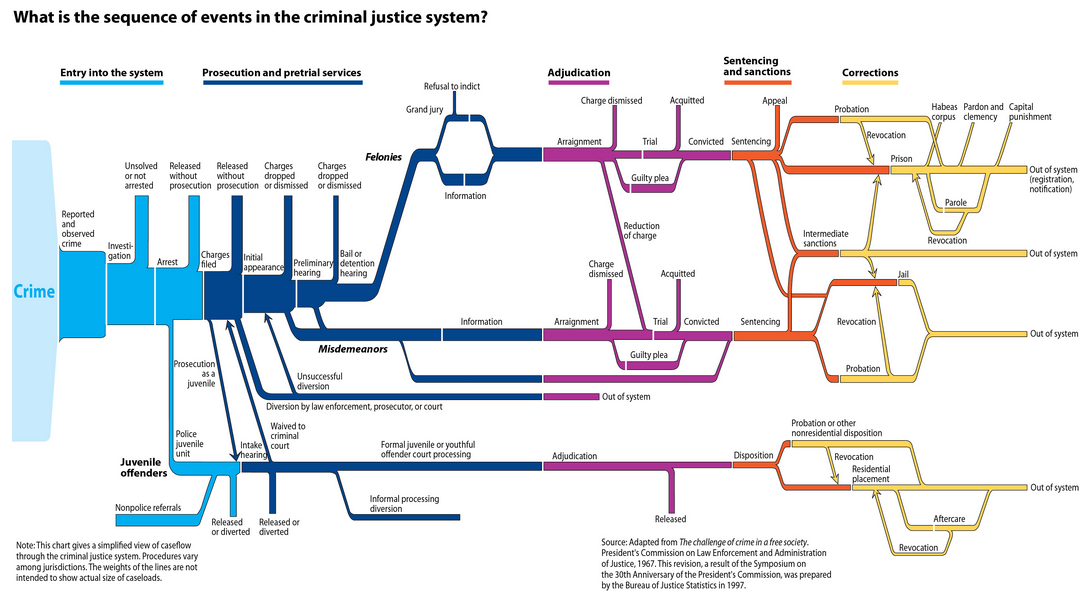
The chart is designed to give you a sense of the vastness and complexity of the criminal justice and the many places that cases "leak" out of the system, but, as the chart itself indicates, it is not to scale. For example, as this table shows, of the 79,704 criminal cases resolved in federal court in the year studied, 71,550 pled guilty, while only 1,879 trials were held. Thus, though we will pay a fair amount of attention to criminal trials, jury instructions, and appeals, it is important to remember that nearly all criminal cases are resolved without a trial.
This book, and all H2O books, are Creative Commons licensed for sharing and re-use with the exception of certain excerpts. Any excerpts from the Restatements of the Law, Principles of the Law, and the Model Penal Code are copyright by The American Law Institute. Excerpts are reproduced with permission, not as part of a Creative Commons license.