1 Introduction to Criminal Law & Punishment 1 Introduction to Criminal Law & Punishment
1.1 What is Criminal Law and why do we use it? 1.1 What is Criminal Law and why do we use it?
1.2 Alice Ristroph, What is Criminal Law? 1.2 Alice Ristroph, What is Criminal Law?
Introduction, from Alice Ristroph, Criminal Law: An Integrated Approach
What is criminal law?
Of the various subjects a student encounters in an American law school, criminal law may appear the most familiar. From an early age, every American is exposed to depictions of various aspects of the criminal legal system. Police (and “robbers” and “burglars”) appear in children’s books and toys. Criminal investigations and prosecutions are dramatized in television and movies. In the news media, there is ample, perhaps exaggerated, coverage of crimes, arrests, trials, and punishments. Criminal law appears everywhere, in part because in the United States it is nearly everywhere: this country uses criminal legal interventions with a frequency and severity unmatched in most other nations. For this reason, many of the ideas and terms you encounter in this book will be ones you’re likely to have heard before: charges, conviction, presumption of innocence, proof beyond a reasonable doubt, to give a few examples—along with terms of critique such as mass incarceration and racial bias and overcriminalization.
Criminal law seems familiar, but the apparent familiarity can be misleading. . . .Notwithstanding the seeming familiarity of criminal law, many students eventually find the subject to be very different from what they expected “law” to be. To minimize confusion, it is useful to begin with some basic descriptions. What makes criminal law the same as other areas of law? That is, what makes it law? And what makes criminal law different from other areas of law? What makes criminal law a distinctive field?
Philosophers have no single answer to the question, what is law, and dictionaries identify the word as one with multiple meanings. We speak of the laws of physics, for example, but those statements about the observed properties of physical objects are very different from the kinds of laws that one studies in law school. For the purposes of this [course], law can be understood as a human practice that involves both authoritative written texts and decisions by public officials. Text and decision: it will be important to keep both in mind as you study criminal law.
In law, texts and decisions interact in a number of different ways. For example, a statute that defines “burglary” is a written text, and it is designed to guide official decisions by police officers, prosecutors, and judges. Official decisions are often but not always guided by a preexisting written text; sometimes public officials make decisions without statu- tory or other written guidance. And official decisions are sometimes, but only sometimes, recorded in a new written text. Decisions by police officers are often unrecorded, or recorded in a document such as an arrest report that is soon lost to history, whereas courts frequently announce and explain their decisions in written opinions that are preserved for much longer periods. This latter kind of text, the judicial opinion or “case,” makes up much of law school reading assignments. But cases are not the only written texts that are important to the practice of law, and judicial decisions are not the only decisions that are important to law. In criminal law (and many other fields), statutes are especially important legal texts. And in criminal law (and many other fields), decisions by executive branch officials are often determinative of legal outcomes. . . .
Here, then, is one way in which criminal law is like other areas of law that you will encounter in law school: it is a distinctive human practice that involves the use of written texts to guide, constrain, or express official decisions and actions. It bears emphasis that the decisions reached in law are decisions made by human beings. Humans are rational creatures who can deliberate about moral values, or take into account empirical evidence, or be influenced by public opinion, or rely on “common sense” as they make legal decisions. But human rationality is bounded, or limited by various factors such as imperfect information and cognitive biases. Human law, unlike the laws of physics, thus reflects various characteristics of human decisionmaking that are also observable in other contexts, such as the influence of emotion and cognitive biases. Racial bias is a particularly acute concern in criminal law. . . . Perhaps criminal law is even more shaped by emotion and cognitive bias than other fields of human law; we will explore that possibility. For now, the key point is that legal texts are designed to guide human decisionmaking, but the relevant text may not be the only factor that shapes an official decision.
What (beyond the possibility of unusual effects of bias and emotion) distinguishes criminal law from other fields of human law? Criminal law was once more commonly called “the law of crimes,” and the concept of a crime may help us identify what is distinctive about criminal law. In popular culture and lay parlance, the term crime is likely to bring to mind images of wrongful or harmful acts. It is tempting to think of criminal law as the law that regulates (by prohibiting) acts of violence or other inflictions of serious harm. Certainly many cultural depictions of crime encourage that view, equating crime with murder, rape, or other grave physical harms. But in legal terms, a crime is any act that has been designated as a crime by the appropriate legal actors. Many acts designated as crimes do not involve any physical harm, or even conduct that is widely viewed as harmful. Public intoxication, or “loitering,” or a failure to file required paperwork, are all acts designated as criminal . . . .
Whether or not the acts designated as criminal are in fact wrongful or harmful in all cases, the designation of a person as “a criminal” brings significant negative consequences to that person in all or nearly all cases. Criminal law is often said to be distinctive in imposing unique burdens, such as loss of liberty through a jail or prison sentence. Even when a person convicted of a criminal offense avoids incarceration, a criminal conviction carries considerable stigma and often renders a person ineligible for various social benefits.
Indeed, the burdens of a criminal conviction are a key part of the distinction between criminal law and tort law. Tort law, which you are likely to study in your first year of law school, is similar to criminal law in that it imposes legal liability for conduct designated as wrongful. In fact, the modern English word “tort” comes from the Latin term torquere (to twist, or distort) and its past participle tortum (wrong or injustice). Many acts could be classified as both crimes and torts, such as intentional inflictions of physical injury. But tort law is different from criminal law in at least two key respects. First, the sanctions are different. Tort liability usually means having to pay monetary damages to the injured party, but it does not involve custodial detention or the stigma of a criminal con- viction. To be sure, criminal punishment can take the form of a fine, or monetary restitution to a victim, so the fact that a person has to pay money for some wrongdoing does not itself distinguish crimes from torts. But criminal sanctions often involve not monetary payments (or, not only monetary payments) but physical detention, in a jail or prison. Additionally, there is a stigma associated with a criminal conviction that is not typically associated with being found liable for a tort. Thus, the severity and stigma of criminal sanctions may be one point of distinction from tort law. A second way in which tort law is different from criminal law is that the decision to pursue a tort claim is usually the choice of a private party, not a public official. Police and prosecutors decide whether a given individual will be investigated and charged with a crime, but the individual or pri- vate party who is harmed by tortious conduct decides whether to file a tort suit.
Because the burdens of a criminal conviction are seen as more severe than the burdens typically imposed by non-criminal laws, criminal law contains various structures designed to limit the imposition of criminal penalties. For example, criminal punishment is said to require a higher standard of proof than is required in many other areas of law. That’s the beyond a reasonable doubt standard that you’re likely to have heard invoked before. This is another way in which criminal law differs from tort law, and it may explain why some defendants are acquitted of criminal charges but found civilly liable for the same conduct in a tort suit. (O.J. Simpson is a famous example: he was acquitted of the murders of his ex-wife and her friend Ron Goldman, but Simpson was found liable for the deaths in a subsequent civil tort suit with a lower standard of proof.) . . . [W]e will encounter several cases that address constitutional principles arguably designed to limit the imposition of criminal law’s distinctively severe penalties. As you read those cases, you will gain a better understanding of how the United States has developed its extensive system of criminal legal interventions, notwithstanding ostensible limits on the use of criminal sanctions.
. . . [W]e will consider three types of official decisions that are especially important to criminal law. For any individual person to be convicted of a crime, each of these three decisions is necessary. First, the criminalization decision is the choice to define some category of conduct as criminal. Today, this decision usually must be made by a legislature and expressed in a criminal statute, but we will see . . . that criminalization decisions have not always required legislative action or a written statute.
Criminal statutes (or other texts that define activity as criminal) are not self-enforcing. For example, the existence of a statute that criminalizes the possession of cocaine is not by itself enough to ensure that all persons who possess cocaine will be convicted of violating that statute. Accordingly, a second type of decision key to criminal law is the enforcement decision, or the decision by enforcement agents such as police and prosecutors to arrest or charge a given person. In practice, a single criminal case often involves multiple enforcement decisions: the decision by a police officer to investigate and perhaps arrest a person; the decision by a prosecutor to charge a particular offense; and in many instances, later decisions by a prosecutor to add or drop charges as part of a plea bargaining process.
Plea bargaining is often (but not always) a precursor to the third key decision, the adjudication decision, in which a formal, and often final, decision is made to classify the defendant as guilty or not guilty. If a criminal case involves a jury trial, then it is the jury who makes the adjudication decision. Some criminal cases involve bench trials, in which a judge serves as the factfinder and decides whether to convict the defendant or not. But the vast majority of criminal convictions are based on guilty pleas rather than jury or bench trials. When a defendant pleads guilty, it is more difficult to identify the actor who makes the adjudication decision. It could be said that the defendant himself (or herself) makes the adjudication decision, since the defendant admits his own guilt instead of asking a jury or judge to determine guilt. But what would lead a defendant to do that? In a system that promises that every defendant will be presumed innocent until proven guilty, why do so many defendants plead guilty, disclaim their own innocence, and relieve prosecutors of their burden to prove guilt? . . . It will turn out that criminalization decisions and enforce- ment decisions can create situations in which adjudication decisions all but disappear – choices about what to criminalize, and how to enforce those laws, can make a guilty plea rather than a trial the least terrible option for many a defendant. For now, it is important simply to note that the distinctive standard of proof mentioned above – proof beyond a reasonable doubt – does not actually get tested in most criminal cases. Prosecutors don’t have to “prove” anything if a defendant pleads guilty.
In a nutshell, then, criminal law is a human practice which involves three important types of decisions: criminalization, enforcement, and adjudication. Any of these decisions may be guided by, or recorded in, an official text, but texts will not always determine how the decisions are made.
Taken from: Alice Ristroph, Criminal Law: An Integrated Approach, Second Edition, Published by CALI eLangdell® Press. Available under a Creative Commons (CC BY-NC-SA 4.0) License.
1.3. Mass Incarceration: The Whole Pie 2025 | Prison Policy Initiative
1.4 Criminal System Flowcharts: two versions 1.4 Criminal System Flowcharts: two versions
Below are two different depictions of how the criminal system works, from arrest through adjudication. How are they the same and how do they differ?
Flowchart #1, from the Bureau of Justice Statistics, has the following introduction: "The flowchart of the events in the criminal justice system (shown in the diagram) updates the original chart prepared by the President's Commission on Law Enforcement and the Administration of Justice in 1967. The chart summarizes the most common events in the criminal and juvenile justice systems including entry into the criminal justice system, prosecution and pretrial services, adjudication, sentencing and sanctions, and corrections.
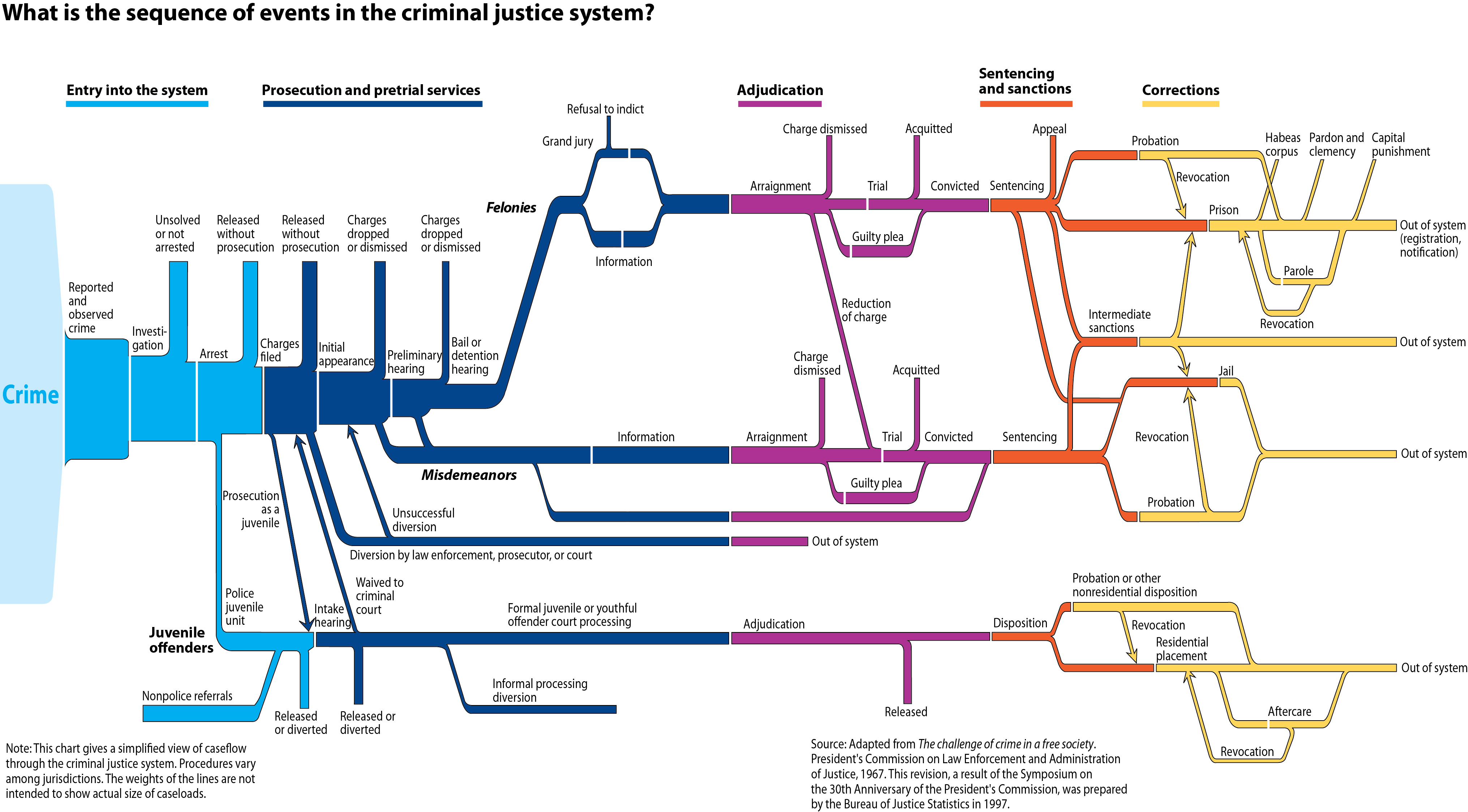
[source: Criminal Justice System Flowchart | Bureau of Justice Statistics (ojp.gov)]
FlowChart #2: from "Beyond Criminal Courts." The introduction to the flowchart of this online resource at beyondcourts.org reads: "Understanding the general contours of what happens in criminal court cases illuminates the violence embedded in every stage of the process and in each of the discretionary decisions made by criminal court actors."
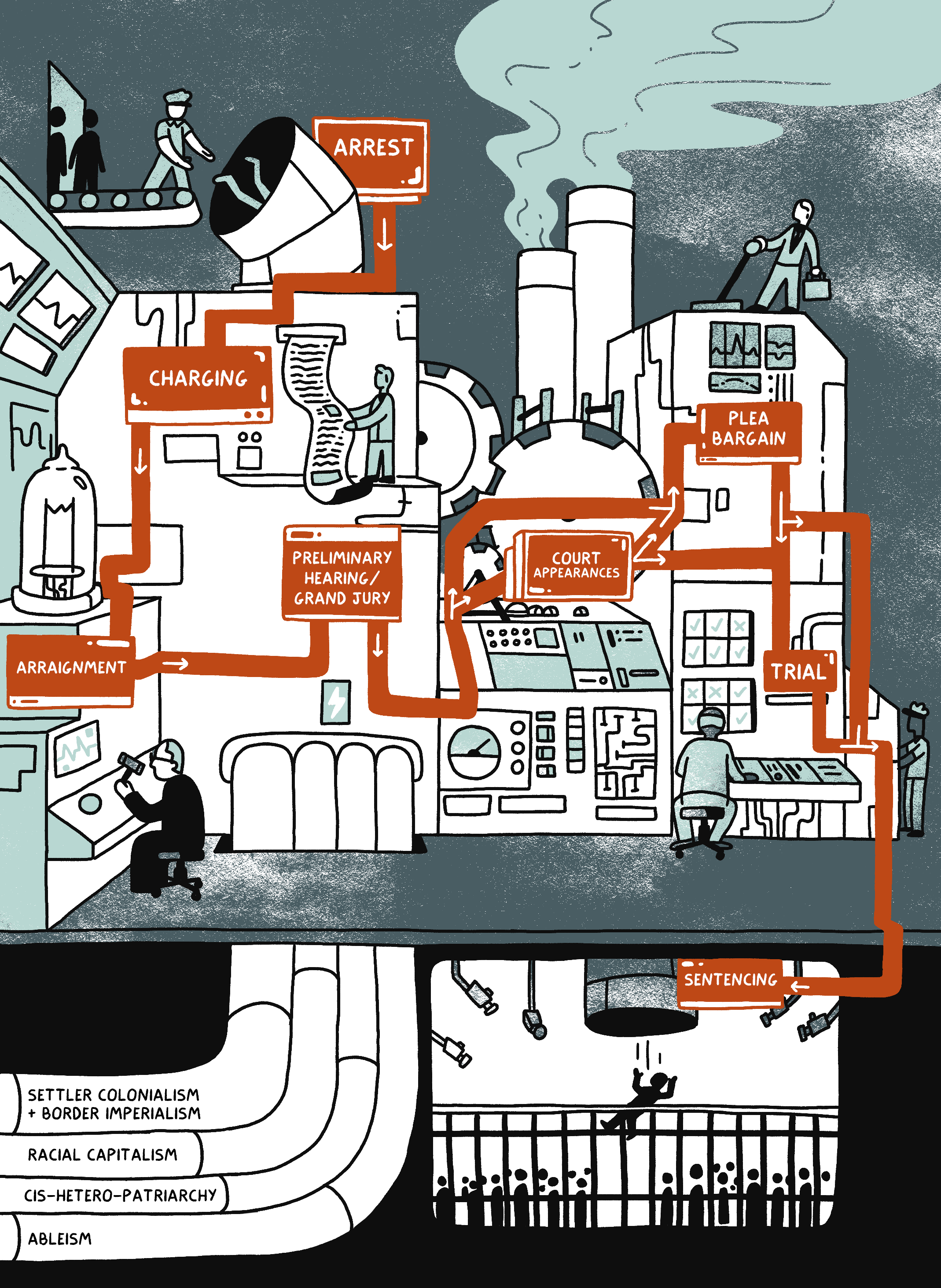
[source: Criminal Courts 101 | Beyond Criminal Courts (beyondcourts.org)]
1.5 Alexandra Natapoff, Punishment without Crime 1.5 Alexandra Natapoff, Punishment without Crime
Natapoff, Punishment Without Crime ch.1 (2018)
One of the great myths of our criminal system is that minor arrests and convictions are not especially terrible for the people who experience them. It is a highly influential myth. It helps justify the speed and sloppiness of misdemeanor processing. It supports the assignment of the least-experienced prosecutors and public defenders to misdemeanor dockets. It makes pleading guilty seem sensible so as to avoid the difficult and expensive process of contesting a case. It even explains the Supreme Court’s habit of withholding constitutional rights from misdemeanor defendants. The Court has held that people who face less than six months’ imprisonment have no right to a jury trial. If they are not incarcerated for a misdemeanor, they have no right to a lawyer. In effect, when the law deems punishment not particularly burdensome, it makes it easier to convict people in the first place.
But misdemeanor punishments are not petty at all. People with minor arrests and convictions are jailed, fined, supervised, tracked, marked, and stigmatized. They can lose their jobs, driver’s licenses, welfare benefits, child custody, immigration status, and housing. They may be disqualified for loans and professional licenses or sink into debt and ruin their credit. Sometimes these things happen even when their cases are dismissed and they are never convicted at all.
Current US law barely acknowledges the broad punitive impact of the misdemeanor experience. Criminal law draws a line between formal legal “punishment”—the jail time, probation, and fines imposed by a judge when someone is convicted—and all the other “collateral consequences” of that conviction. But in the misdemeanor arena such legal distinctions obscure the sprawling reality of the punishment experience. The full impact of a misdemeanor begins long before people are convicted and ends long after they have served their sentences. It can amount to a crushing burden, heavier than the punishment ordered by the court and often wildly disproportionate to the seriousness of the offense.
A misdemeanor’s impact can flow from many different sources. We’ll look at the main categories that make up the punishment experience: jail, probation, fines and fees, warrants, criminal records, the loss of public benefits, immigration consequences, future encounters with the criminal system, and, finally, the fear and stigma that go with it all.
JAIL
Tyrone Tomlin was a fifty-three-year-old construction worker in Brooklyn, New York. One afternoon in late November 2014, chatting with friends, he popped into the corner store to buy a soda. When he came out, two undercover police officers were frisking his friends. An officer took Tomlin’s soda. “What you got in the other hand?” the officer asked. “I got a straw that I’m about to use for the soda,” said Tomlin. The office searched Tomlin and arrested him for the straw. “Drug paraphernalia,” the officer explained.
When Tomlin got to court, the prosecutor offered him a thirty-day sentence if he pled guilty. He wouldn’t, but Tomlin couldn’t afford the $1,500 bail set by the judge, so he was sent to Riker’s Island, New York’s infamously violent jail complex. He went back to court on November 25, two days before Thanksgiving. There was still no drug evidence, but the government continued to insist on a plea; Tomlin continued to insist that he was innocent, but since he still couldn’t make bail, back to Riker’s he went. Days later, he was jumped by a group of inmates in the shower who punched, kicked, and stomped him in his head and his eyes. When Tomlin went to court two weeks later, his eye was still swollen shut. At that hearing, however, the prosecution produced a report from the police lab confirming that the straw was just a straw: “No Controlled Substance Identified” was written at the top of the report in bold. The report had been faxed to the district attorney on November 25, the very same day that Tomlin was in court before the beating, but no one had picked it up. Now the government dismissed the case. At the time, Tomlin was relieved. “It feels great to go home,” he said.
Six months later, Tomlin’s eye remained askew, and his sight was blurry. “I still feel the aftereffects,” he said. “Pain [in] my eye, in my head.” Now that the threat of Riker’s had passed, he was thinking about the fact that he got locked up and beaten up, lost three weeks of salary, and missed Thanksgiving with his family, all because he could not afford to pay bail. “I got a raw deal," he concluded, but he was philosophical. “I’m not Johnny Rich-Kid with a silver spoon. Sure, yeah, I’m mad about it. But that’s the way it is. I’ve got to accept it. It’s not right, but that’s the way it is.” He shrugged. “What are you going to do?”
Jail is one of the most damaging aspects of the misdemeanor experience, and it looms large throughout. It is where you go when you are arrested, where you stay if you can’t make bail, where you will serve your sentence if convicted, and where you might end up if you can’t pay your fine. Jails are different from prisons. Prison is where people serve felony sentences, and the US prison population of 1.5 million has made this country internationally infamous. But there are 11 million admissions to 3,000 American jails every year—on any given day, approximately 730,000 people are in jail. On average, approximately one-third of them are there for misdemeanors, but in some cities it is as many as 50 percent. Sixty percent—nearly half a million people—are incarcerated pretrial; like Tyrone Tomlin they have not been convicted of anything and are thus presumptively innocent.
* * *
As Tyrone Tomlin’s story illustrates, jail is intimately connected to the phenomenon of bail. Bail is supposed to be a kind of good faith down payment—an amount of money set by the court to ensure that defendants show up for future court appearances. Defendants who can afford to pay it get released. When their case is over, they get it back. * * * For people who don’t have the money, however, the cost of bail creates pressure to plead guilty. Most misdemeanor defendants who are set bail cannot pay it, so they either plead out or stay in jail until their cases are over.
The impact of going to jail is substantial, both for individuals and their families. Studies have shown that as few as twenty-four hours of pretrial detention can have negative effects. Longer stays are highly disruptive and can lead to evictions, towed cars, and the loss of food stamps and other resources. More than 5 million children have seen a parent go to jail or prison. In 2009, over 400,000 parents were in local jails. Incarcerated parents can lose custody or visitation rights or face further incarceration for failing to pay child support that accrued while they were in jail. In sum, whether incarceration occurs before or after conviction, going to jail is an enormously costly aspect of the misdemeanor experience.
PROBATION
Sometimes people are sentenced not to jail but to probation, a period of court-ordered supervision. While it can be a way of avoiding incarceration, probation carries its own unique burdens. In 2014, for example, Danyelle and Roland Hall threw a Christmas Day party for friends and family. Afterward, Hall drove two of her guests home and was stopped for driving thirty-eight in a twenty-five-mph zone. A breathalyzer test showed a blood alcohol content of .09, just over the Maryland legal limit of .07, the difference of about one glass of wine.
Although Hall had no criminal record and no history of alcohol use, she was sentenced to eighteen months’ probation—if she completed it successfully, the case would be dismissed, and she would avoid a criminal record. The conditions of that probation included $105 a month in supervision fees, twenty-six weeks of alcohol education at $280 a month, $252 in court costs, and three Alcoholics Anonymous meetings a week. If Hall wanted to change addresses, she would need the judge’s permission. Hall also owed $2,000 to the bail bondsman and $1,500 to her lawyer. Because her license was suspended for two weeks, she lost her job as a nurse’s aide, making it difficult for her husband to pay those costs.
After she had been in compliance for several months, Hall’s apartment developed a mouse infestation. She wrote to the court explaining her intention to move, but the court issued a summons stating that she did not have permission to change her address. When Hall lost the paperwork proving her attendance at the AA meetings, the judge issued a warrant for her arrest. Hall went to jail for a month, and the judge entered the conviction onto her record. As a result, her driver’s license was suspended for six months. Because she couldn’t drive to work, she lost her new job.
Probation, sometimes referred to as community supervision, is the most common misdemeanor sentence other than fines. The federal Bureau of Justice Statistics (BJS) reports that approximately 4 million Americans are on some form of probationary supervision, nearly half of them for misdemeanors, but this is an undercount since many low-level probations are not reported to BJS at all.
Probation is often seen as a lenient sentence because it permits people to avoid jail time, but as Donyelle Hall’s story reveals, it can be expensive, burdensome, and intrusive. Probationers lose their privacy rights: probation officers can search them and their homes at any time. Probation usually requires periodic drug tests, visits to the probation office, electronic monitoring, counseling, fines, or other conditions that can be difficult to meet, especially for low-income and working-class probationers. A typical misdemeanor probation term can last from six months to a year or more. During that time, violation of any condition, including failure to pay fines and fees, can subject the defendant to incarceration; only about two-thirds of probationers successfully complete their terms.
FINES, FEES, AND THE NEW DEBTORS’ PRISON
* * *
[F]ines are a widely used form of punishment that imposes hundreds and sometimes thousands of dollars of debt on misdemeanor offenders. California alone has $10 billion in outstanding unpaid traffic debt. The practice can have far-reaching consequences because so many people cannot afford to pay. Low-income defendants are punished not only with their original fine but with long-term debt, loss of credit, or pressure to forgo rent payments or other necessities such as food, health care, and education. If people do not pay, they may be jailed.
In contrast to fines, fees are technically not punishment: they are instead financial charges imposed on defendants by courts, jails, cities, public defenders, prosecutors, probation officers, and clerks to pay for the operations of the criminal process itself. They can include court costs, fees for using the public defender, supervision or “tether” fees, drug testing fees, electronic monitoring fees, warrant fees, jail fees, and late fees. Total fees can far exceed any fine. * * *
Thousands of people * * * end up incarcerated every year because they cannot afford to pay fines and fees. Often their incarceration becomes a way of paying off their debt: some states offer a $50 or $100 credit for every day spent in jail. Because this kind of debt-based incarceration only occurs when people are too poor to pay, the phenomenon is commonly referred to as the new debtors’ prison.
WARRANTS
The failure to pay a misdemeanor fine or to show up in court for a minor offense can also trigger the issuance of a warrant, which is a court order authorizing the person’s arrest at any time by any police officer. There are millions of such outstanding warrants in the United States, and they have wide legal and practical ramifications. * * *
Some places use warrants more than others. In Texas, the city of El Paso issues 87,000 warrants per year in a city of 680,000 residents. In New York City alone, there are over 1.2 million outstanding warrants; in Pennsylvania, 1.4 million; in California, 2.5 million. Pine Lawn, a small town in St. Louis County near Ferguson, had 23,457 outstanding warrants pending in 2013—more than seven per resident. These warrants subject people to being stopped and arrested at any time.
* * *
CRIMINAL RECORDS AND EMPLOYMENT
Perhaps the best-known informal consequence of a criminal conviction is its impact on employment. Job listings on Craigslist often warn people with misdemeanors not to bother applying: “No Exceptions! * * * No Misdemeanors and/or Felonies of any type ever in background”; “Do Not Apply with Any Misdemeanors/Felonies”; and “You must not have any felony or misdemeanor convictions your record. Period.”
Such barriers can last a long time. Johnny Magee was forty years old when he picked up a package for his uncle. Unbeknownst to Magee, who is developmentally disabled, the package contained drugs. Magee was convicted of misdemeanor conspiracy—the only contact with drugs or the criminal system he ever had. But nine years later, Lowe’s home improvement store still wouldn’t give him a job in its garden center. “Lowe’s policy is unfair to me and lots of other people,” says Magee. “It’s unfair because they only see something that happened to me many years ago, even though I’ve never been in trouble since.”
Over 65 million Americans have a criminal record, the majority for misdemeanors. These low-level convictions increasingly inhibit employment. Most employers now use criminal background checks. Indeed, some insurance companies require employers to conduct checks as a condition of their coverage. And online searches and commercial databases make access to criminal records easy.
* * *
The growing reliance on criminal records means that even very low-level conduct can trigger widespread employment disqualifications. After September 11, 2001, for example, the pharmaceutical company Eli Lilly expanded its background check procedures to include misdemeanors. This resulted in the banning of a number of employees from Eli Lilly facilities, including a woman whose only offense was a misdemeanor conviction for a $60 bounced check to a refrigerator rental company, which she said occurred because she closed the account without realizing that the check had not yet cleared.
* * *
LOSING PUBLIC BENEFITS
A misdemeanor conviction or probation violation disqualifies a person from a wide range of benefits and opportunities. Under federal law, any probation violation for any type of misdemeanor disqualifies an individual from welfare benefits, including Temporary Assistance to Needy Families, food stamps, low-income housing, Supplemental Security Income for the elderly and disabled. The consequences of a drug misdemeanor conviction are particularly harsh and can include the loss of health-care coverage, welfare, and student financial aid.
Marisa Garcia, for instance, was a month away from starting freshman year of college. It was also her nineteenth birthday, and she and her friends were out celebrating. But when they stopped for gas, police parked behind their van. “Eventually they started searching the car,” Garcia remembers. “There was a little coin purse, with a small pipe with ash in it.” It was hers.
Garcia had never been in trouble before and did not want to tell her mother, so she went to court alone, without a lawyer, and pled guilty immediately. She paid a $400 fine. Two months later, a letter from the federal financial aid office arrived, asking whether she had a drug conviction. “My heart kind of stopped,” she says. Garcia lost her financial aid for a year. Her mother, already supporting four children, took out a loan to pay Garcia’s tuition.
Garcia feels that she was punished twice: first with the fine and then again, far more severely, with the loss of her financial aid. If she had been richer, she could have paid for a drug-treatment program, which would have let her get her aid back sooner. “I still would have been arrested for marijuana,” she muses, “but if I was wealthier, I could go out and do whatever I wanted and just be punished once.”
The Council of State Governments maintains a database of the collateral legal consequences of a criminal conviction; that database counts 8,958 different statutory provisions across the country that disqualify people with various misdemeanor convictions from professional occupations, housing opportunities, educational programs, and other benefits. * * *
One of the most devastating consequences of a low-level conviction can be the loss of housing, both private and public. Like employers, private landlords have easy access to criminal records; criminal background checks are a routine aspect of lease applications. For public housing, a conviction can cut off access by law. A conviction for disorderly conduct makes a person presumptively ineligible for New York City public housing for two years. In Baltimore, a misdemeanor conviction disqualifies a person from public housing for eighteen months.
IMMIGRATION
The misdemeanor net puts immigrants at an especially heightened risk because it touches so many people and imposes criminal convictions for such low-level conduct. Hundreds of thousands of noncitizens are deported every year, the majority of them triggered by an arrest or conviction for minor offenses.
One of those people was Elizabeth Perez’s husband. “We were supposed to do this together,” said Perez, as her three-year-old son tugged on her long hair and her four-year-old daughter screamed for attention. “Raise the kids, I mean.” Perez was thirty-five years old, an American-born former marine who served in Afghanistan. She lived in Painesville, Ohio. Her husband was deported to Mexico in 2010 after the police detained him during a traffic stop. He had fourteen year-old misdemeanor charges for assault and marijuana possession. “It’s been hard without my husband here,” said Perez.
Legal residents can lose their immigration status if they sustain a misdemeanor conviction. As one scholar describes it, deportable offenses include “misdemeanor drug possession[,] * * * theft of a ten-dollar video game, shoplifting fifteen dollars worth of baby clothes, * * * forging a check for less than twenty dollars * * * theft of services offenses like turnstile jumping, misdemeanor indecent exposure, [and] petty shoplifting offenses.” Undocumented immigrants, meanwhile, can face deportation if they are taken into government custody for something as minor as speeding. From 2009 to 2014, nearly 200,000 people were deported [as] a result of being arrested solely for a traffic offense.
* * *
A misdemeanor arrest or conviction can completely alter an individual’s immigration outlook. For undocumented defendants who are jailed on minor offenses but who have not yet come to the attention of immigration authorities, there is massive pressure to plead guilty immediately in the hope of avoiding an immigration warrant, called a detainer. Small plea bargain details, moreover, can have big immigration consequences for legal residents. Subtracting a single day from a 365-day sentence can transform a deportable offense into a non-deportable one. Attorneys can bargain a minor marijuana-possession charge into a disorderly conduct charge to spare the defendant automatic deportation.
* * *
FUTURE ENCOUNTERS
After a misdemeanor conviction, a person’s interactions with the criminal process will never be the same. Police are more likely to arrest individuals who have prior low-level convictions rather than letting them walk away or merely issuing a ticket. Prosecutors are more likely to seek bail or to charge them with more serious crimes. Judges typically impose longer sentences on people who have prior convictions, even minor convictions not involving a lawyer.
* * *
These ratcheting dynamics are particularly destructive where people and neighborhoods are heavily policed. In places like Baltimore and Brooklyn, where African American men are stopped more often than average, their chances of getting an initial low-level conviction rise accordingly. The next time they are stopped, they have already been marked by the process and will be treated more harshly. The more times this happens, the harsher the system will act. For example, the New York City Transit Police Department operates on a recidivism policy. The first time people are stopped in the subway for a fare violation, they will be given a ticket. If they have a prior transit violation or arrest, however, they will be arrested. Because the New York Police Department has a history of racially disproportionate stops and arrests—92 percent of turnstile-jumping tickets are issued to people of color, who comprise 66 percent of city residents—this recidivism policy ensures that people of color will continue to be arrested at higher rates. This type of negative feedback loop imposes long records and increasingly harsh sentences not because people have become more dangerous or worse offenders but because the system is responding to its own cues and criminalizing and recriminalizing the same people over and over.
FEAR, STIGMA, AND CIVIC DISRESPECT
By now it should be clear how many concrete burdens and disabilities are triggered by the misdemeanor experience. Being labeled a criminal, however, inflicts its own special psychological and social wounds.
Legal scholar Paul Butler has shared his own experiences. As law professors go, Butler is indisputably prominent. Educated at Yale and Harvard, a former federal prosecutor, and now an eminent scholar at Georgetown Law School, he appears routinely on national television and in national newspapers. Back in 1993, however, an unsavory neighbor falsely accused him of misdemeanor assault. After being arrested and released on his own recognizance, Butler went home and cried. “If I get convicted of this crime—this stupid little misdemeanor,” he thought, “life as I know it is over.” He hired one of the best criminal defense attorneys in Washington, DC, and a private investigator. Even so, he stayed frightened and uncertain right up until the moment of his acquittal. He later wrote that he knew that his innocence was “beside the point.” Afterward, despite his acquittal and stellar background, he never quite recovered. “I’m not as innocent as I was before,” he concluded. “I have a record.”
Even for highly educated, well-resourced professionals like Butler, the misdemeanor process can be painful and alienating. For the less educated, less wealthy people who are even more likely to encounter the system, it is often confusing, frightening, and disrespectful. Recall the story at the beginning of this book of Grandma G, who was led sobbing and in handcuffs out of the courtroom after a proceeding she did not understand and no one bothered to explain to her. For those with criminal records who have been through the process before, repeated exposure to the criminal system is a special trauma its own. As legal scholar Jonathan Simon puts it, “The whole structure of misdemeanor justice * * * seems intended to subject the urban poor to a series of petty but cumulative blows to their dignity as citizens of equal standing.”
* * *
Contact with the criminal system also changes people’s relationship to government; indeed, it can taint their very understanding of democratic society and their place in it. People who have been arrested and convicted may avoid institutions that keep formal records, such as banks, hospitals, and schools, exhibiting what one scholar calls “system avoidance.” Studies show that people who have gone through the criminal system, even for minor offenses, distrust the government more and participate less in politics. As one interviewee explained, the unresponsive, heavy-handed criminal system is “the only government I know.” Others are even more pessimistic: “All we know about government is bad. We don’t know the good aspects.” The petty-offense process teaches this cynical, destructive lesson in civics to 13 million Americans every year.
It is a lesson that has been taught in lower courts for a long time. In 1979, sociologist Malcolm Feeley wrote a famous book about the misdemeanor court in New Haven, Connecticut, called The Process the Punishment. His title captured the fact that merely being hauled into court and going through the judicial process was often more punitive than any formal sentence the judge might impose. Even when their cases were dismissed, people had already been punished simply by being forced to show up and account for themselves. Feeley argued that the judicial process itself—not the formal conviction or punishment—was in many ways the point of the exercise, a way of managing poor, disadvantaged, or disorderly people regardless of whether they were legally guilty.
Feeley’s aphorism is even truer today. The petty-offense process starts “punishing” people long before they get to court, and it keeps punishing them long after they have completed their court-imposed sentences. It can even punish those who are never convicted of anything. Being stopped, arrested, cited, jailed, posting bail, telling your employer—these experiences take a heavy personal and social toll. The damaging consequences of a brush with the criminal system kick in from the very beginning. Indeed, for people of color, immigrants, and others who fully expect to be touched by the criminal system, fear of the inevitable encounter can haunt them long before it ever takes place. Afterward, the repercussions continue long after the legal punishment is over. The formal mark of an arrest or conviction record lasts a lifetime; the psychological and economic burdens of being convicted can last just as long. The total impact of these burdens and exclusions can be so great as to amount to what some call a “new civil death,” a permanent barrier to full civic and economic participation.
Technically speaking, the law does not recognize all these different hardships as punishment; nor does it acknowledge the many ways that we punish without crime. From the law’s formal perspective, Tyrone Tomlin’s eye injury doesn’t count. Donyelle Hall losing her job doesn’t count. Neither does Marisa Garcia losing her financial aid. The impact on their families doesn’t count either. But as these stories reveal, a legalistic approach misses the true punitive weight and extent of the misdemeanor experience for those who actually go through it. An encounter with the misdemeanor system for even the pettiest conduct can derail a person’s life.
1.6 New York Penal Law § 1.05 General purposes 1.6 New York Penal Law § 1.05 General purposes
The general purposes of the provisions of this chapter are:
1. To proscribe conduct which unjustifiably and inexcusably causes or threatens substantial harm to individual or public interests;
2. To give fair warning of the nature of the conduct proscribed and of the sentences authorized upon conviction;
3. To define the act or omission and the accompanying mental state which constitute each offense;
4. To differentiate on reasonable grounds between serious and minor offenses and to prescribe proportionate penalties therefor;
5. To provide for an appropriate public response to particular offenses, including consideration of the consequences of the offense for the victim, including the victim's family, and the community; and
6. To insure the public safety by preventing the commission of offenses through the deterrent influence of the sentences authorized, the rehabilitation of those convicted, the promotion of their successful and productive reentry and reintegration into society, and their confinement when required in the interests of public protection.
1.7 Ewing v. California 1.7 Ewing v. California
EWING v. CALIFORNIA
No. 01-6978.
Argued November 5, 2002
Decided March 5, 2003
*13O’Connor, J., announced the judgment of the Court and delivered an opinion, in which Rehnquist, C. J., and Kennedy, J., joined. Scalia, J., post, p. 31, and Thomas, J., post, p. 32, filed opinions concurring in the judgment. Stevens, J., filed a dissenting opinion, in which Souter, Ginsburg, and Breyer, JJ., joined, post, p. 32. Breyer, J., filed a dissenting opinion, in which Stevens, Souter, and Ginsburg, JJ., joined, post, p. 35.
Quin Denvir, by appointment of the Court, 535 U. S. 1076, argued the cause for petitioner. With him on the briefs were David M. Porter, Karyn H. Bucur, and Mark E. Haddad.
Donald E. De Nicola, Deputy Attorney General of California, argued the cause for respondent. With him on the brief were Bill Lockyer, Attorney General, Manuel M. Medeiros, State Solicitor General, Robert R. Anderson, Chief Assistant Attorney General, Pamela C. Hamanaka, Senior Assistant Attorney General, and Jaime L. Fuster, Kristofer S. Jorstad, and David C. Cook, Deputy Attorneys General.
Assistant Attorney General Chertoff argued the cause for the United States as amicus curiae urging affirmance. With him on the brief were Solicitor General Olson, Deputy Solicitor General Dreeben, John P. Elwood, and Joel M. Gershowitz.*
announced the judgment of the Court and delivered an opinion, in which The Chief Justice and Justice Kennedy join.
In this case, we decide whether the Eighth Amendment prohibits the State of California from sentencing a repeat felon to a prison term of 25 years to life under the State’s “Three Strikes and You’re Out” law.
r — <
A
California’s three strikes law reflects a shift in the State’s sentencing policies toward incapacitating and deterring repeat offenders who threaten the public safety. The law was designed “to ensure longer prison sentences and greater punishment for those who commit a felony and have been previously convicted of serious and/or violent felony offenses.” Cal. Penal Code Ann. § 667(b) (West 1999). On March 3, 1993, California Assemblymen Bill Jones and Jim Costa introduced Assembly Bill 971, the legislative version of what would later become the three strikes law. The Assembly Committee on Public Safety defeated the bill only weeks later. Public outrage over the defeat sparked a voter initiative to add Proposition 184, based loosely on the bill, to the ballot in the November 1994 general election.
On October 1, 1993, while Proposition 184 was circulating, 12-year-old Polly Klaas was kidnaped from her home in Petaluma, California. Her admitted killer, Richard Allen Davis, had a long criminal history that included two prior kidnaping convictions. Davis had served only half of his *15most recent sentence (16 years for kidnaping, assault, and burglary). Had Davis served his entire sentence, he would still have been in prison on the day that Polly Klaas was kidnaped.
Polly Klaas’ murder galvanized support for the three strikes initiative. Within days, Proposition 184 was on its way to becoming the fastest qualifying initiative in California history. On January 3, 1994, the sponsors of Assembly Bill 971 resubmitted an amended version of the bill that conformed to Proposition 184. On January 31,1994, Assembly Bill 971 passed the Assembly by a 63 to 9 margin. The Senate passed it by a 29 to 7 margin on March 3, 1994. Governor Pete Wilson signed the bill into law on March 7, 1994. California voters approved Proposition 184 by a margin of 72 to 28 percent on November 8, 1994.
California thus became the second State to enact a three strikes law. In November 1993, the voters of Washington State approved their own three strikes law, Initiative 593, by a margin of 3 to 1. U. S. Dept. of Justice, National Institute of Justice, J. Clark, J. Austin, & D. Henry, “Three Strikes and You’re Out”: A Review of State Legislation 1 (Sept. 1997) (hereinafter Review of State Legislation). Between 1993 and 1995, 24 States and the Federal Government enacted three strikes laws. Ibid. Though the three strikes laws vary from State to State, they share a common goal of protecting the public safety by providing lengthy prison terms for habitual felons.
B
California’s current three strikes law consists of two virtually identical statutory schemes “designed to increase the prison terms of repeat felons.” People v. Superior Court of San Diego Cty. ex rel. Romero, 13 Cal. 4th 497, 504, 917 P. 2d 628, 630 (1996) (Romero). When a defendant is convicted of a felony, and he has previously been convicted of one or more prior felonies defined as “serious” or “violent” in Cal. Penal Code Ann. §§ 667.5 and 1192.7 (West Supp. 2002), sentencing *16is conducted pursuant to the three strikes law. Prior convictions must be alleged in the charging document, and the defendant has a right to a jury determination that the prosecution has proved the prior convictions beyond a reasonable doubt. § 1025; § 1158 (West 1985).
If the defendant has one prior “serious” or “violent” felony conviction, he must be sentenced to “twice the term otherwise provided as punishment for the current felony conviction.” § 667(e)(1) (West 1999); § 1170.12(c)(1) (West Supp. 2002). If the defendant has two or more prior “serious” or “violent” felony convictions, he must receive “an indeterminate term of life imprisonment.” § 667(e)(2)(A) (West 1999); § 1170.12(c)(2)(A) (West Supp. 2002). Defendants sentenced to life under the three strikes law become eligible for parole on a date calculated by reference to a “minimum term,” which is the greater of (a) three times the term otherwise provided for the current conviction, (b) 25 years, or (c) the term determined by the court pursuant to §1170 for the underlying conviction, including any enhancements. §§667(e)(2)(A)(i)-(iii) (West 1999); §§ 1170.12(c)(2)(A)(i)-(iii) (West Supp. 2002).
Under California law, certain offenses may be classified as either felonies or misdemeanors. These crimes are known as “wobblers.” Some crimes that would otherwise be misdemeanors become “wobblers” because of the defendant’s prior record. For example, petty theft, a misdemeanor, becomes a “wobbler” when the defendant has previously served a prison term for committing specified theft-related crimes. §490 (West 1999); §666 (West Supp. 2002). Other crimes, such as grand theft, are “wobblers” regardless of the defendant’s prior record. See § 489(b) (West 1999). Both types of “wobblers” are triggering offenses under the three strikes law only when they are treated as felonies. Under California law, a “wobbler” is presumptively a felony and “remains a felony except when the discretion is actually exercised” to make the crime a misdemeanor. People v. Wil*17liams, 27 Cal. 2d 220, 229, 163 P. 2d 692, 696 (1945) (emphasis deleted and internal quotation marks omitted).
In California, prosecutors may exercise their discretion to charge a “wobbler” as either a felony or a misdemeanor. Likewise, California trial courts have discretion to reduce a “wobbler” charged as a felony to a misdemeanor either before preliminary examination or at sentencing to avoid imposing a three strikes sentence. Cal. Penal Code Ann. §§ 17(b)(5), 17(b)(1) (West 1999); People v. Superior Court of Los Angeles Cty. ex rel. Alvarez, 14 Cal. 4th 968, 978, 928 P. 2d 1171, 1177-1178 (1997). In exercising this discretion, the court may consider “those factors that direct similar sentencing decisions,” such as “the nature and circumstances of the offense, the defendant’s appreciation of and attitude toward the offense,... [and] the general objectives of sentencing.” Ibid, (internal quotation marks and citations omitted).
California trial courts can also vacate allegations of prior “serious” or “violent” felony convictions, either on motion by the prosecution or sua sponte. Romero, supra, at 529-530, 917 P. 2d, at 647-648. In ruling whether to vacate allegations of prior felony convictions, courts consider whether, “in light of the nature and circumstances of [the defendant’s] present felonies and prior serious and/or violent felony convictions, and the particulars of his background, character, and prospects, the defendant may be deemed outside the [three strikes’] scheme’s spirit, in whole or in part.” People v. Williams, 17 Cal. 4th 148, 161, 948 P. 2d 429, 437 (1998). Thus, trial courts may avoid imposing a three strikes sentence in two ways: first, by reducing “wobblers” to misdemeanors (which do not qualify as triggering offenses), and second, by vacating allegations of prior “serious” or “violent” felony convictions.
C
On parole from a 9-year prison term, petitioner Gary Ewing walked into the pro shop of the El Segundo Golf *18Course in Los Angeles County on March 12, 2000. He walked out with three golf clubs, priced at $399 apiece, concealed in his pants leg. A shop employee, whose suspicions were aroused when he observed Ewing limp out of the pro shop, telephoned the police. The police apprehended Ewing in the parking lot.
Ewing is no stranger to the criminal justice system. In 1984, at the age of 22, he pleaded guilty to theft. The court sentenced him to six months in jail (suspended), three years’ probation, and a $300 fine. In 1988, he was convicted of felony grand theft auto and sentenced to one year in jail and three years’ probation. After Ewing completed probation, however, the sentencing court reduced the crime to a misdemeanor, permitted Ewing to withdraw his guilty plea, and dismissed the case. In 1990, he was convicted of petty theft with a prior and sentenced to 60 days in the county jail and three years’ probation. In 1992, Ewing was convicted of battery and sentenced to 30 days in the county jail and two years’ summary probation. One month later, he was convicted of theft and sentenced to 10 days in the county jail and 12 months’ probation. In January 1993, Ewing was convicted of burglary and sentenced to 60 days in the county jail and one year’s summary probation. In February 1993, he was convicted of possessing drug paraphernalia and sentenced to six months in the county jail and three years’ probation. In July 1993, he was convicted of appropriating lost property and sentenced to 10 days in the county jail and two years’ summary probation. In September 1993, he was convicted of unlawfully possessing a firearm and trespassing and sentenced to 30 days in the county jail and one year’s probation.
In October and November 1993, Ewing committed three burglaries and one robbery at a Long Beach, California, apartment complex over a 5-week period. He awakened one of his victims, asleep on her living room sofa, as he tried to disconnect her video cassette recorder from the television in *19that room. When she screamed, Ewing ran out the front door. On another occasion, Ewing accosted a victim in the mailroom of the apartment complex. Ewing claimed to have a gun and ordered the victim to hand over his wallet. When the victim resisted, Ewing produced a knife and forced the victim back to the apartment itself. While Ewing rifled through the bedroom, the victim fled the apartment screaming for help. Ewing absconded with the victim’s money and credit cards.
On December 9,1993, Ewing was arrested on the premises of the apartment complex for trespassing and lying to a police officer. The knife used in the robbery and a glass cocaine pipe were later found in the back seat of the patrol car used to transport Ewing to the police station. A jury convicted Ewing of first-degree robbery and three counts of residential burglary. Sentenced to nine years and eight months in prison, Ewing was paroled in 1999.
Only 10 months later, Ewing stole the golf clubs at issue in this case. He was charged with, and ultimately convicted of, one count of felony grand theft of personal property in excess of $400. See Cal. Penal Code Ann. § 484 (West Supp. 2002); §489 (West 1999). As required by the three strikes law, the prosecutor formally alleged, and the trial court later found, that Ewing had been convicted previously of four serious or violent felonies for the three burglaries and the robbery in the Long Beach apartment complex. See § 667(g) (West 1999); § 1170.12(e) (West Supp. 2002).
At the sentencing hearing, Ewing asked the court to reduce the conviction for grand theft, a “wobbler” under California law, to a misdemeanor so as to avoid a three strikes sentence. See §§ 17(b), 667(d)(1) (West 1999); § 1170.12(b)(1) (West Supp. 2002). Ewing also asked the trial court to exercise its discretion to dismiss the allegations of some or all of his prior serious or violent felony convictions, again for purposes of avoiding a three strikes sentence. See Romero, 13 Cal. 4th, at 529-531, 917 P. 2d, at 647-648. Before sen-*20fencing Ewing, the trial court took note of his entire criminal history, including the fact that he was on parole when he committed his latest offense. The court also heard arguments from defense counsel and a plea from Ewing himself.
In the end, the trial judge determined that the grand theft should remain a felony. The court also ruled that the four prior strikes for the three burglaries and the robbery in Long Beach should stand. As a newly convicted felon with two or more “serious” or “violent” felony convictions in his past, Ewing was sentenced under the three strikes law to 25 years to life.
The California Court of Appeal affirmed in an unpublished opinion. No. B143745 (Apr. 25, 2001). Relying on our decision in Rummel v. Estelle, 445 U. S. 263 (1980), the court rejected Ewing’s claim that his sentence was grossly disproportionate under the Eighth Amendment. Enhanced sentences under recidivist statutes like the three strikes law, the court reasoned, serve the “legitimate goal” of deterring and incapacitating repeat offenders. The Supreme Court of California denied Ewing’s petition for review, and we granted certiorari, 535 U. S. 969 (2002). We now affirm.
II
A
The Eighth Amendment, which forbids cruel and unusual punishments, contains a “narrow proportionality principle” that “applies to noncapital sentences.” Harmelin v. Michigan, 501 U. S. 957, 996-997 (1991) (Kennedy, J., concurring in part and concurring in judgment); cf. Weems v. United States, 217 U. S. 349, 371 (1910); Robinson v. California, 370 U. S. 660, 667 (1962) (applying the Eighth Amendment to the States via the Fourteenth Amendment). We have most recently addressed the proportionality principle as applied to terms of years in a series of cases beginning with Rummel v. Estelle, supra.
*21In Rummel, we held that it did not violate the Eighth Amendment for a State to sentence a three-time offender to life in prison with the possibility of parole. Id., at 284-285. Like Ewing, Rummel was sentenced to a lengthy prison term under a recidivism statute. Rummel’s two prior offenses were a 1964 felony for “fraudulent use of a credit card to obtain $80 worth of goods or services,” and a 1969 felony conviction for “passing a forged check in the amount of $28.36.” Id., at 265. His triggering offense was a conviction for felony theft — “obtaining $120.75 by false pretenses.” Id., at 266.
This Court ruled that “[hjaving twice imprisoned him for felonies, Texas was entitled to place upon Rummel the onus of one who is simply unable to bring his conduct within the social norms prescribed by the criminal law of the State.” Id., at 284. The recidivism statute “is nothing more than a societal decision that when such a person commits yet another felony, he should be subjected to the admittedly serious penalty of incarceration for life, subject only to the State’s judgment as to whether to grant him parole.” Id., at 278. We noted that this Court “has on occasion stated that the Eighth Amendment prohibits imposition of a sentence that is grossly disproportionate to the severity of the crime.” Id., at 271. But “[ojutside the context of capital punishment, successful challenges to the proportionality of particular sentences have been exceedingly rare.” Id., at 272. Although we stated that the proportionality principle “would . . . come into play in the extreme example ... if a legislature made overtime parking a felony punishable by life imprisonment,” id., at 274, n. 11, we held that “the mandatory life sentence imposed upon this petitioner does not constitute cruel and unusual punishment under the Eighth and Fourteenth Amendments,” id., at 285.
In Hutto v. Davis, 454 U. S. 370 (1982) (per curiam), the defendant was sentenced to two consecutive terms of 20 years in prison for possession with intent to distribute nine *22ounces of marijuana and distribution of marijuana. We held that such a sentence was constitutional: “In short, Rummel stands for the proposition that federal courts should be reluctant to review legislatively mandated terms of imprisonment, and that successful challenges to the proportionality of particular sentences should be exceedingly rare.” Id., at 374 (citations and internal quotation marks omitted).
Three years after Rummel, in Solem v. Helm, 463 U. S. 277, 279 (1983), we held that the Eighth Amendment prohibited “a life sentence without possibility of parole for a seventh nonviolent felony.” The triggering offense in Solem was “uttering a ‘no account’ check for $100.” Id., at 281. We specifically stated that the Eighth Amendment’s ban on cruel and unusual punishments “prohibits .. . sentences that are disproportionate to the crime committed,” and that the “constitutional principle of proportionality has been recognized explicitly in this Court for almost a century.” Id., at 284, 286. The Solem Court then explained that three factors may be relevant to a determination of whether a sentence is so disproportionate that it violates the Eighth Amendment: “(i) the gravity of the offense and the harshness of the penalty; (ii) the sentences imposed on other criminals in the same jurisdiction; and (iii) the sentences imposed for commission of the same crime in other jurisdictions.” Id., at 292.
Applying these factors in Solem, we struck down the defendant’s sentence of life without parole. We specifically noted the contrast between that sentence and the sentence in Rummel, pursuant to which the defendant was eligible for parole. 463 U. S., at 297; see also id., at 300 (“[T]he South Dakota commutation system is fundamentally different from the parole system that was before us in Rummel”). Indeed, we explicitly declined to overrule Rummel: “[Q]ur conclusion today is not inconsistent with Rummel v. Estelle.” 463 U. S., at 303, n. 32; see also id., at 288, n. 13 (“[O]ur decision *23is entirely consistent with this Court’s prior cases — including Rummel v. Estelle”).
Eight years after Solem, we grappled with the proportionality issue again in Harmelin. Harmelin was not a recidivism case, but rather involved a first-time offender convicted of possessing 672 grams of cocaine. He was sentenced to life in prison without possibility of parole. A majority of the Court rejected Harmelin’s claim that his sentence was so grossly disproportionate that it violated the Eighth Amendment. The Court, however, could not agree on why his proportionality argument failed. Justice Scalia, joined by The Chief Justice, wrote that the proportionality principle was “an aspect of our death penalty jurisprudence, rather than a generalizable aspect of Eighth Amendment law.” 501 U. S. at 994. He would thus have declined to apply gross disproportionality principles except in reviewing capital sentences. Ibid.
joined by two other Members of the Court, concurred in part and concurred in the judgment. Justice Kennedy specifically recognized that “[t]he Eighth Amendment proportionality principle also applies to noncap-ital sentences.” Id., at 997. He then identified four principles of proportionality review — “the primacy of the legislature, the variety of legitimate penological schemes, the nature of our federal system, and the requirement that proportionality review be guided by objective factors” — that “inform the final one: The Eighth Amendment does not require strict proportionality between crime and sentence. Rather, it forbids only extreme sentences that are ‘grossly disproportionate’ to the crime.” Id., at 1001 (citing Solem, supra, at 288). Justice Kennedy’s concurrence also stated that Solem “did not mandate” comparative analysis “within and between jurisdictions.” 501 U. S., at 1004-1005.
The proportionality principles in our cases distilled in Justice Kennedy’s concurrence guide our application of the *24Eighth Amendment in the new context that we are called upon to consider.
B
For many years, most States have had laws providing for enhanced sentencing of repeat offenders. See, e. g., U. S. Dept. of Justice, Bureau of Justice Assistance, National Assessment of Structured Sentencing (1996). Yet between 1993 and 1995, three strikes laws effected a sea change in criminal sentencing throughout the Nation.1 These laws responded to widespread public concerns about crime by targeting the class of offenders who pose the greatest threat to public safety: career criminals. As one of the chief architects of California’s three strikes law has explained: “Three Strikes was intended to go beyond simply making sentences tougher. It was intended to be a focused effort to create a sentencing policy that would use the judicial system to reduce serious and violent crime.” Ardaiz, California’s Three Strikes Law: History, Expectations, Consequences, 32 McGeorge L. Rev. 1, 12 (2000) (hereinafter Ardaiz).
Throughout the States, legislatures enacting three strikes laws made a deliberate policy choice that individuals who have repeatedly engaged in serious or violent criminal behavior, and whose conduct has not been deterred by more conventional approaches to punishment, must be isolated from society in order to protect the public safety. Though three strikes laws may be relatively new, our tradition of deferring to state legislatures in making and implementing such important policy decisions is longstanding. Weems, 217 U. S., at 379; Gore v. United States, 357 U. S. 386, 393 *25(1958); Payne v. Tennessee, 501 U. S. 808, 824 (1991); Rummel, 445 U. S., at 274; Solem, 463 U. S., at 290; Harmelin, 501 U. S., at 998 (Kennedy, J., concurring in part and concurring in judgment).
Our traditional deference to legislative policy choices finds a corollary in the principle that the Constitution “does not mandate adoption of any one penological theory.” Id., at 999 (Kennedy, J., concurring in part and concurring in judgment). A sentence can have a variety of justifications, such as incapacitation, deterrence, retribution, or rehabilitation. See 1 W. LaFave & A. Scott, Substantive Criminal Law § 1.5, pp. 30-36 (1986) (explaining theories of punishment). Some or all of these justifications may play a role in a State’s sentencing scheme. Selecting the sentencing rationales is generally a policy choice to be made by state legislatures, not federal courts.
When the California Legislature enacted the three strikes law, it made a judgment that protecting the public safety requires incapacitating criminals who have already been convicted of at least one serious or violent crime. Nothing in the Eighth Amendment prohibits California from making that choice. To the contrary, our cases establish that “States have a valid interest in deterring and segregating habitual criminals.” Parke v. Raley, 506 U. S. 20, 27 (1992); Oyler v. Boles, 368 U. S. 448, 451 (1962) (“[T]he constitutionality of the practice of inflicting severer criminal penalties . upon habitual offenders is no longer open to serious challenge”). Recidivism has long been recognized as a legitimate basis for increased punishment. See Almendarez-Torres v. United States, 523 U. S. 224, 230 (1998) (recidivism “is as typical a sentencing factor as one might imagine”); Witte v. United States, 515 U. S. 389, 400 (1995) (“In repeatedly upholding such recidivism statutes, we have rejected double jeopardy challenges because the enhanced punishment imposed for the later offense ... [is] ‘a stiffened penalty for the latest crime, which is considered to be an aggravated *26offense because a repetitive one’ ” (quoting Gryger v. Burke, 334 U. S. 728, 732 (1948))).
California’s justification is no pretext. Recidivism is a serious public safety concern in California and throughout the Nation. According to a recent report, approximately 67 percent of former inmates released from state prisons were charged with at least one “serious” new crime within three years of their release. See U. S. Dept. of Justice, Bureau of Justice Statistics, P. Langan & D. Levin, Special Report: Recidivism of Prisoners Released in 1994, p. 1 (June 2002). In particular, released property offenders like Ewing had higher recidivism rates than those released after committing violent, drug, or public-order offenses. Id., at 8. Approximately 73 percent of the property offenders released in 1994 were arrested again within three years, compared to approximately 61 percent of the violent offenders, 62 percent of the public-order offenders, and 66 percent of the drug offenders. Ibid.
In 1996, when the Sacramento Bee studied 233 three strikes offenders in California, it found that they had an aggregate of 1,165 prior felony convictions, an average of 5 apiece. See Furillo, Three Strikes — The Verdict: Most Offenders Have Long Criminal Histories, Sacramento Bee, Mar. 31, 1996, p. A1. The prior convictions included 322 robberies and 262 burglaries. Ibid. About 84 percent of the 233 three strikes offenders had been convicted of at least one violent crime. Ibid. In all, they were responsible for 17 homicides, 7 attempted slayings, and 91 sexual assaults and child molestations. Ibid. The Sacramento Bee concluded, based on its investigation, that “[i]n the vast majority of the cases, regardless of the third strike, the [three strikes] law is snaring [the] long-term habitual offenders with multiple felony convictions . . ..” Ibid.
The State’s interest in deterring crime also lends some support to the three strikes law. We have long viewed both incapacitation and deterrence as rationales for recidivism *27statutes: “[A] recidivist statute[’s] . . . primary goals are to deter repeat offenders and, at some point in the life of one who repeatedly commits criminal offenses serious enough to be punished as felonies, to segregate that person from the rest of society for an extended period of time.” Rummel, supra, at 284. Four years after the passage of California’s three strikes law, the recidivism rate of parolees returned to prison for the commission of a new crime dropped by nearly 25 percent. California Dept. of Justice, Office of the Attorney General, “Three Strikes and You’re Out” — Its Impact on the California Criminal Justice System After Four Years, p. 10 (1998). Even more dramatically:
“An unintended but positive consequence of ‘Three Strikes’ has been the impact on parolees leaving the state. More California parolees are now leaving the state than parolees from other jurisdictions entering California. This striking turnaround started in 1994. It was the first time more parolees left the state than entered since 1976. This trend has continued and in 1997 more than 1,000 net parolees left California.” Ibid.
See also Janiskee & Erler, Crime, Punishment, and Romero: An Analysis of the Case Against California’s Three Strikes Law, 39 Duquesne L. Rev. 43, 45-46 (2000) (“Prosecutors in Los Angeles routinely report that ‘felons tell them they are moving out of the state because they fear getting a second or third strike for a nonviolent offense’ ” (quoting Sanchez, A Movement Builds Against “Three Strikes” Law, Washington Post, Feb. 18, 2000, p. A3)).
To be sure, California’s three strikes law has sparked controversy. Critics have doubted the law’s wisdom, cost-efficiency, and effectiveness in reaching its goals. See, e. g., Zimring, Hawkins, & Kamin, Punishment and Democracy: Three Strikes and You’re Out in California (2001); Vitiello, Three Strikes: Can We Return to Rationality? 87 J. Crim. *28L. & C. 395, 423 (1997). This criticism is appropriately directed at the legislature, which has primary responsibility for making the difficult policy choices that underlie any criminal sentencing scheme. We do not sit as a “superlegisla-ture” to second-guess these policy choices. It is enough that the State of California has a reasonable basis for believing that dramatically enhanced sentences for habitual felons “advance[s] the goals of [its] criminal justice system in any substantial way.” See Solem, 463 U. S., at 297, n. 22.
III
Against this backdrop, we consider Ewing’s claim that his three strikes sentence of 25 years to life is unconstitutionally disproportionate to his offense of “shoplifting three golf clubs.” Brief for Petitioner 6. We first address the gravity of the offense compared to the harshness of the penalty. At the threshold, we note that Ewing incorrectly frames the issue. The gravity of his offense was not merely “shoplifting three golf clubs.” Rather, Ewing was convicted of felony grand theft for- stealing nearly $1,200 worth of merchandise after previously having been convicted of at least two “violent” or “serious” felonies. Even standing alone, Ewing’s theft should not be taken lightly. His crime was certainly not “one of the most passive felonies a person could commit.” Solem, supra, at 296 (internal quotation marks omitted). To the contrary, the Supreme Court of California has noted the “seriousness” of grand theft in the context of proportionality review. See In re Lynch, 8 Cal. 3d 410, 432, n. 20, 503 P. 2d 921, 936, n. 20 (1972). Theft of $1,200 in property is a felony under federal law, 18 U. S. C. § 641, and in the vast majority of States. See App. B to Brief for Petitioner 21a.
That grand theft is a “wobbler” under California law is of no moment. Though California courts have discretion to reduce a felony grand theft charge to a misdemeanor, it remains a felony for all purposes “unless and until the trial *29court imposes a misdemeanor sentence.” In re Anderson, 69 Cal. 2d 618, 626, 447 P. 2d 117, 126 (1968) (Tobriner, J., concurring); see generally 1 B. Witkin & N. Epstein, California Criminal Law §73 (3d ed. 2000). “The purpose of the trial judge’s sentencing discretion” to downgrade certain felonies is to “impose a misdemeanor sentence in those cases in which the rehabilitation of the convicted defendant either does not require, or would be adversely affected by, incarceration in a state prison as a felon.” Anderson, supra, at 664-665, 447 P. 2d, at 152 (Tobriner, J., concurring). Under California law, the reduction is not based on the notion that a “wobbler” is “conceptually a misdemeanor.” Necochea v. Superior Court, 23 Cal. App. 3d 1012, 1016, 100 Cal. Rptr. 693, 695 (1972). Rather, it is “intended to extend misde-meanant treatment to a potential felon.” Ibid. In Ewing’s case, however, the trial judge justifiably exercised her discretion not to extend such lenient treatment given Ewing’s long criminal history.
In weighing the gravity of Ewing’s offense, we must place on the scales not only his current felony, but also his long history of felony recidivism. Any other approach would fail to accord proper deference to the policy judgments that find expression in the legislature’s choice of sanctions. In imposing a three strikes sentence, the State’s interest is not merely punishing the offense of conviction, or the “triggering” offense: “[I]t is in addition the interest... in dealing in a harsher manner with those who by repeated criminal acts have shown that they are simply incapable of conforming to the norms of society as established by its criminal law.” Rummel, 445 U. S., at 276; Solem, supra, at 296. To give full effect to the State’s choice of this legitimate penological goal, our proportionality review of Ewing’s sentence must take that goal into account.
Ewing’s sentence is justified by the State’s public-safety interest in incapacitating and deterring recidivist felons, and *30amply supported by his own long, serious criminal record.2 Ewing has been convicted of numerous misdemeanor and felony offenses, served nine separate terms of incarceration, and committed most of his crimes while on probation or parole. His prior “strikes” were serious felonies including robbery and three residential burglaries. To be sure, Ewing’s sentence is a long one. But it reflects a rational legislative judgment, entitled to deference, that offenders who have committed serious or violent felonies and who continue to commit felonies must be incapacitated. The State of California “was entitled to place upon [Ewing] the onus of one who is simply unable to bring his conduct within the social norms prescribed by the criminal law of the State.” Rummel, supra, at 284. Ewing’s is not “the rare case in which a threshold comparison of the crime committed and the sentence imposed leads to an inference of gross disproportion-ality.” Harmelin, 501 U. S., at 1005 (Kennedy, J., concurring in part and concurring in judgment).
We hold that Ewing’s sentence of 25 years to life in prison, imposed for the offense of felony grand theft under the three strikes law, is not grossly disproportionate and therefore does not violate the Eighth Amendment’s prohibition on *31cruel and unusual punishments. The judgment of the California Court of Appeal is affirmed.
It is so ordered.
concurring in the judgment.
In my opinion in Harmelin v. Michigan, 501 U. S. 957, 985 (1991), I concluded that the Eighth Amendment’s prohibition of “cruel and unusual punishments” was aimed at excluding only certain modes of punishment, and was hot a “guarantee against disproportionate sentences.” Out of respect for the principle of stare decisis, I might nonetheless accept the contrary holding of Solem v. Helm, 463 U. S. 277 (1983) — that the Eighth Amendment contains a narrow proportionality principle — if I felt I could intelligently apply it. This case demonstrates why I cannot.
Proportionality — the notion that the punishment should fit the crime — is inherently a concept tied to the penological goal of retribution. “[I]t becomes difficult even to speak intelligently of ‘proportionality,’ once deterrence and rehabilitation are given significant weight,” Harmelin, supra, at 989 — not to mention giving weight to the purpose of California’s three strikes law: incapacitation. In the present case, the game is up once the plurality has acknowledged that “the Constitution does not mandate adoption of any one penological theory,” and that a “sentence can have a variety of justifications, such as incapacitation, deterrence, retribution, or rehabilitation.” Ante, at 25 (internal quotation marks omitted). That acknowledgment having been made, it no longer suffices merely to assess “the gravity of the offense compared to the harshness of the penalty,” ante, at 28; that classic description of the proportionality principle (alone and in itself quite resistant to policy-free, legal analysis) now becomes merely the “first” step of the inquiry, ibid. Having completed that step (by a discussion which, in all fairness, does not convincingly establish that 25-years-to-life is a “proportionate” punishment for stealing three golf clubs), the *32plurality must then add an analysis to show that “Ewing’s sentence is justified by the State’s public-safety interest in incapacitating and deterring recidivist felons.” Ante, at 29.
Which indeed it is — though why that has anything to do with the principle of proportionality is a mystery. Perhaps the plurality should revise its terminology, so that what it reads into the Eighth Amendment is not the unstated proposition that all punishment should be reasonably proportionate to the gravity of the offense, but rather the unstated proposition that all punishment should reasonably pursue the multiple purposes of the criminal law. That formulation would make it clearer than ever, of course, that the plurality is not applying law but evaluating policy.
Because I agree that petitioner’s sentence does not violate the Eighth Amendment’s prohibition against cruel and unusual punishments, I concur in the judgment.
concurring in the judgment.
I agree with Justice Scalia’s view that the proportionality test announced in Solem v. Helm, 463 U. S. 277 (1983), is incapable of judicial application. Even were Solem’,s test perfectly clear, however, I would not feel compelled by stare decisis to apply it. In my view, the Cruel and Unusual Punishments Clause of the Eighth Amendment contains no proportionality principle. See Harmelin v. Michigan, 501 U. S. 957, 966-985 (1991) (opinion of Scalia, J.).
Because the plurality concludes that petitioner’s sentence does not violate the Eighth Amendment’s prohibition on cruel and unusual punishments, I concur in the judgment.
with whom Justice Souter, Justice Ginsburg, and Justice Breyer join, dissenting.
Justice Breyer has cogently explained why the sentence imposed in this case is both cruel and unusual.1 The eoncur-*33rences prompt this separate writing to emphasize that proportionality review is not only capable of judicial application but also required by the Eighth Amendment.
“The Eighth Amendment succinctly prohibits ‘excessive’ sanctions.” Atkins v. Virginia, 536 U. S. 304, 311 (2002); see also U. S. Const., Arndt. 8 (“Excessive bail shall not be required, nor excessive fines imposed, nor cruel and unusual punishments inflicted”). Faithful to the Amendment’s text, this Court has held that the Constitution directs judges to apply their best judgment in determining the proportionality of fines, see, e. g., United States v. Bajakajian, 524 U. S. 321, 334-336 (1998), bail, see, e. g., Stack v. Boyle, 342 U. S. 1, 5 (1951), and other forms of punishment, including the imposition of a death sentence, see, e. g., Coker v. Georgia, 433 U. S. 584, 592 (1977). It “would be anomalous indeed” to suggest that the Eighth Amendment makes proportionality review applicable in the context of bail and fines but not in the context of other forms of punishment, such as imprisonment. Solem v. Helm, 463 U. S. 277, 289 (1983). Rather, by broadly prohibiting excessive sanctions, the Eighth Amendment directs judges to exercise their wise judgment in assessing the proportionality of all forms of punishment.
The absence of a black-letter rule does not disable judges from exercising their discretion in construing the outer limits on sentencing authority that the Eighth Amendment imposes. After all, judges are “constantly called upon to draw . . . lines in a variety of contexts,” id., at 294, and to exercise their judgment to give meaning to the Constitution’s broadly phrased protections. For example, the Due Process Clause directs judges to employ proportionality re*34view in assessing the constitutionality of punitive damages awards on a case-by-case basis. See, e. g., BMW of North America, Inc. v. Gore, 517 U. S. 559, 562 (1996). Also, although the Sixth Amendment guarantees criminal defendants the right to a speedy trial, the courts often are asked to determine on a case-by-case basis whether a particular delay is constitutionally permissible or not. See, e. g., Doggett v. United States, 505 U. S. 647 (1992).2
Throughout most of the Nation’s history — before guideline sentencing became so prevalent — federal and state trial judges imposed specific sentences pursuant to grants of authority that gave them uncabined discretion within broad ranges. See K. Stith & J. Cabranes, Fear of Judging: Sentencing Guidelines in the Federal Courts 9 (1998) (hereinafter Stith & Cabranes) (“From the beginning of the Republic, federal judges were entrusted with wide sentencing discretion”); see also Mistretta v. United States, 488 U. S. 361, 364 (1989). It was not unheard of for a statute to authorize a sentence ranging from one year to life, for example. See, e. g., State v. Perley, 86 Me. 427, 30 A. 74, 75 (1894) (citing Maine statute that made robbery punishable by imprisonment for life or any term of years); In re Southard, 298 Mich. 75, 77, 298 N. W. 457 (1941) (“The offense of ‘robbery armed’ is punishable by imprisonment for life or any term *35of years”). In exercising their discretion, sentencing judges wisely employed a proportionality principle that took into account all of the justifications for punishment — namely, deterrence, incapacitation, retribution, and rehabilitation. See Stith & Cabranes 14. Likewise, I think it clear that the Eighth Amendment’s prohibition of “cruel and unusual punishments” expresses a broad and basic proportionality principle that takes into account all of the justifications for penal sanctions. It is this broad proportionality principle that would preclude reliance on any of the justifications for punishment to support, for example, a life sentence for overtime parking. See Rummel v. Estelle, 445 U. S. 263, 274, n. 11 (1980).
Accordingly, I respectfully dissent.
with whom Justice Stevens, Justice Souter, and Justice Ginsburg join, dissenting.
The constitutional question is whether the “three strikes” sentence imposed by California upon repeat-offender Gary Ewing is “grossly disproportionate” to his crime. Ante, at 14, 30-31 (plurality opinion). The sentence amounts to a real prison term of at least 25 years. The sentence-triggering criminal conduct consists of the theft of three golf clubs priced at a total of $1,197. See ante, at 18. The offender has a criminal history that includes four felony convictions arising out of three separate burglaries (one armed). Ante, at 18-19. In Solem v. Helm, 463 U. S. 277 (1983), the Court found grossly disproportionate a somewhat longer sentence imposed on a recidivist offender for triggering criminal conduct that was somewhat less severe. In my view, the differences are not determinative, and the Court should reach the same ultimate conclusion here.
I
This Court’s precedent sets forth a framework for analyzing Ewing’s Eighth Amendment claim. The Eighth Amendment forbids, as “cruel and unusual punishments,” prison *36terms (including terms of years) that are “grossly disproportionate.” Solem, supra, at 303; see Lockyer v. Andrade, post, at 71. In applying the “gross disproportionality” principle, courts must keep in mind that “legislative policy” will primarily determine the appropriateness of a punishment’s “severity,” and hence defer to such legislative policy judgments. Gore v. United States, 357 U. S. 386, 393 (1958); see Harmelin v. Michigan, 501 U. S. 957, 998 (1991) (Kennedy, J., concurring in part and concurring in judgment); Solem, supra, at 289-290; Rummel v. Estelle, 445 U. S. 263, 274-276 (1980); Weems v. United States, 217 U. S. 349, 373 (1910). If courts properly respect those judgments, they will find that the sentence fails the test only in rare instances. Solem, supra, at 290, n. 16; Harmelin, supra, at 1004 (Kennedy, J., concurring in part and concurring in judgment); Rummel, supra, at 272 (“[Successful challenges to the proportionality of particular sentences have been exceedingly rare”). And they will only “‘rarely’” find it necessary to “‘engage in extended analysis’” before rejecting a claim that a sentence is “grossly disproportionate.” Harmelin, supra, at 1004 (Kennedy, J., concurring in part and concurring in judgment) (quoting Solem, supra, at 290, n. 16).
The plurality applies Justice Kennedy’s analytical framework in Harmelin, supra, at 1004-1005 (opinion concurring in part and concurring in judgment). Ante, at 23-24. And, for present purposes, I will consider Ewing’s Eighth Amendment claim on those terms. But see ante, at 32-33, n. 1 (Stevens, J., dissenting). To implement this approach, courts faced with a “gross disproportionality” claim must first make “a threshold comparison of the crime committed and the sentence imposed.” Harmelin, supra, at 1005 (Kennedy, J., concurring in part and concurring in judgment). If a claim crosses that threshold — itself a rare occurrence — then the court should compare the sentence at issue to other sentences “imposed on other criminals” in the same, or in other, jurisdictions. Solem, supra, at 290-291; *37Harmelin, 501 U. S., at 1005 (Kennedy, J., concurring in part and concurring in judgment). The comparative analysis will “validate” or invalidate “an initial judgment that a sentence is grossly disproportionate to a crime.” Ibid.
I recognize the warnings implicit in the Court’s frequent repetition of words such as “rare.” Nonetheless I believe that the case before us is a “rare” case — one in which a court can say with reasonable confidence that the punishment is “grossly disproportionate” to the crime.
II
Ewing’s claim crosses the gross disproportionality “threshold.” First, precedent makes clear that Ewing’s sentence raises a serious disproportionality question. Ewing is a recidivist. Hence the two cases most directly in point are those in which the Court considered the constitutionality of recidivist sentencing: Rummel and Solem. Ewing’s claim falls between these two cases. It is stronger than the claim presented in Rummel, where the Court upheld a recidivist’s sentence as constitutional. It is weaker than the claim presented in Solem, where the Court struck down a recidivist sentence as unconstitutional.
Three kinds of sentence-related characteristics define the relevant comparative spectrum: (a) the length of the prison term in real time, i. e., the time that the offender is likely actually to spend in prison; (b) the sentence-triggering criminal conduct, i. e., the offender’s actual behavior or other offense-related circumstances; and (c) the offender’s criminal history. See Rummel, supra, at 265-266, 269, 276, 278, 280-281 (using these factors); Solem, supra, at 290-303 (same). Cf. United States Sentencing Commission, Guidelines Manual ch. 1, pt. A, intro., n. 5 (Nov. 1987) (USSG) (empirical study of “summary reports of some 40,000 convictions [and] a sample of 10,000 augmented presentence reports” leads to sentences based primarily upon (a) offense characteristics and (b) offender’s criminal record); see id., p. s. 3.
*38In Rummel, the Court held constitutional (a) a sentence of life imprisonment with parole available within 10 to 12 years, (b) for the offense of obtaining $120 by false pretenses, (c) committed by an offender with two prior felony convictions (involving small amounts of money). 445 U. S. 263; ante, at 21. In Solem, the Court held unconstitutional (a) a sentence of life imprisonment without parole, (b) for the crime of writing a $100 check on a nonexistent bank account, (c) committed by an offender with six prior felony convictions (including three for burglary). 463 U. S. 277; ante, at 22-23. Which of the three pertinent comparative factors made the constitutional difference?
The third factor, prior record, cannot explain the difference. The offender’s prior record was worse in Solem, where the Court found the sentence too long, than in Rum-mel, where the Court upheld the sentence. The second factor, offense conduct, cannot explain the difference. The nature of the triggering offense — viewed in terms of the actual monetary loss — in the two cases was about the same. The one critical factor that explains the difference in the outcome is the length of the likely prison term measured in real time. In Rummel, where the Court upheld the sentence, the state sentencing statute authorized parole for the offender, Rum-mel, after 10 or 12 years. 445 U. S., at 280; id., at 293 (Powell, J., dissenting). In Solem, where the Court struck down the sentence, the sentence required the offender, Helm, to spend the rest of his life in prison.
Now consider the present case. The third factor, offender characteristics — i. e., prior record — does not differ significantly here from that in Solem. Ewing’s prior record consists of four prior felony convictions (involving three burglaries, one with a knife) contrasted with Helm’s six prior felony convictions (including three burglaries, though none with weapons). The second factor, offense behavior, is worse than that in Solem, but only to a degree. It would be difficult to say that the actual behavior itself here (shop*39lifting) differs significantly from that at issue in Solem (passing a bad check) or in Rummel (obtaining money through false pretenses). Rather the difference lies in the value of the goods obtained. That difference, measured in terms of the most relevant feature (loss to the victim, i. e., wholesale value) and adjusted for the irrelevant feature of inflation, comes down (in 1979 values) to about $379 here compared with $100 in Solem, or (in 1973 values) to $232 here compared with $120.75 in Rummel. See USSG §2B1.1, comment., n. 2(A)(i) (Nov. 2002) (loss to victim properly measures value of goods unlawfully taken); U. S. Dept. of Labor, Bureau of Labor Statistics, Inflation and Consumer Spending, Inflation Calculator (Jan. 23, 2003), http://www.bls.gov (hereinafter Inflation Calculator). Alternatively, if one measures the inflation-adjusted value difference in terms of the golf clubs’ sticker price, it comes down to $505 here compared to $100 in Solem, or $309 here compared to $120.75 in Rummel. See Inflation Calculator.
The difference in length of the real prison term — the first, and critical, factor in Solem and Rummel — is considerably more important. Ewing’s sentence here amounts, in real terms, to at least 25 years without parole or good-time credits. That sentence is considerably shorter than Helm’s sentence in Solem, which amounted, in real terms, to life in prison. Nonetheless Ewing’s real prison term is more than twice as long as the term at issue in Rummel, which amounted, in real terms, to at least 10 or 12 years. And, Ewing’s sentence, unlike Rummel’s (but like Helm’s sentence in Solem), is long enough to consume the productive remainder of almost any offender’s life. (It means that Ewing himself, seriously ill when sentenced at age 38, will likely die in prison.)
The upshot is that the length of the real prison term — the factor that explains the Solem/Rummel difference in outcome — places Ewing closer to Solem than to Rummel, though the greater value of the golf clubs that Ewing stole *40moves Ewing’s case back slightly in Rummel’s direction. Overall, the comparison places Ewing’s sentence well within the twilight zone between Solem and Rummel — a zone where the argument for unconstitutionality is substantial, where the cases themselves cannot determine the constitutional outcome.
Second, Ewing’s sentence on its face imposes one of the most severe punishments available upon a recidivist who subsequently engaged in one of the less serious forms of criminal conduct. See infra, at 44-45. I do not deny the seriousness of shoplifting, which an amicus curiae tells us costs retailers in the range of $30 billion annually. Brief for California District Attorneys Association as Amicus Curiae 27. But consider that conduct in terms of the factors that this Court mentioned in Solem — the “harm caused or threatened to the victim or society,” the “absolute magnitude of the crime,” and the offender’s “culpability.” 463 U. S., at 292-293. In respect to all three criteria, the sentence-triggering behavior here ranks well toward the bottom of the criminal conduct scale.
The Solicitor General has urged us to consider three other criteria: the “frequency” of the crime’s commission, the “ease or difficulty of detection,” and “the degree to which the crime may be deterred by differing amounts of punishment.” Brief for United States as Amicus Curiae 24-25. When considered in terms of these criteria — or at least the latter two — the triggering conduct also ranks toward the bottom of the scale. Unlike, say, drug crimes, shoplifting often takes place in stores open to other customers whose presence, along with that of store employees or cameras, can help to detect the crime. Nor is there evidence presented here that the law enforcement community believes lengthy prison terms necessary adequately to deter shoplifting. To the contrary, well-publicized instances of shoplifting suggest that the offense is often punished without any prison sentence at all. On the other hand, shoplifting is a frequently com*41mitted crime; but “frequency,” standing alone, cannot make a critical difference. Otherwise traffic offenses would warrant even more serious punishment.
This ease, of course, involves shoplifting engaged in by a recidivist. One might argue that any crime committed by a recidivist is a serious crime potentially warranting a 25-year sentence. But this Court rejected that view in Solem, and in Harmelin, with the recognition that “no penalty is per se constitutional.” Solem, supra, at 290; Harmelin, 501 U. S., at 1001 (Kennedy, J., concurring in part and concurring in judgment). Our cases make clear that, in cases involving recidivist offenders, we must focus upon “the [offense] that triggers the life sentence,” with recidivism playing a “relevant,” but not necessarily determinative, role. Solem, supra, at 296, n. 21; see Witte v. United States, 515 U. S. 389, 402, 403 (1995) (the recidivist defendant is “punished only for the offense of conviction,” which “‘is considered to be an aggravated offense because a repetitive one’” (quoting Gryger v. Burke, 334 U. S. 728, 732 (1948))). And here, as I have said, that offense is among the less serious, while the punishment is among the most serious. Cf. Rummel, 445 U. S., at 288 (Powell, J., dissenting) (overtime parking violation cannot trigger a life sentence even for a serious recidivist).
Third, some objective evidence suggests that many experienced judges would consider Ewing’s sentence disproportionately harsh. The United States Sentencing Commission (having based the federal Sentencing Guidelines primarily upon its review of how judges had actually sentenced offenders) does not include shoplifting (or similar theft-related offenses) among the crimes that might trigger especially long sentences for recidivists, see USSG §4B1.1 (Nov. 2002) (Guideline for sentencing “career offenders”); id., ch. 1, pt. A, intro., n. 5 (sentences based in part upon Commission’s review of “summary reports of some 40,000 convictions [and] a sample of 10,000 augmented presentence reports”); see also *42infra, at 45, nor did Congress include such offenses among triggering crimes when it sought sentences “at or near the statutory maximum” for certain recidivists, S. Rep. No. 98-225, p. 175 (1983); 28 U. S. C. § 994(h) (requiring sentence “at or near the maximum” where triggering crime is crime of “violence” or drug related); 18 U. S. C. § 3559(c) (grand theft not among triggering or “strike” offenses under federal “three strikes” law); see infra, at 45-46. But see 28 U. S. C. § 994(i)(l) (requiring “a substantial term of imprisonment” for those who have “a history of two or more prior ... felony convictions”).
Taken together, these three circumstances make clear that Ewing’s “gross disproportionality” argument is a strong one. That being so, his claim must pass the “threshold” test. If it did not, what would be the function of the test? A threshold test must permit arguably unconstitutional sentences, not only actually unconstitutional sentences, to pass the threshold — at least where the arguments for unconstitutionality are unusually strong ones. A threshold test that blocked every ultimately invalid constitutional claim — even strong ones — would not be a threshold test but a determinative test. And, it would be a determinative test that failed to take account of highly pertinent sentencing information, namely, comparison with other sentences, Solem, supra, at 291-292, 298-300. Sentencing comparisons are particularly important because they provide proportionality review with objective content. By way of contrast, a threshold test makes the assessment of constitutionality highly subjective. And, of course, so to transform that threshold test would violate this Court’s earlier precedent. See 463 U. S., at 290, 291-292; Harmelin, supra, at 1000, 1005 (Kennedy, J., concurring in part and concurring in judgment).
> — l ► — <
Believing Ewing’s argument a strong one, sufficient to pass the threshold, I turn to the comparative analysis. A *43comparison of Ewing’s sentence with other sentences requires answers to two questions. First, how would other jurisdictions (or California at other times, i. e,, without the three strikes penalty) punish the same offense conduct? Second, upon what other conduct would other jurisdictions (or California) impose the same prison term? Moreover, since hypothetical punishment is beside the point, the relevant prison time, for comparative purposes, is real prison time, i. e., the time that an offender must actually serve.
Sentencing statutes often shed little light upon real prison time. That is because sentencing laws normally set maximum sentences, giving the sentencing judge discretion to choose an actual sentence within a broad range, and because many States provide good-time credits and parole, often permitting release after, say, one-third of the sentence has been served, see, e.g., Alaska Stat. § 33.20.010(a) (2000); Conn. Gen. Stat. § 18-7a (1998). Thus, the statutory maximum is rarely the sentence imposed, and the sentence imposed is rarely the sentence that is served. For the most part, the parties’ briefs discuss sentencing statutes. Nonetheless, that discussion, along with other readily available information, validates my initial belief that Ewing’s sentence, comparatively speaking, is extreme.
As to California itself, we know the following: First, between the end of World War II and 1994 (when California enacted the three strikes law, ante, at 15), no one like Ewing could have served more than 10 years in prison. We know that for certain because the maximum sentence for Ewing’s crime of conviction, grand theft, was for most of that period 10 years. Cal. Penal Code Ann. §§ 484, 489 (West 1970); see Cal. Dept. of Corrections, Offender Information Services, Administrative Services Division, Historical Data for Time Served by Male Felons Paroled from Institutions: 1945 Through 1981, p. 11 (1982) (Table 10) (hereinafter Historical Data for Time Served by California Felons), Lodging of Petitioner. From 1976 to 1994 (and currently, absent application *44of the three strikes penalty), a Ewing-type offender would have received a maximum sentence of four years. Cal. Penal Code Ann. §489 (West 1999), § 667.5(b) (West Supp. 2002). And we know that California’s “habitual offender” laws did not apply to grand theft. §§ 644(a), (b) (West 1970) (repealed 1977). We also know that the time that any offender actually served was likely far less than 10 years. This is because statistical data show that the median time actually served for grand theft (other than auto theft) was about two years, and 90 percent of all those convicted of that crime served less than three or four years. Historical Data for Time Served by California Felons 11 (Table 10).
Second, statistics suggest that recidivists of all sorts convicted during that same time period in California served a small fraction of Ewing’s real-time sentence. On average, recidivists served three to four additional (recidivist-related) years in prison, with 90 percent serving less than an additional real seven to eight years. Id., at 22 (Table 21).
Third, we know that California has reserved, and still reserves, Ewing-type prison time, i. e., at least 25 real years in prison, for criminals convicted of crimes far worse than was Ewing’s. Statistics for the years 1945 to 1981, for example, indicate that typical.(nonrecidivist) male first-degree murderers served between 10 and 15 real years in prison, with 90 percent of all such murderers serving less than 20 real years. Id., at 3 (Table 2). Moreover, California, which has moved toward a real-time sentencing system (where the statutory punishment approximates the time served), still punishes far less harshly those who have engaged in far more serious conduct. It imposes, for example, upon nonrecidi-vists guilty of arson causing great bodily injury a maximum sentence of nine years in prison, Cal. Penal Code Ann. § 451(a) (West 1999) (prison term of 5, 7, or 9 years for arson that causes great bodily injury); it imposes upon those guilty of voluntary manslaughter a maximum sentence of 11 years, § 193 (prison term of 3, 6, or 11 years for voluntary man*45slaughter). It reserves the sentence that it here imposes upon (former-burglar-now-golf-club-thief) Ewing for non-recidivist, first-degree murderers. See § 190(a) (West Supp. 2003) (sentence of 25 years to life for first-degree murder).
As to other jurisdictions, we know the following: The United States, bound by the federal Sentencing Guidelines, would impose upon a recidivist, such as Ewing, a sentence that, in any ordinary case, would not exceed 18 months in prison. USSG §2Bl.l(a) (Nov. 1999) (assuming a base offense level of 6, a criminal history of VI, and no mitigating or aggravating adjustments); id., ch. 5, pt. A, Sentencing Table. The Guidelines, based in part upon a study of some 40,000 actual federal sentences, see supra, at 37, 41, reserve a Ewing-type sentence for Ewing-type recidivists who currently commit such crimes as murder, §2A1.2; air piracy, §2A5.1; robbery (involving the discharge of a firearm, serious bodily injury, and about $1 million), §2B3.1; drug offenses involving more than, for example, 20 pounds of heroin, §2D1.1; aggravated theft of more than $100 million, § 2B1.1; and other .similar offenses. The Guidelines reserve 10 years of real prison time (with good time) — less than 40 percent of Ewing’s sentence — for Ewing-type recidivists who go on to commit, for instance, voluntary manslaughter, §2A1.3; aggravated assault with a firearm (causing serious bodily injury and motivated by money), §2A2.2; kidnaping, §2A4.1; residential burglary involving more than $5 million, §2B2.1; drug offenses involving at least one pound of cocaine, § 2D 1.1; and other similar offenses. Ewing also would not have been subject to the federal “three strikes” law, 18 U. S. C. § 3559(c), for which grand theft is not a triggering offense.
With three exceptions, see infra, at 46-47, we do not have before us information about actual time served by Ewing-type offenders in other States. We do know, however, that the law would make it legally impossible for a Ewing-type offender to serve more than 10 years in prison in 33 jurisdictions, as well as the federal courts, see Appendix, *46Part A, infra, more than 15 years in 4 other States, see Appendix, Part B, infra, and more than 20 years in 4 additional States, see Appendix, Part C, infra. In nine other States, the law might make it legally possible to impose a sentence of 25 years or more, see Appendix, Part D, infra — though that fact by itself, of course, does not mean that judges have actually done so. But see infra this page. I say “might” because the law in five of the nine last mentioned States restricts the sentencing judge’s ability to impose a term so long that, with parole, it would amount to at least 25 years of actual imprisonment. See Appendix, Part D, infra.
We also know that California, the United States, and other States supporting California in this case, despite every incentive to find someone else like Ewing who will have to serve, or who has actually served, a real prison term anywhere approaching that imposed upon Ewing, have come up with precisely three examples. Brief for United States as Amicus Curiae 28-29, n. 13. The Government points to Ex parte Howington, 622 So. 2d 896 (Ala. 1993), where an Alabama court sentenced an offender with three prior burglary convictions and two prior grand theft convictions to “life” for the theft of a tractor-trailer. The Government also points to State v. Heftel, 513 N. W. 2d 397 (S. D. 1994), where a South Dakota court sentenced an offender with seven prior felony convictions to 50 years’ imprisonment for theft. And the Government cites Sims v. State, 107 Nev. 438, 814 P. 2d 63 (1991), where a Nevada court sentenced a defendant with three prior felony convictions (including armed robbery) and nine misdemeanor convictions to life without parole for the theft of a purse and wallet containing $476.
The first of these cases, Howington, is beside the point, for the offender was eligible for parole after 10 years (as in Rummel), not 25 years (as here). Ala. Code §15-22-28(e) (West 1982). The second case, Heftel, is factually on point, but it is not legally on point, for the South Dakota courts did not consider the constitutionality of the sentence. 513 N. W. *472d, at 401. The third case, Sims, is on point both factually and legally, for the Nevada Supreme Court (by a vote of 3 to 2) found the sentence constitutional. I concede that example — a single instance of a similar sentence imposed outside the context of California’s three strikes law, out of a prison population now approaching two million individuals. U. S. Dept. of Justice, Office of Justice Programs, Bureau of Justice Statistics, Prison Statistics (Jan. 8, 2003), http://www.ojp.usdoj.gov/bjs/prisons.htm (available in Clerk of Court’s case file).
The upshot is that comparison of other sentencing practices, both in other jurisdictions and in California at other times (or in respect to other crimes), validates what an initial threshold examination suggested. Given the information available, given the state and federal parties’ ability to provide additional contrary data, and given their failure to do so, we can assume for constitutional purposes that the following statement is true: Outside the California three strikes context, Ewing’s recidivist sentence is virtually unique in its harshness for his offense of conviction, and by a considerable degree.
IV
This is not the end of the matter. California sentenced Ewing pursuant to its “three strikes” law. That law represents a deliberate effort to provide stricter punishments for recidivists. Cal. Penal Code Ann. § 667(b) (West 1999) (“It is the intent of the Legislature ... to ensure longer prison sentences and greater punishment for those who commit a felony and have been previously convicted of serious and/or violent felony offenses”); ante, at 24. And, it is important to consider whether special criminal justice concerns related to California’s three strikes policy might justify including Ewing’s theft within the class of triggering criminal conduct (thereby imposing a severe punishment), even if Ewing’s sentence would otherwise seem disproportionately harsh. *48Cf. Harmelin, 501 U. S., at 998-999, 1001 (noting “the primacy of the legislature” in making sentencing policy).
I can find no such special criminal justice concerns that might justify this sentence. The most obvious potential justification for bringing Ewing’s theft within the ambit of the statute is administrative. California must draw some kind of workable line between conduct that will trigger, and con-' duct that will not trigger, a “three strikes” sentence. “But the fact that a line has to be drawn somewhere does not justify its being drawn anywhere.” Pearce v. Commissioner, 315 U. S. 543, 558 (1942) (Frankfurter, J., dissenting). The statute’s administrative objective would seem to be one of separating more serious, from less serious, triggering criminal conduct. Yet the statute does not do that job particularly well.
The administrative line that the statute draws separates “felonies” from “misdemeanors.” See Brief for Respondent 6 (“The California statute relies, fundamentally, on traditional classifications of certain crimes as felonies”). Those words suggest a graduated difference in degree. But an examination of how California applies these labels in practice to criminal conduct suggests that the offenses do not necessarily reflect those differences. See United States v. Watson, 423 U. S. 411, 438-441 (1976) (Marshall, J., dissenting) (felony/misdemeanor distinction often reflects history, not logic); Rummel, 445 U. S., at 284 (“The most casual review of the various criminal justice systems now in force in the 50 States of the Union shows that the line dividing felony theft from petty larceny, a line usually based on the value of the property taken, varies markedly from one State to another”). Indeed, California uses those words in a way unrelated to the seriousness of offense conduct in a set of criminal statutes called “ ‘wobblers,’ ” see ante, at 16, one of which is at issue in this case.
Most “wobbler” statutes classify the same criminal conduct either as a felony or as a misdemeanor, depending upon *49the actual punishment imposed, Cal. Penal Code Ann. §§ 17(a), (b) (West 1999); ante, at 16-17, which in turn depends primarily upon whether “the rehabilitation of the convicted defendant” either does or does not “require” (or would or would not “be adversely affected by”) “incarceration in a state prison as a felon.” In re Anderson, 69 Cal. 2d 613, 664-665, 447 P. 2d 117, 152 (1968) (Tobriner, J., concurring in part and dissenting in part); ante, at 29. In such cases, the felony/misdemeanor classification turns primarily upon the nature of the offender, not the comparative seriousness of the offender’s conduct.
A subset of “wobbler” statutes, including the “petty theft with a prior” statute, Cal. Penal Code Ann. § 666 (West Supp. 2002), defining the crime in the companion case, Lockyer v. Andrade, post, p. 63, authorizes the treatment of otherwise misdemeanor conduct, see Cal. Penal Code Ann. § 490 (West 1999), as a felony only when the offender has previously committed a property crime. Again, the distinction turns upon characteristics of the offender, not the specific offense conduct at issue.
The result of importing this kind of distinction into California’s three strikes statute is a series of anomalies. One anomaly concerns the seriousness of the triggering behavior. “Wobbler” statutes cover a wide variety of criminal behavior, ranging from assault with a deadly weapon, §245, vehicular manslaughter, § 193(c)(1), and money laundering, § 186.10(a), to the defacement of property with graffiti, § 594(b)(2)(A) (West Supp. 2002), or stealing more than $100 worth of chickens, nuts, or avocados, § 487(b)(1)(A) (West Supp. 2003); § 489 (West 1999). Some of this behavior is obviously less serious, even if engaged in twice, than other criminal conduct that California statutes classify as pure misdemeanors, such as reckless driving, Cal. Veh. Code Ann. §23103 (West Supp. 2003); § 23104(a) (West 2000) (reckless driving causing bodily injury), the use of force or threat of force to interfere with another’s civil rights, Cal. Penal Code *50Ann. §422.6 (West 1999), selling poisoned alcohol, §347b, child neglect, § 270, and manufacturing or selling false government documents with the intent to conceal true citizenship, § 112(a) (West Supp. 2002).
Another anomaly concerns temporal order. An offender whose triggering crime is his third crime likely will not fall within the ambit of the three strikes statute provided that (a) his first crime was chicken theft worth more than $100, and (b) he subsequently graduated to more serious crimes, say, crimes of violence. That is because such chicken theft, when a first offense, will likely be considered a misdemeanor. A similar offender likely will fall within the scope of the three strikes statute, however, if such chicken theft was his third crime. That is because such chicken theft, as a third offense, will likely be treated as a felony.
A further anomaly concerns the offender’s criminal record. California’s “wobbler” “petty theft with a prior” statute, at issue in Lockyer v. Andrade, post, p. 63, classifies a petty theft as a “felony” if, but only if, the offender has a prior record that includes at least one conviction for certain theft-related offenses. Cal. Penal Code Ann. §666 (West Supp. 2002). Thus a violent criminal who has committed two violent offenses and then steals $200 will not fall within the ambit of the three strikes statute, for his prior record reveals no similar property crimes. A similar offender will fall within the scope of the three strikes statute, however, if that offender, instead of having committed two previous violent crimes, has committed one previous violent crime and one previous petty theft. (Ewing’s conduct would have brought him within the realm of the petty theft statute prior to 1976 but for inflation.)
At the same time, it is difficult to find any strong need to define the lower boundary as the State has done. The three strikes statute itself, when defining prior “strikes,” simply lists the kinds of serious criminal conduct that falls within the definition of a “strike.” § 667.5(c) (listing “violent” felon*51ies); § 1192.7(e) (West Supp. 2003) (listing “serious” felonies). There is no obvious reason why the statute could not enumerate, consistent with its purposes, the relevant triggering crimes. Given that possibility and given the anomalies that result from California’s chosen approach, I do not see how California can justify on administrative grounds a sentence as seriously disproportionate as Ewing’s. See Parts II and III, supra.
Neither do I see any other way in which inclusion of Ewing’s conduct (as a “triggering crime”) would further a significant criminal justice objective. One might argue that those who commit several property crimes should receive long terms of imprisonment in order to “incapacitate” them, i. e., to prevent them from committing further crimes in the future. But that is not the object of this particular three strikes statute. Rather, as the plurality says, California seeks “‘to reduce serious and violent crime.’” Ante, at 24 (quoting Ardaiz, California’s Three Strikes Law: History, Expectations, Consequences, 32 McGeorge L. Rev. 1 (2000) (emphasis added)). The statute’s definitions of both kinds of crime include crimes against the person, crimes that create danger of physical harm, and drug crimes. See, e. g., Cal. Penal Code Ann. § 667.5(c)(1) (West Supp. 2002), § 1192.7(c)(1) (West Supp. 2003) (murder or voluntary manslaughter); §667.5(c)(21) (West Supp. 2002), § 1192.7(c)(18) (West Supp. 2003) (first-degree burglary); § 1192.7(c)(24) (selling or giving or offering to sell or give heroin or cocaine to a minor). They do not include even serious crimes against property, such as obtaining large amounts of money, say, through theft, embezzlement, or fraud. Given the omission of vast categories of property crimes — including grand theft (unarmed)— from the “strike” definition, one cannot argue, on property-crime-related incapacitation grounds, for inclusion of Ewing’s crime among the triggers.
Nor do the remaining criminal law objectives seem relevant. No one argues for Ewing’s inclusion within the ambit *52of the three strikes statute on grounds of “retribution.” Cf. Vitiello, Three Strikes: Can We Return to Rationality? 87 J. Crim. L. & C. 395, 427 (1997) (California’s three strikes law, like other “[hjabitual offender statutes[, is] not retributive” because the term of imprisonment is “imposed without regard to the culpability of the offender or [the] degree of social harm caused by the offender’s behavior,” and “has little to do with the gravity of the offens[e]”). For reasons previously discussed, in terms of “deterrence,” Ewing’s 25-year term amounts to overkill. See Parts II and III, supra. And “rehabilitation” is obviously beside the point. The upshot is that, in my view, the State cannot find in its three strikes law a special criminal justice need sufficient to rescue a sentence that other relevant considerations indicate is unconstitutional.
V
Justice Scalia and Justice Thomas argue that we should not review for gross disproportionality a sentence to a term of years. Ante, at 81 (Scalia, J., concurring in judgment); ante, at 32 (Thomas, J., concurring in judgment). Otherwise, we make it too difficult for legislators and sentencing judges to. determine just when their sentencing laws and practices pass constitutional muster.
I concede that a bright-line rule would give legislators and sentencing judges more guidance. But application of the Eighth Amendment to a sentence of a term of years requires a case-by-ease approach. And, in my view, like that of the plurality, meaningful enforcement of the Eighth Amendment demands that application — even if only at sentencing’s outer bounds.
A case-by-case approach can nonetheless offer guidance through example. Ewing’s sentence is, at a minimum, 2 to 3 times the length of sentences that other jurisdictions would impose in similar circumstances. That sentence itself is sufficiently long to require a typical offender to spend virtually all the remainder of his active life in prison. These and the *53other factors that I have discussed, along with the questions that I have asked along the way, should help to identify “gross disproportionality” in a fairly objective way — at the outer bounds of sentencing.
In stun, even if I accept for present purposes the plurality’s analytical framework, Ewing’s sentence (life imprisonment with a minimum term of 25 years) is grossly disproportionate to the triggering offense conduct — stealing three golf clubs — Ewing’s recidivism notwithstanding.
For these reasons, I dissent.
APPENDIX TO OPINION OF BREYER, J.
A
Thirty-three jurisdictions, as well as the federal courts, have laws that would make it impossible to sentence a Ewing-type offender to more than 10 years in prison:1
Federal: 12 to 18 months. USSG §2B1.1 (Nov. 1999); id., ch. 5, pt. A, Sentencing Table.
Alaska: three to five years; presumptive term of three years. Alaska Stat. §§ 11.46.130(a)(1), (c), 12.55.125(e) (2000).
Arizona: four to six years; presumptive sentence of five years. Ariz. Rev. Stat. Ann. §§ 13-604(C), 13-1802(E) (West 2001).
Connecticut: 1 to 10 years. Conn. Gen. Stat. §§53a-35a(6), 53a-40(j), 53a-124(a)(2) (2001).
Delaware: not more than two years. Del. Code Ann., Tit. 11, § 840(d) (Supp. 2000); § 4205(b)(7) (1995). Recidivist offender penalty not applicable. See §4214; Buckingham v. State, 482 A. 2d 327 (Del. 1984).
District of Columbia: not more than 10 years. D. C. Code Ann. §22-3212(a) (West 2001). Recidivist offender penalty *54not applicable. See § 22-1804a(c)(2) (West 2001) (amended 2001).
Florida: not more than 10 years. Fla. Stat. Ann. §§775.084(l)(a), (4)(a)(3) (West 2000) (amended 2002); § 812.014(c)(1) (West 2000).
Georgia: 10 years. Ga. Code Ann. § 16-8-12(a)(1) (1996); § 17-10-7(a) (Supp. 1996).
Hawaii: 20 months. Haw. Rev. Stat. §§ 708-831(1)(b), 706-606.5(1)(a)(iv), (7)(a) (Supp. 2001).
Idaho: 1 to 14 years. Idaho Code §§ 18-2403, 18-2407(b)(1), 18-2408(2)(a) (1948-1997). Recidivist/habitual' offender penalty of five years to life in prison, §19-2514, likely not applicable. Idaho has a general rule that “ ‘convictions entered the same day or charged in the same information should count as a single conviction for purposes of establishing habitual offender status.’ ” State v. Harrington, 133 Idaho 563, 565, 990 P. 2d 144, 146 (App. 1999) (quoting State v. Brandt, 110 Idaho 341, 344, 715 P. 2d 1011, 1014 (App. 1986)). However, “the nature of the convictions in any given situation must be examined to make certain that [this] general rule is appropriate.” Ibid. In this case, Ewing’s prior felony convictions stemmed from acts committed at the same apartment complex, and three of the four felonies were committed within a day of each other; the fourth offense was committed five weeks earlier. See App. 6; Tr. 45-46 (Information, Case No. NA018343-01 (Cal. Super. Ct.) (available in Clerk of Court’s ease file)). A review of Idaho ease law suggests that this case is factually distinguishable from cases in which the Idaho courts have declined to adhere to the general rule. See, e. g., Brandt, supra, at 348, 344, 715 P. 2d, at 1013, 1014 (three separately charged property offenses involving three separate homes and different victims committed “during a two-month period”); State v. Mace, 133 Idaho 903, 907, 994 P. 2d 1066, 1070 (App. 2000) (unrelated crimes (grand theft and DU I) committed on different dates in different counties); State v. Smith, 116 Idaho 553, 560, 777 *55P. 2d 1226, 1233 (App. 1989) (separate and distinguishable crimes committed on different victims in different counties).
Illinois: two to five years. Ill. Comp. Stat., ch. 730, §5/ 5-8-1(a)(6) (Supp. 2001); ch. 720, § 5/16-1(b)(4). Recidivist offender penalty not applicable. § 5/33B-1(a) (2000).
Indiana: 18 months (with not more than 18 months added for aggravating circumstances). Ind. Code § 35-43-4-2(a) (1993); §35-50-2-7(a). Recidivist offender penalty not applicable. See § 35-50-2-8 (amended 2001).
Iowa: three to five years. Iowa Code Ann. §§714.2(2), 902.9(5) (West Supp. 2002); §902.8 (West 1994).
Kansas: 9 to 11 months. Kan. Stat. Ann. §§21-3701(b)(2), 21-4704(a) (1995). Recidivist offender penalty not applicable. See §21-4504(e)(3).
Kentucky: 5 to 10 years. Ky. Rev. Stat. Ann. § 514.030(2) (Lexis Supp. 2002); §§ 532.060(2)(c), (d), 532.080(2), (5) (Lexis 1999).
Maine: less than one year. Me. Rev. Stat. Ann., Tit. 17-A, §353 (West 1983); §362(4)(B) (West Supp. 2000) (amended 2001); §1252(2)(D) (West 1983 and Supp. 2002). Recidivist offender penalty not applicable. See § 1252(4-A) (West Supp. 2000) (amended 2001).
Massachusetts: not more than five years. Mass. Gen. Laws, ch. 266, §30(1) (West 2000). Recidivist offender penalty not applicable. See ch. 279, §25 (West 1998); Commonwealth v. Hall, 397 Mass. 466, 468, 492 N. E. 2d 84, 85 (1986).
Minnesota: not more than five years. Minn. Stat. § 609.52, subd. 3(3)(a) (2002). Recidivist offender penalty not applicable. See §609.1095, subd. 2.
Mississippi: not more than five years. Miss. Code Ann. § 97-17-41(1)(a) (Lexis 1973-2000). Recidivist offender penalty not applicable. See §99-19-81.
Nebraska: not more than five years. Neb. Rev. Stat. § 28-105(1) (2000 Cum. Supp.); §28-518(2) (1995). Recidivist offender penalty not applicable. See §29-2221(1).
*56New Jersey: Extended term of between 5 to 10 years (instead of three to five years, N. J. Stat. Ann. § 2C:43-6 (1995)), § 2C:43-7(a)(4) (Supp. 2002), whether offense is treated as theft, § 2C:20-2(b)(2)(a), or shoplifting, §§2C:20-ll(b), (c)(2), because, even if Ewing’s felonies are regarded as one predicate crime, Ewing has been separately convicted and sentenced for at least one other crime for which at least a 6-month sentence was authorized, §2C:44-3(a); §2C:44-4(c) (1995).
New Mexico: 30 months. N. M. Stat. Ann. §30-16-20(B)(3) (1994); §31-18-15(A)(6) (2000); §31-18-17(B) (2000) (amended 2002).
New York: three to four years. N. Y. Penal Law § 70.06(3)(e) (West 1998); §155.30 (West 1999).
North Carolina: 4 to 25 months (with exact sentencing range dependent on details of offender’s criminal history). N. C. Gen. Stat. §§ 15A-1340.14, 15A-1340.17(c), (d), 14-72(a) (2001). Recidivist offender penalty not applicable. See §§ 14-7.1, 14-7.6.
North Dakota: not more than 10 years. N. D. Cent. Code § 12.1-23-05(2)(a) (1997); §§ 12.1-32-09(1), (2)(c) (1997) (amended 2001).
Ohio: 6 to 12 months. Ohio Rev. Code Ann. §§ 2913.02(B)(2), 2929.14(A)(5) (West Supp. 2002). No general recidivist statute.
Oregon: not more than five years. Ore. Rev. Stat. §161.605 (1997); Ore. Rev. Stat. Ann. §§ 164.055(l)(a), (3) (Supp. 1998). No general recidivist statute.
Pennsylvania: not more than five years (if no more than one prior theft was “retail theft”); otherwise, not more than seven years. Pa. Stat. Ann., Tit. 18, §§ 1103(3), 1104(1) (Pur-don 1998); §§ 3903(b), 3929(b)(l)(iii)-(iv) (Purdon Supp. 2002); § 3921 (Purdon 1983). Recidivist offender penalty not applicable. See 42 Pa. Cons. Stat. § 9714(a)(1) (1998).
*57Rhode Island: not more than 10 years. R. I. Gen. Laws § 11-41-5(a) (2002). Recidivist offender penalty not applicable. See § 12-19-21(a).
South Carolina: not more than five years. S. C. Code Ann. §§ 16-13-30, 16-13-110(B)(2) (West 2001 Cum. Supp.). Recidivist offender penalty not applicable. See § 17-25-45.
Tennessee: four to eight years. Tenn. Code Ann. §§39-14-105(3), 40-35-106(a)(1), (c), 40-35-112(b)(4) (1997).
Utah: not more than five years. Utah Code Ann. § 76-3-203(3) (1999) (amended 2000); § 76-6-412(l)(b)(i) (1999). Recidivist offender penalty not applicable. See §76-3-203.5 (Supp. 2002).
Washington: not more than 14 months (with exact sentencing range dependent on details of offender score), Wash. Rev. Code §§ 9A.56.040(l)(a), (2) (2000); §§9.94A.510(1), 9.94A.515, 9.94A.525 (2003 Supp. Pamphlet); maximum sentence of five years, §§9A.56.040(l)(a), (2), 9A.20.021(l)(c) (2000). Recidivist offender penalty not applicable. See §§9.94A.030(27), (31) (2000); § 9.94A.570 (2003 Supp. Pamphlet).
Wyoming: not more than 10 years. Wyo. Stat. Ann. § 6-3-404(a)(i) (Michie 2001). Recidivist offender penalty not applicable. See § 6-10-201(a).
B
In four other States, a Ewing-type offender could not have received a sentence of more than 15 years in prison:
Colorado: 4 to 12 years for “extraordinary aggravating circumstances” (e. g., defendant on parole for another felony at the time of commission of the triggering offense). Colo. Rev. Stat. §§ 18-l-105(l)(a)(V)(A), 18-l-105(9)(a)(II), 18-4-401(2)(c) (2002). Recidivist offender penalty not applicable. See §§ 16-13-101(f)(1.5), (2) (2001).
Maryland: not more than 15 years. Md. Ann. Code, Art. 27, § 342(f)(1) (1996) (repealed 2002). Recidivist offender penalty not applicable. See § 643B.
*58New Hampshire: not more than 15 years. N. H. Stat. Ann. §§637:ll(I)(a), 651:2(II)(a) (West Supp. 2002). Recidivist offender penalty not applicable. See §651:6(I)(c).
Wisconsin: not more than 11 years (at the time of Ewing’s offense). Wis. Stat. Ann. § 939.50(3)(e) (West Supp. 2002); §§939.62(l)(b), (2), 943.20(3)(b) (West 1996) (amended 2001). Wisconsin subsequently amended the relevant statutes so that a Ewing-type offender would only be eligible for a sentence of up to three years. See §§ 939.51(3)(a), 943.20(3)(a), 939.62(l)(a) (West Supp. 2003). And effective February 1, 2003, such an offender is eligible for a sentence of only up to two years. See §§ 939.51(3)(a), 943.20(3)(a), 939.62(l)(a).
C
In four additional States, a Ewing-type offender could not have been sentenced to more than’20 years in prison:
Arkansas: 3 to 20 years. Ark. Code Ann. § 5-36-103(b)(2)(A) (1997); §§ 5-4-501(a)(2)(D), (e)(1) (1997) (amended 2001). Eligible for parole after serving one-third of the sentence. § 5-4-501 (1997); § 16-93-608 (1987).
Missouri: not more than 20 years. Mo. Rev. Stat. §558.016(7X3) (2000); § 570.030(3)(1) (2000) (amended 2002). Eligible for parole after 15 years at the latest. §558.011(4)(l)(c).
Texas: 2 to 20 years. Tex. Penal Code Ann. §§ 12.33(a), 12.35(c)(2)(A) (1994); §§ 12.42(a)(3), 31.03(e)(4)(D) (Supp. 2003). Eligible for parole after serving one-fourth of sentence. Tex. Govt. Code Ann. §508.145(f) (Supp. 2003).
Virginia: statutory range of 1 to 20 years (or less than 12 months at the discretion of the jury or court following bench trial), Va. Code Ann. § 18.2-95 (Supp. 2002), but discretionary sentencing guideline ranges established by the Virginia Sentencing Commission, §§ 17.1-805, 19.2-298.01 (2000), with a maximum of 6 years, 3 months, to 15 years, 7 months, see Virginia Criminal Sentencing Commission, Virginia Sentencing Guidelines Manual, Larceny — Section C Recommenda*59tion Table (6th ed. 2002) (with petitioner likely falling within the discretionary guideline range of 2 years, 1 month, to 5 years, 3 months, see Brief for Petitioner 33, n. 25). Recidivist offender penalty not applicable. See § 19.2-297.1 (2000).
D
In nine other States, the law might make it legally possible to impose a sentence of 25 years or more upon a Ewing-type offender. But in five of those nine States,2 the offender would be parole-eligible before 25 years:
Alabama: “life or any term of not less than 20 years.” Ala. Code § 13A-5-9(c)(2) (Lexis Supp. 2002); §§ 13A-8-3(a), (c) (1994). Eligible for parole after the lesser of one-third of the sentence or 10 years. § 15-22-28(e) (1995).
Louisiana: Louisiana courts could have imposed a sentence of life without the possibility of parole at the time of Ewing’s offense. La. Stat. Ann. §§ 14:67.10(B)(1), 14:2(4), (13)(y) (West Supp. 2003); §§ 15:529.1(A)(l)(b)(ii) and (c)(iMii) (West 1992) (amended 2001). Petitioner argues that, despite the statutory authority to impose such a sentence, Louisiana courts would have carefully scrutinized his life sentence, as they had in other cases involving recidivists charged with a nonviolent crime. Brief for Petitioner 35-36, n. 29; see Brief for Families Against Mandatory Minimums as Amicus Curiae 24-25, and n. 21; State v. Hayes, 98-1526, p. 4 (La. App. 6/25/99), 739 So. 2d 301, 303-304 (holding that a life sentence was impermissibly excessive for a defendant convicted of theft of over $1,000, who had a prior robbery conviction). But see Brief for Respondent 45-46, n. 12 (contesting petitioner’s argument). Louisiana has amended its recidivist statute to require that the triggering offense be a violent felony, and that the offender have at least two prior violent felony convictions to be eligible for a life sentence. La. Stat. *60Ann. § 15:529.l(A)(l)(b)(ii) (West Supp. 2003). Under current law, a Ewing-type offender would face a sentence of 6% to 20 years. §§ 14:67.10(B)(1), 15:529.1(A)(b)(i).
Michigan: “imprisonment for life or for a lesser term,” Mich. Comp. Laws Ann. §769.12(l)(a) (West 2000) (instead of “not more than 15 years,” §769.12(l)(b), as petitioner contends, see Brief for Petitioner 34, n. 26; Brief for Families Against Mandatory Mínimums as Amicus Curiae 16-17, n. 15, 22-23, n. 20), because the triggering offense is “punishable upon a first conviction by imprisonment for a maximum term of 5 years or more,” § 769.12(l)(a) (West 2000). The larceny for which Ewing was convicted was, under Michigan law, “a felony punishable by imprisonment for not more than 5 years.” § 750.356(3)(a) (West Supp. 2002). Eligible for parole following minimum term set by sentencing judge. §769.12(4) (West 2000).
Montana: 5 to 100 years. Mont. Code Ann. §45-6-301(7)(b) (1999); §§46-18-501, 46-18-502(1) (2001). A Ewing-type offender would not have been subject to a minimum term of 10 years in prison (as the State suggests, Brief for Respondent 44) because Ewing does not meet the requirements of §46-18-502(2) (must be a “persistent felony offender,” as defined in §46-18-501, at the time of the offender’s previous felony conviction). See Reply Brief for Petitioner 18, n. 14. Eligible for parole after one-fourth of the term. §46-23-201(2).
Nevada: “life without the possibility of parole,” or “life with the possibility of parole [after serving] 10 years,” or “a definite term of 25 years, with eligibility for parole [after serving] 10 years.” Nev. Rev. Stat. §§207.010(l)(b)(l)-{3) (1995).
Oklahoma: not less than 20 years (at the time of Ewing’s offense). Okla. Stat., Tit. 21, § 51.1(B) (West Supp. 2000) (amended in 2001 to four years to life, § 51.1(C) (West 2001)); § 1704 (West 1991) (amended 2001). Eligible for parole after serving one-third of sentence. Tit. 57, § 332.7(B) (West *612001). Thus, assuming a sentence to a term of years of up to 100 years (as in Montana, see supra, at 60), parole eligibility could arise as late as after 33 years.
South Dakota: maximum penalty of life imprisonment, with no minimum term. S. D. Codified Laws §22-7-8 (1998); §22-30A-17(l) (Supp. 2002). Eligible for parole after serving one-half of sentence. §24-15-5(3) (1998). Thus, assuming a sentence to a term of years of up to 100 years (as in Montana, see supra, at 60), parole eligibility could arise as late as after 50 years.
Vermont: “up to and including life,” Vt. Stat. Ann., Tit. 13, § 11 (1998), or not more than 10 years, §2501; State v. Angelucci, 137 Vt. 272, 289-290, 405 A. 2d 33, 42 (1979) (court has discretion to sentence habitual offender to the sentence that is specified for grand larceny alone). Eligible for parole after six months. Tit. 28, § 501 (2000) (amended 2001).
West Virginia: Petitioner contends that he would only have been subject to a misdemeanor sentence of not more than 60 days for shoplifting, W. Va. Code §§61-3A-1, 61-3A-3(a)(2) (2000); Brief for Petitioner 31, n. 19, 33-34, n. 25. However, a Ewing-type offender could have been charged with grand larceny, see State ex rel. Chadwell v. Duncil, 196 W. Va. 643, 647-648, 474 S. E. 2d 573, 577-578 (1996) (prosecutor has discretion to charge defendant with either shoplifting or grand larceny), a felony punishable by imprisonment in the state penitentiary for 1 to 10 years (or, at the discretion of the trial court, not more than 1 year in jail). §61-3-13(a). Under West Virginia’s habitual offender statute, a felon “twice before convicted ... of a crime punishable by confinement in a penitentiary.. . . shall be sentenced to . . . life [imprisonment],” § 61 — 11—18(c), with parole eligibility after 15 years, § 62-12-13(c). Amicus curiae on behalf of petitioner notes that, in light of existing state-law precedents, West Virginia courts “would not countenance a sentence of life without the possibility of parole for 25 years for shoplifting golf clubs.” Brief for Families Against Mandatory Mínimums as Amicus *62Curiae 25-26 (citing State v. Barker, 186 W. Va. 73, 74-75, 410 S. E. 2d 712, 713-714 (1991) (per curiam); and State v. Deal, 178 W. Va. 142, 146-147, 358 S. E. 2d 226, 230-231 (1987)). But see Brief for Respondent 45, n. 11 (contesting that argument).
1.8 Frase on Punishment Purposes 1.8 Frase on Punishment Purposes
Here is one account, from Prof. Richard Frase, of the traditional set of ideas for why the state punishes people under the Criminal Law. This is an excerpt from Richard S. Frase, Punishment Purposes, 58 Stan. L. Rev. 67, 69–74 (2005):
- Overview of Contemporary Sentencing Purposes and Limitations
.. Why should violators of criminal laws be punished, and what principles should be recognized to limit the type and degree of punishment? Punishment purposes and limitations are traditionally grouped in two categories: utilitarian and nonutilitarian. Utilitarian purposes and limitations seek to achieve beneficial effects (or a net benefit) and, in particular, lower frequency and/or seriousness of future criminal acts by this offender or others. Nonutilitarian punishment purposes and limitations embody principles of justice and fairness which are viewed as ends in themselves, without regard to whether they produce any particular social or individual benefit.
..
- Utilitarian Purposes and Limitations
The most widely adopted utilitarian sentencing principles focus on using criminal penalties to prevent or lessen the seriousness of future criminal acts by the offender being sentenced and/or by other, would-be offenders. Criminal penalties have the potential to achieve these crime-control effects through at least five causal mechanisms: rehabilitation, incapacitation, specific deterrence, general deterrence, and denunciation. Each of these methods depends on certain critical assumptions and conditions for its effectiveness.
The first three methods seek to prevent future crimes by this particular offender; these methods thus assume both that certain defendants have an elevated risk of reoffending (justifying special measures addressed toward them specifically) and that these offenders and their degree of elevated risk can be identified in advance. Rehabilitation further assumes that the offender has identifiable and treatable problems which cause him to commit crimes; this approach seeks to reduce the offender's future criminality by addressing those causes through education and treatment in prison or in a nonprison program. Incapacitation prevents crime by imprisoning high-risk offenders, thus physically restraining them from committing further crimes against the public. This crime-control method assumes not only that such offenders can be reliably identified but also that they are not made worse by imprisonment, and that-- while in custody--they are not replaced by other offenders. Specific deterrence (also known as special or individual deterrence) seeks to discourage the defendant from committing further crimes by instilling fear of receiving the same or a more severe penalty in the future.
. . . The fourth and fifth crime-control methods, general deterrence and denunciation, are designed to prevent future crimes by members of the public at large or certain subgroups believed to have an elevated risk of offending. General deterrence seeks to discourage would-be offenders from committing further crimes by instilling a fear of receiving the penalty given to this offender. General deterrent effects depend on a number of factors: the severity of the penalty; the swiftness with which it is imposed; the probability of being caught and punished; the target group's perceptions of the severity, swiftness, and certainty of punishment; the extent to which members of the target group suffer from addiction, mental illness, or other conditions which significantly diminish their capacity to obey the law; and the extent to which these would-be offenders face competing pressures or incentives to commit crime. As a result of the combined impact of these factors, some offenses and offenders are likely to be easily deterred by the threat of criminal penalties; at the other extreme, some offenses and offenders are essentially undeterrable.
Several of the deterrence factors listed above interact. For example, a major increase in penalty severity may cause a decrease in the swiftness and/or certainty of punishment. This is because severe penalties give offenders a stronger incentive to vigorously contest the charges and may make prosecutors, judges, and juries reluctant to consistently impose such penalties. Research has found that offenders are more sensitive to the probability of punishment than to its severity. Thus, increased severity may cause crime rates to remain the same or even increase.
Punishment can also prevent crime by means of more diffuse processes that depend on internalized values rather than fear of punishment. Through denunciation (also referred to as the communicative, educative, or expressive function of punishment, or as positive general prevention) criminal penalties serve to define and reinforce important social norms of law-abiding behavior and relative crime seriousness. . . .
In addition to crime control, sentences may achieve several other important utilitarian purposes: promoting satisfaction, closure, and/or compensation for crime victims and victimized communities; reassuring the public that something is being done about crime; and facilitating the offender's successful reintegration into society. Each of these effects is desirable for its own sake but may also help to prevent future crimes by the defendant or other would-be offenders.
Utilitarian theory also imposes several important limitations on the form or severity of punishment. Criminal penalties should not cost more than the benefits they achieve or cause individual or social harms which outweigh their crime-controlling effects or other benefits. Punishment should also be efficient. Penalties should not be more severe or more costly than necessary; if the same crime-control and other benefits can be achieved with less severe or less costly methods, those methods should be preferred. In a world of limited resources, punishment must also be prioritized. Prison beds and other scarce correctional resources should be reserved for the most socially harmful offenses and offenders. Prisons must also not be used beyond their effective capacities. Overcrowded prisons are unsafe for prisoners and staff, and reduced security and resources for programming increase the odds that prisoners will leave prison more violent or antisocial than when they entered. (Overcrowded prisons are also likely to violate nonutilitarian principles, in particular the right to humane treatment discussed below.)
- Nonutilitarian Purposes and Limitations
Retribution is the most widely recognized nonutilitarian sentencing principle. Under this theory, offenders should be punished in proportion to their blameworthiness (or desert) in committing the crime being sentenced. Two basic elements determine an offender's degree of blameworthiness: the nature and seriousness of the harm caused or threatened by the crime and the offender's degree of culpability in committing the crime. Culpability depends on several factors: the offender's intent (deliberate wrongdoing is more culpable than criminal negligence); his or her capacity to obey the law (which may be diminished by mental disease or defect, chemical dependency, or situational factors such as threats or other strong inducements to commit the crime); the offender's motives for committing the crime (which may mitigate or aggravate culpability); and, for multi-defendant crimes, the defendant's role in the offense as instigator, leader, follower, primary actor, or minor player.
Retribution can serve both as a purpose (positive justification) for punishment and as a limitation on penalties imposed to achieve other purposes. The purpose theory views retribution as the primary or even exclusive goal of punishment-- offenders are punished simply because they deserve to be and the severity of their punishment should be no more and no less than they deserve. The underlying moral arguments supporting this view often involve claims of fairness: fairness to the victim and the victim's family (whose right to seek vengeance is supplanted by the criminal law); fairness to law-abiding persons (who refrained from committing this offense); and fairness to the defendant (who, according to this theory, has a right to be punished in proportion to his blameworthiness).
. . . the limiting (negative) version of retributive theory merely sets outer limits on punishment, defining a range of permissible severity for any given case. In terms of the fairness arguments summarized above, retributive limits defining the minimum acceptable penalty reflect concerns about fairness to victims, law-abiding persons, and other offenders; upper-retributive limits, defining the maximum allowable penalty, reflect the widely shared sense that it is fundamentally unfair and an abuse of governmental power to punish an offender more severely than he deserves.
Uniformity is another very important nonutilitarian sentencing principle. . . This combination of retributive and uniformity principles is often called the Theory of Just Deserts; offenders of comparable blameworthiness (in terms of social harm and offender culpability) should receive similar penalties, and offenders differing in blameworthiness should be punished in proportion to their respective degrees of blame. . . .
The civil and human rights of defendants provide another set of nonutilitarian limiting principles. The requirement of humane treatment forbids torture, dismemberment, and other brutal physical or psychological punishments, without regard to whether some offenders might be thought to deserve such penalties or whether the penalties could be deemed necessary and effective to achieve crime control or other utilitarian purposes. Convicts also retain First Amendment and other civil rights which may limit the form or conditions of punishment.
1.9. Angela Davis, Are Prisons Obsolete? (excerpt)
The following excerpt contains the final pages of Angela Y. Davis' 2003 book, Are Prisons Obsolete?
1.10 Allegra McLeod, Prison Abolition and Grounded Justice 1.10 Allegra McLeod, Prison Abolition and Grounded Justice
Excerpt from: Allegra M. McLeod, Prison Abolition and Grounded Justice, 62 UCLA L. Rev. 1156, 1158–60 (2015)
In 1973, the U.S. Department of Justice sponsored a National Advisory Commission on Criminal Justice Standards and Goals to study the “American Correctional System,” and after extensive research and analysis, the Commission published a report concluding that U.S. prisons, juvenile detention centers, and jails had established a “shocking record of failure.” The Commission recommended a moratorium on prison construction to last ten years. Instead, as a vast and compelling body of scholarship attests, in the years to follow, both prison construction and the U.S. prison population-- characterized by stark racial disparities--boomed. Forty years later, one in every thirty-five American adults was under criminal supervision of some form. Penal intervention had become even more alarmingly prevalent among African American men. According to some estimates, one of every three young African American men may expect to spend part of his life in prison or jail.
Apart from the inhumanity of incarceration, there is good reason to doubt the efficacy of incarceration and prison-backed policing as means of managing the complex social problems they are tasked with addressing, whether interpersonal violence, addiction, mental illness, or sexual abuse. Moreover, beyond prisons and jails, broader reliance on punitive policing to handle myriad social problems leads to routine use of excessive police force and to volatile, often violent, police-citizen relations. Yet, despite persistent and increasing recognition of the problems that attend incarceration and punitive policing in the United States, . . . abandoning carceral punishment and punitive policing remains generally unfathomable.
If prison abolition is conceptualized as an immediate and indiscriminate opening of prison doors--that is, the imminent physical elimination of all structures of incarceration-- rejection of abolition is perhaps warranted. But abolition may be understood instead as a gradual project of decarceration, in which radically different legal and institutional regulatory forms supplant criminal law enforcement. These institutional alternatives include meaningful justice reinvestment to strengthen the social arm of the state and improve human welfare; decriminalizing less serious infractions; improved design of spaces and products to reduce opportunities for offending; urban redevelopment and “greening” projects; proliferating restorative forms of redress; and creating both safe harbors for individuals at risk of or fleeing violence and alternative livelihoods for persons otherwise subject to criminal law enforcement. When abolition is conceptualized in these terms--as a transformative goal of gradual decarceration and positive regulatory substitution wherein penal regulation is recognized as morally unsustainable--then inattention to abolition . . . comes into focus as a more troubling absence. Further, the rejection of abolition as a horizon for reform mistakenly assumes that reformist critiques concern only the occasional, peripheral excesses of imprisonment and prison-backed policing rather than more fundamentally impugning the core operations of criminal law enforcement, and therefore requiring a departure from prison-backed criminal regulation to other regulatory frameworks.
1.11 Critical Resistance Poster 1.11 Critical Resistance Poster
Below is a link to an undated poster from Critical Resistance, a group that, in their words, " was formed in 1997 when activists challenging the idea that imprisonment and policing are a solution for social, political, and economic problems came together to organize a conference that examined and challenged what we have come to call the prison industrial complex (PIC)." [See more at criticalresistance.org]
https://brooklaw.instructure.com/courses/2584/files/folder/Resources%20linked%20to%20H20%20casebook?preview=430446
1.12 Preliminary constitutional limits: Due Process & the Eighth Amendment 1.12 Preliminary constitutional limits: Due Process & the Eighth Amendment
1.13 The New Sundown Towns 1.13 The New Sundown Towns
Tracy Rosenthal / from the New Republic
April 30, 2024
USUAL CRUELTY
The New Sundown Towns
As Grants Pass, Oregon—and the nation—await a Supreme Court ruling on just how far cities can police the homeless, a volunteer mayor and her unhoused constituents try to weather the backlash.
---
On July 24, 2018, Debra Blake was banished from every park in Grants Pass, Oregon. She added the exclusion order to a growing pile of violations—for sleeping, sitting, camping, and trespassing, a mix of civil and criminal charges that accrued late fees, bench warrants, and jail stints, wrecked her credit and job prospects, and made her a known entity to police. At 59, Blake had lived in Grants Pass for almost 15 years, seven without a home. She didn’t qualify for a bed in the town’s only shelter, and there was no place she could legally rest outdoors. “It seemed like everywhere she camped she would get tickets,” a friend of hers told me. “Every night. Everywhere. Anytime the cops caught her, she was in the wrong place.”
In fall 2018, Blake sued the city for violating her constitutional rights. Friends described her to me as “motherly,” “selfless,” and “a force to be reckoned with.” By then, Blake owed the city $4,000 in fines. “I am afraid at all times in Grants Pass that I could be arrested, ticketed, and prosecuted for sleeping outside or for covering myself with a blanket to stay warm,” she testified in the lawsuit. She wasn’t alone. “I have met dozens, if not hundreds, of homeless people in Grants Pass,” she said. “They have all had similar experiences.” In September 2019, her debt cresting $5,000, Blake was banished from the parks a second time. She sought refuge beyond city limits, in places she feared were “not physically safe … far from food and other services.”
Banishment of unhoused people was the point, her class-action suit argued. Ahead of the tourist season in spring 2013, officials had held a roundtable on the city’s “vagrancy problems.” Meeting minutes rehearse now-standard talking points in our national homelessness crisis. A councilman explained the utility of punishment: “Until the pain of staying the same outweighs the pain of changing, people will not change.” The deputy police chief suggested a “sobering center” that would house people in “a jail cell with steel doors.” Other officials urged banning food distribution (“If you stop feeding them, then they will stop coming”) and posting “zero tolerance” signs at all entrances to the city. Grants Pass redesigned its municipal code to incorporate these ideas. “The point,” one councilman said, was “to make it uncomfortable enough for them in our city so they will want to move on down the road.”
Blake won her case. As Ed Johnson, Blake’s lawyer at the Oregon Law Center, told me, Grants Pass had managed to design a “set of ordinances that made it illegal to survive on every inch of public land 24 hours a day.” In 2020, the Oregon District Court ruled that the imposed fees were excessive, that exclusion orders violated due process, and that blanket criminalization constituted cruel and unusual punishment against those “engaging in the unavoidable, biological, life-sustaining acts of sleeping and resting.” Blake passed away before she could see the results: an injunction that allows homeless people to rest in Grants Pass parks for 24 hours at a time, as long as there is nowhere else for them to go. Her friend said it felt as if unhoused people “didn’t have to hide anymore.”
But the city appealed—all the way to the U.S. Supreme Court. Gripped by a right-wing supermajority, that court has already restricted abortion, undermined the Environmental Protection Agency, curtailed affirmative action, and voided pandemic eviction moratoriums. Last fall, a flood of official briefs urged the court to take up the case. Their authors included business improvement and sheriffs’ associations, archconservative think tanks like the Goldwater Institute, the liberal cities of San Francisco and Los Angeles, and California Governor Gavin Newsom, a Democrat.
Homelessness policies that fail drive electoral success, and politicians can claim an empty sidewalk—and an unsolved crisis—as a political victory.
Now a town of fewer than 40,000 people may get to rewrite the scripts of homelessness policy for the entire United States. When the court rules, likely in late June, unhoused people could lose the Eighth Amendment as a bulwark against widespread criminalization and encampment sweeps. But Grants Pass’s current practices, even under the injunction, suggest cruelty is rarely unusual. The embattled Oregon town is a microcosm of the drama now playing out among politicians, their constituents, and the fast-growing number of people who live in public space. In this bipartisan production, homelessness is portrayed as something police can deter and rehabilitation can cure. Homelessness policies that fail drive electoral success, and politicians can claim an empty sidewalk—and an unsolved crisis—as a political victory.
Grants Pass’s mayor, Sara Bristol, often wears an expression of amused exasperation. The day we met, she’d tried to dispel a Facebook rumor that nonprofit warming shelters would house undocumented immigrants. She often finds herself disputing the claim that homeless people in town are outsiders. Born in Grants Pass, not registered with either party, Bristol was elected just as the injunction settled into place, turning new clusters of tents—on green spaces abutting the Rogue River, on muddy dirt by the ball fields, on the grass strip of a road median—into Bristolvilles. In fall 2023, a group of residents campaigned for her recall, gathering signatures under signs that read TAKE BACK OUR PARKS. Bristol maintained her mandate.
…Over the last 20 years, Grants Pass nearly doubled in size. Almost a third of renters spend more than half their income on rent. The most recent “Point in Time” count logged more than 500 homeless people, a number that the count’s coordinator said was certainly an underestimation, conducted at the height of winter, when people seek shelter anywhere they can find it. Many don’t want to be found.
The city is an odd estuary of lawn-sign liberals and flag-flying conservatives. During the 2020 uprisings against police violence, an open-carry guard convened at the 140-foot American flag on Union Avenue, patrolling the roof of the local Baskin-Robbins. The county boasts the lowest property taxes in the state and hosts two secessionist movements. . . . Residents often pointed me to the legacy of the Ku Klux Klan. One unhoused person I met told me his grandfather had been a wizard.
The first time Bristol used her power to break a City Council tie, she voted to install portable toilets in the city’s parks. Some residents and officials warned the move would “encourage” homelessness, but, Bristol said, “nobody’s going to come live in Grants Pass, Oregon, because they heard there’s a Porta Potty in Riverside Park.” Nonetheless, that “if you build it, they will come” fear has suffused public comment periods, inspired town ordinances, and compromised resources from the state. When the Oregon legislature earmarked $200 million for homelessness, county supervisors refused to issue a required “state of emergency” declaration or send in an application for the funds.
“Public health, mental health, housing services are not things that the city of Grants Pass provide, but we do have parks,” Bristol said. “The city doesn’t want our parks to become homeless camps.” . . . [O]rganizers continue to protest at the parks. Vigilantes honk their horns, throw trash, and yell “carp,” meaning “bottom-feeders,” from their cars. Residents circulate photos of unhoused people on social media; one Facebook group promotes citizens taking matters into their own hands, even “final answers.” Bristol suggested I contact David Dapper. She did not mention that, in 2021, Dapper had been arrested at Tussing Park for pointing a gun at unhoused people, including one pregnant woman, and firing into the air.
Laws targeting the homeless have surged alongside homelessness itself: The number of bans on camping, resting, standing around, and asking for money all just about doubled between 2006 and 2019. But some laws have been overturned by the courts. Lawyers leveraged the First Amendment to protect panhandling and handing out food; the Fourth and Fourteenth Amendments to prevent belongings from getting destroyed in sweeps. The United States Constitution, Shayla Myers of the Legal Aid Foundation of Los Angeles said, “provides that last line of defense” for unhoused people’s civil liberties.
In September 2018, the U.S. Court of Appeals for the Ninth Circuit issued a landmark ruling governing the Western United States, where more than half of all unsheltered homeless people in the country reside. The court determined in Martin v. Boise that criminalizing the “involuntary … unavoidable consequence of being homeless,” sleeping in public, when there was no “adequate” alternative place to go, violated the Eighth Amendment’s prohibition against cruel and unusual punishment. The district court and appellate court rulings against the city of Grants Pass built on this foundation. (After Debra Blake’s death, the case was named City of Grants Pass v. Johnson for another unhoused plaintiff, Gloria Johnson.) The city’s ordinances had attempted to distinguish the necessity “sleeping” from voluntary “camping,” the latter signaled by the presence of anything that would separate a person from the elements, including a tent, a bedroll, cardboard, or a blanket. But staying warm and dry, the courts said, was as necessary as rest. The town’s use of civil rather than criminal penalties could not evade the amendment either.
. . . Theane Evangelis wrote in an email to me that Eighth Amendment rulings “are harming the very people they purport to protect.” A white paper Evangelis co-wrote expands on this view: Camping bans are “decades-old, ordinary, municipal laws” that prevent the spread of encampments, incubators of deadly diseases and drug use that victimize unhoused people and threaten surrounding residents and businesses. The paper also highlights the “axiomatic” function of anti-homeless laws as deterrence: Like laws against every other criminal activity, the threat of punishment dissuades people from living on the streets. Eighth Amendment rulings, by contrast, are an invitation tantamount to “a constitutional right to camp in public.”
But even under the rulings, the authors observed, cities are free to issue time, manner, and place restrictions on people sleeping or camping in public space. And the rulings have “no effect on laws prohibiting drug dealing, violent criminal activity, and conduct that poses environmental and health hazards.”
…[T]here is often little daylight between Democrats and Republicans in their efforts to engineer cities as sundown towns. It wasn’t Idaho where unhoused people first called on the Eighth Amendment to protect themselves from criminalization; that distinction was California’s. In a 2007 settlement, the court struck down 41.18, Los Angeles’s “sit-lie” law, a ban on sitting, sleeping, lying, and storing property in public. San Francisco now boasts 24 unique anti-homeless laws. Recent reports show unhoused people account for a disproportionate number of arrests, even in liberal strongholds: one in six in L.A., and one in two in Portland.
. . . Liberal cities met Martin not as an opportunity to diversify their efforts to house people, but to creatively remove them within the confines of the law. In 2021, Los Angeles updated its sit-lie law with exclusion zones—around parks, schools, libraries, underpasses, and shelters—which effectively if not technically blanket the city. Other cities responded to Martin’s demand that unhoused people need “alternative” places to sleep before they can be ticketed or arrested by codifying it into a cold calculus of beds versus tents. Both San Diego and Las Vegas now issue misdemeanors for camping if shelter space exists. “The right to shelter must be paired with the obligation to use it,” Sacramento Mayor Darrell Steinberg has said. In other words, unhoused people must accept shelter at the penalty of fines or imprisonment.
Democrats have their own rhetoric of deterrence, a “tough love” imbrication of coercion and care. Criminalization, San Francisco explains in its brief in the Grants Pass case, is essential “to encourage individuals … to accept services.” This model fastens the stick of policing to the carrot of shelter and rehabilitation. Punishment helps unhoused people make a choice that ultimately serves them. One sociologist termed this approach “therapeutic policing.”
But research shows that criminalization perpetuates rather than discourages homelessness, disqualifying unhoused people from the support they need, including federal housing benefits. A criminal record and credit scores wrecked by civil debt mean fewer employers or landlords willing to give them a chance. In the short term, arrests and sweeps interrupt the efforts of service providers. Unhoused people lose medication, critical documents, survival gear, and fragile support networks, losses that compound the physical and emotional toll of living outdoors.
When voters demand action on homelessness, sweeps are a useful but temporary fix; politicians keen to show progress on the issue resort to shuffling the problem around. In two years, according to L.A.’s own data, 81 percent of encampments reemerged after “sit-lie” enforcement. In Seattle, exclusion orders ultimately failed to prevent people from living in parks. In one San Francisco study, most of the 350 homeless people interviewed said sweeps pushed them just a few blocks away.
When sweeps fail, politicians blame the courts. In August 2023, Mayor Breed joined a protest on the steps of the Ninth Circuit Court, decrying a recent injunction, which found that the city would sweep, cite, and arrest unhoused people when no alternative shelter existed to offer them; the wait list for its shelters was 1,000 people long. Standing in front of a sign that read DON’T RYUN SF (after Judge Donna Ryu, who issued the order), Breed accused the courts of “micromanag[ing]” her efforts to clear encampments. She was “sick and tired of being sick and tired,” she said, quoting civil rights leader Fannie Lou Hamer.
With a flurry of final, mostly neutral briefs sent to the court this spring, liberal cities supported the Grants Pass case as a vehicle to limit or clarify lower court rulings. San Francisco’s brief demanded the freedom “to enforce the will” of its voters. Los Angeles asked whether a count of all homeless individuals is required every day before it can enforce its laws. (The city has three times more unhoused people than shelter beds.) Shayla Myers called these bids disingenuous, even dangerous: No court has blocked anything besides blanket restrictions, cities have ample room to say where unhoused people can be, and the Supreme Court is in a frenzy of “overturning rights.”
California’s Governor Newsom sent his own plea that the court take the case, admitting it was a “hell of a statement for a progressive Democrat.” His final, neutral brief insists that he does not support the criminalization of homelessness. But his warning that lower courts have erected a “roadblock” that “hamstring[s]” cities echoes Grants Pass’s own suit, which uses the same words; Grants Pass’s attorney, who says they’ve “tied the hands” of officials; and the dissenting Ninth Circuit judge, who wrote that while Martin “handcuffed local jurisdictions,” Grants Pass “places them in a straitjacket.”
“I’m in the cyclical hell that everyone else is in,” John Babb told me. That morning, his and every other tent in Baker Park had been orange-tagged. Around 7 a.m., Grants Pass police made their twice-weekly rounds, issuing notices to pack up and move. The “Public Notice of Illegal Camping,” printed on 8 x 10 orange copy paper, instructs recipients, “Your campsite is subject to involuntary removal” 72 hours after issuance.
A “compulsive rule follower,” Babb had situated his tent strategically: a dozen feet away from the banks of the Rogue River, far enough from Department of Transportation property under the bridge and the two “buffer zones” surrounding the paths on either side of him. I sat on a thick navy blue poster board rolled out in front of his tent. Babb, in a waffle-knit long sleeve and narrow black jeans, kept the door flap around him like a shawl. The night’s temperatures had dropped into the 20s, and the morning sun was only just breaking up the chill.
Despite her detractors’ accusations of leniency, Mayor Bristol has overseen a crackdown on encampments. Forcing houseless people to relocate, Bristol said, “helps make it so that people don’t have a sense of permanency, like they own that square of the park.” Even under the injunction, the city can issue tickets for illegal camping with 24 hours’ notice. In a nearly five-hour council meeting in June 2023, the city introduced further rules. It prohibited “scattering rubbish,” using propane heaters, and public needle exchanges (which can halve the spread of HIV and hepatitis C); it established “buffer zones” around walkways and pavilions; and it limited park users to taking up a total spatial footprint of eight feet by eight feet. Police had made rounds sizing up tents to inform the decision: “Six by eight looked OK to me,” the chief explained. “Ten by 10 did not look OK to me.” Most violations earn a ticket for $295—$537 if left unpaid. During public comment, one resident argued: “Rights aren’t given; they’re earned with responsibilities. Everybody has to earn their rights.”
Two police officers, Tim Artoff and Jason McGinnis, make up Grants Pass’s Community Response Team, dedicated to enforcing the city’s ordinances at its parks. (Neither the officers nor the police chief responded to interview requests.) Babb went to high school with Artoff, whom Babb remembers with a mullet and acne. Every unhoused person I talked to knew both officers by name. The entire Grants Pass police force has fewer than 60 officers; about six are on patrol at a time. In short, a full third of the city’s resources for public safety—itself almost a third of the city’s budget—are directed to policing its unhoused residents.
Babb had just passed his two-year anniversary of living outside. When he lost both his parents, whom he called his “best friends,” he couldn’t remain in the house they shared. Then the city impounded his car, and he went from “cushy homeless” to living outdoors. Without the care of his mother, he had to face the challenge of “learning to adult” at 52. Babb was ambivalent about standing out in the community as “an English major,” an “Eskimo,” and gay. People “go out of their way to paint everyone with the same brush, like, ‘Well, they just don’t want to work. They’re useless drug addicts,’” he said. For the resources to stand up for himself, he sometimes turned to Debra Blake’s memory.
“With every fiber of my being, I know that I’m not going to be in this circumstance forever,” he said. But life outdoors puts up roadblocks to getting out: “It’s a vicious cycle.… It kind of compounds and compounds.” He has lost four IDs. Moving wears down his gear and triggers his arthritis. His phone charger had been soaked through in a recent storm—not that he could find somewhere to plug it in. The city’s ordinances, even under the injunction, erect their own obstacles. “Two tickets. That’s all I make in a year.”
That morning, Babb had walked the half-mile to Riverside Park, where a host of volunteers and nonprofits deliver the city’s only services, providing wound care and distributing groceries, gloves, and naloxone. The city itself has restricted access to electricity, trash cans, bathrooms, and running water at its parks. Asked about the specifics of “scattering rubbish” violations, Artoff once said, “I don’t know it by heart.… It includes garbage and other items of personal property”—a slippage between trash and houseless people’s belongings. Of the relentless cycle of sweeps, one person told me, “The cops run them around like they’re goddamn farm animals.” People have to pick up everything they own and move it between the only places they are allowed to be—one pen to another.
Criminalizing homelessness is an increasingly organized effort on the right. In 2021, Joe Lonsdale, a co-founder of the Palantir data analysis company, bankrolled a camping ban in Austin. He helped establish the Cicero Institute to take that campaign national. Already passed, introduced, or adapted in 12 states, Cicero’s template legislation bans camping statewide—at the penalty of a $5,000 fine and a month in prison—and redirects all but 10 percent of homelessness funding from permanent to temporary housing, with mandatory drug treatment. One policy director summarized the strategy as “treatment first, not Housing First.”
Ironically, the right is seeking to undo a framework popularized under George W. Bush. Before Bush, federal policies prioritized short-term shelter, offering permanent housing as a reward for sobriety and employment. Housing First promised the opposite: unconditional, permanent housing with voluntary mental health and substance care. Appeasing fiscal and humanitarian concerns and once enjoying bipartisan support, Housing First has been shown to use public resources efficiently—housing people costs less than repeatedly incarcerating and hospitalizing them—and to keep people housed over the long term. The framework has been adopted widely. It’s the official policy of the state of California and the Department of Veterans Affairs. It gets preference for federal grants. But no level of government has built anywhere near enough permanent housing to keep pace with the growing number of houseless people.
. . . Cutting swiftly between shots of unhoused people in distress, a video by the Cicero Institute and PragerU warns that cities with rising homeless populations “have one policy in common: Housing First.” It makes the case that homelessness “is not a poverty problem…. The root of the problem is mental illness and addiction.” Rejecting, in Lonsdale’s words, “the Marxist idea that American capitalism causes homelessness,” conservatives insist that criminalization and mandatory treatment will promote personal accountability and get people off the streets. . . .
Nationally, unhoused people with such problems are in the minority: 21 percent struggle with a serious mental illness; 16 percent with substance abuse. Studies reflect that forced treatment doesn’t stop drug use. Nor does drug treatment treat homelessness. Of almost 200,000 homeless people who entered substance treatment, one study demonstrated, nearly 70 percent remained homeless afterward. Treatment programs will also prove difficult to expand; they already face critical staff shortages.
. . . David Peery, who served as class representative of unhoused people in a suit against the city of Miami, locates unhoused people’s struggles with addiction in the experience of living outdoors: They turn to substances when it’s too cold or uncomfortable to sleep, for help staying awake when there’s no place to rest, or to address pain when they can’t access medical care. Without stable housing, they look for the predictability of a hit. Recently, concerns about unhoused people’s drug use fueled a backlash against a 2020 Oregon state measure that had decriminalized possession of small amounts of illicit drugs. Accused of enabling addiction and encouraging public disorder, the measure now sits on the governor’s desk for repeal.
The concerns echo in Grants Pass. The Sobering Center that the city planned in its vagrancy roundtable opened its doors in 2016. The facility consists of 12 locked rooms, where people can stay for up to 24 hours. Almost half of its nightly inhabitants are placed there by the police. The town’s only shelter, the Gospel Rescue Mission, has a zero-tolerance approach: sobriety from drugs, alcohol, even nicotine; residents have to quit smoking to qualify for one of the 138 beds. The “pray-to-stay” facility’s 29 rules also include attending church services that follow the dictates of the “Apostles’ Creed,” not interacting with members of the opposite sex, and presenting oneself in line with one’s “birth gender.” (I am personally out on three counts.) Residents must work 40 hours a week at the mission and can’t look for a job elsewhere. Executive director Brian Bouteller defends his shelter’s strict rules and advocates stricter enforcement at parks. In a recent video, he describes people living in the parks as “can and won’t”: They can leave homelessness but won’t, because they are receiving “free needles,” meals, and medical care.
. . . Ignoring the systemic math of tattered social safety nets, stagnant wages, and rising rents, politicians often frame homelessness as an individual choice, even a “lifestyle.” Homeless people are deemed “service resistant” when they choose a tent over a space indoors, even when that space is temporary or separates them from their community or belongings. . . .
Behavioral modification is as old as the poorhouse, where residents were forced to break rocks to earn a shelter bed. I often fear the future of homelessness policy may look like a regression into that past. Palantir co-founder Joe Lonsdale speaks wistfully of the terms “vagrants, bums, tramps.” London Breed just won mandatory drug treatment for welfare recipients, a policy revived from the Reagan years. Gavin Newsom is bent on reopening the asylums, shuttered slowly after John F. Kennedy’s term. Housing First’s right-wing detractors exploit a 1950s playbook of assaults on public housing. . . . At its most expansive, Housing First could do what public housing promised, ensuring no one went without a home. But local opposition, chronic underfunding, and eligibility requirements that invite only the most visibly homeless indoors have reduced Housing First, Uppsala’s Don Mitchell said, to yet another “treatment program,” treating the visible symptoms of homelessness rather than the disease. What is languishing may not be unhoused people in public space, but a sense of political possibility, constrained by the effort it takes just to stop things from getting worse.
Tracy Rosenthal has written for The Nation, the Los Angeles Times, and elsewhere. Rosenthal’s book, Abolish Rent, written with Leonardo Vilchis, is forthcoming from Haymarket Books.
The full article can be found here: https://newrepublic.com/article/181036/new-sundown-towns-grants-pass-v-johnson
1.14 City of Grants Pass Oregon v. Johnson 1.14 City of Grants Pass Oregon v. Johnson
144 S.Ct. 2202
Supreme Court of the United States.
CITY OF GRANTS PASS, OREGON, Petitioner
v.
Gloria JOHNSON, et al., on behalf of themselves and all others similarly situated
No. 23-175
|
Argued April 22, 2024
|
Decided June 28, 2024
GORSUCH, J., delivered the opinion of the Court, in which ROBERTS, C. J., and THOMAS, ALITO, KAVANAUGH, and BARRETT, JJ., joined. THOMAS, J., filed a concurring opinion. SOTOMAYOR, J., filed a dissenting opinion, in which KAGAN and JACKSON, JJ., joined.
.
Opinion
Justice GORSUCH delivered the opinion of the Court.
*2207 Many cities across the American West face a homelessness crisis. The causes are varied and complex, the appropriate public *2208 policy responses perhaps no less so. Like many local governments, the city of Grants Pass, Oregon, has pursued a multifaceted approach. Recently, it adopted various policies aimed at “protecting the rights, dignity[,] and private property of the homeless.” App. 152. It appointed a “homeless community liaison” officer charged with ensuring the homeless receive information about “assistance programs and other resources” available to them through the city and its local shelter. Id., at 152–153; Brief for Grants Pass Gospel Rescue Mission as Amicus Curiae 2–3. And it adopted certain restrictions against encampments on public property. App. 155–156. The Ninth Circuit, however, held that the Eighth Amendment's Cruel and Unusual Punishments Clause barred that last measure. With support from States and cities across the country, Grants Pass urged this Court to review the Ninth Circuit's decision. We take up that task now.
I
A
Some suggest that homelessness may be the “defining public health and safety crisis in the western United States” today. 72 F.4th 868, 934 (CA9 2023) (Smith, J., dissenting from denial of rehearing en banc). According to the federal government, homelessness in this country has reached its highest levels since the government began reporting data on the subject in 2007. Dept. of Housing and Urban Development, Office of Community Planning & Development, T. de Sousa et al., The 2023 Annual Homeless Assessment Report (AHAR) to Congress 2–3 (2023). California alone is home to around half of those in this Nation living without shelter on a given night. Id., at 30. And each of the five States with the highest rates of unsheltered homelessness in the country—California, Oregon, Hawaii, Arizona, and Nevada—lies in the American West. Id., at 17.
Those experiencing homelessness may be as diverse as the Nation itself—they are young and old and belong to all races and creeds. People become homeless for a variety of reasons, too, many beyond their control. Some have been affected by economic conditions, rising housing costs, or natural disasters. Id., at 37; see Brief for United States as Amicus Curiae 2–3. Some have been forced from their homes to escape domestic violence and other forms of exploitation. Ibid. And still others struggle with drug addiction and mental illness. By one estimate, perhaps 78 percent of the unsheltered suffer from mental-health issues, while 75 percent struggle with substance abuse. See J. Rountree, N. Hess, & A. Lyke, Health Conditions Among Unsheltered Adults in the U. S., Calif. Policy Lab, Policy Brief 5 (2019).
Those living without shelter often live together. L. Dunton et al., Dept. of Housing and Urban Development, Office of Policy Development & Research, Exploring Homelessness Among People Living in Encampments and Associated Cost 1 (2020) (2020 HUD Report). As the number of homeless individuals has grown, the number of homeless encampments across the country has increased as well, “in numbers not seen in almost a century.” Ibid. The unsheltered may coalesce in these encampments for a range of reasons. Some value the “freedom” encampment living provides compared with submitting to the rules shelters impose. Dept. of Housing and Urban Development, Office of Policy Development and Research, R. Cohen, W. Yetvin, & J. Khadduri, Understanding Encampments of People Experiencing Homelessness and Community Responses 5 (2019). Others report that encampments offer a “sense of community.” Id., at 7. And still others may seek them out for *2209 “dependable access to illegal drugs.” Ibid. In brief, the reasons why someone will go without shelter on a given night vary widely by the person and by the day. See ibid.
As the number and size of these encampments have grown, so have the challenges they can pose for the homeless and others. We are told, for example, that the “exponential increase in ... encampments in recent years has resulted in an increase in crimes both against the homeless and by the homeless.” Brief for California State Sheriffs’ Associations et al. as Amici Curiae 21 (California Sheriffs Brief). California's Governor reports that encampment inhabitants face heightened risks of “sexual assault” and “subjugation to sex work.” Brief for California Governor G. Newsom as Amicus Curiae 11 (California Governor Brief). And by one estimate, more than 40 percent of the shootings in Seattle in early 2022 were linked to homeless encampments. Brief for Washington State Association of Sheriffs and Police Chiefs as Amicus Curiae on Pet. for Cert. 10 (Washington Sheriffs Brief).
Other challenges have arisen as well. Some city officials indicate that encampments facilitate the distribution of drugs like heroin and fentanyl, which have claimed the lives of so many Americans in recent years. Brief for Office of the San Diego County District Attorney as Amicus Curiae 17–19. Without running water or proper sanitation facilities, too, diseases can sometimes spread in encampments and beyond them. Various States say that they have seen typhus, shigella, trench fever, and other diseases reemerge on their city streets. California Governor Brief 12; Brief for Idaho et al. as Amici Curiae 7 (States Brief). . . .
Communities of all sizes are grappling with how best to address challenges like these. As they have throughout the Nation's history, charitable organizations “serve as the backbone of the emergency shelter system in this country,” accounting for roughly 40 percent of the country's shelter beds for single adults on a given night. See National Alliance To End Homelessness, Faith-Based Organizations: Fundamental Partners in Ending Homelessness 1 (2017). Many private organizations, city officials, and States have worked, as well, to increase the availability of affordable housing in order to provide more permanent shelter for those in need. See Brief for Local Government Legal Center et al. as Amici Curiae 4, 32 (Cities Brief). But many, too, have come to the conclusion that, as they put it, “[j]ust building more shelter beds and public housing options is almost certainly not the answer by itself.” Id., at 11.
As many cities see it, even as they have expanded shelter capacity and other public services, their unsheltered populations have continued to grow. Id., at 9–11. The city of Seattle, for example, reports that *2210 roughly 60 percent of its offers of shelter have been rejected in a recent year. See id., at 28, and n. 26. Officials in Portland, Oregon, indicate that, between April 2022 and January 2024, over 70 percent of their approximately 3,500 offers of shelter beds to homeless individuals were declined. Brief for League of Oregon Cities et al. as Amici Curiae 5 (Oregon Cities Brief). Other cities tell us that “the vast majority of their homeless populations are not actively seeking shelter and refuse all services.” Brief for Thirteen California Cities as Amici Curiae 3. Surveys cited by the Department of Justice suggest that only “25–41 percent” of “homeless encampment residents” “willingly” accept offers of shelter beds. See Dept. of Justice, Office of Community Oriented Policing Services, S. Chamard, Homeless Encampments 36 (2010).
The reasons why the unsheltered sometimes reject offers of assistance may themselves be many and complex. Some may reject shelter because accepting it would take them further from family and local ties. See Brief for 57 Social Scientists as Amici Curiae 20. Some may decline offers of assistance because of concerns for their safety or the rules some shelters impose regarding curfews, drug use, or religious practices. Id., at 22; see Cities Brief 29. Other factors may also be at play. But whatever the causes, local governments say, this dynamic significantly complicates their efforts to address the challenges of homelessness. See id., at 11.
Rather than focus on a single policy to meet the challenges associated with homelessness, many States and cities have pursued a range of policies and programs. See 2020 HUD Report 14–20. Beyond expanding shelter and affordable housing opportunities, some have reinvested in mental-health and substance-abuse treatment programs. See Brief for California State Association of Counties et al. as Amici Curiae 20, 25; see also 2020 HUD Report 23. Some have trained their employees in outreach tactics designed to improve relations between governments and the homeless they serve. Ibid. And still others have chosen to pair these efforts with the enforcement of laws that restrict camping in public places, like parks, streets, and sidewalks. Cities Brief 11.
Laws like those are commonplace. By one count, “a majority of cities have laws restricting camping in public spaces,” and nearly forty percent “have one or more laws prohibiting camping citywide.” See Brief for Western Regional Advocacy Project as Amicus Curiae 7, n. 15 (emphasis deleted).
Different governments may use these laws in different ways and to varying degrees. See Cities Brief 11. But many broadly agree that “policymakers need access to the full panoply of tools in the policy toolbox” to “tackle the complicated issues of housing and homelessness.” California Governor Brief 16; accord, Cities Brief 11; Oregon Cities Brief 17.
B
Five years ago, the U. S. Court of Appeals for the Ninth Circuit took one of those tools off the table. In Martin v. Boise, 920 F.3d 584 (2019), that court considered a public-camping ordinance in Boise, Idaho, that made it a misdemeanor to use “streets, sidewalks, parks, or public places” for “camping.” Id., at 603 (internal quotation marks omitted). According to the Ninth Circuit, the Eighth Amendment's Cruel and Unusual Punishments Clause barred Boise from enforcing its public-camping ordinance against homeless individuals who lacked “access to alternative shelter.” Id., at 615. That “access” was lacking, the court said, whenever “ ‘there is a greater number of homeless individuals in a jurisdiction than the number of available beds in shelters.’ ” Id., at 617 (alterations omitted). According to the Ninth Circuit, nearly three quarters of Boise's shelter beds were not “practically available” because the city's charitable shelters had a “religious atmosphere.” Id., at 609–610, 618. Boise was thus enjoined from enforcing its camping laws against the plaintiffs. Ibid.
. . .
After Martin, similar suits proliferated against Western cities within the Ninth Circuit. As Judge Smith put it, “[i]f one picks up a map of the western United States and points to a city that appears on it, there is a good chance that city has already faced” a judicial injunction based on Martin or the threat of one “in the few short years since [the Ninth Circuit] initiated its Martin experiment.” 72 F.4th, at 940; see, e.g., Boyd v. San Rafael, 2023 WL 7283885, *1–*2 (ND Cal., Nov. 2, 2023); Fund for Empowerment v. Phoenix, 646 F.Supp.3d 1117, 1132 (D Ariz. 2022); Warren v. Chico, 2021 WL 2894648, *3 (ED Cal., July 8, 2021).
. . .
C
The case before us arises from a Martin injunction issued against the city of Grants Pass. Located on the banks of the Rogue River in southwestern Oregon, the city is home to roughly 38,000 people. Among them are an estimated 600 individuals who experience homelessness on a given day. 72 F.4th, at 874; App. to Pet. for Cert. 167a–168a; 212a–213a.
Like many American cities, Grants Pass has laws restricting camping in public spaces. Three are relevant here. The first prohibits sleeping “on public sidewalks, streets, or alleyways.” Grants Pass Municipal Code § 5.61.020(A) (2023); App. to Pet. for Cert. 221a. The second prohibits “[c]amping” on public property. § 5.61.030; App. to Pet. for Cert. 222a (boldface deleted). Camping is defined as “set[ting] up ... or remain[ing] in or at a campsite,” and a “[c]ampsite” is defined as “any place where bedding, sleeping bag[s], or other material used for bedding purposes, or any stove or fire is placed ... for the purpose of maintaining a temporary place to live.” §§ 5.61.010(A)–(B); App. to Pet. for Cert. 221a. The third prohibits “[c]amping” and “[o]vernight parking” in the city's parks. §§ 6.46.090(A)–(B); 72 F.4th, at 876. Penalties for violating these ordinances escalate stepwise. An initial violation may trigger a fine. §§ 1.36.010(I)–(J). Those who receive multiple citations may be subject to an order barring them from city parks for 30 days. § 6.46.350; App. to Pet. for Cert. 174a. And, in turn, violations of those orders can constitute criminal trespass, punishable by a maximum of 30 days in prison and a $1,250 fine. Ore. Rev. Stat. §§ 164.245, 161.615(3), 161.635(1)(c) (2023).
. . . [S]hortly after the panel decision in Martin, two homeless individuals, Gloria Johnson and John Logan, filed suit challenging the city's public-camping laws. App. 37, Third Amended Complaint ¶¶6–7. They claimed, among other things, that the city's ordinances violated the Eighth Amendment's Cruel and Unusual Punishments Clause. Id., at 51, ¶66. And they *2214 sought to pursue their claim on behalf of a class encompassing “all involuntarily homeless people living in Grants Pass.” Id., at 48, ¶52.2
The district court certified the class action and enjoined the city from enforcing its public-camping laws against the homeless. . . . [T]he court found, everyone without shelter in Grants Pass was “involuntarily homeless” because the city's total homeless population outnumbered its “ ‘practically available’ ” shelter beds. App. to Pet. for Cert. 179a, 216a. In fact, the court ruled, none of the beds at Grants Pass's charity-run shelter qualified as “available.” They did not, the court said, both because that shelter offers something closer to transitional housing than “temporary emergency shelter,” and because the shelter has rules requiring residents to abstain from smoking and attend religious services. Id., at 179a–180a. The Eighth Amendment, the district court thus concluded, prohibited Grants Pass from enforcing its laws against homeless individuals in the city. Id., at 182a–183a.
. . .
Grants Pass filed a petition for certiorari. A large number of States, cities, and counties from across the Ninth Circuit and the country joined Grants Pass in urging the Court to grant review to assess the Martin experiment. See Part I–B, supra. We agreed to do so. 601 U. S. ––––, 144 S.Ct. 679, 217 L.Ed.2d 341 (2024).3
II
A
The Constitution and its Amendments impose a number of limits on what governments in this country may declare to be criminal behavior and how they may go about enforcing their criminal laws. Familiarly, the First Amendment prohibits governments from using their criminal laws to abridge the rights to speak, worship, assemble, petition, and exercise the freedom of the press. The Equal Protection Clause of the Fourteenth Amendment prevents governments from adopting laws that invidiously discriminate between persons. The Due Process Clauses of the Fifth and Fourteenth Amendments ensure that officials may not displace certain rules associated with criminal liability that are “so old and venerable,” “ ‘so rooted in the traditions and conscience of our people[,] as to be ranked as fundamental.’ ” Kahler v. Kansas, 589 U.S. 271, 279, 140 S.Ct. 1021, 206 L.Ed.2d 312 (2020) (quoting Leland v. Oregon, 343 U.S. 790, 798, 72 S.Ct. 1002, 96 L.Ed. 1302 (1952)). The Fifth and Sixth Amendments require prosecutors and courts to observe various procedures before denying any person of his liberty, promising for example that every person enjoys the right to confront his accusers and have serious criminal charges resolved by a jury of his peers. One could go on.
But if many other constitutional provisions address what a government may criminalize and how it may go about securing a conviction, the Eighth Amendment's prohibition against “cruel and unusual punishments” focuses on what happens next. That Clause “has always been considered, and properly so, to be directed at the method or kind of punishment” a government may “impos[e] for the violation of criminal statutes.” Powell v. Texas, 392 U.S. 514, 531–532, 88 S.Ct. 2145, 20 L.Ed.2d 1254 (1968) (plurality opinion).
We have previously discussed the Clause's origins and meaning. In the 18th century, English law still “formally tolerated” certain barbaric punishments like “disemboweling, quartering, public dissection, and burning alive,” even though those practices had by then “fallen into disuse.” Bucklew v. Precythe, 587 U.S. 119, 130, 139 S.Ct. 1112, 203 L.Ed.2d 521 (2019) (citing 4 W. Blackstone, Commentaries on the Laws *2216 of England 370 (1769) (Blackstone)). The Cruel and Unusual Punishments Clause was adopted to ensure that the new Nation would never resort to any of those punishments or others like them. Punishments like those were “cruel” because they were calculated to “ ‘superad[d]’ ” “ ‘terror, pain, or disgrace.’ ” 587 U.S., at 130, 139 S.Ct. 1112 (quoting 4 Blackstone 370). And they were “unusual” because, by the time of the Amendment's adoption, they had “long fallen out of use.” 587 U.S., at 130, 139 S.Ct. 1112. . . .
All that would seem to make the Eighth Amendment a poor foundation on which to rest the kind of decree the plaintiffs seek in this case and the Ninth Circuit has endorsed since Martin. The Cruel and Unusual Punishments Clause focuses on the question what “method or kind of punishment” a government may impose after a criminal conviction, not on the question whether a government may criminalize particular behavior in the first place or how it may go about securing a conviction for that offense. Powell, 392 U.S., at 531–532, 88 S.Ct. 2145. To the extent the Constitution speaks to those other matters, it does so, as we have seen, in other provisions.
Nor, focusing on the criminal punishments Grant Pass imposes, can we say they qualify as cruel and unusual. Recall that, under the city's ordinances, an initial offense may trigger a civil fine. Repeat offenses may trigger an order temporarily barring an individual from camping in a public park. Only those who later violate an order like that may face a criminal punishment of up to 30 days in jail and a larger fine. See Part I–C, supra. None of the city's sanctions qualifies as cruel because none is designed to “superad[d]” “terror, pain, or disgrace.” Bucklew, 587 U.S., at 130, 139 S.Ct. 1112 (internal quotation marks omitted). . . .
B
Instead, the plaintiffs and the dissent pursue an entirely different theory. . . . [E]choing the Ninth Circuit in Martin, they insist one notable exception exists.
In Robinson v. California, 370 U.S. 660, 82 S.Ct. 1417, 8 L.Ed.2d 758 (1962), the plaintiffs and the dissent observe, this Court addressed a challenge to a criminal conviction under a California statute providing that “ ‘[n]o person shall ... be addicted to the use of narcotics.’ ” Ibid., n. 1. In response to that challenge, the Court invoked the Cruel and Unusual Punishments Clause to hold that California could not enforce its law making “the ‘status’ of narcotic addiction a criminal offense.” Id., at 666, 82 S.Ct. 1417. The Court recognized that “imprisonment for ninety days is not, in the abstract, a punishment which is either cruel or unusual.” Id., at 667, 82 S.Ct. 1417. But, the Court reasoned, when punishing “ ‘status,’ ” “[e]ven one day in prison would be ... cruel and unusual.” Id., at 666–667, 82 S.Ct. 1417.
. . . [T]he Court read[] the Cruel and Unusual Punishments Clause to impose a limit not just on what punishments may follow a criminal conviction but what a State may criminalize to begin with. It was a view unprecedented in the history of the Court before 1962. In dissent, Justice White lamented that the majority had embraced an “application of ‘cruel and unusual punishment’ so novel that” it could not possibly be “ascribe[d] to the Framers of the Constitution.” 370 U.S., at 689, 82 S.Ct. 1417. Nor, in the 62 years since Robinson, has this Court once invoked it as authority to decline the enforcement of any criminal law, leaving the Eighth Amendment instead to perform its traditional function of addressing the punishments that follow a criminal conviction.
Still, no one has asked us to reconsider Robinson. Nor do we see any need to do so today. Whatever its persuasive force as an interpretation of the Eighth Amendment, it cannot sustain the Ninth Circuit's course since Martin. In Robinson, the Court expressly recognized the “broad power” States enjoy over the substance of their criminal laws, stressing that they may criminalize knowing or intentional drug use even by those suffering from addiction. 370 U.S., at 664, 666, 82 S.Ct. 1417. The Court held only that a State may not criminalize the “ ‘status’ ” of being an addict. Id., at 666, 82 S.Ct. 1417. In criminalizing a mere status, Robinson stressed, California had taken a historically anomalous approach toward criminal liability. One, in fact, this Court has not encountered since Robinson itself.
Public camping ordinances like those before us are nothing like the law at issue in Robinson. Rather than criminalize mere status, Grants Pass forbids actions like “occupy[ing] a campsite” on public property “for the purpose of maintaining a temporary place to live.” Grants Pass Municipal Code §§ 5.61.030, 5.61.010; App. to Pet. for Cert. 221a–222a. Under the city's laws, it makes no difference whether the charged defendant is homeless, a backpacker on vacation passing through town, or a student who abandons his dorm room to camp out in protest on the lawn of a municipal building. See Part I–C, supra; Blake v. Grants Pass, No. 1:18–cv–01823 (D Ore.), ECF Doc. 63–4, pp. 2, 16; Tr. of Oral Arg. 159. In that respect, the city's laws parallel those found in countless jurisdictions across the country. See Part I–A, supra. And because laws like these do not criminalize mere status, Robinson is not implicated.5
C
If Robinson does not control this case, the plaintiffs and the dissent argue, we should extend it so that it does. Perhaps a person does not violate ordinances like Grants Pass's simply by being homeless but only by engaging in certain acts (actus rei) with certain mental states (mentes reae). Still, the plaintiffs and the dissent insist, laws like these seek to regulate actions that are in some sense “involuntary,” for some homeless persons cannot help but do what the law forbids. See Brief for Respondents 24–25, 29, 32; post, at 2236 - 2237 (opinion of SOTOMAYOR, J.). And, the plaintiffs and the dissent continue, we should extend Robinson to prohibit the enforcement of laws that operate this way—laws that don't proscribe status as such but that proscribe acts, even acts undertaken with some required mental state, the defendant cannot help but undertake. Post, at 2236 - 2237. To rule otherwise, the argument goes, would “ ‘effectively’ ” allow cities to punish a person because of his status. Post, at 2241. The Ninth Circuit pursued just this line of thinking below and in Martin.
The problem is, this Court has already rejected that view. In Powell v. Texas, 392 U.S. 514, 88 S.Ct. 2145, 20 L.Ed.2d 1254 (1968), the Court confronted a defendant who had been convicted under a Texas statute making it a crime to “ ‘get drunk or be found in a state of intoxication in any public place.’ ” Id., at 517, 88 S.Ct. 2145 (plurality opinion). Like the plaintiffs here, Mr. Powell argued that his drunkenness was an “ ‘involuntary’ ” byproduct of his status as an alcoholic. Id., at 533, 88 S.Ct. 2145. Yes, the statute required proof of an act (becoming drunk or intoxicated and then proceeding into public), and perhaps some associated mental state (for presumably the defendant knew he was drinking and maybe even knew he made his way to a public place). Still, Mr. Powell contended, Texas's law effectively criminalized his status as an alcoholic because he could not help but doing as he did. Ibid. Justice Fortas embraced that view, but only in dissent: He would have extended Robinson to cover conduct that flows from any “condition [the defendant] is powerless to change.” 392 U.S., at 567, 88 S.Ct. 2145 (Fortas, J., dissenting).
The Court did not agree. Writing for a plurality, Justice Marshall observed that Robinson had authorized “a very small” intrusion by courts “into the substantive criminal law” “under the aegis of the Cruel and Unusual Punishment[s] Clause.” 392 U.S., at 533, 88 S.Ct. 2145. That small intrusion, Justice Marshall said, prevents States only from enforcing laws that criminalize “a mere status.” Id., at 532, 88 S.Ct. 2145. It does nothing to curtail a State's authority to secure a conviction when “the accused has committed some act ... society has an interest in preventing.” Id., at 533, 88 S.Ct. 2145. . . .
*2220 This case is no different from Powell. Just as there, the plaintiffs here seek to expand Robinson’s “small” intrusion “into the substantive criminal law.” Just as there, the plaintiffs here seek to extend its rule beyond laws addressing “mere status” to laws addressing actions that, even if undertaken with the requisite mens rea, might “in some sense” qualify as “ ‘involuntary.’ ” And just as Powell could find nothing in the Eighth Amendment permitting that course, neither can we. As we have seen, Robinson already sits uneasily with the Amendment's terms, original meaning, and our precedents. Its holding is restricted to laws that criminalize “mere status.” Nothing in the decision called into question the “broad power” of States to regulate acts undertaken with some mens rea. And, just as in Powell, we discern nothing in the Eighth Amendment that might provide us with lawful authority to extend Robinson beyond its narrow holding. . . .
D
Not only did Powell decline to extend Robinson to “involuntary” acts, it stressed *2221 the dangers that would likely attend any attempt to do so. Were the Court to pursue that path in the name of the Eighth Amendment, Justice Marshall warned, “it is difficult to see any limiting principle that would serve to prevent this Court from becoming ... the ultimate arbiter of the standards of criminal responsibility, in diverse areas of the criminal law, throughout the country.” Powell, 392 U.S., at 533, 88 S.Ct. 2145. After all, nothing in the Amendment's text or history exists to “confine” or guide our review. Id., at 534, 88 S.Ct. 2145. Unaided by those sources, we would be left “to write into the Constitution” our own “formulas,” many of which would likely prove unworkable in practice. Id., at 537, 88 S.Ct. 2145. Along the way, we would interfere with “essential considerations of federalism” that reserve to the States primary responsibility for drafting their own criminal laws. Id., at 535, 88 S.Ct. 2145.
. . . Martin exemplifies much of what can go wrong when courts try to resolve matters like those unmoored from any secure guidance in the Constitution.
Start with this problem. Under Martin, cities must allow public camping by those who are “involuntarily” homeless. 72 F.4th, at 877 (citing Martin, 920 F.3d, at 617, n. 8). But how are city officials and law enforcement officers to know what it means to be “involuntarily” homeless, or whether any particular person meets that standard? *2222 Posing the questions may be easy; answering them is not. Is it enough that a homeless person has turned down an offer of shelter? Or does it matter why? Cities routinely confront individuals who decline offers of shelter for any number of reasons, ranging from safety concerns to individual preferences. See Part I–A, supra. How are cities and their law enforcement officers on the ground to know which of these reasons are sufficiently weighty to qualify a person as “involuntarily” homeless?
If there are answers to those questions, they cannot be found in the Cruel and Unusual Punishments Clause. . . . To be sure, Martin attempted to head off these complexities through some back-of-the-envelope arithmetic. The Ninth Circuit said a city needs to consider individuals “involuntarily” homeless (and thus entitled to camp on public property) only when the overall homeless population exceeds the total number of “adequate” and “practically available” shelter beds. See 920 F.3d, at 617–618, and n. 8. But as sometimes happens with abstract rules created by those far from the front lines, that test has proven all but impossible to administer in practice.
. . . Consider an example. The city of Chico, California, thought it was complying with Martin when it constructed an outdoor shelter facility at its municipal airport to accommodate its homeless population. Warren v. Chico, 2021 WL 2894648, *3 (ED Cal., July 8, 2021). That shelter, we are told, included “protective fencing, large water totes, handwashing stations, portable toilets, [and] a large canopy for shade.” Brief for City of Chico as Amicus Curiae on Pet. for Cert. 16. Still, a district court enjoined the city from enforcing its public-camping ordinance. Why? Because, in that court's view, “appropriate” shelter requires “ ‘indoo[r],’ ” not outdoor, spaces. Warren, 2021 WL 2894648, *3 (quoting Martin, 920 F.3d, at 617). One federal court in Los Angeles ruled, during the COVID pandemic, that “adequate” shelter must also include nursing staff, testing for communicable diseases, and on-site security, among other things. See LA Alliance for Hum. Rights v. Los Angeles, 2020 WL 2512811, *4 (CD Cal., May 15, 2020). By imbuing the availability of shelter with constitutional significance in this way, many cities tell us, Martin and its progeny have “paralyzed” communities and prevented them from implementing even policies designed to help the homeless while remaining sensitive to the limits of their resources and the needs of other citizens. Cities Cert. Brief 4 (boldface and capitalization deleted).
There are more problems still. The Ninth Circuit held that “involuntarily” homeless individuals cannot be punished for camping with materials “necessary to protect themselves from the elements.” 72 F.4th, at 896. It suggested, too, that cities cannot proscribe “life-sustaining act[s]” that flow necessarily from homelessness. 72 F.4th, at 921 (joint statement of Silver and Gould, JJ., regarding denial of rehearing). But how far does that go? The plaintiffs before us suggest a blanket is all that is required in Grants Pass. Brief for Respondents 14. But might a colder climate trigger a right to permanent tent encampments and fires for warmth? Because the contours of this judicial right are so “uncertai[n],” cities across the West have been left to guess whether Martin forbids their officers from removing everything from tents to “portable heaters” on city sidewalks. Brief for City of Phoenix et al. on Pet. for Cert. 19, 29 (Phoenix Cert. Brief). There is uncertainty, as well, over whether Martin requires cities to tolerate other acts no less “attendant [to] survival” than sleeping, such as starting fires to cook food and “public urination [and] defecation.” Phoenix Cert. Brief 29–30; see also Mahoney v. Sacramento, 2020 WL 616302, *3 (ED Cal., Feb. 10, 2020) (indicating that “the [c]ity may not prosecute or otherwise penalize the [homeless] for eliminating in public if there is no alternative to doing so”). By extending Robinson beyond the narrow class of status crimes, the Ninth Circuit has created a right that has proven “impossible” for judges to delineate except “by fiat.” Powell, 392 U.S., at 534, 88 S.Ct. 2145. . . .
III
Homelessness is complex. Its causes are many. So may be the public policy responses required to address it. At bottom, the question this case presents is whether the Eighth Amendment grants federal judges primary responsibility for assessing those causes and devising those responses. It does not. Almost 200 years ago, a visitor to this country remarked upon the “extreme skill with which the inhabitants of the United States succeed in proposing a common object to the exertions of a great many men, and in getting them voluntarily to pursue it.” 2 A. de Tocqueville, Democracy in America 129 (H. Reeve transl. 1961). If the multitude of amicus briefs before us proves one thing, it is that the American people are still at it. Through their voluntary associations and charities, their elected representatives and appointed officials, their police officers and mental health professionals, they display that same energy and skill today in their efforts to address the complexities of the homelessness challenge facing the most vulnerable among us.
Yes, people will disagree over which policy responses are best; they may experiment with one set of approaches only to find later another set works better; they may find certain responses more appropriate for some communities than others. But in our democracy, that is their right. Nor can a handful of federal judges begin to “match” the collective wisdom the American people possess in deciding “how best to handle” a pressing social question like homelessness. Robinson, 370 U.S., at 689, 82 S.Ct. 1417 (White, J., dissenting). The Constitution's Eighth Amendment serves many important functions, but it does not authorize federal judges to wrest those rights and responsibilities from the American people and in their place dictate this Nation's homelessness policy. The judgment below is reversed, and the case is remanded for further proceedings consistent with this opinion.
It is so ordered.
Justice THOMAS, concurring.
I join the Court's opinion in full because it correctly rejects the respondents’ claims under the Cruel and Unusual Punishments Clause. . . . I write separately to make two additional observations about the respondents’ claims.
First, the precedent that the respondents primarily rely upon, Robinson v. California, 370 U.S. 660, 82 S.Ct. 1417, 8 L.Ed.2d 758 (1962), was wrongly decided. In Robinson, the Court held that the Cruel and Unusual Punishments Clause prohibits the enforcement of laws criminalizing a person's status. Id., at 666, 82 S.Ct. 1417. That holding conflicts with the plain text and history of the Cruel and Unusual Punishments Clause. . . .
Second, the respondents have not established that their claims implicate the Cruel and Unusual Punishments Clause in the first place. The challenged ordinances are enforced through the imposition of civil fines and civil park exclusion orders, as well as through criminal trespass charges. But, “[a]t the time the Eighth Amendment was ratified, the word ‘punishment’ referred to the penalty imposed for the commission of a crime.” Helling v. McKinney, 509 U.S. 25, 38, 113 S.Ct. 2475, 125 L.Ed.2d 22 (1993) (THOMAS, J., dissenting); see ante, at 2215 – 2216. The respondents have yet to explain how the civil fines and park exclusion orders constitute a “penalty imposed for the commission of a crime.” Helling, 509 U.S., at 38, 113 S.Ct. 2475.
Justice SOTOMAYOR, with whom Justice KAGAN and Justice JACKSON join, dissenting.
Sleep is a biological necessity, not a crime. For some people, sleeping outside is their only option. The City of Grants Pass jails and fines those people for sleeping anywhere in public at any time, including in their cars, if they use as little as a blanket to keep warm or a rolled-up shirt as a pillow. For people with no access to shelter, that punishes them for being homeless. That is unconscionable and unconstitutional. Punishing people for their status is “cruel and unusual” under the Eighth Amendment. See Robinson v. California, 370 U.S. 660, 82 S.Ct. 1417, 8 L.Ed.2d 758 (1962).
Homelessness is a reality for too many Americans. On any given night, over half a million people across the country lack a fixed, regular, and adequate nighttime residence. Many do not have access to shelters and are left to sleep in cars, sidewalks, parks, and other public places. They experience homelessness due to complex and interconnected issues, including crippling debt and stagnant wages; domestic and sexual abuse; physical and psychiatric disabilities; and rising housing costs coupled with declining affordable housing options.
At the same time, States and cities face immense challenges in responding to homelessness. To address these challenges and provide for public health and safety, local governments need wide latitude, including to regulate when, where, and how homeless people sleep in public. The decision below did, in fact, leave cities free to punish “littering, public urination or defecation, obstruction of roadways, possession or distribution of illicit substances, harassment, or violence.” App. to Pet. for Cert. 200a. The only question for the Court today is whether the Constitution permits punishing homeless people with no access to shelter for sleeping in public with as little as a blanket to keep warm.
It is possible to acknowledge and balance the issues facing local governments, the humanity and dignity of homeless people, and our constitutional principles. Instead, the majority focuses almost exclusively on the needs of local governments and leaves the most vulnerable in our society with an impossible choice: Either stay awake or be arrested. The Constitution provides a baseline of rights for all Americans rich and poor, housed and unhoused. This Court must safeguard those rights even when, and perhaps especially when, doing so is uncomfortable or unpopular. Otherwise, “the words of the Constitution become little more than good advice.” Trop v. Dulles, 356 U.S. 86, 104, 78 S.Ct. 590, 2 L.Ed.2d 630 (1958) (plurality opinion).
I
The causes, consequences, and experiences of homelessness are complex and *2229 interconnected. The majority paints a picture of “cities across the American West” in “crisis” that are using criminalization as a last resort. Ante, at 2207. That narrative then animates the majority's reasoning. This account, however, fails to engage seriously with the precipitating causes of homelessness, the damaging effects of criminalization, and the myriad legitimate reasons people may lack or decline shelter.
A
Over 600,000 people experience homelessness in America on any given night, meaning that they lack “a fixed, regular, and adequate nighttime residence.” Dept. of Housing and Urban Development, T. de Sousa et al., The 2023 Annual Homeless Assessment Report to Congress 4 (2023 AHAR). These people experience homelessness in different ways. Although 6 in 10 are able to secure shelter beds, the remaining 4 in 10 are unsheltered, sleeping “in places not meant for human habitation,” such as sidewalks, abandoned buildings, bus or train stations, camping grounds, and parked vehicles. See id., at 2. “Some sleep alone in public places, without any physical structures (like tents or shacks) or connection to services. Others stay in encampments, which generally refer to groups of people living semipermanently in tents or other temporary structures in a public space.” Brief for California as Amicus Curiae 6 (California Brief) (citation omitted). This is in part because there has been a national “shortage of 188,000 shelter beds for individual adults.” Brief for Service Providers as Amici Curiae 8 (Service Providers Brief).
People become homeless for many reasons, including some beyond their control. “[S]tagnant wages and the lack of affordable housing” can mean some people are one unexpected medical bill away from being unable to pay rent. Brief for Public Health Professionals and Organizations as Amici Curiae 3. Every “$100 increase in median rental price” is “associated with about a 9 percent increase in the estimated homelessness rate.” GAO, A. Cackley, Homelessness: Better HUD Oversight of Data Collection Could Improve Estimates of Homeless Populations 30 (GAO–20–433, 2020). Individuals with disabilities, immigrants, and veterans face policies that increase housing instability. See California Brief 7. Natural disasters also play a role, including in Oregon, where increasing numbers of people “have lost housing because of climate events such as extreme wildfires across the state, floods in the coastal areas, [and] heavy snowstorms.” 2023 AHAR 52. Further, “mental and physical health challenges,” and family and domestic “violence and abuse” can be precipitating causes of homelessness. California Brief 7.
People experiencing homelessness are young and old, live in families and as individuals, and belong to all races, cultures, and creeds. Given the complex web of causes, it is unsurprising that the burdens of homelessness fall disproportionately on the most vulnerable in our society. People already in precarious positions with mental and physical health, trauma, or abuse may have nowhere else to go if forced to leave their homes. Veterans, victims of domestic violence, teenagers, and people with disabilities are all at an increased risk of homelessness. For veterans, “those with a history of mental health conditions, including post-traumatic stress disorder (PTSD) ... are at greater risk of homelessness.” Brief for American Psychiatric Association et al. as Amici Curiae 6. For women, almost 60% of those experiencing homelessness report that fleeing domestic violence was the “immediate cause.” Brief for Advocates for Survivors of Gender-Based Violence as Amici Curiae 9. For young people, “family dysfunction and rejection, *2230 sexual abuse, juvenile legal system involvement, ‘aging out’ of the foster care system, and economic hardship” make them particularly vulnerable to homelessness. Brief for Juvenile Law Center et al. as Amici Curiae 2. For American Indians, “policies of removal and resettlement in tribal lands” have caused displacement, resulting in “a disproportionately high rate of housing insecurity and unsheltered homelessness.” Brief for StrongHearts Native Helpline et al. as Amici Curiae 10, 24. For people with disabilities, “[l]ess than 5% of housing in the United States is accessible for moderate mobility disabilities, and less than 1% is accessible for wheelchair use.” Brief for Disability Rights Education and Defense Fund et al. as Amici Curiae 2 (Disability Rights Brief).
B
States and cities responding to the homelessness crisis face the difficult task of addressing the underlying causes of homelessness while also providing for public health and safety. This includes, for example, dealing with the hazards posed by encampments, such as “a heightened risk of disease associated with living outside without bathrooms or wash basins,” “deadly fires” from efforts to “prepare food and create heat sources,” violent crime, and drug distribution and abuse. California Brief 12.
Local governments need flexibility in responding to homelessness with effective and thoughtful solutions. See infra, at 2237 – 2239. Almost all of these policy solutions are beyond the scope of this case. The only question here is whether the Constitution permits criminalizing sleeping outside when there is nowhere else to go. That question is increasingly relevant because many local governments have made criminalization a frontline response to homelessness. “[L]ocal measures to criminalize ‘acts of living’ ” by “prohibit[ing] sleeping, eating, sitting, or panhandling in public spaces” have recently proliferated. U. S. Interagency Council on Homelessness, Searching Out Solutions 1 (2012).
Criminalizing homelessness can cause a destabilizing cascade of harm. “Rather than helping people to regain housing, obtain employment, or access needed treatment and services, criminalization creates a costly revolving door that circulates individuals experiencing homelessness from the street to the criminal justice system and back.” Id., at 6. When a homeless person is arrested or separated from their property, for example, “items frequently destroyed include personal documents needed for accessing jobs, housing, and services such as IDs, driver's licenses, financial documents, birth certificates, and benefits cards; items required for work such as clothing and uniforms, bicycles, tools, and computers; and irreplaceable mementos.” Brief for 57 Social Scientists as Amici Curiae 17–18 (Social Scientists Brief). Consider Erin Spencer, a disabled Marine Corps veteran who stores items he uses to make a living, such as tools and bike parts, in a cart. He was arrested repeatedly for illegal lodging. Each time, his cart and belongings were gone once he returned to the sidewalk. “[T]he massive number of times the City or State has taken all I possess leaves me in a vacuous déjà vu.” Brief for National Coalition for Homeless Veterans et al. as Amici Curiae 28.
Incarceration and warrants from unpaid fines can also result in the loss of employment, benefits, and housing options. See Social Scientists Brief 13, 17 (incarceration and warrants can lead to “termination of federal health benefits such as Social Security, Medicare, or Medicaid,” the “loss of a shelter bed,” or disqualification from “public housing and Section 8 vouchers”). Finally, *2231 criminalization can lead homeless people to “avoid calling the police in the face of abuse or theft for fear of eviction from public space.” Id., at 27. Consider the tragic story of a homeless woman “who was raped almost immediately following a police move-along order that pushed her into an unfamiliar area in the dead of night.” Id., at 26. She described her hesitation in calling for help: “What's the point? If I called them, they would have made all of us move [again].” Ibid.
For people with nowhere else to go, fines and jail time do not deter behavior, reduce homelessness, or increase public safety. In one study, 91% of homeless people who were surveyed “reported remaining outdoors, most often just moving two to three blocks away” when they received a move-along order. Id., at 23. Police officers in these cities recognize as much: “ ‘Look we're not really solving anybody's problem. This is a big game of whack-a-mole.’ ” Id., at 24. Consider Jerry Lee, a Grants Pass resident who sleeps in a van. Over the course of three days, he was woken up and cited six times for “camping in the city limits” just because he was sleeping in the van. App. 99 (capitalization omitted). Lee left the van each time only to return later to sleep. Police reports eventually noted that he “continues to disregard the city ordinance and returns to the van to sleep as soon as police leave the area. Dayshift needs to check on the van this morning and ... follow up for tow.” Ibid. (same).
Shelter beds that are available in theory may be practically unavailable because of “restrictions based on gender, age, income, sexuality, religious practice, curfews that conflict with employment obligations, and time limits on stays.” Social Scientists Brief 22. Studies have shown, however, that the “vast majority of those who are unsheltered would move inside if safe and affordable options were available.” Service Providers Brief 8 (collecting studies). Consider CarrieLynn Hill. She cannot stay at Gospel Rescue Mission, the only entity in Grants Pass offering temporary beds, because “she would have to check her nebulizer in as medical equipment and, though she must use it at least once every four hours, would not be able to use it in her room.” Disability Rights Brief 18. Similarly, Debra Blake's “disabilities prevent her from working, which means she cannot comply with the Gospel Rescue Mission's requirement that its residents work 40-hour work weeks.” Ibid.
Before I move on, consider one last example of a Nashville man who experienced homelessness for nearly 20 years. When an outreach worker tried to help him secure housing, the worker had difficulty finding him for his appointments because he was frequently arrested for being homeless. He was arrested 198 times and had over 250 charged citations, all for petty offenses. The outreach worker made him a t-shirt that read “Please do not arrest me, my outreach worker is working on my housing.” Service Providers Brief 16. Once the worker was able to secure him stable housing, he “had no further encounters with the police, no citations, and no arrests.” Ibid.
These and countless other stories reflect the reality of criminalizing sleeping outside when people have no other choice.
II
Grants Pass, a city of 38,000 people in southern Oregon, adopted three ordinances (Ordinances) that effectively make it unlawful to sleep anywhere in public, including in your car, at any time, with as little as a blanket or a rolled-up shirt as a pillow. . . .
Respondents here, two longtime residents of Grants Pass who are homeless and sleep in their cars, sued on behalf of themselves and all other involuntarily homeless people in the City, seeking to enjoin enforcement of the Ordinances. The District Court eventually certified a class and granted summary judgment to respondents. “As was the case in Martin, Grants Pass has far more homeless people than ‘practically available’ shelter beds.” App. to Pet. for Cert. 179a. The City had “zero emergency shelter beds,” and even counting the beds at the Gospel Rescue Mission (GRM), which is “the only entity in Grants Pass that offers any sort of temporary program for some class members,” “GRM's 138 beds would not be nearly enough to accommodate the at least 602 homeless individuals in Grants Pass.” Id., at 179a–180a. Thus, “the only way for homeless people to legally sleep on public property within the City is if they lay on the ground with only the clothing on their backs and without their items near them.” Id., at 178a.
The District Court entered a narrow injunction. It concluded that Grants Pass could “implement time and place restrictions for when homeless individuals may use their belongings to keep warm and dry and when they must have their belonging[s] packed up.” Id., at 199a. The City could also “ban the use of tents in public parks,” as long as it did not “ban people from using any bedding type materials to keep warm and dry while they sleep.” Id., *2233 at 199a–200a. Further, Grants Pass could continue to “enforce laws that actually further public health and safety, such as laws restricting littering, public urination or defecation, obstruction of roadways, possession or distribution of illicit substances, harassment, or violence.” Id., at 200a. . . .
III
The Eighth Amendment prohibits the infliction of “cruel and unusual punishments.” Amdt. 8 (Punishments Clause). . . .
In Robinson v. California, this Court detailed one substantive limitation on criminal punishment. Lawrence Robinson was convicted under a California statute for “ ‘be[ing] addicted to the use of narcotics’ ” and faced a mandatory 90-day jail sentence. 370 U.S., at 660, 82 S.Ct. 1417. The California statute did not “punis[h] a person for the use of narcotics, for their purchase, sale or possession, or for antisocial or disorderly behavior resulting from their administration.” Id., at 666, 82 S.Ct. 1417. Instead, it made “the ‘status’ of narcotic addiction a criminal offense, for which the offender may be prosecuted ‘at any time before he reforms.’ ” Ibid.
The Court held that, because it criminalized the “ ‘status’ of narcotic addiction,” ibid., the California law “inflict[ed] a cruel and unusual punishment in violation” of the Punishments Clause, id., at 667, 82 S.Ct. 1417. Importantly, the Court did not limit that holding to the status of narcotic addiction alone. It began by reasoning that the criminalization of the “mentally ill, or a leper, or [those] afflicted with a venereal disease” “would doubtless be universally thought to be an infliction of cruel and unusual punishment.” Id., at 666, 82 S.Ct. 1417. It extended that same reasoning to the status of being an addict, because “narcotic addiction is an illness” “which may be contracted innocently or involuntarily.” Id., at 667, 82 S.Ct. 1417.
Unlike the majority, see ante, at 2215 – 2217, the Robinson Court did not rely on the harshness of the criminal penalty itself. It understood that “imprisonment for ninety days is not, in the abstract, a punishment which is either cruel or unusual.” 370 U.S., at 667, 82 S.Ct. 1417. Instead, it reasoned that, when imposed because of a *2234 person's status, “[e]ven one day in prison would be a cruel and unusual punishment.” Ibid.
. . .
IV
Grants Pass's Ordinances criminalize being homeless. The status of being homeless (lacking available shelter) is defined by the very behavior singled out for punishment (sleeping outside). The majority protests that the Ordinances “do not criminalize mere status.” Ante, at 2218. Saying so does not make it so. Every shred of evidence points the other way. The Ordinances’ purpose, text, and enforcement confirm that they target status, not conduct. For someone with no available shelter, the only way to comply with the Ordinances is to leave Grants Pass altogether.
A
Start with their purpose. The Ordinances, as enforced, are intended to criminalize being homeless. The Grants Pass City Council held a public meeting in 2013 to “ ‘identify solutions to current vagrancy problems.’ ” App. to Pet. for Cert. 168a. The council discussed the City's previous efforts to banish homeless people by “buying the person a bus ticket to a specific destination,” or transporting them to a different jurisdiction and “leaving them there.” App. 113–114. That was unsuccessful, so the council discussed other ideas, *2235 including a “ ‘do not serve’ ” list or “a ‘most unwanted list’ made by taking pictures of the offenders ... and then disseminating it to all the service agencies.” Id., at 121. The council even contemplated denying basic services such as “food, clothing, bedding, hygiene, and those types of things.” Ibid.
The idea was deterrence, not altruism. “[U]ntil the pain of staying the same outweighs the pain of changing, people will not change; and some people need an external source to motivate that needed change.” Id., at 119. One councilmember opined that “[m]aybe they aren't hungry enough or cold enough ... to make a change in their behavior.” Id., at 122. The council president summed up the goal succinctly: “ ‘[T]he point is to make it uncomfortable enough for [homeless people] in our city so they will want to move on down the road.’ ” Id., at 114. . . .
B
Next consider the text. The Ordinances by their terms single out homeless people. They define “campsite” as “any place where bedding, sleeping bag, or other material used for bedding purposes” is placed “for the purpose of maintaining a temporary place to live.” § 5.61.010. The majority claims that it “makes no difference whether the charged defendant is homeless.” Ante, at 2218. Yet the Ordinances do not apply unless bedding is placed to maintain a temporary place to live. Thus, “what separates prohibited conduct from permissible conduct is a person's intent to ‘live’ in public spaces. Infants napping in strollers, Sunday afternoon picnickers, and nighttime stargazers may all engage in the same conduct of bringing blankets to public spaces [and sleeping], but they are exempt from punishment because they have a separate ‘place to live’ to which they presumably intend to return.” Brief for Criminal Law and Punishment Scholars as Amici Curiae 12.
Put another way, the Ordinances single out for punishment the activities that define the status of being homeless. By most definitions, homeless individuals are those that lack “a fixed, regular, and adequate nighttime residence.” 42 U.S.C. § 11434a(2)(A); 24 C.F.R. §§ 582.5, 578.3 (2023). Permitting Grants Pass to criminalize sleeping outside with as little as a blanket permits Grants Pass to criminalize homelessness. . . .
Take the respondents here, two longtime homeless residents of Grants Pass who sleep in their cars. The Ordinances define “campsite” to include “any vehicle.” § 5.61.010(B). For respondents, the Ordinances as applied do not criminalize any behavior or conduct related to encampments (such as fires or tents). Instead, the Ordinances target respondents’ status as people without any other form of shelter. Under the majority's logic, cities cannot criminalize the status of being homeless, but they can criminalize the conduct that defines that status. The Constitution cannot be evaded by such formalistic distinctions.
The Ordinances’ definition of “campsite” creates a situation where homeless people necessarily break the law just by existing. . . . Every human needs to sleep at some point. Even if homeless people with no available shelter options can exist for a few days in Grants Pass without sleeping, they eventually must leave or be criminally punished.
The majority resists this understanding, arguing that the Ordinances criminalize the conduct of being homeless in Grants Pass while sleeping with as little as a blanket. Therefore, the argument goes, “[r]ather than criminalize mere status, Grants Pass forbids actions.” . . . The best the majority can muster is the following tautology: The Ordinances criminalize conduct, not pure status, because they apply to conduct, not status.
The flaw in this conclusion is evident. The majority countenances the criminalization of status as long as the City tacks on an essential bodily function—blinking, sleeping, eating, or breathing. That is just another way to ban the person. By this logic, the majority would conclude that the ordinance deemed unconstitutional in Robinson criminalizing “being an addict” would be constitutional if it criminalized “being an addict and breathing.” . . .
The Ordinances are enforced exactly as intended: to criminalize the status of being *2237 homeless. City officials sought to use the Ordinances to drive homeless people out of town. See supra, at 2234 – 2235. The message to homeless residents is clear. As Debra Blake, a named plaintiff who passed away while this case was pending, see n. 1, supra, shared:
“I have been repeatedly told by Grants Pass police that I must ‘move along’ and that there is nowhere in Grants Pass that I can legally sit or rest. I have been repeatedly awakened by Grants Pass police while sleeping and told that I need to get up and move. I have been told by Grants Pass police that I should leave town.
Because I have no choice but to live outside and have no place else to go, I have gotten tickets, fines and have been criminally prosecuted for being homeless.” App. 180–181.
Debra Blake's heartbreaking message captures the cruelty of criminalizing someone for their status: “I am afraid at all times in Grants Pass that I could be arrested, ticketed and prosecuted for sleeping outside or for covering myself with a blanket to stay warm.” Id., at 182. So, at times, when she could, Blake “slept outside of the city.” Ibid. Blake, who was disabled, unemployed, and elderly, “owe[d] the City of Grants Pass more than $5000 in fines for crimes and violations related directly to [her] involuntary homelessness and the fact that there is no affordable housing or emergency shelters in Grants Pass where [she could] stay.” Ibid.
. . .
The majority proclaims, with no citation, that “it makes no difference whether the charged defendant is homeless, a backpacker on vacation passing through town, or a student who abandons his dorm room to camp out in protest.” Ante, at 2218. That describes a fantasy. In reality, the deputy chief of police operations acknowledged that he was not aware of “any non-homeless person ever getting a ticket for illegal camping in Grants Pass.” . . .
…(C)
The majority . . . spars with a strawman in its discussion of Powell v. Texas. The Court in Powell considered the distinction between status and conduct but *2240 could not agree on a controlling rationale. Four Justices concluded that Robinson covered any “condition [the defendant] is powerless to change,” 392 U.S., at 567, 88 S.Ct. 2145 (Fortas, J., dissenting), and four Justices rejected that view. Justice White, casting the decisive fifth vote, left the question open because the defendant had “made no showing that he was unable to stay off the streets on the night in question.” Id., at 554, 88 S.Ct. 2145 (opinion concurring in judgment). So, in his view, it was “unnecessary to pursue at this point the further definition of the circumstances or the state of intoxication which might bar conviction of a chronic alcoholic for being drunk in a public place.” Id., at 553, 88 S.Ct. 2145.
This case similarly called for a straightforward application of Robinson. . . . The Powell Court considered a statute that criminalized voluntary conduct (getting drunk) that could be rendered involuntary by a status (alcoholism); here, the Ordinances criminalize conduct (sleeping outside) that defines a particular status (homelessness). So unlike the debate in Powell, this case does not turn on whether the criminalized actions are “ ‘involuntary’ or ‘occasioned by’ ” a particular status. Id., at 533, 88 S.Ct. 2145 (Marshall, J., dissenting). For all the reasons discussed above, see supra, at 2234 – 2238, these Ordinances criminalize status and are thus unconstitutional under any of the opinions in Powell.
D
. . . The majority cites various amicus briefs to amplify Grants Pass's belief that its homelessness crisis is intractable absent the ability to criminalize homelessness. In so doing, the majority chooses to see only *2241 what it wants. Many of those stakeholders support the narrow rule in Martin. See, e.g., Brief for City and County of San Francisco et al. as Amici Curiae 4 (“[U]nder the Eighth Amendment ... a local municipality may not prohibit sleeping—a biological necessity—in all public spaces at all times and under all conditions, if there is no alternative space available in the jurisdiction for unhoused people to sleep”); Brief for City of Los Angeles as Amicus Curiae 1 (“The City agrees with the broad premise underlying the Martin and Johnson decisions: when a person has no other place to sleep, sleeping at night in a public space should not be a crime leading to an arrest, criminal conviction, or jail”); California Brief 2–3 (“[T]he Constitution does not allow the government to punish people for the status of being homeless. Nor should it allow the government to effectively punish the status of being homeless by making it a crime in all events for someone with no other options to sleep outside on public property at night”).
Even the Federal Government, which restricts some sleeping activities on park lands, see ante, at 2210 – 2211, has for nearly three decades “taken the position that laws prohibiting sleeping in public at all times and in all places violate the Robinson principle as applied to individuals who have no access to shelter.” Brief for United States as Amicus Curiae 14. The same is true of States across the Nation. See Brief for Maryland et al. as Amici Curiae 3–4 (“Taking these policies [criminalizing homelessness] off the table does not interfere with our ability to address homelessness (including the effects of homelessness on surrounding communities) using other policy tools, nor does it amount to an undue intrusion on state sovereignty”).
Nothing in today's decision prevents these States, cities, and counties from declining to criminalize people for sleeping in public when they have no available shelter. Indeed, although the majority describes Martin as adopting an unworkable rule, the elected representatives in Oregon codified that very rule. See infra, at 2241 – 2242. The majority does these localities a disservice by ascribing to them a demand for unfettered freedom to punish that many do not seek.
VI
The Court wrongly concludes that the Eighth Amendment permits Ordinances that effectively criminalize being homeless. Grants Pass's Ordinances may still raise a host of other legal issues. Perhaps recognizing the untenable position it adopts, the majority stresses that “many substantive legal protections and provisions of the Constitution may have important roles to play when States and cities seek to enforce their laws against the homeless.” Ante, at 2224. That is true. Although I do not prejudge the merits of these other issues, I detail some here so that people experiencing homelessness and their advocates do not take the Court's decision today as closing the door on such claims.
* * * . .
I remain hopeful that our society will come together “to address the complexities of the homelessness challenge facing the most vulnerable among us.” Ante, at 2226. That responsibility is shared by those vulnerable populations, the States and cities in which they reside, and each and every one of us. “It is only after we begin to see a street as our street, a public park as our park, a school as our school, that we can become engaged citizens, dedicating our time and resources for worthwhile causes.” M. Desmond, Evicted: Property and Profit in the American City 294 (2016).
This Court, too, has a role to play in faithfully enforcing the Constitution to prohibit punishing the very existence of those without shelter. I remain hopeful that someday in the near future, this Court will play its role in safeguarding constitutional liberties for the most vulnerable among us. Because the Court today abdicates that role, I respectfully dissent.
1.15 Podcast: A Place to Sleep, Ep. 7: Grants Pass 1.15 Podcast: A Place to Sleep, Ep. 7: Grants Pass
This is one in a series of episodes by reporters at the Albany Democrat-Herald asking people what it's like to sleep in public spaces. This episode focuses on people living in Grants Pass in 2023.
Here is the official link for episode 7 this podcast, but it may require a login: https://democratherald.com/news/local/government-politics/homeless-podcast-travels-to-grants-pass/article_3c8edc5e-85b6-11ee-8710-dfe57a2320f3.html
Here is the Apple podcasts link to the episode: https://podcasts.apple.com/us/podcast/grants-pass/id1707184185?i=1000635542320
You can find it by searching on any podcast search for "A Place to Sleep Grant's Pass."
1.16 Lawrence v. Texas 1.16 Lawrence v. Texas
Supreme Court of the United States
John Geddes LAWRENCE and Tyron Garner, Petitioners,
v.
TEXAS.
Decided June 26, 2003.
KENNEDY, J., delivered the opinion of the Court, in which STEVENS, SOUTER, GINSBURG, and BREYER, JJ., joined. O’CONNOR, J., filed an opinion concurring in the judgment, post, p. 2484. SCALIA, J., filed a dissenting opinion, in which REHNQUIST, C.J., and THOMAS, J., joined, post, p. 2488. THOMAS, J., filed a dissenting opinion, post, p. 2498.
Opinion
Justice KENNEDY delivered the opinion of the Court.
Liberty protects the person from unwarranted government intrusions into a dwelling or other private places. In our tradition the State is not omnipresent in the home. And there are other spheres of our lives and existence, outside the home, where the State should not be a dominant presence. Freedom extends beyond spatial bounds. Liberty presumes an autonomy of self that includes freedom of thought, belief, expression, and certain intimate conduct. The instant case involves liberty of the person both in its spatial and in its more transcendent dimensions.
I
The question before the Court is the validity of a Texas statute making it a crime for two persons of the same sex to engage in certain intimate sexual conduct.
In Houston, Texas, officers of the Harris County Police Department were dispatched to a private residence in response to a reported weapons disturbance. They entered an apartment where one of the petitioners, John Geddes Lawrence, resided. The right of the police to enter does not seem to have been questioned. The officers observed Lawrence and another man, Tyron Garner, engaging in a sexual act. The two petitioners were arrested, held in custody overnight, and charged and convicted before a Justice of the Peace.
The complaints described their crime as “deviate sexual intercourse, namely anal sex, with a member of the same sex (man).” App. to Pet. for Cert. 127a, 139a. The applicable state law is Tex. Penal Code Ann. § 21.06(a) (2003). It provides: “A person commits an offense if he engages in deviate sexual intercourse with another individual of the same sex.” The statute defines “[d]eviate sexual intercourse” as follows:
“(A) any contact between any part of the genitals of one person and the mouth or anus of another person; or
“(B) the penetration of the genitals or the anus of another person with an object.” § 21.01(1).
The petitioners exercised their right to a trial de novo in Harris County Criminal Court. They challenged the statute as a violation of the Equal Protection Clause of the Fourteenth Amendment and of a like provision of the Texas Constitution. Tex. Const., Art. 1, § 3a. Those contentions were rejected. The petitioners, having entered a plea of nolo contendere, were each fined $200 and assessed court costs of $141.25. App. to Pet. for Cert. 107a–110a.
The Court of Appeals for the Texas Fourteenth District considered the petitioners’ federal constitutional arguments under both the Equal Protection and Due Process Clauses of the Fourteenth Amendment. After hearing the case en banc the court, in a divided opinion, rejected the constitutional arguments and affirmed the convictions. 41 S.W.3d 349 (2001). The majority opinion indicates that the Court of Appeals considered our decision in Bowers v. Hardwick, 478 U.S. 186, 106 S.Ct. 2841, 92 L.Ed.2d 140 (1986), to be controlling on the federal due process aspect of the case. Bowers then being authoritative, this was proper.
We granted certiorari, 537 U.S. 1044, 123 S.Ct. 661, 154 L.Ed.2d 514 (2002), to consider three questions:
- Whether petitioners’ criminal convictions under the Texas ‘Homosexual Conduct’ law—which criminalizes sexual intimacy by same-sex couples, but not identical behavior by different-sex couples—violate the Fourteenth Amendment guarantee of equal protection of the laws.
- Whether petitioners’ criminal convictions for adult consensual sexual intimacy in the home violate their vital interests in liberty and privacy protected by the Due Process Clause of the Fourteenth Amendment.
- Whether Bowers v. Hardwick, supra, should be overruled. See Pet. for Cert. i.
The petitioners were adults at the time of the alleged offense. Their conduct was in private and consensual.
II
We conclude the case should be resolved by determining whether the petitioners were free as adults to engage in the private conduct in the exercise of their liberty under the Due Process Clause of the Fourteenth Amendment to the Constitution. For this inquiry we deem it necessary to reconsider the Court’s holding in Bowers.
[The Court then described a series of cases that lead up to Bowers.] In Griswold [in 1965] the Court invalidated a state law prohibiting the use of drugs or devices of contraception and counseling or aiding and abetting the use of contraceptives. The Court described the protected interest as a right to privacy and placed emphasis on the marriage relation and the protected space of the marital bedroom. Id., at 485, 85 S.Ct. 1678.
[Another relevant precedent is] Roe v. Wade, 410 U.S. 113, 93 S.Ct. 705, 35 L.Ed.2d 147 (1973). As is well known, the case involved a challenge to the Texas law prohibiting abortions, but the laws of other States were affected as well. Although the Court held the woman’s rights were not absolute, her right to elect an abortion did have real and substantial protection as an exercise of her liberty under the Due Process Clause. The Court cited cases that protect spatial freedom and cases that go well beyond it. Roe recognized the right of a woman to make certain fundamental decisions affecting her destiny and confirmed once more that the protection of liberty under the Due Process Clause has a substantive dimension of fundamental significance in defining the rights of the person.
In Carey v. Population Services Int’l, 431 U.S. 678, 97 S.Ct. 2010, 52 L.Ed.2d 675 (1977), the Court confronted a New York law forbidding sale or distribution of contraceptive devices to persons under 16 years of age. . . . This was the state of the law with respect to some of the most relevant cases when the Court considered Bowers v. Hardwick.
The facts in Bowers had some similarities to the instant case. A police officer, whose right to enter seems not to have been in question, observed Hardwick, in his own bedroom, engaging in intimate sexual conduct with another adult male. The conduct was in violation of a Georgia statute making it a criminal offense to engage in sodomy. One difference between the two cases is that the Georgia statute prohibited the conduct whether or not the participants were of the same sex, while the Texas statute, as we have seen, applies only to participants of the same sex. Hardwick was not prosecuted, but he brought an action in federal court to declare the state statute invalid. He alleged he was a practicing homosexual and that the criminal prohibition violated rights guaranteed to him by the Constitution. The Court, in an opinion by Justice White, sustained the Georgia law. . . . Four Justices dissented. . . .
The Court began its substantive discussion in Bowers as follows: “The issue presented is whether the Federal Constitution confers a fundamental right upon homosexuals to engage in sodomy and hence invalidates the laws of the many States that still make such conduct illegal and have done so for a very long time.” Id., at 190, 106 S.Ct. 2841. That statement, we now conclude, discloses the Court’s own failure to appreciate the extent of the liberty at stake. To say that the issue in Bowers was simply the right to engage in certain sexual conduct demeans the claim the individual put forward, just as it would demean a married couple were it to be said marriage is simply about the right to have sexual intercourse. The laws involved in Bowers and here are, to be sure, statutes that purport to do no more than prohibit a particular sexual act. Their penalties and purposes, though, have more far-reaching consequences, touching upon the most private human conduct, sexual behavior, and in the most private of places, the home. The statutes do seek to control a personal relationship that, whether or not entitled to formal recognition in the law, is within the liberty of persons to choose without being punished as criminals.
This, as a general rule, should counsel against attempts by the State, or a court, to define the meaning of the relationship or to set its boundaries absent injury to a person or abuse of an institution the law protects. It suffices for us to acknowledge that adults may choose to enter upon this relationship in the confines of their homes and their own private lives and still retain their dignity as free persons. When sexuality finds overt expression in intimate conduct with another person, the conduct can be but one element in a personal bond that is more enduring. The liberty protected by the Constitution allows homosexual persons the right to make this choice.
Having misapprehended the claim of liberty there presented to it, and thus stating the claim to be whether there is a fundamental right to engage in consensual sodomy, the Bowers Court said: “Proscriptions against that conduct have ancient roots.” Id., at 192, 106 S.Ct. 2841. In academic writings, and in many of the scholarly amicus briefs filed to assist the Court in this case, there are fundamental criticisms of the historical premises relied upon by the majority and concurring opinions in Bowers. . . . We need not enter this debate in the attempt to reach a definitive historical judgment . . . [the Court then discussed the history of the criminalization of sex and sodomy].
. . . . It must be acknowledged, of course, that the Court in Bowers was making the broader point that for centuries there have been powerful voices to condemn homosexual conduct as immoral. The condemnation has been shaped by religious beliefs, conceptions of right and acceptable behavior, and respect for the traditional family. For many persons these are not trivial concerns but profound and deep convictions accepted as ethical and moral principles to which they aspire and which thus determine the course of their lives. These considerations do not answer the question before us, however. The issue is whether the majority may use the power of the State to enforce these views on the whole society through operation of the criminal law. “Our obligation is to define the liberty of all, not to mandate our own moral code.” Planned Parenthood of Southeastern Pa. v. Casey, 505 U.S. 833, 850, 112 S.Ct. 2791, 120 L.Ed.2d 674 (1992).
. . . In all events we think that our laws and traditions in the past half century are of most relevance here. These references show an emerging awareness that liberty gives substantial protection to adult persons in deciding how to conduct their private lives in matters pertaining to sex. . . .
This emerging recognition should have been apparent when Bowers was decided. In 1955 the American Law Institute promulgated the Model Penal Code and made clear that it did not recommend or provide for “criminal penalties for consensual sexual relations conducted in private.” ALI, Model Penal Code § 213.2, Comment 2, p. 372 (1980). It justified its decision on three grounds: (1) The prohibitions undermined respect for the law by penalizing conduct many people engaged in; (2) the statutes regulated private conduct not harmful to others; and (3) the laws were arbitrarily enforced and thus invited the danger of blackmail. ALI, Model Penal Code, Commentary 277–280 (Tent. Draft No. 4, 1955). In 1961 Illinois changed its laws to conform to the Model Penal Code. Other States soon followed. Brief for Cato Institute as Amicus Curiae 15–16.
In Bowers the Court referred to the fact that before 1961 all 50 States had outlawed sodomy, and that at the time of the Court’s decision 24 States and the District of Columbia had sodomy laws. 478 U.S., at 192–193, 106 S.Ct. 2841. Justice Powell pointed out that these prohibitions often were being ignored, however. Georgia, for instance, had not sought to enforce its law for decades. . . .
In our own constitutional system the deficiencies in Bowers became even more apparent in the years following its announcement. The 25 States with laws prohibiting the relevant conduct referenced in the Bowers decision are reduced now to 13, of which 4 enforce their laws only against homosexual conduct. In those States where sodomy is still proscribed, whether for same-sex or heterosexual conduct, there is a pattern of nonenforcement with respect to consenting adults acting in private. The State of Texas admitted in 1994 that as of that date it had not prosecuted anyone under those circumstances. State v. Morales, 869 S.W.2d 941, 943.
. . . Equality of treatment and the due process right to demand respect for conduct protected by the substantive guarantee of liberty are linked in important respects, and a decision on the latter point advances both interests. If protected conduct is made criminal and the law which does so remains unexamined for its substantive validity, its stigma might remain even if it were not enforceable as drawn for equal protection reasons. When homosexual conduct is made criminal by the law of the State, that declaration in and of itself is an invitation to subject homosexual persons to discrimination both in the public and in the private spheres. The central holding of Bowers has been brought in question by this case, and it should be addressed. Its continuance as precedent demeans the lives of homosexual persons.
The stigma this criminal statute imposes, moreover, is not trivial. The offense, to be sure, is but a class C misdemeanor, a minor offense in the Texas legal system. Still, it remains a criminal offense with all that imports for the dignity of the persons charged. The petitioners will bear on their record the history of their criminal convictions. Just this Term we rejected various challenges to state laws requiring the registration of sex offenders. . . .We are advised that if Texas convicted an adult for private, consensual homosexual conduct under the statute here in question the convicted person would come within the registration laws of at least four States were he or she to be subject to their jurisdiction. This underscores the consequential nature of the punishment and the state-sponsored condemnation attendant to the criminal prohibition. Furthermore, the Texas criminal conviction carries with it the other collateral consequences always following a conviction, such as notations on job application forms, to mention but one example.
The foundations of Bowers have sustained serious erosion from our recent decisions in Casey and Romer. . . . To the extent Bowers relied on values we share with a wider civilization, it should be noted that the reasoning and holding in Bowers have been rejected elsewhere. The European Court of Human Rights has followed not Bowers but its own decision in Dudgeon v. United Kingdom. . . .Other nations, too, have taken action consistent with an affirmation of the protected right of homosexual adults to engage in intimate, consensual conduct. . . . The right the petitioners seek in this case has been accepted as an integral part of human freedom in many other countries. There has been no showing that in this country the governmental interest in circumscribing personal choice is somehow more legitimate or urgent.
The doctrine of stare decisis is essential to the respect accorded to the judgments of the Court and to the stability of the law. It is not, however, an inexorable command. . . .
The rationale of Bowers does not withstand careful analysis. . . . As the Constitution endures, persons in every generation can invoke its principles in their own search for greater freedom.
The judgment of the Court of Appeals for the Texas Fourteenth District is reversed, and the case is remanded for further proceedings not inconsistent with this opinion. It is so ordered.
Justice SCALIA, with whom THE CHIEF JUSTICE and Justice THOMAS join, dissenting.
“Liberty finds no refuge in a jurisprudence of doubt.” Planned Parenthood of Southeastern Pa. v. Casey, 505 U.S. 833, 844, 112 S.Ct. 2791, 120 L.Ed.2d 674 (1992). That was the Court’s sententious response, barely more than a decade ago, to those seeking to overrule Roe v. Wade, 410 U.S. 113, 93 S.Ct. 705, 35 L.Ed.2d 147 (1973). The Court’s response today, to those who have engaged in a 17–year crusade to overrule Bowers v. Hardwick, 478 U.S. 186, 106 S.Ct. 2841, 92 L.Ed.2d 140 (1986), is very different. The need for stability and certainty presents no barrier.
. . . I begin with the Court’s surprising readiness to reconsider a decision rendered a mere 17 years ago in Bowers v. Hardwick. I do not myself believe in rigid adherence to stare decisis in constitutional cases; but I do believe that we should be consistent rather than manipulative in invoking the doctrine. Today’s opinions in support of reversal do not bother to distinguish—or indeed, even bother to mention—the paean to stare decisis coauthored by three Members of today’s majority in Planned Parenthood v. Casey. There, when stare decisis meant preservation of judicially invented abortion rights, the widespread criticism of Roe was strong reason to reaffirm it:
“Where, in the performance of its judicial duties, the Court decides a case in such a way as to resolve the sort of intensely divisive controversy reflected in Roe [,] ... its decision has a dimension that the resolution of the normal case does not carry.... [T]o overrule under fire in the absence of the most compelling reason ... would subvert the Court’s legitimacy beyond any serious question.” 505 U.S., at 866–867, 112 S.Ct. 2791.
Today, however, the widespread opposition to Bowers, a decision resolving an issue as “intensely divisive” as the issue in Roe, is offered as a reason in favor of overruling it. . . .
. . . Having decided that it need not adhere to stare decisis, the Court still must establish that Bowers was wrongly decided and that the Texas statute, as applied to petitioners, is unconstitutional.
Texas Penal Code Ann. § 21.06(a) (2003) undoubtedly imposes constraints on liberty. So do laws prohibiting prostitution, recreational use of heroin, and, for that matter, working more than 60 hours per week in a bakery. But there is no right to “liberty” under the Due Process Clause, though today’s opinion repeatedly makes that claim. . . . The Fourteenth Amendment expressly allows States to deprive their citizens of “liberty,” so long as “due process of law” is provided. . . .
. . . I turn now to the ground on which the Court squarely rests its holding: the contention that there is no rational basis for the law here under attack. This proposition is so out of accord with our jurisprudence—indeed, with the jurisprudence of any society we know—that it requires little discussion.
The Texas statute undeniably seeks to further the belief of its citizens that certain forms of sexual behavior are “immoral and unacceptable,” Bowers, supra, at 196, 106 S.Ct. 2841—the same interest furthered by criminal laws against fornication, bigamy, adultery, adult incest, bestiality, and obscenity. Bowers held that this was a legitimate state interest. The Court today reaches the opposite conclusion. The Texas statute, it says, “furthers no legitimate state interest which can justify its intrusion into the personal and private life of the individual,” ante, at 2484 (emphasis added). The Court embraces instead Justice STEVENS’ declaration in his Bowers dissent, that “ ‘the fact that the governing majority in a State has traditionally viewed a particular practice as immoral is not a sufficient reason for upholding a law prohibiting the practice,’ ” ante, at 2483. This effectively decrees the end of all morals legislation. If, as the Court asserts, the promotion of majoritarian sexual morality is not even a legitimate state interest, none of the above-mentioned laws can survive rational-basis review.
* * *
Today’s opinion is the product of a Court, which is the product of a law-profession culture, that has largely signed on to the so-called homosexual agenda, by which I mean the agenda promoted by some homosexual activists directed at eliminating the moral opprobrium that has traditionally attached to homosexual conduct. I noted in an earlier opinion the fact that the American Association of Law Schools (to which any reputable law school must seek to belong) excludes from membership any school that refuses to ban from its job-interview facilities a law firm (no matter how small) that does not wish to hire as a prospective partner a person who openly engages in homosexual conduct. See Romer, supra, at 653, 116 S.Ct. 1620.
One of the most revealing statements in today’s opinion is the Court’s grim warning that the criminalization of homosexual conduct is “an invitation to subject homosexual persons to discrimination both in the public and in the private spheres.” Ante, at 2482. It is clear from this that the Court has taken sides in the culture war, departing from its role of assuring, as neutral observer, that the democratic rules of engagement are observed. Many Americans do not want persons who openly engage in homosexual conduct as partners in their business, as scoutmasters for their children, as teachers in their children’s schools, or as boarders in their home. They view this as protecting themselves and their families from a lifestyle that they believe to be immoral and destructive. The Court views it as “discrimination” which it is the function of our judgments to deter. So imbued is the Court with the law profession’s anti-anti-homosexual culture, that it is seemingly unaware that the attitudes of that culture are not obviously “mainstream”; that in most States what the Court calls “discrimination” against those who engage in homosexual acts is perfectly legal; that proposals to ban such “discrimination” under Title VII have repeatedly been rejected by Congress, see Employment Non–Discrimination Act of 1994, S. 2238, 103d Cong., 2d Sess. (1994); Civil Rights Amendments, H.R. 5452, 94th Cong., 1st Sess. (1975); that in some cases such “discrimination” is mandated by federal statute, see 10 U.S.C. § 654(b)(1) (mandating discharge from the Armed Forces of any service member who engages in or intends to engage in homosexual acts); and that in some cases such “discrimination” is a constitutional right, see Boy Scouts of America v. Dale, 530 U.S. 640, 120 S.Ct. 2446, 147 L.Ed.2d 554 (2000).
Let me be clear that I have nothing against homosexuals, or any other group, promoting their agenda through normal democratic means. Social perceptions of sexual and other morality change over time, and every group has the right to persuade its fellow citizens that its view of such matters is the best. That homosexuals have achieved some success in that enterprise is attested to by the fact that Texas is one of the few remaining States that criminalize private, consensual homosexual acts. But persuading one’s fellow citizens is one thing, and imposing one’s views in absence of democratic majority will is something else. I would no more require a State to criminalize homosexual acts—or, for that matter, display any moral disapprobation of them—than I would forbid it to do so. What Texas has chosen to do is well within the range of traditional democratic action, and its hand should not be stayed through the invention of a brand-new “constitutional right” by a Court that is impatient of democratic change. It is indeed true that “later generations can see that laws once thought necessary and proper in fact serve only to oppress,” ante, at 2484; and when that happens, later generations can repeal those laws. But it is the premise of our system that those judgments are to be made by the people, and not imposed by a governing caste that knows best.
One of the benefits of leaving regulation of this matter to the people rather than to the courts is that the people, unlike judges, need not carry things to their logical conclusion. The people may feel that their disapprobation of homosexual conduct is strong enough to disallow homosexual marriage, but not strong enough to criminalize private homosexual acts—and may legislate accordingly. The Court today pretends that it possesses a similar freedom of action, so that we need not fear judicial imposition of homosexual marriage, as has recently occurred in Canada (in a decision that the Canadian Government has chosen not to appeal). . . . . Do not believe it. . . . Today’s opinion dismantles the structure of constitutional law that has permitted a distinction to be made between heterosexual and homosexual unions, insofar as formal recognition in marriage is concerned. . . This case “does not involve” the issue of homosexual marriage only if one entertains the belief that principle and logic have nothing to do with the decisions of this Court. Many will hope that, as the Court comfortingly assures us, this is so.
The matters appropriate for this Court’s resolution are only three: Texas’s prohibition of sodomy neither infringes a “fundamental right” (which the Court does not dispute), nor is unsupported by a rational relation to what the Constitution considers a legitimate state interest, nor denies the equal protection of the laws. I dissent.
Justice THOMAS, dissenting.
I join Justice SCALIA’s dissenting opinion. I write separately to note that the law before the Court today “is ... uncommonly silly.” Griswold v. Connecticut, 381 U.S. 479, 527, 85 S.Ct. 1678, 14 L.Ed.2d 510 (1965) (Stewart, J., dissenting). If I were a member of the Texas Legislature, I would vote to repeal it. Punishing someone for expressing his sexual preference through noncommercial consensual conduct with another adult does not appear to be a worthy way to expend valuable law enforcement resources.
Notwithstanding this, I recognize that as a Member of this Court I am not empowered to help petitioners and others similarly situated. My duty, rather, is to “decide cases ‘agreeably to the Constitution and laws of the United States.’ ” Id., at 530, 85 S.Ct. 1678. And, just like Justice Stewart, I “can find [neither in the Bill of Rights nor any other part of the Constitution a] general right of privacy,” ibid., or as the Court terms it today, the “liberty of the person both in its spatial and more transcendent dimensions,” ante, at 2475.
1.17 Dale Carpenter & Dahlia Lithwick on Lawrence 1.17 Dale Carpenter & Dahlia Lithwick on Lawrence
Extreme Makeover
March 4, 2012
from the New Yorker, March 12, 2012
Tyron Garner and John Lawrence had a secret to keep: they weren’t guilty as charged.
In 2003, the United States Supreme Court decided the case of Lawrence v. Texas, ruling, by a six-to-three margin, that anti-sodomy laws were unconstitutional. Even those of us who followed the case had a rather gauzy notion of what had triggered the litigation. On the night of September 17, 1998, someone made a phone call to the police, warning that a black man was “going crazy with a gun” in an apartment just outside Houston. A clutch of sheriff’s deputies stormed the apartment, and found no gun, but they arrested John Geddes Lawrence and Tyron Garner for having sex in Lawrence’s bedroom. And, in an unlikely series of legal twists, the arrests of Lawrence and Garner became a vehicle for challenging old anti-sodomy laws that were used solely to shame and stigmatize gay couples. Lawrence and Garner were arrested for simply doing what loving couples do.
The story told in Lawrence v. Texas was a story of sexual privacy, personal dignity, intimate relationships, and shifting notions of family in America. By the time the tale poured from Justice Anthony Kennedy’s pen, in his decisive majority opinion, it was even about the physical dimension of love: “When sexuality finds overt expression in intimate conduct with another person, the conduct can be but one element in a personal bond that is more enduring.” The opinion used the word “relationship” eleven times.
That is the story that Dale Carpenter, a professor at the University of Minnesota Law School, seeks to untell in his important new book, “Flagrant Conduct” (Norton), a chronicle that peels the Lawrence case back through layers of carefully choreographed litigation and tactical appeals, back to the human protagonists we never really got to know, and back again through centuries of laws criminalizing “unnatural” sexual activity. What if, Carpenter asks, this weren’t a story about love, or even sex? What if, in the end, Lawrence v. Texas was less a whodunnit than a who didn’t? And, if there was no sex, let alone an intimate relationship, in John Lawrence’s apartment that night, how did the case come to be about both?
Start with the two men charged with sodomy. When Lawrence, who was born in 1943 to devout white Southern Baptists, was enlisting in the Navy, he quizzed a buddy about the forms he was filling out. “What’s a homosexual?” he wondered. Neither knew the word. Both were gay. After leaving the Navy, Lawrence moved to Houston, worked as a medical technician, and totted up a slew of drunk-driving violations, including a conviction for murder by automobile, in 1967. In the late seventies, he moved into a run-down complex in East Houston populated by underemployed youngsters and strippers who liked to party. Lawrence largely kept his sexual orientation a secret at work, and was anything but a gay-rights activist. Right to the end of the litigation bearing his name, Lawrence’s principal beef was that overzealous policemen had invaded his home without a warrant.
Tyron Garner, the tenth child of black Baptist parents, was twenty-four years younger than Lawrence. He had no car and no fixed address, and supported himself by washing dishes and cleaning houses when he could. Described as “sweet” (despite three previous assault charges) and effeminate, Garner was involved in a stormy relationship with another white man from Houston, Robert Eubanks. And Eubanks, by all accounts, was a mess. Homeless and a heavy drinker, he was the person who called the police on September 17, 1998. Garner and Eubanks lived together wherever they could find an apartment, fighting viciously along the way. Garner and Lawrence, according to Carpenter’s research, were never much more than acquaintances. They weren’t lovers before the case or after.
That night in 1998, Lawrence, Garner, Eubanks, and probably a fourth man were all in Lawrence’s apartment. Lawrence and Eubanks were very drunk. Eubanks seems to have thought that Garner was being flirtatious with Lawrence, and fell into a jealous rage. He left the apartment, supposedly to get some soda, and called the police with a false story about his lover, Garner, brandishing a gun. There was never any dispute that the four policemen who responded to that call were entitled to enter the apartment to investigate, or that Lawrence began screaming furiously at the intruding officers, demanding to see a warrant and threatening to call his lawyer. There was sexually explicit art on the walls, notably a pencil drawing of a naked James Dean with oversized genitals. Eventually, Lawrence and Garner were charged with the crime of “deviate sexual intercourse, namely anal sex, with a member of the same sex (man).”
Some gay-rights attorneys, having been burned a dozen years earlier when, in Bowers v. Hardwick, the Supreme Court upheld Georgia’s homosexual-sodomy law, wanted nothing to do with Lawrence or Garner or the prospect of another legal challenge. Since the days of Brown v. Board of Education, and right up to District of Columbia v. Heller, the 2008 handgun-ban case, major test cases, they knew, have turned as much on selecting the perfect plaintiffs as on the law being challenged. An interracial, lower-middle-to-lower-class pair hooking up in a seedy apartment in a marginal neighborhood: Lawrence and Garner were hardly a civil-rights litigator’s dream plaintiffs. They were not the type to tug at judicial heartstrings.
But advocates for gay rights couldn’t afford to shop around for a perfect plaintiff. They knew how hard it would be to find a case to challenge the Texas sodomy statute. Since Bowers, no other test case had emerged in which someone was actually arrested for violating a state sodomy law. National gay-rights groups had been challenging state sodomy laws based on supposed harms to gay citizens, who were, litigators claimed, made to look like presumptive criminals. That strategy wasn’t working. After the Supreme Court, in Romer v. Evans (1996), struck down a Colorado initiative excluding gays from anti-discrimination protection, the time felt ripe for another challenge to sodomy statutes. But the gay-civil-rights groups needed to find plaintiffs who would not suffer custody losses or other collateral harms from admitting that they had violated criminal sodomy laws, which tended to rule out gay couples in a committed family relationship. As Carpenter puts it, civil-rights attorneys knew that they needed plaintiffs “with little to lose.” Garner and Lawrence fit that bill.
The two were accidental plaintiffs in more ways than one. Instructively, it was mere happenstance that their arrest even came to the attention of civil-rights advocates in the first place. A closeted gay file clerk saw the arrest report (the charge of sodomy was so rare that it didn’t even have an assigned code) and, gossiping at a local gay watering hole, told the bartender, a man named Lane Lewis. Since Lewis happened to be a gay activist, he recognized the potential importance of the case. It was Lewis who called Lawrence and persuaded him to speak to a gay-civil-rights veteran he had alerted. Each of the legal experts who were subsequently brought into the case knew instantly that it could end up at the high court. The challenge would be in finding a story about love and personal dignity to tell about Lawrence and Garner.
The cultural trends, the legal strategists knew, were in their favor, as they continue to be. Two decades ago, a majority of Americans thought that gay sex should be illegal, and that gays should be barred from serving openly in the military. Today, popular sentiment has switched sides. The restriction on military service has been repealed, and almost half the states have laws offering gays some protection from discrimination. Whereas only a decade ago public-opinion polls showed Americans opposing gay marriage by a two-to-one margin, new polls show that slightly more than half of Americans are in favor of it. . . .
Lawrence and Garner may have been reluctant to talk to civil-rights lawyers from the outset, and reluctant to become the face of gay sodomy in Texas, and yet this imperfect test case could be made over into something more than serviceable. Lambda Legal, a national gay-rights advocacy group, agreed to represent them as a means both of directly challenging Bowers v. Hardwick and of highlighting the consequences of criminalizing consensual gay sex. Sodomy laws were almost never enforced, but their very existence legitimatized a culture of homophobia, and as long as Bowers was still on the books gay-rights arguments would be stymied in the courts.
The legal opportunity depended, however, upon persuading the defendants to go along with an unusual strategy. High-powered lawyers would represent Lawrence and Garner, as long as they agreed to stop saying they weren’t guilty and instead entered a “no contest” plea. By doing so, the two were promised relative personal privacy, and given a chance to become a part of gay-civil-rights history. The cause was greater than the facts themselves. Lawrence and Garner understood that they were being asked to keep the dirty secret that there was no dirty secret.
That’s the punch line: the case that affirmed the right of gay couples to have consensual sex in private spaces seems to have involved two men who were neither a couple nor having sex. In order to appeal to the conservative Justices on the high court, the story of a booze-soaked quarrel was repackaged as a love story. Nobody had to know that the gay-rights case of the century was actually about three or four men getting drunk in front of a television in a Harris County apartment decorated with bad James Dean erotica.
The malleability of anti-gay laws is in part a function of failed legal language. “Sodomy” was, for centuries, a crime defined by its unspeakable nature. The eighteenth-century British legal commentator William Blackstone called it a crime “not fit to be named,” which takes you only so far when it comes to drafting a ban. Sodomy was codified thereafter as a “crime against nature,” without much clarity about what unspoken horrors were not to be spoken of. Early American sodomy laws targeted heterosexual as well as homosexual conduct. The vagueness of the original crime tainted the subsequent laws, allowing for selective enforcement, and permitting those laws to turn into statutes that, like the one in Texas, criminalized just homosexual activity. By the time Texas criminalized gay sex, in 1973, it was also legalizing consensual heterosexual sodomy and bestiality.
That same unspoken horror of unnamed “unnatural” deviant conduct leads to Carpenter’s most fascinating revelation: the arresting officers in the Lawrence case never agreed on what they saw that night, and, in fact, reported seeing completely different conduct at the time. Two of the four officers who entered the apartment reported seeing two men having sex. Yet one officer reported seeing anal sex and the other remembered seeing oral sex. The other two saw no sex at all. At least three saw the homoerotic drawing.
Carpenter’s painstaking interviews establish that Garner and Lawrence not only weren’t having sex but were clothed (Lawrence was in his underwear, preparing for bed) and in separate rooms. This makes sense if you consider the timeline that night (Eubanks was ostensibly just slipping out to buy a soda) and the fact that there was yet another man still in the apartment. But the defendants’ accounts were never disclosed to the media. Nor was the existence of Lawrence’s longtime boyfriend, Jose Garcia. Requests by lawyers that the privacy of the two plaintiffs be respected meant that little attention was ever paid to their personal lives. Lawrence and Garner, for their part, were given strict instructions by the lawyers to shun the press. (Carpenter is careful throughout to show that none of the civil-rights lawyers lied or misrepresented the facts.) The litigation strategy, as the case made its way up through the trial courts and appeals courts, was deliberately framed to highlight the need to decriminalize homosexual conduct as a means of recognizing and legitimatizing same-sex “relationships” and “families.” In short, the legal issue was not that free societies must let drunken gay Texans have sex; it was that gay families around the country, in the words of one of the lawyers in the case, “are essentially just like everybody else.”
…
Published in the print edition of the March 12, 2012, issue, with the headline “Extreme Makeover.”
1.18 City of Chicago v. Morales 1.18 City of Chicago v. Morales
527 U.S. 41 (1999)
JUSTICE STEVENS announced the judgment of the Court and delivered the opinion of the Court with respect to Parts I, II, and V, and an opinion with respect to Parts III, IV, and VI, in which JUSTICE SOUTER and JUSTICE GINSBURG join.
In 1992, the Chicago City Council enacted the Gang Congregation Ordinance, which prohibits "criminal street gang [*46] members" from "loitering" with one another or with other persons in any public place. The question presented is whether the Supreme Court of Illinois correctly held that the ordinance violates the Due Process Clause of the Fourteenth Amendment to the Federal Constitution.
I
Before the ordinance was adopted, the city council's Committee on Police and Fire conducted hearings to explore the problems created by the city's street gangs, and more particularly, the consequences of public loitering by gang members. Witnesses included residents of the neighborhoods where gang members are most active, as well as some of the aldermen who represent those areas. Based on that evidence, the council made a series of findings that are included in the text of the ordinance and explain the reasons for its enactment.
The council found that a continuing increase in criminal street gang activity was largely responsible for the city's rising murder rate, as well as an escalation of violent and drug related crimes. It noted that in many neighborhoods throughout the city, "the burgeoning presence of street gang members in public places has intimidated many law abiding citizens." 177 Ill. 2d 440, 445, 687 N.E.2d 53, 58, 227 Ill. Dec. 130 (1997). Furthermore, the council stated that gang members "establish control over identifiable areas . . . by loitering in those areas and intimidating others from entering those areas; and . . . members of criminal street gangs avoid arrest by committing no offense punishable under existing laws when they know the police are present . . . ." Ibid. It further found that "loitering in public places by [*47] criminal street gang members creates a justifiable fear for the safety of persons and property in the area" and that "aggressive action is necessary to preserve the city's streets and other public places so that the public may use such places without fear." Moreover, the council concluded that the city "has an interest in discouraging all persons from loitering in public places [****12] with criminal gang members." Ibid.
The ordinance creates a criminal offense punishable by a fine of up to $ 500, imprisonment for not more than six months, and a requirement to perform up to 120 hours of community service. Commission of the offense involves four predicates. First, the police officer must reasonably believe that at least one of the two or more persons present in a "public place" is a "criminal street gang member." Second, the persons must be "loitering," which the ordinance defines as "remaining in any one place with no apparent purpose." Third, the officer must then order "all" of the persons to disperse and remove themselves "from the area." Fourth, a person must disobey the officer's order. If any person, whether a gang member or not, disobeys the officer's order, that person is guilty of violating the ordinance. Ibid. [FN2]
Two months after the ordinance [***75] was adopted, the Chicago Police Department promulgated General Order 92-4 to provide guidelines to govern its enforcement. That order purported to establish limitations on the enforcement discretion of police officers "to ensure that the anti-gang loitering ordinance is not enforced in an arbitrary or discriminatory way." Chicago Police Department, General Order 92-4, reprinted in App. to Pet. for Cert. 65a. The limitations confine the authority to arrest gang members who violate the ordinance to sworn "members of the Gang Crime Section" and certain other designated officers, and establish detailed criteria for defining street gangs and membership in such gangs. Id. at 66a-67a. In addition, the order directs district commanders to "designate areas in which the presence of gang members has a demonstrable effect on the activities of law abiding persons in the surrounding community," and provides that the ordinance "will be enforced only within the designated areas." Id. at 68a-69a. The city, however, does not release the locations of these "designated areas" to the public.
II
During the three years of its enforcement, the police issued over 89,000 dispersal orders and arrested over 42,000 people for violating the ordinance. In the ensuing enforcement proceedings, two trial judges upheld the constitutionality of the ordinance, but eleven others ruled that it was invalid. In respondent Youkhana's case, the trial judge held that the "ordinance fails to notify individuals what conduct is prohibited, and it encourages arbitrary and capricious enforcement by police."
Illinois Appellate Court affirmed the trial court's ruling in the Youkhanacase, consolidated and affirmed other pending appeals in accordance with Youkhana, and reversed the convictions of respondents Gutierrez, Morales, and others. The Appellate Court was persuaded that the ordinance impaired the freedom of assembly of non-gang members in violation of the First Amendment to the Federal Constitution and Article I of the Illinois Consti- tution, that it was unconstitutionally vague, that it improperly criminalized status rather than conduct, and that it jeopardized rights guaranteed under the Fourth Amendment.
The Illinois Supreme Court affirmed. It held "that the gang loitering ordinance violates due process of law in that it is impermissibly vague on its face and an arbitrary restriction on personal liberties." 177 Ill. 2d at 447, 687 N.E.2d at 59. The court did not reach the contentions that the ordinance "creates a status offense, permits arrests without probable cause or is overbroad." Ibid.
In support of its vagueness holding, [****17] the court pointed out that the definition of "loitering" in the ordinance drew no distinction between innocent conduct and conduct calculated [*51] [***77] to cause harm. "Moreover, the definition of 'loiter' provided by the ordinance does not assist in clearly articulating the proscriptions of the ordinance." 177 Ill. 2d at 451-452, 687 N.E.2d at 60-61. Furthermore, it concluded that the ordinance was "not reasonably susceptible to a limiting construction which would affirm its validity."
We granted certiorari, 523 U.S. (1998), and now affirm. Like the Illinois Supreme Court, we conclude that the ordinance enacted by the city of Chicago is unconstitutionally vague.
III
The factual predicate for the city's ordinance is not in dispute. As the city argues in its brief, "the very presence of a large collection of obviously brazen, insistent, and lawless gang members and hangers-on on the public ways intimidates residents, who become afraid even to leave their homes and go about their business. That, in turn, imperils community residents' sense of safety and security, detracts from property values, and can ultimately destabilize entire neighborhoods." The findings in the ordinance explain that it was motivated by these concerns. We have no doubt that a law that directly prohibited such intimidating conduct would be constitutional, but this ordinance broadly covers a significant amount of additional activity. Uncertainty about the scope of that additional coverage provides the basis for respondents' claim that the ordinance is too vague.
We are confronted at the outset with the city's claim that it was improper for the state courts to conclude that the ordinance is invalid on its face. The city correctly points out that imprecise laws can be attacked on their face under two different doctrines. 18 First, the overbreadth doctrine permits the facial invalidation [****20] of laws that inhibit the exercise [***78] of First Amendment rights if the impermissible applications of the law are substantial when "judged in relation to the statute's plainly legitimate sweep." Broadrick v. Oklahoma, 413 U.S. 601, 612-615, 37 L. Ed. 2d 830, 93 S. Ct. 2908 (1973). Second, even if an enactment does not reach a substantial amount of constitutionally protected conduct, it may be impermissibly vague because it fails to establish standards for the police and public that are sufficient to guard against the arbitrary deprivation of liberty interests. Kolender v. Lawson, 461 U.S. 352, 358, 75 L. Ed. 2d 903, 103 S. Ct. 1855 (1983).
While we, like the Illinois courts, conclude that the ordinance is invalid on its face, we do not rely on the overbreadth doctrine. We agree with the city's submission that the law does not have a sufficiently substantial impact on conduct [*53] protected by the First Amendment to render it unconstitutional. The ordinance does not prohibit speech. Because the term "loiter" is defined as remaining in one place [****21] "with no apparent purpose," it is also clear that it does not prohibit any form of conduct that is apparently intended to convey a message. By its terms, the ordinance is inapplicable to assemblies that are designed to demonstrate a group's support of, or opposition to, a particular point of view. Cf. Clark v. Community for Creative Non-Violence, 468 U.S. 288, 82 L. Ed. 2d 221, 104 S. Ct. 3065 (1984); Gregory v. Chicago, 394 U.S. 111, 22 L. Ed. 2d 134, 89 S. Ct. 946 (1969). Its impact on the social contact between gang members and others does not impair the First Amendment "right of association" that our cases have recognized. See Dallas v. Stanglin, 490 U.S. 19, 23-25, 104 L. Ed. 2d 18, 109 S. Ct. 1591 (1989).
On the other hand, as the United States recognizes, freedom to loiter for innocent purposes is part of the "liberty" protected by the Due Process Clause of the Fourteenth Amendment. We have expressly identified this "right to remove from one place to another according to inclination" as "an attribute of personal liberty" protected by the Constitution. Williams v. Fears, 179 U.S. 270, 274, 45 L. Ed. 186, 21 S. Ct. 128 (1900); see also Papachristou v. Jacksonville, 405 U.S. 156, 164, 31 L. Ed. 2d 110, 92 S. Ct. 839 (1972). 20 [*54] Indeed, it is apparent [**1858] that an individual's [***79] decision to remain in [****22] a public place of his choice is as much a part of his liberty as the freedom of movement inside frontiers that is "a part of our heritage" Kent v. Dulles, 357 U.S. 116, 126, 2 L. Ed. 2d 1204, 78 S. Ct. 1113 (1958), or the right to move "to whatsoever place one's own inclination may direct" identified in Blackstone's Commentaries. 1 W. Blackstone, Commentaries on the Laws of England 130 (1765). 21 [****23] [****24]
[*55] [****25] There is no need, however, to decide whether the impact of the Chicago ordinance on constitutionally protected liberty alone would suffice to support a facial challenge under the overbreadth doctrine. Cf. Aptheker v. Secretary of State, 378 U.S. 500, 515-517, 12 L. Ed. 2d 992, 84 S. Ct. 1659 (1964) (right to travel); Planned Parenthood of Central Mo. v. Danforth, 428 U.S. 52, 82-83, 49 L. Ed. 2d 788, 96 S. Ct. 2831 (1976) (abortion); Kolender v. Lawson, 461 U.S. at 358-360, nn. 3, 9. For it is clear that the vagueness of this enactment makes a facial challenge appropriate. This is not an ordinance that "simply regulates business behavior and contains a scienter requirement." See Hoffman Estates v. Flipside, Hoffman Estates, Inc., 455 U.S. 489, 499, 71 L. Ed. 2d 362, 102 S. Ct. 1186 (1982). It is a criminal law that contains no mens rearequirement, see Colautti v. Franklin, 439 U.S. 379, 395, 58 L. Ed. 2d 596, 99 S. Ct. 675 (1979), and infringes on constitutionally protected rights, see id. at 391. When vagueness permeates the text of such a law, it is subject to facial attack.
Vagueness may invalidate a criminal law for either of two independent [***80] reasons. First, it may fail to provide the kind of notice that will enable ordinary people to understand what conduct it prohibits; second, it may authorize and even encourage arbitrary and discriminatory enforcement. See Kolender v. Lawson, 461 U.S. at 357. Accordingly, we first consider whether the ordinance provides fair notice to the citizen and then discuss its potential for arbitrary enforcement.
IV
It is established that a law fails to meet the requirements of the Due Process Clause if it is so vague and standardless that it leaves the public uncertain as to the conduct it prohibits . . . ." Giaccio v. Pennsylvania, 382 U.S. 399, 402-403, 15 L. Ed. 2d 447, 86 S. Ct. 518 (1966). The Illinois Supreme Court recognized that the term "loiter" may have a common and accepted meaning, 177 Ill. 2d at 451, 687 N.E.2d at 61, but the definition of that term in this ordinance -- "to remain in any one place with no apparent purpose" -- does not. It is difficult to imagine how [*57] any citizen of the city of Chicago standing in a public place with a group of people would know if he or she had an "apparent purpose." If she were talking [****27] to another person, would she have an apparent purpose? If she were frequently checking her watch and looking expectantly down the street, would she have an apparent purpose? 23
Since the city cannot conceivably have meant to criminalize each instance a citizen stands in public with a gang member, the vagueness that dooms this ordinance is not the product of uncertainty about the normal meaning of "loitering," but rather [***81] about what loitering is covered by the ordinance and what is not. The Illinois Supreme Court emphasized the law's failure to distinguish between innocent conduct and conduct threatening [****28] harm. 24 Its decision followed the precedent set by a number of state courts that have upheld ordinances that criminalize loitering combined with some other overt act or evidence of criminal intent. 25 [**1860] However, state [*58] courts have uniformly invalidated laws that do not join the term "loitering" with a second specific element of the crime. 26 [****29]
The city's principal response to this concern about adequate notice is that loiterers are not subject to sanction until after they have failed to comply with an officer's order to disperse. "Whatever problem is created by a law that criminalizes conduct people normally believe to be innocent is solved when persons receive actual notice from a police order of what they are expected to do." 27 We find this response unpersuasive for at least two reasons.
First, the purpose of the fair notice requirement is to enable the ordinary citizen to conform his or her conduct to the law. "No one may be required at peril of life, liberty or property [****30] to speculate as to the meaning of penal statutes." Lanzetta v. New Jersey, 306 U.S. 451, 453, 83 L. Ed. 888, 59 S. Ct. 618 (1939). Although it is true that a loiterer is not subject to criminal sanctions unless he or she disobeys a dispersal order, the loitering is the conduct that the ordinance is designed to prohibit. 28 If the loitering is in fact harmless and innocent, the dispersal order itself is an unjustified impairment of liberty. If the police are able to decide arbitrarily which members of the public they will order to disperse, then the Chicago ordinance becomes indistinguishable from the law we held invalid in Shuttlesworth v. Birmingham,382 U.S. 87, 90, 15 L. Ed. 2d 176, 86 S. Ct. [***82] 211 [*59] (1965). 29 Because an officer may issue an order only after prohibited conduct has already occurred, it cannot provide the kind of advance notice that will protect the putative loiterer from being ordered to disperse. Such an order cannot retroactively give adequate warning of the boundary between the permissible and the impermissible applications of the law.
[****31] Second, the terms of the dispersal order compound the inadequacy of the notice afforded by the ordinance. It provides that the officer "shall order all such persons to disperse and remove themselves from the area." App. to Pet. for Cert. 61a. This vague phrasing raises a host of questions. After such an order [****32] issues, how long must the loiterers remain apart? How far must they move? If each loiterer walks around the block and they meet again at the same location, are they subject to arrest or merely to being ordered to disperse again? As we do here, we have found vagueness in a criminal statute exacerbated by the use of the standards of "neighborhood" and "locality." Connally v. General Constr. Co., 269 U.S. 385, 70 L. Ed. 322, 46 S. Ct. 126 (1926). We remarked in Connally that "both terms are elastic and, dependent upon circumstances, may be equally satisfied by areas measured by rods or by miles." Id. at 395.
Lack of clarity in the description of the loiterer's duty to obey a dispersal order might not render the ordinance [**1861] unconstitutionally [*60] vague if the definition of the forbidden conduct were clear, but it does buttress our conclusion that the entire ordinance fails to give the ordinary citizen adequate notice of what is forbidden and what is permitted. The Constitution does not permit a legislature to "set a net large enough to catch all possible offenders, and leave it to the courts to step inside and say who could be rightfully detained, and who should be set at large." United Statesv. [****33] Reese, 92 U.S. 214, 221, 23 L. Ed. 563 (1876). This ordinance is therefore vague "not in the sense that it requires a person to conform his conduct to an imprecise but comprehensible normative standard, but rather in the sense that no standard of conduct is specified at all." Coates v. Cincinnati, 402 U.S. 611, 614, 29 L. Ed. 2d 214, 91 S. Ct. 1686 (1971).
V
The broad sweep of the ordinance also violates "'the requirement that a legislature establish minimal guidelines to govern law enforcement.'" Kolender v. Lawson, 461 U.S. at 358. There are no such guidelines in the ordinance. In any public place in the city of Chicago, persons who stand or sit in the company of a gang member may be ordered to disperse unless their purpose is apparent. The mandatory language in the enactment directs the police to issue an order without first making any inquiry about their possible purposes. It matters not whether the reason that a gang member and his father, for example, might loiter near Wrigley Field is to rob an unsuspecting fan or just to get a glimpse of Sammy Sosa leaving the ballpark; in either event, if their purpose is not apparent to a nearby police officer, she may -- indeed, she "shall" -- order them to disperse.
Recognizing that the ordinance does reach a substantial amount of innocent conduct, we turn, then, to its language to determine if it "necessarily entrusts lawmaking to the moment-to-moment judgment of the policeman on his beat." Kolender v. Lawson, 461 U.S. at 359 (internal quotation marks omitted). As we discussed in the context of fair notice, [*61] see supra, at 12, the principal source of the vast discretion conferred on the police in this case is the definition of loitering as "to remain in any one place with no apparent purpose."
As the Illinois Supreme Court interprets that definition, it "provides absolute discretion to police officers to determine what activities constitute loitering." We have no authority to construe the language of a state statute more narrowly than the construction given by that State's highest court. 31 "The power to determine the meaning of a statute carries with it the power to prescribe its extent and limitations as well as the method by which they shall be determined." Smiley v. Kansas, 196 U.S. 447, 455, 49 L. Ed. 546, 25 S. Ct. 289 (1905).
Nevertheless, the city disputes the Illinois Supreme Court's interpretation, arguing that the text of the ordinance limits the officer's discretion in three ways. First, it does not permit the officer to issue a dispersal order to anyone who is moving along or who has an apparent purpose. Second, it does not permit an arrest if individuals obey a dispersal order. Third, no order can issue unless the officer reasonably believes that one of the loiterers is a member of a criminal street gang.
Even putting to one side our duty to defer to a state court's construction of the scope of a local enactment, we find each of these limitations insufficient. That the ordinance does not apply to people who are moving -- that is, to activity that would not constitute loitering under any possible definition of the term -- does not even address the question of how much discretion the police enjoy in deciding which stationary persons [*62] to disperse under the ordinance. 32Similarly, that the [**1862] ordinance does not permit an arrest until after a dispersal order has been disobeyed does not provide any guidance to the officer deciding whether such an order should issue. The "no apparent purpose" standard for [****36] making that decision is inherently subjective because [***84] its application depends on whether some purpose is "apparent" to the officer on the scene.
Presumably, an officer would have discretion to treat some purposes -- perhaps a purpose to engage in idle conversation or simply to enjoy a cool breeze on a warm evening -- as too frivolous to be apparent if he suspected a different ulterior motive. Moreover, an officer conscious of the city council's reasons for enacting the ordinance might well ignore its text and issue a dispersal order, even though an illicit purpose is actually apparent.
It is true, as the city argues, that the requirement that the officer [****37] reasonably believe that a group of loiterers contains a gang member does place a limit on the authority to order dispersal. That limitation would no doubt be sufficient if the ordinance only applied to loitering that had an apparently harmful purpose or effect, 33 or possibly if it only applied to loitering by persons reasonably believed to be criminal gang members. But this ordinance, for reasons that are not explained in the findings of the city council, requires no harmful purpose and applies to non-gang members as well as suspected gang members. 34 It applies to everyone in the city [*63] who may remain in one place with one suspected gang member as long as their purpose is not apparent to an officer observing them. Friends, relatives, teachers, counselors, or even total strangers might unwittingly engage in forbidden loitering if they happen to engage in idle conversation with a gang member.
Ironically, the definition of loitering in the Chicago ordinance not only extends its scope to encompass harmless conduct, but also has the perverse consequence of excluding from its coverage much of the intimidating conduct that motivated its enactment. As the city council's findings demonstrate, the most harmful gang loitering is motivated either by an apparent purpose to publicize the gang's dominance of certain territory, thereby intimidating nonmembers, or by an equally apparent purpose to conceal ongoing commerce in illegal drugs. As the Illinois Supreme Court has not placed any limiting construction on the language [****39] in the ordinance, we must assume that the ordinance means what it says and that it has no application to loiterers whose purpose is apparent. The relative importance of its application to harmless loitering is magnified by its inapplicability to loitering that has an obviously threatening or illicit purpose.
Finally, in its opinion striking down the ordinance, the Illinois Supreme Court refused to accept the general order issued by the police department as a sufficient limitation on the "vast amount of discretion" granted to the police in its enforcement. We agree. See Smith v. Goguen, 415 U.S. 566, 575, 39 L. Ed. 2d 605, 94 S. Ct. 1242 (1974). That the police [***85] have adopted internal rules limiting their enforcement to certain designated areas in the city would not provide a defense to a loiterer who might be arrested elsewhere. Nor could a person who knowingly loitered with a well-known gang member anywhere in the city [*64] safely assume that they would not be ordered to disperse no matter how innocent and harmless their loitering might be.
VI
In our judgment, the Illinois Supreme Court correctly concluded that the ordinance does not provide sufficiently specific limits on the enforcement discretion of the police [****40] "to meet constitutional standards for definiteness and clarity." 35 177 Ill. 2d at 459, 687 N.E.2d at 64. We recognize the serious and difficult problems testified to by the citizens of Chicago that led to the enactment of this ordinance. "We are mindful that the preservation of liberty depends in part on the maintenance of social order." Houston v. Hill, 482 U.S. 451, 471-472, 96 L. Ed. 2d 398, 107 S. Ct. 2502 (1987). However, in this instance the city has enacted an ordinance that affords too much discretion to the police and too little notice to citizens who wish to use the public streets.
Accordingly, the judgment of the Supreme Court of Illinois is affirmed.
FN2: The ordinance states in pertinent part: “(a) Whenever a police officer observes a person whom he reasonably believes to be a criminal street gang member loitering in any public place with one or more other persons, he shall order all such persons to disperse and remove themselves from the area. Any person who does not promptly obey such an order is in violation of this section. “ (b) It shall be an affirmative defense to an alleged violation of this section that no person who was observed loitering was in fact a member of a criminal street gang. “(c) As used in this section: “(1) ‘Loiter’ means to remain in any one place with no apparent purpose. “(2) ‘Criminal street gang’ means any ongoing organization, association in fact or group of three or more persons, whether formal or informal, having as one of its substantial activities the commission of one or more of the criminal acts enumerated in paragraph (3), and whose members individually or collectively engage in or have engaged in a pattern of criminal gang activity. . . . . . “(5) ‘Public place’ means the public way and any other location open to the public, whether publicly or privately owned. “(e) Any person who violates this Section is subject to a fine of not less than $100 and not more than $500 for each offense, or imprisonment for not more than six months, or both. “In addition to or instead of the above penalties, any person who violates this section may be required to perform up to 120 hours of community service pursuant to section 1—4—120 of this Code.” Chicago Municipal Code §8—4—015 (added June 17, 1992), reprinted in App. to Pet. for Cert. 61a—63a.
1.19 Dorothy Roberts on Morales 1.19 Dorothy Roberts on Morales
Journal of Criminal Law and Criminology, Spring 1999
FOREWORD: RACE, VAGUENESS, AND THE SOCIAL MEANING OF ORDER-MAINTENANCE POLICING
Copyright (c) 1999 Northwestern University School of Law;
- Introduction
… The Morales case was decided without much attention to race. Race did not play a role in either the Illinois Supreme Court’s opinion overturning the Chicago ordinance or the United States Supreme Court’s affirmance. Yet issues of race are critical to the constitutionality of the gang-loitering law from the perspectives of both its supporters and its opponents. The disproportionate number of Blacks and Latinos arrested under the ordinance alone suggests that race mattered in the passage and enforcement of the ordinance. Racism is also one of the motivating concerns underlying constitutional objections to vague loitering laws like the Chicago ordinance. Ironically, race is also at the center of the strongest argument in favor of upholding the ordinance. Some of the law’s defenders argue that Black support for the ordinance demonstrates its efficacy at protecting inner-city communities from crime and outweighs concerns about the violations of citizens’ civil liberties.
Given the predominance of race in the arguments both for and against the gang-loitering ordinance, the debate about its constitutionality should carefully address the relation between this and similar order-maintenance policing measures and Black Americans’ political and social status. Is the disproportionate arrest of people of color under the ordinance evidence of racial discrimination, or evidence that the Chicago Police Department is finally starting to protect the city’s minority communities against internal disorder? Does the apparent support of many inner-city residents for new policing techniques trump constitutional arguments based on the racial disparity in the arrests? To borrow the terms of the sociological theorists, are the social norms enforced by order-maintenance policing beneficial or detrimental to African Americans given current political conditions? …
- Race and The Problem with Vagueness
The Supreme Court held that the Chicago gang-loitering ordinance violated the due process clause of the Constitution because it was an excessively vague impairment of citizens’ personal liberty to move freely on the streets. Although this constitutional flaw can be explained in race-neutral terms, in Chicago it resulted in a particular racial injury; the gang-loitering law disproportionately violated the rights of Black and Latino citizens. One of the main problems with vague statutes is their capacity to further racial injustice in the criminal justice system. Examining the relationship between racial inequality and the vagueness doctrine in the context of Morales helps to illuminate the political basis for this important constitutional shield against police abuse.
Vague statutes pose two problems: when criminal codes fail to clearly define the offense, citizens may not understand what conduct is prohibited and police are likely to enforce the law in an arbitrary and discriminatory manner. The Chicago law’s definition of loitering raised both of these problems. The ordinance directed police officers who observe anyone whom they reasonably believe to be a gang member standing in any public place “with no apparent purpose” with one or more other persons to order the entire group to leave the area. Officers were permitted to arrest anyone who fails to promptly obey the dispersal order. The prohibition against remaining in a place without an “apparent purpose” offers no guidance for determining what behavior an officer might consider illegal. How can someone standing on a Chicago sidewalk predict an observing officer’s interpretation of her reason for being there?
. . . Rather than coherently delineate the behavior that the ordinance bans, the City Council left it to the police to distinguish between criminal and legitimate public presence. For this reason, the law’s broad language was also an invitation to police abuse. Giving police officers the authority to determine on the spot the legality of conduct creates the chief evil of vague criminal statutes. As the Court recognized in prior decisions, “the most important aspect of the vagueness doctrine is ‘. . . the requirement that a legislature establish minimal guidelines to govern law enforcement.” ’ Without these guidelines, police have a tendency to enforce the law against groups that they despise. The city council deliberately made the law’s reach exceptionally wide “so that persons who are undesirable in the eyes of the police and prosecutors can be convicted even though they are not chargeable with any other particular offense.” The Chicago Police Department took full advantage of the leeway the ordinance granted. From 1992 until 1995, police issued over 89,000 orders to disperse and arrested over 42,000 people for disobeying their orders. This is the point of vague loitering laws: they permit the police to haul off the streets people who look suspicious even though they have committed no criminal conduct. In fighting its gang problem, the courts concluded, “the city cannot empower the police to sweep undesirable persons from the public streets through vague and arbitrary criminal ordinances.”
Loitering laws inevitably involve judgments about people’s criminal propensity. They embody legislative predictions about the likelihood that people engaged in certain activities, bearing certain characteristics, or belonging to certain groups will engage in criminal activity. This preventive measure is justified as a means of removing crime-prone people from the streets before they have a chance to break the law. Loitering laws, then, give the state an advantage in fighting crime and maintaining public order. The vaguer the law, the greater the benefit it provides as a prophylactic tool. The Supreme Court has determined that vague loitering laws’ infringement of liberty outweighs any benefit for law enforcement these laws offer. Why should we fear so much the state’s power to identify people with a propensity for crime and to remove them from the streets when this power might help to guarantee safer neighborhoods?
One answer is that expansive and ambiguous allocations of police discretion are likely to unjustly burden members of unpopular or minority groups. Papachristou v. City of Jacksonville, perhaps the Supreme Court’s most important invalidation of vague loitering laws, suggests this rationale.
…
In the United States, vagrancy-type laws served the same function in the regime of white domination of Blacks. The colonies sought to prevent slave rebellions by enacting laws that prohibited slaves from traveling without a pass and permitted slave patrols to arrest slaves on mere suspicion of sedition. After Emancipation, white southerners tied freed Blacks to plantations through Black Codes that punished vagrancy. As the Court described them, “vagrancy laws were used after the Civil War to keep former slaves in a state of quasi slavery.” A more contemporary example of the oppressive restriction of movement is the requirement of the apartheid regime in South Africa that Blacks carry passes while traveling in white districts.
The mandate that police arrest individuals who do not promptly disperse and “remove themselves from the area” exacerbates this constitutional violation. The obligation to leave *789 “the area” gives police officers additional discretion to decide whether someone has complied with their orders by moving far enough away. It also magnifies the racist nature of the law’s control over movement in the city. The ordinance’s leave-the-area requirement might be interpreted as an order to leave the neighborhood, a site delineated in Chicago by race and ethnicity. As amici noted, “[a] law authorizing police to order strangers back to their own neighborhood would make all-too-real the concerns of Chicago aldermen who compared this ordinance to South Africa’s pass laws.”
The arrest of the named plaintiff, Jesus Morales, illustrates the law’s potential for racial bias. Morales was arrested when he stood on a street corner with five other Latino teenagers in a predominantly white neighborhood. The arresting officer testified that he initially approached the group “[b] ecause we wanted to know if they lived in the neighborhood.” He concluded that Morales was a gang member because Morales wore blue and black clothes, the colors of the Gangster Disciples street gang. It appears that Morales became the subject of suspicion because of his ethnicity: being Latino made his presence in a white neighborhood alarming; it also made it seem likely that his clothing signified gang membership. Vague loitering laws give license to police officers to arrest people purely on the basis of race-based suspicions like these.
1.20 Alice Ristroph, Vagrancy Then and Now 1.20 Alice Ristroph, Vagrancy Then and Now
from Alice Ristroph, Criminal Law: An Integrated Approach
Vagrancy Then and Now
“Laws prohibiting loitering and vagrancy have been a fixture of Anglo-American law at least since the time of the Norman Conquest,” wrote Justice Thomas in his dissent in City of Chicago v. Morales. Morales explored the meaning of the term loiter, but what is “vagrancy”? The term is often associated with idleness, but as a criminal offence, vagrancy is notoriously hard to define. Arguably, that is the point of the term: to capture an array of behaviors or conditions that are not easily defined in a written statute. Here is one typical vagrancy statute:
Rogues and vagabonds, or dissolute persons who go about begging, common gam- blers, persons who use juggling or unlawful games or plays, common drunkards, common night walkers, thieves, pilferers or pickpockets, traders in stolen prop- erty, lewd, wanton and lascivious persons, keepers of gambling places, common railers and brawlers, persons wandering or strolling around from place to place without any lawful purpose or object, habitual loafers, disorderly persons, persons neglecting all lawful business and habitually spending their time by frequenting houses of ill fame, gaming houses, or places where alcoholic beverages are sold or served, persons able to work but habitually living upon the earnings of their wives or minor children shall be deemed vagrants and, upon conviction in the Municipal Court shall be punished as provided for Class D offenses.
What is a rogue, a vagabond, a wanton person, a habitual loafer? This particular statute, Jacksonville Ordinance Code § 26-57, was found to be unconstitutionally vague in Papachristou v. City of Jacksonville (1972). Until Papachristou, the legitimacy of vagrancy law was largely taken for granted, and even after Papachristou, new versions of vagrancy have persisted, as discussed below. According to one scholar, vagrancy laws were popular among ruling authorities for two reasons. “First, the laws’ breadth and ambiguity gave the police virtually unlimited discretion…. [I]t was almost always possible to justify a vagrancy arrest.” Risa Goluboff, Vagrant Nation 2 (2016). Additionally, “vagrancy laws made it a crime to be a certain type of person…. Where most American laws required people to do something criminal before they could be arrested, vagrancy laws emphati- cally did not.” Id. “The goals was to prevent crimes which may likely flow from a vagrant’s mode of life…. Such preventive purpose wholly fails if a law enforcement officer must wait until a crime is committed.” Id. (internal quotation marks omitted). Another function of vagrancy and loitering laws, echoed by Chicago’s approach to “gang loitering,” was sim- ply to enable police to clear public spaces of people thought to be dangerous or other- wise undesirable. Once brought to court, many persons arrested for vagrancy would be offered dismissal of the charges on the condition that they leave the area and not return.
But in other contexts, the point of a vagrancy arrest was very different. As the Morales plurality mentioned [Fn. 2 in the opinion as edited above], “vagrancy laws were used after the Civil War to keep former slaves in a state of quasi slavery.” The Thirteenth Amend- ment to the U.S. Constitution abolishes slavery “except as a punishment for crime.” After the Thirteenth Amendment was adopted, many southern states sought to replace the lost labor of enslaved persons through a practice known as “convict leasing.” Black men and women were arrested and prosecuted for vagrancy, then “leased” or “sold” to companies that would force them to labor. A Pulitzer-Prize-winning historical study of convict leas- ing opens with this example:
"On March 30, 1908, Green Cottenham was arrested by the sheriff of Shelby County, Alabama, and charged with vagrancy. Cottenham had committed no true crime. Vagrancy, the offense of a person not being able to prove at a given moment that he or she is employed, was … dredged up from legal obscurity at the end of the nineteenth century by the state legisla- tures of Alabama and other southern states. It was capriciously enforced by local sheriffs and constables, adjudicated by mayors and notaries public … and, most tellingly in a time of massive unemployment among all southern men, was reserved almost exclusively for black men. Cottenham’s offense was blackness.
… Cottenham was found guilty in a swift appearance before the county judge and immediately sentenced to a thirty-day term of hard labor. Unable to pay the array of fees assessed on every prisoner … Cottenham’s sentence was extended to nearly a year of hard labor. The next day, Cottenham was sold [to a mining company which would] pay off Cottenham’s fine and fees."
- from Douglas Blackmon, Slavery By Another Name: The Re-Enslavement of Black Americans from the Civil War to World War II (2008).
Convict leasing eventually came to an end after World War II, in part because of a change in enforcement decisions: federal prosecutors finally began to enforce the federal statutes that made “peonage,” or the use of forced labor, into a crime. Even so, the sep- arate vagrancy statutes remained valid law. Indeed, even after the 1972 Papachristou decision struck down the Jacksonville vagrancy ordinance quoted above, and called into question the constitutionality of similar laws, vagrancy did not exactly fade to obscurity. Florida enacted a new vagrancy law that made it a crime “to loiter or prowl in a place, at a time or in a manner not usual for law-abiding individuals, under circumstances that warrant a justifiable and reasonable alarm or immediate concern for the safety of persons or property in the vicinity.” (See Goluboff, Vagrant Nation, p. 331.) Chicago similarly re- enacted a new version of its gang loitering ordinance after Morales, as discussed above. The revised Florida loitering law and the revised gang loitering ordinance are still in place as of 2024.
Taken from: Alice Ristroph, Criminal Law: An Integrated Approach, Second Edition, Published by CALI eLangdell® Press. Available under a Creative Commons (CC BY-NC-SA 4.0) License.
1.21 Statutory Interpretation & the Rule of Lenity 1.21 Statutory Interpretation & the Rule of Lenity
1.22 McBoyle v. United States 1.22 McBoyle v. United States
McBOYLE v. UNITED STATES.
No. 552.
Argued February 26, 27, 1931.
Decided March 9, 1931.
Mr. Harry F. Brown for petitioner.
Mr. Claude R. Branch, Special Assistant to the Attorney General, with whom Solicitor General Thacher, Assistant Attorney General Dodds and Messrs. Harry S. Ridgely and W. Marvin Smith were on the brief, for the United States.
delivered the opinion of the Court.
The petitioner was convicted of transporting from Ottawa, Illinois, to Guymon, Oklahoma, an airplane that he knew to have been stolen, and was sentenced to serve three years’ imprisonment and to pay a fine of $2,000. The judgment was affirmed by the Circuit Court of Appeals for the Tenth Circuit. 43 F. (2d) 273. A writ of certiorari was granted by this Court on the question whether the National Motor Vehicle Theft Act applies to aircraft. *26Act of October 29, 1919, c. 89, 41 Stat. 324; U. S. Code. Title 18, § 408. That Act provides: “ Sec. 2. That when used in this Act: (a) The term ‘motor vehicle’ shall include an automobile, automobile truck, automobile wagon, motor cycle, or any other self-propelled vehicle not designed for .running on rails; . . . Sec. 3. That whoever shall transport or cause to be transported in interstate or foreign commerce a motor vehicle, knowing the same to have been stolen, shall be punished by a fine of not more than $5,000, or by imprisonment of not more than five years, or both.”
Section 2 defines the motor vehicles of which the transportation in interstate commerce is punished in § 3. The question is the meaning of the word ‘ vehicle ’ in the phrase “ any other self-propelled vehicle not designed for running on rails.” No doubt etymologically it is possible to use the word to signify a conveyance working on land, water or air, and sometimes legislation extends the use in that direction, e. g., land and air, water being separately provided for, in the Tariff Act, September 22, 1922, c. 356, § 401 (b), 42 Stat. 858, 948. But in everyday speech ‘ vehicle ’ calls up the picture of a thing moving on land. Thus in Rev. Stats. § 4, intended, the Government suggests, rather to enlarge than to restrict the definition, vehicle includes every contrivance capable of being used “ as a means of transportation on land.” And this is repeated, expressly excluding aircraft, in the Tariff Act, June 17, 1930, c. 997, § 401 (b); 46 Stat. 590, 708. So here, the phrase under discussion calls up the popular picture. For after including automobile truck, automobile wagon and motor cycle, the words “ any other self-propelled vehicle not designed for running on rails ” still indicate that a vehicle in the popular sense, that is a vehicle running on land, is the theme. It is a vehicle that runs, not something, not commonly called a vehicle, that flies. Airplanes were well known in 1919, when this statute was passed; but it is admitted that they were not mentioned in the reports or in the debates in Congress. *27It is impossible to read words that so carefully enumerate the different forms of motor vehicles and have no reference of any kind to aircraft, as including airplanes under a term that usage more and more precisely confines to a different class. The counsel for the petitioner have shown that the phraseology of the statute as to motor vehicles follows that of earlier statutes of Connecticut, Delaware, Ohio, Michigan and Missouri, not to .mention the late Regulations of Traffic for the District of Columbia, Title 6, c. 9, § 242, hone of which can be supposed to leave the earth.
Although it is not likely that a criminal will carefully consider the text of the law before he murders or steals, it is reasonable that a fair warning should be given to the world in language that the common world will understand, of what the law intends to do if a certain line is passed. To make the warning fair, so far as possible the line should be clear. When a rule of conduct is laid down in words that evoke in the common mind only the picture of vehicles moving on land, the statute should not be extended to aircraft, simply because it may seem to us that a similar policy applies, or upon the speculation that, if the legislature had thought of it, very likely broader words would have been used. United States v. Third, 261 U. S. 204, 209.
Judgment reversed.
1.23 Yates v. United States 1.23 Yates v. United States
John L. YATES, Petitioner
v.
UNITED STATES.
No. 13-7451.
Supreme Court of the United States
Argued Nov. 5, 2014.
Decided Feb. 25, 2015.
John L. Badalamenti, Tampa, FL, for Petitioner.
Roman Martinez, Levittown, PR, for Respondent.
Donna Lee Elm, Federal Defender, John L. Badalamenti, Counsel of Record, Rosemary Cakmis, Adeel M. Bashir, Office of the Federal Defender, Tampa, FL, for Petitioner.
Donald B. Verrilli, Jr., Solicitor General, Counsel of Record, Leslie R. Caldwell, Assistant Attorney General, Michael R. Dreeben, Deputy Solicitor General, Roman Martinez, Assistant to the Solicitor General, John F. De Pue, Attorney, Department of Justice, Washington, DC, for the United States.
Opinion
Justice GINSBURGannounced the judgment of the Court and delivered an opinion, in which THE CHIEF JUSTICE, Justice BREYER, and Justice SOTOMAYOR join.
John Yates, a commercial fisherman, caught undersized red grouper in federal waters in the Gulf of Mexico. To prevent federal authorities from confirming that he had harvested undersized fish, Yates ordered a crew member to toss the suspect catch into the sea. For this offense, he was charged with, and convicted of, violating 18 U.S.C. § 1519, which provides:
"Whoever knowingly alters, destroys, mutilates, conceals, covers up, falsifies, or makes a false entry in any record, document, or tangible object with the intent to impede, obstruct, or influence the investigation or proper administration of any matter within the jurisdiction of any department or agency of the United States or any case filed under title 11, or in relation to or contemplation of any such matter or case, shall be fined under this title, imprisoned not more than 20 years, or both."
Yates was also indicted and convicted under § 2232(a), which provides:
"Destruction or Removal of Property to Prevent Seizure.-Whoever, before, during, or after any search for or seizure of property by any person authorized to make such search or seizure, *1079knowingly destroys, damages, wastes, disposes of, transfers, or otherwise takes any action, or knowingly attempts to destroy, damage, waste, dispose of, transfer, or otherwise take any action, for the purpose of preventing or impairing the Government's lawful authority to take such property into its custody or control or to continue holding such property under its lawful custody and control, shall be fined under this title or imprisoned not more than 5 years, or both."
Yates does not contest his conviction for violating § 2232(a), but he maintains that fish are not trapped within the term "tangible object," as that term is used in § 1519.
Section 1519was enacted as part of the Sarbanes-Oxley Act of 2002, 116 Stat. 745, legislation designed to protect investors and restore trust in financial markets following the collapse of Enron Corporation. A fish is no doubt an object that is tangible; fish can be seen, caught, and handled, and a catch, as this case illustrates, is vulnerable to destruction. But it would cut § 1519loose from its financial-fraud mooring to hold that it encompasses any and all objects, whatever their size or significance, destroyed with obstructive intent. Mindful that in Sarbanes-Oxley, Congress trained its attention on corporate and accounting deception and cover-ups, we conclude that a matching construction of § 1519is in order: A tangible object captured by § 1519, we hold, must be one used to record or preserve information.
I
On August 23, 2007, the Miss Katie,a commercial fishing boat, was six days into an expedition in the Gulf of Mexico. Her crew numbered three, including Yates, the captain. Engaged in a routine offshore patrol to inspect both recreational and commercial vessels, Officer John Jones of the Florida Fish and Wildlife Conservation Commission decided to board the Miss Katieto check on the vessel's compliance with fishing rules. Although the Miss Katie was far enough from the Florida coast to be in exclusively federal waters, she was nevertheless within Officer Jones's jurisdiction. Because he had been deputized as a federal agent by the National Marine Fisheries Service, Officer Jones had authority to enforce federal, as well as state, fishing laws.
Upon boarding the Miss Katie,Officer Jones noticed three red grouper that appeared to be undersized hanging from a hook on the deck. At the time, federal conservation regulations required immediate release of red grouper less than 20 inches long. 50 C.F.R. § 622.37(d)(2)(ii)(effective April 2, 2007). Violation of those regulations is a civil offense punishable by a fine or fishing license suspension. See 16 U.S.C. §§ 1857(1)(A), (G), 1858(a), (g).
Suspecting that other undersized fish might be on board, Officer Jones proceeded to inspect the ship's catch, setting aside and measuring only fish that appeared to him to be shorter than 20 inches. Officer Jones ultimately determined that 72 fish fell short of the 20-inch mark. A fellow officer recorded the length of each of the undersized fish on a catch measurement verification form. With few exceptions, the measured fish were between 19 and 20 inches; three were less than 19 inches; none were less than 18.75 inches. After separating the fish measuring below 20 inches from the rest of the catch by placing them in wooden crates, Officer Jones directed Yates to leave the fish, thus segregated, in the crates until the Miss Katie returned to port. Before departing, Officer Jones issued Yates a citation for possession of undersized fish.
*1080Four days later, after the Miss Katie had docked in Cortez, Florida, Officer Jones measured the fish contained in the wooden crates. This time, however, the measured fish, although still less than 20 inches, slightly exceeded the lengths recorded on board. Jones surmised that the fish brought to port were not the same as those he had detected during his initial inspection. Under questioning, one of the crew members admitted that, at Yates's direction, he had thrown overboard the fish Officer Jones had measured at sea, and that he and Yates had replaced the tossed grouper with fish from the rest of the catch.
For reasons not disclosed in the record before us, more than 32 months passed before criminal charges were lodged against Yates. On May 5, 2010, he was indicted for destroying property to prevent a federal seizure, in violation of § 2232(a), and for destroying, concealing, and covering up undersized fish to impede a federal investigation, in violation of § 1519.1By the time of the indictment, the minimum legal length for Gulf red grouper had been lowered from 20 inches to 18 inches. See 50 C.F.R. § 622.37(d)(2)(iv)(effective May 18, 2009). No measured fish in Yates's catch fell below that limit. The record does not reveal what civil penalty, if any, Yates received for his possession of fish undersized under the 2007 regulation. See 16 U.S.C. § 1858(a).
Yates was tried on the criminal charges in August 2011. At the end of the Government's case in chief, he moved for a judgment of acquittal on the § 1519charge. Pointing to § 1519's title and its origin as a provision of the Sarbanes-Oxley Act, Yates argued that the section sets forth "a documents offense" and that its reference to "tangible object[s]" subsumes "computer hard drives, logbooks, [and] things of that nature," not fish. App. 91-92. Yates acknowledged that the Criminal Code contains "sections that would have been appropriate for the [G]overnment to pursue" if it wished to prosecute him for tampering with evidence. App. 91. Section 2232(a), set out supra,at 1-2, fit that description. But § 1519, Yates insisted, did not.
The Government countered that a "tangible object" within § 1519's compass is "simply something other than a document or record." App. 93. The trial judge expressed misgivings about reading "tangible object" as broadly as the Government urged: "Isn't there a Latin phrase [about] construction of a statute.... The gist of it is ... you take a look at [a] line of words, and you interpret the words consistently. So if you're talking about documents, and records, tangible objects are tangible objects in the nature of a document or a record, as opposed to a fish." Ibid.The first-instance judge nonetheless followed controlling Eleventh Circuit precedent. While recognizing that § 1519was passed as part of legislation targeting corporate fraud, the Court of Appeals had instructed that "the broad language of § 1519is not limited to corporate fraud cases, and 'Congress is free to pass laws with language covering areas well beyond the particular crisis du jourthat initially prompted legislative action.' " No. 2:10-cr-66-FtM-29SPC (MD Fla., Aug. 8, 2011), App. 116 (quoting United States v. Hunt,526 F.3d 739, 744 (C.A.11 2008)). Accordingly, the trial court read "tangible object" as a term "independent" of "record" or "document." App. 116. For violating § 1519and § 2232(a), the court sentenced Yates to imprisonment for *108130 days, followed by supervised release for three years. App. 118-120. For life, he will bear the stigma of having a federal felony conviction.
On appeal, the Eleventh Circuit found the text of § 1519 "plain." 733 F.3d 1059, 1064 (2013). Because "tangible object" was "undefined" in the statute, the Court of Appeals gave the term its "ordinary or natural meaning," i.e.,its dictionary definition, "[h]aving or possessing physical form." Ibid.(quoting Black's Law Dictionary 1592 (9th ed. 2009)).
We granted certiorari, 572 U.S. ----, 134 S.Ct. 1935, 188 L.Ed.2d 959 (2014), and now reverse the Eleventh Circuit's judgment.
II
The Sarbanes-Oxley Act, all agree, was prompted by the exposure of Enron's massive accounting fraud and revelations that the company's outside auditor, Arthur Andersen LLP, had systematically destroyed potentially incriminating documents. The Government acknowledges that § 1519was intended to prohibit, in particular, corporate document-shredding to hide evidence of financial wrongdoing. Brief for United States 46. Prior law made it an offense to "intimidat[e], threate[n], or corruptly persuad[e] another person" to shred documents. § 1512(b) (emphasis added). Section 1519cured a conspicuous omission by imposing liability on a person who destroys records himself. See S.Rep. No. 107-146, p. 14(2002) (describing § 1519as "a new general anti shredding provision" and explaining that "certain current provisions make it a crime to persuade another person to destroy documents, but not a crime to actually destroy the same documents yourself"). The new section also expanded prior law by including within the provision's reach "any matter within the jurisdiction of any department or agency of the United States." Id.,at 14-15.
In the Government's view, § 1519extends beyond the principal evil motivating its passage. The words of § 1519, the Government argues, support reading the provision as a general ban on the spoliation of evidence, covering all physical items that might be relevant to any matter under federal investigation.
Yates urges a contextual reading of § 1519, tying "tangible object" to the surrounding words, the placement of the provision within the Sarbanes-Oxley Act, and related provisions enacted at the same time, in particular § 1520 and § 1512(c)(1), see infra,at 1083, 1084 - 1085. Section 1519, he maintains, targets not all manner of evidence, but records, documents, and tangible objects used to preserve them, e.g.,computers, servers, and other media on which information is stored.
We agree with Yates and reject the Government's unrestrained reading. "Tangible object" in § 1519, we conclude, is better read to cover only objects one can use to record or preserve information, not all objects in the physical world.
A
The ordinary meaning of an "object" that is "tangible," as stated in dictionary definitions, is "a discrete ... thing," Webster's Third New International Dictionary 1555 (2002), that "possess[es] physical form," Black's Law Dictionary 1683 (10th ed. 2014). From this premise, the Government concludes that "tangible object," as that term appears in § 1519, covers the waterfront, including fish from the sea.
Whether a statutory term is unambiguous, however, does not turn solely on dictionary definitions of its component words. Rather, "[t]he plainness or ambiguity of statutory language is determined *1082[not only] by reference to the language itself, [but as well by] the specific context in which that language is used, and the broader context of the statute as a whole."Robinson v. Shell Oil Co.,519 U.S. 337, 341, 117 S.Ct. 843, 136 L.Ed.2d 808 (1997). See also Deal v. United States,508 U.S. 129, 132, 113 S.Ct. 1993, 124 L.Ed.2d 44 (1993)(it is a "fundamental principle of statutory construction (and, indeed, of language itself) that the meaning of a word cannot be determined in isolation, but must be drawn from the context in which it is used"). Ordinarily, a word's usage accords with its dictionary definition. In law as in life, however, the same words, placed in different contexts, sometimes mean different things.
We have several times affirmed that identical language may convey varying content when used in different statutes, sometimes even in different provisions of the same statute. See, e.g.,FAA v. Cooper,566 U.S. ----, ---- - ----, 132 S.Ct. 1441, 1448-1449, 182 L.Ed.2d 497 (2012), ("actual damages" has different meanings in different statutes); Wachovia Bank, N.A. v. Schmidt,546 U.S. 303, 313-314, 126 S.Ct. 941, 163 L.Ed.2d 797 (2006)("located" has different meanings in different provisions of the National Bank Act); General Dynamics Land Systems, Inc. v. Cline,540 U.S. 581, 595-597, 124 S.Ct. 1236, 157 L.Ed.2d 1094 (2004)("age" has different meanings in different provisions of the Age Discrimination in Employment Act of 1967); United States v. Cleveland Indians Baseball Co.,532 U.S. 200, 213, 121 S.Ct. 1433, 149 L.Ed.2d 401 (2001)("wages paid" has different meanings in different provisions of Title 26 U.S.C.); Robinson,519 U.S., at 342-344, 117 S.Ct. 843("employee" has different meanings in different sections of Title VII of the Civil Rights Act of 1964); Merrell Dow Pharmaceuticals Inc. v. Thompson,478 U.S. 804, 807-808, 106 S.Ct. 3229, 92 L.Ed.2d 650 (1986)( "arising under" has different meanings in U.S. Const., Art. III, § 2, and 28 U.S.C. § 1331); District of Columbia v. Carter,409 U.S. 418, 420-421, 93 S.Ct. 602, 34 L.Ed.2d 613 (1973)("State or Territory" has different meanings in 42 U.S.C. § 1982and § 1983); Atlantic Cleaners & Dyers, Inc. v. United States,286 U.S. 427, 433-437, 52 S.Ct. 607, 76 L.Ed. 1204 (1932)("trade or commerce" has different meanings in different sections of the Sherman Act). As the Court observed in Atlantic Cleaners & Dyers,286 U.S., at 433, 52 S.Ct. 607:
"Most words have different shades of meaning and consequently may be variously construed.... Where the subject matter to which the words refer is not the same in the several places where [the words] are used, or the conditions are different, or the scope of the legislative power exercised in one case is broader than that exercised in another, the meaning well may vary to meet the purposes of the law, to be arrived at by a consideration of the language in which those purposes are expressed, and of the circumstances under which the language was employed."2
In short, although dictionary definitions of the words "tangible" and "object" bear consideration, they are not dispositive of the meaning of "tangible object" in § 1519.
Supporting a reading of "tangible object," as used in § 1519, in accord with dictionary definitions, the Government points to the appearance of that term in Federal Rule of Criminal Procedure 16. That Rule requires the prosecution to *1083grant a defendant's request to inspect "tangible objects" within the Government's control that have utility for the defense. See Fed. Rule Crim. Proc. 16(a)(1)(E).
Rule 16's reference to "tangible objects" has been interpreted to include any physical evidence. See 5 W. LaFave, J. Israel, N. King, & O. Kerr, Criminal Procedure § 20.3(g), pp. 405-406, and n. 120 (3d ed. 2007). Rule 16is a discovery rule designed to protect defendants by compelling the prosecution to turn over to the defense evidence material to the charges at issue. In that context, a comprehensive construction of "tangible objects" is fitting. In contrast, § 1519is a penal provision that refers to "tangible object" not in relation to a request for information relevant to a specific court proceeding, but rather in relation to federal investigations or proceedings of every kind, including those not yet begun.3See Commissioner v. National Carbide Corp.,167 F.2d 304, 306 (C.A.2 1948)(Hand, J.) ("words are chameleons, which reflect the color of their environment"). Just as the context of Rule 16supports giving "tangible object" a meaning as broad as its dictionary definition, the context of § 1519tugs strongly in favor of a narrower reading.
B
Familiar interpretive guides aid our construction of the words "tangible object" as they appear in § 1519.
We note first § 1519's caption: "Destruction, alteration, or falsification of records in Federal investigations and bankruptcy." That heading conveys no suggestion that the section prohibits spoliation of any and all physical evidence, however remote from records. Neither does the title of the section of the Sarbanes-Oxley Act in which § 1519was placed, § 802: "Criminal penalties for altering documents." 116 Stat. 800. Furthermore, § 1520, the only other provision passed as part of § 802, is titled "Destruction of corporate audit records" and addresses only that specific subset of records and documents. While these headings are not commanding, they supply cues that Congress did not intend "tangible object" in § 1519to sweep within its reach physical objects of every kind, including things no one would describe as records, documents, or devices closely associated with them. See Almendarez-Torres v. United States,523 U.S. 224, 234, 118 S.Ct. 1219, 140 L.Ed.2d 350 (1998)("[T]he title of a statute and the heading of a section are tools available for the resolution of a doubt about the meaning of a statute." (internal quotation marks omitted)). If Congress indeed meant to make § 1519an all-encompassing ban on the spoliation of evidence, as the dissent believes Congress did, one would have expected a clearer indication of that intent.
Section 1519's position within Chapter 73 of Title 18 further signals that § 1519was not intended to serve as a cross-the-board ban on the destruction of physical evidence of every kind. Congress placed § 1519(and its companion provision § 1520) at the end of the chapter, following immediately after the pre-existing § 1516, § 1517, and § 1518, each of them prohibiting obstructive acts in specific contexts. See § 1516 (audits of recipients of federal funds); § 1517 (federal examinations of financial institutions); § 1518 (criminal investigations of federal health care offenses).
*1084See also S.Rep. No. 107-146, at 7(observing that § 1517 and § 1518 "apply to obstruction in certain limited types of cases, such as bankruptcy fraud, examinations of financial institutions, and healthcare fraud").
But Congress did not direct codification of the Sarbanes-Oxley Act's other additions to Chapter 73 adjacent to these specialized provisions. Instead, Congress directed placement of those additions within or alongside retained provisions that address obstructive acts relating broadly to official proceedings and criminal trials: Section 806, "Civil Action to protect against retaliation in fraud cases," was codified as § 1514A and inserted between the pre-existing § 1514, which addresses civil actions to restrain harassment of victims and witnesses in criminal cases, and § 1515, which defines terms used in § 1512 and § 1513. Section 1102, "Tampering with a record or otherwise impeding an official proceeding," was codified as § 1512(c) and inserted within the pre-existing § 1512, which addresses tampering with a victim, witness, or informant to impede any official proceeding. Section 1107, "Retaliation against informants," was codified as § 1513(e) and inserted within the pre-existing § 1513, which addresses retaliation against a victim, witness, or informant in any official proceeding. Congress thus ranked § 1519, not among the broad proscriptions, but together with specialized provisions expressly aimed at corporate fraud and financial audits. This placement accords with the view that Congress' conception of § 1519's coverage was considerably more limited than the Government's.4
The contemporaneous passage of § 1512(c)(1), which was contained in a section of the Sarbanes-Oxley Act discrete from the section embracing § 1519and § 1520, is also instructive. Section 1512(c)(1) provides:
"(c) Whoever corruptly-
"(1) alters, destroys, mutilates, or conceals a record, document, or other object, or attempts to do so, with the intent to impair the object's integrity or availability for use in an official proceeding
. . . . .
"shall be fined under this title or imprisoned not more than 20 years, or both."
The legislative history reveals that § 1512(c)(1) was drafted and proposed after § 1519. See 148 Cong. Rec. 12518, 13088-13089 (2002). The Government argues, and Yates does not dispute, that § 1512(c)(1)'s reference to "other object" includes any and every physical object. But if § 1519's reference to "tangible object" already included all physical objects, as the Government and the dissent contend, then Congress had no reason to enact § 1512(c)(1): Virtually any act that would violate § 1512(c)(1) no doubt would violate § 1519as well, for § 1519applies to "the investigation or proper administration of any matter within the jurisdiction of any department or agency of the United *1085States ... or in relation to or contemplation of any such matter," not just to "an official proceeding."5
The Government acknowledges that, under its reading, § 1519and § 1512(c)(1)"significantly overlap." Brief for United States 49. Nowhere does the Government explain what independent function § 1512(c)(1)would serve if the Government is right about the sweeping scope of § 1519. We resist a reading of § 1519that would render superfluous an entire provision passed in proximity as part of the same Act.6See Marx v. General Revenue Corp.,568 U.S. ----, ----, 133 S.Ct. 1166, 1178, 185 L.Ed.2d 242 (2013)( "[T]he canon against surplusage is strongest when an interpretation would render superfluous another part of the same statutory scheme.").
The words immediately surrounding "tangible object" in § 1519-"falsifies, or makes a false entry in any record [or] document"-also cabin the contextual meaning of that term. As explained in Gustafson v. Alloyd Co.,513 U.S. 561, 575, 115 S.Ct. 1061, 131 L.Ed.2d 1 (1995), we rely on the principle of noscitur a sociis-a word is known by the company it keeps-to "avoid ascribing to one word a meaning so broad that it is inconsistent with its accompanying words, thus giving unintended breadth to the Acts of Congress." (internal quotation marks omitted). See also United States v. Williams,553 U.S. 285, 294, 128 S.Ct. 1830, 170 L.Ed.2d 650 (2008)("a word is given more precise content by the neighboring words with which it is associated"). In Gustafson,we interpreted the word "communication" in § 2(10) of the Securities Act of 1933 to refer to a public communication, rather than any communication, because the word appeared in a list with other words, notably "notice, circular, [and] advertisement," making it "apparent that the list refer[red] to documents of wide dissemination." 513 U.S., at 575-576, 115 S.Ct. 1061. And we did so even though the list began with the word "any."
The noscitur a sociiscanon operates in a similar manner here. "Tangible object" is the last in a list of terms that begins "any record [or] document." The term is therefore appropriately read to refer, not to any tangible object, but specifically to the subset of tangible objects involving records and documents, i.e., objects used to record or preserve information. See United States Sentencing Commission, Guidelines Manual § 2J1.2, comment., n. 1 (Nov. 2014) (" 'Records, documents, or *1086tangible objects' includes (A) records, documents, or tangible objects that are stored on, or that are, magnetic, optical, digital, other electronic, or other storage mediums or devices; and (B) wire or electronic communications.").
This moderate interpretation of "tangible object" accords with the list of actions § 1519proscribes. The section applies to anyone who "alters, destroys, mutilates, conceals, covers up, falsifies,or makes a false entry inany record, document, or tangible object" with the requisite obstructive intent. (Emphasis added.) The last two verbs, "falsif[y]" and "mak[e] a false entry in," typically take as grammatical objects records, documents, or things used to record or preserve information, such as logbooks or hard drives. See, e.g., Black's Law Dictionary 720 (10th ed. 2014) (defining "falsify" as "[t]o make deceptive; to counterfeit, forge, or misrepresent; esp., to tamper with (a document, record, etc.)"). It would be unnatural, for example, to describe a killer's act of wiping his fingerprints from a gun as "falsifying" the murder weapon. But it would not be strange to refer to "falsifying" data stored on a hard drive as simply "falsifying" a hard drive. Furthermore, Congress did not include on § 1512(c)(1)'s list of prohibited actions "falsifies" or "makes a false entry in." See § 1512(c)(1)(making it unlawful to "alte[r], destro [y], mutilat[e], or concea[l] a record, document, or other object" with the requisite obstructive intent). That contemporaneous omission also suggests that Congress intended "tangible object" in § 1519to have a narrower scope than "other object" in § 1512(c)(1).7
A canon related to noscitur a sociis, ejusdem generis,counsels: "Where general words follow specific words in a statutory enumeration, the general words are [usually] construed to embrace only objects similar in nature to those objects enumerated by the preceding specific words." Washington State Dept. of Social and Health Servs. v. Guardianship Estate of Keffeler,537 U.S. 371, 384, 123 S.Ct. 1017, 154 L.Ed.2d 972 (2003)(internal quotation marks omitted). In Begay v. United States,553 U.S. 137, 142-143, 128 S.Ct. 1581, 170 L.Ed.2d 490 (2008), for example, we relied on this principle to determine what crimes were covered by the statutory phrase "any crime ... that ... is burglary, arson, or extortion, involves use of explosives, or otherwise involves conduct that presents a serious potential risk of physical injury to another,"18 U.S.C. § 924(e)(2)(B)(ii). The enumeration of specific crimes, we explained, indicates that the "otherwise involves" provision covers "only similar crimes, rather than every crime that 'presents a serious potential risk of physical injury to another.' " 553 U.S., at 142, 128 S.Ct. 1581. Had Congress intended the latter "all encompassing" meaning, we observed, "it is hard to see why it would have needed to include the examples at all." Ibid.See also CSX
*1087Transp., Inc. v. Alabama Dept. of Revenue,562 U.S. 277, ----, 131 S.Ct. 1101, 1113, 179 L.Ed.2d 37 (2011)("We typically use ejusdem generis to ensure that a general word will not render specific words meaningless."). Just so here. Had Congress intended "tangible object" in § 1519to be interpreted so generically as to capture physical objects as dissimilar as documents and fish, Congress would have had no reason to refer specifically to "record" or "document." The Government's unbounded reading of "tangible object" would render those words misleading surplusage.
Having used traditional tools of statutory interpretation to examine markers of congressional intent within the Sarbanes-Oxley Act and § 1519itself, we are persuaded that an aggressive interpretation of "tangible object" must be rejected. It is highly improbable that Congress would have buried a general spoliation statute covering objects of any and every kind in a provision targeting fraud in financial record-keeping.
The Government argues, however, that our inquiry would be incomplete if we failed to consider the origins of the phrase "record, document, or tangible object." Congress drew that phrase, the Government says, from a 1962 Model Penal Code (MPC) provision, and reform proposals based on that provision. The MPC provision and proposals prompted by it would have imposed liability on anyone who "alters, destroys, mutilates, conceals, or removes a record, document or thing." See ALI, MPC § 241.7(1), p. 175 (1962). Those proscriptions were understood to refer to all physical evidence. See MPC § 241.7, Comment 3, at 179 (1980) (provision "applies to any physical object"). Accordingly, the Government reasons, and the dissent exuberantly agrees, post,at 4-5, Congress must have intended § 1519to apply to the universe of physical evidence.
The inference is unwarranted. True, the 1962 MPC provision prohibited tampering with any kind of physical evidence. But unlike § 1519, the MPC provision did not prohibit actions that specifically relate to records, documents, and objects used to record or preserve information. The MPC provision also ranked the offense as a misdemeanor and limited liability to instances in which the actor "believ[es] that an official proceeding or investigation is pending or about to be instituted." MPC § 241.7(1), at 175. Yates would have had scant reason to anticipate a felony prosecution, and certainly not one instituted at a time when even the smallest of the fish he caught came within the legal limit. See supra,at 1080; cf. Bond v. United States,572 U.S. ----, ----, 134 S.Ct. 2077, 2089-2090, 189 L.Ed.2d 1 (2014)(rejecting "boundless reading" of a statutory term given "deeply serious consequences" that reading would entail). A proposed federal offense in line with the MPC provision, advanced by a federal commission in 1971, was similarly qualified. See Final Report of the National Commission on Reform of Federal Criminal Laws § 1323, pp. 116-117 (1971).
Section 1519conspicuously lacks the limits built into the MPC provision and the federal proposal. It describes not a misdemeanor, but a felony punishable by up to 20 years in prison. And the section covers conduct intended to impede any federal investigation or proceeding, including one not even on the verge of commencement. Given these significant differences, the meaning of "record, document, or thing" in the MPC provision and a kindred proposal is not a reliable indicator of the meaning Congress assigned to "record, document, or tangible object" in § 1519. The MPC provision, in short, tells us neither "what *1088Congress wrote [nor] what Congress wanted," cf. post,at 1098, concerning Yates's small fish as the subject of a federal felony prosecution.
C
Finally, if our recourse to traditional tools of statutory construction leaves any doubt about the meaning of "tangible object," as that term is used in § 1519, we would invoke the rule that "ambiguity concerning the ambit of criminal statutes should be resolved in favor of lenity." Cleveland v. United States,531 U.S. 12, 25, 121 S.Ct. 365, 148 L.Ed.2d 221 (2000)(quoting Rewis v. United States,401 U.S. 808, 812, 91 S.Ct. 1056, 28 L.Ed.2d 493 (1971)). That interpretative principle is relevant here, where the Government urges a reading of § 1519that exposes individuals to 20-year prison sentences for tampering with anyphysical object that mighthave evidentiary value in anyfederal investigation into anyoffense, no matter whether the investigation is pending or merely contemplated, or whether the offense subject to investigation is criminal or civil. See Liparota v. United States,471 U.S. 419, 427, 105 S.Ct. 2084, 85 L.Ed.2d 434 (1985)("Application of the rule of lenity ensures that criminal statutes will provide fair warning concerning conduct rendered illegal and strikes the appropriate balance between the legislature, the prosecutor, and the court in defining criminal liability."). In determining the meaning of "tangible object" in § 1519, "it is appropriate, before we choose the harsher alternative, to require that Congress should have spoken in language that is clear and definite." See Cleveland,531 U.S., at 25, 121 S.Ct. 365(quoting United States v. Universal C.I.T. Credit Corp.,344 U.S. 218, 222, 73 S.Ct. 227, 97 L.Ed. 260 (1952)). See also Jones v. United States,529 U.S. 848, 858-859, 120 S.Ct. 1904, 146 L.Ed.2d 902 (2000)(rule of lenity "reinforces" the conclusion that arson of an owner-occupied residence is not subject to federal prosecution under 18 U.S.C. § 844(i)because such a residence does not qualify as property "used in" commerce or commerce-affecting activity).8
For the reasons stated, we resist reading § 1519expansively to create a coverall spoliation of evidence statute, advisable as such a measure might be. Leaving that important decision to Congress, we hold that a "tangible object" within § 1519's *1089compass is one used to record or preserve information. The judgment of the U.S. Court of Appeals for the Eleventh Circuit is therefore reversed, and the case is remanded for further proceedings.
It is so ordered.
Justice ALITO, concurring in the judgment.
This case can and should be resolved on narrow grounds. And though the question is close, traditional tools of statutory construction confirm that John Yates has the better of the argument. Three features of 18 U.S.C. § 1519stand out to me: the statute's list of nouns, its list of verbs, and its title. Although perhaps none of these features by itself would tip the case in favor of Yates, the three combined do so.
Start with the nouns. Section 1519refers to "any record, document, or tangible object." The noscitur a sociiscanon instructs that when a statute contains a list, each word in that list presumptively has a "similar" meaning. See, e.g., Gustafson v. Alloyd Co.,513 U.S. 561, 576, 115 S.Ct. 1061, 131 L.Ed.2d 1 (1995). A related canon, ejusdem generisteaches that general words following a list of specific words should usually be read in light of those specific words to mean something "similar." See, e.g., Christopher v. SmithKline Beecham Corp.,567 U.S. ----, ----, 132 S.Ct. 2156, 2171, 183 L.Ed.2d 153 (2012). Applying these canons to § 1519's list of nouns, the term "tangible object" should refer to something similar to records or documents. A fish does not spring to mind-nor does an antelope, a colonial farmhouse, a hydrofoil, or an oil derrick. All are "objects" that are "tangible." But who wouldn't raise an eyebrow if a neighbor, when asked to identify something similar to a "record" or "document," said "crocodile"?
This reading, of course, has its shortcomings. For instance, this is an imperfect ejusdem generiscase because "record" and "document" are themselves quite general. And there is a risk that "tangible object" may be made superfluous-what is similar to a "record" or "document" but yet is not one? An e-mail, however, could be such a thing. See United States Sentencing Commission, Guidelines Manual § 2J1.2and comment. (Nov. 2003) (reading "records, documents, or tangible objects" to "includ[e]" what is found on "magnetic, optical, digital, other electronic, or other storage mediums or devices"). An e-mail, after all, might not be a "document" if, as was "traditionally" so, a document was a "piece of paper with information on it," not "information stored on a computer, electronic storage device, or any other medium." Black's Law Dictionary 587-588 (10th ed. 2014). E-mails might also not be "records" if records are limited to "minutes" or other formal writings "designed to memorialize [past] events." Id.,at 1465. A hard drive, however, is tangible and can contain files that are precisely akin to even these narrow definitions. Both "record" and "document" can be read more expansively, but adding "tangible object" to § 1519would ensure beyond question that electronic files are included. To be sure, "tangible object" presumably can capture more than just e-mails; Congress enacts "catchall[s]" for "known unknowns." Republic of Iraq v. Beaty,556 U.S. 848, 860, 129 S.Ct. 2183, 173 L.Ed.2d 1193 (2009). But where noscitur a sociisand ejusdem generisapply, "known unknowns" should be similar to known knowns, i.e., here, records and documents. This is especially true because reading "tangible object" too broadly could render "record" and "document" superfluous.
Next, consider § 1519's list of verbs: "alters, destroys, mutilates, conceals, covers up, falsifies, or makes a false entry in."
*1090Although many of those verbs could apply to nouns as far-flung as salamanders, satellites, or sand dunes, the last phrase in the list-"makes a false entry in"-makes no sense outside of filekeeping. How does one make a false entry in a fish? "Alters" and especially "falsifies" are also closely associated with filekeeping. Not one of the verbs, moreover, cannotbe applied to filekeeping-certainly not in the way that "makes a false entry in" is always inconsistent with the aquatic.
Again, the Government is not without a response. One can imagine Congress trying to write a law so broadly that not every verb lines up with every noun. But failure to "line up" may suggest that something has gone awry in one's interpretation of a text. Where, as here, each of a statute's verbs applies to a certain category of nouns, there is some reason to think that Congress had that category in mind. Categories, of course, are often underinclusive or overinclusive-§ 1519, for instance, applies to a bomb-threatening letter but not a bomb. But this does not mean that categories are not useful or that Congress does not enact them. See, e.g., Vance v. Bradley,440 U.S. 93, 108-109, 99 S.Ct. 939, 59 L.Ed.2d 171 (1979). Here, focusing on the verbs, the category of nouns appears to be filekeeping. This observation is not dispositive, but neither is it nothing. The Government also contends that § 1519's verbs cut both ways because it is unnatural to apply "falsifies" to tangible objects, and that is certainly true. One does not falsify the outside casing of a hard drive, but one could falsify or alter data physically recorded on that hard drive.
Finally, my analysis is influenced by § 1519's title: "Destruction, alteration, or falsification of recordsin Federal investigations and bankruptcy." (Emphasis added.) This too points toward filekeeping, not fish. Titles can be useful devices to resolve " 'doubt about the meaning of a statute.' " Porter v. Nussle,534 U.S. 516, 527-528, 122 S.Ct. 983, 152 L.Ed.2d 12 (2002)(quoting Almendarez-Torres v. United States,523 U.S. 224, 234, 118 S.Ct. 1219, 140 L.Ed.2d 350 (1998)); see also Lawson v. FMR LLC,571 U.S. ----, ---- - ----, 134 S.Ct. 1158, 1162-1164, 188 L.Ed.2d 158 (2014)(SOTOMAYOR, J., dissenting). The title is especially valuable here because it reinforces what the text's nouns and verbs independently suggest-that no matter how other statutes might be read, this particular one does not cover every noun in the universe with tangible form.
Titles, of course, are also not dispositive. Here, if the list of nouns did not already suggest that "tangible object" should mean something similar to records or documents, especially when read in conjunction with § 1519's peculiar list of verbs with their focus on filekeeping, then the title would not be enough on its own. In conjunction with those other two textual features, however, the Government's argument, though colorable, becomes too implausible to accept. See, e.g.,Washington State Dept. of Social and Health Servs. v. Guardianship Estate of Keffeler,537 U.S. 371, 384-385, 123 S.Ct. 1017, 154 L.Ed.2d 972 (2003)(focusing on the "product of [two] canons of construction" which was "confirmed" by other interpretative evidence); cf. Al-Adahi v. Obama,613 F.3d 1102, 1105-1106 (C.A.D.C.2010)(aggregating evidence).
Justice KAGAN, with whom Justice SCALIA, Justice KENNEDY, and Justice THOMASjoin, dissenting.
A criminal law, 18 U.S.C. § 1519, prohibits tampering with "any record, document, or tangible object" in an attempt to obstruct a federal investigation. This case *1091raises the question whether the term "tangible object" means the same thing in § 1519as it means in everyday language-any object capable of being touched. The answer should be easy: Yes. The term "tangible object" is broad, but clear. Throughout the U.S. Code and many States' laws, it invariably covers physical objects of all kinds. And in § 1519, context confirms what bare text says: All the words surrounding "tangible object" show that Congress meant the term to have a wide range. That fits with Congress's evident purpose in enacting § 1519: to punish those who alter or destroy physical evidence-any physical evidence-with the intent of thwarting federal law enforcement.
The plurality instead interprets "tangible object" to cover "only objects one can use to record or preserve information." Ante, at 1081. The concurring opinion similarly, if more vaguely, contends that "tangible object" should refer to "something similar to records or documents"-and shouldn't include colonial farmhouses, crocodiles, or fish. Ante, at 1089 (ALITO, J., concurring in judgment). In my view, conventional tools of statutory construction all lead to a more conventional result: A "tangible object" is an object that's tangible. I would apply the statute that Congress enacted and affirm the judgment below.
I
While the plurality starts its analysis with § 1519's heading, see ante,at 1083 ("We note first § 1519's caption"), I would begin with § 1519's text. When Congress has not supplied a definition, we generally give a statutory term its ordinary meaning. See, e.g., Schindler Elevator Corp. v. United States ex rel. Kirk,563 U.S. ----, ----, 131 S.Ct. 1885, 1891, 179 L.Ed.2d 825 (2011). As the plurality must acknowledge, the ordinary meaning of "tangible object" is "a discrete thing that possesses physical form." Ante,at 1081 (punctuation and citation omitted). A fish is, of course, a discrete thing that possesses physical form. See generally Dr. Seuss, One Fish Two Fish Red Fish Blue Fish (1960). So the ordinary meaning of the term "tangible object" in § 1519, as no one here disputes, covers fish (including too-small red grouper).
That interpretation accords with endless uses of the term in statute and rule books as construed by courts. Dozens of federal laws and rules of procedure (and hundreds of state enactments) include the term "tangible object" or its first cousin "tangible thing"-some in association with documents, others not. See, e.g., 7 U.S.C. § 8302(2)(referring to "any material or tangible object that could harbor a pest or disease"); 15 U.S.C. § 57b-1(c)(authorizing investigative demands for "documentary material or tangible things"); 18 U.S.C. § 668(a)(1)(D)(defining "museum" as entity that owns "tangible objects that are exhibited to the public"); 28 U.S.C. § 2507(b)(allowing discovery of "relevant facts, books, papers, documents or tangible things").1To my knowledge, no court has *1092ever read any such provision to exclude things that don't record or preserve data; rather, all courts have adhered to the statutory language's ordinary (i.e., expansive) meaning. For example, courts have understood the phrases "tangible objects" and "tangible things" in the Federal Rules of Criminal and Civil Procedure to cover everything from guns to drugs to machinery to ... animals. See, e.g.,United States v. Obiukwu,17 F.3d 816, 819 (C.A.6 1994)(per curiam) (handgun); United States v. Acarino,270 F.Supp. 526, 527-528 (E.D.N.Y.1967)(heroin); In re Newman,782 F.2d 971, 972-975 (C.A.Fed.1986)(energy generation system); Martin v. Reynolds Metals Corp.,297 F.2d 49, 56-57 (C.A.9 1961)(cattle). No surprise, then, that-until today-courts have uniformly applied the term "tangible object" in § 1519 in the same way. See, e.g.,United States v. McRae,702 F.3d 806, 834-838 (C.A.5 2012)(corpse); United States v. Maury,695 F.3d 227, 243-244 (C.A.3 2012)(cement mixer).
That is not necessarily the end of the matter; I agree with the plurality (really, who does not?) that context matters in interpreting statutes. We do not "construe the meaning of statutory terms in a vacuum." Tyler v. Cain,533 U.S. 656, 662, 121 S.Ct. 2478, 150 L.Ed.2d 632 (2001). Rather, we interpret particular words "in their context and with a view to their place in the overall statutory scheme." Davis v. Michigan Dept. of Treasury,489 U.S. 803, 809, 109 S.Ct. 1500, 103 L.Ed.2d 891 (1989). And sometimes that means, as the plurality says, that the dictionary definition of a disputed term cannot control. See, e.g.,Bloate v. United States, 559 U.S. 196, 205, n. 9, 130 S.Ct. 1345, 176 L.Ed.2d 54 (2010). But this is not such an occasion, for here the text and its context point the same way. Stepping back from the words "tangible object" provides only further evidence that Congress said what it meant and meant what it said.
Begin with the way the surrounding words in § 1519reinforce the breadth of the term at issue. Section 1519refers to "any" tangible object, thus indicating (in line with that word's plain meaning) a tangible object "of whatever kind." Webster's Third New International Dictionary 97 (2002). This Court has time and again recognized that "any" has "an expansive meaning," bringing within a statute's reach alltypes of the item (here, "tangible object") to which the law refers. Department of Housing and Urban Development v. Rucker,535 U.S. 125, 131, 122 S.Ct. 1230, 152 L.Ed.2d 258 (2002); see, e.g., Republic of Iraq v. Beaty,556 U.S. 848, 856, 129 S.Ct. 2183, 173 L.Ed.2d 1193 (2009); Ali v. Federal Bureau of Prisons,552 U.S. 214, 219-220, 128 S.Ct. 831, 169 L.Ed.2d 680 (2008). And the adjacent laundry list of verbs in § 1519("alters, destroys, mutilates, conceals, covers up, falsifies, or makes a false entry") further shows that Congress wrote a statute with a wide scope. Those words are supposed to ensure-just as "tangible object" is meant to-that § 1519covers the whole world of evidence-tampering, in all its prodigious variety. See United States v. Rodgers,466 U.S. 475, 480, 104 S.Ct. 1942, 80 L.Ed.2d 492 (1984)(rejecting a "narrow, technical definition" of a statutory term when it "clashes strongly" with "sweeping" language in the same sentence).
Still more, "tangible object" appears as part of a three-noun phrase (including also "records" and "documents") common to evidence-tampering laws and always understood to embrace things of all kinds. The Model Penal Code's evidence-tampering section, drafted more than 50 years ago, similarly prohibits a person from "alter[ing], destroy[ing], conceal[ing] or remov[ing]
*1093any record, document or thing" in an effort to thwart an official investigation or proceeding. ALI, Model Penal Code § 241.7(1), p. 175 (1962) (emphasis added). The Code's commentary emphasizes that the offense described in that provision is "not limited to conduct that [alters] a written instrument." Id.,§ 241.7, Comment 3, at 179. Rather, the language extends to "any physical object." Ibid. Consistent with that statement-and, of course, with ordinary meaning-courts in the more than 15 States that have laws based on the Model Code's tampering provision apply them to all tangible objects, including drugs, guns, vehicles and ... yes, animals. See, e.g.,State v. Majors,318 S.W.3d 850, 859-861 (Tenn.2010)(cocaine); Puckett v. State,328 Ark. 355, 357-360, 944 S.W.2d 111, 113-114 (1997)(gun); State v. Bruno,236 Conn. 514, 519-520, 673 A.2d 1117, 1122-1123 (1996)(bicycle, skeleton, blood stains); State v. Crites,2007 Mont. Dist. LEXIS 615, *5-*7 (Dec. 21, 2007) (deer antlers). Not a one has limited the phrase's scope to objects that record or preserve information.
The words "record, document, or tangible object" in § 1519also track language in 18 U.S.C. § 1512, the federal witness-tampering law covering (as even the plurality accepts, see ante,at 1084) physical evidence in all its forms. Section 1512, both in its original version (preceding § 1519) and today, repeatedly uses the phrase "record, document, or other object"-most notably, in a provision prohibiting the use of force or threat to induce another person to withhold any of those materials from an official proceeding. § 4(a) of the Victim and Witness Protection Act of 1982, 96 Stat. 1249, as amended, 18 U.S.C. § 1512(b)(2). That language, which itself likely derived from the Model Penal Code, encompasses no less the bloody knife than the incriminating letter, as all courts have for decades agreed. See, e.g.,United States v. Kellington,217 F.3d 1084, 1088 (C.A.9 2000)(boat); United States v. Applewhaite,195 F.3d 679, 688 (C.A.3 1999)(stone wall). And typically "only the most compelling evidence" will persuade this Court that Congress intended "nearly identical language" in provisions dealing with related subjects to bear different meanings. Communications Workers v. Beck,487 U.S. 735, 754, 108 S.Ct. 2641, 101 L.Ed.2d 634 (1988); see A. Scalia & B. Garner, Reading Law: The Interpretation of Legal Texts 252 (2012). Context thus again confirms what text indicates.
And legislative history, for those who care about it, puts extra icing on a cake already frosted. Section 1519, as the plurality notes, see ante,at 1079, 1081, was enacted after the Enron Corporation's collapse, as part of the Sarbanes-Oxley Act of 2002, 116 Stat. 745. But the provision began its life in a separate bill, and the drafters emphasized that Enron was "only a case study exposing the shortcomings in our current laws" relating to both "corporate and criminal" fraud. S.Rep. No. 107-146, pp. 2, 11(2002). The primary "loophole[ ]" Congress identified, see id.,at 14, arose from limits in the part of § 1512just described: That provision, as uniformly construed, prohibited a person from inducing another to destroy "record[s], document[s], or other object[s]"-of every type-but not from doing so himself. § 1512(b)(2); see supra,at 1093. Congress (as even the plurality agrees, see ante,at 1081) enacted § 1519to close that yawning gap. But § 1519could fully achieve that goal only if it covered all the records, documents, and objects § 1512did, as well as all the means of tampering with them. And so § 1519was written to do exactly that-"to apply broadly to any acts to destroy or fabricate physical evidence," as long as performed with the *1094requisite intent. S.Rep. No. 107-146, at 14. "When a person destroys evidence," the drafters explained, "overly technical legal distinctions should neither hinder nor prevent prosecution." Id.,at 7. Ah well: Congress, meet today's Court, which here invents just such a distinction with just such an effect. See United States v. Philadelphia Nat. Bank,374 U.S. 321, 343, 83 S.Ct. 1715, 10 L.Ed.2d 915 (1963)("[C]reat[ing] a large loophole in a statute designed to close a loophole" is "illogical and disrespectful of ... congressional purpose").
As Congress recognized in using a broad term, giving immunity to those who destroy non-documentary evidence has no sensible basis in penal policy. A person who hides a murder victim's body is no less culpable than one who burns the victim's diary. A fisherman, like John Yates, who dumps undersized fish to avoid a fine is no less blameworthy than one who shreds his vessel's catch log for the same reason. Congress thus treated both offenders in the same way. It understood, in enacting § 1519, that destroying evidence is destroying evidence, whether or not that evidence takes documentary form.
II
A
The plurality searches far and wide for anything-anything-to support its interpretation of § 1519. But its fishing expedition comes up empty.
The plurality's analysis starts with § 1519's title: "Destruction, alteration, or falsification of records in Federal investigations and bankruptcy." See ante,at 1083; see also ante,at 1090 (opinion of ALITO, J.). That's already a sign something is amiss. I know of no other case in which we have begunour interpretation of a statute with the title, or relied on a title to override the law's clear terms. Instead, we have followed "the wise rule that the title of a statute and the heading of a section cannot limit the plain meaning of the text." Trainmen v. Baltimore & Ohio R. Co.,331 U.S. 519, 528-529, 67 S.Ct. 1387, 91 L.Ed. 1646 (1947).
The reason for that "wise rule" is easy to see: A title is, almost necessarily, an abridgment. Attempting to mention every term in a statute "would often be ungainly as well as useless"; accordingly, "matters in the text ... are frequently unreflected in the headings." Id.,at 528, 67 S.Ct. 1387. Just last year, this Court observed that two titles in a nearby section of Sarbanes-Oxley serve as "but a short-hand reference to the general subject matter" of the provision at issue, "not meant to take the place of the detailed provisions of the text." Lawson v. FMR LLC,571 U.S. ----, ----, 134 S.Ct. 1158, 1169, 188 L.Ed.2d 158 (2014)(quoting Trainmen,331 U.S., at 528, 67 S.Ct. 1387). The "under-inclusiveness" of the headings, we stated, was "apparent." Lawson,571 U.S., at ----, 134 S.Ct., at 1169. So too for § 1519's title, which refers to "destruction, alteration, or falsification" but not to mutilation, concealment, or covering up, and likewise mentions "records" but not other documents or objects. Presumably, the plurality would not refuse to apply § 1519when a person only conceals evidence rather than destroying, altering, or falsifying it; instead, the plurality would say that a title is just a title, which cannot "undo or limit" more specific statutory text. Ibid.(quoting Trainmen,331 U.S., at 529, 67 S.Ct. 1387). The same holds true when the evidence in question is not a "record" but something else whose destruction, alteration, etc., is intended to obstruct justice.
The plurality next tries to divine meaning from § 1519's "position within Chapter *109573 of Title 18." Ante,at 1083. But that move is yet odder than the last. As far as I can tell, this Court has never once suggested that the section number assigned to a law bears upon its meaning. Cf. Scalia, supra,at xi-xvi (listing more than 50 interpretive principles and canons without mentioning the plurality's new number-in-the-Code theory). And even on its own terms, the plurality's argument is hard to fathom. The plurality claims that if § 1519applied to objects generally, Congress would not have placed it "after the pre-existing § 1516, § 1517, and § 1518" because those are "specialized provisions." Ante,at 1084. But search me if I can find a better place for a broad ban on evidence-tampering. The plurality seems to agree that the law properly goes in Chapter 73-the criminal code's chapter on "obstruction of justice." But the provision does not logically fit into any of that chapter's pre-existing sections. And with the first 18 numbers of the chapter already taken (starting with § 1501 and continuing through § 1518), the law naturally took the 19th place. That is standard operating procedure. Prior to the Sarbanes-Oxley Act of 2002, all of Chapter 73 was ordered chronologically: Section 1518 was later enacted than § 1517, which was later enacted than § 1516, which was ... well, you get the idea. And after Sarbanes-Oxley, Congress has continued in the same vein. Section 1519is thus right where you would expect it (as is the contemporaneously passed § 1520)-between § 1518 (added in 1996) and § 1521 (added in 2008).2
The plurality's third argument, relying on the surplusage canon, at least invokes a known tool of statutory construction-but it too comes to nothing. Says the plurality: If read naturally, § 1519"would render superfluous" § 1512(c)(1), which Congress passed "as part of the same act." Ante,at 1085. But that is not so: Although the two provisions significantly overlap, each applies to conduct the other does not. The key difference between the two is that § 1519protects the integrity of "matter [s] within the jurisdiction of any [federal] department or agency" whereas § 1512(c)(1)safeguards "official proceeding[s]" as defined in § 1515(a)(1)(A). Section 1519's language often applies more broadly than § 1512(c)(1)'s, as the plurality notes. For example, an FBI investigation counts as a matter within a federal department's jurisdiction, but falls outside the statutory definition of "official proceeding" as construed by courts. See, e.g.,United States v. Gabriel,125 F.3d 89, 105, n. 13 (C.A.2 1997). But conversely, § 1512(c)(1)sometimes reaches more widely than § 1519. For example, because an "official proceeding" includes any "proceeding before a judge or court of the United States," § 1512(c)(1)prohibits tampering with evidence in federal litigation between private parties. See § 1515(a)(1)(A); United States v. Burge,711 F.3d 803, 808-810 (C.A.7 2013); United States v. Reich,479 F.3d 179, 185-187 (C.A.2 2007)(SOTOMAYOR, J.). By contrast, § 1519wouldn't ordinarily operate in that context because *1096a federal court isn't a "department or agency." See Hubbard v. United States,514 U.S. 695, 715, 115 S.Ct. 1754, 131 L.Ed.2d 779 (1995).3So the surplusage canon doesn't come into play.4Overlap-even significant overlap-abounds in the criminal law. See Loughrin v. United States,573 U.S. ----, ---- - ----, n. 4, 134 S.Ct. 2384, 2390-2391, n. 4, 189 L.Ed.2d 411 (2014). This Court has never thought that of such ordinary stuff surplusage is made. See ibid.;Connecticut Nat. Bank v. Germain,503 U.S. 249, 253, 112 S.Ct. 1146, 117 L.Ed.2d 391 (1992).
And the legislative history to which the plurality appeals, see ante,at 1081, only cuts against it because those materials show that lawmakers knew that § 1519and § 1512(c)(1)share much common ground. Minority Leader Lott introduced the amendment that included § 1512(c)(1)(along with other criminal and corporate fraud provisions) late in the legislative process, explaining that he did so at the specific request of the President. See 148 Cong. Rec. 12509, 12512 (2002) (remarks of Sen. Lott). Not only Lott but several other Senators noted the overlap between the President's package and provisions already in the bill, most notably § 1519. See id.,at 12512 (remarks of Sen. Lott); id.,at 12513 (remarks of Sen. Biden); id.,at 12517 (remarks of Sens. Hatch and Gramm). The presence of both § 1519 and § 1512(c)(1) in the final Act may have reflected belt-and-suspenders caution: If § 1519contained some flaw, § 1512(c)(1)would serve as a backstop. Or the addition of § 1512(c)(1)may have derived solely from legislators' wish "to satisfy audiences other than courts"-that is, the President and his Justice Department. Gluck & Bressman, Statutory Interpretation from the Inside, 65 Stan. L.Rev. 901, 935 (2013)(emphasis deleted). Whichever the case, Congress's consciousness of overlap between the two provisions removes any conceivable reason to cast aside § 1519's ordinary meaning in service of preventing some statutory repetition.
Indeed, the inclusion of § 1512(c)(1)in Sarbanes-Oxley creates a far worse problem for the plurality's construction of § 1519than for mine. Section 1512(c)(1)criminalizes the destruction of any "record, document, or other object"; § 1519of any "record, document, or tangible object." On the plurality's view, one "object" is really an object, whereas the other is only an object that preserves or stores information. But "[t]he normal rule of statutory construction assumes that identical words used in different parts of the same act," passed at the same time, "are intended to have the same meaning." Sorenson v.
*1097Secretary of Treasury,475 U.S. 851, 860, 106 S.Ct. 1600, 89 L.Ed.2d 855 (1986)(internal quotation marks omitted). And that is especially true when the different provisions pertain to the same subject. See supra,at 1083. The plurality doesn't-really, can't-explain why it instead interprets the same words used in two provisions of the same Act addressing the same basic problem to mean fundamentally different things.
Getting nowhere with surplusage, the plurality switches canons, hoping that noscitur a sociisand ejusdem generis will save it. See ante, at 1085 - 1087; see alsoante,at 1089 (opinion of ALITO, J.). The first of those related canons advises that words grouped in a list be given similar meanings. The second counsels that a general term following specific words embraces only things of a similar kind. According to the plurality, those Latin maxims change the English meaning of "tangible object" to only things, like records and documents, "used to record or preserve information." Ante,at 1085.5But understood as this Court always has, the canons have no such transformative effect on the workaday language Congress chose.
As an initial matter, this Court uses noscitur a sociisand ejusdem generis to resolve ambiguity, not create it. Those principles are "useful rule[s] of construction where words are of obscure or doubtful meaning." Russell Motor Car Co. v. United States,261 U.S. 514, 520, 58 Ct.Cl. 708, 43 S.Ct. 428, 67 L.Ed. 778 (1923). But when words have a clear definition, and all other contextual clues support that meaning, the canons cannot properly defeat Congress's decision to draft broad legislation. See, e.g., Ali,552 U.S., at 227, 128 S.Ct. 831(rejecting the invocation of these canons as an "attempt to create ambiguity where the statute's text and structure suggest none").
Anyway, assigning "tangible object" its ordinary meaning comports with noscitur a sociis and ejusdem generis when applied, as they should be, with attention to § 1519's subject and purpose. Those canons require identifying a common trait that links all the words in a statutory phrase. See, e.g., Graham County Soil and Water Conservation Dist. v. United States ex rel. Wilson,559 U.S. 280, 289, n. 7, 130 S.Ct. 1396, 176 L.Ed.2d 225 (2010); Ali, 552 U.S., at 224-226, 128 S.Ct. 831. In responding to that demand, the plurality characterizes records and documents as things that preserve information-and so they are. But just as much, they are things that provide information, and thus potentially serve as evidence relevant to matters under review. And in a statute pertaining to obstruction of federal investigations, that evidentiary function comes to the fore. The destruction of records and documents prevents law enforcement agents from gathering facts relevant to official inquiries. And so too does the destruction of tangible objects-of whatever *1098kind. Whether the item is a fisherman's ledger or an undersized fish, throwing it overboard has the identical effect on the administration of justice. See supra,at 1094. For purposes of § 1519, records, documents, and (all) tangible objects are therefore alike.
Indeed, even the plurality can't fully credit its noscitur/ejusdem argument. The same reasoning would apply to every law placing the word "object" (or "thing") after "record" and "document." But as noted earlier, such statutes are common: The phrase appears (among other places) in many state laws based on the Model Penal Code, as well as in multiple provisions of § 1512. See supra,at 1092 - 1093. The plurality accepts that in those laws "object" means object; its argument about superfluity positively dependson giving § 1512(c)(1)that broader reading. See ante, at 1085, 1087. What, then, is the difference here? The plurality proposes that some of those statutes describe less serious offenses than § 1519. See ante,at 1087. How and why that distinction affects application of the noscitur a sociisand ejusdem generiscanons is left obscure: Count it as one more of the plurality's never-before-propounded, not-readily-explained interpretive theories. See supra,at 1094, 1094 - 1095, 1096 - 1097. But in any event, that rationale cannot support the plurality's willingness to give "object" its natural meaning in § 1512, which (like § 1519) sets out felonies with penalties of up to 20 years. See §§ 1512(a)(3)(C), (b), (c). The canons, in the plurality's interpretive world, apparently switch on and off whenever convenient.
And the plurality's invocation of § 1519's verbs does nothing to buttress its canon-based argument. See ante,at 1085 - 1086;ante,at 1089 - 1090 (opinion of ALITO, J.). The plurality observes that § 1519prohibits "falsif[ying]" or "mak[ing] a false entry in" a tangible object, and no one can do those things to, say, a murder weapon (or a fish). Ante,at 1085. But of course someone can alter, destroy, mutilate, conceal, or cover up such a tangible object, and § 1519prohibits those actions too. The Court has never before suggested that all the verbs in a statute need to match up with all the nouns. See Robers v. United States,572 U.S. ----, ----, 134 S.Ct. 1854, 1858, 188 L.Ed.2d 885 (2014)("[T]he law does not require legislators to write extra language specifically exempting, phrase by phrase, applications in respect to which a portion of a phrase is not needed"). And for good reason. It is exactly when Congress sets out to draft a statute broadly-to include every imaginable variation on a theme-that such mismatches will arise. To respond by narrowing the law, as the plurality does, is thus to flout both what Congress wrote and what Congress wanted.
Finally, when all else fails, the plurality invokes the rule of lenity. See ante,at 1087. But even in its most robust form, that rule only kicks in when, "after all legitimate tools of interpretation have been exhausted, 'a reasonable doubt persists' regarding whether Congress has made the defendant's conduct a federal crime." Abramski v. United States,573 U.S. ----, ----, 134 S.Ct. 2259, 2281, 189 L.Ed.2d 262 (2014)(SCALIA, J., dissenting) (quoting Moskal v. United States,498 U.S. 103, 108, 111 S.Ct. 461, 112 L.Ed.2d 449 (1990)). No such doubt lingers here. The plurality points to the breadth of § 1519, see ante,at 1087, as though breadth were equivalent to ambiguity. It is not. Section 1519is very broad. It is also very clear. Every traditional tool of statutory interpretation points in the same direction, toward "object" meaning object. Lenity offers no *1099proper refuge from that straightforward (even though capacious) construction.6
B
The concurring opinion is a shorter, vaguer version of the plurality's. It relies primarily on the noscitur a sociisand ejusdem generiscanons, tries to bolster them with § 1519's "list of verbs," and concludes with the section's title. See supra,at 1094, 1097 - 1098, 1098 (addressing each of those arguments). (Notably, even the concurrence puts no stock in the plurality's section-number and superfluity claims.) From those familiar materials, the concurrence arrives at the following definition: " 'tangible object' should mean something similar to records or documents." Ante,at 1090 (opinion of ALITO, J.). In amplifying that purported guidance, the concurrence suggests applying the term "tangible object" in keeping with what "a neighbor, when asked to identify something similar to record or document," might answer. Ante,at 1089. "[W]ho wouldn't raise an eyebrow," the concurrence wonders, if the neighbor said "crocodile"? Ante,at 1089. Courts sometimes say, when explaining the Latin maxims, that the "words of a statute should be interpreted consistent with their neighbors." See, e.g.,United States v. Locke, 529 U.S. 89, 105, 120 S.Ct. 1135, 146 L.Ed.2d 69 (2000). The concurrence takes that expression literally.
But § 1519's meaning should not hinge on the odd game of Mad Libs the concurrence proposes. No one reading § 1519needs to fill in a blank after the words "records" and "documents." That is because Congress, quite helpfully, already did so-adding the term "tangible object." The issue in this case is what that term means. So if the concurrence wishes to ask its neighbor a question, I'd recommend a more pertinent one: Do you think a fish (or, if the concurrence prefers, a crocodile) is a "tangible object"? As to that query, "who wouldn't raise an eyebrow" if the neighbor said "no"?
In insisting on its different question, the concurrence neglects the proper function of catchall phrases like "or tangible object." The reason Congress uses such terms is precisely to reach things that, in the concurrence's words, "do[ ] not spring to mind"-to my mind, to my neighbor's, or (most important) to Congress's. Ante,at 1089 (opinion of ALITO, J.). As this Court recently explained: "[T]he whole value of a generally phrased residual [term] is that it serves as a catchall for matters not specifically contemplated-known unknowns." Beaty,556 U.S., at 860, 129 S.Ct. 2183. Congress realizes that in a game of free association with "record" and "document," it will never think of all the other things-including crocodiles and fish-whose destruction or alteration can (less frequently but just as effectively) thwart law enforcement. Cf. United States v. Stubbs,11 F.3d 632, 637-638 (C.A.6 1993)(dead crocodiles used as *1100evidence to support smuggling conviction). And so Congress adds the general term "or tangible object"-again, exactly because such things "do[ ] not spring to mind."7
The concurrence suggests that the term "tangible object" serves not as a catchall for physical evidence but to "ensure beyond question" that e-mails and other electronic files fall within § 1519's compass. Ante,at 1089. But that claim is eyebrow-raising in its own right. Would a Congress wishing to make certain that § 1519applies to e-mails add the phrase "tangible object" (as opposed, say, to "electronic communications")? Would a judge or jury member predictably find that "tangible object" encompasses something as virtual as e-mail (as compared, say, with something as real as a fish)? If not (and the answer is not), then that term cannot function as a failsafe for e-mails.
The concurrence acknowledges that no one of its arguments can carry the day; rather, it takes the Latin canons plus § 1519's verbs plus § 1519's title to "tip the case" for Yates. Ante,at 1089. But the sum total of three mistaken arguments is ... three mistaken arguments. They do not get better in the combining. And so the concurrence ends up right where the plurality does, except that the concurrence, eschewing the rule of lenity, has nothing to fall back on.
III
If none of the traditional tools of statutory interpretation can produce today's result, then what accounts for it? The plurality offers a clue when it emphasizes the disproportionate penalties § 1519imposes if the law is read broadly. Seeante,at 1087 - 1088. Section 1519, the plurality objects, would then "expose[ ] individuals to 20-year prison sentences for tampering with any physical object that might have evidentiary value in anyfederal investigation into any offense." Ante,at 1088. That brings to the surface the real issue: overcriminalization and excessive punishment in the U.S. Code.
Now as to this statute, I think the plurality somewhat-though only somewhat-exaggerates the matter. The plurality omits from its description of § 1519the requirement that a person act "knowingly" and with "the intent to impede, obstruct, or influence" federal law enforcement. And in highlighting § 1519's maximum penalty, the plurality glosses over the absence of any prescribed minimum. (Let's not forget that Yates's sentence was not 20 years, but 30 days.) Congress presumably enacts laws with high maximums and no minimums when it thinks the prohibited conduct may run the gamut from major to minor. That is assuredly true of acts obstructing justice. Compare this case with the following, all of which properly come within, but now fall outside, § 1519: McRae,702 F.3d, at 834-838(burning human body to thwart murder investigation); Maury,695 F.3d, at 243-244(altering cement mixer to impede inquiry into amputation of employee's fingers); United States v. Natal,2014 U.S. Dist. LEXIS 108852, *24-*26 (D.Conn., Aug. 7, 2014) (repainting van to cover up evidence of fatal arson). Most district judges, as Congress knows, will recognize differences between such cases and prosecutions like this one, *1101and will try to make the punishment fit the crime. Still and all, I tend to think, for the reasons the plurality gives, that § 1519is a bad law-too broad and undifferentiated, with too-high maximum penalties, which give prosecutors too much leverage and sentencers too much discretion. And I'd go further: In those ways, § 1519is unfortunately not an outlier, but an emblem of a deeper pathology in the federal criminal code.
But whatever the wisdom or folly of § 1519, this Court does not get to rewrite the law. "Resolution of the pros and cons of whether a statute should sweep broadly or narrowly is for Congress." Rodgers,466 U.S., at 484, 104 S.Ct. 1942. If judges disagree with Congress's choice, we are perfectly entitled to say so-in lectures, in law review articles, and even in dicta. But we are not entitled to replace the statute Congress enacted with an alternative of our own design.
I respectfully dissent.
1.24 Introduction in Context: "Loitering for the Purposes of Engaging in Prostitution" 1.24 Introduction in Context: "Loitering for the Purposes of Engaging in Prostitution"
1.25 New York Penal Law § 240.37 - Loitering for the purpose of engaging in a prostitution offense 1.25 New York Penal Law § 240.37 - Loitering for the purpose of engaging in a prostitution offense
This reflects the New York Penal law as passed in 1976, and current as of 2020.
Article 240 - (240.00 - 240.77) OFFENSES AGAINST PUBLIC ORDER
240.37 - Loitering for the purpose of engaging in a prostitution offense.
240.37 Loitering for the purpose of engaging in a prostitution offense.
1. For the purposes of this section, "public place" means any street, sidewalk, bridge, alley or alleyway, plaza, park, driveway, parking lot or transportation facility or the doorways and entrance ways to any building which fronts on any of the aforesaid places, or a motor vehicle in or on any such place.
2. Any person who remains or wanders about in a public place and repeatedly beckons to, or repeatedly stops, or repeatedly attempts to stop, or repeatedly attempts to engage passers-by in conversation, or repeatedly stops or attempts to stop motor vehicles, or repeatedly interferes with the free passage of other persons, for the purpose of prostitution as that term is defined in article two hundred thirty of this part, shall be guilty of a violation and is guilty of a class B misdemeanor if such person has previously been convicted of a violation of this section or of section 230.00 of this part.
3. Any person who remains or wanders about in a public place and repeatedly beckons to, or repeatedly stops, or repeatedly attempts to stop, or repeatedly attempts to engage passers-by in conversation, or repeatedly stops or attempts to stop motor vehicles, or repeatedly interferes with the free passage of other persons, for the purpose of patronizing a person for prostitution as defined in section 230.02 of this part, shall be guilty of a violation and is guilty of a class B misdemeanor if such person has previously been convicted of a violation of this section or of section 230.04, 230.05, 230.06 or 230.08 of this part.
4. Any person who remains or wanders about in a public place and repeatedly beckons to, or repeatedly stops, or repeatedly attempts to stop, or repeatedly attempts to engage passers-by in converstion, or repeatedly stops or attempts to stop motor vehicles, or repeatedly interferes with the free passage of other persons, for the purpose of promoting prostitution as defined in article two hundred thirty of the penal law is guilty of a class A misdemeanor.
1.26 Melissa Gira Grant on "Walking While Trans" 1.26 Melissa Gira Grant on "Walking While Trans"
Here is a .pdf of the Melissa Gira Grant article in the Village Voice in 2016, entitled "The NYPD Arrests Women for Who They Are and Where They Go Now They’re Fighting Back."
https://brooklaw.instructure.com/courses/2584/files/folder/Resources%20linked%20to%20H20%20casebook?preview=430454
1.27. Make the Road New York, Transgressive Policing Report (2012)
Make the Road New York's 2012 Report, "TRANSGRESSIVE POLICING: POLICE ABUSE OF LGBTQ COMMUNITIES OF COLOR IN JACKSON HEIGHTS."