1 Intellectual Property - Nature and Ratio 1 Intellectual Property - Nature and Ratio
1.1 Richard Stallman "Did You Say “Intellectual Property”? It's a Seductive Mirage" 1.1 Richard Stallman "Did You Say “Intellectual Property”? It's a Seductive Mirage"
It has become fashionable to toss copyright, patents, and trademarks—three separate and different entities involving three separate and different sets of laws—plus a dozen other laws into one pot and call it “intellectual property.” The distorting and confusing term did not become common by accident. Companies that gain from the confusion promoted it. The clearest way out of the confusion is to reject the term entirely.
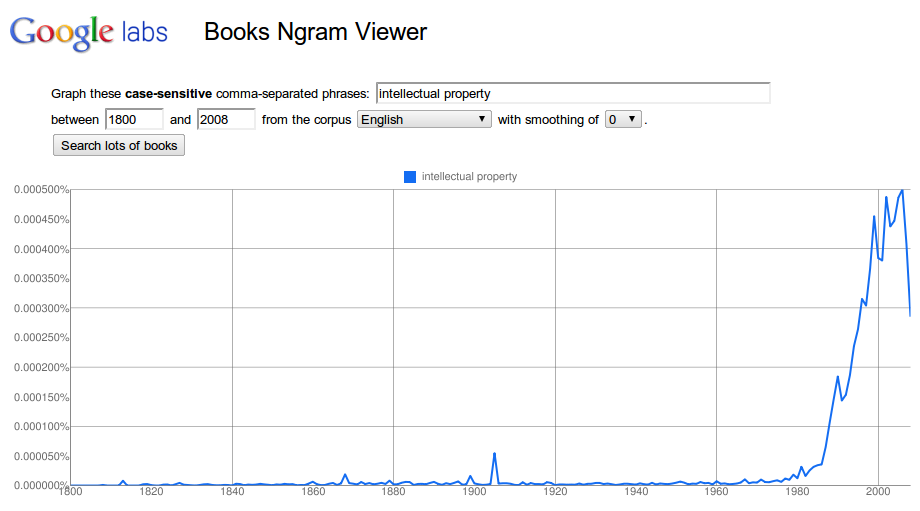
According to Professor Mark Lemley, now of the Stanford Law School, the widespread use of the term “intellectual property” is a fashion that followed the 1967 founding of the World “Intellectual Property” Organization (WIPO), and only became really common in recent years. (WIPO is formally a UN organization, but in fact represents the interests of the holders of copyrights, patents, and trademarks.) Wide use dates from around 1990. (Local image copy)
The term carries a bias that is not hard to see: it suggests thinking about copyright, patents and trademarks by analogy with property rights for physical objects. (This analogy is at odds with the legal philosophies of copyright law, of patent law, and of trademark law, but only specialists know that.) These laws are in fact not much like physical property law, but use of this term leads legislators to change them to be more so. Since that is the change desired by the companies that exercise copyright, patent and trademark powers, the bias introduced by the term “intellectual property” suits them.
The bias is reason enough to reject the term, and people have often asked me to propose some other name for the overall category—or have proposed their own alternatives (often humorous). Suggestions include IMPs, for Imposed Monopoly Privileges, and GOLEMs, for Government-Originated Legally Enforced Monopolies. Some speak of “exclusive rights regimes,” but referring to restrictions as “rights” is doublethink too.
Some of these alternative names would be an improvement, but it is a mistake to replace “intellectual property” with any other term. A different name will not address the term's deeper problem: overgeneralization. There is no such unified thing as “intellectual property”—it is a mirage. The only reason people think it makes sense as a coherent category is that widespread use of the term has misled them about the laws in question.
The term “intellectual property” is at best a catch-all to lump together disparate laws. Nonlawyers who hear one term applied to these various laws tend to assume they are based on a common principle and function similarly.
Nothing could be further from the case. These laws originated separately, evolved differently, cover different activities, have different rules, and raise different public policy issues.
For instance, copyright law was designed to promote authorship and art, and covers the details of expression of a work. Patent law was intended to promote the publication of useful ideas, at the price of giving the one who publishes an idea a temporary monopoly over it—a price that may be worth paying in some fields and not in others.
Trademark law, by contrast, was not intended to promote any particular way of acting, but simply to enable buyers to know what they are buying. Legislators under the influence of the term “intellectual property,” however, have turned it into a scheme that provides incentives for advertising. And these are just three out of many laws that the term refers to.
Since these laws developed independently, they are different in every detail, as well as in their basic purposes and methods. Thus, if you learn some fact about copyright law, you'd be wise to assume that patent law is different. You'll rarely go wrong!
In practice, nearly all general statements you encounter that are formulated using “intellectual property” will be false. For instance, you'll see claims that “its” purpose is to “promote innovation,” but that only fits patent law and perhaps plant variety monopolies. Copyright law is not concerned with innovation; a pop song or novel is copyrighted even if there is nothing innovative about it. Trademark law is not concerned with innovation; if I start a tea store and call it “rms tea,” that would be a solid trademark even if I sell the same teas in the same way as everyone else. Trade secret law is not concerned with innovation, except tangentially; my list of tea customers would be a trade secret with nothing to do with innovation.
You will also see assertions that “intellectual property” is concerned with “creativity,” but really that only fits copyright law. More than creativity is needed to make a patentable invention. Trademark law and trade secret law have nothing to do with creativity; the name “rms tea” isn't creative at all, and neither is my secret list of tea customers.
People often say “intellectual property” when they really mean some larger or smaller set of laws. For instance, rich countries often impose unjust laws on poor countries to squeeze money out of them. Some of these laws are among those called “intellectual property” laws, and others are not; nonetheless, critics of the practice often grab for that label because it has become familiar to them. By using it, they misrepresent the nature of the issue. It would be better to use an accurate term, such as “legislative colonization,” that gets to the heart of the matter.
Laymen are not alone in being confused by this term. Even law professors who teach these laws are lured and distracted by the seductiveness of the term “intellectual property,” and make general statements that conflict with facts they know. For example, one professor wrote in 2006:
Unlike their descendants who now work the floor at WIPO, the framers of the US constitution had a principled, procompetitive attitude to intellectual property. They knew rights might be necessary, but…they tied congress's hands, restricting its power in multiple ways.
That statement refers to Article 1, Section 8, Clause 8 of the US Constitution, which authorizes copyright law and patent law. That clause, though, has nothing to do with trademark law, trade secret law, or various others. The term “intellectual property” led that professor to make a false generalization.
The term “intellectual property” also leads to simplistic thinking. It leads people to focus on the meager commonality in form that these disparate laws have—that they create artificial privileges for certain parties—and to disregard the details which form their substance: the specific restrictions each law places on the public, and the consequences that result. This simplistic focus on the form encourages an “economistic” approach to all these issues.
Economics operates here, as it often does, as a vehicle for unexamined assumptions. These include assumptions about values, such as that amount of production matters while freedom and way of life do not, and factual assumptions which are mostly false, such as that copyrights on music supports musicians, or that patents on drugs support life-saving research.
Another problem is that, at the broad scale implicit in the term “intellectual property,” the specific issues raised by the various laws become nearly invisible. These issues arise from the specifics of each law—precisely what the term “intellectual property” encourages people to ignore. For instance, one issue relating to copyright law is whether music sharing should be allowed; patent law has nothing to do with this. Patent law raises issues such as whether poor countries should be allowed to produce life-saving drugs and sell them cheaply to save lives; copyright law has nothing to do with such matters.
Neither of these issues is solely economic in nature, and their noneconomic aspects are very different; using the shallow economic overgeneralization as the basis for considering them means ignoring the differences. Putting the two laws in the “intellectual property” pot obstructs clear thinking about each one.
Thus, any opinions about “the issue of intellectual property” and any generalizations about this supposed category are almost surely foolish. If you think all those laws are one issue, you will tend to choose your opinions from a selection of sweeping overgeneralizations, none of which is any good.
Rejection of “intellectual property” is not mere philosophical recreation. The term does real harm. Apple used it to warp debate about Nebraska's “right to repair” bill. The bogus concept gave Apple a way to dress up its preference for secrecy, which conflicts with its customers' rights, as a supposed principle that customers and the state must yield to.
If you want to think clearly about the issues raised by patents, or copyrights, or trademarks, or various other different laws, the first step is to forget the idea of lumping them together, and treat them as separate topics. The second step is to reject the narrow perspectives and simplistic picture the term “intellectual property” suggests. Consider each of these issues separately, in its fullness, and you have a chance of considering them well.
And when it comes to reforming WIPO, here is one proposal for changing the name and substance of WIPO.
1.2 Tim Harford - The great intellectual property trade-off - BBC News 1.2 Tim Harford - The great intellectual property trade-off - BBC News
In January 1842, Charles Dickens arrived on American shores for the first time.
He was greeted like a rock star in Boston, Massachusetts, but the great novelist was a man with a cause: he wanted to put an end to cheap, sloppy pirated copies of his work in the US.
They circulated with impunity because the United States granted no copyright protection to non-citizens.
In a bitter letter to a friend, Dickens compared the situation to being mugged and then paraded through the streets in ridiculous clothes.
"Is it tolerable that besides being robbed and rifled," he wrote, "an author should be forced to appear in any form - in any vulgar dress - in any atrocious company?"
Monopoly
It was a powerful and melodramatic metaphor. But the truth is the case for what Dickens was demanding - legal protection for ideas that otherwise could be freely copied and adapted - has never been quite so clear cut.
Patents and copyright grant a monopoly.
Dickens's British publishers will have charged as much as they could get away with for copies of Bleak House. Cash-strapped literature lovers simply had to go without.
But these potential fat profits encourage new ideas.
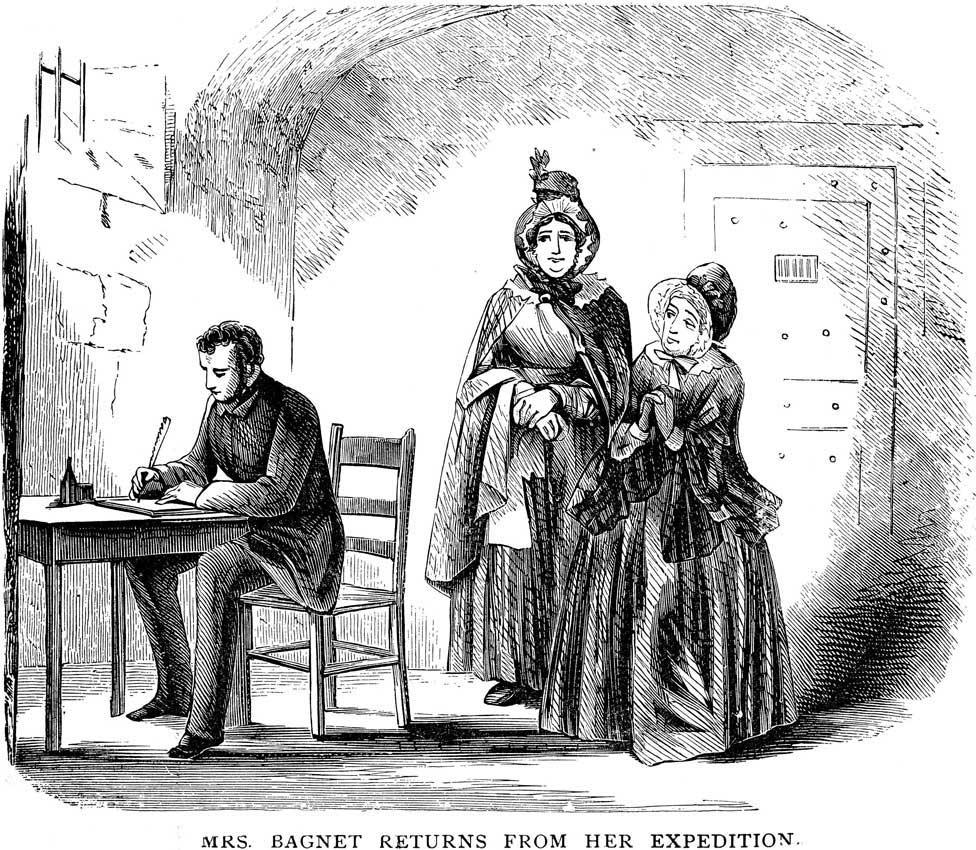 Image source,Alamy
Many US editions of Dickens's work - including Bleak House - were pirated copies
It took Dickens a long time to write Bleak House. If other British publishers could have ripped it off like the Americans, perhaps he wouldn't have bothered.
So, intellectual property reflects an economic trade-off, a balancing act. If it's too generous to the creators, then good ideas will take too long to copy, adapt and spread. If it's too stingy, then maybe we won't see the good ideas at all.
This trade-off has always been coloured by politics.
The British legal system strongly protected the rights of British authors and British inventors in the 1800s because the UK was then - as now - a powerful force in world culture and innovation.
Brazen copying
But in Dickens's day, American literature and innovation were in their infancy. The US economy was in full-blown copying mode: they wanted the cheapest possible access to the best ideas that Europe could offer.
US newspapers filled their pages with brazen copying - alongside attacks on the interfering Mr Dickens.
A few decades later, when American authors and inventors spoke with a more powerful voice, America's lawmakers began to take an increasingly fond view of the idea of intellectual property. Newspapers, once opposed to copyright, now rely upon it.
And we can expect to see a similar transition in developing countries today: the less they copy other ideas and the more they create their own, the more they protect ideas. There's been a lot of recent movement: China didn't have a copyright system at all until 1991.
The modern form of intellectual property originated, like so many things, in 15th Century Venice. Venetian patents were explicitly designed to encourage innovation.
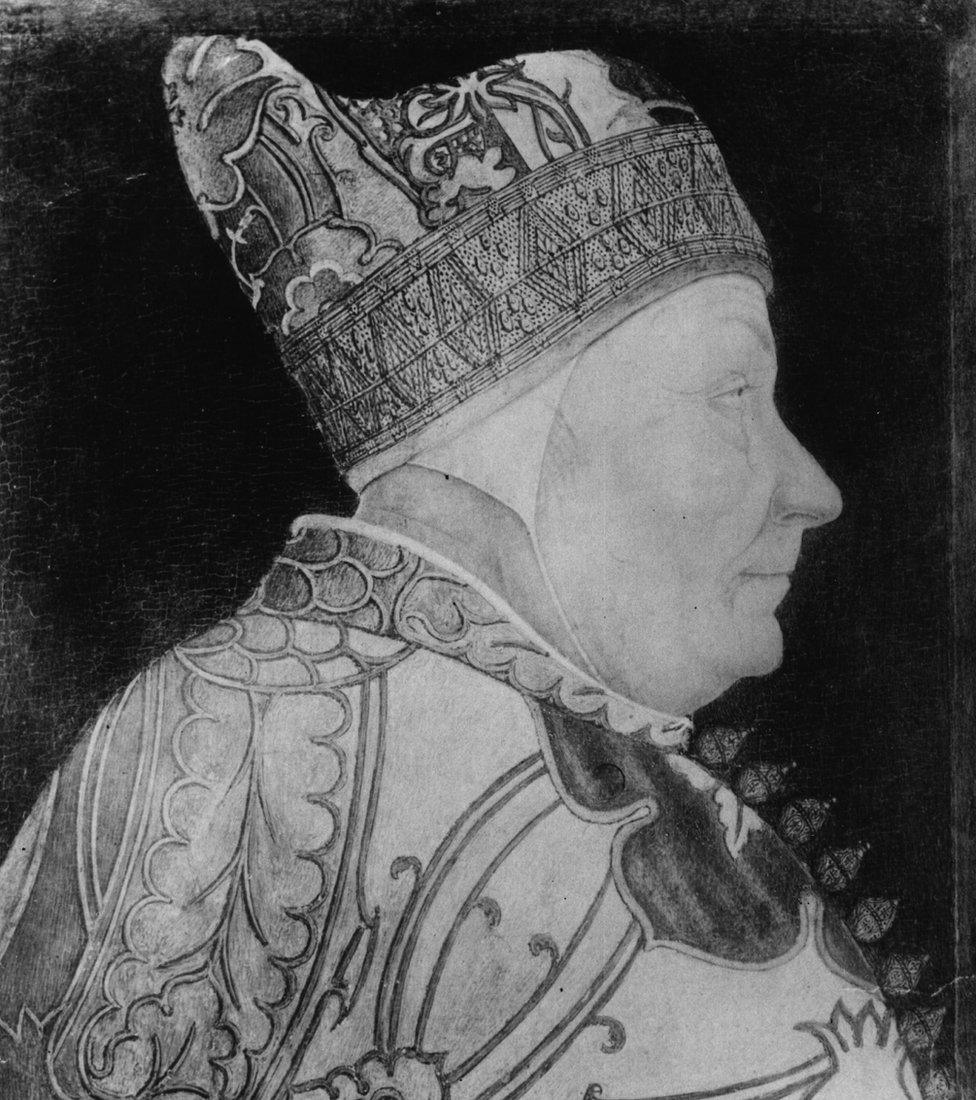 Image source,Getty Images Image caption, Francesco Foscari was Doge of Venice in 1474 when the Venetian patent statute was introduced
The inventor would automatically receive a patent if their invention was useful. The patent was temporary, but could be sold, transferred or even inherited during its lifetime.
It would be forfeited if it wasn't used, and invalidated if the invention proved to be closely based on a previous idea.
These are all very modern ideas. And they soon created very modern problems.
Rivalry
During the British industrial revolution, the great engineer James Watt worked out a superior way to design a steam engine. He spent months developing a prototype, but then put even more effort into securing a patent.
His influential business partner, Matthew Boulton, even got the patent extended by lobbying Parliament.
Boulton and Watt used it to extract licensing fees and crush rivals - for example, Jonathan Hornblower, who made an even better steam engine yet found himself ruined and imprisoned.
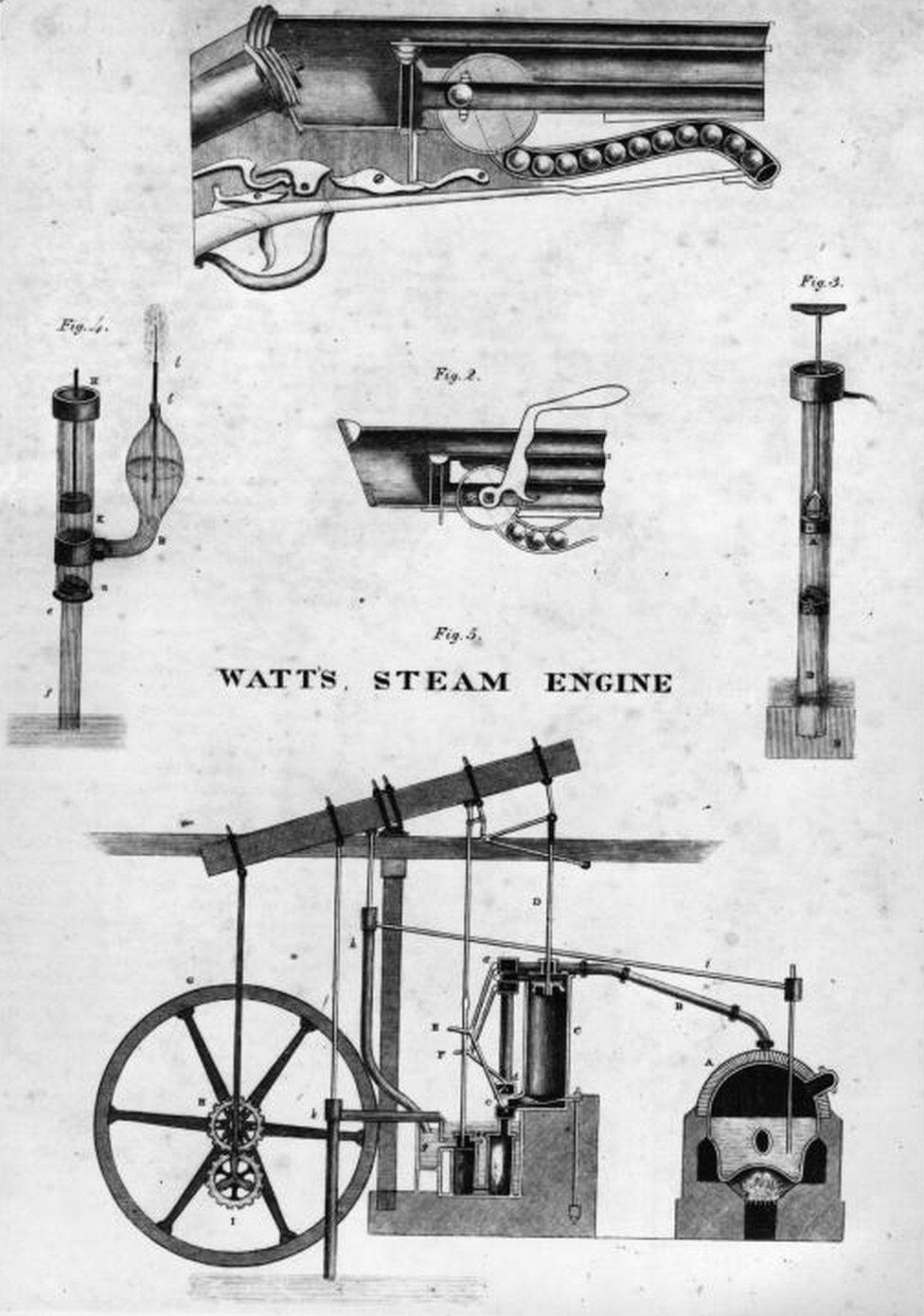 Image source,Hulton Archive
The details may have been grubby, but surely Watt's famous invention was worth it? Well, maybe not.
The economists Michele Boldrin and David Levine argue that what truly unleashed steam-powered industry was the expiry of the patent, in 1800, as rival inventors revealed the ideas they had been sitting on for years.
And what happened to Boulton and Watt, once they could no longer sue those rivals? They flourished anyway. They redirected their attention from litigation towards the challenge of producing the best steam engines in the world. They kept their prices as high as ever, and their order books swelled.
Far from incentivising improvements in the steam engine, the patent actually delayed them.
Expansion
Yet since the days of Boulton and Watt, intellectual property protection has grown more expansive, not less so.
Copyright terms are growing ever longer. In the US, they were originally 14 years, renewable once. They now last 70 years after the death of the author - typically more than a century.
Patents have become broader and are being granted on vague ideas - for example, Amazon's "one-click" US patent protects the not-entirely-radical idea of buying a product on the internet by clicking only one button.
 Image source,Getty Images Image caption, Amazon's "one-click" buying process is now protected
The US intellectual property system now has a global reach, thanks to the inclusion of intellectual property rules in what tend to be described as "trade agreements".
And more and more things fall under the scope of intellectual property - for example plants, buildings and software have all been brought into its domain.
These expansions are hard to justify, but easy to explain: intellectual property is very valuable to its owners, which justifies the cost of employing expensive lawyers and lobbyists.
Meanwhile, the cost of the restrictions are spread widely among people who barely notice it.
The likes of Matthew Boulton and Charles Dickens have a strong incentive to lobby aggressively for more draconian intellectual property laws - while the many buyers of steam engines and Bleak House are unlikely to get politically organised to object.
The economists Boldrin and Levine have a radical response to this problem: scrap intellectual property altogether, external.
There are, after all, other rewards for inventing things - getting a "first mover" advantage over your competitors, establishing a strong brand, or enjoying a deeper understanding of what makes a product work.
Financial upside?
In 2014, the electric car company Tesla opened up access to its patent archive in an effort to expand the industry as a whole, calculating the company would benefit overall.
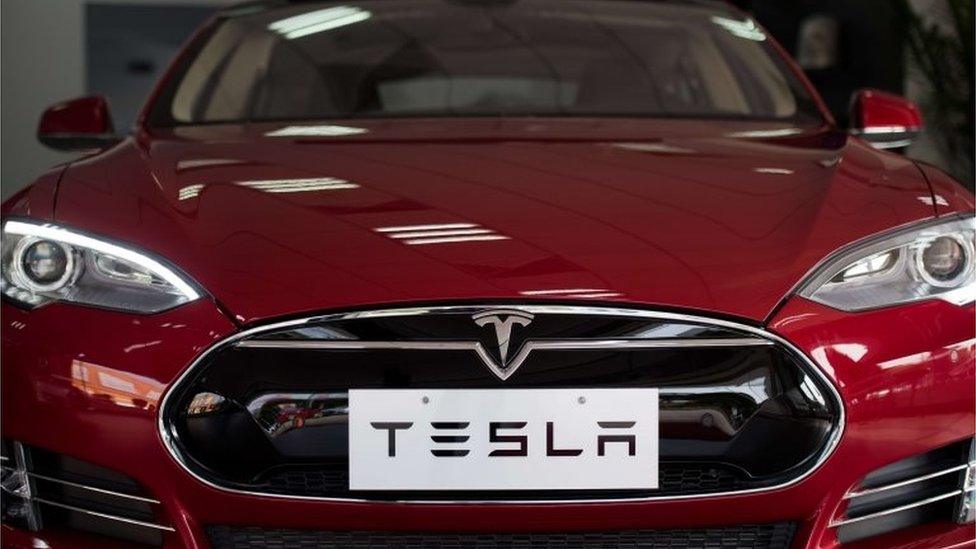 Image source,Getty Images Image caption,Tesla's Model S was the world's best-selling plug-in electric car for two years in a row, 2015 and 2016
For most economists, scrapping intellectual property entirely is going too far. They point to important cases - such as new medicines - where the costs of invention are enormous and the costs of copying are trivial.
But those who defend intellectual property protections still tend to argue that - right now - those protections offer more than enough incentive to create new ideas.
Dickens himself eventually discovered a financial upside to weak copyright protection.
Twenty five years after his initial visit to the US, Dickens returned, keen to make some money.
He reckoned that so many people had read cheap knock-offs of his stories that he could cash in on his fame with a lecture tour. He was absolutely right: off the back of pirated copies of his work, Charles Dickens made a fortune as a public speaker, many millions of dollars in today's terms.
Perhaps the intellectual property was worth more when given away.
1.3 John Locke, Second Treatise, Chap. V, Of Property §§ 25--51, 123--26. 1.3 John Locke, Second Treatise, Chap. V, Of Property §§ 25--51, 123--26.
25. Whether we consider natural Reason, which tells us, that Men, being once born, have a right to their Preservation, and consequently to Meat and Drink, and such other things, as Nature affords for their Subsistence: Or Revelation, which gives us an account of those Grants God made of the World to Adam, and to Noah, and his Sons, 'tis very clear, that God, as King David says, Psal. CXV. xvi. has given the Earth to the Children of Men, given it to Mankind in common. But this being supposed, it seems to some a very great difficulty, how any one should ever come to have a Property in any thing: I will not content my self to answer, That if it be difficult to make out Property, upon a supposition, that God gave the World to Adam and his Posterity in common; it is impossible that any Man, but one universal Monarch, should have any Property, upon a supposition, that God gave the World to Adam, and his Heirs in Succession, exclusive of all the rest of his Posterity. But I shall endeavour to shew, how Men might come to have a property in several parts of that which God gave to Mankind in common, and that without any express Compact of all the Commoners.
26. God, who hath given the World to Men in common, hath also given them reason to make use of it to the best advantage of Life, and convenience. The Earth, and all that is therein, is given to Men for the Support and Comfort of their being. And though all the Fruits it naturally produces, and Beasts it feeds, belong to Mankind in common, as they are produced by the spontaneous hand of Nature; and no body has originally a private Dominion, exclusive of the rest of Mankind, in any of them, as they are thus in their natural state: yet being given for the use of Men, there must of necessity be a means to appropriate them some way or other before they can be of any use, or at all beneficial to any particular Man. The Fruit, or Venison, which nourishes the wild Indian, who knows no Inclosure, and is still a Tenant in common, must be his and so his, i.e. a part of him, that another can no longer have any right to it, before it can do him any good for the support of his Life.
27. Though the Earth, and all inferior Creatures be common to all Men, yet every Man has a Property in his own Person. This no Body has any Right to but himself. The Labour of his Body, and the Work of his Hands, we may say, are properly his. Whatsoever then he removes out of the State that Nature hath provided, and left it in, he hath mixed his Labour with, and joyned to it something that is his own, and thereby makes it his Property. It being by him removed from the common state Nature placed it in, hath by this labour something annexed to it, that excludes the common right of other Men. For this Labour being the unquestionable Property of the Labourer, no man but he can have a right to what that is once joyned to, at least where there is enough, and as good left in common for others.
28. He that is nourished by the Acorns he pickt up under an Oak, or the Apples he gathered from the Trees in the Wood, has certainly appropriated them to himself. No Body can deny but the nourishment is his. I ask then, When did they begin to be his? When he digested? Or when he eat? Or when he boiled? Or when he brought them home? Or when he pickt them up? And 'tis plain, if the first gathering made them not his, nothing else could. That labour put a distinction between them and common. That added something to them more than Nature, the common Mother of all, had done; and so they became his private right. And will any one say he had no right to those Acorns or Apples he thus appropriated, because he had not the consent of all Mankind to make them his? Was it a Robbery thus to assume to himself what belonged to all in Common? If such a consent as that was necessary, Man had starved, notwithstanding the Plenty God had given him. We see in Commons, which remain so by Compact, that 'tis the taking any part of what is common, and removing it out of the state Nature leaves it in, which begins the Property; without which the Common is of no use. And the taking of this or that part, does not depend on the express consent of all the Commoners. Thus the Grass my Horse has bit; the Turfs my Servant has cut; and the Ore I have digg'd in any place where I have a right to them in common with others, become my Property, without the assignation or consent of any body. The labour that was mine, removing them out of that common state they were in, hath fixed my Property in them.
29. By making an explicit consent of every Commoner, necessary to any ones appropriating to himself any part of what is given in common, Children or Servants could not cut the Meat which their Father or Master had provided for them in common, without assigning to every one his peculiar part. Though the Water running in the Fountain be every ones, yet who can doubt, but that in the Pitcher is his only who drew it out? His labour hath taken it out of the hands of Nature, where it was common, and belong'd equally to all her Children, and hath thereby appropriated it to himself.
30. Thus this Law of reason makes the Deer, that Indian's who hath killed it; 'tis allowed to be his goods who hath bestowed his labour upon it, though before, it was the common right of every one. And amongst those who are counted the Civiliz'd part of Mankind, who have made and multiplied positive Laws to determine Property, this original Law of Nature for the beginning of Property, in what was before common, still takes place; and by vertue thereof, what Fish any one catches in the Ocean, that great and still remaining Common of Mankind; or what Ambergriese any one takes up here, is by the Labour that removes it out of that common state Nature left it in, made his Property who takes that pains about it. And even amongst us the Hare that any one is Hunting, is thought his who pursues her during the Chase. For being a Beast that is still looked upon as common, and no Man's private Possession; whoever has imploy'd so much labour about any of that kind, as to find and pursue her, has thereby removed her from the state of Nature, wherein she was common, and hath begun a Property.
31. It will perhaps be objected to this, That if gathering the Acorns, or other Fruits of the Earth, &c. makes a right to them, then any one may ingross as much as he will. To which I Answer, Not so. The same Law of Nature, that does by this means give us Property, does also bound that Property too. God has given us all things richly, 1 Tim. vi. 17. is the Voice of Reason confirmed by Inspiration. But how far has he given it us? To enjoy. As much as any one can make use of to any advantage of life before it spoils; so much he may by his labour fix a Property in. Whatever is beyond this, is more than his share, and belongs to others. Nothing was made by God for Man to spoil or destroy. And thus considering the plenty of natural Provisions there was a long time in the World, and the few spenders, and to how small a part of that provision the industry of one Man could extend it self, and ingross it to the prejudice of others; especially keeping within the bounds, set by reason of what might serve for his use; there could be then little room for Quarrels or Contentions about Property so establish'd.
32. But the chief matter of Property being now not the Fruits of the Earth, and the Beasts that subsist on it, but the Earth it self; as that which takes in and carries with it all the rest: I think it is plain, that Property in that too is acquired as the former. As much Land as a Man Tills, Plants, Improves, Cultivates, and can use the Product of, so much is his Property. He by his Labour does, as it were, inclose it from the Common. Nor will it invalidate his right to say, Every body else has an equal Title to it; and therefore he cannot appropriate, he cannot inclose, without the Consent of all his Fellow-Commoners, all Mankind. God, when he gave the World in common to all Mankind, commanded Man also to labour, and the penury of his Condition required it of him. God and his Reason commanded him to subdue the Earth, i.e. improve it for the benefit of Life, and therein lay out something upon it that was his own, his labour. He that in Obedience to this Command of God, subdued, tilled and sowed any part of it, thereby annexed to it something that was his Property, which another had no Title to, nor could without injury take from him.
33. Nor was this appropriation of any parcel of Land, by improving it, any prejudice to any other Man, since there was still enough, and as good left; and more than the yet unprovided could use. So that in effect, there was never the less left for others because of his inclosure for himself. For he that leaves as much as another can make use of, does as good as take nothing at all. No Body could think himself injur'd by the drinking of another Man, though he took a good Draught, who had a whole River of the same Water left him to quench his thirst. And the Case of Land and Water, where there is enough of both, is perfectly the same.
34. God gave the World to Men in Common; but since he gave it them for their benefit, and the greatest Conveniencies of Life they were capable to draw from it, it cannot be supposed he meant it should always remain common and uncultivated. He gave it to the use of the Industrious and Rational, (and Labour was to be his Title to it;) not to the Fancy or Covetousness of the Quarrelsom and Contentious. He that had as good left for his Improvement, as was already taken up, needed not complain, ought not to meddle with what was already improved by another's Labour: If he did, 'tis plain he desired the benefit of another's Pains, which he had no right to, and not the Ground which God had given him in common with others to labour on, and whereof there was as good left, as that already possessed, and more than he knew what to do with, or his Industry could reach to.
35. 'Tis true, in Land that is common in England, or any other Country, where there is Plenty of People under Government, who have Money and Commerce, no one can inclose or appropriate any part, without the consent of all his Fellow-Commoners: Because this is left common by Compact, i.e. by the Law of the Land, which is not to be violated. And though it be Common, in respect of some Men, it is not so to all Mankind; but is the joint property of this Countrey, or this Parish. Besides, the remainder, after such inclosure, would not be as good to the rest of the Commoners as the whole was, when they could all make use of the whole: whereas in the beginning and first peopling of the great Common of the World, it was quite otherwise. The Law Man was under, was rather for appropriating. God Commanded, and his Wants forced him to labour. That was his Property which could not be taken from him where-ever he had fixed it. And hence subduing or cultivating the Earth, and having Dominion, we see are joyned together. The one gave Title to the other. So that God, by commanding to subdue, gave Authority so far to appropriate. And the Condition of Humane Life, which requires Labour and Materials to work on, necessarily introduces private Possessions.
36. The measure of Property, Nature has well set, by the Extent of Mens Labour, and the Conveniency of Life: No Mans Labour could subdue, or appropriate all: nor could his Enjoyment consume more than a small part; so that it was impossible for any Man, this way, to intrench upon the right of another, or acquire, to himself, a Property, to the Prejudice of his Neighbour, who would still have room, for as good, and as large a Possession (after the other had taken out his) as before it was appropriated. This measure did confine every Man's Possession, to a very moderate Proportion, and such as he might appropriate to himself, without Injury to any Body in the first Ages of the World, when Men were more in danger to be lost, by wandering from their Company, in the then vast Wilderness of the Earth, than to be straitned for want of room to plant in. And the same measure may be allowed still, without prejudice to any Body, as full as the World seems. For supposing a Man, or Family, in the state they were, at first peopling of the World by the Children of Adam, or Noah; let him plant in some in-land, vacant places of America, we shall find that the Possessions he could make himself upon the measures we have given, would not be very large, nor, even to this day, prejudice the rest of Mankind, or give them reason to complain, or think themselves injured by this Man's Incroachment, though the Race of Men have now spread themselves to all the corners of the World, and do infinitely exceed the small number [which] was at the beginning. Nay, the extent of Ground is of so little value, without labour, that I have heard it affirmed, that in Spain it self, a Man may be permitted to plough, sow, and reap, without being disturbed, upon Land he has no other Title to, but only his making use of it. But, on the contrary, the Inhabitants think themselves beholden to him, who, by his Industry on neglected, and consequently waste Land, has increased the stock of Corn, which they wanted. But be this as it will, which I lay no stress on; This I dare boldly affirm, That the same Rule of Propriety, (viz.) that every Man should have as much as he could make use of, would hold still in the World, without straitning any body, since there is Land enough in the World to suffice double the Inhabitants had not the Invention of Money, and the tacit Agreement of Men to put a value on it, introduced (by Consent) larger Possessions, and a Right to them; which, how it has done, I shall, by and by, shew more at large.
37. This is certain, That in the beginning, before the desire of having more than Men needed, had altered the intrinsick value of things, which depends only on their usefulness to the Life of Man; or [Men] had agreed, that a little piece of yellow Metal, which would keep without wasting or decay, should be worth a great piece of Flesh, or a whole heap of Corn; though Men had a Right to appropriate, by their Labour, each one to himself, as much of the things of Nature, as he could use: Yet this could not be much, nor to the Prejudice of others, where the same plenty was still left, to those who would use the same Industry. To which let me add, that he who appropriates land to himself by his labour, does not lessen but increase the common stock of mankind. For the provisions serving to the support of humane life, produced by one acre of inclosed and cultivated land, are (to speak much within compasse) ten times more, than those, which are yeilded by an acre of Land, of an equal richnesse, lyeing wast in common. And therefor he, that incloses Land and has a greater plenty of the conveniencys of life from ten acres, than he could have from an hundred left to Nature, may truly be said, to give ninety acres to Mankind. For his labour now supplys him with provisions out of ten acres, which were but the product of an hundred lying in common. I have here rated the improved land very low in making its product but as ten to one, when it is much nearer an hundred to one. For I aske whether in the wild woods and uncultivated wast of America left to Nature, without any improvement, tillage or husbandry, a thousand acres will yeild the needy and wretched inhabitants as many conveniencies of life as ten acres of equally fertile land doe in Devonshire where they are well cultivated?
Before the Appropriation of Land, he who gathered as much of the wild Fruit, killed, caught, or tamed, as many of the Beasts as he could; he that so employed his Pains about any of the spontaneous Products of Nature, as any way to alter them, from the state which Nature put them in, by placing any of his Labour on them, did thereby acquire a Property in them: But if they perished, in his Possession, without their due use; if the Fruits rotted, or the Venison putrified, before he could spend it, he offended against the common Law of Nature, and was liable to be punished; he invaded his Neighbour's share, for he had no Right, farther than his Use called for any of them, and they might serve to afford him Conveniencies of Life.
38. The same measures governed the Possession of Land too: Whatsoever he tilled and reaped, laid up and made use of, before it spoiled, that was his peculiar Right; whatsoever he enclosed, and could feed, and make use of, the Cattle and Product was also his. But if either the Grass of his Inclosure rotted on the Ground, or the Fruit of his planting perished without gathering, and laying up, this part of the Earth, notwithstanding his Inclosure, was still to be looked on as Waste, and might be the Possession of any other. Thus, at the beginning, Cain might take as much Ground as he could till, and make it his own Land, and yet leave enough to Abel's Sheep to feed on; a few Acres would serve for both their Possessions. But as Families increased, and Industry inlarged their Stocks, their Possessions inlarged with the need of them; but yet it was commonly without any fixed property in the ground they made use of, till they incorporated, settled themselves together, and built Cities, and then, by consent, they came in time, to set out the bounds of their distinct Territories, and agree on limits between them and their Neighbours, and by Laws within themselves, settled the Properties of those of the same Society. For we see, that in that part of the World which was first inhabited, and therefore like to be best peopled, even as low down as Abraham's time, they wandred with their Flocks, and their Herds, which was their substance, freely up and down; and this Abraham did, in a Country where he was a Stranger. Whence it is plain, that at least, a great part of the Land lay in common; that the Inhabitants valued it not, nor claimed Property in any more than they made use of. But when there was not room enough in the same place, for their Herds to feed together, they, by consent, as Abraham and Lot did, Gen. xiii. 5. separated and inlarged their pasture, where it best liked them. And for the same Reason Esau went from his Father, and his Brother, and planted in Mount Seir, Gen. xxxvi. 6.
39. And thus, without supposing any private Dominion, and property in Adam, over all the World, exclusive of all other Men, which can no way be proved, nor any ones Property be made out from it; but supposing the World given as it was to the Children of Men in common, we see how labour could make Men distinct titles to several parcels of it, for their private uses; wherein there could be no doubt of Right, no room for quarrel.
40. Nor is it so strange, as perhaps before consideration it may appear, that the Property of labour should be able to over-ballance the Community of Land. For 'tis Labour indeed that puts the difference of value on every thing; and let any one consider, what the difference is between an Acre of Land planted with Tobacco, or Sugar, sown with Wheat or Barley; and an Acre of the same Land lying in common, without any Husbandry upon it, and he will find, that the improvement of labour makes the far greater part of the value. I think it will be but a very modest Computation to say, that of the Products of the Earth useful to the Life of man 9/10 are the effects of labour: nay, if we will rightly estimate things as they come to our use, and cast up the several Expenses about them, what in them is purely owing to Nature, and what to labour, we shall find, that in most of them 99/100 are wholly to be put on the account of labour.
41. There cannot be a clearer demonstration of any thing, than several Nations of the Americans are of this, who are rich in Land, and poor in all the Comforts of Life; whom Nature having furnished as liberally as any other people, with the materials of Plenty, i.e. a fruitful Soil, apt to produce in abundance, what might serve for food, rayment, and delight; yet for want of improving it by labour, have not one hundredth part of the Conveniencies we enjoy: And a King of a large fruitful Territory there feeds, lodges, and is clad worse than a day Labourer in England.
42. To make this a little clearer, let us but trace some of the ordinary provisions of Life, through their several progresses, before they come to our use, and see how much they receive of their value from Humane Industry. Bread, Wine and Cloth, are things of daily use, and great plenty, yet notwithstanding, Acorns, Water, and Leaves, or Skins, must be our Bread, Drink and Clothing, did not labour furnish us with these more useful Commodities. For whatever Bread is more worth than Acorns, Wine than Water, and Cloth or Silk than Leaves, Skins, or Moss, that is wholly owing to labour and industry. The one of these being the Food and Rayment which unassisted Nature furnishes us with; the other provisions which our industry and pains prepare for us, which how much they exceed the other in value, when any one hath computed, he will then see, how much labour makes the far greatest part of the value of things, we enjoy in this World: And the ground which produces the materials, is scarce to be reckon'd in, as any, or at most, but a very small, part of it; So little, that even amongst us, Land that is left wholly to Nature, that hath no improvement of Pasturage, Tillage, or Planting, is called, as indeed it is, wast; and we shall find the benefit of it amount to little more than nothing. This shews, how much numbers of men are to be preferd to largenesse of dominions, and that the increase of lands and the right imploying of them is the great art of government. And that Prince who shall be so wise and godlike as by established laws of liberty to secure protection and incouragement to the honest industry of Mankind against the oppression of power and narrownesse of Party will quickly be too hard for his neighbours. But this bye the bye. To return to the argument in hand.
43. An Acre of Land that bears here Twenty Bushels of Wheat, and another in America, which, with the same Husbandry, would do the like, are without doubt, of the same natural, intrinsick Value. But yet the Benefit Mankind receives from the one, in a Year, is worth 5 l. and from the other possibly not worth a Penny, if all the Profit an Indian received from it were to be valued, and sold here; at least, I may truly say, not 1/1000. 'Tis Labour then which puts the greatest part of Value upon Land, without which it would scarcely be worth any thing: 'tis to that we owe the greatest part of all its useful Products; for all that the Straw, Bran, Bread, of that Acre of Wheat, is more worth than the Product of an Acre of as good Land, which lies wast, is all the Effect of Labour. For 'tis not barely the Plough-man's Pains, the Reaper's and Thresher's Toil, and the Bakers Sweat, is to be counted into the Bread we eat; the Labour of those who broke the Oxen, who digged and wrought the Iron and Stones, who felled and framed the Timber imployed about the Plough, Mill, Oven, or any other Utensils, which are a vast Number, requisite to this Corn, from its being seed to be sown to its being made Bread, must all be charged on the account of Labour, and received as an effect of that; Nature and the Earth furnished only the almost worthless Materials, as in themselves. 'Twould be a strange Catalogue of things, that Industry provided and made use of, about every Loaf of Bread, before it came to our use, if we could trace them; Iron, Wood, Leather, Bark, Timber, Stone, Bricks, Coals, Lime, Cloth, Dying-Drugs, Pitch, Tar, Masts, Ropes, and all the Materials made use of in the Ship, that brought any of the Commodities made use of by any of the Workmen, to any part of the Work, all which, 'twould be almost impossible, at least too long, to reckon up.
44. From all which it is evident, that though the things of Nature are given in common, yet Man (by being Master of himself, and Proprietor of his own Person, and the actions or Labour of it) had still in himself the great Foundation of Property; and that which made up the great part of what he applied to the Support or Comfort of his being, when Invention and Arts had improved the conveniencies of Life, was perfectly his own, and did not belong in common to others.
45. Thus Labour, in the Beginning, gave a Right of Property, where-ever any one was pleased to imploy it, upon what was common, which remained, a long while, the far greater part, and is yet more than Mankind makes use of. Men, at first, for the most part, contented themselves with what un-assisted Nature Offered to their Necessities: and though afterwards, in some parts of the World, (where the Increase of People and Stock, with the Use of Money) had made Land scarce, and so of some Value, the several Communities settled the Bounds of their distinct Territories, and by Laws within themselves, regulated the Properties of the private Men of their Society, and so, by Compact and Agreement, settled the Property which Labour and Industry began; and the Leagues that have been made between several States and Kingdoms, either expressly or tacitly disowning all Claim and Right to the Land in the others Possession, have, by common Consent, given up their Pretences to their natural common Right, which originally they had to those Countries, and so have, by positive agreement, settled a Property amongst themselves, in distinct Parts and parcels of the Earth: yet there are still great Tracts of Ground to be found, which (the Inhabitants thereof not having joyned with the rest of Mankind, in the consent of the Use of their common Money) lie waste, and are more than the People, who dwell on it, do, or can make use of, and so still lie in common. Tho' this can scarce happen amongst that part of Mankind, that have consented to the use of Money.
46. The greatest part of things really useful to the Life of Man, and such as the necessity of subsisting made the first Commoners of the World look after, as it doth the Americans now, are generally things of short duration; such as, if they are not consumed by use, will decay and perish of themselves: Gold, Silver, and Diamonds, are things, that Fancy or Agreement hath put the Value on, more then real Use, and the necessary Support of Life. Now of those good things which Nature hath provided in common, every one had a Right (as hath been said) to as much as he could use, and had a Property in all that he could affect with his Labour: all that his Industry could extend to, to alter from the State Nature had put it in, was his. He that gathered a Hundred Bushels of Acorns or Apples, had thereby a Property in them; they were his Goods as soon as gathered. He was only to look that he used them before they spoiled; else he took more than his share, and robb'd others. And indeed it was a foolish thing, as well as dishonest, to hoard up more than he could make use of. If he gave away a part to any body else, so that it perished not uselesly in his Possession, these he also made use of. And if he also bartered away Plumbs that would have rotted in a Week, for Nuts that would last good for his eating a whole Year, he did no injury; he wasted not the common Stock; destroyed no part of the portion of Goods that belonged to others, so long as nothing perished uselesly in his hands. Again, if he would give us Nuts for a piece of Metal, pleased with its colour; or exchanged his Sheep for Shells, or Wool for a sparkling Pebble or a Diamond, and keep those by him all his Life, he invaded not the Right of others, he might heap up as much of these durable things as he pleased; the exceeding of the bounds of his just Property not lying in the largeness of his Possession, but the perishing of any thing uselesly in it.
47. And thus came in the use of Money, some lasting thing that Men might keep without spoiling, and that by mutual consent Men would take in exchange for the truly useful, but perishable Supports of Life.
48. And as different degrees of Industry were apt to give Men Possessions in different Proportions, so this Invention of Money gave them the opportunity to continue to enlarge them. For supposing an Island, separated from all possible Commerce with the rest of the World, wherein there were but a hundred Families, but there were Sheep, Horses and Cows, with other useful Animals, wholsome Fruits, and Land enough for Corn for a hundred thousand times as many, but nothing in the Island, either because of its Commonness, or Perishableness, fit to supply the place of Money: What reason could any one have there to enlarge his Possessions beyond the use of his Family, and a plentiful supply to its Consumption, either in what their own Industry produced, or they could barter for like perishable, useful Commodities, with others? Where there is not something both lasting and scarce, and so valuable to be hoarded up, there Men will not be apt to enlarge their Possessions of Land, were it never so rich, never so free for them to take. For I ask, What would a Man value Ten Thousand, or an Hundred Thousand Acres of excellent Land, ready cultivated, and well stocked too with Cattle, in the middle of the in-land Parts of America, where he had no hopes of Commerce with other Parts of the World, to draw Money to him by the Sale of the Product? It would not be worth the inclosing, and we should see him give up again to the wild Common of Nature, whatever was more than would supply the Conveniencies of Life to be had there for him and his Family.
49. Thus in the beginning all the World was America, and more so than that is now; for no such thing as Money was any where known. Find out something that hath the Use and Value of Money amongst his Neighbours, you shall see the same Man will begin presently to enlarge his Possessions.
50. But since Gold and Silver, being little useful to the Life of Man in proportion to Food, Rayment, and Carriage, has its value only from the consent of Men, whereof Labour yet makes, in great part, the measure, it is plain, that Men have agreed to disproportionate and unequal Possession of the Earth, they having by a tacit and voluntary consent found out a way, how a man may fairly possess more land than he himself can use the product of, by receiving in exchange for the overplus, Gold and Silver, which may be hoarded up without injury to any one, these metalls not spoileing or decaying in the hands of the possessor. This partage of things, in an inequality of private possessions, men have made practicable out of the bounds of Societie, and without compact, only by putting a value on gold and silver and tacitly agreeing in the use of Money. For in Governments the Laws regulate the right of property, and the possession of land is determined by positive constitutions.
51. And thus, I think, it is very easie to conceive without any difficulty, how Labour could at first begin a title of Property in the common things of Nature, and how the spending it upon our uses bounded it. So that there could then be no reason of quarrelling about Title, nor any doubt about the largeness of Possession it gave. Right and conveniency went together; for as a Man had a Right to all he could imploy his Labour upon, so he had no temptation to labour for more than he could make use of. This left no room for Controversie about the Title, nor for Incroachment on the Right of others; what Portion a Man carved to himself, was easily seen; and it was useless as well as dishonest to carve himself too much, or take more than he needed.
Chap. IX. Of the Ends of Political Society and Government.
123. If Man in the State of Nature be so free, as has been said; If he be absolute Lord of his own Person and Possessions, equal to the greatest, and subject to no Body, why will he part with his Freedom? Why will he give up this Empire, and subject himself to the Dominion and Controul of any other Power? To which 'tis obvious to Answer, that though in the state of Nature he hath such a right, yet the Enjoyment of it is very uncertain, and constantly exposed to the Invasion of others. For all being Kings as much as he, every Man his Equal, and the greater part no strict Observers of Equity and Justice, the enjoyment of the property he has in this state is very unsafe, very unsecure. This makes him willing to quit a Condition, which however free, is full of fears and continual dangers: And 'tis not without reason, that he seeks out, and is willing to joyn in Society with others who are already united, or have a mind to unite for the mutual Preservation of their Lives, Liberties and Estates, which I call by the general Name, Property.
124. The great and chief end therefore, of Mens uniting into Commonwealths, and putting themselves under Government, is the Preservation of their Property. To which in the state of Nature there are many things wanting.
First, There wants an establish'd, settled, known Law, received and allowed by common consent to be the Standard of Right and Wrong, and the common measure to decide all Controversies between them. For though the Law of Nature be plain and intelligible to all rational Creatures; yet Men being biassed by their Interest, as well as ignorant for want of study of it, are not apt to allow of it as a Law binding to them in the application of it to their particular Cases.
125. Secondly, In the State of Nature there wants a known and indifferent Judge, with Authority to determine all differences according to the established Law. For every one in that state being both Judge and Executioner of the Law of Nature, Men being partial to themselves, Passion and Revenge is very apt to carry them too far, and with too much heat, in their own Cases; as well as negligence, and unconcernedness, to make them too remiss, in other Mens.
126. Thirdly, In the state of Nature there often wants Power to back and support the Sentence when right, and to give it due Execution. They who by any Injustice offended, will seldom fail, where they are able, by force to make good their Injustice: such resistance many times makes the punishment dangerous, and frequently destructive, to those who attempt it.