1 Introduction and Overview 1 Introduction and Overview
1.1 Criminal Law Overview 1.1 Criminal Law Overview
1.1.1 A Note about This Book 1.1.1 A Note about This Book
For the first twenty years that I taught this course, I used Sandy Kadish and Stephen Schulhofer’s Criminal Law and Its Processes as my casebook. It’s a great and enormous book. Sandy Kadish was a professor of mine and I began teaching the course from the lecture notes that he was good enough to share with me.
Over time, however, I came to the conclusion that the book is more rewarding for law professors than it is for students. It is deeply theoretical, containing many notes, hypotheticals, and digressions that fascinate and perplex. But as a means of covering the basics of first year Criminal Law, I often found it frustrating. Particularly with the challenges posed by the pandemic and distance education, teaching a book that felt decreasingly user-friendly seemed like a bad idea.
Using the H2O open casebook resource from Harvard Law School, I have tried to replicate the things I liked about the Kadish book while leaving behind the things I didn’t. I also tried to incorporate more Colorado statutes and cases into the materials, to both illustrate important points and help you learn a little more about the criminal justice system here in our state. It also doesn’t hurt that this open source format allows me to provide you this content free of charge.
This book is a collaborative effort. It borrows from materials created by others under a collective commons license. In particular, I have drawn on the materials prepared by W. David Ball at Santa Clara, Jeannie Suk-Gersen at Harvard, Darryl Brown at the University of Virginia, and Laurent Sacharoff at the University of Denver. These materials have also benefitted greatly from student input over the last five years.
What you see here is a continuing work in progress. As the semester goes on, I may adapt these materials to match our pace and to incorporate current events as they occur. You can always read an assignment or two ahead, but please don't treat this book as written in stone. One huge advantage of an online casebook like this one is its flexibility; I will ask you to be patient with me as I periodically make changes to these materials to make them more relevant and appropriate to our work together.
As we go along, I’ll welcome your feedback about which cases and other materials work and which don’t and whether the notes that I have incorporated help your comprehension. Please don’t be shy about letting me know what you find effective or even if you just find typos or other errors in these materials. This year's materials are substantially different from last year's materials, largely in response to student feedback; I really do try to listen and incorporate what I learn.
Finally, an important note about disturbing content. Criminal cases often have grisly facts. While I have chosen to make the material on sex assault optional (for reasons I will explain later in the semester), there are still cases in this book that are likely to upset and disturb many of you. I have endeavored to spare you the worst of these cases and to edit the facts as best I could to convey the relevant legal points without dwelling on the macabre. But, this being criminal law, we will still encounter sexual assaults, child abuse, suicide, and other difficult material that may strike uncomfortably close to home for many of you. Where appropriate, I have tried to provide a warning about troubling content.
Furthermore, the cases I've included span different eras and jurisdictions. Not all of the opinions in this book have enlightened views about gender roles, race relations, or mental illness, among other topics. I have included some of these less enlightened cases not because I agree with their treatment of the relevant issues, but to demonstrate how far the law has come in a relatively short period of time and how much is left to be done. The inclusion (or exclusion) of any case should not be seen as an endorsement (or criticism) of that case's opinions or holdings. These cases are here to help us wrestle with the topics they raise and to learn together.
1.1.2 A Note about My Editing of Cases 1.1.2 A Note about My Editing of Cases
With one or two exceptions, all of the cases in this book are edited versions of much longer documents. Often, I have removed entirely the analysis of issues that are not germane to our discussion; I have also edited out most concurring and dissenting opinions, as well as streamlining some of the courts' majority opinions for clarity. For ease of readability I have not indicated every omission, though I have endeavored to clearly marked any language in the opinions that is mine rather than the court’s. If there is a note that contains my language rather than the courts, it is signed either with my initials or with "ed."
In editing these cases, I have attempted not to change the court’s reasoning or analysis. If you are puzzled by something you read – if it seems abrupt, poorly argued, or ahistorical – remember that you are reading only a few pages of what might have been a much longer opinion.
Each case has a citation that will allow you to view the full text if you choose to do so. Obviously, you won’t have the time or energy to do so for very often. I wouldn’t want you to. But it might make sense to, at least occasionally, pull up the full text of an opinion to discover what’s been omitted.
If at any point you think I have changed or diminished the court’s meaning, please let me know.
1.1.3 Theories of Punishment 1.1.3 Theories of Punishment
Criminal law differs from your other classes in a number of ways. Principally, the criminal law condemns and punishes some behavior in ways that other areas of law do not. We might not like tort feasors or contract breakers, but we do not deprive them of their liberty, take away their right to vote, or put them to death.
By contrast, we punish criminals. But why? The answer might seem obvious, but it is important, particularly at the outset, to think carefully about that question.
The justifications for criminal punishment generally fall into two categories: consequentialist and non-consequentialist. Consequentialist theories of punishment, which expect the use of criminal sanction to reduce crime, typically consist of the following:
- Incapacitation -- taking away the defendant's capacity to commit new crimes by depriving her of either her freedom or life. The defendant is made incapable of further offending.
- Deterrence -- the imposition of negative consequences to convince either the individual punished, or the public more generally, that crime does not pay. The former is referred to as specific deterrence, the latter as general deterrence.
- Rehabilitation -- the idea that separating the individual from society will give them the opportunity to change their criminal ways. Though it has fallen into disfavor in recent years, this theory had great sway in the creation of early penological institutions -- states created reformatories or penitentiaries as places where rehabilitation could occur.
In contrast, the principal non-consequentialist theory is that of retribution. Here, the idea is not to reduce crime -- through reduced opportunity or reduced inclination to commit crimes -- but simply to dole out just deserts. Retribution is idea that fairness requires punishment for proven crimes even in the absence of any hope that it will reduce crime.
As a practical matter, we punish for both consequentialist and nonconsequentialist reasons, and different theories of punishment might counsel for different punishments even in the same case. Which, if any, of these theories, justifies imposition of punishment on the defendants in the following case? As we read more cases this semester, keep these theories in mind and ask yourself whether you can see them playing out in the courts' opinions.
1.1.4 Regina v. Dudley & Stephens 1.1.4 Regina v. Dudley & Stephens
This case is one of the classics of first year criminal law. Any lawyer you meet throughout your career is likely to remember it from their time in law school.
That said, the case is not easy to read. It is important to see that the English high court begins by summarizing the factual findings of the trial jury and noting that the jury was unable to come to a legal conclusion regarding the defendants' guilt. This surprises the high court, which spends much of its opinion considering whether some theory can excuse the defendants for their grisly acts.
The ultimate result in this case is also a surprise. Why do you think the crown, which began this prosecution, ultimately chose to spare the lives of the two defendants?
Regina v. Dudley & Stephens
Queen’s Bench Division
14 Q.B.D. 273 (1884)
LORD COLERIDGE, C J. The two prisoners, Thomas Dudley and Edwin Stephens, were indicted for the murder of Richard Parker on the high seas on the 25th of July in the present year. They were tried before my Brother Huddleston at Exeter on the 6th of November, and, under the direction of my learned Brother, the jury returned a special verdict, the legal effect of which has been argued before us, and on which we are now to pronounce judgment. The special verdict . . . is as follows.
That on July 5, 1884, the prisoners, Thomas Dudley and Edward [sic] Stephens, with one Brooks, all able-bodied English seamen, and the deceased also an English boy, between seventeen and eighteen years of age, the crew of an English yacht, a registered English vessel, were cast away in a storm on the high seas 1,600 miles from the Cape of Good Hope, and were compelled to put into an open boat belonging to the said yacht. That in this boat they had no supply of water and no supply of food, except two 1 lb. tins of turnips, and for three days they had nothing else to subsist upon. That on the fourth day they caught a small turtle, upon which they subsisted for a few days, and this was the only food they had up to the twentieth day when the act now in question was committed. That on the twelfth day the remains of the turtle were entirely consumed, and for the next eight days they had nothing to eat. That they had no fresh water, except such rain as they from time to time caught in their oilskin capes. That the boat was drifting on the ocean, and was probably more than 1000 miles away from land. That on the eighteenth day, when they had been seven days without food and five without water, the prisoners spoke to Brooks as to what should be done if no succour came, and suggested that some one should be sacrificed to save the rest, but Brooks dissented, and the boy, to whom they were understood to refer, was not consulted. That on the 24th of July, the day before the act. now in question., the prisoner Dudley proposed to Stephens and Brooks that lots should be cast who should be put to death to save the rest, but Brooks refused to consent, and it was not put to the boy, and in point of fact there was no drawing of lots. That on the day the prisoners spoke of their families, and suggested it would be better to kill the boy that their lives should be saved, and Dudley proposed that if there was no vessel in sight by the morrow morning the boy should be killed. That next day, the 25th of July, no vessel appearing, Dudley told Brooks that he had better go and have a sleep, and made signs to Stephens and Brooks that the boy had better be killed. The prisoner Stephens agreed to the act, but Brooks dissented from it. That the boy was then lying at the bottom of the boat quite helpless and extremely weakened by famine and by drinking sea water, and unable to make any resistance, nor did he ever assent to his being killed. The prisoner Dudley offered a prayer asking forgiveness for them all if either of them should be tempted to commit a rash act, and that their souls might be saved. That Dudley, with the assent of Stephens, went to the boy, and telling him that his time was come, put a knife into his throat and killed him then and there; that the three men fed upon the body and blood of the boy for four days; that on the fourth day after the act had been committed the boat was picked up by a passing vessel, and the prisoners were rescued, still alive, but in the lowest state of prostration. That they were carried to the port of Falmouth, and committed for trial at Exeter. That if the men had not fed upon the body of the boy they would probably not have survived to be so picked up and rescued, but would within four days have died of famine. That the boy, being in a much weaker condition, was likely to have died before them. That at the time of the act in question there was no sail in sight, nor any reasonable prospect of relief. That under these circumstances there appeared to the prisoners every probability that unless they then fed or very soon fed upon the boy or one of themselves they would die of starvation. That there was no appreciable chance of saving life except by killing someone for the others to eat. That assuming any necessity to kill anybody, there was no greater necessity for killing the boy than any of the other three men. But whether upon the whole matter by the jurors found the killing of Richard Parker by Dudley and Stephens be felony and murder the jurors are ignorant, and pray the advice of the Court thereupon, and if upon the whole matter the Court shall be of opinion that the killing of Richard Parker be felony and murder, then the jurors say that Dudley and Stephens were each guilty of felony and murder as alleged in the indictment. . . .
From these facts, stated with the cold precision of a special verdict, it appears sufficiently that the prisoners were subject to terrible temptation, to sufferings which might break down the bodily power of the strongest man, and try the conscience of the best. Other details yet more harrowing, facts still more loathsome and appalling, were presented to the jury, and are to be found recorded in my learned Brother's notes. But nevertheless this is clear, that the prisoners put to death a weak and unoffending boy upon the chance of preserving their own lives by feeding upon his flesh and blood after he was killed, and with the certainty of depriving him of any possible chance of survival. The verdict finds in terms that "if the men had not fed upon the body of the boy they would probably not have survived," and that "the boy being in a much weaker condition was likely to have died before them." They might possibly have been picked up next day by a passing ship; they might possibly not have been picked up at all; in either case it is obvious that the killing of the boy would have been an unnecessary and profitless act. It is found by the verdict that the boy was incapable of resistance, and, in fact, made none; and it is not even suggested that his death was due to any violence on his part attempted against, or even so much as feared by, those who killed him. Under these circumstances the jury say that they are ignorant whether those who killed him were guilty of murder, and have referred it to this Court to determine what is the legal consequence which follows from the facts which they have found. . . .
[T]he real question in the case [is] whether killing under the circumstances set forth in the verdict be or not be murder. The contention that it could be anything else was, to the minds of us all, both new and strange, and we stopped the Attorney General in his negative argument in order that we might hear what could be said in support of a proposition which appeared to us to be at once dangerous, immoral, and opposed to all legal principle and analogy. . . . First it is said that it follows from various definitions of murder in books of authority, which definitions imply, if they do not state, the doctrine, that in order to save your own life you may lawfully take away the life of another, when that other is neither attempting nor threatening yours, nor is guilty of any illegal act whatever towards you or anyone else. But if these definitions be looked at they will not be found to sustain this contention. . . .
It is . . . clear . . . that the doctrine contended for receives no support from the great authority of Lord Hale. It is plain that in his view the necessity which justified homicide is that only which has always been and is now considered a justification. . . . Lord Hale regarded the private necessity which justified, and alone justified, the taking the life of another for the safeguard of one's own to be what is commonly called "self defence." (Hale's Pleas of the Crown, i. 478.)
But if this could be even doubtful upon Lord Hale's words, Lord Hale himself has made it clear. For in the chapter in which he deals with the exemption created by compulsion or necessity he thus expresses himself -- "If a man be desperately assaulted and in peril of death, and cannot otherwise escape unless, to satisfy his assailant's fury, he will kill an innocent person then present, the fear and actual force will not acquit him of the crime and punishment of murder, if he commit the [act], for he ought rather to die himself than kill an innocent; but if he cannot otherwise save his own life the law permits him in his own defence to kill the assailant, for by the violence of the assault, and the offence committed upon him by the assailant himself, the law of nature, and necessity, hath made him his own protector. . . ." (Hale's Pleas of the Crown, vol. i. 51.)
But, further still, Lord Hale in the following chapter deals with the position... that in a case of extreme necessity, either of hunger or clothing; "theft is no theft, or at least not punishable as theft, as some even of our own lawyers have asserted the same." "But," says Lord Hale, "I take it that here in England, that rule, at least by the laws of England, is false; and therefore, if a person, being under necessity for want of victuals or clothes, shall upon that account clandestinely and animo furandi* steal another man's goods, it is felony, and a crime by the laws of England punishable with death." (Hale, Pleas of the Crown, i. 54.) If, therefore, Lord Hale is clear -- as he is -- that extreme necessity of hunger does not justify larceny, what would he have said to the doctrine that it justified murder? [The opinion then reviewed other legal commentators and found that none of them supported the defendants' contentions, either.]
Is there, then, any authority for the proposition which has been presented to us? Decided cases there are none. . . . The American case [United States v. Holmes, 26 F. Cas. 360, 1 Wall. Jr. 1 (C.C.E.D. Pa. 1842)] in which it was decided, correctly indeed, that sailors had no right to throw passengers overboard to save themselves, but on the somewhat strange ground that the proper mode of determining who was to be sacrificed was to vote upon the subject by ballot, can hardly be an authority satisfactory to a court in this country. . . .
The one real authority of former time is Lord Bacon, who . . . lays down the law as follows: "Necessity carrieth a privilege in itself. Necessity is of three sorts -- necessity of conservation of life, necessity of obedience, and necessity of the act of God or of a stranger. First of conservation of life; if a man steals viands to satisfy his present hunger, this is no felony nor larceny. So if divers be in danger of drowning by the casting away of some boat or barge, and one of them get to some plank, or on the boat's side to keep himself above water, and another to save his life thrust him from it, whereby he is drowned, this is neither se defendendo nor by misadventure, but justifiable." . . . Lord Bacon was great even as a lawyer; but it is permissible to much smaller men, relying upon principle and on the authority of others, the equals and even the superiors of Lord Bacon as lawyers, to question the soundness of his dictum. There are many conceivable states of things in which it might possibly be true, but if Lord Bacon meant to lay down the broad proposition that man may save his life by killing, if necessary, an innocent and unoffending neighbour, it certainly is not law at the present day. . . .
Now it is admitted that the deliberate killing of this unoffending and unresisting boy was clearly murder, unless the killing can be justified by some well recognised excuse admitted by the law. It is further admitted that there was in this case no such excuse, unless the killing was justified by what has been called "necessity." But the temptation to the act which existed here was not what the law has ever called necessity. Nor is this to be regretted. Though law and morality are not the same, and many things may be immoral which are not necessarily illegal, yet the absolute divorce of law from morality would be of fatal consequence; and such divorce would follow if the temptation to murder in this case were to be held by law an absolute defence of it. It is not so. To preserve one's life is generally speaking a duty, but it may be the plainest and the highest duty to sacrifice it. War is full of instances in which it is a man's duty not to live, but to die. The duty, in case of shipwreck, of a captain to his crew, of the crew to the passengers, of soldiers to women and children; these duties impose on men the moral necessity, not of the preservation, but of the sacrifice of their lives for others, from which in no country, least of all, it is to be hoped, in England, will men ever shrink, as indeed, they have not shrunk. It is not correct, therefore, to say that there is any absolute or unqualified necessity to preserve one's life. Necesse est ut eam, non ut vivam,† is a saying of a Roman officer quoted by Lord Bacon himself with high eulogy in the very chapter on necessity to which so much reference has been made. It would be a very easy and cheap display of commonplace learning to quote from Greek and Latin authors, from Horace, from Juvenal, from Cicero, from Euripides, passage after passage, in which the duty of dying for others has been laid down in glowing and emphatic language as resulting from the principles of heathen ethics; it is enough in a Christian country to remind ourselves of the Great Example whom we profess to follow. It is not needful to point out the awful danger of admitting the principle which has been contended for. Who is to be the judge of this sort of necessity? By what measure is the comparative value of lives to be measured? Is it to be strength, or intellect, or what? It is plain that the principle leaves to him who is to profit by it to determine the necessity which will justify him in deliberately taking another's life to save his own. In this case the weakest, the youngest, the most unresisting, was chosen. Was it more necessary to kill him than one of the grown men? The answer must be "No" --
So spake the Fiend, and with necessity,
The tyrant's plea, excused his devilish deeds.
It is not suggested that in this particular case the deeds were "devilish," but it is quite plain that such a principle once admitted might be made the legal cloak for unbridled passion and atrocious crime. There is no safe path for judges to tread but to ascertain the law to the best of their ability and to declare it according to their judgment; and if in any case the law appears to be too severe on individuals, to leave it to the Sovereign to exercise that prerogative of mercy which the Constitution has entrusted to the hands fittest to dispense it.
It must not be supposed that in refusing to admit temptation to be an excuse for crime it is forgotten how terrible the temptation was; how awful the suffering; how hard in such trials to keep the judgment straight and the conduct pure. We are often compelled to set up standards we cannot reach ourselves, and to lay down rules which we could not ourselves satisfy. But a man has no right to declare temptation to be an excuse, though he might himself have yielded to it, nor allow compassion for the criminal to change or weaken in any manner the legal definition of the crime. It is therefore our duty to declare that the prisoners' act in this case was willful murder, that the facts as stated in the verdict are no legal justification of the homicide; and to say that in our unanimous opinion the prisoners are upon this special verdict guilty of murder.‡
1.1.5 Problem Based on Dudley and Stephens 1.1.5 Problem Based on Dudley and Stephens
Take five minutes to talk with someone else about the strongest theoretical arguments for prosecuting Dudley and Stephens for murder as well as the arguments to be made on their behalf against prosecution. Which side do you think has the stronger argument and why? What theories of punishment would you invoke to strengthen your argument?
1.2 The Criminal Justice System 1.2 The Criminal Justice System
1.2.1 What Makes Criminal Law Different 1.2.1 What Makes Criminal Law Different
What Makes Criminal Law Different
In other first year courses, judges often explicitly make the rules. They decide whether a contract is enforceable or whether a tort defense is available. By contrast in criminal law, the rules are generally made by the state legislatures. The relevant state (or federal) statute tells us what is forbidden and the job of courts -- either judges or juries -- to interpret those statutes to determine whether the defendant has done the things the legislature has prohibited. While there is room for interpretation in reading criminal statutes, judges generally describe their task as attempting to discover the intent of the legislature in drafting those statutes.
In addition to being nearly entirely statutory in nature, there are other factors that distinguish criminal law from your other first year courses.
First, as discussed above, the stakes are higher. Only the criminal law involves societal condemnation and significant deprivations of personal liberty -- the taking of an individual's liberty and possibly their life. As a result, the criminal justice system is organized quite differently from the rest of the American courts system. First, and perhaps most fundamentally, criminal cases are brought by the government on behalf of the people rather than by the injured party on her own behalf. This is why our cases have titles like Queen v. Smith, State v. Jones, or People v. Johnson. While the government merely provides a forum for individuals to resolve disputes for other kinds of harms, society considers criminal conduct to be a different kind of transgression, requiring direct intervention by the state. Crime is so serious a violation of the social contract, under this view, that it must be prosecuted by the state rather than left to be resolved between the private individuals involved.
For these reasons – the high stakes and the fact that criminal prosecution involves the apparatus of the state operating against a lone individual – the American criminal justice system contains many protections which are either written into, or implicit in, the federal constitution. Some of these will be familiar to you. For example, in a criminal case, the government bears the burden of proof beyond a reasonable doubt on every element of a criminal offense; in civil cases the plaintiff need only prove her case to the far lower standard of preponderance of the evidence. A criminal defendant also enjoys the right to an attorney, the right to remain silent, the right to trial by jury, the right to confront witnesses against her, and so forth. Upper year classes in criminal procedure will investigate these rights in detail. As we go through the course, however, I will point out places where the criminal justice system, at least in theory, is designed to make it difficult for the state to deprive an individual of her liberty.
1.2.2. Criminal Justice System Flowchart
As with all law school courses, it is important to remember that the cases that end up in casebooks represent only a tiny sliver of the disputes in a particular area of law. In this course, we read reported cases that resulted from prosecutions, which resulted from criminal investigations, which resulted from complaints to the police.
The so-called leaky pipe model of the criminal justice is crucial to understanding the practical realities of the administration of the American system. This chart demonstrates, in a stylized way, what a small percentage of crime even leads to criminal prosecution, let alone conviction, sentence, and appeal.
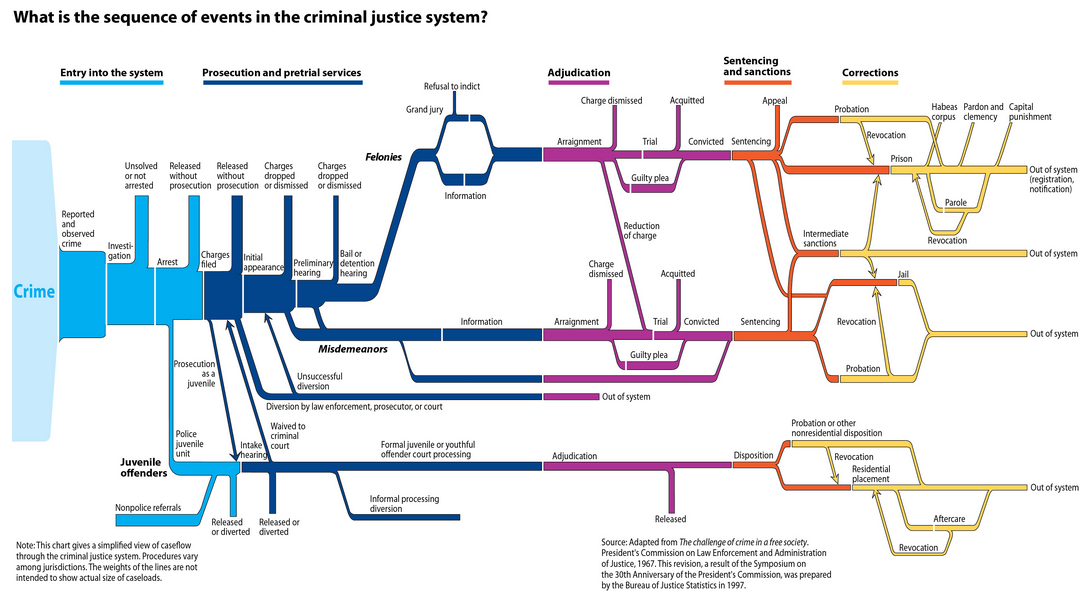
The chart is designed to give you a sense of the vastness and complexity of the criminal justice and the many places that cases "leak" out of the system, but, as the chart itself indicates, it is not to scale. For example, as this table shows, of the 79,704 criminal cases resolved in federal court in the year studied, 71,550 pled guilty, while only 1,879 trials were held. Thus, though we will pay a fair amount of attention to criminal trials, jury instructions, and appeals, it is important to remember that nearly all criminal cases are resolved without a trial.
1.2.3 Crime and Imprisonment Data 1.2.3 Crime and Imprisonment Data
The American criminal justice system is unique in both its scope and its organization. Before we start discussing what conduct is criminal (or whether particular conduct should be criminal) it is important to understand exactly what the criminal justice system is.
The Prison Policy Project does an excellent job of both describing the scope of the criminal justice system and breaking it down into its component parts. Please familiarize yourself with how many people are currently incarcerated, where, and for what. We will refer to this information throughout the semester.
Crime is a harder thing to measure than incarceration. While the country can know, with some certainty, how many people are incarcerated or otherwised involved with the criminal justice system, measuring the extent of crime in this country is essentially impossible. Not all crime is reported to the police, not all crime is investigated by law enforcement, not all law enforcement agencies report crime totals for compilation. Until 2019, the best source for crime data was the Uniform Crime Reports published each year by the FBI. Unfortunately, that record is no longer kept. The closest measure today is the FBI's Crime Data Explorer.
1.2.4 Questions Based on the Crime and Justice Statistics 1.2.4 Questions Based on the Crime and Justice Statistics
After reading about America's use of the criminal justice system, how would you objectively explain that system to someone unfamiliar with it? What are some of its principal characteristics? What should people know about the criminal justice system that would help them evaluate arguments regarding the fairness of the system?
Did you feel like the authors of the Prison Policy Initiative provided an unbiased description of the criminal justice system? Of the myths regarding the criminal justice system that the authors identified, were there any that surprised you? Did thinking about who is in prison and jail in the United States change your thinking about crime and punishment?
How should we evaluate the fairness of the criminal justice system? Is it enough to look at its size and scope and conclude that the criminal justice system in the United States is overused? What would we need to know about the relationship between crime rates and imprisonment to help us evaluate the "right" amount of punishment in our society? Why is it important to have valid and reliable measures of crime commission? Are there downsides to relying too heavily on such data?
1.3 Colorado Model Jury Instructions 1.3 Colorado Model Jury Instructions
Although this course is designed to give you an overview of how criminal law works in the United States, we will often use Colorado law as an illustrative example. Below are the model jury instructions for some familiar (and unfamiliar) crimes. The idea is to give you some familiarity with how crimes are explained to lay juries; later in the semester we will go into far greater depth on a number of these crimes as well as others. For now, the point is not to master (or even memorize) the elements of these offenses, but rather to get used to reading statutes and understanding what they do (and do not) prohibit.
1.3.1 Criminal Law Is Statutory Interpretation 1.3.1 Criminal Law Is Statutory Interpretation
Criminal law is fundamentally about reading and applying statutes. Unlike your other first year classes, criminal law is almost entirely statutory in nature – if the legislature has not prohibited particular conduct, it is generally not criminal.
This has not always been the case. Traditionally, criminal law was what courts said it was. The idea of common law crimes – crimes defined by court decisions rather than legislatures – was widespread in England for centuries. After American independence, many states formally adopted English common law, including its definition of common law crimes.
As time went on, however, states began to codify the definitions of various crimes and nearly all abolished the idea that courts could create new crimes. Today, it is largely presumed that unless the legislature has expressly prohibited the defendant’s conduct, he cannot be convicted of a crime; the courts will punish that conduct, and only that conduct, that the legislature has chosen to prohibit.
This move to statutory definition of crimes is an example of what is known as the principle of legality – that crimes must be clearly laid out before they may be enforced. Often expressed in Latin as nulla poena sine lege, the idea that there can be no punishment without law is often perceived as one of the cornerstones of a just legal system. But ask yourself whether the requirement of a statutory definition of crimes is either a necessary or a sufficient condition for fairness. Would it be unfair to punish an individual for murder in the absence of a statute expressly prohibiting the unlawful killing of another human being with malice aforethought? Conversely, would it be fair to punish an individual for unknowingly possessing a prohibited substance simply because, unbeknownst to the defendant, the substance is included on a list of banned substances in an obscure piece of legislation? Does the publication of that law and that list protect the defendant from the arbitrary imposition of criminal sanction?
In this course we will look carefully at a number of criminal statutes and at the instructions that are given to juries trying defendants accused of violating those statutes. The legislatures write the criminal code and the state judiciary determines how to explain these statutes to lay juries in a way that will be comprehensible to them and consistent with the legislature’s intent. Ultimately, however, the legislature is in charge of the meaning of its statutes and, if it disagrees with how the judiciary has interpreted its statutes, it may override that reading by making its true intent clear and amending the law.
As you read through these statutes, you may be surprised how they differ from your previous understanding of certain crimes. For example, television and movies have trained us to think of burglary as theft from a home. Is that what is prohibited by the Colorado burglary statute? Note that it is the entry (with the intent to commit a felony) that is prohibited by the Colorado burglary statute, rather than any actual taking of property. This is a reminder that we must read statutes carefully and put aside our prior conceptions of what a particular crime is or should be.
1.3.2 Burglary 1.3.2 Burglary
4-2:03 SECOND DEGREE BURGLARY
The elements of the crime of second degree burglary are:
- That the defendant,
- in the State of Colorado, at or about the date and place charged,
- knowingly,
- broke an entrance into, entered unlawfully in, or remained unlawfully after a lawful or unlawful entry in,
- a building or occupied structure,
- with intent to commit therein the crime[s] of [insert name(s) of offense(s)] against another person or property.
1.3.3 Robbery 1.3.3 Robbery
4-3:01 ROBBERY
The elements of the crime of robbery are:
- That the defendant,
- in the State of Colorado, at or about the date and place charged,
- knowingly,
- took anything of value,
- from the person or presence of another,
- by the use of force, threats, or intimidation.
1.3.4 Murder 1.3.4 Murder
3-1:01 MURDER IN THE FIRST DEGREE (AFTER DELIBERATION)
The elements of the crime of murder in the first degree (after deliberation) are:
- That the defendant,
- in the State of Colorado, at or about the date and place charged,
- after deliberation, and
- with the intent,
- to cause the death of a person other than himself [herself],
- caused the death of that person or of another person.
1.3.5 Unlawful Display of a Flag 1.3.5 Unlawful Display of a Flag
11:08 UNLAWFUL FLAG DISPLAY
The elements of the crime of unlawful flag display are:
- That the defendant,
- in the State of Colorado, at or about the date and place charged,
- displayed any flag other than the flag of the United States of America or the state of Colorado or any of its subdivisions, agencies, or institutions,
- on a permanent flagstaff located on a state, county, municipal, or other public building or on its grounds within this state.
1.3.6 Hypotheticals Based on the Jury Instructions 1.3.6 Hypotheticals Based on the Jury Instructions
For each of the following hypotheticals, consider whether, in the state of Colorado, a defendant could be convicted under the relevant statute based on the conduct described. Don't think about whether the conduct is, or should be, prohibitted by some law; consider only whether the defendant described is guilty under the statute provided.
Burglary
1. D breaks into Kamin’s vacant mountain cabin to avoid freezing to death in a snowstorm.
2. Same as 1 except the next morning he takes a power bar from the kitchen cabinet for the trek to safety.
3. D, an invited dinner guest at Kamin’s home, chooses to steal medicine from the medicine cabinet while in the bathroom.
4. D, an invited dinner guest at Kamin’s house, accepts the invitation in order to steal something. At the dinner, he does so.
5. D believes that Kamin gave the whole class the opportunity to visit his house while he was out of town. Kamin did not. D decides that he will go to Kamin’s house and will steal something of Kamin’s as a keepsake. He does so.
Robbery
1. D, a talented pickpocket, relieves Kamin of his wallet without Kamin’s knowledge.
2. D asks Kamin for his wallet and Kamin, afraid, gives it to him.
3. D calls Kamin and tells him that there is a bomb in Kamin’s house which will go off unless Kamin gives her his bank account info over the phone. Kamin does so to spare his life and D then removes funds from Kamin’s account.
4. D points a gun at Kamin and takes from him what she believes to be a useless bauble of no value. It is, however, a very valuable family heirloom.
First Degree Murder
1. D, frustrated with her grade in Kamin’s class, confronts him in the hall and bumps into him, causing him to fall over backward to his death.
2. D, frustrated with her grade in Kamin’s class, confronts him in the hall after class and, when Kamin refuses to change the grade, pulls a pistol from her pocket and shoots him once, killing him.
3. D, frustrated with her grade in Kamin’s class, confronts him in the hall after class and, when Kamin refuses to change the grade, pulls a pistol from her pocket intending to hurt Kamin with it. Her aim is poor, however, and she shoots Kamin fatally.
4. D, frustrated with her grade in Kamin’s class, plants a bomb in Kamin’s classroom. However the bomb fails to go off on time and instead of killing Kamin it kills Katz.
Unlawful display of a flag
1. D, a Black Lives Matter protestor, pulls down the Colorado flag from the capitol and flies a BLM flag in its place.
2. D, a BLM protestor, brings a BLM flag with her to a protest at the capitol and proudly displays it on the steps of the capitol.
3. Does it matter in 1&2 whether D knew of this law?